Yamuna River

Yamuna Basin Storm Water Drain No 8 now Effluents Disposal Drain

(Feature Image: DN 8 full of untreated effluents near GTK road on May 13, 2023. Bhim Singh Rawat)

In the past, the Storm Water Drains (SWD) used to be seasonal streams feeding Yamuna river in upper segment of Haryana. After introduction of canal based irrigation system, most of the SWDs dissected by Western Yamuna Canal (WYC) networks have been converted into flood escape channels.

In recent decades, many of these SWDs have been degraded into waste water disposal drains. The Dhanaura escape in Karnal, Drain Number (DN) 2 in Panipat and DN 6 in Sonepat districts of Haryana state are glaring example of the deliberate abuse.

Continue reading “Yamuna Basin Storm Water Drain No 8 now Effluents Disposal Drain”
DRP News Bulletin

DRP 150523: Will the govt listen to caveats against Ken Betwa Project?

The following report raises three caveats regarding Ken Betwa River Link Project, among others. Firstly it urges that the substantial impact of climate change on the rivers needs to be taken into account, particularly the need for accurate hydrological assessment. It underlines that the project themselves are accelerating the climate change impact on monsoons as they are reducing freshwater flows to the oceans, which in turn has an impact on the ocean’s thermal and salinity gradients, both of which are drivers of monsoon.

Secondly, it rightly says that the impact of projects on adaptive capacity of areas like Bundelkhand needs to be taken into account. In Bundelkhand, climate adaptation can be harnessed using rain water harvesting, rejuvenation of traditional water systems, less water intensive crops and alternative agricultural practices. Thirdly, the water sharing issues that may worsen with both climate change and big projects, need to be kept in mind while taking up mega projects, particularly its impact on water and other security issues.

Continue reading “DRP 150523: Will the govt listen to caveats against Ken Betwa Project?”
Dam floods

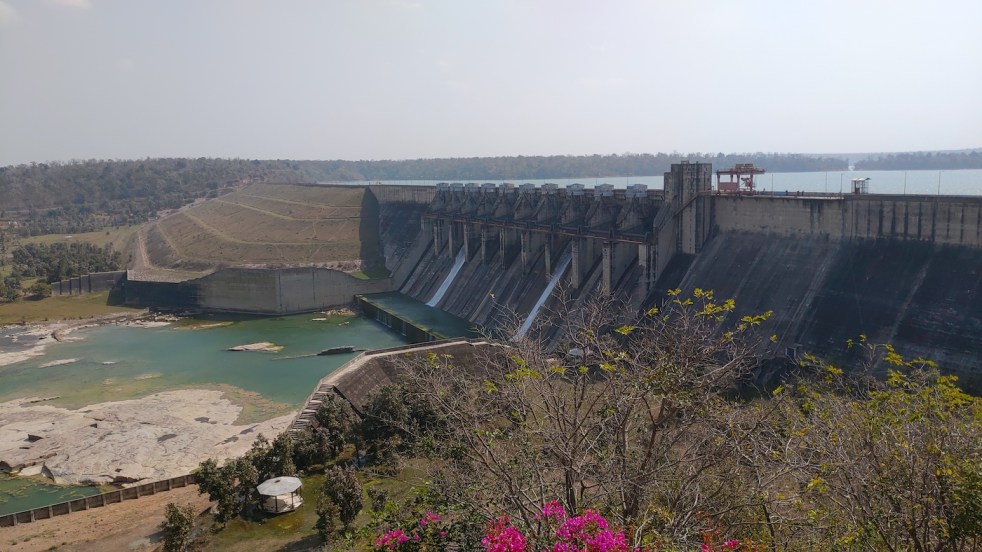
Role of dams: 2021 Flood Management In MP’s Sindh River

Guest Article by: Aishani Goswami and Rahul Singh

Walking through Dhimarpura village, in Seondha block, Datia district, Madhya Pradesh, heaps of broken clay tiles, wooden logs and other construction materials could be seen. Temporary tent-like shelters made of plastic sheets were erected in place of the houses that fell due to the floods in River Sindh in 2021.

In this article we try and put together available information to understand the role played by the Madhikheda system of dams in worsening the flood disaster in Sindh River basin in first week of August 2021. It may be noted that whenever a dam proposed, one of the claimed benefits is that the dams can help moderate floods in the downstream area. This is indeed true, provided, the dam is operated with the objective. However, when the dam is not operated with that objective, then the dam can actually end up acting like a force multiplier for the flooded downstream areas. Let us see if Madhikheda dam played that role in August 2021.

Continue reading “Role of dams: 2021 Flood Management In MP’s Sindh River”
DRP News Bulletin

DRP 080523: Pune citizens Oppose River Front Development Project

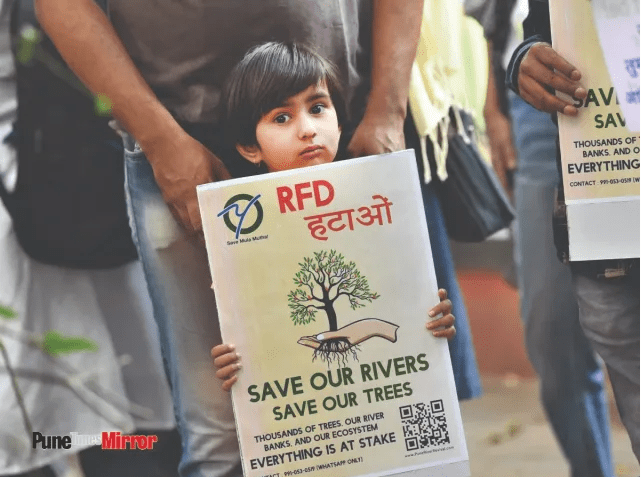
(Feature Image: On April 29, thousands of Pune citizens join Chipko Andolan against the planned cutting of over 7,000 trees for the Mula Mutha Riverfront Development (RFD) project. Image Credit: Rahul Deshmukh, Source: Pune Mirror.)

It is heartening to see thousands of Pune citizens out on the streets over the last two weeks protesting against felling of thousands of trees for the destructive Mula Mutha River Front Development Project. The project will destroy the best biodiversity habitat along the rivers in Pune, fell thousands of trees, encroach on riverbeds and floodplains, destroy bird migration corridor, and create fresh flood hazards for the city, which will further worsen in changing climate.

We hope this protests continue and intensify till the Pune Municipal Corporation and the Maharashtra government wakes up and scraps the project and instead, uses the scarce available resources for protecting and rejuvenating the water bodies and biodiversity in Pune in collaboration with the people of Pune.

Continue reading “DRP 080523: Pune citizens Oppose River Front Development Project”
Gangetic Dolphins

India Lost 10 More Gangetic River Dolphins In One Year in 2022-23

(Feature Image: Post mortem being done of a dolphin carcass found at gate number 01 of Girija barrage in Bahraich, UP. Image Source: Dainik Bhaskar, Nov. 2022)

May 18, 2023, would mark 13 year of declaration of Gangetic dolphin as a national aquatic animal. However, the habitats of this ‘highly endangered’ species continue to suffer anthropogenic threats including wrong operations of dams & barrages, inland waterways projects, decreasing flows & increasing pollution in rivers, sand mining and poaching etc. in India. As a result, there are frequent incidents of mysterious and unnatural deaths of these fresh water mammals.

SANDRP has been tracking such incidents since January 2020 and our previous two reports published in January 2021 & April 2022 on the subject have complied deaths of at least 21 Gangetic dolphins in 2 years (2020 and 2021). In continuation of the same, this account covers the incidents of deaths of Gangetic river dolphins during past one year.

Continue reading “India Lost 10 More Gangetic River Dolphins In One Year in 2022-23”
DRP News Bulletin

DRP 010523: Water bodies census welcome, but how reliable?

While the publication by the Union Jal Shakti Ministry of the first water body census of India is not only welcome but urgently required, the usefulness of the census findings will depend on the quality of the information in the report. Firstly, such a census should have been conducted in a bottom up way, starting from villages in rural areas and ward in urban areas. That way, the census findings would have not only been more reliable, but also the process would have helped create greater awareness about the water bodies and issues surrounding them.

In case of Karnataka, as the report below shows the survey by the Tank Conservation and Development Authority and Karnataka Public Land Corporation in 2021 showed the state had 40483 water bodies, whereas the Jal Shakti Ministry census of 2022 says the state has just 26994 water bodies, a huge 13489 less than the 2021 census. Clearly so many water bodies cannot disappear in a year. As some experts from Karnataka have asked, is the Jal Shakti Census a deliberate attempt to show that a much lower number of water bodies exist, allowing encroachers to go ahead to destroy water bodies not registered in the census?

Continue reading “DRP 010523: Water bodies census welcome, but how reliable?”
Fish, Fisheries, Fisherfolk · Rivers · Teesta

Changing Course: Teesta Mahananda Rivers in North Bengal

Guest Article: Steve Lockett, Mahseer Trust

(Above: Teesta-Mahananda Link Canal, part of a water-use strategy that seems broken. Copyright: Adrian Pinder, Mahseer Trust)

Rivers change course, it is part of their being. A river changing course can bring unexpected or unwanted ramifications. Sometimes they can be quite devastating. But when they come as a result of deliberate actions to alter the river’s course how can we expect people, whole communities or wildlife to cope?

Continue reading “Changing Course: Teesta Mahananda Rivers in North Bengal”
Dam floods · Dams

April 2023: Breach in Micro Hydel Canal Damages crops in Punjab

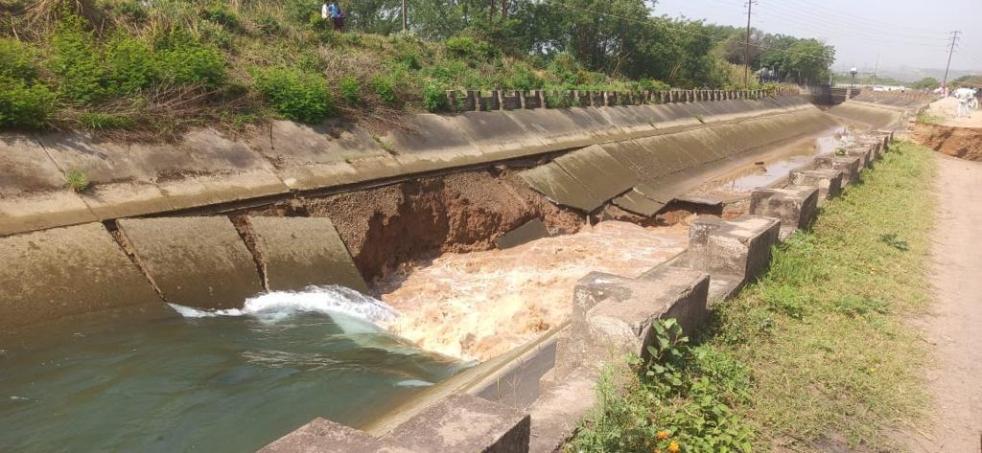
(Feature Image: Breach in GGSSTP micro hydel canal on April 26, 2023. Image by The Tribune)

A sudden breach in a micro hydel canal of Guru Gobind Singh Super Thermal Plant (GGSSTP) has damaged standing wheat crops on hundreds of acres of land in Ranjitpura village of Ropar district, Punjab. The breached occurred near Batarla around 08:00 am on April 24, 2023. 

Continue reading “April 2023: Breach in Micro Hydel Canal Damages crops in Punjab”
DRP News Bulletin

DRP 240423: The world is moving away from Big Dams: Are we?

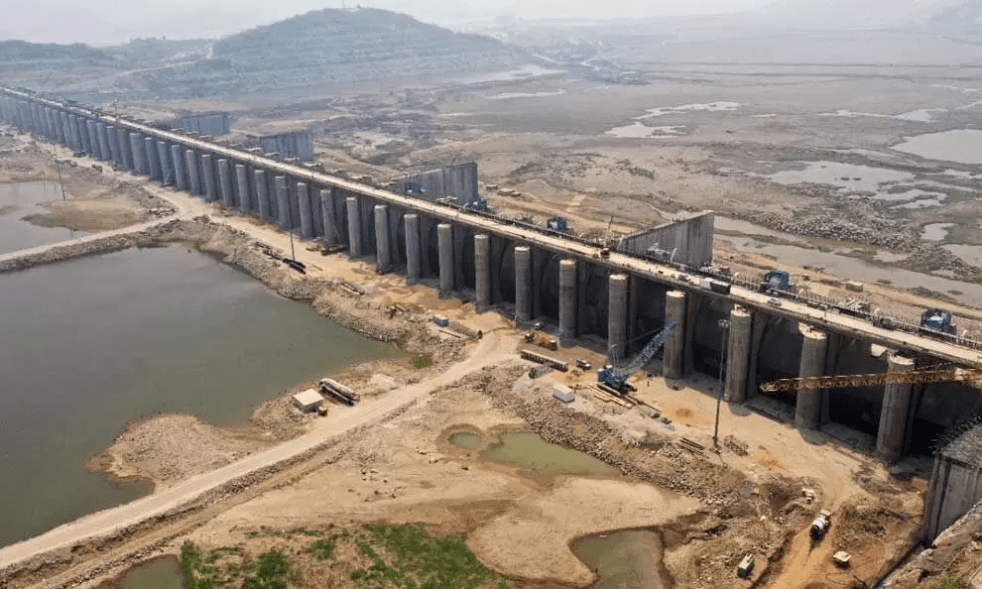
(Feature Image: Construction works going on at Polavaram Dam site. Source: The Hans Media, May 2021)

This well substantiated report from Yale School of Environment this week shows that the end of the big dam era is approaching. The well argued report from Jacques Leslie uses the reports from UN University, International Renewable Energy Agency, Oxford University, Inclusive Development International, China, among others to show how the pace of construction of dams and hydropower projects and also pace of financing such projects have hugely reduced in recent years and decades.

Even the International Hydropower Association, sensing the change, is now advocating pump storage hydro rather than conventional hydro and that too off stream version, to complement the power from solar and wind. Emerging economics with rising cost of hydropower projects and rising cost of power from such projects compared to solar, wind (onshore and offshore) are a major reason for the massively slowing pace of new hydropower projects.

Continue reading “DRP 240423: The world is moving away from Big Dams: Are we?”
Sand Mining

Uttar Pradesh: Ken River ravaged by Illegal Sand Miners in Banda

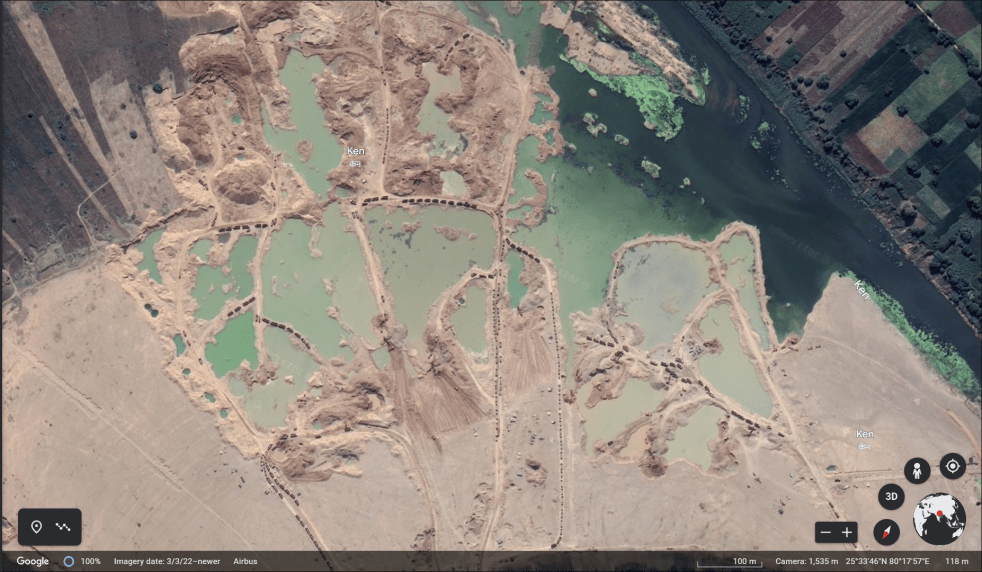
(Feature Image: March 2022 Google Earth image showing excessive mechanized mining in Ken river at Chatkan meander in Banda)

Ken river one of the important tributaries of Yamuna in lower segment has been witnessing industrial scale riverbed mining in Banda district of Uttar Pradesh. The Sentinel Hub satellite images reveal the mechanized mining of morrum (light orange colour sand) has been going on unabated at multiple locations in the district. Recent local media reports have also highlighted the illegalities and violations of the rules by the miners.

The information on Directorate of Mining & Geology website shows that there are 50 sand mine sites in Banda district of which 36 sites are closed. The complete list of 50 closed and active sand mine sites in Banda can be seen here.

Continue reading “Uttar Pradesh: Ken River ravaged by Illegal Sand Miners in Banda”