Mumbai · Narmada · Western Ghats

Crisis in India’s Urban Water Sector

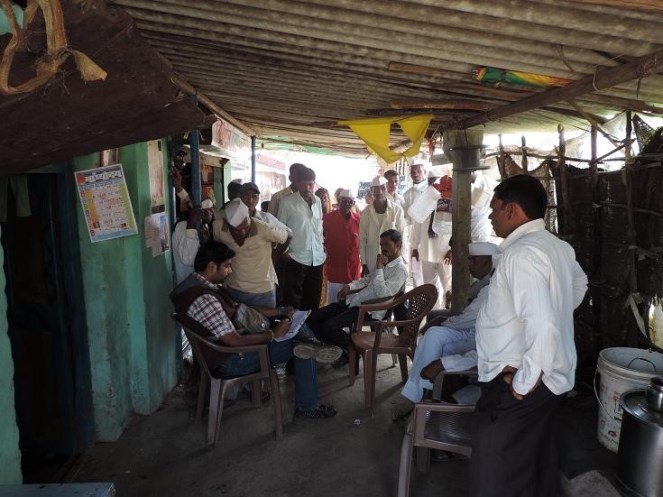
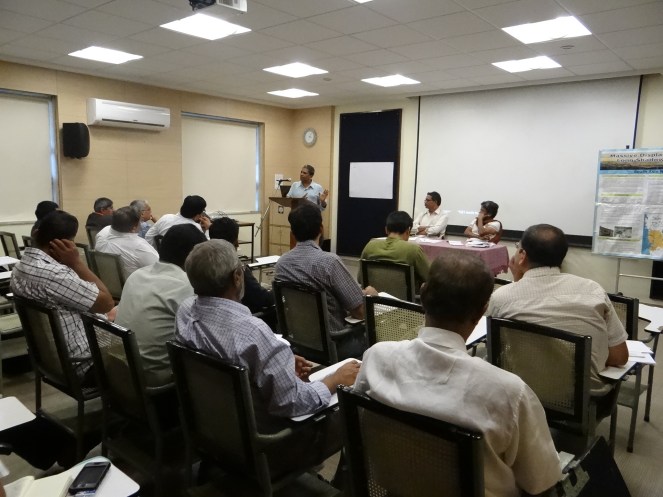
More than 50 people including tribal groups, social activists, water experts, ecologists and wildlife experts, academics came together for a brainstorming workshop about Dams coming up for Mumbai Region. The meeting was organized by South Asia Network on Dams, Rivers and People, Shramik Mukti Sangathana, and Jalbiradari.

Meeting on Dams round Mumbai Photo: SANDRP
Seetaram Shelar of YUVA at Meeting on Dams round Mumbai Photo: SANDRP

About 12 dams are planned or are under construction to satisfy the increasing thirst of the Mumbai Metropolitan Region (MMR). All of these dams fall in eco-sensitive region of the Western Ghats. They will together submerge more than 22,000 hectares of land, including nearly 7000 hectares of forests, lakhs of trees and more than 750 hectares of Tansa Sanctuary. They will affect a minimum of 100,000 tribals who depend on the forests and their ancestral lands for livelihoods. These dams include Kalu, Shai, Balganga, Susari, Khargihill, Bhugad, Pinjal, Gargai, Middle Vaitarna, Barvi and Poshir, among others. These are in addition to the dams already constructed for MMR water supply.

Tribals and other affected groups of Thane and Raigad region have been strongly opposing these projects. Most people in Mumbai seem unaware of their struggles or impacts of these projects.

Most of these dams are escaping the social and environmental impact assessments and management plans, environment clearance requirements, environmental monitoring or public consultations due to blunders in environmental impact assessment notification of Sept 2006, which excludes domestic and industrial water supply projects from environmental clearance process. It signifies the environmental illiteracy of the officials and ministers at the Union Ministry of Environment and Forests. In spite of repeated letters, and acknowledging that this makes no sense, they have refused to change it.

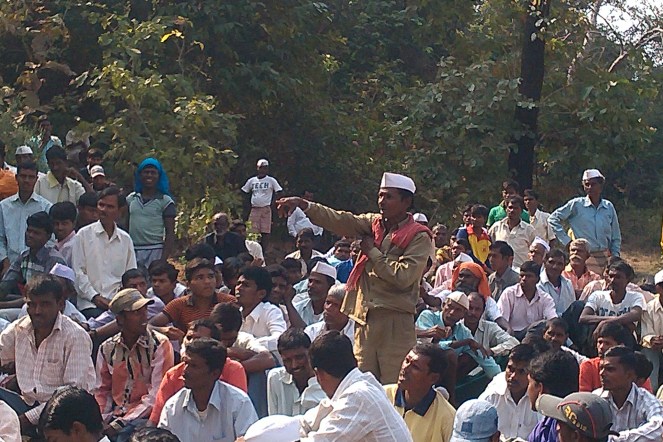
Local protest against Pinjal Dam near Jawhar which can submereg 11 villages and 2000 hectares fo forests Photo: SANDRP
Local protest against Pinjal Dam near Jawhar which can submereg 11 villages and 2000 hectares of forests Photo: SANDRP

MMR has not done any sort of options assessment before pushing these projects and cursory review show that many options exist. At the city or Region level, there is no shortfall in water supply currently and the existing problems are due to inequitable, non-transparent, non-participatory and wasteful water governance in MMR. Municipal corporations under the MMR which are pushing new dams do not treat even 15% of their sewage. Bhiwandi Nizampur & Vasai Virar Corp do not treat ANY of their sewage. The Mumbai Region has no estimate of its rainwater harvesting potential, and there is little effective action in this direction despite high rainfall. Water supply and distribution losses are over 30%. Local water sources like rivers, lakes and wells are being destroyed by pollution and encroachments. There is no interest in democratizing governance of MMR water sector.

The meeting resolution urged the MMR region to address these issues first, which would lead to sustainable water supply to the city and suburbs. Konkan Irrigation Department which is constructing most of these projects has violated several laws related to tribal and forest rights, environment, forests and resettlement and has been mostly favoring a single contractor, illegally.

The meeting also strongly urged the MMRDA, MCGM, Municipal Corporations of MMR, Maharashtra government, Union Ministry of environment and forests, Maharashtra Forest Department, National Board of Wildlife and all others concerned to ensure that following steps are taken up urgently and in a credible way:

Þ     Undertake thorough options assessment for Mumbai’s (and also for other cities of MMR) water needs which includes groundwater recharge and sustainable use, protect and use local water sources, rainwater harvesting, sewage treatment and reuse, plug leakages, improve water supply efficiency, take up systematic demand side management measures etc.;

Þ     Undertake Environmental and Social impact assessments for all the dams coming up for Mumbai Region;

Þ     Take immediate action against KIDC for violating multiple laws while bulldozing ahead with projects and MMRDA for funding projects in the absence of clearances;

Þ     Respect people’s protests and Gram Sabha resolutions against displacement, deforestation and their refusal to give permission for these projects;

Þ     Take strong penal action against the officers and the contractors who have displaced Adivasis illegally;

Þ     Not resume any work or planning for any project before the above is done, stop work on projects in the meantime;

Þ     Change the EIA notification to ensure that all large dams are included for environment clearance, public hearings and EIA requirements;

Þ     Immediately institute a credible Cumulative Impact Assessment of the projects already constructed and advanced in implementation;

Þ     Institutionalize decentralized, democratic governance of water sector in MMR from bottom to top.

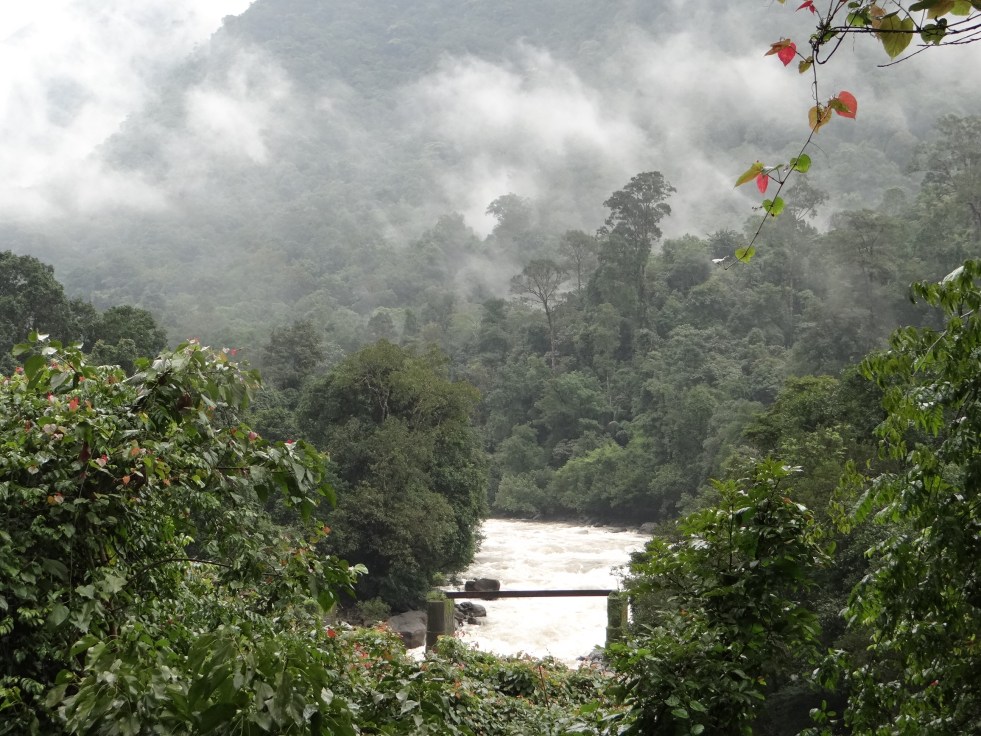
Forests in the Western Ghats are Mumbai’s and MMR’s lungs. They are the watersheds of rivers and water sources like Tansa and Bhatsa and naturally purify Mumbai’s & MMR’s drinking water. Rich tribal culture of Thane and Raigad is a shared heritage of Mumbai and we have no right to displace the tribals or destroy their livelihoods. This destruction in Mumbai’s backyard must be stopped.

Submergence of Gargai Dam Photo: SANDRP

However, Mumbai and MMR are not the only urban areas guilty of destroying the environment, forests, biodiversity and livelihoods of lakhs of poor people. Delhi, already having more per capita water than European cities like Paris, Amsterdam or Bonn, is asking for Renuka, Lakhwar and Kishau dams in upstream Yamuna basin, while destroying the YamunaRiver for all downstream areas. Ahmedabad is using water from the Sardar Sarovar Narmada dam that was meant for the people of Kutch and Saurashtra and which has led to displacement of over two lakh people. Jaipur is taking water from Bisalpur dam. Farmers for whom it was made are not getting the water and some lost their lives in police firing, while demanding that water. Massive diversion of Nethrawathi water is proposed for Bangalore and other areas, destroying the pristine Western Ghats forests. 3 farmers died in police firing near Pune when a huge farmers rally was protesting against diversion of water from Pawna Dam to the Corporation of Pimpri-Chinchwad.

Headwaters of Netravathi and Gundia threatened by Yettinahole Diversion Photo: Parineeta Dandekar, SANDRP

As Planning Commission member Dr Mihir Shah recently wrote, the 12th Five Year Plan proposes paradigm shift in Urban sector sector: “Each city must consider, as the first source of supply, its local waterbodies. Therefore, cities must only get funds for water projects, when they have accounted for the water supply from local waterbodies and have protected these waterbodies and their catchments. This precondition will force protection and build the infrastructure, which will supply locally and then take back sewage also locally.”

The trouble with this urban water sector reform agenda is that close to two years into the 12th Plan, we still do not see it being implemented anywhere. We do not see any roadmap for its implementation. And yet the UPA government continues to fund solutions catering to only long distance supply-side measures like big dam projects for urban areas under the Jawaharlal Nehru National Urban Renewal Mission. In fact, of the first Rs 60 000 crores sanctioned for JNNURM, about 70% was for urban water sector, but do we see any progress in democratisation or even improvement of Urban Water Governance?

The hope lies with clean, transparent and participatory governance. Let us hope we see some change in this direction.

Himanshu Thakkar (ht.sandrp@gmail.com), Parineeta Dandekar (parineeta.dandekar@gmail.com), SANDRP

A slightly edited version of this has appeared in Civil Society http://www.civilsocietyonline.com/pages/Details.aspx?480

Maharashtra · Mumbai · Western Ghats

Pathetic state of rehabilitation at the “State-of-the-Art” Middle Vaitarna Dam

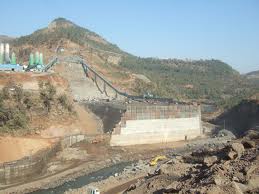
Middle Vaitarna Dam across the west flowing Vaitarna River near Mumbai is supposed to be a state-of-the-art technological feat. It’s a 102 meters tall concrete dam, the second tallest in Maharashtra. It was built with an what is claimed to be innovative mix of cement and fly ash from Eklahere Thermal Power Plant. The dam is also claimed to be completed in a record time. Additional Commissioner, Municipal Corporation of Greater Mumbai (MCGM), Mr. Jalota claims that Middle Vaitarna was completed in 15.5 months out of the total project duration of 42 months.  This speed is supposed to be ninth fastest globally for RCC Dams[i].

Middle Vaitarna Project Photo with thanks from mmmhydropower.blogspot.com

The project was partly funded by the Jawarharlal Nehru National Urban Renewal Mission (JNNURM). When fully functional, the dam will be supplying 455 MLD (Million Liters per Day) water to MCGM (Municipal Corporation of Greater Mumbai), one of the biggest Municipal Corporations of the world.

So many exceptional performances claimed for one dam!

One would expect the similar concern for efficiency and speed while dealing with rehabilitation and resettlement of project affected population.

The project submerged over 3473 hectares of land (8581 acres land) including over 634 hectares forests (1566 acres forest). It also affected about 8 villages and several adivasi padas in the region. Of these, only 35 families who lost their homes were rehabilitated in a colony near the project site of Kochale village.

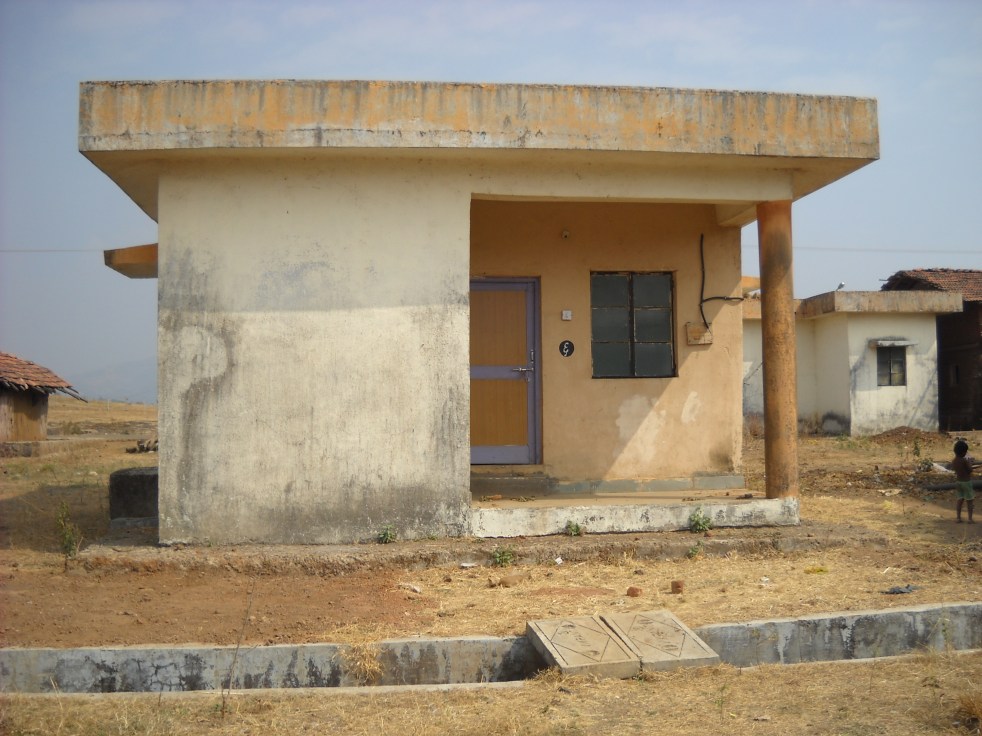
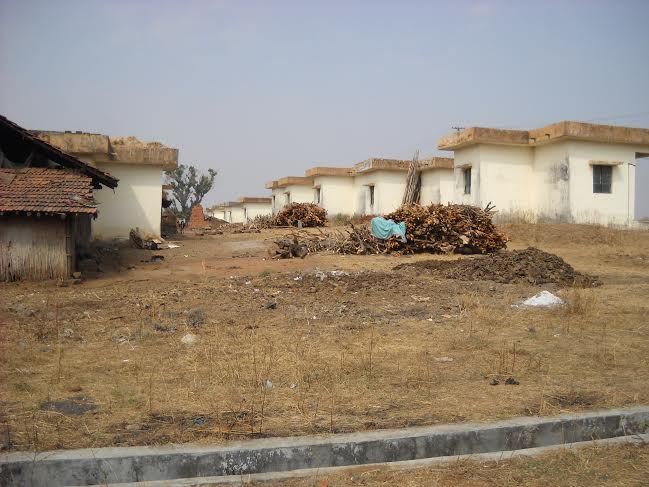
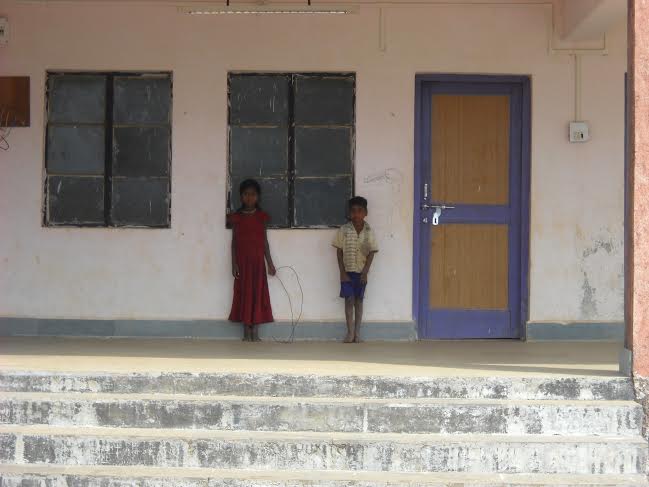
A visit to the rehabilitation colony in 2012 and in January 2014 where the project affected families moved in last year reveals:

Extremely poor construction quality. Just one year after families moved in, roofs of one of the houses collapsed. Human injury was narrowly avoided.

Resettlement Colony of the Middle Vaitarna Dam. Photo: Amit Tillu

Almost all of the homes are chronically leaking.

There is no drinking water supply to this colony. The main supply tank does not get water. So no taps are working.

Middle Vaitarna Colony Photo: Amit Tillu
  • There is no water in the toilets. Site-in-charge and contractor orders a tanker when they feel like.
  • Common electric connections are defunct: Contractor took away the meters. No electricity at Hospital, Temple and Community Hall.
  • No Doctor has been appointed at the hospital. It’s an empty building.
Middle Vaitarna resettlement colony Photo: Amit Tillu

Completely disillusioned by these houses, many affected people have built separate mud and thatch houses next to the ‘Sarkari’ homes.

Middle Vaitarna Resettlement Colony Photo: Amit Tillu

What is the state of other Project affected people?

The affected people from Kochale, Karegaon, Vihigaon have received paltry compensation sums at Rs. 28000 per hectare for cultivated land. This is much lower than per hectare compensation given to the Forest Department for trees lost.

Smr Sangeeta Vare from Kochale village, struggling to get a project affected certificate Photo: Parineeta Dandekar
Smt. Sangeeta Vare from Kochale village, struggling to get a project affected certificate Photo: Parineeta Dandekar

Project affected were told that one member from each affected family will get a government job. Land acquisition for Middle Vaitarna has been done under the article 52 A of the Maharashtra Land Acquisition Act, which includes provisions for ‘Urgent’ land acquisition. Special Land Acquisition officer promised that action will be taken about securing some jobs. After a long follow up, none of the project affected have received jobs. Requests for recommendations for temporary jobs at the dam site have also been denied.

Regarding “Project Affected” Certificate (Government Resolution 21 Jan 1980):  According to the Maharashtra Project Affected Persons Rehabilitation Act 1999, it is the duty of the Collector “to issue a certificate to a person who is nominated by the project affected person for being employed against the quota reserved for the nominees of the affected persons”.

None of the PAs from Middle Vaitarna have received these Certificates, even after repeated and expensive follow up with a number of agencies.

When they contacted the Tahasildar, they were given a list of 12 documents that they have to compile in order to get this Certificate.

These documents include certificates from 4 other officials.

Considering the fact that all the Project affected persons of Middle Vaitarna Project are financially vulnerable tribals, with minimum education and considering that this small number of population is bearing the brunt of displacement and loss of livelihood for a mega city, they could have been helped with in this task.

In the case of Bhatsa Dam near Middle Vaitarna, the same conditions prevails for over 35 years. Project affected have not received full compensation, have not been given project affected certificates or any jobs.

The state of rehabilitation and resettlement for the claimed state of art dam seems dismal to say the least. More than 12 dams are coming up around Mumbai Metropolitan Region for drinking water supply. These will together affect more than one lakh tribals and over 7000 hectares of forest.

(https://sandrp.wordpress.com/2013/12/20/dams-in-tribal-areas-of-western-ghats-for-water-supply-to-mumbai-why-are-they-unjustified/)

Rehabilitation and resettlement at Middle Vaitarna is a sign of how these issues will be treated in these dams. We hope this is proved wrong.

– Parineeta Dandekar (parineeta.dandekar@gmail.com) and Amit Tillu (amittillu@gmail.com), Nashik

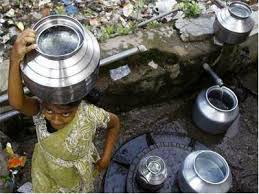
Women fetching water from far off sources even as Middle Vaitarna is close by. Photo: Parineeta Dandekar
Ministry of Environment and Forests · Western Ghats

Open Letter to Dr. Veerappa Moily as he supports foundation stone laying of Yettinahole Diversion Project

 January 30, 2014

To,

Dr. M. Veerappa Moily

Union Minister of Environment and Forests

Paryavaran Bhawan, CGO Complex, Lodhi Road,

New Delhi 110 003

vmoily@kar.nic.in

Subject: Issues about the laying of Yettinahole Diversion Project’s foundation Stone

Respected Dr. Moily,

We learnt about your announcement and support for laying the foundation stone of the controversial Yettinahole Diversion Project on January 31, 2014 in your parliamentary constituency of Chikkaballapur, from several media reports[i]. The project has not conducted any impact assessment study and does not have any statutory clearance from your ministry. This is in complete violation of several norms and laws and is shocking, to say the least.

Dr. Moily, our assessments based on local interactions, site visits, study of the Project report (the DPR for the project is still not ready) indicate that the project involves eight dams inside the Western Ghats, deforestation of more than 100 ha of forests inside the Western Ghats eco-sensitive region, water diversion without any ecological studies, 370 MW of power for pumping, a canal of 250 kms length, 1200 ha submergence near Devaranyadurga including submergence of 2 villages and 600 ha forest land. [ii]

The foundation stone laying ceremony is supposed to take place on the 31st January 2014 at Muddenahalli, Chikkaballapur, which also happens to be your current constituency.  It is clear why you chose Chikkaballapur to lay the foundation stone, and not Sakaleshpur, from where the water will be diverted, or Dakshin Kannada, which will face most of the impacts of the project. In Sakaleshpur and entire Dakshin Kannada, (which was your constituency in the past) there is a huge and mounting opposition to Yettinahole Diversion and also to your decision.

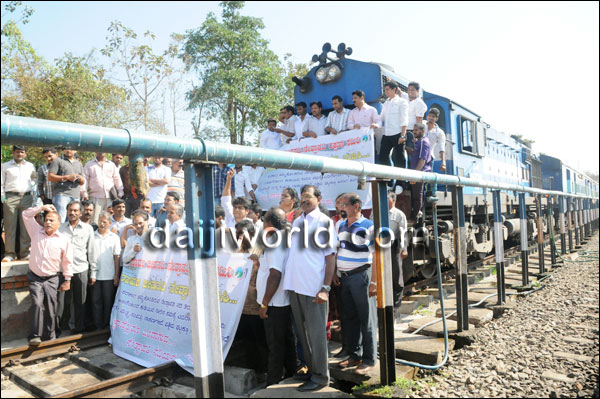
Just in the last two weeks, there have been attempts to a stop train in protest, numerous dharnas, hunger strikes, letters in opposition and a Satyagraha in Netravathi River to oppose this project.[iii]

Rail Roko prtest against Yettinahole Diversion Photo: Daiji World
Rail Roko protest against Yettinahole Diversion Photo: Daiji World

Despite this growing discontent, you, as an MP from Chikkaballapur and the Union Environment Minister, or the Karnataka Government did not feel the need to initiate a dialogue with the people of this region. Has the government learnt no lessons from Delhi as to what happens when local voices are ignored and unheeded?

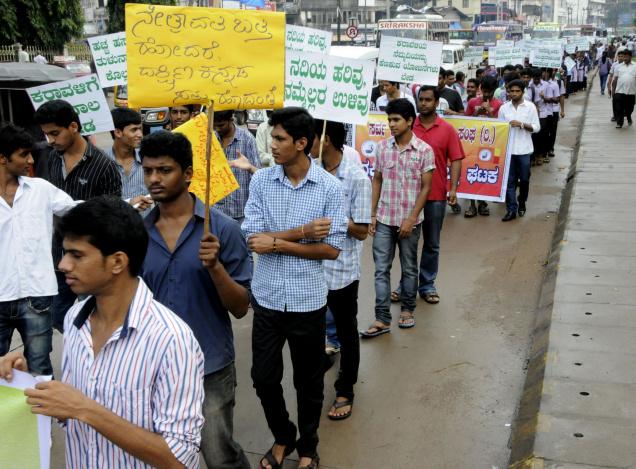
Protest in Hassan (in addition to Dakshin Kannada) against Yettinahole Diversion Photo: The Hindu
Protest in Hassan (in addition to Dakshin Kannada) against Yettinahole Diversion. Photo: The Hindu

Why has the Karnataka Government or the Union Ministry of Environment and Forests, which you now head, not thought it necessary to assess and address the serious ecological impacts of this project? Why have you supported the fraudulent tactics of this project to escape environmental clearance?  Our letter to the Ministry in his regard dated 10 Sept 2013, which was endorsed by several experts remains unanswered till date[iv].

As the  Minister of Environment and Forests, it is your duty to see that projects with significant impacts on ecology and dependent communities are assessed. Why are you escaping that duty?

Why is the Karnataka Government and the MoEF, under you leadership, hiding behind weak technical clauses of the EIA Notification 2006 to claim that the project does not qualify for Environment appraisal?

In fact the EIA Notification 2006 requires that there is thorough appraisal of the project. We have sent you a letter in this regard again on the 28th of January 2014, with scanned pages from the project report proving  this.

How can you support foundation stone laying ceremony when RTI reveals that Forest Department has not even assessed the forest area affected by this project?

How can a Minister of Environment and Forests of India indulge in an illegal act of formal initiation of a project that does not have environmental or forest clearances?

The project will come to the Ministry of Environment and Forests, headed by you, for Forest Clearances. But you have supported the foundation stone for this project already, giving a signal that forest clearance is a foregone conclusion.

If this is not conflict of interest, what is?

And all this for 2.8 TMC drinking water for Kolar and Chikkaballpur Districts. Has the government conducted any studies to prove that project with Rs 100 Billion cost and severe environmental impacts is the least-cost option to get drinking water for Kolar and Chikkaballapur in whose name the project is being pushed?

Dr. Moily, as the Union Environment Minister, it is you duty to address these questions before you support the foundation stone laying of Yettinahole Diversion Project.

Not doing so is in violation of environmental norms and legal stipulations.

We are looking forward to getting a point-wise response from you.

Sincerely,

Parineeta Dandekar, Himanshu Thakkar, SANDRP, Pune and Delhi

Dr. T. V. Ramchandra, Energy and Wetlands Group, Centre for Ecological Sciences, Indian Institute of Science, Bangalore, Karnataka 

Panduranga Hegde,Parisara Samrakshana Samithi, Appiko Movemenr, Sirsi, Karnataka

Dr. Shrinivas Badigere, Water and Irrigation Expert, Bangalore, Karnataka

Dr. Latha Anantha, River Research Center, Kerala

Dr. Rajeev Raghavan, South Asia Co-Chair, IUCN SSC/WI Freshwater Fish Specialist Group
Member, IUCN SSC Red List Committee 

Debi Goenka on behalf of Conservation Action Trust, Mumbai

Shankar Sharma, Power Policy Analyst, Tirthahalli, Karnataka

R. Sreedhar, Managing Trustee, Environics Trust and Chairpserson, Mines , Minerals and People

Vidyadhar Atkore, Fisheries Researcher, Bangalore, Karnataka

Neethi Mahesh, Mahseer Conservancy, Karnataka

Dr. Ashok Kundapur, Udupi, Karnataka

Anand Krishnamurthy, Bangalore, Karnataka

Dr. Nitya Ghotge, Anthra, Pune

Ms. Nyla Coelho on behalf of  Paryavarni, Belgaum, Karnataka

Pratim Roy on behalf of Keystone Foundation, Kotagiri, Tamilnadu

Dr. Archana Godbole, Jayant Sarnaik, AERF, Pune

Dr. K. Amitha Bachan, Western Ghats Hornbill Foundation

Vijay Sambare, Lok Panchayat, Sangamner, Maharashtra

Dr. Bhaskar Acharya, Independent Researcher, Bangalore

Ramesh Gauns, Environmental Activist, Goa

Ramaswamy Selvam for Tamilnadu organic farmers federation, Arachalur,Erode.

Headwaters of Netravathi and Gundia threatened by Yettinahole Diversion Photo: Parineeta Dandekar, SANDRP
Hydropower · Hydropower Performance · Western Ghats

Story of a free-flowing stretch of Kali River in Karnataka

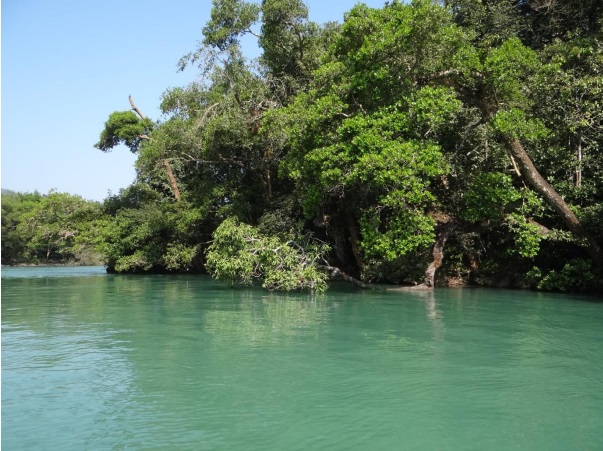
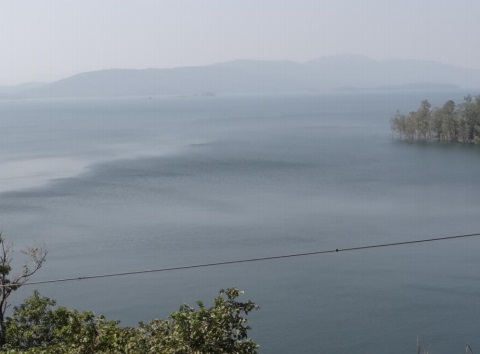
River Kali, before it enters Dandeli in Karnataka is a breathtaking sight..

Its waters are emerald green, flowing steadily. Its banks are thickly forested with a continuous canopy. Endemic species like Malabar Giant Squirrel, Malabar Pied Hornbills, Malabar Gray Hornbills are a common sight here. Down the river, a monitor lizard is stretched across a branch, low over the waters. Fishing eagles and several kinds of Kingfishers look for fish. Fisher folk hover along the banks in beautiful coracles, laying hooks in the riparian vegetation.

During our visit to the Kali, my six-year-old  swam in the river and could not believe that the river back in his home-town was once as clear as this!

Emerald waters of the Kali Photo: Author

It’s hard to imagine that it was a touch-and-go for this stretch of Kali…

If it were not for some brave, timely advocacy and strong local action, most of this stretch would have been submerged. Rest of the river would have been diverted through a tunnel or silenced in a steady pool of a reservoir: the way many Indian rivers are silenced. There would have been no river, no riparian forests and possibly no swimming.

Malabar Pied and Malabar Gray Hornbills on the banks of Kali Photo: Author

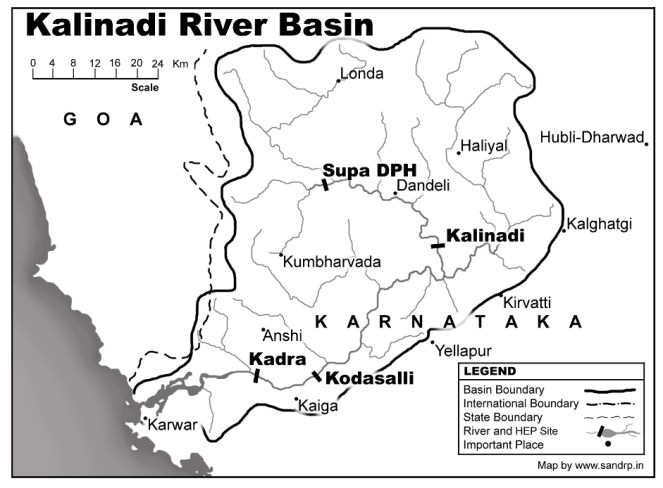
Dams on Kali: Kali has seen far too much damming. According to Kali Bachao Andolan, a network of organizations working to protect Kali River, more than 5 dams across the river have already submerged 32,000 acres of forests in the Western Ghats. According to Karnataka Power Corporation website, “The west flowing Kalinadi has its origin at an elevation of 900 m, near the DiggiVillage in the Western Ghats of Karnataka. Its 180-km long journey ends at the Arabian Sea near Karwar.”

Kalimap1

After its origin, it’s dammed at Supa in Joida Taluk of the Uttara Kannada District. The submergence of Supa Dam is a site to behold. Stretching endlessly like an ocean, this dam submerged more than 24 villages and hundreds of hectares of forests. One of the dam evictees, an old, frail man now tells me, “Even now in summers, when the waters recede, I can see my village and my temple. We try to go there some times. I can see all my past life there, for a brief period, before it all goes under water again”.

Extensive submergence of the Supa Dam Photo: Author

genrationKali

Downstream the 101 m-high Supa Dam (100 MW), the river flows down through Dandeli town, taking huge pollution from West Coast Paper Mills on the way. From here it is dammed at Bomanhalli Pick up Dam, from where it is diverted to Nagazhari Powerhouse (870 MW), then to Kodasalli Dam and powerhouse (120 MW) and then at Kadra Dam and powerhouse (150 MW).  If we look at the flow chart of Kali Nadi Dams, the river seems to be flowing from one reservoir into the next, with nearly no free flowing river stretch between two dams. Its main tributaries Kaneri and Tatihalla have been dammed too.[1] The power generation performance of Kali dams for the last 27 years is shown in the graph above.

There is a stretch downstream the Supa dam to Bomanhalli Pick up dam, where the Kali still flows. This again is controlled flow, regulated by the Supa Dam. But this is the precise stretch which was also targeted to be dammed in 2000’s. An 18 MW project by Murudeshwar Power Corporation Limited (MPCL) was proposed to come up at Mavlangi village downstream Supa Dam. According to Kali Bachao Andolan, it would have meant submergence of 210 hectares of land, including 70 hectares of forest land, next to the Dandeli Sanctuary. Kali Bachao Andolan, including Parisar Samrakshana Samiti, Sirsi and Environment Support Group (ESG), Bangalore, highlighted that Uttar Kannada District only needed 17 MW electricity (in 2000) while it was producing more than 1200 MW electricity and one more dam at a huge social and ecological costs cannot be justified. More importantly, ESG exposed that the Rapid EIA (Environment Impact Assessment) report done by reputed consultancy Ernst and Young for the proponent, was in fact a copy-paste of a different EIA, done by a different agency for a different river! A strong campaign was built around this, which garnered public and media support.

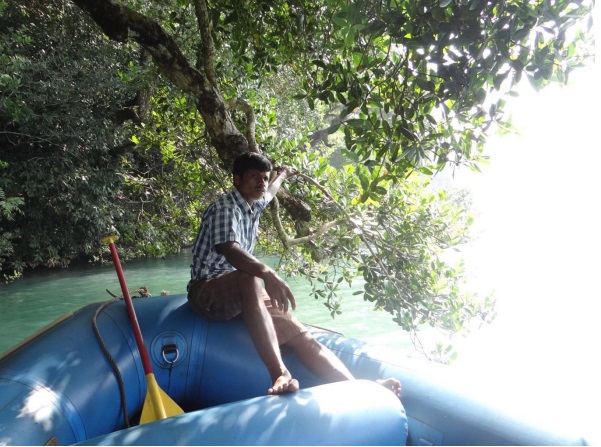
Guide from one of the homestay-resorts, a resident of Dandeli Photo: Author

In 2006, the Forest Advisory Committee of the MoEF rejected Forest Clearance for this project. The project was also strongly opposed internally within the Karnataka Government by the Department of Tourism. Surprisingly, MoEF did not book the EIA agent (Ernst and Young) or the proponent (MPCL) for submitting an entirely false report! Even more shockingly, this EIA was later done by TERI (The Energy Research Institute), which also completed the study in one month and came up with a dubious report based on secondary data. However, strong opposition from local groups, ESG, and even within Karnataka Government resulted in rejection of the proposal by a number of authorities, including the Department of Industries and Collectorate of Uttar Kannada. Since then, the project has tried to raise its head again, only to be opposed strongly.[2]

Fishing along the Kali in the early morning Photo: Author

Around 10 years down the line, what does this small stretch of free flowing river mean?

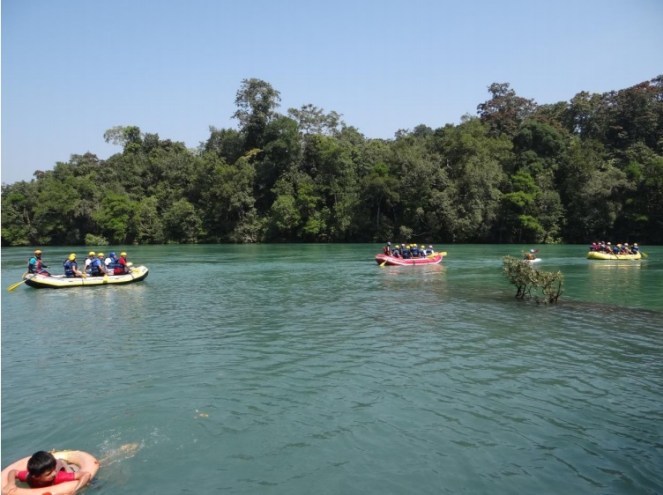
I traveled in Uttara Kannada as a tourist in November 2013. A thriving tourism industry now exists on the banks of Kali and the river is now world-renowned as one of the best rivers for white-water rafting in India. There is boating, canoeing, kayaking, swimming, fishing along this stretch of the river. Pools and islands in the river provide perfect habitats for various species as well as for naturalists and bird watchers. The range of recreational activities that take place along the river are endless. Fishermen still lay their nets across this stretch and catch some fish (though I was told that fish greatly reduced after Supa Dam was commissioned in 1985). Along the banks of the river in this stretch, a thick riparian forest flourishes, providing habitat and corridor to several species.

But more importantly, this tiny stretch is a reminder of how this great river once was. A humbling reminder.

According to Lal, now a boatman and guide from Dandeli, the river stretch which could have been dammed, now provides tourism related employment to around 1000 people from around the region. The region supports around 8 resorts and several homestays. It has created multiple employment opportunities for locals like naturalists, guides, white-water trainers, etc.  Some of the locals are descendants of the Supa Dam evictees. One of them says, “The relocated colony of Supa evictees is called Ramnagara, actually it is Vanvasanagara. If it were not for the tourism, I would have migrated to Goa or Belgaon.  We saw the fate of Supa dam displaced and would not allow one more dam, no matter how small or big, to affect us again.”

Many ways to enjoy a flowing river: Rafting, canoeing, swimming Photo: Author

The struggle against 18 MW mini hydel has been significant in a number of ways. EIA and public hearing for the project were the two events where protests were recorded. It was through these platforms that the extent of the impacts of the projects was known and could be opposed. However, after this, a newer version of EIA Notification was adopted in Sept 2006 which excludes hydel projects below 25 MW from its ambit! This has been a ecologically senseless move as projects which have severe impacts on the ecology do not even need a public hearing and an EIA now! We, and several experts and organizations, have raised this point a number of times with the MoEF, but MoEF is yet to respond.

One more strong point of the struggle was a more than 20-year-old order by Karnataka government categorically stating that since the Kali river is so heavily dammed (five major dams on this short 186 kilometre long river, destroying most of its forests and displacing thousands of tribal and forest dwelling communities), no more dams, big or small, shall be allowed further across this river. This has been a very significant order.

Even today, when more and more bumper to bumper dams in the Himalayas and Western Ghats are killing our rivers, our Ministry of Environment and Forests does not have a clear guideline for protecting certain stretches of rivers from dams or declaring them as no-dam stretches. There exists no such order protecting over-dammed, collapsing rivers.The only report which actually recommended that 24 dams in the Upper Ganga basin should be dropped due to their impact on ecosystems, has not been complied with by the MoEF. Dams are coming up in cascades, without leaving any free-flowing riverine stretch between two projects. Nothing is being done about this. The MoEF’s Expert Appraisal Committee on River Valley Projects now has a weak norm of leaving a bare kilometer of flowing river between projects. But this norm too gets twisted and violated.

Avay Shukla committee appointed by Himachal Pradesh High Court recommended that projects should have at least 5 kilometers of free flowing river between them. But MoEF does not seem to support this. In fact, a flowing river seems to have no value in our governance system.

However, as the Kali experience shows, a flowing river is good for ecology and is good for the people too.

Let us take this opportunity to thank the Kali Bachao Andolan and the local communities for protecting the last remaining free flowing stretch of Kali… so that we can catch a glimpse of how a free-flowing river looks like!

– Parineeta Dandekar

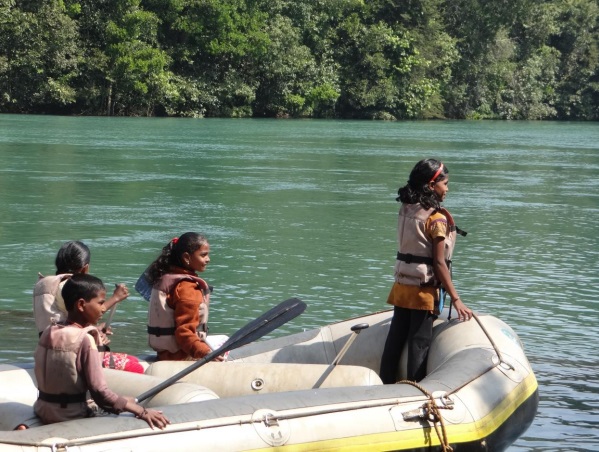
Local children rafting along the Kali Photo: Author
Ministry of Environment and Forests · Uttarakhand · Western Ghats

Affected communities, scientists, experts urge the MoEF: “Address Impacts of Small Hydel Projects”

47 experts and organisations from across the country have written to the Ministry of Environment and Forests, including the Minister Ms. Jayathi Natarajan to include hydel projects between 1-25 MW under the purview of EIA Notification 2006. A similar letter has been sent to the Ministry of New and Renewable Energy and Minister Dr. Farooq Abdulla, to address the impacts of these projects which are governed by the MNRE.

Those who have written include eminent personalities like Former Water Resources Secretary: Dr. Ramaswamy Iyer, Former Ambassador of India: Ms. Madhu Bhaduri, Former Secretary of Power and Principle Advisor to Planning Commission: Dr. EAS Sarma, Former member of MoEF’s Forest Advisory Committee: Dr. Ullas Karanth, Head of IISC’s Centre for Ecological Sciences: Dr. TV Ramachandran, Head of People’s Science Institute: Dr. Ravi Chopra, experts from energy field, as well as activists, fisheries experts, scientists and importantly, representatives from affected communities

Letter sent to MoEF is below:

1. Smt. Jayanthi Natarajan,

Union Minister of State (IC) of Environment and Forests,

Paryavaran Bhawan, Lodhi Road, New Delhi, jayanthi.n@sansad.nic.in

2. Dr. V Rajagopalan,

Secretary,

Union Ministry of Environment and Forests, New Delhi, vrg.iyer@nic.in

 3. Mr. Maninder Singh

Joint Secretary,

Ministry of Environment and Forests, New Delhi, jsicmoef@nic.in

4. Mr. Ajay Tyagi

Joint Secretary,

Union Ministry of Environment and Forests, New Delhi a.tyagi@nic.in

5. Mr. B. B. Barman

Director (IA) River Valley Projects,

Union Ministry of Environment and Forests, New Delhi, bidhu-mef@nic.in

Please include Small Hydel Projects (1-25 MW) under the purview of EIA Notification 2006, considering their serious impacts on ecosystems and communities.

 Respected Madam Minister and office bearers of the MoEF,

We want to record our concern about serious impacts of small hydro projects on communities and ecosystems. Several groups from us have written to you in the past to urgently amend the EIA Notification 2006 and to include Small Hydel Projects in its ambit. Looking at the serious impacts of these projects, MoEF could have suo motto taken this initiative. But that has not happened, despite several amendments in the EIA Notification down the years.

SHPs can have and are having severe impacts on communities and ecosystems. This is significant as SHPs are exempt from environmental impact assessment, public hearing, and environmental management plan as EIA Notification 2006 restrict itself to projects above 25 MW. The local communities are specifically affected as they do not have a platform to voice their concerns.

To highlight some of the impacts of SHPs:

Þ      70 SHPs in Karnataka under scanner following HC orders Karnataka High Court upheld Elephant Task Force’s recommendation about impacts of SHPs on Elephant habitats and directed Karnataka Government to review clearances of all such projects affecting elephant habitats[1], bringing at least 70 SHPs under scanner, 40 in Hassan district, the rest in Mandya, Chamarajanagar and Uttara Kannada districts.

Gangani1
Gangani Small Hydro project in Uttarakhand across Yamuna which resulted in loss of lives and property during Uttarakhand floods. Photo: Yamuna Jiye Abhiyan

Þ      Karnataka HC no to SHPs in W Ghats In Feb 2013, the Karnataka High Court banned SHPs in Western Ghats[2], following a petition filed by Western Ghats Forum.

Þ      Uttarakhand Uttarakhand had earlier cancelled as many as 56 SHPs due to irregularities.

Þ      Western Ghats reports Considering the impacts of small hydro projects, the Madhav Gadgil Panel on Western Ghats recommended that in Ecologically sensitive zone 1, only projects below 10 MW with max height of 3 m and not involving forest land be taken up. In ESZ 2, projects upto 25 MW can be taken up only if dam height is below 15 m. This shows the nuanced approach that is required for small hydro projects. The panel also recommended that WGEA should include small hydro projects under EIA notification. Even the Kasturirangan committee has recommended that hydropower projects, including SHPs be allowed only on condition that 30% eflows are released, less than 50% of the river length is destroyed and there is 3 km free flowing river between projects. It has also recommended that hydropower projects, including small hydro projects should required environment clearance in the Ecologically Sensitive Area.

Pristine Forests set for submergence under the 24 MW Kukke Mini hydel Plant in Dakshin Kannada, Karnataka. Photo: SANDRP

Þ      Bhagirathi ESA In the notified Bhagirathi ESA in Uttarakhand, the MoEF itself has implied that Hydro projects only of below 2 MW installed capacity can be taken up.

Þ      BWSSB asks for stoppage of SHPs In March 2013, Bangalore Water Supply and Sanitation Board (BWSSB) asked the Karnataka Power Corporation Limited (KPCL) to stop power generation from four mini hydel projects on Cauvery River as it was affecting drinking water supply to Bangalore.[3]

Most Small Hydro projects (1-25 MW) are grid connected, and local communities do not get electricity from the projects in their backyards, across their rivers which have significant impacts on local water availability, habitats and submergence.

Some examples in this regard are given here:

Þ      In Himachal, communities have protested strongly against 4.5 MW Hul project affecting drinking water security and irrigation of 6 villages, as well as ancient oak forests.

Protesst against 4.5 MW Hul project in Himachal/ Photo: Saal Ghati Bachao Samiti

Þ      Projects like 24.75 Kukke I in Dakshin Kannada can submerge a massive 388 hectares, including extremely bio-diverse forests, plantations and houses. This is being strongly opposed by local communities.

Þ      Greenko’s Perla and Shemburi Projects, Basavanna and Mauneshwara SHPs in Karnataka are examples where two 24.75 MW SHPs are fraudulently shown as separate projects, but are single projects with a common dam. In the latter case, villagers assumed that the power canal is actually an irrigation canal for their fields. They only realised that they were alienated from their river after they were banished from approaching the canals.

Blatant violations in 24.75 MW Perla MHP and 24.75 MW Shemburi MHP across Netravathi. The common, huge barrage can be seen for two supposed seperate projects. Photo SANDRP

Þ      Maruthi Gen projects, also in Karnataka, were not only clubbed together, but also hid their significant impact on forest land.

Þ      Submergence data of SHPs is routinely hidden & affected communities are kept in dark till water actually floods their lands. 24.75 MW Thangarabalu SHP on Krishna in Karnataka entails a dam of more than 22 meters in height, but has not divulged any data of submergence to villagers or Forest Department.

Þ      3 MW Beedalli MHP in Karnataka is on the boundary of the Pushpagiri Sanctuary and will severely affect wildlife, but does not envisage eflows release, fish passage or environmental mitigation measures

Þ      15 MW Barapole MHP in Kerala is affecting reserve forests in Karnataka. An earlier such project which was affecting Brahmagiri Sanctuary was opposed and cancelled due to pressure from conservation groups in Karnataka.

Þ      String of more than 98 mini hydel projects in various stages of operation, commissioning, construction and planning on the Cauvery in Karnataka has affected elephant corridors and movement.

Þ      Many mini hydel projects along the Cauvery in Karnataka are adjoining the Cauvery Wildlife Sanctuary, violating the 10 km buffer zone, while also encroaching on forest land.

The lovely bharachukki falls on Cuavery, also shackeled by many mini hydel projects. Photo: SANDRP

Þ      In Himachal Pradesh, several hydel projects have been built on streams that are on ‘negative list for hydel projects’. Fisheries department wanted in-situ conservation of fish in these streams.

Þ      The 15 MW Om Power project near Palampur in Himachal Pradesh has caused extensive loss of forest cover and has disrupted irrigation and drinking water supply to downstream areas due to indiscriminate muck dumping.

Þ      The 1.5 MW Pakhnoj Nala Power project would impact the flourishing apple economy of 19 villages in Kullu District of Himachal Pradesh by disrupting irrigation supplies. The local people have been strongly opposing the project and the matter is pending in the court.

MoEF and NCDMA: National CDM Authority is under the MoEF and has been giving Host Country Approvals to CDM applications of several small hydel projects. Many of us have been writing to NCDMA and MoEF, providing clear evidence of the sham in CDM applications of projects and their validation reports. But the MoEF has never taken a notice of this. In fact, the MoEF certifies that these projects have positive impact on sustainable development without checking the ground situation, when the impacts of some of these projects on sustainable development are negative.

World over, it is being recognised that impact of small hydel projects is in fact comparable with large hydro projects and hence has to be assessed and mitigated.[4] Countries like Vietnam have cancelled 338 small hydel projects as their assessment indicated that environmental and social impacts of these projects is not commensurate with their benefits.[5]

We would be willing to present the problems from the ground to the MoEF. A holistic and truly sustainable approach can help boost renewable energy development in our country.

We are sure MoEF is committed to protecting environmental impacts, irrespective of the installed capacities of projects and will amend the EIA Notification to this effect urgently. Till such a credible regulatory system is in place, we request the MoEF to stop providing Host Country Approvals to Small Hydel Projects.

Some links and additional information related small hydro projects and their impacts can be found at:

Þ      http://www.himdhara.org/wp-content/uploads/2012/09/hul_comments-for-unfccc.pdf

Þ      http://www.thehindu.com/opinion/op-ed/neither-small-nor-green/article5045672.ece

Þ      https://sandrp.in/hydropower/PR_Halt_Mini_Hydel_Projects_in_Karnatka_pending_regulation_and_review_080812.pdf
Þ      http://www.downtoearth.org.in/content/karnataka-cancels-leases-two-mini-hydel-projects-western-ghats

Þ      http://www.daijiworld.com/news/news_disp.asp?n_id=124076,http://www.daijiworld.com/news/news_disp.asp?n_id=124443

Þ      Himdhara’s Report on Mini Hydel Projects in Himachal Pradesh: http://www.himdhara.org/2012/09/09/small-hydropower-big-impact-a-discussion-on-issues-facing-local-communities-in-himachal-pradesh/

Þ      Meeting on Mini hydel projects in Karnataka:  https://sandrp.in/hydropower/PR_Halt_Mini_Hydel_Projects_in_Karnatka_pending_regulation_and_review_080812.pdf

Þ      https://sandrp.wordpress.com/2013/03/16/impact-of-62-mini-hydel-projects-on-cauvery-on-bangalores-water-supply/

Þ      Comments on some of the CDM proposals for SHPs: https://sandrp.in/hydropower/

Looking forward to your response to the issues raised above.

Thanking You,

Yours Sincerely,

  1. Ramaswamy Iyer, Former Secretary, Ministry of Water Resources, New Delhiramaswamy.iyer@gmail.co
  2. EAS Sarma, Former Secretary, Ministry of Power, eassarma@gmail.com
  3. Madhu Bhaduri, Ambassador of India, ( Retd), madhu.bhaduri@gmail.com
  4. Dr. Ullas Karanth, Former member, Forest Advisory Committee, MoEF, Director for Science-AsiaWildlife Conservation Society and Director, Centre for Wildlife Studies, ukaranth@gmail.com
  5. Dr. Ravi Chopra, Director, People’s  Science Institute, Dehra Doon, Uttarakhand, psiddoon@gmail.com
  6. Dr.Bharat Jhunjhunwala, Uttarakhand, bharatjj@gmail.com
  7. Manoj Misra, Convener, Yamuna Jiye Abhiyaan, Delhi, yamunajiye@gmail.com
  8. Sharadcchandra Lele, Member, Elephant Task Force, Bangalore, Karnataka, sharad.lele@gmail.com
  9. Dr. T.V. Ramachandra, Head, Energy & Wetlands Research Group, Centre for Ecological Sciences, Indian Institute of Sciences, Bangalore
  10. Dr. Bijukumar, Associate Professor and Head, Dept. of Aquatic Biology & Fisheries University of Kerala, Thiruvananthapuram 695 581, Kerala, abiju@rediffmail.com/ bijupuzhayoram@gmail.com
  11. Neeraj Vagholikar, Kalpavriksh, Pune, nvagho@gmail.com
  12. Emmanuel Theophilus, Himal Prakriti, Pithoragarh, Uttarakhand,etheophilus@gmail.com
  13. Ramnarayan K, Himal Prakriti, Pithoragarh, Uttarakhandramnarayan.k@gmail.com,
  14. Malika Virdi, Himal Prakriti, Pithoragarh, Uttarakhand malika.virdi@gmail.com
  15. Dr. Latha Anantha, River Research Centre, Kerala, rrckerala@gmail.com
  16. Samir Mehta, River Basin Friends, Guwahati International Rivers, Mumbai, samir@internationalrivers.org
  17. Dr. Jagdish Krishnaswamy, Eco hydrologist, Bangalore, jagdish.krishnaswamy@gmail.com
  18. Dr. Shrinivas Badiger, Fellow, ATREE-Bengaluru, sbadiger@atree.org
  19. Dr. Bhaskar Acharya, ATREE, Bangalore, bhaskar.acharya@atree.org
  20. Dunu Roy, Hazards centre, Delhi, qadeeroy@gmail.com
  21. Sankar Ray, Journalist with specialisation in environmental issues, Kolkata sankar.ray@gmail.com
  22. Meher Engineer, mengineer2003@gmail.com
  23. Manshi Asher, Himdhara Collective, Himachal Pradesh, manshi.asher@gmail.com
  24. Rahul Saxena, Himdhara Collective, Himachal Pradesh, lokvigyankendra@gmail.com
  25. Prasad Chacko, Human Development and Research Centre, Ahmedabad, prasad.chacko@gmail.com
  26. Girin Chetia, North-East Affected Area Development Society (NEADS), Village & P.O.- DhekiakhowaDist.- Jorhat (Assam), neads_jorhat@yahoo.co.in; girin_neads@yahoo.co.in
  27. Ashwin Gambhir, Prayas Energy Group, Pune, ashwin@prayaspune.org
  28. Falguni Joshi, Gujarat Forum for CDM, Ahmedabad, gujaratforumoncdm@gmail.com
  29. Madhusoodhanan C.G., Research Scholar, IIT Bombay, madhucg@gmail.com
  30. Neethi Mahesh- Independent researcher, International collaborator- Mahseer Trust.neeti.mahesh@gmail.com
  31. Kedar Nadolli Gogate, Urumbi Ankattu Pratirodh Samiti, Hosmata, Karanataka, kedarnadoli@gmail.com
  32. Karunakar Gogate, President, Urumbi Ankattu Pratirodh Samiti, Hosmata, Karanataka
  33. Dr. Beerathadaka Rajesh, Kutrupady, Hosmata, Dakshin Kannada, drrajeshb23@gmail.com
  34. Beni Prasad (Chairperson) Jan Jagaran evam Vikas Sanstha, Village Sarsei, PO Haripur, Tehsil and District Kullu, Himachal Pradesh.
  35. Dr. Pushpal Thakur (General Secretary), Jan Jagaran evam Vikas Sanstha, Village Sarsei, PO Haripur, Tehsil and District Kullu, Himachal Pradesh.
  36. Lal Chand Katoch, Sanyojak, Jal Jangal Jameen Bachao Sangharsh Samiti (Majhat), Village Batahar, PO Haripur, Tehsil and District Kullu, Himachal Pradesh.
  37. Rahul Banerjee, Dhas Gramin Vikas Kendra, Indore. rahul.indauri@gmail.com
  38. Subhadra Khaperde, Kansari nu Vadavno, Khargone subhadra.khaperde@gmail.com
  39. Shankar Tadwal, Khedut Mazdoor Chetna Sangath, Alirajpur shankarkmcs@rediffmail.com,
  40. Dr. AK Malhotra – Trustee, SAI (Save Animals Initiative) Sanctuary Trust, Kodagu District, Karnataka, saisanctuary@gmail.com
  41. Gopakumar Menon, Nityata Foundation, Bangalore, gopakumar.rootcause@gmail.com
  42. Nisarg Prakash, Nityata Foundation,Bangalore, nisargprakash@gmail.com
  43. Tarun Nair, Researchers for Wildlife Conservation, tarunnair1982@gmail.com
  44. Dr Shambu Prasad, Chebrolu, Bhubaneshwar, shambuprasad@gmail.com
  45. Anush Shetty, Bangalore, anushshetty@gmail.com
  46. Himanshu Thakkar, SANDRP, New Delhi, ht.sandrp@gmail.com
  47. Parineeta Dandekar, SANDRP, Pune, parineeta.dandekar@gmail.com
Western Ghats

Yettinahole Diversion: An imprudent, Rs.100 Billion proposition

Background Karnataka has been mulling over diverting waters of the west flowing rivers to the east for many years. Netravathi-Hemavathy Link was proposed by the National Water Development Agency (NWDA) as a part of peninsular component of the River linking project. In the meantime, Karnataka appointed a committee under the leadership of Dr. G. S. Paramshivaiah which worked on a plan to divert waters from west-flowing rivers including Netravathi to 7 districts of Bayaleseeme region including Kolar, Bangalore, Tumkur, Ramanagara, Chikmagalore, Chikkaballapur, etc.

River Gundia, formed by Yettinahole and other streams which are to be diverted by Yettinahole Diversion Project Photo: SANDRP

But currently, the Karnataka Government is seriously considering Yettinahole Diversion Project which plans to divert head waters of the Gundia River ( a tributary of the Kumardhara, which is a tributary of the Netravathi) in the west and transfer this water to the other end of the state, in the east. It has been reported that tenders for this project have been floated already. Its Project Report (June 2012 version) is titled as ‘Scheme for diversion of flood water from Sakleshpura (West) to Kolar/ Chikkaballapra Districts (East)’.

NOTE, SANDRP: 4 Sept 2014:

Following the efforts of several groups, including SANDRP, Yettinahole Project was strongly opposed, though advocacy and on-ground struggle. In response, the Karnataka government has made substantial changes in the DPR of the Project which was completed in late 2013/early 2014. Several elements have been changed cosmetically, to counter our valid points, thus vindicating the points raised below. SANDRP has published a detailed assessment of this DPR. It can be found here: Yettinahole DPR: New Avtaar, Old Problems.  https://sandrp.wordpress.com/2014/09/18/yettinahole-diversion-dpr-new-avataar-old-problems/

~~

In Karnataka Budget Part I, February 2012, Rs 200 Crores have been allocated for making DPR and initial works while Rs 2670 Crores have been sanctioned and Rs 850 Crores allocated in 2013-14 for lift works upto Harvanahalli in Sakaleshpura.[1] All these allocations have been made without a Detailed Project Report, cost benefit assessment, options assessment or environmental and social appraisal of the scheme, or any statutory clearances. This is highly problematic as this assessment indicates that this energy intensive project will have profound impact on Western Ghats biodiversity, wildlife and livelihoods

______________________

SANDRP analyzed the Project Report (PR) which was obtained under RTI by Mr. Kishore Kumar Hongadhalla, who had specifically asked for a ‘Detailed’ Project Report. The total cost of the project as per the PR is 8323 Crores. But the estimate does not include many costs like Rehabilitation and Resettlement (R & R), complete land acquisition, construction of reservoirs on Palar Basin as mentioned in the Project Report, pipeline to 337 tanks, Forest NPV, etc. If these are included, cost of the project will certainly go beyond Rs 10000 crores /Rs 100 billion.

______________________

Purpose of this scheme is stated as drinking water supply to Kolar and Chikkaballapur Districts. However, analysis of the Project Report indicates that drinking water to be supplied to Kolar and Chikkaballapur will be a bare 2.81 TMC or 11.7% of the 24.01 TMC diverted. If water is supplied to Bangalore (urban) as is said in the Budget, but not the Project Report, then water supplied to Kolar and Chikkaballapur will be even less, possibly nil.

_______________________

Analysis of the Project Report and site visits to Yettinahole and surrounding catchments indicate that this project is economically, socially and technically inviable and will have a massive impact on the ecology of the Western Ghats and eastern plains. The analysis also assesses the claim of providing drinking water to Kolar and Chikkaballapur: whether it is viable, desirable and optimal option.

I.                    The Project

The project involves construction of 8 dams  in 2 phases at the head waters of Gundia River basin, a tributary of Kumaradhara, which in turn is a major tributary of the West flowing Netravathi River, the lifeline of Mangalore and Dakshin Kannada districts. The Project Report insists on calling these as weirs, but the drawings[1] indicate the height these dams as 15 meters from deepest foundation, making them large dams, as per the definition of International Commission on Large Dams {ICOLD}.

Dams and rising mains in Western Ghats: 2 dams are planned across Yettinahole stream, 2 on its tributaries, 2 across Kadumanehole stream, 1 across Kerihole stream and 1 across Hongadhalla stream. All these streams are rivulets which join at various points to make river Gundia. Rising mains (large pipelines that transport water under pressure) from these projects will pump water into 3 delivery chambers. From the delivery chambers, water will be lifted to an intermediate pumping station at Doddanagara in Sakaleshpur. From Doddanagara, water will be lifted again and conveyed to Delivery chamber 4 located near Harvanahalli in Sakaleshpura.

Schematic Representation of pumping involved in Yettinahole Diversion Project. From: KNNL Project Report Volume I)

233 kms long Gravity canal: From Harvanahalli, water will flow through a gravity canal of 233 kms (Proponent says 250 kms in MoEF Meeting) in length to Tumkur.

Devaranya Durga Reservoir: From Tumkur, again the water will be lifted through a rising main and will culminate into a reservoir to be built at Devaranyadurga. This reservoir will have a height of 68 meters and gross storage capacity of 11 TMC. It will submerge approximately 980.4 hectares of land, including forests.

When this project was discussed in the Expert Appraisal Committee meeting of the Ministry of environment and Forests, the proponents have claimed that Devaranyadurga Reservoir will submerge 1200 hectares of land, of which 50% will be forest land and will also submerge at least 2 villages.[2]

From here, two rising mains of 80 kms and 55 kms will again lift and convey water to Chikkaballapura and Kolar respectively. In Chikkaballapura and Kolar, the rising main will feed various streams and rivers and will have dedicated pipelines to feed Minor Irrigation (MI) and Zilla Parishad (ZP) tanks.  Scheme envisages feeding 198 tanks in Chikkaballapur and 139 tanks in Kolar District.

The scheme envisages providing 14 TMC for Hassan, Chikkamagalore, Tumkur and Bangalore rural and 10 TMC for Kolar and Chikkaballapur, through the dam at Devaranyadurga. So, the claims that Kolar and Chikkaballapur will get 24 TMC water is false. The project report is titled ‘Scheme of diversion of floodwaters to Chikkaballpur and Kolar’ but these districts seem to be getting less than 50% of the diverted water. As we see in later sections, of this 10 TMC barely 2.81 TMC is earmarked for drinking water supply.

Locations of Dams/Weirs of Yettinahole Project SANDRP

New Reservoirs planned

  • Chikkaballapur District:
    • New reservoir across Kushavathy River at Gudibande.
    • A new reservoir At Timassandra across Palar river
    • Kolar District: Bethmangala Tank to be used as an important reservoir
    • At Tanadihalli on Palar River North to store 2.20 TMC water

Electricity needed: As per the project Report, the scheme will require massive 370 MW of electricity.

Yettinahole River Photo: SANDRP

Volume of water to be diverted: 24.01 TMC water is proposed to be diverted between June-November from a catchment area of 89.66 sq kilometers (8966 hectares). It has to be noted that 24.01 TMC water is available at 50% dependability. So, in 50% years under consideration, 24.01 TMC volume would not be available for diversion. The structures and conveyance system has also been designed at 50% dependability. This may imply several things:

  • The scheme can work beyond June-November
  • The scheme can divert more than 24 TMC waters from Yettinahole
  • The scheme can be used later for diverting waters of other rivers.

This further warrants a serious look at the entire project.

II.                  Environmental Impact of the Project on Western Ghats and other regions

Impact on Forest Land and Wildlife

The exact extent of revenue, private, agriculture and forest land required for the scheme is not known from the PR. The report (Volume II, Estimates) mentions a head ‘clearing of thick forest by burning’ under costs for laying rising mains from dams to pumping stations. According to these estimates, 107.27 hectares of thick forests will have to be cut or burnt for the rising mains alone.

Yettinahole Catchment and surrounding forests Photo: SANDRP

The forest land involved in submergence of dams, approach roads, workers colonies, muck dumping sites, electrical substations, mining of materials for the project, destruction due to blasting, etc. will be additional. The project report does not provide any of these details.

Most of the forests in the vicinity of Yettinahole, Kadumane hole, Kerihole and Hongadhalla are not only reserved forests, but important wildlife corridors. When IISC studied this region  it recorded  119 trees species,  63 shrubs and climbers, 57 herbs and 54 pteridophytes[3], 44 species of butterflies, 4 dragon and damsel flies, 23 species of amphibians including the threatened Gundia Indian Frog, 32 reptiles, 91 birds and 22 mammals including Tiger, Lion Tailed Macaque, Elephant, Slender Loris and Gaur.

Elephant dung at a KPCL survey in Hongadhalla region, to be affected by Yattinahole Diversion Project. Photo: IISc

The region is witnessing rising man animal conflicts due to destruction and degradation of habitats. During 2002-2012-13, 34 people have died and 17 elephants have been electrocuted in Sakaleshwar Taluk alone (http://www.thehindu.com/news/national/karnataka/elephant-encounter-is-an-everyday-affair-for-them/article4874172.ece). The Karnataka Elephant Task Force has acknowledged the impact of mini hydel projects in Sakaleshpur on Elephant corridors and has given strong recommendations about reviewing clearance and canceling projects which affect elephant distribution areas negative and do not comply with existing laws.

Dams, roads, blasting, muck disposal, workers colonies, sub stations, increased traffic in this region will have a pronounced impact on the wildlife, including the elephants. Any more stress on these regions will precipitate in furthering of conflicts and disturbance.

Environmental Flows As per the working tables, all inflow from the headwaters will be diverted for the most of June, parts of July and August and all of September, October and November. The streams will be completely dry for most days during this period. (Project Report Vol. I, Page A 21) There has been no provision made for environmental flows. This will be extremely damaging for the downstream ecology, wildlife and forests. This issues needs urgent attention and studies.

The scheme may look inviable if eflows are released, as they must be, from the dams/ dams into the downstream river.

Impact on fish assemblages and fish sanctuaries Kumaradhara and Netravathi are home to some rare community conserved fish sanctuaries. Fish sanctuaries exist at Kukke Subramanya, Nakur Gaya and Yenekal, all of which are downstream from the proposed diversion. The fish assemblages, their feeding and breeding patterns are highly affected by flow. Any drastic changes in flow regime will affect these species.

Gundia River itself has several rare and endangered fish species. 3 new fish species have been discovered and 1 rediscovered in Kumardhara river basin between 2012-13[4]

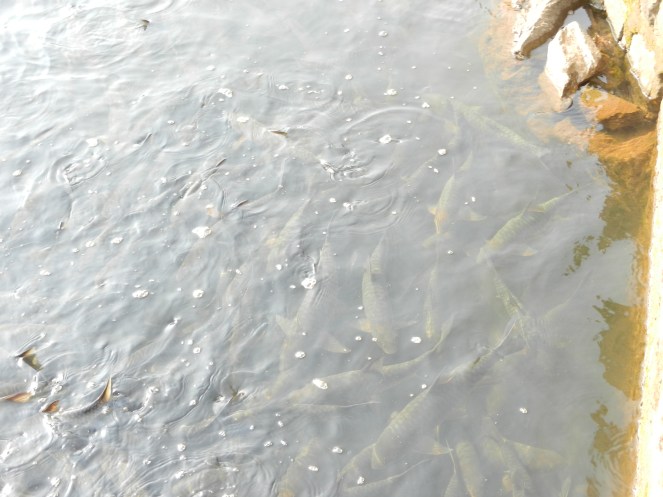
Congregation of the engandgered Mahseer fish at Yenekal Fish Sanctuary, Kumaradhara RIver downstream proposed Yettinahole diversion. Photo: SANDRP
Congregation of the endangered Mahseer fish at Yenekal Fish Sanctuary, Kumaradhara River downstream of proposed Yettinahole diversion. Photo: SANDRP

Blasting using dynamite The project report and estimates state that hard rock will need to be blasted extensively with dynamite. Dynamite blasting will have severe negative impact on the wildlife of the region. Blasting also has documented harmful effects on groundwater aquifers and can affect the existing water sources and water holes of the wildlife.

Muck generation and disposal As per the project report, muck generated for laying the rising mains alone will be to the tune of 13,02,837 cubic meters. All of this muck will be generated close to the rivers, in forest areas. Dumping of this muck will have a huge negative impact on water quality, forests and wildlife. Uttarakhand disaster in June 2013 highlighted the how muck is routinely disposed into rivers and the havoc this causes in the downstream.

Additional muck will be generated during dam/ dam construction, approach, colonies, substations, etc. The impact of this will be compounded.

Approach roads, workers colonies All the dams/ dams, rising mains, electric substations will require approach roads which will pass through forests, further impacting forests and wildlife. Workers colonies and waste disposal will again have additional impacts on the region.

Diverting entire rivers and not just floodwaters The scheme purports that it is diverting only the flood waters of these rivers. However, the yield of all the rivers at 50% dependability between June-November is 28.94 TMC, out of which 24.01 TMC will be diverted. This leaves just 4.93 TMC for the downstream. This is maximum diversion of the rivers and not just ‘flood waters’ or overflow.

Also, even when rainfall is low, the scheme will divert all available water till it gets its share of 24.01 TMC, which will then dry the rivers completely in the downstream.

These are monsoon-fed rivers. Only source of water for these rivers is the monsoon, which also replenishes groundwater, which constitutes the base flow in non-monsoon months. This diversion in monsoon months will have a huge impact on water availability in non-monsoon months also in these rivers and which in turn will have impact on the biodiversity and livelihoods.

III.                Supposed Beneficiaries: Contradictions between Budget and Project Report

As stated (verbatim) in the Project Report, following are the beneficiaries of the project (Project Report Volume I:  Section 4.7, Page 52)

  • Selected parts in Hassan District
  • Selected towns in Chikmagalur, Chitradurga by feeding Vedavathi river
  • Tumkur, Madhugiri, Pavagada and Koratagere Taluk
  • Chamrajsagar reservoir
  • Water to Devanhalli Industrial Area
  • Augmentation of Hesarghatta tank
  • Water to Chikkaballpur and Kolar District

In addition, water will be used to rejuvenate Rivers like Arkavathy (Cauvery Basin), Palar, (Independent basin) Jayamangli, Kushavathy, Uttara and Dakshin Pinakini, Chitravathi and Papagni rivers (Pennar Basin) (Project Report Volume I: Section 4.9, Page 52)

The project report makes no mention of supplying water to Bangalore urban area or BBMP (Bruhut Benguluru Mahananagara Palike). However, the Karnataka Budget 2012-14 specifically mentions providing water to these areas.

How much water will this be? What are the options of water supply to Bangalore? If water is supplied to voracious Bangalore and Devanahalli Industrial area, will there actually be water for Kolar, Chikkaballapur and other drought affected areas?

River Rejuvenation: Long distance transfer of water involving huge ecological, social and financial costs seems to be a poor way of rejuvenating rivers. Experts claim that rejuvenating rivers like Arkavathy can be achieved with rainwater harvesting, demand side management, pollution control and releasing treated water in rivers like Arkavathy and Vrishabhavati, not interbasin transfers.

Priority to Drinking water for Kolar and Chikkaballapur? Doesn’t seem so

Of the 10 TMC to be provided to Kolar and Chikkaballapur, the Project Report mentions that drinking water needs of Kolar and Chikaballapur Districts are 6 TMC. Rest of the 4 TMC will be used to fill up 337 MI and ZP Tanks in the districts.

The project report proposes to fill these tanks at 60% live storage capacity. According to Table 2 and 3 in Project Report Volume 1, Page 7, this proposed 60% filling requires 4.08 TMC water in Chikkaballapur District and 3.11 TMC water in Kolar District. So together, as per the Project Report, the proposed filling of MI tanks needs 7.19 TMC water.

This leaves bare 2.81 TMC water for drinking purposes of these districts!

If out of 24.01 TMC transferred, only 2.81 TMC will be supplied for drinking water to Kolar and Chikaballapur, this is clearly not a drinking water supply project for these districts, as claimed.

So undecided is the Project Report about supplying drinking water that it says further “alternatively if water is to be used fully for drinking, then it will require 4 new storage tanks”. The Project Report does not conclude on whether these tanks will be built.

IV.                Escaping Environmental Clearance by false claims

This scheme will:

  1. Destroy hundreds of hectares of pristine biodiversity rich and unexplored forests, wildlife habitats, habitats of critically endangered species, reserved and protected forests in the Western Ghats
  2. Affect downstream flows and riverine ecology of the Gundia, Kumaradhara & Netravathi Rivers
  3. It will submerge nearly a 1200 hectares of land, 50% forest land and 2 villages  for reservoir to be constructed at Devaranyadurga
  4. Main gravity canal which will be 250 kms long and 16 mts wide (as stated in EAC meeting by proponent) will require a minimum of 400 hectares of land
  5. It involves Interbasin water transfer, which is not prudent or viable as per the Western Ghats Expert Ecology Panel Report

Clearly, the scheme requires detailed scrutiny for its impacts by undergoing participatory environment and social impact assessment and undergoing a thorough Environmental Appraisal.

The scheme has escaped this by wrongly claiming that it is a purely drinking water supply scheme. The proposal was considered by the Expert Appraisal Committee of the MoEF in its 63rd meeting in October 2012. In the meeting, the EAC noted that ‘there appear to be some environmental and R and R issues which should be addressed” but recorded its inability to consider this project as drinking water projects do not fall in the purview of EIA Notification 2006.

The minutes note that: “The project neither proposes any hydro-electric power generation component nor comprises of any irrigation component and thus has no command area.”

However, this is a wrong claim for the following reasons, among others:

A. Irrigation Component: The EAC says that there is no irrigation component. However, the command areas of 337 minor irrigation tanks in Kolar and Chikkaballapur, as mentioned in the Project Report (Voulme I, Annex 3) come to 29,182 hectares, all of which will benefit from the project. This is higher than command area of 10,000 hectares; hence the project comes under the purview of EIA Notification 2006 and will have to be considered for Environmental Clearance by Expert Appraisal Committee of the MoEF under EIA notification 2006.

B. Hydropower Generation: The project claims that it can generate 125-150 MW of power   through gravity canals. Location details are also made available in the Project erport (Page 59, Volume I). As the total capacity is higher than 25 MW, the project comes under the purview of EIA Notification 2006 and will have to considered for Environmental Clearance by the Expert Appraisal Committee of the MoEF.

It is clear that the EAC’s decision that the project does not fall under the purview of EIA notification is incorrect technically. Furthermore, it is unacceptable to exclude any large dam or project which has such significant impact on land and ecology from the purview of EIA notification and EIA notification needs urgent amendment.

A joint letter has been issued by more than 14 organisations and individuals across Karnataka, urging the MoEF to appraise this project completely. Signatories include former Forest Advisory committee Member Dr. Ullas Karanth, Praveen Bhargav from Wildlife First, institutes like IISc, amongst many other. (https://sandrp.wordpress.com/2013/09/10/complete-appraisal-needed-for-yettinahole-diversion-project-letter-to-moef/) Reports on the Submission: www.dnaindia.com/bangalore/1889546/report-govt-hiding-facts-on-yettinahole-say-activists,http://articles.timesofindia.indiatimes.com/2013-09-12/mangalore/42007183_1_yettinahole-project-chikkaballapur-districts-water-problem,http://articles.timesofindia.indiatimes.com/2013-09-13/mangalore/42039865_1_water-problem-drinking-water-supply-scheme-dams)

V.    Yettinahole & Gundia HEP (Phase I: 200 MW, Phase II: 200 MW) overlap

While the Karnataka Neeravari Nigam Limited is making Project Reports, DPRs and has even earmarked budget in 2013-14 session, Gundia HEP has been planned on the same catchments and same rivers by Karnataka Power Corporation Limited (KPCL).

Gundia HEP proposes to divert flows from Yettinahole, Kerihole, Hongadhalla and Kadumanehole (Phase II) through maze of tunnels to generate 200 MW power in phase I and 200 MW in Phase II. KPCL has completed an Environment Impact Assessment for this project (which is of a poor quality). KPCL has also made presentations to the Western Ghats Expert Ecology Panel about the project.

Power generation is based on water yield from the catchment, which will be intercepted by Yettinahole Diversion Project. In fact, dams of Gundia HEP and Yettinahole HEP are placed close to each other. Both the projects, by the Karnataka Government are working in isolation and cross purposes as if the other project does not exist.

Locations of weirs and dams of Gundia and Yettinahole Projects SANDRP
Locations of weirs and dams of Gundia Hydel Project (GHEP) and Yettinahole Projects SANDRP

Shockingly, both projects have also been considered within three months by the EAC of the MoEF for appraisal. The Expert Appraisal committee of the MoEF in its 59th Meeting in July 2012 considered Gundia HEP and in its 63rd Meeting in October 2012 Yettinahole Diversion Project. EAC has recommended Environmental Clearance to Gundia (another wrong decision), whereas it has indicated that Yettinahole Diversion Project does not require an Environmental Clearance. In doing so, the EAC has not considered that both these projects plan to divert waters from the same catchments. This also says a lot about application of mind by the Expert Appraisal Committee. At the same time, it also raises questions about the coordination and work of Karnataka Government.

VI.                Options Assessment

The project raises pertinent questions about water management and water sharing: Is diverting water from west flowing rivers, at a huge social, ecological and economical costs the only option to provide drinking water to Kolar and Chikkaballapur regions? Is there no other optimal solution? Did the Karnataka government undertake an options assessment study to arrive at such a conclusion?

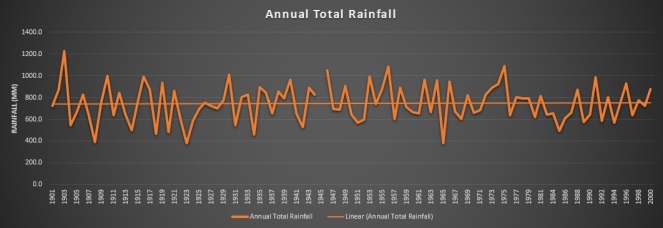
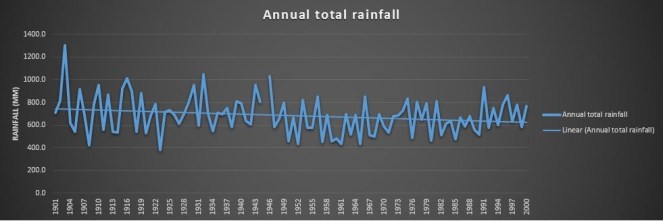
An analysis of rainfall for the one hundred years between 1901-2001 indicates that rainfall in Kolar and Chikkaballapur has not shown significant fall.

Annual Rainfall in Kolar District during 1901-2001 Data Source: IMD, Graph: SANDRP
Annual Rainfall in Chikkaballapur District during 1901-2001 Data Source: IMD, Graph: SANDRP
Kolar
Annual Rainfall in Kolar District during 1901-2001 Data Source: IMD, Graph: SANDRP

Kolar District, especially was once rich in water tanks and local harvesting measures. Average rainfall in Kolar is 750 mm, which is not low. According to the Karnataka Gazetteer, the district had, in 2012, only 2,095 tanks from the 35,783 tanks in 1968. Most of the tanks were a victim of siltation, encroachment and neglect.[5] Organisations like Gramvikas and Dhan Foundation have demonstrated how desilting and management of tanks in Kolar can secure water for drinking as well as for irrigation, cattle rearing, etc.[6] Some groups have worked on highlighting the positive impact of applying reservoir silt to crops, as an option to fertilisers and to facilitate desilting. Indian Institute of Sciences (IISc) has demonstrated that desilting these tanks in Kolar can not only help water security, but it can also reduce the incidence of fluorosis.[7]

River Rejuvenation: Long distance water diversion is not an answer to drying and dying rivers Rivers like Arkavathy are dying due to persistent pollution from industries and urban areas and also due to catchment degradation. How will waters from Yettinahole revive this situation? Local efforts, sound environmental and water governance however, can help this situation. But this is not being explored sufficiently.

_____________

Long-distance water transfer: problems and prospects

(From: Prof. Asit Bisaws, Long-Distance Water Transfer United Nations University, 1983)

If many of the past and present experiences on long-distance water transfer are reviewed critically, the following major issues emerge:

(1)                Mass transfer of water is often justified by considering only the direct cost of transporting water. Seldom are the values of services foregone by the exporting region due to reduction of their water availability, i.e. the opportunity costs of exported water analysed.

(2) Various other feasible alternatives to interbasin water transfer are often not investigated. There is a tendency within the engineering and economic professions to opt for technological solutions-“soft” options tend to be neglected. Since water resources development is dominated by these two professions, there is a tendency to opt for technological fixes before all viable alternatives are explored. Among possible options are:

-more efficient use of available water;

-re-use of waste water;

-better management of watersheds;

-improved integration of surface and groundwater supplies;

-changing cropping patterns.

______________

Climate Change and Western Ghats:

Climate change Assessments like 4X4 Assessment of INCA have indicated that rainfall in southern Western Ghats, which also includes Netravathi and Gundia catchment is expected to fall in the coming years. This will affect water resource projects, crops, fisheries, etc. (https://sandrp.wordpress.com/2013/07/26/climate-change-in-western-ghats-4×4-report-and-beyond/)

We cannot ignore these signals while planning expensive schemes at the cost of ecology and sociology which might prove to be inviable in a few years in face of climate change. Keeping all these factors in mind Karnataka needs to proceed extremely cautiously on Yettinahole diversion scheme.

_______________

VII.              In Conclusion

Environment and Social Assessment are basic prerequisites for a project of such massive dimensions.

All in all, looking at several serious issues associated with Yettinahole Diversion Project, it is urgently needed that:

  1. Project should undergo complete  Environment appraisal and Clearance scrutiny, as laid down by the  EIA notification, 2006
  2. Recommendations of the Western Ghats Expert Ecology Panel about avoiding inter-basin transfers in the Western Ghats should be adhered to.
  3. Options Assessment and cost benefit analysis, including the ecological costs of the diversion should be carried out and put in public domain.
  4. Downstream affected communities, including cities like Mangalore and estuarine fisher folk should be consulted during public hearings.
  5. Unbiased assessment about the water stress in Kolar and Chikkaballapur should be carried out with members from groups which have been working from the region, to evolve a holistic water management policy for the region.
  6. Options for reviving rivers and tanks in Kolar-Chikkaballapur need to be explored using traditional and appropriate technology practices. Appropriate cropping pattern and cropping methods should be a part of this exercise.
  7. A review of rain water harvesting, efficient water supply, demand management, lake revival, groundwater recharge, grey water and sewage recycling for cities including Bangalore should be carried out prior to allocating more water from distant sources to such cities.
  8. A democratic bottom up exercise has to be taken up on such proposals both in the Western Ghats areas as well as the projected benefiting areas.

It will not be the interest of the ecology in Western Ghats, Eastern regions or communities in Dakshin Kannada, Hassan, Kolar, Tumkur, Bangalore and Chikkaballpur if a project of such massive proportions, with devastating social and environmental impacts is taken up for short term political or financial gains, bypassing proper credible appraisal and democratic decision making.

Kolar and Chikkaballapur regions have been facing severe water crisis, leading to hardships to local communities. But, for a long term and sustainable solution to these problems, Yettinahole Diversion does not look like a viable option, we do not even know how much water will reach these regions. But the project has the potential to exacerbate ecological degradation, fuel man animal conflicts and further water conflicts between regions.

Drought affected regions may have better options, including better operation and maintenance of existing water infrastructure, more appropriate cropping and water use pattern, revival of existing water harvesting structures, recycle and reuse of water, among others. Attention needs to be paid to these options, rather than ‘diverting’ it.

Hidden costs of projects like Yettinahole Diversion are too big to be actually hidden.

-Parineeta Dandekar, SANDRP  (parineeta.dandekar@gmail.com)


[1] Volume II, Part B, Estimates, Section: Estimates for implementation of the scheme: Drawings

[2] Minutes of the Meeting, 63rd EAC Meeting, MoEF held on 12-13th October 2012. Agenda Item 2.11 (B)

[3] Pteridophytes are plants from the fern family that reproduce by spores.

[4] http://www.deccanherald.com/content/264870/researchers-stumble-species-fish.html, Ichthyological Exploration of Freshwaters, Vol. 23, Number 4

Environment Impact Assessment · Expert Appraisal Committee · Ministry of Environment and Forests · Western Ghats

Huge Impacts, but no assessment? Groups urge MoEF to correct its blunder on Yettinahole

Yettinahole Diversion Project is being planned in the Western Ghats and Eastern Plains of Karnataka, by the Karnataka Neeravari Nigam Limited (KNNL) purportedly as a drinking water supply scheme to supply 24 TMC water to Kolar and Chikkaballapur Districts. The scheme involves 8 dams in Western Ghat forests, 250 kms long canals, 80 and 50 kms long raising mains, a reservoir that will submerge 1200 hectares of land and 2 villages.  A closer look at the Project Report of the scheme indicates that of the 24 TMC to be diverted, assured drinking water to Kolar and Chikkabalapur is just 2.81 TMC! Rest is planned to be allocated for uses like river and tank rejuvenation, irrigation, industries, urban supply etc.

DSC03697
Gundia River, formed of headwaters of Yettinahole, Kerihole, Hongadhalla and Kadumanehole which will be diverted for the Yettinahole Diversion Project Photo: SANDRP

The Project has escaped appraisal by the Expert Appraisal Committee of the MoEF, claiming that it is a drinking water scheme ( as per the EIA Notification 2006, Drinking Water Supply Schemes are exempt from Appraisal and Environmental Clearance process.)

But analysis of the Project report indicates a different picture.

More than 14 individuals, mainly from Karnataka have written to the Union Environment Minister, Secretary, MoEF and Director, Impact Assessment, River Valley Projects Division to appraise the Yettinahole Diversion Scheme entirely. Signatories include Dr. Ullas Karanth, former non-official member of the Forest Advisory Committee, MoEF, Praveen Bhargava from Wildlife First, Dr. T.V. Ramchandra from Indian Institute of Sciences, noted rainwater harvesting expert Vishwanath Srikataiah, Niren Jain of Kudremukh Wildlife Foundation, amongst others. While the signatories support long term and sustainable solutions to legitimate drinking water demands of drought affected regions in Karnataka, as the letter clarifies, Yettinahole Diversion Project does not seem to be an answer to that.


To,

Smt. Jayanthi Natarajan,

Union Minister of State (IC) of Environment and Forests,

Paryavaran Bhawan, Lodhi Road, New Delhi, jayanthi.n@sansad.nic.in


Dr V Rajagopalan,

Secretary,

Union Ministry of Environment and Forests, New Delhi, vrg.iyer@nic.in


Maninder Singh

Joint Secretary,

Union Ministry of Environment and Forests, New Delhi, jsicmoef@nic.in

Mr. B. B. Barman

Director (IA) River Valley Projects,

Union Ministry of Environment and Forests, New Delhi, bbbdx.dy@gmail.com


Subject: Appeal for fresh Appraisal of the Yettinahole Diversion Project in Karnataka and withdrawal of the Letter/NOC which has been issued by the MoEF on the basis on inaccurate/insufficient information.

Respected Madame and Sirs,

In the 63rd meeting of the EAC for River Valley and Hydropower projects, the committee considered Yettinahole Diversion Project by Karnataka Neeravari Nigam Limited, Government of Karnataka (Agenda Item: 2.11 (b) “Clarification on Drinking Water Supply Scheme to Tumkur, Bangalore (Rural), Kolar & Chikaballapur Districts by M/s. Karnataka Neeravari Nigam Ltd, Government of Karnataka for applicability of EIA Notification, 2006.)

The EAC concluded (emphasis added): “In view of the above, the EAC expressed its inability to consider the project for the purpose of TOR/EIA/EMP etc as this does not fall within the preview and mandate of the  EAC although, there appear to be  some environmental and R&R issues involved which may be appropriately addressed. Outcome of the WGEEP report may also have to be factored. The drinking water schemes, in fact, do not attract the provisions of EIA Notification, 2006 and its subsequent amendment, 2009… The project neither proposes any hydro-electric power generation component nor comprises of any irrigation component and thus has no command area.”

The EAC also recommended: “The Ministry of Environment & Forests may write to Karnataka Neeravari Nigam Ltd (KNNL), Government of Karnataka that the instant project does not attract the provisions of EIA Notification, 2006 and its subsequent amendment, 2009.” We understand the MoEF sent a letter to KNNL on these lines.

This recommendation of the EAC and MoEF decision are both incorrect. Looking at the facts mentioned below, the scheme is Category A project and needs to be appraised by the EAC not only because it falls under the purview of the EIA Notification 2006, but also due to   serious ecological and social impacts. This letter is based on a site visit to the region, discussions with local communities, perusal of the Project Report of the scheme as well as the minutes of 63rd EAC Meeting.

EAC considered the project only on the basis of the proponent’s statements, without studying the Project Report.

An analysis of the Project Report (Version June 2012, prior to EAC Meeting) it is clear that:

1. Irrigation Component: The project aims to supply water to 337 minor irrigation tanks and Zilla Parishad Tanks in Kolar and Chikkaballapur. The command areas of these 337 minor irrigation tanks, as mentioned in the Project Report (Voulme I, Annex 3) come to 29,182 hectares. This is higher than command area of 10,000 hectares; hence this is a Category A project which comes under the purview of EIA Notification 2006 and will have to be considered for Environmental Clearance by Expert Appraisal Committee of the MoEF.

2. Hydropower Generation: The Project Report claims that it can generate 125-150 MW of power through gravity canals. Location details are also made available in the Project erport (Page 59, Volume I). As this is higher than 25 MW, the project comes under the purview of EIA Notification 2006 and will have to be considered for Environmental Clearance by the Expert Appraisal Committee of the MoEF.

Thus, the Project comes under the purview of EIA Notification 2006 and should be considered by the EAC, urgently taking back any letter sent to Karnataka Government to the effect that the project does not require an EC as per EIA notification 2006.

In addition to technicalities about qualifying under the EIA Notification 2006, the project has severe socio ecological impact, which cannot be sidelined by the EAC and the MoEF.

  1. Majority of the project falls in Ecologically Sensitive Zone I as per the WGEEP, where any large infrastructure project is banned. In addition, WGEEP bans any inter-basin transfer of water. MoEF has as yet not decided on WGEEP recommendations. In the absence of this, the MoEF cannot provide any letter to the state about not requiring an Environmental Clearance. MoEF will need to consider the WGEEP Report while making its recommendations, as also directed by NGT, which MoEF has not done.
  2. The project plans to divert 24.01 TMC water from 4 streams in Western Ghats, without making any study of eflows for the downstream Eco Sensitive Zone.
  3. The project does not divulge forest land required. Only by estimating heads under ‘cutting thick forests’ in its estimates, it will require 107.27 hectares land with thick forest cover only for laying raising mains. The Hon’ble Supreme Court has formulated Guidelines in the Lafarge Judgment which mandate that projects that require both forest and environment clearance must first secure forest clearance. This has not been complied with.
  4. Gravity Canal from Harvanahalli (Sakaleshpur) to Tumkur will require a minmum of 400 hectares land
  5. Reservoir at Devarnyadurga will require 1200 hectares of land, including 50% forest land and will submerge at least 2 villages.

Though the project claims to be a scheme for drinking water of Kolar and Chikkaballapur Districts, actual dedicated drinking water allocation of these districts is only 2.81 TMC of the 24.01 TMC diverted which works out to less than 10%. Rest will go for irrigation, river rejuvenation, urban areas, industrial areas, etc. Signatories support long term and sustainable solutions to drinking water crisis. While provision of drinking water to the said districts is a legitimate necessity that we do not object to, what we are questioning is the justification of this ill conceived project whose cost-benefit analysis is extremely skewed and the ecological and social impacts are horrendous.

Alternative and feasible proposals that will provide the 2.81 TMC feet of water for the said districts have, in our considered view, not been explored. Furthermore, the feasibility of large-scale land acquisition required for the project must be considered in the context of the amendments to the Land Acquisition Bill that has just been passed by Parliament.

Considering all these serious issues, the EAC’s appraisal of this project has been incorrect technically as well as wrong on facts and law.

We urgently request the MoEF to:

1.  Withdraw any letter/NOC etc., that it may have sent to Karnataka Government in this regard as the current decision of the EAC and MoEF  may not stand the test of legal scrutiny and may lead to some wholly un-necessary litigation.

2. Direct the State of Karnataka to present a detailed project report that includes the plans for phase II and III that are sure to follow.

3. Ensure that the EAC considers the DPR and appraises  project for Environmental Clearance in its entirety.

Looking forward to your response and appropriate action to points raised above.


Thanking you,


Yours Sincerely,

Niren Jain, Kudremukh Wildlife Foundation, Mangalore, Karnataka (kudremukh.wildlife@gmail.com)

Dr. Ullas Karanth, Director, Centre for Wildlife Studies, Bangalore

Praveen Bhargav, Trustee, Wildlife First, Bangalore

Kishore Kumar Hongadhalla, Malanada Janapara Horata Samiti, Sakaleshpura, Karnataka

Panduranga Hegde, Parisara Sanmrakshana Kendra, Appiko Movement, Sirisi, Karnataka

Dr. T.V. Ramachandra, Energy and Wetlands Group, Centre for Ecological Sciences, Indian Institute of Science, Bangalore, Karnataka

Vishwanath Srikantaiah, Water and Rainwater Harvesting Expert, Bangalore, Karnataka)

Dr. Jagdish Krishnaswamy, Eco-hydrologist, Bangalore, Karnataka

Dr. Shriniwas Badiger, Water and Irrigation Expert, Bangalore, Karnataka

Dr. Bhaskar Acharya, Bangalore, Karnataka

Dr. Sharad Lele, Atree, Bangalore, Karnataka

Nachiket Kelkar, Wildlife researcher, Bangalore, Karnataka

Vidyadhar Atkore, Fisheries Scientist, Bangalore Karnataka

Neeti Mahesh, Mahseer Trust, Karnataka

Parineeta Dandekar (parineeta.dandekar@gmail.com,09860030742), andHimanshu Thakkar (ht.sandrp@gmail.com, 09968242798) South Asia Network on Dams, Rivers and People, Delhi and Pune


Free flowing rivers · Western Ghats

Ecological value of free flowing Aghanashini for estuarine communities and beyond

Comparing ecological goods and services of a dammed Vs undammed river estuary is important for a number of reasons. This sort of post facto analysis is seldom done in our country. That is why a case study by Mahima Bhat, V. N. Nayak et al (Mahima Bhat, 2012) comparing Aghanashini and Sharvathi estuaries titled “Impact of Hydroelectric Dams on Fisheries in the Sharavathi Estuary of Uttara Kannada District, South-West India” is an important study (http://www.ces.iisc.ernet.in/energy/lake2012/fullpaper/mahima_fullpaper.pdf). The researchers are a part of Wetlands and Energy Group of the Centre for Ecological Science, Indian Institute of Sciences, Bangalore. The study went on for one year in which the researchers studied and compared productivity, ecological goods and services and fish diversity of Aghanashini and Sharavathi Estuaries. They have talked with the fisher folk and listened to what they had to say about impacts of dams on Sharavathi on the fish catch and productivity of the Sharavathi estuary.

Estuary of River Aghanashini Courtesy; The Hindu

Due to a number of peoples protests supported by some well-researched studies by Centre for Ecological Sciences, IISc, Aghanashini River, small west flowing river of the Western Ghats is as yet in a free flowing, undammed condition. The stretches river also has recently been declared conservation reserve. In many senses, West-flowing River basins of Western Ghats in Karnataka have set inspiring examples. Plans of building a hydel dam on BedthiRiver, also in coastal Karnataka were dropped due to extensive studies and advocacy of groups which demonstrated that the river is of higher value than the dam. (Read Vijay Paranjpye’s book on the subject: Foresight at Bedthi)

Free flowing rivers are the rivers which do not have any dams or barrages on their course. In its dam onslaught, India has few free flowing rivers left. We do not have any policy or law to protect these last remaining free flowing rivers. Many countries across the world have specific laws to protect free flowing rivers that they have. To know more about free flowing rivers and policy tools across the world to protect these, see: http://www.internationalrivers.org/resources/where-rivers-run-free-1670

Western Ghats has few free flowing rivers like Shastri (Ratnagiri district of Maharashtra) and Aghanashini (Uttar Kannada district of Karnataka). The range of services provided by these rivers is often neglected. In reality, they support livelihoods of communities around them as well as rich biodiversity. Studies indicate that free flowing rivers are more resilient to challenges posed by Climate Change than their dammed counterparts.

Collection of mussels from Aghanashini Estuary. Not only a significant source of income, but also protein
Collection of mussels from Aghanashini Estuary. Not only a significant source of income, but also protein Photo: CES, IISc

The paper tries to evaluate the ecological as well as economic status of Aghanashini/ Tadri river estuary and that of Sharavathi Estuary. River Sharavathi has cascade of hydel dams on its main stem and tributaries, most of them belonging to the Karnataka Power Corporation Limited, together with an installed capacity of 1469.2 MW (for a map of the basin with HEP locations, see: https://sandrp.in/basin_maps/Sharavathy150411.jpg). The dam that is closest to the estuary is the Gerusouppa HEP (240 MW), the dam that is farthest is Linganamakki (55 MW).

Table 1Flow Chart of 1469.2 MW Sharavathi Hydroelectric Projects Source: KPCL

 flowchart

These dams submerged a huge area of land, forests and villages. Linganmakki Dam submerged 326.34 sq km, Talakalele: 7.77sq km and Gerusoppa submerged 5.96 sq. km respectively. The Linganamakki reservoir resulted in the full or partial submergence of 99 villages in the Sagar and 76 villages in the Hosanagar taluks of Shimoga district, also causing the displacement of 12000 people. The Talakalale reservoir resulted in the full or partial submergence of 3 villages in the Sagar taluk. Whereas, the Gerusoppa reservoir the submerged 5.96 sq. km of tropical evergreen to semi-evergreen forests. In addition, for the Sharavathi Tail Race project, 4.72 sq. km of forest and 0.08 sq. km of other lands was also acquired for the township, roads, etc. (http://www.ces.iisc.ernet.in/energy/water/paper/Cumulative/studyarea.htm) The land taken for Chakra dam, Savehaklu dam (both upstream of Linkanmakki dam) and Kargal Anicut and Sirur balancing reservoir would be additional.

Submergence area of Linganmakki Reservoir Photo: Sabarish Raghupathy

The dams have no system of releasing environmental flows, mimicking the natural hydrograph of the river for people and communities in the downstream.

Geographically the Uttar Kannada district of Karnataka has 4 estuaries. From north to south, these are Kali, Bedthi/ Gangavali, Aghanashini/ Tadri and Sharavathi estuaries. Distance between Kali and Bedthi estuary is 32 km, just 10 km further south, we have Aghanashini/ Tadri estuary and further 24km south we have Sharavathi estuary.

Projects on Sharavathi Map: SANDRP
Sharvathi Projects: CES, IISc

Important findings of the study:

Please note that the comparison given below is only with respect to some specific aspects of estuaries of the two river basins and not with respect to the whole river basins and cost benefits of the hydropower projects in case of Sharavathi basin. The implied impacts mentioned here on the Sharavathi basin is not with respect to what was the situation before the projects were taken up. It needs to be added that such impacts were not taken into account while taking decisions about the projects, while doing cost benefit analysis of the projects, while undertaking social and environmental impact assessments or while formulating social and environmental management plans.

1.    Free flowing river supports more biodiversity:

90 fish species were observed in Aghanashini estuary while the number of different fish species observed in Sharavathi estuary is only 43, nearly 50% less than Aghanashini. Sharavathi had specifically lower populations of marine species migrating up river. This is attributed to near-freshwater salinity of Sharavathi Estuary, maintained due to constant inflow of water from upstream hydel projects, even in peak summer.

2.    Free flowing River supports more river dependant livelihoods, than its dammed counterpart

Aghanashini Estuary supports 20 fishing villages, while there are only 10 fishing villages in Sharavathi Estuary. Fisherfolk in Aghanashini are more than 6000, while Sharavathi estuary supports only 283 fisherfolk. Gathering of edible bivalves, a major economic activity in Aghanashini estuary has gone extinct in Sharavathi.

3. Estuarine salinity is highly modified in the river with hydel projects:

Aghanashini’s salinity increases during non-monsoon months – since it is a rain-fed river. This salinity makes conditions favorable for marine fish and other animals to travel upstream the estuary. The salinity of the Aghanashini reaches the peak value of 24-34 ppt[1] during April- May.

Sharvathi: the study finds that even in peak summer months, the salinity of Sharavathi Estuary remains under 1 ppt, due to the continuous release of dammed freshwater from the turbines into the river while producing power. Hydropower projects affect the hydrograph as well as salinity in a river. Due to this drastic change in salinity, only the organisms which have a high tolerance for freshwater are found in Sharavathi estuary. Fishes and estuarine organisms such as crabs, bivalves etc. have a specific range of tolerance towards salinity.  These freshwater conditions affect the species of fish that migrate upstream in the Sharavathi estuary.

4.    Estuary of a Free flowing river is highly productive in ecological terms than its dammed counter part

The open estuarine part of Aghanashini, measuring 1977 ha, excluding saltpans, rice, and aquaculture, has annual fisheries (including bivalves) income to the tune of estimated Rs 1,095,072,000 or about Rs 1095 million, at Rs 553,905/ ha, in Sharavathi, 977 ha of open estuary produces only Rs 12,852,500 income or Rs 12.85 million, at an abysmally low rate of Rs 13,155/ ha in comparison. Shrimp aquaculture is widespread in Aghanashini, while practically non-existent in Sharavathi.

The study recommends exercising caution in “execution of hydroelectric projects in the west flowing rivers from Western Ghats to avoid fisheries collapse and dislocations in local livelihoods and economy.”

The study mainly attributes fall in fisheries to salinity changes in Sharavathi following cascade of dams. There may be other major underlying reasons contributing to this, including change in entire hydrological regime of the river and estuary, which affects fisheries, change in sediment load, sediment trapping by upstream dams, blockage to upstream and downstream migration of fish, pollution, differing and changing water use pattern, including groundwater uses, etc. The study mentions some of these reasons, although it’s done rather sketchily. There needs to be more thorough analysis of these factors.

In conclusion Value of a river is not only limited to the hydropower it can produce. Rivers have been providing free and invualble services to communities and societies at large since time immemorial. These services cannot always be converted into monitory terms, due to their complex and interconnected nature. At times, it is also not advisable to attempt that. However it is high time that free flowing rivers are at least recognized as important repositories of biodiversity and as highly useful ecosystems from anthropogenic view, offering goods and services for free, in addition to providing habitat for aquatic and terrestrial biodiversity.

Unfortunately, India’s environmental impact assessments, costs and benefit analysis surrounding dams and hydel projects do not give any value to a flowing river. The value of a river is assumed to be zero! The social impact assessment also needs to take into account the impact of the project on livelihoods of the people dependent on downstream river and rehabilitation plans needs to take such impacts into account. None of this is happening today.

There is an urgent need of a policy to protect the last remaining free flowing rivers in our country and understand the range of goods and services such Rivers can provide to communities and ecosystems currently and in future with changing climate.

Estuary of the free flowing Shashtri River in Maharashtra
Estuary of the free flowing Shashtri River in Maharashtra Photo: SANDRP

About Wetlands and Energy Group, CES, IISC: Wetlands and Energy Group of the IISc, currently under the leadership of Dr. T.V. Ramchandra has been working on groundbreaking research which is connected to the real challenges faced by regions like Western Ghats.  When the gap between research and challenges faced by biodiversity on the ground is widening day by day, such research by IISc is indeed laudable.

Their initial study on Aghanashini Estuary: http://wgbis.ces.iisc.ernet.in/biodiversity/pubs/ETR/ETR35/ETR35.pdf

On impacts of Gundia Hydel Project: http://www.ces.iisc.ernet.in/biodiversity/pubs/ces_tr/TR122/introduction.htm
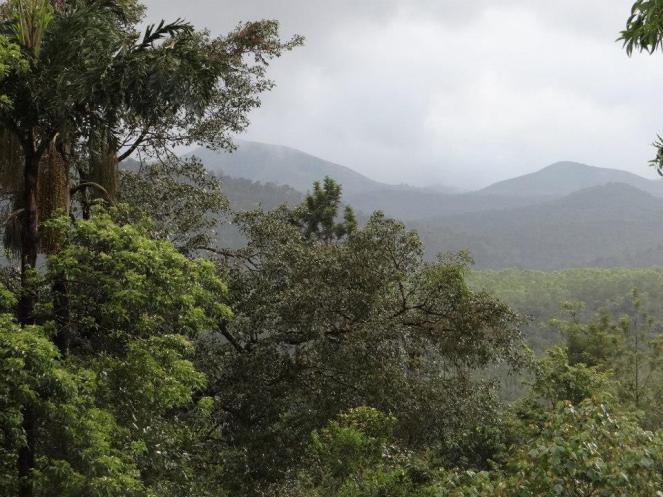
On Cumulative Impact Assessment of Sharavathi projects: http://wgbis.ces.iisc.ernet.in/energy/sharavathi/svati.htm

On impacts of Kukke I and Kukke II Hydel projects: http://wgbis.ces.iisc.ernet.in/biodiversity/pubs/ETR/ETR54/intervention.htm


-Parineeta Dandekar, Damodar Pujari


[1] Parts per trillion: 1 ppt= 10-12

Climate Change · Western Ghats

Climate Change in Western Ghats: 4X4 Report and Beyond

Background

“No country in the world is as vulnerable, on so many dimensions to climate change as India. We need to build our own independent and credible research capacity on these issues.”

-Jairam Ramesh, erstwhile Union Environment Minister in Preface to CLIMATE CHANGE AND INDIA: A 4X4 ASSESSMENT: A SECTORAL AND REGIONAL ANALYSIS FOR 2030s

As India is struggling to cope with the extent and scope of the Uttarakhand Disaster[1], it is high time that we take the very real and urgent challenges of Climate Change seriously. India has several regions and communities significantly vulnerable to climate change. Himalayan glaciers are receding faster than global averages, precipitation across India is becoming more intense and unpredictable, biodiversity is under stress, sea levels are rising affecting thousands of coastal communities. And despite all this, destructive development in fragile regions is happening with utter disregard to this reality.

Maximum impacts of climate change are being faced by local poor communities and ecosystems.

With this in mind, we take a look at 4X4 Climate Assessment report (4X4 Report for short), brought out in 2010 by Ministry of Environment and forests (MoEF) which assessed Climate Change impacts by 2030 on four ecologically sensitive sectors: the Himalayan region, Western Ghats (WG), Coastal areas and North-east regions of the country and four issues: Agriculture, Forests, Human health and Water together. We also look at other reports on climate change in Western Ghats and compare these with actual challenges faced by WG. Till date this report remains the only official and definitive report about assessment of impact of climate change in India, to the best of our information (Readers, please let us know if there are other relevant reports in this regard).

The report is prepared by Indian network on Climate Change Assessment (INCCA)[2], which consists of 120 Indian Institutes and research laboratories, geared towards data analysis and impact predictions of the climate change scenarios. The network was launched by MoEF on 14th October 2009. 4X4 Report was published in November 2010 when Mr. Jairam Ramesh was the Union Minister for Environment and Forests.

Athirappilly Falls 1

A1 B Scenario Predictions

The climate change impact predictions need the to assume of socio-economic context for which predictions are made. IPCC has classified socio-economic scenarios under A & B categories with further sub-divisions under each of them. 4X4 Report uses the A1B prediction scenario for India. This scenario assumes significant innovations in energy technologies, which improve energy efficiency and reducethe cost of energy supply with a balance across all sources. A1B assumes drastic reductions in power generation costs through the use of solar, wind, and other modern renewable energies and end use products.[3],[4].

Ironically, this assumption of A1B scenario for 2030 seems baseless when we look at the current dependence on non-sustainable energy sources like coal based thermal and large hydro.

PRECIS (Providing Regional Climates for Impact Studies)[5] tool used in this report considers data from large time scale of 5-7 decades in order to predict impact for coming 3-4 decades.

We look at Water in Western Ghats and what the Report predicts for this most populated biodiversity hotspot in the World.

1.       Western Ghats: The Water Tower of Peninsular India

Western Ghats (WG) are one of the oldest mountain ranges– older than the Himalayas- occupying around 6 % of Indian landmass. According to High Level Working Group Report on Western Ghats (HLWG/Kasturirangan Committee Report), geographical area of WG is over 1,64,280 sq. km. WG harbor high degree of endemism with more than 78% of amphibian and about 41% fish species[6] and similar high RET (Rare, endemic and Threatened) floral and faunal groups. They also support numerous tribal and forest dwelling communities. In 2012 UNESCO has declared 38 sites from Western Ghats as World-heritage sites. Most of the Peninsular east flowing or west flowing rivers originate from Western Ghats making it the water tower of peninsular India. Millions depend on these rivers like Krishna, Godavari, Cauvery, Malaprabha, Ghataprabha, Bhima, Tungabhadra for water and ecosystem goods and services. West flowing rivers are shorter and swifter. Examples include Vaitarna, Ulhas, Kali, Sharavati, Chalakudy, Pamba, Bharatpuzha, Nethravathy, Hemavathy, Bhawani etc. There are many complex community- water relationships which could be found in the region.

Rivers from Western Ghats drain almost 40% of Indian drainage. Therefore, it is essential to understand the impacts of the climate change on water resources in Western Ghats.

Pristine Forests set for submergence under the 24 MW Kukke Mini hydel Plant in Dakshin Kannada, Karnataka. Photo: SANDRP
  1. 2.       Predictions from 4X4 Report for Water and Western Ghats for 2030s

2.1   Precipitation and temperature:

In the Western Ghats, annual temperatures are likely to increase to 26.8 °C–27.5 °C in the 2030s. The rise in temperature with respect to the 1970s will be between 1.7° C and 1.8° C. The mean annual rainfall is likely to vary from 935± 185.33mm to 1794±247mm, which is an increase of 6%–8% with respect to the 1970s. The minimum temperatures may rise by 2.0 °C to 4.5° C, with minimum increase in those parts of Karnataka that lie in the Western Ghats. Within the region bordering the state of Kerala, the maximum temperature is likely to rise by 1° C–3° C.

The number of rainy days are likely decrease along the entire Western coast, including in the Western Ghats.

The intensity of rainfall is likely to increase by 1-2 mm/day.

2.2   Water yield, sedimentation the predictions for Western Coastal region, including the Western Ghats:

The west coast region exhibits a wide variability in the change in precipitation under the 2030s scenario. The northern portion of the west coast, consisting of areas of Gujarat and Maharashtra, shows an increase in precipitation for the 2030s scenario, and the increase varies from 4% to over 25%. However, areas of Karnataka and Kerala show a marginal decrease upto 4%.

The west coast region shows a general reduction in Evapotranspiration (ET), which varies from a very nominal value to about 5% for the 2030s scenario. Areas of Gujarat and Maharashtra, which had shown an increase in precipitation, still show a reduction in ET perhaps because of high intensity of the rainfall.  

The reduction in water yield for Karnataka and Kerala is up to about 10%. Gujarat and Maharashtra areas see an increase in water yield[7], and the magnitude is up to about 50%.

The west coast region also shows a considerable increase in the sediment yield for majority of the areas. Even those areas that are expected to receive less precipitation show an increase in sediment yield of up to 25%. The increase in sediment yield in these areas can possibly be explained due to an increase in the intensity of precipitation. This will have major impacts on water resource projects.

It is also seen that there is an increase in the moderate drought development for Krishna, Pennar, and Cauvery basins, which have either predicted decrease in precipitation or have enhanced level of evapo-transpiration. The maximum water withdrawal takes place from Godavari and Krishna river basins in Western Ghats in all the years[8]

2.3   Flood Analysis According to 4×4 Report, all the regions show an increase in the flooding varying between 10 to over 30% of the existing magnitudes. This has a very severe implication for the existing infrastructure such as dams for the areas and shall require appropriate adaptation and dam safety and operation measures to be taken up.

2.4   Impacts on crops:

a.       Coconut: Coconut yields are projected to increase by up to 30% in majority of the region. Increase in coconut yield may be mainly attributed to projected increase in rainfall (~10%) and relatively less increase in temperatures. However, some areas like south-west Karnataka, parts of Tamil Nadu and parts of Maharashtra, may lose yield up to 24%.

b.      Rice: Productivity of irrigated rice in Western Ghats region is likely to change +5 to –11% depending upon the location. Majority of the region is projected to lose the yield by about 4%. However, irrigated rice in parts of southern Karnataka and northern-most districts of Kerala is likely to gain. In the case of rain-fed rice, the projected change in yield is in the range of –35 to +35% with a large portion of the region likely to lose rice yields up to 10%.

c. Maize and sorghum: Climate change is likely to reduce yields of maize and sorghum by up to a whopping 50% depending upon the region.

Surprisingly, the report has no insights to offer to spice, coffee and tea plantation across Western Ghats. ( For impact of Climate Change on spices and plantations in Western Ghats: Dr. Latha Anantha and Unnikrishnan: https://sandrp.in/wtrsect/Water_Sector_Options_India_in_Changing_Climate_0312.pdf)

Plantations in Western Ghats Credit: Thinkstock


2.5   Impacts on forests:

The entire Western Ghats region is covered by 54 grids, out of which 10 (18%) are projected to undergo change. 18% forested grids in the region are projected to be vulnerable to climate change. The projection of the NPP (Net Primary Productivity) for the Western Ghats region is projected to have approximately 20% increase in NPP on an average.

2.6   Temperature Humidity Index (THI) and its possible impact on biodiversity:  While the report uses this index for studying analyzing impacts on livestock, its conclusions can also be used for biodiversity and fisheries. The report predicts “A severe thermal discomfort and stress is expected in most parts of Western Ghats and the Coastal region in the month of May.” This will not only affect the biodiversity, but also fisheries. However, the report makes no such correlation.

Seetha Nadi, free flowing river in Karnataka Western Ghats. Photo: SANDRP

3.       Limitations and Way Forward:

The report accepts its limitation in terms of data sources, details which have been gathered, lack of integration of existing data, etc. The authors seem aware that the report in this form is of little use to policy makers or communities.

4.       Conclusions:

While the report has its severe gray areas, and there are variations within Western Ghats, it is clear that for Western Ghats:

  • Precipitation will be more intense with less rainy days
  • Temperatures will see a gradual increase
  • Crops will be affected
  • Forests (and dependent biodiversity) will be made more vulnerable
  • Sedimentation will increase sharply
  • Incidence of floods and droughts will rise sharply

 5.       Problems with 4 X 4 Assessment:

Apart from the limitations admitted by INCAA, the report suffers several other limitations.

  • It does not offer any recommendations for policy makers.
  • Neither does it hold any recommendations for communities. In fact in its way forward, when it mentions that cooperation has to be sought from several departments and organizations, it does not even mention local communities who will face major impacts!
  • No mention of adaptation and mitigation measures that communities can adapt, except some very limited mentions. This is a huge gap. (More on Water Sector Options for India including a paper on plantations in Western Ghats can be found here:https://sandrp.in/wtrsect/Ex_Summary_WATER_SECTOR_OPTIONS_FOR_INDIA_IN_CHANGING_CLIMATE_MARCH_2012.pdf)
  • In the task of assessing impacts and devising solutions to mitigate and adapt to impacts of climate change, local communities have proved to be extremely adept. At the same time, the impacts of climate change affect these communities the most and hence they have to be made a part of ongoing research. 4 X 4 Report does not even attempt this.
  • Some big questions:

The report says that “The northern portion of the west coast, consisting of areas of Gujarat and Maharashtra, shows an increase in precipitation for the 2030s scenario, and the increase varies from 4% to over 25%. Gujarat and Maharashtra areas see an increase in water yield, and the magnitude is up to about 50%. As per the maps, this region also includes the Western Ghats.

Now Northern Western Ghats is exactly the same region where Indian Institute of Tropical Meteorology (IITM, also a part of INCA) has said that there have been drastic, ongoing reductions in rainfall!

In fact, Centre for Climate change, IITM has said that in the last 110 years (1901-2011) rainfall in Mahabaleshwar, origin of five rivers in northern Western Ghats has decreased by 800 mm! In northern Westenr Ghats of Maharashtra, rainfall has decreased at the rate of 2% per decade while the rate of decrease is lower in Southen Western Ghats for Kerala at 1%.[9]

This aspects needs some more clarity.

  • No reference to the ongoing destructive development in Western Ghats: Western Ghats are facing severe threat from Mining, Hydropower projects, Irrigation Projects, mini hydel projects, which affect water cycle, sedimentation, forests and biodiversity of the region and displacement and impoverishment of very large number of people. However, the report does not dwell on any of these practical problems and their impact in compounding climate change challenges.

    Mining in Goa Photo: Damodar Pujari
    Mining in Goa Photo: Damodar Pujari


  • No reference to biodiversity, freshwater fisheries: The report has no predictions or recommendations to offer for biodiversity in Western Ghats. While there is a section on coastal fisheries, there is no mention of rich freshwater fisheries in Western Ghats!


  • A1B Scenario: There is no evidence that India is adopting the A1B scenario which considers growth through a mix of energy sources like solar and wind, etc. We still depend heavily on non-sustainable energy sources like Thermal and large hydro. Hence, this assumption itself is flawed and predictions based on this assumption cannot be considered seriously. In fact, the actual predictions, looking at India’s and Western Ghat’s track record, (with over 10 coal based thermal power plants, several other nuclear power projects, ports and large dams coming up in Maharashtra, concentrated and non-sustainable mines in Goa) could be much more severe.

 6.       Impacts of climate Change on Western Ghats from Western Ghats Expert Ecology Panel report and High Level Working Group on Western Ghats Report:

  • Western Ghat Expert Ecology Panel Report: WGEEP does not refer to 4 X 4 Report. It considers A2 and B2 scenarios, and concludes that northern region of Ghats is more sensitive to climate change than southern region. Though the report does not deal with climate change in detail, the recommendations of WGEEP are extremely climate friendly.
  • High Level Working Group Report:  HLWG report has considered 4×4 Report in its analysis and includes a Chapter on Climate Change. This chapter is more effective in dealing with ground challenges than the 4×4 report. However there are some major problems in this.

The HLWG Report states:

a.       “Biodiversity: In the Western Ghats, climate change is expected to increase species losses.  Changes in phenology are expected to occur for many species. Ecosystems dominated by long-lived species (like forests in WG) will be slow to show evidence of change and slow to recover from the climate related stress

b.      Water, Irrigation and Hydro Power: Impacts of climate change and climate variability on the water resources are likely to affect irrigated agriculture, installed power capacity, environmental flows in the dry season, and higher flows during the wet season, thereby causing severe droughts and flood problems. “It is seen that there is an increase in the moderate drought development   for Krishna, Pennar, and Cauvery  basins, which have either predicted decrease in precipitation or have enhanced level of evapo-transpiration. The maximum water withdrawal takes place from  Godavari and Krishna river basins in Western Ghats in all the years.”

c.       Hydro capacity “is expected to increase, but its share decreases from the total installed capacity by 2100. The slow growth in capacity is due to barriers of high investment requirements and long gestation periods. A number of socio-environmental issues are related to dam construction, flooding of areas, damages to the ecology, and resettlement and rehabilitation of the population.”

Though HLWG dedicates an entire chapter to Climate Change Impacts on Western Ghats, it still does not comment on destructive hydropower projects and such other plans which decrease resilience and adaptation capacities of ecosystems and communities and in fact contributes to climate change by deforestation and methane emissions! In fact, by not opposing projects like 163 MW Athirappilly and 200 MW Gundia, the HLWG report supports projects which have huge potential on increasing climate change impacts[10],[11],[12]

Shockingly, the HLWG report certifies all hydro as green and renewable source of energy, something that even developed countries or UNFCCC does not do.

According to the Second National Communication on Climate Change (NATCOM, 2012), the Western Ghats is expected to experience increase in temperature regimes, rainfall and extreme events due to climate change. There is also a high probability of significant decrease in the duration of the precipitation (NATCOM, 2012). The projected changes in the precipitation may induce changes in the hydrological regimes especially increase in evapo-transpiration and increased runoff .

7.       Way Forward of Water, communities and ecosystems in Western Ghats

India has been witnessing several climate related disasters in the recent years. Instead of going into a ‘climate change or no climate change’ debate, it is time to adopt no-regrets strategies and build climate resilience of communities and ecosystems. Unfortunately, we do not see evidence of decreasing emissions or adopting climate friendly strategies from India, or even other developed countries which support and fun destructive projects in India.  The Clean Development Mechanism introduced by UNFCCC has in fact been supporting and pushing destructive projects in developing countries, while legitimizing pollution in developed countries.

 Some possible measures:

  • Natural ecosystems are resilient in coping with climate change challenges: natural ecosystems like rivers, streams, forests need to be protected for their resilience to climate change impact as well as the goods and services they provide to local communities, who are most vulnerable and least able to cope with the climate change implications.
  • Free flowing rivers are more resilient than their dammed counterparts: Free flowing rivers in western Ghats need to be protected on priority
  • Fragmented Forests are more vulnerable to climate change impacts: Deforestation and fragmentation of forests in Western Ghats should be avoided at all costs. Large Hydro power, irrigation projects, mini hydel, mines, hills station projects affecting forests should be dropped urgently. Local projects should be considered only with free, prior and informed consent of the communities. All projects related t the mega Inter Linking of Rivers in the western Ghats should be dropped, including Par Tapi Narmada, Damanganga Pinjal, Nethrawati, Hemawati, Pamba, Achankovil, among others.
  • Old and unsafe large dam projects like the Mullaperiyar and others should be considered for decommissioning as recommended by WGEEP.
  • The diversion of east flowing rivers to the west in Maharashtra should be reversed in a time bound manner and no more such projects should be considered.
  • All projects in Western Ghats: large or small should be brought under the ambit of environmental clearance which should look specifically at climate change impacts on these projects and should also require FPIC.
  • Community water harvesting systems, traditional water harvesting systems, watershed measures need to be encouraged. Western Ghats is rich in these examples
  • Efficient and water saving measures like System of Rice Intensification should be adopted for the entire Ghat region.
  • Recommendations of WGEEP need to be implemented urgently
  • Most importantly, communities need to be made an integral part of decision making surrounding natural resources. Currently, mega projects like Athirappilly, Gundia, Talamba and Tillari dams in Maharashtra, drinking water dams near Mumbai, etc. completely neglect community concerns. Communities will not only face direct impacts of displacement and losing rights, the long term impacts on adaptation and mitigation capacities of communities will also be jeopardized due to destructive projects.


Damodar Pujari

with inputs from Parineeta Dandekar

South Asia Network on Dams, Rivers and People


[2] INCAA- Indian Network for Climate Change Analysis.

[4] High Level Working Group Report, Part I, Page 20

[6] Western Ghats Ecology Expert Panel Group: WGEEP

[7] Water yield (water crop or runout). The runoff from the drainage basin, including ground-water outflow that appears in the stream plus ground-water outflow that bypasses the gaging station and leaves the basin underground. Water yield is the precipitation minus the evpotranspiration. (http://water.usgs.gov/wsc/glossary.html)

[8] HLWG Report, Part 1, Page 24