Above: Cover photo and map from NIDM report of Bihar floods 2007
Guest blog by: Dr. Dinesh Kumar Mishra
West Champaran district of Bihar is located in the Northwestern corner of the state and is surrounded by the Gandak and the Burhi Gandak along with their tributaries. Two of its blocks, Madhubani and Thakaraha, are located on the western bank of the Gandak and are adjacent to the Deoria district of Uttar Pradesh. There used to be a rail line connection between Chhitauni Ghat of Uttar Pradesh and Bagaha in Bihar. A bridge connecting these two towns was washed away during the floods in 1924 and the British Government did not restore this bridge as the train service was coming handy for the freedom fighters to travel to UP and vice versa. This bridge and the rail service were restored a few years ago. The administration of these two blocks (these are split into four now) is run from Padarauna in UP during the flood season as the blocks get thoroughly disconnected from Bihar. To prevent the westward movement of the Gandak and embankment named Pipra-Piparasi Ghat embankment (PP Embankment) was constructed in 1960s as the river has a tendency to shift towards the west and there is a constant pressure of the river on this embankment during the rainy season. At times, the safety of this embankment is threatened and there is long history of its breaches and the engineers of the Irrigation Department face a tough time maintaining the embankment. When the rail bridge was not there on the Gandak one had to go to Madhubani and Thakaraha by crossing the Ganga via Chhapra, Siwan and Gopalganj. Continue reading “Bihar Floods in 1987 – III – West Champaran”→
Above: The dried up Manjara Dam near Latur. Photo: Vivek Bendre, The Hindu
On the 16th of January 2016, when Latur City in the heart of Marathwada was receiving drinking water once in 15 days and when plans of bringing water from Ujani Dam, about 300 kms away were being mulled upon, I was standing on the wall of the Lower Terna Reservoir in Osmanabad, about 40 kms from Latur. The dam has been at dead storage for the past 3 years. There are a string of jackwells inside the dam, to take water to rural drinking water supply schemes in Osmanabad and Latur for Nilanga, Killari and recently Ausa in Latur and Makani and Omerga in Osmanabad. Water Filtration System which is supposed to supply drinking water to 14 villages in Osmanabad lies defunct for years, even as the Revenue Minister inaugurated a brand new system for Latur City. Villages supposed to receive water from the dead stock stay thirsty. This is also the same Lower Terna Dam from where water is being taken for the Latur city in tankers now.Continue reading “Latur Drinking Water Crisis highlights absence of Water Allocation Policy and Management”→
Above: Cover photo and map from NIDM report of Bihar floods 2007
Guest blog by Dr. Dinesh Kumar Mishra
Floods in East Champaran started following the heavy rainfall in the last week of July 1987. There was a sudden rise in the flood levels of the tributaries of the Burhi Gandak (Sikrahana) like the Sarisawa, the Tilawe, the Gaadh, and the Bangari leading to submergence of lower areas of Raxaul town where flood water of depth up to two to two and half feet was spread all over. This initial flood had also affected 25 Panchayats and 125 villages in the blocks of Raxaul and Ramgarhawa. The rains that set in on the 26th July, 1987 continued unabated and by the time of the beginning of August all the major rivers –the Gandak, the Burhi Gandak and the Bagmati were in spate. Road communication of Motihari, the district HQ of East Champaran, was disrupted fully in this very first spell of floods. There was three feet deep water passing over NH-28 near Chhapwa. The road to Bettiah and Areraj was too badly damaged to afford vehicular traffic to pass through. Road from Pipra Kothi to Siwan was already damaged much before the rains and its condition deteriorated further after rains. All the three rivers were flowing above danger mark on the 2nd August, 1987 and a vast cultivated area along with hundreds of villages came under a sheet of flood water of these rivers. The train service between Sugauli and Darbhanga was suspended because of flood water on the railway track. Continue reading “Bihar Floods in 1987 – II – East Champaran”→
Background Bihar faced the worst floods if its history in 1987[1], the records of which are yet to be bettered. In the preceding year of 1986 the flood was severe in many parts of Bihar but as the rainy season drew to close, the last October rains failed and a vast area of the State came under the grip of drought. Surprisingly, the districts cited for perennial floods like Saharsa, Purnea and Khagaria in the State were also hit by the drought. The year 1987, however, was worst for floods in Bihar (in addition to UP and W Bengal) while the rest of the country was facing one of the most severe droughts in the century. Many parts of the country were facing famine like situation while all the rain bearing clouds had moved toward Bihar. Traditionally, two days of continuous rains or a clear sky of the same duration during the rainy season signals floods or drought in the State and makes farmers apprehensive of the days to come. Continue reading “Bihar Floods of 1987-I”→
Promise of credible Irrigation Data remains unfulfilled yet again
Economic Survey Report of Maharashtra state for the year 2015-16 is out. For the Agriculture and allied activities sector, its findings are sad though not shocking. The sector has clocked negative growth rate of 2.7% and production of almost all Kharif and Rabi Crops has taken a hit following the second consecutive monsoon failure and 59.4% deficit.Continue reading “Maharashtra Economic Survey 2015-16”→
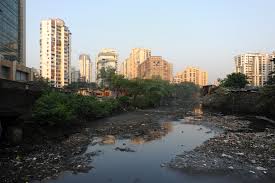
Above: Polluted, encroached and neglected water sources of Mumbai Source: visualwhiplash.com
The total dependency of urban areas on dams in faraway regions is a fairly recent phenomenon. Till the middle of nineteenth century, even important urban centers like Mumbai, Bangalore and Chennai used local water sources like shallow wells, tanks and rivers to quench the thirst of a concentrated population. British administration pushed dam building and long distance transfers in many cities like Mumbai. While dam building did quench the thirst of a growing population, and some of it spurred from acute water crisis like in the case of Mumbai in 1845, distant water sources and dams were instrumental in cutting the connection of the local residents with their water sources, which were revered and well maintained till then. In no time, wells in Mumbai were reclaimed, tanks in Chennai and Bangalore were encroached and Boalies and wetlands of Delhi disappeared. Urban centres became hopelessly dependent on large dams, away from the cities. Water supply and sanitation became someone else’s responsibility. The vestiges of a more independent water management can still be seen lying defunct and dilapidated in form of wells and tanks like Banganga in Mumbai, water channels of Pune, several tanks of Bangalore, Nugambakkam Lake of Chennai, Baolis of Delhi, etc.
Mumbai:Mumbai currently receives a supply of 3,750 MLD (million litres per day), while its usage is around 2,400 MLD. However, the requirementis projected as 4,200 MLD by officials and media based on an inflated figure of 240 liters per capita per day – used to justify construction of new dams. The requirement is projected to reach 6,680 MLD by 2041.
The Brihanmumbai Municipal Corporation (BMC) has proposed 4 dams to increase the water supply to Mumbai. Two of the proposed dams are the Gargai and Pinjaldams which are awaiting clearances. The dams are together expected to submerge 17 villages and 2850 ha forest land in a predominantly tribal region, with many areas falling under Schedule 5 of the Constitution. All the tribals from the affected villages are strongly against the project. More than 12 dams in close proximity are in various stages of construction in the same region and no cumulative impact assessment or even options assessment has been conducted so far. The Gargai and Pinjal dams will cost about Rs 16,000 crore and take 8 years for construction. They are expected to supply 440 and 865 MLD respectively to Mumbai. Read more about the projects here.
Watersupply lines for Mumbai Source: footage.framepool.com
The other proposed dams are part of the Damanganga-Pinjal river linkingproject which is being pushed by the union water resources ministry. The Union water resources minister Uma Bharati announced that the project is to be a national project, making it eligible for 90% funding from the Centre. The project is expected to cost around Rs 800 crore. It includes construction of a dam on the Damanganga River in Nashik district close to the Gujarat border and another dam across Vagh river in Mokhada taluka, Thane district. It proposes to direct surplus water from the Damanganga River in Gujarat via the 2 reservoirs to the Pinjal reservoir which is to be constructed by the BMC. The project is expected to bring 2,450 MLD to Mumbai.
Valley to be submerged by Bhugad Dam, part of Damanganga Pinjal Link Photo: Parineeta Dandekar
The project has beenstalled as of Feb 2016 as the Gujarat government wants a greater share of water from the Tapi River in return for increased share of water to supply to Mumbai. Maharashtra is already facing regional disputes over water in water starved Nashik, Ahmednagar and Marathwada. The Chief Minister had to promise the Assembly in March 2015 that “not a drop of water from Maharashtra will go to Gujarat”. Activists have objected that these regions would be adversely affected by the river linking project. The river linking proposals are already creating new conflicts.
Bangalore:To meet the growing demands of Bangalore city, Karnataka has proposed two dam projects across Cauvery near Mekedatu, in Kanakapura taluka in Ramanagaram district. The project is expected to help the state store 48 TMC (thousand million cubic feet) of water. Mekedatu is located about 110 km from Bangalore.
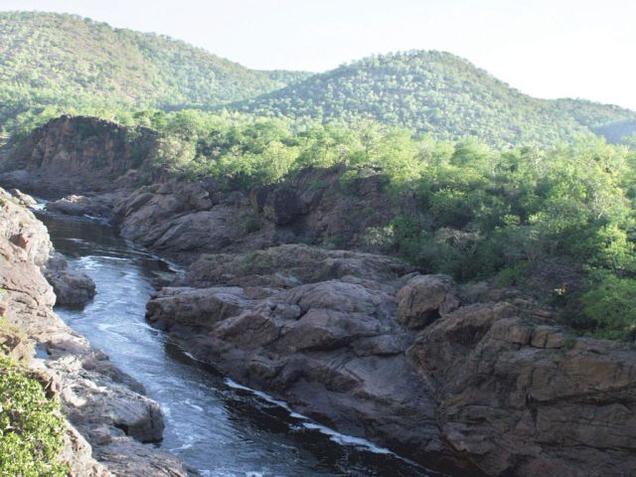
Near the site of Mekedatu Dam Source: The Hindu
In the March 2015 budget of Karnataka, the chief minister proposed preparing a detailed project report (DPR) for the project and Rs 25 crore was allotted for the same triggering a new round of conflict over sharing Cauvery water with Tamil Nadu.
Tamil Nadu says that the project is in violation of the final award of the Cauvery Water Disputes Tribunal. Tamil Nadu adopted a resolution urging the Centre to stop Karnataka from going ahead with the project and a bandh was observed. It has also moved the Supreme Court arguing that the reservoirs would result in ‘impounding of the flows’ of Tamil Nadu.
However Karnataka claims that the dams are within the rights of Karnatakaand that the project would act as a balancing reservoir and harness water otherwise flowing into the sea. The CM informed that his government wascommitted to implementing the Mekedatu dam project and it would face the issue legally. Similar show of political will in preserving wetlands of Bangalore city and implementing steps for water conservation would go far in improving water security of the city.
On June 18, 2015, the Karnataka Water Resources minister said that the Mekedatu project was being expedited and the DPR for the implementation of the project will be readied within three months (as opposed to the usual period of one year). The projects would be right in the middle of the Cauvery Wildlife Sanctuary. About 2,500 acres of forest area will be submerged. As the project is for potable purpose, it does not require environment clearance from the ministry of environment and forests (MoEF).
Hyderabad: Hyderabad is going to draw drinking water from Yellampally barrage in Adilabad district on the Godavari River. It is an ambitious project for the Telangana government bringing approximately 680 MLD of water to the city of Hyderabad. While the Godavari flows toward Eastern Ghats before draining into the Bay of Bengal, Hyderabad is located in another river basin, namely Krishna basin. Such water transfers can have many impacts, including floods and land sliding. A 186 km long pipeline would route the water from the Yellampally barrage.
Delhi: The Renuka dam project was proposed on the Giri River, a tributary of Yamuna, in Sirmaur district of Himachal Pradesh in 2008. The project was expected to supply 1,240 MLD water to Delhi and its surrounding areas.
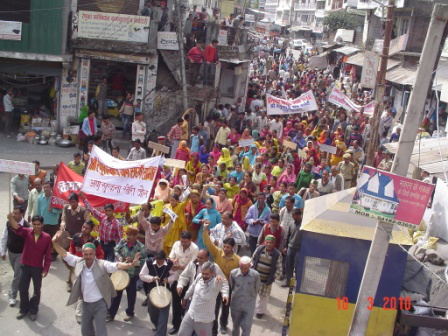
Protests against Renuka Dam Source: SANDRP Partners
After a prolonged controversy, the National Green Tribunal (NGT) on Feb 2, 2016 passed judgement in a case challenging the environmental clearance to the Renuka project, basically since Supreme Court in an earlier case had made some remarks about the project, as one can see from reading of the NGT order. The tribunal took grounds of national importance of the project and amount already spent on the project to allow it. Under the UPA government, the then environment minister Jairam Ramesh denied forest clearance to the project saying that the national capital should first fix its water distribution losses of over 45 %. “Delhi must learn to use the tougher options that are available. It cannot be a parasite on the rest of the country”, he said. The project is yet to receive forest clearance.
The NGT declined to stall the land acquisition proceedings for the dam by the State government since the Centre had declared the project as one of “national importance”. To execute the project, Himachal has acquired about 2,950 ha, including private agricultural and forest land despite protests of the locals. The state claimed that until Oct 2015, the Centre had not released any money to compensate farmers whose plots were taken over. 90% of the funding of the project is to be borne by the Centre as the project was declared a national project.
The project has been delayed for lack of clearances, support and funds. The total project cost which was initially estimated at Rs 3498.86 crore as in March, 2009 is likely to go beyond Rs 5,200 crore with delay in the execution of the project. In Nov 2015, Delhi Water Minister declared at India Rivers Day function that Delhi does not need water from Renuka dam, but very strangely, neither Delhi govt filed an affidavit to that effect before NGT, nor did NGT take cognizance of this public stand of Delhi Government.
Srinagar:Protests erupted in Chadoora area of Kashmir’s Budgam district on Dec 18, 2015 against a proposed water supply scheme sourced from Doodh Ganga River for Srinagar. People from twin constituencies of Chrar-e-Sharief and Chadoora fear the scheme will dry up half-a-dozen water supply schemes, already fed on Doodh Ganga. The protestors were worried that the projects would deprive them of irrigation and drinking water and also put them under risk of flooding. The protesters alleged that they had approached the officials to put forth their reservations, but nobody heeded their concerns.
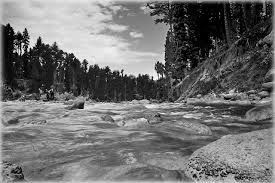
Dudh Ganga River Source: triphills.com
The executive agency, Jammu and Kashmir Economic Reconstruction Agency (ERA) claimedthat the scheme will benefit 3.5 lakh people and that there are no risks associated with it. The ERA said that more than Rs. 10 crore had been invested by the Asian Development Bank (ADB) and that the state would lose out future investment from ADB if Dhoodhganga water scheme were stopped.
Hundreds of protestors held demonstrations for a week. The protesters allegedly clashed with government forces while the forces retaliated by firing teargas shells and pepper gas. After days of massive protests and clashes, on Dec 24, 2015, the Jammu and Kashmir Government ordered temporary suspensionof the work on the scheme.
Big dams come at a huge social and environmental cost. Recurring costs of repair and maintenance are so much that they far outweigh the benefits. Urban areas can and should explore low cost local solutions and conserve water than solely rely on dams. Recent happenings bear witness to the drawbacks of building dams to supply water to cities.
Drought of 2015-16: As of Jan 2016, water levels are already very low in dams at many places across the country because of deficient rains in 2015. Water usage has to be rationed until the monsoons. Even in such times, urban usage is often not regulated and urban water supply is prioritized and comes at the cost of irrigation water for agriculture.
As of Jan 2016, reservoir levels in Gujarat are at a 10 year low. Rains last year were 23% less than normal and the state’s 202 reservoirs have only 24% usable water as compared to the usual 48% around this time of the year. The CM has declared that the water wouldonly be used for drinking purposes for the next 5 months and no water would be spared for agriculture until monsoons. In Porbandar town, water is provided once a week in several areas. Two main reservoirs that provide water to the area may go dry in a month. Drinking water crisis is expected to hit Saurashtra and Kutch badly.
The depletion of water table at the Lower Manair Dam on the Godavari basin in Karimanagar district, Telangana raised alarm in Jan 2016 as the reservoir provides drinking water to Karimnagar, Warangal and other places located close to the reservoir. The drought in the region has cast concerns over availability of drinking water for the coming summer season.
Water levels, as of late Feb 2016 have hit a record low in reservoirs on Krishna and CauveryRivers threatening drinking water supply to Bengaluru and other places in Karnataka, Telangana and Andhra Pradesh. Reservoirs in the Krishna basin have never been in such bad shape. The worst hit is Tungabhadra dam which has a storage capacity of 100.86 TMC while the available water at present is a mere 9.23 TMC. Cities like Hubli-Dharwad are getting water once in eight days, owing to the alarmingly low level in Malaprabha dam in Krishna basin. Farmers have been alerted in both Krishna and Cauvery basins that there will be no water release for irrigation, this summer. Despite the austerity measure, meeting drinking water needs will be difficult until monsoons fill up the reservoirs. Storage as of late Feb 2016 in the KRS reservoir supplying water from the Cauvery River is only 18.69 TMC compared to last year’s level of 32.84 TMC. While 2 TMC is dead storage (water which cannot be utilised), another 2 TMC of water will be lost due to evaporation over the next five months. Bengaluru alone requires 1.5 TMC water every month.
With no rainfall in the latter part of Jan 2016 and release of water for irrigation, storage in the Vaigai reservoir in Theni district, Tamil Nadu is fast depleting and has slipped below 50 feet (maximum level is 71 feet). The Vaigai dam provides drinking water to Madurai and it is anticipated that shortages might be experienced during April-May 2016.
Prior to the monsoons in 2015, it was reported that Panvelwas facing massive water cuts for 4 months, until rains came in the end of June 2015, as the Dehrang dam, the city’s primary source of water had dried up. The dam was constructed in 1964 and at present the city has a population over 1.11 lakh.
Reliance of urban areas solely on dam based water supply exposes them to seasonal shortages. As the summers are becoming hotter, longer and drier, dams lose greater amount of water to evaporation. Climate change is changing the rainfall pattern and has increased occurrences of intensely heavy rainfall and prolonged periods of drought. Dams also increase risk of flooding during heavy rains.
Flooding: More than 1,500 people, including 500 people from Ahmedabad city, were evacuated due to sudden floods in the Sabarmati Riverafter water was released from the Dharoi dam in Mehsana district, Gujarat, on July 30, 2015. Sabarmati water level dramatically rose after huge volume of water was released into the river from the dam due to heavy rainfall in the catchment.
Sabarmati Floods Source: Indian Express
Flooding is frequently seen during heavy rains when the rivers are already overflowing and surplus water also has to be released from dams. During 2015 monsoons, flooding also occurred in West Bengal after release of water from the Damodar Valley project and in Punjab after authorities opened the flood gates of the Pong dam in Himachal Pradesh.
The floods in Chennai in Dec 2015 were made worse by negligent operation of the Chembarambakkam reservoir in the outskirts of the city. Meteorological agencies had predicted heavy rains and advised the PWD and other bureaucrats to bring down the water level in the reservoir. However the proposal to release water was caught in bureaucratic red tape. From Nov 24 to Nov 30, when the city experienced little rainfall, outflow from the reservoir was limited, while storage levels were maintained at 85-88%. Orders to open the Chembarambakkam sluice gates were received only after the city was pounded with rain and the reservoir started overflowing. On Dec 1, following heavy rainfall, approximately 29,000 cusecs (cubic feet per second) was released in a short span of time into the already constricted Adyar River and into the waterlogged city. Much of the flooding and subsequent waterlogging was a consequence of these outflows and water level in many areas went up even after the rains stopped.
Accumulation of silt is another recurring problem with dams. The dam’s storage capacity reduces with silt accumulation. Removal of silt is economically unviable – desilting a dam might be as expensive as constructing multiple new dams. However, the structure itself is endangered due to silt accumulation – necessitating removal or increasing the storage level of the dam. Deterioration over time of material used to build the dam also necessitates repair.
Khadakwasla dam which had 4 TMC storage capacity and supplied water to 80,000 Punekars when it was constructed, was left with 2 TMC water storage capacity as of June 2015.
Environmental NGOs and socially aware groups have been working on desilting the dam removing a lakh truckloads of silt in the last 3 years. The Temghar, Panshet dams in Pune are also prone to loss of capacity from silting. While periodic silting by civic agencies is called for, it is also observed that the reason behind increased silting is deforestation and catchment destruction. An environmentalist working on Khadakwasla explainedthat over time the area around the dam has lost its green cover leading to a rise in the rate of silting.
The Central Water Commission (CWC) with assistance from the World Bank has initiated the Dam Rehabilitation and Improvement Project (DRIP) at an estimated cost of Rs. 2100 crore and progresswas reviewed on Feb 10, 2016. The project across seven states of India (Kerala, Madhya Pradesh, Orissa, Tamil Nadu, Karnataka, Uttarakhand, and Jharkhand) targets rehabilitation of about 225 dam projects and preparatory activities have been completed for 207 dams in collaboration with states.
Land acquisition and rehabilitation: The Thumbe vented dam on the Nethravati River is the primary source of water for Mangalore city. A new dam is being constructed at Thumbe to increase the height of stored water from present 4m to 7m. An estimated 386 acre of additional land would be submerged if water is stored up to that level. The construction of the new dam has been almost completed and the process ofland acquisition would be initiated soon. Strangely, the process of land acquisition is being initiated when the dam is almost completed.
In Jan. 2016, it was reported that Pune district has at least 800 pending cases of rehabilitation for the dam-affected that the district aims to clear during the year. The district has 25 dams. Besides rehabilitation and compensation, provision of civic amenities and basic infrastructure is also pending.
The rehabilitation process is often fraught with corruption. For instance, in the case of rehabilitation of Narmada dam oustees, activists have claimed that thousands of oustees have faced serious corruption in the rehabilitation process, thereby depriving them of their rights and rehabilitation benefits. The soon to be released report of the Jha Commission set up by the Madhya Pradesh HC to investigate corruption in the rehabilitation process is expected to reveal misappropriation to the tune of Rs 1,000 to 1,500 crore.
The recently reported issues related to dams reveal that they are an inefficient approach to urban water supply. Dams come at a high cost and the final expenditure is almost always in excess of what is predicted at the outset. Dam building also offers potential for embezzlement of huge amounts of money. Maintenance is again an expensive affair and is indispensable as they could otherwise lead to major disasters. They come at a huge social and environmental cost submerging agricultural lands, villages, forests and habitats of other species often against the will of the people they displace whose livelihoods are lost and life is altered permanently. Diversion of water is also at the cost of competing local demands for irrigation and domestic use. The burdens and benefits of such projects are distributed inequitably and cleave along the urban-rural, rich-poor social divide.
There is little appreciation of the huge costs involved and there is no incentive to conserve water among urban residents who are beneficiaries of the project. Often there is also lack of information regarding shortages on the supply side. Urban water supply can benefit more at lower costs and greater reliability from developing better water managing techniques such as rainwater harvesting, conserving and developing aquifers, protecting local water bodies and rivers, treated and recycling sewage and recharging groundwater. Groundwater is a much better storage option in times of drought, as it is not lost by evaporation. These require way less infrastructure and work along with nature than destroy it. However making sustainable use of groundwater requires disciplined planning and might not present chances for corruption that major dam projects do. It is sincerely hoped that the planners make this paradigm shift sooner than later.
Unless all available low cost and low impact options are exhausted, Dams are not water smart, climate smart or economically smart option for urban areas. Such projects should not be part of smart cities scheme.
Konkan is that narrow and spectacular strip of land encompassing coastlines, estuaries, lateritic plateaus, foothills of Western Ghats and dense forests, which runs from Maharashtra to Goa. Bound by the Arabian Sea to its west and the mighty Sahyadri ranges (Western Ghats) to its east, the region has a distinct and rich culture of folklore, performing arts, music, literature, culinary art. Konkan, its temples, rivers and forests have an entire Sahyadrikand of the SkandPurana dedicated to it. Several poems and songs have been penned about the beauty, the mystery and the people of this region. Many of our celebrated singers, poets and authors come from Konkan. Community conservation practices that thrive here include some of the most pristine Sacred Groves, Temple Tanks, Fish Sanctuaries and sacred trees.Continue reading “Large Dams in Konkan Western Ghats: Costs, Benefits and Impacts”→
Even as the Ministry of Environment, Forests and Climate Change has been sanctioning cascades of hydropower projects on here-to free flowing rivers in the Himalaya and North East India, Cumulative Assessment of the Impacts of these projects became a crucial area of concern. Over 70 dams are planned one after other for the rivers of the Upper Ganga Basin, 44 dams across the Siang Basin in Arunachal Pradesh famed for its pristine forests and biodiversity, 12 dams across the Lohit Basin, 19 for Subansiri basin. These are bumper to bumper projects, one starting where the other ends. Continue reading “Cumulative Impact Assessment documents not in public domain anymore? Letter to MoEF and CC”→
Above: A huge protest march against water release to Marathwada Photo: Zee 24 Taas
In 2015, with the change in the ruling party after 15 long years, Maharashtra had a massive opportunity to break free from the crisis-ridden and scam-ridden image of its water sector. Water and dams have been central behind the embarrassing loss of Congress-NCP government in the 2014 Loksabha elections. But could the ruling BJP government actually deliver such a “Paradigm Shift” as it likes to call it? Is there light at the end of the tunnel for the state that is facing not only management scams, but repeated droughts and extreme weather events?
Above: Water released from Bhama Askhed Dam for Ujani Dam, April 2013 Photo:Author
Today (14th January 2016) Maharashtra’s Marathi AgroDaily announces[i]: “ 3 TMC Water will be released from Bhama Askhed and Chaskaman Dam for Ujani Dam from tomorrow, 15th January 2016. Looking at the opposition to this by farmers in Pune district, the release will happen under strict police protection. Electricity to farm pumps near the river will be disconnected for 7 days between 15th-22nd January to avoid water theft”.






 SANDRP