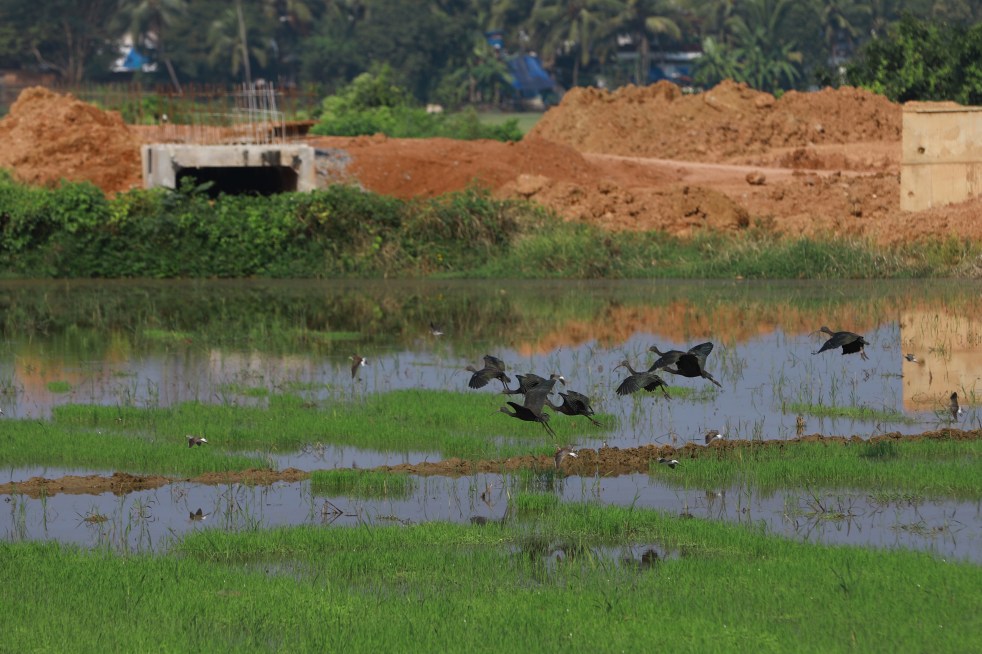
Marking the World Wetlands Day (WWD) 2026, this overview presents top ten interventions by judiciary to protect the wetlands in India during 2025 so far. Apart from this, there have been several wetlands protection related court cases going on across the country during the year and reports of some of the relevant matters can be seen here. The judiciary has also been pursuing cases pertaining to conservation of several Ramsar wetlands in the country as covered in the first part of the overview here.
With some comforting directions and some disappointing decisions, the various judicial interventions into protection of wetlands during 2025 have painted a mixed picture. For example, the SC March 2025 order asking Rajasthan govt to remove the concrete structures of the Ana Sagar lake area is quite remarkable and has also seen a positive outcome.
Similarly, the SC in Aug. 2025 directing UTs and state govts two-month time to complete the ground truthing and boundary demarcation of wetlands larger than 2.25 ha area appears reassuring. However, matter has been going on since 2018 and compliance to earlier interim orders have not been achieved.
The Madras HC in Oct. 2025 ordering disciplinary action against officers for approving public buildings on water bodies and the Gujarat HC in Sept. 2025 issuing contempt of court notices to concerned officials for prolonged failure to comply with court regarding pollution in waterbodies are cases worth mentioning.
On the other hand, the apex court’s ruling on Futala lake Nagpur in Oct. 2025 is quite problematic and suggests uneven judicial approach. Further, the Bombay HC approval in Dec. 2025 to cut 45,675 mangroves for a coastal road in Mumbai has sparked criticism for lacking public interest rationale.
1 Complete wetlands’ boundary demarcation in 2 months: SC Unhappy over the delay in the “ground truthing and boundary demarcation” of wetlands, the Supreme Court (SC) on Aug. 19, 2025 ordered states to complete the exercise in 2 months and warned that it would be compelled to pass coercive orders against non-compliant states. “We direct these States to expedite the ground truthing and boundary demarcation expeditiously and at any rate within an outer limit of two months from today, failing which, the secretaries of the concerned States of the Department of Environment and Ecology will have to personally remain present before this court on next date of hearing,” a Bench of Justice Aravind Kumar and Justice NV Anjaria said in its August 19, 2025 order.
The top court has been hearing a PIL by bird enthusiast Anand Arya, advocate MK Balakrishnan and NGO Vanashakti filed in 2018 on wetland conservation. Prior to 2017, the figures given by ISRO regarding the number of wetlands in India having an area of more than 2.25 Ha was 2,01,503. The latest ISRO data of the year 2021 reflected the figure having increased to 2,31,195. However, advocate Akash Vashishtha, appearing for intervenors Manu Bhatnagar and Vikrant Tongad, claimed that there were 5,55,557 wetlands.
The applications also called for protection of 24,24,540 waterbodies enumerated in the first Water Census conducted by the Ministry of Jal Shakti in 2023. Counsel Vashishtha argued that many small wetlands, including floodplain lakes, oxbow lakes, and coastal and inland lakes, were under severe pressure from encroachments.
The apex court said the Union of India shall coordinate with the State Wetland Authorities (SWAs) and expedite the issuance of notifications for which the draft notifications are already in place. “The statistics furnished would also reflect that wetlands, which are less than 2.25 ha, are required to be identified as prescribed under the extant rules and the affidavits of the SWAs of the state govts shall also delve upon as to the manner and method in which steps have been taken or being taken to protect these wetlands which are less than 2.25 ha, which according to the statistics is around 5,55,557 as mentioned in the Wetland Atlas”.
“In the light of the wetlands having been identified, it is incumbent upon the SWAs to publish the same in the respective State Govts’ website… Let the affidavit of compliance be filed immediately after such an exercise being undertaken and at any rate before the next date of hearing,” the bench said. Next hearing was on Oct 7, 2025.
2 Rajasthan How a city can become smart without protecting the water bodies: SC The apex court in March 2025 asked, in the context of Ajmer City in Rajasthan, how can a city become smart without protecting the water bodies/ wetlands? How cities will become smarter by encroachments on the water bodies and wetlands? The SC bench threatened the Rajasthan govt of contempt of court for non-compliance of order dated Dec 1, 2023 as also the order of NGT on Dec. 13, 2021.
The SC raised a very fundamental question that is relevant to all the cities across India as they are all guilty of allowing encroachments and destruction of local water bodies in their respective areas. This is a suicidal step as it has adverse impact on the cities in multiple ways and yet, most cities consider this smart and in fact get away with it. There is also no National Urban Water Policy guiding the cities solve the puzzle of multiple issues handled by multiple departments, including some by the local, state and central governments. This self-created mess in the cities comes handy for the various vested interests in encroaching more water bodies. The judiciary, so far has also not been effective in addressing this issue.
“In view of non-compliance with the order dated Dec 1, 2023, before we consider of initiating action under the Contempt of Courts Act, 1971, we direct the Chief Secretary of Rajasthan to appear before the court through video-conferencing on March 17, 2025″ said the court.
Will the encroachments in Anasagar lake be removed? Over the last about 4 years, very interesting events are playing out in India’s judiciary regarding the encroachments in Anasagar lake in Ajmer, Rajasthan. The first order from the NGT came to remove the encroachments from Anasagar lake in Dec. 2021, reiterated in Aug. 2023 as the encroachments were in violation of the environmental regulations and Wetland Rules of 2017.
Apparently, the state govt with investment of Rs 12 Cr was the biggest encroacher and the investment in the encroached land continued even while NGT order was awaiting implementation. The state govt appealed against the NGT order in the SC and the SC refused to stay the NGT order and subsequently, latest on March 17, 2025, stood by the NGT order and asked Rajasthan to remove the encroachments.
As far as wetlands protection in India is concerned, the events here have a mix of tragedy, comedy, tragicomedy, among other genres. It will be interesting to see where this sequence of events ends. The bench led by Justice Abhay S. Oka dismissed the govt’s concerns that it had already invested Rs 12 cr in developing the park, which attracts about 2,500 visitors daily.
The SC ruled that the area surrounding the lake must be cleared, necessitating either the relocation or demolition of the seven replicas. The state had contended that the structures and pathways of the Seven Wonders Park serve as a public utility. The bench also asked the state to submit detailed plan in the next hearing on April 7. According to this report, the state govt had started removal of encroachments since March 10 2025. This is welcome development.
Ashok Malik, the petitioner emphasized the need for a concrete plan of action. “This project, which cost approximately ₹58 crore of taxpayer money, is both illegal and unjust,” said Malik.
SC approves development of 2 new wetlands near Ajmer Hearing the matter further, the SC on May 16, 2025, gave its approval to the state govt’s comprehensive proposal for developing two new wetlands, spanning a total area of 22 ha, near Ajmer. The proposed wetlands will be developed at two locations: a 12 ha. site at Foy Sagar (Varun Sagar) Extension near Hathi-Khera and a 10 ha. site at Tabiji-1. Both locations will be situated outside the Ana Sagar Lake’s catchment boundary.
The decision followed a comprehensive environmental assessment conducted by the National Environmental Engineering Research Institute (NEERI), appointed by the Ajmer Municipal Corporation. NEERI’s recommendations include detailed implementation steps such as excavation work, native species plantation and regular monitoring of water and sediment quality. The institute has also advised conducting biodiversity assessments during pre-monsoon and post-monsoon seasons.
Demolition begins at Ajmer’s Seven Wonders Park Acting on SC’s March 18, 2025 directions, the Ajmer Development Authority (ADA) started tearing down the popular spot ahead of the Sept. 17, 2025 deadline in the district administration’s affidavit. This comes after the SC gave six months for its demolition while hearing concerns regarding construction in the wetland and green belt surrounding Anasagar Lake. The court also ordered the administration to take down the food court at Luv-Kush Garden in Vaishali Nagar by April 7, 2025. However, despite the court’s directions, one statue was moved, with officials claiming that only one company had put forth their bid when tenders were floated.
3 Tamil Nadu HC orders disciplinary action against officers who granted sanction for public buildings on waterbodies The Madras HC was considering a PIL pertaining to the new buildings of the Primary Health Centre and Panchayat Office on the land which has been recorded as water body. The Court noted that it was stated in the Counter Affidavit that on the land in dispute, the Primary Health Centre is being run since many decades and the public interest litigation was filed only when the dilapidated building was demolished and new structure was raised. It also found from the counter that on this land, which is recorded as Karikulam, there are as many as six structures, which accommodate public buildings used by the people at large. It thus directed the State to submit appropriate proposal for shifting of these buildings so as to clear the water body, within eight weeks.
The Court further directed that in the meantime, the remaining area of Karikulam shall not be allowed for raising any construction whatsoever. “We find that, in many cases, various public buildings are being constructed on water bodies. Such constructions obviously must have been permitted by an authority, under his sanction, without verifying from the records as to the nature of the land”, the Court observed. Next hearing on Dec 3, 2025.
4 Gujarat Officials face contempt notice over water pollution The Gujarat HC issued contempt of court notices to four IAS officers and Dholka town’s chief officer for their prolonged failure to comply with court orders regarding pollution in waterbodies of nearby villages. The bench of Justice A S Supehia and Justice L S Pirzada issued notices on Sep. 25, 2025 for contempt proceedings against Gujarat Pollution Control Board (GPCB) chairman R B Barad, Ahmedabad district collector Sujeet Kumar, commissioner of municipalities and managing director of Gujarat Urban Development Co Ltd (GUDCL) Remya Mohan and its chairman M Thennarasan, and Dholka’s chief officer Prarthana Jadeja. As the lawyers representing these officers sought time to take instructions from the officers, next hearing was on Oct 3.
5 Jharkhand HC orders officials to ensure no encroachment around water bodies The HC on July 29, 2025 ordered state govt officers and the authorities in Ranchi to ensure that encroachments are removed from the water bodies. The court ordered that the areas around the water bodies should be converted into a “no-entry zone”. Barbed wire fencing should be erected in those places to prevent encroachment, the bench said. The orders were given to secretaries of the water resources and urban development departments, besides the Deputy Commissioner and the Ranchi Municipal Corporation administrator.
The officers appeared before the HC in person on a previous order of the HC and were directed to take immediate steps to remove all encroachments from the catchment area of various water bodies in the capital and across the state. The HC was hearing a PIL filed by advocate Khushbu Kataruka who presented the sorry state of affairs of the Ranchi Lake in the heart of the city. The lake also known as Swami Vivekanand Sarovar and popularly known as the ‘Bada Talab’ has suffered due to lack of upkeep by the Ranchi Municipal Corporation. The court ordered the govt to file a detailed affidavit in the matter, informing about the steps taken to secure the catchment area of the water bodies. Next hearing on Aug 22, 2025.
HC orders removal of encroachments from water bodies The HC on Dec. 15, 2025 directed the state govt to free water bodies in the state capital from encroachments. The court was hearing a public interest litigation filed for upkeep and removal of encroachment from water bodies in the state capital and the state. While hearing the case, the court was informed that steps were being taken for removal of encroachment from the Kanke, Dhurwa, and Getalsud Dams. However, the court was not convinced with the progress shown by the govt and observed that it should not adopt a pick and choose method to remove encroachments. The court also said that people responsible for creating encroachments in water bodies should also be dealt with severely. The HC ordered the govt to produce the report of experts for removal of garbage and silt from the Ranchi Lake.
6 Haryana Govt to demarcate 1.8k wetlands after SC ultimatum The state govt asked all deputy commissioners to complete ground verification and digital boundary demarcation of 1,881 wetlands across the state in two weeks. The directive came after a SC ultimatum. The SC orders on Aug 19 and Sep 19, 2025 had cautioned that environment secretaries of states that don’t comply with the directive will be required to appear before it on Oct 7, 2025.
District administrations were sent a list of 1,881 water bodies on Sept 01, 2025 for verification and boundary marking. The total wetland area in Haryana grew from 33,649 ha in 2017-18 to 36,984.5ha in 2023-24, marking a 10% increase of 3,335.5ha. This growth is largely due to the creation and expansion of human-made wetlands, such as artificial ponds, tanks and waterlogged areas, as per a report titled “Indian Wetlands: High Resolution Remote Sensing Assessment and Analysis” by SAC.
7 Telangana HC refuses to grant relief in Bathukamma Kunta lake land dispute The HC on July 8, 2025 refused to grant any interim relief to a petitioner who claimed that land in his possession is now submerged and located inside the recently restored Bathukamma Kunta lake in Hyderabad’s Bagh Amberpet area. While the petitioner contended that the disputed land was only a low-lying area that was dug up further and subsequently collected rainwater to form a lake, the HC looked at recent photographs of the lake restored by the Hyderabad Disaster Response and Assets Protection Agency (HYDRAA) to refuse interim relief to the petitioner. The core of the argument is that if the land was never legally acquired, the govt has no right to alter its classification or ownership status in official records or planning documents.
8 Tamil Nadu NGT flags concerns over real estate project near Madambakkam Lake The NGT on Jan 7, 2025 flagged concerns over a real estate project bordering Madambakkam Lake. It had received a private complaint on the matter. The bench directed the state govt pleader D Shanmuganathan to verify whether the project secured all approvals and if so, the ground on which the approvals were granted. A representative of Ocean Lifespaces Private Limited, which is developing the project, measuring 14.5 acres, said they have received planning permission from the Chennai Metropolitan Development Authority (CMDA) and were in the process of obtaining Real Estate Regulatory Authority (RERA) registration.
Hearing the a suo motu case pertaining to the issue in Nov. 2024, the NGT noted that the TNPCB had issued a show-cause notice to the civic body in July 2024 but the Commissioner has not responded to it. There has been no response from the Commissioner – Tambaram City Municipal Corporation though. They have neither given a plan of action pursuant to the directives of CPCB nor have responded to the TNPCB, the bench observed.
The bench added that if the action plan and the progress of the plan are not furnished before the next date of hearing (Dec. 20, 2024), the Tambaram Corporation should pay a fine of Rs 10,000. “If no action is taken, the same will also be viewed very seriously, and the Tambaram City Municipal Corporation will have to pay a heavy penalty,” the bench said.
Madambakkam lake full of sewage, hyacinth As per Feb. 2025 report, the Madambakkam Lake, covering over 250 acres, once a drinking water source, is now sewage-ridden and marred by unchecked growth of hyacinths. Additionally, there is illegal dumping of garbage, including plastic and meat waste. In 2024, the CMDA floated a ₹10-crore tender to restore the lake and transform it into an eco-park, but nothing has changed. The issue was raised in a NGT case. CMDA, however, is yet to submit updates on the project. Activists are now demanding that civic agencies drop their plan to build an ecopark. Residents say they often see tankers illegally dumping sewage into the lake.
Prevent contamination of Madambakkam lake: NGT On June 3, 2025, the NGT directed the Tamil Nadu Pollution Control Board to ensure that there is no further contamination of the Madambakkam lake. It has also told the board to inspect the area around the waterbody and ensure that individual residences or commercial buildings were not draining their sewage directly into the lake.
Hearing a suo motu case about reported supply of contaminated water from Madambakkam lake for drinking purpose, the bench directed the secretary of Municipal Administration & Water Supply to get an appropriate report as to the status of the DPR sent by the Tambaram City Municipal Corp & regarding the wetland status of the Madambakkam lake.
During the hearing, Tambaram Corp informed that for providing UGSS (underground sewer system), a DPR was drawn up and submitted to the govt for administrative and financial sanction of Rs 1,241.32 cr. “Only upon getting a sanction, the project will be taken up following the Tender Transparency Act procedure. Thereafter, it may take 24 months for them to complete the project,” the civic body said.
Tambaram seeks 1,241 cr for UG sewage project While Tambaram corp cited a pending detailed project report, the NGT observed that no updates were received on earlier directions, including one from Jan. 2025 to submit building permits and environmental clearance details for the same site. The collector was also asked to verify whether the Madambakkam lake features in the National Wetland Atlas — a detail critical to determining protection under wetland rules. With no water treatment plant in place and residents still dependent on overhead tank chlorination, the NGT has warned of stricter action if further delays persist.
Instead of waiting for the 1,241 cr, the govt should clear the 14.5 cr proposal for intercepting and diverting sewage outfalls around Madambakkam lake through peripheral channels, along with the 3.5 MLD sewage treatment plant — a plan submitted by Tambaram corp nearly 7 months ago, said Dayanand Krishnan, a resident-activist. The 4.6 cr proposal for a water treatment plant should also be prioritised, he added.
Amid this, the SWA requested an immediate action taken report from district authorities regarding the protection and management of Madambakkam Lake in Chengalpattu district. The direction came in the wake of multiple petitions filed by local residents and environmental activists raising concerns over sewage pollution, encroachments, and developmental threats to the waterbody. The NGT had scheduled the next hearing for July 3.
9 Maharashtra HC approval for cutting 45675 mangroves for road that does not make public interest sense The uproar against the Govt of India and SC on Aravalli and stay on the decision by the SC is welcome. However, similarly absurd decision of the Maharashtra Govt, approved by the Bombay HC on allowing cutting of 45675 mangroves in Mumbai’s northern stretch for a coastal road that makes no public interest sense did not invite similar reactions, as highlighted by the Question of Cities.
The absurdity multiplies when we note that the compensatory afforestation for the mangrove destruction will happen in faraway, land-locked Chandrapur district. It’s disturbing how the HC agreed to such a proposal that clearly has no backing of science, public interest or understanding of climate science or even climate change.
The 26 km long road, costing Rs 20 000 Cr is the extension of the coastal road from Versova to Bhayander in the suburbs; the coastal road is being built in sections in the Arabian Sea to reduce travel time mainly for private cars or semi-private transport like taxis. It’s a case of public money, private gain. But its ecological cost has hardly been counted. On its own strength, the project makes little sense. Factor in the destruction of the vast stretch of mangroves – a coastal city’s bulwark and natural barrier against floods, sea level rise, erosion, rising incidences of cyclones – and the coastal road looks ludicrous.
10 Maharashtra Man-made waterbody cannot enjoy protection of a wetland: SC The apex court on Oct. 07, 2025 held that an artificial lake or man-made waterbody cannot enjoy the statutory protection of wetlands but every government is bound to protect it under the salutary principle of doctrine of public trust in the larger interest of promoting ecology and environment. The court passed the order while deciding that the Futala lake in Nagpur is a man-made waterbody and permitted constructions in and around the lake that provided for a plaza, floating restaurant, musical fountain, viewers gallery among other facilities.
A bench of justices K Vinod Chandran and NV Anjaria concluded that the Futala Tank, also known as Telangkhedi Tank, was constructed in the year 1799 with a catchment area of about 200 ha by the then ruler of Nagpur to cater to irrigation needs. The SC upheld the decision of the HC by declaring that the Futala Lake is not a ‘wetland’ as defined in Rule 2(1)(g) of the 2017 Rules as this definition excludes manmade water bodies & those created for irrigation.
The HC recognized Futala Lake as not a statutory wetland but applied environmental principles to protect it directing to not raise any permanent structures and allowing sanctioned projects to proceed with strict safeguards against ecological harm. Challenging the HC’s decision, the NGO moved to the SC, where the HC in Jan, 2024, had ordered the status quo on construction of temporary structures in and around the Futala Lake and sought the response from the State Govt on the status of ‘temporariness’ of the structures concerned.
The judgment went on to state, “All those man-made or artificial bodies created from natural resources which contribute to the environment and are eco-friendly in their existence, have to be subject to the doctrine of public trust.” Swacch Association’s claim was rejected by the Bombay high court’s Nagpur bench on July 5, 2023 against which they approached the top court.
SANDRP
Also see
WWD 2026: Top Ten Reports on Our continued Failure to Identify, Protect Wetlands
WWD 2026: Govts Wetlands Protection Actions mostly fail to convince

 SANDRP
I liked how this post balances regulation with usability.The linked article shows how parking permit management software supports both sides. It gives a realistic view of modern parking permit systems.
LikeLike