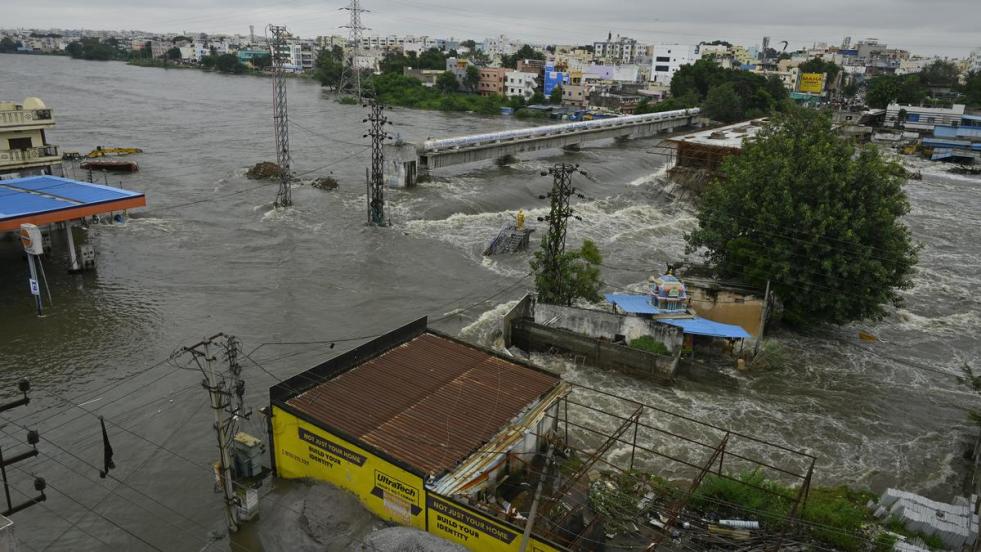
(Feature Image: The Musi river in flood spate in Hyderabad on Sept 27, 2025 following incessant rains and the lifting of gates at the overflowing Osman Sagar and Himayatsagar reservoirs. Credit: Nagara Gopal )
In 2025, we could find reports on two Indian cities facing the impact of dam induced floods. While the excessive discharges by Himayat Sagar reservoir severely inundated residential areas along Musi river in Hyderabad in last week of Sept 2025, the significant releases by Ukai dam authority into Tapi river affected daily life in Surat city twice in mid Aug and first week of Sept. 2025.
After the deluge in Hyderabad, the concerned citizens and affected residents demanded compensation from govt claiming the untimely releases by Himayat Sagar reservoir impacted over 6000 families in the city. Before this, the mismanagement of dams has created flood deluge in the city in July 2022.
Notably, the two citizen groups reports released in July 2025 have also found mismanagement of Ukai dam for creating devasting floods in Surat in Aug 2006 which is known among worst deluge spells inundating about 80 percent of the city for four days. The reports are based on ground investigation and RTI data on Ukai dam discharges. Strangely, 19 years after the flood disaster there is no conclusive report from two-member committee set up by the govt then.
RTI response have also revealed significant mismatch between actual water releases and official figures for Khadakwasla dam which resulted in devastating floods in Pune in July 2024 killing at least three citizens. In national capital the role of 3 barrages is under the dock for creating unusual floods in Sept. 2025 like happened in July 2023. Similarly, the opaque operation of Okhla and Gokul barrages could be reason behind abnormal floods in Noida, Faridabad, Mathura and Agra cities in these years apart from floodplain encroachment.
Hyderabad Sept. 2025: Compensation demand for Himayat Sagar release affected Members of Hyderabad Civil Society, along with affected residents from several flood-hit localities wrote to the Telangana govt with grave concern and deep anguish over the sudden and large-scale release of floodwaters from the Himayat Sagar reservoir on the night of 26 Sept 2025 around 9:00 pm and demanded compensation. This unannounced release caused catastrophic flooding across Moosa Nagar, Vinayak Veedhi, Kamal Nagar, Rasoolpura, Shankar Nagar, Shivaji Bridge, Purana Pul, Kishan Bagh, Moghal Nala A & B, Defence Colony, Langar House, Jiyaguda, Attapur Bridge, Hashim Nagar, and surrounding areas, directly affecting over 6,000 families, the letter says. The lack of timely warnings, coordination, and precautionary measures devastated homes and livelihoods, they wrote.
Sudden release floods houses along Musi For residents of Moosanagar and Vinayakaveedhi Rasoolpura, and Shankar Nagar areas located on the banks of the Musi River in Hyderabad, water inundating their houses isn’t a new occurrence. But on the night of September 26, they were caught off guard as water released from Osmansagar and Himayatsagar reservoirs gushed into their houses. They claim that they had no prior information about it. The flood water didn’t just submerge the new bridge of Chaderghat, but also the bastis located on either side.
Musi leaves behind destruction trail Water enters 200-300 houses, and many are completely submerged. Many residents say they were not alerted about water release from two reservoirs. In the city’s main bus station, about 2,000 passengers were evacuated using ropes.
Hyderabad flood: Whose tears, whose prospect? The recent flooding caused by the Musi River in Hyderabad made thousands homeless and destitute. However, the primary reason for the flood was not heavy rains but officials releasing huge quantities of water from Himayat Sagar and Osman Sagar — without warning, by opening all gates at once, releasing 30,000 cusecs of water. (N Venugopal)
The release of a large volume of water from the twin reservoirs was necessitated by the alarming rise in water levels due to incessant monsoon rains. GHMC officials stated that 12 of the 15 gates at Osman Sagar and 9 of the 17 gates at Himayat Sagar were opened to prevent dam breaches. The sudden surge in water flow caused the Musi River to overflow, inundating areas like Moosarambagh, Falaknuma, Malakpet, Bahadurpura, and making roads impassable near Chaderghat Bridge. Floodwaters entered the MGBS premises, disrupting bus operations and trapping numerous passengers who were evacuated by the NDRF.
According to officials, the twin reservoirs were almost filled to the brim, forcing authorities to release nearly 35,000 cusecs of water, for the first time in the last two decades. The sudden release of water swelled the Musi River, inundating several low-lying settlements.
Hyderabad July 2022 Floods Informative piece by Dr Narasimha Reddy Donthi highlighting how mismanagement of dams has resulted in avoidable flood damages in Hyderabad in July 2022. Also shares information on similar floods in the city in July 2021 and Oct. 2020: -Floods in Hyderabad downstream of these twin reservoirs were visible and enormous on 26th July, and not in the week ending 13th July, wherein the rainfall was larger. This contradictory situation needs explanation. Normally, for any reservoir floods are defined by the storage levels and the inflows. If the inflows are steady and higher, outflow of water is allowed by lifting the gates, even while the peak storage levels are maintained. For the twin reservoirs, storage level was 5.384 on 13th July, when the rainfall was heavier. On 27th July, storage level was 6.418 when the rainfall was lower than earlier episode. With higher rainfall, inflows should have been higher in 2nd week of July than in 3rd week of July. In entire July, storage levels of the twin reservoirs never peaked to the storage capacity. Yet, gates were opened before the full capacity enabling higher outflows in 3rd week of July, than in 2nd week of July.
As alleged by Dr. Lubna Sarwath, there is heavy data fudging by HMWSSB. Inflows from the rainfall in 2nd week of July increased the storage levels in the reservoirs. In 3rd week of July, HMWSSB lifted the gates to enable outflow, expecting adverse backwater effect on the encroachments, high-end residential areas and unauthorized layouts in the 10 km radius. By doing so, it has compromised the safety of poor housing colonies along the Musi River.
In 2021, on 22nd July, 2 gates of Osman Sagar and 5 gates of Himayat Sagar were lifted to prevent flooding of constructed area, upstream of the reservoirs. Again, on 4th September, 2021, 4 gates of Osman Sagar were lifted. Earlier, in October, 2020, 13 gates of Himayat Sagar had to be lifted to release 15,000 cusecs of flood water.
Another baffling factor is that the catchment area of Himayat Sagar is bigger than Osman Sagar. Rainfall in Rangareddy district mandals which fall in the catchment area of Himayat Sagar received higher rainfall than in Vikarabad district, which largely falls in the catchment area of Osman Sagar. However, in recent years, gates of Osman Sagar are being lifted more frequently and at a higher height than Himayat Sagar.
This also indicates that a full tank level Osman Sagar is hurting the influential more than FTL of Himayat Sagar. Gandipet reservoir capacity is decreasing with encroachments. With heavy rainfall, destruction of watershed and streams in the catchment area, loss of soil strata, destruction of hillocks, devegetation and deforestation, inflows into Osman Sagar are likely to increase. With the number of extreme weather events likely to increase, management of twin reservoirs needs to be more professional, following principles of water management, equity and justice.
Oct. 2020 flood: In addition to dams, the unplanned urbanization, encroachments of water bodies, poor urban infrastructure and preparedness have been blamed for Oct. 2020 flood disaster in Hyderabad city.
Surat Overnight rainfall inundates low-lying areas Due to heavy overnight rainfall, many low-lying areas of Surat were inundated with rainwater on Sept 5. Meanwhile, the Ukai dam authorities discharged over 1.62 lakh cusecs of water into the Tapi River, prompting Surat Municipal Corporation to close three floodgates to prevent river water from entering the city. In the afternoon, an advocate, Surat resident Feroz Pathan (50), jumped into the Tapi river from the cable-stayed bridge near the district court building.
Surat City’s Chief Fire Officer Basant Pareek said, “The search is on to find the body of the advocate. The body may have been washed away.” The water level recorded in the Ukai dam on Sept 5 was 337 feet, 3 feet short of rule level. On Sept 5, the usually narrow Tapi river was seen filled to the brim and flowing in full sway.
Ukai level near rule, huge inflows expected Ukai Dam authorities started the release of water. For the first time this monsoon all four 75 Mw hydropower turbine units became operational. Total discharge from the dam was around 24,500 cusecs. The water level reached 334 feet on Aug 18, a foot below the rule level of 335 feet for the second half of August. Inflows rose above 80,000 cusecs. Of the dams in Maharashtra, Hatnur released 53,855 cusecs and Prakasha 48,197 cusecs.
On Aug 20, nine gates of Ukai dam were opened (7 gates by 7 ft and 2 gates by 8 ft) to release 1.25 lakh cusecs, ten villages in the downstream were put on alert. Inflow was 1.39 lakh cusecs. Water level in Ukai dam reached 334.77 ft. Haripura causeway in Bardoli was submerged.
According to this report on Aug 19, 2025 at around 11:00 am: gates of Tapi Dam were opened for the first time in this monsoon, 8 of them by 5 ft and one by 4 ft, releasing 98739 cusecs. Water level at the dam is 334.64 ft, with inflow of 1.27 lack cusecs.
The release of 1.25 lakh cusecs of water from the Ukai dam (report dated Aug 20) caused the river to overflow its banks, the entire district was put on red alert for the next 48 hours. Once a vital link for daily commuters, the weir-cum-causeway connecting Rander and Singapore was submerged under a raging torrent of water. The danger level for the causeway is 6 meters, but it was overflowing at a dangerous 8.32 meters.
The continuous flow of water from the Ukai dam sent alarm bells ringing among authorities. Parts of the city, including Katargam, Dabholi, Vedroad, and Singanpur, were struggling with knee-deep water. Local shopkeepers and motorists were facing immense hardship as roads became impassable, disrupting traffic and daily routines. The city grappled with a waterlogged situation that threw daily life into chaos.
Citizens’ reports indict govt for Aug 2006 floods The floods of August 2006 are among the worst Surat city has experienced in recent times. The sudden release of a huge amount of water from the Ukai dam led to over 80 per cent of Surat going under water. More than 2 million people were incommunicado–trapped in their houses without food and drinking water for four days and four nights. While the state govt described the floods as a natural disaster, experts had a different version.
They claimed the govt was responsible and set up two people’s committees after the flood to examine the situation. Both–the People’s Committee on Gujarat Floods of August 2006 and Surat Citizens’ Council Trust’s Committee–have released their reports, indicting the govt. The former was set up by two ngos, Narmada Abhiyan and Gujarat Sarvodaya Mandal, with a former acting chief justice of the Gujarat High Court R A Mehta as chairperson. The latter had nine members, including engineers, architects and social scientists.
According to the report of the people’s committee, released this July, the flood was largely caused by gross mismanagement of Ukai dam operations and could have been averted, or minimised, if the authorities had taken note of the signs of an approaching flood and released water from the dam promptly. The committee, in its report, also said that the state government had worked against the forecast of the CWC. The district collector and the municipal commissioner had sounded the alarm bells, but were ignored.
The Surat citizens’ committee has also found mismanagement of the Ukai dam waters, from data obtained under the RTI Act, 2005. Other experts, too, are saying that the floods were clearly human-made. The state govt has set up a two-member commission to enquire into the floods but it has not submitted a conclusive report yet.
Pune RTI reveals negligence behind July 2024 flood disaster The devastating floods that hit Pune on Jul 25 2024 were not merely the result of heavy rainfall but also stemmed from the negligence of certain officials. Excess water discharged from the Khadakwasla Dam triggered extensive flooding, submerging residential neighborhoods, displacing families, and tragically claiming the lives of three young men in Pulachi Wadi. In the wake of a startling revelation obtained through the RTI Act, Republican Bahujan Aghadi president Kishor Kamble has called for the dismissal of the implicated officials and the initiation of culpable homicide charges against them.
The RTI report revealed a significant mismatch between the actual water released from the Khadakwasla Dam and the figures provided by Shweta Kurhade, the Executive Engineer of the Khadakwasla Irrigation Division. While officials and the media were told that 35,000 cusecs had been discharged, RTI data exposed that a staggering 61,178 cusecs were actually released. This misinformation misled both the authorities and the public, intensifying the severity of the flood crisis and its consequence.
Delhi Opaque barrage operation reason behind July 2023 & Sept 2025 deluge? In just 22 km stretch of the river in Delhi, there are 3 barrages Wazirabad, ITO and Okhla being managed by 3 different state governments of Delhi, Haryana and Uttar Pradesh. These barrages are being operated without coordination as mentioned by CWC in the court and in a non-transparent manner and have huge potential to create artificial flooding in downstream areas.
To precisely examine their role in aggravating July 2023 flood and now Sept 2025 flood, their hourly discharge data is required which neither have they disclosed nor CWC has been able to ensure. The coordination among these barrage operators and formation of a nodal agency for the purpose has yet to be achieved.
The ITO barrage has particularly been suspectable for aggravating July 2023 floods as 5 of its 32 gates could not be opened. Interestingly, the MoJS report has found hydrological discharge computation methods being practiced by all the barrages in Delhi and by the HKB as erroneous and suggested correction.
Yamuna Flood 2025: Is River Carrying Capacity, Pattern Changing? In absence of hourly discharge data of Wazirabad, Okhla and Gokul barrages, their role in aggravating the flood situation in downstream areas is always under suspicion. The flood spells of 2023 and 2025 have also underlined that the flood carrying capacity and flooding pattern of the Yamuna is changing due to these factors. If necessary steps are not taken to map, manage and protect the river floodplain in holistic manner and on urgent basis, the impact and damage from high floods in future is bound to be bigger and worse.
SANDRP

 SANDRP