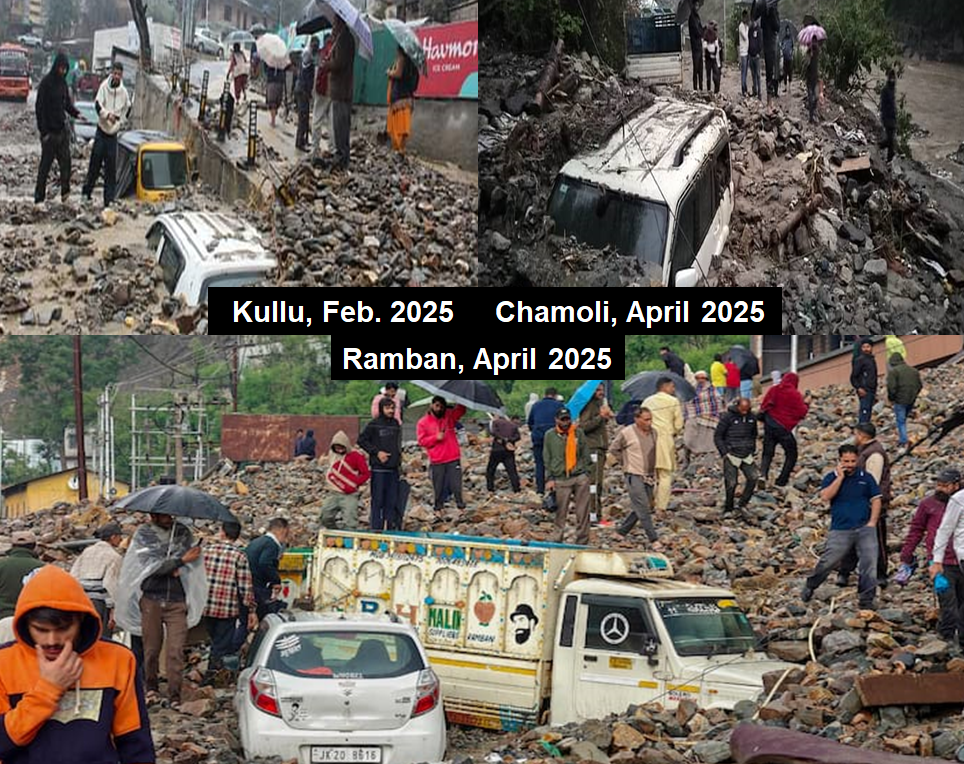
The rising numbers and intensity of western disturbances (WDs) in pre-monsoon months are causing excessive but short rainfall spells across the country particularly in the Himalayan states. These events are then resulting in sudden flash floods and taking a huge toll on human life and public infrastructure. However, the specific monitoring and warning services for such disasters by the Central Water Commission (CWC) & Indian Meteorological Department (IMD) are largely unavailable as these agencies are mainly forecasting floods during the monsoon.
2025: Some Extreme Weather Events in Pre-monsoon Months
HIMACHAL PRADESH; February 2025: Several parts of the Kullu, Kangra, Mandi, Chamba, Kinnaur and Lahul & Spiti districts in the state were severely affected by torrential rain and snowfall on the last day of February 2025 disrupting power, water and transport services. Reports said flashfloods following 2 ‘cloudbursts’ & landslides caused by heavy rainfall resulted in large scale destruction in these areas.
Kangra: A ‘cloudburst’ induced deluge amid prolonged heavy rainfall damaged around 14 houses, several vehicles and building of a school in Chherana village in Multhan area of Chhota Bhanghal valley. Residents of 50 houses were moved to safer places due to continuous landslides from nearby hills. Local authorities were forced to open the gates of 2 HEP projects to reduce flood levels in Uhl and Lambadug rivers. The sudden deluge also damaged several camping sites along the Uhl river in the area and affected agricultural land and flooded homes and CHC, Barot. In Baijnath division 2 potable water supply schemes were washed away causing losses worth Rs 2.5 cr.
Flash floods in the Charan river damaged development works at the IT park in Chaitru village near Dharamsala. It also damaged public and private infrastructure along the river. About two years ago, flash floods in the Charan river had caused extensive damage to public and private infrastructure.
The Jia HEP was affected by the landslide injuring a worker while one more worker was reportedly missing after the incident. In Manni stream 3 tippers, 2 JCBs and 1 Poclain machines involved in riverbed mining work were caught in the flood fury while a Poclain machine was washed away in Manjhi stream in Gaggal area.
Kullu: The flashflood formed an artificial lake on Jeera stream in Tosh village in Manikaran valley causing safety threats to downstream residents who were shifted to safer places. The second ‘cloudburst’ incident took place in Pahnuallah burying several vehicles under muck and debris. Several vehicles in Shastri Nagar and Khori Ropa parking were damaged by the flashfloods. Homes were also flooded in Inner Akhara Bazar area of Kullu town.
Mandi: The district faced severe disruptions due to massive landslides & heavy rainfall. A landslide near the Jalogi tunnel on the Kiratpur-Manali highway led to roadblock. The gates of Larji project and the Pandoh Dam were opened after significant rise in flood level in Beas river. A bus overturned on the Chandigarh-Manali Highway.
Overall, 1 person was killed, 1 was injured and 1 was missing due to 48 hours long rain and snowfall spell and 22 vehicles were damaged by the flood and landslides. 5 avalanches took place in Chamba, Kinnaur & Lahul-Spiti district. The avalanche damaged 5 homes in Kukrolu village in Pangi valley of Chamba. The flow of Chandrabhaga river was also blocked by an avalanche in Lahaul. The severe weather conditions led to closure of 5 National Highways & 583 other roads. It also affected 2263 power transformers and 279 potable water supply lines.
May 2025: An elderly man was killed after being washed away in flash flood in Dondara nullah in Cheli village of Chamba district on May 3. The ‘cloudburst’ induced deluge also killed about 150 sheep.
UTTARAKHAND; February 2025 A massive avalanche in the morning hours of Feb 28, trapped about 57 workers in a container near their camp site in bordering Mana village area about 5 km away from Badrinath shrine in Joshimath, Chamoli District. The workers were engaged in road construction work by the Border Roads Organisation (BRO). At least 8 of workers were found dead on March 2 by the Army team engaged in rescue work which was halted several times due to the incessant snowfall and rain. The complex rescue work was carried out by more than 200 Army personnel for over 60 hours.
April 2025: The 3 hour long heavy downpour on April 9 afternoon flooded several homes and shops, PHC building in Tharali market area and damaged several vehicles in Chamoli district. The flash flood in the local streams also blocked several roads including the NH in the area. Other towns and villages in the district were also affected by the heavy rains. Some reports termed it a ‘cloudburst’ incident. A flash flood also happened in Maneri area of Uttarkashi district around same the time.
Next day (April 10) another ‘cloudburst’ was reported from Nandprayag area of Chamoli district which disrupted traffic on Badrinath NH. Heavy rains and flash flood were also reported from Rudraprayag district on the same day blocking the Kedarnath NH near Banswara. Local media reported a ‘cloudburst’ incident from Kusumgaad Bhiri area of the district.
May 2025: Some homes and shops were flooded in Kempty falls in Mussoorie and Song river swelled dangerously after ‘cloudburst’ type rainfalls in Dehradun on May 5. Flash flood following intense rainfall have also been reported from and Biron Khal block of Pouri district and Choukhatiya block of Almora district on May 10 impacting local infrastructure.
JAMMU & KASHMIR; Feb 2025: Incessant rains continued for the third straight day leaving 5 people dead in the Union Territory (UT) on Feb 28. While a woman and her son died when a boulder rolled down and hit their two-wheeler in Moungari area of Udhampur district, a civilian driver of a CRPF vehicle died and two personnel were wounded after it was hit by a boulder in Surankote of Poonch in rains a day before. Another truck driver died in the same area after it fell into a gorge, while a 12-year-old boy was washed away in flash floods in Reasi.
About 12 workers were rescued from the flood fury in Ujh river in Rajbagh area of Kathua when they were putting up a shed near a construction site when they were suddenly marooned in the flash floods. SDRF teams rescued a truck driver trapped in floods in Niki Tawi area of Jammu. Traffic movements were disrupted on several roads including Srinagar highway Batote-Doda, Bhaderwah-Chamba, Mughal and Sinthan roads in the UT due to continuous snow, rain and landslides incidents. Severe weather conditions also affected helicopter services to Sanjichhat (Vaishno Devi shrine) from Katra.
April 2025: Multiple cloudburst incidents reported in early morning of Apr 20 in Ramban & Reasi districts killing 3 people, damaging several homes, hotels, vehicles and leaving a trail of destruction.
The death toll occurred due to collapse of a house in Seri Champa village on the outskirts of Ramban town. Scores of homes, shops, hotels and govt buildings & vehicles were severely damaged due to flash flood amid heavy rainfall. About 500 people were moved to safer locations.
The strategic Jammu-Srinagar NH 44 was significantly damaged due to multiple landslides, mudslides and shooting stones between Nashri and Banihal sections. Crops and orchards also suffered extensive damage in the district. Hundreds of vehicles were stranded on the NH and thousands of tourist were left without food, shelter or medical aid. Power supply, mobile connectivity across the district was also badly affected.
The entire Ramban district suffered massive damages due to heavy rain, cloudbursts, high-velocity winds, landslides & hailstorms. The hills in the area have been made vulnerable to disaster by the large scale construction including road, tunnels and buildings aggravating the disaster impact. Questions have also been raised over NH 44 construction work which as per the locals has compromised the drainage system in cloudburst affected area.
Another ‘cloudburst’ incident in Reasi also damaged homes and killed some cattle around the same time. Before this, a ‘cloudburst’ incident happened in forest area of Nageshwari hills in Kishtwar district on April 19. In the wake of the severe weather conditions flight services were disrupted from Jammu airport.
May 2025: The Seri area of Ramban district was again faced destruction following ‘cloudburst’ induced flash flood on May 2 which again caused damages to the Jammu-Srinagar NH 44.
ARUNACHAL PRADESH. April 2025: The NH 113, a critical road connecting the Indo-China and Indo-Myanmar borders was cut off at Monpani along the Arrowa-Khupa-Hayuliang section in Anjaw district, following continuous heavy rainfall on April 1. The downpour caused severe cracks and structural distress, disrupting connectivity in the region. About 10 meters of road was washed away, disrupting a crucial lifeline. The Tezu-Hawai road which is the lifeline of the remote district, often gets washed away during the monsoon.
High alerts were issued in the East Kameng district on April 23 after the Para river-a tributary of Kameng River flowed over danger level near Rebe village under the Chayang Tajo administrative circle posing threats to the abutment of a bailey bridge abutment .
SIKKIM. April 2025: The roads at many places near Munshithang on the way to Lachen from Chungthang and near Lima on the way to Lachung from Chungthang were damaged badly due to several landslides triggered by continuous rainfall since April 24. As a result, about 1,000 tourists in Lachen and Lachung, two high-altitude hill stations in north Sikkim, were stranded and about 1,500 more tourists were rescued by the district administration. Lachen was among the places worst hit by October 2023 GLOF disaster.
Need to Improve Extreme Weather Forecast Services
The available media reports clearly show that several extreme weather events fuelled by WDs have struck the Northwest and Northeast Himalayan states in pre-monsoon months in 2025, killing at least 18 people including 8 each in J&K and Uttarakhand and 2 in Himachal Pradesh. Of this, 14 deaths have occurred only during February 27-28 WD disaster which battered J&K, Himachal Pradesh and Uttarakhand with high intensity rain and snowfall spells triggering scores of avalanches, ‘cloudburst’ flash floods and landslides disasters in these states. These disasters have also extensively damaged homes, public infrastructures including NHs, roads, water and power supply structures in these states.
The excessive rainfall events then in April 2025 have resulted in flash floods and landslide disasters in J&K, Arunachal Pradesh and Sikkim states destroying the NHs and jeopardizing the safety of thousands of tourists visiting these states. The incidents of heavy sudden downpours and resultant flash floods have taken place in May 2025 in J&K, Himachal Pradesh and Uttarakhand damaging the local infrastructures and causing safety risks for pilgrims and tourists particularly on Char Dham yatra in Uttarakhand.
However, the weather and flood monitoring and forecast services by the IMD and CWC are primarily active in the monsoon season. The IMD issues weather warnings for rainfall events throughout the year but its flash flood services are not available in pre-monsoon months. Moreover, the rainfall alerts by the local meteorological divisions are often late and of general category while there is need for more precise area specific rainfall alerts. The sheer number of tourists getting trapped along severely damaged national highways and scores of vehicles getting damaged only suggests that the available weather alerts are still not reaching the targeted group of public timely and the local administrations are failing to follow the instructions. These gaps are bound to result in a major disaster in these states.
In the context of pre and post monsoon flood disasters in hilly states and other parts of country, when the flood monitoring and forecast services by the CWC are unavailable.
Ironically, the CWC is still providing the services based on the notification issued in December 2013 which divides the flood period in 3 categories as mentioned in table below.
| SN | Basin | Existing Period |
| 1 | Brahmaputra & Barak (including Teesta, Rivers flowing in States of Tripura, Manipur, Mizoram, Nagaland, Meghalaya, North Bengal, Sikkim) and Jhelum Sub Basin of Indus | 1st May to 31st October |
| 2 | All other Basins up to Krishna Basin | 1st June to 31st October |
| 3 | Basins South of Krishna Basin (Pennar, Cauvery and Southern Rivers) | 1st June to 31st December |
The CWC claims the forecasting services for unexpected floods beyond the typical period will be issued by the concerned division, however past experiences show absence of the same as seen in February 2021 Chamoli flood disaster in Ganga basin. Then the October 2023 GLOF disaster in Teesta basin has revealed vulnerabilities of its monitoring system. Even this year in March, the concerned division were seen inactive during flash flood event in Beas basin. In fact, CWC lacks adequate monitoring and forecast stations in Beas, Sutlej and Indus river basins.
We clearly need specific rain and flash flood warnings and forecast from the IMD and CWC to minimize the death and destruction toll. The National Disaster Management Authority too here has a role to ensure that IMD and CWC to ensure these minimal disasters related services in timely and area specific way.
Bhim Singh Rawat (bhim.sandrp@gmail.com)

 SANDRP