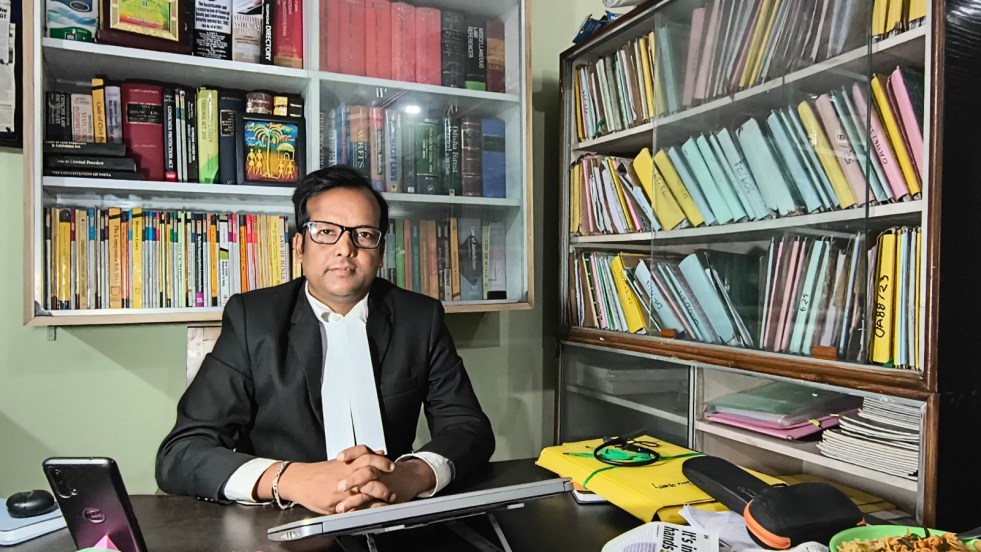
(Feature Image: Lawyer Sankar Prasad Pani. Source: Facebook)
Advocate Sankar Prasad Pani is among some of the finest environmental lawyers in Odisha with knowledge about the effective legal remedies for addressing the adverse impacts of unsustainable and illegal riverbed mining. Over the past decade, Sankar Pani has argued in more than 50 cases in the eastern bench of National Green Tribunal (NGT).
The lawyer aims to bring transparency and improve governance in riverbed mining operations in Odisha and has secured remarkable decisions in some of the cases in 2024. In January 2025, the tribunal prohibited sand excavation in Mayurbhanj district following Pani’s intervention. In this interview with the lawyer Sankar Pani, Bhim Singh Rawat of SANDRP focuses on the basics of legal mechanisms and impact as well as limitations of available legal tools concerning the governance of finite natural resource like sand.
1. What are the reasons behind you joining the legal profession? Can you share some details about your initial years in the NGT while contesting riverbed mining petitions.
During post-graduation in environmental science, I came across some case studies on environmental litigation work by famous lawyer MC Mehta which motivated me towards this profession. In 2003, I completed my law degree. For next 7 years, I got opportunities to work with some organizations which helped me develop basic understanding about rules concerning water quality, waste management and forest governance in Odisha. I obtained PG Diploma in Environment Law in 2012 & started working as an independent environmental lawyer.
It was in 2014 when the regional bench of the NGT was established in Calcutta, I got engaged in environmental litigation works. My first case on riverbed mining was in 2015 when I argued against grant of Temporary Permit (TP) in Jajpur district without environment clearance (EC). It turned out that the TP was being misused to avoid environmental scrutiny. Further, no EC was required for sand mining in area less than 5 ha. Though, the remarkable Feb 2012 judgement Justice Deepak Misra vs. State of Haryana had clearly stated that riverbed mining leases are subjected to ECs irrespective of quantity, size and time.
2. Which are the rivers and districts in Odisha do you find affected the most by the illegal sand mining and what have been the main grievances of the affected parties?
There are many small and big rivers passing through Odisha. Among the big rivers the Mahanadi, Brahmani, Rushikulya and Subarnarekha are rich in minor minerals & are affected by unsustainable riverbed mining. I have also seen mechanized mining in smaller rivers here. But most of my riverbed mining litigation works have been limited to Subarnarekha River.
3. Can you elaborate on the basic process a sand mining plan goes through?
Presently, all the sand mining leases are subjected to District Survey Reports (DSR) which are prepared by the District Environment Impact Assessment Authority (DEIAA) and approved by State Environment Impact Assessment Authority (SEIAA).
Once the DSR is prepared, the mining department invites the tenders for the specific area and based on DSR, Environment Impact Assessment (EIA) report, Environment Management Plan (EMP), the EC is granted by the SEIAA for B2 (area less than 5 ha) & B1 (5 to 25 ha).
As new DSR is under preparation for several districts, there is no fresh sand mine lease being granted in Odisha for the past 3 years. Some sand mines with old ECs are still under operation.
4. What loopholes do you find in minor mineral policy framework?
Though riverbed mining governance is still a work in progress, I find it is being centralized instead of decentralization. The major problem is that unlike major minerals confined to limited reserves which make monitoring and compliance easier, the minor minerals are found all along the length of various rivers. Here, involvement of district level authorities is necessary to make monitoring and compliance effective.
In this regard, I disagree with the decision to disallow DEIAA in approval and monitoring processes by both NGT in 2018 and Supreme Court in 2020. It has only increased workload on SEIAA which is already burdened with several proposals.
Similarly, through an amendment in minor mineral policy in 2023, the district mining officer has been given power to execute mining leases which were earlier being done by a Tehsildar level official. The revenue department has a huge workforce with representatives at panchayat level which were more effective in monitoring and grievances redressal work.
However, the mining department lacks manpower for these purposes. The decision has also made the revenue department reluctant and there have been incidents where they have refused to interfere in mining related issues.
Interestingly, realizing the drawbacks, a Government Resolution (GR) recently allowed the panchayat level committee and Block Development Officer (BDO) to identify sand sources for the purpose of catering to the demand of government approved panchayat level construction activities. Thus, in a limited sense, the power is divested back to Panchayat Raj Institutions.
It is interesting to observe the unfolding changes. Hope the best outcome from the ongoing experiments are incorporated in the policy.
5. What structural problems are affecting DEIAA & SEIAA institutions? What suggestions do you make to improve their functioning?
I find that SEIAA does not have the management capacity for the mining leases. So, DEIAA is required to create hierarchy in the governance system and supplement the SEIAA efforts. Interestingly, the DEIAA is involved in preparation of DSR which is then scrutinized by the SEIAA. So, mining leases with less than 5 ha can be approved by the DIEAA and SEIAA can play the supervisory role.
At the same time, I feel the functioning of both DEIAA and SEIAA need a lot of improvement. Often, they lack experts on subject matter and independent members to examine the proposals thoroughly. So, unless SEIAA achieves efficiency, disbanding the DEIAA is not a step in the right direction.
6. Do the miners follow the environmental clearance (EC) norms? How does unsustainable and illegal mining take place in legally approved mining leases?
The EC letter makes the mining companies adhere to several conditions. In case of violations, the EC can be cancelled. In fact, miners can excavate a certain amount of minerals daily. If they follow the norms, they cannot mine more than 100 cubic meters which translate into 5 truckloads as each truck has 20 to 25 cubic meter capacity. But, on ground, the miners are loading over 100 of trucks which shows it is largely unsustainable and illegal.
This is the key reason; the miners are often buying sand leases by paying ten to twenty times more than the normal cost. Because they know there is huge scope for earning by extracting way more than the permissible limit.
7. Can you elaborate on District Survey Reports (DSR)? Do you find it an effective legal tool to address the illegalities in sand mining activities or it has its own limitations?
The provisions of DSR and DEIAA were incorporated in the EIA notification through an amendment in Jan 2016 by the MOEF&CC. The actual implementation of the DSR started only after Jul 2018 when its parameters were introduced through an office memorandum (OM).
In Odisha the first DSR came out in Dec 2019. Since it was compulsory for securing ECs, initially the agencies were just coming out with some document lacking scientific analysis including 3 years replenishment data and approval from the State Expert Appraisal Committee (SEAC) or SEIAA. Thus, miring the spirit of the DSR. I have seen DSRs with copy-paste work and successfully challenged the same.
Then the government came up with interim DSR to continue riverbed mining activities. These interim DSR lacked legal validity, replenishment studies and approval from SEAC and SEIAA. I argued these reasons before the NGT which then cancelled two DSRs in Odisha.
Now the district administration is at least conducting site visit, replenishment studies and using drone and satellite images for identification of potential sand sources in new DSRs. In this way I find the DSR concept is still evolving. It can be an effective tool if prepared & followed sincerely.
8. Is the replenishment study part of the DSRs? Does it adequately address the sustainability aspects of sand mining?
Any DSR is valid for five years from the date of approval. The replenishment study is done once during preparation of the DSR. But when a specific mine area is leased out based on the DSR, the replenishment study requires four surveys in a year for the first year and three surveys for the remaining years. But generally, this is not happening as proposed in the Enforcement and Monitoring Guidelines for Sand Mining, 2020 and there is no mechanism in place to verify the authenticity of replenishment studies.
9. What is “interim DSRs”, the term often mentioned in legal cases you have argued in the NGT? Is it a means to circumvent the legal processes?
As the preparation of DSRs in the country did not start in 2016, the DSRs readied by 2018, 2019 lacked the mandatory replenishment study hence faced legal challenges. To avoid this, the government in several states including Odisha, Bihar and Haryana started proposing interim DSRs to carry out mining activities.
Since, there was no statutory provision for the interim DSR, it also was made subject to judicial scrutiny. And Pawan Kumar vs. State of Bihar was most remarkable litigation in this regard wherein the NGT ordered preparation and approval of DSRs by the SEAC/SEIAA as necessary step before starting riverbed mining.
The matter then reached the Supreme Court where the final decision is still awaited but as an interim order, the apex court in Nov 2021 allowed Bihar state mining corporation to conduct riverbed mining until the DSRs are finalized and granted approval by SEAC and SEIAA.
Overturning the NGT decision which asked for involvement of private consultants for DSRs preparation, the Supreme Court also stated that the district authorities are better equipped to visit the sites and prepare the draft DSR for the concerned district.
10. Do you find technological intervention (CCTVs, Satellite Images, Drones, Bar code, GPS) effective in monitoring and ensuring norms compliance in sand excavation and transportation? Are these being used in Odisha?
Available technological equipment has the potential to improve monitoring processes. A 2019 GR in Odisha made some references on applying technology to control illegal mining activities. But there has not been an effective implementation in any district till now.
In Jajpur district case, we got specific order from NGT directing the collector to ensure installation of CCTVs and GPS at the mining sites. But district administration did nothing for two years. It was only enforced when we again took the matter to the court. So far, it is happening in selective mine areas after court orders or regular complaints by the local people.
The government has not been ensuring this while granting fresh mining leases. I think, it needs to be applied uniformly across all the mining affected districts. The selective application will be difficult to implement and fail to achieve the objectives.
11. What does the govt departments lack to achieve sustainable riverbed mining?
To me the issue needs to be addressed at policy level. Since mining leases of less than 5 ha do not go through the public hearing process. The district mining departments have been exploiting this escape despite DSR identifying areas equivalent to or more than 5 ha.
The departments have started moving to advance techniques in place of outdated methods. However, it needs to be done on a larger scale in a systematic manner. They also require adequate training to use it efficiently. They also lack hydrologists and river experts.
Another problematic issue is that they often do not take independent stand. There are incidents where mining has damaged the riverbanks and caused pollution but the irrigation and pollution control department refrain from going against the mining department. Because they are also part of the approval and monitoring processes, they try to save their own skins. Same is the case with government lawyers representing them in the court.
12. What are the reasons behind unabated illegal sand mining cases and regular incidents of violent attacks on government officials?
The legally approved sand mine leases are subjected to due processes, revenue charges, record keeping, royalties, monitoring, norm compliance, fine in case of violations, cancellation of EC and persecution for serious violations. However, mining the sand illegally faces no such scrutiny.
It’s only during irregular raids that the illegal miners face some actions which are mostly limited to imposing fines and impounding vehicles. By that time, the illegal miners would have already earned huge money, these actions hardly ensure deterrence. On the contrary, it encourages illegal miners who on occasion also indulge in violence.
13. What is the status of District Mineral Funds (DMF) in sand mining affected districts in Odisha? Are the funds being utilized well to improve the conditions of environment and mining affected communities?
The DMFs have been set up in every district. At least 5% of the total royalty from mining of minor minerals is deposited in the DMF. Apart from this, there is another fund, Environment Management Fund (EMF) where about 10% of fund collected from mining of minor minerals is collected. But utilization of these funds is a concern. Further, there is no sperate account for fund collected from major and minor minerals.
14. What are the most effective legal means to apply to regulate the unsustainable sand mining? Are the court directions followed sincerely by the administration?
In fact, if you closely see the introduction as well as evolvement of many laws and rules concerning riverbed mining governance including DSR, Replenishment Studies, Quarterly Compliance Report, EC, EMP, EIA, Public Hearing, Use of technology are all outcome of judicial litigation. These legal tools are being successfully used throughout the country now.
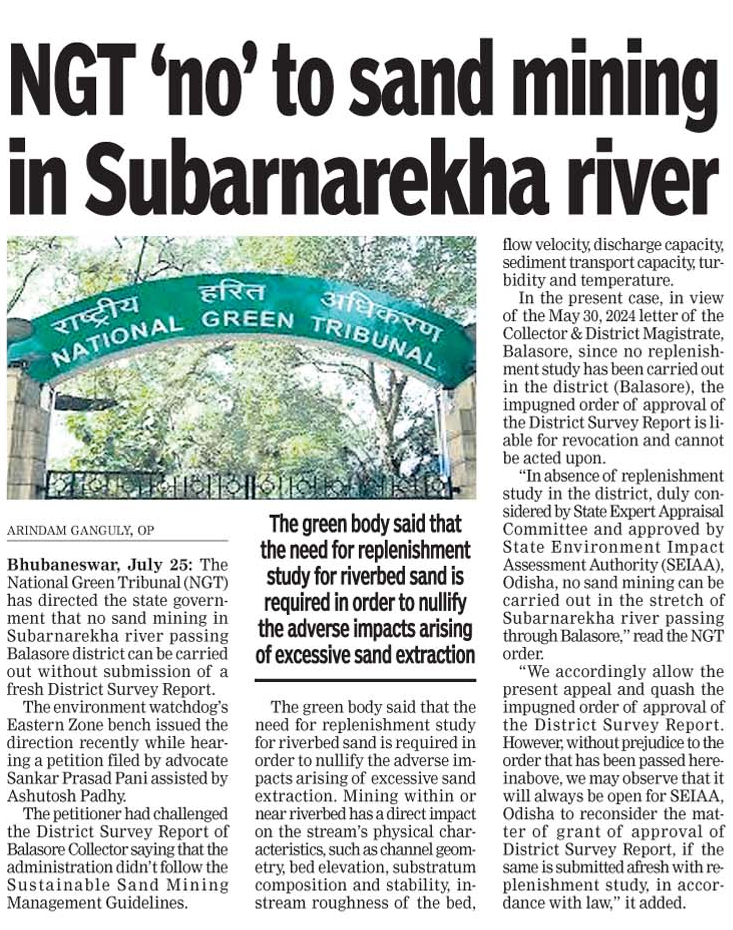
Recently, I have argued two cases in which the NGT stayed sand mining in Mayurbhanj and Balasore districts in absence of credible DSR and due processes. But there is no prohibition on mining in other districts despite the invalid DSR as the court order is specific to two districts only.
Yes, sometimes securing a favorable order is easy but getting it implemented is a difficult task altogether. So, responsibilities largely rest with the enforcers. The follow up of court orders is necessary and local people as well as activists have an important role to play here.
15. What key regulatory changes are required to make the riverbed mining governance transparent, accountable? What role do the local communities need to have in the governance of riverbed mining?
There is an urgent need for making the riverbed mining governance decentralized. DEIAA and SEIAA need to be made effective. The bodies must include independent expert members. At the same time, the illegal mining activities need to be curbed strictly with regular raids, heavy fines and FIRs. The habitual violators must face trial and prosecution. The penalty imposed by the department is meagre and does not factor the cost of damage to the environment. The court intervention in some cases have been effective. For sizeable and visible impacts, the law enforcers need to work proactively.
The government needs to empower the minor mineral cell to monitor illegal sand mining. Similarly, there is prohibition on mechanical sand mining. But I see the mechanical mining has become a rule and manual mining is an exception.
So, I guess the monitoring is one of the biggest parts. And, in the monitoring of the riverbed sand mining project, the community has an important role to play. In fact, the EC process needs to involve the community in the monitoring of the sand mining activity. This is one of the issues that we continue to raise.
My litigation work has raised several issues which are then incorporated in EC making it part of regulatory systems. But mere incorporation without any compliance or monitoring makes no sense. As far as the regulatory regime is concerned, there are enough provisions. It’s all about monitoring and enforcement.
16. What shortcomings do you find in judicial interventions? Do you think government and judiciary need to develop more effective mechanisms (rules, laws, policy) to ensure sustainable sand mining practices?
The judiciary can only play its role in addressing the gaps in the policy or when there is a strong case built up against the illegal miners and violations in mining operations. Filing an FIR requires criminal prosecution following witnesses’ statements, documentary evidence, summons and sometimes personal appearance of concerned officials in the courts. Very few actions by law enforcers reach the stage of FIR registration. And the law enforcers are mostly compounding the illegalities which further encourages the violations.
Citizens too largely tend to avoid judicial intervention for various reasons including inadequate information about the rules and regulations, cost and time taken by legal discourse. At present, mainly two parties, severely affected local people and in some cases the competitors come to courts. I believe whoever seeks legal remedies, in the end it only benefits the environment, the local people and the government. So, I encourage judicial litigation to improve the governance of sand mining.
Bhim Singh Rawat (bhim.sandrp@gmail.com)

 SANDRP