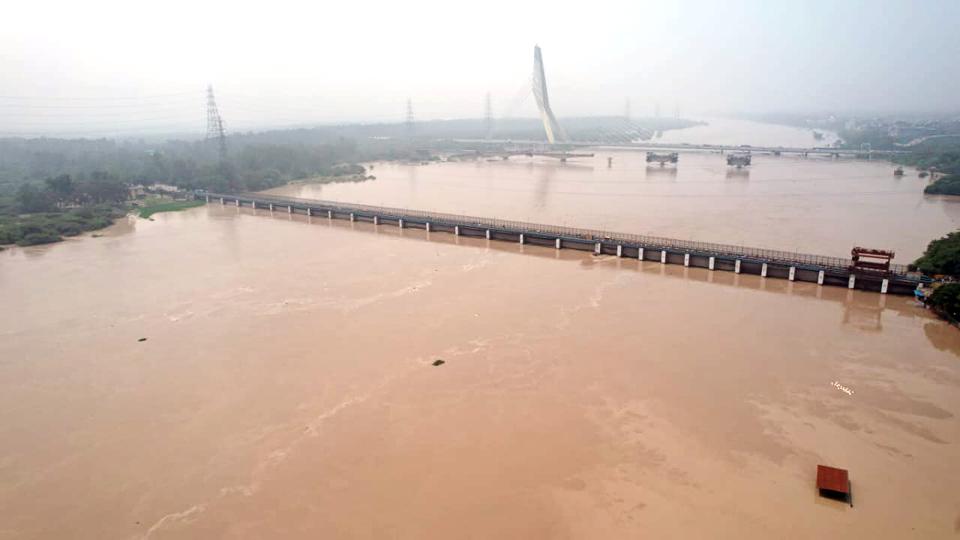
(Feature Image: A view of overflowing Yamuna river at Wazirabad in New Delhi on 13 July 2023. Credit: HT_PRINT/Source: Live Mint)
Post July 2023 unusual flood spell in Yamuna river reaching unprecedented levels in Delhi, the Ministry of Jal Shakti (MoJS) on August 06, 2023, constituted a committee for conducting a “Joint flood management study of river Yamuna for its reach between Hathnikund and Okhla Barrage”. The Committee headed by Chairman, Central Water Commission (CWC) & Ex-Officio Secretary to Govt of India with members from Haryana, Uttar Pradesh, NCT of Delhi and expert Organizations was mandated to examine the meteorological aspects, return period of floods, discharging capacity of barrages, functional requirement of ITO barrage, etc.
Following the terms of reference (ToR), the committee proposed scientific and technical studies on ten points mentioned below:
- Detailed catchment representative analysis to compare the floods of the year 1978 and 2023 and other years as decided.
- Estimation of 05, 10, 25, 50, 100 and 500 year return period floods at Hathnikund Barrage (HKB), Wazirabad, Delhi Railway Bridge (DRB) and Okhla Barrage.
- Carrying capacity of river between HKB and Okhla Barrage.
- Maximum water level at salient locations of the study river reach for 05, 10, 25, 50, 100 and 500 year return period floods.
- Afflux of barrages, bridges, flood protection dykes and other structures in the study reach of the river.
- 2D modelling and submergence area estimation for the reach of river Yamuna from 10 km upstream (u/s) Wazirabad Barrage and 10 km downstream (d/s) Okhla Barrage.
- Identification of possible drainage congestion in Delhi in case of high spate of river Yamuna.
- To review utility of ITO Barrage in present context.
- Examine feasibility of some innovative measures like creating underground reservoirs for flood moderation in the line with Tokyo model.
- Examine feasibility of creation of storages for surplus flood water in the floodplains of Yamuna and thereafter identification of such sites.
Over a period of one year, the committee carried out various field visits, conducted several meetings, obtained and reviewed official data on multiple aspects of the flood in river Yamuna. It finally submitted two reports: a 54 page interim report in January 2024 and the 194 page final report in August 2024 under same titled: “Report of the committee on Joint Flood Management Study of River Yamuna for its reach between Wazirabad and Okhla barrage”. The final report was available in public domain only recently.
What the reports have found: Basically, the interim report is a summary of detailed report. Broadly both the reports have concluded three main reasons responsible for unusual flood spells in Delhi in July 2023:
Very heavy rainfall spell for 5 days during 9th to 13th July 2023 period was one of the major causative factors for extreme flooding in Delhi and other locations along the reach of river Yamuna.
The hydrological discharge data for HKB, Wazirabad, Okhla barrages were incorrect.
The ITO barrage, lateral structures on Yamuna, encroachment in floodplain by legacy waste and siltation reduced the flood carrying capacity of the river in Delhi and resulted in congestion and attaining flood afflux in the city.
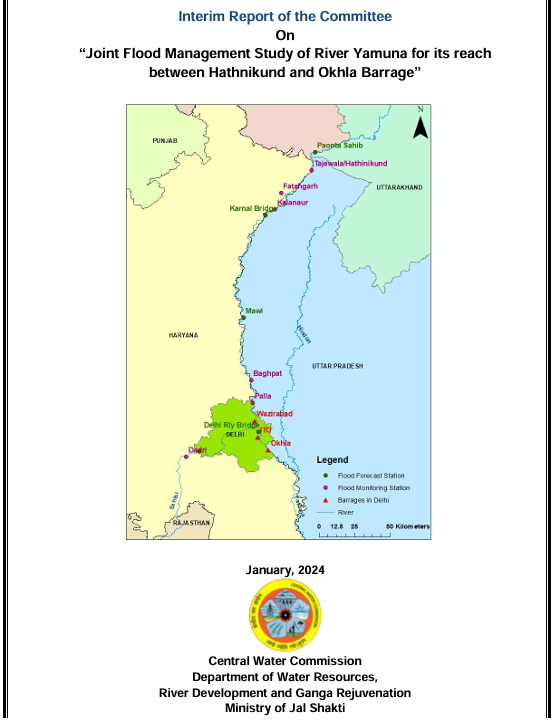

As we have been closely monitoring and documenting Yamuna flood events, here we try to critically analysis the CWC committee report including the above observations, other key findings as well short comings of the report.
Chapter 2. Catchment Representative Rainfall Analysis: The conclusions in Chapter 2 based on detail catchment representative rainfall analysis during the period 09-13th July 2023 utilizing IMD Gridded Rainfall data and its comparison with catchment representative rainfall for the period 1970 to 2023 is summarised in table below as in the CWC Committee report.
| Location | Catchment Area | Annual Max of Sum of 5 days (mm) between 31.08-04.09. 1978 | Annual Max of Sum of 5 days (mm) between 09-13 July 2023 | %Increase in 2023 w.r.t 1978 |
| HKB | 11397 km2 | 222.09 | 316.94 | +42.7 % |
| Mawi | 15683 km2 | 230.8 | 303.6 | +31.7 % |
| DRB | 17882 km2 | 223.12 | 276.25 | +23.8 % |
| Level at DRB | 207.49 m | 208.66 m | +1.17 m |
As per the MoJS committee report, the cumulative 5-day catchment representative rainfall during July 2023 at HKB and Mawi G&D site corresponds to rainfall of about 100 year return period.
Indeed, the rainfall in adjoining districts of Yamuna in Haryana and Uttar Pradesh downstream HKB including Delhi and Gurugram witnessed excess to large excess rainfall as shows the IMD data for 08-11 July 2023 for 10 districts compiled here by SANDRP.
However, the committee report has again failed to answer the key question: why did resultant flood level created from this 100 year return period rainfall stayed roughly around half a meter below the Highest Flood Level (HFL) in the river at the 5 flood monitoring stations upstream if Delhi but over toppled the historic 1978 HFL at Delhi Railway Bridge (DRB) by unprecedented 1.17-meter margin as shown in table below.
| No. | Site | HFL (m)/ Date | Peak level in July 2023 | Below HFL by (m) margins |
| 1 | Kalanaur | 268.66 m 09.09.2010 | 268.00 m 10.07.2023 | -0.66 m |
| 2 | Karnal | 250.07 m 17.06.2013 | 248.91 m 11.07.2023 | -1.16 m |
| 3 | Mawi | 232.75 m 18.06.2013 | 232.30 m 12.07.2023 | -0.45 m |
| 4 | Baghpat | 217.18 m 27.09.1988 | 216.53 m 13.07.2023 | -0.65 m |
| 5 | Palla | 212.80 m 08.09.1995 | 212.55 m 13.07.2023 | -0.25 m |
| 6 | ORB | 207.49 m 06.09.1978 | 208.66 m 13.07.2023 | +1.17 m |
Chapter 3. Flood Frequency Analysis: Chapter 3 of the report provides computation of annual peak discharge at HKB, DRB and Okhla Barrage. We have taken the report data for high flood years and put the same in table below. The peak discharge of the high floods is given in cusecs.
| High Flood Year | Reconciled HKB peak discharge | Old HKB peak discharge | Gap | ORB | Okhla Barrage | Peak level at DRB |
| 1978 | NA | 709000 | NA | NA | NA | 207.49 |
| 1988 | NA | 577522 | NA | NA | NA | 206.92 |
| 1995 | 536338 | 536188 | NA | 248165 | 259854 | 206.93 |
| 1998 | 541700 | NA | NA | 119468 | 165306 | 206.18 |
| 2010 | 496338 | 744507 | -248169 | 122413 | 287885 | 207.11 |
| 2011 | 427641 | 641462 | -213821 | 71255 | 126520 | 205.72 |
| 2013 | 537643 | 806464 | -268821 | 114381 | 365573 | 207.32 |
| 2018 | 470634 | 605949 | -135315 | 87935 | 79390 | 206.05 |
| 2019 | 652584 | 828072 | -185488 | 102056 | 174968 | 206.60 |
| 2023 | 422431 | 359760 | +62671 | 247160 | 372225 | 208.66 |
*Note: The reconciled figures were arrived at by CWC team corrected the method of computation using IS codes during its visit to the barrage on 18 November 2023.
Surprisingly, while the committee report compares 2023 floods with the rainfalls and floods in 1978, the committee has not provided reconciled peak discharge figures for 1978 and 1988 floods. The third column in the table above mentions the original peak discharges form HKB taken from official reports by SANDRP.
Notably, the CWC team part of the MoJS committee has reconciled the peak flood discharge for HKB. The data shows that the CWC team after reconciliation, reduced the peak discharge figure for HKB by around 2 lakh cusecs for 2010, 2011, 2013 floods, by more than 1 lakh cusecs for 2018 and 2019 floods. Interestingly, for July 2023 it has increased the HKB peak discharge figure from 359760 cusec to 422431 cusecs.
So, if the HKB staff have applied wrong method to calculate the flood discharges in all these years and CWC team has reduced the peak discharge figures for the past high floods passing through the HKB, why has it increased the peak discharge figure for July 2023 by 62 thousand cusecs. The report does not throw light on reasons for these different reconciliations. It is also not clear what has CWC done to correct the discharge measurement all these years, since the HKB and other G&D sites are all managed by CWC staff.
Similarly, even after increasing the July 2023 peak discharge figure, it is still the lowest compared to the previous 8 high flood years and in no way can lead to attaining of new HFL of 208.66 meter at DRB by breaching 1978 HFL by 1.17 meter. The MoJS commitee and the CWC team that visited the HKB, has not properly explained if the high rainfall in the HKB downstream Yamuna catchment can lead to such unprecedented HFL breach at Delhi Railway Bridge.
Chapter 4. Carrying Capacity: In the conclusion of Chapter 4 Carrying Capacity of River Yamuna based on cross-sectional data provided by the Irrigation & Water Resource Department (WRD), Haryana, the MoJS committee report mentions, “As limited data of cross-section has been provided, the results look like erratic. Therefore, Hec-Ras Model used for the study has been shared with the WRD Haryana, for refinement as per proper cross-sections and validation to arrive at realistic carrying capacity in various reaches.” Here it may be noted that CWC has been regularly assessing river cross sections across the country, but that data has never been put to independent scrutiny. Why has CWC team not used its own cross section data in the present case?
Chapter 5. 2-D Modelling and Submergence Area: Then in Chapter 5, the committee has used DRB peak flood discharge data from 1970 to 2020 and 2023 to estimate the submergence area with respect to 2, 5, 10, 25, 50 and 100 year flood from 10km upstream Wazirabad Barrage upto 10km downstream Okhla barrage, to identify possible drainage congestion in Delhi and to assess flood afflux of barrages, bridges, flood protection and other structures. The result of the analysis based on report data is given in table below.
| Return Period | Flood value at DRB | DRB Flood level | Net Submergence area km2 | |
| Cumec | Cusecs | |||
| 2 | 2313 | 81755 | 204.20 m | 0 |
| 5 | 4023 | 142082 | 205.99 m | 0.4 |
| 10 | 5157 | 182042 | 206.9 m | 16.7 |
| 25 | 6587 | 232521 | 207.94 m | 33.1 |
| July 2023 | 6999 | 247168 | 208.60 | 44.1 |
| 50 | 7648 | 269974 | 208.75 m | 47.3 |
| 100 | 8701 | 307145 | 209.35 m | 54.8 |
As per the analysis July 2023 flood spell neither fitted into 1 in 25 year nor 1 in 50 year return flood period but came in between. Even for this analysis 1978 peak flood discharge data was missing for DRB site.
The report says that “Simulated water level for 2023 flood at DRB is found to be 208.6 m against the observed 208.65 m (actually it was 208.66 m). It also finds that the “simulated submergence area for 2023 flood is found to be 44.1 km2 which is slightly less than the simulated submergence area for 50 year flood at DRB.”
Congestion: The committee observed lack of coordination among different agencies including I&FCD (Irrigation and Flood Control Department), Govt NCT of Delhi, MCD, NDMC maintaining the network of 20 drains falling into Yamuna within Delhi reach. SOPs (Standard Operating Procedures) with clear guidelines for operation of drains is required. The report has suggested formation of a nodal agency entrusted with the task of monitoring of proper maintenance and regular desilting of drains depending upon the water level in river Yamuna before and after monsoon period.
Afflux: Importantly the simulations results indicated that replacing lateral embankments with piers leads to lower water surface elevations (WSL) in the middle reach of the river compared to the existing terrain. An afflux of 0.536 meters has been observed at around 26.404 km suggesting that the current embankments of structures and muck contribute to higher water levels.
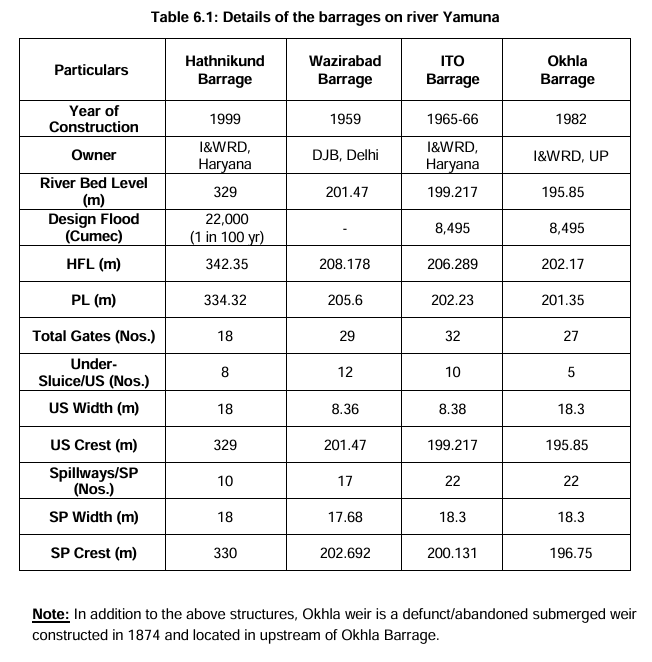
Chapter 6. Barrages on River Yamuna: In addition to the 4 barrages of HKB, Wazirabad, ITO and Okhla, the committee report in Chapter 6 has mentioned about a defunct submerged weir constructed in 1874 upstream of Okhla Barrage. The screenshot of the table with salient features of 4 existing barrages in the study area from the report is given below.
HKB: The MoJS committee found that the HKB project authority’s discharge computation methodology was erroneous as the staff calculated peak discharge 3,59,760 cusecs corresponding to upstream water level 336.35 meter recorded on 11.07.2023 at 11.00 am. The committee conveyed the correct method of computation as per IS codes during the visit of the team on 18.11.2023.
After application of new computation method, the peak discharge for July 2023 was reported to be 4,22,431 cusecs. Accordingly, the final peak discharge figures for years between 2014 to 2023 for the HKB have been modified.
Wazirabad Barrage: Like HKB, the MoJS committee report (CWC team) has found incorrect discharge computation methods applied by barrage authority as it had reported the peak discharge of 11,37,020 cusecs corresponding to upstream water level of 209.43 meter on 13.07.2023 at 01.00 pm.
The committee found that by standard calculation method the estimated discharge would be 2,89,000 cusecs for the same discharge scenario. As per the report the siltation in up and downstream of Wazirabad barrage may affect the discharge passing capacity of the barrage.
The committee advised Wazirabad project authority to undertake model studies at least up to ITO barrage for better accuracy in discharge computation. As per the report, the project authority had approached IRI, Roorkee for model studies for updated tail water rating curve.
ITO Barrage: Very disappointingly, the committee has cited no official data/report and stated that during peak flow some of the gates of the ITO barrage were ‘reportedly’ non-operational till 13.07.2023 leading to higher afflux and subsequent water levels. It has failed to accurately figure out the afflux impact of the July 2023 flood in river adjoining areas in Delhi.
As per the report the estimated maximum discharge from the barrage in free flow condition at HFL 206.289 meter would be 3,23,000 cusecs as per IS Code. The estimated discharge from the barrage gates observed on 27.07.2023 was 2,29,000 cusecs at HFL of 206.289 meter as per design calculations.
The committee stated that the siltation up and downstream may affect the discharge passing capacity of the ITO barrage. It advised the project authority to adopt correct discharge computation method.
On reviewing the utility of the ITO barrage, the committee strangely remarked that barrage gates are kept open, and it has a minimum impact on river flow during floods. It conveniently overlooked the obstruction created by the ITO barrage during the July 2023 flood spell. It also said that the barrage was linked with road bridge and only matter to be considered was whether gates are to be dismantled or not.
Further the committee found that the barrage could be useful to store some water in lean season for various purposes including recreational activities. One really fails to understand what sort of recreational activities the stinking pondage would serve.
Recommending keeping all the gates open in coordination with operation of Wazirabad and Okhla barrages, the committee advised regular maintenance of all hydro-mechanical equipment of barrage as per the operation and maintenance manual. On handing over the barrage to Delhi govt, the committee stated that the matter could be taken up separately by appropriate authority.
Okhla Barrage: The discharge computation methodology of the Okhla barrage too has been found erroneous by the committee. The barrage authority recorded the peak discharge of 3,72,225 cusecs corresponding to up and downstream water level of 200.80 meter and 200.75 meter on 13.07.2023 at 05.00 pm against the design capacity of 3,00,000 cusecs at 202.17 meter HFL.
Estimating discharge in above mentioned scenario in free flow condition would be only 1,77,421 cusecs, the committee on 09.01.2024 advised the barrage authority to modify discharge computation and historical discharge data according to corrected methodology.
On the committee advise of undertaking model studies for determination of actual coefficient of discharge, the Okhla barrage authority agreed to engage IIT Delhi for the purpose and to adopt correct discharge computation methods suggested by CWC team.
Summing up the chapter, the report mentioned that the CWC has reconciled discharge computations for HKB which may be used in future and same were being revised by the Wazirabad and Okhla barrage authorities in consultation with IRI, Roorkee and IIT, Delhi.
The committee has made some more recommendation including regular silt removal and channel maintenance in up and downstream of the barrages. The committee should have recommended a strict restriction on construction work in riverbed and floodplain before the monsoon season and removal of all construction materials and malbas before flood season.
As per the committee there is need for integrated operation of barrages on Yamuna to avoid any flow congestion. The task of coordination in operation among all 3 barrages has been left with the I&FC Dept. Delhi govt.
It also recommended that all the barrages should have common benchmark (BM) for measuring river water levels/gauges to avoid discrepancies during correlation of water levels. As per the committee the engineers and staff engaged in data recording and discharge calculations may be given training for their capacity building by suitable institutes.
Chapter 7. Floodplain Encroachment: The most disappointing aspect of the report is that the MoJS committee has squarely failed to scrutinize DDA’s tall and false claims on floodplain restoration plan be it mapping, encroachment removal or restoration. It appears the team lacked any river ecologist and have not visited a single floodplain project to observe the drastic changes the so called ‘restoration’ plans have been subjecting the river floodplain eco-system.
While DDA claimed that the primary objective of the plan is to restore, revive and rejuvenate the floodplains in pristine state and make them accessible to the public at large, the ground truth however is that the completed and ongoing ‘floodplain restoration plans’ have blatantly contradicted the ‘primary objectives’, degrading the floodplain land into exclusionary manicured parks with tons of concrete poured in, scores of permanent structures built on and commercialised the common resource for the certain section of society.
Further, the committee report has no information on scale of damages the projects faced and its impact on increasing river congestion during July 2023 flood. Notably, all the ‘restoration’ projects were inundated by flood water in July 2023.
Among many other grave official encroachments and infrastructural projects by DMRC, NHAI, PWD, NCRTC narrowing down floodplain stretch, the committee has not looked into levelling and raising of about 19 hectares of floodplain by several feet at Bela Estate farm near Shashtri Park Metro Depot by the Forest Department and DDA. The report has also not investigated flood afflux caused by DMRC casting yard occupying huge part of floodplain at Usmanpur. Further, the committee has not scientifically examined the congestion and afflux impact of compensatory plantation occupying hundreds of acres of floodplain land.
In the name of recommendation, the committee has only suggested for an integrated approach by a Nodal Agency for involving all agencies like DMRC, DDA, Delhi PWD, I&FCD, Delhi Jal Board should be adopted to make river Yamuna free from such encroachments.
The I&FCD pictorial report shared with the committee shows several agencies including NCRTC, DMRC, NHAI, PWD were carrying out several kinds of construction works which were actually hindering river flows and occupying the floodplain before July 2023. However, the committee has not analysed its corresponding impact on the flood carrying capacity of the river.
Additionally, the committee has not studied the corresponding impact of fragmentation of Yamuna floodplain by over 26 road, railway, metro bridges and few under construction bridges on flooding pattern of the river.
Review of Danger & Warning Levels at DRB: Earlier, warning level (WL) & danger levels (DL) at Old Railway Bridge were 204.00 m & 204.83 m, respectively. However, in the year 2019, the WL & DL were raised by 0.5 m which is 204.50 m & 205.33 m, respectively. Delhi Govt. officials informed that they are now contemplating to change WL & DL further to 205.00 m and 205.75 m, respectively.
The MoJS committee has not looked into the matter in holistic manner as this is third time that the DL, WL of DRB site is being raised in isolation as no similar steps are being taken at any other flood monitoring sites upstream and downstream of river.
Is the river losing carrying capacity due to accumulation silt and sediments? If yes, the committee and CWC should have explained why and to what extent and should have suggested ways to solve the problem instead of asking for raising of the WL and DL at DRB.
Summing Up: The interim and final report by the MoJS committee has found heavy rainfall, operation of barrages and floodplain encroachment responsible for the July 2023 Yamuna flood disaster in Delhi. As the 5-day long period rainfall did not turn into extreme flood situation at any of the 5 flood monitoring stations upstream Delhi, blaming rain alone for the unprecedented flood levels in Delhi does not sound convincing.
Disappointingly, it is only after the flood disaster, the CWC has cared to check on and subsequently found out faults with discharge computation methods used by all the 4 barrages on river namely HKB, Wazirabad, ITO and Okhla. Even the reconciliation of HKB peak discharge figure from 359760 cusecs to 422431 cusecs during July 2023 floods does not help understand the unprecedented flood levels at DRB.
It must be remembered that the reconciled peak discharge figures applied retrospectively for all previous high floods passing through HKB are still remarkably higher than the reconciled peak discharge of July 2023 flood despite MoJS committee decreasing the peak discharge figures greatly for previous high floods and increasing the same for the July 2023 by 62671 cusecs.
Now, the focus must be on the remaining causative factors lying within Delhi stretch of the river including role of Wazirabad, ITO and Okhla barrages, infrastructural projects and encroachments severely compromising the flood carrying capacity of river and leading to significant flood afflux in Delhi.
However, the MoJS committee report has studied the factors both inadequately and improperly. The finding of reduction in 0.536-meter flood afflux between Wazirabad and ITO barrages minus lateral embankments and muck in riverbed is an important observation of the committee.
It’s an inconclusive report failing to determine key factors and does not offer definite lessons to learn to avoid July 2023 flood like situation in Delhi. At best it appears like a routine paperwork.
Most importantly, the July 2023 flood disaster reflects poorly on CWC’s own flood monitoring and forecasting performance which the committee report has conveniently overlooked. CWC abysmally failed to forecast July 2023 floods. Its hydrographs for all the flood monitoring stations faced unexplained technical glitch while the river attained peak flood afflux in Delhi.
Notably, the CWC has 7 more flood monitoring station on Yamuna upstream of Delhi including 3 level forecast stations (Mawi, Shargarh Tapu and Paonta) 3 level monitoring stations (Palla, Baghpat and Kalanaur) and 1 inflow forecast station (HKB). It has in addition 4 other level monitoring stations on Yamuna’s tributaries downstream of HKB installed especially for the purpose of alerting and protecting Delhi from flood disaster.
Although, 2 years have passed, the July 2023 flood mystery still requires an honest independent scientific investigation to decode the puzzle and recommend corrective measures. Under the current river and floodplain affairs and forecast services a similar or bigger flood disaster is round the corner for Delhi.
Bhim Singh Rawat (bhim.sandrp@gmail.com)
You may also like to see our two more reports on the subject:
July 2023 Delhi Floods: Why Unprecedented Yamuna Water Levels even at moderate releases?
Delhi July 2023 Floods: Parliamentary Committee Report Raises More Questions

 SANDRP