
There are at least four cases in this past week where the judiciary has used strong words or taken up crucial issues in water, dams, hydropower projects, wetlands and riverbed mining related issues. In the case related to the safety of Mullaperiyar dam on Kerala-TN border, the Supreme Court has prodded the Centre to wake up from the slumber to ensure that National Dam Safety Authority quickly forms a panel to examine the project. This case has wide ranging repercussions not only about this project, but also functioning of NDSA and other bodies under the Dam Safety Act 2021. Indeed, there is huge question mark as to what extent NDSA and DSA has made our dams any safer.
In case of Shanan Hydropower project of Punjab govt in Himachal Pradesh, the HP High Court has issued notices to Punjab and HP authorities to reply regarding release of Silt laden water from the project and its adverse impact on the river, fisheries, pollution and so on. This case can have far reaching implications about functioning of hydropower projects across the country as every project releases at least twice a year, such heavily silt laden water into the river without bothering to assess its impacts and providing compensation to those who are adversely affected. We hope this case leads to credible regulations related to these practices.
In case of mining in Bageshwar district in Uttarakhand, the High Court has found how the officials helped illegal miners and has said the situation is “not just alarming but utterly shocking.” It observed after looking at the court appointed commissioner’s report: “The report and photographs clearly demonstrate complete lawlessness by the miners and (it is) proof of the local administration turning a blind eye to the transgressions.” The report said: “Uttarakhand enacted lenient mining policies which can have severe and far-reaching consequences for the environment, economy, society, and governance. Lenient policies allow unrestrained exploitation of mineral resources, leading to rapid depletion, leaving little for future generations… (The policies) further encourage illegal mining and black-market trade of minerals, undermining the rule of law.” It also warned that unregulated mining in Bageshwar would result in large-scale deforestation, destruction of habitats, and endangerment of wildlife species. The fact is that such lawlessness is norm rather than exception in riverbed mining. One hopes the HC will take this issue to its logical conclusion.
Lastly, in case of Ramsar wetlands in Maharashtra, the Mumbai High court has taken suo moto action to monitor conservation of such Ramsar sites. This case has the potential to ensure current lawlessness prevailing in case of even Ramsar wetlands in India as we have been regularly reporting.
Clearly in all four cases, there is potential to bring about major changes in practices related to key water sector issues. The question is, will the judiciary take these matters to their logical conclusion?
Mullaperiyar Dam SC slams Centre delay in drafting safety panel The Supreme Court on Wednesday called for the Centre’s response to a petition over the structural safety of the century-old Mullaperiyar dam in Kerala and sought to know why a committee, which was required to assess the structural safety of dams under the Dam Safety Act of 2021, not formed yet. https://www.hindustantimes.com/india-news/sc-slams-centre-delay-in-drafting-safety-panel-for-mullaperiyar-dam-101736363812371.html (Jan 9 2025)
Has NDSA examined dam safety? SC A fresh PIL by five advocates led by Mathews J Nedumpara on Jan 8 apprehended grave danger to millions of people in Kerala living downstream Mullaperiyar dam as it questioned the dam safety and doubted correctness of two earlier SC judgments allowing raising the water storage level in the dam from 136 feet to 142 feet. The bench wondered as to how the central government could on its own constitute a supervisory committee for examining the safety audit of Mullaperiyar dam when such a move is not backed by the 2021 legislation.
– It asked the NDSA and the ministry of Jal Shakti to file their affidavits on steps taken since 2021 to evaluate the safety of Mullaperiyar dam under the provisions of Dam Safety Act and explain whether the supervisory committee appointed by the ministry was envisaged under the legislation. The bench requested attorney general R Venkataramani to assist the court in the case. It criticised the Union government for being in slumber since 2021 when it was informed that no relevant rules and regulations under the Act have been framed till date. https://timesofindia.indiatimes.com/india/has-national-dam-safety-authority-examined-safety-of-mullaperiyar-sc-seeks-response-from-union-government-ndsa-seeks-ags-assistance/articleshow/117070937.cms (09 Jan. 2025)
Govt yet to wake up from its slumber on dam safety act: SC The Supreme Court has used strong words about center’s slumber about only on paper Dam Safety Act 2021, which is what we also wrote. One hopes SC will take CWC, NDSA and others to task. https://www.thehindu.com/news/national/government-yet-to-wake-up-from-its-slumber-on-dam-safety-act-supreme-court/article69076973.ece (08 Jan. 2025)
Uttarakhand Officials helped illegal miners: HC Report Land and houses in the villages are cracking, like in the sinking town of Joshimath, due to rampant mining. We reveal a court-commissioned report that found state complicity in illegal mining and misuse of funds meant for welfare of mining affected areas https://www.reporters-collective.in/trc/officials-actively-helped-illegal-miners-obstructed-probe-in-bageshwar-villages-uttarakhand-hc-report (10 Jan. 2025)
Not just alarming but utterly shocking Uttarakhand HC has been shocked by the complete lawlessness in mining in Bageshwar in Uttarakhand. One hopes the HC will take this to its logical conclusion. https://timesofindia.indiatimes.com/city/dehradun/not-just-alarming-but-utterly-shocking-hc-on-bageshwar-mining/articleshow/117062740.cms (8 Jan 2025)
Maharashtra HC initiates suo motu PIL for Ramsar sites conservation The Bombay High Court on Friday (Jan. 10) initiated a suo motu proceeding to monitor the conservation and preservation of three Ramsar sites in Maharashtra- Nandur Madhyameshwar Wildlife Sanctuary, Lonar Lake, and Thane Creek Flamingo Sanctuary.
A bench of Chief Justice DK Upadhyaya and Justice Amit Borkar took cognizance of the matter following a Supreme Court (SC) order dated December 11, 2024, which had called for the protection of Ramsar sites across the country. The apex court bench in December 2024, comprising justices Sudhanshu Dhulia and Ahsanuddin Amanullah, directed suo motu monitoring of 85 Ramsar sites, asking high courts to initiate the proceedings. “Under directions issued by Supreme Court on December 11… We treat it as a suo-motu PIL to ensure that Ramsar convention sites within the jurisdictions of the court are properly maintained,” the bench said. https://www.hindustantimes.com/cities/mumbai-news/hc-initiates-suo-motu-pil-for-ramsar-sites-conservation-in-maharashtra-101736536541802.html (11 Jan. 2025) https://www.livelaw.in/high-court/bombay-high-court/bombay-high-court-suo-moto-cognisance-preservation-wetlands-280544 (10 Jan. 2025)

Himachal Pradesh The HP HC has issued notices to Shanan HEP, Punjab Elec Board, HPPCB, HP Fisheries Dept, HP Chief Secretary among others about the impact of silt water released from the HEP. The Court converted a letter sent to HC CJ into a petition. The notices are to be replied by March 22. HC has also asked the HP PCB to prepare a report about the impacts of such water releases. https://www.etvbharat.com/hi/!state/himachal-high-court-issued-notice-to-punjab-state-electricity-corporation-in-shanan-power-project-case-himachal-pradesh-news-hps25011105456 (11 Jan. 2025)
HYDRO POWER PROJECTS
Arunachal Pradesh Fishes die downstream of Ranganadi hydro dam The Ranganadi (Panyor) river downstream of the 405 Mw hydroelectric project is once again witnessing mass fish death, with the water turning turbid and emitting a foul odour. This recurring environmental crisis has left locals alarmed and demanding answers. The murky black water and dead fishes along the banks have raised questions about water contamination and its potential impacts on human health and the aquatic ecosystem.
Ranganadi Hydroelectric Project Downstream Forum (RHEPDF) general secretary Tar Takam said, “In a recent meeting between the North Eastern Electric Power Corp Ltd (NEEPCO) and the RHEPDF, an agreement was reached to provide Rs 19 lakhs as compensation to the affected communities. The NEEPCO also assured the locals that it is taking proactive steps to address the issue, including the creation of artificial ponds to temporarily store fish.”
The blackening of the water and mass death of fishes occur around every five years due to maintenance activities at the dam. Although the NEEPCO claims to maintain the natural water flow during maintenance, the discoloured water and the death of fishes suggest lapses in ensuring adequate water quality. Over the years, downstream communities have repeatedly voiced their concern over reduced water flow, heavy siltation, and the destruction of the aquatic ecosystem. The lack of proper silt management and water quality monitoring remains a persistent issue. https://arunachaltimes.in/index.php/2025/01/10/panyor-turns-turbid-again-fishes-die-downstream-of-ranganadi-hydro-dam/ (10 Jan. 2025)
The Arunachal Pradesh State Human Rights Commission (APSHRC) has initiated suo moto action regarding a report on the Ranganadi River turbidity, mass fish deaths, water contamination linked to the 405 MW Ranganadi Hydroelectric Project, spreading a threat to the life of local communities. As a result, the commission has instructed the deputy commissioners of Keyi Panyor and Papum Pare districts to carry out a joint assessment of the project’s effects on downstream populations. The APSHRC has also directed the Chief General Manager of the North East Electric Power Corporation, Yazali, to conduct an inquiry into the matter and submit an action taken report within four weeks. https://www.sentinelassam.com/north-east-india-news/arunachal-news/arunachal-apshrc-takes-action-on-ranganadi-hydroelectric-projects-impact-orders-joint-assessment ; https://arunachaltimes.in/index.php/2025/01/11/apshrc-directs-dcs-to-assess-downstream-impacts-of-ranganadi-hydro-project/ (11 Jan. 2025)
Himachal Pradesh Chenab basin Lahaul society opposes hydro projects The ‘Save Lahaul and Spiti Society’ has strongly voiced its opposition against the state government’s plan to commission large-scale hydroelectric projects in the Chenab basin, which spans several districts, including tribal district Lahaul and Spiti. The society argues that the proposed projects, ranging from 6.5 MW to 400 MW, pose significant threats to the delicate ecosystem of the region, which is home to fragile Himalayan glaciers and diverse biodiversity. https://www.tribuneindia.com/news/himachal/lahaul-society-opposes-hydro-projects-in-chenab-basin/ (07 Jan. 2025)
उहल नदी में छोड़ी जा रही है जहरीली सिल्ट देवभूमि पर्यावरण रक्षक मंच मंडी जिले के प्रदेशाध्यक्ष नरेंद्र सैनी ने बताया कि बरोट बांध से रात को जहरीली व गन्दी सिल्ट ऊहल नदी में छोड़ी जा रही है। सिल्ट व्यास नदी तक पहुॅच गई है जिसके कारण जितनी भी पीने के पानी की योजनाए है वह प्रभावित हो रही है। मण्डी शहर की पेयजल सप्लाई योजना का स्त्रोत भी उहल नदी ही है। उन्होंने बताया कि इस संबंध में 03.12.2024 को प्रदेश सरकार व सम्बन्धित विभाग को लिखित जानकारी दी जा चुकी है । जहरीली सिल्ट के कारण नदी में जितने भी जीव जन्तु हैं वे मर रहे है।
ऊहल नदी में ट्राऊट मछलियाँ होती है और आजकल 01.11.2024 से 28.02.2025 तक ट्राऊट मछलियाँ पकड़ने पर मत्स्य विभाग ने प्रतिबंध लगा रखा है, क्योंकि इस वक्त ट्राऊट मछलियाँ का प्रजनन काल होता है। इस दौरान नदी में गन्दी व जहारली सिल्ट नही छोड़नी चाहिए। पिछलें वर्ष मत्स्य विभाग ने ट्राऊट मछलियों के रेनवो व ब्राऊन के 10 हजार बीज कमान्द के पास ऊहल नदी में डाले थे वह भी जहरीली सिल्ट के कारण तबाह हो गये। जहरीली सिल्ट सिंचाई खेतों के लिये भी हानिकारक है। 2018 मे भी उन्होंने सिल्ट सर्दियों में छोड़ी थी जिसके कारण पर्यावरण को बहुत हानि हुई थी व पानी के सारे जीव जन्तु मर गये थे। https://dainiksaveratimes.com/national/himachal/being-released-into-the-uhl-river-trout-fish-seeds-are-in-danger-of-being-destroyed/ (26 Dec. 2024)
MoEF Decisions of EAC meeting on River Valley Projects held on Dec 31, 2024:
1. Tarali Open Loop Pumped Storage Project (1500 MW) in 150.74 Ha at Village Nivade, Tondoshi, Kalambe and Jalu, Sub Dist Patan, District Satara, Maharashtra by Adani Green Energy Ltd – Environmental Clearance: Approved
2. Warsgaon Warangi Close Loop Pumped Storage Project (1500 MW) in 226.16 Ha at Village Khanu, Teckpole and Warangi, Sub Dist Velhe and Mahad, Dist Pune & Raigad, Maharashtra by Adani Green Energy Ltd – Terms of Reference: Approved
3. Chentikheda Major Irrigation Project (CCA: 15300 ha) in 1361.25 Ha at Villages Agra, Bijaipur, Devra, Garhi and etc., Sub-dist Vijaypur and Sabalgarh, Dist Sheopur and Morena, Madhya Pradesh by – Reconsideration of Terms of References: Approved
4. Teesta-III HEP (1200 MW), Sikkim by Sikkim Urja Ltd at North Dist – Consideration of Site Visit Report: Site Visit Report Approved. https://parivesh.nic.in/utildoc/117163024_1736421639007.pdf
Decisions of EAC meeting for river valley projects held on Dec 19 2024:
1. Indirasagar – Omkareshwar Open loop Pumped Storage Project (640 MW) in 198 Ha at Village Narmada Nagar, Tahasil Punasa, District- Khandwa, Madhya Pradesh by NHDC Ltd – Terms of References: Approved
2. Musakhand Close Loop Pumped Storage Project (600 MW) in 313.70 ha at Village Mobarakpur and Jamsoti, Tehsil Chakia, District Chandauli, Uttar Pradesh by Acme Urja Two Private Limited – Amendment in Terms of References: Approved.
3. as per recommendations of the EAC during its meeting on 27.09.2024 a sub- committee of the EAC conducted site visit of following PSPs:
i. Expansion of Tembhu Lift Irrigation Project in 2284.601 ha at Village Tembhu, Dist Satara, Sangli and Solapur, Mah by Dept of Irrigation, Maharashtra on 27.11.2024 (report at Annex A).
ii. Tarali Off Stream Open Loop Pumping Storage Project (1500 MW) in 150.74 ha at Village Kalambe, Jalu, Nivade and Tondoshi, Sub District Patan, Dist Satara, Maharashtra by Adani Green Energy Ltd on 26.11.2024 (report at Annexure B).
iii. Koyna-Nivakane (Closed loop) Pumped Storage Project (2450 MW) in 312.84 ha at Village Marathwadi, Tehsil Patan, District Satara, Mah by Adani Green Energy Ltd on 26.11.2024 (report at Annexure C). DECISION: The EAC after accepting the site visit reports recommended that the PP should submit response to the observations raised in the site visit reports.
– It was also observed that certain representations have been received for the project namely Tarali Pumped Storage Project and Koyna-Nivakane Pumped Storage Project by M/s Adani Green Energy Limited. The EAC desired to have appropriate response from the PP on the issues raised in the representations and accordingly recommended that a copy of the representations received be forwarded to the PP. https://parivesh.nic.in/utildoc/116165996_1735538521957.pdf
Agenda of EAC meeting to be held on Jan 10, 2025: –1. Expansion of Tembhu Lift Irrigation Project in 2284.601 ha at Village Tembhu, Ranad, Govare and etc, Sub District Khatav, Atpadi, Karad and etc, District Satara, Sangli and Solapur, Mah – Environmental Clearance
2. Teesta HEP-III (1200 MW) in 213.8831 ha at Village Lingdong, Kazor, Barfok, Meyong etc, Sub-district Mangan and Chungthang, North District, Sikkim by Sikkim Urja Ltd – Reconsideration of Amendment in Environmental Clearance
3. Balotra Close Loop Pumped Storage Project (1800 MW) in 313.15 Ha at Village Asotra, Bituja, Nal, etc, Sub District Pachpadra and Siwana, Dist Barmer, Rajasthan by Adani Green Energy Ltd – Terms of Reference
4. Sukhpura Off-Stream Closed Loop Pumped Storage Project (OCPSP)-2560 MW in 788.6761Ha in Village Sukhpura, Lakshmikhera, and Nahargarh etc, Sub District Rawatbhata, Dist Chittaurgarh, Rajasthan by Greenko Energies Pvt Ltd– Corrigendum in amendment in Terms of Reference https://parivesh.nic.in/utildoc/116449655_1736233526048.pdf (Jan. 2025)
Relevant decisions of FAC meeting held on Dec 26, 2024 1. Non-forestry use of 4.75 ha. of forest land (Pailo Village Reserve Forest = 0.88 ha & Unclassed State Forest = 3.87 ha) for Halaipani HEP (16 MW) by Halaipani Hydro Project Ltd. on Halai River in Lohit basin in Anjaw District of Arunachal Pradesh [Violation has been done by earlier User Agency i.e. EE, Hayuliang Hydro Power Division, Hayuliang and action has been initiated against same vide R.O Ditchu No. WLS OR/01/2023 dated 24.07.2023] The Project is NOT mentioned in Cumulative impact study of Lohit basin. Approved.
2.Use of 17.00 ha. of forest land for underground work of URI-I Stage II HE Project NHPC, District Baramula UT of Jammu & Kashmir: Approved. https://forestsclearance.nic.in/writereaddata/FAC_Minutes/1113125712171ApprovedMoMofAC.pdf (Jan. 2025)
Relevant Agenda of FAC meeting to be held on Jan 20 2025: – DIVERSION OF 2250.05 HA (INSTEAD OF 2272.05 HA) FOREST LAND FOR CONSTRUCTION OF MORAND – GANJAL IRRIGATION PROJECT LOCATED IN HOSHANGABAD, BETUL, HARDA AND KHANDWA DISTRICTS OF MADHYA PRADESH https://forestsclearance.nic.in/AgendaDetail.aspx?id=310%21dis1&fbclid
DAMS
SANDRP Blog 2024: Mining Dam Breach Flood Incidents Besides the dam induced flood events, the available media reports show two incidents of breach in industrial dams causing substantial flood damages to local people during 2024. The first incident took place in NMDC’s iron ore mine in Kirandul area of Dantewada district in Chhattisgarh in July 2024 in which collapse of an iron ore waste ‘check dam’ resulted in extensive flood damages in downstream areas.
The second such incident happened in September 2024 when aluminum mine waste dyke breached in Vedanta Alumina Lanjigarh facility in Kalahandi district of Odisha flooding scores of farmlands with toxic mud. Interestingly both the NMDC and Vedanta have blamed extreme rains reason behind the breach in their mine waste collection facilities while the reports indicate negligence in maintenance of these dams. https://sandrp.in/2025/01/11/2024-mining-dam-breach-flood-incidents-in-india/ (11 Jan. 2025)
Polavaram Project Parliamentary panel directs AP to complete project expeditiously The Parliamentary Standing Committee of the Union Ministry of Jal Shakti has directed the Andhra Pradesh water resources authorities involved in the execution of the Polavaram irrigation project to expedite the works, warning that lapses in its execution will not be tolerated. The panel, led by Rajiv Pratap Rudy, questioned the reasons for delays in executing some components and sought details regarding the functioning of other agencies such as the Polavaram Project Authority. The committee also enquired whether the CWC was providing timely clearances for different components of the project. Additionally, the panel discussed Odisha’s complaint about the potential submergence of its areas due to the project’s backwaters. The members expressed their intent to review the project’s progress every three months and emphasised the need for swift execution. https://www.deccanchronicle.com/southern-states/andhra-pradesh/parliamentary-panel-directs-ap-to-complete-polavaram-project-expeditiously-1853651 (12 Jan. 2025)
Maharashtra Plan for radial gates in Ambazari dam to prevent flood fury The irrigation department has revised its plans to install flood control gates at Ambazari Dam, opting for radial gates instead of the previously proposed vertical lift gates. This shift also moves the installation site from the dam’s spillway to a safer location behind the Gajanan Maharaj temple on the dam’s extreme right side. The change came after contractors repeatedly declined to take on the original project due to concerns over potential threat to the dam’s structure and the nearby Swami Vivekananda statue during installation. The initial plan involved installing three vertical lift gates (measuring 4.0 x 2.0 meters) on the auxiliary spillway to manage water release. A project estimate of Rs11 crore was prepared, but the tender process failed twice as no bids were received due to apprehensions over safety.
– The decision to install the gates follows the flash floods on September 23, 2023, which inundated the Ambazari Dam, covering an area of 15.4 sq km. The flood submerged localities such as Purohit Layout, Ambazari Layout, Kasturba Layout, and Samata Layout, among others, causing widespread damage to property and loss of life. The flash flood, which affected more than 25,000 families and caused over 300 crore in damages, prompted the Nagpur Municipal Corporation (NMC) to take remedial measures and prevent future disasters.
– Experts previously recommended radial gates due to their sturdiness and ability to regulate water release more efficiently than vertical lift gates, which were prone to operational inefficiencies and vibrations. After a meeting on December 19, 2024, the department shifted its focus to radial gates, highlighting their durability and maintenance advantages. The revised design was submitted by the Nashik head office and approved on December 26, 2024. The project is currently in the valuation phase. https://timesofindia.indiatimes.com/city/nagpur/radial-gates-ambazari-dams-new-plan-to-prevent-flood-fury/articleshow/117096446.cms (10 Jan. 2025)
Andhra Pradesh Rs 103 cr WB’s aid for Srisailam dam repairs The two-day visit of the World Bank (WB) delegation to assess the safety and integrity of the Srisailam reservoir was concluded on Tuesday. Speaking to the reporters, Chief Engineer Kabir Basha informed that the World Bank representatives have approved Rs 103 crore aid under Phase 1 for dam repairs and added that tenders would be called in November for the works.
The Chief Engineer recalled that Rs 10 crore had already been allocated for the repairs of the plunge pool in front of the dam. A team of officials from the CWC and Irrigation Department inspected the plunge pool, dam gates, machines, and construction walls among others and prepared a detailed report furnishing the data regarding the required repair works and conditions of the dam. The World Bank representatives have agreed to fund the repairs of the reservoir approach road which was damaged by landslides recently. Srisailam reservoir capacity has been reduced by 9 TMC ft due to sedimentation between 2011 and 2024. The plunge pool formed in the front portion of the dam is currently around 46 metres deep, he explained. https://www.newindianexpress.com/states/andhra-pradesh/2024/Oct/09/rs-103-crore-aid-from-world-bank-for-srisailam-dam-repairs (09 Oct. 2024)
Tamil Nadu Plan to address seepage issue at Siruvani Dam Coimbatore Corporation plans to tackle seepage and assess the potential for full-capacity storage at Siruvani Dam in Kerala. To address water seepage and improve storage capacity, Coimbatore Corporation Commissioner M. Sivaguru Prabakaran, along with officials from the Central Water and Power Research Station (CWPRS), Pune, IIT-Madras, Tamil Nadu Water Supply and Drainage (TWAD) Board, and the Kerala Government, conducted an inspection of the Siruvani Dam on January 8, 2025. The inspection comes amid concerns that the reservoir’s restricted storage capacity limits the city’s ability to meet water demands during summer. Although the reservoir fills to capacity during the monsoon, seepage and storage constraints reduce its effectiveness. The Dam Safety Organisation has set the maximum permissible water level at 44.61 feet, despite the dam’s full capacity being 49.53 feet. Currently, the reservoir provides 79 million litres per day (MLD) of drinking water to the city. https://www.thehindu.com/news/cities/Coimbatore/coimbatore-corporation-plans-to-address-seepage-issue-at-siruvani-dam/article69088848.ece (11 Jan 2025)
Study Decoupling of surface water storage from precipitation Abstract: -The availability of surface water in global drylands is essential for both human society and ecosystems. However, the long-term drivers of change in surface water storage, particularly those related to anthropogenic activities, remain unclear. Here we use multi-mission remote sensing data to construct monthly time series of water storage changes from 1985 to 2020 for 105,400 lakes and reservoirs in global drylands. An increase of 2.20 km3 per year in surface water storage is found primarily due to the construction of new reservoirs.
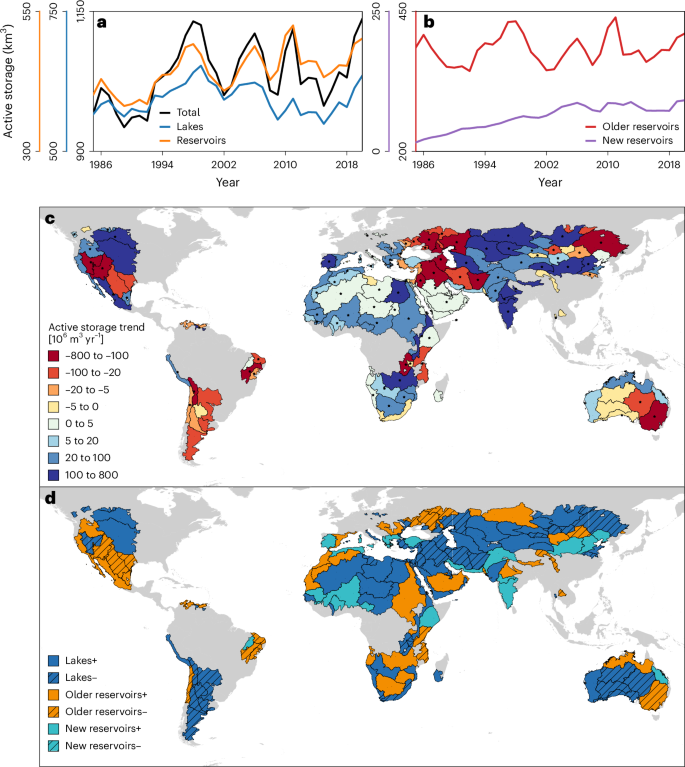
For lakes and old reservoirs (constructed before 1983), conversely, the trend in storage is minor when aggregated globally, but they dominate surface water storage trends in 91% of individual global dryland basins. Further analysis reveals that long-term storage changes in these water bodies are primarily linked to anthropogenic factors—including human-induced warming and water-management practices—rather than to precipitation changes, as previously thought. These findings reveal a decoupling of surface water storage from precipitation in global drylands, raising concerns about societal and ecosystem sustainability. https://www.nature.com/articles/s44221-024-00367-7 (10 Jan. 2025)
INTERLINKING OF RIVERS
Ken Betwa Link This video shows how farmers and people of Panna district in MP have remained deprived while UP takes away the Ken Waters so far. The Kan Betwa Project is going to continue in the same mode. https://www.youtube.com/watch?v=BBYnNS1o3L0 (07 Jan. 2024)
Bids invited for restoration of Ken Main Canal Irrigation Department, Uttar Pradesh has invited bids for the UP Irrigation dept has invited bids for the restoration of Ken Main Canal under Ken-Betwa Link Project. The work will extend from km. 0.000 to 31.600 in restoration of Ken Canal System, and from km. 31.600 to 59.338 under Ken-Betwa Link Project at a cost of Rs 188.52 crore and Rs 167.33 crore respectively. The specifications include excavation, earthework in embankment, cement concrete and RCC works, PVC water seal, cement concrete canal lining and other works, and is to be completed in 36 months for both contracts. The bid submission due date for both is 12 February, 2025. https://www.projectstoday.com/News/Bids-invited-for-restoration-of-Ken-Main-Canal-under-Ken-Betwa-Link-Project (07 Jan. 2025)
Nalganga-Wainganga River Linking CS Tech AI bags Rs 381 cr contract for survey, DPR A Megha Group company, CS Tech AI, has secured the Rs 381 cr contract for conducting the initial survey and preparing a detailed project report (DPR) for the state govt’s ambitious Nalganga-Wainganga river linking project. The 485km long network will link the Wainganga River in Bhandara to the Nalganga River in Buldhana, which flows in the west Vidarbha region. This marks the first step for the Rs 84,000 crore river linking project cleared by the state govt in its previous tenure. The contract also led to CS Tech’s shares touching the upper circuit after the company announced that it secured the contract. The project was cleared by the state cabinet in Aug 2024. https://timesofindia.indiatimes.com/city/nagpur/cs-tech-ai-bags-rs-381-crore-contract-for-nalganga-wainganga-river-linking-project/articleshow/117129622.cms (11 Jan 2025)
Opinion River interlinking, the fount of environmental disaster The uncontrolled human-induced disequilibrium in natural hydrographic systems will destroy associated ecological niches with incalculable repercussions for the long-term well-being of society — an unpardonable disservice to future generations. We may also have to factor in the consequences of climate change impacting rainfall and river flow, which will aggravate the situation. It is unclear how the nation’s declared commitment to mitigating human-induced climate change and river manipulation go hand in hand.
Policymakers ignore the point that there is no “free” surplus water in any river and simple elementary arithmetic rationalisations such as tapping the ‘water lost to sea’ do not consider the eco-hydrological dimensions of the issue. The supporters of these projects and the politicians do not understand or deliberately ignore viewing the river as a part of the drainage basin with constitutive ecological niches, which includes its final destination of deltaic plains, interfacing with the sea.
The eco-services of the free-flowing rivers include the flushing of silt from riverbeds to the coastal waters to form deltas. Flood water is not to be rationalised as ‘surplus’. It needs to be seen as the carrier of minerals for land fertility, groundwater recharge and sustenance of biodiversity, which finally helps the livelihood of millions of marginalised people. (C.P. Rajendran) https://www.thehindu.com/opinion/lead/river-interlinking-the-fount-of-environmental-disaster/article69077414.ece (09 Jan. 2025)
INTERSTATE WATER DISPUTES
Yamuna Water Disputes Opposition questions water sharing MoU Reacting to the MoU, Congress state president Govind Singh Dotasra said, by mortgaging Rajasthan’s interests and making Haryana the dominant beneficiary in the MoU, the BJP govt is accused of misleading the people of Shekhawati for superficial applause. The truth, as opposition leaders claimed, is that the Memorandum of Understanding (MoU) signed on Feb 17, 2024, for drafting a new Detailed Project Report (DPR) between Rajasthan and Haryana violates the terms of the original 1994 agreement and surrenders Rajasthan’s interests.
“Under the new agreement, Haryana will receive 24,000 cusec of water first, and only if surplus water remains or additional water becomes available during the monsoon will Rajasthan receive its share. Haryana Chief Minister himself confirmed this during a meeting in Delhi on Jan 7,” said Dotasra. The opposition further alleges that CM Sharma capitulated to Haryana’s demands. “The Central Water Commission (CWC) typically controls water allocation, yet Haryana unilaterally decided on a 24,000-cusec allocation, up from its previous claims of 13,000 and later 18,000 cusecs. Despite this, CM Sharma signed the agreement without safeguarding Rajasthan’s interests,” alleged Dotasra. https://timesofindia.indiatimes.com/city/jaipur/yamuna-water-deal-to-benefit-shekhawati-oppn-slams-mou/articleshow/117130292.cms (11 Jan. 2025)
URBAN RIVERS
Mutha; Pune Sewage chokes river For the last 18 months, two city residents have been diligently visiting a 4km stretch of the Mutha river, from Vitthalwadi to the Riddheshwar Siddheshwar temple in Shivajinagar. Their task? Mapping and tracking open sewage outfall points along the banks to investigate the magnitude of what is poisoning this river. Alarmingly, in the course of this dedicated effort, the duo managed to find at least 50 sewage outfall points, indicating a small part of a larger threat to the vital ecosystem.
Both volunteers of social group Pune River Revival — open technology developer Amitraj and real-estate consultant Nishad Sevekari — began visiting the stretch in July 2023 to create a database. In addition to gathering data, Amitraj and Nishad — along with Rekha Joshi, another Pune River Revival volunteer and a few others — are also taking groups of children and other citizens on excursions to the riverbanks to help them connect with nature.
At present, Pune has 9 STPs, but these are not enough to manage the city’s waste, said Manish Ghorpade, one of the founders and directors of Jeevitnadi. “If we are to meet international standards of waste treatment, we need the capacity of Pune’s STPs to be at least 1,600 MLD, based on our population. Even with the 11 new STPs that are to be built under there will still be 600MLD of untreated sewage. The JICA project started in Pune 2016, but we are yet to see a single STP completed,” Ghorpade said. The existing ones also aren’t always functional, he added. https://timesofindia.indiatimes.com/city/pune/sewage-chokes-mutha/articleshow/117095940.cms (10 Jan. 2025)
Activists criticize PMC for tree cutting Environmental activists and local citizens have raised concerns over the Pune Municipal Corporation’s (PMC) decision to cut down 50-60 trees for the proposed 30-meter road project from Manjari to Shivajinagar. During a meeting with PMC officials on Friday (Jan. 10), they objected to the move, pointing out that no expert committee had been formed to oversee the tree felling, as required by environmental regulations.
The activists emphasized that the road project, part of the city’s development plan, should have obtained a separate environmental clearance, distinct from the Mula-Mutha riverfront development plan. They referred to a condition set by the State Environment Impact Assessment Authority (SEIAA) on November 12, which approved the riverfront project but mandated the formation of a committee for any tree cutting work.
Despite this, PMC proceeded with tree cutting in Koregaon Park, under the assumption that the environmental clearance for the riverfront project covered the road project as well. However, no expert committee has yet been established, as activists pointed out. https://punemirror.com/pune/others/pune-news-activists-criticize-pmc-for-tree-cutting-without-expert-committee-approval/cid1736581988.htm (11 Jan. 2025)
RIVERS
CAUVERY Documentary -Cauvery: River of Life the 55-minute documentary highlights the fact that ecosystems and wildlife have evolved over millions of years and they know how to survive. https://www.thehindu.com/news/cities/bangalore/cauvery-river-of-life-turns-lens-on-the-magical-brown-landscapes-of-mm-hills/article69080982.ece (10 Jan. 2025)
GODAVARI Telangana Mesrams embark on 160-km trek to fetch holy water -The Mesrams embarked on a padayatra for fetching holy water from the Godavari river, at Keslapur village in Indervelli mandal on Friday (Jan. 10) as part of Nagoba Jatara, a five-day annual religious and cultural affair of the clan slated for January 28. Nagoba Jatara is the largest congregation of ethnic tribes belonging to several parts of not only Telangana but also Maharashtra, Madhya Pradesh, and Chhattisgarh. https://telanganatoday.com/watch-mesrams-embark-on-160-km-trek-to-fetch-holy-water-from-godavari (10 Jan. 2025)
GANGA Sad state of affairs in Muzaffarpur, the constituency of Union Jal Shakti Minister where untreated sewage is polluting the Burhi Gandak, one of the tributaries of Ganga.

YAMUNA Delhi Centre has accepted to NGT, that the forecast for Yamuna flow in 2023 flood was faulty. Rare acceptance. https://www.thehindu.com/news/cities/Delhi/forecast-for-2023-delhi-floods-was-inaccurate-as-flow-of-yamuna-was-marred-by-silt-muck-centre-to-ngt/article69077725.ece (09 Jan. 2025)
River congestion impaired 2023 floods forecast: Centre to NGT The reply filed by the MoJS and CWC on January 4 said the high discharge downstream of Hathnikund Barrage created a flood situation in River Yamuna near Delhi. “Due to this, the flow of the Delhi Railway Bridge site increased continuously and crossed the previous high flow level of 207.49 metre at 13:00 hrs on July 12, 2023, and achieved the highest peak water level of 208.66 metre at 18:00 hrs on July 13,” it said. The flood forecast, it said, required the water channel to be in a “free flow state” and changes in flow conditions upstream and downstream of the flood forecasting station could “compromise” accuracy.
It said the free flowing conditions did not exist between Wazirabad and Okhla barrages because of the non-opening of all the gates of ITO Barrage, the formation of islands of silt deposits, trees in the river’s course and muck disposal at various locations due to bridge construction activities across the river. “All these factors resulted in congestion in the river in Delhi reach and if the free flow condition of the channel is compromised, then, the forecast issued will not match with the actual forecast,” the reply said. A committee headed by the CWCs chairperson suggested the departments concerned in Delhi to take corrective measures for the future, it said. https://www.hindustantimes.com/india-news/conman-sukesh-chandras-declares-overseas-income-of-rs-7-640-crore-offers-to-pay-tax-pm-modi-nirmala-sitharaman-101736660668590.html (08 Jan. 2025)
Weeks before Delhi polls, Kalindi residents’ wish for clean Yamuna remains unfulfilled. https://www.telegraphindia.com/india/weeks-before-delhi-polls-kalindi-residents-wish-for-clean-yamuna-remains-unfulfilled/cid/2076769 (10 Jan. 2025) While most young people are moving away from their family occupation of plying boats on the Yamuna in Delhi, Ganesh Pandit is the exception. https://ruralindiaonline.org/en/articles/row-row-row-your-boat…/ (11 Jan. 2025)
Ghaziabad Jal Nigam replies to NGT’s notice Noting that the UP Jal Nigam was under statutory obligation to carry out functions relating to preparation, execution, promotion and financing schemes for sewerage and sewerage disposal, the tribunal in September had issued a show cause to the corporation’s Managing Director (MD), saying why prosecution may not be initiated against him and other responsible authorities.
In the reply submitted to the NGT on November 18, the corporation said it had no independent funds to finance any projects. “It is humbly submitted before this tribunal that prosecution under section 43 of the Water Act (punishment for failing to prevent or control pollution) may not be initiated against the undersigned (MD) and other responsible authorities,” the reply said.
It said the corporation was “completely dependent upon the state government for financing of schemes” and that the body was required to submit periodic reports on its activities, projects, finances, and compliance with its statutory responsibilities. The reply said the UP Jal Nigam’s role was “limited to the preparation and execution of projects as per government directives, without financial accountability for funding.” https://www.indiatvnews.com/news/india/yamuna-pollution-up-jal-nigam-replies-to-ngt-s-notice-says-no-financially-independent-2024-11-19-962429 (19 Nov 2024)
FISH, FISHERIES, FISHERFOLKS
Study One-quarter of freshwater fauna threatened with extinction Abstract: –Here we present the results of a multi-taxon global freshwater fauna assessment for The IUCN Red List of Threatened Species covering 23,496 decapod crustaceans, fishes and odonates, finding that one-quarter are threatened with extinction. Prevalent threats include pollution, dams and water extraction, agriculture and invasive species, with overharvesting also driving extinctions. We also examined the degree of surrogacy of both threatened tetrapods and freshwater abiotic factors (water stress and nitrogen) for threatened freshwater species.
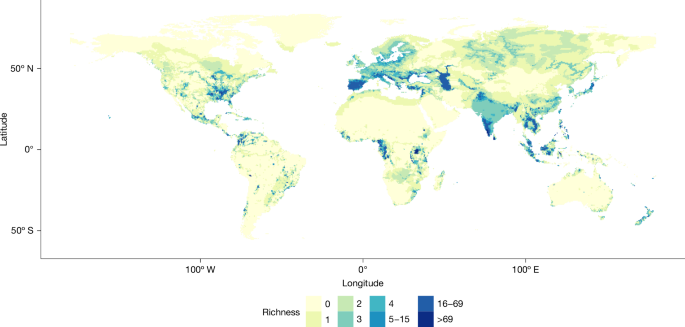
Threatened tetrapods are good surrogates when prioritizing sites to maximize rarity-weighted richness, but poorer when prioritizing based on the most range-restricted species. However, they are much better surrogates than abiotic factors, which perform worse than random. Thus, although global priority regions identified for tetrapod conservation are broadly reflective of those for freshwater faunas, given differences in key threats and habitats, meeting the needs of tetrapods cannot be assumed sufficient to conserve freshwater species at local scales. https://www.nature.com/articles/s41586-024-08375-z (08 Jan. 2025)
Four in 10 species inhabiting inland water ecosystems in the Western Ghats face the threat of extinction, conservation scientists said on Jan 8 after a worldwide assessment covering habitats critical to livelihoods and the environment. The assessment by an international consortium of researchers has estimated that 24 per cent of freshwater fauna worldwide are threatened with extinction, with at least 4,294 of the 23,496 freshwater animals at high risk of extinction.
-Among the Western Ghats’ threatened species are the hump-backed mahseer found only in the River Cauvery, the subterranean groundwater dragon snakehead fish, and the peninsular hill trout, found only in the River Periyar. In the Western Ghats, growing populations of non-native fish such as the African catfish, common carp, or tilapia too pose a threat to native fish, Rajeev Raghavan, assistant professor at the Kerala University of Fisheries and Ocean Studies, Kochi, and a study co-author said.
-The study found that among the groups studied, 30 per cent of crabs, crayfishes and shrimps are at risk of extinction, followed by 26 per cent of freshwater fishes and 16 per cent of dragonflies and damselflies. Of the freshwater species under threat, 54 per cent are threatened by pollution, 39 per cent by dams and water extraction, 37 per cent by agriculture and other land use changes, and 28 % by invasive species and diseases. https://www.telegraphindia.com/india/four-in-10-freshwater-species-in-western-ghats-face-extinction-says-research/cid/2076558 (10 Jan 2025)
The first-ever multi-taxon global freshwater fauna assessment for The IUCN Red List of Threatened Species has identified Western Ghats as a key location with greatest abundance of threatened freshwater species. The study co-authored by species experts from all geographical regions of the world also revealed that a staggering one-quarter of the freshwater fauna are threatened with extinction. The study led by IUCN and published in the multidisciplinary science journal, Nature, underscores the historical underappreciation of freshwater ecosystems in global environmental governance. https://www.thehindu.com/sci-tech/energy-and-environment/first-ever-multi-taxon-global-freshwater-fauna-assessment-identifies-western-ghats-as-a-hotspot-of-threatened-species/article69076585.ece (08 Jan. 2025)
According to the authors of the study, “globally, biodiversity is in decline, with freshwater ecosystems being particularly affected.” On the basis of monitored natural inland wetlands (including peatlands, marshes, swamps, lakes, rivers, and pools, among others), 35% of wetland area was lost between 1970 and 2015, at a rate three times faster than that of forests.” “Of the remaining wetland habitats, 65% are under moderate-to-high levels of threat, and 37% of rivers over 1,000 km are no longer free-flowing over their full length. Declines are continuing, generally out of sight and out of mind, despite the importance of the freshwater realm. Freshwaters support over 10% of all known species, including approximately one-third of vertebrates and one-half of fishes, while only covering less than 1% of the surface of the Earth.” https://www.ndtv.com/science/freshwater-species-face-a-crisis-a-quarter-are-on-the-brink-of-extinction-study-7450919 (11 Jan. 2025)
Nowhere is this loss more profound than in the Western Ghats, a freshwater biodiversity hotspot and home to many endemic species. The study identifies this region as one where freshwater species are most threatened. “There are over 300 species of freshwater fish in the Western Ghats. More than half of them is found only here and nowhere else on Earth, making them exceptionally vulnerable to environmental threats,” said Dr Rajeev Raghavan, assistant professor at the Kerala University of Fisheries and Ocean Studies (KUFOS), Kochi. According to him, Kerala has the highest number of threatened freshwater fishes in India (74), and the Periyar River is the most significant in terms of ‘conservation attention’ as it harbours the maximum number of endemic & threatened freshwater fishes in Kerala. https://www.newindianexpress.com/states/kerala/2025/Jan/08/a-quarter-of-worlds-freshwater-life-at-risk-of-extinction-reveals-study (08 Jan. 2025)
SAND MINING
Haryana वाट्सअप ग्रुप से हो रही अधिकारियों की रेकी यमुनानगर। जिले में अवैध खनन को लेकर नया खुलासा हुआ है। अवैध खनन करने वाले वाट्सअप ग्रुप से अफसरों की रेकी कर रहे हैं। पुलिस व प्रशासनिक अफसरों की एक-एक पल की जानकारी दी जाती है। ओके रिपोर्ट होने पर ही खनन के वाहन आगे बढ़ते हैं। सोशल मीडिया पर एक ग्रुप की वीडियो वायरल होने के बाद खलबली मची है। खनन विभाग के अफसरों ने भी मामले की जांच शुरू कर दी है। एंटी करप्शन सोसाइटी के प्रदेशाध्यक्ष और अधिवक्ता वरयाम सिंह ने कहा कि रेकी ग्रुप के जरिए बड़े-बड़े गैर कानूनी काम इन ग्रुपों के जरिये हो रहे हैं। उनका कहना है कि अधिकारी तक इन ग्रुपों के बारे में जानते हैं। लेकिन, इन ग्रुपों पर कंट्रोल नहीं लगा है। वरयाम सिंह ने कहा कि हमने साल 2020 में इन ग्रुपों के खिलाफ एक मामला दर्ज कराया था। जिसके बाद इसके लिए एक एसआईटी बनी थी लेकिन वो सिर्फ कागजों तक ही सीमित रह गई। https://www.amarujala.com/haryana/yamuna-nagar/officials-are-being-monitored-through-whatsapp-groups-yamuna-nagar-news-c-246-1-ymn1002-131254-2025-01-10 (10 Jan. 2025)
Mine to destroy An ecological crisis looms large as Aravalli hills get flattened and Haryana dithers on an effective strategy to counter illegal mining. Between 1975 and 2019, nearly 8 per cent of the Aravalli hill range has disappeared, says a study covering four states, projecting the losses to rise to around 22 per cent by 2059 if ‘explosive’ urbanisation and mining continue at the current pace in Delhi-NCR. Researchers from the Central University of Rajasthan studied satellite images and land-use maps between 1975 and 2019 to come up with the estimates. Data showed that 5,772.7 sq km (7.6 per cent) of the Aravalli range was flattened during the 44-year period. Of this, nearly 5 per cent (3,676 sq km) of the hills was converted into barren land and another 776.8 sq km (around 1 per cent) into settlements. The projected loss by 2059 of the total Aravalli area is 16,360 sq km. https://www.tribuneindia.com/news/in-depth/mine-to-destroy (12 Jan. 2025)
Bihar The story of two mafias—sand and booze The sand and liquor mafias have corroded Bihar’s economy, fuelled criminal politics, brought in a rural rot, and rendered its youth unemployable for at least a decade. At the top of Bihar’s rural black market are the policymakers—MLAs and MLCs—collaborating with relatives to grease the wheels of the operation. At the bottom, labourers from marginalised castes toil endlessly. In the middle are the munshis, managers, and owners of tractors, JCBs, and Poclains, along with small-scale businessmen.
The money from sand, legal or illegal, runs into crores. On the legitimate side, Bihar earned Rs 1,558.16 crore from sand mining in 2023-24, almost twice the Rs 836.57 crore earned in 2018-19. While the state has increased its revenue through policy changes, surveillance, and political efforts, the sand syndicates have only grown stronger. The illegal market generates at least double the state’s revenue, according to the estimates of mining department officials. https://theprint.in/ground-reports/the-story-of-bihars-two-mafias-sand-and-booze/2440294/ (13 Jan. 2025)
Andhra Pradesh Illegal sand mining intensifies along Tungabhadra Due to halted official operations in designated sand reaches, illegal sand mining has escalated across 137 villages along Tungabhadra river. This pause in official sand mining has paved way for illegal operators. Although permits exist for four reaches in Kowthalam, sand is being transported illegally without official oversight. More than 200 tractors have been transporting sand daily from Panchalingala and Munagalapadu villages with large-scale excavations occurring dangerously deep within the river. Sand is then transported to cities and sold at rates of up to Rs 3,000 per tractor. Some real estate developers are stock piling sand from this area for their ventures. It is estimated that illegal sand trade worth Rs 7 to Rs 8 lakh occurs daily in Munagalapadu alone. https://www.thehansindia.com/andhra-pradesh/illegal-sand-mining-intensifies-along-tungabhadra-river-936583 (11 Jan. 2025)
Telangana Gundala hot water springs faces threat from mining Ushnagundalu or hot water springs in the riverbed of the Godavari near Bhadrachalam is a religious spot often visited by both devotees and tourists alike. There are several legends associated as well with the naturally formed hot water springs. Devotees believe that during winter, Lords Brahma, Vishnu and Shiva visit the hot water pools in the river to take a bath and hence the hot springs here have healing properties. Another legend is that during his exile, Lord Rama created a hot water spring in the river by shooting an arrow into it. According to another legend the hot springs were created by the serpent king Adhi Sesha and taking a dip in the sacred spring would obliterate one’s past sins.
Speaking to Telangana Today, retired Deputy Director of Groundwater Department V Anand Kumar said huge quantities of sulfur deposits beneath the riverbed causes the hot water springs. Sulfur deposited in the gaps of sandstones deep in the riverbed causes heat due to geothermal activity, he said. But in recent times, due to excessive sand mining, often illegally, the hot water springs are getting damaged, complained Srinivas, a resident of Gundala village. He wanted the officials to control sand mining in the area to preserve the hot water springs. https://telanganatoday.com/gundala-hot-water-springs-draw-tourists-devotees-but-faces-threat-from-rampant-sand-mining (12 Jan. 2025)
Tamil Nadu HC forms SIT to probe sand mining in Kovai Madras high court has constituted a special investigation team (SIT) comprising two IPS officers to probe the illegal sand mining by brick kilns operating near the reserve forests of Coimbatore. A special division bench appointed G Nagajothi, superintendent of police, State Crime Records Bureau, Chennai, and F Shashank Sai, SP, Organised Crime Intelligence Unit as members of SIT. The court directed the team to begin its investigation into the cases already registered by police and to register fresh cases if it came across a larger conspiracy that resulted in the creation of massive trenches near the forest areas, putting wild animals in danger. The court further directed the district authorities to obliterate illegal bridges and roads put up by the illegal miners and restore all water bodies in the area to their original form. https://timesofindia.indiatimes.com/city/chennai/hc-forms-sit-to-probe-sand-mining-in-kovai/articleshow/117129964.cms (11 Jan. 2025) A special Division Bench of Justices N. Sathish Kumar and D. Bharatha Chakravarthy passed the orders on a batch of petitions filed by activists S. Muralidharan, R. Karpagam, M. Siva and others, through their counsel S.P. Chockalingam and M. Purushothaman, and called for a status report by February 27, 2025. https://www.thehindu.com/news/national/tamil-nadu/madras-high-court-constitutes-sit-to-probe-illegal-sand-mining-near-forest-areas/article69084436.ece (11 Jan. 2025) https://www.livelaw.in/high-court/madras-high-court/madras-high-court-sit-illegal-sand-mining-western-ghats-280629 (10 Jan. 2025)
Farmers, villagers take out rally against tungsten mining project Over 10,000 farmers and villagers from Melur and nearby regions, on Tuesday (January 7, 2025) went on a 25-km procession from Narasingampatti to Tallakulam in Madurai city demanding that the tungsten mining project at Melur taluk in Madurai district be scrapped. https://www.thehindu.com/news/national/tamil-nadu/thousands-of-madurai-farmers-villagers-take-out-25-km-long-procession-against-tungsten-mining-project/article69071887.ece (08 Jan. 2025) CM M.K. Stalin on Saturday (Jan. 11) said that the tungsten mining project would not be implemented in the State. https://www.thehindu.com/news/national/tamil-nadu/tungsten-mining-will-not-be-allowed-says-stalin/article69089240.ece (12 Jan. 2025)
Kerala Fishers protest offshore mining auction Fishing community on Saturday (Jan. 11) organized a protest in the city against the move by Union ministry of mines to auction coastal and offshore mining sites of Kerala. Inaugurating the dharna, former MP and AITUC president T J Angelos said sea mining infringes on the state fisherfolk’s rights. Such a move would devastate Kerala’s ecological balance and biodiversity. The fishing community consistently opposed these measures since 2003.Angelos said central govt’s appropriation of state authority through the blue economy agenda undermines federalism.
Meanwhile, the first roadshow on the maiden e-auction of offshore mineral blocks, showcasing India’s commitment to unlocking the vast resource potential in the exclusive economic zone (EEZ), was presided over by Union joint secretary Vivek K Bajpai in Kochi on Saturday. It saw a strong presence of industry leaders, policymakers, stakeholders and govt representatives. https://timesofindia.indiatimes.com/city/kochi/fishers-protest-against-offshore-mining-auction/articleshow/117157797.cms (12 Jan. 2025)
Kerala has expressed opposition to the Union government’s move to carry out sand mining off the state’s coast. Kerala pointed out that the norms and provisions of the Offshore Minerals (Development and Regulation) Act- 2002 and the amendments made thereto in 2023 do not take into account the interests of states. The royalties derived from the mining of mineral wealth are entirely vested in the central government. The 2023 amendment also allowed the private sector to participate in the mining sector. The state’s dissent has already been informed to the Centre.
The Centre’s move came after a study conducted by the central agency Geological Survey of India on the Kerala coast found that there is 745 million tonnes of sand deposits suitable for construction activities.The deposits of these sands are found in Indian territorial waters up to 12 nautical miles from the coast and in the exclusive economic zone beyond 12 nautical miles. About 300 million tonnes of sand is deposited in three blocks in Kollam region currently under consideration for sand block auction. https://www.newindianexpress.com/states/kerala/2025/Jan/12/kerala-opposes-union-govts-move-to-carry-out-offshore-sand-mining (12 Jan. 2025)
WETLANDS, LAKES, WATER BODIES
Goa 10 more waterbodies notified as wetlands The state department of environment and climate change has issued the final notification declaring 10 more lakes as wetlands in Goa, under the Wetlands (Conservation and Management) Rules, 2017. Already, 15 lakes in the state have been notified as wetlands. Now the total number of wetlands in Goa has gone up to 25. The waterbodies notified as wetlands are Parra lake in Bardez, Panchami lake in Ponda, Karmale lake or Arla Keri Tollem and Betal lake at Querim in Ponda, Kolamwada lake and Kodal lake at Karapur in Bicholim, Macasana lake in Salcete, Sapu lake or Tollem Bandar at Ambelim in Salcete, Bandolem lake at Sancoale in Mormugao, and Talaulim lake or Talsal Tollem in Ponda.
The Goa State Wetland Authority and the Union ministry of environment, forest and climate change will now monitor the enforcement of the wetland conservation rules in the area of these wetlands and their zone of influence. Historically, most wetlands of Goa were created as agricultural tanks to store rainwater as a source of irrigation in the post-monsoon months. They support the extant flora and fauna, including migratory birds. Many waterbodies were constructed for storage within temple premises and this conservation effort gained a sacred status in the form of temple tanks, promoting water harvesting. https://timesofindia.indiatimes.com/city/goa/10-more-waterbodies-notified-as-wetlands-state-now-has-25/articleshow/117157640.cms (12 Jan 2025)
Kerala Action sought to halt encroachment on Kottooly wetlands The Sarovaram Mangrove and Wetland Protection Committee has urged Revenue Minister K. Rajan to take immediate action against the ongoing encroachment on the Kottooly wetlands. A mass petition, signed by around 500 people living around the wetlands, was handed over to the Minister on Thursday (January 9) under the aegis of local councillor and chairman of the committee M.N. Praveen and convenor I.K. Biju.
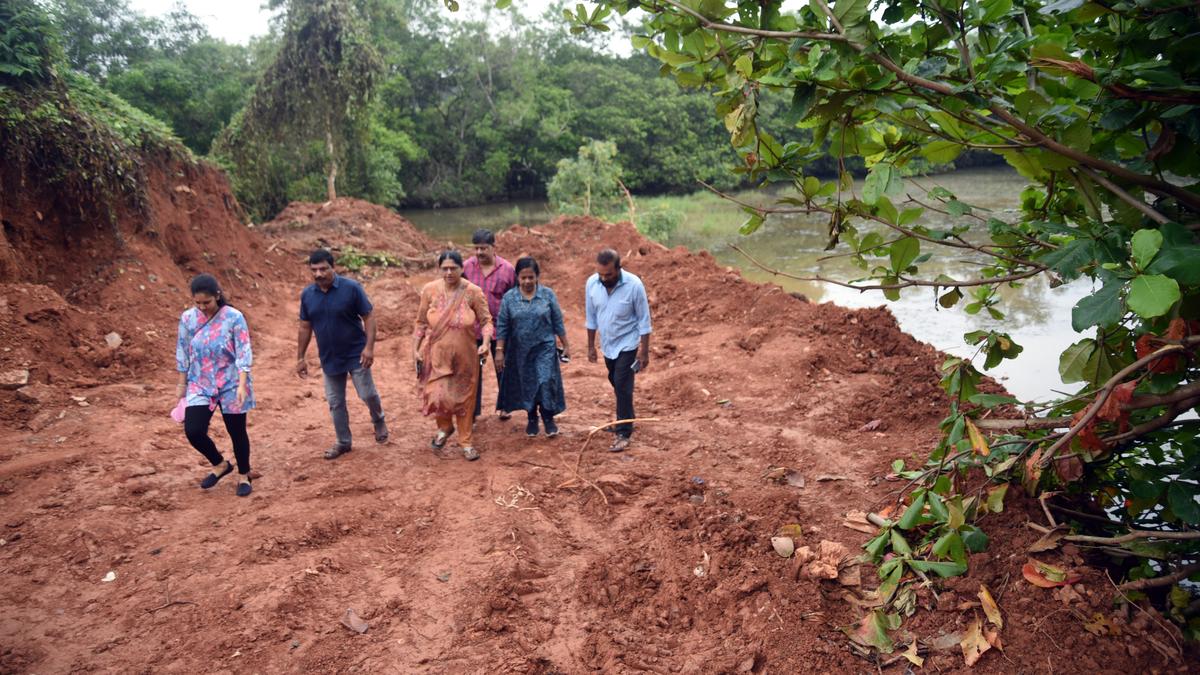
The memorandum alleges extensive encroachments on wetlands near the Sarovaram Bio Park, particularly on the land occupied by the Calicut Trade Centre and a recently encroached strip behind the Markaz International School, as well as several private plots. “These encroachments, carried out day and night, pose a grave threat to the ecosystem and blatantly defy the legal system. Local residents and public representatives who question these actions face threats,” the memorandum stated. It also criticised the Revenue department for its alleged inaction against the encroachers. https://www.thehindu.com/news/national/kerala/action-sought-to-halt-encroachment-on-kottooly-wetlands/article69089362.ece (11 Jan. 2025)
Bihar Jagatpur wetland to be developed as tourist hub: DDC District development commissioner (DDC) Pradeep Singh said that the district officials’ team along with the Naugachhia subdivision officials visited Jagatpur wetland recently in order to assess the potential of ecotourism in the area, and bring the region into the world map. “Major challenge is to develop infrastructures, including bird-watching center, rest houses, and good road connectivity near the wetland for the visit and stay of tourists in a way that the biodiversity and ecosystem of the wetland and the region are not harmed and disturbed,” said the DDC, adding that it would be a milestone for the ecological conservation in accordance with the ‘Jal Jeevan Hariyali’ programme of the state govt.
Jagatpur, a freshwater lagoon situated nearly 12km north-east of Bhagalpur city, is home to migratory birds during winters to this wetland. As per reports, 169 species have been recorded from Jagatpur wetland through surveys conducted by the forest department and local birders. https://timesofindia.indiatimes.com/city/patna/jagatpur-wetland-in-bhagalpur-to-be-developed-as-a-tourist-hub-says-ddc/articleshow/117132842.cms (11 Jan. 2025)
WATER OPTIONS
Goa Vargao’s sacred well, reservoir of 300-year-old history, faces erasure A sacred well at Vargao, a repository of a 300-year-old legacy, is sinking into oblivion. Located just 500m from the Candola-Old Goa Road, the well is situated at Madapai and is thought to be the abode of a hallowed force. Sukadu Bhosle, an 80-year-old retired teacher from Madapai, said, “This well is believed to be associated with the unseen, holy spirit Nara.” He added, “Every year, a rice pancake is offered to it after sacrificing a cock. We don’t know who built the well. However, we have considered it holy based on ancestral traditions.”
Agro-horticulture is the chief means of sustenance for Madapai, where Kuddo, Sakhalyo, and Nara are believed to be the guardian spirits. Locals do not dare visit the well unless religious practices are warranted there. The well is squarish, deep, and has a perennial source of water. Centuries of natural decay and neglect have all but sealed the well’s fate. As the well is covered with natural vegetation, it has remained unnoticed, said Eknath Parab, a local panch. https://timesofindia.indiatimes.com/city/goa/vargaos-sacred-well-reservoir-of-300-year-old-history-faces-erasure/articleshow/117157933.cms (12 Jan. 2025)
GROUNDWATER
Sharing this data table (published in CGWB report) on nine ground water assessments done from 2004 to 2024.
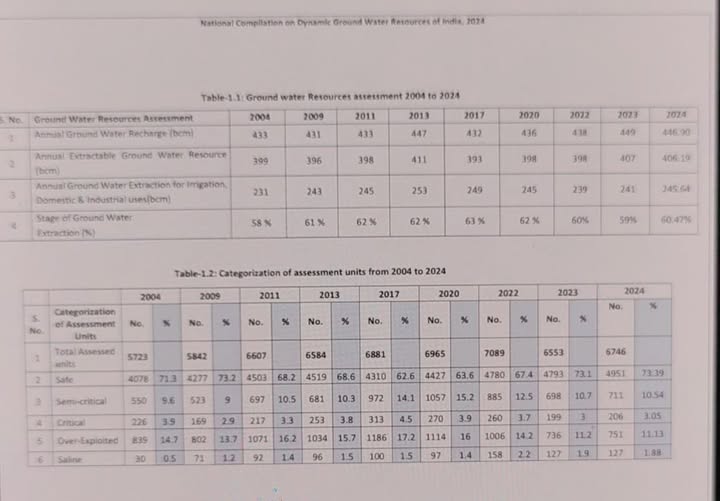
Table shows, there is no significant change in total annual Recharge. It ranged between 431 bcm in 2009 to 449 in 2023. In 2024, it reduced slightly to 446.90, the same figure was also reported 10 years back in 2013.
. Over years, recharge from monsoon rainfall has slightly decreased, but surprisingly recharge from other sources increased disproportionately, while recharge from rainfall in non-monsoon relatively also reduced sharply.
. On the ground, extraction rapidly increased in different sectors through huge numbers of irrigation, industrial, drinking water tubewell, submersible borings all across the country, but CGWB figures on groundwater extraction from 2004 to 2024 depict a confusing picture, minimum extraction of 230 bcm was reported in 2004, maximum 253 in 2013. Surprisingly 245 bcm in 2011 and same estimate – 245 bcm was also reported in 2024. https://www.facebook.com/share/p/1XZUWN4LfN/
Report Groundwater contamination India, the world’s largest user of groundwater, consumes 87% of it for irrigation and 11% for domestic use. However, this vital resource is increasingly polluted, driven by complex interactions between natural processes and human activities, highlights the Annual Ground Water Quality Report released by the Central Ground Water Board (CGWB) on December 31.
In an accompanying report, Dynamic Ground Water Resource of India 2024, the CGWB estimates groundwater extraction at 60.4% in 2024, which hasn’t changed much since 2009, when measurements began biennially (and annually since 2022). “This is hard to believe, with rising population, agricultural intensity, and urban settlements heavily relying on groundwater instead of surface water. There is a rise in construction on recharge areas and encroachment on floodplains. As a result, we are losing the net total recharge areas. It is concerning that paved areas are expanding at the cost of unpaved lands that are crucial for groundwater recharge,” says says Venkatesh Dutta, a professor at Babasaheb Bhimrao Ambedkar University, Lucknow. https://india.mongabay.com/2025/01/government-report-highlights-groundwater-contamination-across-india/ (08 Jan. 2025)
GW recharge declined marginally in 2024 Total annual groundwater recharge in the country marginally declined in 2024, compared to 2023, and so did water availability due to higher groundwater extraction last year, with northwest India, including parts of Punjab, Haryana, Delhi and western Uttar Pradesh, being the bigger culprits.
The Central Ground Water Board’s annual assessment report, released recently by the ‘Jal Shakti’ (water resources) ministry, also shows that the percentage of ‘critical’ and ‘over-exploited’ assessment units (block/taluk/tehsil/mandal), put together, increased in 2024, compared to the previous year, reflecting a bigger concern of inadequate recharge of groundwater in certain states, which extracted more for multiple use.
Data shows that the annual groundwater recharge in 2024 was 446.9 billion cubic meter (BCM), compared to 449.08 BCM in 2023. Accordingly, the annual extractable groundwater resources has also decreased marginally from 407.21 in 2023 to 406.19 BCM in 2024. In 2022, the total annual groundwater recharge was 437.6 BCM, whereas extractable groundwater resources was 398.08 BCM.
Though the annual groundwater recharge and availability last year was much higher than 2022, the decline compared to 2023 is a concern, even as the year got good monsoon rainfall. The board has attributed it mainly to the reduction in return flow from irrigation. https://timesofindia.indiatimes.com/india/groundwater-recharge-declined-marginally-in-2024-dip-in-water-availability-too/articleshow/117182060.cms (13 Jan. 2025)
Make country’s groundwater sustainable According to the CGWB Report on Groundwater Assessment, the groundwater used for irrigation increased from 38% in 2016-17 to 52% in 2023-24. The situation is expected to intensify further in the coming years.
As a result of the current farming practices and the increasing population, most districts of the top paddy-producing states such as Rajasthan (19), Punjab (19), and Haryana (14) have over-exploited their groundwater for irrigation purposes.
Rainfall is the main source of recharging groundwater and between Rajasthan, Punjab, and Haryana, Rajasthan received the highest average rainfall (608 mm) in 2023-24. Yet, its groundwater experienced the highest salinisation at 22%. https://www.financialexpress.com/opinion/make-countrys-groundwater-sustainable/3711483/ (10 Jan. 2025)
Telangana Nitrate-Laced Ground Water Everywhere Groundwater in most part of Telangana may not be safe for drinking, unless purified before consumption, due to excessive concentration of nitrates because of unrestrained use of fertilisers for crop production in the rural areas, and, in urban areas, untreated water percolating into the ground. There is not a single district, out of the 33 in the state, which is not plagued by the problem of excessive nitrate concentrations, the levels being more than the permissible limits. According to the Central Ground Water Board (CGWB), Rangareddy district is at No. 3 among the top 15 districts in the country where groundwater has extensive nitrate levels. Adilabad is at No. 11 followed by Siddipet at No. 12 while Palnadu district in Andhra Pradesh is at No. 8.
In its annual groundwater survey report 2024 released in the last week of December, the CGWB said that nitrate contamination of ground water is “primarily linked to agricultural run-off and overuse of fertilisers.” Telangana has among the highest fertiliser use per hectare with the National Academy of Agricultural Sciences, New Delhi’s State of India Agriculture report for 2024, pegging the average fertilizer consumption at 297.5 kg per hectare for 2021-22. According to the Fertiliser Association of India’s 2022-23 annual review of fertilizer production and consumption, fertiliser use in Telangana saw a 4.7 per cent growth between 2021-21 and 2022-23. https://www.deccanchronicle.com/southern-states/telangana/nitrate-laced-ground-water-everywhere-in-telangana-1853572 (11 Jan. 2025)
URBAN LAKES, WETLANDS
Mumbai Study maps changes to mangroves and wetlands Researchers from the Indian Institute of Technology Bombay have mapped the changes in Maharashtra’s mangroves and wetlands over the past decade. The study found that the mangrove areas in the coastal Palghar district decreased by about 15% between 2010 and 2020, while in Mumbai, the mangrove regions increased by 16%. However, the wetland areas have decreased significantly in Palghar by 19%, with no big change seen in Mumbai. The increase in mangroves in Mumbai is likely because of the efforts to protect these areas, showing that conservation efforts can make a real difference!
The research offers clear evidence of how human activities, like urbanization and construction, are impacting these sensitive ecosystems. By understanding these changes, policymakers and environmentalists in India can make better decisions about how to protect these invaluable areas. https://researchmatters.in/news/study-maps-changes-mangroves-and-wetlands-along-maharashtras-coastline (11 Jan. 2025)
Greater Noida Authority draws up plan to save Surajpur wetland Taking cognizance of the constant water pollution at the Surajpur Wetland, the Greater Noida authority directed officials to undertake measures to clean up the site and prevent further pollution, said officials. The instructions came following a review meeting on September 20, held in response to significant damage to the wetland’s trees and plants, possibly from unchecked disposal of chemical and dirty waste from nearby industrial units and residential areas, said an official from Greater Noida authority.Officials said on-site inspection was held recently and the entire team reviewed the sources of pollution affecting the wetland ecological balance, particularly its trees and plants. The inspection revealed that untreated water from Sector Ecotech 3, Police Lines, and nearby industries, was being discharged into the wetland, causing significant harm to the flora. https://www.hindustantimes.com/cities/noida-news/greater-noida-draws-up-plan-to-save-surajpur-wetland-from-polluted-discharge-101727978263633.html (04 Oct. 2024)
URBAN WATER
Chennai Residents oppose sewage pumping station fearing gw contamination Residents of Jalladianpet in Pallikaranai under Zone XIV oppose a sewage pumping station planned in Raghavendra Colony there, fearing groundwater contamination leading to drought and health issues. As per details accessed regarding the project, the Chennai Metro Water Supply and Sewage Board (CMWSSB) project in Raghavendra Colony involves constructing a suction well for the underground sewerage system on a site with an existing overhead tank (OHT). It uses reinforced concrete and 100 mm and 200 mm cast iron pipes, along with sluice valves, non-return valves etc., for construction.
Krishnaswamy K.N., a resident there for nearly 30 years, claimed, “Trenches that were dug by GCC few years ago used for freshwater storage and groundwater recharge, may hold wastewater instead when the Metrowater Department project is implemented. Poor maintenance of a suction well could contaminate groundwater. While the Department promises an odour control mechanism, there are no assurances against mosquitoes or rodent infestation in the locality due to the accumulation of wastewater.” According to him: Motor failures could cause wastewater to overflow into streets, worsening Northeast monsoon woes. The trenches helped decrease stagnation on the roads in December 2024 during heavy rains. https://www.thehindu.com/news/cities/chennai/jalladianpet-residents-oppose-sewage-pumping-station-fearing-groundwater-contamination/article69077274.ece (09 Jan. 2025)
MONSOON 2024
Jammu and Kashmir Lowest rainfall in 50 years J&K witnessed its driest year in half a century in 2024, with rainfall levels plunging to just 870.9 mm, a sharp 29 percent deficit compared to the annual average of 1232.3 mm. This marks the fifth consecutive year of below-normal precipitation in the region, amplifying concerns over water scarcity and its cascading effects on agriculture, hydropower, and daily life. This was revealed by independent weatherman Faizan Arif in a survey. The downward spiral in precipitation has been a consistent trend.
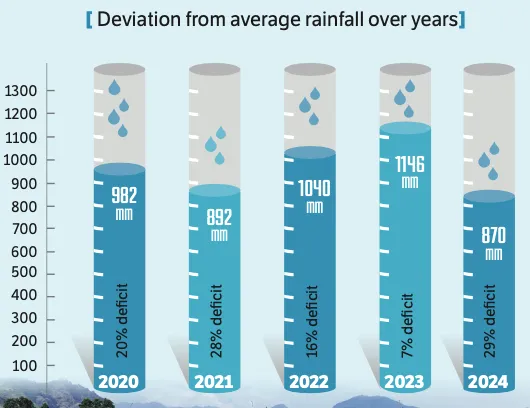
In 2023, the region received 1146.6 mm of rainfall (7 percent below average), while 2022 recorded 1040.4 mm (16 percent deficit). The figures dropped further in 2021 to 892.5 mm (28 percent deficit) and 982.2 mm (20 percent deficit) in 2020. The data indicates a worsening trajectory, with 2024’s precipitation levels approaching the record low of 802.5 mm from 1974.
The year began with a staggering 91 percent shortfall in January, followed by deficits of 17 percent in February and 16 percent in March. While April witnessed a temporary respite with a 48 percent surplus, the months that followed were largely deficit-laden with May 67 percent deficit, June 38 percent deficit, July 36 percent deficit, August 2 percent deficit, and September to December deficits ranged from 41 percent to as high as 74 %t with October recording the steepest shortfall. https://www.greaterkashmir.com/front-page-2/jk-records-lowest-rainfall-in-50-years/ (11 Jan 2025)
HFL BREACH
SANDRP Blog Rivers Flowing in Extreme Flood during Northeast Monsoon 2024 In addition to rivers flowing in extreme flood situations at 64 flooding monitoring stations during Southwest Monsoon 2024, there have been four stations where rivers have crossed highest flood level (HFL) during Northeast Monsoon season. Of these four stations, three are in Tamil Nadu state and one is in Union Territory of Puducherry.
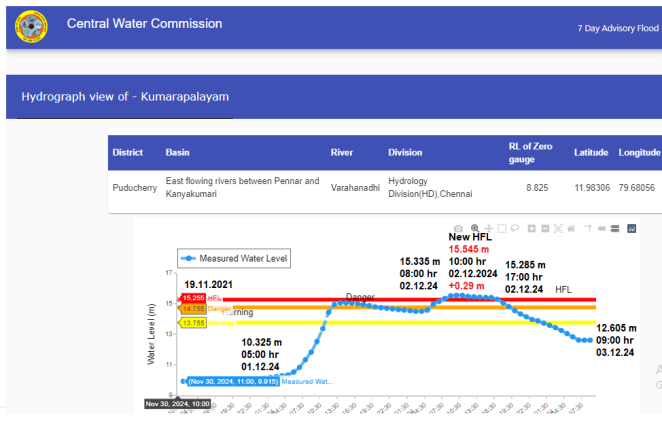
One of these four flood monitoring stations one is in Cauvery basin and the remaining three stations are part of East Flowing Rivers between Pennar and Kanyakumari basin. While the Bhavani river at Gandhavayal station has crossed the HFL after 11 years, the Ponnaiyar river at Vazhavachanur station has topped the old HFL by a margin of 3.32 meters. https://sandrp.in/2025/01/12/rivers-flowing-in-extreme-flood-situation-during-northeast-monsoon-2024/ (12 Jan. 2025)
LANDSLIDES
Fatal landslides in 2024 2024 was exceptional in every way in terms of fatal landslides. In total, I recorded 766 fatal landslides (excluding those triggered by an earthquake), costing 4,933 lives. In terms of the number of fatal landslides, this is the highest annual total that I have ever recorded, breaking the previous record by over 100 events. https://eos.org/thelandslideblog/fatal-landslides-in-2024 06 Jan. 2024)
SOUTH ASIA
Bhutan BHEL commissions hydroelectric project Bharat Heavy Electricals said that it has successfully commissioned two units of the 6?170 MW Punatsangchhu-II Hydroelectric Project (PHEP-II) in Bhutan. The said project was executed under a bilateral agreement between the Government of India and the Royal Government of Bhutan. PHEP-II is a greenfield hydroelectric project located in the Wangdue district of Western Bhutan. Unit 1 and 2 of the 670 MW PHEP-II were synchronised on December 16 and 17, 2024, respectively.
BHEL has executed major projects like 4×84 MW Chukha, 4×15 MW Kurichhu, 6×170 MW Tala and 4×180 MW Mangdechhu in Bhutan till date. With the commissioning of these two units at PHEP-II, BHELs contribution to the total installed capacity in Bhutan now stands at nearly 89%. Further strengthening its footprint in the region, BHEL is currently executing an order for 6×200 MW Punatsangchhu-I HEP, in addition to PHEP-II in Bhutan, stated in the company’s regulatory filing. https://www.business-standard.com/markets/capital-market-news/bhel-commissions-hydroelectric-project-in-bhutan-125010900343_1.html (09 Jan. 2025)
Khorlochhu hydropower project moves forward The board of the 600 MW Khorlochhu Hydro Power Limited (KHPL) signed contracts worth Nu 16.8 billion for the construction of dam and powerhouse, with Jaiprakash Associates Limited (JAL) and Construction Development Corporation Limited (CDCL) during its first extraordinary general meeting in Trashiyangtse on Jan 10.
The project, a joint venture between Druk Green Power Corporation (DGPC) and Tata Power Company Limited (TPC), also finalised key appointments, including the Chief Executive Officer and Chief Finance Officer. https://kuenselonline.com/khorlochhu-hydropower-project-moves-forward/ (11 Jan. 2025)
Joint technical assessment underway for PHPA-I dam stabilization A joint technical assessment is underway for the 1,200 MW Punatsangchhu-I Hydropower Project (PHPA-I) dam, with technical teams from Bhutan and India evaluating stabilisation measures for the right bank slide. Both countries have agreed to proceed with the construction of the dam, integrating necessary stabilisation measures to address the issue. An official from the Ministry of Energy and Natural Resources (MoENR) said that technical deliberations are being conducted during Technical Coordination Committee meetings. https://kuenselonline.com/joint-technical-assessment-underway-for-phpa-i-dam-stabilisation/ (08 Jan. 2025)
Domestic electricity consumption surpasses exports Bhutan’s domestic electricity consumption surpassed exports for the first time in 2023. According to the Environmental Accounts Statistics 2024, this marks a departure from the past decade, during which exports traditionally outpaced domestic use. The change is linked to declining hydropower production and an increasing reliance on imported electricity. The Department of Hydropower Systems projects that Bhutan’s energy demand could grow by more than 400 percent by 2030 if consumption peaks as expected. The surge in domestic demand over the years is primarily driven by the growing industrial sector, which accounted for 93.84 percent of the total domestic electricity consumption in 2023. In contrast, household consumption comprised only 6.17 percent, relying more heavily on fossil fuels and fuelwood for energy needs. In 2023, a total of 11,157 gigawatt-hours (GWh) of hydroelectricity were supplied. Of this, 622 GWh were imported, 5,895 GWh were consumed domestically—with 5,531.98 GWh by industries and 364 GWh by households— and 5,143 GWh were exported.
– In 2021, the overall generation of hydropower was 10,821.80 GWh, while imports were relatively minimal at 25.19 GWh. In 2022, production slightly decreased to 10,754.05 GWh, but imports rose significantly to 247.32 GWh. By 2023, production continued to decline to 10,535.60 GWh, while imports saw a sharp increase, reaching 622.00 GWh. https://kuenselonline.com/domestic-electricity-consumption-surpasses-exports/ (07 Jan. 2025)
CHINA
Deadly Tibet quake damaged four reservoirs Tibet’s earthquake of magnitude 6.8 that killed 126 and damaged four water reservoirs this week (Jan. 07, 2025) highlights the risks from a hydropower building spree by Asian giants China and India in one of the world’s most remote, quake-prone regions, experts say.
Some 68 major dams in the Himalayan region exploit the enormous hydropower potential of high-altitude lakes and rivers – just a fifth of which has been tapped, researchers say, but face seismic risks. Another 101 are in the stages of being planned or built.
Earthquakes have damaged dams in the past, particularly by setting off landslides and rockfalls. A massive earthquake in Nepal in 2015 shuttered almost a fifth of its hydropower for more than a year, research published in 2018 showed. https://www.reuters.com/world/asia-pacific/tibet-quake-highlights-earthquake-risk-dams-roof-world-2025-01-10/ (13 Jan. 2025)
A major seismic event in the region was the devastating 1950 Assam-Tibet earthquake, which had a magnitude of 8.6, showing the region’s potential for large-scale destruction. The region’s dangerous geography, with steep mountain slopes and glacial lakes, makes it even more risky, as these lakes can cause floods. The high altitude of the plateau also makes the effects of seismic waves stronger, leading to further disasters like landslides.
In a map featured by South China Morning Post from the open-source OpenStreetMap, the hair-raising proximity of the earthquake’s epicentre to the Brahmaputra, known as Yarlung Zangbo in Mandarin, the site of China’s colossal dam project, sends a chilling reminder of the risks at play. https://www.firstpost.com/world/chinas-xizang-earthquake-wake-up-call-on-risks-to-yarlung-zangbo-dam-project-in-tibet-13850549.html (07 Jan. 2025)
This report explains the geology of the Jan 7 2025 7.1 magnitude earthquake in Tibet. https://www.thehindu.com/sci-tech/science/why-the-location-of-chinas-magnitude-71-quake-matters/article69072697.ece (07 Jan. 2025)
This certificate by this pro hydro magazine is funny and clearly baseless: “China appears to follow the major tenets of international water law (the duties of equitable and reasonable use; due diligence obligation to prevent causing significant harm; procedural rules, institutional mechanisms, dispute prevention), with nuanced approaches to applying these rules in different watercourses.” https://www.waterpowermagazine.com/analysis/global-hydropower-policies-insights-and-challenges/ (09 Jan. 2025)
THE REST OF THE WORLD
USA Mississippi’s sprawling delta could soon vanish (Fascinating): “We actually know more about how deltas build than how they degrade,” says Bentley, who leads the effort together with Allison. “In a world where probably every major river delta is in retreat,” Sam Bentley, an Louisiana State University (LSU) coastal geologist adds, it’s important to understand the forces that drive degradation. Louisiana’s marshy coastline is sinking by as much as 2.5 centimeters per year, mostly because water-soaked mud is being compressed as more sediment weighs down on it, like a hand pressing on a sponge. By the latest count, the coast is losing the equivalent of 10 city blocks of wetland every day. Meanwhile, the supply of sediment that could sustain the coastline and delta against these forces has dwindled, in part because dams built upstream over the past century capture sediment that would otherwise have washed downstream.
– What’s less well understood is how all these factors are converging on the very tip of the Mississippi’s dynamic delta, and how natural forces and further human tinkering might influence its future shape. If all goes as planned, scientists hope to build a model of the Bird’s Foot region that is sophisticated enough to enable policymakers and scientists to see how tweaks in one place will ripple through this elaborate seminatural plumbing system.
– Bentley, who is collaborating with Emily Wei, an LSU geologist, on the project, suspects they will find that the river is beginning what could be a sustained retreat, shifting from building land at the delta’s tip to building it off to the sides farther upstream in places like Breton Sound. If that proves to be correct, the long-term prognosis for the Bird’s Foot, he says, “is not so great.” Says Barret Fortier, a wildlife biologist for the U.S. Fish and Wildlife Service who monitors the Delta National Wildlife Refuge, part of the Bird’s Foot’s 660 square kilometers of state and federal reserves. “We are absolutely losing land,” he says. “The fringes of the refuge are washing away.” Among other things, that means less habitat for the hundreds of thousands of waterbirds that use the area as a stopover on their spring and fall migrations across the gulf.
– Meanwhile, the Army Corps, which is responsible for dredging the main shipping channel so it’s deep enough for the 6000 hulking ships that pass through the delta each year, is beginning a 5-year effort to create a comprehensive plan for managing the lower stretches of the Mississippi. Several experts wondered whether the agency might consider rerouting the shipping entrance so it meets the gulf farther upstream. That would avoid some of the most troublesome dredging and land loss—a strategy that goes by the bureaucratic term “river realignment.”
– The tug of war between helping the flagging delta and building land farther north illustrates a fundamental contradiction at play along Louisiana’s coastline: There is too little mud to go around. “There is a finite amount of sediment coming down the river,” says Ehab Meselhe, a water resources engineer at Tulane who has modeled the way sediment and water move through the river and surrounding coast. It’s a problem that resonates well beyond the Mississippi. A number of the world’s great deltas, including those at the terminus of the Mekong in Vietnam, the Nile in Egypt, and the Yangtze in China, are sediment starved. The precise factors differ from place to place. But the comprehensive model that scientists are building to capture the myriad geologic and biologic forces shaping the Bird’s Foot could be used to predict the futures of other deltas as well, Allison says. “It wouldn’t be that hard to take what we have done and build a similar tool for another system.” https://www.science.org/content/article/starved-sediment-iconic-piece-mississippi-river-delta-could-vanish (09 Jan. 2025)
This Tiny Fish’s Mistaken Identity Halted a Dam’s Construction For such a tiny fish, the snail darter has haunted Tennessee. It was the endangered species that swam its way to the Supreme Court in a vitriolic battle during the 1970s that temporarily blocked the construction of a dam. On Friday, a team of researchers argued that the fish was a phantom all along. “There is, technically, no snail darter,” said Thomas Near, curator of ichthyology at the Yale Peabody Museum. Dr. Near contends that early researchers “squinted their eyes a bit” when describing the fish, because it represented a way to fight the Tennessee Valley Authority’s plan to build the Tellico Dam on the Little Tennessee River, about 20 miles southwest of Knoxville.
– “I feel it was the first and probably the most famous example of what I would call the ‘conservation species concept,’ where people are going to decide a species should be distinct because it will have a downstream conservation implication,” Dr. Near said. The T.V.A. began building the Tellico Dam in 1967. Environmentalists, lawyers, farmers and the Cherokee, whose archaeological sites faced flooding, were eager to halt the project. In August 1973, they stumbled upon a solution.
– David Etnier, a dam opponent and a zoologist at the University of Tennessee, went snorkeling with students in the Little Tennessee River at Coytee Spring, not far from Tellico. There, they found a fish on the river bottom that Dr. Etnier said he had never seen before, and he named it the snail darter. The fish became a “David” to pit against “Goliath” — because if it were to be protected under the Endangered Species Act, the dam’s construction would be blocked. “Here’s a little fish that might save your farm,” Dr. Etnier told a local farmer, according to the book “The Snail Darter and the Dam,” by Zygmunt Plater, an emeritus law professor at Boston College. https://www.nytimes.com/2025/01/03/science/snail-darter-fish-tellico-dam.html (03 Jan. 2025)
SANDRP
Also see: DRP 06 Jan. 2025 & DRP 30 Dec. 2024
Follow us on: www.facebook.com/sandrp.in; https://twitter.com/Indian_Rivers

 SANDRP