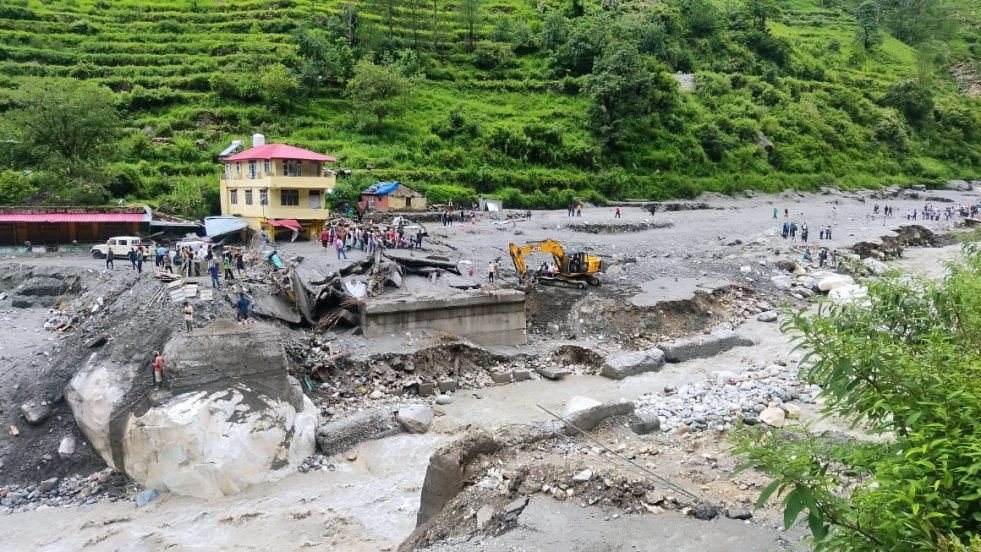
(Feature Image: Cloudburst ravaged Bagipul area along Kurpan khad in Kullu district. in Aug. 2024. Source: Aaj Tak)
We have been able to identify 27 reported incidents of ‘cloudburst’ in Himachal Pradesh during the SW monsoon 2024. A table with some basic information about these incidents can be seen here.
The ‘cloudburst’ incidents have been reported from all geographical areas of the state spanning 8 districts throughout the season beginning with May 12 in Gharshu village of Kinnaur to September 26 from Paonta Sahib area of Sirmaur. The maximum 18 of these incidents have occurred in areas close to glaciers or snow-clad mountains followed by 5 in middle segment of Himalaya and 4 in Shivalik range of the state.
River basin wise Sutlej river basin witnessed the maximum 12 ‘cloudburst’ induced flashflood spells followed by 5 in Chenab basin, 4 each in Beas and Yamuna basin and 1 each in Ravi and Ghaggar basin.
Month wise, a maximum of 16 number of these ‘cloudburst’ incidents were reported in the month of August followed by 6 in July month, 2 each in June and September and 1 incident in the month of May.
District wise, maximum 6 of the documented ‘cloudburst’ incidents have taken place in Lahaul & Spiti followed by 5 in Shimla and 4 each in Kinnaur, Kullu and Sirmaur districts. There have been 2 such incidents in Mandi district and 1 each in Chamba and Solan districts.
The reports also suggest that at least 59 human beings have lost their lives in these disasters. Notably, the death toll and infrastructure damages were mainly caused by 7 ‘cloudburst’ incidents. The multiple ‘cloudbursts’ in Shimla, Kullu and Mandi districts in intervening night of July 31 and August 1, has alone killed 56 people (of which bodies of 28 were recovered).
The table below prepared by the Himachal Pradesh State Disaster Management Authority (HPSDMA) highlights the impact of this disaster.
| Damage/Loss Summary | Kullu (Jaon/ Bagipul) | Shimla (Samej) | Mandi (Tikkan) | Total |
| Total Missing | 13 | 33 | 10 | 56 |
| Body Recovered | 4 | 15 | 9 | 28 |
| House Fully Damaged | 31 | 25 | 4 | 60 |
| Partially Damaged | 30 | 6 | 0 | 36 |
| Cattle shed | 18 | 0 | 1 | 19 |
| Cattle Loss | 123 | 22 | 4 | 149 |
| Motor Bridges | 4 | 1 | 0 | 5 |
| Foot Bridges | 7 | 2 | 0 | 9 |
| Shops | 17 | 0 | 0 | 17 |
| Schools | 3 | 1 | 0 | 4 |
| Health Infrastructure | 0 | 1 | 0 | 1 |
| Vehicles | 12 | 4 | 0 | 16 |
| Water Supply | 5 | 0 | 0 | 5 |
| Fish Farm | 3 | 0 | 0 | 3 |
Of the remaining 3 deaths, 2 people were killed in 2 different ‘cloudburst’ incidents on July 20 and September 26 in Sirmaur district and a woman was washed away on August 2 in ‘cloudburst’ induced flashflood in Pin Valley of Lahaul & Spiti.
However, in annexure I (page no. 112) on district wise death details, the SDMA report mentioned only 23 human casualties including 9 from Mandi and 14 Shimla due to the cloudburst disaster during the monsoon season 2024. As per the report 8 human deaths took place due to flashflood incidents including 3 in Una, 2 in Kullu and 1 each from Lahaul & Spiti, Solan and Sirmaur districts in this period.
Another significant ‘cloudburst’ disaster the state has witnessed this monsoon season has taken place in Palchan area of Kullu on July 25. The area lacked any rainfall gauge and doppler radar too failed to predict the extreme weather event. Further debris impacting homes in Palchan village and bailey bridge were washed away from Atal tunnel dumping zone.

Moreover, the 2 HEPs damaged by flashfloods were built in flooding zone of the Serai nullah and Beas river. The Palchan villagers also blamed faulty alignment of bailey bridge for diverting flood currents towards the village.
The incident aptly highlighted the persisting lacuna in monitoring and mitigation measures and at the same time how haphazard developmental activities including hydro projects, roads and tunnels have been amplifying the destruction scale of ‘cloudburst’ induced flashfloods in the state.
Higher Reaches Affected More by Cloudburst/ Flashflood
Interactive Google Earth map showing geographical area and proximate location of ‘cloudburst’ incidents.
The SDMA report has also covered information on 57 cloudburst/ flashflood incident in the state during SW monsoon 2024. The analysis of the report shows that of 57 of these incidents about 40 incidents were of flashflood, 14 of cloudburst and 3 of landslides. Of the all the cloudburst incidents mentioned in the report, 6 have taken place in Kullu, 4 in Lahaul & Spiti, 2 in Shimla and 1 each in Kinnaur and Mandi districts.
Worryingly, in addition to 4 cloudburst incidents, the Lahaul & Spiti district also known as cold desert has seen 18 flashflood incidents in the SW monsoon out of 40 as reported by SDMA. The Miyar valley incident in this context is worth mentioning where sudden flood in Karpat nullah on July 27 affected 35 families and caused severe damage to public properties, crops and farming land.
In addition to Lahaul & Spiti, the SDMA report further shares that the higher region of Kinnaur district has also witnessed at least 5 flashfloods and 1 cloudburst incident.
Damage to Hydro Projects
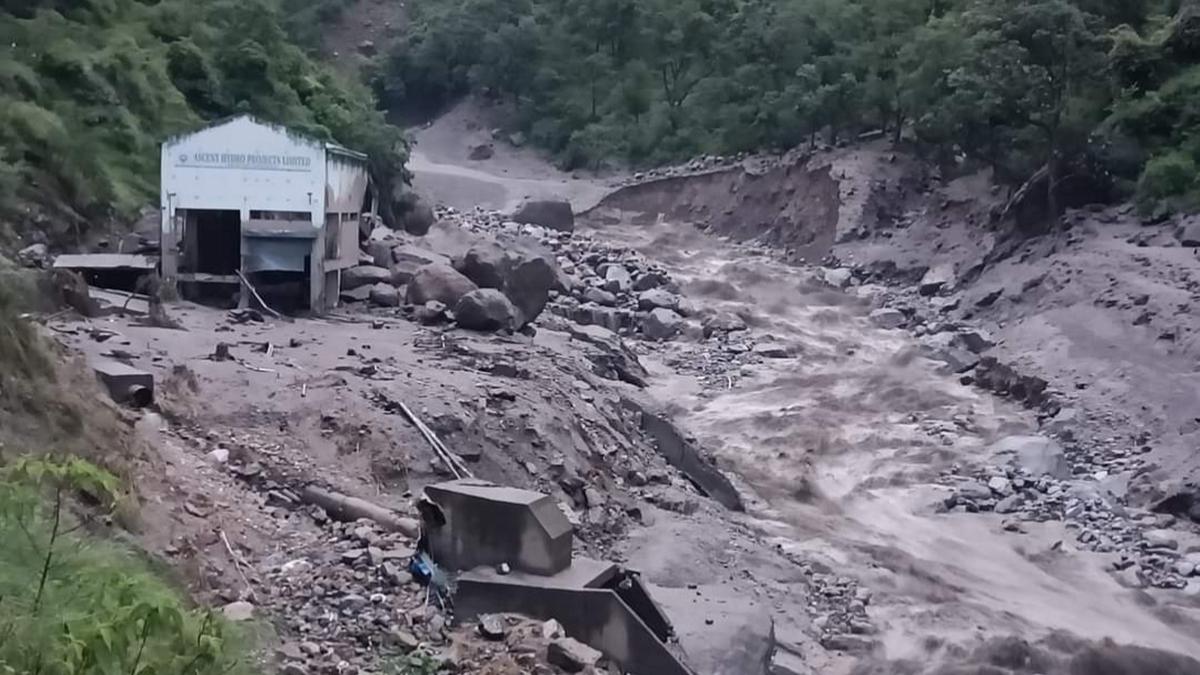
The ‘cloudburst’ incidents this monsoon season have severely damaged several hydroelectric power (HEP) projects in the state. SANDRP has documented damages to 2 HEP projects in July 2024 and to 12 HEPs in August 2024. Of the total 14 HEPs bearing the burnt of ‘cloudburst’ disasters, 12 belonged to private companies and 2 to Himachal Pradesh State Electricity Board Limited (HPSEBL).
Besides, the SDMA report in its annexure V (page number 122) further shares some details of tentative damages to 9 more HEP projects due to Heavy Rain/ Cloud burst/ Flash Flood belonging to HPSEBL during monsoon season 2024 as given in table below.
| SN | Name of HEP | Details of damage | Total Funds Required (In Lakh) |
| 1 | 2.5 Mw Nogli HEP Powerhouse | Damage to temp. Diversion channel, & Damaged to stone masonry at top of channel | ₹8.00/- |
| 2 | Thirot HEP Powerhouse | Damage to the path on different point including cutting/ removal of boulder on rocky portion from fore bay to intake | ₹10.50/- |
| 3 | Billing HEP Powerhouse | Leakage in the HDPE water conductor pipe system and filling of earth for covering these pipes from intake, damage to the construction of RCC bed at the intake | ₹40.50/- |
| 4 | Rongtong HEP Powerhouse | Damage to trench weir, cement concrete portion provided downstream trench weir & weir crate protection works provided at intake | ₹100.00/- |
| 5 | Bassi HEP Powerhouse | Lower side of Retaining wall for Center Store of Bassi Powerhouse adjoining to Neri Khad has fallen and washed away in Khad, Retaining wall of Sub-ordinate Rest House lawn fallen | ₹10.80/- |
| 6 | Baner HEP Powerhouse | Damage to switch yard area &drains / cable trenches, Approach Road Diala to Powerhouse slided/eroded earthen portion on left side of road etc | ₹112.10/- |
| 7 | Chaba HEP Powerhouse | Damage to intake raised weir right side portion eroded due to flood in Nauty Khad. | ₹4.20/- |
| 8 | Purthi Mini HEP Powerhouse | Civil work damage: -Trash rack, Disilting tank, Fornay tank, Spill way Channel damaged due to heavy rain | ₹35.00/- |
| 9 | Killar Mini HEP Powerhouse | Civil work damaged: -Water conducting system, Trash rack , Disilting tank, Forbay tank , Spill way Channel damaged due to heavy rain | ₹20.00/- |
In all the HPSEBL required ₹124.04 crore to restore the damages to its power infrastructure including transmission lines and HEP projects. We could not find any official report detailing the overall financial losses incurred by private hydro project companies (at least 14 HEPs) due to damages from ‘cloudburst’ and flashflood.
Some Relevant Reports
HP: 12 More HEPs Impacted by Cloudburst Disaster The information available with the government and project officials, reveals that the flashflood episode in Kullu and Shimla districts has affected at least 12 small and big HEPs in Beas (5 HEPs) and Sutlej (7 HEPs) rivers basin in lesser or greater degree. The disaster has rendered all these HEPs non-operational thus they are facing huge generational losses in addition to the significant structural damages. The calamity has proved a life-threatening experience for the workers of several HEPs. While about 33 stranded workers of Malana II HEP got rescued by NDRF team, about 8 workers of Greenko Sumez HEP have lost their lives in the deluge. https://sandrp.in/2024/08/16/himachal-pradesh-12-more-heps-impacted-by-cloudburst-disaster-in-july-2024/ (16 Aug. 2024)
July 2024: ‘Cloudburst’ in damages 2 HEPs in HP The incident suggests that the HIMURJA and Directorate of Energy (DoE) departments are lacking safety guidelines and monitoring for Small Hydro Power (SHP) projects. HIMURJA officials claim that they are just facilitator to help Independent Power Producer (IPP) with allotment and clearances. As per them the Detailed Project Reports (DPR) are approved by the DoE and the IPPs also have their own consultants. https://sandrp.in/2024/08/03/july-2024-cloudburst-in-beas-basin-damages-2-heps-in-himachal-pradesh/ (03 Aug. 2024)
14 HEPs damaged in flash flood According to the analysis by SANDRP, 2 HEPs suffered significant damage due to a “cloudburst-induced flash flood” in the Palchan area of Kullu district on the intervening night of July 25-26. Both HEPs — the 2-megawatt Pinnacle HEP on the Serai river and the 9-MW Beas Kund HEP on the Beas river — are owned and operated by private companies. “We have lost everything except the powerhouse building,” Vinay Parmar, the manager of the Beas Kund project, told SANDRP. Bhim Rawat of SANDRP said that Google Earth imagery shows that the powerhouses of both HEPs were built in active flood zones of the Serai and Beas rivers.
Himanshu Thakkar of SANDRP pointed out that there are no inflow forecast stations or level forecast stations in Himachal Pradesh. As a result, no flood forecasts are made in the state, which are crucial for saving lives and public property. A Central Water Commission official in Shimla told PTI that there are plans to establish inflow and level forecast stations in the state but did not divulge details. Thakkar added that the Union Environment Ministry should conduct disaster risk analyses before hydroelectric projects are sanctioned. Independent post-disaster assessments should be conducted after such incidents. Robust disaster management plans should be prepared, and early warning systems should be installed, he said. https://economictimes.indiatimes.com/industry/energy/power/14-hydropower-projects-damaged-due-to-flash-floods-in-himachal-since-july-25/articleshow/112718157.cms ; https://www.business-standard.com/india-news/14-hydropower-projects-damaged-by-flash-floods-in-himachal-since-july-25-124082201107_1.html (22 Aug. 2024)
Dam failure highlights urgent need for safety reforms Early Aug 1 morning a cloudburst hit above the Malana II project in the Parbati Valley region. The gates of the Malana II Dam were opened slowly as per protocol, and Malana I, located downstream, was informed, the plant head claimed. Key components of The Malana Power Project 1 and 2 owned by Bhilwara and Greenko groups, were affected.
The cloudburst led to an accumulation of muck, boulders damaging the switchyard and the Malana II project. ”The gates were opened as per protocol. But since the dam does not have capacity to hold this volume of water it resulted in the flooding taking toll on infrastructure,” they added. Malana I, lacks floodgate, and has only a reservoir which was overwhelmed by the surge of water.
The cloudburst and subsequent dam overflow released approximately 4.70 million cusecs of water, causing extensive damage. At least nine individuals are reported missing, a bridge was washed away, and significant road blockages occurred. A private bus parked along the roadside was also swept away near Sainj. Despite the gravity of the situation, authorities have not yet issued a detailed response. This incident follows last year’s malfunction at the Malana Project, where a floodgate failed to open during an emergency, raising serious concerns about dam safety protocols. https://himachalscape.com/malana-dam-failure-in-himachal-pradesh-highlights-urgent-need-for-safety-reforms/ (01 Aug 2024)
Pvt hydropower firm fails to provide relief for damages Residents of Chowki and Baladhi villages have said that they would start a protest from next day over not receiving compensation for damages they suffered after a barrage of Malana Hydropower Project-I gave way due to a cloudburst upstream on July 31. A few houses, two temples, some other buildings and cultivable land were washed away downstream in Chowki and Baladhi villages due to flooding of the Malana nullah. A villager identified as Bhagat Singh alleged that they suffered huge losses due to the flaw in hydropower projects upstream. He said, “We have sent memorandums to the government and the administration many times and also requested to consider our demands. But till now, none of our demand has been met and neither our problems solved.” https://www.tribuneindia.com/news/himachal/villagers-to-protest-as-pvt-hydropower-firm-fails-to-provide-relief-for-damages/ (17 Sept. 2024)
Cloudburst disaster around HEPs From January 1 to July 31, incidents of cloudburst have occurred at seven places in Himachal Pradesh. There were hydropower projects at four of the seven locations. On July 25, the Anjani Mahadev nullah in Manali Dhundi was flooded after a cloudburst. This led to the closure of the national highway. A 9- Mw power project has been constructed at this place. Apart from this, on the night of July 31, cloudburst incidents occurred simultaneously at four places in Himachal including in Malana river.
On the same night, a cloudburst incident took place in Samej near Jhakri in the Rampur area of Shimla district, near a 6 MW power project. Two people died and 34 people are missing. Apart from this, there was huge damage due to a cloudburst near Tosh in the Parvati Valley on July 31. The Parbati-II hydroelectric project is located here.
Natural disasters in years past also occurred near some power project or national highway. The 2023 disasters in Kullu Malani and the Sainj Valley resulted in loss of lives and property worth thousands of crores. The Malana, Sainj, Parvati, Larji power projects, as well as the Bhakra and Pong dams, were major factors in the huge losses incurred. The disasters caused losses of Rs 12,000 crore and killed 441 people. https://www.downtoearth.org.in/climate-change/himachal-cloudbursts-are-hydropower-projects-to-blame (04 Aug. 2024)
Catastrophic floods linked to glacial retreat: HNA. A fact-finding report by Himalaya Niti Abhiyan (HNA) highlighted that infrastructure development, especially hydel power projects, are at significant risk of high, sudden sediment discharge at high velocity, particularly in the soft sediment portions of the paraglacial zone.
The Malana dam burst was attributed to the failure of Phase 1 project gates, leading to the erosion of the soft sediment valley portion and subsequent burst of the water dam, although the main dam structure remained intact. The Sainj River valley also faced disaster due to torrential rainfall, with the HPPCL Niharni dam and NHPC Parvati Phase III dam both opening their gates simultaneously, resulting in the washing away of the left bank road of Sainj market.
The report emphasized the need for stricter and specialized planning for construction in paraglacial areas, particularly in the higher and trans-Himalayan regions of Himachal Pradesh. Key recommendations included enforcing slope stability analysis, comprehensive sediment mapping, and restricting mega hydel projects above 8,000 feet. It also advocated for safety audits of existing dams, afforestation, and bioremediation to prevent erosion and landslides. https://himachalscape.com/himachal-pradesh-catastrophic-floods-linked-to-glacial-retreat-report/ (07 Aug. 2024)
The risks of disasters due to bursting or leakages in artificial barrages of hydroelectric projects have increased manifold since these projects have mushroomed in the state over the last two decades. https://www.tribuneindia.com/news/dams-barrages-pose-threat-to-sensitive-himalayan-region/ (17 Aug. 2024)
Shrikhand cloudburst disaster The epicentre of two of the five cloudbursts in Himachal Pradesh that caused the maximum devastation at Nirmand block in Kullu and Samej Khad in Shimla’s Rampur division was the Shrikhand Kailash mountains. The water level in the Samej Khad rivulet rose by 35 to 45 m and its width expanded from approximately 40 m to 180 m after the cloudbursts. The cloudbursts that wreaked havoc at Bagipul in Kullu and Samej Khad in Shimla occurred simultaneously. These were some of the findings of the SDMA preliminary assessment of the five cloudbursts – 3 in Kullu, one eachn Shimla & Mandi – that occurred between 11.30 pm on Jul 31 & 1.15 am on Aug 1. https://indianexpress.com/article/cities/chandigarh/two-cloudbursts-kailash-mansarovar-himachal-9505801/ (10 Aug. 2024)
31 killed in 51 events of cloudburst, flash flood Thirty-one people were killed in 51 events of cloudburst and flash flood between June 27 and August 16 in Himachal, the State Emergency Operation Centre said. Lahaul and Spiti witnessed 22 such incidents, the highest in the state, followed by 11 in Kinnaur, 6 in Una, 3 each in Kullu and Mandi, 2 in Sirmaur and 1 each in Chamba, Hamirpur, Shimla and Solan districts, it said. According to the data, 121 houses were completely or partially damaged.
According to officials, Himachal has suffered losses to the tune of Rs 1,140 crore so far with the maximum damage to the road infrastructure. The Public Works Department has suffered losses of Rs 502 crore, followed by the Jal Shakti Department (Rs 469 crore) and the Horticulture Department (Rs 139 crore). https://www.deccanherald.com/india/himachal-pradesh/31-killed-in-51-events-of-cloudburst-flash-flood-in-himachal-since-onset-of-monsoon-3154891 (18 Aug. 2024)
Flash floods on rise Last year (2023), the State saw 72 flash flood occurrences. In the year 2022, the State witnessed 75 flash flood incidents, while in 2021 the number was 16. There were ten such incidents in the 2020 monsoon, as per data from the SDMA. https://www.thehindu.com/news/national/himachal-pradesh/flash-floods-on-rise-in-himachal-pradesh-traditional-water-sources-to-bear-the-brunt/article68536226.ece (17 Aug. 2024)
Monsoon losses ₹1,360cr in 2024 The state has suffered losses to the tune of over Rs 1,360 cr this monsoon. Last year, the losses due to the widespread rain disaster were around Rs 10,000. The state recorded 101 events of cloudburst/flash floods and landslides this year, resulting in the death of 37 persons with 33 persons going missing. In the 54 flash floods/ cloudburst and 47 landslides, 122 houses were damaged, and 149 cattle were lost.
The PWD suffered the maximum damage of around Rs 633 cr. Jal Shakti Vibhag was a close 2nd, recording losses around Rs 540 cr. The Horticulture Dept suffered losses of around Rs 140 cr. Jal Shakti Vibhag saw 5,505 water supply schemes damaged. This caused a loss of around Rs 382 cr to the dept. 1,213 irrigation schemes were affected, resulting in the loss of Rs 129 cr. https://www.tribuneindia.com/news/himachal/monsoon-losses-rs-1360-crore-in-2024/ (1 Oct 2024)
Radar can help prevent cloudburst damage Himachal Pradesh has reported 11 cloudburst incidents since July 27. Five of these cloudbursts occurred within a span of two-and-a-half hours on the intervening night of July 31 and August 1, says Dr Kuldeep Srivastava, director of the Indian Meteorological Department (IMD), Shimla. He says: All the recently reported cloudbursts occurred in the high hills (upper parts of districts Kullu and Mandi, Lahaul & Spiti, Kinnaur, and Chamba) rather than in the middle hills or low hills and plains.
The formation of clouds and even cloudbursts occur suddenly. While Doppler radars (used to determine the velocity of an object) can predict heavy rainfall events up to two hours in advance, they cannot detect the velocity if a mountain obstructs the signal. Another point to note is that cloudbursts are not confined to one place. The conditions that trigger cloudbursts can develop quickly in one location and then move to another. To prevent damage, it is crucial to identify cloudburst-prone areas, evacuate people from riverbanks, rivulets, and drains within these areas, and implement other precautionary measures.
The cloudbursts in Kullu, Mandi, & Shimla were the result of Easterly winds (which flow from east to west, coming from the Bay of Bengal and crossing Uttarakhand, Western UP, Haryana) and a cyclonic circulation that developed over the specific areas where the incidents occurred. The five cloudbursts were caused by the convergence of winds from two different directions. Cloudburst events increase during the monsoon, particularly in Jul-Aug. Certain areas received 200 mm rain in 5 hrs on Jul 31. https://indianexpress.com/article/cities/chandigarh/cloudburst-damage-himachal-pradesh-imd-9520319/ (19 Aug. 2024)
In-depth studies required to understand cloudburst: CS The damage was this heavy despite HP receiving rainfall which was 18% deficient. In July, HP recorded 180mm rain against the normal of 255mm. In Aug, it received 243mm rain against a normal of 256 mm.
According to chief secretary Prabodh Saxena, there is a need to conduct in-depth studies of cloudburst events. “The state suffers human and financial loss every year. There is an urgent need to have in-depth studies to understand cloudbursts, so that we can save precious lives and property,” said Saxena. https://timesofindia.indiatimes.com/city/shimla/65-lives-lost-in-himachal-pradesh-due-to-54-cloudbursts-and-47-landslides-during-monsoon/articleshowprint/114099098.cms (10 Oct. 2024)
Central team visits cloudburst-hit areas A team from the Centre visited flood-ravaged Mandi district on Oct 24. The losses due to recent cloudbursts and floods in the district have been estimated to be Rs 213.50 crore. The eight-member interministerial team was led by Mihir Kumar, joint secretary of MHA. It visited Terang village and the surrounding areas in Chauhar Valley of Mandi district where a flash flood wreaked havoc on August 1. The team also visited the flood-hit villages of Matt and Vamanu. https://timesofindia.indiatimes.com/city/shimla/central-team-assesses-26-million-damage-in-mandi-flood- (25 Oct. 2024)
SANDRP’s previous analysis on ‘cloudburst’ incident in Himachal Pradesh state can be seen here 2023 (65 incidents) 2022 (39 incidents); 2021 (30 incidents); 2020 (3 incidents); 2019 (16 incidents); 2018 (21 incidents).
Compiled by Bhim Singh Rawat (bhim.sandrp@gmail.com)

 SANDRP
3 thoughts on “Himachal Pradesh: ‘Cloudburst’ Incidents in SW Monsoon 2024”