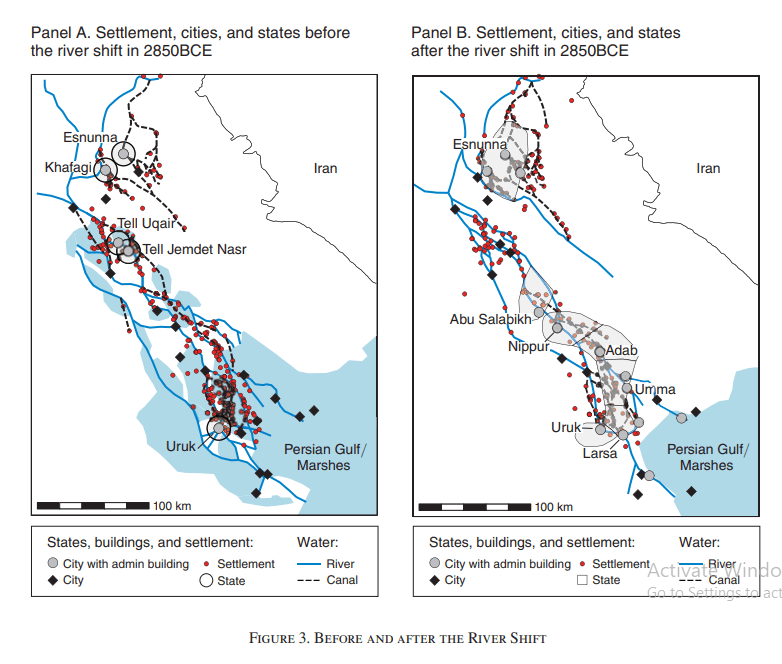
(Feature Image Source: The Economic Origins of Govt)
Interesting research published in 2023 suggests that archaeologists and economists are now learning that dynamic, shifting rivers also created conditions that triggered people to develop some of the first organized govts on the planet.
In the research published in The American Economic Review Robert Allen and two co-authors found that Agriculture and large settlements emerged alongside rivers because they could tap into the gifts of rivers: close access to water and fertile soil. But rivers can move and take those gifts away. So, society developed organized govts to work collectively to regain their access to those gifts.
River scientists have long known that dynamic, shifting rivers create conditions that support some of the most productive and diverse ecosystems on Earth. They found this sequence in the archaeological and geologic records: first, following an avulsion event, the river abandoned a region. Then, the abandoned region’s city began to construct buildings associated with government along with canals that stretched from the new river location to the region’s croplands.
Changing river course led people to form first govts In summary, the researchers consistently found this sequence in the archaeological and geologic records: first, following an avulsion event, the river abandoned a region. Then, the abandoned region’s city began to construct buildings associated with government along with canals that stretched from the new river location to the region’s croplands. (Jeff Opperman) https://www.forbes.com/sites/jeffopperman/2024/09/19/how-a-river-changing-course-led-people-to-form-the-first-governments/ (19 Sep 2024)
HYDRO POWER PROJECTS
Arunachal Pradesh Concern over HEP dams A group of nature lovers, environmentalists, social activists and human rights defenders has submitted a letter to Chief Minister Pema Khandu expressing deep concerns over the rampant construction of dams in the state. The letter, which serves as a reminder of their previous correspondence from 24 February, 2024, emphasizes that their opposition to these projects is not anti-government or anti-development.
They highlighted the risks associated with Glacial Lake Outburst Floods (GLOF), referencing a warning issued by the National Disaster Management Authority (NDMA) regarding several high-threat glacial lakes in the region. They expressed skepticism over a glacial lake study funded by dam developers, citing concerns about data manipulation.
In addition, the letter criticized the Wildlife Institute of India’s report on the Etalin Hydroelectric Project, which was deemed inadequate by a panel of 29 scientists for its incomplete data and insufficient survey duration.
The group raised alarm over a recent order from the Siang district DC, which they claim suppresses local voices and threatens community leaders for participating in discussions about the dams. They reiterated their opposition to the NHPC’s notification for the pre-feasibility report of the proposed Siang Upper Multipurpose Project as they underscored the importance of free, prior and informed consent for affected communities. They cited a judgment from the Gauhati High Court that mandates such consent to ensure safety of the indigenous communities as they reiterated that local opposition to the Siang dam has been documented for over 40 years.
They asked for reconsideration of the state’s approach to dam construction, urging respect for indigenous voices and environmental concerns as they requested a review of the State Hydropower Policy of 2008 to promote community-based renewable energy alternatives, which could benefit both local communities and the state government. https://arunachaltimes.in/index.php/2024/09/19/concern-over-rampant-construction-of-hydro-power-dams-in-arunachal/ (19 Sept. 2024)
Adi Bachao says no to mega dam Amidst growing concern over the proposed 11,000 mw Siang Upper Hydroelectric Project, the Adi Bachao, a collective of Adi community members, is vehemently opposing the construction of a mega dam at the Parong portion of the Siang river.
The Adi Bachao slammed the NHPC and the state government for failing to inform the local residents about the potential impacts of the mega dam. The organisation demanded a comprehensive assessment of both upstream and downstream effects, along with a clear mitigation policy to address the potential risks before supporting any hydropower dam in the Siang belt.
“We cannot support the construction of any hydropower dam in the Siang belt until an assessment of upstream and downstream impact and proper mitigation policy against probable effects is made public,” he said. Stating that the hydropower projects on rivers of the Siang belt would have significant impact in downstream Assam, Aje appealed to the people of Assam to join their movement and raise voice to scrap the proposed mega dams.
Adi Bachao president Tabeng Megu reiterated the organisation’s longstanding opposition to mega hydropower dams in the Siang river. Megu lashed out at the NHPC for conducting surveys and preparing a pre-feasibility report without involving the local people. The Adi Bachao leaders stated that they would only support construction of small dams in the Siang belt if the authorities concerned ensure safety measures and economic development for the affected people. https://arunachaltimes.in/index.php/2024/09/23/adi-bachao-says-no-to-mega-dam/ (23 Sept. 2024)
Nagaland Dikhu HEP on the brink The 186 MW Dikhu HEP in Nagaland is a joint venture between the Department of Power Nagaland and Manu Energy System Private Limited, with an equity share of 24% and 76%, respectively. Former Engineer-in-Chief of the Power Department, Er Moa Aier further explained that the Central Electricity Authority (CEA) had extended the TEC three times and was initially reluctant to do so for the third time. However, after several requests and meetings, another extension was granted on the condition that the land issues must be resolved by March 2024, and the TEC extension granted till 31 March 2025.
– The long-standing unresolved issue between the Nagaland Power Department and the villages of Nyang and Kangching in Longleng district has brought the Dikhu 186 MW Project to a standstill. With only five months left before the Techno Economic Clearance (TEC) expires in March 2025, all eyes are on whether the two parties will reach a breakthrough in the interest of the State and the people. The proposed Dikhu HEP spans three districts: Mon, Longleng, and Mokokchung. The project has been in discussion since 2009.
– The project area submergence of the 186 MW Dikhu Hydroelectric Project will touch lands of 17 villages, with the submergence area distributed among them. According to the power department, although some paddy fields and plantations will be affected, the submergence area will primarily consist of gorges, cliffs, wasteland, and other uncultivable land, covering about 2,013 hectares—40% less than the area submerged by the Doyang Hydroelectric Project. However, the villages of Nyang and Kangching fear that the submergence will affect approximately 50% of their village area. The department told MT that they had made repeated attempts to approach the villages. They narrated instances where they were chased out of the village and had their camps burned while trying to conduct the land survey.
– The department added that, if the two villages ultimately disagree, they will stop pursuing the plan and will prepare a “white paper.” The Department said, “after March 2025, the matter will no longer be in our hands, and the project proposal shall die a premature death, and the Department will not be held liable for the loss for the State.” https://mokokchungtimes.com/dikhu-hydroelectric-project-on-the-brink-will-there-be-a-breakthrough/ (17 Sept. 2024)
Sikkim NHPC has declared Patel Engineering (PEL) as L1 for a Rs. 240.02 crore contract for the works involving modification of diversion tunnel into tunnel spillway arrangement – Civil & Hydro Mechanical works for Package 6 – TEESTA-V POWER STATION, SIKKIM. The project is to be completed in a period of 18 months. The scope of work involves Construction of NHPC’s Teesta VI HEP. https://www.business-standard.com/markets/capital-market-news/patel-engineering-wins-bid-for-nhpc-hydro-power-project-in-sikkim-124092001005_1.html (20 Sep 2024)
Himachal Pradesh Pvt hydropower firm fails to provide relief for damages Residents of Chowki and Baladhi villages have said that they would start a protest from tomorrow over not receiving compensation for damages they suffered after a barrage of Malana Hydropower Project-I gave way due to a cloudburst upstream on July 31. A few houses, two temples, some other buildings and cultivable land were washed away downstream in Chowki and Baladhi villages due to flooding of the Malana nullah. A villager identified as Bhagat Singh alleged that they suffered huge losses due to the flaw in hydropower projects upstream. He said, “We have sent memorandums to the government and the administration many times and also requested to consider our demands. But till now, none of our demand has been met and neither our problems solved.” https://www.tribuneindia.com/news/himachal/villagers-to-protest-as-pvt-hydropower-firm-fails-to-provide-relief-for-damages/ (17 Sept. 2024)
Jangi Thopan Powari HEP to be executed by HPPCL Having cancelled the allotment of 780 MW Jangi Thopan Powari Hydro power project to Satluj Jal Vidyut Nigam Ltd (SJVNL) last year, the much delayed project will now be executed by state government-owned HP Power Corporation Ltd. The decision was taken by the cabinet at its meeting held here on Friday (Sept. 20) under the chairmanship of CM Sukhvinder Singh Sukhu. It is only on Thursday (Sept. 19) that Sukhu reiterated his government’s resolve to protect Himachal Pradesh’s interest while stating that a revision petition will be filed before the High Court to take over the 210 MW Luhri project state –I, 66 MW Dhaula Sidh and 382 MW Sunii projects.
The Jangi Thopan Powari project, located on the Satluj river in the tribal district of Kangra, has been in the news following the decision of Sukhu-led Congress regime to cancel the allotment of the project to SJVNL for failing to start work within the stipulated period. The decision to cancel the project on November 18, 2023, was also taken by the state cabinet. The project was allotted to SJVNL on November 24, 2018, and the MoU was signed on September 25, 2019. With SJVNL being a Govt of India undertaking, a sum of Rs 93.24 crore was sanctioned by the Centre on May 20, 2021, for undertaking the pre-construction activities. https://www.tribuneindia.com/news/himachal/780-mw-jangi-thopan-powari-hydro-power-project-to-be-executed-by-hp-power-corporation/ (20 Sept. 2024)
This Tribune report shows how the interest in Hydropower projects in HP is rapidly reducing due to high costs, high impacts, opposition, better and cheaper options. https://www.tribuneindia.com/news/himachal/hydropower-generation-slows-himachal-pradesh-looks-to-tap-solar-energy/ (18 Sept. 2024)
-किन्नौर के दो अलग-अलग स्थानों पर विशालकाय प्राकृतिक झीलों के बनने से भविष्य में कभी भी होने वाले संभावित खतरे को देखते हुए किन्नौर प्रशासन ने दोनों प्राकृतिक झीलों की जांच शुरू कर दी है। प्राकृतिक झीलों की वास्तविक स्थिति को जानने के लिए किन्नौर प्रशासन द्वारा आर्मी, आईटीबीपी, डिजास्टर व रेवन्यू सहित स्थानीय लोगों की एक टीम गठित की गई है। लगभग 50 लोगों की यह टीम विगत सात सितंबर को सांगला कंडे के परपाबंग नामक स्थान के लिए रवाना हुई। चार दिन के भीतर ही उक्त टीम ने इस अभियान को सफलतापूर्वक पूर्ण कर स्कुशल वापस लौटी। https://www.divyahimachal.com/2024/09/investigation-of-natural-lake-built-in-sangla-kande-of-kinnaur/amp/ (15 Sep. 2024)
Maharashtra CEA concurred 2 more PSPs CEA has concurred 2 more Pumped Storage Projects (PSPs) in Maharashtra viz. 1500 MW Bhavali PSP being developed by JSW Energy Ltd. and 1000 MW Bhivpuri PSP being developed by Tata Power Co. Ltd. These PSPs are concurred within 10 days of completion of the DPRs i.e. the date on which the complete DPRs were submitted on the ONLINE portal by the developers. The project developers of these PSPs have indicated that they will fast track the commissioning and complete them in 44 to 46 months i.e. by 2028. CEA targets to concur atleast two PSPs each month during the current year depending upon the completion of the DPRs by the developers. During 2024-25, CEA has targeted to concur 15 Hydro PSPs of 25,500 MW capacity, out of this 4 PSPs of 5,100 MW capacity have already been concurred. https://pib.gov.in/PressReleasePage.aspx?PRID=2057568 (22 Sept. 2024)
MoEF Relevant agenda of FAC meeting to be held on Sept 23 2024:
– Diversion IN FAVOUR OF MICRO HYDRO ELECTRIC POWER GENERATION Pvt Ltd FOR 2.1063 HA. OF FOREST LAND FOR SWAD HEP (5 MW) IN NACHAN FOREST DIVISION, DISTT. MANDI HIMACHAL PRADESH
– Diversion IN FAVOUR OF SHREE HYDROPOWER Pvt Ltd OF 1.1464 HA. FOR GHATOR- I HEP (2.2 MW) AT SAMWARA NALLAH, A TRIBUTARY OF CHIRCHIND KHAD OF RAVI RIVER IN BHARMOUR FOREST DIV, DIST CHAMBA HIMACHAL PRADESH
– Diversion IN FAVOUR OF SHREE HYDROPOWER Pvt Ltd OF 2.7252 HA. FOREST LAND FOR SAMWARA HEP (2.5 MW) IN BHARMOUR FOREST DIV, DIST CHAMBA HIMACHAL PRADESH https://forestsclearance.nic.in/AgendaDetail.aspx?id=305%21dis1&fbclid
Agenda of EAC meeting on River Valley Projects to be held on Sept 27 2024: 1. Warsgaon Warangi Pumped Storage Project (1500 MW) in 225.14Ha at Village Teckpole and Warangi, Tehsil Velhe and Mahad, Dist Pune and Raigad (Maharashtra) by Adani Green Energy Ltd – Amendment in Terms of Reference
2. Khairibhandan Barrage Project at village Anlabeni, Tehsil – Jashipurin, Mayurbhanj, Odisha by Dept of Water Resources, Govt of Odisha – for Environmental Clearance https://parivesh.nic.in/utildoc/104027543_1726751070510.pdf
DAMS
Polavaram Project Work on new D wall to begin in Nov Construction of the Polavaram project’s new diaphragm wall would start at Polavaram village in Eluru district in Nov, after the monsoon and last a year. The new D-wall will come up towards the upstream of the river from the old and damaged D-wall. The new wall measures to a length of 1.4 km. Its width would be 1.5 metres and depth a minimum of 40 metres to a maximum of 80 metres, depending upon the availability of rock in the river bed. The dewatering of the construction area would be done during the next flood season so that the year-long works would continue without disruption.
– The D-wall is the foundation for construction of the Polavaram Dam. Once the D-wall work is complete, the work for the dam will be taken up. It could take one more year. Currently, the preparation of technical designs for the Polavaram Dam is on. Several agencies are involved in it and the Central Water Commission would take a final decision on these designs. The Union Cabinet has given its approval for the phase-1 of the Polavaram project works, including land acquisition, resettlement and rehabilitation (R and R) that would involve a fund outlay of `30,636 crore. Out of this, `12,157 crore would be a compensation to AP. https://www.deccanchronicle.com/southern-states/andhra-pradesh/work-on-polavarams-new-d-wall-to-begin-in-november-1824391 (18 Sept. 2024)
Kaleshwaram Project Huge water storage led to sinking of piers in Medigadda: Engineers to Ghose panel In a startling revelation, senior engineers of engineering research laboratory (ERL) in the irrigation department said Medigadda barrage block 7 piers sank and Annaram and Sundilla suffered leakages owing to storage of a huge quantity of water. They also said the problems surfaced as the authorities did not lift the gates despite the barrages receiving a huge flood. The engineers on Sept 20 appeared before the Justice PC Ghose Commission. They said the construction works began before model studies of the barrages could be completed. The engineers said after the studies were done, they furnished a report to the state govt suggesting rectification of baffle blocks and other changes in the project. https://timesofindia.indiatimes.com/city/hyderabad/huge-water-storage-led-to-sinking-of-piers-in-medigadda-engineers-to-ghose-panel/articleshow/113534738.cms (21 Sept. 2024)
More uncomfortable truth tumbles out Officials from the State Dam Safety Organisation (SDSO) on Friday (Sept. 20) informed Justice Pinaki Chandra Ghose, heading the judicial commission of inquiry, that construction of the barrages was on even as model studies were being conducted, and that the SDSO did not receive monsoon reports about the barrage sites before their construction. Asked if the required dam safety procedures were followed at the barrages, SDSO official Pramila did not provide a clear response. To a question on whether pre- and post-monsoon reports were received and who prepared these reports, she responded saying such reports were not received before beginning of the construction of the barrages.
– SDSO officials, along with officials from the Central Designs Organisation (CDO) also informed the commission that they did not receive any report either before, or after the subsidence of part of the Medigadda barrage as field level officials did not submit them. https://www.deccanchronicle.com/southern-states/telangana/more-uncomfortable-truths-tumble-out-at-kaleshwaram-hearing-1824878 (20 Sept. 2024)
Mullaperiyar Dam Supervisory panel gives clean chit to dam ahead of safety inspection The Supervisory Committee, led by Central Water Commission (CWC) Chief Engineer Rakesh Kashyap, visited the dam on June 13. According to the panel report, no one raised any significant issues concerning the dam. Inspections were conducted on the main dam, the baby dam, and the spillway. However, Kerala has consistently alleged that the Supervisory Committee fails to address its concerns while preparing its reports.
The Supervisory Committee conducts an annual inspection of the dam, with a sub-committee visiting the reservoir every three months to submit reports. The latest clean chit from the committee comes even as the CWC has called for a detailed safety inspection of the 129-year-old dam within the next 12 months. This directive was issued during a meeting of the Mullaperiyar Supervisory Committee, attended by both Kerala and Tamil Nadu. MP Dean Kuriakose has announced plans to petition the Supreme Court to bring the Mullaperiyar Dam under the direct regulation of the National Dam Safety Authority, bypassing the Supervisory Committee. https://www.onmanorama.com/news/kerala/2024/09/17/supervisory-committee-clean-chit-mullaperiyar-dam-ahead-safety-inspection.html (17 Sept. 2024)
Hirakud Dam Govt may bring necessary changes in rule curve Given the changing circumstances and drastic variations in the water inflow and demand from the Hirakud reservoir, the Odisha government is all set to bring some necessary changes in the dam’s rule curve to adapt it to the present-time need. As per reports, the Water Resource Department (WRD) has already started the process in this regard. A committee has been formed led by the Planning and Design Engineer-in-Chief of the department Lingaraj Gouda. The committee will evaluate the existing rule curve and suggest necessary changes required in view of the conflicts in dam operation due to demands for water for various purposes and the effects of climate change. As per sources, deliberation is underway for the desilting of the dam which is reducing the water storage capacity of the dam. https://odishatv.in/news/odisha/odisha-govt-may-bring-necessary-changes-in-rule-curve-of-hirakud-dam-244525 (19 Sept. 2024)
Himachal Pradesh पौंग बांध से खतरा अब भी बरकरार हाल ही में ऊर्जा निदेशालय के विशेषज्ञों की एक टीम ने उन सभी परियोजनाओं का दौरा किया था, जिनमें बांध हैं। इन परियोजना में से एक बीबीएमबी की पौंग बांध परियोजना भी है, जो सुरक्षा के सभी मापदंडों को पूरा नहीं करती है, ऐसा सामने आया है। इतना ही नहीं इनको निर्देश देने के बाद भी कोई कदम नहीं उठाए गए हैं। जो जानकारी विशेषज्ञों की रिपोर्ट के बाद सामने आई है, उसके मुताबिक पौंग बांध से जल स्तर खतरे के निशान 1400 फुट पर अधिकतम 2,27,764 क्यूसेक तक पानी ब्यास नदी में छोड़ा जा सकता है। पौंग स्पीलवे की पानी छोडऩे की अधिकतम क्षमता 4,37,000 क्यूसेक है और लगभग 7600 क्यूसेक पेनस्ट्रोक के माध्यम से छोड़ा जा सकता है।
– जब पानी की मात्रा सीमित रहती है, तब पानी ब्यास दरिया में ही बहता है। परंतु बरसात में जब पानी अत्यधिक छोड़ा जाता है, तो पानी अपना बहाव बदलकर खेतों व गांवों में घुस जाता है। पिछले साल कुछ ऐसा ही हुआ था, जिससे लोगों का बड़ा नुकसान हुआ था। रिपोर्ट में कहा गया है कि छह स्थानों पर अर्ली वॉर्निंग सिस्टम लगाए जाने जरूरी हैं, मगर नहीं लगाए गए हैं। उनको इस संबंध में कई बार निर्देश भी दिए गए, मगर उनके द्वारा यही कहा जा रहा है कि जल्दी ही अर्ली वॉर्निंग सिस्टम लगा दिया जाएगा।
-इतना ही नहीं, रिपोर्ट में यह भी बताया गया है कि बीबीएमबी द्वारा पौंग बांध से प्रभावित गांव में डेंजर जोन की मार्किंग भी नहीं की गई है, जो एक बड़ी कोताही है। रिपोर्ट में कहा गया है कि डैम सेफ्टी एक्ट के सुरक्षा मानकों के पालन हेतु रिवर बैंक फेल्योर प्वाइंट, जोकि सुरक्षा की दृष्टि से महत्त्वपूर्ण हैं, डैम ओनिंग अथॉरिटी के अधिकार क्षेत्र में आते हैं, इसलिए इन्हें चिन्हित करना डैम अथॉरिटी का काम है। इस संबंध में भाखड़ा बांध प्रबंधन ने कहा है कि ब्यास बांध के डाउन स्ट्रीम का क्षेत्र भाखड़ा ब्यास प्रबंधन बोर्ड के अधिकार क्षेत्र में मान्य नहीं है, इसलिए उनको आवश्यक निर्देश इस संबंध में भी दिए गए हैं। https://www.divyahimachal.com/2024/09/danger-from-pong-dam-still-persists-there-is-no-marking-of-danger-zone-in-the-affected-villages/amp/ (14 Sep. 2024)
Uttarakhand Lakhwar dam affected farmers plan to resume protest if UJVNL fails to take steps towards fulfilling their 11 point demand charter already submitted to and agreed upon by the govt about a year back. (Dainik Jagran 22 Sept. 2024)

Karnataka All 33 gates at Tungabhadra dam need to be replaced Kannaiah Naidu (77), a national expert on hydraulic gate and handling equipment who spoke to THE WEEK, said he cautioned the government to replace all the crest gates as they are already 70 years old and have outlived their lifespan. “Once the dam gates complete 2.5 million cycles, they fail. All 33 gates need to be replaced and it may cost around Rs 250 crore. The new design will have vertical gates with higher density and will be stronger than the existing gates,” said Naidu, adding that the country had many ageing dams and the state governments should give priority to dam safety.
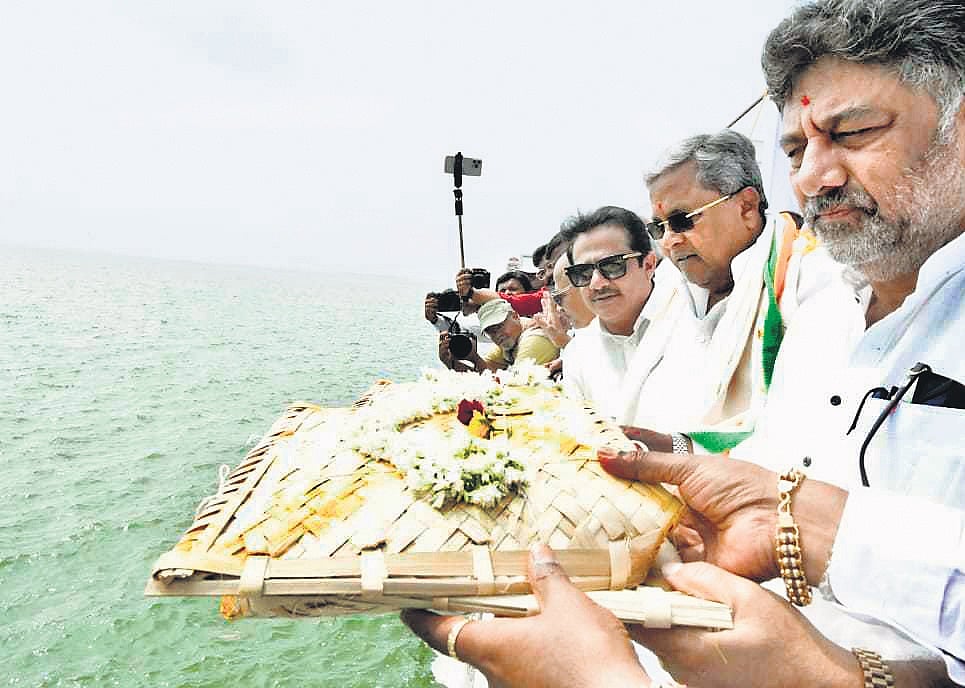
“Now, regular inspections are being carried out in India though not all states have foolproof systems of surveillance. The Centre has realised the importance of dam management and if dams are not managed well, by 2030, there could be a scarcity of drinking water. So, the centre has roped in experienced dam experts to assess the risk and take corrective measures. But the state governments have to take it seriously and provide funds to carry out the replacement of the gates and overall maintenance,” said Naidu, who has commissioned 170 dams across the country and extended technical know-how to 500 dams, since his retirement in 2002. https://www.theweek.in/news/india/2024/09/23/dam-expert-on-why-all-33-gates-at-tungabhadra-dam-need-to-be-replaced.html (23 Sept. 2024) Siddaramaiah on Sunday (Sept. 22) said all 33 crest gates of the Tungabhadra dam will be replaced as soon as possible. As per an expert committee report, the crest gates are in a bad shape at present and the government will take necessary steps to save the state’s oldest dam, he said after felicitating the team that replaced the damaged crest gate number 19 of the dam. The CM and some members of his cabinet also offered bagina to the Tungabhadra river on the occasion. https://www.newindianexpress.com/states/karnataka/2024/Sep/23/karnataka-govt-plans-to-replace-all-33-crest-gates-of-tungabhadra-dam-cm-siddaramaiah (22 Sept. 2024)
Report Course on dam safety in India at IIT Roorkee M. Tech course on dam safety and rehabilitation from IIT Roorkee was started in 2021-22 after India felt a strong need to create exclusive dam experts to tackle the challenges being posed in managing dams due to climate change. The course is open to candidates from international countries. A reduced fee structure has been kept for the members of the South Asian Association for Regional Cooperation (SAARC) countries. The programme is jointly run by the departments of hydrology, civil engineering, earthquake engineering, water resources development and management. The faculty from departments of architecture, earth sciences, mechanical and industrial engineering have been specially drawn for this course. https://www.theweek.in/education/latest/2024/09/20/first-of-its-kind-course-on-dam-safety-in-india-at-iit-roorkee.html (20 Sept. 2024)
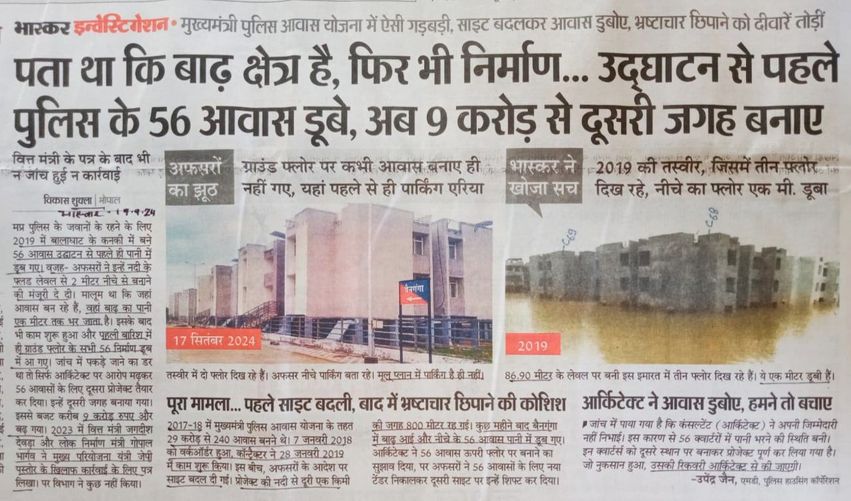
Madhya Pradesh Story of how quarters were made in Bhopal in submergence areas, now to be remade elsewhere.
Rising above the waters with musk melon The Gandhisagar dam’s backwater submerges farmland for most of the year, making cultivation possible only from March to June. Farmers in the dam’s backwater submergence area have adapted to seasonal flooding by cultivating musk melon, which thrives in the limited summer months and provides high revenue from seed sales. Local authorities and experts are considering establishing a processing unit in the region to reduce transportation costs and increase farmers’ profits from musk melon seeds. https://india.mongabay.com/2024/06/rising-above-the-waters-with-musk-melon/ (04 June 2024)
INTERSTATE WATER DISPUTES
Mahadayi Water Sharing Dispute Karnataka reconsiders sanction to Goa-Tamnar line Karnataka CM shot off a letter to PM Modi on Wednesday (Sept. 18), stating that Karnataka had reconsidered its decision on the Goa-Tamnar powerline. Noting that Goa had objected to the Kalasa-Banduri Nala Diversion Project despite minimum disruption to wildlife, Siddaramaiah said the state would not give its consent to the Goa-Tamnar project till the PM intervened and ensured that the Kalasa project receives the necessary wildlife clearances at the earliest. https://www.deccanherald.com/india/karnataka/karnataka-reconsiders-sanction-to-goa-tamnar-line-3196872 (19 Sept. 2024) Two years after the Union government cleared the revised Detailed Project Report (DPR) for the Mahadayi drinking water project, the Goa government continues to stall it, creating hurdles for forest and wildlife clearance, to the detriment of Karnataka. The National Board of Wildlife (NBWL) recently deferred permission for wildlife clearance, pointing to Goa’s writ petition in the Supreme Court. https://thesouthfirst.com/karnataka/how-goa-stands-in-the-way-of-karnatakas-drinking-water-project-from-mahadayi-river/ (16 Sept. 2024)
‘Save Mahadayi to Save Malaprabha’ Presenting a case study of the River Malaprabha to participants from across the state, Captain Nitin Dhond of Parisarakkaagi Naavu, Belagavi District Chapter, explained the Climate Science behind the critical role played by the contiguous forests of Khanapur taluka in brining rain to the region, water to the Malaprabha, sustaining life and livelihoods of people of North Karnataka and in deterring progressive desertification of North Karnataka.
The Khanapur forests, home to the origin of two major river systems, are facing the threat of destruction due to proposed infra projects, deforestation, changes in land use, and unscientific agricultural practices. Any tampering leading to their fragmentation and loss would affect the water security of the region, compromising the climatic and rainfall cycles of the entire North Karnataka region opined Captain Dhond. https://allaboutbelgaum.com/news/save-mahadayi-to-save-malaprabha-captain-nitin-dhond/ (18 Sept. 2024)
Karnataka mulls pact with Maharashtra to lift Tillari water Four decades ago, Goa and Maharashtra completed work on the Tillari irrigation project under a pact to share the water for drinking and irrigation. Now, Karnataka is preparing to work out a similar understanding with Maharashtra for sharing water of some tributaries flowing in the Tillari region. That prospect has raised concerns in Goa. It is feared that the two states’ agreement may affect the quantum of water available to Goa through the Tillari project. Goa CM Pramod Sawant has already tried to clarify Goa’s stand, stating that 80% of the water from the Tillari project is reserved for Goa and 20% for parts of Maharashtra, as agreed by the two states. “We will discuss this matter with Maharashtra,” the CM said. Maharashtra and Karnataka have recently joined hands to divert the waters of various tributaries near Chandgad into the Tillari reservoir and from there into the Markandeya basin of Karnataka.
– Chandgad MLA Rajesh Patil and Belagavi MP Jagdish Shettar recently held a meeting at the govt inspection bungalow in Belagavi. They discussed the proposal to construct three medium-sized reservoirs inside the forested region surrounding the Dhamne reservoir of Tillari. Accordingly, 6TMC (thousand million cubic feet) of water from Bhanduri, Devalnala, and Palepurmar nullahs, rising in the Western Ghats of the Maharashtra-Karnataka region, would be diverted to the Tillari reservoir and villages in the bordering regions of Maharashtra and Karnataka will get 3TMC of water each. https://timesofindia.indiatimes.com/city/goa/ktaka-mulls-pact-with-maharashtra-to-lift-tillari-water/articleshow/113576600.cms (22 Sept. 2024)
IRRIGATION
Tamil Nadu Minister upset over illegal release of dam water Upset over the unauthorised release of water, in the newly constructed dam across Ponnai river, in Gugayanallur village in Katpadi, WRD Minister Durai Murugan on Saturday (Sept. 21) said that people responsible for the release will be caught and sent to Vellore Central Jail in Thorapadi within 15 days. Speaking at the inauguration of the dam on Saturday (Sept. 21), the minister said he had asked for a small amount of water to be stored in the dam so that it could be released during the inauguration, to check the functioning of the dam. However, someone had released the water overnight, he said. Further, he also warned the contractors of the project saying that they would be sent to jail if the dam was found to be defective. “If the dam proves to be defective during flood time, you will be sent to jail,” he said. https://www.newindianexpress.com/states/tamil-nadu/2024/Sep/22/tn-water-minister-upset-over-illegal-release-of-dam-water-says-will-jail-culprits-soon (22 Sept. 2024)Three years after the check dam built in 1857 was badly damaged during November 2021 floods, the ₹12.70 crore check dam across the Ponnai, a tributary of the Palar, at Kugaiyanallore village in Katpadi was opened on Saturday (Sept. 21). https://www.thehindu.com/news/national/tamil-nadu/minister-inaugurates-check-dam-across-ponnai-river-near-katpadi/article68667431.ece (21 Sept. 2024)
URBAN RIVERS
Musi; Hyderabad RFD: Over 10,000 structures enumerated on riverbed, buffer zone Telangana government will have to demolish over 10,000 structures in the bed and buffer zones of the Musi river to proceed with the Musi River Development project as envisaged. A survey conducted by the Revenue Department in and around the river reportedly revealed that there are 2,116 structures on the riverbed and 7,850 in the buffer zone.
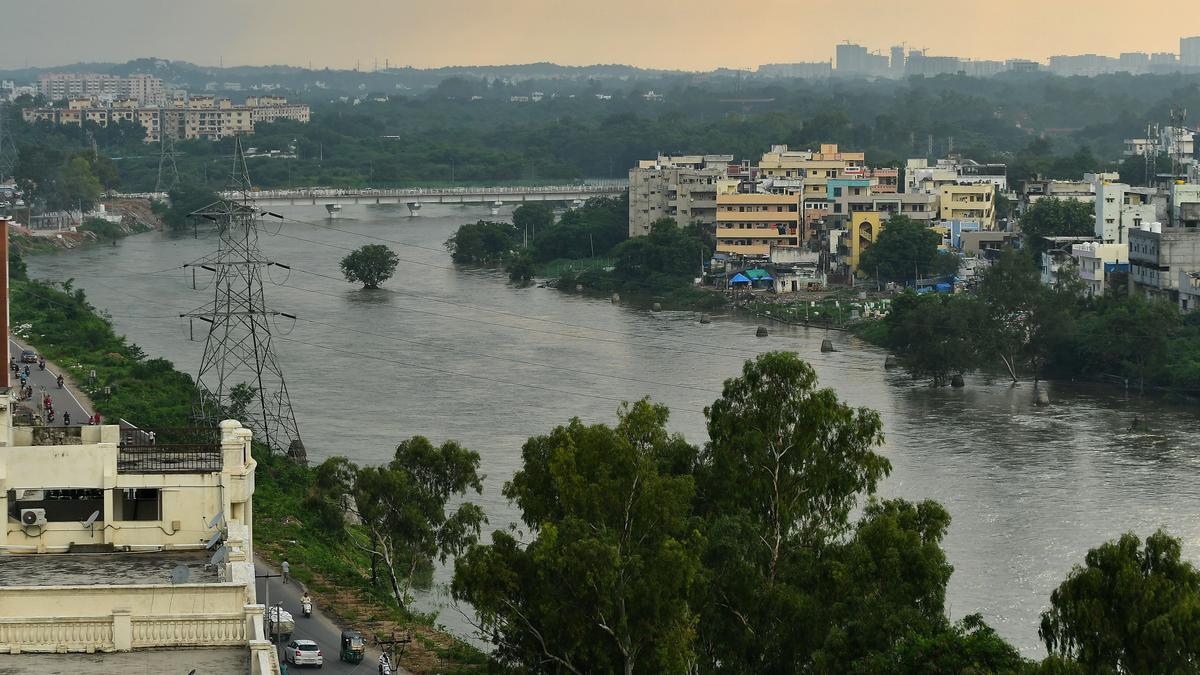
The number of people to be displaced by demolition of the structures is yet to be known, as there could be multiple families staying in the same building, especially in the densely populated ghettoes of Chaderghat and Patel Nagar. The government proposes to rehabilitate the people dwelling on the riverbed as most of them are poorest of the poor and extremely underprivileged, according to officials, who sought anonymity. https://www.thehindu.com/news/national/telangana/musi-rejuvenation-over-10000-structures-enumerated-on-riverbed-buffer-zone/article68667921.ece (21 Sept. 2024) Transport Minister Ponnam Prabhakar on Saturday (Sept. 21) said that the government will take all measures to do justice to the families of those affected by the Musi Riverfront Development Project (MRDP). He said the state government would rehabilitate them and that there was no need to worry. https://www.newindianexpress.com/states/telangana/2024/Sep/22/families-affected-by-musi-riverfront-development-project-to-receive-compensation-says-minister-ponnam-prabhakar (22 Sept. 2024)
Sabarmati; Ahmadabad No homes; more parks & fun zones at riverfront The Sabarmati Riverfront Development Corporation has revamped its development plan, allocating nearly 5 per cent more land for green spaces. Residential zones have been scrapped entirely, and the business area has been reduced to a mere 0.27 per cent. The space allocated for public purposes has been reduced by 6.4 per cent, from 13.75 per cent to 7.35 per cent. As the land available for sale will be reduced, its value is expected to skyrocket due to the focus on creating high-end, desirable spaces. An SRFDCL official told Mirror that the increased allocation for multi-use land will ensure the project’s sustainability and help recover development costs.
The original plan for sale of the reclaimed land included residential and commercial zones on both sides of the river. However, based on market trends and feedback from international and national developers, the project’s footprint has been redesigned. The revised plan prioritises connectivity and green spaces. The area allocated for roads has increased from 19.69 per cent to 25.52 per cent. Gardens will also see a significant expansion, with their share rising from 13.40 per cent to 17.70 per cent. https://www.ahmedabadmirror.com/no-homes-more-parks–fun-zones-at-riverfront/81876120.html (21 Sept. 2024)
Ludhiana ₹650-cr Buddha Nullah project in vain The much-hyped Rs 650-crore Buddha Dariya Rejuvenation project has failed to yield desired results and now when activists have threatened to block the path of drain water from entering the villages, the administration and the govt are claiming to act on the problem. The announcement of the project had sparked hope among people that the pollution level in the drain would reduce. However, with the project almost completed, the ground situation seems different, with Jamalpur STP releasing coloured water even after treatment and common effluent treatment plants in industrial units discharging dirty water into the drain.
The chairman of Punjab vidhan sabha committee for local bodies department and MLA Gurpreet Gogi has even claimed to write to govt, demanding a CBI inquiry into the project. The officials got new STPs installed, and old ones upgraded. New pumping stations were installed and two effluent treatment plants were installed for the dairy units. Despite these steps, the Punjab water supply and sewerage board, through several letters, has been asking the MC officials to check the arrival of waste from dairies and dyeing units. https://timesofindia.indiatimes.com/city/ludhiana/is-the-650-cr-buddha-nullah-project-in-vain-ludhiana-activists-and-residents-express-concerns-over-the-failure-of-the-buddha-dariya-rejuvenation-project/articleshow/112479788.cms (13 Aug. 2024)
RIVERS
Opinion Restoring river ecosystems vital to ensuring economic stability India’s secure environmental and economic future remains jeopardised without concerted efforts to protect and restore river ecosystems. The threats to river basin degradation demand an address on many fronts. On the one hand, they call for more rigorous regulation in urban development and land-use laws to forestall encroachment into natural drainage systems. On the other hand, they contemplate restoring and rehabilitating degraded river ecosystems through reforestation of riverbanks, establishing protected areas in critical watersheds, and using sustainable water management practices. https://www.business-standard.com/opinion/columns/restoring-river-ecosystems-vital-to-ensuring-economic-stability-in-india-124091801544_1.html (19 Sept. 2024)
Report Restoring rivers’ natural curves can prevent flooding A healthy river should be sinuous, free flowing and replete with wildlife. In Britain, however, 97% of rivers are fragmented by artificial barriers like weirs. Now, there is at least one artificial barrier for every 1.5km of stream in the country. And for centuries rivers have been slowly canalised – or artificially straightened – to stop water from flooding and spilling onto farmland and houses.
But removing a river’s natural meanders has, in fact, achieved the opposite effect. Instead, it’s disrupted the flow of rivers and degraded aquatic habitats, water quality and heightened flood risk. As the poor health of Europe’s rivers and streams continues to make news – due to dwindling wildlife, sewage pollution and agricultural runoff – communities are turning towards natural solutions to restore their rivers. https://www.bbc.com/future/article/20240918-how-restoring-rivers-natural-curves-can-prevent-flooding (19 Sept. 2024)
Odisha Mahanadi encroachment: Final hearing on Oct 14 The NGT has fixed Oct 14 for final hearing on the plea seeking intervention against the alleged encroachments on Mahanadi river bed in the eastern part of Cuttack city. The NGT’s principal bench in New Delhi fixed the date after the report of the joint inspection committee constituted by it to probe the allegations was submitted by State Pollution Control Board (SPCB) – the assigned nodal agency for the inquiry. Accordingly, the bench of Arun Kumar Tyagi (judicial member) & Dr Afroz Ahmed (expert member) issued notice to the Cuttack Development Authority (CDA) to file response within Oct 7.
The probe was ordered on Feb 19, after taking cognizance of a letter petition received through e-mail from one Shailesh Sahoo. The letter petition alleged encroachments in form of constructions on Mahanadi river bed along areas under Chauliaganj police station and CRRI police station limits. According to the report submitted along with an affidavit by member secretary SPCB Dr Kailasam Murugesan, unauthorised constructions have been identified at Kanheipur, Bhadimul and Gatiroutpatna along the river bed under Cuttack Sadar tehsil. The total land area apparently encroached is 938.699 acre. Out of the 2,303 private plots (private holdings), 778 plots have been converted to homestead and 1,625 are recorded as other than homestead. https://www.newindianexpress.com/states/odisha/2024/Sep/11/encroachments-on-mahanadi-river-bed-under-ngt-scanner (11 Sept. 2024)
Maharashtra 2 civic bodies get notices for neglecting water pollution The Maharashtra Pollution Control Board’s Kolhapur office has served notices to Kolhapur Municipal Corporation and Ichalkaranji Municipal Corporation for neglecting the pollution issue of Rankala lake and Panchganga river. The MPCB officials, during their site visit, found dead fish in Rankala lake and determined that the sewage flowing from Shyam Society Nullah into the lake was responsible for that. On the other hand, the MPCB also found that the effluent from the textile town was being discharged into Kala Odha, further mixing into Panchaganga river. The effluent was not being pumped to the STP for treatment. A senior official said that the KMC has been given seven days to stop the discharge of sewage into Rankala Lake and 15 days for the IMC to operate the STP at full potential. https://timesofindia.indiatimes.com/city/kolhapur/kolhapur-ichalkaranji-civic-bodies-served-notices-for-neglecting-water-pollution/articleshow/112479919.cms (13 Aug. 2024)
GANGA Kanwar Marg Case: NGT fines SGI ₹1 for failing to appear The NGT’s principal bench Friday (Sept. 20) imposed Rs 1 penalty on the Surveyor General of India for failure to appear before it for a hearing on the ongoing case of the proposed Kanwar Marg. The NGT has suo motu taken up the issue of mass tree felling for the 111-km long Kanwar Marg project planned along the right branch of the Upper Ganga canal from Murad Nagar in Uttar Pradesh to Purkaji, near Uttarakhand. https://indianexpress.com/article/cities/delhi/kanwar-marg-case-ngt-fines-surveyor-general-of-india-rs-1-for-failing-to-appear-9579846/ (21 Sept. 2024)
YAMUNA Delhi According to NGT, not a single effective step has been taken to demarcate Yamuna floodplain in Delhi. https://indianexpress.com/article/cities/delhi/no-steps-taken-on-ground-to-demarcate-yamuna-floodplain-says-ngt-9577835/ (20 Sept. 2024)
21 of 37 STPs don’t meet standards: DPCC A report by the Delhi Pollution Control Committee (DPCC) said the 37 STPs were analysed on the basis of faecal coliform, BOD, TSS, oil & grease and dissolved phosphates in treated water, and 56% failed to match up to standards. According to the report, STPs that failed to match parameters of faecal coliform are at Keshopur, Nilothi, Najafgarh, Papuan Kalan, Rohini, Narela, Yamuna Vihar, Mehrauli, Vasant Kunj, Molarband, Okhla and Ghitorni. The water from the STPs goes to the drains and through them ends up in the river. In Jan it was reported that most of the STPs – about 75% – did not have ways to treat faecal coliform due to the absence of a facility for bacterial disinfection through either chlorination, UV treatment, or ozonation, despite a previous NGT order. https://timesofindia.indiatimes.com/city/delhi/21-of-37-sewage-treatment-plants-dont-meet-standards-in-delhi-report/articleshow/113507294.cms (20 Sept. 2024)
The Delhi government will be hiring an agency for erecting barricades and deploying labourers to prevent the immersion of Ganesha idols in the Yamuna river. The Irrigation and Flood Control Department has floated a tender to hire an agency for the purpose. “The agency will be responsible for barricading of all entry points to river Yamuna with mild steel pipes and curtains and deployment of labour in three shifts for watch and ward of barricading,” the official added. https://www.deccanherald.com/india/delhi/delhi-govt-to-hire-agency-to-prevent-ganesha-idols-immersion-in-yamuna-river-3185116 (10 Sept. 2024)
Delhi’s 700-year-old bridge is crying for attention. Will the Yamuna Biodiversity Park bring attention to this structure? Alka Raza. https://www.tribuneindia.com/news/features/wazirabads-wonder/ (15 Sept. 2024)
Noida Township ‘flouts rules’, NGT serves notices to Centre and forest dept In a recent order, a bench headed by NGT Chairperson Justice Prakash Shrivastava took note of the allegations about the township being located on the Yamuna riverbed, around 2 km from the river, under the Okhla Bird Sanctuary. The bench took note of the claims about the realtor felling trees illegally and raising commercial construction in a green area. Next hearing on Nov 23, 2024. The respondents or parties in the case are the Centre, the Noida Development Authority, the UPPCB, the state forest & environment dept & sector 126 SHO. https://timesofindia.indiatimes.com/city/noida/township-flouts-rules-ngt-serves-notices-to-centre-and-forest-dept/articleshow/113468912.cms (19 Sept. 2024)
Rajasthan चंबल के लिए खतरा बना खनन व औद्योगिक प्रदूषण एनजीटी ने राजस्थान राज्य प्रदूषण नियंत्रण बोर्ड (आरएसपीसीबी) से चंबल के किनारे मौजूद उद्योगों पर एक रिपोर्ट प्रस्तुत करने को कहा है। कोर्ट के निर्देशानुसार रिपोर्ट में इस बात का ब्यौरा शामिल होना चाहिए कि क्या कोई उद्योग पर्यावरण नियमों का उल्लंघन कर रहा है और क्या नदी में दूषित पानी छोड़ा जा रहा है। साथ ही 18 सितंबर, 2024 को दिए इस आदेश में राजस्थान राज्य प्रदूषण नियंत्रण बोर्ड से भी इन मुद्दों को हल करने के लिए आवश्यक कदम उठाने को कहा गया है। प्रदूषण नियंत्रण बोर्ड को 22 अक्टूबर, 2024 तक ट्रिब्यूनल के समक्ष उनके द्वारा की गई कार्रवाइयों के बारे में अपडेट प्रस्तुत करना होगा।
आवेदक के वकील ने कोर्ट को जानकारी दी है कि संयुक्त समिति ने भी अपनी रिपोर्ट में चंबल में हो रहे अनियंत्रित रेत खनन और बहुत ज्यादा मात्रा में होते मछलियों के शिकार को लेकर सजग किया था। इसकी वजह से संकट ग्रस्त घड़ियाल और गंगा नदी में पाई जाने वाली डॉल्फिन जैसी दुर्लभ प्रजातियों के लिए खतरा पैदा हो गया है। कोटा में हर दिन 31.2 करोड़ लीटर गंदा पानी पैदा हो रहा है, लेकिन उसमें से केवल पांच करोड़ लीटर ही यहां मौजूद दो सीवेज ट्रीटमेंट प्लांट की मदद से साफ हो पा रहा है। ऐसे में राजस्थान राज्य प्रदूषण नियंत्रण बोर्ड ने जल प्रदूषण अधिनियम के तहत कोटा नगर निगम को नोटिस जारी कर चंबल में दूषित सीवेज छोड़ने से रोकने को कहा है। हालांकि, अधिकारियों ने इस पर अब तक कोई कार्रवाई नहीं की है। ऐसे में एनजीटी की सेंट्रल बेंच ने कोटा नगर निगम को इस मुद्दे पर जवाब देने का आदेश दिया है। https://hindi.downtoearth.org.in/river/mining-and-industrial-pollution-are-posing-a-threat-to-chambal-creatures-like-gharial-and-dolphin-are-in-danger (21 Sep 2024)
FISH, FISHERIES, FISHERFOLKS
Chennai IT professionals want invasive fish out of lakes The presence of invasive fish in Chennai’s Korattur Lake has now reached the environment court with the NGT taking suo motu cognizance of a newspaper report that mentioned the survey findings by IT entrepreneur Kharthickeyen and Mahatvaraj. The survey highlights a silent problem being faced by freshwater fish species that are at risk of extinction. The court has asked the state government to take necessary action to remove the invasive species. Korattur is not an isolated case.
Mahatvaraj has been documenting and studying fish in the Western and Eastern ghats area, particularly in Tamil Nadu and Kerala. He undertakes such exercises both independently and in collaboration with different groups such as the CIFRI.
The challenge of identifying invasive fish in local ecosystem becomes difficult because even the fishers’ knowledge of the fauna is not authentic. Beta Mahatvaraj/special arrangement. “We are trying to contribute what we know to build a community knowledge,” said Kharthickeyen. The study was aimed at empowering the local fishermen community as their lives are directly dependent on it.
Scientists say that only Rajasthan and Kerala had done this till now in India, but there too they didn’t continue to do it after the first time. Rajasthan introduced a 10-year project to remove African catfish in 2016. In Kerala, the Periyar Tiger Reserve did the removal project independently. https://theprint.in/feature/chennai-it-professionals-want-invasive-fish-out-of-indias-lakes/2276790/ (21 Sept. 2024)
SAND MINING
Karnataka 33-year-old who raised alarm on sand mining killed Six people were arrested on Thursday (Sept. 19) for allegedly killing a 33-year-old man in Davanagere district after he informed the mining department about the illegal sand mining activities by the accused. Davanagere superintendent of police (SP) Uma Prashant said: “The victim, identified as Shivaraj, had informed the district mining and geology department about Satish’s illegal sand mining activities along the Tungabhadra river, following which the department had served a notice to the contractor.”
The accused were allegedly used the illegally mined sand for a construction project in Halolli village, he said. He further said: “The complaint had irked the accused and Satish, his son (Abhishek), and their associates confronted Shivaraj and his friend Bharat on Wednesday (Sept. 18) evening in Margondanahalli. The argument escalated, and Satish and his supporters allegedly attacked Shivaraj and Bharat with knives.” While Shivaraj died on the spot, Bharat sustained serious injuries and is undergoing treatment at a hospital in Shivamogga,” the officer added. https://www.hindustantimes.com/india-news/33yearold-who-raised-alarm-on-sand-mining-killed-6-arrested-101726772965334.html (20 Sept. 2024)
Andhra Pradesh CM launches Sand Management System CM N Chandrababu Naidu on Thursday (Sept. 19) launched the Andhra Pradesh Sand Management System, which caters to the needs of consumers and provides end-to-end digital solutions from sand booking to delivery of the construction material. The sand portal facilitates easy booking of sand, streamlines operations through designated delivery slots, issuance of e-permits/waybills, besides strengthening the vigilance mechanism. The State government launched the free sand policy on July 8. Sand is being supplied free of cost to consumers, by only charging the cost of operations, statutory levies and taxes. https://www.newindianexpress.com/states/andhra-pradesh/2024/Sep/20/cm-chandrababu-naidu-launches-sand-management-system (20 Sept. 2024)
Kerala Illegal beach sand-mining: HC seeks govt. response A Division Bench of the Kerala High Court on Wednesday (Aug. 13) directed the State government to file a statement in response to a public interest litigation against the alleged illegal mining of beach mineral sand being undertaken at Thottappally in Alappuzha under the guise of an order passed under the Disaster Management Act. The Bench comprising Acting Chief Justice A. Muhamed Mustaq and Justice S. Manu gave the directive when a writ petition filed by Bharatiya Janata Party State leader Shaun George came up for hearing. https://www.thehindu.com/news/cities/Kochi/alleged-illegal-beach-sand-mining-kerala-hc-seeks-govt-response/article68524787.ece (14 Aug. 2024)
Madhya Pradesh Sand mafia tries to kill revenue official An on-duty revenue department official in Rajgarh district had a narrow escape when a tractor-trolley allegedly driven by an illegal sand transporter hit his vehicle, police said on Saturday (Aug. 17). The complainant, Naib Tehsildar Suresh Singh, stated that Pal had called him up on his mobile phone on August 8 and threatened to crush him under a tractor valley for seizing illegally mined sand. A case was registered under the Bharatiya Nyay Sanhita (BNS) on charges of attempt to murder, attacking a public servant on duty and others against Pal, Bhilala and Neeraj Bhilala. The tractor-trolley has been seized, and a search is under way to trace the three accused named in the FIR, said Rahoria. https://www.deccanherald.com/india/madhya-pradesh/sand-mafia-tries-to-kill-madhya-pradesh-revenue-official-by-dashing-tractor-trolley-against-his-vehicle-3154498 (17 Aug. 2024)
A tribal farmer has been brutally killed in Singrauli district, allegedly by sand mafia. The incident took place late Sunday (Sept. 01) night in Gannai village. Indrapal Agariya, 46, was crushed to death by a tractor-trolley allegedly involved in the illegal transportation of sand. The sand mafia was excavating sand from the Patir river, which flows near Gannai village, and transporting it through Indrapal Agariya’s paddy fields, sources said. Concerned about the damage to his crops, Indrapal had confronted the mafia and urged them to stop. Indrapal had attempted to stop them once again, when he was run over. https://www.ndtv.com/india-news/farmers-murder-in-madhya-pradesh-allegedly-by-sand-mafia-sparks-tension-6484303 (03 Sept. 2024)
ग्वालियर: अवैध रेत से भरे डंपर और ट्रैक्टर ट्राली को रोकने को लेकर खनिज और राजस्व अधिकारियों पर हमला करने की कोशिश की गई. घटना का वीडियो वायरल हो रहा है, जिसमें आरोपी कान्हा यादव पुलिस राजस्व और खनिज अधिकारियों को गाली देता नजर आ रहा है और अपने समर्थकों ने साथ लोहे के रॉड से हमले की कोशिश कर रहा है. वहीं, डंपर से सड़क पर ही रेत को अनलोड कर दिया गया. https://www.etvbharat.com/hi/!state/gwalior-sand-mafia-attacked-with-rods-on-mineral-and-revenue-officials-gwalior-sand-mafia-terror-mps24062606358 (26 June 2024)
मुरैना: कैलारस थाना क्षेत्र अंतर्गत नेशनल हाईवे 552 स्थित पुरानी सब्जी मंडी के पास बालू लदे ट्रैक्टर ट्राली ने बाइक सवार पति-पत्नी को कुचल दिया. इस हादसे में महिला की मौत हो गई और पति गंभीर रूप से घायल हो गया है. घटना की सूचना मिलते ही तत्काल पुलिस घटनास्थल पर पहुंची, लेकिन तब तक आरोपी ट्रैक्टर ट्राली छोड़कर मौके पर से फरार हो गया. वहीं, पुलिस मामले को दर्ज कर जांच में जुट गई है. https://www.etvbharat.com/hi/!state/morena-bike-and-tractor-collision-tractor-hits-bike-woman-dies-in-accident-mps24062407183 (26 June 2024)
Bihar Illegal sand mining ruining rivers Irrespective of the ban, rampant illegal sand mining has been going on across the state, allegedly in the full knowledge of the local authorities. There’s a strong nexus of local politicians, contractors, criminals, administrative officials including the police, say reports. Contrary to government claims, most riverine belts are under their control. In the past over six months, there have been reports of more than three dozen incidents in which the sand mafia attacked and injured police and local administrative officials. It appears that Illegal sand mining has become a part of an organised crime syndicate. https://www.newsclick.in/bihar-failure-stop-illegal-sand-mining-during-rains-ruining-ecosystem-several-rivers (25 July 2024)
नवादा जिले के मेसकौर थाना क्षेत्र के पवई गांव में बालू तस्करों ने पुलिस टीम पर हमला कर दिया, जिसमें दो जवान घायल हो गये. दोनों को इलाज के लिए सीएचसी मेसकौर में भर्ती कराया गया. मिली जानकारी के अनुसार ढाढर नदी से बालू तस्करी की सूचना पर कार्रवाई के लिए मेसकौर थाना के कुछ पुलिस जवान पवई बालू घाट की ओर गए थे. यहां एक बालू लदे ट्रैक्टर को पुलिस जवानों ने पकड़ लिया. इस दौरान ट्रैक्टर चालक व अन्य लोगों ने पुलिस टीम पर हमला कर दिया. https://www.aajtak.in/bihar/story/sand-mafia-attack-police-team-in-nawada-bihar-two-policemen-injured-ntc-1988795-2024-07-20 (20 July 2024)
नवादा: बालू माफियाओं का हौसला इस कदर बुलंद है कि नवादा में एएसआई को ट्रैक्टर से कुचल दिया. मामला जिले के सिरदला थानाक्षेत्र का है. जहां अवैध बालू खनन रोकने गए थाने के एएसआई को बालू माफियाओं ने ट्रैक्टर से रौंद दिया है. गंभीर हालत में उनको पीएमसीएच रेफर किया गया है. जख्मी एएसआई की पहचान संजीत कुमार के रूप में की गई है. https://www.etvbharat.com/hi/!state/sand-mafia-crushed-asi-of-sirdala-police-station-with-tractor-in-nawada-brs24061601551 (16 June 2024)
Study Analyzing sand more effectively The SandAI tool offers a novel approach for geological and archaeological studies, especially for periods or environments where other evidence, like fossils, is scarce. Its advanced microtextural analysis provides a clearer window into the past, revealing how sand grains were shaped by natural forces such as wind, rivers, waves, or glaciers. https://interestingengineering.com/innovation/stanford-ai-tool-sand-time-machine (16 Sep 2024)
WETLANDS, LAKES, WATER BODIES
Jammu & Kashmir Hygam Wetland gasps for breath Hygam Wetland Conservation Reserve, in north Kashmir, is gasping for breath. Siltation, pollution and encroachments are severely affecting its carrying capacity and flora and fauna.
Hygam, a Ramsar Site, a wetland site designated to be of international importance under the Ramsar Convention, is an important part of Jhelum floodplains and one of the associated wetlands of Wullar lake comprising an important habitat for lakhs of migratory water birds within the Central Asian Flyway. Over 40,000 migratory and resident bird species visit the wetland annually and take refuge in its reeds in winter. https://www.greaterkashmir.com/opinion/hygam-wetland-conservation-reserve-gasps-for-breath/ (16 Sept. 2024)

Green Humour by Rohan Chakravarty on India’s forgotten wetlands and grasslands. https://www.thehindu.com/society/green-humour-rohan-chakravarty-scaly-breasted-munia-birds-environment-indias-forgotten-wetlands-and-grasslands/article68647974.ece (19 Sept. 2024)
WATER OPTIONS
Karnataka Bantwal: 6 women build over 200 RWH pits to boost groundwater levels Six women from the Chiguru Sanjeevini Federation of Vitlamudnoor gram panchayat in the taluk have constructed more than 200 rainwater harvesting pits to increase groundwater levels by directing rainwater from the hills into these pits during the monsoon season.
These pits, built at Kundadka Kushalanagara, are expected to provide significant benefits during the summer months. The area consists of 1.8 acres of cemetery land, of which only 50 cents are used for cremation and burial, while the remaining area contains a cashew farm. The gram panchayat decided to construct the rainwater harvesting pits under the MNAREGA. Upon communication to the Sanjeevini Federation, with the aim of providing employment to the village women, six members of the federation dug pits measuring six feet in length, two feet in width, and two feet in depth. https://daijiworld.com/news/newsDisplay?newsID=1228120 (20 Sep 2024)
GROUNDWATER
Rajasthan NGT directs action on illegal groundwater extraction The NGT has issued directives to the chief secretary, instructing district magistrates across the state to take immediate action against illegal groundwater extraction. In its latest order, the NGT emphasised the importance of enforcing guidelines issued by the Central Ground Water Authority (CGWA). “District magistrates have been mandated to ensure that all groundwater extraction units operate with a valid no objection certificate (NOC) from the CGWA. Any unit found extracting groundwater without such authorisation must be shut down immediately, with illegal wells sealed and electricity disconnected,” the order stated. The chief secretary has been instructed to communicate these directives to district magistrates in key districts, including Bikaner, Alwar, Udaipur, and Barmer. The tribunal has also ordered authorities to submit a follow-up report within one month, detailing the enforcement actions taken. https://timesofindia.indiatimes.com/city/jaipur/ngt-directs-action-on-illegal-groundwater-extraction-in-rajasthan/articleshow/113567096.cms (22 Sept. 2024)
Study “Replacing 37% area of rice with other crops can recover 61-108 BCM groundwater compared to 13-43 BCM with current cropping pattern under the 1.5-3 degrees Celsius global warming levels,” the authors wrote in the study accepted for publication in the journal Proceedings of the National Academy of Sciences (PNAS) Nexus.
Compared to current cropping trends, the benefits of switching crops in saving groundwater are more during the prolonged dry periods predicted under global warming, the researchers said. https://www.tribuneindia.com/news/haryana/replacing-rice-with-other-crops-could-help-recover-groundwater-lost-since-2000-study/amp (15 Sept. 2024)
URBAN LAKES, WETLANDS
Hyderabad HYDRAA to get legal status, power of other govt dept The state government has initiated the process to amend the Telangana Land Encroachment Act, 1905 in order to bolster the powers of the Hyderabad Disaster Response and Assets Monitoring and Protection Agency (HYDRAA). The move is intended to streamline and strengthen asset protection and disaster management in Telangana Core Urban Region (TCUR). The Cabinet at its meeting on September 20 is set to clear the draft ‘Telangana Land Encroachment, 1905 (Amendment) Ordinance.’ Once cleared, the draft will be referred to the Governor for final approval.
– The ordinance is expected to grant HYDRAA legal status and transfer several key powers held by other departments, such as revenue, irrigation, municipal, WALTA (Water, Land, and Trees Act) and fire services. The amendment will focus on revising specific sections of the existing Telangana Land Encroachment Act, including Section 1A and 7A. HYDRAA is composed of three specialized wings — asset protection wing, disaster management wing and logistical support. Its primary responsibility is to safeguard government and local body assets like parks, lakes, playgrounds, land parcels and public roads, from encroachments.
– HYDRAA is tasked with liaising with technical organisations such as the Indian Meteorological Department (IMD) and the National Remote Sensing Agency (NRSA) to provide timely alerts to relevant departments. HYDRAA is also charged with maintaining a database for future disaster risk assessments and issuing fire NOCs under the Telangana Fire Services Act, 1999. https://www.deccanchronicle.com/southern-states/telangana/hydraa-set-to-get-legal-status-and-key-powers-of-other-govt-depts-1823751 (15 Sept. 2024)
HYDRA FIR: GHMC dy commissioner approaches HC GHMC Deputy Commissioner Nandagiri Sudhamsh has approached the Telangana High Court seeking anticipatory bail after a Rangareddy district court dismissed his plea last week. Sudhamsh is named in an FIR filed by the Hyderabad Disaster Response and Asset Protection Agency (HYDRAA) for allegedly granting building permissions in the buffer zone of Erla Cheruvu in Madinaguda, Chanda Nagar circle. https://www.siasat.com/hydra-fir-ghmc-dy-commissioner-approaches-hc-for-anticipatory-bail-3099423/ (20 Sep 2024)
HYDRAA demolishes unauthorised structures in Nallacheruvu, Kukatpally Demolitions of unauthorized constructions are being carried out by HYDRAA in Nallacheruvu, Kukatpally on Sunday. Out of the lake’s total 27 acres, 7 acres have been encroached upon in the Full Tank Level (FTL) and buffer zones. More than 50 unauthorized structures, including pucca houses and apartments have been built on 4 acres of the buffer zone. In 3 acres of FTL, 25 buildings and 16 sheds have been constructed. HYDRAA is demolishing the 16 sheds, excluding the occupied buildings. A heavy police force has been deployed at the demolition site. https://www.deccanchronicle.com/southern-states/telangana/illegal-structures-near-nallacheruvu-demolished-by-hydraa-1825192 (22 Sept. 2024)
Cabinet likely to give more teeth to HYDRAA Friday’s (Sept. 19) Cabinet meeting, to be chaired by CM A. Revanth Reddy, will take up several key issues with major political and administrative implications. A primary item on the agenda is the anticipated clearance of an ordinance granting the HYDRAA legal status and enhanced powers. Once approved by the Cabinet, the ordinance will be sent to the Governor for final approval. https://www.deccanchronicle.com/southern-states/telangana/cabinet-likely-to-give-more-teeth-to-hydraa-today-1824642 (19 Sept. 2024)
Chennai NGT orders comprehensive survey of Pallikaranai marshland In a suo motu case concerning the construction of a road within the Perumbakkam wetland, the Bench, comprising Justice Pushpa Sathyanarayana and expert member Satyagopal Korlapati, on Tuesday (Sept. 17) directed the Department of Survey and Settlement to conduct a comprehensive survey of the Pallikaranai marshland. This survey should be based on the 1911 revenue records as well as the current extent of the marshland. Observing discrepancies in reports classifying lands around the Pallikaranai marshland, the NGT wanted the Chengapattu Collector to clarify the issues and provide supporting documents. https://www.thehindu.com/news/cities/chennai/ngt-orders-comprehensive-survey-of-pallikaranai-marshland-based-on-1911-revenue-records/article68652107.ece (17 Sept. 2024)
Bathymetric study underway in Pallikaranai marsh In a first, a bathymetric study is under way in and around Pallikaranai marshland to assess the volume of sludge that can be dredged to enhance the marsh’s water holding capacity and ecological functions. Incidentally, the study is being conducted amidst the NGT’s insistence on clearly defining the boundaries of the marshland to prevent further encroachments.
Pallikaranai marsh, which received the Ramsar tag in 2022, continues to face significant anthropogenic pressures, including encroachments and sewage discharge. Deepak Srivastava, Member Secretary of the State Wetland Authority (SWA), emphasised the study’s importance in addressing the degradation of the marshland. To ensure scientific rigour, the Authority has collaborated with the National Centre for Coastal Research (NCCR) to investigate multiple locations within the marshland, he said.
M.V. Ramana Murthy, NCCR Director, explained that the study addresses two critical issues — wetland degradation and inadequate flood water drainage. By analysing entry and exit points, the study aims to restore natural inlets and outlets, identifying bottlenecks to maintain optimal water levels. The dredged sludge will be carefully assessed and disposed of in suitable locations, Mr. Murthy said. https://www.thehindu.com/news/cities/chennai/bathymetric-study-underway-in-pallikaranai-marsh-to-improve-ecological-functions/article68668064.ece (22 Sept. 2024)
Nainital NGT orders town classification into prohibited, regulated, development zones A bench of Justice Sudhir Agarwal and expert member Afroz Ahmad, from the principal bench, passed the order on September 9, in a case relating to large-scale and unauthorized tree cutting in forest areas adjacent to Nainital in the last few years, which it was alleged caused damage to forest areas and affected recharging of Naini Lake. The tribunal enlarged the scope of the case and with the help of amicus curiae, advocate Akash Vashishtha, examined many other important environmental issues affecting the town.
It has also directed the Uttarakhand government to evolve a mechanism for monitoring these zones by forming multi-district committees of officials, experts and local representatives from different fields. The tribunal also directed the Uttarakhand government to implement catchment area treatment plans for rehabilitation of the several natural lakes which attract tourism to Nainital from around the country. The bench noted that Nainital in Kumaon division is a major tourist attraction due to several lakes and they create a beautiful landscape.
The order comes at a time when Nainital Lake or Naini Lake has been under threat of drying up due to climate change-linked environmental factors as well as unchecked development activities such as encroachments and tree felling in the lake’s catchment area. The tribunal directed the Uttarakhand chief secretary to ensure compliance of its orders through relevant departments and asked it to submit a compliance report by Dec 15. https://indianexpress.com/article/india/green-tribunal-orders-nainital-town-classified-as-prohibited-regulated-development-zone-9580501/ (21 Sep 2024)
URBAN WATER
Bengaluru Need a timeframe on supply of Cauvery water: Residents With pre-commissioning trials being carried out by the Bangalore Water Supply and Sewerage Board (BWSSB), residents of 11 villages in Horamavu, Kalkere and Ramamurthy Nagar are put off by the lack of clarity on when water will be supplied to their houses. Citing the repeated deadlines not met, they demand answers. The trials are being conducted by BWSSB before supplying water from Cauvery to 110 villages in the peripheral areas of the City.
The Rs 5,550-cr project, funded by the Japan International Cooperation Agency aimed to supply an additional 750 MLD water to Bengaluru by March 2023 but missed the deadline and many others later. Areas newly added to the City in 2007 spread across villages in Bommanahalli, Mahadevapura, Rajarajeshwari Nagar, Dasarahalli and Byatarayanapura zones were to receive water from them. https://www.newindianexpress.com/states/karnataka/2024/Sep/18/need-a-timeframe-onsupply-ofcauvery-waterto-our-homessay-bengaluru-residents-in-peripheral-areas (18 Sep 2024) BWSSB Chairman Ramprasat Manohar stated that Cauvery water could begin reaching the homes of residents in 110 villages within the next 10 days. “We have submitted the report to the govt and are awaiting official confirmation to begin the commissioning process”, he said. Although the physical infrastructure was completed in July, the BWSSB took an additional month to thoroughly test the system. Officials confirmed that the network, including valves and trunk lines, underwent extensive testing. https://www.deccanherald.com/india/karnataka/bengaluru/cauvery-stage-v-all-set-for-launch-water-to-reach-110-villages-in-10-days-3185244 (11 Sept. 2024)
Gujarat A note prepared by the state govt as a preparatory exercise for the distribution of Narmada water to stakeholder states that Gujarat meets 69% of its requirement from surface water, while the remaining is from groundwater sources. https://timesofindia.indiatimes.com/city/ahmedabad/surface-water-meets-69-of-states-requirement-govt/articleshow/113577562.cms (23 Sept. 2024)
WATER
NWP to be revised soon The revision of the national water policy will likely be taken up soon with the new minister to resolve outstanding issues, said water resources secretary Debashree Mukherjee on Sep 16 2024 during the curtain raiser of the 8th edition of the International Water Week between 17-21 Sept. The govt decided to revise the National Water Policy 2012, back in 2021, and a drafting committee was constituted. However, due to some bottlenecks, the draft has not come out yet. https://www.livemint.com/news/india/water-policy-china-bangladesh-international-water-week-11726480569812.html (16 Sep 2024)
MONSOON 2024
EDIT Mission Monsoon Good to see a somewhat critical EDIT on Govt of India’s Rs 2000 Cr two year Mission Mausam (MM). “The state of knowledge on cloudbursts and lightning — it claims more lives than floods and landslides — is nascent… It (MM) will involve adding around 70 doppler radars, 10 wind profilers and 10 radiometers. To put this scale of the Mission in perspective, the IMD has so far installed less than 40 doppler radars and the agency gets wind profiler data largely from the navy… At the same time, the policy cannot have a fixed template: It will need to evolve with the likely unravelling of some of the complexities of climate science. In recent years, AI-aided research has shown promise in enhancing weather prediction at costs less than conventional computing power… One component of the mission, for instance, focuses on controlling rainfall. Cloud seeding has been used in a limited way in the US, China, parts of the UAE, Russia and Australia. However, the science and environmental effects of weather controlling mechanisms are not well understood and the jury on their cost-effectiveness and utility for large-scale operations is still out.” https://indianexpress.com/article/opinion/editorials/express-view-on-mission-mausam-it-will-need-to-evolve-with-changing-climate-science-9571392/ (17 Sept. 2024)
MoES Union Ministry of Earth Sciences (MoES) Secretary M. Ravichandran revealed that the country is expected to have 56 additional Doppler weather radars in the next few years. https://www.thehindu.com/news/national/india-to-have-56-new-doppler-weather-radars-soon-says-ministry-of-earth-sciences/article68655135.ece (18 Sept. 2024)
CWC The latest report by the CWC on the reservoir stocks of the country suggests that 141 of the 155 total reservoirs in the country have more than 80 per cent of their total respective stocks for September. Only five reservoirs have 50 per cent of below stocks.
This monsoon season (till Sepr 11), both Himachal Pradesh (535.9mm) and Punjab (304.5mm) have recorded 21% and 24% rainfall below normal, respectively. More significantly, these states have not received normal rainfall throughout the season. And there seem no chances for the situation to improve either. https://indianexpress.com/article/cities/delhi/except-north-india-monsoon-replenished-reserves-in-141-dams-in-india-9571232/lite/ (16 Sept. 2024)
FLOOD 2024
Sardar Sarovar Project India needs better dam management system The sudden release of water from the Sardar Sarovar dam last September is another case in point. A report by the South Asia Network on Dams, Rivers and People (SANDRP) states that despite advance information about rains upstream, water from the Narmada river was released at once, flooding the low-lying areas. The NDSA’s preliminary report also found that crucial time was lost in taking preparatory action. The opposition Congress in Gujarat attributed the floods to gross negligence by authorities overseeing the Sardar Sarovar Project. Himanshu Thakkar, coordinator of SANDRP, says that forecast is not unreliable every time. “There have been instances when appropriate action is not taken despite advance warning, and the Sardar Sarovar incident is a clear example,” he says.
– Moreover, rule curves of dams need to be updated to avoid disasters, says Thakkar. Rule curves are target levels to be maintained in the reservoir during different periods of a year, under different conditions of inflows. Vijay Kumar, whose Jomiso Consulting Ltd designs EWS, seconds Thakkar’s point, adding that “there is also an urgent need for Integrated Reservoir Operation, which entails linking together of operations of all dams on any single river”.
– However, sources say the pace at which early warning systems are being installed does not inspire confidence. Only 220 of 6,281 large dams have been equipped with EWS since the passage of the act. Also, concerns have been raised about the available manpower to implement the act. “Around 200 people from the Central Water Commission (CWC) have been given the additional charge of dam safety work. This shows the lack of manpower to undertake the mammoth task,” says a source.
– After last year’s breach of Pong and Bhakra dams, a committee headed by the CWC was formed. Although its report is still awaited, the CWC shared a revised rule curve for Pong dam, besides approving eight sites in the catchment to strengthen hydrological observatory. The Central Electricity Authority has issued advanced standard operating procedures for installing EWS and listed 46 dams needing immediate attention. https://www.theweek.in/theweek/current/2024/09/14/india-has-a-robust-dam-management-system-on-paper-but-inadequate-maintenance-and-climate-change-pose-serious-threats.html (22 Sept. 2024)
Flood disaster exacerbated by dam ‘mismanagement’ The environmental advocacy group South Asia Network on Dams, Rivers and People (SANDRP) has issued a warning, supported by detailed diagrams, that the Sardar Sarovar Dam (SSD) is at risk of causing flash floods in the Narmada Valley this year, similar to incidents that occurred last year. https://www.counterview.net/2024/09/narmada-valley-again-facing-flood.html (17 Sept. 2024)
Prevent submergence in Narmada Valley Friends of the Earth India demands that the Govt of India ministry of Jal Shakti and the Gujarat Government, which owns and operates the Sardar Sarovar Narmada Nigam Ltd — takes urgent measures and immediately open more gates of the Sardar Sarovar Dam in an orderly way, to save thousands of families from being drowned and their houses and property destroyed. The Narmada Control Authority must immediately bring down dangerously high water levels in the reservoir to save human and non human lives and property of villagers upstream of the Sardar Sarovar Dam. https://countercurrents.org/2024/09/friends-of-the-earth-india-demand-urgent-action-in-order-to-prevent-submergence-in-narmada-valley-open-the-gates-of-sardar-sarovar-dam-to-bring-water-levels-below-135m/ (16 Sept. 2024)
A group of 85 organisations have raised alarm over the precarious situation in the downstream villages along the flow of Sardar Sarovar Dam (SSD) in Gujarat’s Narmada district. The activists urge the authorities to release excess water in the dam’s reservoir as they fear that the high water level in the reservoir would eventually submerge villages and displace people. https://www.downtoearth.org.in/amp/story/water/gujarat-activists-urge-authorities-to-release-excess-water-as-thousands-face-submergence-by-sardar-sarovar-dam (16 Sept. 2024)
DVC MADE FLOODS IN W BENGAL: W Bengal CM has termed the current floods as man- made floods as Damodar Valley Corp released all the water from Jharkhand into Bengal.
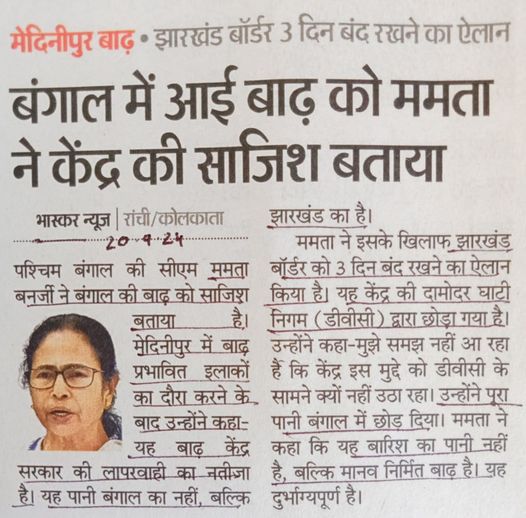
CM blames Jharkhand & DVC for floods With CM Mamata Banerjee blaming Jharkhand and the Damodar Valley Corporation (DVC) for the grim flood situation in south Bengal, and barring entry of commercial vehicles from the neighbouring state at three border points, the Centre on Sep 20 wrote to her, saying the state was kept in the loop about the release of water. It said the water was released to avoid any “catastrophic impact” in south Bengal due to possible dam failures following heavy rain.
Union Jal Shakti Minister C R Paatil wrote to Banerjee, hours after she shot off a letter to PM Modi reiterating that the DVC — a multi-purpose river valley project involving the Centre, West Bengal and Jharkhand — released water in an “unplanned and uncoordinated” manner, causing the floods that has affected at least 5 million people. She also threatened that her state would sever all ties with the DVC if the issues were not resolved. https://indianexpress.com/article/cities/kolkata/mamata-banerjee-damodar-valley-project-bengal-floods-9578917/ (21 Sept. 2024)
WB CM has written to PM, saying that if DVC continues to unilaterally release water to flood downstream Bangal, the state would severe all ties with DVC. https://www.thehindu.com/news/national/west-bengal/west-bengal-floods-cm-mamata-banerjee-writes-to-pm-modi-threatens-to-sever-ties-with-dvc/article68663700.ece (20 Sept. 2024)
Amid a war of words between W Bengal govt and Centre over release of water from reservoirs of Damodar Valley Corporation, state Power secretary Santanu Basu has stepped down from the Board of DVC, officials said on Sunday (Sept. 22). The Chief Engineer, Irrigation and Waterways of West Bengal has also quit the Damodar Valley Reservoir Regulation Committee (DVRRC), they said.
Basu in an email to DVC chairman on Sept 21 said “In view of the unprecedented and uncontrolled release of water by the DVC from its dam systems, leading to widespread inundation causing immense sufferings to the people in vast areas of the state, I do hereby tender my resignation as the member of state from the Board of DVC.” State Information and Cultural Affairs Dept in a statement on Sep 22 said “apart from the Power secretary, the Chief Engineer, Irrigation and Waterways, W Bengal, also resigned to voice protest on the same issue from DVRRC.” https://www.telegraphindia.com/west-bengal/bengal-power-secretary-steps-down-from-dvc-board-amid-war-over-release-of-water-from-reservoirs/cid/2049687 (22 Sep 2024)
The Damodar Valley Corporation (DVC), a central PSU under the ministry of power, takes the West Bengal govt into the loop at every stage before releasing water from its Maithon and Panchet dams. However, the same was not done by the Jharkhand government while water was released from the Jharkhand-operated Tenughat Dam, leaving the downstream areas off-guard and aggravating the flood situation. The West Bengal government knew it, and that’s why it first reacted against Jharkhand and went for a blockade. Though the state chief minister Mamata Banerjee later wrote to Prime Minister Narendra Modi complaining against the DVC for its alleged “unplanned and uncoordinated” release of water, a preliminary fact-finding report made it clear that all releases from the DVC-controlled Maithon and Panchet dams were advised by the Damodar Valley Reservoir Regulation Committee (DVRRC), which has representatives from the governments of West Bengal and Jharkhand, and the Central Water Commission (CWC).
– “The Jharkhand govt-controlled Tenughat Dam, which is outside the control of DVRRC, made a huge release of 85,000 cusecs of water, adding to the problem in several districts of south West Bengal. Jharkhand has, so far, refused to bring the Tenughat Dam within the ambit of the DVRRC, making the situation during a few days of incessant rain in the state quite complicated,” said an official in the CWC. Referring to alerts issued by the India Meteorological Department (IMD) for the states, he said both West Bengal and Jharkhand were sensitised and asked to be prepared due to heavy rains. Significant rainfall occurred in the lower Damodar valley area in West Bengal during Sept 14-15 and in the upper valley area in Jharkhand during Sept 15-16 due to a deep depression over both states. IMD records show that the weather department had issued an ‘Orange’ (be prepared) alert for Jharkhand for both Sept 14 and 15, and a ‘Red’ (take action) alert for West Bengal for Sept 14 in advance.
– On the question, as raised by Mamata Banerjee in her letter to the PM on Friday, of whether the release could have been deferred, especially in view of the emergency provision of encouraging beyond the ‘maximum flood management level’ (425 ft for Panchet), the DVC informed the ministry that it took the responsibility of even permitting the Panchet reservoir to build beyond the land acquisition level and the maximum level, which reached 425.22 ft as of 5 PM on Sept 17. https://timesofindia.indiatimes.com/india/west-bengal-floods-jharkhands-refusal-to-bring-its-dam-within-the-ambit-of-a-joint-committee-adds-to-the-crisis/articleshow/113563938.cms (22 Sept. 2024)
Even without any rain in the last three days inflow of thousands of acre-feet of water to the upper dam reservoirs continues. Senior water commission officials suspect certain ‘hidden’ feeders responsible for the flow of water to the dams. Rains in the upper dam catchment areas have completely stopped since Wednesday (Sept. 18) afternoon, but the Maithon reservoir recorded increasing water inflow from 811 acre-feet to 25,724 acre-feet. The figures in Panchet ranged between 3,048 acre-feet to 50,669 acre-feet. The outflow, accordingly, had to be scaled up from 811 acre-feet to 21,856 and 19,400 acre-feet in Maithon and from 4,159 acre-feet to 80,040 acre-feet in Panchet in the last three days.
– “We are really surprised to note the altering and even accelerating degrees in continued inflow in both the dams,” said Shashi Rakesh, member secretary, Damodar Valley River Regulation Committee. He added, “We suspect some never diagnosed hidden small tributaries responsible for this. We’ve taken note of this bizarre issue and have suggested the hydrology survey experts of the Damodar Valley Corporation should hold an inspection on this.”
– In November, 2020, during the Durgapur Barrage’s lock-gate disaster that had forced the state irrigation authorities to go for absolute evacuation of the barrage pond, an unknown rivulet Khadia was identified as ‘culprit’ for uninterrupted feeding to the dried up pond, when the upper dams had halted discharge for restoration work of the damaged lock-gates. Despite the halt, water flow was measured 1,236 cusecs near the affected lock-gate, said executive engineer Sanjoy Majumdar of Damodar Headworks. https://www.thestatesman.com/bengal/water-experts-suspect-hidden-tributaries-for-feeding-dams-despite-no-rain-1503345745.html (22 Sept. 2024)
Report Lack of river management a key reason for floods in Krishna: Expert The immediate cause for the latest floods, according to the Indian Meteorological Department, was a lower pressure built up over the Bay of Bengal, besides a land-based cyclone, which drew moisture from both the Arabian Sea and Bay of Bengal. The combination of these factors led to very heavy rains in both the Telugu states, starting from the night of August 30 and continuing till September 3. “Over 27 per cent of the state’s annual rainfall occurred in just 48 hours, causing severe flooding in many areas and Vijayawada, particularly, bore the brunt of the deluge with 290 mm of rainfall in a single day on the night of August 31 and September 1, which was the highest rainfall in the last 30 years,” said Andhra Pradesh Disaster Management Authority managing director Ronanki Kurmanath. During this period, several parts of Telangana received the highest rainfall ranging from 438 mm in Mahabubabad to 435 mm in Warangal, 425 mm in Suryapet and 422 mm in Khammam. Experts held massive construction on the river flood plains in both Krishna and Godavari basins as a contributing factor.
– “One of the main reasons for floods in Krishna river is lack of proper river management by the riparian states. Maharashtra and Karnataka impound Krishna water in their dams to the brim before releasing to the downstream. This is causing floods in their respective states due to backwaters of these dams. For example, Sangli city and its surroundings suffer from floods whenever water is impounded in Almatti dam by Karnataka,” Veeramalla Prakash, chairman of Indian Peninsular River Basin Council (IPRBC) said. “All the dams in Maharashtra and Karnataka were filled to the brim in July itself. So, was the case with Srisailam and Nagarjunasagar,” said Prakash.
– The Munneru river, typically a dry tributary, swelled unexpectedly, causing a flash flood in just one hour between 10 am and 11 am on September 1. With no prior warning or announcement from the authorities, the flood devastated Khammam, for the first time in the last 70 years, disaster management officials said. “The flash floods to Munneru was because of a sudden surge in the Akeru forest stream upstream about four kilometres away. It came like a Tsunami to the people of Khammam, who built their colonies along the river course,” said R Satyanarayana, a resident of Khammam. https://www.hindustantimes.com/india-news/lack-of-river-management-a-key-reason-for-floods-in-krishna-expert-101726426821992.html (16 Sept. 2024)
Prakasam Barrage WRD officials salvage one boat The WRD officials could salvage one of the three boats stuck at the gates of the Prakasam Barrage on Sept 18. The officials were making efforts to remove the second boat as well. The third boat had sunk in the waters. The officials were trying to change the direction of the second boat. It was not possible to remove the boat unless its direction was changed. But it become a big task, they said. Four boats drifted from an unknown place upstream the barrage and hit the gate in the first week. https://www.thehindu.com/news/national/andhra-pradesh/wrd-officials-salvage-one-boat-from-prakasam-barrage/article68656757.ece (19 Sept. 2024)
The WRD officials on Sept 21 salvaged the third and final boat that blocked the flow of water at the Prakasam Barrage after sinking in the Krishna river on September 1. Rescue teams used the same method used in the salvaging of the first two boats. First, the boat was sunk to the riverbed, where divers punched holes on the body of the vessel. Chains were then fixed onto the boat and pulled with the help of two towboats linked with a girder. Finally the boat was pulled ashore at Punnami Ghat. https://www.deccanchronicle.com/southern-states/andhra-pradesh/three-boats-salvaged-from-krishna-1825130 (21 Sept. 2024)
Bihar नादानी के बांध, बैराज और तटबंध डेढ़-दो सौ साल पहले से कहा जाने लगा है कि नेपाल से उतरने वाली नदियां बिहार में कहर ढाती हैं (हालांकि 1870 के पहले बिहार में बाढ़ को कोई नहीं जानता था) और उनसे निपटने के लिए बड़े बांध, बैराज या तटबंध अपरिहार्य हैं, तो भी क्या इन्हें ठीक-ठाक बनाया जाना जरूरी नहीं है? बाढ़ से निपटने के नाम पर क्या हो रहा है, बिहार में? (कुमार कृष्णन) https://www.spsmedia.in/dam-and-displacement/bihar-dams-barrages-and-embankments-of-naadani/
Odisha Water storage breach at Vedanta alumina unit A water storage facility at miner Vedanta Aluminium’s unit in Odisha breached on Sunday, impacting agricultural land in the region, which was flooded by “red mud”. ‘Red mud’ is the waste generated in the production of alumina from bauxite. It is also known as ‘bauxite residue’. The incident, which happened at Vedanta’s Lanjigarh alumina refinery in Odisha on Sunday, has alarmed environment experts who pointed out it was a serious matter as the toxic byproduct ‘red mud’ was involved. The pumped water level, or PWL, has causticity in water, meaning it can corrode organic tissue by damaging skin, eyes and mucus membranes. The water overflowed due to heavy rain, Vedanta Aluminium said. https://www.ndtv.com/business-news/water-storage-breach-at-vedanta-alumina-unit-in-odisha-impacts-farm-land-6580992 (17 Sept. 2024)
Haryana: -झज्जर: शुक्रवार (Sept. 13) को आई तेज बरसात के कारण नहर में हुए तेज बहाव से जिले के अंतिम छोर से निकलने वाली खानपुर माइनर टूट गई। माइनर टूटने के कारण नहर का पानी साथ लगते गांव गोरिया, खानपुर, खोरड़ा, बहु झोलरी की गलियों व घरों में घुस गया। माइनर टूटने से पानी खेतों में बहने लगा। जिस कारण करीब 600 एकड़ फसल जलमग्न हो गई। शनिवार की सुबह जब ग्रामीणों ने उठकर देखा तो गांव की गलियों में करीब दो से तीन फुट तक हुए जलभराव ने उनकी चिंता बढ़ा दी। इतनी अधिक मात्रा में हुए जलभराव के कारण जनजीवन प्रभावित रहा। https://www.haribhoomi.com/state-local/haryana/jhajjar/news/rainfall-brought-disaster-jhajjar-khanupar-minor-broke-600-acres-crops-submerged-public-life-affected-47052 (14 Sept. 2024) -क्षेत्र से होकर गुजर रही खानपुर व चिड़िया माइनर के टूटने से ओलिंपियन मनु भाकर के गांव गोरिया व समीपवर्ती गांव खोरड़ा में बाढ़ जैसे हालात बन गए हैं। सुबह जब ग्रामीण सोकर उठे तो उन्हें अलग ही तरह की विपदा का सामना करना पड़ा। दिन चढ़ने के साथ-साथ गांव की गलियों तक पानी पहुंचना शुरू हो गया था। दोनों गांवों की करीब 12 हजार की आबादी एकाएक आई इस मुसीबत से प्रभावित हुई है। खास तौर पर निचले इलाके में रहने वाले करीब 30 से ज्यादा परिवारों को पलायन तक करना पड़ा है। गांव के जोहड़ से लेकर फिरनी तक के एरिया में हर जगह पानी ही पानी दिखाई दे रहा है। https://www.jagran.com/haryana/jhajjar-flood-situation-in-manu-bhaker-village-situation-worsened-in-two-villages-due-to-breakdown-of-khanpur-chidiya-miner-villagers-forced-to-migrate-23796994.html (14 Sept. 2024)
HFL BREACH
West Bengal: –River Icchamati at Kuthibari site in North 24 Parganas district has crossed old HFL 11.785 meter dated 02.09.2020 at 23:00 hour on 15.09.2024. Present flood level is 12.15 meter at 10:00 hour on 17.09.2024 with steady trend.
River Ichhamati at Bangaon site in North 24 Parganas has crossed old HFL 7.725 meter dated 02.09.2020 at 02:00 hour on 16.09.2024. Present flood level is 7.9 meter at 22:00 hour on 16.09.2024 with rising trend.
River Icchamati at Tarinipur site in North 24 Parganas district has crossed old HFL 5.78 meter dated 01.08.2019 at 01:00 hour on 19.09.2024. Present flood level is 5.81 meter at 11:00 hour on 19.09.2024 with rising trend.
River Dwarka at Saralpur site in Birbhum district has crossed old HFL 14.19 meter dated 31.07.2021 at 03:00 hour on 16.09.2024. Present flood level is 44.89 meter at 09:00 hour on 17.09.2024 with steady trend.
River Damodar at Jamalpur site in Purba Bardhman district has crossed old HFL 23.38 meter dated 28.08.1987 at 10:00 hour on 18.09.2024 and set 23.49 meter as new HFL at 12:00 hour on 18.09.2024. Present flood level is 23.22 meter at 19:00 hour on 18.09.2024 with falling trend.
Uttar Pradesh: – River Sengar a tributary of Yamuna at Bulakipura site in Auraiya district has crossed old HFL 137.02 meter dated 25.09.2022 at 10:00 hour on 18.09.2024. Present flood level is 137.52 meter at 20:00 hour on 18.09.2024.
River Son at Negai site in Sonbhadra district has crossed old HFL 161.33 meter dated 29.09.2019 at 16:00 hour on 17.09.2024 and set 162.17 meter as new HFL at 21:00 hour on 17.09.2024. Present flood level is 161.85 meter at 18:00 hour on 18.09.2024 with falling trend.
Bihar: – River Dhardha at Masaurhi in Patna district has again crossed old HFL 56.75 meter dated 30.09.2019 at 24:00 hour on 17.09.2024. Present flood level is 56.80 meter 20:00 hour on 18.09.2024 with rising trend.
Madhya Pradesh: – River Sonar at Narsinghgarh site in Damoh district has again crossed old HFL 335.5 meter dated 16.09.2023 and has attained peak of 335.98 meter at 12:00 hour 18.09.2024.
River Asan in lower Yamuna basin at Jaraina site in Morena district has again crossed old HFL 172.67 meter dated 18.08.2020 at 01:00 hour on 20.09.2024. Present flood level is 173.76 meter at 16:00 hour on 20.09.2024 with steady trend.
URBAN FLOODS
Vadodara Govt forms committee to study flood The Gujarat govt has constituted a five-member committee to undertake a comprehensive field analysis of the factors that led to the recent deluge in Vadodara city and district, resulting in the unfortunate loss of lives and extensive damage to property. The committee has also been entrusted with the responsibility of recommending remedial measures to mitigate the risk of future flooding in Vadodara. The committee will be chaired by B N Navalawala, former advisor to the chief minister who has also previously served as a secretary in the govt of India. The other members of the committee include S S Rathore, advisor to the chief minister, M N Rai, engineer, central water commission (CWC), Prof Gopal Bhatti from the civil engineering department of Maharaja Sayajirao University (MSU) of Baroda, and the municipal commissioner of Vadodara. The committee’s mandate encompasses an exhaustive study of the Ajwa reservoir, the Pratappura Sarovar and the Vishwamitri river, along with their catchment areas. https://timesofindia.indiatimes.com/city/ahmedabad/gujarat-government-forms-committee-to-investigate-vadodara-flooding/articleshow/113436669.cms (18 Sep 2024)
Chennai NGT tells NHAI to remove debris in Cooum in 10 days The NGT has directed the National Highways Authority of India (NHAI) to clear all construction debris the latter had dumped inside the Cooum river by September 30. NHAI has been carrying out piling work inside the Cooum river for the new four-lane elevated road from Chennai port to Maduravoyal, The Water Resources Department (WRD), in its status report submitted before the NGT southern bench on Thursday (Sept. 19), said it has set the deadline as September 30 to avoid flooding during the monsoon. NHAI has agreed to comply with the deadline. Recording the submissions, the green bench instructed WRD to conduct an inspection on October 1 and submit another status report during the next hearing on October 3.

The Cooum river site near Aminjikarai was handed over to NHAI on May 31, and work was started on the approach roads and platform using construction debris for pile driving inside the Cooum river at various stretches for the elevated road project. Debris was dumped along the river bed at 97 locations, and at present piling work is in progress at 15 locations. Additionally, debris is being dumped 100m upstream of inner ring road bridge and 300m downstream of inner ring road bridge along the river bed. https://www.newindianexpress.com/cities/chennai/2024/Sep/20/ngt-tells-nhai-to-remove-debris-in-cooum-in-10-days (20 Sept. 2024)
CLOUD BURSTS
Arunachal Pradesh A sudden cloudburst hit Mechuka, a town in the Shi-Yomi district near the Indo-China border, causing significant damage to properties, farmlands, and infrastructure. The cloudburst, which struck the Dorjeeling and Sekar areas of Mechuka this morning (Sept. 20), has disrupted life in the region, with local authorities still assessing the full extent of the destruction. https://www.indiatodayne.in/arunachal-pradesh/video/arunachal-cloudburst-strikes-mechuka-in-shi-yomi-district-extensive-damage-reported-1095884-2024-09-20 (20 Sept. 2024)
ENVIRONMENT GOVERNANCE
Supreme Court HoD guilty if govt dept fails to comply with NGT order The Supreme Court recently observed that if a Govt Department fails to comply with an order of the NGT, the Head of the Department shall be deemed liable for such failure as per section 28 of the NGT Act, 2010. A bench of Justice Abhay Oka, Justice Ahsanuddin Amanullah and Justice Augustine George Masih set aside an NGT order deleting 15 government officers from an execution application that alleged non-compliance with NGT direction to prevent unauthorized activities in the Wild Ass Sanctuary in Gujarat’s Rann of Kutch. https://www.livelaw.in/top-stories/head-of-department-guilty-if-government-dept-fails-to-comply-with-ngt-order-supreme-court-269929 (18 Sep 2024)
A survey by Central Building Research Institute has revealed that 50% of public infrastructure buildings in India are not ready for the disasters. The disasters are increasing due to uncontrolled urbanisation, climate change and geological factors.
SOUTH ASIA
IWT India demands changes, Sends notice India has sent a notice to Pakistan, demanding a modification of the Indus Waters Treaty. Top sources with the government have said India, in its notice, said in today’s scenario, it is not feasible to maintain the same treaty and thus it needs modification. The notice from the Indian side was served on August 30, 2024. The notice also mentioned that a one-sided water treaty has been there since its inception in 1960 and that various articles of the treaty need real assessment. https://www.news18.com/india/india-notice-to-pakistan-indus-water-treaty-modification-9055023.html (18 Sept. 2024) Days after India formally sought a review of the 64-year-old IWT, Pakistan reaffirmed the agreement’s importance, expressing hope that New Delhi would continue to adhere to its provisions. The comments came on Thursday from Pakistan’s Foreign Office spokesperson, Mumtaz Zahra Baloch, in response to India’s August 30 notice requesting a review of the longstanding water-sharing pact. https://timesofindia.indiatimes.com/india/after-india-seeks-review-of-indus-water-treaty-pakistan-urges-compliance-with-pact/articleshow/113497076.cms (19 Sept. 2024)
New Delhi in a notice to Pakistan said “fundamental and unforeseen” changes in the circumstances require a reassessment of the Indus Water Treaty. The notice was issued to Pakistan on August 30 under Article XII(3) of the Indus Water Treaty (IWT), government sources told Press Trust of India (PTI) on Wednesday (September 18). Article XII(3) says: The provisions of this Treaty may from time to time be modified by a duly ratified treaty concluded for that purpose between the two Governments. This is not the first time that India has issued such a notice to Pakistan. In January 2023, New Delhi sought review of the IWT due to Islamabad’s continued “intransigence” in implementing the treaty, by raising repeated objections to the construction of hydel projects on the Indian side. https://indianexpress.com/article/explained/india-notice-pakistan-indus-water-treaty-9574375/ (19 Sept. 2024)
Pakistan has reaffirmed the Indus Water Treaty’s importance, expressing hope that New Delhi would continue to adhere to its provisions. The comments came on Sept 19 from Pakistan’s Foreign Office spokesperson, Mumtaz Zahra Baloch, in response to India’s August 30 notice requesting a review of the longstanding water-sharing pact. “Pakistan considers the Indus Water Treaty as an important one and hopes that India will also comply with its provisions,” Baloch said during a press briefing. India’s notice, issued on August 30, cited “fundamental and unforeseen” changes in circumstances, including the impact of persistent cross-border terrorism, as grounds for a comprehensive review of the treaty. According to PTI sources, the recent notice builds on this earlier one of Jan 2023 and reflects India’s concerns over various issues, including demographic changes, environmental challenges, and the need to accelerate clean energy development to meet its emission targets. https://timesofindia.indiatimes.com/india/after-india-seeks-review-of-indus-water-treaty-pakistan-urges-compliance-with-pact/articleshow/113497076.cms (19 Sept. 2024)
India-Nepal WB’s flip flop on Upper Arun HEP In October 2023, upon returning from the annual meetings of the International Monetary Fund (IMF) and the World Bank Group in Morocco, Finance Minister Prakash Sharan Mahat announced that the World Bank would be the primary financier to develop $ 1.8 B 1061 MW Upper Arun HEP, upstream from SJVN’s under construction 900 MW Arun III HEP. The site is 15km from where the Arun River enters Nepal from China, cutting between Mt Everest and Kangchenjunga. SJVN has also got Nepal’s approval to develop the 679MW Lower Arun and 490MW Arun IV projects. However, Upper Arun is located directly downstream from numerous glacial lakes in Nepal and China, which have been expanding dangerously due to climate breakdown. SJVN Limited has also proposed taking over the 769MW Tamor project on a tributary of the Arun, which was earlier set to be built with Chinese investment. Upper Arun shows every sign of being a geopolitical hot potato, since the Chinese would be averse to such a large Indian project so close to its border.
– A concessional loan agreement during an investment summit later that month did not happen due to ‘lack of preparation’. Now, the World Bank appears to have developed cold feet. Bank officials reportedly told the Nepali side a final decision would be taken at its board meeting last month after the proposal failed to gain traction during the Group’s International Development Association (IDA) Replenishment Meeting in Nepal in June. But there is a deafening silence. “India has not communicated this to us directly, but its displeasure at the World Bank’s decision to invest in this project is well understood,” an official at the Finance Ministry said. Sources told Nepali Times that India has been urging the Bank to let it invest in Upper Arun. For now, uncertainty over the Upper Arun and the lack of a clear answer from the World Bank has thrown the future of Nepal’s largest hydroelectric project into doubt. Says Fanendra Raj Joshi of Upper Arun Hydro-electric Limited: “Nepal can find alternative sources of funding and we will go ahead with this project even if the World Bank decides not to provide the loan.” https://nepalitimes.com/news/world-bank-flip-flop-on-upper-arun (21 Sept. 2024)
Bhutan Punatshangchhu-II hits snag: Water seepage in powerhouse Barely a month after successfully testing and commissioning of the first two generating units of the 1020 MW Punatsangchhu-II Hydroelectric Project, water seepages have been detected from the crown of the powerhouse cavern in the machine hall, causing a temporary suspension of testing and commissioning activities. The initial reservoir filling began on February 21, 2024, after the completion of civil works for key components of the project. This was followed by the filling of the water conductor system, which includes the desilting chambers, headrace tunnel, surge shaft, pressure shaft, and tailrace tunnel. On August 15, 2024, a key milestone was achieved with the mechanical spinning of the first two generating units. However, reports of a major leakage from the turbine stirred concerns. The Ministry of Energy and Natural Resources (MoENR) and the Chairman’s office for Hydropower projects stated that while there was no turbine leakage, water seepage from the powerhouse cavern had been detected.
– This issue has disrupted wet testing for the first two units and slowed the assembly and installation of electro-mechanical equipment for the remaining units. An MoENR official said that the seepage issue was taken up with the designers and consultants, Central Water Commission and Water and Power Consultancy Service Limited, who recommended immediate remedial measures such as installing a false ceiling and provision of temporary channels to manage the seepage. The technical group met on September 5, 2024, and recommended immediate remedial measures, which include immediate installation of false ceilings in the powerhouse cavern and service bay and dewatering of the water-conducting system. The project management team has begun lowering the dam water level to empty the headrace tunnel, surge shaft, and pressure shaft. This process is expected to take over a month, with a similar time frame required for re-filling the water conductor system. The official mentioned that the installation of electro-mechanical equipment is expected to resume after false ceilings are installed, which is expected to take about three months. “The timeline for resuming the commissioning of the generating units will depend on the treatment measures recommended after inspecting the emptied water conductor system,” he added. For the long-term solution, the technical group has determined that the water-conducting system (headrace tunnel, surge shaft and pressure shaft) has to be emptied to locate the source of the seepages and implement appropriate measures to address the seepages at the source. https://kuenselonline.com/punatshangchhu-ii-hits-snag-water-seepage-in-powerhouse/ (18 Sept. 2024)
Bangladesh The interim government in Bangladesh has decided to export 3,000 tonnes of ilish (hilsa) to Bengal “on the occasion of the upcoming Durga Puja”, junking its earlier decision not to send across the border one of the state’s most loved varieties of fish. The Bangladesh commerce ministry released a notification on Saturday (Sept. 21) seeking applications by September 24 noon from traders who wish to export ilish to Bengal. Signed by Sultana Akhtar of the commerce ministry, the notification refers to permission to export 3,000 tonnes of ilish. https://www.telegraphindia.com/west-bengal/bangladesh-interim-government-to-export-3000-tonnes-of-hilsa-to-bengal-as-durga-puja-gift/cid/2049603 (22 Sept. 2024)
THE REST OF THE WORLD
USA Fire destroys HEP powerhouse A fire broke out on Sept 14 evening at 56 MW Spier Falls Dam on the Hudson River in New York, destroying the dam’s hydroelectric powerhouse. No one was injured, but the dam’s power house will need to be rebuilt. Spier Falls dam was completed in 1903 and initially provided a capacity of 37 MW. At the time of its construction, it was the fourth largest dam and the largest power dam in the world. https://www.hydroreview.com/world-regions/north-america/fire-destroys-hydro-powerhouse-at-hudson-river-dam/ (16 Sept. 2024)
AMAZON Worst drought on record lowers rivers to all-time lows The worst drought on record has lowered the water level of the rivers in the Amazon basin to historic lows, in some cases drying up riverbeds that were previously navigable waterways.
The Solimoes, one of the main tributaries of the mighty Amazon River whose waters originate in the Peruvian Andes, has fallen to its lowest level on record in Tabatinga, the Brazilian town on the border with Colombia. https://www.reuters.com/business/environment/worst-drought-record-lowers-amazon-rivers-all-time-lows-2024-09-18/ (18 Sept. 2024)
SANDRP
Also see: DRP 16 Sept 2024 & DRP 09 Sept. 2024
Follow us on: www.facebook.com/sandrp.in; https://twitter.com/Indian_Rivers

 SANDRP