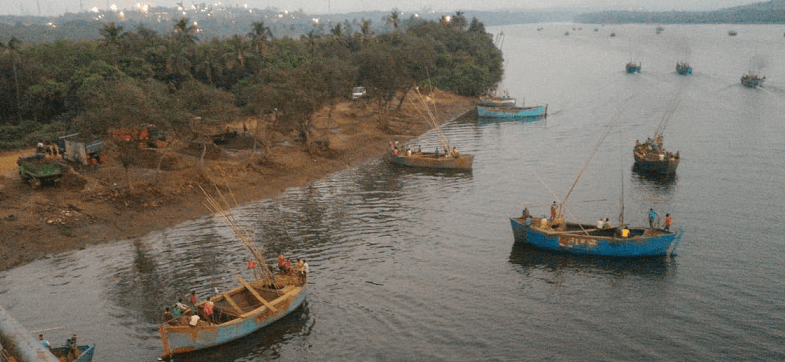
(Feature Image: Sand extraction in Mandovi river near Candola bridge. Image Credit: GRSPN)
This is indeed a rare and important victory by Goa River Sand Protectors’ Network (GRSPN) in their long fight against illegal river sand mining in Goa. Following a petition in the National Green Tribunal the state government has agreed to recall all the environment clearances granted by the State Environment Impact Assessment Authority.
Goa government has agreed since these clearances were given without a District Survey Report (DSR) as required under the sustainable sand mining guidelines of MoEF. While this may sound like a temporary respite based on some technical violation, the fact is most sand mining clearances across India are given without a credible DSR, but it has not been possible to stop such violations elsewhere.
In fact it would be good if the NGT in particular and judiciary in general were to ensure adherence to the norms underlined in the Sustainable Sand Mining Guidelines of the of MoEF across the India and also pull up the state and central Environment regulators including ministries and clearance committees for not ensuring adherence to the norms. To learn more about the work of GRSPN, see: https://sandrp.in/2024/06/15/secret-of-goa-river-networks-success-fight-collectively-consistently-to-stop-the-menace-of-illegal-sand-mining/.
Goa Govt withdraws ECs for sand mining Goa River Sand Protectors’ Network Appeal (GRSPN) Succeeds: -The state government on Aug. 12 informed the NGT that it was recalling all its environment clearances (EC) granted by the State Environment Impact Assessment Authority’s (SEIAA) for extraction of sand in Goa’s rivers. The government informed the NGT that it would undertake the District Survey Report (DSR) as required under the sustainable sand mining guidelines and only thereafter apply for fresh ECs. The NGT, after recording the statements of the Advocate General, thereafter disposed of the appeal (No.38/2021) filed by the GRSPN against the SEIAA’s ECs for sand mining in various zones of the state.
The appeal filed by the Network challenged the four ECs, all dated 12-10-2021, issued by the SEIAA for sand mining to the District Collector (North Goa) for four stretches along the River Chapora. Based on the ECs, the Collector was empowered to sublet leases to individuals for sand mining. The appeal was filed on 17-11-2021.
The GRSPN is an organisation of individuals that have consistently filed complaints against illegal sand mining in their villages. The Network is hosted by the Goa Foundation, but does not belong to it. The members of GRSPN % GF, being deeply concerned about the erosion of river banks and destruction of the riverine ecology due to the illegal sand mining, decided to join hands. https://goafoundation.org/goa-government-withdraws-ecs-for-sand-mining-in-the-state/ (12 Aug 2024)
Viraj Bakre, Member Goa River Sand Protectors Network said, “It was basically a challenge to the ECs granted. They were not granted as per the procedures laid down by law. It was withdrawn because the district survey report was not there. In NIO’s report, it is very clearly mentioned that there is not replenishment. Permissions can be given provided there is replenishment.” It may be recalled that one labourer was shot dead at Bansai-Curchorem during illegal sand mining. Thereafter CM Pramod Sawant had assured to expedite the process of resuming legal sand extraction. He called on officials to simplify and expedite the process of granting Environment Clearance (EC) for sand mining.
DMG had not renewed or granted sand mining permits for the last three seasons – 2018, 2019 and 2020 and 2021. NIO conducted a study on Sand Mining Impact and River Biodiversity Index at of Chapora, Mandovi, Zuari, Tiracol, rivers. Based on the report, the State Expert Appraisal Committee (SEAC) in September 2021, granted green signal for grant of EC at seven sites. A cap of 15 cubic metres per permit per day for each location had been imposed. The petitioner Goa river sand protectors’ network, challenged the EC granted by the SEIAA allowing sand mining in four river stretches in the state. https://www.heraldgoa.in/News-Today/Major-victory-for-Goa-River-Sand-Protectors-Govt-to-withdraw-all-sand-mining-ECs/224713 (13 Aug. 2024)
HYDRO POWER PROJECTS
SANDRP Blog 12 more HEPs impacted by cloudburst in July 2024 The flashflood spell has rendered all these HEPs non-operational thus they are facing huge generational losses in addition to the significant structural damages. The disaster has again raised questions on safety and operational issues of HEP dam projects.
Due to severe damages to main and approach roads, most of the private operators have not been able to visit project sites to figure out extent of damages and financial losses to their respective HEPs. The official reports of SDMA and DoE assessing cumulative impact of the disaster on these HEPs are still awaited in public domain. https://sandrp.in/2024/08/16/himachal-pradesh-12-more-heps-impacted-by-cloudburst-disaster-in-july-2024/ (16 Aug. 2024)
The risks of disasters due to bursting or leakages in artificial barrages of hydroelectric projects have increased manifold since these projects have mushroomed in the state over the last two decades. https://www.tribuneindia.com/news/dams-barrages-pose-threat-to-sensitive-himalayan-region/ (17 Aug. 2024)
-हिमालय नीति अभियान द्वारा कुल्लू घाटी में हुई तबाही को लेकर जारी फैक्ट फाइंडिंग रिपोर्ट में कहा गया है कि ट्रांस और उच्च हिमालय क्षेत्र में वैश्विक तापमान से जलवायु की प्रवृत्ति में बदलाव के कारण ही भारी बारिश और बादल फटने की घटनाएं हो रही हैं। https://hindi.downtoearth.org.in/natural-disasters/big-hydro-projects-in-higher-himalayas-should-be-stopped-report (08 Aug. 2024)
Uttarakhand Threats of more HEP dams Himanshu Thakkar, who heads the South Asia Network on Dams, Rivers and People (SANDRP) says, “There is a lot of money to be made in the construction of dams, and if they get washed away, then there is more money to be earned in their rebuilding. Everyone is hand-in-glove in this business.” Thakkar holds that the Central Water Commission must be asked to provide a safety evaluation of all dams and the ones that are too old must be decommissioned.
– Supreme Court advocate Prashant Bhushan, who filed a petition challenging the proposal to build 28 dams believes that the central government committee that approved 7 of these was the third committee to have looked into the issue of dam construction in the Himalayas. Several members of the committee, he added, were themselves involved in clearing these project proposals — establishing clear bias, surely. https://www.nationalheraldindia.com/national/talk-of-more-dams-in-the-himalayas-makes-scientists-see-red 16 Aug. 2024)
Karnataka Greens slam Sharavathi PSP Prof T V Ramachandra of IISc questioned the project pointing out that the ecology of the area is already fragile, “All sensible people, including me, will oppose the project. We can’t take more risks in ecologically sensitive areas. We have already burnt our fingers in Wayanad of Kerala, in Kodagu, Chikkamagaluru and Shirur in Uttar Kannada district. Why should we make the same mistakes?” IISc had studied the area between 2000 and 2003 and submitted a report to the state govt which said any such project will cause irreparable damage to the ecological balance in the region. State Western Ghats Task former chairman Anant Hegde Ashisara said that the project must not be approved. https://www.deccanherald.com/india/karnataka/greens-slam-sharavathi-hydro-pumped-storage-plant-3150887 (15 Aug. 2024)
Maharashtra Govt signs MoUs for PSPs worth ₹24,631cr The water resources department acting as nodal agency on Aug. 12 signed three MOUs with Mahagenco, Tata Power, and Avaada Group to generate pump storage hydro power projects with a combined capacity of 5,630Mw. The estimated investment for these projects is ₹24,631 crore, with the state government projecting the creation of 10,300 jobs.
Mahagenco plans to develop an 80 MW pump storage project at the Koyna left bank dam foot power house. Tata Power has committed to developing two pumped hydro storage projects in the state: a 1,000 MW project at Bhivpuri in Raigad district and an 1,800 MW project at Shirawata in Pune district. The company aims to commission these projects by the financial years 2027 and 2028, respectively, with a proposed capital investment of ₹13,000 crore.
Avaada Group, a company specialising in green energy, signed MOUs to develop two pumped storage projects with a combined capacity of 2,750 MW. These include the 1,500 MW Pawana-Falyan pump storage project in Pune and Raigad districts and the 1,250 MW Kumbhavade project in Kolhapur and Ratnagiri districts. Avaada plans to invest approximately ₹14,000 crore in these projects over the next five to seven years. https://www.hindustantimes.com/cities/mumbai-news/maharashtra-signs-agreements-for-hydro-power-projects-worth-24-631-crore-101723518716787.html (13 Aug. 2024)
Punjab Low water level in dams likely to hit irrigation, power generation Due to deficient monsoon rainfall in Punjab and Himachal Pradesh this year, the water level in the Bhakra, Pong and Ranjit Sagar reservoirs may not reach the required mark by the end of filling season (September 20).
The hot weather conditions that prevailed in the state during May and June and insufficient monsoon rainfall thereafter resulted in an unexpected increase in power demand. “The gap between unrestricted and restricted supply given by the PSPCL is around 1,000 MW to 1,200 MW this year. It may increase next year and the consumers may have to face more frequent power cuts,” said a PSPCL official.
PSEB Engineers Association general secretary Ajaypal Sater levels in dams would surely impact the power generation, besides affecting the farming sector as the water supply for irrigation would have to be curtailed. “The state authorities should start thinking about increasing the solar and thermal power generation so that the situation can be tackled during the next summers when the power demand will increase further,” he said. https://www.tribuneindia.com/news/punjab/low-water-level-in-dams-likely-to-hit-irrigation-power-generation/ (18 Aug. 2024)
Report Spurt in ECs to projects in forest areas by NBWL While 71 projects across the nation were cleared by the Standing Committee of the National Board for Wildlife (NBWL) in 2019-20, the numbers rose to 421 across the nation in 2023-24. The maximum clearances pertaining to upgrade of roads, defence projects were given in Ladakh in Changthang Wildlife Sanctuary and Karakoram Wildlife Sanctuary. Over 200 proposals were cleared in Ladakh since 2019. The ecologically sensitive Uttarakhand too has received 38 clearances from the committee with respect to drinking water, irrigation and upgrade of roads projects. A Rs 2,580-crore irrigation and drinking water project in Nainital’s Dudhwa-Lagga tiger corridor was cleared. Over 94 projects pertaining to linear infrastructure projects in Rajasthan were cleared by the wildlife panel. https://www.tribuneindia.com/news/india/spurt-in-clearance-of-projects-in-forest-areas-by-wildlife-committee/amp/ (11 Aug. 2024) Despite protests from environmentalists, the Public Works Department has prepared a proposal for a Rs 33 crore project to develop the road from Attigundi to Kemmannugundi within the Bhadra Tiger Reserve area and submitted it to the government. As a result, there is a possibility that human traffic will resume within the tiger reserve’s environment. https://bangaloremirror.indiatimes.com/bangalore/others/road-via-bhadra-tiger-reserve-gets-green-signal-again/articleshow/112595930.cms (18 Aug. 2024)
MoEF Agenda for EAC meeting on River Valley Projects to be held on Aug 30-31 2024:
1. Bhavali Pumped Storage Project (1500 MW) in 278.92 Ha in Village Kalbhonde, Kothale and Jamunde Sub District Shahapur and Igatpuri, Dist Thane and Nashik, Mah by JSW Energy PSP Two Ltd: for EC
2. Brutang Irrigation Project (CCA 23300Ha) in 3552.06 ha in village Manjari, Sub District, Dist Nayagrah, Odisha: For EC
3. Amalpada Pumped Storage Hydro Electric Project (300 MW) in 293.65ha in village Amalpada, Sub District Songadh, Dist Tapi, Gujarat by Gujarat State Electricity Corp Ltd: For TOR
4. Juni Kayaliwel Pumped Storage Hydro Electric Project (300 MW) in 308.77 ha in village Kayaliwel, Sub District Songadh, Dist Tapi, Gujarat by Gujarat State Electricity Corp Ltd: For TOR
5. Serula Pumped Storage Hydro Electric Project (960 MW) in 542.54Ha in village Serula, Sub District Songadh, Dist Tapi, Gujarat By Gujarat State Electricity Corp Ltd: for TOR
6. Attappady Irrigation Project (CCA 4,255 ha) in 302.0005 ha in village Agali and Sholayur, Sub District Mannarkkad, Dist Palakkad, Kerala by Dept of Irrigation: for EC
7. Bhivpuri Off-Stream Open Loop Pumped Storage Project (1000 MW) in 117.41Ha in Village Sawale, Khand and Bhivpuri (camp), Sub Dist Mawal and Karjat, Dist Pune and Raigarh, Mah by Tata Power Co. Ltd: For EC
8. Dangari Pumped Storage Hydro-electric Project (1400 MW) in 499 ha in village Dangari, Madia and Rajpuri R F, Sub District Bagicha, Dist Jashpur, Chhattisgarh by Chhattisgarh State Power Generation Company Ltd: For TOR
9. Juni Bavli Pumped Storage Hydro Electric Project (450 MW) in 240Ha in village Amode, Umarda, Untavad, etc, Sub Dist Nizar, Uchchhal and Songadh, Dist Tapi, Narmada, and Nandurbar, Gujarat By Gujarat State Electricity Corporation Ltd: For TOR
10. Satkashi Pumped Storage Hydro Electric Project (330 MW) in 254.2Ha in village Satkashi, Sub District Songadh, District Tapi, Gujarat By Gujarat State Electricity Corp Ltd for TOR
11. Kandhaura Pumped Storage Project (1680 MW) in 584.57 Ha in village Sashnai, Markuri & Cherue, Taluka Obra and Robertsganj District Sonbhadra, Uttar Pradesh By JSW Energy PSP Six Ltd for amendment in TOR https://parivesh.nic.in/utildoc/93881139_1723789006885.pdf
DAMS
Polavaram Project Experts recommend new design for diaphragm wall, dam An international panel of experts has recommended that the Centre adopt new designs for the diaphragm wall and main dam of the Polavaram project. The experts suggested various measures to the Centre to strengthen the existing cofferdams and other crucial structures. However, they said that there was no need for renovation or reconstruction of the cofferdams, despite the presence of seepage. The Panel of Experts (PoE), comprising two members each from the US and Canada, visited the project site in June and conducted a study to develop a roadmap for the project’s progress. The panel recently submitted its final report to the Centre.
– Four experts—David P Paul and Gain Franco de Sikko from the USA, and Richard Danielle and Sean Hinch Berger from Canada, who specialize in international dam safety, structural engineering, structural solutions, civil engineering, hydraulics, and geo-technology engineering—presented their findings to the Union Jal Shakti Ministry. Sources said that the state govt had already requested the Polavaram Project Authority (PPA) and Jal Shakti Ministry to make a prompt decision on the report submitted by the expert panel. The state cabinet recently passed a resolution seeking the Centre’s support for the construction of a new diaphragm wall.
– Initially, the experts observed that the damaged diaphragm wall could be restored with minor repairs. However, they supported the stance of the state and Jal Shakti Ministry upon completing their study. “Changes to the project designs are necessary as the new diaphragm wall must be constructed between the upper cofferdam and lower cofferdam. The main dam space will also remain unaltered. Therefore, creating space for the new diaphragm wall is a bit challenging,” said a senior official. Since completely draining seepage waters from cofferdam portions is considered expensive, the expert panel has suggested creating filters/ pumping to reduce the water level. https://timesofindia.indiatimes.com/city/vijayawada/experts-recommend-new-designs-for-diaphragm-wall-and-main-dam-at-polavaram-project/articleshow/112578883.cms (17 Aug 2024)
AP tells Odisha, Chhattisgarh to give options on back water Andhra Pradesh has proposed that Odisha and Chhattisgarh come up with options on the Polavaram backwaters issue. The Central Water Commission is holding a meeting in New Delhi on August 28 with these two states as also AP and Telangana, to discuss the impact of the backwaters on them.
– The CWC has conducted a study on this last year and advised AP to follow specific designs for erection of the various components for the project. The AP water resources authorities claim that they are scrupulously following these directions and are mindful of the impact of the project’s backwaters on other states too. However, they say, the Odisha government must avail the options proposed by AP. The first option is that AP is ready to construct flood banks to avoid submergence of vulnerable areas in Odisha. As for the second option, AP has expressed its intent to compensate for the submergence.
As for Telangana, AP feels its complaint on submergence of some low-lying areas is because small streams are not getting emptied into the Godavari river especially during the floods for the reason that the water level in the river rises beyond the level of the streams. As this is a natural phenomenon, much intervention is not possible to resolve the issue. Once the water level in the river comes down, the water in the streams will flow into the river and there will be no flooding of the low-lying areas, says AP. https://www.deccanchronicle.com/southern-states/andhra-pradesh/polavaram-ap-tells-odisha-chhattisgarh-to-give-options-on-backwater-issue-1816165 (13 Aug. 2024)
‘Polavaram to submerge 200 villages’ BJD’s fact finding team which visited areas likely to be affected by Polavaram project expressed grave concern over its impact on Malkangiri district. The team led by former minister Atanu Sabyasachi Nayak, stated around 200 villages in Motu and Padia blocks of Malkangiri district will be submerged and more than 6,000 people, mostly tribals affected due to the project. It submitted its report to party president and leader of Opposition Naveen Patnaik. The report stated the block headquarters town of Motu will be completely submerged. No public consultation or hearings were organised in the affected villages by the authorities implementing the project. Besides, no survey was conducted to assess the potential damage to livestock, agricultural produce, government institutions, public infrastructure and environment. The team also visited Alama, Muraliguda, Bariwansa and Binayakpur villages in Motu block inhabited by tribals who opposed the project vehemently. https://www.newindianexpress.com/states/odisha/2024/Aug/13/polavaram-project-to-submerge-200-villages-says-bjd (13 Aug. 2024)
Karnataka 5 stoplogs installed at broken crest gate in Tungabhadra dam The team of experts successfully installed all five stoplogs at the broken crest gate no 19 of the Tungabhadra Dam after two days of continuous efforts. The outflow of water from the broken crest gate of the reservoir has reduced from 65,000 cusecs to 500 cusecs after the installation of all the temporary stoplogs on Saturday (Aug. 17).
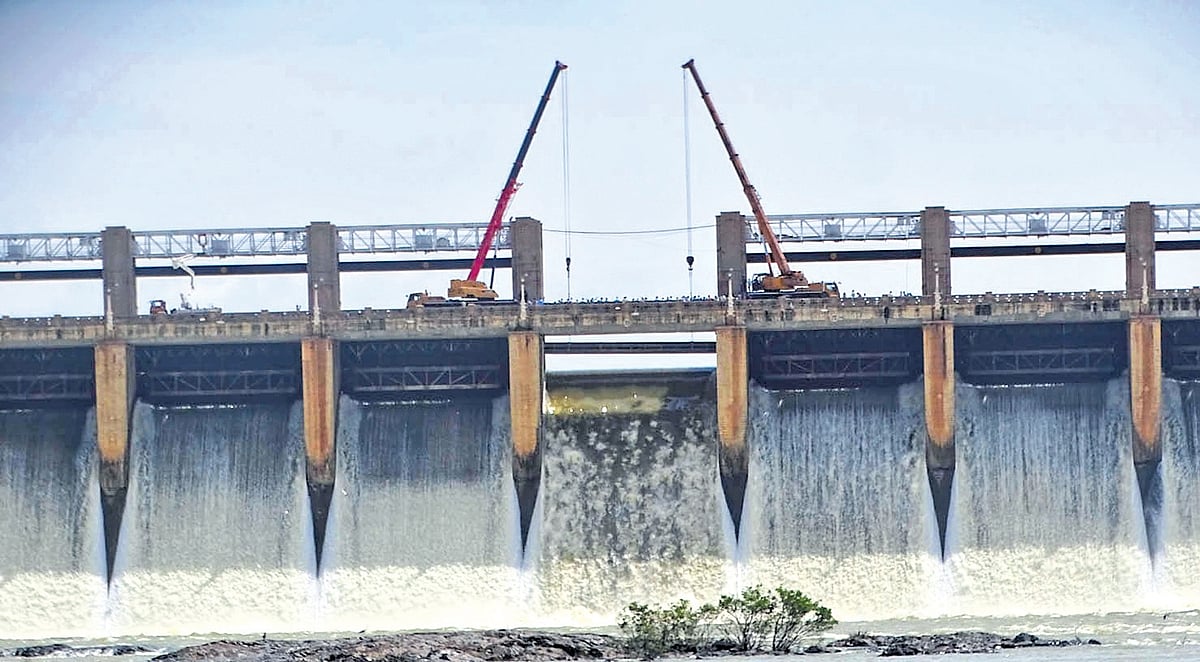
The crest gate gave way because the chain link was more than 50 years old. Installation of the new crest gate no 19 will be done next year during the summer season,” added Hydro Mechanical Engineer and team lead N Kannaiah Naidu. The broken crest gate was found near the dam’s downstream area after a week of the incident. Officials tried to lift it from the river on Saturday (Aug. 17). https://www.newindianexpress.com/states/karnataka/2024/Aug/18/all-five-stoplogs-installed-at-broken-crest-gate-in-tungabhadra-dam (18 Aug. 2024) Several attempts to fix the breach in crest gate number 19 of Tungabhadra dam failed to yield the desired results on Thursday (Aug. 15). After the repeated efforts to fix the parts of the steel gate, readied at Toranagallu-based Jindal company, into the stone pillar hooks failed, the dam authorities have decided to try the gate assembled at the Hindustan Engineering Company’s shed at the Hindustan Engineering Company’s shed at Hosalli in Koppal taluk. https://www.deccanherald.com/india/karnataka/tungabhadra-dam-gate-crash-efforts-to-fix-breach-fail-to-yield-results-3152291 (16 Aug. 2024) Taking farmers’ concerns into account, authorities are exploring ways to fix the damaged crest gate no. 19 of the Tungabhadra reservoir, which was washed away late on Saturday after its chain link was broken, keeping the water loss to the least possible quantum. The government is consulting a second team of experts to explore how this can be done, after the first team held that the reservoir had to be emptied by half before a new gate could be fixed. https://www.thehindu.com/news/national/karnataka/efforts-on-to-fix-tb-dam-crest-gate-without-colossal-wastage-of-water/article68517147.ece (13 Aug. 2024)
Dam is it safe? -The recent failure of the 19th crest gate at the Tungabhadra reservoir has heightened worries about the overall safety and functionality of dams throughout Karnataka. This incident is not an isolated case; similar issues have been reported in the past. In June 2024, the Bhadra reservoir experienced a jammed gate due to rust, which led to the unintended release of excess water into the river. Despite attempts to fix the problem, the gate remained stuck, continuing to cause water overflow.
-For the past three years, the Kabini reservoir has been dealing with a leakage in the spillway walls of its right bank canal. Although experts have stated that the leakage does not pose an immediate risk to the reservoir’s safety, it is being closely monitored with CCTV cameras. Repairs are scheduled for February or May when water levels are lower.
-Two years ago, MP Sumalatha Ambareesh raised concerns about a possible crack in the KRS Dam. While experts have found no evidence of cracks or leaks, a trial blast to determine if nearby mining activities are affecting the dam has been delayed since 2018 due to public opposition. The trial blast remains a contentious issue, as the community continues to oppose it despite the lack of significant findings.
-These recurring problems highlight the aging infrastructure of the state’s dams, many of which are over 50 to 70 years old. The gates and chains, crucial for controlling water flow, are also old and require regular maintenance. Unfortunately, the maintenance work is often subpar, with the government spending large sums of money only to see the quality of work compromised.
-Contracts are frequently awarded to contractors lacking the necessary expertise, resulting in poor workmanship. “There have even been cases where fake certificates were used to approve maintenance work, leading to serious risks. A similar issue surfaced 10 years ago at the Bhadra reservoir, but the case was eventually closed without proper resolution. This lack of transparency in the maintenance process has fueled corruption and increased the likelihood of accidents. In light of these concerns, there is an urgent need for the authorities to take swift action to ensure that dams and gates are properly maintained and safe for use,” said a source. Reacting to this, Deputy CM DK Shivakumar said that an expert committee will be formed to evaluate safety aspects of all the dams in the state. https://bangaloremirror.indiatimes.com/bangalore/others/dam-is-it-safe/articleshow/112475986.cms (13 July 2024)
Andhra Pradesh Tungabhadra gate damage forces govt to open two reservoirs The release of such a huge quantity of water from Tungabhadra resulted in swelling of water levels in Srisailam reservoir, the first major dam in Andhra Pradesh-Telangana border, which is already filled to its brim. On Monday (Aug. 12), the inflows into this reservoir was around 1.80 lakh cusecs and the authorities were forced to let out 2,66,933 cusecs of water to the downstream by opening all its nine crest gates. At Nagarjunsagar, the second major reservoir on Krishna river in Andhra, the inflows on Monday (Aug. 12) were 1.69 lakh cusecs. The irrigation authorities are discharging 40,278 cusecs of water to maintain the reservoir balance.
“Had there been no problem with the crest gates, there would have been 105 tmc ft of water in Tungabhadra dam. Now, with the damage to the gate, it would be losing around 61 tmc. Unless there are further rains in the upstream of the river, the farmers will be at loss,” the official added. The irrigation minister, however, said there was no immediate threat to the irrigation needs of Rayalaseema at least for this season. “If we can complete the crest gate work at the earliest, there is a possibility of storing more water in the coming days due to rains. We can still fill the dam up to 105 tmc ft,” he asserted. https://www.hindustantimes.com/india-news/damage-to-karnataka-dam-forces-andhra-to-open-two-reservoirs-101723488667719.html (13 Aug. 2024)
Concerns rise over Srisailam dam safety Concern over the Srisailam Dam’s downstream apron remains unaddressed despite regular visits from dam safety authorities. The phase 2 of the Dam Rehabilitation and Improvement Project (DRIP) scheme, a part of a central government initiative with World Bank assistance, was intended to address these issues. This envisaged a cost-sharing arrangement of 70:30 between the central and state government. However, the funds allocated for maintenance are far below the requirement. Some ₹3 crore to ₹4 crore is proposed annually for the maintenance, but what is released is around ₹1 crore or less, year after year.
Proposals worth ₹700 crore were submitted some time ago to strengthen the apron at gates 6, 7, 8 and 9 and to cover the plunge pool with concrete. Yet, there was neither the administrative sanction nor any action on the ground. In February last, a team from the national dam safety authority and the central water commission conducted a detailed study of the dam. According to chief engineer Kabir Basha, the team concentrated on the plunge pool’s condition, highlighting concerns about a significant pit in front of the dam.
A proposed budget of ₹135 crore was suggested for essential safety repairs. With the reservoir now full due to heavy rains, doubts about the plunge pool’s efficacy have resurfaced. However, dam officials assert there is no immediate cause for concern, but stress that the apron needs be strengthened in view of future floods. https://www.deccanchronicle.com/southern-states/andhra-pradesh/andhra-pradesh-concerns-rise-over-srisailam-dam-safety-1814867 (7 Aug 2024)
Mullaperiyar Dam SC urged to review its 2006 order regarding dam’s safety, say lawyers The Supreme Court must review its orders regarding the safety of Mullaperiyar dam, since the presumption in the order of 2006 is that the floodwaters from the dam (if it broke) would gush through the Periyar river and reach the Idukki dam located 56 kms away, which has the capacity to contain this additional influx of water, lawyers Mathews J. Nedumpara and Chittoor Rajamannar said here on Aug 17 2024. They said tens of thousands of people who resided in towns en route in this 56 km distance, like at Vandiperiyar and at Upputhura, stood at the risk of being washed away. https://www.thehindu.com/news/national/kerala/sc-must-review-its-2006-order-regarding-mullaperiyar-dams-safety-say-lawyers/article68537160.ece (17 Aug. 2024)
Opposition in Kerala demand construction of new dam Kerala’s Leader of the Opposition V.D. Satheesan has said a policy of “water for Tamil Nadu and security for Kerala” should guide the construction of a new dam at Mullaperiyar. Mr. Satheesan’s comment on Tuesday (August 13, 2024) comes against the backdrop of mounting public concern in Kerala about the safety of the 129-year-old masonry gravity dam.
Kerala Irrigation Minister Roshy Augustine, who chaired a meeting at the Idukki District Collector’s office on Monday (August 12, 2024), ruled out any immediate cause for alarm. But, he insisted that Kerala intended to construct a new dam at Mullaperiyar for public safety. At least three UDF MPs – Dean Kuriakose and Hiby Eden, both of the Congress, and Haris Beeran, IUML’s Rajya Sabha member – had moved either Houses of the Parliament to replace the ageing Mullaperiyar dam. Moreover, the Mullaperiyar Samara Samithi, a politically bipartisan front, is set to restart its agitation for a new dam at Mullaperiyar.
Mr. Satheesan pointed out that the Opposition had flagged the danger posed by Mullaperiyar to residents downstream several times in the Kerala Assembly. Moreover, the United Nations University Institute for Water, Environment and Health highlighted the dam’s issues in its 2021 report ‘Ageing Water Storage Infrastructure: An Emerging Global Risk.’ The Kerala government has also sought a high-level meeting with Union Jal Shakti Minister C.R. Patil to convene a high-level meeting. It also planned to move the Supreme Court to get a favourable order. https://www.thehindu.com/news/national/kerala/kerala-opposition-leader-says-water-for-tamil-nadu-and-security-for-kerala-policy-should-guide-construction-of-new-dam-at-mullaperiyar/article68519580.ece (13 Aug. 2024)
Bhakra Dam Muck dumping: HC asks govt why no prosecution The high Court has directed the state govt to explain why it has failed to prosecute those involved in the illegal muck dumping in the Bhakra dam reservoir and forest areas of Bilaspur district. A bench of Chief Justice MS Ramachandra Rao and Justice Satyen Vaidya has stated that the state govt should explain why “they are simply collecting fines and not prosecuting the people responsible for illegal muck-dumping.” The HC has also observed in its order that no steps have been taken by the state govt to clear the muck from the shores of Gobind Sagar lake in Bilaspur.
– The HC, during a previous hearing in the case on May 31, had ordered the Bilaspur deputy commissioner and superintendents of police to initiate penal action against all violators found dumping muck in the Bhakra dam reservoir and its feeding nullahs in Bilaspur district of the state. The HC had also directed Himachal Pradesh CS to personally monitor the implementation of the court orders and file a status report. https://timesofindia.indiatimes.com/city/shimla/himachal-pradesh-high-court-questions-lack-of-prosecution-for-illegal-muck-dumping/articleshow/112479823.cms (13 Aug. 2024)
Telangana Devadula LIP fails to fill reservoirs The Lift Scheme has been designed to draw water from the Godavari River to irrigate over 6.21 lakh acres in the upland drought prone areas in the erstwhile Karimnagar, Warangal and Nalgonda districts is yet to be put into operation. But only a few of the pumping units in phase III of the project have been put to operation recently. The lift scheme had hitherto been facing operational challenges due to insufficient water levels in the Godavari even during monsoon seasons.
Much in contrast with the previous year flows, over 1970 TMC of water had flown down the river at Devadula. But the water utilised by the Lift Irrigation project so far this year was just a trickle. The project has as many as 20 pumping units in its three phases with a capacity to lift 5200 cusecs. They feed as many as 36 irrigation tanks. The lift irrigation project has potential to extend the supplies even to the Lower Manair Project and even beyond. https://telanganatoday.com/telangana-water-woes-persist-as-devadula-lift-irrigation-fails-to-fill-reservoirs (15 Aug. 2024)
Jharkhand Massanjore Dam has no benefit for people “The Centre had constructed the Massanjore Dam over the Mayurakshi river in Dumka in 1956 with financial aid from the Canadian govt. The dam was built to control drought in Bengal’s Birbhum and Burdwan districts. As per the agreement, a canal was to have been constructed to provide water for Dumka villagers. But that was never done. “The Dumka area is arid and relies only on monsoons. Dumka is the sub-capital of Jharkhand only on paper. The people’s lot has not improved,” said Gautam Chatterjee. https://www.telegraphindia.com/elections/lok-sabha-election-2024/the-dam-of-all-problems-massanjore-dam-in-dumka-constituency-has-no-benefit-for-the-people/cid/2024115 (2 Jun 2024)
मध्य प्रदेश सिंगरौली जिले में हैदराबाद की एक कंपनी को मेसर्स पटेल इंजीनियरिंग के जॉइंट वेंचर को साल 2019 में तत्कालीन कमलनाथ सरकार ने ठेका दिया था. उसी साल जल वितरण चैनल के निर्माण के लिए Rs 243.95 करोड़ की एडवांस राशि जारी की गई. इस परियोजना को गोंड वृहद सिंचाई परियोजना कहा जाता है और इसका निर्माण 28 मार्च 2024 तक पूरा किया था. लेकिन इस योजना में अब तक एक भी पाइप नहीं बिछाई गई और न ही बांध का निर्माण शुरू हो सका है. https://www.abplive.com/states/madhya-pradesh/mp-govt-paid-advance-rs-243-crore-without-dam-construction-mla-rajendra-meshram-ann-2761100 (14 Aug 2024)
INTERLINKING OF RIVERS
Ken-Betwa Linking CM Yogi Adityanath on Monday (Aug. 12) suggested that Hamirpur district should also be made part of the Ken-Betwa River linking project. The project includes constructing a 21km link channel in UP that will require the acquisition of 271 ha of land. It will provide irrigation to 2.51 lakh hectares in UP and benefit the districts of Banda, Mahoba, Jhansi, and Lalitpur. https://timesofindia.indiatimes.com/city/lucknow/cm-yogi-adityanath-suggests-including-hamirpur-in-ken-betwa-linking-project/articleshow/112480283.cms (13 Aug. 2024)
Bihar Protests against Kosi-Mechi linking Documents available on the National Water Development Agency’s (NWDA) website under the Union Ministry of Jal Shakti (MoJS) reveal that the Kosi-Mechi River Linking Project is not for flood control but for irrigation purposes. The project aims to provide irrigation support to 215,000 hectares of agricultural land in the Mahananda river basin during the Kharif season.

Mahendra Yadav, an activist from the Kosi Nav Nirman Manch — an organisation that works to safeguard the interests of Kosi flood victims, said. Yadav explained that only 5,247 cubic feet per second (cusecs) of additional water will be released from the barrage after the project is completed, whereas the barrage is designed to handle a discharge of 900,000 cusecs. “Therefore, how will a mere reduction of 5,247 cusecs of water stop flooding?” he argued. Yadav also questioned how much water will be needed in that region during the monsoon, given that the area often faces flood-like conditions. https://www.downtoearth.org.in/natural-disasters/for-irrigation-not-for-flood-control-protests-in-bihar-against-kosi-mechi-link-project (14 Aug 2024)
INTERSTATE WATER DISPUTES
Cauvery Water Dispute CWRC tells TN to release water to Puducherry The Cauvery Water Regulation Committee (CWRC) in its 101st meeting has expressed satisfaction over the Cauvery water flow from Karnataka to Tamil Nadu’s reservoir Mettur Dam. The committee has now directed the Tamil Nadu government to release water to Puducherry to meet its shortfall. The next meeting of CWRC is scheduled on August 30 to reassess the situation in the Cauvery basin. https://www.newindianexpress.com/states/karnataka/2024/Aug/14/cauvery-water-regulation-committee-tells-tamil-nadu-to-release-cauvery-water-to-puducherry (14 Aug. 2024)
IRRIGATION
Punjab NGOs to protest pollution of canal water in Ludhiana At a meeting held in Beopar Mandal Bhavan in Sadulshehar on Aug. 12, participants from various NGOs gave ‘Ludhiana Chalo’ call for protest on August 24 against supply of polluted water through canals to Sriganganagar and other districts in Rajasthan. Convener of ‘Zehar se Mukti’ movement, Maninder Singh Mann said there has been no check on poisonous water coming into canals from Punjab, which had been spreading diseases. As the govt had not made sincere efforts to combat water pollution even when the NGT had imposed heavy penalties in the past few years on the complaints filed in this connection, the aim of the march was to connect the people of Punjab and Rajasthan, District vice-president of All India Kisan Sabha Kaur Singh Sindhu said. https://www.tribuneindia.com/news/ludhiana/ngos-to-protest-pollution-of-canal-water-in-ludhiana-on-august-24/ (14 Aug. 2024)
URBAN RIVERS
Buddha Dariya; Ludhiana Pollution level up: CPCB to NGT In an ongoing petition filed in NGT against 54 dyeing units causing pollution in Buddha Nullah, the CPCB, PPCB and Ludhiana deputy commissioner have filed their status report. CPCB, in its report highlighted that CETPs were dumping treated wastewater into Buddha Nullah. But, when they were granted environment clearance, it was mentioned that they will not do the same.
PPCB gave status report of three CETPs and scattered units as well. As per PPCB report, the 50 MLD Tajpur CETP, the 40 ML Focal Point CETP and 15 MLD Bahadur Road CETP have been achieving standards notified by MoEF except TDS and discharging effluents into Buddha Nullah. As per the board, it imposed environmental compensation of ₹ 25 lakh, ₹ 1 cr and ₹1.77 cr respectively on these CETPs for violations on a special purpose vehicle which is operating the CETP. PPCB has clearly mentioned in its report that it has not given any relaxation to scattered units after March 2023 and MC was told to disconnect their sewer connections. https://timesofindia.indiatimes.com/city/ludhiana/pollution-in-buddha-dariya-on-the-rise-cpcb-informs-ngt/articleshow/112536836.cms (15 Aug. 2024)
The CPCB in its reply has further stated that on August 12, it issued fresh directions to the PPCB to “take appropriate action including imposing environmental compensation” and send an action taken report to CPCB within 15 days. The CPCB has also directed the PPCB to stop the discharge of treated effluents from these CETPs into Buddha Nullah, states the reply. https://indianexpress.com/article/cities/chandigarh/buddha-nullah-water-pollution-ludhiana-9515572/ (15 Aug. 2024)
The NGT’s notice came after it took suo motu cognisance of a report, ‘Ludhiana PPCB report flags 54 dyeing units in Buddha Nullah’s catchment’, published in these columns on April 26, 2024. The report highlighted environmental concerns related to industrial pollution in the Buddha Nullah. The CPCB and state environment secretary have been named as respondents in the case due to their alleged failure to comply with a Supreme Court order requiring all CETPs to be fully functional within three years from February 17, 2017. According to the CPCB report, the CETPs are still not in compliance.
In May, the NGT issued a notice to the authorities, seeking status reports on the dyeing. Another PPCB report submitted in an earlier case revealed that the water in Buddha Nullah was ‘unfit for irrigation’ due to high levels of BoD and CoD demand. These elevated levels were reportedly caused by discharge of wastewater from dyeing units in the area. https://www.hindustantimes.com/cities/chandigarh-news/plants-dumping-treated-wastewater-into-drains-ppcb-report-101723653511292.html (14 Aug. 2024)
RIVERS
River Sings – Storytelling in Nature A captivating talk by Shrishtee Bajpai of Kalpavriksh, who masterfully weaves together landscapes, emotions, and stories from across India and beyond. Shrishtee reveals that places and people are not merely destinations but integral to a deeper connection. Her narratives underscore the importance of empathy and understanding, featuring profound reflections like “We are the rivers, the rivers are us,” which illustrate our profound interconnectedness. https://www.youtube.com/watch?v=fjZzgM5tPlQ (14 Aug 2024)
Study Ecohydrological dynamics of GW springs in Himalaya The study provides an integrated analytical framework for understanding Himalayan springs, which are critical for achieving SDG 6 (access to clean water) and a baseline for developing appropriate springshed models for effective management of freshwater ecosystems (SDG 15) against future climate change impacts (SDG 13), as well as informing the water security assessment in the Himalaya. https://www.sciencedirect.com/science/article/pii/S2352801X24002340 (Nov. 2024)
Report PepsiCo, Coca-Cola top polluters in hills Once again, PepsiCo India, CG Foods, Parle, Coca-Cola India, and ITC have been identified as the top five polluters of the Indian Himalayan Region for 2024, according to findings from The Himalayan Cleanup campaign. It is noteworthy that they were among the top 20 polluters in 2022 as well. During the presentation of the THC 2024 findings, Priya Shrestha, a member of Zero Waste Himalaya, revealed that volunteers collected 121,739 pieces of waste, of which 87.7% was plastic. Only 24.8% of the plastic waste was recyclable, highlighting the struggle to manage and process recyclable plastics in the mountains. The prevalence of non-recyclable multilayered plastics further exacerbates the issue, with food packaging accounting for 84.2% of all plastics collected, underscoring the high consumption of junk processed foods. https://mokokchungtimes.com/pepsico-coca-cola-among-top-5-polluters-in-himalayan-cleanup-campaign-2024/ (04 Aug. 2024)
Karnataka SPCB asks CPCB to delist 6 rivers from PRS The SPCB has asked CPCB for the delisting of Sharavathi, Gangavalli, Aghanashini, Krishna, Kagina, and Nethravathi as the BOD value of these rivers has not crossed 3mg/litre in the last four years. The board has clarified this in a report submitted to the NGT after the court took suo motu cognizance of an article that appeared in Bangalore Mirror on January 10. Once done, Karnataka will only have 10 polluted river stretches. The SPCB has also informed the tribunal that an action plan is being implemented to provide STPs for all cities located on the banks of the polluted river stretches. The STPs, which are under construction and are in the proposed stage, will be established by the end of Dec 2024. https://bangaloremirror.indiatimes.com/bangalore/civic/rivers-in-the-clear/articleshowprint/112595280.cms (18 Aug. 2024)
Karwar Kali bridge crashes, hits traffic to Goa A 40-year-old bridge across Kali River, a crucial link between Karwar and Goa on NH-66, collapsed around 1.30am on Aug. 07. The old bridge had been closed by the district administration in 2011 due to concerns that it might collapse at any time. Despite expert recommendations, pressure from the public led to its reopening after minor repairs. The repair team had difficulty locating the bearings of the bridge, but they certified it as fit for use, said sources. The failure of the structure is believed to be the result of damage sustained from the frequent movement of heavy equipment for building of nuclear power plants at Kaiga. The bridge was inaugurated in 1982 and had collapsed when it was under construction. https://timesofindia.indiatimes.com/city/bengaluru/karnataka-karwar-kali-bridge-crashes-hits-traffic-to-goa/articleshow/112377551.cms (08 Aug. 2024)
Maharashtra मराठवाड़ा: कयाधु के संरक्षण की कहानी जयाजी पाईकराव मराठवाड़ा में नदी संरक्षण की एक बड़ी मुहिम चला रहे हैं। यहां बहने वाली एक प्रमुख नदियों कयाधु और आसना को बचाने के काम में उनका बड़ा रोल रहा है। कयाधु को संरक्षित करने में उन्होंने जो कामयाबी हासिल की है उस कारण उन्हें कयाधु का जेपी (जयप्रकाश नारायण) कहा जाता है।
दस साल पहले ग्रामीण और दूसरे सामाजिक कार्यकर्ताओं के साथ उन्होंने इस नदी को बचाने का बीड़ा उठाया जो गोदावरी की सहायक नदी है और नांदेड़ ज़िले में उससे मिलती है। वह कहते हैं कि इस काम में उन्हें मैग्सेसे पुरस्कार विजेता राजेन्द्र सिंह का साथ मिला और इसमें डाले जाने वाले प्रदूषकों को रोका गया और नदी के तट पर अतिक्रमण हटाये गये। चला जानुया नदिला (चलो जानें नदी को) नाम के अभियान के तहत इस नदी को बचाने की मुहिम जारी है जिसके बारे में हृदयेश जोशी ने जयाजी पाइकराव से बात की. https://www.youtube.com/watch?v=g6eYi4JR2cw (12 Aug. 2024)
GANGA Uttar Pradesh Kanwar route tree felling: NGT forms panel The NGT has formed a four-member joint panel for investigation into the allegations of illegal felling of trees for the construction of the 111-km Kanwar route and has asked the state’s chief secretary to ensure that there was no illegal felling of trees. The NGT was hearing a matter regarding the alleged felling of more than one lakh trees and shrubs in the protected forest area across three forest divisions of Ghaziabad, Meerut, and Muzaffarnagar for the construction of the Kanwar road from Muradnagar (Ghaziabad district) to Purkaji (Muzaffarnagar district) near Uttarakhand border.
The NGT bench also said that the previous report had underlined that the expressway would cause a lot of damage to the vegetation all along the upper Ganga canal and disturb the wildlife habitat. Questioning the feasibility of the Uttar Pradesh expressway, the report said that there were already two roads connecting Ghaziabad, Meerut, and Muzaffarnagar with Uttarakhand via NH-58. There is also a Kanwar road on the left bank of the upper Ganga canal. “It is not clear if while taking a fresh decision, the earlier report of 2010 and conclusion recorded therein was considered,” the tribunal observed. The green panel then considered the submissions of the assistant solicitor general, according to which, around 33,000 trees were to be felled for the construction, of which 17,450 trees were already cut. https://www.hindustantimes.com/india-news/uttar-pradesh-ngt-to-probe-allegations-of-over-1-lakh-trees-being-cut-for-construction-of-111-kms-kanwar-route-101723555060237.html (13 Aug. 2024)
Bihar Under construction bridge collapsed third time The bridge was being built at the cost of Rs.1710 crore by SP Singla Construction Pvt. Limited for Bihar Rajya Pul Nirman Nigam Limited. On June 5 last year, slabs of the bridge on pillars nine to eleven of the 3.11-km-long four-lane bridge had sank in the midst of streams of the river. Another portion of the same bridge had caved in in April 2022. The Road Construction Department (RCD) had allowed the construction firm to rebuild the bridge, despite the glaring design fault and quality compromise in construction material noted by the IIT-Roorkee experts. The department had initially proposed taking stern action against the construction company, including black listing, but later the firm was roped in again to rebuild the bridge. https://www.hindustantimes.com/cities/patna-news/portion-of-bihar-s-aguwani-sultanganj-bridge-collapses-yet-again-101723888257671.html (17 Aug. 2024)
भागलपुर में सुलतानगंज-अगुवानी गंगा नदी पर बन रहा निर्माणाधीन फोरलेन पुल तीसरी बार गंगा नदी में शनिवार (Aug. 17) को ध्वस्त होकर गिर गया. सुल्तानगंज से अगुवानी घाट की तरफ से पिलर नंबर नौ और दस के बीच का हिस्सा गंगा नदी में समा गया. इस महासेतु का निर्माण एसपी सिंगला कंपनी करा रही है. भागलपुर जिले के सुल्तानगंज में बन रहा यह पुल खगड़िया और भागलपुर जिला को जोड़ने के लिए बनाया जा रहा है. पहले भी चार जून 2023 को सुलतानगंज-अगुवानी गंगा नदी पर बन रहा निर्माणाधीन फोरलेन पुल जमींदोज हो गया था. उसके पहले 27 अप्रैल 2022 को इस निर्माणाधीन पुल का सुपर स्ट्रक्चर नदी में गिर गया था. तेज आंधी और बारिश में करीब 100 फीट लंबा हिस्सा भरभराकर नदी में गिर गया था. इस परियोजना का आरंभिक मूल्यांकन 1710.77 करोड़ किया गया था. मुख्यमंत्री नीतीश कुमार ने 23 फरवरी 2014 को इसका शिलान्यास किया था. https://www.abplive.com/states/bihar/bhagalpur-sultanganj-bridge-collapsed-into-the-ganges-river-in-bihar-ann-2762873 (17 Aug. 2024)
YAMUNA Delhi CWC forecast that the Yamuna water level at Old Delhi Railway Bridge will cross the warning level of 204.5 m and reach upto 204.9 m has proved wrong, water level did not even touch the warning level. https://www.pressreader.com/india/hindustan-times-st-noida/20240814/281676850218443 (14 Aug. 2024)
Govt to setup 32 OLMS to check river pollution The Delhi govt has started setting up 32 online monitoring stations (OLMS) along the Yamuna river and various open drains to access real-time data on pollutants. The Delhi Pollution Control Committee (DPCC) is installing these systems. These OLMS are to transmit continuous data to the DPCC server around the clock, in compliance with the Central Pollution Control Board’s guidelines and standard operating procedures. The selected bidder will be responsible for the installation and commissioning. After a trial run of 3 months, the company will operate & maintain the system for 5 years. https://timesofindia.indiatimes.com/city/delhi/delhi-govt-to-setup-32-online-monitoring-stations-for-yamuna-river-pollution/articleshow/112488111.cms (13 Aug. 2024)
8 STPs out of function The Delhi Jal Board (DJB) submitted the affidavit on the status of STPs in the national capital on August 1. The report claimed that in total there are 40 STPs operating in Delhi, although around eight of these are not functioning. During Aug. 6 hearing several issues were revealed in the affidavit provided by Delhi authorities regarding the STPs during this hearing. The NGT has issued nearly 28 orders to prevent pollution in the river. These include directives for the installation of STPs and decentralised STPs as part of the Yamuna rejuvenation plan. But it is evident that NGT’s orders are not being followed by the Delhi authorities. The affidavit also showed that the STPs are not only fewer in number but also operating below their capacity. https://www.downtoearth.org.in/waste/yamuna-continues-to-receive-sewage-as-8-stps-remain-dysfunctional-delhi-jal-board (13 Aug. 2024)
Uttar Pradesh NGT on pollution in Betwa river: एनजीटी ने 13 अगस्त 2024 को दिए अपने आदेश में कहा है कि जल अधिनियम, 1974 और ठोस अपशिष्ट प्रबंधन नियमों का सख्ती से पालन किया जाना चाहिए। ट्रिब्यूनल ने यह भी निर्देश दिया कि जहां नियमों का पालन नहीं किया जा रहा और बेतवा में बिना उपचार के सीवेज छोड़ा जा रहा है उसके खिलाफ कार्रवाई की जानी चाहिए। विदिशा नगर परिषद द्वारा कोर्ट में साझा जानकारी के मुताबिक गौशाला, चोरघाट और पिलिया आदि नालों से निकलने वाले गंदे पानी का प्रबंधन अमृत 2.0 के तहत किया जाएगा। इसके ट्रीटमेंट के लिए 22.25 एमएलडी क्षमता वाले सीवेज ट्रीटमेंट प्लांट की मदद ली जाएगी। https://hindi.downtoearth.org.in/river/action-should-be-taken-against-sewage-being-released-into-betwa-without-being-cleaned-ngt (15 Aug. 2024)
RIVERS BIODIVERSITY
Punjab Indus river dolphins in troubled waters he possibility of the small dolphin population in the Beas river reconnecting with populations in the Indus river is remote. Numerous barrages and dry rivers separate them, ensuring their complete isolation. They also face several challenges in their current range, including getting caught in fishing gear, water pollution from industrial waste and escaping downstream through the Harike Barrage.
Additionally, it is not yet known which habitat features are important for the dolphins in the Beas River and why they persist only in certain stretches of the river. It is assumed that the dolphins, similar to elsewhere in their range, select pools with high volume, especially during the low water season. However, hydrological alterations affecting the upper reaches may be reducing available habitat and limiting their range. Understanding river hydrology and morphology would help identify why certain habitats are not used and what features are crucial for dolphin survival.
“Today the greatest threats to the Indus River dolphins in the Beas River are water availability and pollution. Upstream hydropower projects cause frequent water fluctuations, creating an unstable habitat for these dolphins. The confluence of the Sutlej River with the Beas River at Harike marks the area where I first sighted Indus dolphins. This suggests their preference for this location due to stable water depth provided by the barrage. However, high levels of pollution are now causing them to avoid this stretch,” says Sandeep Behera, a consultant for the NMCG. https://india.mongabay.com/2024/08/indus-river-dolphins-in-troubled-waters/ (15 Aug. 2024)
Bihar गंगा नदी पर बने पुल के मलबे से बढ़ा डॉल्फिनों को खतरा एनजीटी ने अधिकारियों से उन आरोपों का जवाब देने को कहा है जिनमें कहा गया है कि गंगा नदी के अगुआनी घाट पर पुल के मलबे से डॉल्फिन मछलियों को खतरा है। मामला सुल्तानगंज का है। इस मामले में 12 अगस्त, 2024 को ट्रिब्यूनल की पूर्वी ने राज्य प्रदूषण नियंत्रण बोर्ड, भागलपुर के जिला मजिस्ट्रेट, एनएमसीजी, बिहार के पर्यावरण, वन और जलवायु परिवर्तन विभाग, पर्यावरण, वन और मंत्रालय के क्षेत्रीय कार्यालय को भी पक्षकार बनाने का निर्देश दिया है। इन सभी से चार सप्ताह के भीतर अपना जवाबी हलफनामा दाखिल करने को कहा गया है।
आवेदक हेमंत कुमार के मुताबिक सुल्तानगंज में अगुआनी घाट पर गंगा नदी पर बन रहा निर्माणाधीन पुल चार जून, 2024 को क्षतिग्रस्त हो गया था। हालांकि यह क्षति कैसे हुई इसके कारणों की अभी जांच रही है, लेकिन इसकी वजह से नदी में रहने वाली डॉल्फिन मछलियों की आबादी खतरे में पड़ गई है। यह भी बताया गया है कि इस नुकसान की वजह से भारी मात्रा में मलबा गंगा नदी में फेंका गया है, जिससे डॉल्फिन मछलियों को गंभीर नुकसान पहुंचा है। डॉल्फिन संरक्षण के लिए भारत का एकमात्र विक्रमशिला गंगा डॉल्फिन अभयारण्य, बिहार के भागलपुर में है, जो सुल्तानगंज से कहलगांव तक नदी के करीब 60 किलोमीटर क्षेत्र को कवर करता है। https://hindi.downtoearth.org.in/wildlife-biodiversity/in-bihar-dolphins-remain-in-danger-the-debris-of-the-bridge-over-the-river-ganges (14 Aug. 2024)
FISH, FISHERIES, FISHERFOLKS
Telangana Fishermen turn up for big catch near Srisailam dam Fishermen turned up in large numbers in their country boats for fishing at Lingalagattu in the downstream of Srisailam project after officials closed the crest gates of the dam and stopped release of water downstream. With heavy inflows into the Srisailam project in the last two weeks from upstream, the dam is almost full to the brim. However, with the inflows declining steadily since the last couple of days, officials have closed the crest gates of the dam.
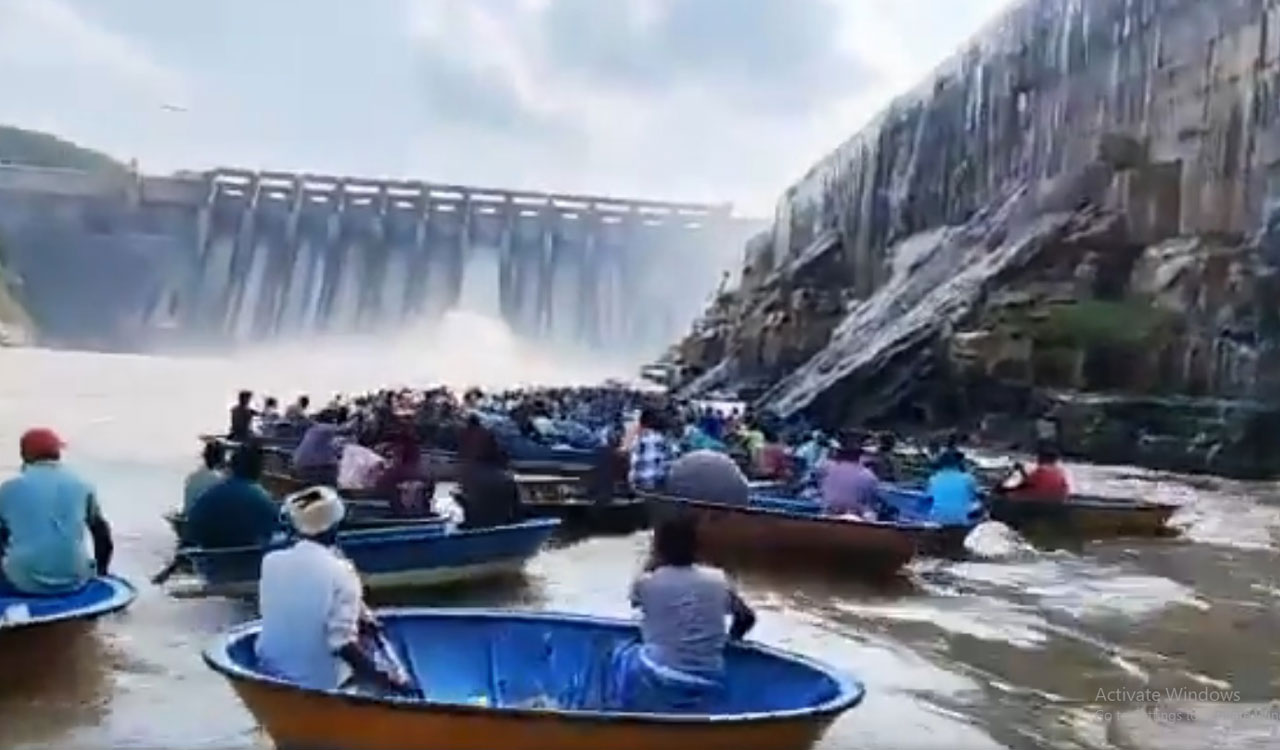
As there was heavy flow downstream since all these days, fishermen were denied permission for fishing. Soon after the last crest gate was closed on Tuesday (Aug. 13), armed with their country boats, many fishermen entered the River Krishna at Lingalagattu near the project for fishing. With heavy inflows all these days, fishermen believe that many fish, especially the heavier and bigger ones, which fetch good prices in the market, would get trapped in their nets. https://telanganatoday.com/watch-fishermen-turn-up-in-large-numbers-for-big-catch-near-srisailam-dam (13 Aug. 2024)
Maharashtra Fisherfolks seek compensation for loss due to Atal Setu The Koli Fishing Community has moved the Bombay High Court seeking compensation for the loss in fish production caused by the Mumbai Trans Harbour Link (MTHL), also known as Atal Bihari Vajpayee Atal Setu. The petition has been filed by Mari Aai Machimar Sahkari Sanstha Maryadit, which represents the Koli fisherfolk community from various villages, including Vashigaon, Juhugaon, Koparkhairane, Ghansoli, Gothivali, Diva, and Belapur. Furthermore, it stated that although the authorities have admitted that compensation ought to be paid, they have failed to provide it. The plea asserts that the fundamental rights under Articles 14, 19, and 21 of the Constitution of India, 1950, as well as the customary easementary rights of the fisherfolk community, are being violated. https://lawbeat.in/news-updates/fisherfolk-community-moves-bombay-high-court-seeking-compensation-loss-caused-due-atal-setu (13 Agu. 2024)
Jammu & Kashmir Rising threats on Trout fish -One of the major challenges confronting trout in Kashmir is illegal riverbed mining in various streams. As part of its habitat, trout likes to pass through gushing streams with boulders and cobble stones. The use of heavy machinery for riverbed mining is spelling doom on trout population and destroying its habitat. The high demand for boulders and sand has led to its illegal extraction by heavy machines like JCBs devastating hydrology of streams and habitat of trout.
-On May 24 this year, over 2500 trout died at a private fish farm at Donkulibagh area of central Kashmir’s Budgam district after water supply to the unit was blocked due to haphazard extraction of stones from a stream.
-In October last year, hundreds of trout were found dead in nallah Sindh at Sumbal Bala due to poisoning by bleaching powder. As this was not enough, increasing pollution levels in streams across Kashmir is slowly killing trout. Increasing footfall of people to eco-fragile areas housing freshwater streams and unscientific disposal of sewage and solid waste is taking a toll on trout and destroying its habitat.
The use of pesticides, insecticides and other chemicals in orchards close to streams is slowly leading to decline in trout population. Construction of hydroelectric projects and dams has already knelt death blow to trout. There is also massive siltation of streams due to deforestation in upper reaches of the valley. Siltation severely affects the habitat of trout and affects its movement downstream. https://www.greaterkashmir.com/opinion/save-kashmirs-trout/ (12 Aug 2024)
Trout habitat threatened in Ganderbal The once-pristine Sindh Nallah, a lifeline of fresh water and home to the famous trout habitat is fast losing its glory due to unchecked pollution. Flowing gracefully through the Ganderbal district, this vital waterway is being marred by relentless garbage dumping, stretching from the Wayil area to the tourist haven of Sonamarg, while the concerned authorities remain indifferent. Sindh Nallah, a major tributary of the River Jhelum, plays an essential role in the region, contributing to irrigation, hydropower generation, and supplying drinking water to Srinagar via the Rangil Water Treatment Plant.
Social activist Raja Parvaiz expressed concern, saying that the growing pollution poses a severe threat to the trout fish population, as the deteriorating water quality could irreversibly damage their habitat. “This environmental neglect is turning the once-pristine Sindh Nallah into a dumping ground,” Parvaiz says. “The authorities need to take immediate action before the situation spirals out of control. The river’s water is already becoming undrinkable, and the pollution is marring the natural beauty of the area.” https://www.greaterkashmir.com/gk-top-news/sindh-nallah-polluted-trout-habitat-threatened-in-ganderbal/ (19 Aug. 2024)
Arunachal Pradesh Fishes dying in Poma river A large number of unnatural deaths of fishes in the Poma river here in Papum Pare district has alarmed the villagers. The residents have reported seeing dead fishes, with ulcer-like red wounds on their bodies, being washed away in the river water over the last month. While the exact cause of the deaths is not known, bacterial infection is suspected to be the cause. https://arunachaltimes.in/index.php/2024/08/19/fishes-dying-in-poma-river/ (19 Aug. 2024)
Chennai Invasive fish species affecting natives in Korattur lake A survey of Korattur lake in Chennai undertaken by a group of native fish enthusiasts and inland fishermen on Sunday (Aug. 18) has found multiple invasive fish species in the waterbody, which they suspect are affecting the natives. Native fish enthusiast Beta Mahatvaraj said: “Invasive fish such as plecos destabilise the eco system in the waterbody. They are burrowers and can excavate the earth.” Due to their armoured plating on themselves and less meat, birds rarely feed on them and they continue to affect the native Indian fish species, he said. They caught plecos, tilapias, Midas cichlids, flowerhorns, Gambusia, among others.
When asked about Gambusia serving the purpose of controlling mosquito larvae, Mr. Mahatvaraj said there were native species such as Indian killifish and Indian ricefish (Oryzias) that could serve the same purpose, as they were surface dwellers too. He has been studying native Indian fishes and one of them has been named after him. S. Sekharan, secretary of Korattur Aeri Padukappu Makkal Iyakkam, said they have been proposing to declare the waterbody a bird sanctuary, as multiple bird species visited. They moved the NGT and obtained a stay on industrial effluents being let into the waterbody. Pointing out there were seven villages near the lake with over several inland fishermen, Mr. Sekharan said the fishermen too were keen to protect the waterbody. https://www.thehindu.com/news/national/tamil-nadu/invasive-fish-species-affecting-natives-in-korattur-lake/article68539578.ece (19 Aug. 2024)
SAND MINING
Odisha NGT bans mining of minor minerals in Mayurbhanj The NGT has imposed an indefinite ban on mining of minor minerals in Mayurbhanj due to the lack of a final district survey report (DSR). The dispute centres round the contention that the final DSR is mandatory before granting of any mining lease or issuing of tender and in its absence, the auction notice dated June 20 is not sustainable. It was also alleged that the interim DSR does not address any concerns about ecological impact and sustainable sand mining under the Sustainable Sand Mining Guidelines, 2016, and Enforcement and Monitoring Guidelines for Sand Mining, 2020. While granting three weeks to the state govt to file a counter affidavit, the bench adjourned the matter to Oct 3. https://timesofindia.indiatimes.com/city/cuttack/ngt-bans-mining-of-minor-minerals-in-mayurbhanj-district/articleshow/112507838.cms (14 Oct. 2024)
Himachal Pradesh Govt amends mining rules The cabinet presided by CM Sukhvinder Singh Sukhu during its meeting on Thursday (Aug. 08) decided to amend the Himachal Pradesh Minor Minerals (Concession) and Minerals (Prevention of Illegal Mining, Transportation and Storage) Rules, 2015. Under the new provisions, suitable private lands available for mining in the state could be put to auction for the extraction of minerals with the consent of the land owners. Also, as per the new rules, 80% of this annual bid amount will be offered to the land owners.
The cabinet also allowed the use of machinery for mineral excavations. The depth of riverbed mining has been enhanced from one metre to two metre. “A provision has been made to allow the removal of sand and gravel from agriculture fields up to the depth of two metres after every monsoon season, however, it will be treated as a non-mining activity,” said the govt in a statement. https://timesofindia.indiatimes.com/city/shimla/himachal-pradesh-cabinet-approves-mining-on-private-land-and-increases-riverbed-mining-depth/articleshow/112388932.cms (9 Aug 2024)
छत्तीसगढ़ बस्तर के पत्रकारों की आंध्र प्रदेश में गिरफ़्तारी पर आक्रोश दक्षिण बस्तर पत्रकार संघ के अध्यक्ष बप्पी राय, धर्मेंद्र सिंह, मनीष सिंह और निशु त्रिवेदी की गिरफ़्तारी दस अगस्त को हुई थी, जब उनकी गाड़ी में गांजा पाया गया था. छत्तीसगढ़ के पत्रकारों का कहना है कि सुकमा के कुछ भाजपा नेताओं ने उन पर झूठा आरोप लगाकर उन्हें फंसाया है. इन पत्रकारों ने सत्रह अगस्त को सुकमा के कोंटा क्षेत्र में धरना दिया और इन चारों की तत्काल रिहाई की मांग की.
गौरतलब है कि इस प्रकरण में कोंटा के थाना प्रभारी अजय सोनकर की तस्करों से कथित संलिप्तता सामने आई है. सोनकर पर चारों पत्रकारों की बेगुनाही का प्रमाण मिटाने का भी आरोप है. सुकमा एसपी किरण चव्हाण ने सोनकर को तत्काल निलंबित कर दिया है. इस मामले में कोंटा के भाजपा ज़िला उपाध्यक्ष पी. विजय का भी नाम आया है. पी. विजय इलाके की कद्दावर हस्ती हैं. सुकमा के पत्रकार संघ ने प्रदेश भाजपा अध्यक्ष को एक ज्ञापन सौंपा है, जिसमें पी. विजय के खिलाफ जांच की मांग की गई है.
नौ अगस्त को बप्पी राय ने पत्रकारों के वॉट्सऐप ग्रुप में वीडियो साझा किया था जिसके अनुसार उन्हें खबर मिली थी कि दक्षिण बस्तर के कोंटा से आंध्र प्रदेश के कुछ इलाकों में रेत की तस्करी की जा रही है. वाहनों को बड़ी आसानी से बॉर्डर पार करा दिया जाता है. पत्रकारों को ख़बर मिली थी कि ये तस्कर भाजपा से जुड़े हैं. इस ख़बर की तलाश में दंतेवाड़ा से बप्पी राय और निशु त्रिवेदी, सुकमा से धर्मेंद्र सिंह और मनीष सिंह कोंटा गए थे. कोंटा पहुंचकर इन्होंने अपने साथी पत्रकारों को बताया था कि उन्होंने तस्करी करते हुए कुछ गाड़ियों को देखा था. वे कैमरे में वाहनों की वीडियो रिकॉर्ड कर रहे थे कि तस्करों ने अजय सोनकर को मौके पर बुला लिया. अजय सोनकर पहुंचे, उन्होंने पत्रकारों के साथ गाली-गलौज की और उन्हें थाने ले जाने की धमकी दी. https://thewirehindi.com/282667/chhattisgarh-journalist-arrested-in-andhra-pradesh/ (19 Aug. 2024)
WETLANDS, LAKES, WATER BODIES
3 more wetlands get Ramsar tag Ahead of the 78th Independence Day, India has added three new Ramsar sites to its network, bringing the total to 85 Ramsar sites across the country. The total area under these sites now stands at an impressive 1,358,068 hectares. The new additions include two sites in Tamil Nadu viz Nanjarayan Bird Sanctuary (125. 865 Hectares) and Kazhuveli Bird Sanctuary (5151.6 Hectares), both of which are vital for bird conservation and biodiversity. Additionally, Madhya Pradesh has joined the ranks with the inclusion of Tawa Reservoir (20050 Hectares), a crucial wetland for supporting local wildlife.
Nanjarayan Bird Sanctuary: This is a large shallow wetland located in the northeastern region of Uthukuli Taluk, Tiruppur District, Tamil Nadu. Situated about 10 km north of Tiruppur city along the Tiruppur-Uthukkuli main road, the lake spans 125.865 hectares and lies between the villages of Sarkar Periyapalayam and Neruperichal. It was historically restored by King Nanjarayan, from whom it derives its name. The sanctuary supports a rich biodiversity, with 191 bird species, 87 butterfly species, 7 amphibians, 21 reptiles, 11 small mammals, and 77 plant species recorded. Further, it serves as a crucial feeding and nesting ground for resident and migratory birds and is a vital water source for local agriculture.
Kazhuveli Bird Sanctuary: Covering 5,151.6 ha, this was designated as Tamil Nadu’s 16th bird sanctuary in 2021. Located on the Coromandel Coast in Villupuram District, north of Pondicherry, this brackish shallow lake connects to the Bay of Bengal via the Uppukalli Creek and Edayanthittu Estuary. It is one of the largest wetlands in peninsular India, with diverse water features including estuarine brackish water, sea-fed Uppukalli Creek, and fresh water in the Kazhuveli Basin. Situated along the Central Asian Flyway, it serves as a critical stopover for migratory birds, a breeding ground for resident species and fish, & a major aquifer recharge source.
The Tawa Reservoir: It located at the confluence of the Tawa and Denwa rivers near Itarsi in Madya Pradesh, serves primarily for irrigation, but also for power generation and aquaculture. The reservoir covers 20,050 hectares with a catchment area of 598,290 hectares. Originating from the Mahadeo Hills in Chhindwara, the Tawa River is a major left bank tributary of the Narmada River, flowing through Betul and Narmadapuram districts. Administered by the Forest Department of Narmadapuram, the reservoir lies within the Satpura Tiger Reserve, forming the western boundary of Satpura National Park and Bori Wildlife Sanctuary. It supports diverse aquatic flora and fauna, including many rare and endangered species, and is a crucial habitat for local and migratory birds. The area is the largest protected zone in Madhya Pradesh and is notable for its ecological, archaeological, historical, and forestry significance. https://pib.gov.in/PressNoteDetails.aspx?NoteId=152029&ModuleId=3 (14 Aug. 2024)
Tamil Nadu has highest 18 Ramsar sites With two more wetlands being added to the Ramsar list, Tamil Nadu leads in the network of protected areas in India with the total number now at 18. Kazhuveli bird sanctuary in Villupuram and Nanjarayan bird sanctuary in Tiruppur are the latest additions to the list. The state government had sent proposals seeking Ramsar recognition for Kazhuveli and Nanjarayan, which were accepted by the Union environment ministry and Ramsar secretariat on the Independence Day eve.
These two sanctuaries, with a combined area of 5,277 ha, lie in the Central Asian Flyway and are vital breeding and foraging grounds for water bird species. The sites are home to over 750 species of flora and fauna and near-threatened bird species like Spot-billed Pelican, Black-headed Ibis and Oriental Darter. https://www.newindianexpress.com/states/tamil-nadu/2024/Aug/15/two-more-wetlands-added-tamil-nadu-tops-ramsar-list-with-a-total-of-18-sites (15 Aug. 2024)
Opinion Ramsar sites rise, wetlands care fall The government has done well in floating the Indian wetlands website to update the water bodies. This remains more of a statistics site than anything else. But so far so good. Now, we know that of the 2.5 lakh major wetlands, just 1,304 are notified. That means only these 1,304 wetlands are notified and hence eligible for protection. Consider this pathetic situation in the backdrop of the official definition of wetlands. As per the ISRO Atlas, Wetlands are submerged or water-saturated lands, natural or man-made, inland or coastal, permanent or temporary, static or flowing, vegetated or non-vegetated, which necessarily has a land-water interface. (BN Kumar) https://www.freepressjournal.in/mumbai/green-paradox-ramsar-sites-rise-wetland-care-falls (16 Aug. 2024)
Assam Fishers dependent on Deepor beel loss livelihoods While the fishing community wants their rights within Deepor Beel to be defined, they said this should not be at the cost of denotifying the wetland as a wildlife sanctuary. The fishing community said members were aware their livelihood rights remain protected under the Wildlife Protection Act. According to Section 26 A of the Act, the limits of the area of a water body to be included within the sanctuary will be determined in consultation with the chief naval hydrographer, “after taking adequate measures to protect the occupational interests of the local fishermen”.
-In fact, the fishermen often end up cleaning the wetland. They see large quantities of plastic floating on the wetland when they are fishing, and try to collect the plastic, said Golak Das. Also, the fishermen still use traditional wooden boats, not motorboats. According to Seema Talukdar of 7Weaves, more comprehensive studies need to be done on the fishing community of Deepor Beel. “Their fishing is based on their traditional knowledge which they have acquired by living in the vicinity of the beel for ages—they do not use any modern technologies—and yet their techniques are scientific enough,” Talukdar said.
The president of the Deeporbeel Paaspara Samabay Samiti, also named Golak Das, said, “What will the tourists come here for? When there aren’t enough birds and fishes like before, when the water is so dirty…what will they see?” Before attempting to turn the area into a tourist spot, authorities should instead clean the waterbody and stop all further pollution, he said. https://article-14.com/post/as-assam-s-only-wetland-protected-under-global-treaty-deteriorates-local-fishing-community-faces-loss-of-livelihood-66bc2476cfc17 (14 Aug. 2024)
WATER OPTIONS
Arunachal Pradesh How Ziro thrives with limited water resources Ziro, often admired for its natural beauty and unique agricultural practices, faces a challenge that many might not be aware of: the town has limited water resources. However, despite this, the people of Ziro have found innovative ways to manage their farming and daily water needs. Siikhee Lake, an artificial lake, now plays a crucial role in the town’s water supply.
Originally, the area where Siikhee Lake now exists was used as farmland by local villagers. Recognising the need for a sustainable water source, particularly for farming and drinking, the community decided to transform the farmland into a lake. This transformation was essential to ensure a steady water supply for the future. The project to create Siikhee Lake began around the year 2000 when the local community started digging a large pit in the middle of their fields to form a reservoir. The lake was finally completed and officially opened in 2019. Those who initially owned the farmland are now members of a society that manages the lake. This society, consisting of about 200 members, holds annual meetings to discuss the upkeep of the lake, fish harvesting schedules, and other essential matters. https://arunachaltimes.in/index.php/2024/08/13/how-ziro-thrives-with-limited-water-resources/ (13 Aug. 2024)
Report Trust, cost go greater depths to sustain unscientific water divining practice Popular among residents of hard rock terrains, the traditional practice of water divining is believed to locate groundwater without relying on scientific instruments or techniques. Water diviners are sustained by people’s steadfast faith in the practice and its accessibility, in contrast to scientific methods that often involve lengthy processes and significant costs. A modernised variant, “scientific” divining incorporates machinery and technology, such as electrical resistivity metres, but scientists say these methods are ineffective, warning of the potential risks of over-extraction of groundwater. https://india.mongabay.com/2024/08/trust-cost-go-greater-depths-to-sustain-unscientific-water-divining-practice/ (12 Aug. 2024)
URBAN LAKES, WETLANDS
Delhi Budhela residents demand restoration of pond Documents from Delhi Parks and Gardens Society indicate that four ponds were originally listed in Budhela village, including the johar in question. Revenue records also confirm the land’s designation as GM johar (gram johar or village pond) with khasra number 22/14(4-8).
-According to the Wetland Authority’s records, the pond covered 0.6 hectares. In August 2021, the Wetland Authority included the pond in a list of 1,040 waterbodies identified and assigned unique identification numbers. Locals say their calls for the pond’s revival have fallen on deaf ears as the authorities continue constructing the complex. “A new building will only add to the congestion prevalent in our area. It would be better if they just restored the land to its original status as a pond,” said another resident. No response was received from the Sahitya Kala Parishad or the DDA on queries regarding the matter. https://www.newindianexpress.com/cities/delhi/2024/Aug/13/delhi-residents-demand-restoration-of-pond-as-cultural-complex-rises-on-contested-land (13 Aug. 2024)
Waterbodies only on paper The Delhi high court directed the government to carry an on-ground assessment of the water bodies, following which an exercise was kicked off in the same month by the Delhi revenue department and Delhi State Wetland Authority (DSWA).

They have, so far, assessed 1,291 of these water bodies, out of which only 656 were found, and the remaining 635 do not exist other than in maps and records. https://www.hindustantimes.com/cities/delhi-news/half-of-delhi-s-water-bodies-remain-only-on-paper-shows-revenue-dept-survey-101723484644118.html (13 Aug. 2024)
Hyderabad HYDRA continues demolition drive to save lakes Continuing its crackdown on illegal structures to save water bodies in and around Hyderabad, Hyderabad Disaster Response and Assets Monitoring and Protection Agency (HYDRA), on Sunday (Aug. 18), demolished unauthorised constructions near Gandipet reservoir on the outskirts of the city. HYDRA personnel deployed bulldozers to pull down the structures at Khanapur in the Full Tank Level (FTL) of the reservoir across Musi River in Rangareddy district.
The newly-created body headed by the IPS officer has taken up the demolition of illegal structures at various places in and around the city to save lakes. On August 10, HYDRA demolished illegal structures on heritage lake Bum-Rukn-Ud-Dowla in Shastripuram. Several buildings had come up in the Full Tank Level (FTL) of the 18th-century lake and the heritage and environment activists have long been demanding action to save the lake. HYDRA recovered over 10 acres of land related to Bum-Rukn-ud-Dowla Lake FTL. It earlier demolished 52 illegal structures in the FTL of another water body in Devender Nagar.
Ranganath had said that HYDRA which has been allocated a budget of Rs 200 crore by the state government, will soon be setting up a police station to speed up cases relating to encroachments. Recently, the National Remote Sensing Centre (NRSC) revealed that the extent of lakes in Hyderabad reduced by 61% between 1979 and 2024. https://www.ap7am.com/en/84868/hydra-continues-demolition-drive-to-save-hyderabad-lakes (18 Aug. 2024)
HYDRA warns against encroachments of Lake land Encroachers should now be fearful of constructing illegal buildings or developing layouts in FTL or buffer zones of lakes, or any other government-owned assets, warned A.V. Ranganath, the commissioner of the newly-created HYDRA. Unveiling HYDRA’s future course of action, the officer said that the state government has decided to deal with land grabbers by establishing exclusive police stations within its jurisdiction. In the first stage, HYDRA plans to demolish all under-construction structures within the FTL and buffer zones of lakes and water bodies. In the second stage, HYDRA will take action against already occupied illegal structures by serving notices and initiating legal proceedings. The third stage will focus on the revival of lakes and water bodies. As part of the asset protection process, the state government has also decided to file criminal cases against government officials who approved building permits and layout permissions in the FTL and buffer zones of lakes, in addition to taking action against the builders. https://www.deccanchronicle.com/southern-states/telangana-hydra-warns-against-encroachments-of-lake-land-1815918 (12 Aug. 2024)
Mumbai The houses built by the CIDCO under PM’s Awas Yojana (PMAY) in Navi Mumbai have violated the environmental conditions and mangrove buffer zones, Green groups have complained to the PM Narendra Modi. The PMAY projects, particularly in Mansarovar and Kharghar, areas have come up in proximity of mangroves, mudflats and inter-tidal wetlands, the complaint filed by NatConnect Foundation on PMO Public Grievance website, said. The status report on the website says the complaint has been referred to the Director in the MoEF&CC Arvind Kumar Agrawal. NatConnect attached the recent Google Earth picture and actual ground photographs to fortify its case. https://www.freepressjournal.in/mumbai/navi-mumbai-houses-under-pm-awas-yojana-built-on-mangrove-zones-greens-complain-to-pm-modi (16 Aug. 2024)
Pune PMC to develop floating wetlands to rid of pollutants The Pune Municipal Corporation (PMC) is working to develop ‘floating wetlands’ or ‘florafts’ on the lines of the Thane Municipal Corporation (TMC) to clean polluted lakes in the city. Bangalore-based company, JMS Biotech Pvt Ltd, led a presentation on floating wetlands in the PMC environment department on Tuesday. The TMC in 2015 had developed florafts under the guidance of the National Environmental Engineering Research Institute (NEERI). The florafts involved planting in rafts certain plant varieties that help fight pollution. https://www.hindustantimes.com/cities/pune-news/pmc-to-develop-floating-wetlands-to-rid-lakes-of-pollutants-101723832266574.html (17 Aug. 2024)
URBAN WATER
Hyderabad 4 officials suspended for Sunkishala lapse The municipal administration & urban development (MA&UD) dept has suspended four engineers from the Hyderabad Metropolitan Water Supply and Sewerage Board (HMWS&SB) and transferred director D. Sudarshan following the collapse of the gate and side wall at the intake well and pumping station in Sunkishala. A senior officer committee was formed to investigate the incident, which revealed technical lapses among project officers. https://www.deccanchronicle.com/southern-states/telangana/hyderabad-4-hmwssb-officials-suspended-for-sunkishala-lapse-1816522 (15 Aug 2024)
Delhi DPCC fines school ₹ 1 lakh for drilling 12 borewells DPCC has reported to the NGT that it has levied an environmental compensation of Rs 1 lakh on a private school in Anand Vihar, east Delhi, for illegally extracting groundwater. DPCC also mandated the school to install a rainwater harvesting system to help replenish the area’s groundwater table. The tribunal passed an order on July 25, 2022, in response to a plea by resident Amit Sharma, who alleged that the school had violated environmental norms by digging 12 borewells and installing a commercial RO system. https://timesofindia.indiatimes.com/city/delhi/dpcc-fines-e-delhi-school-1-rs-lakh-for-drilling-borewells-to-extract-groundwater/articleshow/112556351.cms (16 Aug. 2024)
Gurugram Keeping waste out of landfill I Am Gurgaon is a reputed citizens’ initiative to green the concrete jungle of Gurugram. Its success in converting a large stretch of barren land into the lush Aravali Biodiversity Park is well known. The group has set up three waste recycling units located at Samadhaan Hub, Badshahpur Forest Corridor and Creek 56.
On any given day, residents can bring their dry waste to any of these centres. Set up in partnership with the Municipal Corporation of Gurgaon (MCG), the Hub is where corporates, RWAs, citizens, schools can drop off segregated, clean and dry wastepaper, plastic, e-waste, metal, glass, clothes, expired and unexpired medicines, and medical equipment. https://www.civilsocietyonline.com/cities/keeping-waste-out-of-landfills-in-gurgaon/ (12 Aug. 2024)
WATER
Documentary In search of water In Satara district of Maharashtra, a film on the acute water crisis.
Travelling across Mann in Satara district, the search for water documents the stories of people reeling under an acute water crisis and those who supply water to them. https://ruralindiaonline.org/en/articles/the-search-for-water/ (13 Aug. 2024)
Jharkhand HC raps govt over supply of potable water in Pakur The high court on Aug 16, in response to a PIL pulled up the state govt for failing to provide potable drinking water to the residents of ward 1 to 6 of Pakur. A division bench of acting chief justice Sujit Narayan Prasad and justice Arun Kumar Rai ordered the govt to ensure an alternate mode for supply of water to the residents in the district.
Additional advocate general Ashutosh Anand told the court, “More deep bore wells will also be made after ascertaining the supply of water,” the counsel said. Anand also said that talks are also in the final stage with the West Bengal govt for sharing some water from the neighbouring Farakka dam. The court ordered the govt to file an affidavit in the matter and inform the developments of the meeting with the Bengal govt on water sharing. The case will again be heard after a fortnight. https://timesofindia.indiatimes.com/city/ranchi/jharkhand-high-court-criticizes-state-over-water-supply-in-pakur/articleshow/112578614.cms (17 Aug. 2024)
WHO 4.4 bl people lack access to clean potable water Out of the roughly 8 billion people on Earth, more than 4.4 billion lack access to safely managed drinking water, researchers report August 15 in Science. The estimate, based on computer simulations of data from low- and middle-income countries, is more than double the figure calculated by the World Health Organization. https://www.sciencenews.org/article/four-billion-lack-access-clean-water (16 Aug. 2024)
AGRICULTURE
Punjab Farmers plough back cotton crop, go for paddy Apprehensive of poor returns from cotton due to whitefly and pink bollworm attack, farmers in Punjab have started ploughing back cotton crop in their fields, opting for a safer late-maturing paddy variety that allows them an assured income. In the past week, there have been instances of farmers in Bathinda, Mansa and Fazilka, ploughing the cotton crop back in the fields, and then using the fields for transplantation of PR 126 variety of paddy. https://www.tribuneindia.com/news/punjab/fearing-losses-farmers-plough-back-cotton-crop-go-for-paddy/ (13 Aug. 2024)
Report Healthy soils produce symphony of sounds In the Frontiers of Restoration Ecology Lab in the College of Science and Engineering at Flinders University, Dr. Jake Robinson and his team are tuning into the symphony of the underground.
As a microbial ecologist, Dr. Robinson seeks to explore the diverse living species hidden beneath our feet, comprising an astounding 60% of life on Earth. A grave concern around the globe, about 75% of the world’s soils are currently degraded. The treasure trove of living species under the ground stands in the face of a bleak future unless substantial restoration efforts are made. “Restoring and monitoring soil biodiversity has never been more important,” said Dr. Robinson. By employing “eco-acoustics,” a budding research area, scientists are exploring new ways to detect and monitor soil biodiversity. This innovative technique has already found application in Australian bushland and various ecosystems in the UK. Echoing Sherlock Holmes, they’re listening for the “sounds of the underground” for clues about soil health.
This auditory exploration involves comparing live recordings from pristine vegetation with those from degraded plots and land that was revegetated 15 years ago. The acoustic complexity and diversity are significantly higher in the latter, showing that these soil symphonies can be clear indicators of soil biodiversity. “The acoustic complexity and diversity are also significantly associated with soil invertebrate abundance and richness,” noted Dr. Robinson. The rustles, pops, and clicks are the languages of earthworms, beetles, ants, spiders, and more, each contributing to the unique soundtrack of the soil.“All living organisms produce sounds, and our preliminary results suggest different soil organisms make different sound profiles depending on their activity, shape, appendages, and size,” said Dr. Robinson.https://www.earth.com/news/healthy-soils-produce-a-symphony-of-sounds/ (17 Aug. 2024)
MONSOON 2024

28% excess rains in 2 weeks of Aug In August, there is 55.7% excess rain over northwest India; 46.8% excess over east and northeast India; 13.1% excess over central India and 2.7% excess over the southern peninsula. July saw 9% excess rain while June recorded a 11% deficiency. Experts attributed the excess rain to multiple weather systems running concurrently. https://www.hindustantimes.com/india-news/after-june-deficit-august-logs-28-excess-rainfall-within-2-weeks-101723487170210.html (13 Aug. 2024)
Mumbai IMD forecasts wrong by 42% in July When Mumbai woke up on July 8, it was taken by surprise – large parts of the city were inundated in the 200 mm overnight rains. But nothing about the IMD’s prediction, issued the previous day, had prepared the city for the downpour. The agency had issued a yellow alert, which meant the city was expected to receive up to 115 mm of rainfall in 24 hours. But the metropolis ended up getting 267 mm rain in the period.
This wasn’t a rare miss by the IMD. Data reviewed by The Indian Express shows that the agency, despite being equipped with some of the most advanced instruments, issued inaccurate district forecasts for Mumbai on at least 13 days in July, of which, on eight days, the forecast warnings were off by more than 25 per cent.
On July 24-25, the rains caught Mumbai, and the IMD, unawares once again. This time, on July 24, the IMD had issued a yellow alert (heavy rainfall, 64.5-115.5 mm) for the following day. But that day, July 25, going by the heavy rainfall in some parts, the IMD upgraded the alert for the day from yellow to red (extremely heavy, above 200 mm). But by then, the rains had receded. In July, the IMD’s forecasts for the city were off nearly 42 per cent. Besides this, data showed that on at least four days in July, the IMD had changed its forecast and warnings twice within a 24-hour window. https://indianexpress.com/article/cities/mumbai/imd-rain-forecasts-for-mumbai-wrong-by-42-in-july-what-explains-these-extreme-misses-9519965/ (18 Aug. 2024)
Report Declining rainfall over the Indo-Gangetic Plains Deficient rainfall in the northern plains of India is a concern not limited to this year’s monsoon season alone. In the past decade or so, there has been a clear trend of declining rainfall over the Indo-Gangetic belt. A recent study by the Council on Energy, Environment and Water (CEEW), an independent think tank, analysed southwest monsoon rainfall data for the past 40 years and reported that 11% of tehsils (out of the total 4,419 tehsils studied) witnessed a decrease in rainfall, particularly in the past decade of 2012-2022. https://india.mongabay.com/2024/08/deficient-monsoon-rainfall-in-the-indo-gangetic-plains-hits-paddy-farmers-worse-to-come-warn-climate-scientists/ (27 Aug. 2024)
QoC Changing monsoon patterns demand shifting gears in preparedness There is empirical evidence to show that changes in the monsoon or heavier rainfall is not merely our imagination. The tehsil-level study by the Council on Energy, Environment and Water maps, like never before, the many changes across India. As many as 55 percent of all tehsils saw an increase in the June-September southwest monsoon in the last decade including previously dry areas of Gujarat and Rajasthan, and cities such as Mumbai, Pune and Mangalore. This and other findings must, urgently, inform climate action plans and flood preparedness in states and cities. https://questionofcities.org/indias-changing-monsoon-patterns-demand-shifting-gears-in-preparedness/ (9 Aug 2024)
Report India lost 33.9 ml ha of crops due to excess rains in 2015-21 India lost 33.9 million hectares of crops due to excess rains and an additional 35 million hectares due to drought between 2015 and 2021, a World Economic Forum (WEF) report has said. The impact of extreme climate events in India touches on nearly every aspect of its economy and society, but is more pronounced in particularly exposed sectors such as agriculture, which comprises 15 per cent of India’s GDP and employs around 40 per cent of its population – 70 per cent among its rural households, it said.
The report “Income Protection and Early Warning Systems: How India is Building Climate Resilience” said India risks losing ground due to heightened exposure to climate perils including heat waves, floods and earthquakes. Several Indian sectors including agriculture suffered $159 billion in economic losses in 2021 due to lost working hours from extreme climate impacts. “By 2030, India is projected to see a substantial 5.8 per cent decline in working hours – equivalent to 34 million full-time jobs – due to heat stress,” it said. However, a growing insurance coverage gap is preventing many of these people from protecting their livelihoods from extreme weather events and climate change, said the WEF. https://www.thehindubusinessline.com/economy/agri-business/india-lost-339-million-hectares-of-crops-due-to-excess-rains-says-wef-report/article68530030.ece (16 Aug 2024)
FLOOD 2024
Karnataka Release dam water to lakes, to free up space for rainwater: CM Siddaramaiah on Friday (Aug. 16) reviewed the flood situation across the state owing to heavy rain and suggested that steps should be taken to release water to lakes and tanks from reservoirs. This will leave reservoirs with space for more water if the rain continues. “Since all reservoirs in the state have filled up up to 89% of their storage capacity, based on the rain forecast, appropriate amount of water should be released to lakes in advance to prevent the sudden accumulation of water in the reservoirs and causing floods,” CM said while chairing a meeting with officials to discuss precautionary measures and preparedness. https://www.newindianexpress.com/states/karnataka/2024/Aug/17/karnataka-cm-release-dam-water-to-lakes-to-free-up-space-for-rainwater (17 Aug. 2024)
Release water from dams in case of heavy rains: Minister Ahead of heavy rain predicted in the next couple of days, Revenue Minister Krishna Byregowda has directed deputy commissioners to gear up to tackle floods and rain. He also directed them to release water from dams for now. “When it rains, inflow will increase and along with the released water and rain, low-lying areas will suffer,’’ he said.
Compared to the previous year, crop damage and human loss are lower this year. Byregowda explained that in 2019, 67 rain-related deaths were recorded, while in 2022, it was 75. This year, 58 lives have been lost so far. In terms of agriculture loss, in 2020, 2.21 lakh hectares of land saw damage; in 2021, 2.12 lakh hectares; and in 2022, 1.53 lakh hectares. This year, 80,000 hectares have seen damage. He said they would be able to estimate the quantum of loss in a week. https://www.newindianexpress.com/states/karnataka/2024/Aug/13/karnataka-revenue-minister-byregowda-alerts-water-department-to-release-water-in-case-of-heavy-rain (13 Aug. 2024)
“During heavy rains, rivers tend to overflow, and if water is released from dams simultaneously, it could lead to flooding, causing distress to people. Therefore, instructions have been given to regulate the release of water from reservoirs before they reach full capacity, to control floods. The district collectors have also been instructed to identify and evacuate people from dilapidated schools and houses at risk of landslides and move them to safety centers,” Gowda said. https://indianexpress.com/article/cities/bangalore/rain-related-deaths-karnataka-minister-krishna-byre-gowda-9511551/ (13 Aug. 2024)
Sardar Sarovar Dam flood level increase threatens submergence of many villages by E A S Sarma: Sardar Sarovar flood level increase threatens submergence of many villages- Appeal to the authorities not to repeat the deliberate neglect of human values as it happened in September last year. https://countercurrents.org/2024/08/sardar-sarovar-flood-level-increase-threatens-submergence-of-many-villages/ (14 Aug. 2024)
Madhya Pradesh -मुरैना जिले में टोंगा गांव के लोग इस सोच में डूबे हुए हैं कि न जाने अब आगे क्या होगा… फसल तो खराब हो ही चुकी है, क्या घर भी छोड़ना पड़ेगा? कहां जाएंगे, कैसे गुजारा करेंगे..यह दहशत यहां रिजर्व डैम के फूटने के बाद पसरी है।
डैम से पानी लगातार बह रहा है। 24 घंटे पहले जो दरार 15 इंच की थी, वो बढ़कर 20 फीट हो गई है। इसकी चौड़ाई बढ़ती जा रही है। चार गांव डूब चुके हैं, 20 गांवों में खतरा मंडरा रहा है। 12 गांवों में 400 बीघा से ज्यादा खेतों में खड़ी फसलें नष्ट हो चुकीं हैं। ग्रामीणों का दावा है कि करीब 30 लाख रुपए की बाजरा की फसल खराब हुई है। https://www.amarujala.com/photo-gallery/madhya-pradesh/morena/morena-crack-in-tonga-dam-of-morena-is-continuously-increasing-four-villages-have-drowned-2024-08-14 (14 Aug. 2024)
Bihar Flood wreak havoc in Bhagalpur The floods caused by the swollen Ganga and Kosi rivers have wreaked havoc in Bhagalpur district, displacing thousands from their villages in the diara areas. At least nine blocks have been affected, both south and north of the Ganga, in the district. The severity of the situation has prompted the lifting of gates at the Farakka barrage in West Bengal, releasing 10.50 lakh cusecs of water. This discharge is expected to lower the Ganga’s water level, but the flood situation remains dire in Patna district’s Hathidah area as well as in Munger and Bhagalpur. https://timesofindia.indiatimes.com/city/patna/floods-wreak-havoc-in-bhagalpur-displacing-thousands/articleshow/112480102.cms (13 Aug. 2024)
Uttar Pradesh Arvind Shukla reports about how Ghagra river floods are destroying lives, houses and farms in Barabanki district.
https://www.youtube.com/watch?v=baq_bqbIsTw (15 Aug. 2024)
CWC Flood Watch 2.0 -The earlier version, launched in August 2023, used to provide information on flood forecasts at 200 level forecast stations. The Version 2.0, however, will now provide information at additional 392 flood monitoring stations. https://timesofindia.indiatimes.com/india/centre-launches-upgraded-floodwatch-india-app-for-real-time-flood-forecasts/articleshow/112500907.cms (13 Aug. 2024)
URBAN FLOODS
Chennai Core city stares at flood threat Many of the city’s core areas face a flood threat this monsoon as 30 major storm water drain outfalls, including those into Buckingham Canal and Mambalam Canal, are blocked due to ongoing metro rail construction. On Wednesday (Aug. 07), Greater Chennai Corporation (GCC) set up a five-member expert committee to study the outfalls, assess damaged drains, and propose solutions before the monsoon sets in by mid-October.
The committee, which has members from the Commissionerate of Revenue Administration, IIT Madras, GCC, CMRL and TNRDC, will begin field inspections soon. It aims to find temporary solutions till CMRL completes work by 2026, and then propose permanent measures. IIT-Madras civil engineering professor Balaji Narasimhan, a committee member, said “There are multiple drains with lateral connectivity, and some storm water drains are broken due to metro work. We will begin inspections to find the best solutions.” https://timesofindia.indiatimes.com/city/chennai/chennai-flood-threat-due-to-metro-construction/articleshow/112358486.cms (08 Aug. 2024)
Gurugram ₹429 cr spent in 8 years to address water logging Since the Gurujam of 2016 – a traffic jam so long (20 hours, to be exact) that it got its own name – MCG has spent almost Rs 429 crore to clean up and construct drains in the city. And yet, heavy monsoon rainfall on Sunday (Aug. 11) paralysed large parts of the city once again. Colonies turned into islands, cut off from link roads, societies were flooded and arterial stretches inundated. The upscale Golf Course Road, Narsinghpur along Delhi-Gurgaon Expressway, Rajiv Chowk, and residential colonies Sushant Lok-2, 3, Greenwood City, Mayfield Garden were among the areas under water. All taxpayer money spent on repair and maintenance of the existing stormwater channels, or construction of new drains was washed away, residents said on Monday (Aug. 12). https://timesofindia.indiatimes.com/city/gurgaon/down-the-drain-rs-429-crore-in-8-years-roads-still-flood-spots-in-gurgaon/articleshow/112480669.cms (13 Aug. 2024)
-Even though Gurugram has spent over Rs 100 crore on anti-waterlogging measures in the past three years, it has failed to resolve the perennial problem of urban flooding. The Gurugram Metropolitan Development Authority (GMDA), Municipal Corporation, Municipal Corporation of Manesar (MCM), NHAI and private developers like the DLF have failed to save the city from monsoon mayhem. This, despite the fact that over 50 anti-waterlogging planning meetings and two mock drills have been held since the last monsoon. https://www.tribuneindia.com/news/haryana/drowning-in-gurugram-100-crore-spent-in-3-years/ (13 Aug. 2024)
-The natural storm water drains used to be wide and carried water through their natural contours but presently these drains across the city have been either encroached, or land along these drains have been sold and construction carried out. These drains have also be concretised and boxed as a result of which water does not seep into the ground. Also these drains suffer from waste and illegal sewage being pushed into these channels, which leads to spilling of water into drains. Experts said that large-scale construction has led to extensive concretisation of land in Gurugram, exacerbating the waterlogging issue. https://www.hindustantimes.com/cities/gurugram-news/crores-spent-but-unfinished-drainage-projects-leave-gurugram-vulnerable-in-monsoon-101723485663695.html (13 Aug. 2024)
Another problem, according to experts as well as residents, is that authorities outsource the desilting of drains to private contractors, but there is hardly any check on their work. A majority of contractors who are awarded work orders for maintenance and development of stormwater drains and sewerage lines have links to politicians, a former town planner who worked with the Haryana govt pointed out. As a result, the quality of drainage infrastructure in the city is compromised, the former official said.
“The contractors who execute work on the ground don’t do their job properly. Sometimes, a drain is not linked to the master drain at all. At other times, they carry out only 20% of desilting work. Authorities can’t take action against them because of their political connections,” the planner said. Moreover, several contractors have also abandoned their projects midway despite being fined or blacklisted by authorities, resulting in the construction of new drains or desilting being left incomplete. Govt agencies have also failed to execute several projects, including major stormwater drain projects, despite having received administrative approval. https://timesofindia.indiatimes.com/city/gurgaon/rainwreck-why-is-waterlogging-problem-in-gurgaon-so-hard-to-solve/articleshow/112599728.cms (18 Aug. 2024)
Despite having spent over Rs 200 crore on road and highway infrastructure in the past one year, the Millennium City still has over 70 cratered roads and junctions, threatening thousands of lives during rains. Gurugram, which has one of the costliest and elaborate road and expressway infrastructure in Northern India, has a majority of stretches in a shambles. https://www.tribuneindia.com/news/haryana/200-cr-spent-millennium-city-roads-still-riddled-with-craters/ (14 Aug. 2024) NHAI & GMDA blame game over Bajghera underpass flooding https://www.hindustantimes.com/cities/gurugram-news/nhai-gmda-clash-over-bajghera-underpass-flooding-drainage-issues-101723485723719.html (13 Aug. 2024)
Noida No drainage, parks here remain flooded for days after rain Parks in sectors 31, 122, and 52 were flooded last week after heavy rain. Residents complained that despite showers having stopped for a couple of days, the park reamined flooded. They also complained about inadequate drainage, resulting in waterlogging. They are awaiting action from the authorities. According to officials, the authority has assured to take action on the issue. They stated that sump pumps are deployed in several sectors to pump out accumulated rainwater. However, the situation is no different in several sectors including 51, 19, 20, 26 and more. https://timesofindia.indiatimes.com/city/noida/noida-no-drainage-parks-here-remain-flooded-for-days-after-rain/articleshow/112457032.cms (12 Aug. 2024)
Delhi City roads can’t function as ‘makeshift drains’: HC Roads in Delhi can’t function as “makeshift drains,” Delhi High Court has underlined, in a clear disapproval of the failure of civic agencies during the monsoon. In its order handing over the investigation into the deaths of three UPSC aspirants to CBI, HC flagged several instances of 2024 itself where it had to step in due to govt authorities acting in such a “farcical way”. https://timesofindia.indiatimes.com/city/delhi/delhi-high-court-criticizes-civic-agencies-for-using-roads-as-makeshift-drains/articleshow/112272046.cms (05 Aug. 2024)
CLOUD BURSTS
Himachal Pradesh Shrikhand cloudburst disaster -The epicentre of two of the five cloudbursts in Himachal Pradesh that caused the maximum devastation at Nirmand block in Kullu and Samej Khad in Shimla’s Rampur division was the Shrikhand Kailash mountains. The water level in the Samej Khad rivulet rose by 35 to 45 metres and its width expanded from approximately 40 metres to 180 metres after the cloudbursts. The cloudbursts that wreaked havoc at Bagipul in Kullu and Samej Khad in Shimla occurred simultaneously. These were some of the findings of the State Disaster Management Authority’s (SDMA) preliminary assessment of the five cloudbursts – three in Kullu, one in Shimla, and one in Mandi – that occurred between 11.30 pm on July 31 and 1.15 am on August 1. https://indianexpress.com/article/cities/chandigarh/two-cloudbursts-kailash-mansarovar-himachal-9505801/ (10 Aug. 2024)
Jammu & Kashmir Cloudburst in Bandipura A cloudburst in Bandipora district triggered a flash flood on Aug 15 morning. The cloudburst occurred in the Arin area of North Kashmir’s Bandipora, leading to heavy rainfall and widespread flooding, submerging several areas. https://timesofindia.indiatimes.com/city/jammu/cloudburst-triggers-flash-flood-in-jammu-and-kashmirs-bandipora/articleshow/112545663.cms (15 Aug. 2024)
– A man died after a cloudburst hit Damhal Hanjipora area of south Kashmir’s Kulgam district on Thursday, official said. An official told news agency KNO that the cloudburst hit Banward area in DH Pora and soon after a rescue operation was launched. https://www.greaterkashmir.com/kashmir/man-dies-another-injured-as-cloudburst-hits-kulgam-village/ (15 Aug. 2024)
Arunachal Pradesh The restoration of Kurung bridge here in Kurung Kumey district is expected to be completed by next week. The Bailey bridge over the Kurung river had been washed away in the wee hours of 1 July due to incessant heavy rainfall. The bridge was important as it linked district headquarters Koloriang with Sangram, and with adjoining districts. https://arunachaltimes.in/index.php/2024/08/19/restoration-of-kurung-bridge-nears-completion/ (19 Aug. 2024)
LANDSLIDES
Kerala Dam burst effect caused Wayanad landslide Scientists from the National Centre for Earth Science Studies have suggested that following the 570 mm rainfall around the Wayanad landslide location on July 30, a temporary barrage may have been formed from preliminary earth movement. When this dam broke, it created a dam burst effect in the downstream areas washing away three villages. However, the report does not provide any evidence to support this hypothesis. https://www.thehindu.com/news/national/kerala/dam-burst-effect-caused-wayanad-landslide-experts/article68529310.ece (15 Aug. 2024)
What CM has said here is correct that we are still unable to provide precise location and timing of natural disaster and what we have in some general warnings. Need of the day is to convert these general warnings to more precise actionable forecasts. https://www.thehindu.com/news/national/kerala/kerala-chief-minister-pinarayi-vijayan-highlights-challenges-in-disaster-prediction-and-scientific-awareness-during-independence-day-address/article68527962.ece (15 Aug. 2024)

Satellite images show both the source area and the track of the channelised debris flow Dave Petley. https://eos.org/thelandslideblog/planet-labs-wayanad (19 Aug. 2024) Satellite imagery shows how deadly landslides swept through settlements and washed away hundreds of buildings in Wayanad. https://www.reuters.com/graphics/ASIA-WEATHER/INDIA-LANDSLIDE/gdvzmgkenpw/ (16 Aug. 2024)
5 years after ignoring warning, Meppadi struggles for relocation Had the Meppadi panchayat authorities heeded a disaster management report prepared five years ago, which warned that over 900 houses within its limits were at risk of landslides or mud slips, the devastation from the recent landslide might have been significantly reduced. The report, commissioned in 2019 during the tenure of former panchayat president K K Sahad, was prompted by the Puthumala landslide. It identified nine wards as well as Kottatharavayal, as high-risk zones.
The report also emphasized the need for rapid response teams to manage emergencies and highlighted the dangers posed by obstructions in natural water flow. It warned that any development activities undertaken without considering the environmental impact could have catastrophic consequences, citing the Puthumala landslide, which claimed 17 lives, as a grim example.
“The subsequent administration should have acted on it to relocate families from landslide-prone areas. However, the current governing body hasn’t even reviewed the 2019 report or updated it. Just before the Puthumala landslide, we had to evacuate 350 people from the area to a relief camp after a minor landslide. This helped limit casualties to 17 in 2019. In contrast, the current administration merely instructed people to evacuate without providing adequate support,” Sahad said. The lack of follow-through on the 2019 recommendations has contributed to the panchayat’s current struggle to find safe land for relocating families from vulnerable areas. https://timesofindia.indiatimes.com/city/kochi/meppadi-struggles-with-safe-relocation-after-ignoring-warning/articleshow/112615536.cms (19 Aug. 2024)
Maharashtra ‘1,500 landslides in 2021, no lesson learnt’ The Wayanad landslides bring back memories of last year’s landslide in Maharashtra’s Raigad district, on the Sahyadri range of the Western Ghats that straddle down to Kerala. Almost 30 percent of Maharashtra is landslide-prone. The recurring landslides have put the spotlight on the extremely fragile ecology of the Western Ghats in this region too and the urgent need to conserve the ecosystem. Years of neglect and apathy, and the total disregard for nature in the name of development must stop. Wayanad landslides are a wake-up call for Maharashtra too. https://questionofcities.org/maharashtra-had-1500-landslides-in-2021-so-1500-lessons-but-nothing-learnt/ (09 Aug. 2024)
Report Western Ghats reports have an ugly side Recent landslides in Wayanad have again led to demands that we listen to ecologists who recommended Western Ghats Eco-sensitive Zones more than a decade ago. But, is there more to this story than meets the eye? Nitin Sethi. https://www.reporters-collective.in/blog/western-ghats-reports-have-an-ugly-side (16 Aug 2024) The Centre’s expert panel on the Western Ghats is in advanced discussions on the extent of ecologically sensitive areas (ESAs) to be finalised in Gujarat, Maharashtra and Goa, and may recommend separate notifications for these three states first if an agreement is reached soon, rather than waiting for consensus from all six states, The Indian Express has learnt. https://indianexpress.com/article/india/panel-on-western-ghats-maharashtra-goa-gujarat-esas-may-be-notified-first-9516737/ (16 Aug. 2024)
Uttarakhand Rampant mining causes landsinking in Kanda In Bageshwar district, rampant mining has led to a Joshimath-like situation in the Kanda area, where cracks have appeared in homes, temples, fields, and roads. Locals allege that the government is ignoring their plight. Despite the escalating crisis, there have been no visible efforts by the government to address the issue or offer assistance to those affected. Many residents have invested their entire life savings into constructing their homes and are now left in a precarious situation.
A 1,000-year-old Kalika temple is at risk due to nearby mining activities. Cracks have appeared in the temple premises, with locals attributing the damage to a chalk mine just 50 meters away. Many locals are now demanding relocation. The family of Hemchandra Kandpal is among the worst affected by rampant talc mining, which has caused catastrophic cracks in their home. Kandpal blames the mining beneath the hill for the life-threatening damage. https://www.indiatoday.in/india/story/rampant-mining-causes-joshimath-like-crisis-in-uttarakhands-bageshwar-2581839-2024-08-14 (14 Aug. 2024)
Study New landslide hotspots in Himalayas, Western Ghats RMSI has flagged that infrastructural development, deforestation, and vegetation removal apart from climate change, are critical reasons why the frequency of landslides is going up in vulnerable areas. Its analysis indicates that Himachal Pradesh and Uttarakhand have reported a higher number of landslide-related deaths in recent years and that certain Himalayan districts and the Western Ghats have reported a steep increase in landslides, more so since 2006.
Landslides caused over 150 deaths in Himachal Pradesh and around 70 in Uttarakhand between 2022 and September 2023, data from the disaster management division of the home ministry show. Analysis revealed that Himachal Pradesh and Uttarakhand recorded 22% and 32% increase in population density between 2001 and 2019. https://www.hindustantimes.com/environment/new-landslide-hotspots-found-in-himalayas-western-ghats-warns-survey-101723646523930.html (15 Aug. 2024)
Climate change intensified rain that caused deadly landslides -Heavy rain made about 10% stronger by human-caused climate change triggered the landslides that killed more than 200 people in India’s southern state of Kerala last month, a team of international scientists has concluded. The landslides on July 30 in the coastal state’s Wayanad region were its worst disaster since 2018, when floods killed more than 400 people.
The study, released on Wednesday (Aug. 07) by the World Weather Attribution group, which examines the role of climate change in extreme weather, found that single-day monsoon downpours in Wayanad have become 10% heavier because of climate change. “The increase in climate change-driven rainfall found in this study is likely to increase the potential number of landslides that could be triggered in the future,” it said. Minimising deforestation and quarrying, reinforcing susceptible slopes, and building retaining structures to protect vulnerable areas were some of the other measures it recommended to prevent similar disasters in future. https://www.reuters.com/business/environment/climate-change-intensified-rain-that-caused-deadly-indian-landslides-study-finds-2024-08-13/ (13 Aug. 2024)
A sudden burst of rainfall on July 30 caused a cascade of landslides that buried hundreds of people in the mountainous Kerala region of southern India. That downpour was 10 percent heavier because of human-caused climate change, according to a study by World Weather Attribution, a group of scientists who quantify how climate change can influence extreme weather. Nearly six inches, or 150 millimeters, of rain fell on soils already highly saturated from two months of monsoon and marked the third highest single-day rain event on record for India. Maja Vahlberg, a climate risk consultant at the Red Cross Red Crescent Climate Centre said, “The increase in climate-change-driven rainfall found in this study is likely to increase the number of landslides that could be triggered in the future.”
“The results of that model suggest that mining could have had a very substantial effect on the amount of water that was contributed to the flood,” Dr. Haneberg said. If the landscape had been more intact, he added, the land and vegetation would have been able to absorb and intercept about half the rainfall. https://www.nytimes.com/2024/08/13/climate/landslides-climate-change.html (13 Aug. 2024)
ENVIRONMENT GOVERNANCE
Assam File affidavit on action against top forest officer: NGT The NGT eastern bench directed the Centre to file an affidavit indicating action taken against Assam’s senior forest officer MK Yadava who “permitted diversion of forest land for making a commando battalion camp on 28 hectares of forest in Geleky, Sibasagar district.” In an order passed Friday, the eastern bench said it was not for the top forest officer to decide whether the commando camp would impact forest conservation or not since that decision has to be taken by the Centre under the Forest Conservation Act, 1980.
Hearing the ongoing plea alleging violation of Forest Conservation Act, 1980, the NGT bench said, “There is nothing on record to show there is any permission or sanction granted by the Central Government for diversion of forest land in question for the constructions referred to in the affidavit of the PCCF, Assam.” https://indianexpress.com/article/india/file-affidavit-on-action-against-assam-top-forest-officer-ngt-tells-centre-9512719/ (14 Aug. 2024)
Report Western Ghats reports have an ugly side Recent landslides in Wayanad have again led to demands that we listen to ecologists who recommended Western Ghats Eco-sensitive Zones more than a decade ago. But, is there more to this story than meets the eye? Nitin Sethi. https://www.reporters-collective.in/blog/western-ghats-reports-have-an-ugly-side (16 Aug 2024) The Centre’s expert panel on the Western Ghats is in advanced discussions on the extent of ecologically sensitive areas (ESAs) to be finalised in Gujarat, Maharashtra and Goa, and may recommend separate notifications for these three states first if an agreement is reached soon, rather than waiting for consensus from all six states, The Indian Express has learnt. https://indianexpress.com/article/india/panel-on-western-ghats-maharashtra-goa-gujarat-esas-may-be-notified-first-9516737/ (16 Aug. 2024)
MoEF proposes ‘trust-based’ rules for industrial pollution; experts wary The Union environment ministry has introduced several draft notifications to implement the Jan Vishwas (Amendment of the Provisions) Act, 2023 with provisions the government has said is meant to promote “enhanced trust-based governance, ease of living and ease of doing business”. State Pollution Control Boards and Pollution Control Committees ensure that exempted units do not carry out activities other than those intimated. https://www.hindustantimes.com/india-news/govt-proposes-trust-based-rules-for-industrial-pollution-experts-wary-101723833469255.html (17 Aug. 2024)
SOUTH ASIA
Pakistan Hydropower costlier than wind, solar power claims study The cost of hydropower generation is much higher than wind and solar as hydropower generation cost has exceeded Rs 50 per unit when taken into account the externalities (hidden cost), the findings of a study revealed here on Aug 13. The study based on two case sudies said that electricity generation from hydropower costs Rs 53.61 to produce a unit of electricity at Tarbela and Rs. 50.55 at Neelum-Jhelum by taking into account the true cost of hydropower in Pakistan. Speakers talking about the financial and social implications of hydropower advocated for transition to renewable sources of energy rather than the construction of dams in the country as the developed world is now moving towards dismantling of big dams.
– They were speaking at the launch of report ‘True Cost of Hydropower ‘ based on the true cost of hydropower from Tarbela and Neelum Jhelum project. Pakistan Research Institute for Equitable Development (PRIED) and ZiZAK, a consultancy firm for knowledge products launched the report jointly. Experts Abrar Qazi, Dr Hassan Abbas, Badar Alam and others spoke on the hydropower projects and their huge financial cost in terms of adverse impacts on environment and people lives.
– In case of Tarbela, report revealed that the major cost is accrued from one, carbon footprint of the reservoir lake and lost ecological services responsible for carbon sequestration; and two, from its share of silt trapping which results in erosion of the Indus Delta. The case study on Tarbela; however, revealed that the facility has done more harm to water resources than good. The losses due to water have; however not been added to the cost of electricity. One can see; however, that the loss due to water is more than all other costs combined.
– In the case of Neelum-Jhelum Hydropower, time/ cost overruns, and cost of financing and social costs are the biggest factors in raising the generation cost. Seismicity is the biggest risk and people are neither aware not informed about its dangers. The dam has already been designed to breach under certain conditions in way that major infrastructure will remain safe and the deluge of water will pass down the valley. But for the valley and its residents, there is neither insurance cover nor any emergency plan know to the public.
– The cost estimates given in this study, therefore, are for general reference and can be improved with detailed study of each aspect covered here. Moreover, the aspects covered in these estimates are not comprehensive. There could be more externalities which have not been touched upon. Further studies can help fine-tune the process as well as the estimates made here, it said. https://www.brecorder.com/news/40317442/hydropower-costlier-than-wind-solar-power-claims-study (14 Aug. 2024)
Bhutan After 13 yrs PHPA-II HEP inches closer to full operation Thirteen years after the inter-governmental agreement between Bhutan and India for the 1020 MW Punatsangchhu-II Hydroelectric Project was signed on April 30, 2010, the project achieved a major milestone on Aug 15 with the first two out of the six turbines successfully operated. The next phase will involve integrating these turbines with the electrical and communication systems, leading to full-scale energy production. The project, initially scheduled for completion in 2017, faced delays due to geographical challenges, flash floods, the Covid-19 pandemic, and the discovery of a significant shear zone at the dam foundation.
– Chief Engineer of the Department of Energy, Ugyen, said that a Francis turbine for a mega project is used for the first time in the country. “All existing hydropower plants currently in operation use Pelton turbines.” By December, all six turbines are expected to be operational. The project, with an estimated cost of Nu 94.45 billion, has already achieved several key milestones, including the reservoir filling on February 21, the filling of headrace tunnel on June 27, tailrace tunnel on August 2 and the pressure shaft on August 12. https://kuenselonline.com/first-turbines-of-phpa-ii-spin-as-project-inches-closer-to-full-operation/ (16 Aug. 2024)
Nepal GLOF from Thyanbo glacial lake sweeps away Thame Village The devastating flood which struck Thame, a village in the Khumbu region of Nepal, yesterday (16 August 2024) was due to an outburst flood from Thyanbo glacial lake. An initial assessment of damage by the local authorities shows 14 properties have been destroyed, including one school, one health post, five hotels and seven homes. Thame is a prominent village in Namche region of Solukhumbu, home to renowned Everest mountaineers and current record holder Kami Rita Sherpa. https://www.icimod.org/press-release/glof-from-thyanbo-glacial-lake-sweeps-away-thame-village/ (18 Aug. 2024)

GLOF devastation in Khumbu region It has been proved that the massive flood in the Thame and Dudhkoshi rivers on Friday (Aug. 16) was due to the two glacial lake outbursts in the Khumbu region of Solukhumbu. Chief District Officer of the Solukhumbu Devi Pande said, “There are five lakes, out of them Two were burst off Friday (Aug. 16). Two more are at the risk of brust whereas one is in normal state.” https://risingnepaldaily.com/news/47581 (17 Aug. 2024)
GLOF devastated village in Everest region -Hurtling down the steep slopes, carrying boulders, debris and muck with it, the floods devastated more than half of the homes in Thame village in the scenic Khumbu Pasang Lhamu Rural Municipality-5. The incident occurred at around 1.30 pm local time on Friday (Aug. 16). Although no deaths have been reported so far, one person is reportedly missing, news portal My Republica said about the damage caused due to the flooded Thame rivulet, one of the tributaries of Dudhkoshi River.
-Although no lives were lost, about 50 per cent of the Thame village has been severely damaged, and the remaining houses are uninhabitable. “Authorities reported that around 93 villagers who fled to higher altitudes or were rescued are now being sheltered in an army camp, while 42 others have been temporarily placed in a nearby community building,” The Himalayan Times newspaper reported. The Himalayan Times quoted police as saying that a school, a health clinic, and 20 houses and hotels were swept away by the disaster. “Although the water level in the Thame River has decreased, it continues to pose a threat to settlements along its banks in the Khumbu and lower Solu areas,” it said and added that the local power project’s powerhouse was completely damaged.
-Thame lies 16 km from Namche Bazaar, which serves as the entry to the Everest region. Located at about 12,500 feet above sea level in the Khumbu Valley, it is famous as the birthplace of legendary Sherpa Tenzing Norgay, who along with New Zealand’s Edmund Hillary was the first to summit Mount Everest, the highest in the world, in May 1953. It is also home to famous record-breaking Everest climbers including Apa Sherpa, Kami Rita Sherpa, and Lakpa Rita Sherpa, among others. https://www.outlookindia.com/international/nepal-glacial-lake-outburst-devastated-village-in-everest-region-experts-confirm (17 Aug. 2024)
THE REST OF THE WORLD
USA Colorado River delta is showing signs of life A decade-old effort to restore the once parched Colorado River delta in northwestern Mexico appears to be succeeding. Since the United States and Mexico agreed to restore some water to the delta in 2012, populations of native birds and plants have begun to rebound after decades of decline. Most of the 2300-kilometer-long Colorado River is in the United States. But the river’s final 106 kilometers flow through Mexico to a delta along the Gulf of Baja California. By the early 2000s, researchers estimated the delta had lost 90% of its forests and wetlands because dams and water withdrawals had drained the lower Colorado.
– In a bid to reverse those losses, in 2014 the U.S. began to release relatively small but critical flows of water into the delta. At the same time, Mexican and U.S. nonprofit groups launched a restoration effort called Raise The River, which has been working with local communities to restore riverside vegetation and monitor how delta ecosystems are responding. The surveys, conducted from 2002 to 2021, showed that in restored areas 60% of the 53 bird species, including native birds such as Abert’s towhee and blue grosbeak, had stopped declining or were possibly increasing. At the same time, populations of invasive bird species in restored areas declined. https://www.science.org/content/article/colorado-river-delta-showing-signs-life-after-u-s-mexico-deal-restore-water (14 Aug. 2024)
Removing Daniels dam will help wildlife With the help of nearly $2 million in federal funds, a nonprofit is going to start looking at what the Patapsco River could look like without Daniels Dam. The National Oceanic and Atmospheric Administration, or NOAA, recently allocated $1.8 million to the nonprofit American Rivers to start a study. The Maryland Department of Natural Resources has the final say if the dam will be removed.
“We’ll work through a process, assuming the state decides to move forward with dam removal at the site,” said Jessie Thomas-Blate, Director of River Restoration with American Rivers. “We would work through a design process with an engineering firm where we would get more input from the community”. Thomas-Blate adds the dam is impeding fish swimming upstream and that removing it could make the area safer for people.
Multiple signs around the dam warn of dangerous conditions and that people have died there. There’s also a concern about the sediment built up behind the dam. “One of the things that we’re most aware of is that there’s a flooding problem in Ellicott City and the surrounding area with the Patapsco and the tributaries to the Patapsco,” Thomas-Blate said. “We don’t want to exacerbate that issue with this project.” American Rivers is currently working on its community outreach plan but plans to have some talks scheduled in the fall. https://www.cbsnews.com/baltimore/news/how-would-removing-daniels-dam-in-patapsco-river-help-wildlife-2-million-to-be-used-for-study/ (24 July 2024)
Study New global accounting of Earth’s Rivers A study led by NASA researchers provides new estimates of how much water courses through Earth’s rivers, the rates at which it’s flowing into the ocean, and how much both of those figures have fluctuated over time — crucial information for understanding the planet’s water cycle and managing its freshwater supplies. The results also highlight regions depleted by heavy water use, including the Colorado River basin in the United States, the Amazon basin in South America, and the Orange River basin in southern Africa.
-For decades, most estimates of Earth’s total river water were refinements of a 1974 United Nations figure, and no study has illustrated how the amount has varied with time. Better estimates have been hard to come by, David said, due to a lack of observations of the world’s rivers, particularly those far from human populations. Another issue has been that there are many more stream gauges monitoring the levels and flow of large rivers than there are of small ones. There’s also broad uncertainty in estimates of land runoff — the rainwater and snowmelt that flow into rivers. https://www.jpl.nasa.gov/news/nasa-led-study-provides-new-global-accounting-of-earths-rivers (26 April 2024)
Africa Rare pic of Orange river from space NASA shared a photograph of South Africa’s Orange River as seen from space. The picture was taken from about 250 miles (400 km) above Earth. The picture features a reddish desert, seen from space. It also has deep blue river snakes, with scattered hills and mountains in shades of black and white.
In southwestern Africa, the Orange River carves through a rugged, stark, and beautiful landscape before emptying its desert-sand-filled waters into the South Atlantic Ocean. The river is a political and geographical divide, separating Namibia from South Africa and the massive sand dunes of the lower Namib Desert from the swept-rock moonscape of northwestern Namaqualand, according to NASA. https://www.ndtv.com/science/nasa-shares-rare-picture-of-south-africas-largest-river-as-seen-from-space-6345534 (15 Aug. 2024)
SANDRP
Also see: DRP 12 Aug 2024 & DRP 05 Aug 2024
Follow us on: www.facebook.com/sandrp.in; https://twitter.com/Indian_Rivers

 SANDRP