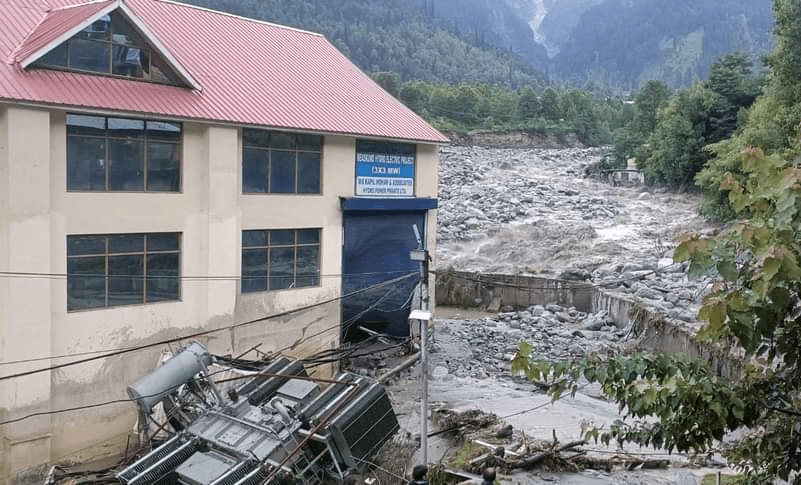
(Feature Image: Flashflood ravaged 9 Mw Beas Kund HEP Powerhouse complex. Image Source: News on Air)
The cloudburst induced flashflood destruction took place late on July 25, 2024 in Palchan area of Manali tehsil in Kullu district. Many of the media reports have also mentioned about the deluge damaging a hydroelectric power (HEP) project in Palchan just in a single line without revealing any details or even the name of the HEP.
While looking for more information about the affected HEP, we came to know that not just one but two HEPs have faced significant damages due to the flashflood incident. Both projects are owned and run by private companies in upper Beas River basin.
2 MW Serai HEP: The first one is Serai HEP also known as Pinnacle HEP on Serai river about 1.5 km downstream Anjani Mahadev area from where the deluge has originated and about 2 km upstream Palchan village in Manali teshil. The 2 Mw HEP was allotted to Pinnacle Hydro Energy Private Limited by HIMURJA in June 2009. Agreement for the project on Build, Own, Operate and Transfer (BOOT) basis, was signed in March 2013. The construction work started in April 2016 and the project was commissioned in March 2018.
Impact The flash flood on Serai river also known as Paagal (mad) nullah in intervening night of July 25-26, 2024 has damaged the pen stock, trench weir site and approach road of the project. The flood alert issued through phone call by staff at weir site helped the workers leave the powerhouse site of the HEP in time to save themselves.

Though the project officials have not estimated the actual figure of damage, they assume the losses cloud be around ₹50-60 lakhs. “Getting new pen stock will alone cost about ₹25 lakh”, said Brijesh Verma project manager adding that making the project operational will take at least one and half month that too depends on flood scenario in Serai River.
9 MW Beas Kund HEP The second project impacted massively by the deluge is 9 Mw Beas Kund HEP which project is located on Beas river near Palchan village about 13 km upstream Manali tehsil. The project was allotted to Kapil Mohan Associates Hydro Power Pvt Ltd (KMHPL) by HIMURJA and it was commissioned in June 2012. It had also applied for Clean Development Mechanism (CDM) fund.
Impact The deluge entered the powerhouse complex of the project around 02:00 am on July 26, 2024, inundating it completely. As per the officials the flood has damaged control room, power panel, machine hall, generator, transformer yard, pump house, storeroom, project office etc. “We have lost everything except the powerhouse building”, said Viany Parma, Manager of the project.
Due to scale of flood impact, the project officials have not estimated overall financial losses to the HEP. “We are still removing the flood debris and can figure out actual losses after testing every machine and equipment”, said Parminder Singh Boparai, Senior Manager of the project. Meanwhile some video reports claim that the deluge has caused damages worth ₹20 to 40 crore to the project. There is also uncertainty on time limit by which the project can become operational again. “It may take two months or more”, said the official.
As per the official, project staff at powerhouse was alerted through phones and wireless saving their lives. While as per Amar Ujala report a project staff was trapped at the powerhouse site, other reports claim the stranded person was a local villager.
Both HEPs Vulnerable to Flood Disaster The Google Earth imagery shows that powerhouses of both the HEPs have been built in active flood zone of Serai and Beas rivers. About 300 m long approach road of Serai HEP has narrowed the river channel. Its powerhouse has further been built inside the flood zone of the river and to protect it from floods, the developer has built a protection wall around it. But both the approach road and powerhouse are evidently prone to damages during high floods.
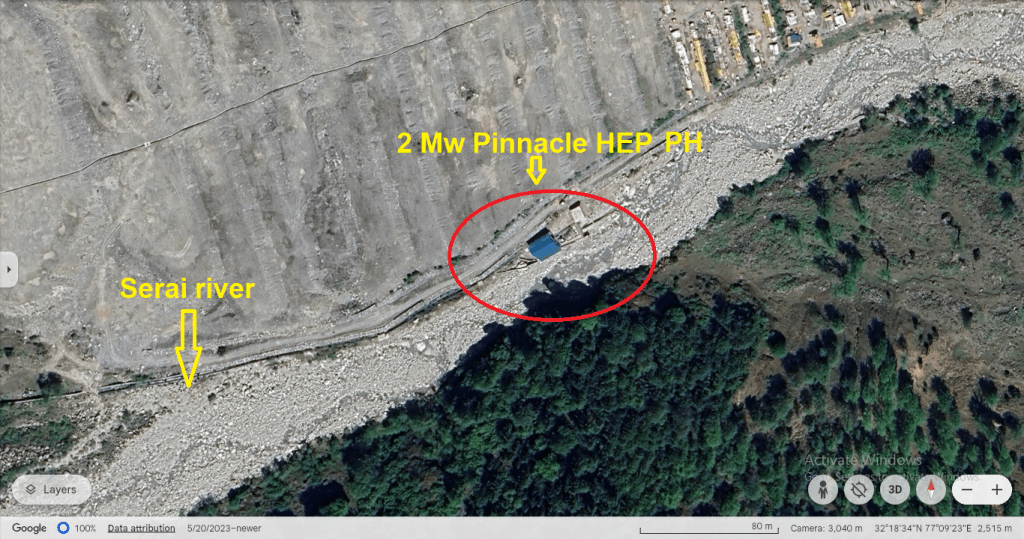

Similarly, the powerhouse of Beas Kund HEP is constructed inside the riverbank and depends on a protection wall for safety against floods. Interestingly, the powerhouse of the project has faced major damages during a similar incident in August 2012. In fact, both the projects are also surrounded by snow clad mountain range.
No One Owning Responsibility The incident suggests that the HIMURJA and Directorate of Energy (DoE) departments are lacking safety guidelines and monitoring for Small Hydro Power (SHP) projects. HIMURJA officials claim that they are just facilitator to help Independent Power Producer (IPP) with allotment and clearances. As per them the Detailed Project Reports (DPR) are approved by the DoE and the IPPs also have their own consultants.
The officials at DoE also make similar statements that they facilitate the projects and do technical monitoring. As per DoE officials there are Central Water Commission (CWC) guidelines regarding building project structures away from Highest Flood Level (HFL) apart from other government departments including Jal Shakti, Forest, Irrigation granting approvals to the project. They also blame IPPs for constructing project structures in flood zone. The question is, who is ensuring compliance with CWC and other such guidelines? What are the monitoring bodies like DoE and HIMURJA doing when IPPs construct project structures inside flood zone? What do they do when they see such violations?
On the other hands, strangely, the IPPs are blaming the government for not informing them about the potential environmental hazards in project areas. “The snow-covered area is retracting, exposing glacial moraines which are flowing down with rainfall and floods posing a safety threats to the project”, says Manager of the Serai HEP. “The powerhouse is not in flood zone, but the river has changed its course, and we cannot now shift the powerhouse”, says the Senior Manager of the Beas Kund HEP.
About the Incident: – A cloudburst in Anjani Mahadev area along Serai river and heavy rainfall spell in Dhundi area enroute Beas Kund in the intervening night of July 25-26, 2024 have caused severe damages to public and private properties in Beas river basin upstream Manali town of Kullu district in Himachal Pradesh.
The Palachan village has reportedly suffered most from the ensuing flashflood where 20 sheep, 3 houses were washed and 1 house, 1 shop, Mahila Mandal office building were damaged. Hearing loud rumbling sound in river, 13 villagers of Palchan whose homes were washed away woke mid-night and left their homes in the nick of time. Terrified by the deluge, residents of Palchan, Ruaru, Kulang, Nehru Kund and Patlikul spent a sleepless night.
The flood spell severely impacted about 20 km Beas river stretch between Dhundi-Palchan-Patlikuhal. The road to Atal tunnel was blocked completely due to flash flood in Dhundi nullah which also flooded the glacier gallery at South Portal of Atal tunnel with debris and affected avalanche harvesting structure near BRO Café about 5km before the Atal Tunnel.

The deluge in Serai river from Anjani Mahadev hills and Dhundi nullah on the other side of the hills enroute Atal Tunnel carried boulder and debris in massive amount, chocking recently built Solang Valley bridge in Palchan and blocking Palchan-Solang road and the Manali-Leh National Highway (NH)-3.
Further, the furious Beas River submerged the road near Aalu ground and washed away a portion of Kullu-Manali NH near 15 Mile apart from damaging a retaining wall of a bridge at Kalath. The NH was also damaged at Bahang in Manali and near Aut in Mandi. The administration in mid-night hours raised flood alert through hooters for locals and tourists living along the Beas river between Palchan to 18 Mile asking them to move to safer places.
Villagers Blame Bridge The villagers of Palchan have blamed the faulty alignment of newly built Solang Valley bridge for diverting the flood towards their village. The 110-meter-long bridge is built on the confluence on Serai and Beas rivers by BRO in October 2020 costing ₹12.83 crore. The villagers claim that before the bridge a hillock used to divide Seari and Beas courses and facilitated Serai floods pass into Beas easily. But after the hillock has been levelled during the construction of the bridge, the flood has been invading the village area.


As per them, one end of the bridge is quite close to Serai riverbank and as a result the floods are over-topping the bridge. After the flood damages, the village panchayat has also demanded BRO in written to take concrete flood protection steps to protect their village. The villagers claim appears true as the aftermath images show flood sludge and debris completely chocking the bridge.
Disaster Monitoring, Mitigation Absent It is worth mentioning that the areas around Palchan have witnessed cloudburst induced flashflood destruction in July 2018 and July 2022. Despite this there is no rainfall gauge installed in the area to figure out whether the flash flood spell on July 25-26, 2024 night was result of a single or multiple cloudburst incident or any other weather calamity.
As per an official of the Met. Department-Shimla, the nearest weather station at Manali and Bhuntar recorded light rainfall during the flashflood event claiming that the weather condition in upper Beas region were of heavy precipitation.
The state is now equipped with three doppler radars at Kufri in Shimla, at Jot in Chamba and at Murari Devi in Mandi district. However, none of these helped in detection and forecast of the extreme weather event that unfolded in upper Beas basin in the night of July 25-26, 2024. The officials of the Met. Department and State Disaster Management Authority (SDMA) attribute the failure to technical issues in Doppler radars.
In addition to lack of rainfall gauges and problems in doppler radars, there is no flood forecast or monitoring station set up in upper Beas basin either by state government or by the CWC. In fact, the Palchan villagers got flashflood alert through mobile phone from the people living upstream the area preventing any casualty in Palchan village as stated by an affected village woman in the Hindustan Times report. As per a CWC official in Shimla, a high-level committee was formed last year regarding opening more flood forecast and monitoring sites in Beas and other river basin in Himachal Pradesh but the present status of the committee decisions are not known.
From Where the Debris Came? The most perplexing aspect of the disaster was to see the debris and boulders in massive amount flooding Solang Valley bridge and causing destruction in Palchan and downstream areas including damages to Beas Kund HEP.
The media reports have seemingly overlooked this fact. But as per the SDMA report, the huge boulders and debris came down with flashflood from the dumping site of Atal tunnel causing change in Serai river’s course at merging point with Beas and diverting the deluge towards Palchan village area.
Meanwhile, the Serai river has flooded again in the night of July 29, 2024, inundating the Solang Valley bridge at Palchan and blocking traffic on Manali-Leh NH for some time. As per The Tribune report, the BRO has partially removed the debris dumped during July 25-26, 2024 floods to open the road. Further, to clear the debris, the traffic on road stretch between Palchan and Atal tunnel has been halted from 11:00 am to 03:00 pm from July 28 to 31, 2024.
The continuous flood has made some more houses in Palchan vulnerable to collapse. As a result, over 60 villagers have left their homes in addition to 13 flashflood affected people already living in a local school. As a solution, the administration has started dredging the Beas river to change its course in order to protect the Palchan village.
There is doubt whether this move will achieve its objective as the Google Earth Imagery shows that the course of Serai river is much wider than Beas suggesting the Serai carries more flood volume than the Beas river at the confluence.
Summing Up It is clear that the flashflood destruction in and around Palchan area of Manali is abject failure of concerned government departments at multiple levels. The powerhouses of Serai HEP and Beas Kund HEP have come up in flood zone of rivers, thus facing damages. But none of the concerned government departments including HIMURJA and DoE took step to do anything to stop this.
Further, they seem uninterested in addressing the basic flaws and gaps in their hydro sector policy to prevent such damages in future. The project owners too are paying a heavy price for underestimating flood threats from extreme weather events. They are quite vulnerable to climatic disasters but now left on their own.
Despite, increasing incidents of cloudburst and flashflood in upper Beas basin, the Met. Department, SDMA and CWC have not set up any weather station or flood forecast site in the region which can certainly help in minimizing the damage scale.
The basic problem with Solang Valley bridge and sheer negligence in the management of Atal tunnel debris, both projects having been developed by BRO have apparently worked as force multiplier in this flashflood event. The agency seems quite non-serious towards environmental norms and fragility of terrain. Sadly, district administration, SDMA seem to find themselves helpless in making the central body accountable for the violations.

Instead of dredging of the Beas River, the Kullu district administration must earnestly initiate rivers’ flood zone mapping and notifying exercise and fix the elementary problems plaguing its disaster monitoring and mitigation mechanism. If the concerned government departments continue to follow an ostrich approach, it will only prove invitation to further disasters for the people and infrastructure in the upper Beas basin in Kullu district.
Bhim Singh Rawat (bhim.sandrp@gmail.com)

 SANDRP