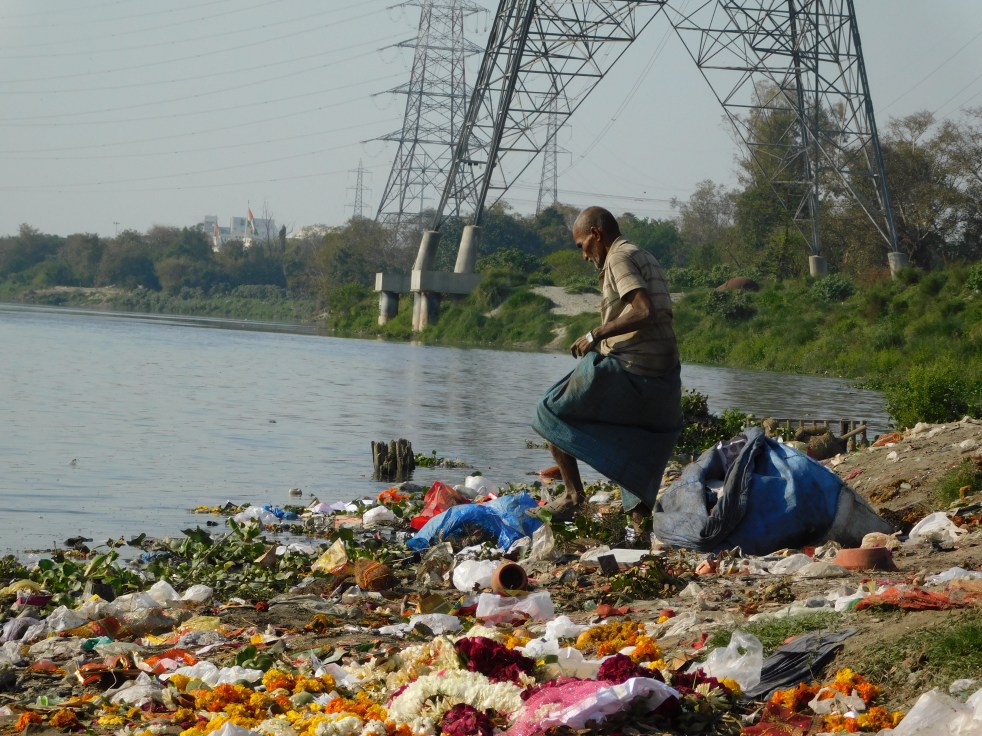
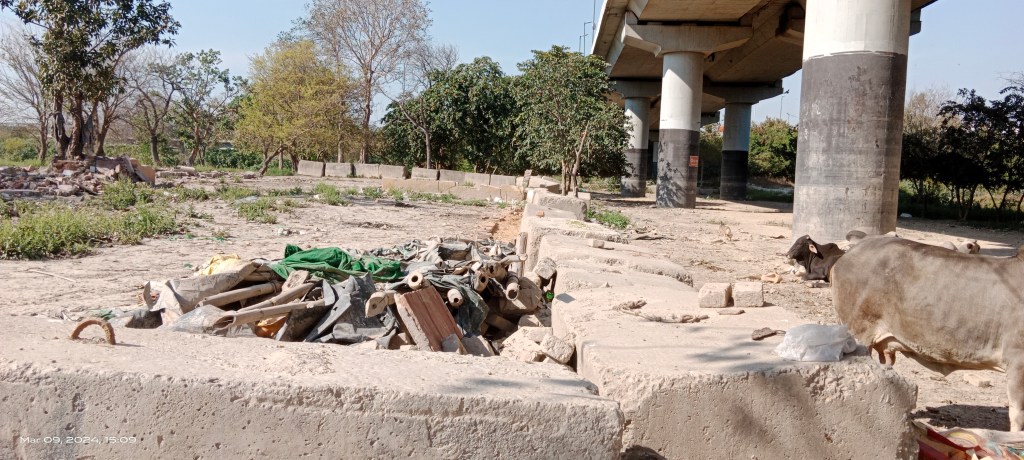
(Feature Image: Solid waste strewn along east bank of polluted river Yamuna near Geeta Colony bridge, Delhi on March 09, 2024. Bhim Singh Rawat/SANDRP)
The Parliamentary Standing Committee on Water Resources has submitted its 27th report titled “Review of Upper Yamuna River Cleaning Projects upto Delhi and Riverbed Management in Delhi” to the Parliament on 6 Feb 2024. The 113 paged report has two parts first on Narration and second on Observation and 25 Recommendations. The first part of the report has XI chapters dealing with various issues of River Yamuna.
SANDRP here presents a detailed chapter wise overview of the key observations made by the Committee based on the replies mainly from Department of Water Resources, River Development & Ganga Rejuvenation (DoWR, RD & GR) along with the Committee’s recommendations and some comments by SANDRP.
Chapter 1. Introduction
In his introductory letter, Shri Parbatbhai Savabhai Patel, Chairperson mentions that the Report could not be finalized during the 2020-21 tenure hence the Standing Committee selected it for successive tenures of 2021-22, 2022-23 and 2023-24. The Committee took evidence of the representatives of the Ministry of Jal Shakti (MoJS) –DoWR, RD & GGR; National Mission for Clean Ganga (NMCG), Central Water Commission (CWC), Upper Yamuna River Board (UYRB), Central Pollution Control Broad (CPCB), Delhi Pollution Control Committee (DPCC), Delhi Development Authority (DDA), Delhi Jal Board (DJB), Govts of Haryana, Delhi, Uttar Pradesh & Uttarakhand on 16 Dec 2021; & 27 Jul 2023.
The Committee states that despite immense economic, cultural, environmental and religious significance and important irrigation source in the region, river Yamuna and its tributaries are getting polluted due to discharge of untreated/partially treated wastewater. The Committee accepted that the various efforts made for prevention and control of pollution in river have not yielded desired outcomes.
The chapter has a table on salient features of the Yamuna River along its co-basin States as mentioned in Table 1 below.
| Length of Yamuna River (Km) | 1376 |
| Catchment Area (Sq. km.) | 366223 |
| Average Water Resources Potential (BCM) | 57.2 |
| Utilizable Surface Water Resource (BCM) | NA |
| Live Storage Capacity of Completed Projects (BCM) | NA |
| Live Storage Capacity of Projects under construction (BCM) | NA |
| Total Live Storage Capacity of Projects (BCM) | NA |
The DoWR, RD & GR has submitted wrong information to the Parliamentary Committee that no major or medium category of project have been constructed in upper Yamuna basin except a few small run-off the river (RoR) Hydro Electric Power (HEP) project which do not significantly change the flow pattern of river.
On the question of any study conducted in this regard, the DoWR, RD & GR replied that as per March 2021 study report by Uttarakhand Jal Vidyut Nigam Limited (UJVNL) through National Institute of Hydrology (NIH) after construction of 3 multipurpose projects (MPP) Lakhawar, Renukaji and Kishau the water availability during non-monsoon period would increase in upper Yamuna basin.
Comment: Surprisingly, the Committee has made no recommendation despite several questionable claims and incomplete information by DoWR, RD & GR. The various built, planned and under construction dams, hydro and barrage projects in upper reaches of Yamuna have not only have compromised free flowing status of the river but also have affected the river ecology in adverse manner.
The Committee has accepted that pollution load in Yamuna and its tributaries is only increasing and the various interventions by governments to improve the situation have failed.
The table on salient features of river Yamuna is based on decade old the Ganga Basin Report, (March 2014) by CWC & ISRO and has no data on utilizable surface water resources, live storage capacity of completed and under construction projects.
The DoWR, RD & GR has provided information on only 12 Dam, Hydro, Barrage projects in the Upper Reaches of river whereas presently there are about 37 hydro, dam and projects in upper reaches of river in Himachal Pradesh (11) and Uttarakhand (26) of which 15 have been completed, 4 are under construction and 18 are proposed as mentioned in Table 2.
Table 2: Hydro, Dam, Barrage Projects in Upper Reaches of Yamuna
| Proposed | Under Construction | Built | Total | |
| Dams | 2 | 1 | – | 3 |
| Barrage | 1 | – | 2 | 3 |
| HEP | 10 | 3 | 8 | 21 |
| SHP | 5 | – | 5 | 10 |
| 18 | 4 | 15 | 37 |
SANDRP has prepared a detailed table on these 37 projects listing 12 projects mentioned in the report as serial number 1-12 and the remaining projects from 13-37 which were excluded in the report. The table file can be seen here.
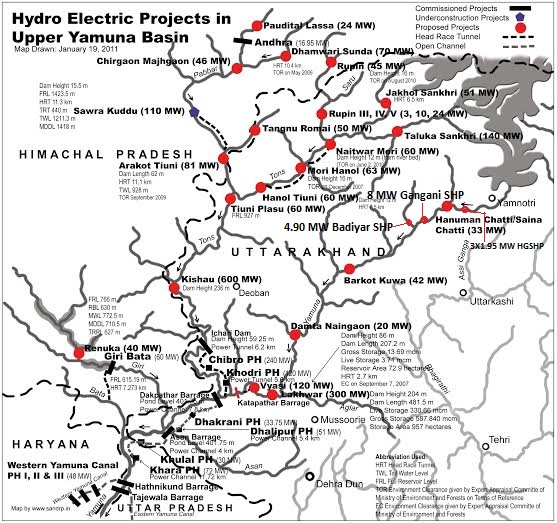
In fact, a 2015 study titled Cumulative Impact of Hydro Power Projects on River Yamuna and Tons & its Tributaries, Uttarakhand by Indian Council of Forestry Research and Education (ICFRE), Dehradun; Alternate Hydro Energy Centre, Indian Institute of Technology (IIT), Roorkee, Uttarakhand, Directorate of Cold Water Fisheries Research Bhimtal, Nanital, Uttarakhand and The Sálim Ali Centre for Ornithology and Natural History (SACON) Coimbatore, Tamil Nadu has listed 46 number of HEPs including 9 built, 6 under construction and 31 proposed projects in river Yamuna, Tons and Its tributaries in Uttarakhand.
The study concludes that considering the number of project and the diversion proposed in river Rupin, Supin; in river Tons due to Naitwar-Mori, Mori-Hanol, Hanol-Tiuni Tuni-Plasu and a reservoir; some starches in Yamuna such as Sauli-Barnigad, Rinknal Khad, Barnigad, Barigad and Barnigad, Nainagaon due to diurnal reservoir and barrage there will be significant changes in the hydrological flow which will have negative impact on river ecology, aquatic and riparian ecosystem.
The study further reveals that frequent water level fluctuations on a daily basis due to HEPs operations will affect all kinds of organisms as well as physicochemical environment of the river stretch and the hydrological flow changes to meet the peak power demand will have negative impact on river ecology, aquatic and riparian ecosystems. According to the study the projects would have adverse impacts on farming, fisheries, forest and would increase human-animal conflicts in the region.
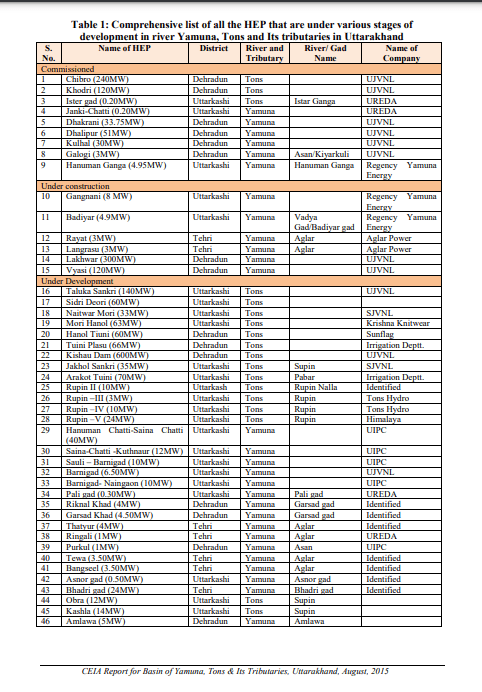
On ground, the number of existing and under construction projects have been adversely affecting the environmental flows and aquatic eco-system in Yamuna and its key tributaries Tons, Tiuni, Pabbar, Rupin, Giri, Bata etc. in the founding basin itself. The founding basin is very small and forms merely 2.8% of the total Yamuna basin area of 3, 66,220 sqkm. It is already vulnerable to geological as well as climate change induced disasters. And these projects are only increasing the disaster impact and vulnerability of the fragile basin.
Every RoR projects has a dam blocking the flows of the river. The Ichari and Vyasi HEP have about 60 m and 86 m tall dams causing ecological damages to Ton and Yamuna River. But the MoWR, RD & GR has falsely claimed that there is no major project in Yamuna basin and RoRs do not majorly affect flow pattern of the river.
Over the years the water flows in tributary rivers and as a result in Yamuna have seen significant decline due to increasing extraction for irrigation, drinking water amid deteriorating catchment, irregular rain, decreasing snowfall and forest cover in the upper catchment. This is the reason the recently built 120 Mw Vyasi HEP struggles to generate even half of its planned power capacity.
There is urgent need of a credible cumulative study to assess the impact of dams, hydro, irrigation, drinking water projects and climate change on Yamuna rivers in upper reaches. The objective of the March 2021 study by UJVNL is to pursue the projects like Lakhwar, Renuka and Kishau which will further irreversibly impact the Yamuna rivers in Himalayan region with lasting adverse impact on the river in upper segment.
The No Recommendation on the chapter shows that the Standing Committee report has failed to underline the link between decreasing environmental flows and increasing pollution in river Yamuna.
Chapter-2: Floodplain/Wetland of River Yamuna
Uttarakhand, Himachal Pradesh, Uttar Pradesh and Rajasthan have submitted no information on State wise information sought regarding the total area of flood plains and total number of wetlands located along River Yamuna vis-a-vis floodplain/wetland area under encroachment.
Haryana has submitted that the Yamuna floodplain area in Karnal is 10,960 acres, in Panipat is 5,100 acre and in HKB Jagadhari is 8,346 acres. There is no wetland and no encroachment exists along the river Yamuna.
Delhi has submitted that the total area of the Zone ‘O’ (River Zone/ floodplains) is 9,700 hectares (ha) as per the Master Plan of Delhi (MPD)-2021. Out of this area, land available with DDA (inclusive of UP Irrigation Department land) is 1675.10 ha. The total wetlands area of river Yamuna is 59.82 ha. And there is no encroached wetland area along Yamuna in Delhi. About 161.95 ha. of floodplain land in Delhi is under encroachment. DDA has recovered 477.79 ha. area from the encroachments.
Recommendation: (1) The Parliamentary Committee urged the DoWR, RD & GR to act in coordination with DDA in expediting the litigations to free the flood plains of river Yamuna from encroachment and restore its original ecosystem.
(2) The Committee recommended DoWR, RD & GR to persuade the Yamuna basin states of Uttarakhand, Himachal Pradesh, Uttar Pradesh and Rajasthan to furnish the relevant information on total area vis a vis area under encroachment of floodplain and wetlands along Yamuna in the respective states along with measures taken by them for removing the encroachments within three months of the presentation of this Report.
Comment: Despite the report being delayed over two years, the DoWR, RD & GR has failed to provide complete information on status of wetlands and floodplain areas along Yamuna as there is no data from four basin States.
DDA’s claims of no wetlands encroachment and recovering 477.79 hectares of floodplain are questionable and misleading. DDA itself has been allotted several hectares of Yamuna floodplain to various construction companies and have not been able to restore the degraded floodplain to its original eco-system including of around 60-hectare Millenium bus depot floodplain land.
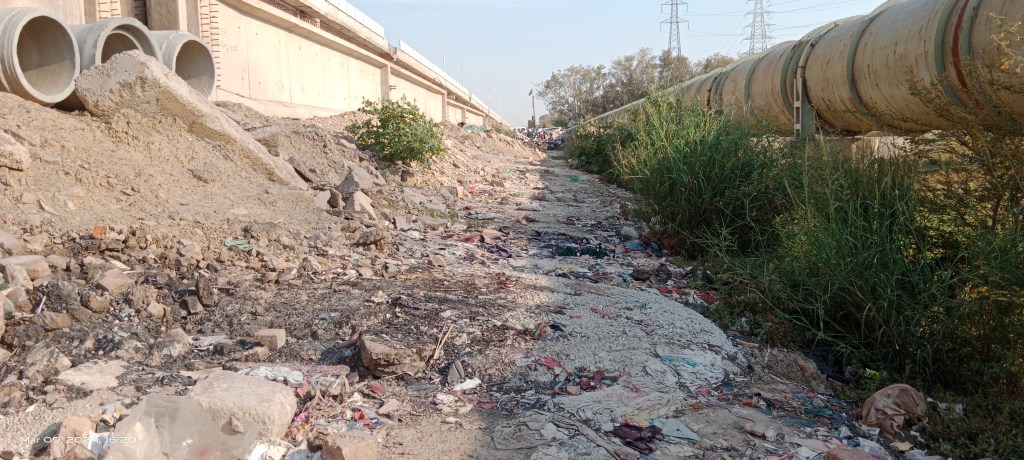
The legacy construction waste of bridges is still scattered in floodplain and riverbed. The construction malbas, concrete mixtures, solid waste is being dumped in floodplain along the eastern embankments between ITO and Wazirabad barrage. DDA has not even cleared malbas left behind following removal of some illegal settlements in floodplain.
The DDA is functioning in most opaque and unaccountable manner. In the name of recovery and restoration, the DDA has been displacing the riverbed farmers and nursery people who are least responsible for Yamuna pollution and could be important stakeholders in city farming concept to mitigate adverse impacts of climate change.
The Parliamentary Committee should have asked that an independent ground assessment is required to figure out the actual status of Yamuna floodplain in Delhi.
Presently, the Yamuna floodplain areas downstream Delhi in Noida, Greater Noida, Faridabad and Palwal districts of Haryana and Uttar Pradesh have been undergoing large scale encroachments in the form of farmhouses and unauthorised residential colonies. But the DoWR, RD & GR and the Parliamentary Committee report have turned blind eye on this.
Impact of groundwater extraction on Yamuna flows
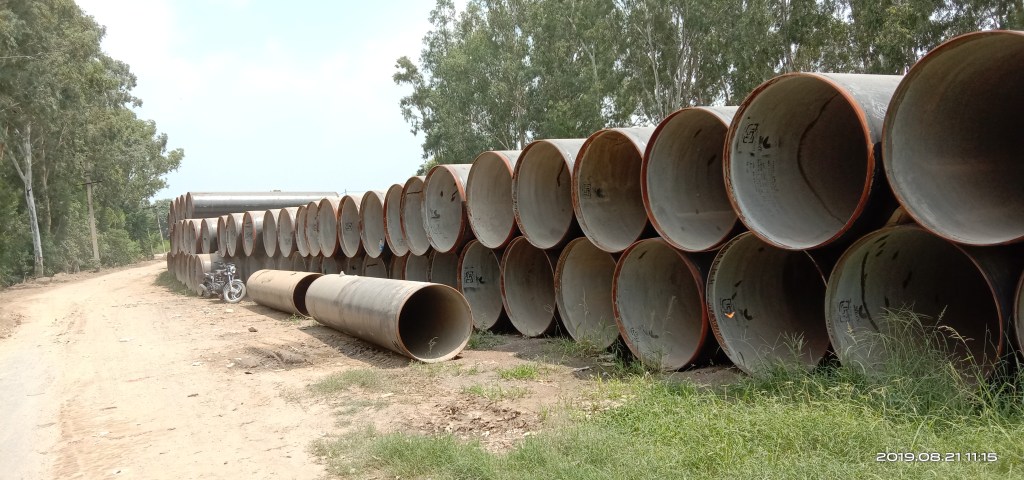
On the question of any underground water extraction by borewells in areas near the Yamuna floodplains due to which the river goes dry in summer and winter; the DoWR, RD & GR replied that as per Central Ground Water Board (CGWB) studies about 85 MGD (386 MLD) of fresh groundwater can be sustainably withdrawn from four potential areas by constructing high yielding tubewells in Yamuna floodplain.
The Delhi Jal Board (DJB) has already installed 130 production wells in these sectors presently yielding 196 MLD (45 MGD) water. There is still scope for withdrawal of additional 190 MLD (40 MGD) water. During lean season, river course quite often turns dry due to various reasons which may include pumping of ground water by borewells in flood plains.
Recommendation: (1) The Committee recommend that in the agriculture sector the process to use water judiciously may be adopted by extensively applying micro and drip irrigation techniques, suitable pattern of cropping, practice of water budgeting at micro-levels and water-shed management in the command area of river Yamuna.
(2) The Committee has underlined that there is urgent need for storage of monsoon water as well as rain water harvesting to meet the increasing water needs in the Yamuna basin.
(3) It has urged the DoWR, RD & GR to take necessary action along with the concerned States to prevent the pumping of groundwater by borewells in floodplains of Yamuna.
Comment: The DoWR, RD & GR has again submitted incomplete information as there is no mention of rainey wells being constructed in increasing numbers in Noida, Greater Noida, Faridabad and Palwal districts situated on either side of river Yamuna downstream Delhi in Haryana and Uttar Pradesh states.
As per Haryana government September 2023 Press Release there are about 22 operational, 12 under construction ranney wells in Faridabad alone and the government has planned to build 22 more rainey wells by 2031. Similarly, the Nodia Master Plan 2031 mentions of 182 tubewells, 6 rainey wells among potable water supply sources and Greater Noida Draft Master Plan 2041 mentions of 155 tubewells among potable water supply sources.
The Yamuna River in this stretch is deprived for flows during lean season and floods during monsoon season. The double whammy of perennial pollution and extraction of groundwater from deep aquifers have resulted in both fast depletion and contimination of groundwater table there irreversibly affecting the river hydrology. However, DoWR, RD & GR and the Parliamentary Committee have taken no notice of this another important issue.
Sand Mining
On the question riverbed mining the Parliamentary Committee asked the DoWR, RD & GR to furnish State wise details of sand mining, if any, noticed/found in the floodplains of Yamuna. State wise information of offenders found guilty of illegal sand mining and imposed penalty/ imprisoned and the amount of penalty recovered in last 5 years.
The DoWR, RD & GR reply shows that governments of Uttarakhand, Himachal Pradesh, Delhi and Rajasthan have submitted no information against the specific queries. The governments of Uttar Pradesh and Haryana have shared details of only some measures taken to control illegal sand mining in Yamuna River.
Additionally, only the Haryana government has submitted district wise details of total illegal sand mining cases registered and penalty recovered from the offenders during last 5 years as mentioned in Table 3 below. However, there is no details on number of offenders and imprisoned for the illegal sand mining in Yamuna River in the state.
Table 3: District wise details of illegal sand mining incidents and fine recovered in Haryana state in last 5 years.
| SN | Districts | Total cases | Fine Recovered |
| 1 | Yamuna Nagar | 2599 | ₹21,22,79,522 |
| 2 | Panipat | 151 | ₹2,18,16,530 |
| 3 | Karnal | 202 | ₹2,20,12,810 |
| 4 | Sonipat | 281 | ₹3,04,79,802 |
| 5 | Faridabad/ Palwal | 559 | ₹3,98,09,405 |
| Total | 3,792 | ₹33,63,98,069 | |
Recommendation: (1) The Committee stated that excessive sand mining leads to riverbed alteration, affecting the course of the river and causing bank erosion and asked the DoWR, RD & GR to take necessary steps to collate the information regarding sand mining from all the Yamuna basin States and with their coordination make concerted efforts to prevent illegal sand mining in the floodplains of river Yamuna.
(2) The Committee further suggested setting up of a portal where all the relevant information like river sand mining, floodplain/wetland encroachment, dumping of waste into the rivers may be furnished by the concerned States in a time-bound manner on periodic basis. The Committee opined that having such information in public domain may play an important role in checking the illegal environmental activities in the floodplains of our rivers.
Comment: Again, the DoWR, RD & GR could not submit the required information for 4 states of Uttarakhand, Himachal Pradesh, Delhi and Rajasthan while governments of Haryana and Uttar Pradesh have provided incomplete information on the important issue.
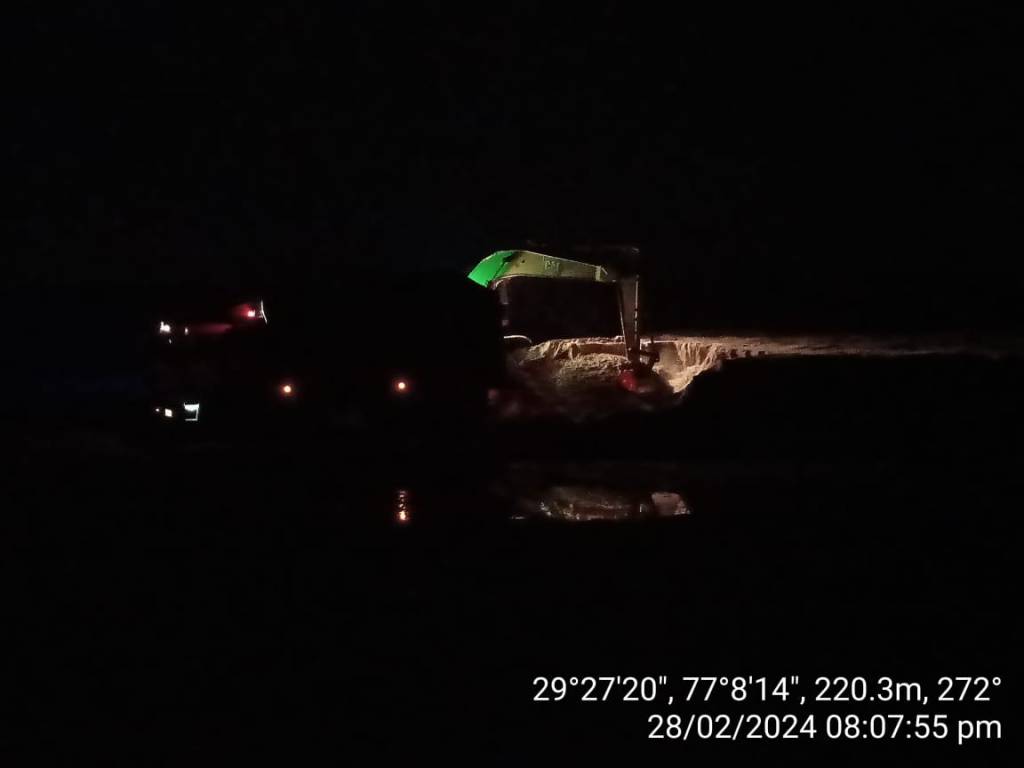
On the ground, illegal riverbed mining has increased in Himalayan segment in recent years and the entire upper segment of the river have been adversely affected by large scale mechanized sand mining activities in brazen violations of existing norms.
The unsustainable river mining has resulted in multiple incidents of embankment breach, river bank erosion, damages to river aquatic eco-system and scores of drowning deaths in deep sand mine pits apart from ruining the lean season flows in the river.
The Parliamentary Committee could have asked the Union Ministry of Environment and Forest for the environmental and forest clearances given for river sand mining during the relevant period. That would have provided a comprehensive picture about such sanctions.
Both the Parliamentary Committee and DoWR, RD & GR have not deliberated on these problems. Nevertheless, the Committee recommendation of a common portal for sand mining, floodplain/wetland encroachment, dumping of waste into the rivers is a welcome step. Hope, the DoWR, RD & GR and all Yamuna basin governments will establish the portal at the earliest and update it regularly in the right spirit of protecting the Yamuna.
Dumping of Debris in River
The DDA in writing accepted that the dumping of construction debris as well as bio-medical waste has been noticed in the riverbed of Yamuna. As per the DDA reply, it has deployed 134 security guards in 3 shifts with patrolling vehicles area from Wazirabad Barrage to Okhla Barrage to check illegal dumping of malba and Construction & Demolition (C&D) Waste. DDA is using GPS to monitor security guards and patrolling vehicles. It has challaned owners of malba dumping vehicles.
DDA has also claimed about installing 93 CCTV cameras at 27 locations from Wazirabad Barrage to Okhla Barrage to check the illegal debris dumping, encroachments in the Yamuna riverbed and barricaded some of the areas to prevent entry of dumping vehicles. Further DDA stated that it has placed 27 signboards at various locations to sensitize people on the issue.
DDA’s reply on number of offenders found guilty and penalty imposed and recovered on dumping waste in river in last five years as listed in Table 4 below reveals that it has provided no information for 2022 and 2023. The incidents of debris dumping have been increasing. So far, against the penalty of Rs. 2.41 crores, the DDA has recovered only Rs. 46.9 lakhs.
| SN | Year | Offence | No. of Challans | Compensation Amount | Recovery Amount |
| 1 | 2018 | Malba Dumping | 1 | Rs 50.000/- | Nil |
| 2 | 2019 | Malba Dumping, Unauthorized parking, garage in floodplain | 186 | ₹89,55,000/- | ₹17,85,00/- |
| 3 | 2020 | Malba Dumping, Unauthorized parking, garage in floodplain | 54 | ₹21,30,000/- | ₹2,85,000/- |
| 4 | 2021 | Malba Dumping, Unauthorized parking, garage in floodplain | 610 | ₹1,14,05,500/- | ₹26,17,500/- |
| Total | 929 | ₹2,41,45,500/- | ₹46,87,500/- |
The Committee noted that no study has been done to assess the damages due to dumping of C&D debris as well as bio-medical waste on the health of river Yamuna and despite measures by DDA cases of debris dumping in floodplain have increased from 1 in 2018 to 610 in 2021.
Recommendation: Taking note of these facts the Committee has recommended DoWR, RD & GR to prepare guidelines/ rules regarding dumping of construction and other waste in Yamuna violation of which should attract penal provisions.
Comment: DDA’s claims of CCTVs, security guards, mobile patrolling lack credibility. The agency has no report on the same in public domain. Such claims need to be verified through independent agency by DoWR, RD & GR as well as by the Parliamentary Committee. On the contrary presently, construction debris in massive amounts along with solid waste is being dumped in floodplain all along eastern embankment of river between ITO and Wazirabad barrage. The bridge construction companies in past and even currently have been dumping remains of concrete mixtures in the floodplain.
However, the recommendation of forming guidelines for dumping of construction debris and other waste is welcome step by the Committee. One hopes that the DDA will invite suggestions from general public regarding this and implement the guidelines in time bound manner.
River Bed Management in Delhi
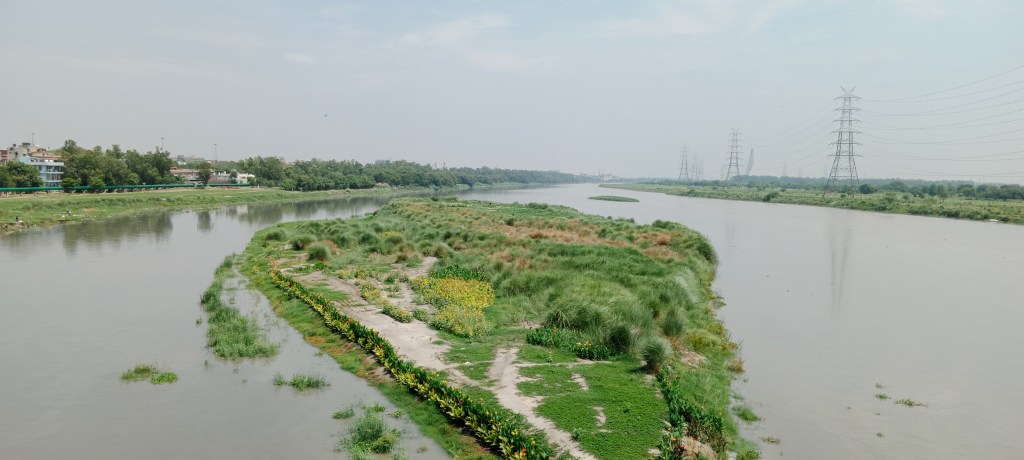
The Committee is informed that regarding Delhi stretch of river Yamuna being highly impacted due to huge sediment deposits to prevent which a draft proposal of CSIR-NEERI submitted to Yamuna Monitoring Committee (YMC) of National Green Tribunal (NGT) had recommended controlled dredging of riverbed.
However, the DoWR, RD & GR stated that there is no scientific basis to support that legacy sludge accumulated in the river bed is contributing in flooding the adjoining areas. It further informed the Committee that Delhi Irrigation & Flood Control (I&FC) department has not observed any perceptible change in the flood level during the past few years. Hence, there is no evidence to conclusively suggest gradual rise in river bed due to deposition of sludge and sludge deposited in pre monsoon season gets washed off downstream due to scouring of river bed during high floods.
As per the DoWR, RD & GR written reply, the sludge/sediments sampling by CSIR NEERI in pre and post monsoon months (12-14 June 2019 and 17-18 October 2019) which has also detected alarming level of heavy metals in river bed in pre-monsoon months indicated decline in sediments and heavy metals in post monsoon months due to flushing and churning of the riverbed during monsoon months. However, the survey did not rule out the possibility of legacy sludge in deeper section of the riverbed and recommended deep digging of sludge/sediment up to 5-6 ft to support any conclusion/decision regarding legacy sludge.
Recommendation: (1) Taking notice of excessive presence of heavy metals (lead, copper, zink, nickel, cadmium and chromium) in the riverbed of Yamuna in Delhi, the Committee concluded that the problem cannot be left on flushing during monsoon and recommended DoWR, RD & GR to actively explore the possibility of controlled dredging for removal of debris and heavy metals from the bottom of riverbed of Yamuna.
(2) The Committee urged the DoWR, RD & GR to work in close coordination with other Ministries and Departments for framing a proper disposal system of sludge containing heavy metals to avoid potential health impacts on people at sites where they are proposed to be disposed.
Comment: The subject of rise in riverbed level of Yamuna in Delhi requires thorough scientific assessment of river cross sections on regular periods. It is surprising the CWC and UYRB have done nothing regarding this issue. Contrary to DoWR, RD & GR submission in the report, a study by former IIT Delhi professor A.K. Gosain has only in January 2024 claimed a 7.5-foot rise in the riverbed of the Yamuna between Wazirabad and Okhla in Delhi.
Provision of round the year adequate flows and facilitation of smooth passage of flood water during monsoon are natural, better, cost effective solutions to the problem in place of dredging of riverbed which entails a complex process for safe disposal of dredged materials.
Chapter 3. Environmental Flow (E-Flows) of the River
As per the DoWR, RD & GR due to rising demands for irrigation and drinking there is NIL environmental flow available at downstream of Wazirabad Barrage for 9 non-monsoon months. It accepted that 10 cumecs being released downstream Hathni Kund Barrage which was mandated by NGT in 11 June 2015 order is inadequate and most of it evaporates or percolates before it reaches Wazirabad during the lean season.
The DoWR, RD & GR further revealed that in absence of fresh flowing water downstream of Wazirabad desired water quality of BOD < 3 mg/l & DO >5 mg/l may not be achieved even if DJB treats the entire sewage generated in Delhi upto BOD of 10 mg/l. It also stated that due to differences among Yamuna basin States, the NIH recommendations of increasing e-flows to 23 cumecs downstream Hathni Kund cannot be accepted.

Recommendations: Accepting the significance of e-flows for Yamuna River health and taking cognizance and IUCN’s 2003 E-flows definition, the Committee recommended to DoWR, RD & GR to make concerted efforts to evolve consensus among the basin States for maintaining E-flow of 23 cumecs in the lean season. The Committee also asked the DoWR, RD & GR to apprise it on reasons behind for disagreement among basin States.
Comment: Lack of adequate flows in Yamuna is key factor behind continuous degradation of river and failure of cleaning projects. The release of 10 cumecs following NGT June 2015 order has not made any difference except for a little distance downstream of Hathnikund Barrage.
It is worth mentioning that this inconsequential 10 cumces is the figure which is proposed to be released in Yamuna River as environmental flows after construction of 3 dams of Lakhwar, Renuka and Kishau as per UYRB 1994 agreement. This fact clearly exposes the claim of governmental agencies pushing these destructive dams.
It is time for all the basin governments and decision makers to realize that unless at least 50 percent of available water at Hathni Kund Barrage is not released in the Yamuna as environmental flows, the plans and projects to clean and protect the river will not achieve desired results.
Chapter 4: Water Quality of river Yamuna
Based on water quality the CPCB has identified three locations of Yamuna in Delhi (Palla to Okhla), Haryana (Hathni Kund to Palla and Palwal to Hasanpur) Uttar Pradesh (Vrindavan to Hamirpur) in Priority I category under polluted river stretches (PRS) in 2022.
The CPCB monitors water quality of river at 33 locations including 4 each in Uttarakhand & Himachal Pradesh, 6 in Haryana, 7 in Delhi and 12 in Uttar Pradesh on 4 parameters of Dissolved Oxygen (DO), pH, Biochemical Oxygen Demand (BOD) and Fecal Coliform (FC).
The water quality data of these 33 locations analysed during January 2021- May 2023 have found only 10 locations (4 each in Uttarakhand & Himachal; 1 each in Delhi & Uttar Pradesh) as complying with criteria while remaining 23 locations (6 in Haryana, 6 in Delhi and 11 in Uttar Pradesh) as non-complying. The water quality of Yamuna in Delhi is not fit for bathing.
Recommendation: The Committee while observing the critical situation of Yamuna due to deteriorating water quality parameters call for urgent, lucid and coordinated response from all the stakeholders in order to abate pollution and conserve it for posterity.
Impact of Pollution on the ecology of Yamuna
The DO >4 mg/l is required for sustenance of healthy aquatic life, which is generally observed NIL in Delhi stretch between Wazirabad Barrage to Asgarpur village hence the river is not meeting the prescribed parameters regarding healthy fish environment.
There have been incidents of mass fish death in Agra due to discharge of untreated effluents from upstream areas including from Gokul barrage in Mathura and due to absence of adequate treatment infrastructure.
There has been no study to assess the damage to ecology of Yamuna and the fish environment.
Recommendation: The Committee urged the DoWR, RD & GR in coordination with the Ministry of Environment, Forest and Climate Change (MoEF&CC) to undertake a study to assess the damage done to the ecology of river Yamuna and the fish environment. As per the Committee such a study will present a true picture would enable the policy makers formulate appropriate steps to conserve river ecology.
Chapter 5: Industrial Pollution in Yamuna & its Tributaries
On the questions of total number of industrial clusters in Yamuna basin States and Common Effluent Treatment Plants (CETPs), the DoWR, RD & GR in writing submitted that there are 50 industrial clusters of Grossly Polluting Industries (GPIs) in Yamuna main stem States (Uttar Pradesh, Haryana and Delhi) and 34 CETPs. The state wise details of GPIs and CETPs is given in Table 5 below.
| State | Industrial clusters | Connected to CETP | CETPs locations |
| UP | 8 | 2 | 2 CETPs (Mathura, Tronica City) |
| Haryana | 14 | 10 | 19 CETPs (Panipat-3, Faridabad-2, Gurugram-2, Ambala-2, Jind-1, Panchkula-1, Rewari-1, Rohtak-3, Sonipat-4) |
| Delhi | 28 | 17 | 13 CETPs (Badli, Bawana, Karnal Road, Jhilmil, Lawrence Road, Mangolpuri, Mayapuri, Naraina, Narela, Okhla, SMA CETP, Udyog Nagar and Wazirpur). |
The industrial wastewater from 29 clusters is treated through CETPs while remaining 21 clusters have been discharging effluents into Yamuna and its tributaries through drains. During 2021-22 annual inspection, out of 34 CETPs 33 were found operational but 14 CETPs of these were non-complying to CPCB’s prescribed standards.
As per DPCC, out of 28 approved industrial areas in Delhi 17 are connected with 13 CETPs and in remaining 11 industrial areas most units are non-water polluting and water polluting units in these areas have individual waste water treatment facilities.
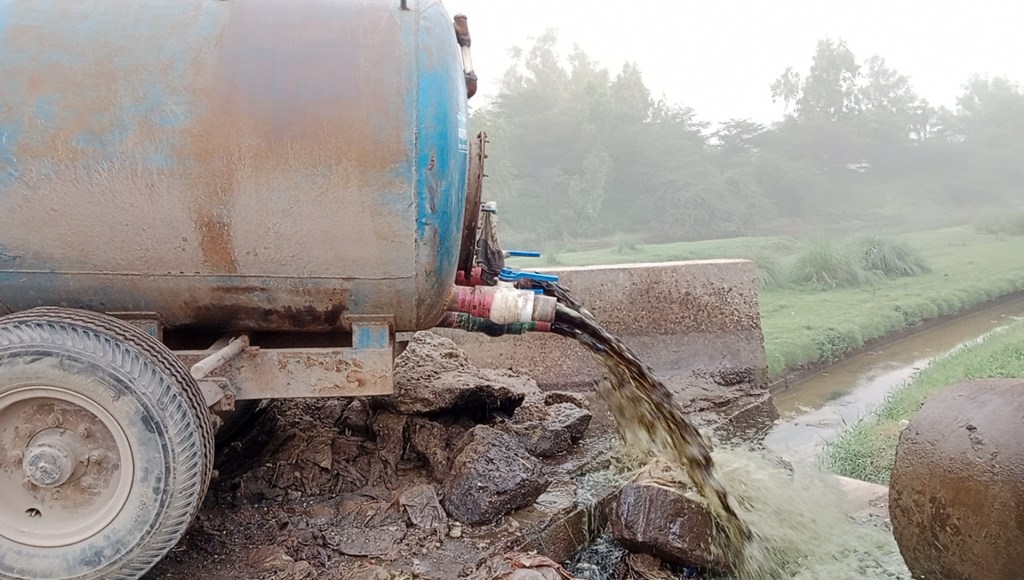
The DPCC further stated that all 13 CETPs are meeting the prescribed standards as per July 2023 analysis report whereas out of the 35 STPs only 13 STPs are complying with DPCC’s prescribed standards as per June 2023 analysis report.
The 13 CETPs in Delhi have 212.3 MLD treatment capacity however the utilization is only 67.5 MLD which is just 31.8% of the installed capacity. Similarly, the installed treatment capacity of 35 operational STPs is 2874 MLD however the actual utilization is 2542 MLD which is 88.5% of the installed capacity. Surprisingly, the DPCC has no information on number of unauthorized industries operating in Delhi.
The DoWR, RD & GR also submitted that as per 2021 data there are 1655 GPIs in 4 Yamuna States consuming 261.02 MLD freshwater and discharging 144.4 MLD effluents. The State wise detail of GPIs is given in Table 6 below.
| States | No. of GPIs | Freshwater consumption (MLD) | Effluents Discharge (MLD) |
| Delhi | 210 | 15.28 | 2.4 |
| Haryana | 924 | 113.13 | 54.59 |
| UP | 510 | 128.21 | 84.75 |
| Uttarakhand | 11 | 4.4 | 2.66 |
| Total | 1655 | 261.02 | 144.4 |
As per the CPCB till date (Feb. 2024) only 540 GPIs out 1957 GPIs in Yamuna main stem have installed Online Continuous Effluent Monitoring System (OCEMS) and are connected with SPCBs, CPCB’s server.
The DoWR, RD & GR further stated that the pollution load including of heavy metals from residential, industrial sources is increasing in Yamuna rivers with serious implications for human health.
Recommendation 9: 1 The Committee recommended DoWR, RD & GR to nudge respective states specially Delhi to find out the reasons behind low utilization capacity of CETPs and to take necessary remedial steps accordingly.
2. The Committee further asked the DoWR, RD & GR to make war-footing efforts to improve CETPs capacity utilization and connect all industrial clusters with the CETPs within a fixed time frame.
Recommendation 10: The Committee asked the DoWR, RD & GR to persuade the State of Delhi to carry out a study to assess the number of unauthorized industries operating in Delhi so that necessary arrangements may be made for regulating these industries and treating the industrial effluents generated from these industries.
Recommendation 11: The Committee asked the DoWR, RD & GR to coordinate with CPCB to prepare a schedule for installing the OCEMS in all the GPIs on Yamuna main stem States and make sure that all the GPIs comply with this schedule.
Chapter 6: Yamuna Water Pollution from Municipalities and Non-Point Sources
Broadly untreated sewage from municipalities contributes to about 80 precent of pollution load into the river. The UPPCB has also estimated that the discharge of sewage contributes approximately 80 percent of total pollution load in Yamuna in Uttar Pradesh.
As per SPCBs there are 64 major drains (18 in Delhi, 11 in Haryana, 35 in UP) discharging pollution in Yamuna. In addition to this, there are 4 drains in municipal limits of Paonta Sahib, of Himachal Pradesh carrying about 1.9 MLD grey water into Yamuna River.
As per NMCG the Drain No. 2 and 8 in Haryana dumps organic and industrial pollution in huge amount in river Yamuna. It further stated that Najafgarh drain alone carries about 23 cumecs treated and untreated pollution in the river.
As per CPCB overall there are 22 drains polluting the river in Delhi. Out of 22 drains in Delhi 9 have been trapped and 2 are partially trapped. The major drains of Najafgarh and Shahdara will be covered under Interceptor Sewage Project.
Though there are 137 drains in Uttar Pradesh discharging pollution in Yamuna however the UPPCB has not worked out the flow estimation of all of the drains. Out of 35 major drains 18 are carrying mixed waste water while 17 are carrying purely domestic sewage.
Referring to UPPCB information on pollution in Hindon, NMCG informed that there are 453 water polluting industries along the river Hindon in 6 districts of Uttar Pradesh. Of these about 55 industries are connected with 6 MLD CETP and the remaining have their own treatment plants. 22 industries alone are generating 78 MLD effluents which reaches the Hindon river.
Given the severe pollution load in Hindon, Kali West and Krishni rivers, the NMCG doubted the UPPCB figures and assumed actual effluent discharges higher than estimated by UPPCB. Similarly, there are 22 STPs of 1163 MLD as total existing treatment capacity. Though the UPPCB claims only 3 STPs are non-compliant but the ground reality of Hindon states otherwise.
The reasons behind untreated sewage flowing in drains includes lack of surveys, DPR for STPs as per Yamuna Action Plan (Himachal Pradesh); incomplete interception, diversion and treatment of sewage (Uttar Pradesh); discharge of untreated sewage from unauthorised colonies and JJ Clusters (Delhi) apart from delay in permission by Railway, PWD, Forest and other government departments.
The report has also revealed that there is significant gap in sewage generation and treatment capacity in Yamuna states as shown in Table 7 below.
| States | Estimated sewage generation (MLD) | No. of STPs | Existing treatment capacity (MLD) | Utilization Capacity (MLD) | No. of Non-complying STPs |
| Delhi | 3600 | 35 | 2874 | 2486.7 | 22 |
| Haryana | 1506.9 | 156 | 1835.2 | 1465.7 | 64 |
| UP | 5500 | 130 | 4074.5 | 3187.27 | 27 |
| Uttarakhand | 329.32 | 69 | 427.9 | 245.78 | 30 |
| HP | 91.95 | 75 | 126.33 | 85.82 | 22 |
| 11028.17 | 465 | 9337.93 | 7471.27 | 165 |
Presently, there are 1799 unauthorised colonies in Delhi of which sewer lines have been commissioned in 706 colonies and work is in progress in 448 colonies. 161 colonies lacked NOC for being in O Zone, Forest, ASI land. The government plans to set up STPs, sewerage network in 484 colonies by December 2024.
Soil contimination due to fertilizers have been observed at all the monitoring sites in Delhi. The river is polluted with heavy metals mainly due to industrial pollution.
Recommendation 12: The Committee has asked the DoWR, RD & GR to proactively act with all the main stem Yamuna States to overcome the loopholes in sewage generation and treatment in a time bound manner and plug the untreated sewage flowing into the drains. The department is also asked to fix the accountability for those overseeing these works to strengthen the monitoring.
Recommendation 13: The Committee has asked the DoWR, RD & GR to work in tandem with the Delhi Jal Board (DJB) to connect all the households including all the 1799 unauthorized colonies with sewerage network in Delhi in a time-bound manner.
Recommendation 14: The Committee urged the DoWR, RD & GR to take up the issue of underutilized capacity of STPs with concerned States and also with their coordination prepare a time-bound Action Plan on urgent basis to not only enhance the capacity of the existing STPs but also bridge the gap between the capacity generation and the utilization capacity.
Recommendation 15: In view of the potential health hazards due to use of fertilizers and pesticides in floodplains of Yamuna, the Committee urged the DoWR, RD & GR to work with the Ministry of Agriculture and Farmers’ Welfare to promote organic farming along the course of Yamuna by providing incentives.
Solid Waste
There is a huge gap between the solid waste generation and processing capacity in Yamuna States as shown in Table 8 below.
| States | No. of Yamuna towns | Current waste generation (TPD) | Processing Capacity (TPD) | Actual utilization of capacity (TPD) | Gaps |
| HP | 1 | 11 | 8.65 | 100% | 2.35 |
| UP | 6 | 1832 | 1335 | 1201 | 497 |
| Delhi | 1 | 11376 | 8219 | 7529 | 3157 |
| Total | 8 | 13219 | 9562.65 | 8730 | 3656.35 |
Only Himachal Pradesh have put screens on 4 drains to prevent solid waste from reaching the river. Delhi government has proposed to installed 6470 TPD capacity by December 2027. The States of Haryana, Uttarakhand and Rajasthan have not submitted the required information to DoWR, RD & GR.
There is no study to find out to what extent the existing cremation process is responsible for pollution in Yamuna. There are 6 CNG furnaces, 6 Moksha Dah furnaces and about 90 open platform facilities available for the rites at Nigam Bodh ghat, Delhi.
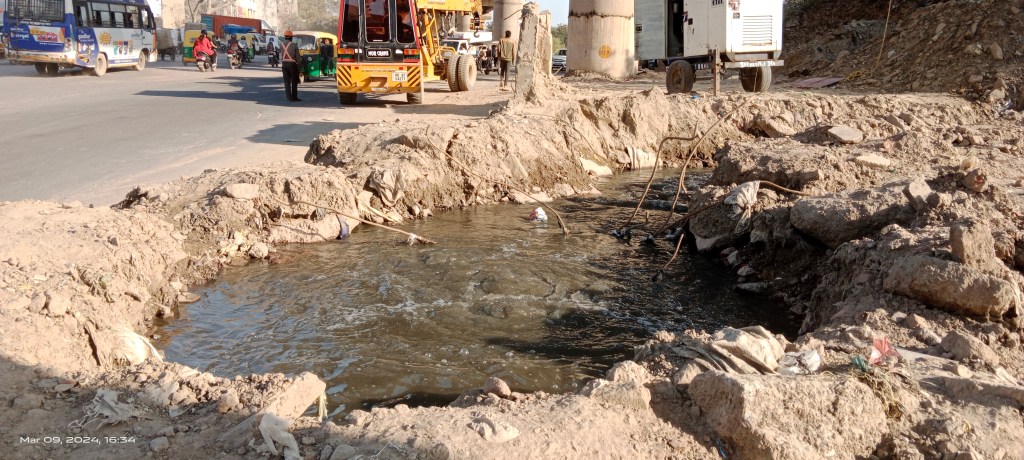
Recommendation 16: The Committee recommended the DoWR, RD & GR to take up the issue of solid waste generation and gap in processing with the concerned States and persuade them to make necessary efforts to bridge this gap on priority basis.
DoWR, RD & GR is also urged to develop a monitoring mechanism in coordination with the State of Delhi to ensure that the proposed additional MSW facilities is installed within the fixed timeframe.
The Committee further sought information regarding the extent and magnitude of solid waste pollution in the Yamuna and its tributaries as well as the steps taken by all the basin States to install screens on the drains.
Recommendation 17: The Committee urged the DoWR, RD & GR to explore ways including providing financial assistance to the States to establish electric/CNG furnaces and find ways to discourage rituals on the pyres built on the banks of Yamuna.
Chapter 7: Formation of Foam in River Yamuna
Reasons and Impacts of foaming in river: Foaming incidents are occurring at ITO and Okhla barrages during winter season. Foaming is caused by phosphates (Sodium tri-poly-phosphate) and surfactants pollution impounded in waste water of the barrages. Release of this waste water from barrages agitates phosphoric compounds settled as sludge in riverbed resulting in foaming.
Presence of these pollutants indicate discharge of untreated or partially treated sewage or industrial effluents in the river. In stagnant condition, this wastewater also causes water hyacinth growth in the pondage of Okhla barrage.
Exposure to the foaming can cause skin irritation and infections. The eutrophication of river surface prevents penetration of light and oxygen into water resulting in the death of organisms.
Preventive Measures: The Committee is informed that complete treatment of sewage in Delhi, Haryana and Uttar Pradesh is required to prevent foaming problem in Yamuna.
Provision of creating gentle slope or smooth discharge spillway at Okhala barrage to prevent turbulence and vertical fall of waste water can address the foaming issue.
BIS has stipulated standards for household detergents and industrial detergents (IS-4155 & 4156). These standards have been revised to reduced phosphates in the products.
The DPCC has issued public notice on 17 November 2021 completely prohibiting the Sale, Storage, Transportation and Marketing of soaps and detergents in NCT of Delhi which are not conforming to the revised BIS Standards.
A Joint Teams of MCD, DPCC, Revenue Dept., Power Companies & DJB have been made for taking action taken against Dyeing Industries in Non-Conforming Areas of Delhi.
After a joint committee meeting on 21 October 2022, the DJB sprayed anti surfactants at the downstream of Okhla Barrage 3 days before the Chattha Poja in 2022, as a reason minimal foam formation was observed.
Recommendation 18: The Committee hoped that DoWR, RD & GR will make all efforts to improve the functioning of the STPs in Yamuna States. The Committee further stated that efforts are required to introduce alternatives for phosphates in detergents which get biodegraded in STPs. The Committed urged the DoWR, RD & GR to take up the matter with concerned agencies including BIS to reduce the foam formation in river Yamuna to negligible levels.
Recommendation 19: As short term measures the Committee urged the DoWR, RD & GR to persuade Delhi government to take the matter of gentle slope provision and regulated operation of Okhla barrage gates on priority basis.
Chapter 8: Institutional mechanism for prevention & control of pollution
No recommendation made by the Committee. Again, the claims of DDA of restoring floodplains by developing ghats and biodiversity parks have not been scrutinized either by DoWR, RD & GR or by the Committee. DDA work had suffered severe damages during 2023 floods resulting in huge wastage of public money. However DDA presently continues to carry the same work without learning any lessons.
Chapter 9: Namami Gange Programme
Rs. 1514.70 crore has been incurred for creation of 57 sewage treatment facilities with capacity of 483 MLD and rehabilitation of 328 MLD STP in Haryana & Delhi for conservation of river Yamuna under the Yamuna Action Plan – I & II.
The NMCG has sanctioned 34 projects of Rs. 5834.7 crore for in 5 Yamuna States including of 1 in Himachal Pradesh, 2 in Haryana, 11 in Delhi and 20 in Uttar Pradesh to create 2110.3 MLD STP capacity. Out of the 34 projects, 15 projects of Rs. 2597.28 crore have been completed including of 1 in Himachal Pradesh, 2 in Haryana and 6 each in Delhi and Uttar Pradesh creating 980.97 MLD STP capacity.
The state wise details on the status of these projects and budget expenses as upto 31 August 2023 is given in Table 9 below.
| States | Projects Sanctioned | Projects Completed | Sanctioned STP capacity in MLD | Created STP Capacity in MLD | Sanctioned Cost in Rs. Crore | Expenditure Cost in Rs. Crore |
| Delhi | 11 | 6 | 1268 | 704 | 2009.08 | 1683.53 |
| HP | 01 | 1 | 1.72 | 1.72 | 11.57 | 3.75 |
| Haryana | 02 | 2 | 145 | 145 | 217.87 | 217.94 |
| UP | 20 | 6 | 694.09 | 130.25 | 3596.2 | 692.06 |
| Total | 34 | 15 | 2108.81 | 980.97 | 5834.7 | 2597.28 |
2025-26 has been set up as completion timeline for all these sanctioned projects. However, the execution of projects and utilization of budgets has been facing delays for various reasons including delay in permission from PWD, Railway Departments and delay in coordination at state level.
The NMCG has set up 5 State Ganga Committees (SGC) and 169 District Ganga Committees (DGC) including 13 in Uttarakhand, 75 in Uttar Pradesh, 38 in Bihar, 4 in Jharkhand and 9 in West Bengal and created Clean Ganga Fund (CGF). However, no such initiative has been taken regarding Yamuna River.
Recommendation 20: The Committee recommended the DoWR, RD & GR to fast track the NMCG’s Yamuna cleaning STPs projects in Delhi and UP to avoid cost and time overrun.
Recommendation 21: Recognising the important role of DGCs in monitoring the river cleaning work of local authorities, the Committee urged the DoWR, RD & GR to take measures for setting up of State Yamuna Committee (SYC) and District Yamuna Committees (DYC) on the lines of SGC and DGC. The DoWR, RD & GR is also asked to explore possibilities of establishing Clean Yamuna Fund (CYF) to avoid shortage of funds for river cleaning related activities. Additionally, the Committee has recommended DoWR, RD & GR to take appropriate steps for encouraging technical and financial support from corporate sector.
Chapter 10: Role of Barrages on River Yamuna and Flood Management in Delhi
SANDRP has published a detailed review of the Chapter and recommendations (22 & 23) which can be seen here. The Committee report has raised more questions than revealing the causes responsible behind unusual flood spell in Delhi in July 2023. Without providing convincing reasons, the Haryana government and CWC have ruled out role of ITO barrage closed gates in Delhi’s flood situation.
Moreover, the fact that 3 barrages, namely, Wazirabad, ITO and Okhla in just 22 km river stretch being managed by three different governments of Delhi, Haryana and Uttar Pradesh in apparently opaque manner and CWC, UYRB just running away of their responsibilities does not auger well for holistic flood management.
The information on water discharges through HKB, Wazirabad and Okhla barrages in the report has again raised serious questions on CWC’s role as prime flood monitoring agency. The committee has not adequately dealt with growing encroachment of floodplains in Delhi and corresponding impact on aggravating the flood situation.
Thus, the Committee has in limited manner dealt with the serious issue as it has neither summoned nor sought replies from DDA, PWD Delhi, NHAI, NMCG etc. which have been regularly allowing projects which are ending up further restricting the Yamuna’s flowing space, encroaching on and fragmenting the floodplains.
Chapter 11: Upper Yamuna River Board (UYRB)
To implement 12th May 1994 Memorandum of Understanding (MoU) among basin states of Himachal Pradesh, Haryana, Uttar Pradesh, Rajasthan and Delhi regarding allocation of utilizable surface flow of River Yamuna upto Okhla, UYRB was on 11th March 1995 set up as a subordinate office under the DoWR, RD & GR under Ministry of Jal Shakti (MoJS).
Regulating allocation of available flows amongst the beneficiary States; maintenance of minimum flow, recording hydro-meteorological data for the basin; overviewing plans for watershed management; monitoring and reviewing the progress of all projects upto and including Okhla barrage; to resolve interstate water sharing disputes amicably are main function of UYRB.
The 8th meeting of UYRB dated 05 July 1996 decided to fill all the posts of Board Secretariat by transfer on deputation basis from staff/officers of Central/Basin States Governments. Accordingly, the MoWR now MoJS on 27 December 1999 approved creation of 58 permanent posts in UYRB.
However, the MoJS through two Office Memorandum (OM) first on 19 March 2015 and the on 03 November 2017 abolished 36 posts of UYRB which were lying vacate for over 5 years. As per another letter dated 27 October 2020 of DoWR, RD & GR, the sanctioned strength of UYRB is only 22. Of these 22 sanctioned posts, 17 posts have further gone under deemed abolished category.
And presently only 2 posts (Member Secretary & Specialist Environment) are filled and 3 officials (Deputy Director, Assistant Engineer-II and Junior Engineer) have been posted informally from Central Water Commission (CWC).
The UYRB has submitted a proposal for encadrement of various posts to maintain its strength through deputation apart from a separate proposal for revival of required posts. Currently, both these proposals are pending with DoWR, RD & GR. Advertisement for inviting application for filling up of 3 vacant live posts (01 no. Executive Engineer, 01 no. Assistant Executive Engineer and 01 no. draftsman) has been published in December, 2021 and response is awaited.
Recommendation 24: Expressing concerns over huge shortage of manpower in UYRB impacting its functioning, the Committee recommended DoWR, RD & GR to fill up the vacancies required for smooth running of UYRB at the earliest and also take urgent steps on the proposal submitted to it for the revival of the posts which have gone under deemed abolished category.
Additional Recommendation 25: Recognizing the significance of public awareness program, the Committee urged the DoWR, RD & GR to organize regular people participation programme on large scales to make them responsible for having a clean environment including the rivers.
Summary: The Parliamentary Committee report has revealed official information on various critical issues resulting in perennial degradation of the river in upper segment. However, the information is incomplete even outdated (regarding dams, hydro projects in upper reaches) on several subjects and state governments of Uttarakhand, Himachal, Rajasthan, Haryana and Uttar Pradesh have not submitted required information on several key issues including encroachment of floodplain, wetlands, sand mining, groundwater extraction along Yamuna.
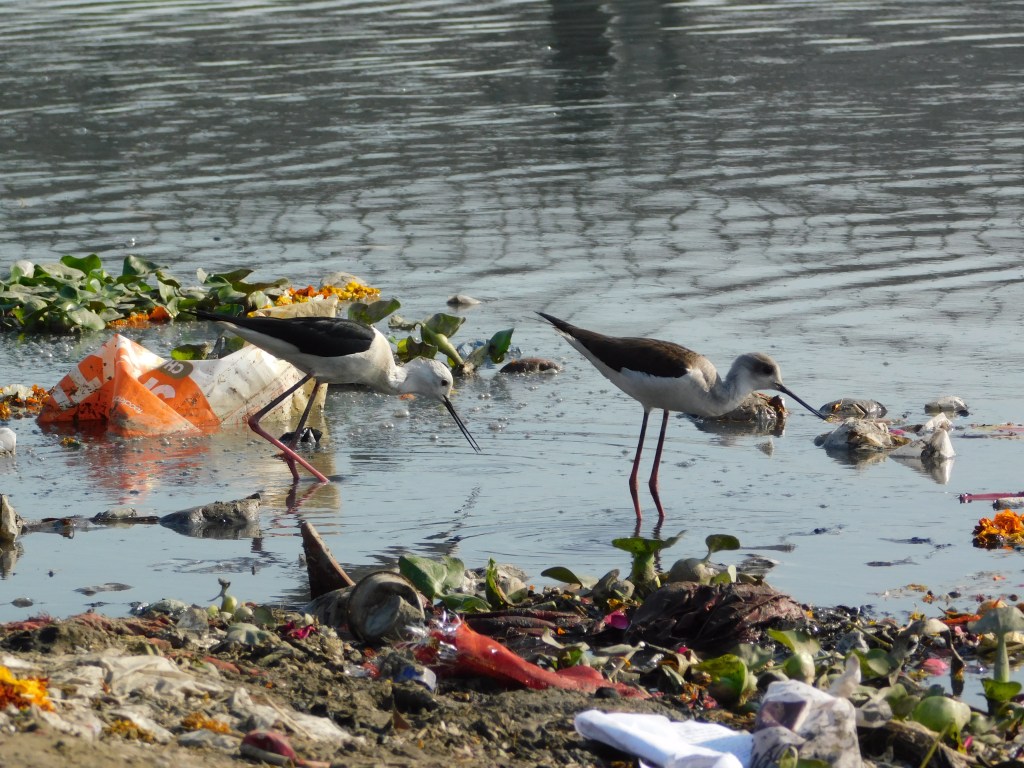
The report has well documented the present status of untreated industrial and domestic effluents increasingly polluting the river and slow progress of river cleaning projects including sanctioned under Namami Gange. Further, the report has signified how critical is environmental flows for the river in absence of which the pollution control and river cleaning projects are turning ineffective and futile exercise.
Despite staggering rise in untreated industrial effluents, sewage from municipal areas and solid waste from towns along Yamuna which indicates complete breaking down of river governance, the Parliamentary Committee has made No Recommendation on the institutional mechanism for pollution control and prevention and their functioning.
In fact, presently the State Pollution Control Boards (SPCB) particularly of Haryana (63% posts vacate), Uttarakhand (62% posts vacate) and Uttar Pradesh (40% post vacate) are hugely understaffed impacting their functioning. These institutions also have poor governance mechanism with little transparency, accountability or participatory governance.
The staff strength of UYRB with several responsibilities has been curtailed from 58 to just 22 over past two decades. Most of the posts are lying vacate for years and the UYRB is left with 5 functionaries that too posted informally from CWC.
The recommendations of forming a common portal for sand mining, floodplain, wetland encroachment, dumping of waste in river and preparation of guidelines on dumping of construction and other waste in Yamuna are positive outcome of the report. Similarly, suggestion for establishing DYCs and CYF are welcoming steps.
Though the recommendations are not legally binding, the Committee has asked the DoWR, RD & GR to apprise it on the updates in three months of publishing of this Parliamentary report. The measures of ensuring environmental flows in Yamuna, ensuring optimum treatment of effluents, regulating unsustainable riverbed mining and prohibiting encroachments of floodplain are some doable actions the respective governmental agencies can take. These steps would also to large extent determine the improvement in ground condition of the river.
One hopes that the DoWR, RD & GR and all other government agencies would follow the recommendations of the report in all their earnest and right spirit.
Bhim Singh Rawat (bhim.sandrp@gmail.com)

 SANDRP