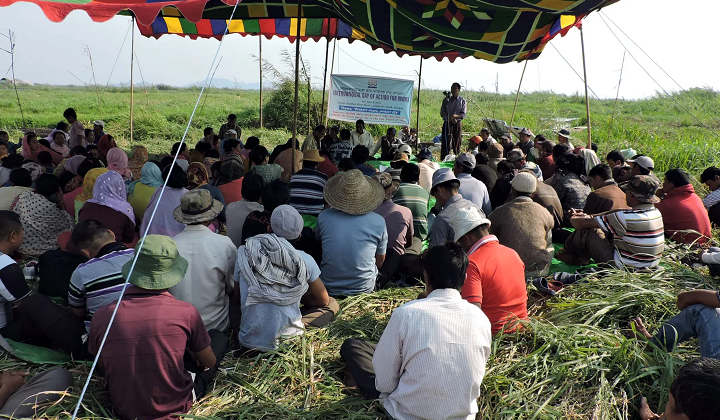
(Feature Image: Loktak fishers holding meeting at Champu Khangpok floating island village. Photo Credit: Vikalp Sangam)
World Wetland Day (WWD) is celebrated on February 2 annually to signify the environmental as well as socio-economic services and benefits provided by the wetlands both natural and man-made water bodies including rivers, lakes, ponds, reservoirs, swamps, marshlands deltas, coral reefs and mangroves. The theme of WWD 2024 is ‘Wetlands and Human Wellbeing’.
Ramsar Wetlands Convention selects Wetlands of International Importance, basically depending on nominations of the respective national governments and includes them under what is also known as the Ramsar List. However, it is not clear what exactly the Ramsar does for the protection of such designated wetlands. There are currently 75 Ramsar wetlands in India. In fact, the Ramsar sites have seen nearly a three-fold rise in the country in the past eight years decade (26 in 2014 to 75 in 2022). The complete list of 75 Ramsar wetlands in India can be seen here. The state of large number of these designated Ramsar Wetlands is pretty sad for years and decades and deteriorating, but it is not known if Ramsar convention is doing anything in this regard.
In reality, most of the Ramsar sites in the country have been facing the common problems of pollution, abuse, siltation, encroachments by private as well as public bodies adversely affecting their eco-systemic services and in turn livelihoods of dependent people. Disappointingly, there has been no concrete measures or plans taken so far either by governmental bodies or Ramsar convention itself to effectively address these issues. On the contrary, the Indian governments have been pushing destructive beautification and tourism projects making the plight of Ramsar wetlands and dependent people worse.
Through year end overviews, SANDRP has been highlighting the ground situation of Ramsar wetlands in India. Continuing the efforts, this article highlights the top ten reports. They present the worrying situation of Ramsar sites in India during the past one year. The crux of the matter is that currently the local and wetlands dependent people have hardly any say in Ramsar wetlands affairs be it selection process, governance or management issues.
Instead of addressing the increasing problems of pollution and encroachments, the governments have been pushing cosmetic and tourist centric plans without even consulting the dependent people. In most cases the governmental bodies themselves are responsible for continual degradation and encroachments of Ramsar wetlands.
1. EKW; West Bengal Water, livelihoods dry up for fish farmers The fish farmers of East Kolkata Wetlands are fast losing their farm water. Once a major breeding spot of fish such as rui, katla, pona, telapiya, tyangra, parshe, bhetki, chitol and galda chingri, the wetlands are drying up mainly due to the diversion of wastewater from Kolkata city to Vidyadhari river. “When the sewage accumulates at a height of 9 ft, the wetlands that house 200 fish farms receive water for pisciculture. For the fish ponds to benefit, this water level should be maintained at all times of the year,” explained Bantala resident Sudhir Sardar. If the sewage level is above 9 ft at Bantala station, the water flows to the farms. Conversely, if it falls to 8 ft or below, the water will not reach the wetlands.
The problem started when the authorities began to redirect water into the Vidyadhari. The STP at Bantala, which caters to East Kolkata Wetlands, is in a state of disrepair for a decade now. The redirecting of water into Vidhyadhari even during monsoons not only increases the risk of a breach downstream but also flooding in Kolkata city.
Environmentalist Sourav Chakraborti is convinced that local goons, ruling TMC, realtors and the police have formed a nexus. “They are trapping poor farmers by cutting off the water supply, thus forcing them to sell off fish farms to realtors. Old-timers say the real estate syndicate dates back to the 1990s,” Chakraborti said. Putting the blame on both CPM and TMC governments for the poor state of the water body, Chakraborti felt no political leader wants to acknowledge that the wetlands purify sewage. “They just want to encroach upon the entire area because they need money to fund elections.” Undoubtedly, the biggest gainers from dry wetlands are real estate dealers. As water runs out, more and more fish farmers are forced to sell their lowlands to real estate promoters for constructing multi-storey buildings.
In 2020, local NGO Laban Hrad Matsyachashi Kalyan Samiti filed a public interest litigation in the Calcutta High Court on the issues faced by fish farmers. Last December, the court ordered demolition of buildings constructed in the area. However, police or municipal authorities are yet to act. “An atmosphere of fear makes many remain silent. Even if they suffer, they refrain from talking about it. I can name three fishermen — Rabi Ghosh, Tapan Pandit and Roga Jasmin — who have been untraceable ever since they approached the police. That is why we moved court on their behalf,” said Sardar. https://odishabytes.com/water-livelihoods-dry-up-for-fish-farmers-of-east-kolkata-wetlands/ (25 March 2023)
The wetlands have been classified into three parts — settlements, where human habitations are allowed; agricultural land; and water body. An official of the environment department said that there are over 500 pending FIRs filed by the department for encroachments on land and water bodies at the protected site. An official said they hoped that before buying land, people would verify whether it is in any of the mouzas that form the wetlands. The whole of 30 mouzas and parts of seven mouzas constitute the wetlands.
A part of the wetlands is under the Calcutta Municipal Corporation and the rest is under the Bidhannagar Municipal Corporation. An official said the problems of encroachment, illegal construction and filling of water bodies are more prominent in areas close to the city. Some mouzas that under threat are Pashchim Chowbhaga, Jagatipota, Aatghara, Mukundapur and Nonadanga. https://www.telegraphindia.com/my-kolkata/news/it-is-our-pride-and-we-must-conserve-it-em-bypass-boards-for-wetlands-awareness/cid/1982421 (25 Nov. 2023)
Urbanisation is killing Indian wetlands Wetlands just outside India’s Kolkata city have for generations provided tonnes of food daily and thousands of jobs as they filter sewage through fish ponds. But rapid urbanisation is threatening the ecosystem. Conservationists warn that pollution and strong-arm land grabs are putting a lifeline for the megacity’s 14 million residents at risk.
“We are destroying the environment,” said Tapan Kumar Mondal, who has spent his life farming fish in the ingenious system of canals and ponds stretching across about 125 square kilometres (48 square miles). “The population … has increased, there is a pressure on nature, they are ruining it,” the 71-year-old added.
Listed as a wetland of global importance under the United Nations Ramsar Convention, the waters offer natural climate control by cooling sweltering temperatures – and act as valuable flood defences for low-lying Kolkata. But Dhruba Das Gupta, from the environmental group SCOPE, said short-sighted building development was encroaching on the wetlands. https://www.aljazeera.com/gallery/2023/7/18/kidneys-of-kolkata-how-urbanisation-is-killing-indian-wetlands (18 July 2023)
2. Pallikarani Marshland; Tamil Nadu Likely to lose Ramsar status The Pallikaranai marshland which has been recognised as a Ramsar site in 2022 is in the league of losing the status due to pollution in the marshland. The wetland is polluted with sewage discharge and dumping of garbage from the nearby Perungudi garbage dump yard. If the government and the concerned environment and forest department of Tamil Nadu does not act, the site may lead to Pallikaranai entering the International black list, Montreux Record. The Ramsar Convention can act on its own to blacklist Pallikaranai if the garbage dumping and sewage discharge cannot be controlled.
Pallikaranai marshland was spread across 5500 ha in 1965 and is now at a meagre 500 ha. The Perungudi dumpyard has taken up a large area of the Pallikaranai marshland in addition to the encroachments by government bodies like National Institute of Ocean Technology (NIOT) and Centre for Wind Energy Technology. Several Private parks and residential complexes have also eaten up the area of the marshland.
It may be noted that IIT Madras had in 2021, set up a pilot system to treat the leachate before it enters the marshland however funding for the project was stopped by the government and hence the project is stalled now. Environmentalists and social activists have called for setting up STPs to treat the water that enters the marshland from lakes. https://theshillongtimes.com/2023/09/09/sewage-discharge-garbage-dumping-pallikarani-wetland-likely-to-lose-ramsar-status/ (09 Sept. 2023)
38% of Pallikaranai marshland is under legal & illegal occupation According to the State counsel, who presented the map drawn by the Survey Department before the NGT Bench on Jan 22, of the total 1,206.59 ha of the Pallikaranai marshland, the Forest Dept has 749 ha. The remaining 38% is legally and illegally occupied by several public and private institutions besides the Greater Chennai Corp, which is in possession of 173.56 ha.
The Bench directed the GCC, which operates a huge garbage dump yard and has recently proposed an ‘eco-park’, to find an alternative place and allow the marshland to be restored to its original state. It was said that 16 ha of the dump yard has been reclaimed through biomining and will be handed over to the Forest Department. The counsel appearing for the civic body said another 40 has was planned to be reclaimed by the end of 2024.
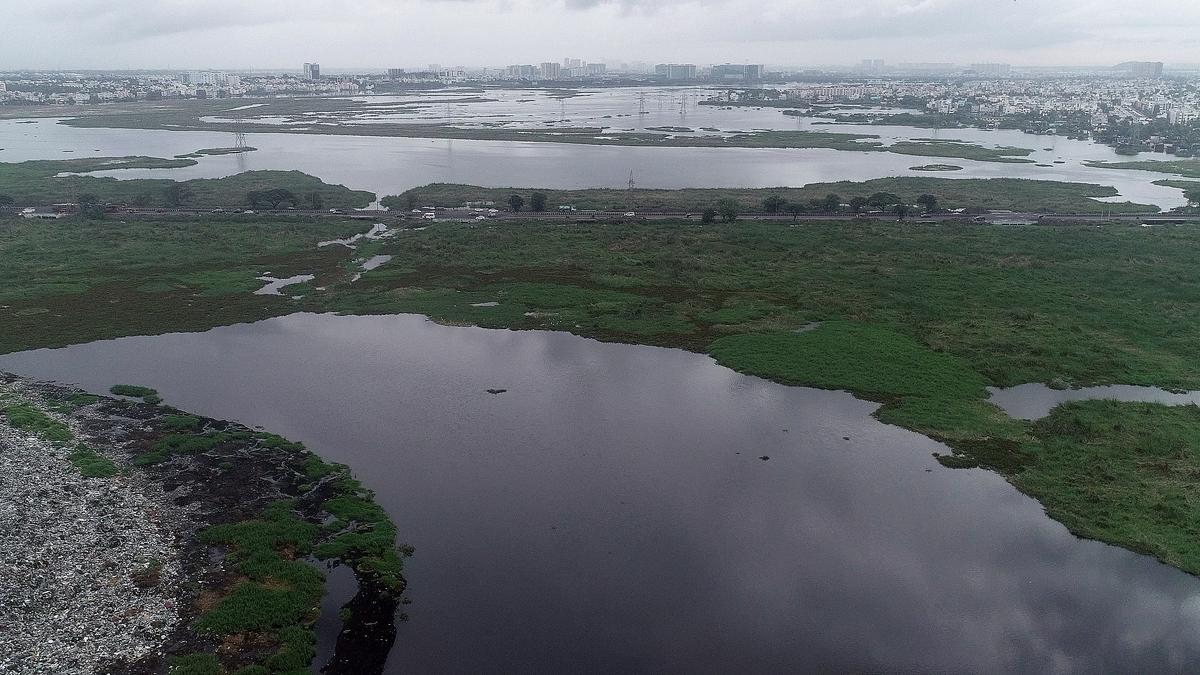
The other major occupants of the Pallikaranai marshland are the Electronics Corp of Tamil Nadu Ltd (163.25 ha) and the Railways (46.92 ha). Another IT park, Chennai One, illegally occupies 5.85 ha, said the State counsel. Referring to the companies, Mr. Korlapati said: “They can go to Siruseri. There’s a lot of land for IT companies there.” As for the Railways, the Bench said nothing could be done and asked the counsel to direct them to pay for maintenance.
The NIOT and the National Institute of Wind Energy each occupy 20.71 ha and 1.93 ha respectively. “NIOT and NIWE are the govt, they cannot encroach. You can give them an alternative piece of land to shift to,” the State counsel was told. Besides the institutions, residential areas, such as Kamakshi Nagar and Quaid-e-Millath Nagar (10 ha), Ambedkar Nagar (4.88 ha), Pari Nagar (3.24 ha), Mahalakshmi Nagar (2.91 ha), Maposi Nagar (2.38 ha), and Kandan Nagar (3.92 ha), have been built on the marshland, which continues to be polluted by sewage from residences and the waste from GCC’s dump yard.
Ordering the State govt to think of eviction option for these areas, the Bench sought a detailed response. Next hearing on Feb 9. https://www.thehindu.com/news/cities/chennai/survey-shows-38-of-pallikaranai-marshland-is-under-legal-and-illegal-occupation-tn-government-tells-ngt/article67766200.ece (22 Jan. 2024)
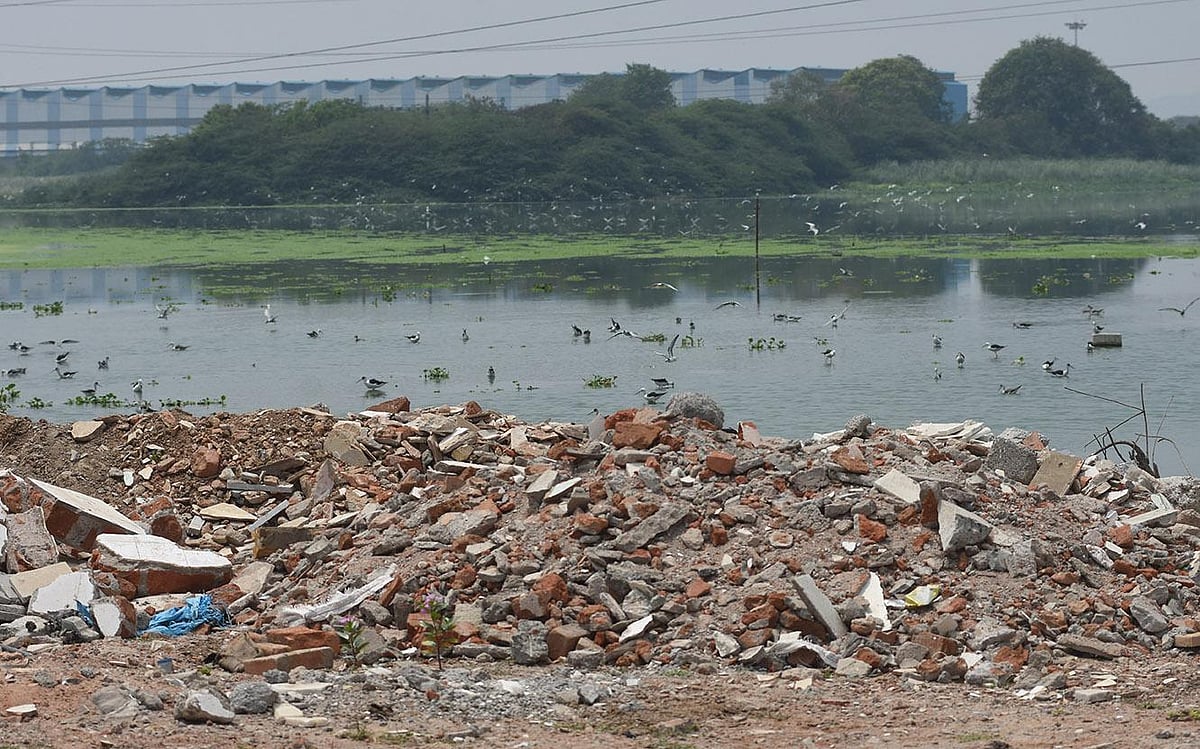
Realtors dump debris to ‘reclaim’ wetland Around 4 ha of the Pallikaranai marshland have become the dumping ground for tonnes of rubble and construction debris in the last couple of weeks. The laying of a 40-feet gravel road and construction of houses in patches is impinging upon the ecological balance of the wetland, which boasts of a multitude of bird and wildlife species.
As per the Ramsar Convention, no part of the wetland is supposed to be used for other purposes. https://www.newindianexpress.com/states/tamil-nadu/2023/mar/17/realtors-dump-debris-to-reclaim-chennais-pallikaranai-ramsar-site-2556798.html (17 March 2023)
Migratory birds’ habitat threatened https://thesouthfirst.com/featured/pallikaranai-marshland-a-crucial-haven-for-migratory-birds-threatened-by-pollution/ (21 Jan. 2024)
3. Loktak Lake; Manipur Fishermen express concern over push for inland waterways Loktak fishermen express concern over Govt’s push for inland waterways project. The All Loktak Lake Areas Fishers Union, Manipur (ALLAFUM), has questioned the Manipur government’s unilateral decision to advance the proposed Loktak inland waterways improvement project. The fishermen’ union contends that the state government has gone ahead without any consultation with the local fishing community residing in and around the peripheral areas of the Loktak Lake, the largest freshwater lake in South Asia, in Manipur’s Bishnupur district. They expressed concern over the potential adverse effects on the lake’s ecology and the traditional livelihoods of numerous fishermen families. https://www.icsf.net/newss/manipur-loktak-fishermen-express-concern-over-govts-push-for-inland-waterways-project/
Socio-political & environmental dynamics of Loktak lake The main ‘bone of contention’ is the Ithai Barrage which is seen as the root of all issues in the lake. The People’s Committee’s thrust is on the call for its decommissioning citing various reasons including biodiversity loss, ecological degradation, effecting massive crop loss with submergence of vast tracts of fertile agricultural lands, loss of livelihoods for local fishers and farmers, and most importantly for the failure of the hydro project proponents in keeping with their assurance on the rehabilitation and resettlement of the affected families – which translate into thousands of displaced families settled in Bishnupur, Thoubal, Kakching and Imphal West districts.

Their voice of dissent also reflects upon the pitiable conditions under which Manipur’s flagship mammal species – the Sangai, Manipur Brow-antlered Deer Rucervus eldii eldii – and the other wildlife are faring amid their deteriorating habitat in Keibul Lamjao National Park, which is often described as the ‘only’ floating national park in the world! The twists and turns continue to this day, with the lake managers always on the lookout for excuses to throw out the fishing community from Champu Khangpok floating island village. In one word, the fishers are “occupiers”, so say the lake managers. At this point of time, there are no alternatives for the fishers than to fight back as best as they can – for their rights to life. (Salam Rajesh) https://vikalpsangam.org/article/socio-political-and-environmental-dynamics-of-manipurs-loktak-ramsar-site/ (24 Jan. 2024)
Wildlife panel set to scrutinise Loktak lake resort proposals NBWL will hold a meeting to discuss diversion of 82.54 ha of forest land to build a golf course (42.14 ha) and a resort (40.40 ha) within the eco-sensitive zone of the Keibul Lamjao National Park and Khongjaingamba Ching Sanctuary for the proposed Loktak Lake eco-tourism project of the state government. During a NBWL meeting held on April 25, minutes of which were published this week on the Parivesh website, the standing committee decided to discuss the proposal with officials of the state forest department, LDA and other stakeholders.
Manipur organized an online meeting on “Wise Use Plan of Loktak Wetland and construction of Golf Course & Resort” on October 6, 2022, under the chairmanship of the additional forest chief secretary, when it was decided that LDA would pursue the matter with the Centre to obtain approval for the project. The union environment ministry will examine the plan submitted by LDA for approval at an early date.
The joint secretary in charge of the wetland division of the union environment ministry informed that a meeting was held on April 5 in the presence of environment minister Bhupender Yadav, when it was decided that the LDA will submit its comments on an appraisal report (AR) submitted by IIT Roorkee on the golf course and resort proposal along with its recommendations. This report was not available on the ministry’s Parivesh website on Tuesday (May 16) The LDA will submit a revised impact assessment for consideration of the ministry under the National Plan for Conservation of Aquatic Ecosystems (NPCA). https://www.hindustantimes.com/india-news/controversy-looms-over-building-a-golf-course-and-resort-on-forest-land-in-eco-sensitive-zone-of-keibul-lamjao-national-park-101684261098191.html (17 May 2023)
4. Haiderpur Wetland; Uttar Pradesh Tractors run through Ramsar site Agricultural activity is being carried out on Ramsar Site Haiderpur wetland’s fertile stretches with impunity, so much so that tractors are seen ploughing land in this protected place. All this is happening right under the nose of the administrations of the two districts (Muzaffar Nagar and Bijnor) and the UP irrigation department.
Asked about it, divisional forest officer of Muzaffarnagar, Kanhaiya Patel said: “This wetland is on the border of Bijnor and Muzaffarnagar and the land is divided between revenue departments of two districts, the UP irrigation department and the forest department. As of now, there is no clarity as to whose land is being used for cultivation.” Interestingly, the entire area falls under Hastinapur Wildlife Sanctuary but the forest division of Bijnor claims that “none of the land comes under the forest dept’s jurisdiction”. https://timesofindia.indiatimes.com/city/meerut/tractors-run-through-ravage-ramsar-site-in-uttar-pradesh/articleshow/97898081.cms (14 Feb. 2023)
After dewatering Haiderpur wetlands faces encroachment Wheat has been sown on a large area in the swampy part of the wetland along the Hastinapur Wildlife Sanctuary, environmentalists and local birders said. This has also led to removal of typha grass, which provides habitat for the swamp deer, and also the elusive Indian Grassbird, which breeds in the wetland. “We now fear the entire wetland region including grassland and swamp is threatened by encroachments,” Birder Asish Loya added. Sub divisional magistrate of Jansath area, Abhishek Singh said he has received report of encroachments and is sending a team to verify the situation on ground.
Shailendra Singh, director of TSA who works on turtle species in Haiderpur, said encroachment inside the wetland which is a part of Hastinapur Wildlife Sanctuary which is a protected area, is a very serious matter. https://www.hindustantimes.com/cities/delhi-news/after-dewatering-haiderpur-wetland-faces-encroachment-101676321040747-amp.html (14 Feb. 2023)
A joint team of forest department, district administration, and the irrigation department has launched a week-long drive to remove encroachment from Haiderpur Wetland inside the Hastinapur Wildlife Sanctuary in Muzaffarnagar. The problem began in the second week of January when the irrigation department drained off water from the wetland into the Ganga. This is an annual exercise to maintain a level of 10,000 cusecs of water at the barrage in the downstream of the river at Narora. However, taking advantage of the water being drained into the Ganga, people from neighbouring villages gradually entered the wetland and started sowing wheat after destroying typha grass, the natural habitat of swamp deer. https://www.hindustantimes.com/cities/others/drive-launched-to-clear-haiderpur-wetland-of-encroachment-101676717913563.html (18 Feb. 2023)
A three-member govt panel visited the Haiderpur wetland on March 1. The team’s visit comes in the wake of authorities carrying out an anti-encroachment drive to free the wetland, a recognised Ramsar site, of the wheat crops sown by nearby villagers in violation of norms. https://www.hindustantimes.com/cities/others/state-panel-inspects-haiderpur-wetland-for-encroachment-water-management-101677760665675.html (02 March 2023)
About 20% of the 6908 ha Haiderpur wetland in UP is encroached upon as per a report by the WII based on satellite maps. 1300 ha has been encroached upon between 2021 and 2023. In 2015-16, 562 ha of wetland was farmed. https://www.pressreader.com/india/hindustan-times-west-up/20230227/281659669238484 (27 Feb. 2023)
Water sports pose fresh threat to Haiderpur Wetland The Bijnor district administration organised a trial of canoeing, kayaking and rowing events, upstream from the wetland, on April 16, as it explored the possibilities of organising water sports in the area in the future as a way to attract tourists. The forest department has however raised objections to the activity in the wetland’s core area. “The district administration needs to seek permission from departments concerned before starting such activities because it could have an adverse impact on birds and the wetland,” said Kanhaiya Patel, divisional forest officer (DFO), Muzaffarnagar, whose views were seconded by his Bijnor counterpart, Arun Kumar. Patel said that such activities could be planned during the period when migratory birds go back to their breeding grounds. “But it can be done only after seeking permissions from NGT, and the forest and other departments.”

Ashish Loya, an environment enthusiast said both upstream and downstream areas of the barrage are ecologically sensitive areas and should not be disturbed at all by any kind of activity. Loya also said that Haiderpur is already facing tremendous challenges from illegal fishing and farming. https://www.hindustantimes.com/india-news/haiderpur-wetland-faces-threat-from-water-sports-as-district-administration-explores-possibilities-to-attract-tourists-raises-concern-among-forest-department-101681843711716.html (19 April 2023)
5. Hokersar Wetlands; J&K In last throes Noted environmentalist Ajaz Rasool said, “There has been a massive deterioration of the ecological status of Hokersar Wetland due to encroachment which has squeezed its area. Poor management strategies of the wetland have resulted in its siltation, uncontrolled growth, and proliferation of weeds in it and affected navigability in the water channels within it.” Ajaz, a hydraulic engineering expert, who had recently made a spot assessment of Hokersar, said major deterioration to its aquatic ecology occurred due to the highest recorded floods of 2014.
“The heavily silt laden floodwaters deposited enormous silt in the wetland along with other solid waste and compounded the already existing problems. A fatal blow to its hydrology occurred when the Irrigation and flood Control Dept envisaged to mechanically dredge a deep channel across it through contract as part of their flood recovery work in phase-1,” he said.
The proposal for the dredging was studied and approved by the Depts of Water Resources and Environment. The approval had put conditions based on the Environmental Impact Study that the executive agency should ensure maintaining a water depth of 4 feet (1.2 m) in the Hokersar wetland at all times as also before and after execution. Besides, there was a condition that the contractor would dispose of dredged material from the wetland area at least 2 km away from the boundary. “Unfortunately both these conditions were violated by the contractor despite the Irrigation and Flood Control Department and Wildlife Department putting him on notice,” Ajaz said. The deep dredging of the channel across the wetland drained off its water, rendering a large area of it dry. The dredged material was disposed of within the wetland, raising the ground level further.
“These adverse impacts resulted in Hokersar losing its hydraulic function of absorbing high inflow waters to release the same during dry spells. The physical, chemical, and biological functions also got affected and the quality of water entering did not improve during its retention or outflow as should have been in a wetland,” he said. Ajaz said that the visits by the experts of the Environment Policy Group made the authorities implement execution of water regulatory gates at inlet and outlet of dredged channel in Hokersar to ensure maintaining required stipulated water depth. This work taken up through IFC in the phase 2 of the flood recovery projects is scheduled to be completed by this year. https://www.greaterkashmir.com/todays-paper/front-page/once-known-as-queen-of-wetlands-hokersar-in-last-throes (16 Feb. 2023)
Wular lake, a Ramsar site, is in crisis over the last few years, the lake has turned into a waste dump, and has been gulping sewage, industrial and horticulture waste, replete with fertilizer and pesticide. Shrouded by encroachments, paddy fields, and willow plantations, the lake and surrounding marshes are mere shadows of their former selves.

In 2020, the Wular Conservation and Management Authority (WUCMA) began dredging in the lake in hopes of reviving it. It is a process involving underwater excavation of sediments and debris from the bottom of the lakes and other water bodies. But they managed to raise water levels in an area less than 2 sq miles, out of 17 sq miles, in the last three years. Moreover operations have been confined to the eastern part of the vast lake.
Multiple studies have established the negative impact of dredging on aquatic life. Several fishers are already reporting further decrease in catch. Environmentalists also allege that ill-managed dredging is hindering movement of waterbirds. From over a hundred thousand birds that usually graced the wetlands, only a few hundred were spotted last season. https://pulitzercenter.org/stories/kashmirs-wular-lake-crisis (19 Dec. 2023) https://www.greaterkashmir.com/todays-paper/editorial-page/save-wular-lake (23 Oct. 2023)
Vanishing Ramsar Wetlands of J&K Due to unabated encroachments, siltation & pollution, most of the wetlands are battling for survival. Despite being a Ramsar site, no tangible measure has been taken to restore Wullar and its associated wetlands in north Kashmir which comprise an important habitat for migratory water birds within Central Asian Flyway. Hygam, also a Ramsar site, has also been encroached upon and converted into land for paddy cultivation over the last two decades. Condition of another Ramsar site, Hokersar wetland is worst with unabated encroachments & siltation. https://www.greaterkashmir.com/todays-paper/editorial-page/vanishing-wetlands-of-jk (17 Apr 2023)
HC seeks status of 7 wetlands declared Ramsar sites The High Court Nov 20 granted a final opportunity to the J & K govt to file the report indicating the status of seven wetlands recognised to be of international importance and declared Ramsar Sites in J&K and Ladakh. Observing the failure of the govt to file the status report as a “serious lapse”, a division bench of Chief Justice N Kotiswar Singh and Justice M A Chowdhary while hearing a suo moto PIL noted that despite the order passed by the court on Sep 9 last year, J&K govt has not yet filed the report. https://www.greaterkashmir.com/front-page-2/high-court-seeks-status-of-7-wetlands-declared-ramsar-sites-in-jk-ladakh/ (21 Nov. 2023)
6. Vembanad Lake; Kerala Storage capacity down by 85% The water retention capacity of Vembanad lake has got reduced by 85% in the past 120 years due to massive encroachment and destruction of its ecosystem, says a five-year comprehensive study report on Vembanad wetland system done by scientists at the Kerala University of Fisheries and Ocean Studies. The report prepared by the Centre for Aquatic Resources Management and Conservation for the state government calls for a master plan to address the challenge of pollution, flooding and drought in the lake and associated areas and to revive the wetland system.
It said that the storage capacity decreased from 2,617.5 million cubic metres (MCM) in 1900 to 387.87 MCM in 2020. This sharp decline is due to extensive reduction in area extent (43.5%) of the lake (from 365 sq km in 1900 to the present 206.30 sq km). In the business as-usual scenario, it is likely that large portions of the lake may disappear soon.
Flash floods and inundation issues to a large extent can be mitigated by increasing the floodwater holding capacity of the lake. Improving the discharge ability of Thottappally Spillway and restoring the filtration efficiency of Kuttanad polders should be given priority. Plastic pollution in Vembanad lake is much higher than reported from most estuaries world over.
There is a marked change in the geomorphology of the rivers in the Vembanad system and the inflow of floodwaters to the coastal belt is much higher than the combined outflow from Thottappally spillway and Cochin barmouth. The cross-sectional area of rivers draining to the lake has narrowed at several stretches due to large-scale encroachments of river banks and construction of bridges. https://timesofindia.indiatimes.com/city/kochi/vembanand-lake-storage-capacity-down-by-85/articleshow/98766103.cms (19 March 2023)
The study released on March 18 says the wetland system faces declining ecosystem services and degradation in functional abilities from anthropogenic and natural disturbances. “The probability of a natural revival of the system is limited and therefore science and technology-based interventions are recommended,” says a brief for policymakers.
The wetland system has seen “alarming depth shrinkage” of the south and central Vembanad Lake. The study says the current fish diversity in the lake is represented by 90 species, a 40% decrease in diversity as 150 species were reported in the 1980s. The study has reported the presence of 30 different compounds of pesticides in the surface sediments in the south and central Vembanad Lake. https://www.thehindu.com/news/cities/Kochi/fisheries-varsity-study-reveals-a-highly-degraded-vembanad-wetland-system/article66634994.ece (18 March 2023)
Vembanad & Ashtamudi NGT slaps ₹10 cr penalty for failure to protect Ramsar sites The Principal Bench of the NGT has slapped a penalty of ₹10 crore on the Kerala govt for its failure to check the indiscriminate pollution of the Vembanad and Ashtamudi lakes, listed as Ramsar sites. The Bench said in its order on Mar 22 that the penalty imposed on the basis of the ‘polluter pays principle’ had to be deposited in a month in a ring-fenced account to be operated under the authority of the Chief Secretary.
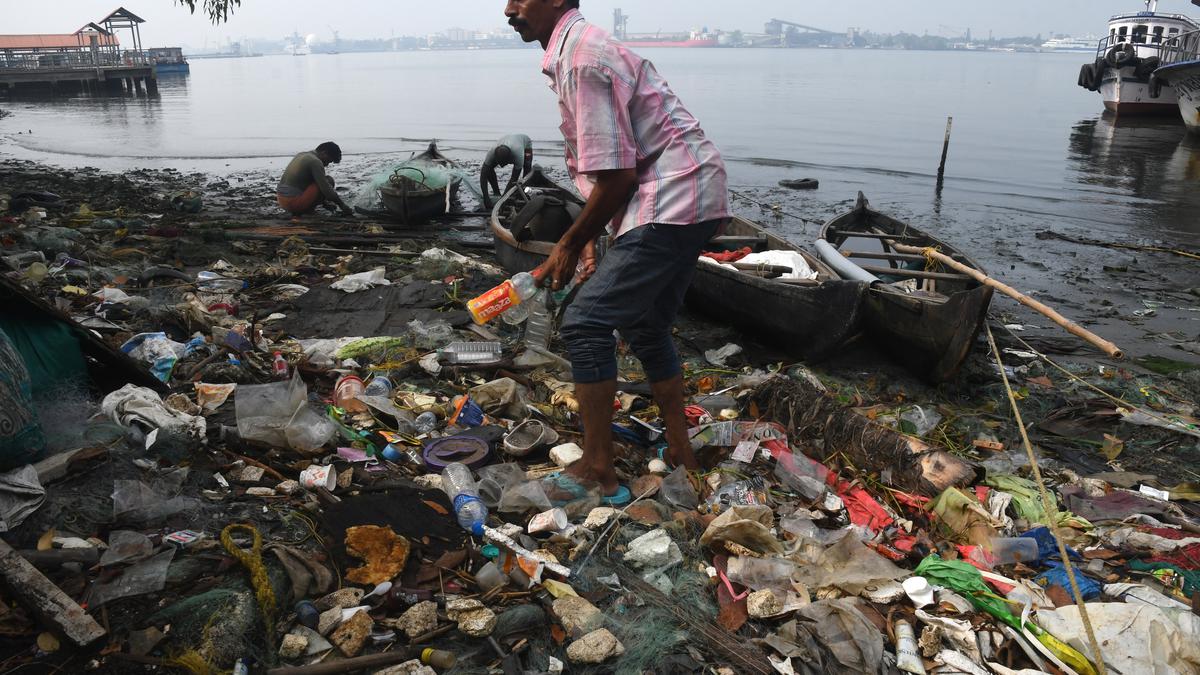
The NGT was disposing of a petition alleging failure of statutory and administrative authorities in taking remedial action for protection of the Vembanad and Ashtamudi lakes hit by illegal waste dumping. https://www.thehindu.com/sci-tech/energy-and-environment/ngts-principal-bench-slaps-10-cr-penalty-on-govt-for-failure-to-protect-ramsar-sites/article66657114.ece (24 March 2023)
According to a report submitted before the NGT, Clean Kerala Company Ltd has collected 9,77,678 kg of waste from Ashtamudi Lake during 2020-23. A survey conducted by the SPCB had revealed that the waterbody is under pollution stress due to dumping of solid waste and discharge of sewage from households and establishments. The Environment Committee of the Legislative Assembly too had reported large quantities of waste accumulation near the waterbody and directions were given to Kollam Corp and all panchayts where wastewater discharge was noticed. https://www.thehindu.com/news/national/kerala/special-enforcement-squads-to-stop-violations-of-waste-management-norms/article66656992.ece (24 Mar 2023)
“The State cannot plead helplessness in implementing guaranteed rights of the citizens and also in taking stringent measures for the protection of environment,” the NGT stated. In accordance with the tribunal’s prior directives, the state’s additional chief secretary filed an action-taken report on March 21. The document pictured a “disappointing state of affairs in doing the mandatory duty of protecting wetlands.” The two wetlands have long been susceptible to massive encroachments, pollution and depletion of ecosystems. https://www.downtoearth.org.in/news/pollution/vembanad-ashtamudi-ngt-slaps-rs-10-crore-on-kerala-for-its-failure-to-protect-ramsar-sites-88520 (29 March 2023)
Kole Wetlands Threats of alien plants Kole wetlands, a Ramsar site, has been facing the threat of alien invasive species. Cabomba furcuta, popularly called as Pink Bloom due its massive flowering, has been a new threat to the kole fields, in addition to water hyacinth and Salvinia molesta. Many parts of the water canals, crisscrossing the vast kole fields, have turned pink now. https://www.thehindu.com/news/national/kerala/kole-wetlands-face-threat-of-alien-plants/article67341793.ece (24 Sept. 2023)
Conolly canal harmful to Kottooli wetland ecosystem A study by a husband-wife duo, both professors, one at the Indian Institute of Management, Kozhikode (IIM-K) and the other at the National Institute of Technology, Calicut (NIT-C), has revealed that rapid urbanisation in Kozhikode city has led to the extensive destruction of the Kottooli wetlands, a proposed Ramsar site.
Deepak Dayanithy, a professor in strategic management at IIM-K, and Anjana Bhagyanathan, a professor in landscape architecture at NIT-C, have in their study in the journal Area of the Royal Geographical Society pointed out that contrary to popular belief, the Conolly Canal was not beneficial to the ecosystem of the Kottooli wetlands. https://www.thehindu.com/news/cities/kozhikode/conolly-canal-harmful-to-kottooli-wetland-ecosystem-finds-study/article67466856.ece (27 Oct. 2023)
7. Pong Dam; Himachal Pradesh Residents protest move to notify ESZ With the MoEF&CC issuing a draft notification declaring 1 km area from the boundaries of the Pong Dam Wildlife Sanctuary in Kangra district as an eco-sensitive zone (ESZ), hundreds of affected residents of 52 gram panchayats of different Assembly constituencies of Kangra district organised a protest rally at Nagrota Surian on Dec. 26.
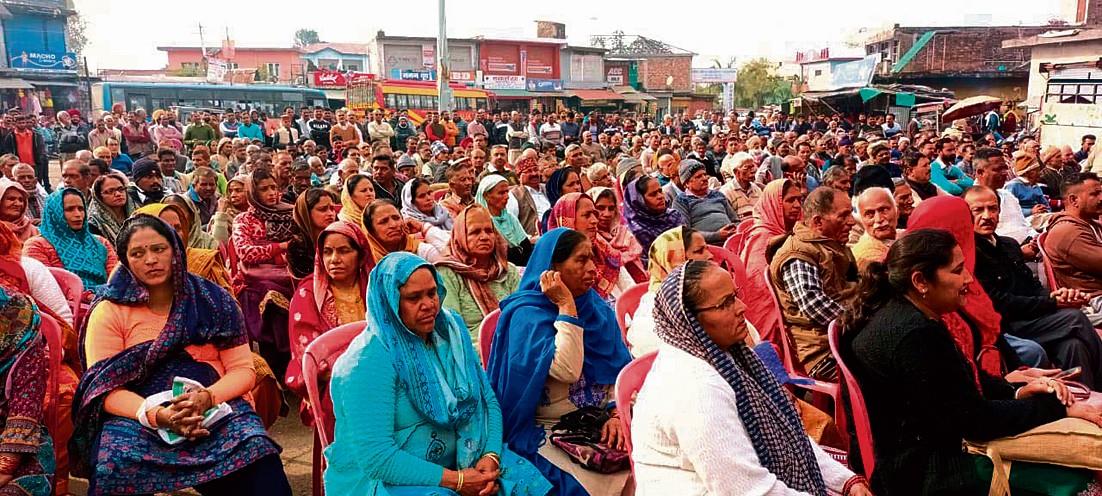
The residents appealed to the state government to raise their concern before the Union Government with a demand to de-notify the notification with immediate effect. Addressing the gathering, MLA Hoshiar Singh said the MoEF had sought objections from residents of 52 affected villages on April 28, 2022, for creating ESZ, but no gram panchayat had been informed about it. He said the proposed zone would be a major roadblock in the development of the area.
The Dehra legislator also announced to visit affected villages and collect objection letters from its residents and submit the same to the state and central govts demanding immediate withdrawal of draft notification. He said if this zone was not de-notified, the affected people would be forced to come on the streets against it. https://www.tribuneindia.com/news/himachal/residents-protest-move-to-notify-pong-wetland-eco-sensitive-zone-575712 (27 Dec. 2023)
Over 25,000 people displaced by the Pong dam on the Beas river have been waiting to be relocated for over five decades. Many of them were surviving by farming around the dam region. But a draft policy to declare Pong Dam ESZ is likely to impact these oustees again. https://www.downtoearth.org.in/news/governance/pong-dam-eco-sensitive-zone-awaiting-rehabilitation-for-over-50-years-not-consulted-for-policy-decision-say-locals-93814 (10 Jan 2024)
8. Deepor Beel; Assam Divert rising water of Brahmaputra to save Deepor Merely creating an inlet and outlet for the storm water of Deepor Beel will not save the Ramsar site of Guwahati city unless the rising water of the Brahmaputra is diverted to the wetland. This was suggested by Deepor Beel Suraksha Mancha (DBSM) in the aftermath of the visit of two ministers- Pijush Hazarika and Jayanta Mallah Baruah to the Deepor Beel on Mar 1, 2023.

“The inflow of untreated stormwater from Guwahati city to this wetland is degrading its water quality, making it hazardous for the aquatic flora and fauna. Municipal garbage and other solid waste dumping in the Belor Tol area near the wetland, and the lack of a comprehensive management policy with adequate institutional arrangements are the major threats to the existence of this wetland. There are other threats faced by the wetland and they need long-term management plans for effective mitigation,” said Pramod Kalita, general secretary of DBSM. “The diversion of flood water from the Brahmaputra refreshes the wetland. But it has been closed due to the fear of flash floods in Guwahati city” Kalita said. https://www.eastmojo.com/assam/2023/03/08/divert-rising-water-of-brahmaputra-to-save-deepor-beel-urges-env-body/ (08 March 2023)
HC upholds notification on Deepor Beel WS Gauhati High Court recently upheld the notification issued by state govt declaring an area of 4.1 sqkm of the “Deepor Beel” a Wildlife Sanctuary within the meaning of the Wild Life (Protection) Act, 1972.
The impugned notification dated February 21, 2009 issued by the Government was challenged before the single judge bench of the High Court on the ground that the same was issued without following the due process of law and also without taking into account the traditional fishing rights enjoyed by the petitioners. It was further submitted before the single bench that there was a requirement under the law to publish the proclamation issued under Section 21 (Proclamation by Collector) of the Act in the neighbourhood of the declared area which was never done by the authorities. https://www.livelaw.in/news-updates/gauhati-high-court-assam-government-notification-deepor-beel-single-bench-ruling-224795 (26 March 2023)
HC prescribes relief for Deepor Beel Hearing a petition by a trio of environment activists who are also farmers, the court prescribed 12 possible solutions to bailing Deepor Beel out of an ecological mess. One of the key suggestions by the court was the setting up of STPs at all the channels flowing from the city to the wetland to minimise the discharge of harmful chemicals or pollutants. No solid waste dumping should be allowed in and around the lake.
The DBSM has been pushing the local authorities to shift Guwahati’s garbage dump at Boragaon on the edge of the wetland. A decision to shift the dumping site has not been implemented yet. The court observed that Deepor Beel has also been in focus because of the construction of a railway line along its northern boundary. The issue was taken up by the NGT and various directions passed are in the process of compliance.
It recommended the construction of a promenade, cycling and walking tracks on the periphery of the lake for beautification, attracting sporting events, and checking the possibilities of encroachment. The court also said the State government should consider systematic and planned removal of water hyacinth from the lake for use in the handicraft industry. Among the court’s other suggestions was curtailing or regulating commercial fishing activities in the lake. https://www.thehindu.com/news/national/other-states/gauhati-high-court-prescribes-relief-for-oft-abused-assam-wetland/article67127107.ece (27 July 2023)
9. Kanwar Lake; Bihar Fishermen want bigger lake, farmers a dry patch Bihar’s only Ramsar site, Kanwar Lake is the source of livelihood for around 20,000 fishermen in 16 villages located on its banks. However, the depletion of this wetland due to manmade factors has dashed their hopes of a decent living, according to fisherman Mallah Rajo Sahni (53). The local fishermen are fully dependent on the lake and do not own agricultural lands. They want the wetland to be as expansive as possible so that they will get a better catch.

There is another group whose interests lie in perpetual contradiction with that of the fishermen. They are the local farmers. “Several mauzas (revenue villages) were included under the Kanwar Lake Bird Sanctuary, making farming in the notified areas illegal. A ban on land sale deteriorated our condition. We are unable to raise money even for marriages in our families,” says Anmol Kumar Sharan of Manjhaul village. “It is okay to declare it a wetland, but do it only where water is present. The rights of farmers should be restored on the rest of the land”.
Being part of the wetland complexes in the interfan of Burhi Gandak and Kosi rivers, the Kanwar wetland connects to the Gandak through a canal, now choking with silt. This has compromised the inflow-outflow mechanism to turn the wetland into a shallow marsh. Fishermen have repeatedly sought canal desiltation, but the state govt has shown no interest.
“Our emphasis is to maintain Kanwar Lake as a bird sanctuary. So there is no enthusiasm for fishing and other activities,” claims the forest official, when asked about the department’s activities to save the lake. Encroachments, illegal cultivation using fertilisers and chemicals, and other human activities have increased the nutrients in the water, leading to excess algal growth and decomposition that deprive oxygen to wetland flora. The inclusion of areas with human settlements under the protected zone has only added to the problem of pollution. https://101reporters.com/article/environment/The_paradox_of_Kanwar_wetlands_Fishermen_want_a_bigger_lake_farmers_a_dry_patch (24 Feb. 2023)
10. Sambhar Lake; Rajasthan NGT directs govt to demarcate lake area The NGT on Nov. 9 issued a slew of directions for protection of Sambhar lake, a Ramsar site. Additional Chief Secretary/ Principal Secretary, Environment Rajasthan was directed to ensure demarcation of lake area, delineation of core and buffer area of Sambhar lake wetland within 3 months. Additional Chief Secretary/Principal Secretary, Department of Revenue and Collectors of districts Nagaur, Ajmer and Jaipur should cooperate and coordinate with the Additional Chief Secretary/ Principal Secretary, Environment Department for completion of the above task, within the time prescribed, said the NGT.
The State Wetland Authority and all other concerned authorities have been ordered to finalise Integrated Environment Management Plan (IEMP) of Sambhar Lake and forward it to the National Wetland Committee for its approval within one month. IEMP should include a proposal for the establishment of ‘Hydrobiological monitoring station’ in the vicinity of the wetland. SPCB should take steps to stop discharge of untreated effluent in wetland whether by any local body or individual or industrial unit and take all preventive, prohibitive, remedial as well as punitive including criminal action against the defaulters/violators.
The NGT directed constitution of a High Powered Committee to visit the Sambhar lake & prepared a report on the aspect of illegal extraction of lake brine/water from the lake, installation of borewells illegally by the individuals or companies, violation of Wetland Rules, 2017 and other activities causing damage to the ecology of Sambhar lake and identify the violators. http://www.indiaenvironmentportal.org.in/content/476105/order-of-the-national-green-tribunal-regarding-protection-of-sambhar-lake-rajasthan-09112023/ (09 Nov. 2023)
See if Sambhar fest harmful to lake habitat: NGT to Govt The NGT on Feb 15 directed the state govt to address the grievance regarding the proposed 3-day Sambhar festival that adversely impacts migratory birds and their natural habitat. The tribunal also directed the authorities, including the chief secretary, to shift the festival’s location if any adverse effect is found. “Decision in the matter be placed on the website of the state by 5pm on February 16,” the NGT order said. The festival is scheduled to take place at Sambhar Lake from Feb 17 to 19. The green panel was hearing a petition that alleged that the festival’s activities, including kite flying, paragliding and motorcycle expedition, would adversely affect migratory birds and the natural habitat of the lake, particularly on account of the use of loudspeakers. https://timesofindia.indiatimes.com/city/jaipur/see-if-sambhar-fest-harmful-to-lake-habitat-ngt-to-rajasthan-govt/articleshow/97965016.cms (16 Feb. 2023)
Some More Relevant Reports on Status of Ramsar Sites in India
Bhoj Taal; Bhopal Govt seeks to go ahead with infra projects on Lower lake The UNESCO may have recognised both Upper Lake and Lower Lake of Bhopal as wetlands of international importance and named them as Ramsar sites but for the MP government and Bhopal Municipal Corporation (BMC), don’t consider Lower Lake a wetland. In fact, MP Housing & Infrastructure Development Board (MPHIDB) in its application before the NGT, seeking dismissal of the petition challenging its redensification project on the banks of the Lower Lake in Professors’ Colony under which it proposes to construct the collectorate building and a commercial complex, said that the criteria of leaving 50 metre open space (as applicable for the wetlands under the wetlands rules, 2017) applies only to the Upper Lake and no other lake of Bhopal.
The original petition filed by environmental activist Nitin Saxena seeking cancellation of the notification regarding the project issued by the urban development & housing department on July 21, 2023, says that not only did the urban development department allow construction in the ‘no-construction zone’ around Lower Lake but MPHIDB, a government undertaking, wants to go ahead with the project under Bhopal Master Plan, notwithstanding wetland rules notified in 2017 and Supreme Court guidelines on wetland preservation in 2021. Lawyer for Bhopal Citizen Forum, Harpreet Singh Gupta, said that once Lower Lake was recognised as a wetland, it will be covered under wetland rules and it will supersede everything else, every law and norms that existed before that.
He said a detailed reply to MPHIDB application for dismissal of petition would be presented. The NGT had given 3 weeks to all parties to reply to the MPHIDB application seeking dismissal of the petition. Nitin Saxena also said that they would file a reply on the MPHIDB application on March 11 to let it know what the guidelines were regarding no construction zone around a wetland site. Environmental activist Subhash C Pandey said that not only did BMC, district administration, department of urban administration and housing “forget” that Lower Lake is a Ramsar site but the department of environment, which is responsible for preserving wetlands, in its notification on March 22, 2022 on dos & don’ts on and around the wetland also “omitted” the Lower Lake and the notification relates only to the Upper Lake. https://timesofindia.indiatimes.com/city/bhopal/controversial-stance-of-madhya-pradesh-government-on-lower-lake-as-wetland/articleshow/107276384.cms (31 Jan. 2024)
NGT gives 3 more months to free Bhoj wetland area The central bench of NGT gave three more months to the district administration and BMC to remove all encroachments in Bhoj wetland area along the Upper Lake and also ensure that no untreated water is discharged into the water bodies of Bhopal. The petitioner in the case, Aarya Shrivastava, who was a student of National Law Institute University (NLIU) when she filed the petition, had sought removal of encroachments from the wetland in the Upper Lake in Bhadbhada area.
Counsel for the petitioner Dharamvir Sharma also referred to discharge of untreated water in the Upper Lake. The matter of control on the discharge of the untreated water into the water body and remedial action with provision of imposing environmental compensation was also taken up by the tribunal. The tribunal, while asking the MPPCB to calculate the amount of environmental damage according to parameters laid down and realise the same from the agencies/ departments concerned, said “The environmental compensation may be on the basis of either per month rate or on the basis of per drain or on the basis of per MLD discharge of untreated water, which is quoted above and notified by the CPCB.” Next hearing on Mar 21, 2024. https://timesofindia.indiatimes.com/city/bhopal/ngt-gives-3-more-months-to-free-bhoj-wetland-area/articleshow/105852859.cms (9 Dec 2023)
NGT imposes Rs.1 cr compensation for Illegal construction NGT has imposed a Rs.1 crore compensation on the BMC for undertaking illegal construction allegedly carried out for floating restaurants in a prohibited area of Bhoj Wetland, also known as Bhopal Lake. Directing BMC to refrain from proceeding with any further permanent construction on the site, the Tribunal has ordered the demolition of the already constructed RCC within one month. https://www.livelaw.in/environment/national-green-tribunal-orders-demolition-bhopal-lake-illegal-construction-232739 (14 July 2023)
Gujarat Rising water levels deter birds at 2 Ramsar sites Two Ramsar sites in Gujarat – Nalsarovar and Wadhwana — are facing the problem of plenty. Excess irrigation water from the Narmada flowing into these lakes is impacting migratory bird numbers and local vegetation on which several species like diving ducks and waders depend. Forest officials said the fluctuating levels at Wadhwana remain a matter of concern. Wadhwana is essentially an irrigation lake that provides water to surrounding villages and hence a certain level of water must be maintained. Forest department officials say water from the Narmada canal is released into this lake throughout the year. But erratic levels have impacted the number of migratory birds. “Sudden rise in water levels keeps many migratory bird species away. So, we have taken up the issue with the irrigation department and are making efforts to ensure that the water level remains stable during the four winter months. Lower levels during the migratory season will make the wetland an ideal site for birds,” said Raviraj Rathod, divisional forest officer (DFO).
– The department has also written to SSNNL authorities asking them to check the release of water into areas around Nalsarovar, besides asking local village panchayats to have water released only as per requirement. https://timesofindia.indiatimes.com/city/ahmedabad/impact-of-rising-water-levels-on-birds-at-ramsar-sites-in-gujarat/articleshow/107340237.cms (02 Feb. 2024)
Thane Creeck Flamingo Sanctuary; Thane HC sends Panje wetlands issue to Environment Dept The case dates back to Nov 11, 2020 when the state environment department asked City and Industrial Development Corp (CIDCO) and Raigad district collector to ensure that intertidal water flow to Panje wetland is not blocked. Meanwhile, BN Kumar of NatConnect recalled that the then CM Devendra Fadnavis had declared on Dec 4, 2015 that the State Wildlife Board has cleared three bird sanctuaries at Sewree-Mahul, Panje-Funde and NRI-TS Chanakya. The govt unfortunately is yet to implement this decision, Kumar regretted. “Even the Mangrove Cell and BNHS are keen to protect the wetlands but CIDCO has been in a denial mode. Panje also forms part of the Satellite Wetland Development Plan for the Thane Creek Flamingo Sanctuary – a Ramsar site – prepared by the Mangrove Foundation in association with BNHS,” Kumar said and regretted that the govt has failed to notify Panje as a wetland though it figures in the National Wetland Inventory Atlas prepared by the ISRO. https://www.freepressjournal.in/mumbai/bombay-hc-sets-aside-ngt-order-on-panje-wetland-in-navi-mumbai-issue-sent-to-state-environment-department (31 Jan 2024)
Environmentalists have raised concerns over a number of projects near the wetland. “Panje is the ideal location for building a biodiversity park. All that the government has to do is to strictly tell the CIDCO not to obstruct intertidal water flow,” says Nandakumar Pawar of Sagarshakti. Panje has been under attack for about five years with the intermittent blocking of tidal water, alleged Pawar. As a result of this the migratory bird population, which used to be 2.5 lakhs, has drastically dwindled. Panje biodiversity must be rebuilt now and the NMSEZ township be stopped, he said. https://www.freepressjournal.in/mumbai/dont-allow-concrete-jungle-on-panje-wetland-activists-to-govt (22 May 2023)
Following Raigad district collector’s confirmation that Cidco has marked the 289-ha Panje wetland in Uran for development by NMSEZ, greens have urged the Centre, state govt and the high court appointed wetland conservation committee to save the CRZ area. Panje is part of the Ramsar site, the Thane Creek Flamingo Sanctuary’s Management Plan prepared by the state forest department in association with BNHS. It also features in the Wetland Atlas of 2017-18 uploaded by the MoEF&CC, Debi Goenka of Conservation Action Trust (CAT) said. It is a CRZ1 property as stated by the Environment department itself, said BN Kumar of NatConnect, asking what stops the government from preserving it. https://timesofindia.indiatimes.com/city/navi-mumbai/greens-urge-govt-to-save-concrete-burial-of-panje-wetland/articleshow/101426787.cms (02 July 2023)
Tampara Lake; Odisha NGT asks govt to stop ‘illegal’ construction NGT on August 11, 2023 directed the state govt not to go ahead with ‘illegal’ construction in and around Tampara Lake, a designated Ramasar site and one of the largest picturesque freshwater lakes near Chhatrapur town of Ganjam district. The NGT has issued the order after hearing a petition filed by Wildlife Society of Orissa, which alleged that the ongoing large-scale permanent construction work in Tampara Lake was illegal. https://www.thehindu.com/incoming/ngt-asks-odisha-government-to-stop-illegal-construction-in-and-around-tampara-lake/article67184880.ece (12 Aug 2023)
Tampara forms part of the Rushikulya river basin where one of the prominent nesting grounds of the endangered Olive Ridley Turtles is located. As per the petition, the permanent construction within water area and 50 metre of the Tampara lake include restaurant, hotel, resorts, and cottages along with many other permanent concrete structures that have been undertaken by Odisha Tourism Development Corporation. The projects are being taken up under the Central government funded ‘Swadesh Darshan’ scheme. The Berhampur Development Authority has finalised additional infrastructure projects for the tourist destination at a cost of `8 crore.
The petition expressed apprehension that the recreational facilities which are being developed for tourists by allegedly reclaiming the Tampara land will threaten the rich biodiversity of the lake. The subsequent anthropogenic pressure because of the inflow of huge number of tourists will further have irreversible impact on the delicate ecosystem of the lake. As such no study has been conducted on the possible impact of huge infrastructure and permanent buildings, waste generated from the tourism activities and carrying capacity of the area, the petition alleged. https://www.newindianexpress.com/states/odisha/2023/Aug/12/tourism-construction-near-tampara-lake-gets-ngt-jolt-2604567.html (12 Aug. 2023)
Hirakud; Odisha High levels of toxic heavy metals High levels of cancer-causing heavy metals such as lead and chromium have been found in 8 wetlands in Odisha, including Hirakud. The findings were recorded in a new study published in the journal Scientific Reports on Sep 28, 2023. “Since the water from these wetlands is not being drawn directly for human consumption, the only way for people in the surrounding community to indirectly consume it is by consuming various foods from that wetland, such as fish, rice, some vegetables and spinach,” read the paper.
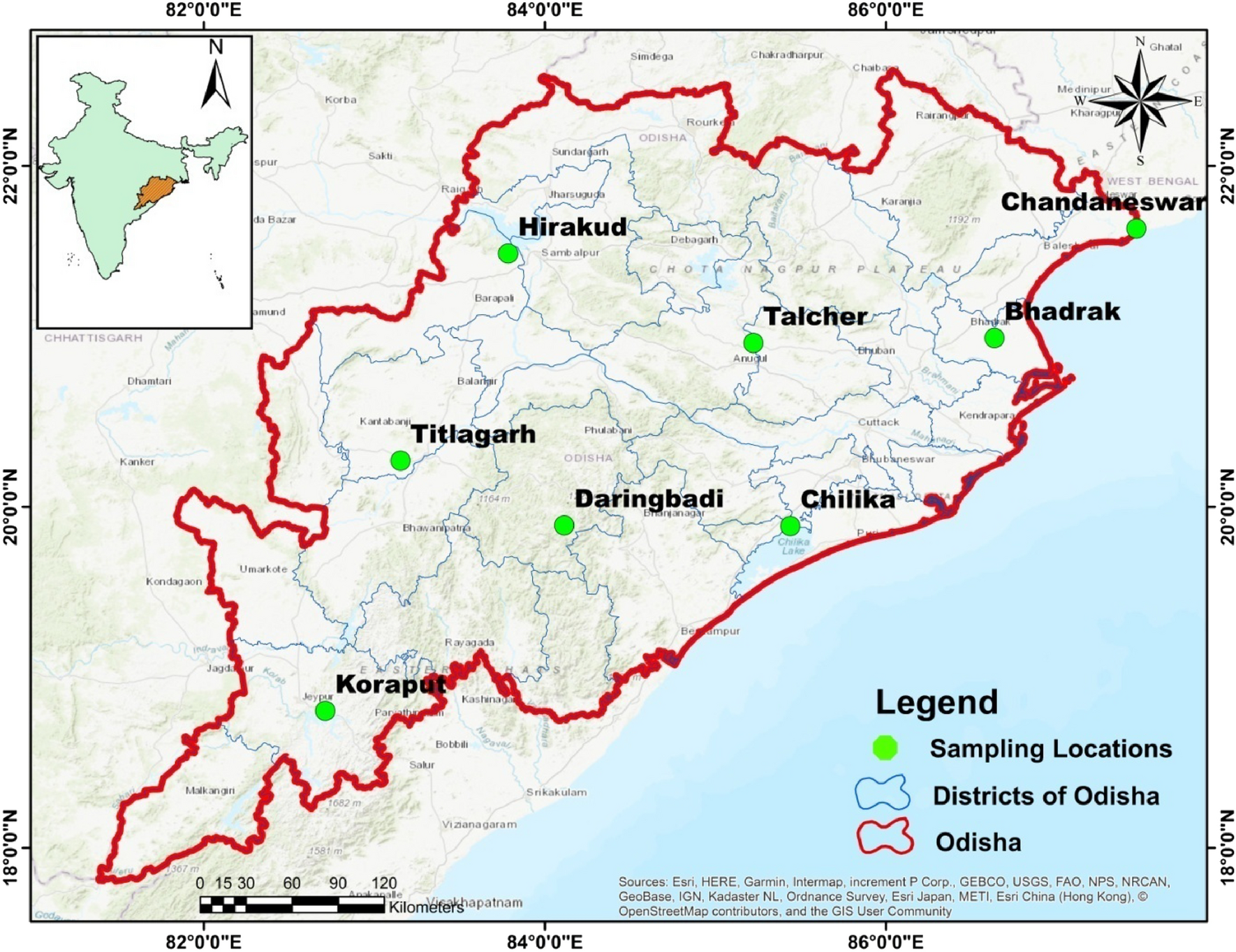
Very little was known about wetland pollution in the study area, the researchers noted. So they aimed to do three things: Study the wetland soils for the accumulation of heavy metals such as lead, chromium, copper and zinc. Secondly, to assess the ecological risk of wetlands inside agricultural landscapes. Thirdly, to study the human health risk potential of lead and chromium.
They selected 8 wetlands: Natural ones such as Chandaneswar, Chilika, Daringbadi and Koraput as well as constructed ones like Bhadrak, Hirakud, Talcher and Titlagarh. The researchers collected 144 samples from these wetlands. The highest concentrations of lead (51.25 micrograms per gram) & chromium (266 micrograms per gram) were found in Hirakud.
They found the highest concentration of copper at the Bhadrak, with 34.27 micrograms per gram. Koraput showed a higher abundance of zinc. All the sites, according to the findings, had a higher concentration of chromium than other studies had previously shown. https://www.downtoearth.org.in/news/health/hirakud-7-other-odisha-wetlands-show-high-levels-of-toxic-heavy-metals-92062 (03 Oct. 2023)
Kolleru; Andhra Pradesh Buzz of migratory birds on wane Kolleru Bird Sanctuary, in important habitat for the thousands of migratory and indigenous birds is now facing a serious threat of pollution. Due to the contamination of water and the apathy of the forest department officials, the bird sanctuary which hummed with the activity of thousands of birds is now witnessing a gradual decrease of migratory birds. As per the forest department, the lake is spread around 308.55 sq km. It was declared as a sanctuary in October 1999 and was designated Ramsar site in November 2022.
Water availability depends on Budameru, Tammileru, Ramileru, Gaderu and Bulusuvagu streams and a number of drains. The reason it attracts birds from across the world is the typical wetland flora which creates a wonderful niche for birds as well as the lake having 63 fish species. The birds’ number is confined to below 5,000 this year as against 7,000 last year.
The contaminated water which is being released from adjacent fishing ponds is posing a threat to the birds. A number of fish ponds were dug up nearby the bird sanctuary. Chemicals and feed used in aquaculture are polluting the bird sanctuary water. This contamination of water is resulting in reduction in fish species that feed the birds. Meanwhile, the polluted water is also affecting the breeding of migratory birds. Besides, the authorities concerned are not giving importance to maintaining greenery & plantation in the bird sanctuary. https://www.thehansindia.com/news/cities/vijayawada/buzz-of-migratory-birds-on-wane-at-kolleru-784238 (22 Feb. 2023)
Call for ‘Operation Kolleru 2.0’ gains strength The survival of India’s largest freshwater lake ecosystem, Kolleru Lake, is under severe threat as aqua ponds continue to encroach and thrive in the heart of the wetland. The rate at which the lake is witnessing encroachments demands ‘Operation Kolleru-2.0’ for the survival of the unique wetland ecosystem that serves as a breeding and feeding ground for 220 avian species including nearly 100 species migrating from the Palearctic region, suggest experts. 43,000 acres of illegal aqua ponds in Kolleru Wildlife Sanctuary were destroyed under Operation Kolleru in 2006 following a Supreme Court direction; experts say current situation demands a repeat of the operation. https://www.thehindu.com/news/cities/Visakhapatnam/call-for-operation-kolleru-20-gains-strength-as-encroachments-threaten-survival-of-indias-largest-freshwater-lake/article67393151.ece (09 Oct. 2023)
Kanjli; Punjab Wetland deteriorating The Punjab Chapter of the INTACH has sounded an alarm over the deteriorating condition of the Kanjli Wetland, situated near the town of Kapurthala and spanning over approximately 183 ha. It now demands immediate attention & comprehensive restoration efforts. https://www.tribuneindia.com/news/punjab/kanjli-wetland-deteriorating-says-intach-549512 (02 Oct. 2023)
Harike Count of migratory birds at 6-year low According to the Harike Water bird Census 2023, 65,624 birds arrived at the wetland between November-February. This is the lowest count in the past six years at Harike in Tarn Taran. Normally, 90,000-95,000 migratory birds arrived.
The fall in the number has compelled wildlife enthusiasts and the Forest Department to study the reasons behind it. If forest and wildlife officials are to be believed, water pollution caused by the factories located along the bank of the Sutlej could be one of the factors. Cement & paint factories, leather, dying industries located along the river discharge untreated waste that flows to the Harike wetland. https://www.tribuneindia.com/news/punjab/at-harike-count-of-migratory-birds-at-six-year-low-481331 (20 Feb. 2023)
Greens raise concern over Sutlej, Beas colour change Jaskirat Singh of PAC said that the visible colour change of Sutlej and Beas rivers to black and green respectively is an an indicator to the unaddressed pollution problem of Punjab. “The reason for the colour change is the discharge of effluents and sewage from channels like Buddha Dariya and Kala Sanghian drain that dump waste water of industrial towns of Ludhiana and Jalandhar into the Sutlej,” he said. The campaigners aim to bring together like-minded people who have love for environment and are committed to do something for its restoration, said Jaskirat told The Indian Express. https://indianexpress.com/article/cities/chandigarh/punjabs-harike-waterbody-concern-sutlej-beas-colour-change-9142064/ (03 Feb. 2024)
Keshopur-Miani Chhamb Gurdaspur’s wetlands need urgent help The Keshopur-Miani Community Reserve in Gurdaspur, is only habitat for sarus and common cranes in Punjab, it regularly supports more than 20,000 water birds. The Keshopur-Miani wetlands encompass marshlands, including aquaculture ponds and wetlands, in the former flood plains of the Ravi and Beas rivers. These are nourished by the annual monsoon. Ramsar acknowledges that Keshopur-Miani “is heavily human-influenced, and includes a series of managed fishponds and cultivated crops such as lotus and chestnut”, and that “the site is an example of wise use of a community-managed wetland, which provides food for people and supports local biodiversity”. The uniqueness, vibrancy and beauty of these wetlands, nestled among fields, roads and human construction, are being confronted with increasing pressures from spiralling population and the complex realities of expanding human habitats. https://www.tribuneindia.com/news/features/gurdaspurs-wetlands-a-haven-for-migratory-birds-need-urgent-help-572699 (18 Dec. 2023)
Panel to probe misuse of tourist centre funds Gurdaspur Deputy Commissioner Himanshu Aggarwal has constituted a fact-finding committee to look into the alleged misappropriation of funds in construction of the Tourist Interpretation Centre (TIC) in one of the country’s biggest wetlands-Keshopur Chhamb. The Asian Development Bank (ADB) had given a grant of Rs 8 crore to the Punjab Tourism Department. In 2016, work at the first phase of the TIC suddenly came to a halt. The first phase was constructed at a cost of Rs 4 crore while the second phase failed to come up. This meant the “half-baked” building could never be put to use.
Rules envisaged that the structure should have been handed over to the Wildlife Department in 2016 itself, but this was not done. In January 2018, the department took possession. An official said, “The TIC has been rendered a white elephant with nobody knowing what to do about it. Let us hope the committee comes up with something concrete and does not turn out to be a group of people who keep minutes but lose hours.” He added, “Some official files are sure to go missing now.” The TIC, had it been fully constructed, was meant to facilitate ornithologists and amateur bird watchers to study migratory birds. It was to come up in two phases and was to be equipped with the latest equipment. https://www.tribuneindia.com/news/punjab/panel-to-probe-misuse-of-tourist-centre-funds-517458 (16 June 2023)
Drop in migratory birds at 5 Ramsar sites Continuing with the downward trend, five wetlands in Punjab have recorded a fall in the number of migratory birds coming to them this year, according to the latest bird census by the state’s department of forests and wildlife preservation. Punjab has 6 Ramsar sites -Harike Wildlife Sanctuary, Nangal Wildlife Sanctuary, Ropar Conservation Reserve, Kanjli Wetland, Beas River Conservation Reserve, and Keshopur-Miani Community Reserve. The collective count of migratory birds visiting Ramsar wetlands fell to 85,882 in 2022-23, against 95,928 in 2021-22, a fall of 10.47%.
Harike wetland, the largest biodiverse wetland in northern India, which till recent years on average served as a habitat for about 95,000 birds of 90 different species saw only 65,624 birds of 84 species come from the colder regions of Europe and Asia during winter. Last year, 74,869 birds of 94 species had come to the wetland. Narbir Singh, vice president of Avian and Wetland Habitat Society, attributed the present trend to changes in weather pattern and local disturbances that have occurred within and areas surrounding wetlands. “These wetlands are under extreme stress due to construction, encroachments and change of landscape. There is also pollution,” said Narbir. https://timesofindia.indiatimes.com/city/chandigarh/punjabs-5-wetlands-see-drop-in-migratory-birds/articleshow/98243926.cms (26 Feb. 2023)
Yashwant Sagar; Indore 36% decline in Sarus cranes Yashwant Sagar wetland, which has been declared as Ramsar site, has reported a decline of around 36% in population of Sarus crane for which wildlife experts blamed man-made situations and negligence on part of the government agencies. “This year, our survey was started in April and concluded in first week of July, during which we thoroughly scanned the entire Yashwant Sagar wetland and its surrounding area and spotted a total 32 Sarus cranes,” ornithologist and president of Nature and Wildlife Conservation and Awareness Society (NWCAS) Ravi Sharma said adding that a decline of around 36% comparing to last year’s survey, when a total 50 Sarus cranes were spotted during the same time.
He pointed out that some ponds have been dug in the periphery of Yashwant Sagar Lake for fisheries hatching and soil were piled up to make the pal (pathways) to these tanks. For this, use of JCB machines is creating a lot of disturbance. Besides, operating motorboats in Gulavat, growing vegetables on the dried land of Yashwant Sagar by using insecticides and pesticides, fishing activities and illegal poaching of birds are some of the major reasons that are affecting the ecosystem and reducing its population. “Apart from checking these points, the authorities should use funds for Sarus and avian protection, conservation instead for beautification of Yashwant Sagar like pathways, railing, painting etc,” he said adding that picnic, pre-wedding shooting & such activities & human interventions should be discouraged. https://timesofindia.indiatimes.com/city/indore/yashwant-sagar-sees-36-decline-in-sarus-cranes/articleshow/102517407.cms (08 Aug. 2023)
Gulf of Mannar; Tamil Nadu Triple trouble for Gulf of Mannar islands Gulf of Mannar Biosphere Reserve (GoMBR) is a Ramsar site in Toothukudi and Ramanathapuram districts. Prosopis chilensis an alien invasive plant is threatening to pulverise native vegetation across 21 islands in the GoMBR, an avian distribution study has revealed. The authors of the study are H. Byju and S. Ravichandran of Annamalai University’s Centre of Advanced Study in Marine Biology, and N. Raveendran of the Madurai-based Iragukal Amritha Nature Trust. “We found the Prosopis chilensis in 7-8 islands. Any invasive species on an island will slowly kill the native trees as well as the mangroves,” Dr. Byju said. The scientists said they could not find any major studies on the invasiveness of this species or how it came to India.
Prosopis chilensis, a drought-resistant plant native to the arid regions of four South American countries — Argentina, Bolivia, Chile, and Peru — is not the only trouble for these islands divided into the Tuticorin, Vembar, Kilakkarai, and Mandapam groups. The coral reef has been destroyed in several places near these islands although coral quarrying for industrial purposes has been outlawed, the study published in the Journal of Threatened Taxa said. Human settlements, though not permanent, have also impacted the islands such as Poomarichan, Pullivasa, and Manoliputti in the Mandapam group, the study said, while recording 96 species of birds on these islands.
While the native vegetation “has lost ground to” Prosopis chilensis on some islands closer to the coast, the study underlined the “indiscriminate destruction of marine life” continuing despite efforts to educate and monitor the fishing community. The study cautioned about temporary settlements on the Mandapam group of islands primarily because of the use of the vegetation on the islands for cooking. Deployment of traditional fishing gear was also infrequently recorded, especially close to the mangrove fringes of many islands, which offer an ideal foraging ground for large wading birds.
The GoMBR, India’s first marine biosphere reserve, is one of the important habitats for coastal birds migrating as far as the Arctic Circle. The area is of particular significance as the 21 islands also serve as resting places for birds migrating to and from the nearby Sri Lankan islands. https://www.thehindu.com/news/national/other-states/triple-trouble-for-gulf-of-mannar-islands-study-finds/article66692147.ece (03 April 2023)
A silent, catastrophic invasion in the Gulf of Mannar Corals usually come in shades of green, brown, pink, yellow, red or blue. But a snorkelling investigation of three coral colonies adjoining Kurusadai, one of the 21 uninhabited islands that form the Gulf of Mannar Marine National Park along the Tamil Nadu coastline, shows them to be grey and eerie. The 21 islands came under the control of the forest dept in 1986, which established the national park — a 10,500 sq km reserve that is a habitat for the rare seacow, dolphin and dozens of coral species — the same year.

Being a protected area, tourism was not allowed in the national park until March 2022, when Kurusadai opened its doors to tourists (the other 20 islands are still closed for visitors). The corals, which provide shelter to myriad marine life, protect against storms and support livelihoods through fisheries and tourism, could have been the star attraction. “But they are dead,” says S Mahendran, forest range officer at the Mandapam Forest Range in Tamil Nadu’s Ramanathapuram district, where the national park is located. https://www.downtoearth.org.in/news/environment/coral-breach-a-silent-catastrophic-invasion-has-happened-in-the-gulf-of-mannar-here-is-how-87837 (16 March 2023) Potential offshore wind project in the Gulf of Mannar leaves fishers anxious. https://india.mongabay.com/2022/03/potential-offshore-wind-project-in-the-gulf-of-mannar-leaves-fishers-anxious/ (23 March 2022) During the third global coral bleaching event in 2017, corals in the Gulf of Mannar faced 16.2 percent mortality. In 2018, the corals begun recovering but the pace is much slower than usual. Recent research has found that the process of recovery is threatened by coral diseases, invasive species and exploitative fishing practices. https://india.mongabay.com/2018/06/corals-in-gulf-of-mannar-show-signs-of-recovery-after-bleaching-but-new-threats-loom/ (22 June 2018)
Compiled by Bhim Singh Rawat (bhim.sandrp@gmail.com)

 SANDRP
One thought on “WWD 2024: Top Ten Ramsar Wetland stories from India: Participatory Decision Making needed but totally absent”