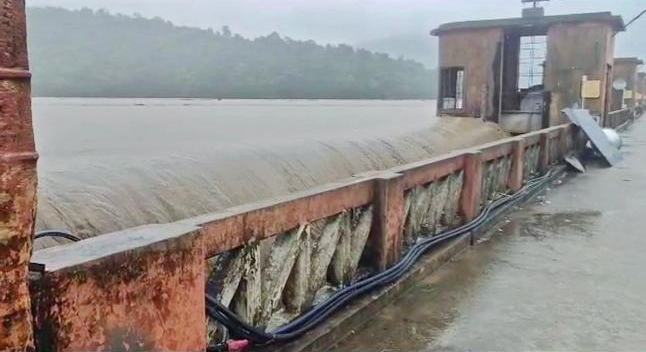
(Kaddam dam spilling over with flood waters in July 2023. Image Source: SM)
Telangana’s Kaddam Dam, built with inadequate spillway capacity, has seen multiple threats and disasters over the years, starting from the very first year after its commissioning in 1958. The dam again saw threat of being washed away during monsoon this year. The Telangana government has decided to rehabilitate the dam at a cost of Rs 640-700 Cr, by reconstruction of spillway and installation of new gates. We hope the new spillway capacity will be in line with the changed monsoon rainfall pattern and will be able to take care of the higher probable maximum precipitation and higher probable maximum flood. Though we are unlikely to get to know how this is going to happen, as the standard operating procedure of all dam owners in India is secrecy rather than transparency even in dam safety aspects. One also hopes this is done at the earliest, and till that is achieved, the dam rule curve will be changed to ensure the dam does not face disastrous situations during monsoon.
What is happening at Kaddam dam is something that is urgently required for most large dams in India. But there is no sign of the need to reassess the design floods of large dams in India keeping in mind the new rainfall regime and also new threats including Glacial Lake Floods in Himalayan dams. The consequences are starkly in front of us in the washing away of the Teesta 3 dam in Sikkim earlier this month, largely due to non-operation of spillway gates and inadequate spillway capacity. Many other dams are facing these threats, requiring urgent action.
Telangana Govt plans total rehabilitation of Kaddam project A plan for total rehabilitation of the Kaddam Narayan Reddy project is under active consideration and its implementation, according to the preliminary estimates, is likely to cost Rs.640 crore to Rs.700 crore, according to top Irrigation officials. The State government is seized of the issue and is considering the rehabilitation of the total project with a sense of urgency, they said.
The key component of the rehabilitation programme are the spillways of the project. Proposal for total reconstruction of the spillways is under consideration. The spillways component alone would be costing about Rs 600 crore while the rehabilitation of other structures including the crest gates is likely to cost nearly Rs.100 crore.
The reservoir, one of the oldest projects in the State, is highly prone to flash floods. Taken up in 1949, the construction was completed in 1958. It witnessed unprecedented flood the same year (August 31, 1958) resulting in breach of the dam.
The flood flow observed was in the order of over 5.19 lakh cusecs as against the designed capacity of 2.5 lakh cusecs. It was reconstructed with an increase spill way capacity adding nine more flood gates to the existing nine. The gross storage capacity was also increased by raising the full reservoir level (FRL) from 212.10 metres to 213.30 metres.
Similar flash floods occurred in Kaddam river in 1995 and again in 2022. Even as the flood flow on both occasions was over 6 lakh cusecs, the project could withstand the flood fury. Again on July 27 this year, the project received unprecedented inflows resulting operational problems with three spillway gates. https://telanganatoday.com/total-rehabilitation-of-kaddam-project-on-the-cards (8 Oct. 2023)
HYDRO POWER PROJECTS
SANDRP Blog Dam Safety Act & role of Dams in 2023 HP Floods We need a holistic view and a comprehensive strategy in place if we want to reduce the impact of such incidents as were witnessed in 2023 in HP in future. The notices given to 21 dam operators should be put in public domain and taken to their logical conclusion, fixing the accountability. Since the 21 operators include those from central, state and private sector, all sectors can be put on notice to improve their operations. Where there are lapses in state government functioning, including monitoring and compliance that should also be addressed. NHAI, which has been also put on notice for encroaching on Beas river bed[iv], need to be also held accountable for the muck dumping in the rivers, as determined by the High Court. The state dam safety institutions need to become much more transparent and they can in fact show the path for the rest of the country. On floodplain zoning policies and practices, HP can start with rigorously implementing the NGT orders and also brining its own policy and regulations.
All this becomes even more imperative and urgent considering the changing climate, the rainfall this year in HP is a rude reminder of that. Dam authorities have to be more transparent & vigilant themselves and about dam owners discharging their responsibility regrading dam safety with utmost care. The system needs to be cognisant of hazard creep and keep that in check. Flood plain zoning of rivers is something that needs to be done on war footing to manage floods and reduce future damages to our future development and also to reduce the hazard creep. https://sandrp.in/2023/10/11/dam-safety-act-the-role-of-dams-in-the-2023-hp-floods/ (11 Oct. 2023)
The above article on Dam Safety Act in view of the recent Himachal and Sikkim Dam Disasters by Archana Vaidya and Himanshu Thakkar (SANDRP) has also been published in DTE. https://www.downtoearth.org.in/blog/natural-disasters/dam-safety-can-no-longer-be-ignored-if-we-are-to-avoid-a-repeat-of-himachal-and-south-lhonak-lake-92208 (10 Oct. 2023)
This sudden loss of major infrastructure underscores another risk that climate change is amplifying: the vulnerability of hydropower and other dams to damage or destruction from floods that will continue to grow in magnitude.
– Such disasters include Libya and Sikkim (2023), Oroville-California-USA (2017), Michigan-USA (2020), Laos (2018), among others. The planning of infrastructure systems should fully consider a range of alternative solutions to these risks, such as land-use planning and reconnecting floodplains to reduce flood risk and diversifying generation technologies to reduce climate-driven risks to energy. https://www.forbes.com/sites/jeffopperman/2023/10/11/floods-in-libya-and-india-highlight-rising-risk-to-dams/ (11 Oct. 2023)
As the GLOF hit Sikkim at the South Lhonak glacial lake, it has come to fore that the continuous destruction in Himalayan states have caused widespread distress due to loss of life, property and an uncertainty of how the future would look like for mountain communities. Sikkim’s tragedy has inflicted another deep wound on the Himalayan communities (Himachal Pradesh, Uttarakhand, Assam) who have had no respite from the cycle of catastrophes throughout this year, finds Youth for Himalaya. https://timesofindia.indiatimes.com/india/disasters-inflicted-deep-wounds-on-the-himalayan-communities-youth-for-himalaya/articleshow/104443795.cms (15 Oct. 2023)
Glaciology and hydrology expert, IIT Indore associate professor Mohd Farooq Azam says that uncertain weather events driven by climate change played a role in Sikkim, all existing hydel projects in the Himalayan states must be reviewed for risk exposure. https://timesofindia.indiatimes.com/blogs/toi-edit-page/sikkim-tells-us-to-be-very-careful-before-allowing-any-new-hydropower-project-in-the-himalayas/ (07 Oct. 2023)

Earth scientist Dr CP Rajendran, who has specialised in earthquake geology and tectonics, with a special focus on earthquake generation along the plate boundary systems of the Himalayas believes the time has come for the government to undertake a serious reappraisal of their program of indiscriminate construction of hydro projects in the Himalayas. https://www.newsclick.in/after-sikkim-disasterthere-should-be-no-more-hydro-projects-himalayas (16 Oct. 2023)
The complex interplay between seismicity and other disasters in the context of climate Change in the Himalayas. https://science.thewire.in/environment/explained-climate-change-earthquakes-hydropower-himalayas/amp/ (20 May 2023)
Power Ministry CEA issues guidelines for hydro projects As per the guidelines the projects with a capacity of 400MW and above, termed “vulnerable”, would require the developer to scrutinize the reservoir upper reaches, pinpoint fault sites and take corrective measures for stabilization. https://www.livemint.com/news/india/cea-issues-guidelines-for-hydro-projects-after-disaster-in-sikkim-11696959278839.html (10 Oct. 2023)
In December 2022, the government signed a contract with the Defence Research and Development Organization (DRDO) of the defence ministry for the implementation of an early warning system (EWS) for vulnerable hydro projects or power stations. https://www.moneycontrol.com/news/business/mc-explains-how-govt-plans-to-safeguard-hydroelectric-projects-in-the-aftermath-of-sikkim-floods-11518271.html (12 Oct. 2023)
Himachal Pradesh HC stays amendments in HEP policy High Court stayed the decision of the state government taken on August 22, 2023 to amend the hydropower policy imposing more royalty on commissioning of power project in the form of free power. The counsel of JSW Energy and Senior counsel P Chidambaram demanded that the action of the state government is a breach of the pre-power purchase agreement should be quashed and the court should issue status quo ante on the matter which was allowed by the high court on the very first hearing on this matter on Thursday (Oct 12 2023). Next date of hearing is on Dec 6 2023.
– The govt amended the clause of royalty to be charged 15 percent for the first 12 years, 20 percent for the next 18 years, and 30 percent for the remaining 10-year period. After 40 years project should be reverted back to the State Government free of cost and free from all encumbrances and liabilities. https://www.himachalheadlines.com/news/set-back-to-himachal-govt-hc-stays-amendments-in-hydropower-policy/ (12 Oct. 2023)
Meghalaya A Hundred Years of Lighting Shillong with Hydro Power https://theshillongtimes.com/2023/10/15/a-hundred-years-of-lighting-shillong-with-hydro-power/ (15 Oct. 2023)
MoEF Minutes of the EAC on RIver Valley Projects held on Sept 12 2023. Decisions:
1. Raiwada Pumped Storage Project by ADANI GREEN ENERGY LIMITED located at ANAKAPALLI, ANDHRA PRADESH: TOR Approved
2. Emra-II Hydro Electric Project by ATHENA EMRA POWER PRIVATE LIMITED located at DIBANG VALLEY, ARUNACHAL PRADESH: TOR APPROVED
3. Proposed Expansion of Tembhu Lift Irrigation Project Taluka Karad, District Satara, Maharashtra: TOR APPROVED
4. Tainsar Pumped Storage Project by JINDAL RENEWABLE POWER PRIVATE LIMITED at DEOGARH, ODISHA: TOR DEFERRED for lack of exploration of alternatives to the project in reserved forest area.
5. Kadopada Pumped Storage Project by JINDAL RENEWABLE POWER PRIVATE LIMITED located at DEOGARH, ODISHA: TOR deferred, more info sought including about alternatives in non forest area, hydrology etc. https://parivesh.nic.in/utildoc/14306370_1696316870738.pdf
Agenda of MoEF’s Expert Appraisal Committee meeting on River Valley Projects to be held on Oct 17-18 2023:
1. Vijayanagar Pump Storage Project (130 MW) in 127.54 ha at Village Kurekuppa, Sub District Sandur, Dist Ballari, Karnataka by JSW Energy PSP Two Ltd – Environmental Clearance
2. Brahmani Pumped Storage Project (600 MW) in 284.95 ha at Village Rayata, Sub District Begun, Dist Chittaurgarh, Rajasthan by Acme Cleantech Solutions Pvt Ltd – Terms of References
3. Hasdeo Bango Pumped Storage Hydro-electric Project (1200 MW) in 145 ha at Village Khirati, Tehsil Morga Road, Podi-Uparoda, Dist Korba, Chhattisgarh by Chhattisgarh State Power Generation Company Ltd: Terms of References
4. Tarali Off Stream Open Loop Pumping Storage Project (1500 MW) in 150.74 ha at Village Kalambe, Jalu, Nivade & Tondoshi, Sub District Patan, Dist Satara, Maharashtra by Adani Green Energy Limited – Amendment in Terms of References
5. Ramial Left Bank Close Loop Pumped Storage Project (1500 MW) in 335.25 ha at Village Godikansa and Godinarda, Tehsil Telkoi, Dist Keonjhar, Odisha by M/s Renew Solar Power Private Ltd Reconsideration for Terms of References
6. Cumulative Impact Assessment and Carrying Capacity Study (CIA & CCS) of Yamuna River Basin in Uttarakhand by Indian Council of Forestry Research and Education (ICFRE), Dehradun – Modifications of Terms of Reference
7. Cumulative Impact Assessment and Carrying Capacity Study (CIA & CCS) of Yamuna River Basin in Himachal Pradesh by Indian Council of Forestry Research and Education (ICFRE), Dehradun – Status of study report
8. Cumulative Impact Assessment and Carrying Capacity Study (CIA & CSS) of Sutlej River Basin Study in Himachal Pradesh by Indian Council of Forestry Research and Education (ICFRE), Dehradun – Reconsideration of Study Report
9. Cumulative Impact Assessment and Carrying Capacity Study (CIA & CCS) of Tirap Basin. Inclusion of Chinglum Hydroelectric Project in Subansiri Basin – Conducting study
10. Proposal for conducting Cumulative Impact Assessment (CIA) & Carrying Capacity Study (CCS) of Ravi River Basin in Himachal Pradesh – Consideration of proposal
11. Discussion on requirement of CIA/CSS for small hydro power projects https://parivesh.nic.in/utildoc/14556150_1696412128934.pdf
INTERLINKING OF RIVERS
Ken Betwa Linking ग्राउंड रिपोर्ट- केन-बेतवा प्रोजेक्ट के साइड इफेक्ट: रहवासी बोले- डैम बनने से सब प्यासे मर जाएंगे; एक्सपर्ट ने बताया- कैसे होगा नुकसान https://www.bhaskar.com/local/mp/news/ground-report-side-effects-of-ken-betwa-project-131973469.html (11 Oct. 2023)
INTERSTATE WATER DISPUTES
Cauvery Water Dispute Tamil Nadu assembly adopts resolution The Assembly on Monday (Oct. 09) adopted a resolution urging the Centre to direct Karnataka to release water from the Cauvery river to the state as per the directions of the Supreme Court. The resolution was declared passed unanimously by speaker M Appavu after the BJP staged a walkout. CM M K Stalin moved the resolution and said Karnataka created an “artificial crisis” and had not released water from the river as per the apex court’s directions. The amendments included nationalisation of rivers and support to the Centre’s Dam Safety Bill. https://www.hindustantimes.com/cities/bengaluru-news/tamil-nadu-assembly-adopts-resolution-seeking-cauvery-water-from-karnataka-101696843569448.html (09 Oct. 2023)
Recent rainfall recorded in southern parts of Karnataka is expected to help the state tide over the Cauvery crisis, caused by below-normal rainfall during the South West monsoon season. Rainfall in districts such as Bengaluru Urban, Mandya, Mysuru, and others will ensure the flow of water to Tamil Nadu while helping Karnataka secure water for the summer months at Krishnarajasagar (KRS) reservoir, said experts. https://indianexpress.com/article/cities/bangalore/cauvery-row-relief-for-karnataka-rainfall-helps-meet-cwma-target-8975309/ (09 Oct. 2023)
Here V.R. Venugopal, BE (Civil) Karnataka suggests transferring of Sharavathi river water from Linganamakki dam to KRS reservoir as solution to Cauvery water dispute. https://starofmysore.com/a-permanent-solution-to-cauvery-water-dispute/ (09 Oct. 2023)
Krishna Water Dispute Andhra CM chairs high-level meeting CM YS Jagan Mohan Reddy on Monday chaired a high-level meeting on the Krishna river water issue in the wake of the Union Cabinet issuing terms of reference to the existing Krishna Water Disputes Tribunal II (KWDT-II). The state government has decided to move the Supreme Court in the wake of the gazette being released incorporating the Birjesh Kumar tribunal’s directions. The chief minister brainstormed with irrigation officials and legal experts and deliberated extensively on the earlier distribution plan of the Krishna river water, an official statement said.
The Andhra Pradesh government has decided to file a special leave petition in the Supreme Court over this issue, terming the latest developments of issuing the terms of reference and the release of the gazette as detrimental to the state. Officials highlighted that the Andhra Pradesh Reorganisation Act mandates that the Krishna river waters apportionment should adhere to the distribution plan implemented before the bifurcation of the state. The chief minister directed the officials to work towards protecting the interests of the state without compromise, including addressing letters to Prime Minister Narendra Modi and Union Home Minister Amit Shah. https://www.deccanherald.com/india/andhra-pradesh/andhra-pradesh-cm-chairs-high-level-meeting-on-krishna-river-water-issue-2-2719744 (10 Oct. 2023)
RIVERS AS NATIONAL WATERWAYS
– भारतीय अंतर्देशीय जलमार्गप्राधिकरण (आईडब्ल्यूएआई) के निदेशक एलके रजक ने जिला प्रशासन को क्रूज स्थगन का पत्र भेजा है। पत्र के मुताबिक, पर्यटक जलयान एमवी गंगा विलास क्रूज कोलकाता से वाराणसी तक 18 दिसंबर तक चलना था। लेकिन फरक्का-वाराणसी के मध्य अपरिहार्य कारणों से स्थगित हो गया है। इसकी सूचना कंपनी मे. हेरिटेज रीवर जर्नी प्राइवेट लिमिटेड ने दी है। यह जलयान आठ और नौ अक्टूबर को भागलपुर होकर गुजरने वाला था। जिसकी पूरी तैयारी प्रशासन ने कर ली थी। मजिस्ट्रेट के अलावा सुरक्षा बलों की भी तैनाती हुई थी। तब तक क्रूज स्थगन की कोई जानकारी प्रशासन को नहीं दी गई थी। https://www.livehindustan.com/bihar/bhagalpur/story-iwai-sent-letter-of-cruise-postponement-8846155.html (14 Oct. 2023)
URBAN RIVERS
Pune PIL filed against riverfront project A PIL was brought against the Pune Riverfront Project, with the primary contention being that the municipal commissioner was given the authority to chop down trees. Pune resident Shalvi Pawar filed a PIL against the Pune Municipal Corporation (PMC), mostly to oppose the Riverfront Development Project. https://www.hindustantimes.com/cities/pune-news/pil-filed-against-riverfront-project-101697048794072.html (12 Oct. 2023)
Coimbatore ₹990 cr for restoration of Noyyal The Central Government would soon allot ₹990 crore from the National River Restoration Fund, managed by the Ministry of Jal Shakti, for the restoration of River Noyyal proposed by the Coimbatore and Tiruppur city Corporations under the ‘Nadanthai Vaazhi Cauvery’ project. Of the total project cost of ₹ 1,200 crore, the Centre would be allotting ₹990 crore and the rest will be from the State Government. https://www.thehindu.com/news/cities/Coimbatore/central-govt-to-give-990-crore-for-restoration-of-river-noyyal-in-coimbatore/article67424053.ece (15 Oct. 2023)
CCMC completes 30% of Sanganur rejuvenation works The development works at the Sanganur stream in the city, which was kick-started at the cost of Rs 49 crore by CM MK Stalin on his visit to Coimbatore in November 2021, was halted for over 10 months by the Coimbatore City Municipal Corporation (CCMC) due to various issues. The civic body was awaiting the Tamil Nadu Slum Clearance Board to allot houses for the people encroaching upon the steam’s shores to resume the works. According to sources, the 11 km-long Sanganur stream, which passes through the centre of the city had been lying dormant for several decades without any water flow in the channel.
The Sanganur stream dredging and development project works were planned to be carried out in two phases. In the first phase, which was kick-started by Stalin, the civic body would be rejuvenating the canal for the first 2.2 km, from the Mettupalayam Road to the Sathyamangalam Road, at a cost of Rs 49 crore. In the second phase, the next stretch of 1 km would be revamped at the cost of Rs 30.3 crore. Based on the development works carried out for the 3.3 km stretch of the canal in two phases at the cost of Rs 79.3 crore, the government would plan the next phase of dredging and development, sources said. https://www.newindianexpress.com/states/tamil-nadu/2023/oct/15/30-per-centsanganur-canal-rejuvenation-works-completed-by-ccmc-2623995.html (15 Oct. 2023)
RIVERS
Opinion India’s rivers: From conservation movements to legal personhood In conclusion, the size and intensity of recent environmental protests in India have decreased. Due to their disparate priorities, an alliance between Hindu and environmentalist organisations seems unlikely, and the legal personhood strategy stands out as a difficult but workable alternative. The legal personhood campaign may gain momentum as there is growing interest in the rights of nature on a global scale and eventually play a significant role in the ongoing campaign to safeguard India’s rivers. (Harry Blair) https://www.indiawaterportal.org/articles/indias-rivers-conservation-movements-legal-personhood (07 Oct. 2023)
Report The tale of Saraswati Regardless of the physical existence of the river, Saraswati continues to hold an important place in Hinduism as the embodiment of knowledge, art, and culture. The river is often depicted as a divine figure with a veena (musical instrument) in one hand and a book in the other. https://timesofindia.indiatimes.com/travel/destinations/the-tale-of-saraswati-the-underground-river/articleshow/104429861.cms (15 Oct. 2023)
Arunachal Pradesh River clean-up and water conservation drive begins in Basar A week-long river clean-up and water conservation drive, organized by the Gumin Rvgo Kwlaju (GRK), was launched on the bank of the Hie River in Leparada district on Saturday (Oct. 14). Campaigns to raise awareness about river pollution will also be held in various schools. The program will culminate with a mass river cleaning event on 20 October. https://arunachaltimes.in/index.php/2023/10/16/river-clean-up-and-water-conservation-drive-begins-in-basar/ (16 Oct. 2023)
Himachal Pradesh NGT seeks report on construction of highway in floodplains The tribunal was hearing a petition which alleged the NHAI is constructing a four-lane highway from Kiratpur to Manali and Pathankot to Mandi in a flood-prone area near the Beas river. A bench of Chairperson Justice Prakash Shrivastava and expert member A Senthil Vel said it was “proper” to “call for a report” from the authorities concerned on the issue.
The bench then formed a joint committee comprising the executive engineer, (in-charge) of NHAI, an officer deputed by the member secretary of the CPCB and the member secretary of SPCB. “Member Secretary, SPCB will act as a nodal agency. The committee will examine the issue and submit the report before the tribunal within eight weeks,” the tribunal said disposing of the petition. https://www.tribuneindia.com/news/himachal/ngt-forms-panel-seeks-report-on-construction-of-highway-in-himachal-floodplains-553279 (14 Oct. 2023)
GANGA Bihar Part of under construction bridge collapses A part of an 80-meter-long bridge being constructed on the Magai River by Setu Nigam collapsed after a beam of the bridge broke, district officials said on Monday (Oct. 09). The District Magistrate said that the bridge being built by the Setu Nigam on the Magai River between Katharia and Firozpur at a cost of over Rs 8 crore. A three-member team has been formed to investigate and give a report within three days. https://www.business-standard.com/india-news/part-of-under-construction-bridge-collapses-in-bihar-no-casualties-123100900929_1.html (09 Oct. 2023)
RIVERS BIODIVERSITY
Research paper on how Gangetic dolphins are suffering due to canals and dams in Ganga. https://epaper.thehindu.com/ccidist-ws/th/th_delhi/issues/54794/OPS/GSABRKQJ9.1+GTLBRMLGT.1.html (08 Oct. 2023)
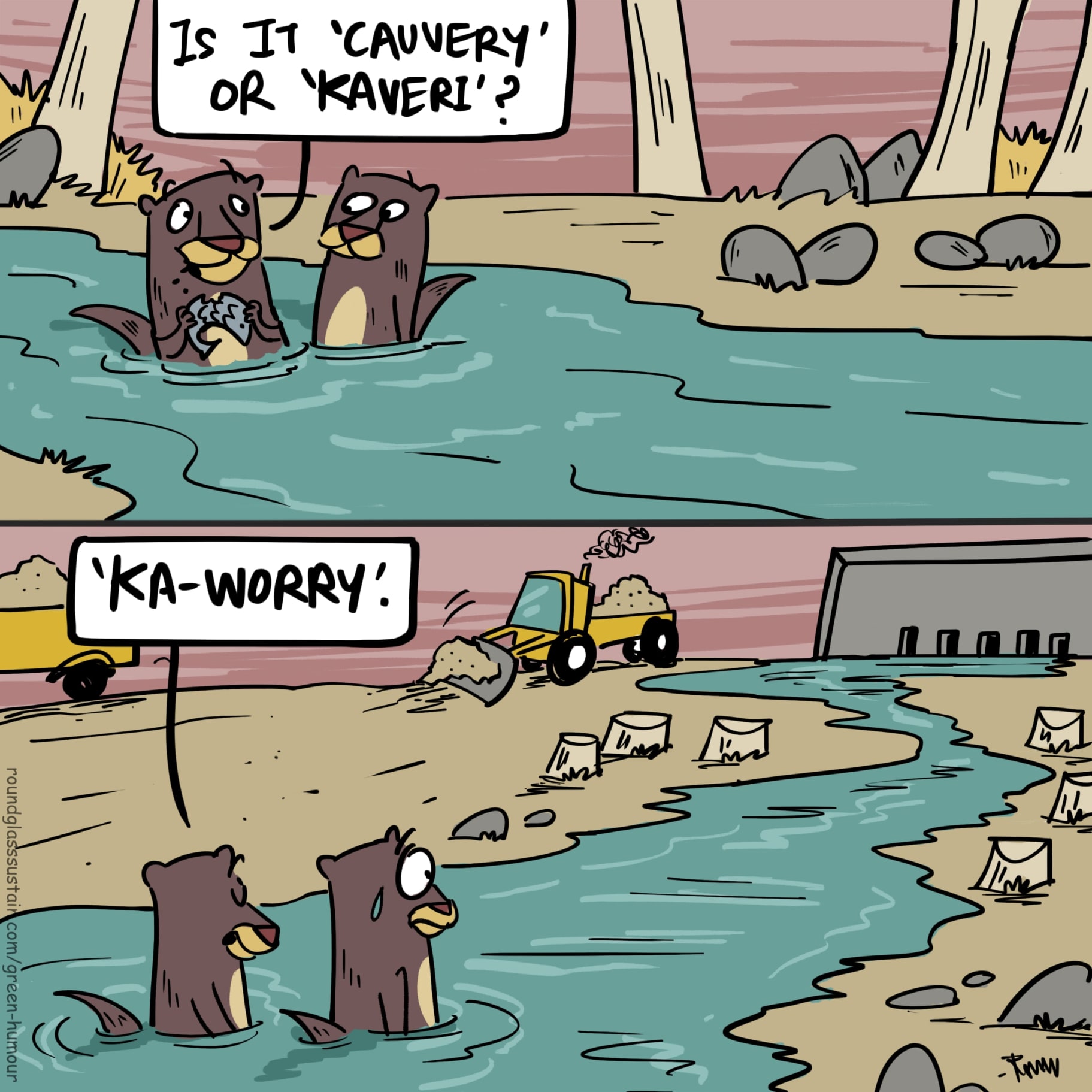
Otters Have Real Struggles by Rohan Chakravarty https://roundglasssustain.com/green-humour/otters-problems (10 Oct. 2023)
FISH, FISHERIES, FISHERFOLKS
Kerala Renowned fish scientist featured in Stanford’s 2023 top 2% scientists list Rajeev Raghavan, Assistant Professor at the Kerala University of Fisheries and Ocean Studies (Kufos), has found a place among the ‘Top 2% Scientists of the world’. Rajeev has found a place in both these lists and joins around 50 other scientists from Kerala (in the ‘career-long database’) and about 70 scientists from Kerala (in the year 2022 database). Rajeev Raghavan, is internationally known for his research on the taxonomy and conservation of freshwater fishes of Western Ghats and has close to 200 publications to his credit. https://www.thehindubusinessline.com/economy/agri-business/renowned-kerala-scientist-rajeev-raghavan-featured-in-stanfords-2023-top-2-scientists-list/article67398845.ece (09 Oct. 2023)
Study Dancing frogs a threatened species The elusive dancing frogs of the Western Ghats is one of the most threatened amphibian genus. The world is facing a critical Amphibian crisis with 41 per cent of species on the brink of extinction! The alarming statistics were revealed in the second Global Amphibian Assessment, a comprehensive analysis of 8,011 species worldwide, conducted by over 1,000 experts, according to a press statement. https://www.deccanherald.com/environment/elusive-dancing-frogs-of-western-ghats-a-threatened-species-report-2719860 (10 Oct. 2023)
SAND MINING
Himachal Pradesh Crushers operating ‘illegally’ on temple land in Kangra The working of the Damtal temple administration in Kangra has come under question as more than 10 stone crushers have allegedly been operating on its land illegally. The issue came to light during a visit to the site recently by a few Himachal MLAs, who were part of the Vidhan Sabha’s ‘Local Funds Audit Committee’. Interestingly, it’s the first time an investigation committee has been formed even though illegal mining was taking place for years. A portion of the land, especially close to Pathankot airport, was prone to illegal mining, sources said, adding the authorities had been dithering on action as the crushers were controlled by politically influential people. https://www.tribuneindia.com/news/himachal/crushers-operating-illegally-on-temple-land-in-kangra-553568 (16 Oct. 2023)
Tamil Nadu Senior official calls for cleaning up “internal mess” Even as the ED is investigating allegations of serious irregularities in the mining and sale of river sand in the state, a top official in the Water Resources Department has urged senior engineers of the Sand Mining & Monitoring Division to clean up the “internal mess” and disclose every inch of illegal sand mining sites to the central investigating agency.
In a letter sent to executive engineers and assistant executive engineers in Chennai, Villupuram, Tiruchi, Thanjavur and Madurai on Thursday, October 12, 2023, the WRD Engineer-in-Chief & Chief Engineer General, A. Muthaiya said: “This is the time of urgency where we have to clean our internal mess in our organisation and disclose every inch of illegal mining sites to the Directorate of Enforcement, the agency investigating this offence of money laundering.” https://www.thehindu.com/news/national/tamil-nadu/sand-mining-in-tn-senior-official-calls-for-cleaning-up-internal-mess-disclosing-all-illegal-sand-mining-sites-to-ed/article67420014.ece (14 Oct. 2023)
WETLANDS, LAKES, WATER BODIES
Andhra Pradesh Call for ‘Operation Kolleru 2.0’ gains strength The survival of India’s largest freshwater lake ecosystem, Kolleru Lake, is under severe threat as aqua ponds continue to encroach and thrive in the heart of the wetland. The rate at which the lake is witnessing encroachments demands ‘Operation Kolleru-2.0’ for the survival of the unique wetland ecosystem that serves as a breeding and feeding ground for 220 avian species including nearly 100 species migrating from the Palearctic region, suggest experts.
43,000 acres of illegal aqua ponds in Kolleru Wildlife Sanctuary were destroyed under Operation Kolleru in 2006 following a Supreme Court direction; experts say current situation demands a repeat of the operation. https://www.thehindu.com/news/cities/Visakhapatnam/call-for-operation-kolleru-20-gains-strength-as-encroachments-threaten-survival-of-indias-largest-freshwater-lake/article67393151.ece (09 Oct. 2023)
Kerala Alappuzha’s houseboat industry reels under sewage disposal issue Forced to dole out large sums as penalties due to the non-functional STPs and the lack of any alternative arrangements, a section of houseboat operators are all set to hold protests, while the others have adopted a “wait and watch” policy in the hope that the government would soon come out with solutions. “We’ll conduct a protest march to the District Tourism Promotion Council office (DTPC) here and a dharna in front of the District Collectorate on October 16. On one hand, the government is doing nothing to resolve the pollution issue and on the other, it levies huge penalties and cancels licenses. The same is affecting the survival of the houseboat industry here,” said Kevin Rozario, general secretary of the All Kerala Houseboat Owners and Operators’ Samiti. As per the current provisions, the annual licence fee for operations will be renewed only if operators empty septage from their houseboats every three months. https://www.onmanorama.com/kerala/top-news/2023/10/10/alappuzha-houseboat-industry-in-crisis-due-to-sewage-disposal-issue.html (10 Oct. 2023)
Uttar Pradesh Govt seeks 4 weeks to tell NGT of status of Dhanauri wetland The Uttar Pradesh government has sought four weeks’ time to inform the NGT about the status of notifying or providing legal protection to the Dhanauri wetland in Greater Noida. The Dhanauri wetland harbours 23 species of endangered, critically endangered, and threatened birds, and is one of the most important habitats for the sarus crane. However, the Uttar Pradesh government has been dragging its feet on notifying the area as a wetland for several years now.
Anand Arya, a Greater Noida-based birder and environmentalist, moved NGT on October 3, praying that the tribunal direct the UP government to notify Dhanauri wetland as the Balmiki Ramsar Wetland and Sarus Sanctuary/Conservation Reserve, as directed by the Union environment ministry in five separate letters between 2019 and 2022 — May 28, 2019; March 20, 2020; August 30, 2020; February 21, 2022; and March 17, 2022 — and implement a conservation plan for the wetland in consultation with the Wildlife Institute of India. https://www.hindustantimes.com/cities/delhi-news/upgovt-seeks-4-weeks-to-tell-ngt-of-status-of-greater-noida-s-dhanauri-wetland-101697395486920.html (16 Oct. 2023)
Rajasthan Udaipur in race to be nation’s first wetland city Udaipur is surrounded by five major lakes and is already part of the restoration project of the National Lake Conservation Plan. The state environment and forest department is sending a nomination to the Ramsar Convention to declare Udaipur as a wetland city. Only a handful of cities in the world have been given this title. Other than Udaipur, Bhopal is also in the race for the tag. In 2022, during CO, the convention recognised 25 cities as wetlands such as Sackville in Canada, Ifrane in Morocco, Cape Town in South Africa and other countries. Currently, there are 42 wetland cities spread across 17 countries worldwide, with China having the maximum or 13 such cities. https://timesofindia.indiatimes.com/city/jaipur/udaipur-in-race-to-be-nations-1st-wetland-city/articleshow/104327336.cms (11 Oct. 2023)
URBAN WATER
Bengaluru Enforce rainwater harvesting rule strictly In 2011, the government mandated RWH for new houses built on plots 60×40 feet or larger. In 2021, RWH was made mandatory for new constructions on 30×40 feet sites. The rule for 60×40 ft and larger plots was enforced retrospectively. Data from BWSSB shows that only 1.8 lakh out of the 19 lakh eligible properties in Bengaluru have installed RWH systems. The BWSSB says penalising non-complying households has had little impact. The board collects nearly Rs 1 crore in fines every month, but households would rather pay the fine than install the RWH system.
Even at present, several new extensions do not have access to Cauvery water and are forced to make their own arrangements to meet their demands either through tankers or borewells. The couldn’t-care-less attitude of many Bengalureans regarding RWH is unfortunate. Unless there is a change in mindset, the city could soon be facing a major water crisis. https://www.deccanherald.com/opinion/editorial/enforce-rainwater-harvesting-rule-strictly-2711304 (04 Oct. 2023)
Even though manual scavenging was officially banned in 1993, it continues in the city. This is due to the increasing number of STPs and a lack of awareness about their operation and maintenance. https://bengaluru.citizenmatters.in/stps-manual-scavenging-apartments-kspcb-bwssb-128544 (12 Oct. 2023)
Mumbai NGT fines IMC for SW mismanagement The NGT, Western Zone has directed the Igatpuri Municipal Corporation (IMC) to pay Rs. 76 lakh as environmental damage compensation within three months for its failure to set up a Solid Waste Management Plant. Judicial Member Justice (Retd) Dinesh Singh and Expert Member Dr Vijay Kulkarni noted that Golibar Maidan in the heart of the city, where all type of waste from 30 to 35 feet high is accumulated, is “not a suitable place” for establishment of Solid Waste Management Plant.
During the rains huge amounts of toxic garbage flows into the nearby stream and from there to the Vaitarna river and dam. The dam caters to the water needs of over 17 lakh homes in Mumbai and the IMC received several notices from the BMC, the court noted. Applicants Ajay Gulab Singh and others through advocate Abhishek Yende and Sagar Paspohe claimed they were assured of another dumping site over 10 years ago but there is no progress since then.
IMC argued that it had already decided to set up a plant in Awalkhed around 6-7 kms from Igatpuri back in 2002. In 2008 they purchased the plot of land and began construction. However, Aseema Public Trust, running a village school, objected and approached the High Court. In 2010, the Bombay High Court ordered status quo which continues till date. The Public Trust argued against shifting the plant to Awalkhed as the Zoite river is only 10 meters away and there would be health hazards for the villagers.
The tribunal opined urgent measures were required to minimize the health hazards. The IMC could either pick an alternate site or push the matter before Bombay High Court for disposal. But it would have to pay compensation till then as ordered by MPCB, NGT held. If a compliance report isn’t submitted within eight weeks penalty would be recovered from the Member Secretary, MPCB and Chief Officer, Igatpuri Municipal Council. https://www.livelaw.in/environment/ngt-mumbai-water-quality-igatpuri-municipal-corporation-solid-waste-management-239709 (10 Oct. 2023)
Noida 13 fined ₹10 lakh each over illegal water extraction Thirteen establishments in Gautam Budh Nagar have been fined ₹10 lakh each for illegally extracting groundwater without the necessary permits. Five establishments have paid the fine, while eight others have yet to comply. Further actions, such as sealing their borewells, will be considered if they fail to pay. The groundwater department will continue identifying and taking legal action against builders who deplete groundwater resources and fail to follow regulations. Last week, 17 establishments had their permits for groundwater extraction revoked for violating regulations. https://www.hindustantimes.com/cities/noida-news/13-fined-10-lakh-each-over-illegal-water-extraction-101696877576387.html (10 Oct. 2023)
WATER
WMO Global water cycle spinning out of balance The World Meteorological Organization said on Thursday (Oct. 12) that the hydrological cycle was increasingly out of balance due to climate change and made a call for a fundamental policy shift towards better monitoring, said WMO Secretary-General Petteri Taalas in a statement as the UN agency released its State of Global Water Resources report for 2022. The water report is only the second such analysis done by the WMO and includes data from large river basins, including river discharge, groundwater, evaporation, soil moisture and reservoir inflow. https://timesofindia.indiatimes.com/world/europe/global-water-cycle-spinning-out-of-balance-un-meteorological-agency/articleshow/104366776.cms (12 Oct. 223)
MONSOON 2023
IMD High Rainfall districts for 24 hrs ending at 0830 hrs on Oct 9, 2023: 50-100 mm: E Kameng, Paump-Pare (ArP), Chirang, Lakhimpur (Assam), S Sikkim (Sikkim) [5] Source: IMD’s daily district wise rainfall page.
Report El Nino likely to peak during Nov-Jan El Nino, a weather impact created by warming of the ocean water, will likely peak during November-January with models indicating further warming of central to eastern Pacific, two global weather agencies have said in their forecast this week. “At its peak (November-January), nearly all models suggest a moderate-to-strong El Nino,” said the Climate Prediction Centre (CPC), an arm of the US weather agency National Oceanic and Atmospheric Administration, on Monday (Oct. 09). https://www.thehindubusinessline.com/economy/agri-business/el-nino-likely-to-peak-during-nov-jan-indian-ocean-dipole-strengthens/article67403674.ece (10 Jan. 2023)
FLOOD 2023
Sikkim Dam Disaster GLOF are a growing threat to hydropower plants Himanshu Thakkar, coordinator of South Asia Network on Dams, Rivers and People (SANDRP), says the provisions in the Act are not enough. “The Dam Safety Act does not require the information it monitors to be publicly available. Dam safety is first and foremost about transparency. The Committees formed under the Act don’t have much space for independent experts.”
– Around 66 percent (177 hydropower plants out of 259 assessed across Himachal Pradesh, Sikkim, Uttarakhand, Bhutan and Nepal were located along potential GLOF tracks) of hydropower plants in Himalayan states fall in glacial lake outburst floods (GLOF) tracks, finds a 2016 study, demonstrating the scale of the risk. Scientists say modeling for impacts in the event of a GLOF should become a more common practice, especially if the hydropower plant is in the vicinity of at-risk glacial lakes. “Up to one third of these HPP could experience GLOF discharges well above local design floods, as hydropower development continues to seek higher sites closer to glacial lakes. We compute that this systematic push of HPP into headwaters effectively doubles the uncertainty about GLOF peak discharge in these locations,” says the study.
– While the Central Water Commission is in charge of monitoring 477 large glacial lakes in the country, a parliamentary panel report from earlier this year noted that no government agency had any information on areas that are likely to be impacted by GLOFs.
– A recent presentation by officials with the Central Water Commission of glacier lakes in the Chenab basin shows how the hazards posed by GLOFs can transform over time. The presentation looks at 11 hydropower projects in the basin and shows how, even though distance from the lake remains the same, as its size increases the time taken for the flood to reach the lake reduces, the volume of water it carries increases, and it the velocity with which it comes down can increase.
– Using simulated models, the IIT Indore study found that GLOFs from 67 lakes could inundate at least one hydropower plant and 15 could inundate two. Nine lakes – a majority located in Jammu and Kashmir and Ladakh – were found capable of inundating 1000 buildings. Even though Uttarakhand did not have any “very high hazard” lakes, the impacts of a breach – should one occur – were among the highest, after Jammu and Kashmir and Sikkim, inundating over 200 buildings. https://india.mongabay.com/2023/10/glacial-lake-outburst-floods-are-a-growing-threat-to-hydropower-plants/ (13 Oct. 2023)
Hydropower projects fuelling disasters in Himalayas Dams act as force multipliers in times of disasters. Most casualties occur near them, said Himanshu Thakkar, coordinator of the SANDRP. “The authorities at Chungthang were informed by the Indo-Tibetan Border Police (about the rise in water levels), and from 10:40 pm to 11:40 pm, they had an hour to open up the spill gates of the dam. Electronically operated gates take minutes to open. Even hydro-mechanical gates take only about 15 minutes to open,” he said.
– He said that the Dam Safety Act (2021) only looks at the “structural integrity of the dams; it doesn’t talk about the operational integrity of dams. Safety audits need to be a public exercise”. In the case of decades-old dams that have become structurally weak over time, Thakkar said that the DSA 2021 was to include decommissioning of dams but that was later omitted from the law. “There will have to be public pressure to decommission the aged dams which pose a threat,” he said. https://www.tribuneindia.com/news/india/hydropower-projects-fuelling-disasters-in-himalayas-experts-553007 (13 Oct. 2023)
Dam Site ‘Completely Devastated’ Himanshu Thakkar, coordinator of the SANDRP said that dams act as a force multiplier in times of disaster and that this was observed during the 2013 Uttarakhand floods also. The quantum of destruction increases when there is a dam and it is people at the sites of these dams who lose their lives, and the highest economic loss occurs in the areas where the disaster occurs, Thakkar said. “The area of the South Lhonak Lake has been increasing since the 1960s and was a known source of a GLOF,” Thakkar said.
– However, the gates of the dam were still not operated in time. Similarly, the existence of an Early Warning System would have decreased the impacts of the GLOF and the dam may even have been saved, and the downstream destruction averted, Thakkar commented.
– Dam operation is crucial under such circumstances. However, the Dam Safety Act of 2021 focuses only on the structural safety of the dam and not operational safety, said Thakkar. The latter is extremely important and needs to be included in the Act, he added. Similarly, information about dam safety must be in the public domain and there is a dire need to include independent dam experts in committees rather than relying on government officials, he commented.
– Decommissioning a dam should also be included as part of a dam’s life cycle and “we the people should fight for this – otherwise people pay the price for it, as does the environment”, Thakkar said. However, this does not figure in the Dam Safety Act at all and the Central Water Commission, which is responsible for dam safety, acts more as a “lobby for dams”, he alleged during the press conference.
– On October 12, the NDMA announced that it had installed two solar-powered twin-camera Automated Weather Stations on two “high-risk” glacial lakes – the South Lhonak and Shako Cho – in upper Sikkim on September 16. However, per the release, the equipment at South Lhonak “ceased transmission” after September 19. “An ITBP contingent checked the equipment on September 28 as physically stable, but it could not be revived,” it noted. https://thewire.in/environment/dam-site-completely-devastated-loss-assessment-sikkim-disaster-time (13 Oct. 2023)
In March, the ISRO’s National Remote Sensing Centre (NSCRC) released a glacial lake atlas of the Himalayan River Basins. NRSC used images acquired by RESOURCESAT-2 satellite during 2016-17 to prepare this atlas, which has identified more than 28,000 glacial lakes of more than 0.25 ha.
– The Sikkim State Disaster Management Authority has identified more than 300 glacial lakes in the state. Of these, 10 have been identified as vulnerable to outburst floods. NRSC has identified 733 glacial lakes in Sikkim. The Geological Survey of India has found that 13 of the 486 glacial lakes in Uttarakhand are vulnerable to GLOFs. A 2021 study led by Delhi University scientist Suraj Mal reported that Jammu and Kashmir has the highest number of vulnerable glacial lakes followed by Arunachal Pradesh and Sikkim. Different studies use different data and methodologies. Hence, their outcomes are not always comparable. But one thing is certain: GLOF threat is rising with time. India has witnessed at least three highly devastating GLOF events in the Ganga and Brahmaputra basins over the last decade — at Kedarnath in 2013, Chamoli in 2021 and Sikkim in 2023. https://indianexpress.com/article/opinion/columns/the-message-from-sikkim-heed-the-waters-warning-8984607/ (16 Oct. 2023)
The risk of another glacier lake outburst flood (GLOF) downstream of South Lhonak lake in Sikkim is still real, glaciologists and expertswarned, recommending that the glacier should be monitored effectively. “The risk has not been eliminated which is obvious from satellite images. There is a slight reduction in the ice area but almost half of the glacier has not deglaciated yet. There is a lot of water and ice in the South Lhonak lake which makes it susceptible,” said Anil Kulkarni, glaciologist and distinguished scientist, IISc. https://www.hindustantimes.com/india-news/sikkims-lhonak-lake-still-at-risk-of-glof-floods-experts-101697134935768.html (13 Oct. 2023)
Minister opposes dam in Chungthang following Teesta disaster Forest and Environment Minister, Karma Loday Bhutia, has taken a stand against the construction of a dam in Chungthang, aligning with the sentiments of most of the town’s citizens who oppose any further dam projects following the catastrophic destruction of the Teesta Urja Stage 3 dam triggered by the October 3 Glacial Lake Outburst Flood (GLOF) from South Lhonak Lake. https://www.indiatodayne.in/amp/sikkim/story/sikkim-flash-floods-forest-and-environment-minister-opposes-dam-in-chungthang-following-teesta-disaster-691193-2023-10-08 (8 Oct 2023)
GTA threatens to stop work at 2 hydro projects over Teesta after floods The Gorkhaland Territorial Administration (GTA), a semi-autonomous body which governs the Darjeeling and Kalimpong hills in north Bengal, has threatened to stop two hydel power projects over the Teesta River in Kalimpong after a flash flood killed more than 90 people in Sikkim last week. “We will not allow the Teesta Low Dam Project (TLDP) III at Reang and TLDP-IV at Kalijhora to function unless the NHPC addresses local concerns, including building up of embankments,” said Anit Thapa, chief executive of GTA.
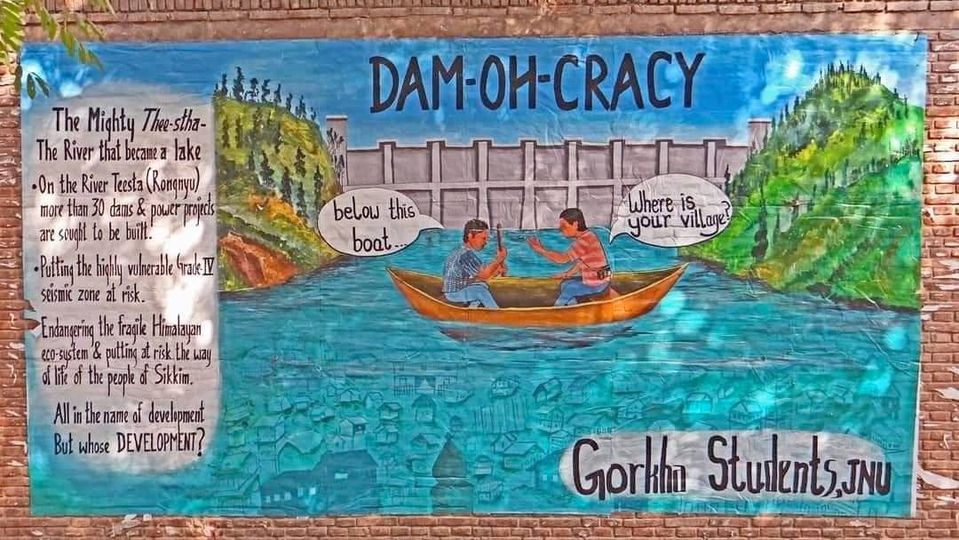
Locals too have voiced their concerns. “Teesta River’s height has gone up in Kalimpong and Darjeeling district due to the sand accumulated due to flood. This has posed a bigger threat and the NHPC must build embankments. Till they address the problems, we will not allow the two projects to function,” Thapa said.
“Had there been proper embankments on the Teesta River, the quantum of the damage would have been much less. Now, the damage caused by the flood is beyond our imagination,” said Mina Sherpa, a resident of 29th Mile. Manita Bhujel of Ghel Khola, whose house has come fully under the debris said, “Unless the NHPC constructs embankments, the Teesta would regularly enter the villages and destroy everything.” Only two of the four units at TLDP-IV are operational at present. All four units of TLDP-III have been kept shut due to silt brought in by the flood waters,” said LK Tripathi, executive director (Siliguri-region) of NHPC. https://www.hindustantimes.com/cities/others/gta-threatens-to-stop-work-at-two-hydel-power-projects-over-teesta-after-floods-101697355107107.html (15 Oct. 2023)
Anit Thapa, chief executive of the Gorkhaland Territorial Administration, the highest local authority in West Bengal state, said this was “the first time Teesta has been this disastrous.” “Many people had literally five seconds to leave their homes,” he told RFA in Teesta Bazaar. “In some areas, whole villages have been washed away … The damages are unsurmountable.”
– Apart from dams, there were also encroachment of the riverbeds for roads and settlements, obstructing the water flow, he said, adding the disaster was “human induced.” “Basically, Teesta River is taking its natural course. We built dams and other infrastructures and changed the natural flow of Teesta. Now it’s claiming it back,” Thapa said.
– Between 2000 and 2016, Himalayan glaciers lost about 8 billion tons of ice annually, mainly due to climate change. Last year, a report from India’s earth sciences ministry said the mean retreat rate of the Hindu Kush Himalayan glaciers was 14.9-15.1 meters per annum, with 20.2-19.7 meters per annum in the Brahmaputra river basins. https://www.rfa.org/english/news/environment/india-flood-glof-10122023212228.html (12 Oct. 2023)
“Whatever happened to all the Himalayan states in the past 10 years, we cannot call it a natural disaster. This is a man-made disaster and we have to accept it. The governments of Himachal Pradesh, Uttarakhand and north-eastern states have to accept this fact,” Gyatso Lepcha of ACT said. https://www.thecitizen.in/india/sikkim-floods-a-man-made-disaster-967974 (16 Oct. 2023)
An Advanced Warning System (AWS) installed almost a month before the disaster at Lhonak Lake in north Sikkim, failed to send any alert before the lake burst triggering a flash flood in river Teesta, official said. “Two AWS were installed at Lhonak Lake and Shako Cho Lake between September 9 and September 19 this year. Unfortunately, the system didn’t send any early warning. Most probably it wasn’t working when the incident took place,” said VB Pathak, chief secretary of Sikkim. https://www.hindustantimes.com/india-news/sikkim-lhonak-lake-early-warning-system-failed-says-official-101697020649076.html (11 Oct. 2023)
Responding to the Teesta-III dam break due to the GLOF last week, the NGT Wednesday (Oct. 11) issued notices to appear on October 20 to three key stakeholders: the Sikkim government; the Sikkim Urja Limited that developed and ran Teesta-III at Chungthang; and NHPC that has suffered heavy damage at its 510 MW Teesta-V 37 km downstream at Dikchu. Not so long ago, the same NHPC had dismissed any threats from GLOF — and the tribunal had accepted this explanation. https://indianexpress.com/article/india/teesta-iii-dam-break-nhpc-admits-damage-9-years-ago-it-said-no-threat-8983369/ (16 Oct. 2023)
This notice comes in response to a news article published in East Mojo on October 4, 2023, titled ‘Sikkim: Here’s why the Chungthang Hydro Dam breach is a big deal’. The NGT has scheduled a hearing for this matter on October 20, 2023. The authorities are expected to present their reports and explanations during the hearing. Failure to appear may result in the case being heard and decided in their absence. https://www.eastmojo.com/sikkim/2023/10/13/em-impact-ngt-issues-notice-to-sikkim-authorities-for-dam-breach/ (13 Oct. 2023)
Insurance claim filed for submerged Teesta-III hydel plant Total sum assured in policy for 1,200 MW project, which got washed away on Oct 3 GLOF, is around Rs 11,400 cr. State govt & operator Sikkim Urja together owe lenders over Rs 10,000 cr (of which Rs 3000 Cr to PFC and Rs 300 Cr to SBI). The project is fully insured by a consortium of insurers led by IFFCO-Tokio General Insurance.
– The SPICL holds a 60.08 percent stake in Sikkim Urja (earlier known as Teesta Urja), and of the remaining 40 percent, 35 percent is owned by Greenko Mauritius, a wholly-owned subsidiary of Mauritius-based Greenko Energy Holdings and 5 percent by PTC India Limited, a leading power trader.
– In 2005, the then state government had chosen Teesta Urja Limited, a private consortium led by Hyderabad-based Athena Group, to develop one of the largest hydropower projects on the Teesta River. Teesta Urja’s shareholding structure has changed several times since then. For instance, in 2019, Athena’s share was acquired by Greenko Mauritius. The project cost back then was Rs 5,705 crore and its completion deadline was 2012. Back then, the state government was a minority shareholder in Teesta Urja, with a 26 percent stake. In 2015, the state government increased its stake to 60.08 percent and became a majority shareholder.
– Sikkim Urja, meanwhile, has to repay its lenders approximately Rs 7,000 crore — 50 percent to Rural Electrification Corporation and another 50 percent to PFC. https://theprint.in/india/flood-submerged-teesta-iii-hydropower-plant-but-sikkim-govt-operator-still-owe-lenders-rs-10000-cr/1800822/ (12 Oct. 2023)
प्राकृतिक आपदा या मानव निर्मित त्रासदी? https://www.youtube.com/watch?v=Nmz13DkD7aM (10 Oct. 2023)
ITBP jawan raised 1st flood alarm in Sikkim It was around 10.30 pm on 3 October at Zanak — a remote area at 16,000 feet located around 8 km away from the South Lhonak glacial lake in Sikkim — when an Indo Tibetan Border Police (ITBP) commander on duty first noticed the water level rising suddenly in the nearby narrow Goma chu (meaning river) that joins the Teesta River downstream. On that cold dark night, even before he could make sense of what was happening, the commander saw the water in the Goma chu rise to approximately 6.5-7 feet, touching the roof of one of the prefabricated huts of the ITBP located around 300 metres from the narrow stream.
He rushed back to inform his commandant who, at 10.40 pm, promptly informed his battalion’s headquarters in capital Gangtok. Within the next few minutes, the deputy inspector general (DIG) of the ITBP in Gangtok had alerted the administration in Chungthang, a small town in Mangan district of north Sikkim, located at the confluence of Lachen and Lachung rivers that meet to form the mighty Teesta. By 10.50 pm, the ITBP personnel had raised an alarm in the town. They woke up the Chungthang dam authorities and told them about the possibility of river waters rising to dangerous levels within the next hour or so. https://theprint.in/india/how-an-alert-itbp-jawan-on-duty-8-km-away-from-south-lhonak-lake-raised-1st-flood-alarm-in-sikkim/1797562/ (10 Oct. 2023)
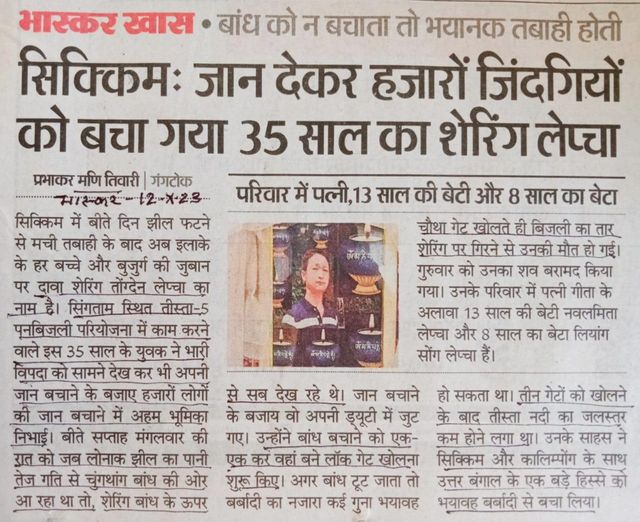
Interesting story of Dawa Shering Tongden Lepcha, a worker on Teesta V project, according to this project, while opening spillway gates of the project died after opening three gates, as while opening 4th one, electric wire fell on him and he died. This story raises a number of questions about the operation situation at Teesta V dam.
Early warning sensors were installed in 2013, 2016 and even last month at the critical glacial lakes in Sikkim but none survived long enough to forewarn residents downstream. https://economictimes.indiatimes.com/news/india/sikkim-glacial-lake-sensors-failed-in-2013-2016-this-month/articleshow/104323699.cms (10 Oct. 2023)
The government covered up the severity of Teesta floods by blaming them on a ‘cloudburst’ writes Himanshu Upadhyaya. https://scroll.in/article/1057436/how-the-government-covered-up-the-severity-of-sikkim-floods-by-blaming-them-on-a-cloudburst (12 Oct. 2023)
South Lhonak GLOF Triggered Flood in Teesta Because Warnings Remained Neglected. https://thewire.in/environment/sikkim-glof-triggered-flood-in-teesta-because-warnings-remained-neglected (11 Oct. 2023)
In an interview, Vimal Khawas, professor at the Special Centre for the Study of Northeast India in JNU says to prevent future disasters, dam proponents and the government must take the science and scientific findings about development projects in the Hamalaya seriously. https://thewire.in/environment/sikkim-disaster-vimal-khawas-interview-himalaya (13 Oct. 2023)
With a death toll of 82 and rising, this disaster is the third of its kind in the past 10 years, involving heavy rain, glacial melt, and the failure of dams to control catastrophic flooding as a result. https://www.business-standard.com/opinion/editorial/tragedy-in-sikkim-123100901299_1.html (09 Oct. 2023)
Maya and dukhkha: How the metaphysical helps the people of Sikkim make sense of natural disasters. https://scroll.in/article/1057295/maya-and-dukhkha-how-the-metaphysical-helps-the-people-of-sikkim-make-sense-of-natural-disasters (10 Oct. 2023)
Bengal floods: Videos, photos show havoc wreaked by swollen Teesta river in Kalimpong. https://www.livemint.com/news/bengal-floods-videos-photos-show-havoc-wreaked-by-swollen-teesta-river-in-kalimpong-11696591391867.html (06 Oct. 2023)
Clouburst in Sikkim leads to Teesta downstream havoc in Jalpaiguri, Cooch Behar districts. https://www.telegraphindia.com/west-bengal/clouburst-in-sikkim-leads-to-teesta-downstream-havoc-in-jalpaiguri-cooch-behar-districts/cid/1971113 (05 Oct. 2023)
DISASTERS
Study “Put people, indigenous local knowledge and governance at the centre” The HIMDHARA study released on Oct 10 2023 brings into focus community perspectives on Himalayan disasters and calls for a holistic interdisciplinary rethinking of the rapid development wreaking havoc in the entire region. https://groundreport.in/put-people-indigenous-local-knowledge-and-governance-at-the-centre-himdhara-study/ (11 Oct. 2023)

Research conducted by Himdhara in Himachal’s tribal Kinnaur district challenges conventional narratives; advocates indigenous knowledge. https://www.downtoearth.org.in/news/climate-change/amp/himalayas-not-fragile-disasters-there-not-natural-don-t-just-have-to-be-managed-study-92227 (10 Oct. 2023)
Jammu & Kashmir Experts fear adverse effect on livelihoods as glaciers melting fast ‘There are 18,000 glaciers in Jammu, Kashmir and Ladakh, but all of them are melting. The glaciers are melting in the entire Himalaya including J&K. In the past couple of years, the melting of glaciers has increased,’ said Earth scientist and glaciology expert Prof Shakil Romshoo. https://www.deccanherald.com/india/jammu-and-kashmir/experts-fear-adverse-effect-on-livelihoods-as-glaciers-melting-fast-in-jk-2727589 (15 Oct. 2023)
LANDSLIDES
Arunachal Pradesh Landslides block OKSRT road Massive landslides that occurred near Sukha Nallah on the Orang-Kalaktang-Shergaon-Rupa-Tenga (OKSRT) road on Tuesday (Oct. 10) morning have disrupted surface communication in West Kameng district. As per sources, the landslides, which occurred at around 9 am, blocked the OKSRT road, which connects West Kameng and Tawang districts with Assam. Dozens of vehicles are reportedly stranded on either side of the block point. https://arunachaltimes.in/index.php/2023/10/11/landslides-block-oksrt-road/ (11 Oct. 2023)
DROUGHT
Karnataka No brides for farmers Farmers in Gadag district are finding it hard to get brides as most parents are reluctant to marry off their daughters to farming households due to financial insecurity. Though it’s not a new issue in the region, it was raised again during the Central drought study team’s visit to Gadag villages on Friday (Oct. 06). Gojanur and surrounding villages have witnessed very few weddings in the past three years due to drought, the farmers told the team. Many people are not agreeing to marry off their daughters to farmers as they have been suffering from financial losses for years because of climate change.
Some farmers said they are planning to migrate if they don’t get any help from the government. In the last three years, almost all wedding proposals have been cancelled because of the farming background of youth. While the condition is the same in most villages of Shirahatti, Mundargi, Lakshmeshwar, Ron and Gajendragad taluks, the most affected are those in Gojanur and surrounding rural areas, where farmers have suffered consecutive losses in the last three to four years. https://www.newindianexpress.com/states/karnataka/2023/oct/08/drought-no-brides-for-farmers-in-these-karnataka-villages-2621872.html (08 Oct. 2023)
SOUTH ASIA
India-Bhutan Shadow from fallen Sikkim dam falls on India’s HEP projects in Bhutan The GLOF devastation in Sikkim has refreshed worries over two of India-assisted, under-construction mega hydropower projects in Bhutan — the 1,200 MW Punatsangchhu Stage-I (Puna-I) and the 1,020 MW Punatsangchhu Stage-II (Puna-II). In pushing for dams, it reflects the failure of several Indian agencies in comprehensively assessing the fragile Himalayan geology, similar to Sikkim and Arunachal Pradesh flanking Bhutan. These agencies are the Central Water Commission, the Geological Survey of India, and WAPCOS, apart from the CEA.
– “Punatsangchhu has been a story of disaster with international landslide experts like Dave Petley having pointed out it was a blunder to start a dam at the location that seems to be on the debris of past landslides,” environmental activist and water expert Himanshu Thakkar said. “The Puna-I project is more or less a washout and hence they are considering the alternative of a barrage there. But that also does not seem to have been finalised. It is an admission of a major failure by these agencies,” he said.
– Reports in Bhutan said the governments of the two countries have tasked the eight-member Technical Coordination Committee (TCC) with reviewing and proposing a path forward for the Puna-I dam. A mutual decision was made to initiate geological investigation studies at the project site, Bhutan’s power officials said, indicating that the TCC would determine the extent of additional geotechnical investigations required at the dam site. “We need to re-look at the geological survey of the (Puna-I) dam. There have been many reasons for the delay, including technical issues. The (soil) stabilisation measures have not yielded the results they wanted,” Bhutan’s Prime Minister, Lotay Tshering said. https://www.thehindu.com/news/national/the-shadow-from-the-fallen-sikkim-dam-falls-on-indias-hydroelectric-projects-in-bhutan/article67420574.ece (15 Oct. 2023)
India-Nepal Govts fail to finalize Pancheshwar DPR Nepal and India have failed to finalise the detailed project report (DPR) of the Pancheshwar Multipurpose Project. Nepali officials claimed they had sorted most of their differences during a bilateral meeting of experts held in Kathmandu on Friday and Saturday (Oct 6-7 2023). They took one more day to prepare the minutes.
– “Once again, we could not reach a conclusion on determining the benefits to each side from the project,” said Nabin Raj Singh, spokesperson for the Ministry of Energy, Water Resources and Irrigation. “Our point was that we get negligible benefits from this project in areas of irrigation and flood control while the Indian side wants to keep the benefits for itself.” Two sides agreed to call another meeting soon. https://kathmandupost.com/money/2023/10/09/nepal-india-fail-to-finalise-pancheshwar-detailed-project-report (09 Oct. 2023)
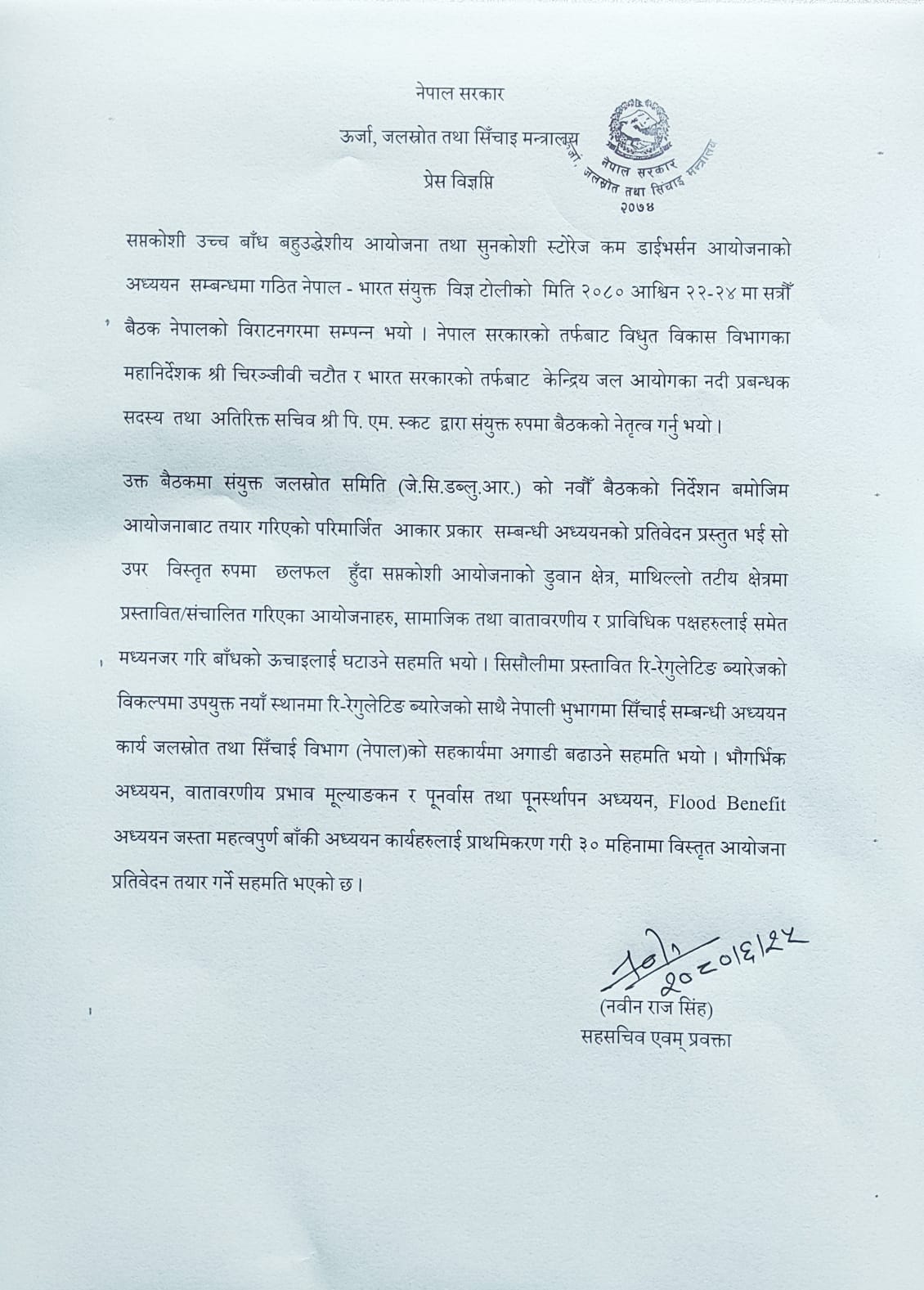
Nepal-India agree to reduce the height of the proposed Saptakoshi High Dam (from 337 m to 304.8 m) amid concerns in Nepal over the potential inundation of a large swathe of land upstream of the dam. With the high dam project stuck for several years due to local protests, the two sides agreed to lower the dam height. Installed Hydro capacity will go down from 3000 MW to 2300 MW.
– During the 17th meeting of the Nepal-India Joint Team of Experts established to study the Saptakoshi High Dam Multipurpose Project and the Sunkoshi Storage and Diversion Project held in Biratnagar on October 9-11, two sides agreed to also change the location of the re-regulating dam about 4 km upstream from present location, the Ministry of Energy, Water Resources and Irrigation said in a statement (https://moewri.gov.np/storage/listies/October2023/press-release-2080-06-25.jpeg).
– A 756MW Tamor Storage Hydroelectric Project has been planned on the Tamor river while the 635MW Dudhkoshi Hydropower Project is also in the pipeline. Nepal and Bangladesh have agreed in principle to develop the 683MW Sunkoshi 3 Hydropower Project. “Besides these hydel projects, Sunkoshi Marin Diversion Multi-Purpose Project, upstream of the proposed dam site, will also reduce the flow in the Saptakoshi river and higher dams may not be required,” a senior official said last year. The DPR is to be made in about 30 months. https://kathmandupost.com/national/2023/10/16/nepal-india-agree-to-reduce-height-of-saptakoshi-dam (16 Oct. 2023)
Nepal Govt seeks $1 billion from World Bank, others for Upper Arun Nepal seeks an investment of around $1 billion (Rs 130 Billion) from the World Bank and other international financial institutions to develop the US$ 1.75 Billion, 1,061MW Upper Arun Hydroelectric Project as the global lender tries to return to an Arun river project after a gap of 28 years, after withdrawing from Arun III project in 1995 following strong protests. “The World Bank could inject as much as $550 million,” said Kul Man Ghising, managing director of Nepal Electricity Authority (NEA), the project developer. “The multilateral agency is expected to attract international financial institutions such as the European Investment Bank and others to inject more funds to take the total international financing up to $1 billion.”
– This is the first time the World Bank is prepared to fund an NEA-led hydropower project. In 2014, the global lending agency approved $84.6 million to finance the Kabeli-A Hydroelectric Project developed by the private sector. In 2019, its private sector arm—the International Finance Corporation (IFC)—had led international creditors to invest $453 million in the 216MW Upper Trishuli 1 Hydropower Project. A South Korean consortium is developing this project. The World Bank has been helping Nepal build transmission line projects. https://kathmandupost.com/national/2023/10/15/nepal-seeks-1-billion-from-world-bank-others-for-upper-arun (15 Oct. 2023)
THE REST OF THE WORLD
Nigeria Dam Floods Mbangkolo dam burst after hours of heavy rainfall At least 30 people have died and 20 have been wounded following a landslide that ripped through the Mbangkolo neighbourhood in Cameroon’s capital Yaounde on October 8, 2023. The landslide was caused due to several hours of heavy rains that led to the collapse of a century-old colonial-era dam located on the Mbangkolo hills in Yaounde. A wave of water was released from a human-made lake that flattened buildings, uprooted trees and swept away dozens of people. The rush of flood waters and mud wiped out at least 30 homes in the neighbourhood, said a local leader in the Mbankolo neighbourhood Joseph Assola.
Minister of Housing and Urban Development Celestin Ketcha Courtes also blamed the locals, saying the disaster could have been avoided if the population had listened to advice from weather experts. “This happened because people occupied the water bed (the river floodplain). We all know that no building can hold the strength of water,” she said. However, Ymele Guy, a landlord in the locality said the embankment was poorly maintained, which led to the tragedy. The country had been a German colony from 1884 until the First World War, with the dam being built over a century ago. https://www.downtoearth.org.in/news/natural-disasters/landslide-in-cameroon-capital-kills-at-least-30-ministers-blame-residents-for-construction-in-floodplain-region-92223 (10 Oct. 2023)
Flood imminent in nine states as Lagdo Dam water released The National Emergency Management Agency (NEMA) has alerted Nigerians to expect flood in nine states as Cameroon began the release of water from its Lagdo Dam. The affected states are: Adamawa, Taraba, Benue, Nasarawa, Kogi, Anambra, Edo, Delta and Bayelsa. https://www.ndtv.com/world-news/viral-before-and-after-pics-reveal-river-in-amazon-drying-up-4466599 (10 Oct. 2023)
Brazil Amazon drying up fast Falling water levels in the rivers and lakes of the Brazilian Amazon are restricting the flow of ships and boats, the main form of transport in the region and the only means of access to health and education facilities for many communities.
This year’s drought is exacerbated by two simultaneous natural events, the main one being El Niño, that inhibit the formation of rain clouds, further reducing the already low rainfall recorded during the dry season. More than 100 Amazonian river dolphins were found dead in a lake in Amazonas state, likely due to high water temperatures and low water levels, according to researchers.
The state of Amazonas is preparing for the worst drought in its history, which will affect 500,000 people by the end of October; the federal government has created a task force to mitigate the impacts, promising to send water, food and medicine. https://news.mongabay.com/2023/10/amazon-drought-cuts-river-traffic-leaves-communities-without-water-and-supplies/ (03 Oct. 2023)

-Brazil’s government said last week it is preparing to provide emergency assistance to inhabitants in the Amazon region hit by a record drought that has drained the rivers that are their life support. The Amazon drought, like flooding in the south of Brazil, is a result of the El Nino phenomenon, which warms the Pacific Ocean’s surface water, experts say, Reuters reported.
-Some rivers winding through Brazil’s vast Amazon rainforest have piled up masses of dead fish as the drought worsened, constricting local communities’ access to food and drinking supplies. The carcasses of some 120 rare river dolphins were found floating in a tributary of the Amazon River in circumstances that experts suspect were caused by severe drought and heat. https://www.ndtv.com/world-news/viral-before-and-after-pics-reveal-river-in-amazon-drying-up-4466599 (10 Oct. 203)
SANDRP
Also see: DRP 09 Oct. 2023 & DRP 02 Oct. 2023
Follow us on: www.facebook.com/sandrp.in; https://twitter.com/Indian_Rivers

 SANDRP
found this post to be exceptionally well-written. It’s one of the most informative posts I’ve read recently. Thank you for sharing such great insights.
LikeLike