
(Feature Image: Landslide damaged homes in Jakhan village, Dehradun. Image source: Social Media)
The Jakhan village in Yamuna valley suffered a huge landslide in noon hours of August 16, 2023. The village is populated by 28 families. The incident has reportedly damaged 10 houses and 07 cowsheds fully and 02 houses partially apart from impacting a power transmission tower of Power Transmission Corp of Uttarakhand Ltd (PTCUL) forcing the villagers to take refuge in nearby primary school of village Pashta.
The village is part of Binhar region situated about 5 km uphill the power station of 120 Mw Vyasi Hydro Electric Power (HEP) Project on Yamuna river. The Vyasi Project is in Hathyari village of Vikas Nagar tehsil in Dehradun district. Before the fateful incident, the area had witnessed prolonged rain spells and the villagers had seen small cracks around the village.
On August 16, a bright sunny day, a huge chunk of hillside above the village detached suddenly and the entire village area witnessed a sharp slid downwards. Locals say the slide is slowly going on and so far, the homes in the village have moved down by 10-25 meters.
Reasons Behind the Landslide
Since the day of landslide, locals have been discussing various reasons responsible for the incident. Geologically, the Jakhan village falls in Shivalik hill range formed by unconsolidated sediments. The village is in seismic zone IV hence prone to earthquake and landslide disaster.
Recommending the relocation of entire village, the official report as covered by the print media also states that a 15-20-meter-thick soil layer was found at the affected site.
Rainfall
The villagers say that the area had witnessed a week-long rainfall spell resulting in oversaturation of ground and causing several small-scale land subsidence and collapse incidents across the region. As per the data of the Meteorological Centre, Dehradun, between 09-16 August 2023, the Dehradun district in whole recorded 350.1 mm (millimeters) rainfall against the normal limit of 120 mm which is nearly three-fold higher than the normal range.

Though the exact rainfall figures for the affected village area are unavailable for the week period, it does appear to be a triggering point behind the landslip.
Tunneling, Blasting work at Vyasi Tunnel
There are many villagers who believe that the tunnel construction and blasting work carried out during construction of Vyasi HEP has made the area more vulnerable to landslide disaster. They claimed to have experienced low intensity tremors of blasting in their villages uphill during construction of the project tunnel.

In fact, more than 20 houses in Bhadogi and Kandoi villages located just uphill from the tunnel end at Hathyari had developed cracks in 2017 for which villagers blamed the Vyasi HEP project. However, a study by the Uttarakhand Jal Vidyut Nigam Limited (UJVNL), the developer of the project into the incident, attributed natural reasons responsible for the cracks.
The study report is not available in public domain and we have requested concerned officials of Vyasi HEP for a copy of the report. We will upload it here if we receive the copy.
PTCUL Transmission Line
In March 2022, PTCUL laid a 220 KV power transmission line through the area to evacuate power generated from Vyasi HEP to Sherpur grid in Dehradun. The transmission line is 71 km long and has 113 towers. The tower number 93 standing in Jakhan village has been affected in the landslide incident.
Due to the landslide, one of the four base pillars of the tower had tilted, resulting in disruption of power transmission for two days. Presently, the power transmission is restored through the same affected tower and PTCUL has planned to build a new tower in Jakhan village area.
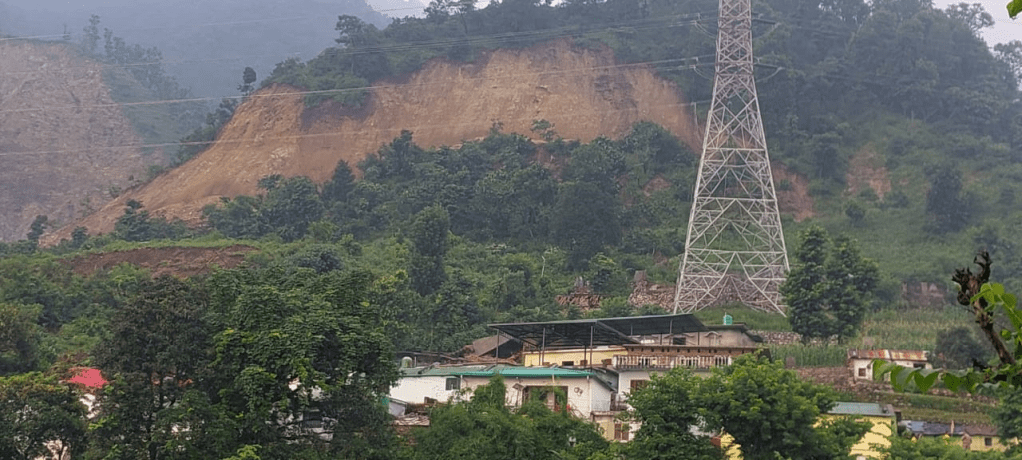
At the time of the incident, the villagers feared that the collapse of the affected tower could have led to more damages including human lives. As per Ankit Tomar, village headman, Jakhan, the tower has become a safety threat for the village and villagers were not consulted when the line was laid.
Villagers also claimed that even the land compensation for the towers had not been paid to them for over one and half year and only after the incident the matter was swiftly taken up by the PTCUL officials.
Another question is if there was any geological study conducted before laying of the transmission line. Moreover, the official report as quoted in the media has also revealed that the topography of Jakhan has a 10-15 meter soil layer suggesting lack of solid base for the pillars of the tower. There is no such study or survey report available on the website of PTCUL.
When contacted, A.K. Juyal, General Manager, PTCUL stated that disaster can happen anywhere in the hills and the transmission line is laid after proper survey and consultation with villagers. He further said that he would try to avail the report to us. We will upload the report here when we get it from the PTCUL.
Villagers Looking for Relocation
The Jakhan village has joined the unending list of villages in Uttarakhand getting affected by natural and man induced disasters in recent years requiring rehabilitation. The Jakhan villagers never thought that one day they would have to abandon their ancestral homes. The village had suffered a ‘cloud burst’ incident in August 2021 in which a villager was killed apart from significant damages to farm land.

Now, the entire village has been affected and the district administration is looking for suitable sites to relocate the village. The villagers prefer to shift to a nearby hilly area where they can sustain their traditional way of life.
It is worth mentioning that the Lohari village submerged by Vyasi HEP has not been rehabilitated and some of the project affected families have been living in worn out school building there for more than a year. The under construction Lakhwar dam in the area would add into the list of villages requiring rehabilitation.
Administration Report Unavailable
As mentioned earlier, the area is tectonically, geologically and climatically vulnerable. It must be noted that in this region, the Vyasi HEP dam has been built and work of 320 Mw Lakhwar dam is going on. Only on August 10 2023, a part of the road leading to Bosan village was destroyed by a landslide. Bosan is located over a lower hill on the left bank of Yamuna river at a 6km aerial distance from Jakhan village.
As per a latest media report, deep fissures have emerged in more than 10 houses of Lelta village in Kalsi block just a few days after it occurred in Jakhan, Lakhwar and Ramkholi villages in the same block. The village houses about 80 families and is located about 14 km arial distance from the Jakhan village. The villagers say the subsidence first started in 2019 and the cracks kept widening since then.
A team led by Kamini Bisht, Geologist, Mining and Geology Department, has completed a study report inquiring into causes of landslide in the village and submitted it to district administration. However, the report is not put in public domain so far. The report as quoted in media has found the area unsafe for habitation and made several recommendations to remedy the continual land subsidence.
We contacted Mrs. Sonika, District Magistrate (DM), Dehradun and Kamini Bisht to seek their comment on the issue and requested a copy of the report. While Kamini Bisht said that the report has been submitted to district administration and can be obtained from there, we got no response from the DM regarding the same. We will add their inputs in this blog and will upload the report if we get a copy of the same.
As per the Kamini Bisht the study has been done of Jakhan village only and it has not looked into if the construction process of the Vyasi HEP and PTCUL transmission line works have any role in aggravating the situation or mentioned about gaps in safety measures during construction of these major infrastructure in the area.
However, the recurring landslide incidents impacting increasing numbers of villages necessitates a cumulative study of Binhar region which also explores the role of the major infrastructure projects and their vulnerabilities to landslide disasters.
Are Lakhwar-Vyasi Projects prepared for Disasters?
SANDRP has been highlighting the geological hazards in Yamuna valley where the Vyasi HEP has been built and Lakhwar dam is under construction. These projects have not only further compromised the carrying capacity vulnerabilities of the region but can also face damages and aggravate the situation in case of bigger disaster.

So far, the flash flood Early Warning System (EWS) for Vyasi HEP has not been installed. Both the mega projects are also not equipped with mitigation of landslide, earthquake and cloud burst related threats. As per the UJVNL official the flash flood EWS will be installed in the project area by October 2023 and the agency will also take up the matter of EWS for landslides. These systems should have been in place before the work on the project was started. Full information about these systems must be in public domain.
Bhim Singh Rawat (bhim.sandrp@gamil.com)
The links of SANDRP’s previous blogs on the issue are given below:
LAKHWAR DAM PROJECT: Why the project should not go ahead
Yamuna fighting existential battle in the homeland as Govt. speeds up construction of dams
Lakhwar & Vyasi Dam: Different reality before the window dressing for EAC
Vyasi Hydro is draining muck and Rs. 40 lakh geo jute work into Yamuna
JAJRED perennial landslide in Yamuna basin, Uttarakhand
Uttarakhand 2021: Cloud Bursts around Vyasi HEP
Vyasi Hydro: Village Drowned; River Dried but little power generation

 SANDRP