Bhutan · Himalayas · Hydropower

Flow for Worship, Flow for Money: Water Wheels and Hydropower in Bhutan

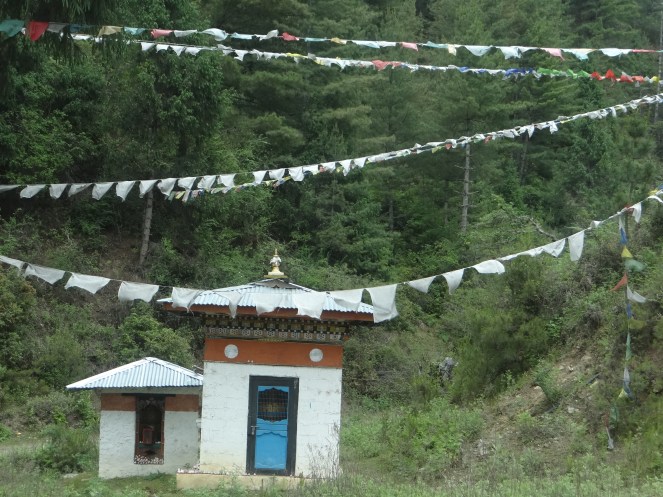
Countries like Bhutan, Nepal, parts of Tibet and parts of India like Sikkim have some lovely Buddhist traditions linked to the nature. On the edges of forests, overlooking valleys and atop majestic mountains flutter tiny colorful prayer flags. Inside Dzongs, fixed prayer wheels spin by the tug of a pious hand. While spinning and fluttering, the prayers are supposed to be disseminated in the universe, reaching every sentinel being.

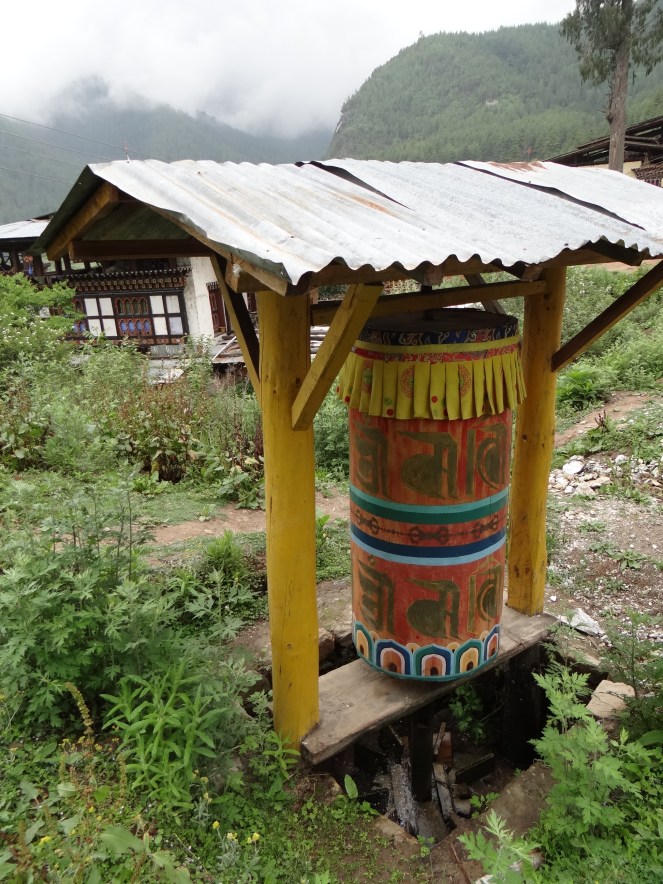
But there is a third kind of fascinating prayer wheel. It worships not only the creator, but also flowing water. Today, as naturally flowing waters become rarer, it is strangely reassuring to see these wheels spinning away, as the stream pushes the small wooden turbines round and round. These wheels are more fascinating for their symbolic significance: In these regions where water wheels worship the flow, the same flow is being harnessed for generating money and power: Hydropower. In Bhutan, the 10,000 MW + hydropower initiative supported by India and financial institutions like ADB & other foreign players will dam almost all of the big river systems in the country.

In fact, institutions like ADB are so over-enthusiastic in pushing hydropower in Bhutan ( ADB is ‘administering‘ Hydropower grants to Bhutan from countries like Norway and Japan)  that they see Bhutan’s strong environmental conservation practices as ‘hurdles’ in this development. ADB says: “Bhutan’s strong environmental conservation policies have affected the pace of implementing power projects because of the time required to complete procedures such as environmental impact assessments, public consultations, forestry clearances, and road planning.”

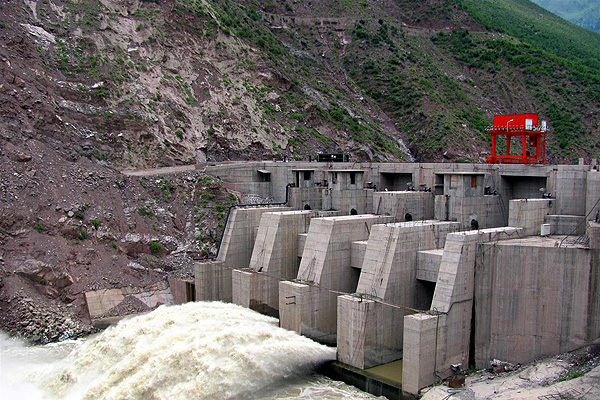
What follows is a short photo feature on Water Wheels in Bhutan as well as the hydropower development in the Punatsangchu Basin, through the 1200 MW Punatsangchu I HEP. Just a few kilometers downstream is the proposed intake and dam of Punatsangchu II which is also underway.

Bhutan is the only country in the world which measures its development not only in terms of GDP, but through Gross National Happiness (GNH), which is an aggregate of a number of things, including environmental conservation and preservation of culture.

Let us hope that this dense hydropower development does not affect the Bhutanese tenets of happiness…

A majestic three tiered prayer wheel in Paro, on way to Tigers Nest Monastery Photo: SANDRP
Majestic three- tiered prayer wheels in Paro, on way to Tiger’s Nest Monastery Photo: SANDRP
A tiny water wheel in agricultural fields of Paro Photo: SANDRP
One more water wheel on way to Taktsang Monastery Photo: SANDRP
A water prayer wheel in a village near Paro Photo: SANDRP
A water wheel on a flowing stream in a dense forest, on way to Phobjikha Valley Photo: SANDRP
The wooden wheel blades
The wooden wheel blades Photo: SANDRP
A roadside Prayer wheel with steel blades Photo: SANDRP
A roadside water wheel on way to Thimpu Photo: SANDRP
On way to Thimpu Photo: SANDRP
On way to Taktsang Monastery Photo: SANDRP
Cascade of three water wheels in Phobjikha Valley Photo: SANDRP
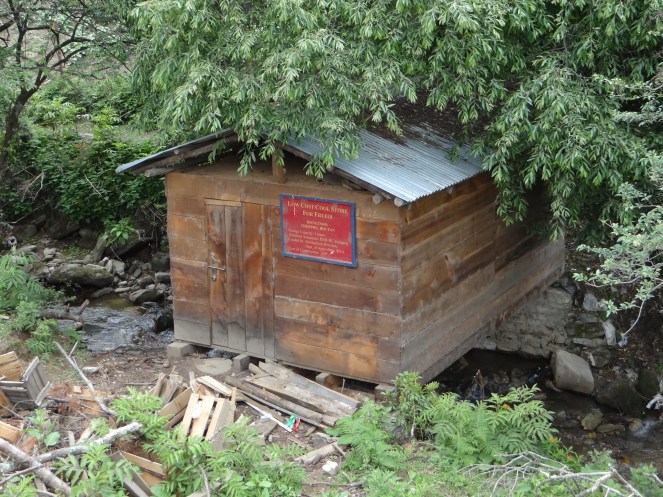
Different ways of using the flow: A storehouse for Apples and other seasonal fruits, built on the top of a stream, which acts like a natural AC Photo: SANDRP
Fresh fruits, preserved in a storehouse on the stream! Photo: SANDRP

HYDROPOWER IN BHUTAN

At the same time, huge, unprecedented hydropower developing is also challenging the tiny nation. Much of it is pushed by India.

Planned, underconstruction and commissioned hydropower projects may cover all the river systems in Bhutan. Photo: Down to Earth from CEA

Bhutan was in news as it was the first foreign country to which the new Prime Minister Narendra Modi paid a visit in June 2014. While he laid the foundation stone of the the 600 MW Khonglongchu Project, protests erupted in downstream Assam, India. Assam had suffered flood losses mainly in 2004 when the 60 MW Kurichhu Project, built by NHPC, released flood waters which reached Indian territory. Same fears are now expressed for Mangdechu and Konglongchu Projects. On July 9, 2014, The Times of India reported that Assam state BJP unit (BJP is in power at the centre), “They (BJP state leaders) also told Pandey (BJP all-India chief for morchas and cells Mahendra Pandey) that even Modi’s foundation laying for a 600-MW power station in Bhutan last month was not taken with enthusiasm by the people in Lower Assam districts because they were already affected by the impact of existing power projects in the Himalayan country.”

In 2006, India and Bhutan signed an agreement to “facilitate and promote development and construction of hydropower projects and associated transmission systems as well as trade in electricity, through both public and private sector engagements”. Under this agreement, India has agreed to minimum imports of 5,000 MW of hydropower capacity by 2020. The agreement will be valid for a period of 60 years and can be extended. In addition to this agreement, a protocol between India and Bhutan was signed in 2009 through which India will develop 10,000 MWs of hydropower in Bhutan for export of surplus power to India by 2020. This has been going on through a mix of soft loans and grants. This also means services for Indian engineering and design consultants like WAPCOS and Indian developers & contractors like L and T, NHPC, Gammon India, JP Associates, BHEL, SJVN, THDC, Tatas, HCC, Jindal, etc.[1] Indian companies like NHPC, WAPCOS are also involved in Detailed Project Reports, while other Indian companies are bagging the construction and equipment contracts.[2]

Already, three hydro projects funded and built by India are operating in Bhutan which include 336 MW Chukha, 60 MW Kurichu and 1020 MW Tala HEP.  Under-construction projects funded mainly by India include 1200 MW Punatsangchhu HE Project Stage-I, 1020 MW Punatsangchu Stage II and 720 MW Mangdechu HEP. News reports indicate that Bhutan and Indian government have together identified 10 HEPs with a total capacity of 11,576 MW by 2020 for development. In addition the country has about 16 operating HEPs[3].

Punatsangchu I Project, 130 mts high dam, envisages submergence of 673 acres of Reserve forest land, 78 acres of private land (involving 116 land owners) and 6 acres of Institutional Land (2 institutions) till the end of April 2013 for the project construction. Punatsangchu II project with 80 mts high dam, involves 479 acres of reserve forest land, 14 acres of private land (involving 17 land owners) and 5 acres of Institutional Land (3 institutions) till the end of April 2013 for the project construction.

In 2014, India and Bhutan also signed an agreement for 2120 MW hydropower capacity through four projects which include 600 MW Kholongchu project, 180 MW Bunakha project (with 230 MW downstream benefits from Tala, Chukha and Wangchu HEPs), 570 MW Wangchu project, and 770 MW Chamkarchu-I project.[4]

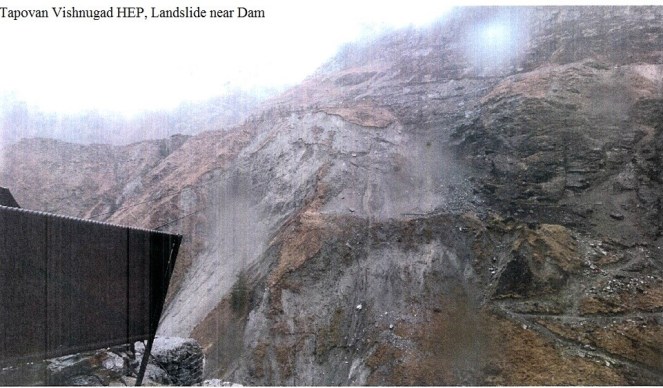
SANDRP visited the site of Punatsangchu I Project which has witnessed serious geological issues, which include severe sinking of the right bank, throwing the project off schedule and also increasing its cost. Similar geological surprises are also feared at Punatsangchu II Site. 

Following are some pictures from Punatsangchu I Site.

DSC08051
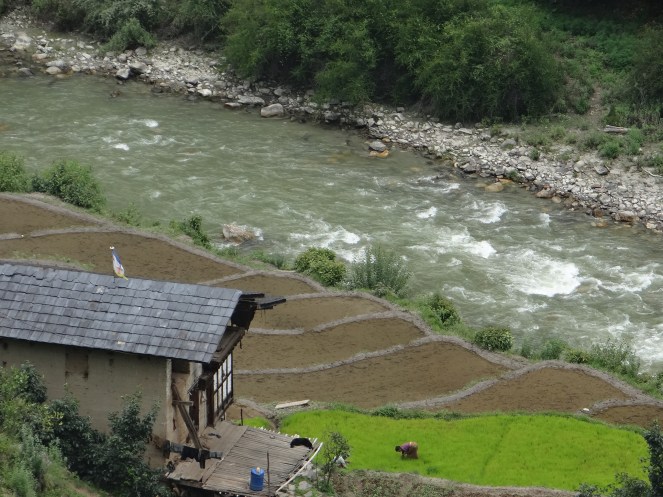
Riparian farming on a tributary of Punatsangchu Photo: SANDRP


Coffer dam and diversion of PSHP I Project Photo: SANRP
Coffer dam and diversion of PSHP I Project Photo: SANDRP
Dam Axis of PSHP I Photo: SANDRP

DSC08097

Diverted River, dry and without flows Photo: SANDRP
Huge muck disposal next to the river bank near the intake chambers Photo: SANDRP
L and T India is the main contractor for Dam Wall
L and T India is the contractor for construction of Diversion Tunnel, Dam, intake and Desilting Chambers Dam Wall Photo: SANDRP
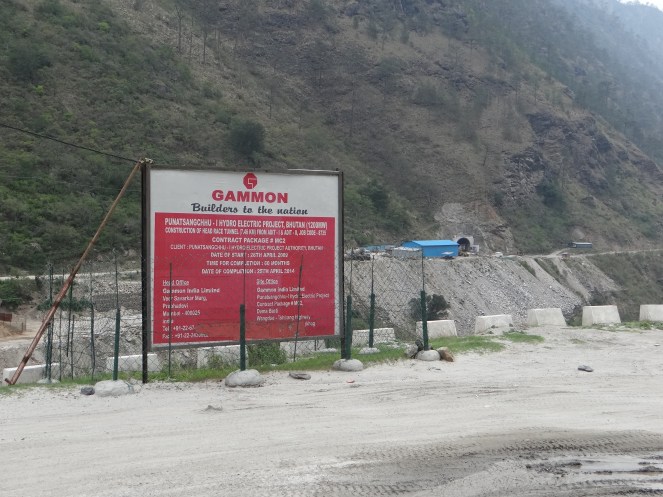
Gammon India is contractor for 7.48 kms Head Race Tunnel. Bharat Heavy Electricals and HCC are also contractors in PSHP I Photo: SANDRP
Stretch of Punatsangchu River that will be diverted through the tunnel when the dam is commissioned Photo: SANDRP
Baso Chhu River, entirely dried as it is diverted for the 66 MW BasoChhu Power Project of Druk Green  Photo: SANDRP
Baso Chhu River, entirely dried as it is diverted for the 66 MW BasoChhu Power Project of Druk Green Photo: SANDRP
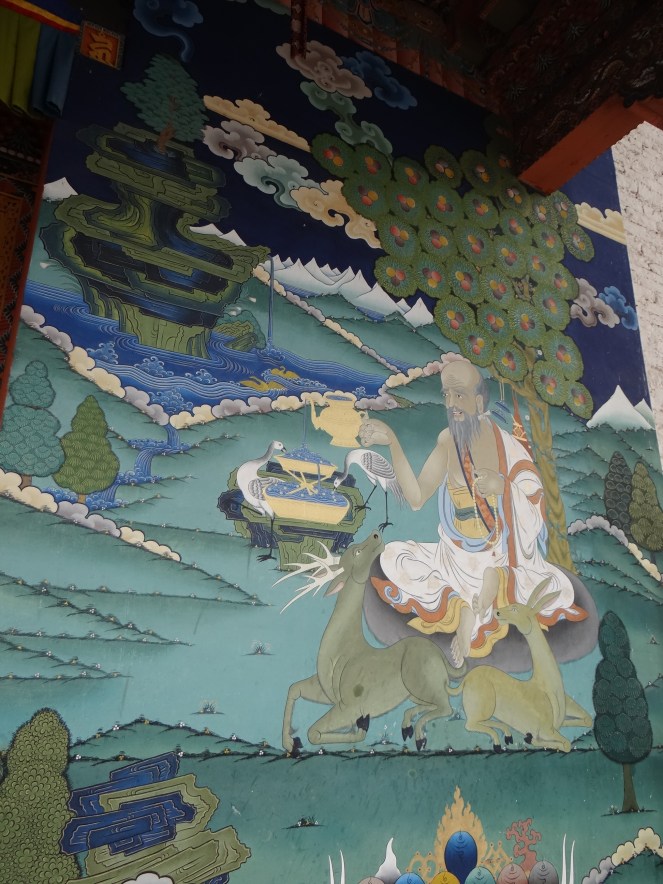
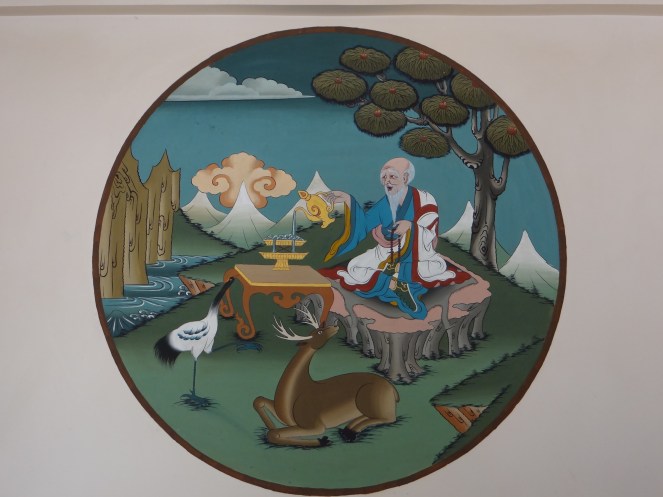
The concept of Six Longevities celebrated in the Bhutan: They include Man, Animals, Birds ( black Necked Cranes!), Montains, Trees and Rivers! Let us hope all these components are indeed conserved for long Photo: At Punakha Monastery, SANDRP
The Six symbols of Longevity celebrated in Bhutan ( also Tibet). Photo: At Punakha Monastery, SANDRP

DSC07549

In almost all Dzongs, as well as hotels and homes rests a picture of Six Symbols of Longevity ( see picture above), all of them are interlinked, hold symbolic significance and are supposed to be auspicious.

They include Man, Animals, Birds ( The Black Necked Cranes, incidentally threatened by an Indian Dam: 780 MW Nyamjangchu, close to Bhutanese border), Mountains, Trees and Rivers!

Let us hope this synergy is long-lived in Bhutan!

-Parineeta Dandekar, SANDRP (parineeta.dandekar@gmail.com)

( All pictures by author)

~~~~~~~~~~~~

END NOTES and References:

[1] http://www.projectsmonitor.com/daily-wire/india-and-bhutan-sign-for-hydropower-projects/

[2] http://www.adb.org/Documents/RRPs/BHU/37399-BHU-RRP.pdf

[3] http://www.lntecc.com/homepage/common/p58.htm

[4] http://www.kuenselonline.com/two-indian-companies-win-supply-contracts/#.U4hkWvmSz6c

[5] Samir Mehta’s blog on Hydropower Challenges in Bhutan: http://www.internationalrivers.org/blogs/257/bhutan-s-picture-of-gross-national-happiness-blurs

[6] Emmanuel Theophilus’s article on Fish Ladder in Kurichhu Dam in Bhutan published on SANDRP Blog:https://sandrp.wordpress.com/2014/02/02/fish-ladder-at-kurichhu-hydropower-project-bhutan-some-thoughts/

[7] Sector Study of Bhutan’s Hydropower by World Bank: http://documents.worldbank.org/curated/en/2007/12/9425448/bhutan-hydropower-sector-study-opportunities-strategic-options

[8] ADB pushing for Hydropower in Bhutan, also for storage projects, which have huge impacts! http://www.adb.org/features/bhutan-s-hydropower-sector-12-things-know?ref=countries/bhutan/features

[9] http://timesofindia.indiatimes.com/city/guwahati/Consult-us-before-decisions-on-Assam-state-BJP-to-Centre/articleshow/38014748.cms


Bihar · Embankments

Response to SANDRP blog: On Sediments & Rivers

Satellite image of Brahmaputra River From: Wikimedia Commons

Dr Dinesh Kumar Mishra (dkmishra108@gmail.com)

Read the article by Thakkar and Dandekar[1] on sediments with great interest. The basic duty assigned by nature to any river  is to build land (nearest word is delta formation), transport the water falling on its catchment to the master drain or the sea and keep the ground water level intact besides saving its fertility. Scriptures define river in many other ways. The basic reason for that was, probably, to discourage tempering with the river. The rivers flow for the good of all the living beings (paropakaray bahanti nadyah), they are cited as an example for continuity. Our ancestors used to bless the younger ones that their name and fame will last till the rule of forests, mountains and rivers are there. There are strict restrictions about polluting rivers and the punishment is also prescribed for doing so. That provides enough food for thought about rivers to us. When we recall our rivers to grace any religious or social ceremony, the emphasis is never forgotten as to what should be our attitude towards rivers. Most of our festivals are held on the bank of the rivers (barring Karmanasa) in Bihar which is called tirthas i.e, the sacred places.

We care too hoots about our rivers now.

An engineer or a trader looks at the rivers about the profits that can be made by the existence of the rivers and they rightly use the word ‘exploitation’ which we all know what it means. As engineers, we all are trained to look into the Benefit Cost ratio and are never taught about the social costs. That is not our job. We tell the politicians where the profit and votes lie. They, in turn, tell all others that they have a team of world class engineers who have advised this or that. The implementers (the contractors) intervene in the mean while. Then there may be financers, promoters, consultants and what not, each with some vested interest or the other. Some of them are for money, some for power, some for name and fame and some for merely impressing others of their proximity with the sources of power.

Each one of them has an insurance that by the time the ill effects of their wrong doing come to the fore, they will not be there in this world. That sets the tone for discussions now.

Let us look at the physical characteristics of river water. The river water contains sediments of all kinds and their shape and size depends on the locations that they are transported to by the river water. The ultimate destination, however, is the sea.  I have read considerable literature about sediments and floods and I know that at least since middle of the 19th Century, the British engineers in India have been telling that water is not the problem and it is the sediment that is responsible for flooding. This should be treated first if the floods are to be avoided.

Unfortunately, we are not taught how to deal with sediments and we read about it as a passing reference.  Water flows downstream but the sediments remain where the water no more is in a position to push it further down.

Structurally, if you intercept water by a dam, the sediment will collect in the reservoir area.  I had read a report of Central Water Commission a few years ago (I should be having a copy of it somewhere in my collection) wherein they had studied the sedimentation of  64 reservoirs in India but only in two of them their prediction of sedimentation was near to reality. Rest all the dams were in pathetic situation. Trap the river within embankments, the sediment will settle within the embankments and raise the bed level of the river. Kosi is a good example of mishandling of sediments. This river was flowing in 15 different channels some 60 years ago. The engineers embanked just one of these channels and forced all the water and sediments into that channel. The result is that the bed of this channel is higher than the adjoining ground. In lower reaches, the river is aggrading at a rate 12.03 centimeters every year. The engineers and the State is busy raising the embankments without realizing that they are ‘storing disasters for the future generation.’ Construct a ring bundh round a settlement to protect it from the floods of river, the sediment will settle outside the ring to the detriment of the community in future.

Many settlements in Bihar were encircled by such rings in the past.  These are all a false security for the people. There is sand casting within the protected area and boats ply there during the rainy season. Some of these rings do not exist anymore because the river has wiped them out. Every step of mishandling sediments leads to a disaster situation which we do not know how to cope with and do away with the sediment.

Look at any silt laden river. It used to spread the sediments free of cost all over the area which is what we call the land building by a river. You disturb a river and this quality is lost.

Then starts the famous debate on forests. The engineers are again confused over the issue and they are not sure whether restoration of the forests can be of any use. Once the ground is saturated due to rains, the role of forests is over, they say. Fortunately such conclusions are not available freely in vernacular. I shudder to think how the masses will react to such wisdom.

I had a chance meeting with the Minister of Water Resources of Bihar before this election and he wanted me to suggest something to combat floods. The discussion boiled down to sediments and the quantity of sediments that passes through Bihar every year.

Irrigation Commission Report of Bihar (1994) talks vaguely about sediments and no inference can be drawn out of it. This may be willful that a reader may not decode the information contained in the report.

Now, if it is understood that sediments are the problem, do we know the amount of it? The answer in ‘No’.

Or, even if it is available, it is not in public domain. We keep on telling that rivers have become shallow but its extent is not known in most cases. I suggested to him that if the government was really serious about the issue, let us take cross section of the river at strategic points that the WRD must have been taking before independence or after the establishment of the Planning Commission and check what is the extent of aggradation of the river bed and what have been the change in the cross section. This will tell us the sediment retained in the river bed and give a hint about its transportation to the sea. It will also tell us that if we pursue the policy of flood control as we are doing at the moment, what will be the fate of the river after say 50 years. He very kindly phoned his principal secretary who, probably, told him that this was possible.

Two questions arise from this discussion, (i) does it require an outsider like me with little access to information that these august bodies dealing with rivers have to tell the minister what should be done to assess the sediments? And (ii) what on earth the responsible engineers of the WRD have been doing all these years? Do they know their job and responsibility well?

kosidisaster

Former chief minister of Bihar had announced in May 2009 after the breach at Kusaha on the Kosi (in Aug 2008) was plugged that the embankment is not going to breach for thirty years, at least. Everybody interested in the Kosi issue knows that the breach had occurred because the river was pushed towards eastern embankment of the river by sediment deposition on the west and this was not given the attention it deserved.

I wonder since when the rivers have started taking command from the chief ministers. Even if they do, what will happen in thirty first year?

I am of the opinion that a peon in government is more powerful than a Noble Laureate outside for the peon can get something done through his contacts but the latter can only make a request. It is up to the establishment whether it heeds to his/ her advice or not.

3rd July 2014. Jamshedpur

END NOTES:

[1] https://sandrp.wordpress.com/2014/07/03/what-do-rivers-have-to-do-with-silt/

Jammu and Kashmir

NHPC’s “controversial child” URI II Hydro Project: Some Facts

Full page advertisements in most  National newspapers in the national capital and possibly in Jammu & Kashmir announced on July 4, 2014 that India’s Prime Minister Narendra Modi will dedicate to the nation the 240 MW URI II hydropower project on Jhelum River near Salamabad village of Uri Tehsil in Baramulla district in J&K, about 18 km upstream from the LOC. The project was aptly described by energylineindia.com in its update on May 27, 2013: “NHPC’s controversial child, Uri has always made the news for all the wrong reasons. Earlier, various natural calamities, law and order problems, frequent bandhs and blockades, and agitation by local residents demanding employment with NHPC” have plagued the project.

The Prime Minister’s dedication of the project to nation has led to a controversy since according to Jammu& Kashmir state government’s minister for health and medical education Taj Mohiuddin, NHPC is operating the project illegally since it does not have consent to operate, which is required as per law. Taj said, “NHPC was supposed to obtain the license under Jammu and Kashmir Water Resources Act but they have not completed the formalities. NHPC authorities have no respect for the local laws.” When asked that what action the state government will take if the NHPC has violated the state laws, Taj said: “The government can close the project.” He added that people of Uri will now approach the High Court through a Public Interest Litigation (PIL) against the NHPC very soon.

Broad Features of the project: (Source: CEA)

  • Concrete Gravity Dam – 52 m High (43.7 m above riverbed), 172 m long,
  • Head Race Tunnel – 8.4m diameter; 4.27 km long;
  • Power House – Underground; 4×60 = 240 MW; net heat 118 m; annual generation 1123 MU in 90% year
  • Turbine – V. Francis
  • Tail Race Tunnel (TRT) – 8.4 m dia, 3.78 km Long;
  • Cost Overrun: Original: 1724.79 Crores; Next: 2081.00 Crores (Rs 8.68 cr per MW, likely to cross Rs 10 Cr per MW); Latest: 2290 as per PIB Press Release on July 4, 2014 after PM dedicated the project to the nation.
  • Time Overrun: Original commissioning date: 2009-10; actually commissioned: 2014-15.
Layout of the URI II project as given by NHPC website

HCC demands mean cost could go up further The energylineindia.com reported on July 6, 2014: “NHPC involved in Rs 608.99 crore arbitration case with HCC: Civil works contractors HCC has made a claim of an additional Rs 608.99 crore from NHPC over execution of civil works in the Uri-II hydroelectric project in Jammu & Kashmir.
–The demand made by HCC pertains to two claims of Rs 379.30 crore and Rs 229.69 crore.
–The claim for Rs 379.30 crore is sought as compensation for additional time & various costs being incurred on account of various disruptions and deviation from the original contract. For this case, the Arbitral Tribunal has scheduled a series of hearings in August, 2014.
–The second claim made by the contractor is for payment of compensation for un-recovered elements of costs due to reduction in scope of work. The hearing on the case was conducted in May, 2014, however, the final order is yet be given by the Tribunal.”

Alstom Hydro provided turbines for the project claimed[1], this much delayed project that also suffered from serious flaws in construction and social unrest, “this project is certainly amongst major references for Alstom Hydro in India”!

Major Social unrest The project affects 521 families including 173 displaced families and 348 partially affected families, as per the Sept 2012 six monthly compliance report. Strangely, the project was allowed to acquire 124 ha of private land when EIA had stated need for 83 ha of private land. The project had such severe impacts and local people were so agitated by the non responsible attitude of the developer NHPC that they actually stopped work on the project for months. CEA has reported:

  • Works stopped on all fronts for 105 days from 19.03.2012 to 30.6.12 due to local unrest for demanding jobs in NHPC. Strike called off by local residents on 30.06.2012.

Major construction problems The project saw major construction problems, some of them, as reported by Government of India’s premier power sector technical body, Central Electricity Authority in their various reports are list below. Very few projects would have suffered so many problems. This also shows how poor were the site selection, appraisal, assessments, management and performance of developer (NHPC), government and contractor:

  • 21.09.2005: Civil works awarded to HCC
  • 8.10.2005: Earthquake
  • March 2007: Flash floods: Coffer dam washed away after river diversion in Jan ‘07
  • Jan 2008: Massive landslide on right side of dam
  • Nov 2008: Under construction bridge on Jhelum collapses. HCC and JC Gupta were required to pay a cumulative sum of Rs 4.39 crore against the damage reimbursable from the Contractor All Risk (CAR) policy and the collapse of the Bandi bridge, respectively, but four years later, the NHPC was yet to recover the money from them.
  • May 2010: Flash floods
  • 17.04.11: Dam overtopped in April due to heavy rains and snowfall!
  • Sept 2011: Flooding of Tail Race Tunnel due to flash flood, cloud burst on 16.09.2011
  • Aug 21, 2012: Calling it “civil contractor`s inefficacy”, energylineindia.com blamed HCC for not starting work for 37 days after the agitation against the project was resolved.
  • Sept 2012: Slush was deposited in D/s portion of Power House and TRT area due to flash flood on Sept. 17, 2012 in Golta Nallah located at the tail race tunnel (TRT) site. This led to excessive flooding of the TRT with water levels reaching up to EL 1,112m. The dewatering pumps, deployed at the TRT outlet, Adit IV and the downstream surge gallery, got submerged in water. The access road to the TRT outlet also got damaged. All this also shows the mismanagement at the project site. This occurrence impacted the completion of the balance invert work in the downstream surge valley and cleaning and finishing work in TRT.
  • Oct 10, 2012: Energylineindia.com holds “shoddy performance of the involved contractual agencies – HCC and Alstom” for the serious technical flaws in the construction work of the project.
  • Nov 2012: Contractor HCC claims financial crunch, asks for assistance
  • April-May-June 2013: Water seepage of 500 litres per minute was observed during filling of Upstream Water Conductor System and Mechanical spinning of units. Seepage was also observed in Power House area: Alstom, the E&M contractor, blamed the civil contractor (HCC) for the seepage in the water conductor system.
  • July 2013: Cracks in Power Channel have been observed
  • Sept 2013: After refilling of the water conductor system, high flood occurred in River Jhelum which started erosion of left bank of dam and some cracks were also observed along left bank hill slope downstream of dam.
  • Dec 2013: Seepage from water conductor system in Power House, Surge shaft area.

Wrong Claims: The industry website energylineindia.com reported on May 14, 2014 that the project achieved “finishing just before the finish line”, when the project was delayed by close to five years! The site was actually contradicted its own repeated earlier updates quoted above.

Environmental noncompliance The project was given environmental clearance on Aug 13, 2004. As per the EIA notification, the project was supposed to submit compliance report to Union Ministry of Environment and Forests every six months. A look at the MoEF website in this regard shows that the latest compliance report available is for Sept 2012[2], clearly violating the EIA notification. The NHPC website though has the six monthly compliance report of March 2014.

Interestingly, the project has seen an unprecedented five monitoring visits by the regional office of MoEF, that is in April 2007, May 2008, July 2009 and June 2011 (all in summer months, not a bad time to visit Kashmir!) & Dec 10, 2013. However, NONE of these monitoring reports are available on MoEF website, another violation of EIA notification.

The project do not seem to be required to release any environment flows, which will dry the river  for long stretch & kill all the biodiversity. The Jhelum basin has about existing, under construction or approved projects, but has no cumulative impact assessment. The project has neither done downstream impact assessment, nor have they done any downstream mitigation plans. The upstream 480 MW URI hydropower project, also of NHPC, and funded by SIDA (Swedish International Development Agency), has a fish ladder on 30 m high dam, but was found to be non functional during site visit. Even if that were to function, now with Uri II in the downstream without any fish ladder or downstream management plan, there is little possibility of the fish in Jhelum or Uri to survive. Local people will also suffer in the process, but there is no possibility of any compensation for their losses.

HCC also has full page Advertisement From all the available accounts, the performance of the civil contractor for the project was far from satisfactory, enegylineindia.com called it shoddy. And yet in a full page advertisement in The Times of India of July 4, 2014, HCC amazingly claimed: “HCC has adhered to its commitment of creating responsible and sustainable infrastructure.”

Facts narrated above, all from official reports and industry websites, speak for themselves, how responsible and sustainable is this infrastructure. It is not for nothing that the project is called NHPC’s controversial child.

Very pertinently, the Kashmir Chamber of Commerce and Industry has appealed to the Prime Minister to dedicate the Uri II project  to the people of J&K and also start the process of handing over  the Salal, Uri and Dul Hasti hydropower projects, all of NHPC, to J&K so that the people of state  can get the benefit from the projects as NHPC has already earned huge revenues from these projects. Going by the PIB press release of July 4, 2014 following dedication of the Uri II project to the nation, the Prime Minister did not agree to the KCCI appeal.

The PIB Press Release of July 4, 2014 (from PMO) also said: “Our objective is to tap maximum hydropower potential, the Prime Minister added… Giving the example of Bhutan, he said the economy of that country was now being built around hydropower. The Prime Minister said sufficient emphasis had not been given to power transmission lines network, and his Government will take this task forward through the PPP model… He said this project was conceived during the Government of Shri Atal Bihari Vajpayee, and we have fulfilled that vision.” These are noteworthy words!

Another PIB Press Release on July 5, 2014 (from Power Ministry) described NHPC as “a premier organization in the country in the field of development of hydroelectric projects” & “The technical capabilities of NHPC in executing hydroelectric projects are unmatched in the country.” One wishes Power ministry would have looked at  the performance of NHPC in this and other projects before giving that certificate.

SANDRP

END NOTES:

[1] http://www.hydroworld.com/articles/2014/05/india-s-240-mw-uri-2-hydropower-plant-in-full-commercial-operation.html

[2] http://environmentclearance.nic.in/writereaddata/Compliance/8_Sept.12_Uri-II_Six_monthly%20PR.pdf

[3] http://www.business-standard.com/article/pti-stories/kcci-asks-pm-to-give-ownership-of-all-nhpc-projects-to-j-k-114070301066_1.html

[4] http://www.kashmirdispatch.com/headlines/040724639-kashmir-minister-s-disclosure-power-project-inaugurated-by-modi-has-no-license-to-operate.htm

[5] http://www.nhpcindia.com/writereaddata/Images/pdf/SMR_URI-II%20PS-March-14.pdf

Post Script: 1. According to Rising Kashmir, two people were washed out due to sudden release of water from the project in Oct 2014, local blamed the power project for the deaths. 

2. Nov 20, 2014 Fire engulfed the project early in the morning at around 4. No deaths reported, but huge damages.

brahmaputra · Chenab · Ganga · Himachal Pradesh · Himalayas

How do dams affect a river?

That sounds like a rather innocent question and I was asked to write an article, addressing it. But before we go into that, let us try and understand a few things. Firstly, what is a River? Let us first try and understand that.

There is no single definition of this complex entity. For every definition, there is something more a river does.

Take the example of the one of the most complex rivers of all, the Ganga that we think we know. Before being a religious entity cultural icon, etc Ganga is, first & foremost, a River. A perennially flowing river like Ganga flows all the time. But that flow is not constant. It changes from day to night, from one day to another, from one season to another, one year to another, from one place to another.

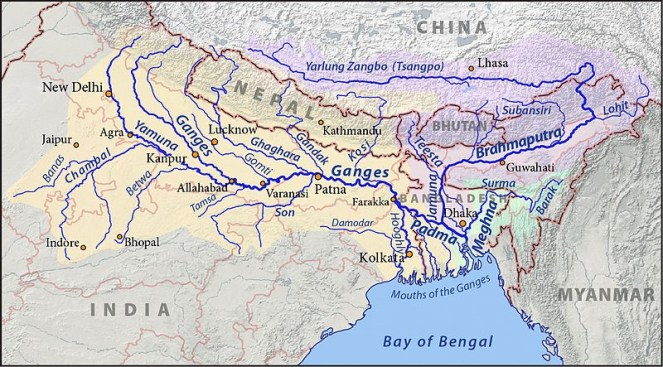
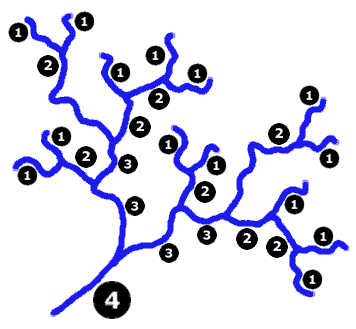
And then, the Ganga that we know is not only a single river but a collection of rivers. So Yamuna, Bhagirathi, Alaknanda, Mandakini, Dhauliganga, Pinder, Ramganga, Kali, Tons, Gomti, Ghaghra, Sone, Gandak, Budhi Gandak, Kosi & Mahananda are some of the major tributaries that directly meet Ganga. Each of them is a river in its own right.

The Ganga Brahmaputra Basin Photo from: Wikimedia Commons

Take Yamuna for example. Some of its major direct tributaries include: Tons, Giri, Som, Sahibi, Hindon, Chambal, Sind, Betwa & Ken, each of them are again significantly big rivers.

Take Chambal, some of the major direct tributaries of Chambal include: Parbati, Kali Sindh (Lakhundar, Ahu, Parwan are some of the tributaries of Kali Sindh, Newaj is one of the tributaries of Parwan, Dudhi is one of the tributaries of Newaj), Banas, Ider, Retam, Sau, Kshipra, Chhoti Kali Sindh, Cham, Siwana, Kural: each of which is a river by its own right.

Take Parbati: some of the major tributaries of Parbati include: Papnaus Ajnal, Sewan Paru, Utawali, Paraparwa, Mawal, Tem, Bhader, Gochi, Gaumukh, Sunk, Negri, Chopan, Uproni, Duhral, Andheri, Beram, Kosam, Ahelil and Sukni. These are all rivers too!

We can go on like this much longer. But such is a vast network of rivers that we call Ganga.

river

Secondly what flows in a river is not just water, though most governments, official agencies & engineers see the rivers as channels of water. Flowing water is surely a major visible defining component of a river. But even a canal or a pipeline can claim that. But unlike a canal or pipeline, a river carries dissolved matter, suspended matter, bed load, microorganisms, many levels of aquatic flora and fauna.

Thirdly, a river is a connected entity. It is connected with upstream and downstream river, biodiversity & landmass, the terrestrial land & life, underground geology and groundwater aquifers and is also connected with the floodplain. Perennial rivers like Ganga meet the sea forming a delta and this connection is vital for the river and as well as the sea. The connections are so strong that a river provides a report card about what is happening upstream and downstream, if read carefully.

From: The River continuum Concept. Species in India will be different, but this represents how biological entitites in a river are linked to each other through a number of processes including nutrient spiralling Oxbowriver.com

This is admittedly a partial description of a river, limited by the constraints of an article or blog. This is also a bit simplistic description of how humans deal with rivers, since there are exceptions. But this provides a broad direction of our journey with the rivers.

from : lakeconesteenaturepark.com

Apart from its many functions like ecological, hydrological, geomorphological ones, a river is also connected with the human society along the banks. The connection with human societies has been as long as the humans have existed. This connection is not really necessary for the river to survive, but we cannot say the same about human survival. Humans cannot survive without the rivers, though is doubtful if the human society understands or even acknowledges that reality.

More importantly, till about a century ago, our interaction with the rivers did not endanger the existence of the rivers themselves. But what we have been doing in last century has created existential threat for rivers. This threat comes in the form of big dams, diversions, chemical pollution from agriculture and industries, large dose of sewage pollution at major urban centers, encroachment on floodplains, deforestation, unsustainable groundwater use, riverfront developments, embankments, and climate change.

What humans have done to the rivers in last century can possibly be described as Terraforming (one of the grandest concepts in science fiction in which “advanced” societies reshape entire planets to suit their needs). Or what some geologists describe as Anthropocene, meaning a new geological age of humans to suggest that humans are now a planet transforming force.

It seems humans have stopped valuing the rivers as they exist in nature and decided that they can stop, bend, tunnel, channelise, divert, encroach, pollute the rivers. So when we build a dam, we do not put any value to the destruction of river & destruction of the services provided by a river that entails in the process of building the dam.

But let us get back to Rivers & what dams do to them. A river, by definition, must flow freely. A dam stops the free flow of river, and impacts the river in the most fundamental ways. In India when we construct a dam (e.g. Tehri), a hydropower project (e.g. 400 MW Vishnuprayag project on Alaknanda in Chamoli district in Uttarakhand) or diversion (Lower Ganga – Bhim Goda at Haridwar, Middle Ganga – Bijnor and Upper Ganga-Narora barrages), we do not have to leave any water for the downstream stretch of river. So complete drying up of the rivers for most of the dry months by these structures is the first direct impact of these structures on the river. To put it mildly, that action practically kills the river. Upstream of the dam too, the river gets killed, for immediate upstream there is stagnant water and further upstream, the river has lost its connections with the downstream river!

Dry Baspa River downstream Baspa II Dam, Himachal Pradesh
Dry Baspa River downstream Baspa II Dam, Himachal Pradesh Photo: SANDRP Partners

This is because these structures not only stop the flow of water to the downstream areas, they also stop flow of everything else that was flowing in the river: the silt, the nutrients, the sand, the organisms, the flora, fauna, and severe every one of the connections of rivers we described earlier

And imagine when a river has to face such death every few kilometers in its journey!

Density of dams in the Upper Ganga Basin Map by SANDRP


That is not all. As the river continues its journey, if the tributaries are flowing reasonably freely, there is some chance for the river to recover some of its defining characteristics. But we have dammed most major tributaries too.

To top it, we also have other elements that help kill the river, like pollution, encroachment, abstraction, etc, as described earlier.

And remember just about a century back Ganga and other rivers were not in such a bad shape. This is an achievement of less than 100 years.

Chandra Basin in Himachal Pradesh depicted by Nicholas Roerich in 1932. The same Chenab Basin now witnesses one of the highest dam densities in Himalayas. From: WikiArt

Some people will read in this a plea to go back by those 100 years. That is not possible, and we all know that. But there are other ways to deal with the rivers. Human society can take what is needed for the society, without destroying the river.

This is true of Ganga, as any other River!

Himanshu Thakkar (ht.sandrp@gmal.com, https://sandrp.wordpress.com/)

~~~~~~~~~~~~~~~~~~~~~~

This is 200th post from SANDRP! We always look forward to your suggestions and comments for improvement.

Our 100th Blog on River Conversations: https://sandrp.wordpress.com/2013/10/08/river-conversations/


Ganga · Hydropower

What do Rivers have to do with Silt??

Rivers are again in the news, though so far only for symptomatic reasons. The new government at the centre has renamed the charge of water resources minister to Minister of Water Resources, River Development and Ganga Rejuvenation. There is fundamental contradiction within this name plate and we have in fact yet to see this nameplate.

There is also a lot of discussion about rejuvenation of Ganga, with the Prime Minister promising the people of Varanasi Parliamentary constituency that he will rejuvenate Ganga.  There is no clarity about how he plans to go about in achieving that. His claim during elections that Gujarat Government’s Sabarmati Riverfront Development provides a model for this is clearly a non-starter. Sabarmati has water only in 10.4 km of the river stretch that flows through Ahmedabad. If you go upstream of this stretch, you will find a dry river in most non-monsoon months and if you go downstream, you will find a river more polluted than Yamuna in Delhi. And even the water that one sees in this 10.4 km stretch is not the water from Sabarmati river basin, but is taken from Narmada River via Sardar Sarovar Canal! Pertinently, Ahmedabad or Sabaramati has no right over that water: the Sardar Sarovar Project has been built and justified in the name of Gujarat’s drought-prone areas like Kutch and Saurashtra.

The nameplate-changing business also extended to Union Ministry of Environment and Forests, its name changed to Union Ministry of Environment, Forests and Climate Change, though here again the new nameplate is yet to be seen. Unfortunately, all the noises that we have heard so far from this front seem to give primacy to growth rather than environment or forests or climate change! The new environment minister has yet to say anything about river protection, but he is already talking about river linking!

So is there a hope for rivers in this new establishment, going beyond the symbolic name changes? Here one is reminded of a meeting, where one of us (HT) was invited a few months before the elections, to discuss the state and fate of Yamuna River in Delhi. When HT started speaking, he started by asking what is a river? Is it just a source of water as engineers see it? Following a sudden change in program, Sushri Uma Bharati was the chief speaker at the meeting and when it was her turn to speak , she actually tried to understand that question and tried to find an answer to it: what is a river? Her becoming the Union Water Resources Minister also raises hopes since she had been campaigning for Aviral Dhara (Continuous flow) of the Ganga and against building of dams and hydropower projects in Uttarakhand. We hope that she will realize that impact of dams and hydropower projects on rivers is similar, if not same everywhere.

Ms Bharati is also minister of river development and Ganga Rejuvenation. The question, What is a river? becomes even more relevant in that context. A river is possibly the most complex ecological entity and we still do not understand fully how to define a river. But here we would like to highlight that river is a lifeblood of the ecology and carries so much more than water. One of the key elements that river carries is silt or sediment (although there is a slight difference between the two, we will use it interchangeably here).

The rivers carry silt from various points in their journey from the hills, to the deltas where most major rivers meet the sea. In this journey, the type, quantity, movement of silt varies with place and time. The silt comes in various forms, from suspended matter to fine silt to coarser sand. It is the transfer of silt from upper catchments to the plains that helps build fertile and alluvial flood plains like the Indo Gangetic plains.

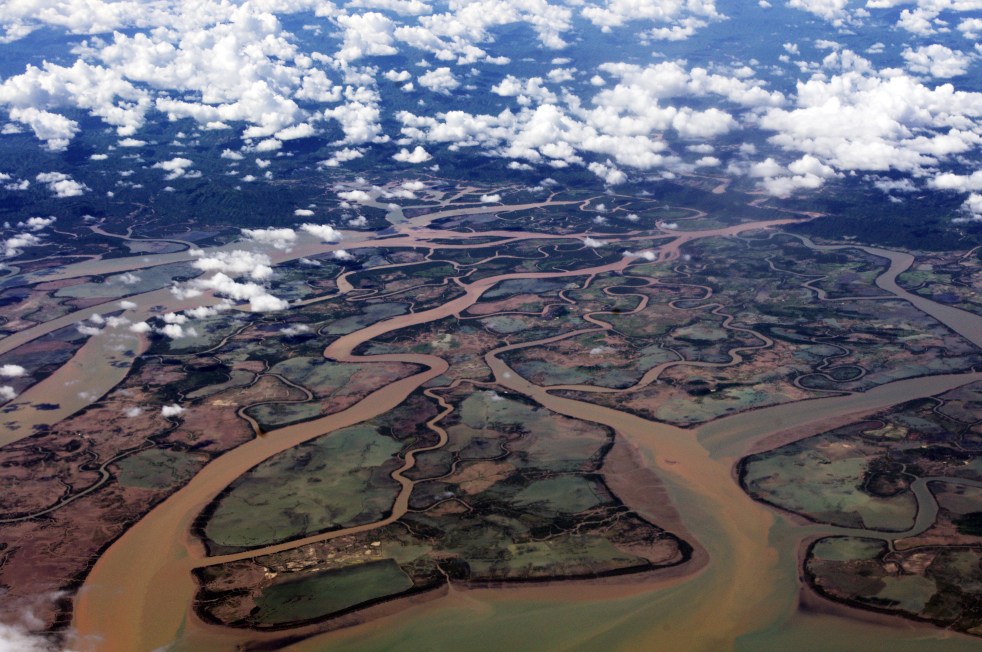
Ganga-Brahmaputra Delta during Monsoons. Pcture from : http://sebix.github.io/gallery/2012/ganges-delta-during-the-wet-season/

The flow of sediment through rivers to the delta also protects the deltas, which are very highly productive & biodiversity rich ecosystems, population centers and agriculturally fertile areas. Deltas are constantly facing the threat of erosion by sea. In this fight against erosion by sea, the sediment brought by the rivers helps the deltas in a major way. Sediment flow to delta becomes even more important when sea levels are rising in changing climate.

However, when we build dams, hydropower projects and diversion structures on the rivers, we completely change the silt flow pattern in the river. The dams arrest the silt and hydropower projects and release silt free water in the downstream. The erosion capacity of the silt free water is greater, and the additional erosion they cause in the immediate downstream may not compensate for the silt trapped in the dams. The run of the river hydropower projects may release silt annually or more frequently and also on daily basis from desilting chambers, but the pattern of transport of the silt again completely changes. Moreover the dams and diversions completely change the character of flood-flow in the downstream area, when it is established that floods are the most important sediment-transporting events. All these changes have huge impacts in the riverbeds, in the floodplains and in the deltas. And most worryingly, we do not understand these impacts completely as yet.

REbuilding a flood barrier in Bangladesh Delta, destroyed due to Cyclone Aila from : http://www.nature.com/news/floods-holding-back-the-tide-1.15013
Rebuilding a flood barrier in Bangladesh Delta, destroyed due to Cyclone Aila from : http://www.nature.com/news/floods-holding-back-the-tide-1.15013

It is only recently that scientists have started work that provides a glimpse of impacts this changing silt flow is causing. For example, our deltas are literally shrinking and sinking, and several independent scientific studies are telling us that dams must take major, about three-fourths of the blame. About 80% of the sediment that rivers bring can be trapped by the dams and this means that dams are annually trapping about 40 billion cubic meter of sediment globally. That is more than five Sardar Sarovar Dams every year! In India, our estimate earlier showed that large dams are trapping at least 2 BCM of silt every year, this figure is likely to have gone up now.

Not all the sediment trapped in the dams would reach the deltas, a significant part would have been left on the floodplains and in the river channels. And sediment trapped by dams is one of the many reasons behind sinking of deltas. However, scientists are estimating that already deltas have been deprived of at least 73 BCM of sediment by the dams. In South Asia, during the past century, Indus delta sediments have been reduced by 94 percent, Ganga-Brahmaputra delta sediments by 30 percent, and Narmada delta sediments by 95 percent.

The Ganga Brahmaputra Delta, formed of rich sediment From: EO Snap.com

In 2007-08, the Ganges, Mekong, Irrawaddy and many other rivers flooded with more than 100,000 lives lost and more than a million displaced. Most of the deltas that were flooded did not receive a significant input of sediment. These major flood events lead to sediment trapping behind mega dams.

The direct impacts of delta subsidence and effective seas level rise include inundation of coastal areas, saltwater intrusion into coastal aquifers, increased rates of coastal erosion, an increased exposure to storm surges, in addition to the threats to food security, livelihood security, water security for millions and a huge loss of biodiversity. These threats impact hundreds of millions of people who inhabit the delta regions as well as the ecologically sensitive and important coastal wetland and mangrove forests.

Sundarban Forests constitute parts of Ganga-Brahmaputra Delta from: Wikimedia Commons

As Prof. James P Syvitski, the Chair of the International Geosphere-Biosphere Programme, told SANDRP, “We must learn to do better.” However, decisions surrounding dams in most regions of the world are not even assessing the impacts on deltas. Ignoring sediments when building and operating dams comes at a huge price. Someone else is paying that price right now and this price is steeply increasing. For full SANDRP report on this issue, write to us or see https://sandrp.in/Shrinking_and_sinking_delta_major_role_of_Dams_May_2014.pdf

This article provides a glimpse of the role that rivers play in sediment transport. It goes to show how little we know about the role played by rivers in our lives. We hope we have much richer debate around the role of rivers in our lives in days to come.

Himanshu Thakkar (ht.sandrp@gmail.com), Parineeta Dandekar (parineeta.dandekar@gmail.com)

For a response to this blog by Dr D K Mishra, see: https://sandrp.wordpress.com/2014/07/05/response-to-sandrp-blog-on-sediments-rivers/

Satellite image of Brahmaputra River From: Wikimedia Commons

( An edited version of this piece appeared in the Civil Society Magazine: http://www.civilsocietyonline.com/pages/Details.aspx?563)


Free flowing rivers · Hydropeaking · Hydropower

“If its peaking, its not an ROR!” Interview with Dr. Thomas Hardy, IAHR and Texas State University

At the 10th International Symposium on Ecohydraulics in Trondheim, Norway in June 2014, SANDRP talked with Dr. Thomas Hardy, Past President of the Ecohydraulics Section of the International Association for Hydro-Environment Engineering and Research (IAHR), and The Meadows Center for Water and the Environment Endowed Professor in Environmental Flows at Texas State University.

Dr. Hardy holds advanced degrees (MS and PhD) in both aquatic ecology and civil engineer and has been at the forefront globally, for linking issues related to hydraulics and hydropower with ecosystems. Here he talks about issues like state-of-art mitigation measures being put to use across the world for mitigating impacts of hydropower, evolution of Ecohydraulics and the dangers of “Putting dams at the wrong place”

We see some significant mitigation measures, some of which include decommissioning, for addressing impacts of hydropower coming from over the world. How did this system evolve? What was the role of various actors and did this happen suo motto from the companies?

Since the last two decades, we have recognized the environmental consequences of hydropower. The cost benefits analyses of many projects is getting skewed, we have been witnessing the ecological costs of many of such projects are exceeding their economic benefits. For example, in the 5 dams in a cascade on the Klamath River, the economic value of the salmon fisheries being destroyed was more than the hydropower benefits from the dams. A lot of mitigation measures have come from countries like Norway and countries like US have also seen them, and we are always keeping our eyes open for better solutions.

Fish Ladder at John Day Dam (from : http://blog.oregonlive.com/)

While it’s accepted that there will be impacts of any intervention, we need to be honest about the scale of the impacts and who pays the price for these impacts.

About the suo motto role of companies, unfortunately, I have not seen very many companies adopting better environmental standards by themselves without consistent pressures and constant monitoring from people and the government. A lot of credit to increased performance of hydropower mitigation measures goes to NGOs, civil society groups, indigenous communities and the citizens themselves for raising these issues with the companies as well as governments to adopt better standards for their rivers. The advent of social media continues to help a lot to this end.

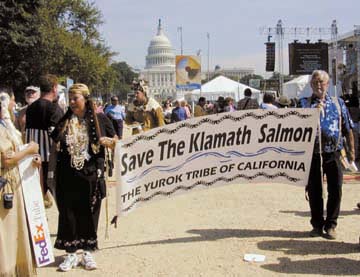
In the US, a lot of changes were also driven by aboriginal communities who protected their fishing rights or riverine ecosystems. For example in the Klamath River, the aboriginal tribes upheld their traditional fishing rights of salmon which were affected by the dams. This led to not only changes in dam operation, but a spurt of work on fish ladders, passes, eflows and decommissioning. Having said that, we have also committed some massive mistakes, the cost of which have been great. The mitigation measures we are trying to put in now are very costly. Making wise decisions about siting dams and including mitigation measures at the level of designing itself is not only effective, but its also comparatively cheaper. In that sense, it is encouraging to see China being more concerned about the impacts of its hydropower on the environment.

From: http://stopwintufraud.blogspot.in/

It is claimed that Run of the River projects are environmentally better than storage type HEPs. There are some such projects which undertake massive peaking. How can the impacts of massive scale of hydro-peaking be mitigated?

Firstly, if its peaking, its not an ROR. [1]An ROR by definition cannot store water and cannot change the hydrographs of a river on a timescale. If it’s doing that, it’s not an ROR and should not be labelled as such. Period. If anyone is doing that, I would question their motives in being less than truthful. It’s also a matter of wrong green labels to these projects. So we need to remember that RORs do not change the downstream hydrograph and hence cannot peak.

How about the contention that ramping up and down reduces peaking capabilities of the project?

Well, there is no free lunch. There is a cost to doing business, cost of doing good business, and only this will keep it running in the long term. No one would deny that all developmental activities entail environmental costs, but we to understand the range of environmental and social costs, put them on table and then take a wise decision, taking everyone on board.

As for ramping rates affecting peaking operations, power demands do not fluctuate hugely from established patterns on a daily, weekly, or seasonal basis and the companies have a pretty good forecast idea of the range of demand. Based on this, if the peaking is supposedly for 3 hours, up ramping can be started an hour earlier, so that we get the benefits of 3 hours peaking. Same goes for down ramping, you need to coordinate it that way. Of course this will mean some change of efficiency, but like I said, there is no free lunch and surely government and companies are concerned about safety of their people downstream these projects.

Safety concerns of peaking opeartions, apart from the ecological concerns, are very important to consider. In case of  the Milner Dam on the Snake River in the US, I actually had a group of students and fishermen stand and then wade in a river and we then worked on the releases from the dam which gave sufficient time for these people to get out of the river. There is no option to safety measures. They are of paramount importance.

When we develop rivers in a cascade, would it help if we maintain free flowing stretches between projects?

Well it’s a relative question, which is all about siting your projects. In the first place, don’t put a dam in the wrong place! That’s most important. After that, placing of other dams will be specific to the ecological uniqueness of that river. But we need guidelines which say at least some percentage of the upper watershed should be conserved and not exposed to impacts like peaking. It may be better to entirely protect the tributaries of a heavily dammed basin, rather than adopting a cut and stitch approach. FERC (Federal Energy Regulatory Commission) is now routinely including impacts of hydropeaking on fish and other organisms like benthic macroinvertebrates while relicensing and also licensing.[2]

Decommissioning of the Glines canyon Dam on the Elwha River From USGS.gov

How is the monitoring mechanism around mitigation measures developed in the US? Do communities have a role to play here?

Monitoring is well developed and an important part of the licensing process. The company can do annual monitoring themselves, or they can outsource this to an external entity.  Monitoring advisory Committees are mandatory for projects and this committee includes representatives from the company, wildlife groups, aboriginal groups, regulators, etc. The membership to this committee is pretty flexible. If a group has significant reasons and wants to be a part of the monitoring committee, it can do so. This committee monitors environmental management plans and also guides the company in this process.The issue is about making the companies and government accountable to the society.

There has been a flood of eflows methodologies, Which one would you describe as the state of art methodology at this moment?

ELOHA is robust and well developed for this moment, but there is no one size fits all method, the assessment method depends on the data, time and resources available. The main point is that even eflows entail consensus generation and equitable sharing of resources and here too, the community should be playing a main role.

When the dam building pressures are too high, there is little point in hurrying through studies. In extreme cases, it is wise to put a moratorium on on-going development, try and fathom what we have lost and will be losing, look at the environmental and social consequences of this loss and then decide on the way forward. These things cannot be hurried into.

At places like Columbia River systems, we realize that we have changed the entire river basin, but the mitigation measures have been developed, put in place and are working. So, that’s good. But in other places, we realize that the social, ecological and even economic costs we are paying for developing dams are just not worth the costs. In those cases, we need to bring them down. This has happened too.

Interviewed by Parineeta Dandekar, SANDRP

(The trip was possible due to generous support from Both ENDS)

~~~~~~~~~~~~~~~~~~

[1] Text book definition of ROR: ““Run-of-river” refers to a mode of operation in which the hydro plant uses only the water that is available in the natural flow of the river, “Run-of-river” implies that there is no water storage and that power fluctuates with the stream flow.”

NOTE: Contrast this with the Indian Bureau of Standards definition of ROR, which allows pondage for even weekly fluctuations of demands and then claiming that this “does not alter the river course materially”. This is a blunder as that sort of pondage and resultant peaking hydrograph changes the downstream character of the river completely. even weekly storage and then peaking as ROR!

[2] http://www.northfieldrelicensing.com/NorthfieldRelicensing/Lists/Documents/Attachments/47/20130228-5329(28100604).pdf: The Turners Falls Project is currently operated with a minimum flow release that was not based on biological criteria or field study. Further, the project generates power in a peaking mode resulting in significant with-in day flow fluctuations between the minimum and project capacity on hourly or daily basis. The large and rapid changes in flow releases from hydropower dams are known to cause adverse effects on habitat and biota downstream of the project. Effects on spawning behavior could include suspension of spawning activity, poor fertilization, flushing of eggs into unsuitable habitat due to higher peaking discharges, eggs dropping out into unsuitable substrate and being covered by sediment deposition and/or eggs becoming stranded on de-watered shoal areas as peak flows subside.

CAG Report · Maharashtra

Clean chit by the Chitale SIT Report on Maha Irrigation Scam?

 Ye jo Public hai, Ye sab Jaanti hai!

The much debated SIT Committee Report headed by Dr. Madhavrao Chitale was finally tabled in the State Assembly on the last day of the Assembly in the evening on the 11th June 2014, reading it one gets a feeling of déjà vu. Following the uproar due to unprecedented dam scam in 2012, GOM constituted Special Investigation Team (SIT) on the last day of the promise, on 31 December 2012. Members of the Special Investigation Team (SIT), chaired by Dr. Madhavrao Chitale include AKD Jadhav, retd. IRS official and also the past Chairperson of MWRRA, Dr. Krishna Lavekar, Retd. Agriculture Commissioner, GOM and Dr. V. M Ranade, Retd. Secy, Command Area Development, WRD, GOM.

The committee report was submitted in March 2014, after some extensions and was kept under wraps for past three months by the government possibly keeping the Loksabha elections in mind. Not that it mattered as Congress and NCP fared terribly in Maharashtra, winning just 6 of the 48 seats in Maharashtra, and the irrigation scam seems to have had a massive role in this. Now the government, especially NCP’s former and current water resources ministers Ajit Pawar and Sunil Tatkare are claiming that they have got a clean chit from the report, keeping the State Assembly elections in mind.

These claims will not help the political parties. On the other hand, they are likely to harm their political prospects.

But first let us look at some basic aspects of the report. Does it really give a clean chit to the political parties? Is it above shortcomings? Will it play an important role in overhauling dam-centric water management in Maharashtra?

TORs of SIT The TORs of the SIT, laid down by the Water Resources Department of the GOM were as follows:

  1. Investigate irrigation potential created, actual irrigated area (pratyaksha sinchit kshetra) and water use for non-irrigation use. In the actual irrigated area, find the irrigated area by wells, farm ponds, water conservation department and water resource department
  2. To ascertain if the revised administrative approvals given to projects by Irrigation Development Corporations (IDCs) are according to the existing rules and regulations.
  3. Investigate the reasons for delay in completing projects
  4. Investigate reasons behind change in scope from original administrative approval and increase in cost due to change in scope
  5. Suggests measures to increase the usefulness of Lift Irrigation Schemes (LIS)
  6. Suggest ways for quality enhancement in WRD
  7. Suggest ways so that project is completed in said time span and costs
  8. Suggest measures to increase irrigated area
  9. If irregularity found in the inquiry, investigate it, fix responsibility and suggest suitable action

Are TORs inadequate? The Chairperson Dr. Chitale has reiterated over and over again, in face of requests and submissions from media, civil society, petitions filed in court (there are at this moment about 23 PILs (Public Interest Litigation) filed in Bombay High Court about irrigation projects between 2009-2013), that it was not a part of their mandate to look at the modus operandi of the corruption involved in the scam, in the process of calling tenders and accepting contracts. As per section 9.8 of  SIT report, issues it has NOT looked at include: Misuse of clause 38 in tenders for addition of component in the main tender without re tendering, Sanctioning mobilization advances without appropriate justification, Manipulating estimates for accepting tenders, inclusion of unjustified and unrelated additional expenses and Dam Designs made by contractors. The Committee says that these irregularities are outside their TORs but there is ‘scope for doubt’ and the “government would need to investigate into this separately within the legal boundaries.” This is not true and the SIT should have gone into these issues, particularly when it has found ‘scope for doubt’ in these issues because per se the TORs are broad enough to include these.

The committee also says that going into these would have been difficult due to absence of man power, resources and time at the committee’s disposal. However, looking at the centrality of these issues in the Dam Scam, due to which the committee was set up in the first place, and the respect Dr. Chitale garners in the WRD (Water Resources Dept) and political circles, it would not have been impossible to get the TORs modified if at all necessary and very easy to get additional resources. But there is no evidence of the committee asking anything in this regard, indicating that this was not even attempted by the committee.

Apart from that, the committee could have addressed many of these issues being in their TORs as corruption, political-influence and contractor-led processes have affected nearly all the aspects covered in the TORs. Not looking at these issues has resulted in a situation where Dr. Chitale says one of the main reasons for cost escalation of projects has been rise in market prices. Now consider this: costs of Kondane dam increased from Rs 57 crores to Rs 614 cores in just six months, and market prices had nothing to do with this. There are several such examples, where cost escalations, time increase, technical problems had nothing to do with the issues looked at by the committee. The  exclusion of political and corruption issues have affected the quality of conclusions and recommendations of the report.

The committee notes that it relaxed the TORs in accepting submissions from organizations and NGOs, keeping the bigger picture in mind. Strange to see that committee did not think of doing so in issues related to corruption and political links.

CONCLUSIONS OF SIT:

Some of the good conclusions:

  • Environmental and Forest Violations: The report says that there are 2 projects without EC (Environment Clearance) and 31 projects without FC (Forest Clearance) and which did not get FC for more than 5 years. Without clearance, work on some projects stopped midway or dragged on, resulting in a dead investment. If work was started only after permissions, these expenses could have been avoided and money instead could have been spent only on those projects with permissions. The SIT has recommended strict action against officials who floated tenders and issued work orders without these clearances, which is welcome.
  • It has also recommended action to be taken against officials responsible for starting working without acquisition of land for the project as well as canals. (9.3.2)
  • Initiating work without detailed design: Recommends action should be taken against the officials. (9.3.3)
  • Initiating work in the absence of finance: Committee recommends Strict action against IDC, Chief Auditor and Executive Director of the IDC (9.3.4.) which started work without requisite finances.
  • River plugging without creation of irrigation potential: There are around 23 projects where the river plugging (ghal bharni) was done but there was no irrigation potential created then or even two years later. Committee recommends strict action against officials.
  • Projects with serious faults, suspicious transactions: Committee recommends that projects with multiple flawed parameters should be checked by an independent committee and recommends action against Executive Director for the respective IDC. Such projects include: Ujani, Krishna Koyna LIS, Seena Medium Project, Bembla Project, Lower Painganga, Jigaon, Kurka Wadoda Project (TIDC), Sulawade, Bodhawad Praisar, Lower Tapi, Mukatinagar LIS, Manjra, Vishnupuri (Godavari Barrages), Brahmangaon LIS, Upper Godavari Project, Krishna Marathawada project
  • The committee also notes serious irregularities in the following projects: Dhamani (Kolhapur) Kukadi (Seena Tunnel), Jigaon (Buldana, Kondane (Thane) and Chanera (Thane) and recommends special attention and investigation into these projects.

But many conclusions are flawed, unacceptable and some are even illegal:

  • Irrigated area in the State: The report relies only on data collected by WRD. It also states that WRD collects seasonal field data. However, this is not true. The WRD currently has no system in place for admeasuring irrigated area. Irrigation Status Reports and Benchmarking reports are also not available for the past three years. Chitale Committees’ conclusions based on data from WRD are not reliable.
  • TOR 9: Investigation and fixing responsibility The committee holds the entire state machinery including the Planning and Finance Department for not providing enough checks and balances on the work of WRD and classifies most blunders as “systemic errors” (9.04). While fixing clear responsibilities of these sectors could have helped, sweeping generalizations and repeated conclusion of “systemic errors” ensure escape route to all offenders.
  • The punishments are classified into mild and strict punishments, but even strict punishment is limited to departmental inquiries. The committee has also taken the circuitous route of not naming the offenders, but alluding to their posts and duration. Even this is extremely vague. So while the committee refuses to look at most contentious issues, it also refuses to name offenders and also does not name political hand behind the decisions. It does not seem to be an investigation team in any way. Also, when fixing responsibility is a part of the TOR, the committee cannot shirk from the responsibility and state that it will not name offenders. This is a public issue and committee does not have the privilege of overriding the TORs for its idea of leniency.
  • The committee says that investigation into irregularities indicates that major driving force has been stress to reduce backlog, pressure from ‘local’ political leadership, centralized decision making in the IDCs and conscious ignorance of rules and social responsibility. This lenient generalization washes any responsibility from the political leadership of the state and the contractor-engineer nexus.
  • Section 10.9 of the report states that the blunders committed by decision makers were not intentional and were mostly ‘errors of judgment’.
  • MWRRA: Committee reports that 12 Projects are without MWRRA permission. Mild action is recommended against responsible Executive Director. (9.4) While the committee recommends action even against Finance and revenue departments, it does not mention any strict action against MWRRA, which, as pointed out by the CAG Report 13-14 cleared 189 projects during 2007-2013 though the State Water Resource Plan, based on which the projects were required to be cleared, was not prepared, violating the MWRRA Act (2005). Significantly, CAG mentions that: “Authority also failed to perform its role as a regulator as envisaged in the Maharashtra Water Resources Regulatory Authority Act, 2005.”
  • On functioning of IDCs The report states that in 2004, at a meeting of the governing council and IDC members, it was decided that the rights of giving Revised Administrative Approval (RAA) will be given to the Chairperson (WRD Minister). Only a few members of the governing council were present for this meeting. The SIT notes that while the IDCs should have been going towards decentralization, this was a regressive step towards centralization and concentration of power and authority, however, the committee does not suggest ANY action against the Chairman!
  • As per a 2003 GR (Government Resolution) regarding Krishna, Godavari and Vidarbha IDC, all rights to provide RAA were given to the Chairperson and Executive Director by the Governing Council of the IDCs, thus concentrating power (and also scope of corruption related to RAA hikes).
  • CAG Report (2013-14) says regular monthly meetings of the Governing Council of IDCs were not held, in violation of Maharashtra Irrigation Development Corporation Acts. The Chairman (WRD Minister) is directly responsible for this. But the SIT Report does not mention this!

Action Suggested with respect to Specific Projects:

GoseKhurd: There should be action against respective officials who did not visit the canal works due to which concretization was to be done again. The SIT does not suggest any departmental inquiry or anything new other than the recommendations of the Mendhegiri committee report.

Barrages on Godavari: Several question marks have been raised about these projects, their utility and safety. Kulkarni Committee appointed to look into irregularities has come up with strong measures against defaulting officials. But rather than upholding Kulkarni Committee’s recommendations, the SIT asks for constituting one more committee to look into the irregularities!

Illegal suggestion of SIT Shockingly the committee says: (Page 210) for Human Project Forest and Forest Clearance was incorporated in project tender and recommends “it would have been good if a separate tender was issued for this” This is very disturbing. The entire process of Forest Clearance happens through the State Government Forest Department and there is NO role for any other agent here. Any such role indicates violation of the Forest Conservation Act, and SIT recommends precisely such a violation!

Similarly, Environmental Appraisal is supposed to be an unbiased process looking at the social and environmental impact of projects. There is again no scope for tendering here. The SIT’s recommendations in this regard are illegal.

WHY THE PEOPLE OF MAHARASHTRA WILL REJECT THIS REPORT

After pursuing the 600 pager main report and its 32 pager Executive summary made by WRD[1], and keeping in mind all the other available information, one is left with little doubt that Chitale Committee has not only refused to unravel the truth, but has tried to protect political parties.

The unprecedented Dam scam in Maharashtra highlighted massive corruption in tendering process, a collusion of politicians contractors, engineers and bureaucrats, shockingly poor quality of work endangering lives of people in the downstream, a huge number of incomplete projects, nonexistent increase in irrigated area, etc. Some of the main whistle blowers of this scam included Anjali Damaniya of erstwhile IAC, organisations like Shramik Mukti Sangathana and SANDRP and most notable, Vijay Pandhare,  who was then the serving Chief Engieer of META, WRD. Mr. Pandhare’s letters to Chief Minister, WRD Officials, his engagement with the media etc., was remarkable and helped people of Maharashtra in understanding the scope and impact of the scam. In the past too, reports from forthright officials like Kulkarni, Vadnere and Upase had exposes parts of the scam and raised public awareness. This is apart from the systemic problems of dam-based water management in Maharashtra on which many individuals and organisations like Lokabhimukh Pani Dhoran Manch, NAPM, etc have been working for many years.

Considering this, people of Maharashtra are not going to look kindly upon any vague report that gives escape route to corrupt politicians, engineers and bureaucrats, without seizing the opportunity available to it. Unfortunately Chitale Committee Report (referred to as Chitale report) does just that. 

In fact, in the minds of people of Maharashtra who have followed this scam and listened to people in power insulting the plight of the common man in the absence of water (like Ajit Pawar’s remark about urinating in the dry dams or cutting water supply of villages that do not vote for NCP),  the report has seriously discredited Dr.  Madhavrao Chitale and the team of past bureaucrats themselves for:

  • not being clear and forthright about the main causes of the problems,
  • basing their data on the same WRD which has proved to be incorrect,
  • not seizing the historic opportunity available which could have altered the course of the Maharashtra irrigation through exemplary recommended actions,
  • not questioning the merits of mega irrigation projects which have been eating into Maharashtra’s public expenditure, concentrating water and power, impacting communities and ecosystems without benefits,
  •  being shockingly protective of the political class that was at the driving seat of this scam at public expense, by ignoring proofs against political leaders and parties even when it was available to the committee,
  • by maintaining escape routes in the report through which political leaders can escape
  • mollycoddling most of the issues as ‘systemic failures’ when it was their responsibility to fix precise responsibility and there were specific known culprits and institutions,
  • making some suggestions which are in fact illegal.

The committee shows how protective it is of the status quo in irrigation department when it talks of possible negative impact of exemplary punishments (and even departmental inquiries!) on the morale of WRD officials and says that irregularities other than financial ones are due to systemic failures and a large scale investigation into these will affect the morale of the officials. What will really affect the morale of good officials in WRD is NOT fixing responsibility on the guilty, thus maintaining a poor public image of the entire department, while putting the burden of political decisions exclusively on WRD officials. This will foster the feeling that no one can touch the political class and hence, officials better toe the line. This is sending a completely wrong signal.

All Political Parties in it together: While members of BJP are saying that the SIT Report indicts some leaders like Ajit Pawar and Sunil Tatakare, these parties too are not stating upfront that there are serious flaws in the report & the projects, processes and systems the report was supposed to investigate and that neither the report, nor the flawed projects can be accepted. Neither do they raise the basic questions of the merits or lack of merits of having hundreds of irrigation projects without benefits at such huge expenses, and mostly unassessed social and environmental costs.

Nor do they talk about the real changes needed with the Water Resource Department, MWRRA (Maharashtra Water Resources Regulatory Authority), IDCs (Irrigation Development Corporations like the Konkan, Tapi, Kirshna Valley & Godavari basin) and related government machinery, to make them accountable, transparent and participatory.

The reasons for this are clear. The opposition parties are not untouched in this scam. Right now, they want to score political brownie points through the chaos while not aiming for any lasting changes or suggesting measures in the interest of people of Maharashtra. It should also be remembered that many of the current 600+ on-going irrigation projects under investigation were initiated at the time of Shiv Sena- BJP rule in the state.

The report protects political parties: While it has been shown by several reports, individuals and organisations that many decisions affecting projects were driven by financial and political interests, the report does not utter a word about political influence on WRD officials.

It should also be remembered Dr. Chitale, through his various roles as Chairman of Maharashtra Irrigation Commission, Secretary Water Resources for Government of Maharashtra & India, Secretary General of International Commission on Irrigation and Drainage, Chairperson of the Expert Appraisal Committee (EAC) of River Valley and Hydropower Projects MoEF[2] has been entirely pro dam in his approach. He has never questioned the basic need and merits of large dams, despite their poor performance, multiple safety issues, environmental and social impacts, hazy and unattained benefits, etc. His pro-dam attitude is very convenient for and coincides with government of Maharashtra’s push for large dam agenda: pushing dams at each and every possible location, without a thought about their performance and impacts. As a result, as pointed out by CAG report 2013, in June 2013, WRD has as many as 601 projects under execution with estimated balance cost of Rs 82,609.64 crore which is nine times the capital grant of the Water Resources Department for the year 2012-13.But the Chitale Committee Report does not say a word about  this.

The report protects the Central Government In sanctioning, monitoring and financing irrigation projects in Maharashtra, there is a huge role for several arms of the Central Government, including Union Ministry of Water Resources, Central Water Commission, Planning Commission and Union Ministry of Environment and Forests. Thousands of crores of money comes from the Center to this state each year. The scam could go on unhindered also due to the failure of these agencies. For example, large irrigation projects are funded through Accelerated Irrigation Benefits Programme that is supposed to be monitored by CWC and Planning Commission. The Planning Commission is supposed to release first installment only after projects have all the clearances and every next installment only after previous installment has been used as per required norms and necessary results achieved. The SIT should have looked into the role of these agencies and their failures, but by not doing so, SIT has again favoured status quo and protected these bodies.

Dr Chitale, Ignorance of law is not a valid legal defense In the most crucial section of the report, dealing with fixing responsibility in grating Revised Administrative Approvals (RAAs), the report says that the Irrigation Development Corporation (IDC) does not have the right to sanction RAA and the Managing Director and CAFO (Audit and Finance Officer) of the IDC did not bring this to the notice of the IDC and hence the responsibility lies with them. In addition it says that: “Permission of Finance Department is needed for issuing RAA and it seems improbable that the GOM does not know this. This clearly implies that although the committee knows that Chairperson of the IDC knows this, being a part of the GOM, it is not ready to say so, shifting the responsibility on the officials.

In the very next point on action suggested, however, the report says: “In cases where expense made exceed approval, the Executive Director of IDC did not have power to grant RAA. CAFO and Executive Director of IDC are responsible for not bringing this fact to the attention of the Governing Council. If they had brought this to the notice of the governing council of the IDCthen responsibility comes to members and Chairperson. GOM should take appropriate decision in this regard.”

This is the only place where the SIT mentions the Chairperson of the IDC (Water Resources Minister) in the entire report!

This is possibly the most dishonest part of the report. The committee implies that WRD Minister of the State not knowing the norms of WRD is fine, and the responsibility for minister’s ignorance should lie with the officials. But, ignorance of laws and orders is not an excuse for violating laws. It is clear that SIT should have firmly indicted the WRD Ministers and recommended strong action against them. The SIT has done nothing of this sort and has transferred the responsibility on the WRD officials, also keeping a clever escape route for the politicians. Sunil Tatkare is already exploiting this escape route. (Interview)

This is shocking, blatant and unacceptable.

RECOMMENDATIONS OF SIT The Chitale Committee has made following recommendations, translated by SANDRP from original Marathi:

1. Through Remote Sensing (RS) find the actual siltation of major, medium and some minor projects

2. Cities and industries should treat their sewage and effluents to 100% level to reduce non-irrigation water demand

3. Water charges should be levied on wells in command which have not been handed over to WUAs

4. Performance evaluation of minor irrigation projects and recommendations for betterment

5. In cases where perennial crops like sugarcane are taken on major projects and canals their area should ascertained by RS and water charges levied accordingly.

6. Revenue and Agriculture Department is causing extreme delay in collating irrigated area. This needs to be looked into urgently.

7. In depth assessment of why water use is less in Konkan, Amravati and Marathwada and undertake works accordingly

8. Study through MERI: why has carrying capacity of canals decreased?

9. Do not declare irrigation potential created unless distribution systems are in place and ascertained

10. Proper account of irrigated area should be kept with the Agriculture Commissioner

11. Any fraudulent use of non-irrigation water should be checked and detailed audit published every year

12. Methods of collecting data for Economic Survey Report should be improved.

13. Data in benchmarking report should be collated at project level and not Division level as it is done now.

14. The actual cost of projects (original cost + escalation) should be considered as Administrative Approval cost and if cost of the project exceeds 12% of this only then it should be considered for Revised Administrative Approval (RAA) according to CWC guidelines

15. In RAA while finding the benefit ratio, the expenses should be modified as per the escalation

16. WRD needs to have its own code of conduct and rulebook

17. LIS Projects should have a separate rate list, separate from the contractor

18. The WRD should publish escalation rates based on rates every year

19. Construction work should be audited at various stages.

20. After the project construction has been completed, the project should be handed to the management division, WUAs, distributaries work should be done asap (As soon as possible)

21. Some period before and after the project should be designated as project related time

22. Before clearing any further LIS, it should be checked whether it has complete financial support and its electricity expenses should also be considered

23. Separate maintenance fund for pumps, rising mains and other LIS equipment should be considered

24. Rather than giving water to PA’s through LIS, smaller WUAs should be formed and water should be given through smaller LIS

25. Manual for LIS needs to be developed which includes all aspects of LIS management, implementation and command area development

26. Quality control parameters for WRD Department are now out of date and new ones should be developed

27. Damaged and dysfunctional equipment on states dams should be immediately made functional and it should be seen if any changes in these are needed

28. A committee should be formed under MERI to implement and manage the recommendation of the Dam Safety Organization

29. Special training session on Colgrout masonry should be organized by META and only the certified employees should be used for overlooking related works.

30. Proper management of projects as per methods like PERT or CPM should be undertaken at Project formulation stage. Activity time considered should be from the start of initial work to the initiation of irrigation from the project

31. Limits of the five year plan should also be laid on project

32. Work on large projects needs to be broken down in smaller pieces and projects with irrigation potential higher than 1 lakh ha should be termed as Mega projects.

33. Investment made for non-irrigation use should be clearly indicated as such

34. Irrigation potential of the project should be adjusted as per the water used for non-irrigation uses.  Requisite area should be reduced from irrigation potential of the project. Not doing so bloats the irrigation potential created.

35. A separate cell should be set up for coordinating mandatory clearances in IDCs (Irrigation Development Corporations)

36. Help should be taken from Social scientists, NGOS etc in rehabilitation, water distribution and WUA formation

37. Completion report of the project should be prepared in which the responsible officer writes the history of the project and looks at future. A separate cell for this need to be created

38. Separate set up for Project related survey and this should have responsibility of awareness creation in beneficiaries.

39. All IDCS should have separate rules as they have separate regional needs.

40. To achieve the scope and participation of IDCS, noted non-government representatives heading financial institutions/ orgnaistiaons, MLAs and MPs etc should be deputed. There should be a quorum for IDC decision making meetings.

41. Steps should be taken to make IDCs self-sufficient through things like fisheries sale, water charges for HEPs, the water charges should be deposited with the IDCs. This will encourage the IDCs

42. High tech and region specific irrigation methods should be used like drip, sprinkles, piped supply, cropping pattern and volumetric water supply norms.

Suggestions Offered: Can they improve the current situation? While some suggestions of the SIT are indeed good, they still continue with the same status quo,  doing tinkering here and there.  When there was a need for substantive increase in transparency, accountability, independent oversight and participation in WRD, the suggestions largely remain at the superficial level. They follow the same system that was so easily manipulated by the officials as well as politicians, while blacking out the affected communities as well as local stakeholders from the decision making processes.

As it was pointed out by several groups (Example: Manch, NAPM, SANDRP, experts like Pradeep Purandare) at the time of appointing the committee, there were several fundamental flaws in the appointment of the members, the TORs of the Committees, the powers it had to take any meaningful action against the guilty. It was clear from the outset, and also vindicated by the report that the SIT committee Report under Dr. Chitale mainly protects the political masters.

However, after witnessing and sometimes even bearing the burden of the irrigation scam and political interference in water management,the people of Maharashtra know how deep the roots of this scam go. They also understand that any report which the political parties use as an escape route is not credible. To that effect, the SIT Committee Report under the chairpersonship of Dr. Chitale will not help the political parties. Ye jo Public hai, ye sab jaanti hai…

Parineeta Dandekar (parineeta.dandekar@gmail.com)

END NOTES:

[1] Exe Summary by WRD and not the SIT committee. Strangely committee report does not have an executive summary

[2] The EAC under the chairpersonship of Dr. Chitale gave environmental clearance to 2000 MW Lower Subansiri Project in Arunachal in 2002, which has been stalled for more than 2 years now for the want of comprehensive studies. When the EAC sanctioned the project, it was designed to release 6 cumec water for nearly 20 hours and suddenly 2000 cumeces for 2-4 hours to generate electricity, which would have disastrous impacts on downstream Assam. The environmental clearance and approval to this project caused a huge uproar and protests in downstream Assam and these are still continuing.

Dams

Ganga in Peril: Building more barrages will finish it off

By Anil Prakash

Rivers are not simply rivers, but they are our cultural life lines. Freshwater of rivers, fertile land on either side and island inside them, living beings, plants and vegetation and millions and millions of human beings, laughing and singing and shedding tears of sorrow, all taking together constitute the world of rivers. Men tried to fetter these rivers and construct dams, hydropower projects, riverfronts, embankments and barrages over them, encroached the floodplains, all in the name of progress. But the rivers want to break these fetters, as if they are giving a message to mankind to break the fetters of slavery, and to live a free and natural life. Whenever obstructions are put to them or they are polluted, they break their self restraint.

Image

GOOGLE IMAGE OF FARAKKA BARRAGE

The 2245 m long Farakka Barrage is one of the most debated river management projects though for reasons which have nothing to do with either environmental or demographic reasons. Built primarily to serve the twin purpose of regulating the amount of Ganga water to flow out from the Indian territory into Bangladesh (East Pakistan then); and to ensure that sufficient water is diverted to Hooghly river to enable the regular flushing of silt at Calcutta port, the Farakka Barrage has been more often mired in controversy as India and Bangladesh have disagreed over the share of Ganga water between the two countries. While in the recent past, some efforts have been made to resolve this contentious dispute between the two nations, no thought has been spared so far on the long term impact the barrage has already caused and continues to do on an ongoing basis.

Though the Farakka Barrage was commissioned in 1975, work on the project had been going on for long. The structure of the Barrage was completed as early as in 1971 but the feeder canal which diverts water to the Bhagirathi river (as the Hooghly is called at this point) was completed only in 1975. By this time however, the cost of the project had escalated and when it was finally completed, the Farakka Barrage cost the nation Rs. 156.49 crore. The cruel irony is that since its commissioning, the Farakka Barrage has cost the nation much more but leave alone calculating the total cost, barring a handful, no one is even willing to concede the fact that the Barrage has caused irreversible harm to environment and society. The Barrage is being maintained by the Farakka Barrage Project (with 878 employees[1]), under Union Ministry of Water Resources, with jurisdiction upto 40 km upstream of the barrage, 80 km downstream along the right bank feeder canal and in the downstream area upto Jangipur barrage[2].

The Farakka Barrage was modelled on the lines of the Damodar Valley Corporation (DVC)- one of the first major riverine projects undertaken by the Central government under the influence of Nehruvian model. Both the DVC and the Bhakra project in the northern India were reflective of the government’s viewpoint that river management projects in India needed to be modelled on western lines – with its emphasis on large dams. In fact, plans for the DVC had already been drawn up by the British before independence during Lord Wavell’s tenure as Governor General. The entire project was modelled on the lines of the Tennessee Valley Authority of America and its chief engineer was actually appointed by the government of Independent India as the Chief Administrator of the DVC. When the DVC was planned and work on it was initiated in the late 1940s & early 1950s, the government was lavish on its claims regarding the benefits from the project. For eastern India, the DVC was considered to be a panacea to several problems in areas of power, irrigation and flood control. But as experience later showed, the claims had been falsely made on all fronts: the DVC in fact, made more areas in West Bengal prone to flood than before; the project’s utility in irrigation & power generation programmes was minimal.

Faulty Projections

By the late 1950s evidence was mounting that the projections made by the planners of the DVC had got it all wrong. The greatest demerit in the DVC was the sharp decline in the discharge capacity of Damodar river: from a level of 50,000 cusecs in 1954, the figure touched abysmal level of 20,000 cusecs. By 1959, the depth of Calcutta port had declined considerably after the construction of the Maithon and Panchet dams. The discharge capacity of several other rivers in the region like Jalonshi, Churni, Mayurakshi, Ajai and Roopnarayan also declined greatly and further contributed to the rising bed of the Hooghly. The situation slowly started reaching the point of no return and by the late 1950s, large ships stopped coming to Calcutta port and instead opted for Diamond Harbour.

Image

SANDRP MAP OF DAMODAR VALLEY DAMS

These facts were not hidden from the policy makers and planners when work on the Farakka Barrage was initiated. Yet, they chose to remain myopic and contended that the Barrage would flush out silt and mud from the Hooghly and thereby it would be possible to reclaim Calcutta port. What was ignored was the fact that till the DVC project had been initiated, the problem of Hooghly not getting desilted had never risen because of the nature and timing and force of the floods in the Damodar and Roopnarayan rivers. But, once various dams came up in the course of the DVC, these rivers lost their capacity to flush the Hooghly thereby jeopardising Calcutta port.

The Farraka Barrage was thus intended to correct a un-envisaged adverse impacts created by DVC dams. However, as events have proved, the step taken to correct a previous wrong move also turned out to be a faulty and unwise decision. However, it is not that words of caution were not available when the DVC dams or the Farakka Barrage were initially planned: they were only not heeded. To illustrate, Kapil Bhattacharya, an engineer in West Bengal contended that the amount of water that could be diverted from the Farakka Barrage into the Bhagirathi, would not be sufficient to flush the Hooghly to the level that Calcutta could once again be used as a port. He also suggested that the DVC should be modified in a manner so that water from river Roopnarayan flows into the Hooghly which would ensure regular flushing of the river. Regarding the Farakka Barrage, Bhattacharya further said that the project would reduce the water carrying capacity of the Hooghly and thereby make more areas in West Bengal prone to floods. He had further cautioned that there would be heavy silt accumulation even in river Padma on the Bangladesh side of the border and this would further make areas on the right bank of Padma flood prone.

Creating Problems at both Upstream and Downstream                                                                  

An alarming development has been the steady decline of the Ganga’s depth. In 1975, when the barrage was commissioned, the depth of the river at the barrage was 75 feet. In March 1997 when I visited the area with some friends, we were shocked to find that the depth of the river was only 13 feet. In effect, this means that the bed of Ganga had risen by 62 feet in the past years. Latest report shows that Ganga has become a havoc and the erosion goes on increasing year after year at Malda and Murshidabad districts.

Actually the Ganga river system transports vast amount of fluvial sediment. The Ganga used to be desalted up to 150 feet during flood season every year. On construction of Farakka barrage natural flushing of the sediment has been obstructed.

Image

Ganga Basin Map (source: https://sandrp.in/basin_maps/)

This alarming development has led to untold misery to the people of Gangetic region of West Bangal, Bihar and Eastern UP as the level of the bed of all tributaries of Ganga has risen steadily. As a result, thousands of Chaurs (lowlands) that previously used to remain flooded only during the monsoons, now remain submerged under water for as long as ten months. The problem of constant water logging not only leads to possibilities of the outbreak of infectious diseases, but also causes unfathomed economic and social miseries on the people in these regions. Nature of the soil becomes alkaline and already lakhs of acres of once fertile land in Bihar have now turned totally barren. The fertility of the Gangetic plains today is a poor image of yesteryears.

While the problem of submergence as a result of the Farakka Barrage is acutely felt upstream of the barrage, the problem is one of erosion downstream of the barrage. As the water discharged into the Bhagirathi and the Padma is devoid of any silt, the water tends to cut into the land more sharply than in the past. As a result the problem of soil erosion is being very acutely felt in villages and towns on the banks of the Bhagirathi.

Depletion of Fish Resources

Besides water depletion, river diversion and dam projects also wreak havoc among the fish living in these waters. These projects adversely affect the fisheries which are migratory in nature. Dams and barrages act as barriers in their migratory paths and several species have either already become extinct or are facing extinction as they breed in a particular type of water while inhabiting in a different sort. The Farakka barrage has over the years acted as a barrier to the migration of marine & deltaic fish leading to the near absence of several popular varieties in the entire northern India. As the waters of several rivers of northern states directly or indirectly flow into the Ganga, there is a similarity in the type of fish found in the rivers. There are many aquatic verities (for instance prawn) that inhabit in fresh water but breed in marine water. Likewise, there are other species – like Hilsa – that inhabit in marine water, but have migrated upstream to breed. The Ganga once used to have plenty of Hilsa but this has changed as the fish is no longer able to breed leading to the near extinction of the Hilsa in the Ganga upstream of the Farakka Barrage.

In fact, it is not just a question of Hilsa alone, but there has been a substantial drop in the fish population on the entire Ganga. Prior to the barrage, during monsoon, there used to be a very high population of eggs and spawns in this stretch (UP and Bihar upstream of Farakka) of Ganga. After catering to the local needs (there is great demand for fish in Bihar and eastern UP) a substantial amount of eggs, prawns and different varieties of fishes used to be sent to other states. Today barely about 25 per cent of the local demand is met by the fish caught in this stretch and for the rest; the people have to depend on fish caught in other states.

It has been estimated that there has been an overall decline of 80 per cent in the entire population of fish upstream of the Farakka Barrage. Large fish, once found in abundance in the Ganga and its tributaries are no longer available and millions of traditional fishermen who have made their living for generations by catching fish now face destitution. What had previously been a close relationship between the fishermen and local customers have now been replaced by a cold system comprising air-conditioned trucks and ice-laden crates of fish brought in by large companies from other states like Andhra Pradesh. This not only makes the fish beyond the reach of the poor, but also alienates traditional fishermen from their ancestral profession in a situation where they do not have the training to do other jobs.

The Farakka Barrage has adversely affected the ecology and economy of Bangladesh too. Before 1975 Ganga used to flush out the Padma basin in Bangladesh and spread the alluvial soil in agricultural fields. But the barrage has disrupted this natural process. Now tides of the sea fill sand in the bed of Padma and also fields around it. Lakes and ponds are filled with saline water. The ground water level has fallen down resulting in drying up the shallow tube wells and dug wells. The Barrage has caused serious damage to land and populace both upstream and downstream of the barrage. Corrective measures are called for immediately and if not taken then there are portents of much greater havoc both to the people and to the land.

Chain of barrages will worsen the situation

The new plan of union government[3] to built chain of barrages along Ganga, every 50-100 KM will further worsen the situation. Natural process of silt transport and distribution in flood plains will be completely obstructed and breeding of migratory fishes will be further disturbed. The government should review this plan. A high level inter-disciplinary team need to be appointed to study at length the problems that have surfaced on account of the Farakka barrage and suggest measures that can be initiated to reverse the process of the damage. This plan will not succeed in either making Ganga Navigable or help the cause of rejuvenation of Ganga that the new government claims it is committed to. Strangely, the plan was announced without any details, public participation, environmental impact assessment, social impact assessment, public participation or participatory decision making. Free flow of Ganga is essential for rejuvenation of this holy river.

Ganga Mukti Andolan

Since 1982 fisher-folk and peasants of gangetic region are contending that rivering projects like dams, barrages and embankments are leading to economic downfall on account of fish depletion, submergence and fertile tracts turning alkaline. The Ganga Mukti Andolan has its origins in the resistance to the system of ‘Panidari’in Bihar. Under this system, waterlords and power contractors had fishing rights of Ganga and its tributaries. After a long struggle zamindari (Panidari) and contract system was abolished in January 1991 and traditional fisher people were given free fishing rights in 500 KM stretch of Ganga and in all rivers passing through the Bihar state. The movement continuously raised the issue of pollution caused by factories and thermal power station. Ganga Mukti Andolan has thus, moved from a movement of social and economic equity to one that questions the very model of development that is destroying the Ganga and those who depend on it. The movement wants a new direction for river management.

(Contact address of author: Anil Prakash, Jayaprabha Nagar, Majhaulia Road, Muzaffarpur – 842001, Bihar. Mobile – 09304549662, email – anilprakashganga@gmail.com)

END NOTES:

[1]Annual Report of Ministry of Water Resources, 2011-12

[2] http://mowr.gov.in/forms/list.aspx?lid=252

[3]PIB press release of Ministry of Water Resources on June 6, 2014

CAG Report · Forest Advisory Committee · Maharashtra · Ministry of Environment and Forests

Press Release:21.06.14: RAMPANT ENVIRONMENTAL VIOLATIONS OF MAHARASHTRA WATER RESOURCE DEPARTMENT

Press Release:                                          ___________                                                                21.06.14

RAMPANT ENVIRONMENTAL VIOLATIONS OF MAHARASHTRA WATER RESOURCE DEPARTMENT: STATE FOREST AND ENVIRONMENT DEPT AND CENTRAL MOEF NEED TO TAKE URGENT ACTION

A shocking expose by the CAG Report on Management of Irrigation Projects in Maharashtra, 2014, highlights the repeated and rampant Environmental Violations in Maharashtra which have led to huge impacts, environmental issues, stoppage of work, wastage of funds and violations of multiple laws.

CAG states that as many as 249 projects in Vidarbha Irrigation Development Corporation (VIDC) alone started work without receiving the legally required Environmental Clearance (EC) from the Central Ministry of Environment and Forests or the State Environment Department. There are large number of projects also from Konkan IDC, Tapi IDC, Godavari Marathawada IDC and Maharashtra Krishna Valley Dev Corporation. In test cases, an expenditure of Rs 376.96 crore was incurred up to March 2013 without obtaining EC by VIDC alone. In addition, work was started in 89 projects and Rs. 7,129.76 crore were spent without Forest Clearance, in violations of Forest Conservation Act by all IDCs. Issues due to this led to an additional expense of nearly Rs. 2000 Crores. Some of the important CAG findings:

  • There was no mechanism in the WRD to monitor compliance of environmental clearance conditions. However, the responsibility of monitoring compliance also falls with the State and Central Environment Departments and Ministries and the Pollution Control Board. They too have violated the laws by not taking any action against the WRD and are to blame for the terrible state of affairs. Following indicates that some of these agencies refused to take action even when SANDRP and other organisations pointed out the violations in the past.
  • Some examples of projects without Environmental clearance are: Surya, Virdi, Nardawe, Kondane: Konkan IDC, Janai Shirsai LIS and Chaskaman extension by MKVDC (Maharashtra Krishna Valley Development Corporation), Katepurna barrage, Lower Dnyanganga, Januna, Pangrabandhi, Warajahangir, Sukli and  Lower Wardha Major Project by VIDC, Kurha Vadoa project by Tapi IDC and Vishnupuri Project Phase II by Godavari Marathawada IDC which includes 13 barrages on the Godavari.

After the CAG report, the Environment Department, GOM has issued notices to 38 projects without EC. Director, Environment Department told SANDRP that Forest Department may issue a separate notice to projects violating the FC Act.

Violations of Forest Conservation Act (1980). Some of the important CAG findings:

  • 188 projects valuing Rs 46,652.44 crore under the jurisdiction of five IDCs remained incomplete (June 2013) because of pending forest clearances by GoI and GoM. 18 projects were not granted forest clearance due to violation of Forest Act.
  • 139 projects from above mentioned 188 projects needed 19,489 hectares of forest land.
  • An expenditure of Rs 7,129.76 crore was incurred on 89 projects out of these pending clearances under the Forest Act in violation of Forest Conservation Act (1980). For 61 projects and 7636 ha land, no NPV (Net Present Value, required to be deposited for use of forest land) was deposited.
  • In 19 out of 89 projects, commencement of work without forest clearances necessitated changes, stoppage of work etc. resulting in blocking of funds to the extent of Rs 1,944.92 crore.

While the CAG report has done a comprehensive assessment of the violations of Environmental Act, Chitale Committee Report, also brought out around the same time misses many of these projects and violations. However, the Chitale Report also recommends strict action to be taken against Executive Engineers for starting working without clearances.

SANDRP had tried to bring several such violations from bigger projects to the notice of both Govt of Maharashtra and Ministry of Environment and Forests, Government of India consistently. However, most shockingly, no action was taken about these violating projects by these bodies. Letter about irregularities in Nardawe Medium Irrigation Project to Mr. A. Rajeev, Principal Secretary Environment Department, GOM in July 2013, as also to the MoEF, has been unanswered till date.

  • Additional HUGE projects which have commenced without EC include the Krishna Marathwada Lift Irrigation Scheme in Solapur, Lower Tapi Project in Dhule, and as many as 9 lift irrigation schemes based on Ujani.
  • SANDRP had sent relevant information on the above projects in form of submissions to MoEF time to time, but NO ACTION WAS TAKEN BY THE MINISTRY.
  • The State Wildlife Board, Maharashtra, under the Chairpersonship of the Chief Minister has cleared violating projects in its last meeting which were under construction and had already violated the Supreme Court Orders as well as the Environment Protection Act 1986. These projects include Nardawe Medium Irrigation Project and Alewadi and Ar Kacheri Nallah Projects in Buldana. Here too, SANDRP had pointed out the violations to the SWB, but it chose to take no action.
  • Additional Environmental and Forest violations are documented by SANDRP in projects including: Balganga, Kalu, Shai, Talamba and Sarambale Dams of KIDC, Upper Godavari Interbasin Transfer and Manjarpada Phase I project and Components of Gosi Khurd in GMIDC.
  • Lift Irrigation Schemes like Shirapur LIS, Sangola LIS, Barshi LIS, Bhima Seena Link Canal, Dahigain LIS and Seena Madha LIS based on Ujani. All information about these has been given by SANDRP in January 2013 to the Expert Appraisal Committee of the MoEF which grants Environmental Clearance to these projects. But no action has been taken by MoEF.

This points to the inescapable conclusion that the state forest and environment department and ministry as well as the MoEF, Delhi, are equally responsible for consciously turning a blind eye towards violations by WRD, Maharahstra.

Any action taken  by these agencies following the CAG report is only to save face and is too little too late, as environment and forests are already impacted and huge amounts of public funds are already spent or locked in these projects without even basic impact assessments or appraisals. This shows that the government, politicians and bureaucrats have no respect for environment and forest clearances, appraisals, impact assessments & affected community’s opinion through public consultations. Strict action should be taken against all those ministers, officials, engineers & contractors, who are responsible for sanctioning and starting such work. Action also needs to be taken against agencies which have looked the other way and have failed to take necessary action, along with WRD Maharashtra for violating laws of the land and affecting forests, environment, people, society and economy of the state.

While the responsibility of ruling coalition of Congress and NCP is greater, the opposition alliance of BJP and Shiv Sena is also equally to blame for not raising these important issues which are crucial for the people of Maharashtra.

-Parineeta Dandekar (9860030742) parineeta.dandekar@gmail.com, Himanshu Thakkar (09968242798) ht.sandrp@gmail.com

South Asia Network on Dams, Rivers and People (SANDRP), https://sandrp.wordpress.com/, https://sandrp.in/

Dam Induced Flood Disaster · Himachal Pradesh · Himalayas · Hydropower · Uttarakhand

Uttarakhand flood disaster of June 2013: Lest we forget the experience and its lessons

June 16, 2014 This is a sad day, reminding us of the Uttarakhand disaster that began on this day a year ago. The disaster was triggered by unseasonal and heavy rainfall in which indicates a clear footprint of climate change. At the same time, the role played by massive infrastructure interventions, including an onslaught of hydropower projects and dams in Uttarakhand’s fragile ecosystem, in magnifying the proportions of this disaster manifold is also undeniable[1]. It is a sign of callousness of our system that till date we do not have a comprehensive report about this disaster that throws light on what all actually happened, which institutes played what role, which institutes failed or succeeded in their assigned role, what were the rehabilitation and resettlement provisions, processes, plans and policies, and what lessons we can learn from this experience.

The lessons from this experience hold significance for the entire Himalayan region.

Uttarakhand and the union government declined to even investigate the role of hydropower projects in the disaster. It was left to the Supreme Court of India, through its order of Aug 13, 2013, to ask the government to set up a committee to assess the role of existing and under construction hydropower projects in the disaster.[2] The apex court also asked governments to stop clearances to all such projects in the state in the meantime. The reluctant Union Ministry of Environment and Forests (MEF) took two more months to set up the committee which was headed by Dr Ravi Chopra.[3]The committee submitted the report in mid April, 2014, but two months later the MEF is yet to put up the report in public domain. Or make it available to the people of Uttarakhand in their language or invite their views. SANDRP had written in detail about the recommendations of the EB, the committee certainly said that the hydropower projects played a significant role in the disaster[4]. Eminent geologist Prof K S Valdiya has also written in Current Science in May 2014 (Vol. 106, p 1-13) that most projects are being built in landslide prone, seismically active area and should not be built there.

It was again left to the Supreme Court on May 7, 2014 to order stoppage of work on the 24 hydropower projects. The Expert Body recommended cancellation for 23 of these projects and change of parameters for one project. There is immense hope in further proceedings in the apex court in coming months, since the results will provide a guide for the whole Himalayan region in Uttarakhand, in other states in India and even for the Himalayan region beyond the border.

At the same time, it is unfortunate to see that the MEF, the Union government and Uttarakhand government seem to have learnt no lessons from the disaster. These bodies have been trying all sorts of manipulations to push massive projects like Lakhwar and Vyasi in Yamuna basin even without Environment Impact Assessment, Cumulative Impact Assessment or public consultations.

Now a new government has taken over at the centre. It is possible sign of things to come that India’s new Prime Minister Shri Narendra Modi has chosen this anniversary day to lay foundation stone for a huge hydropower project in the Himalayan region, read his own statement dated June 14, 2014[1], about his impending trip to Bhutan on June 15-16, 2014: “During the visit, we will lay the Foundation Stone of the 600 MW Kholongchu Hydropower Project[5].” This possibly indicates the thinking of new government on this issue.

Picture1

The memory and lessons of this unprecedented disaster seem to be fading already. While going through the articles on this disaster in a number of newspapers like Indian Express, Hindu, Tribune, Business Standard, among others, I could find just one article in Business Standard[2] that mentioned the role of hydropower projects in Uttarakhand disaster.

gangani1

It is very important, in this context to remember the issue. We are here presenting here some photos of the damaged hydropower projects of Uttarakhand in that context. The photos are mostly taken from official sources, namely 582 page annexures to the Ravi Chopra Committee report. Most of the photos have not been in public domain to the best of our information.

Assi Ganga I (4.5 MW in Uttarkashi district): Letter from Regional office of MoEF to Uttarakhand Forest secretary dated 30 March, 2014 says:“The project was heavily damaged in 2013 devastation.” It also says that the project is in Ganga Eco Sensitive Zone and in the zone only projects below 2 MW capacity and serving the needs for the local population are allowed. Hence it says, “…the project should not start without obtaining fresh forest clearance and permission from the Central Govt.”

Assi Ganga II (4.5 MW in Uttarkashi district): Similar letter from Regional office of MoEF says: “The project was heavily damaged in 2013 devastation.” Following photos from the monitoring report of the project speak about the damage this project suffered:

AssiGangaII

2AssiGangaKaldigarh HEP (9 MW in Uttarkashi district) The project heavily damaged in 2012 floods and it being in Eco Sensistive zone, the report says the project should not be allowed to restart without permission from central govt.

Kotli Bhel 1A HEP (195 MW on Bhagirathi river in Uttarkashi district) The project has not given the final forest clearance. The stage I forest clearance was given on 13.10.2011 and environment clearance on 09.05.2007. The Ravi Chopra Committee report has asked for changes in the project parameters and Supreme Court order of May 7, 2014 has asked for stoppage of work on 24 HEPs, this project is on that list of 24 projects. The regional office report says that work on the project has been started on non forest land, which should now come to stop.

Kaliganga II HEP (6 MW, Rudraprayag district, Mandakini Basin) The Project got forest clearance on March 6, 2007. But project is yet to provide non forest land as required under act. The project is also within 2 km of Kedarnath Wildlife Sanctuary, but has not got clearance either from state wildlife Board or National Wildlife Board. The project construction thus is clearly illegal. Project has now suffered damages in June 2013 disaster, as can be seen from the photos below.

KaligangaII

2KaliGnaga

Madhya Maheshwar HEP (10 MW, Rudra Prayag district):

MadhyaMaheshwar

Phata Byung HEP (76 MW, Mandakini river, Rudra Prayag district):

PhataBuyung

Singoli Bhatwari HEP (99 MW, Mandakini river, Rudra Prayag district):

SingoliBhatwari

Bhyunder Ganga HEP (15 MW, Alaknanda river, Chamoli Disrict):

BhuynderGanga

Lata Taopan HEP (171 MW, Chamoli district):

Lata Tapovan

Tapovan Vishnugad HEP (520 MW, Chamoli district):

TapovanVIshnugad

Kali Ganga I HEP (4 MW, Rudraprayag District):

KaliGangaI

Banala Mini HEP (15 MW, Chamoli Dist):

BanalaMiniHEP

 CONCLUSION: We hope this would possibly remind us that Himalayas cannot take the hydro onslaught that is happening now.

What happened in Uttarakhand a year ago in June 2014 was possibly a warning.

These photos are a reminder that even the hydropower projects are not safe and they will invite not only destruction for themselves, but also for the surrounding areas. Lest we forget the warning.
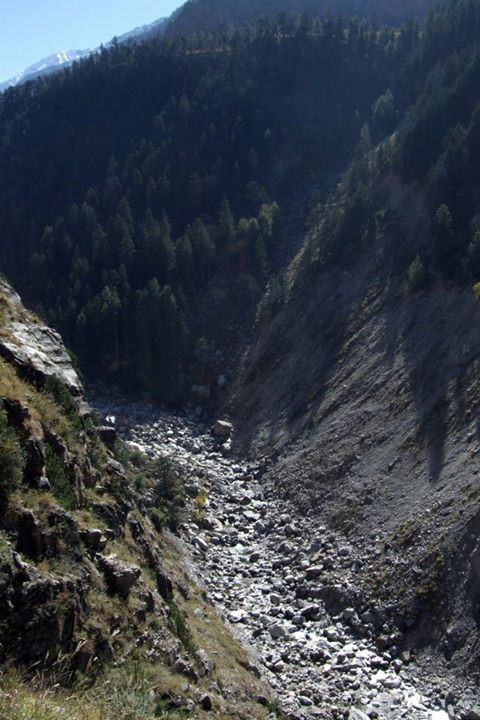
-Himanshu Thakkar (ht.sandrp@gmail.com)

References:

[1] https://sandrp.wordpress.com/2013/06/21/uttarakhand-deluge-how-human-actions-and-neglect-converted-a-natural-phenomenon-into-a-massive-disaster/

[2] https://sandrp.wordpress.com/2013/10/20/expert-committee-following-sc-order-of-13-aug-13-on-uttarakhand-needs-full-mandate-and-trimming-down/

[3] https://sandrp.wordpress.com/2014/04/29/report-of-expert-committee-on-uttarakhand-flood-disaster-role-of-heps-welcome-recommendations/

[4] https://sandrp.wordpress.com/2014/04/29/report-of-expert-committee-on-uttarakhand-flood-disaster-role-of-heps-welcome-recommendations/

[5] http://timesofindia.indiatimes.com/india/Modi-woos-Thimphu-ahead-of-Bhutan-China-dialogue/articleshow/36623685.cms

End Notes:

[1] PIB statement of June  14, 2014, see: http://pib.nic.in/newsite/erelease.aspx

[2] http://www.business-standard.com/article/economy-policy/the-mountain-s-not-a-molehill-114061400858_1.html