Dams · Wetlands

South India Wetlands Review 2017: Wetlands Critical in Changing Climate

KERALA WETLANDS REVIEW 2017

State wetlands face multiple threats In March 2017, a book titled “Biodiversity Richness of Kerala” revealed that riverine ecosystem of Kerala were subjected to human pressures in form of deforestation, land use change, construction of dams, roads, encroachments and mining affecting water holding capacity of the catchments and leading to drying up the rivers and wetlands. Kerala constituted only 1.18 per cent of India’s geographical area but it accommodated 25.69 per cent of the flowering plants in the country. In 2004, Kerala had around 328,402 hectare of wetlands which over the years had fallen to 160,590 hectare dramatic 49 per cent decrease. http://www.business-standard.com/article/news-ians/kerala-wetlands-face-multiple-threats-says-book-117030200590_1.html (Business Standard, 2 March 2017)

Mining posing threat to mangrove forests In Feb. 2017, the district environment committee of the Kerala Sastra Sahithya Parishad alleged that the mineral sand-mining activity carried out by the public-sector Indian Rare Earths along Vellanathurutu in Alapad panchayat was causing widespread damage to the naturally growing mangrove forests in the area. Calling for immediate ban on mining activity the committee complained that a destructive mechanical process was being applied in the area instead of applying the more eco-friendly beach washing method of mining.  According to committee the activity had already destroyed over 2 ha of mangrove forests at estuary where the Pallikkal River met the sea. At least 12 mangrove species, some of them threatened or endangered, were growing in the region. http://www.thehindu.com/todays-paper/tp-national/tp-kerala/Mineral-sand-mining-posing-threat-to-mangrove-forests/article17281729.ece (The Hindu, 10 Feb. 2017)

The mining area of the Indian Rare Earths at Vellanathuruthu where mangrove forests have been destroyed. (Image Source: The Hindu)

Continue reading “South India Wetlands Review 2017: Wetlands Critical in Changing Climate”

Dams · Wetlands

Karnataka Wetlands Review 2017: Bellandur Lake Remains On Fire

Wetlands For A Sustainable Urban Future : Text from Face Book post by Vishwanath Srikantaiah on occasion of World Wetlands Day 2018. 

Much grief, energy and monies can be saved if we imagine our ‘tanks’ as wetlands rather than water bodies in the city of Bengaluru.

World wetlands day is celebrated on the 2nd of February every year. For this year 2018 the theme is “Wetlands for a sustainable urban future”.

A simple definition for a wetland is that it is an area that tends to be saturated with water either permanently or seasonally and harbours a distinct type set of plants. Wetlands behave differently from a water body like a lake and need to be managed, if at all, completely differently.

Wetlands harbour bio-diversity much more than only water, have the ability to absorb pollutants and nutrients better, can manage floods, recharge groundwater, moderate temperature and area huge asset for a city.

In the city of Bengaluru itself the Karnataka State Lake Conservation and Development Authority (KLCDA) has sent a proposal to the central government that 176 tanks within the city be declared as wetlands. This would potentially protect these tanks better from encroachment and solid waste dumping as well as the construction of roads within.

The polluted stretches of the Vrishabhavati and the Dakshina Pinakini could also be brought under wetlands protection.

Wetlands, in combination with waste-water treatment plants, are a good way of reviving the tanks in the city. The example of Jakkur and Rachenahalli are possible starting points for an integrated approach to manage water in the city with wetlands playing an important role. Here waste-water treated to secondary standards are then allowed in to the wetlands which remove nitrates and reduce Total Suspended Solids, thus allowing for it to fill the water body. In turn , the lakes allow for fishing and recharge the surrounding aquifers.

Wetlands provide for a range of services including livelihoods for the poorer sections of society. Even now a range of fodder collectors pick up grass and alligator weed ( called Hongonney in Kannada ) for feeding their cattle almost all across the city.

Remedied waste-water from the city can be further treated in the wetlands and used for agricultural purpose. The proposal and project to transfer treated waste-water to the districts of Kolar and Chikballapur can also benefit substantially if wetlands are integrated in to the design at the first receiving tanks. This would also enhance flora and faunal biodiversity in the tanks of these drought prone rural districts at the same time benefiting agriculture there.

Integrating wetlands into the master plan and the urban fabric of cities is the need of the hour and that would be water wisdom.

Continue reading “Karnataka Wetlands Review 2017: Bellandur Lake Remains On Fire”

Dams · Wetlands

West India Wetlands Review 2017: No Protection Here

GUJARAT WETLANDS DEVELOPMENTS 2017

Gosabara wetland declared IBA In March 2017 during a two days workshop, The Bombay Natural History Society (BNHS) declared 96 sq km coastal wetland area of Gosabara-Mokarsagar in Porbandar, as Important Bird Area (IBA) site. There are around 544 IBAs in India and 18 in Gujarat. As per experts though IBA does not have any legal status, it helps environmentalists to raise alarm if the site faces any threats and press for its conservation. In 2001, Salim Ali Centre for Ornithology (SACON) conducted a country-wide survey for important ‘Inland Wetlands of India’ and Gosabara-Mokarsagar wetland was one the 50 important wetlands of the country.  https://timesofindia.indiatimes.com/city/rajkot/gosabara-wetland-now-a-bnhs-iba-site/articleshow/57453811.cms  (The Times of India, 4 March 2017)

Continue reading “West India Wetlands Review 2017: No Protection Here”

Dams · Wetlands

East India Wetlands Review 2017: West Bengal Bent On Destroying World’s Largest Natural Sewage Treatment Plant

The East Kolkata Wetlands (EKW) are unique yet complex system of natural and human-made wetlands in West Bengal. The wetlands cover 125 sq km comprising of salt marshes, salt meadows, sewage farms and settling ponds. They are used to treat Kolkata’s sewage, and the nutrients contained in the waste water sustain fish farms and agriculture.

Devised by local fishermen and farmers, these wetlands served, in effect, as the largest natural sewage treatment plant (STP) for the city. And using the purification capacity of wetlands, Kolkata by transforming nearly one-third of the city’s sewage into a rich harvest of fish and fresh vegetables daily, has pioneered an environment-friendly system of sewage disposal. Because of this, the EKW were designated a “wetland of international importance” under the Ramsar Convention on August 19, 2002. https://en.wikipedia.org/wiki/East_Kolkata_Wetlands

However for past many years, these wetlands are under threat due to exponential expansion of real-estate projects. Recently illegal landfills are on the rise and unprecedented land development and urbanization have been creating concerns about the impact on EKW environment. 2017 has seen the situation turning only worse for EKW. 

Continue reading “East India Wetlands Review 2017: West Bengal Bent On Destroying World’s Largest Natural Sewage Treatment Plant”

Dams · Wetlands

North East Wetlands Review 2017: “Remove Ithai Barrage on Loktak Lake”

MANIPUR

Loktak lake is the largest freshwater lake near Moirang in Manipur state. In local language Loktak means end of stream. The lake is referred as the “lifeline of Manipur” as it is highly productive and provides habitat to biota and livelihoods to people. The lake is an Important Bird Area (IBA) and is widely famous for the phumdis (heterogeneous mass of vegetation, soil and organic matter at various stages of decomposition) floating over it.

In 1990, the lake was included under Ramsar Convention as a ‘Wetland of International Importance’. But over the years, NHPC’s hydropower projects specially Ithai Barrage have led to severe impact on the lake eco-system and serious disturbance in local community.  Despite this, NHPC has been pushing more hydro projects on the lake streams. As a result, local people and concerned have univocally and repeatedly started protesting against proposed hydro projects and demanding removal of Ithai barrage. And the demand have only grown louder in 2017.  https://en.wikipedia.org/wiki/Loktak_Lake

Continue reading “North East Wetlands Review 2017: “Remove Ithai Barrage on Loktak Lake””

Dams · Wetlands

North India Wetlands Review 2017: Callous Governments

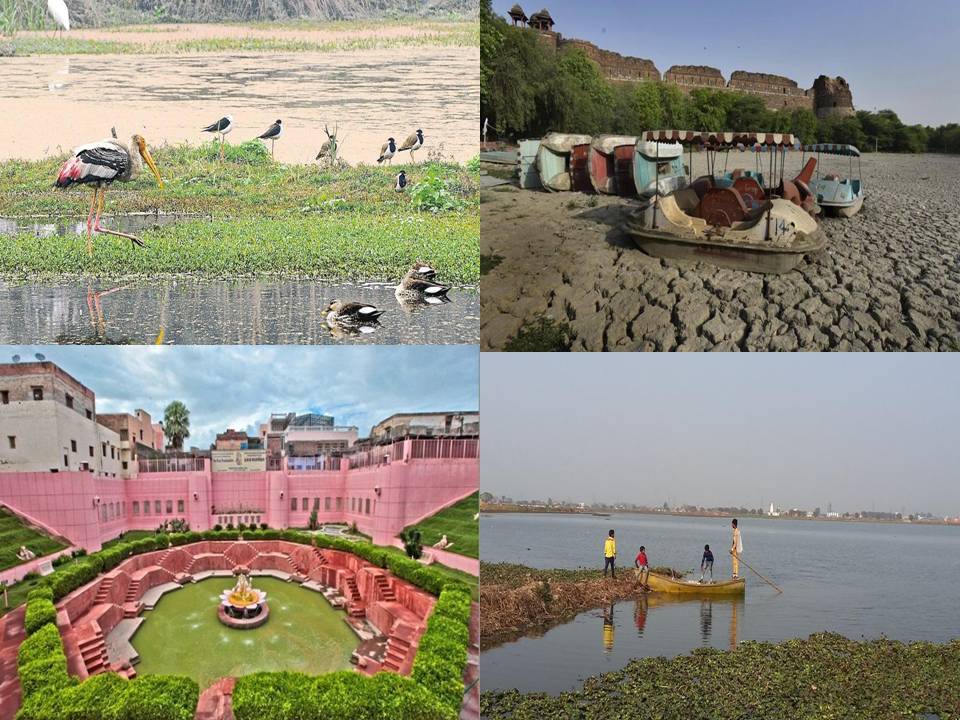
After separate reports on key developments surrounding wetlands in 2017 in North India including Jammu & Kashmir, Uttarakhand, Punjab, Chandigarh and Haryana – this final compilation in North India Wetlands Review 2017 series by SANDRP, highlights the plight of wetlands, lakes and water bodies in Uttar Pradesh, Delhi and National Capital Region.

Continue reading “North India Wetlands Review 2017: Callous Governments”

Dams · Wetlands

Punjab Wetlands 2017: Ramsar Sites Under Severe Threats

Introduction

National Wetlands Atlas has mapped 1381 big wetlands in Punjab State. It has also identified 5049 small wetlands of less than 2.25 hectare area. Total wetland area estimated in the state is 86283 hectare which is about 1.71 per cent of its total geographic area. Out of this, with 59864 hectare the river/stream is accounts for for 69.38 per cent of the wetlands. Reservoirs/Barrages ranks second with 13.74 per cent share spread over 11858 hectare of area.. http://www.moef.nic.in/downloads/public-information/NWIA_Punjab_Atlas.pdf

There are three Ramsar sites (wetlands of International importance) in the state- Harike, Kanjli and Ropar. These wetlands are important habitats for waterfowl, fish and diversity of other flora and fauna including endangered and vulnerable species. Two other wetlands- Ranjit Sagar and Nangal are National wetlands.

Ranjit Sagar is an interstate wetland spreading over in three states (Punjab, Himachal Pradesh and J&K). There are 5 small wetlands considered as state wetlands owing to their rich biodiversity and ecological characters. These are – Keshopur-Miani Jheel, Kahnuwan Chhamb, Jastarwal Jheel, Mand Bharthala and Dholbaha Reservoir. In all, Punjab has 12 important natural and 9 man-made wetlands.

Continue reading “Punjab Wetlands 2017: Ramsar Sites Under Severe Threats”

Dams · Wetlands

Siltation, Encroachment & Pollution Choke Jammu & Kashmir Wetlands in 2017

Captivating images of lakes and wetlands strike the imagination of general masses when the name of Jammu and Kashmir is mentioned. For years, the aquatic wonders have been the main attraction of tourists, at the same time supporting livelihood of local communities in multiple ways. These water bodies also provide safe habitats to the lakhs of migratory birds.

However, over the years, gradual siltation, steady encroachment and increasing pollution have put the wetlands eco-system and associated socio-economical benefits at receiving ends. And, in 2017 the situation only got worse.

Continue reading “Siltation, Encroachment & Pollution Choke Jammu & Kashmir Wetlands in 2017”

Dams · Wetlands

Wetlands Review 2016: Legal Interventions

Featured image showing  36 Wetlands in India requiring urgent attention as per a 2014 petition filed in apex court (Image Source: Live Mint

In the third part of Wetlands Review 2016, SANDRP presents an account of major decisions taken by respective Courts for the protection of Wetlands in India. 

In a significant development in April 2016, the National Green Tribunal (NGT) directed all State Governments to submit a complete list of Wetlands[1] under their jurisdiction. The green court was hearing a plea alleging commercial conversion and resultant destruction of several large ecologically important Wetland areas across the country in absence identification and notification by respective State Governments. 

The court also asked the Ministry of Environment, Forest and Climate Change (MoEF&CC) to submit the list of States that had approached it with Wetlands conservation plans.

Continue reading “Wetlands Review 2016: Legal Interventions”

Dams · Wetlands

Wetlands Review 2016: Government Actions

India is one of the 169 signatories to the Ramsar Convention on Wetlands, signed in Ramsar, Iran, in 1971, an intergovernmental treaty that provides the framework for national action and international cooperation for the conservation and wise use of Wetlands and their resources. There are 2,241 Ramsar sites across the world, including 26 spread across India from Wular Lake in Jammu and Kashmir to Ashtamudi Wetland in Kerala, and from Deepor Beel in Assam to Nal Sarovar in Gujarat.

Despite their vital importance to humans, across India, Wetlands are seriously threatened by reclamation and degradation through processes of drainage, land filling, discharge of domestic and industrial effluents, disposal of solid waste, and over-exploitation of the natural resources that they offer.

Here is an account of major decisions and actions by Central as well as State Governments on wetlands related issues in 2016.

Continue reading “Wetlands Review 2016: Government Actions”