Climate Change · Disasters · Floods · Hydropower · Uttarakhand

Uttarakhand and Climate Change: How long can we ignore this in the Himalayas?

The current disaster in Uttarakhand has exposed our unpreparedness in many spheres: be it disaster management, weather forecasting, early warning system, tourism management or transparent and participatory environmental governance of a fragile region.

However, we cannot ignore Climate Change and its associated challenges when dealing with these issues.

Himalayas are experiencing Climate Change at an unprecedented rate, this is increasing the incidents of flash floods, GLOFs, landslides and related disasters. India has a huge National Action Plan for Climate Change in place since 2009, under it is a special National Mission for ‘Sustaining Himalayan Ecology’, National Mission on Water, among six others. But what has happened down these years? Are we even considering climate change and its impacts while clearing hundreds of projects on hydel power, river bed mining , urban development, roads and related infrastructure in this region? We are not even assessing the impact of such projects on disaster potential in already vulnerable areas. 

In our earlier blog, we have said that there are a number of reasons behind the sudden deluge in Kedarnath and surrounding areas including Glacial Lake Outburst Flood (GLOF) (https://sandrp.wordpress.com/2013/06/21/uttarakhand-deluge-how-human-actions-and-neglect-converted-a-natural-phenomenon-into-a-massive-disaster/). In the absence of precise weather monitoring or documentation, detailed analysis on this difficult.

Uttarakhand disaster linked to Climate Change However, a number of officials have accepted the climate change link with the current disaster. Secretary of Government of India Ministry of Earth Sciences Shailesh Nayak has now said that  the cloudburst that triggered flash floods in Uttarakhand read like a weather phenomenon brought about by warming. He also narrated how the high intensity rainfall is increasing while low and medium intensity events are decreasing. (See: http://timesofindia.indiatimes.com/india/Earth-sciences-secretary-blames-Uttarakhand-rains-on-climate-change/articleshow/20709643.cms)

Shri M Shashidhar Reddy, Vice Chairman of National Disaster Management Authority, (http://timesofindia.indiatimes.com/home/environment/flora-fauna/Need-to-assess-climate-change-Shashidhar-Reddy-says/articleshow/20749744.cms) speaking at the inauguration of South Asia Regional Consultation on Climate Change Adaptation, said: “Nothing more serious could have been witnessed. It is an example of extreme weather events we all are concerned about.” He also acknowledged the role of ecological imbalance: “There is no doubt that ecological imbalance has been created in the Himalayas… it made the impact higher.” Reddy also said precious lives could have been saved in Uttarakhand had the weather office made precise forecasts: “They [India Meteorological Department] need to develop a more precise observational and forecasting capability”. (http://www.thehindu.com/news/national/only-precise-forecast-of-rain-would-have-helped-says-ndma-chief/article4847316.ece?homepage=true)

However, it is an undisputed fact that climate change is impacting the Himalayas at much faster pace than what the global averages tells us. We take a look at our responses to adapt to and mitigate CC Challenges.

1. Unprecedented Climate Change in Himalayas

(This section is largely based on ICIMODs report: The changing Himalayas – Impact ofclimate change on water resources and livelihoods in the Greater Himalayas)

Warming in Himalayas is happening at an unprecedented rate, higher than the global average of 0.74 ˚C over the last 100 years (IPCC, 2007a; Du et al., 2004), at least 2-3 times higher than global averages.  Progressively higher warming with higher altitude is a phenomenon prevalent over the whole greater Himalayan region (New et al., 2002).

1.1          Impact on Precipitation: In many areas, a greater proportion of total precipitation appears to be falling as rain than before. As a result, snowmelt begins earlier and winter is shorter; this affects river regimes, natural hazards, water supplies, and people’s livelihoods and infrastructure. The extent and health of high altitude wetlands, green water flows from terrestrial ecosystems, reservoirs, and water flow and sediment transport along rivers and in lakes are also affected.

Throughout the himalayas, there is increasing perception and documentation that precipitation is changing, becoming more erratic and intense. “Flooding may arise as a major development issue. It is projected that more variable, and increasingly direct, rainfall runoff will also lead to more downstream flooding.”(http://lib.icimod.org/record/27016/files/c_attachment_782_6044.pdf, Changing With The Seasons: How Himalayan communities cope with climate change, Chicu Lokgariwar, People’s Science Institute)

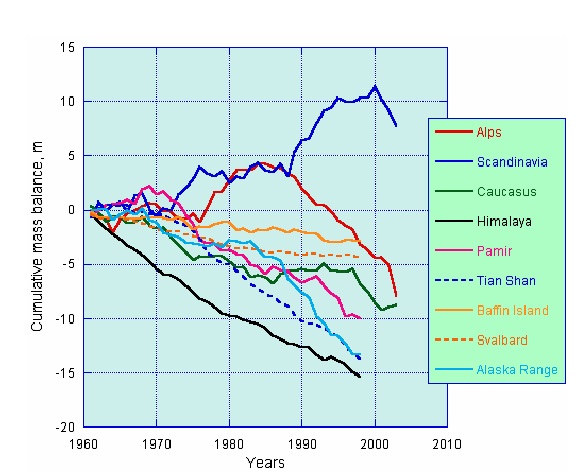
 1.2       Retreating glaciers: As compared to global averages, Himalyan glaciers are receding at a rapid rate. Retreat in glaciers can destabilize surrounding slopes and may give rise to catastrophic landslides (Ballantyne and Benn, 1994; Dadson and Church, 2005), which can dam streams and sometimes lead to outbreak floods.

Excessive melt waters, often in combination with liquid precipitation, may trigger flash floods or debris flows. Available studies suggest changes in climatic patterns and an increase in extreme events. An increase in the frequency of high intensity rainfall often leading to flash floods and land slides has been reported (Chalise and Khanal, 2001; ICIMOD, 2007a).
CC1
Rapid retreat of Himalayan Glaciers as compared to global averages Courtesy: ICIMOD

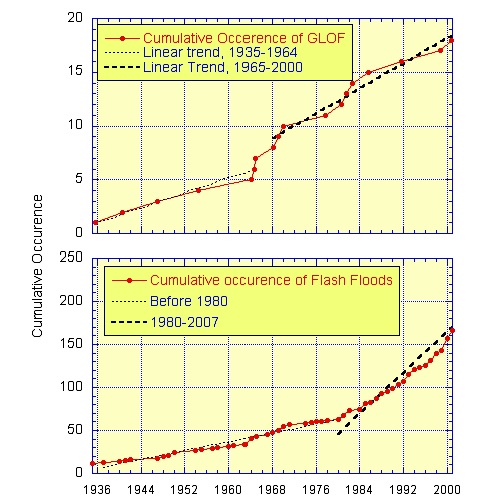
1.3       Higher frequency of flash floods and GLOF events: In the eastern and central Himalayas, glacial melt associated with climate change, has led to the formation of glacial lakes behind terminal moraines. Many of these high-altitude lakes are potentially dangerous. The moraine dams are comparatively weak and can breach suddenly, leading to the discharge of huge volumes of water and debris. The resulting glacial lake outburst floods (GLOFs) can cause catastrophic flooding downstream.

There is an indication that the frequency of GLOF events has increased in recent decades. In the Hindukush Himalayan (HKH) region two hundred and four glacial lakes have been identified as potentially dangerous lakes, which can burst at any time (ICIMOD, 2007b)
CC2
Cumulative Frequency of Flash FLoods and GLOFs in Hindukush Himalayan region Courtesy: ICIMOD

(From: The changing Himalayas – Impact of climate change on water resources and livelihoods in the Greater Himalayas Perspectives on water and climate change adaptation. ICIMOD http://www.worldwatercouncil.org/fileadmin/world_water_council/documents_old/Library/Publications_and_reports/Climate_Change/PersPap_01._The_Changing_Himalayas.pdf)

2.            Our Response so far

2.1       National Mission for Sustaining the Himalayan Ecosystem under the NAPCC:

The ambitious National Action Plan for Climate Change  has a separate National Mission for Sustaining the Himalayan Eco System (NMSHE) under the Ministry of Science of Technology, Government of India.

(There are several issues with this Action Plan itself. For a detailed Critique: http://www.sandrp.in/CRTITUQE_ON_INDIAs_CLIMATE_PLAN-There_is_Little_Hope_Here_Feb_2009.pdf, the link is not working, pl contact us for the file)

The NMSHE Mission document prepared in 2010 states:

“The mission would attempt to evolve management measures for sustaining and safeguarding the Himalayan glaciers and mountain ecosystem by:

• Enhancing monitoring of Himalayan ecosystem with a focus on recession of Himalayan glaciers and its impact on river system and other downstream socio-ecological processes.

• Establishing observational and monitoring network to assess ecosystem health including freshwater systems.

• Deploying technologies – for hazard mitigation & disaster management, development of ideal human habitats, and agriculture and forest sector innovations

2.1.1    Some Proposed Actions to address Objectives and Goals of the Mission:

  • Continuous Monitoring of the Eco-system and Data Generation
  • Enhanced implementation of guidelines for Priority Action in the National Mission on Sustaining the Himalayan Ecosystem
  • Sustainable Urbanization in Mountain Habitats:This includes:
  • Town Planning and Adoption and Enforcement of Architectural Norms:

Given the ecological fragility of mountainous areas, it was agreed that rather than permit the unplanned growth of new settlements, there should be consolidation of existing urban settlements, which are governed through land-use planning incorporated in a municipal master plan.

Further action points may include:

(a) Municipal bye-laws will be amended, wherever required, to prohibit construction activity in areas falling in hazard zones or across alignments of natural springs, water sources and watersheds near urban settlements. There will be strict enforcement of these bye-laws, including through imposition of heavy penalties and compulsory demolition of illegal structures.

(e) Construction activity will be prohibited in source-catchment areas of cities, including along mountain lakes and other water bodies. Their feeder channels will also be kept free of building activity.

In order to enable these decisions to be implemented urgently, it is necessary to draw up, as soon as possible, a comprehensive State-wide inventory of such water resources and their channels, which could then be declared fully protected zones.

Promotion of Sustainable Pilgrimage:

Measures for promoting the healthy and sustainable development of religious pilgrimage to the many sacred and holy sites scattered all over the Himalayas, are also necessary. Some of these actions are:

(a) A comprehensive inventory of key pilgrimage sites in each State would be drawn up, which would include analyses of the ecological capacity of each site, based on its location and fragility.

(b) In advance of the results of the above exercise, develop a plan to harmonise the inflow of pilgrims with the capacity of the local environment to cater to the needs of pilgrims. These include the source of several Himalayan rivers, sacred lakes and forest groves.

(c) The construction of roads should be prohibited beyond at least10 kilometres from protected pilgrim sites, thereby creating a much-needed ecological and spiritual buffer zone around these sites. These areas, like national parks and sanctuaries, will be maintained as special areas, where there would be minimal human interference, respecting the pristine nature of thesesites.

(d) Each designated pilgrimage site should have a declared buffer zone where development activity will be carefully regulated.

“Green Road Construction”The construction of roads must fully take into account the environmental fragility of the region. To this end, the concerned State Governments will consider promulgating, as soon as possible, the following guidelines for road construction in hill areas.

(a) Environmental Impact Assessment to be made mandatory for the construction of all state & national roads and expressways of more than 5 km length, including in the extension and widening of existing roads. This will not apply to inter-village roads.

(b) Road construction will provide for the treatment of hill slope instabilities resulting from road-cutting, cross drainage works and culverts, using bio-engineering and other appropriate technologies. Cost estimates for road construction in these areas will henceforth include estimates on this account.

(c) Plans for road construction must provide for disposal of debris from construction sites at suitable and identified locations, so as to avoid ecological damage and scarring of the landscape. Proposals for road construction must henceforth include cost estimates in this regard.

(e) All hill roads must provide adequate roadside drains and, wherever possible, be connected to the natural drainage system of the area.

(f) Alignment of proposed roads should avoid fault zones and historically landslide prone zones.Where this may not be possible, adequate measures will be taken to minimize associated risks, in consultation with experts.

Water security:

The importance of the Himalayas as a natural storehouse and source of water must be acknowledged fully. The region is already under water-stress, with the drying up or blockage of many water sources and natural springs. The following immediate actions, appear to be necessary:

The Himalayan eco system is vulnerable and susceptible to the impacts and consequences of a) changes on account of natural causes, b) climate change resulting from anthropogenic emissions and c) developmental paradigms of the modern society.

Recognizing the importance of scientific and technological inputs required for sustaining the fragile Himalayan Ecosystem, the Ministry of Science and Technology has been charged with the nodal responsibility of coordinating this mission.”

Unfortunately, we saw that NONE of the above is currently happening in the Uttarkhand Himalayas, or for that matter any of the Himalayan States. There are no clear action plans, timelines and budget breakups of this program available and at best, this seems like a vague wish list, rather than an urgent program.

2.2          Uttarakhand State Action Plan for Climate Change:

Uttarakhand has submitted a State Action Plan for Climate change in June 2012, with the help of UNDP. (http://www.uttarakhandforest.org/Data/SC_Revised_UAPCC_27june12.pdf)

Relevant sections of this Plan:

“Extreme precipitation events have geomorphological significance in the Himalayas where they may cause widespread landslides.  Increase in rainfall is likely to causes fresh floods land slides and damages to the landmass. Winter precipitation has become extremely erratic and unpredictable. Increase in the flooding varying between 10 to over 30 percent of the existing magnitudes is expected in all the regions. This has a very severe  implication for the existing infrastructure such as dams, bridges, roads, etc., for the areas  and shall require appropriate adaptation measures to be taken up.

Strategies:

“The UAPCC recognises that scientific knowledge and evidence base on impacts of climate change to the water sector is limited. As such, a comprehensive water data base in public domain and assessment of the impact of climate change on water resource through the various agencies responsible for different aspects of water resources management in the State will be developed, and updated and analysed on an on-going basis.

Strategies towards this will include:

  • Review of network of hydrological observation stations
  • Review of the network of automatic weather stations and automated rain gauge stations
  • Collection of necessary additional hydro-meteorological and hydrological data for proper assessment of impact of climate change in Himalayan region including other improvements required in hydrometric networks to appropriately address the issues related to the climate change.

Such data will include:

o Hydrological and hydro-meteorological data in low rainfall areas

o Hydrological and hydro-meteorological data above permanent snowline, glaciated areas, seasonal snow areas in Himalayan region

  • · Improved network for collection of evaporation and rain gauge data using automated sensors
  • · Establishment/strengthening of ground water monitoring and geohydrologynetworks
  • · Collection of data about river morphology for monitoring erosion and carrying capacity, and
  • · Surface and ground water quality data collection, etc.

Other initiatives will include adoption/development of modern technology for measurement of flow in hilly areas, development of water resources information system, and reassessment of basin wise water situation, apart from projection of water resources availability as a result of impact of climate change which would inter-alia include the likely changes in the characteristics of water availability in time and space.

Other necessary studies to improve understanding of climate impacts to the sector will also be carried out from time to time, and robust data mechanisms will be established. Currently, Uttarakhand does not have a State Water Policy. As such, it will be a priority agenda for the State to develop an appropriate policy framework, with explicit cognisance of climate concerns.”

Unfortunately, here too we did not find evidence that ANY of the strategies were put in practice. As we have said earlier, we still do not have a picture of how much rainfall occurred where and when. Rudraprayag district seems to have a single raingauge station, and high density tourist spots like Kedarnath, which are already vulnerable do not even have a raingauge. There exists no early warning system and as clarified by CAG report on Disaster Management, 2013, the State Disaster Management Authority has not met even once since its constituion in 2007.

3.    Hydropower and Climate Change: Time to bust the myths

 Hydropower projects are being aggressively pushed for their supposedly benign role in global warming and climate change. However, world over, there is increasing consensus that Hydropower dams are not only extremely vulnerable to climate change but (http://ieeexplore.ieee.org/xpl/login.jsp?tp=&arnumber=1007423&url=http%3A%2F%2Fieeexplore.ieee.org%2Fiel5%2F2195%2F21734%2F01007423), but actually contribute to global warming and climate change, depending on their size and nature. They are being increasingly recognized as being ‘False Solutions to Climate change.’

 (Ref:

http://www.academia.edu/1207242/Why_hydropower_is_not_clean_energy

http://www.academia.edu/2525879/Climate_change_and_the_Amazon_Tropical_dams_emit_greenhouse_gases

http://www.internationalrivers.org/campaigns/wrong-climate-for-damming-rivers

Dirty Hydro: http://www.internationalrivers.org/resources/dirty-hydro-dams-and-greenhouse-gas-emissions-2648

Many hydropower projects being planned, under construction or commissioned in Uttarakhand ( and across Indian Himalayas) are storage dams with reservoirs. Even the so called ‘run of the river’ projects involve reservoirs and big dams. These reservoirs emit methane (21 times more potent than carbon dioxide) and carbon dioxide.  It is now proved that methane is not only emitted from reservoirs, but that it is  boosted at each dam turbines and draw-down (Ref: http://news.wsu.edu/pages/publications.asp?Action=Detail&PublicationID=32301)

 4.            Environmental Clearances to Hydropower Dams do not consider Climate Change impacts or mitigation methods:

Despite the burgeoning literature, debates around the world, several submissions from civil society including SANDRP, there is not even as assessment of the impacts of hydel projects on climate change, leave alone mitigation measures. The Expert Appraisal Committee on River valley and Hydropower Projects constituted by the MoEF which recommends Terms and Reference and further Environmental Clearances to these projects has not included the impacts of climate change or the mitigation measures against impacts while recommending TORs or granting Environmental Clearances. It also does not include assessment of impact of the projects on disaster potential of the region or adaptation capacity of the people. The EAC in fact has zero rejection rate even when we know we do not have credible EIA, SIA or CIA for any projects or basins.

5. Carbon Credits: Incentivising destruction, pollution, discounting impacts

Many of the Hydropower projects in the Himalayas, including Uttarakhand have applied for carbon credits under the UNFCCC’s Clean Development Mechanism. Under this, clean energy projects in developing countries get millions of rupees as incentives from developed world, which in turn get carbon offset credits, which are a license to pollute further. The entire system, put in place after the Kyoto Protocol is inherently flawed due to absence of due attention impact of projects on adaptation of local people, to local voices and due to market based approach. Many destructive hydropower projects in Uttarakhand are being certified as clean projects, making a mockery of climate change adaptation and sustainable development. Notable among-st these include the 99 MW Singoli Bhatwari HEP , 76 MW Phata Byung HEP, both on Mandakini river (epicenter of current disaster), 300 MW Alaknanda (GMR) hydropower project, 330 MW Alaknanda Srinagar Hydropower project, 414 MW Rampur project in Himachal Pradesh, where the World Bank played an active role in getting it registered for Carbon credits.

Carbon credits to large hydropower projects in fact accelerate climate change and its impact on ecosystems and communities and is unacceptable.

6.            Dubious role of World Bank and Asian Development Bank

 World Bank is being reported to have come up with a report which says that “An extremely wet monsoon that at present has a chance of occurring only once in 100 years is projected to occur every 10 years by the end of this century,” It also projected a rise in severe floods within the next 25 years.

The same organisation is pushing some of the biggest and most destructive hydropower projects in the Himalayan region like the 775 MW Luhri HEP, in addition to 2 large Hydel projects upstream on Luhri in the Sutlej Basin in Himachal Pradesh. Luhri HEP will have one of the longest tunnels in Asia and there is no impacts assessment of the impact of this blasting and tunnelling on the villages above, or geological stability.

World Bank is also pushing and financing the 440 MW Vishnugad Pipalkoti Hydropower in Uttarakhand. Incidentally, Pipalkoti region experienced some severe impacts of the current deluge and also suffered damages as per MATU report. The World Bank is supporting these projects even when there are no credible project specific ESIA or cumulative impact assessment studies or carrying capacity studies or studies on the impacts of these cascade projects on disaster risks or climate change.

Asian Development Bank is also supporting a number of hydropower projects n Uttarakhand (they are reported to have suffered damages) and in Himachal Pradesh on similar lines.

Cascade projects along the rivers, with no distance between two projects effectively means that the entire landscape surrounding the rivers is blasted, submerged and tunneled.

There is a huge gap between what World Bank’s says and what it does as far as hydropower and climate change is concerned.

In Conclusion:

Current Uttarakhand disaster has seen government officials to the World Bank suggesting that impacts of climate change are severe, but ironically, when asked specifically if they would link current disaster with climate change, they say that cannot be established and hide behind ‘scientific uncertainity’.

As has been seen world over, the poor and most vulnerable sections of the society and the ecology are worst impacted by climate change. It is high time that we adopt no regret strategies to cope with impacts of climate change, through mitigation and adaptation.

(Uttarakhand Floods: Lessons for Himalayan States: https://sandrp.wordpress.com/2013/06/23/uttarakhand-floods-disaster-lessons-for-himalayan-states/)

National Action Plan of Climate Change needs to be audited for its efficacy and work from organisations like CAG. MoEF urgently needs to include impacts of climate change while it is busy sanctioning all the projects that come to it. Organizations like World Bank need to walk their talk on climate change and stop financing destructive hydro projects in this fragile region, in absence of any studies on their impact on Climate Change and lives and livelihoods of millions dependent on natural systems.

Climate change is knocking at some of our doors, while it has already arrived through other doors. We can choose to close our eyes and ears and say “this is normal and expected in this region”. But if we do not respond to challenges posed by Climate Change urgently, it wont be just politely knocking, but causing extreme damage, as it is being witnessed.

 Parineeta Dandekar

Cumulative Impact Assessment · Ministry of Environment and Forests

Uttarakhand Deluge: How human actions and neglect converted a natural phenomenon into a massive disaster

Analysing a natural disaster is a complex task. Many a times, a natural disaster and its human impacts are a result of multiple things occurring together. At the same time, disasters like the one being faced by Uttarakhand currently highlight the stark anthropogenic reasons which contribute towards causing the disaster as well as increasing its impacts manyfold.

SANDRP has been trying to analyse the situation, and looking at number of causes which precipitated in the current tragedy. These include the absence of early warning system, absence of responsible and active disaster management of monitoring system. While the calamity is natural in the sense that the region did receive extreme heavy rainfall and cloud burst, the root causes which increased the human tragedy include unchecked and unplanned infrastructure development along the rivers and development of  hundreds of hydel projects in the fragile zone without proper checks and balances, transparent studies and decision-making processes.

A brief update on SANDRPs work on this issue as well a compilation of the numerous ways in which hydel projects in Uttarakhand are flouting norms of sustainability, transparency, participation or safety and what has been the response to this from the highest quarters: Prime Minister, Minster and Ministry of Environment and Forests as well as the state administration.

The first thing that strikes you when you analyse this disaster is that there was no specific and timely warning of impending disaster from the IMD or any other body (their claim to the contrary not withstanding). In fact we do not have a system in place to forecast cloud burst events, when technology is available to achieve that at approximate cost of Rs 15 crores, as informed to me by formed Director General of IMD, Dr S K Srivastava.

Secondly, even after the event of rainfall started and occurred, till date, six days after the event started on 15th, there is no account of how much rainfall occurred at what specific locations, and what was done to alert the populations that were at risk. This is again a failure of IMD and local administration. In fact it transpired that Kedarnath, one of the most affected area, has no raingauge, says Indian Express.

This shows how agencies like IMD, CWC, NDMA and SDMA have failed to put in place basic systems of warning, forecasting, monitoring and information dissemination that can greatly reduce disaster potential of any area.

In April 2013, a CAG report said that Uttarakhand state disaster management authority, which was formed in Oct 2007, has never met till date. Nor has it mandatory “rules, regulations, polices or guidelines”, first step for the authority to have functional existence. (for elaborate excellent information on this CAG report, see: http://www.indiatogether.org/2013/jun/gov-disaster.htm, for CAG report, see: http://saiindia.gov.in/english/home/Our_Products/Audit_Report/Government_Wise/union_audit/recent_reports/union_performance/2013/Civil/Report_5/Report_5.html)

See: http://timesofindia.indiatimes.com/india/Uttarakhand-disaster-plan-doesnt-exist-CAG-warned-in-April/articleshow/20690268.cms

RAINFALL EVENTS OF JUNE 15-18 IN UTTARAKHAND

From all accounts it is clear that areas around all four Pilgrimage centres (Gangotri, Yamunotri, Kedarnath and Badrinath) and the fifth one of Hemkunt Sahib have faced some serious floods this season. In addition, areas of Pithoragarh (Goriganga basin) and Himachal Pradesh (Kinnaur district, mainly Kashang area, a tributary of Sutlej) basin also faced floods during the same period. The rainfall event that lead to these floods started on June 15 and went on till June 16-17.  It seems strange to see such vast area facing simultaneous high intensity rainfall. IMD officials tried to explain this (http://www.hindustantimes.com/India-news/NewDelhi/Westerlies-collided-with-monsoon-to-rain-death/Article1-1081810.aspx) as collision of western disturbance with the upcoming monsoon clouds. It is also true, as Anupam Mishra ji explained to me that the catchments of all these basins in their uppermost ranges are not too far from each other. Incidentally, Tibetan area is also not very far from these region, it would be interesting to know if that area also faced cloud burst events in this period.

In an interview with Rediff Editor Sheela Bhatt, NDMA Vice Chair M Shashidhar Reddy accepted that there are no rain-gauges at Kedarnath and Badri nath and hence we may never know how much rainfall feel at those sites and we will never have full scientific explanation of what happened on June 16-17.

The best we have is weekly district wise rainfall in Uttarakhand districts for the week June 13-19, from India Meteorological Department:

DISTRICTWISE RAINFALL DISTRIBUTION

13.06.2013 TO 19.06.2013

DISTRICT (NAME) 

ACTUAL (mm)

NORMAL (mm)

    % DEP

CAT.

ALMORA

208.7

26.3

694%

E

BAGESHWAR

391.2

26.3

1387%

E

CHAMOLI

316.9

22.6

1302%

E

CHAMPAWAT

351.0

33.5

948%

E

DEHRADUN

565.4

36.8

1436%

E

GARHWAL PAURI

149.7

15.8

847%

E

GARHWAL TEHRI

327.7

22.0

1390%

E

HARDWAR

298.8

21.6

1283%

E

NAINITAL

506.5

38.8

1205%

E

PITHORAGARH

246.9

73.0

238%

E

RUDRAPRAYAG

366.3

53.9

580%

E

UDHAM SINGH NAGAR

157.7

40.2

292%

E

UTTARKASHI

375.6

25.8

1356%

E

Events of June 16-17 at Kedar Nath Based on Media information, it seems Kedarnath shrine saw two massive flood events, one starting around 8.15 pm on June 16 and second at 6.55 am on June 17. The flood witnessed at the shrine (located at 3584 m above msl) originated from catchment that includes two mountain peaks: Kedarnath and Kedarnath Dome (6831 m elevation). Following torrential rains possibly triggered by cloude burst, huge boulders broke away from Kedar Dome and ruptured the downstream charbari lake reservoir, about 6 km upstream from the temple along the Mandakini river. This description seems to suggest that this was also an event of GLOF (Glacial Lake Outburst Flood), though no one seems to have used that term so far.

Another instance of GLOF in this Uttarakhand flood disaster could have happened at Hemkunt Sahib pilgrim centre (elevation 4632 m), where report suggest, the level of water in the lake surrounding the shrine suddenly “increased as glacier from the uphill came down.” http://www.business-standard.com/article/current-affairs/no-damage-to-hemkunt-sahib-gurdwara-trust-113062200532_1.html

However, from all accounts, the massive rainfall and cloud burst events were happening at multiple places, including in Bhagirathi basin, Assiganga basin, Mandakini Basin, Badrinath region, other places in Alaknanda region, among others. The high rainfall started sometime on June 15 and went on till at least June 18. When I talked with Prof Bharat Jhunjhunwala staying at Devprayag along the confluence of Bhagirathi and Alaknanda, he said that the peak of the floods happened on the morning of June 17 (The Hindu reported this happened at 3 am on 17th), though massive flood event there in Alaknanda started the previous evening. He also mentioned that the massive amount of muck deposited on the Alaknanda riverbed by the under construction 330 MW GVK Srinagar Alaknanda Hydropower Prooject (the project has had no credible environmental impact assessment) accentuated the flood disaster in the downstream area. The Hindu reported (http://www.thehindu.com/todays-paper/tp-national/no-warning-of-dam-water-release/article4844604.ece) that sudden release of water from the dam along with the illegally dumped muck in the river bed lead to disaster in downstream Srinagar town.

A Sphere India report said that in Rudraprayag (this is likely to be one of the Mandakini hydropower projects, either Phata Byuang or Singoli Bhatwari), “The local are saying the muck of the dam was deposited along the river which has diverted the course of water.” (http://www.sphereindia.org.in/Download/Sitrep-3%20Flood%20Incident%20in%20Uttarakhand.pdf)

It is interesting to note that if these accounts are correct, the peak of flood event at Devprayag and Kedarnath (separated by about 150 km) happened on the morning of June 17, which possibly indicates that there were multiple could burst or very high intensity rainfall events in Alaknanda valley alone.

However, I had already received a detailed report from Uttarkashi Apda Prabanthan Jan Manch with photos of unfolding disaster on the evening of June 16, 2013, so the high rainfall event and beginning of flood  disaster at Uttarkashi began much earlier. The news channels were already showing live footage of the event unfolding in downstream Rishikesh and Haridwar on June 17, again indicating that the flood event in the upstream mountains must have started at least two days earlier.

Unfortunately we still do not have an accurate account of this whole episode from any of the official agency. When Vice Chairman of National Disaster Management Authority M Shashidhar Reddy was asked about this by me on NDTV INDIA badi khabar programme on June 21 evening (see: http://khabar.ndtv.com/video/show/badi-khabar/280131), he accepted we still do not have that account six days after the event. This shows the poor monitoring situation from all concerned.

UTTARAKHAND AND GLOFS The mention of GLOFs in the context of current Uttarakhand floods above should trigger other thoughts. In fact not many observers are mentioning GLOFs in current context. However, Climate scientists including ICIMOD has been mentioning increasing risks of GLOFs all across Himalayas.

This blog (http://blogs.agu.org/landslideblog/2013/06/27/new-high-resolution-images-of-kedarnath-the-cause-of-the-debris-flow-disaster-is-now-clear/) provides satellite images from Indian Space Research Organisation to explain the occurrence of GLOF in the current disaster at disaster and its consequences in the downstream Rambara area. Its Author Dave Petley, dean of research and global engagement, Wilson Professor of Hazard and Risk at DurhamUniversity in the United Kingdom, tries to explain the events around Kedarnath in an interview to Rediff editor Sheela Bhatt: http://www.rediff.com/news/interview/india-should-prepare-for-a-large-earthquake-in-uttarakhand/20130702.htm?sc_cid=emailshare&invitekey=ae3f4cec4fbfe5ba6bb3ee0fa5698550&err_accptd=1

Similar images are also available on Down to Earth article (http://www.downtoearth.org.in/content/floods-uttarakhand-explained) and NRSC website (http://www.nrsc.gov.in/).

Anupam Mishra ji in fact mentioned in NDTV INDIA discussion (http://khabar.ndtv.com/video/show/hum-log/280415) mentioned is 1977 article (see in Hindi: http://mansampark.in/2013/06/22/uk/) where he describes the 1970 floods and also the 1893 glacial dam burst, flood due to bursting of which was monitored and local people alerted by the then British government in collaboration with local people.

Chorbari Glacier The Chorabari glacier that played a role in current floods in Kedarnath lies between latitudes 30°44′50″N and 30°45′30″N, and longitudes 79°1′16″E and 79°5′20″E, from an altitude of approximately 6,000 m (20,000 ft) at the slopes of Kedarnath peak, to 3,800 m (12,500 ft). The glacier is around 7 km in length, while the basin area of the glacier is approximately 38 sq km and the glacier ice cover is 5.9 sq km. The glacier slope is around 11 degrees and faces south. The glacier has two snouts. It is hypothesized by R. K. Chaujar that an original single glacier covered the area, which while receding, split into two snouts. One of the snouts is the source of the Mandakini River at 3,865 m (12,680 ft). The other snout, at 3,835 m (12,582 ft), drains into the Chorabari Tal. (http://chimalaya.org/2013/06/19/disaster-in-uttarakhand-india-huge-death-toll/)

DAMAGED HYDRO PROJECTS A large number of hydropower projects are likely to have suffered damage due to the flood disaster in Uttarakhand and Himachal Pradesh. Some of the projects that have suffered damage include:

  • According to the update from energylineindia.com on June 27, 2013, the 520 MW under construction Tapovan Vishnugad HEP has suffered damaged by rains on June 16, 2013: “While construction of diversion tunnel was completed in April this year, the same was washed away due to heavy rains on June 16. Diversion dyke has washed away and damages have been observed in chormi adit approach road. In August last year, the flash floods had caused serious damages in the coffer dam of the project.”
  • 400 MW Vishnuprayag HEP of JP Associates has suffered serious, but as yet unassessed damage (http://www.indianexpress.com/news/jaiprakash-power-tanks-15–as-plant-shuts-down-in-uttarakhand/1133083/). As per MATU PR (http://matuganga.blogspot.in/), the project has also been cause of damage in Lambagad village, which was also flahsed on front page of TOI on June 25, 2013, though without mentioning the project.
  • 76 MW Phata Byung HEP of Lanco in Mandakini Valley in Uttarakhand
  • 99 MW Singoli Bhatwari HEP of L&T in Mandakini Valley in Uttarakhand NDTV India reported that the water level of the river has gone up due to the silt dumped by dams. This is likely to be due to the Phata Byung and Singholi Bhatwari HEPs.
  • Kali Ganga I, Kali Ganga II and Madhyamaheshwar HEP, all in Mandakini Valley, all of UJVNL, all hit by mudslides (http://www.indianexpress.com/news/uttarakhands-r500-crore-request-to-prevent-landslides-pending-since-2009/1132351/)
  • Assiganga I-IV projects on Assiganga river in Bhagirathi basin in Uttarakhand
  • Small HEP in Goriganga basin in Pithoragarh (name not known)
  • 65 MW Kashang HEP in Sutlej basin in Himachal Pradesh
  • 280 Dhauliganga Project of NHPC in Pithoragarh district of Uttarakhand (reports said the power house was submerged, but is now working, part of the township was submerged.)

It has been now reported in Business Standard (http://www.business-standard.com/article/companies/gvk-l-t-hydel-projects-hit-by-floods-113062300394_1.html) that the 330 MW Srinagar project, a cause for downstream destruction, has itself suffered massive damages on June 17, 2013, with breach of its protective embankment. The report also mentions the damage to the L&T’s Singoli Bhatwari HEP on Mandakini river.

Down to Earth (http://www.downtoearth.org.in/content/hydropower-projects-suffer-severe-damage) has given some details of damage to some of the hydropower projects, quoting UJVNL sources. It says: 19 small hydropower projects have been completely destroyed, while others have been damaged by the raging waters (see BOX)

Estimated losses from damage to hydropower projects on the Ganga
Project Location Capacity Estimated Loss
Dhauli Ganga Pithoragarh  280 MW Rs 30 crore (project completely submerged)
Kaliganga I Rudraprayag 4 MW Rs 18-19 crore (power house and 4 houses washed away)
Kaliganga II Rudraprayag 6 MW Rs 16 crore (power house and 4 houses washed away)
Sobla Pithoragarh 8 MW Rs 14 crore (completely washed away)
Kanchauti Pithoragarh 2 MW Rs 12 crore (totally washed away)
Chirkila Pithoragarh 1.5 MW Rs 20 crore (part of the project washed away)
Maneri Bhali I&II Uttarkashi 304+90 MW Rs 2 crore + Rs 5 crore (walls collapsed, silt in barrages)

In addition, a large  number of projects had to stop generation temporarily due to high silt content, including Maneri Bhali I and II, Tehri, Tanakpur, Nathpa Jakhri, Karcham Wangtoo, among others.

NO LESSONS LEARNT FROM PAST DISASTERS In fact in August 2012, Uttarkashi district saw similar tragedy that left 29 dead, many more missing and collapse of houses like card board boxes. The Uttarakhand State Diaster Mitigation and Management Centre report of this disaster in Oct 2012 concluded, “It is therefore highly important to strictly regulate developmental initiatives in close vicinity of streams and rivers. Appropriate legislative interventions would be required for formulating a policy in this regard and firm executive action in accordance with letter and spirit of this policy would be required to ensure compliance of the same.”

NOTHING WAS DONE ABOUT THIS RECOMMENDATION.

Similarly in Sept 2012, Okhimath in Rudraprayag  district (one of the epicentres of current tragedy) saw monsoon induced landslides killing 69 people among other damages. That state DMMC report of this tragedy in Oct 2012 made made recommendations to reduce the risks of landslides in landslide prone state, one of them read, “Use of explosives in the fragile Himalayan terrain for infrastructure developmental works introduces instability in the rocks and therefore use of explosives should necessarily be banned.” And “This provision would automatically ban habitation in the close proximity of seasonal streams and rivers. In case people are already residing in such areas provision has to be made for their timely relocation.”

AGAIN NOTHING WAS DONE ABOUT THESE RECOMMENDATIONS.

In fact Rudraprayag has faced monsoon related major disasters SEVEN times in last 34 years, including in 1979, 1986, 1998, 2001, 2005, 2006 and 2012, each involving death and destruction.

If implemented, these recommendations could have saved many lives. Each of the hydropower project in the state involves MASSIVE blasting of MASSIVE scale, but there is no regulation in place about this even after clear warning from state DMMC.

Uttarakhand Floods and Climate Change That the vulnerability of already disaster prone Uttarakhand to such events is increasing is well known.  Secretary of Government of India Ministry of Earth Sciences Shailesh Nayak has now said that  the cloudburst that triggered flash floods in Uttarakhand read like a weather phenomenon brought about by warming. He also narrated how the high intensity rainfall is increasing while low and medium intensity events are decreasing. (See: http://timesofindia.indiatimes.com/india/Earth-sciences-secretary-blames-Uttarakhand-rains-on-climate-change/articleshow/20709643.cms)

In this context, all developmental activities in such areas will need to factor in this increased vulnerability and how any intervention is going to affect the disaster vulnerability of the region. We have been writing to the Union Environment Ministry and its expert Appraisal Committee on River Valley Projects that the Environmental Impact Assessments of the hydropower and other projects need to include an assessment as to how the projects would affect the adaptation capacity of the local people in changing climate and how climate change would affect performance of such projects. There has been no change in the working of the ministry on this so far, but we hope this disaster will provide a wake up call to change that urgently.

Recommendation of National Himalayan Mission ignored National Mission of Sustainable Himalayas, one of the nine missions under National Action Plan on Climate Change, had made a recommendation for protection of areas around the four pilgrimage sites of Gangotri, Yamunotri, Kedarnath and Badrinath by creation of spiritual and ecological buffer zones around pilgrim places in the ecologically-sensitive region. The mission noted that construction of roads should be prohibited beyond at least 10 kms from protected pilgrim sites, which could have reduced the number of casualties. These areas, like national parks and sanctuaries, were to be maintained as special areas, where there would be minimal human interference. These measures could have lessened the extent of damage in these area suffered during current floods. However, the recommendations have been completely ignored and rampant construction were carried out at char dham, as tourist inflow boomed over the years. From 2.15 lakh in 2000, the number of Kedarnath pilgrims increased to 5.75 lakh last year. (http://newindianexpress.com/nation/National-Mission-moots-eco-zones-for-Himalayas/2013/06/26/article1653463.ece)

Geological fault lines ignored Prof KS Valdiya, an honorary professor at Bangalore’s Jawaharlal Nehru Centre for Advanced Scientific Research, said the heavy loss of life and property in the deluge was a result of “criminal oversight” over the decades of the state’s geological features and water channels by various authorities. These features are well-mapped and documented. But engineers and builders choose to overlook them, said Valdiya. The geologist identified four major ways in which constructions flouted scientific norms. First, he said, the seismic fault-lines of this earthquake-prone state were not kept in mind while building roads (and other infrastructure). “These tectonic fault-lines, which are active and see back-and-forth movements, have been cut in many places by roads. More dangerously, roads are built along the fault-lines at many places. As a result, tiny seismic movements in the fault-lines weaken the rocks at the base of the roads, making these stretches susceptible to cave-ins and slides,” Valdiya said.

The second area of rampant neglect, he pointed out, was drainage. “I have never seen road engineers provisioning for draining out all rainwater that can possibly enter the stretch. Where one to two metre bridges are required, they build small culverts. At places where drains have been provided for, these are usually filled with debris.” Buildings have been constructed over old drains and streams, blocking the natural pathways of rainwater, he said. “One of the reasons for the devastation at Kedarnath was that people had constructed houses on the west stream of the Mandakini river that had been dry for decades. When the river returned to its old course following the deluge, these constructions were washed away,” he added.

Valdiya said another type of transgression, similar to the previous one, was construction taking place on river flood ways. A flood way is the area covered by the river at the time of its biggest flooding in the past 100 years. “In places along Alakananda/ Ganga such as Karnaprayag and Rishikesh, constructions have taken place on the lower terraces which are part of the flood way. Sooner or later, water would get to these places,” the expert said.

Lastly, Valdiya said roads have been built over the debris of previous landslides because it’s costlier to build paths higher up on the hills where the rock is firmer. “Sadly, the department geologists are often no more than rubber stamps, okaying everything the engineers say. Independent geologists are never consulted,” he said. “Scientific engineering has very low priority in the state,” he lamented. Unfortunately, the state pays with human lives and huge property losses because authorities do not pay attention to basic scientific principles. (http://timesofindia.indiatimes.com/india/Geologist-explains-why-Uttarakhand-tragedy-was-man-made/articleshow/20780742.cms)

SANDRP’s On-ongoing analysis of the Hydel Power Development in Uttarakhand

Flash Flood of Hydel Projects in Uttarakhand: Uttarakhand is witnessing unprecedented development of Hydel Projects along its rivers: mainly Alaknanda, Bhagirathi and their tributaries as well as Ganga, Gori Ganga, Kali Ganga etc. Though exact estimates are not available, activists like Ravi Chopra have said that there are close to 680 dams in various stages of commissioning, construction, planning in the hill state.

http://www.indiaenvironmentportal.org.in/news/680-dams-river-ganga-tributaries

Some maps on the Uttarakhand river basins that contain location and details of the hydropower projects (as in 2011, the maps do not have all the projects, but only those for which we could find details when they were made):

https://sandrp.in/basin_maps/Bhagirathi%20150411.jpg

https://sandrp.in/basin_maps/Alaknanda%20150411.jpg

https://sandrp.in/basin_maps/Mandakini150411.jpg

https://sandrp.in/basin_maps/Goriganga150411.jpg

https://sandrp.in/basin_maps/Major_Hydro_Projects_in_Yamuna_Basin.pdf

Throughout their lifecycle, from construction, deforestation, blasting, mining, obtaining materials from river bed for construction, muck disposal, debris dumping, damming, altering hydrological cycle to allied activities like colonies, roads, infrastructure deevlopment, Hydel power plants have a profound impact on geology and hydrology of the region.

Untitled
Dams in various stages in Alaknanda and Bhagirathi Basins in Upper Ganga, also affecting prtected areas. Map by SANDRP

In response to this unprecedented development ( most of these are private hydel projects), Central Empowered Committee (appointed by the Supreme Court) referred the Kotlibhel IA, 1B &  II projects back to the Forest Advisory Committee for reconsideration of Forest clearances issued under the Forest Conservation Act (1980). A sub-committee of FAC after visiting the area, recommended that a “thorough study of the carrying capacity of Ganga tributaries has to be undertaken.” MoEF hired The Alternate Hydro Energy Center of IIT Roorkee (AHEC IITR), without undertaking any bidding process.

MOEF commissioned two studies: Assessment of Cumulative Impact of Hydropower Projects in Alaknanda and Bhagirathi Basins which was given to AHEC, IITR &Assessment of Cumulative Impacts of Hydroelectric Projects on aquatic and terrestrial biodiversity in Alaknanda and Bhagirathi Basins, Uttarakhand, which was given to Wildlife Institute of India, Dehra Dun.

The supposed ‘Cumulative Impact Assessment Report’ conducted by IIT Roorkee is so pro dam, biased and unscientific that even the Expert Appraisal Committee of the MoEF (not known for any high standards) found plenty of faults in it.

SANDRPs analysis of the IIT R Report: http://www.sandrp.in/hydropower/Pathetic_Cumulative_Impact_Assessment_of_Ganga_Hydro_projects.pdf

At that time too, organisations like SANDRP, Himal Prakriti and others had raised the issue that this study is not looking at cumulative impacts due to muck disposal, bad management practises, seismicity, etc.

Parallelly Wildlife Institute of India submitted its report in 2012 which clearly suggested that 24 projects from the 70 projects in Upper Ganga should be shelved due to their high impact on ecology. The report said that these projects are, together, affecting nearly 10,000 hectares of land in this small state, with more than 3,600 hectares of forests going under submergence. There were some limitations to this report too, but it was a huge improvement on the IIT R Report.

SANDRPs analysis of the WII Report:

http://www.infochangeindia.org/water-resources/features/endangered-rivers-and-biodiversity.html

It may be added here that the World Bank and Asian Development Banks are guilty of funding hydropower projects in Uttarakhand without adequate impact assessment in place.

Interministerial Group’s Report on Upper Ganga Projects: Continuing its modus operandi of appointing  a committee when one committee’s decisions are unpalatable, MoEF appointed the Interministerial Group on Upper Ganga Projects, to study reports of IIT R and WII under the chairpersonship of B. K. Chaturvedi. The Committee was overshadowed with bureaucrats with three non governmental members: Rajendra Singh, Dr.  Veerbhadra Mishra (who passed away) and Sunita Narain.

The report is largely biased towards hydro projects in Uttarakhand and does not say a word about WIIs recommendation of dropping 24 projects, without giving any explanations. The IMG report does not go at all into the issues of environmental destruction that such projects would cause and how they will increase the disaster vulnerability of the region, already prone to multiple disasters. IMG report did not even mention that the state is vulnerable to disaster in so many ways and how the projects would influence that.

IMG report also did not mention the increased vulnerability of the region to climate change and how the projects would affect the adaptation capacity and increase the disaster potential. CSE Director General Sunita Narian, member of the IMG, filed what she called “An alternate view” but closer scrutiny reveals that it is not much of an alternate view. It says adoption of three principles would make hydropower development in Ganga basin sound, but does not bother to apply two of the principles to the projects under review. She also does not mention the numerous environmental destruction this projects would cause, how it will impact the disaster potential, nor the increased vulnerability of the region to climate change. She is the member of the Prime Minister’s advisory committee on climate change and in that context, this is most glaring. She was also a member of the High Level Working Group Chaired by Dr Kasturirangan on Western Ghats and she signed on a report that certified all hydro projects as green and renewable. Something that most other countries wont do.

THE IMG REPORT IS NOT EVEN IN PUBLIC DOMAIN, NOR HAS ANY OF THE MEMBERS OF THE IMG DEMANDED THAT IT BE PLACED IN PUBLIC DOMAIN.

SANDRPs critique of the IMG Report: https://sandrp.wordpress.com/2013/05/22/upper-ganga-report-with-pro-hydro-bias-does-not-do-justice-to-its-terms-or-to-ganga-people-or-environment/

Is MoEF truly assessing Hydel Projects in the Upper Ganga?

Despite all these reports, several represenattions from affected population, PILs in National Green Tribunal, submissions from various organisations, the Expert Appraisal Committee of the MoEF did not deny granting Environmental Clearance to ANY projects in the Upper Ganga. This was depsite the fact that for projects like 300 MW Alaknanda HEP by GMR, the Forest Advisory Committee had actually rejected Forest Clearance TWICE and WII had also written strongly against the project. Not only did the project get Environmental Clearance, the EAC (Expert Appraisal Committee) haggled with the private proponent (GMR) about eflows release in the river. It did not keep to its mandate or the powers it has been given to deny EC in case the impacts of the projects are severe. SANDRP and partner organisations had also raised this point with the EAC, to no avail.

More on this issue: https://sandrp.in/drp/DRP_Jan_Feb_2012.pdf

When it comes to granting TORs and Environmental Clearance to Hydropower and Irrigation Projects, EACs track record is so exceedingly poor that since its conception six years ago, it has not rejected a SINGLE project for Environmental Clearance. From an Expert Appraisal Committee, its seems to be an Expert APPROVAL Committee.

Report on EACs performance: https://sandrp.in/env_governance/TOR_and_EC_Clearance_status_all_India_Overview_Feb2013.pdf

Consistent advocacy about impacts of dams on hydrology, communities: Numerous organisations, notably the Matu Jan Sangathan, Ganga Avhan, individuals like Bharat Jhunjhunwala, and even CAG has been raising questions about the impact of unbridled hydel power development in Uttarakhand. Their concerns have gone largely unaddressed till now. In 2009, CAG performed an audit of Hydel Projects in Uttarakhand and concluded that:

  • “Audit scrutiny of project records revealed that no specific measures had been planned/ designed in any project to cope with the risk of flash floods The adverse consequences of such floods are acute as they can not only damage the project structures but can cause loss of live in low-lying down stream areas. Civil construction in projects is required to factor in this natural threat. Also the bigger the project, the greater should be the efficacy of the preventive measures.”
  • “Given the current policy of the State Government of pursuing hydro-power projects indiscriminately, the potential cumulative effect of multiple run-of-river power projects can turn out to be environmentally damaging.[Paragraph 5.3.2]”
  • “Negligence of environmental concerns was obvious as the muck generated from excavation and construction activities was being openly dumped into the rivers contributing to increase in the turbidity of water. The projects seemed oblivious of the gross negligence of environmental concerns”
  • “The plantation activity was highly deficient, as 38 per cent of projects reported hardly any plantation; posing severe hazards both for natural ecology and stabilization of hill slopes”
  • “Audit analysis revealed that, negligence in applying appropriate construction norms and structuring the project without appropriate technical counter measures may expose projects to enhanced seismic vulnerability”

“In conclusion, the above also shows inadequate construction practices being followed by project developers who failed to cater for such eventualities which are common place in the region. Additionally, it also highlights the ineffective monitoring by the GoU and the nodal agency as a result of which the slapdash approach of the project authorities towards project execution has gone on unchecked” http://www.cag.gov.in/html/cag_reports/uttranchal/rep_2009/pa_cont.htm

CAG report on Uttarakhand Hydro power projects in 2011 again repeats many of these warnings, but none of them were heeded.

Some recent comments:

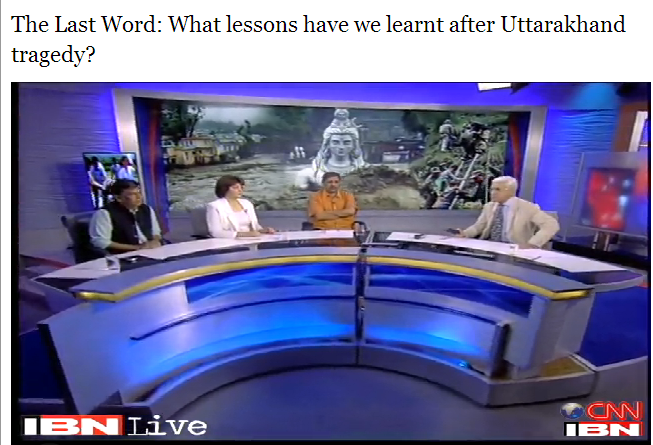
Himanshu Thakkar on Karan Thapar’s Last Word: http://ibnlive.in.com/shows/The-Last-Word.html

Himanshu_KaranThapar
Himanshu Thakkar on The Last Word

“In a state like Uttarakhand, which is prone to disasters like cloud bursts, flash floods, land slides, the indiscriminate building of hundreds of hydropower projects in this state, each project entailing dam, tunnels that need to be blasted through, the roads, townships and deforestation, the disaster and damage potential goes up multi fold, particularly when there are no credible environment of social impact assessments at project or basin leve, nor any carrying capacity study, nor any credible compliance mechanisms. Even the wrong operation of projects can add to the disaster potential.” http://ibnlive.in.com/news/uttarakhand-needs-proper-weather-forecast-mechanism-himanshu-thakkar/400084-3-243.html

“The South Asia Network on Dams, Rivers and People (SANDRP) says too many hydropower projects, underground tunnels, roads, encroachments of riverbeds by buildings coupled with deforestation could have worsened the impact of the flash floods.

“We do not have credible environmental-impact assessment of infrastructure projects on these highly ecologically sensitive areas,” says Himanshu Thakkar of SANDRP. “Neither is there any credible mechanism to assure compliance with environmental regulations. These are places where there is a heavy tourist influx. The collapse of buildings like a set of playing cards shows these were encroachments on the riverbed and floodplains.”

Thakkar says there have been seven similar flood-related disasters in Rudraprayag in the last 34 years. “The administration should have learnt,” he says. “This is not the first time such a disaster has hit us. Both Uttarkashi and the Chamoli-Rudraprayag-Kedarnath area faced monsoon disasters last year, killing several people. There are a few hundred hydropower projects, for instance, in the various tributaries of the Ganga here. These may all be legal projects approved by the environment and forests ministry but have a serious bearing on the flow of the river.”http://timesofindia.indiatimes.com/india/Unchecked-infrastructure-projects-made-it-worse-in-Uttarakhand/articleshow/20673047.cms

In conclusion:

Managing disasters after they occur is at a huge human, ecological and economic cost. Predicting and controlling disasters transparently and swiftly is a crucial factor.It is clear that numerous organisations, groups, individuals, even government institutions had raised the issue of impacts of cascade hydel dams on Upper Ganga on Hydrology, Ecology and Communities in this fragile region. Most of the suggestions have been ignored.

Even gazette notification of 135 kms of Bhagirathi as an Eco sensitive Zone came in pretty late from the MoEF and is being opposed by the Uttarakhand Government.

The responsibility of the current calamity does not rest alone with Uttarakhand Government or Disaster Management unit. It lies squarely also with the MoWR, Ministry of Environment and Forests and the Prime Minister, who is the chairperson of the National Ganga River Basin Authority. Incidentally, the MoEF has been sitting on Draft River Regulation Zone Notification for more than 3 years now. The RRZ Notification could have helped in controlling infrastructure development like hotels and homes along the river.

At the cost of hundreds of lives, the current disaster is a bitter lesson for us. It is not a time to engage in a blame game of whether or not this is a man made disaster. The contributing reasons like Dams, tunnelling, blasting, mining are well known; History of projects on Assiganga and Dhauliganga is well know and so is the topographical, seismological, geological fargility of the region. It is now a time to act and actually implement recommendations given by so many committees and organisations since past many years.

Climate Change is no longer a distant, obscure event, it is in front of us now.

In keeping with all these factors, there is an urgent need to immediately stop the ongoing hydel projects in Uttarakhand, address pending issues raised by communities and groups, undertake transparent and true carrying capacity study of the region, scrap 24 projects mentioned by WII and more, considering geological impacts, monitor commissioned projects closely for compliance, decommission commissioned projects whihc flout environmental norms or have a severe downstream impact, manage 135 kms Ecosenstive zone on bhagirathi, have a similar one for Alaknanda and near all river origins in Uttarakhand.

When faced with a human toll that is feared to be close to a thousand, hydel power does not seem so bright or clean, green and sustainable like it is touted. It is not something for which India can risk the lives and well-being of its population or environment.

Himanshu Thakkar, Parineeta Dandekar

Useful Links:

1. For an account of Floods in Pithoragarh district of Uttarakhand, see: http://www.himalprakriti.org/?q=content/brief-report-spate-along-gori-river-basin-north-eastern-kumaon-uttarakhand-15th-17th-june; images of the Goriganga floods: http://www.himalprakriti.org/?q=content/images-gori-spate-june-2013; Before and after images of 5 Motighat hydropower project: http://www.himalprakriti.org/?q=content/and-after-images-uttarakhand-floods-2013

2. For a photo feature on damage to Vishnuprayag HEP, see: http://matuganga.blogspot.in/

3. For an excellent account of how Uttarakhand is a model of disaster, see: http://tehelka.com/uttarakhand-a-model-of-disaster/

4. Uttarakhand Disaster Mitigation and Management Centre: http://dmmc.uk.gov.in/

5. National Disaster Management Authority: http://ndma.gov.in/ndma/index.htm

6. National Institute of Disaster Management: http://nidm.gov.in/default.asp

7. India Meteorological Department: http://imd.gov.in/

8. Flood forecasting site of Central Water Commission: http://www.india-water.com/ffs/index.htm

9. Sphere India website, coordinating disaster management from non govt agencies: http://www.sphereindia.org.in/

10. People Science Institute: http://peoplesscienceinstitute.org/Appeal-UD…html

11. Action Aid: http://www.actionaid.org/india

Hydropower · Ministry of Environment and Forests · Ministry of Water Resources

LAKHWAR DAM PROJECT: Why the project should not go ahead

PRESS STATEMENT ON WORLD EARTH DAY: APRIL 22, 2013

We the signatories to this statement would like to bring some key issues to the attention of all concerned on the proposed Lakhwar Dam Project on the Yamuna River in Upper Yamuna River Basin in Dehradun district of Uttarakhand state.

The proposed dam involves a massive 204 m high dam with storage capacity of 580 Million Cubic meters, submergence area of 1385.2 ha, including 868.08 ha forest land, at least 50 villages to be affected by submergence of land in the upstream, many more in the downstream area. This site is just about 120 km downstream of the river’s origins from the holy shrine of Yamunotri.  The composite project involves, in addition to the Lakhwar dam with 300 MW underground power house, another 86 m high Vyasi dam with 2.7 km long tunnel and 120 MW underground power house and a barrage at Katapathar.

As can be seen from the details below:

a)      The project has not undergone basic, credible environment or social appraisal in any participatory manner.

b)      It does not have legally valid environment or forest clearance.

c)      There has not been any cumulative impact assessment of various existing, under construction and planned dams and hydro-projects in the Yamuna system.

d)      There has not been any credible assessment about options for the project.

e)      The project is to come up in an area that is seismically active, prone to flash floods and also prone to erosion and land slides.

f)       The spillway capacity of the project has been awfully underestimated resulting in significant risks of dam damage / breakage with concomitant risks of unprecedented downstream flooding and destruction. It may be mentioned here that Delhi is a major city standing in the path of the river in the downstream area.

g)      The religious and spiritual importance of the Yamuna River is at risk since whatever remains of the river will be completely destroyed both in the upstream and downstream of the project.

h)      No agreement exists among the Upper Yamuna basin states about sharing of costs and benefits of the project, which should be a pre-condition for taking up any such project.

i)        It is well known that Yamuna River is already one of the most threatened rivers in the country and the project shall further adversely affect the river system.

Recently as well as earlier last year thousands of people from Allahabad/ Vrindavan marched to Delhi, seeking a revival of their river Yamuna. The focus of the authorities should be on ways and means to restore the river Yamuna system rather than take such massive project without even basic appraisal.

We thus urge the official agencies at both the state and at the centre level to not go ahead with this project. We urge them to rather take steps to protect and preserve than destroy one of the biggest and culturally important river, without even basic appraisal at project or basin level or any options assessment carried out in a due participatory manner.

We hope that the government will not go ahead with this project until all the issues mentioned have been satisfactorily resolved.

Endorsed by:

Ramaswamy Iyer, Former Union Water Resources Secretary, Delhi, ramaswamy.iyer@gmail.com

E.A.S. Sarma, Former Union Power Secretary, Vishakhapattanam, eassarma@gmail.com

Medha Patkar, Narmada Bachao Andolan, Badwani, nba.medha@gmail.com

Ashish Kothari, Kalpavriksh, Pune, chikikothari@gmail.com

Rajendra Singh, Tarun Bharat Sangh, Rajasthan, watermantbs@yahoo.com

Prof. MK Prasad, Kerala Sastra Sahitya Parishad, Cochin, prasadmkprasad@gmail.com

Bittu Sahgal,  Editor, Sanctuary Asia, Mumbai bittusahgal@gmail.com

Prashant Bhushan, Senior Supreme Court Lawyer, Delhi, prashantbhush@gmail.com

Vandana Shiva, Navdanya, Delhi, vandana.shiva@gmail.com

10. Amit Bhaduri, Prof. Emeritus, JNU, Delhi, amit.bhaduri@gmail.com

Ravi Agarwal, Toxics Link, New Delhi, ravig64@gmail.com

Madhu Bhaduri, Former Indian Ambassador & member Yamuna Jiye Abhiyaan, Delhi, madhubhaduri@rediffmail.com

Prof S. Janakarajan, Madras Institute of Development Studies, Chennai, janak@mids.ac.in

Dr Dinesh Mishra, Barh Mukti Abhiyan, Bihar, dkmishra108@gmail.com

Sharad Lele, Centre for Environment and Development, Bangalore, sharad.lele@gmail.com

S. Faizi CBD Alliance, Kerala, s.faizi111@gmail.com

Rohit Prajapati, Paryavaran Suraksha Samiti, Gujarat, rohit.prajapati@gmail.com

Bharat Jhunjhunwala, Former Professor-IIM Bengaluru, Uttarakhand, bharatjj@gmail.com

Vimalbhai, Matu Jansangthan, Uttarakhand, matujansangthan@gmail.com

20. E Theophilus, Malika Virdi, Himal Prakriti, Uttarakhand, etheophilus@gmail.com

Ramnarayan K,  Save the Rivers Campaign Uttarakhand, ramnarayan.k@gmail.com

Kalyani Menon-Sen, Feminist Learning Partnerships, Gurgaon, kmenonsen@gmail.com

Dr RK Ranjan, Citizens Concern for Dams and Development, Manipur ranjanrk50@gmail.com
Jiten Yumnam, Committee on Natural Resources Protection in Manipur, jitnyumnam@yahoo.co.in

Renuka Huidrom, Centre for Research and Advocacy, Manipur, mangangmacha@gmail.com

Shweta Narayan, The Other Media, Chennai, nopvcever.new@gmail.com

Wilfred Dcosta, Indian Social Action Forum – INSAF, New Delhi insafdelhi@gmail.com

Nidhi Agarwal, Activist, Community rights on environment, Delhi, nidhi.sibia@gmail.com

Rahul Banerjee, Dhas Gramin Vikas Kendra, Indore, rahul.indauri@gmail.com
30. Subhadra Khaperde, Kansari Nu Vadavno, Khargone, subhadra.khaperde@gmail.com
Shankar Tadwal, Khedut Mazdoor Chetna Sangath, Alirajpur, shankarkmcs@rediffmail.com

Michael Mazgaonkar, Gujarat, mozdam@gmail.com

Ranjan Panda, Convenor, Water Initiatives Odisha, ranjanpanda@gmail.com

M Gopakumar, Bangalore, gopakumar.rootcause@gmail.com

Janak Daftari, Jal Biradari, Mithi Nadi Sansad, Mumbai, daffy@jalsangrah.org

Shripad Dharmadhikary, Manthan Ahdyayan Kendra, Pune, manthan.shripad@gmail.com

Prof Rohan D’Souza, Jawaharlal Nehru University, Delhi, rohanxdsouza@gmail.com

Dr Brij Gopal, Jaipur, brij44@gmail.com

Alok Agarwal, Narmada Bachao Andolan & Jan Sangharsh Morch, Madhya Pradesh, aloknba@gmail.com

40. Debi Goenka, Conservation Action Trust, Mumbai, debi1@cat.org.in

Shardul Bajikar, Editor – Natural History, Saveus Wildlife India, Mumbai shardulbajikar@gmail.com

Sankar Ray, Kolkata, sankar.ray@gmail.com

Samir Mehta, International Rivers, Mumbai, samir@internationalrivers.org

V Rukmini Rao, Gramya Resource Centre for Women, Secunderabad, vrukminirao@yahoo.com

Dr. Latha Anantha, River Research Centre, Kerala, latha.anantha9@gmail.com

Mrs Anjali Damania, Aam Admi Party, Mumbai, anjalidamania@rediffmail.com

Manshi Asher, Him Dhara, Himachal Pradesh, manshi.asher@gmail.com

Commodore (rtd) Lokesh Batra, Social and RTI activist, NOIDA, batra_lokesh@yahoo.com

Arun Tiwari, Water activist, Delhi, amethiarun@gmail.com

50. Ananda Banerjee, Writer and member, Yamuna Jiye Abhiyaan, Delhi,

Sudha Mohan, Yamuna Jiye Abhiyaan, Delhi, sudhamohan@peaceinst.org

Dr Sitaram Taigor, Yamuna Jiye Abhiyaan, Madhya Pradesh, srtchambal@gmail.com

Bhim S Rawat, Yamuna Jiye Abhiyaan, Delhi, we4earth@gmail.com

Prasad Chacko, Social activist, Ahmedabad, prasad.chacko@gmail.com

Swathi Seshadri, EQUATIONS, Bangalore, swathi.s@equitabletourism.org

Parineeta Dandekar, SANDRP, Pune, parineeta.dandekar@gmail.com,

Manoj Mishra, Yamuna Jiye Abhiyaan, Delhi (09910153601, yamunajiye@gmail.com)

58. Himanshu Thakkar, South Asia Network on Dams, Rivers & People, 86-D, AD block, Shalimar Bagh, Delhi (09968242798, ht.sandrp@gmail.com)


Annexure

DETAILED NOTES

1. No Options Assessment There has been no assessment to show that this project is the best option available for the services that it is supposed to provide, including water supply to Delhi, irrigation in Uttarakhand, hydropower generation and water storage. It was not done during the process preceding the now out-dated environmental clearance given in 1986, nor has it been done subsequently.

It is well known that Delhi has much cheaper, environment friendly and local options that has not been explored with any sense of seriousness. These include reduction in transmission & distribution losses (which stand at 35%), rainwater harvesting (as National Green Tribunal order in April 2013 exposed, even the Delhi Metro is not doing this) including groundwater recharge, demand side management, stopping non essential water use, protection of local water bodies, protection of flood plains, streams and the ridge, recycle and reuse of treated sewage, among others.

As far as irrigation in Uttarakhand is concerned, in this relatively high rainfall area, and considering the local agro-geo-climatic situation and suitable cropping patterns, better options exist. Similarly about other claimed services.

It may be added here that the EIA manual of Union Ministry of Environment & Forests, the National Water Policy and best practices around the world including the recommendations of the World Commission on Dams, require such an options assessment study, including no project scenario, before embarking on such costly and risky projects.

2. No Basin wide cumulative impact assessment or basin study: Yamuna River is already in very bad situation in many senses, including being very polluted for lack of surface water flow. The river basin also has large number of projects existing and under construction, See: http://www.sandrp.in/basin_maps/Major_Hydro_Projects_in_Yamuna_Basin.pdf, for details. Particularly, see the concentration of projects in narrow upper Yamuna Basin. However, there has been no basin wide cumulative impact assessment of projects and water use in the basin in the context of its carrying capacity on various aspects. Without such an assessment, adding more projects may not only be unsustainable, it may actually be worse than zero sum game, since the new projects will have large number of adverse impacts. That we may have already crossed the basin carrying capacity upstream of Delhi seems evident from the worsening state of Yamuna over the past decades in spite of investment of thousands of crores rupees. Adding this project with its massive impacts without such an assessment may actually be an invitation to disaster.

We learn that a Yamuna basin study has been assigned to the Indian Council for Forestry Research and Education (Dehradun). However, it should be noted that in the first place, ICFRE has had poor track record. Its EIA study for the Renuka dam in the same Yamuna basin was so poor that it was based on the poor quality of the study that the National Green Tribunal stayed the work on the project for over a year now.

3. No valid environment clearance, no valid EIA-EMP or Public consultation process

The Composite Lakhwar Vyasi project got environment clearance 27 years back in 1986 without any comprehensive environment impact assessment (EIA) or preparation of environment management plan (EMP) or any participatory process. Some preliminary work started, continued only till 1992 and stopped thereafter for lack of funds.

a) In Sept 2007, the 120 MW Vyasi HEP, part of the original composite project, sought and got environment clearance although the minutes of the Expert Appraisal Committee of MoEF notes a number of unresolved issues. In Nov 2010 EAC meeting, the EAC considered the Lakhwar Dam for Env clearance, and raised a number of questions, none of them were ever resolved. The EAC did not consider the project in any meeting after Nov 2010.

This sequence of events makes it clear that Lakhwar Dam does not have valid environment clearance. The MoEF and project proponent assumption that the Environment Clearance (EC) of 1986 is valid is not correct, since if that EC was not valid for the Vyasi HEP which has sought and received fresh EC in Sept 2007, then how  could Lakhwar HEP Dam of which Vyasi HEP is a part, continue to possess a valid EC.

Thus to give investment clearance to Lakhwar dam without valid EC will be imprudent, and might invite long drawn legal challenge to the project, resulting in more delays and in turn unnecessary cost escalations.

b) The project also does not have valid EIA-EMP. What ever assessments were done before the 1986 EC cannot be considered adequate or valid today. The environment standards and also environment situation has hugely changed in the intervening 27 years.

The project did not have any public consultation process in 1986 or anytime there after. Fresh EC will require that and the project must go through that process.

4. Issues raised by EAC remain unresolved: When the 43rd meeting of EAC considered the project for EC on Nov 12-13, 2010, the minutes of the meeting raised a large number of questions, all of them remain unresolved. These issues are fundamental in nature. Without resolving these issues, the project should not go ahead.

Just to illustrate, EAC raised questions about the need and usefulness of various project components. It is clear from the EAC minutes that the project also involves construction of Katapathar barrage downstream from Vyasi Power House at Hatiari. However, just about 10 km downstream from this barrage there is an existing barrage at Dak Pathar.  It is not clear why this Katapathar barrage is required, the EAC asked. None of these issues have been resolved.

5. Project does not have valid forest clearance: The composite Lakhwar Vyasi project requires a very large area of forest land, at 868.08 ha, the diversion was originally permitted for the UP irrigation Dept, which was then transferred to Uttaranchal Irrigation Dept upon creation of the separate Uttaranchal State. However, the project has now been transferred to Uttaranchal Jal Vidyut Nigam Limited. The Vyasi Project was earlier transferred to NHPC and now stands transferred to UJVNL.

In Aug 2012 FAC (Forest Advisory Committee is a statutory body under the Forest Conservation Act 1980) meeting, there was a proposal put forward to transfer the clearance for 99.93 ha (out of total forest land of Rs 868.08 ha for composite project) forest land required only for the Vyasi Project to UJVNL from Uttaranchal Irrigation Dept. While discussing this proposal, FAC noted that the Vyasi project was earlier transferred NHPC, without getting the forest clearance transferred in favour of NHPC. In fact FAC has recommended, “State Govt shall examine the reasons for not obtaining prior approval of the Central Govt under the Forest (Conservation) Act, 1980, for change of user agency from irrigation dept to NHPC and fix responsibility”. Secondly what is apparent from the minutes of the Aug 2012 FAC meeting is that even the Catchment Area Treatment Plan for the Vyasi project has not yet been prepared. This shocking state of lack of preparation of basic management plan is the consequence of allowing the project based on outdated clearances. The FAC has now asked the user agency to fulfil all such requirements, before which the project will not be given stage II forest clearance. So the Vyasi Project also so far does not have stage II forest clearance.

Most importantly, the transfer of forest clearance for the remaining 768.15 ha of forest land required for the Lakhwar project from Uttarakhnd irrigation dept to the current project agency UJVNL has not been even sought. So the Lakhwar project does not have valid forest clearance even for first stage, and surely no stage II forest clearance. Under the circumstances, the project does not have legal sanction.

6. Inadeaquate spillway capacity The project spillway capacity is proposed to be of 8000 cumecs, as per official website, see: http://india-wris.nrsc.gov.in/wrpinfo/index.php?title=Lakhwar_D00723. However, as per the latest estimates, the location is likely to experience probable Maximum Flood of 18000 cumecs. This is as per a paper titled “The probable maximum flood at the Ukai and Lakhwar dam sites in India” by P R Rakhecha and C Clark, presented in the year 2000 at an international Symposium. Dr Rakhecha later joined Govt of India’s Indian Institute of Tropical Meteorology in Pune. The paper concludes: “For the Lakhwar dam site there would be significant flow over the dam crest after 12 h from the start of the storm hydrograph and this would be maintained for over 18 h. The maximum depth of flow over the crest would be 4 m which is large enough to cause major if not catastrophic damage to the dam structure.”

Thus the spillway capacity of the project needs to be reviewed and it would not be prudent to go ahead without the same as the new PMF could cause major damage to the dam, the paper says. Any damage to this massive structure will have far reaching consequences all along the downstream area, right upto Delhi and downstream.

In fact even for the Vyasi HEP, while discussing the project in the EAC meeting of Aug 16, 2007, the minutes notes that the clarification sought by EAC on Dam Break Analysis for the project is incomplete, inadequate and far from satisfactory and the EAC desired further concurrence of Central Water Commission. In fact, EAC should not have recommended EC to the Vyasi Project with a flawed study. For the bigger Lakhwar project, there has not even been any such appraisal.

7. No agreement among Upper Yamuna basin states, Unresolved disputes The Lakhwar storage project is part of the Upper Yamuna basin. An interstate agreement was arrived at in 1994 for sharing of water in the Upper Yamuna basin among the basin states of Himachal Pradesh, Uttar Pradesh (now also Uttarakhand), Haryana, Delhi and Rajasthan. Each project under the agreement required separate agreements. However, there has been no agreement on sharing the costs and benefits of the individual projects under the agreement.

On Renuka project also in the same Upper Yamuna basin, there was an agreement that was arrived at in 1994, but the Ministry of Law has said that the agreement is no longer valid. For several years now the Upper Yamuna River Basin Board has been holding meetings, but has failed to arrive at any agreement for sharing the costs and benefits of Renuka dam. For Lakhwar dam there has been not been any serious attempt in that direction. The current project proposal envisages to provide 50% of water (about 165 MCM) to Delhi and 50% to Uttarakhand for irrigation (see: http://www.business-standard.com/article/companies/work-on-300-mw-lakhwar-project-to-begin-by-aug-112062200178_1.html dated June 22, 2012 includes statement from project proponent UJVNL (Uttarakhand Jal Vidyut Nigam Ltd) Chairman). However, this proposal completely ignores the claims of share from the project by Uttar Pradesh, Haryana, Rajasthan and Himachal Pradesh. To go ahead with the project without an inter state agreement on sharing costs and benefits would surely not be prudent.

8. Inadequate cost estimates As per estimate as on March 1996 the cost of the project is Rs 1446 crore out of which Rs 227 crore have been spent (see: official website http://uttarakhandirrigation.com/lakhwar_vyasi_project.html). Note that this cost was for the composite project, including Vyasi HEP. As per UJVNL official webstie http://www.uttarakhandjalvidyut.com/lakhwar.php, the cost of Lakhwar Project alone is Rs 4620.48 crore on Feb 2010. The same site gives the cost of Vyasi HEP at Rs 1010.89 crores, so the cost of combined project at Feb 2010 PL is Rs 5631.37 crores. The cost has thus seen 300% escalation in 14 years between 1996 and 2010. This is a very costly project and the cost is likely to be even higher at current prices. In any case, the estimate should be for current price level and the cost benefit calculations should also be for the latest date.

9. Seismically active area, erosion prone landscape: The project area is seismically active, flash flood, land slides, cloud bursts and erosion prone. In the context of changing climate, all these factors are likely to be further accentuated. When the project was first proposed in mid 1980s, none of these issues as also the issues of biodiversity conservation, need to conserve forests for local adaptation, forest rights compliance, environment flows etc were seen as relevant or important. However, all of these issues are important today. The project clearly needs to be reappraised keeping all these issues in mind.

~~