Much has been talked about PPPs (Public Private Partnerships, a euphemism for privatisation) in urban water supply sector. After National Water Policy 2012 spelled water as an economic good, PPP water projects have spurred further across cities all over India.
Concession agreement between the Municipal Corporation and the private company awarded with the contract is a mode of PPP widely used in this sector. Many municipal corporations sign concession agreements in such a way that the concessionaire gets entirely exclusive rights on using the water infrastructure for purpose of water supply and also of billing & collection. This means that the more water the concessionaire sells, the more profit it earns.
While these agreements are signed assessing the financial feasibility of the projects, realistic studies of their impact on the water use from the dams or source at the back end are missing. So how do PPP projects interact with the water sources like dams which are the source of raw water for these agreements? We conducted a brief case study of 24×7 Water Supply PPP Project of Nagpur in Maharashtra. We see a strong link between demand stress on the dams and 24 x 7 water supply promotions, indicating that the 24×7 water supply projects which are pushed widely across the country may further increase the demand stress on the dams.
The central Indian city of Nagpur has been one of the earliest cities to opt for water supply PPP. The pilot project launched in Dharampeth Zone started in June 2007 and is now in the operational phase. Before the project could be critically assessed for its performance, the NMC (Nagpur Municipal Corporation) in November 2011 extended the PPP to entire City claiming that the demo project has already been successful[i]. Concession agreement was signed with Orange City Water Private Ltd. (OCWL) which is a joint venture of Vishvaraj Environment Pvt Ltd and Veolia Water (India) Private Ltd[ii].
It has to be understood at the outset that Dharampeth ward which was chosen as a demo ward[iii] already had average water supply of 18 to 20 hours a day. This ward also has abundant open wells which are used regularly by the consumers for non-potable uses. In fact the experts say that NMC has chosen the ward with least amount of water problems so that the project can be readily showcased as a success, but with such convenient selection, the NMC did not wait for the critical assessment of the performance of demo.
Water consumption increased after 24×7 Water Supply was launched in demo zone
PPP was launched on a pilot basis in this ward claiming multiple benefits. One of the benefits of 24×7 water supply claimed repeatedly is ‘reduced burden on water resources’. Continuous supply is said to reduce water wastage arising from overflowing storage systems and open taps. It is also said to save on stored household water that is discarded when new supply comes in. Because the distribution pipe network is repaired and renewed where needed before starting 24X7, it also reduces losses arising from leaks in the old pipes.
All this is said to result in reduced water use.
In Nagpur however the case has proved to be the opposite.
Administrative State College of India (ASCI), Hyderabad conducted Impact Assessment of the Pilot Project[iv]. The study found that during the demo project the target set for increase in billed volume was 10%. In reality, there was an actual increase of about 50%. Billed volume for Bajiprabhu Nagar (an area of about 2.5 to 4 SqKM in Dharampeth zone) which was 0.440 MLD, increased to 0.504 MLD. The billed volume[v] for Dharampeth zone increased from around 22 MLD before the project to 33 MLD by March 2010. While 24X7 water is not available to the poor in many slums, meter reading and bills have gone up by two to three times in non-slum area. The NMC officials claim that the increase in total water supplied[vi] to the pilot area from 45 MLD to 52 MLD, is a natural growth.

Findings of another study in which this author was involved are on similar lines. The study shows that the leakages after replacement pipes and leakage at consumer premises due to excess pressure in fact increased the wastage multifold. In addition the taps fitted for slum connections are of poor quality and keep leaking. This adds to the wastage. Non slum connection holders point out that 24 hours availability leads to more wasteful water use. They also mention that 3 to 4 hours of water supply with good force twice a day is much preferred than 24 hours water supply.

Print media reports in September 2011 state that water demand for Demo zone was 41.25 million litres per day (MLD) while the actual supply was 92.98 MLD[vii]. The figures had been quoted from information obtained from RTIs filed by corporator Vedprakash Arya. It was alleged that the additional 51.73 MLD more than the actual requirement has been the wastage from the leaking main pipelines & leakage at consumer premises. It was also alleged that this additional water has been provided to the Demo Zone by diverting water from other zones.
Mr.Arya also shows concern about increase in the water supply quantum when the project is implemented in the entire city. He says that NMC will have to arrange for over 1,000 MLD, which is impossible.
Nagpur receives water from the Pench dam at the cost of irrigation potential
While the demand in the city has been going up with introduction of 24×7 water supply, it will be interesting to take a look at what has been happening at the source of city’s raw water.
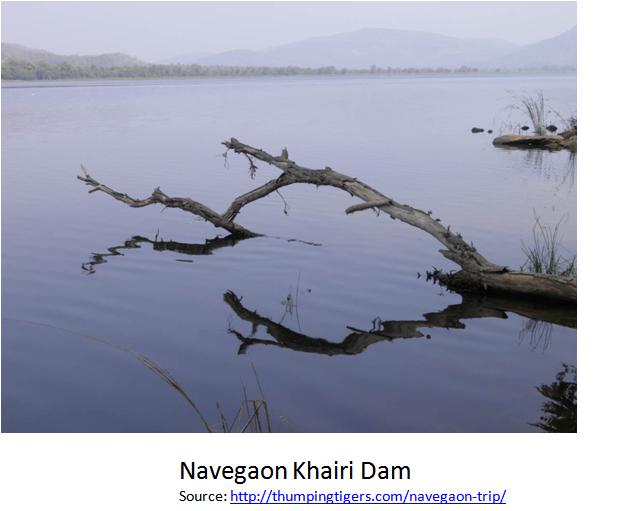
The Navegaon Khairi dam in the Parseoni forests from which the Nagpur City receives its raw water is a part of Pench Project, which incidentally straddles the Pench Tiger Reserve. The dam was constructed in 1977. The total water available for utilization at Navegaon Khairi dam is 965 M Cum (75% dependability). PRAYAS Resources & Livelihoods Groups has conducted a detailed case study of water allocation for the Nagpur City. The report presents startling facts. As per the report, the original allocation plan shows that the project was constructed primarily for irrigation purpose, with 79% of the planned water allocated for agriculture development and 21% allocated for non-irrigation purpose. NMC started drawing 112 MCuM water from the Navegaon Khairi dam between 1982 and 84. In 2001 NMC demanded allocation of additional 78 MCuM water to supply for the increased population. Allocating this share of water to NMC would essentially have to be at the cost of loss of irrigation potential. Hence temporary permission was granted to NMC and the city was specifically asked to lower their dependence on the Pench River. The water allocation was made permanent in August 2008 on two conditions –
1) NMC should pay the restoration cost[viii] of 8445 Ha at the rate of Rs 100 000/ha
2) NMC shall undertake treatment of waste water
The current water allocation to NMC from Pench RBC (Right Bank Canal) is 255.71 MCuM.
Kanhan River to be augmented as a future raw water source
After diverting the water from irrigation to urban water supply, NMC is all set to augment a fresh water source for the city’s growing thirst. The DPR (Detailed Project Report) prepared for 24×7 water supply states that NMC has prepared the master Plan for Water Supply to meet the water supply up to 2031 from identified sources. The future source for city would be proposed barrage on Kanhan River which will meet the water demand up to Year 2031. Kochi barrage and Jamghat will be required to be developed to meet water demand beyond 2031.
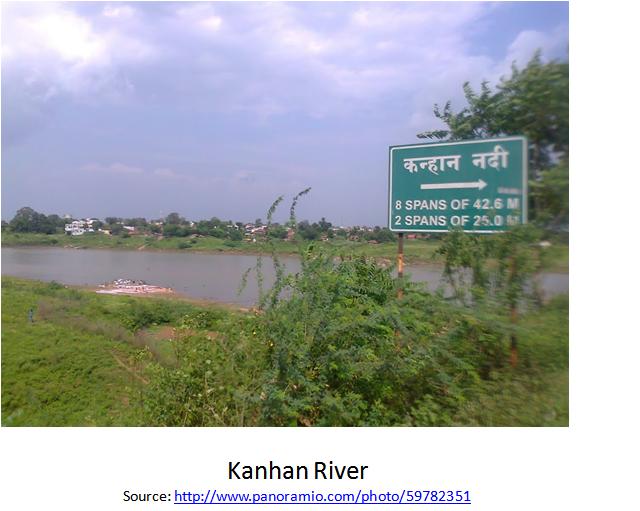
Accordingly NMC has started the process of to approve the project of constructing a barrage at the confluence of Kanhan and Kolara rivers[ix]. The project aims to increase water supply from Kanhan water treatment plant, which would benefit East, North and few parts of South Nagpur. NMC had constructed water treatment plant with installed capacity to treat 240 MLD water. However, the plant cannot function to full capacity due to shortage of raw water from Kanhan River. The plant can treat water stored in the barrage throughout the year.
A proposal has been tabled before the standing committee seeking approval for Rs 1.82 crore for the work. The standing committee was to give its nod in the meeting organized on July 14 (2014).
Conclusion
Case of Pilot 24×7 water supply project at Dharampeth zone is indicating that 24×7 water supply has increased water use by the consumers. It also indicates that the problem of leakage has actually increased in 24×7 water supply. The PPP agreements are drafted in such a way that the more water the concessionaire sells the more profit it earns. Quick look at the PPP agreements of Bhiwandi, Aurangabad, Latur will confirm this fact. In case of Nagpur the more water the private player bills the more profit he earns. This increases the demand pressure at the raw water source and may result in issues like water supplied at the cost of irrigation potential, and increase in the need of dam projects, with associated social, ecological and economic impacts.
Instead of managing the demand and promoting local options like as Rain Water Harvesting, reuse of treated sewage which will reduce the demand side stress on sources like dams, 24 x 7 water supply projects are widely promoted with the assumption that they will automatically mean less water use. No comprehensive assessment of performance of these projects has been done to actually assess initial claims. As in the case of Nagpur, the model seems to promote more wasteful use of water And is banking on more sources for this.
It is also significant to note here that these efforts are funded by the centre. Out of 17 JNNURM projects sanctioned for Nagpur, (till September 2013) eight projects are water supply sector related projects[x]. All of them are proposed to augment the present water supply source and to develop a raw water source. As the situation stands now, NMC has signed concession agreement with OCWL the entire city and is looking to augment more water sources like Kanhan River. On background of poor performance by OCWL during implementation of the project, this move saw signification local protests and opposition[xi].
There is an urgent need to assess the performance of PPP water supply schemes in terms of water use by the consumers which seems to be missing in the hoopla of promotion of PPPs. The alternative of greater democratization of urban water sector by increasing transparency, participation and accountability seems to be more imperative than PPP experiments.
– Amruta Pradhan, SANDRP. amrutapradhan@gmail.com
References
– National water policy 2012
– Detailed Project Report of 24×7 pilot project
– Unpublished study by PRAYAS Resources & Livelihoods Group: Water Diversion from Irrigation to Non-Irrigation Use in Pench Project
[i] http://timesofindia.indiatimes.com/city/nagpur/Double-blow-for-Orange-City-Water-Limited-as-Nagpur-Municipal-Corporation-Centre-tighten-strings/articleshow/13828881.cms
[ii] http://timesofindia.indiatimes.com/city/nagpur/What-is-the-exact-cost-of-24×7-water-supply-project/articleshow/17775071.cms
[iii] http://www.nmcnagpur.gov.in/files/Draft-DPR.pdf
[iv] http://www.urbanindia.nic.in/programme/lsg/lsg_presentation/ASCI/Nagpur%20PPP-dist%20copy.pdf
[v] Billed volume does not include the water losses in the distribution system
[vi] Total water supplied includes the water losses in the distribution system
[vii]http://articles.timesofindia.indiatimes.com/2011-09-20/nagpur/30179542_1_dharampeth-zone-mld-water-supply
[viii] Capital cost incurred into the canal infrastructure rendered unutilized because of diverting water for non irrigation purpose.
[ix] http://timesofindia.indiatimes.com/city/nagpur/Kanhan-river-barrage-plan-revived/articleshow/38226739.cms
[x] http://www.indiaenvironmentportal.org.in/files/file/details%20of%20projects%20approved%20under%20jnnurm.pdf
[xi] http://timesofindia.indiatimes.com/city/nagpur/Orange-City-Water-Private-Limited-paying-Rs-46-lakh-penalty-every-month-for-poor-performance/articleshow/37154852.cms


 SANDRP