This story of Bandi River from Rajasthan is sixth in the series of online stories of urban rivers from across India. Please share your feedback and provide us with suggestions (read more in appendix). If you have any urban river stories or images that you might want to share, please send them to ht.sandrp@gmail.com and asid@veditum.org.
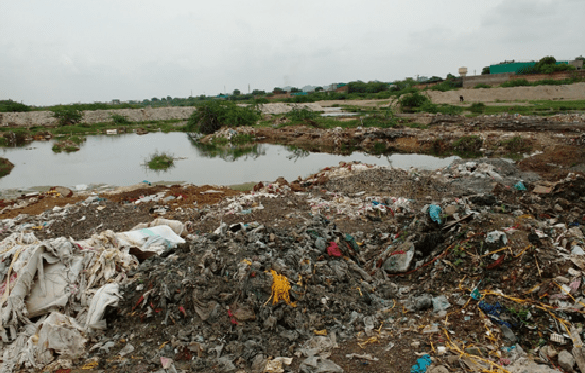
Solid waste dumped on the banks of the Bandi at Pali. Photo credits: Manu Moudgil
Finally on World Environment Day, Swami Shivanand has withdrawn[I] his fast unto death agitation. It was thirteenth day of his indefinite hunger strike including six days of water fast (from May 25 – 30, 2017) against illegal mining in Ganga.
The saint ended his protest around 6pm on June 05, 2017, only after receiving written assurance from the Central Government. As per information, referring to Matri Sandan repeated pleas, UP Singh Director General of National Mission for Clean Ganga has accepted that there were violations[II] of rules specially Rule No. V of Environment Protection Act during mining in Ganga. Subsequently he has asked Chairman, Central Pollution Control Board initiate criminal proceedings against the officials[III] concerned for non-compliance of the rules.
The year has seen many news reports about national and global water bottling brands abstracting groundwater without valid licenses. In the wake of severe drought, thermal power plants have been criticized for aggravating the water crisis. Reports have suggested that many new thermal power plants are proposed to be built in already water scarce regions. This brief report also covers some judicial orders on this subject.
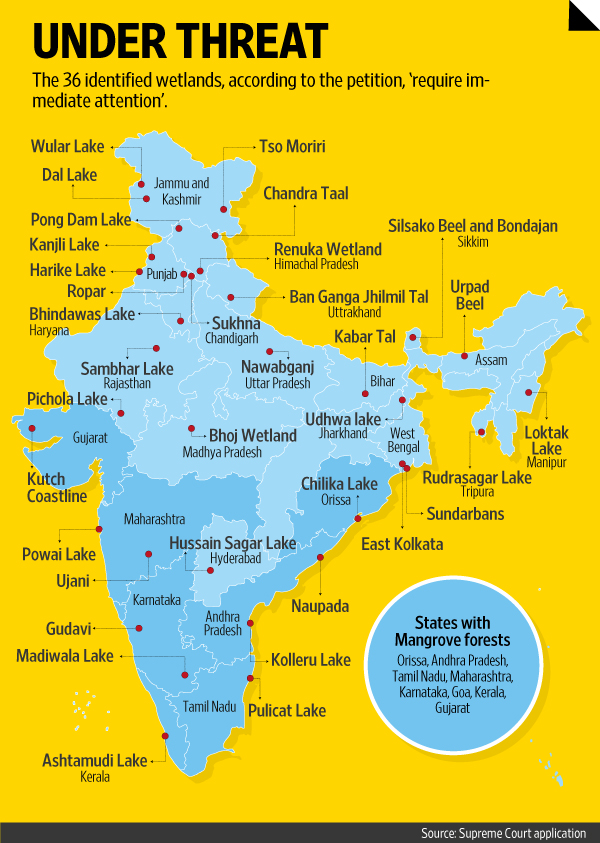
Featured image showing 36 Wetlands in India requiring urgent attention as per a 2014 petition filed in apex court (Image Source: Live Mint)
In the third part of Wetlands Review 2016, SANDRP presents an account of major decisions taken by respective Courts for the protection of Wetlands in India.
In a significant development in April 2016, the National Green Tribunal (NGT) directed all State Governments to submit a complete list of Wetlands[1] under their jurisdiction. The green court was hearing a plea alleging commercial conversion and resultant destruction of several large ecologically important Wetland areas across the country in absence identification and notification by respective State Governments.
The court also asked the Ministry of Environment, Forest and Climate Change (MoEF&CC) to submit the list of States that had approached it with Wetlands conservation plans.
SC transfers PIL on cleaning Ganga to NGTIn a major development, after monitoring Ganga cleaning work for last 31 years and without achieving any cleaner river, the Supreme Court on January 24, 2017 wrapped up a PIL on cleaning of river Ganga and sent it to the National Green Tribunal (NGT) for more effective adjudication. The apex court had been monitoring the issue for 31 years. A bench of Chief Justice J S Khehar and Justice N V Ramana said that since issues relating to municipal solid waste and industrial waste were already being heard by the NGT on a day-to-day basis, all other issues relating to sources of polluting the river should also be heard by the NGT.
The bench said that the tribunal will be required to submit an interim report to it every six months, only to give an idea about the progress made and difficulties, if any. It also granted liberty to the petitioner, environmentalist M C Mehta, to approach the court if he had any grievances in consonance with the law.
During last week hearing (January 17, 2017), the SC bench has directed the government to file a report on the construction and functioning of STPs alongside the river, which runs through five States.
It has been almost two years after the SC has voiced scepticism about the government’s self-proclaimed promise to clean up the Ganga River. Before this, in 2014, the apex court had voiced its reservations about the various efforts over the decades to return the Ganga to its pristine self, once even saying that it “does not expect Ganga to be cleaned up even after 200 years.”
When human beings fall into manholes or die in traffic accidents on a highway they are all over the news. We pity and fear such news, and feel sad for the deceased, just because the whole event is so unfortunate. We are angered by the condition of traffic – that continues to remain appalling despite having six-lane highways that look deceptively magnificent. We wonder if these cases could have been avoided. It is therefore even more disturbing that not a single news item has covered a series of major accidents that have happened right in the middle of the Ganga River National ‘Waterway’ (India’s National Waterway No. 1; see Dams, Rivers & People: Feb-March 2016 issue: p. 1-7, 2016 for details[i]) in the last six months.
Over twenty people have died by drowning at the Barari Ghat (Image 1) at Bhagalpur in Bihar in this period. Offering prayers, taking dips, or lunging in for a calm swim, these people have slipped away as their feet have lost the ground all of a sudden. The river, scouring off the silt from under the concrete, has been catapulting their bodies into the deepening abyss on the fringes of the ghats. Many bodies have not even been found. Family members of many, whose bodies were found, must have never suspected that they would have to carry back their kin’s corpses. What made the same Barari Ghat, which people traditionally visited for years, so dangerous suddenly?
Delhi water supply from Yamuna River through Munak canal has been severely impacted by Jat quota stir as the violent mob has damaged the Munak canal. As a result thousands of Delhiites are facing great difficulty in securing potable water. By the time the canal based water supply is restored which may take about a month, the discharged of industrial effluents in Yamuna upstream by Haryana has forced shutting downof two water treatment plants further jeopardizing the already wrenched out water supply in Delhi.
Delhi water supply has become so vulnerable to causalities that experts have been rightly suggesting development and conservation of Delhi’s own water resources in terms of wetland protection, rain water harvesting etc. to deal with such crisis.
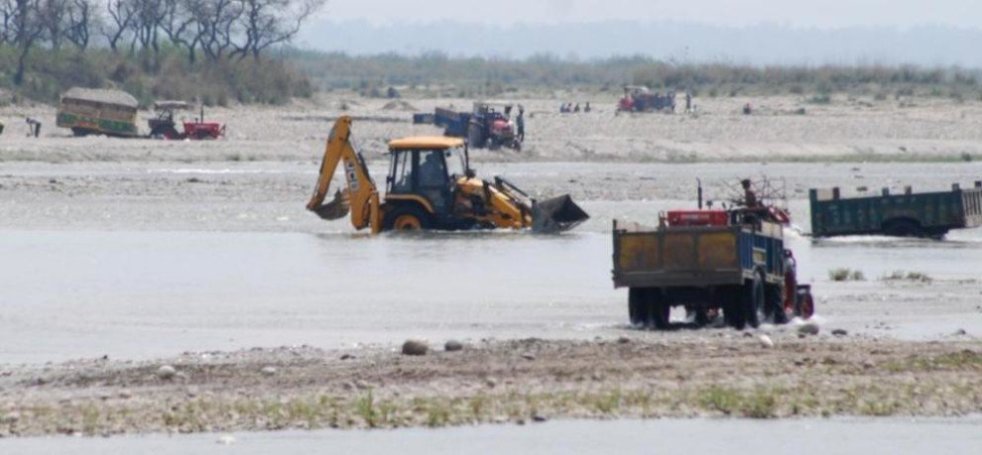
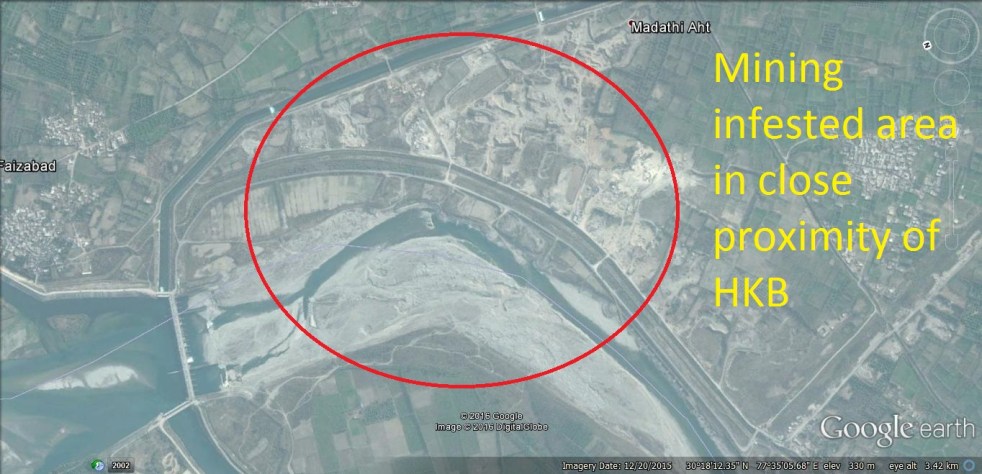
Apart from these two reasons there is a third bigger and still not known reason ignoring which may cause severest of water crisis in national capital and that is rampant mining of riverbed material around Hathini Kund Barrage (HKB). SANDRP in this blog try to highlight how the uncontrolled mining around HKB is endangering the barrage structure which in turn will surely lead to suspense of Delhi water supply for many months.
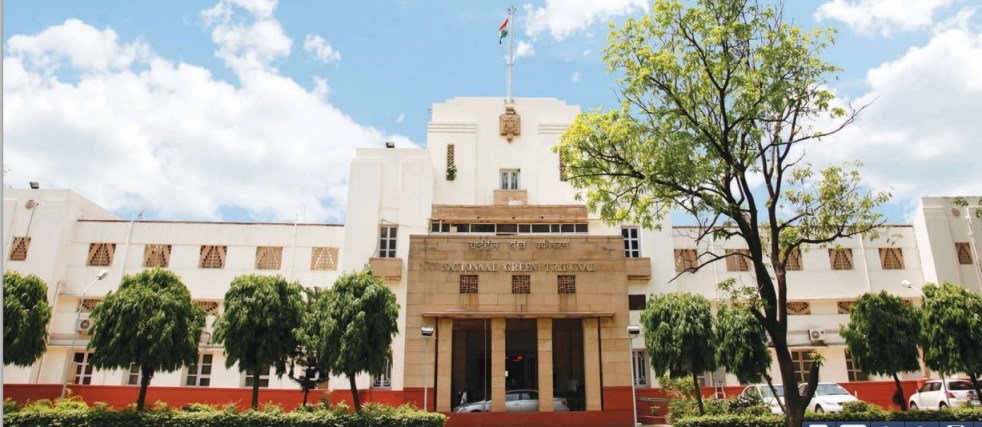
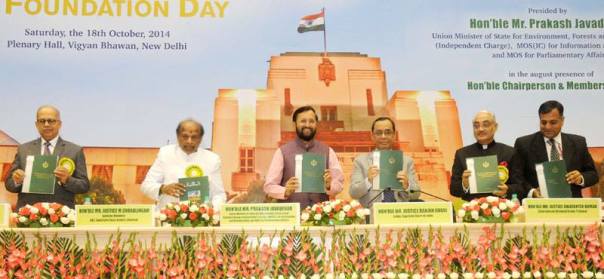
The National Green Tribunal, NGT marked its 4th Foundation Day on 18 October 2014, with an impressive fanfare. A full day function was organized at the Plenary hall of the capital’s iconic Vigyan Bhawan. NGT in this short span has acquired a formidable reputation as a unique, vibrant, active institute with independent & unbiased mind and forthright, quick redressal of petitions that come to it.
The function in two separate sessions, one in the forenoon and the other in the afternoon (a Seminar) was attended by large number of government officials, judicial officers, advocates, law school students, NGT petitioners and office bearers and members of the NGT Bar association.
NGT Foundation Function on Oct 18, 2014 (Source: FB page of Information and Broadcasting Ministry)
Invited dignitaries included Mr Justice Ranjan Gogoi (Judge, Supreme Court), Prakash Javadekar (Union Minister of State for Environment, Forests and Climate Change) and Ashok Lavasa (Secretary, MoEF&CC) in the forenoon session and Mr Justice Sudhanshu Jyoti Mukhopadhaya (Judge, Supreme Court) and Piyush Goyal (Union Minister of state for Power, Coal and new and renewable energy). Mr Justice Swatanter Kumar, the Chairperson of the NGT, Mr Justice Dr. P. Jyothimani, Judicial Member, Principal Bench, NGT, Prof. R. Nagendra, and Dr. D.K. Agarwal, Expert Members at the NGT also spoke and graced the dais.
The function included, in addition to the addresses by the invited dignitaries, the release of 2nd issue of NGT International Journal; the launch of new NGT Website (in the first session) and address by invitee experts (in the second session).
In the first session Mr Javadekar informed the gathering about his political beginnings from a water pollution struggle activist against factory pollution and Mr Lavasa categorically stated that the NGT is playing an extremely crucial role and that there is no move to dilute its powers in any manner. It was in the second session that very controversially one Mr M.K. Pandit was invited to speak as an invited expert.
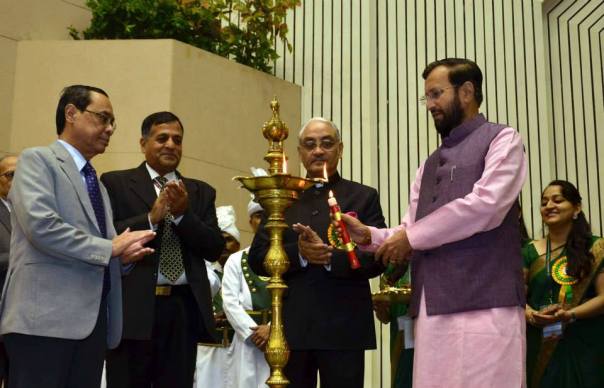
The Minister of State for Environment, Forests and Climate Change (I/C), Shri Prakash Javadekar lighting the lamp at the 4th Foundation Day function of the National Green Tribunal, in New Delhi on October 18, 2014. The Secretary, Environment, Forests and Climate Change, Shri Ashok Lavasa and the Judge, Supreme Court of India, Mr. Justice Ranjan Gogoi are also seen (Source: FB page of I&B Ministry)
Mr Pandit began with highlighting how recent and how fragile the Himalayas were and that a 8+ richter scale earthquake in central Himalayas was round the corner that could flatten Dehradun. Very soon in his almost 25 minute speech changed track as if on a cue to how great the hydropower dam projects in the Himalayas were for the power security of the country. The Union Power Minister had by then just joined the function to nod in full agreement with all that the Mr Pandit was narrating. The audience on the other hand was left perplexed as to what was happening?
An invited speaker was eulogizing the great merits of high dams receiving approving glances from the power minister on an NGT seminar whose topic was “Natural Disasters, Environment & Role of NGT with special reference to Uttarakhand, J&K, Assam & Himachal Pradesh”. Clearly something was amiss, somewhere?
Secondly, Mr Pandit is not a neutral expert, but an interested party. As leader of scores of pro hydro Environmental Impact Assessments that he has led as part of the CISMHE[1] team (Center for Inter-disciplinary studies of Mountain and Hill Environment) has earned them millions as they also continue to mint more money. Typical of Indian EIAs, no EIA done by CISMHE has ever raised any difficult questions for the developers. It has also never concluded that any of the projects is unviable. CISMHE EIAs are as shoddy, incomplete and inadequate as any other[2]. For example on Luhri HEP, the CISMHE EIA was so problematic that even the Ministry of Environment, Forests and Climate Change’s Expert Appraisal Committee on River Valley Projects and the World Bank found it inadequate and unreliable.
Interestingly, CISMHE website says: “Ministry of Power, Government of India established CISMHE as an R&D Centre in power studies in environment in recognition of its excellent past performance”. This means that there is also conflict of interest here in CISMHE doing EIAs, since it has been set up as an R&D Centre by Ministry of Power, that is itself a promoter and developer of hydropower projects. No wonder, Mr Pandit said what the Power Minister wanted to hear and Power Minister made no efforts to hide his approval of what Mr Pandit was saying.
Very strangely, Mr Piyush Goyal claimed that Tehri dam was an example of good project in the Himalayas that saved Uttarakhand in the floods of June 2013. Mr Goyal should know that this claim had absolutely no basis and even an Expert Body appointed by the Supreme Court of India has shown, after listening to THDC, CWC and others that such a claim has no scientific foundation. Mr Pandit did try to support the unfounded contention of Mr Goyal, but the minister asked him to keep quite.
It became clearer, when a pointed question asked by Shri Manoj Misra of Yamuna Jiye Abhiyaan about what would have been the Tehri dam scenario if the Uttarakhand high rainfall event had occurred in the peak monsoon months of July, August or September and not on 16 June 2013 (as in fact happened in Sept 2010, when Tehri created a havoc in the downstream, damaging its own Koteshwar project[3]), when the dam was almost empty and only beginning to get filled, elicited an evasive response first by the Union Minister (we cannot have structures planned for every 365 days in a year). And later when Pandit ji tried to answer, he was asked to shut without him being able to even respond to the other two questions relating to how does he reconcile to the fact of a high intensity earthquake visiting a region where he had been advocating the dams; why was USA (as also some other countries), the mecca of large Dams bringing many of its dams down?
In any case, Mr Maharaj Pandit was contradicting himself, because he said something totally different in his article in The Hindu soon after the Uttarakhand disaster of June 2013: “Most downstream damage in otherwise flood-free areas is caused by dams and barrages, which release large volumes of water to safeguard engineering structures. Dam operators often release more water during rains than the carrying capacity of downstream areas, causing floods… Hydropower policy must consider building fewer dams and prioritise those that have the least environmental and social costs. Independent and serious monitoring of the catchment area treatment plans proposed by Forest Departments with funds from hydropower companies needs to be carried out and reported to the Green Tribunal.” In fact then in June 2013, he was on TV channels almost every night, talking about how Himalayas have the highest dam density in the world and that is such a big invitation to disaster! But he seems ready to change his stand to please the minister or the hydro project developers.
It seems as if Mr Pandit had been invited to justify the building of dams in the Himalayas in front of a large gathering of impressionable judicial officials and young student minds. It is possible that it was also intended to influence the minds of NGT members (judicial and experts) and other persons from judiciary in the face of a number of proposed dams being challenged before the various NGT benches and courts.
If a proper seminar was indeed planned on such an important matter, then there should have been several speakers on wide range of perspectives and topics and not just one speaker with conflict of interest and a clear agenda? The only other technical speaker, Dr R. Nagendran, an expert member with NGT southern bench spoke sensibly on how unscientific management of sanitary projects in hilly regions lead to parallel “Faeco-microbial disaster” which is difficult to tackle.
Mr Ritwick Dutta, secretary of NGT bar association said that the information about Mr Pandit speaking from NGT platform was not available in public domain and it is not clear how he was selected as a speaker.
Such blatant pro hydro bias in an NGT foundation day meeting is certainly unwarranted and out of place for an NGT function. An NGT platform should not have been allowed to be used for such biased presentation. We hope the bias apparent in this aberration is just that, an aberration and does not run deeper, considering that some hydropower professionals have been appointed on NGT benches.
We hope that at least in future the NGT, a statutory judicial body, otherwise doing a great job for the protection of environment, would be more careful in not letting its platform get used by the vested interests. The formidable reputation that NGT has acquired with a lot of remarkable orders should not be allowed to be affected by this one incident. NGT indeed needs to be strengthened in every way and not weakened in any manner.
It would also help if the NGT were to distance itself from this biased episode.
Pushp Jain, EIA Research and Response Centre (http://www.ercindia.org/, Pushp Jain pushp@ercindia.org) & SANDRP (based on interviews with those who were present at the NGT foundation day meeting)


 SANDRP