Dams · DRP News Bulletin

DRP News Bulletin 13 August 2018: Existing Sediment Management Draft Policy Promoting Navigation & Not Rivers’ Health

Traditionally, our river management strategies are mainly focused on the water flows, including flood management, and these have resulted in various interventions such as dams, barrages, canals and embankments. Most of these interventions have had very little consideration for sediment transfer and even if they did, they were generally defunct within a few years of their operations either due to improper design or inadequate maintenance.

A long-term sediment management strategy has never been a part of any protocol of river management, not just in India, but in several other parts of the world. It is amply clear that sediment management must form an important component of management strategies for the Himalayan rivers. The Union Water Ministry has recently circulated a draft policy on sediment management.

Continue reading “DRP News Bulletin 13 August 2018: Existing Sediment Management Draft Policy Promoting Navigation & Not Rivers’ Health”

Dams, Rivers & People

DRP News Bulletin 30 July 2018: Laos Dam DISASTER: Yet Another Wake Up Call?

The various aspects of tragic Dam Disaster in Mekong Basin in Laos are still unfolding. But it is clear from many accounts that it was an avoidable, man-made disaster due to neglect of contractors, decision makers, consultants and supervising agencies. There is a lot we can learn from this if we want to avoid such disasters in India. We still do not have credible Dam Safety Law or institution, CWC is clearly not the right agency considering the conflict of interest with the various other roles of CWC. But for now let us look at the reports of Laos Dam Disaster.

Reminding the world of one of the worst dam disasters, the under construction dam Xepian Xe Nam Noy Hydro power project breached releasing 5 billion cubic metres of water in Southern Laos on July 23.

The gushing water current swept the surrounding leading to death of about 26 people and displacing about 6600 residents. As per report hundreds of people are still missing from neighbouring villages of Yai Thae, Hinlad, Mai, Thasengchan, Tha Hin, and Samong, which bore the brunt of flooding. The deluge has reportedly destroyed thousands of homes.

Continue reading “DRP News Bulletin 30 July 2018: Laos Dam DISASTER: Yet Another Wake Up Call?”

Dams · DRP News Bulletin

DRP News Bulletin 23 July 2018: Landmark CAG Reports on DAM FLOODS & Ineffective; Costly Mega Irrigation Projects

In its latest report, the Comptroller and Auditor General (CAG) has questioned implementation of sixteen National Irrigation Projects. Before this, the CAG has held mismanagement in dams’ operation responsible for Chennai floods in 2015. Both these reports are available on its website now.

The CAG report on National Irrigation Projects, tabled in Parliament on July 20, has revealed that sixteen major multi-purpose water projects, taken up on an expeditious basis about a decade ago, are nowhere near completion, with no work being undertaken in as many as 11 projects despite the incumbent govt’s much-wanted focus on improving irrigation facilities in the country.

The report also mentioned that out of the 16 projects, undertaken under the Accelerated Irrigation Benefits Programme (AIBP) in Feb 2008, only five projects with estimated irrigation potential of 25.10 lakh hectares were under implementation and even these projects suffer from 8 to 99 per cent shortfall in physical progress, the CAG said. The remaining 11 projects with estimated irrigation potential of 10.48 lakh hectares are yet to commence and are at different stages of approval.

Continue reading “DRP News Bulletin 23 July 2018: Landmark CAG Reports on DAM FLOODS & Ineffective; Costly Mega Irrigation Projects”

Dams · DRP News Bulletin

DRP News Bulletin 9 July 2018: National Meeting on Inland Fishworkers in Delhi on July 10, 2018

The NATIONAL PLATFORM FOR SMALL SCALE FISH WORKERS (INLAND) is convening a Consultative Meeting on Livelihood Issues of Inland Small Scale Fish Workers 10thJuly 2018, Gandhi Peace Foundation, New Delhi.

The Invitation letter says: “India is gifted with vast and varied inland water bodies bearing rich fish resources.Rivers and canals, reservoirs, ponds and tanks, oxbow lakes, wetlands, backwaters and estuaries yield 7.21 million tonnes of fish which is more than 66% of total fish production of the country. The sector sustains about 4 million fish workers and a total population of around 2 crores.Fish provides good quality animal protein rich in minerals and vitamins. About 800 million Indians eat fish. After milk, fish is the largest source of our animal protein.These huge resources are under severe stress. Rivers are poisoned with heavy pollution. Diversion of water from rivers is harming their ecological flow.

Continue reading “DRP News Bulletin 9 July 2018: National Meeting on Inland Fishworkers in Delhi on July 10, 2018”

Dams · DRP News Bulletin

DRP News Bulletin 2 July 2018: Punjab Cabinet Meets To Discuss Water crisis, IS IT SERIOUS?

In a rare event, Punjab Cabinet met to discuss water crisis on June 26, 2018. The reports before the meeting seemed to give hope that may be Punjab will look at the water crisis in a fundamental, holistic way. https://indianexpress.com/article/cities/chandigarh/punjab-government-to-firm-up-water-conservation-plan-5233826/ (June 26, 2018)

But the cabinet ended up setting up a committee to assess the ground water situation in the state and submit a detailed proposal for water conservation.

– Punjab has the highest rate of groundwater exploitation and had on average withdrawn 28.2 million acre feet (MAF) water yearly during 2008-2013. However, the yearly average replenishment of water was only 18.9 MAF.

– 73% of Punjab’s irrigated area uses groundwater for irrigation, while only 27% uses surface water. The number of tubewells had gone up exponentially from 2 lakh in 1971 to 12.50 lakh in 2015-16, with 41% of these have water availability beyond the depth of 60 metres. https://timesofindia.indiatimes.com/city/chandigarh/5-member-committee-to-assess-punjab-ground-water/articleshow/64770186.cms  (28 June 2018)

Continue reading “DRP News Bulletin 2 July 2018: Punjab Cabinet Meets To Discuss Water crisis, IS IT SERIOUS?”

Dams · DRP News Bulletin

DRP News Bulletin 19 March 2018 (PM Abandons Inauguration of Mapithel Dam in Manipur Following Protests)

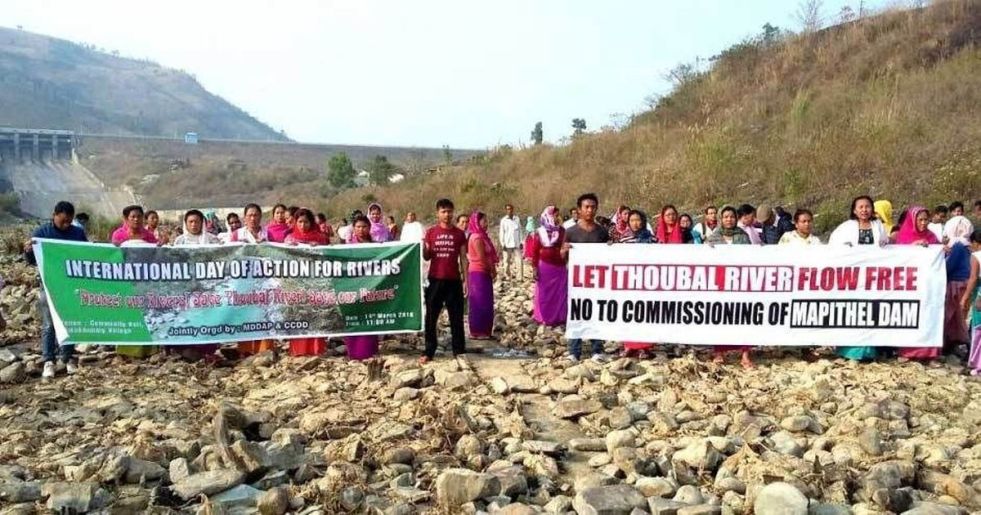
In an important development in Manipur this week, PM Narendra Modi could not commission the controversial Mapithel dam due to local protest. As per, the official statement notifying The PM was  was supposed to launch is the Mapithel dam, part of the Thoubal Multipurpose Project.

As per CRA Manipur blog report, the forum of Mapithel dam affected “Joint Action Committee Against Forced Inauguration of Mapithel Dam had threatened a 48-hour shutdown to coincide with the dam’s scheduled inauguration by Modi. The committee withdrew its call late on March 14, reportedly after the Manipur government agreed to shelve the inauguration.

The action committee is primarily demanding compensation for the people displaced by the project as mandated by the Right to Fair Compensation and Transparency in Land Acquisition, Rehabilitation and Resettlement Act, 2013.

Apart from complaints of inadequate compensation, opposition to the commissioning of the dam itself has grown louder over the years. Local communities claim the project violates the Forest Conservation Act of 1980 and its new avatar, the Forest Rights Act of 2006.  https://cramanipur.wordpress.com/2018/03/16/as-local-communities-protest-manipur-government-cancels-plan-of-modi-inaugurating-mapithel-dam/

Continue reading “DRP News Bulletin 19 March 2018 (PM Abandons Inauguration of Mapithel Dam in Manipur Following Protests)”

Dams · DRP News Bulletin

DRP News Bulletin 26 February 2018 (Banda People Also Protest Against Ken Betwa Link)

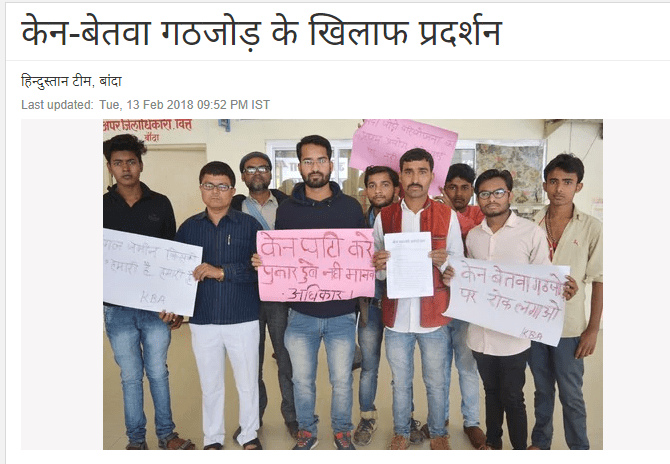
When Central Government is trying to push Ken Betwa link project terming it as beneficial for both Madhya Pradesh and Uttar Pradesh, local people of Banda are now also protesting against it, in addition to the people of Panna that are already opposing it. On Feb. 13, 2018, the Ken Bachao Samiti comprising of farmers, citizens and social workers in Banda sat on a Dharna before district magistrate office. The group have also sent a memorandum to the President of India, demanding immediate cancelling of the project. Raising serious concerns over environmental and social of the linking project, they asked demanded proper impact assessment and public consultation and said the project wont be allowed to go forward. Indeed, as they have said, there has been no downstream impact assessment and people of Banda are likely to loose their river.  https://www.livehindustan.com/uttar-pradesh/banda/story-demonstrate-against-ken-betwa-alliance-1800951.html (Hindustan Hindi,13 Feb. 2018) 

Continue reading “DRP News Bulletin 26 February 2018 (Banda People Also Protest Against Ken Betwa Link)”

Dams · DRP News Bulletin

DRP News Bulletin 19 February 2018 (How Are We Treating Our Urban Rivers?)

In this comprehensive article Mumbai-based author Vaishnavi Chandrashekhar throws the light on the plight of Uraban Rivers. “Rivers and streams have borne the brunt of the recent urban explosion in India, a nation whose population has nearly doubled in the last 40 years to 1.35 billion. Unplanned growth has led to the use of water bodies as dumping grounds for sewage and industrial effluent. According to CPCB, 63 % of the urban sewage flowing into rivers (some 62 billion liters a day) is untreated.

In addition, riverbanks, wetlands, and floodplains have been claimed over time by infrastructure, slums, offices, and housing developments – all of which has narrowed natural river channels and distorted flow, greatly reducing the ability of India’s rivers to buffer flooding. It also has taken a toll on biodiversity. http://e360.yale.edu/features/dying-waters-india-struggles-to-clean-up-its-polluted-urban-rivers (Yale Environment 360, 15 Feb. 2018) 

Continue reading “DRP News Bulletin 19 February 2018 (How Are We Treating Our Urban Rivers?)”

Dams · DRP News Bulletin

DRP News Bulletin 12 February 2018 (With Innovative Ideas Hyderabad, Chennai & Delhi Are Reviving Its Wetlands)

This week there are exemplary and encouraging wetlands revival stories from three metro cities of Chennai, Hyderabad and Delhi.  In the first example from Hyderabad, meticulously chosen plant species such as tulsi, aswagandha, citronella and hibiscus have been used to create an artificial island to clean Neknampur Lake. The treatment islands are composed of four layers of which the bamboo base keeps the entire structure afloat. Based on soil-less hydroponics, these floating treatment wetlands absorb excess nitrates, thereby reducing the chemical content of the lake water. Microorganisms present in the wetland break down organic matter while the root systems filter out pollutants and sediments. https://www.thenewsminute.com/article/3500-saplings-floating-islands-help-rejuvenate-hyd-neknampur-lake-75819 (The News Minute, 3 Feb. 2018)

Image by: Madhulika Choudhary

Similarly, Chennai-based Care Earth Trust along with the public works department (PWD) and the civic body has managed to restore three urban lakes. While many of the smaller wetlands have vanished over time, many mid-sized wetlands seem to have shrunk by almost 65 percent. Thanks to their joint effort, invasive hyacinth was removed from the Narayanapuram Lake in Pallikaranai, while sewer lines, which emptied into the Perungalathur Lake, have now been plugged. A detailed restoration proposal has been forwarded to the PWD regarding the Korattur-Madhavaram-Ambattur lakes. https://timesofindia.indiatimes.com/city/chennai/hyacinth-out-sewer-line-plugged-three-water-bodies-restored/articleshow/62748110.cms (The Times of India, 2 Feb. 2018)

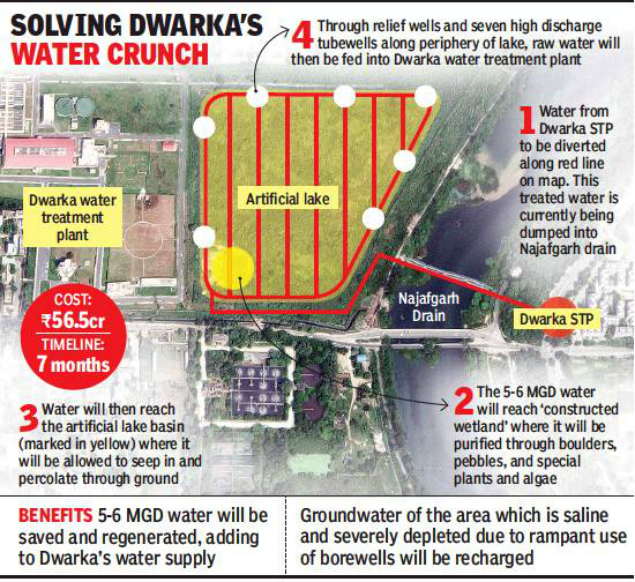
Meanwhile, Delhi Jal Board (DJB) has taken up interesting new project of creating an artificial lake in Dwarka. The project will supply water in sub-city and improve ground water level too. DJB has approved Rs. 56 crore for the project which will be completed in next seven months.  This would the first model project wherein a lake will be used to augment water supply. The special lake is being created next to the Dwarka water treatment plant (WTP) will have a sand bed to allow maximum percolation of water into the ground. It will have a capacity of 10 million gallons (MGD). The project is expected to add supply of 5-6 million gallons water to Dwarka every day.

Continue reading “DRP News Bulletin 12 February 2018 (With Innovative Ideas Hyderabad, Chennai & Delhi Are Reviving Its Wetlands)”

Dams · DRP News Bulletin

DRP News Bulletin 05 February 2018 (J&K Shows The Way To The Nation: To Assess The Viability Of Big Hydro Pojects)

In a remarkable development, Jammu & Kashmir Govt is reviewing its Hydro policy to assess whether the Hydro Electric Power Projects (HEPs) are still viable. As per sources, this is for the first time that the Govt is discussing the viability of generating hydro power.

An empowered committee led by the Chief Secretary has started this discussion by calling for an “approach paper” that will give an overall picture of the hydropower industry in India. Top sources in the State Power Development Corporation (SPDC), a government-owned company, told Kashmir Reader that the empowered committee wants to lay a roadmap for power generation in the state. “It will reflect the vision of the government. It will give the picture of hydropower generation in India, its rates, market, demand and supply. It will also lay down a roadmap for large power projects,”

The approach paper will be part of a new hydropower policy which will be submitted before the same committee, and then before the cabinet for approval. The SPDC had submitted a hydro policy draft in April last year, which was returned to it in December. Sources said the approach paper has to be submitted in two months’ time.

At present, India has a surplus generation of hydropower, which has plummeted its rate. This has led to losses for SPDC as it invested in projects whose generation costs were high. The blunt example is that of the 450-MW Baglihar II. SPDC has failed to lure any buyer for more than a year as its selling cost of per unit of energy, Rs 4.4, is nearly Rs 2 higher than the market rate. The SPDC has finally managed to sell the power at about Rs 4 per unit to the Uttar Pradesh government but for one year only. The SPDC may have to struggle again next year if the state of UP does not continue the contract.

Another example is that of Nimuno Bezgo, and Chutak hydropower projects, which sell energy at Rs 13 per unit. The SPDC also buys power from Dulhasti project at Rs 7, when the available rates for power in the market is around Rs 2 and Rs 4. https://kashmirreader.com/2018/02/02/cs-led-panel-to-lay-roadmap-for-power-generation-in-jk/ (Kashmir Reader. 2 Feb. 2018)

As per another report, facing a growing demand for electricity and unable to tap its vast potential for generating hydroelectric power, the state government is looking to boost solar power generation. Given the long gestation period of hydel projects, it is unlikely the generation of hydroelectric power will expand significantly in the near future, said. Hence,  the focus on solar power. Indeed, when solar power potential exists, with lower installation and operation costs and impacts, why States continue after destructive, expensive hydro projects? https://scroll.in/article/866058/kashmir-can-generate-a-lot-more-hydel-electricity-than-it-requires-why-is-it-eyeing-solar-power (Scroll.In, 30 Jan. 2018)

There is one more interesting hydro power development in which the state cabinet of Bihar has approved closing 3 and cancelling the development of 2 others in addition to handing over of 8 hydropower projects to neighboring Jharkhand.

Continue reading “DRP News Bulletin 05 February 2018 (J&K Shows The Way To The Nation: To Assess The Viability Of Big Hydro Pojects)”