Dams · DRP News Bulletin

DRP: 29 Jan 2018 (Organic Farming Through Cluster Approach Can Help Farmers, Groundwater And Our Future)

There have been many positive developments on agriculture, groundwater and environment round the week. In the first positive development, data from the first impact study of Paramparagat Krishi Vikas Yojana (PKVY) shows that small and marginal farmers, who can’t afford costly agricultural inputs, are turning a new leaf by going organic because of lower costs and higher margins. The study conducted by the National Institute of Agriculture Extension Management, has also revealed that Net Returns of organic farmers were higher for all the three crops studied, namely wheat, paddy and soybean, by 15.8%, 36.7% and 50% respectively.

of

This was based on study of 690 organic clusters in 25 states, out of some 6211 clusters comprising of 2.25 lakh farmers in a PKVY (each ha getting Rs 50 000 as aid) scheme launched in 2015, comprising of 52.3% small farmers. The average cluster size was 69 acres, in each there were 54.6 farmers on average. Maharashtra had the highest number of clusters at 1043 and MP had the highest area under clusters. The funding however remained irregular. India’s domestic organic food market is expected to show Compound Annual Growth rate of 25%, says the study. https://www.hindustantimes.com/india-news/small-farmers-go-big-with-organic-farming/story-nlyQQVUnoewHgeJyvaAnJI.html (Hindustan Times, 29 January 2018)

Another positive news report, have disclosed that how a simple groundwater recharge technique is transforming farmlands in Gujarat. The simple pit and pipe system simply and expertly captures standing water during rains, thus freeing arable land from water logging while recharging groundwater to use for irrigation during the lean season. This is essentially a simple groundwater recharge scheme but appears to last long. As per report about 3000 such units have already been installed in Gujarat and several other states.  http://www.thehindu.com/society/this-simple-technology-has-transformed-gujarat-farmlands-into-an-oasis/article22529034.ece (The Hindu, 27 January 2018)

The third positive news have come from Central Government which has prepared a Rs 6000 crore plan to recharge ground water. The scheme is yet to be cleared by the Expenditure Finance Committee and the Cabinet.  

As per report, the new 5-yr long scheme will be funded 50: 50 by the World Bank and centre, to be implemented in Gujarat, Maharashtra, Madhya Pradesh, Uttar Pradesh, Karnataka, Haryana and Rajasthan, covering 78 districts, 193 blocks and 8300 gram panchayats.

Gram Panchayats that prepare water security plans and put infrastructure to augment water supply will get incentives. Interestingly, an earlier version of the scheme, called National Groundwater Management Improvement Scheme was rejected by AFC in May 2017.  https://www.hindustantimes.com/india-news/centre-readies-rs-6-000-crore-plan-to-recharge-groundwater/story-nziZ6rvp88ZJHFo0DM5kNO.html (Hindustan Times, 28 January 2018)  

Continue reading “DRP: 29 Jan 2018 (Organic Farming Through Cluster Approach Can Help Farmers, Groundwater And Our Future)”
Dams · DRP News Bulletin

DRP: 4 Dec 2017 (Protests Against Pancheshwar Dam in Champawat, Pithoragarh, Almora, Delhi)

Protests and controversies around Pancheshwar Multipurpose Project (PMP) are only growing louder and wider. While Expert Appraisal Committee (EAC) Rivers Valley Project in unnecessary hurry considering the project tomorrow (05 Dec. 2017)  http://environmentclearance.nic.in/writereaddata/Form-1A/Agenda/2811201745T4GD5I10thAgendaEACHydro05122017.pdf

Villagers and local groups people also continue raising their concerns and objections against 5040 Mw dam project. Today, scores of villagers, environmental groups including regional political party have protested at Jhulaghat in Champawat, Pithoragarh, Almora and in Delhi demanding EAC to listen to the voices of local people and groups.

Continue reading “DRP: 4 Dec 2017 (Protests Against Pancheshwar Dam in Champawat, Pithoragarh, Almora, Delhi)”
Dams · DRP News Bulletin

DRP: 6 Nov 2017 (NGT Asks For Fresh Appraisal Of Lower Subansiri Hydro Project)

In a remarkable development, the National Green Tribunal (NGT) on October 24 has suspended the clearances given to the 1750-megawatt (MW) Demwe Lower Hydroelectric Project  (HEP) planned on the Lohit river in Arunachal Pradesh.

In its detailed order, released on October 27, the NGT ruled that the Environment Minister as Chairperson of the National Board for Wildlife (NWBL), a statutory body constituted under the Wildlife Protection Act, 1972, could not “just brush aside” the views of the majority of NBWL standing committee members.

Suspending the clearances given by the Centre and the state govt, the NGT order added that “the decision taken by the Standing Committee is not in accordance with established principles of law and hence the Standing Committee shall reconsider the issue and pass appropriate orders within a period of six months from the date of the judgment”.

Environmental clearance for the project was given by the Union environment ministry’s Expert Appraisal Committee (EAC) for river valley and hydroelectric projects back in 2009. An in-principle forest clearance for the Lower project was given in February 2012 and agreed upon in 2013.

However, the in-principle clearance of the project was opposed by a majority of the Standing Committee of the NBWL but subsequently cleared by the then-environment minister of state (independent charge), Jayanthi Natarajan, who was also the chairperson of the Standing Committee.

Natarajan is currently under the CBI’s scanner for alleged anomalies in clearance given for diversion of land in Saranda forest in Singhbhum district, Jharkhand to mining company Electrosteel during the previous UPA regime.

The NGT said that it is “of the view that either the Chairperson (Natarajan) should have given a proper reason for rejecting the objection of the majority of the non-official members or the decision ought to have been arrived at based on the opinion of the majority of the members. Even though the Standing Committee is a recommendatory body, the same being a statutory committee, is bound by the laudable principles of justice and fair play”.

Continue reading “DRP: 6 Nov 2017 (NGT Asks For Fresh Appraisal Of Lower Subansiri Hydro Project)”
Dams

DAM BUILDING MUST BE HALTED FOR A SAFE AND SECURE WORLD

Guest Blog by Manoj Misra

Rivers in different parts of the world have been dammed to fulfill human needs like water for irrigation, industries and domestic supplies. Then there are dams that have been raised to control floods or to produce electricity.

These have often been celebrated as human victory over nature, glorified as engineering marvel and claimed variously as highest, longest etc as a matter of national pride.

But rarely has there been a holistic assessment or appreciation of what a dam does to the natural entity called river and its adverse impacts on all the associated life forms, including humans.

Continue reading “DAM BUILDING MUST BE HALTED FOR A SAFE AND SECURE WORLD”

Dams · Delhi · DRP News Bulletin · Floods · Ganga · Groundwater

DRP: 16 Oct 2017: New Groundwater Guidelines threat to India’s Water Lifeline

GROUND WATER

New Draft Guidelines designed to privatise & destroy Groundwater The Ministry of Water Resources of the Union Government has on Oct 11, 2017 (see notice: http://www.wrmin.nic.in/forms/List.aspx?lid=1180&Id=6) put up draft guidelines on Groundwater management in India (see draft Guidelines: http://www.wrmin.nic.in/writereaddata/guideline-NOC-CGWA.pdf), with comment period of 60 days. The comments are to be sent to: Member Secretary, Central Ground Water Authority, West Block-2, Wing 3 (Ground Floor), Sector 1, RK Puram, New Delhi – 110066, e-mail: cgwa@nic.in.

New Draft Groundwater guidelines designed to destroy groundwater further and open floodgates for privatisation of common property resource? “Groundwater is a common property resource and should be used for greater good. But these guidelines are not doing that. Groundwater governance and management should happen in a transparent, participatory and accountable way but that too is not happening through guidelines,” Thakkar said.

Explaining, Thakkar said that the guidelines are “trying to make a system wherein state or district level authorities will be giving NOCs but whether those authorities have capacity to give NOCs after understanding the implications is the question.” “The draft guidelines also take out the need to recharge groundwater. Present regulations say that you if you take out groundwater you need to put in recharge capacity but now they are saying that’s not necessary and are only seeking charges. These things will definitely lead to further destruction of groundwater,” he added. http://www.livemint.com/Politics/irx1jFCWMFjGJk82Z8VZ2O/Govt-proposes-new-guidelines-on-groundwater-usage-by-industr.html, http://www.newindianexpress.com/nation/2017/oct/13/centre-proposes-water-conservation-fee-for-use-of-groundwater-1673480.html, http://www.newindianexpress.com/nation/2017/oct/14/townships-with-gym-club-must-pay-water-fee-1673790.htmlhttp://www.hindustantimes.com/environment/centre-proposes-nixing-recharge-requirement-for-industries-extracting-groundwater/story-kN3iPmO9m4MIoYkUX32n7I.html  

Continue reading “DRP: 16 Oct 2017: New Groundwater Guidelines threat to India’s Water Lifeline”
Delhi

Decentralized STPs in the Delhi Capital Region

Guest blog by Kelly D. Alley and Nutan Maurya

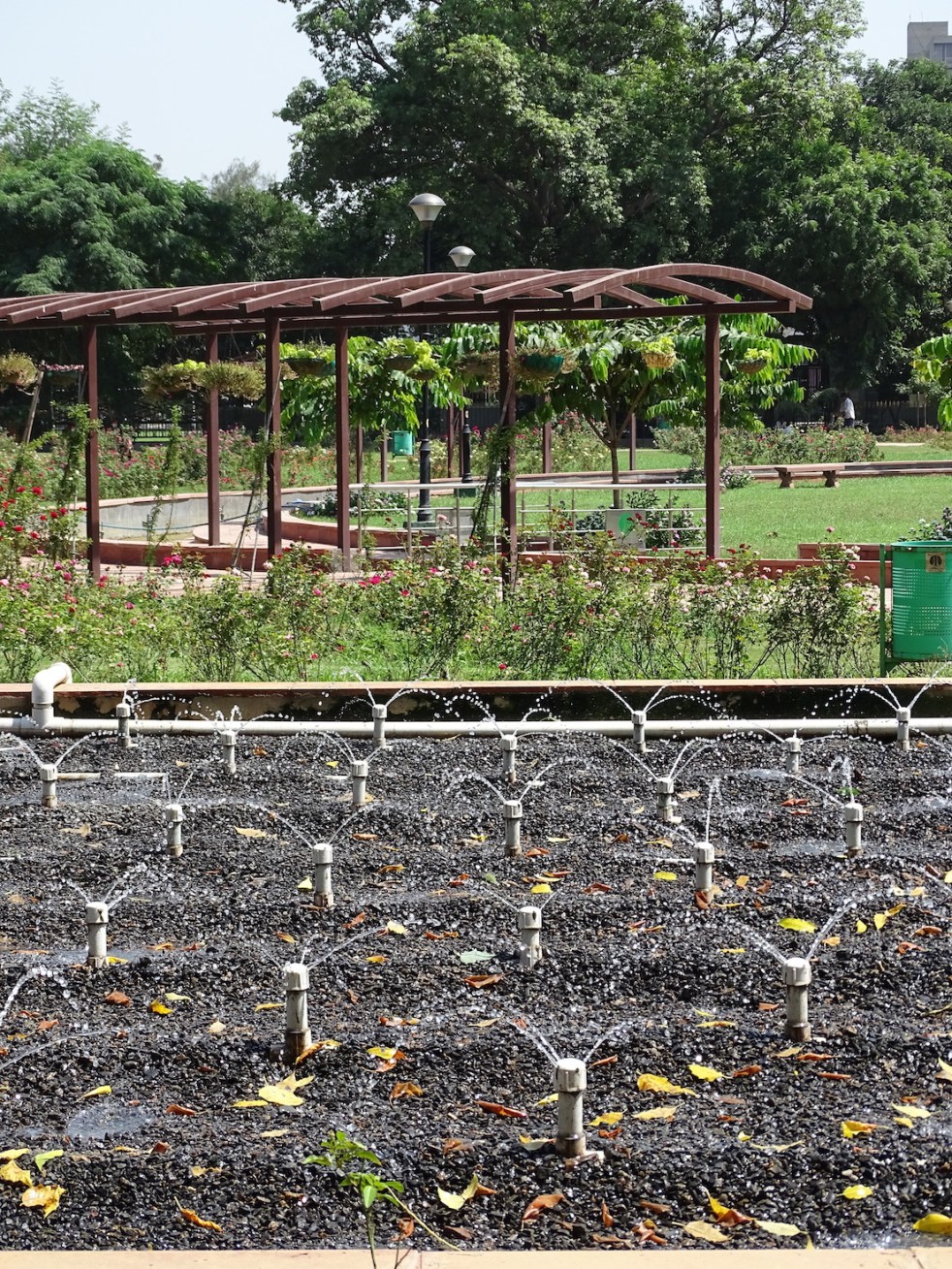
The territory under the jurisdiction of the New Delhi Municipal Council, or Lutyen’s Delhi, is lush with beautiful gardens. The New Delhi Municipal Council maintains around 8,000 parks and uses about 80 million gallons of water a day for grass, plants, shrubbery and trees. The Delhi Jal Board estimates that the total water treated at its sewage treatment plants is about 455 million gallons a day (mgd) of which they provide 142 mgd for horticulture and irrigation in the Delhi metropolitan region. With groundwater levels depleting to over 300 feet in some sections of Delhi, there has been increasing focus on curtailing use of groundwater for horticulture and other non-essential services. In this context, the National Green Tribunal has directed all urban municipalities to use treated wastewater for horticulture.    Continue reading “Decentralized STPs in the Delhi Capital Region”

Dams · DRP News Bulletin

DRP: 31 July 2017 (Dams Turn Floods into Disasters, Yet We Continue to Push Big Dams)  

All through the month, several states in the country have been battling severe flood situation. The Northeastern (Arunachal Pradesh, Assam), Western (Rajasthan Gujurat), Central (Madhya Pradesh, Uttar Pradesh) and Eastern (Bihar, Odisha, West Bengal) regions have been particularly affected by floods following incessant rain.

Till July 28, 2017, 293 people have succumbed to flood related accidents. As per govt sources, the economic cost of flood damages has reached 53894.634 lakh.  http://www.ndmindia.nic.in/flood-2017/floodsJuly-2017.htm

Superficially water deluge seems a natural disaster occurring on annual basis. But a closer observation of flood monitoring mechanisms and scores of media reports reveal that most of the flood crisis is man-made and dams have been playing a bigger role in creating a disaster out of a natural phenomenon.

So far there have been more than a dozen reported incidents across country where breaching of aged or unmaintained dams have led to inundation of human habitation. On July 06, 2017 breaching of Shiv Sagar dam was such an incident causing severe floods in several villages in Mirzapur district, Uttar Pradesh. http://amritprabhat.com/mirzapur-mirzapur-floods-with-heavy-rain-dozens-of-houses-and-five-people-of-the-same-family-found-dead-body-of-two-shivsagar-dam-broke/

Similarly, there is information from reliable sources proving that the wrong operation of dams end up creating flood situation in downstream areas which were already facing heavy rains. The devastating floods in Lakhimpur Assam around July 09, 2017, were a result of release of huge amount of water from Ranganadi dam in Arunachal Pradesh. https://scroll.in/article/844509/severity-of-assam-floods-heightens-old-fears-about-dams-in-the-brahmaputra-basin

In one more similar and latest incident, untimely release of water by Damodar Valley Corporation (DVC), Jharkhand resulted in flood disaster in Birbhum, Purulia, West Medinipur and Hoogly districts. As per West Bengal Govt the DVC officials discharged the around 2 lakhs cusec of water on 25 July 2017, from many dams built on Damodar river without intimating it.  https://scroll.in/latest/845268/mamata-banerjee-blames-west-bengal-floods-on-centre-run-damodar-valley-corporation  

The third dimension in the flood tragedy is the fact that responsible authorities like Central Water Commission (CWC), concerned state department have failed to issue timely warning in so many incidences which could have otherwise been avoided or mitigated. There are also reports suggesting that there was no prior forecast and warning for ongoing floods in Gujarat and Rajasthan.

Similarly there have been dozens of incidents in different parts where flood situation has been either caused or aggravated by faulty dam operation, breach in dams and lack of timely warning by responsible authorities.

The breach in Jaitpura dam and over spilling of Jawai dam in Jalor Rajasthan has inundated several villages. http://indiatoday.intoday.in/story/jawai-dam-pali-disrict-floods-rajasthan-heavy-rains-rescue-operations-ndrf-food-material/1/1012924.html The breach in Narmada canal has led to floods in Badmer districts. http://timesofindia.indiatimes.com/city/jaipur/narmada-canal-damaged/articleshow/59762317.cms

The sudden discharge from Seepu dam on West Banas River, Dharoi dam on Sabarmati river has created severe flooding in downstream districts killing many villagers. http://indianexpress.com/article/india/aerial-survey-of-banas-river-to-be-undertaken-as-death-toll-in-gujarat-floods-touch-111-4768335/ , http://timesofindia.indiatimes.com/city/vadodara/gujarat-sabarmati-waters-flood-anand-villages/articleshow/59786379.cms  

Further, the latest Comptroller and Auditor General (CAG) latest report only goes on reinforcing all these issues. The shocking report tells us that out of 4,862 large dams, emergency action plans or disaster management plans of only 349 (seven per cent) large dams had been prepared till March 2016. http://www.newindianexpress.com/nation/2017/jul/22/huge-delay-in-completion-of-flood-control-projects-in-country-cag-1632017.html

In a similar development another CAG report has put onus on Hirakud dam officials for 2011 floods. http://www.newindianexpress.com/states/odisha/2017/jul/23/cag-puts-onus-on-hirakud-officials-for-2011-flood-1632412.html 

The CAG has also presented scathing indictment of India’s CWC’s shoddy flood forecasting system. https://www.dailypioneer.com/todays-newspaper/indias-flood-forecast-capability-a-washout-cag.html

The efficiency of flood monitoring can be judged from the fact that Irrigation Department Uttar Pradesh still relies on blade runners to convey flood information in the digital era. http://timesofindia.indiatimes.com/city/varanasi/in-e-age-runners-alert-officials-about-flash-floods/articleshow/59676066.cms

The DAM FLOOD sanction of this update is full of such reports proving that dams have turning the floods into disasters.

Continue reading “DRP: 31 July 2017 (Dams Turn Floods into Disasters, Yet We Continue to Push Big Dams)  “
Dams · DRP News Bulletin

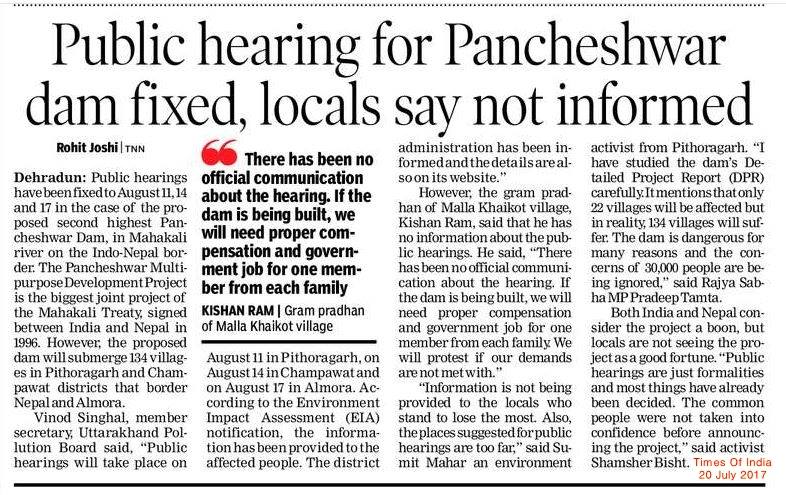
DRP: 24 July 2017 (Pancheshwar Dam Public Hearing Needs To Be Postponed)

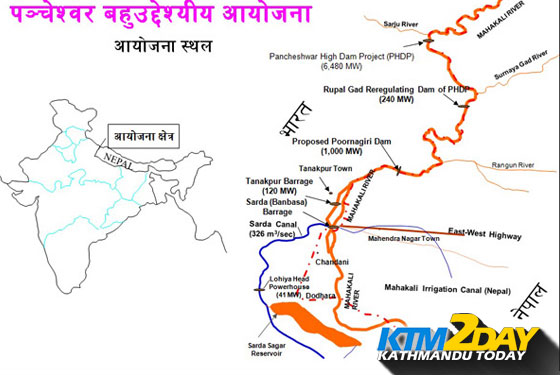
In the middle of monsoon season, authorities have fixed August 7, 11 and 17 as public hearing dates for the Pancheshwar Dam project, a giant dam on Mahakali river at India Nepal border. The proposed dam will submerge 134 villages in Pithoragarh, Champawat and Almora districts. http://www.tribuneindia.com/news/uttarakhand/public-hearing-dates-for-land-fixed/437736.html

The public hearing is happening, when media news reports have widely revealed that villagers have not been informed properly. Many to be affected villagers have even said that they have no information regarding the public hearing. http://timesofindia.indiatimes.com/city/dehradun/ngo-seeks-postpone-of-pancheshwar-dam-hearing/articleshow/59727412.cms  Social media reports, too have disclosed that the state govt has disseminated no relevant information regarding Pancheshwar dam public hearing. https://www.facebook.com/pg/dev1bhoomi/posts/?ref=page_internal

The Environment Impact Assessment (EIA) of the project is incomplete and not shared with villagers in affected area in local language. On the contrary the environment ministry has waived off the requirement of a joint mechanism to assess its environmental impact. https://www.masterbuilder.co.in/india-nepal-pancheshwar-project-assessment-guidelines-now-eased/

The public hearing place is far away from the dam site making the public hearing site unreachable for many concerned villagers. It is worth to mention that its monsoon season, the region in landslide affected, several roads are blocked and it’s not possible for the most of the concerned villagers to reach the hearing venue.

20139587_1969050769787030_8371146017204709374_n.jpg

Local people, regional parties, individuals and civil societies groups have been raising concerns on the disastrous impact of second highest dam project of the world.  http://timesofindia.indiatimes.com/city/dehradun/pancheshwar-dam-spells-doom-for-locals-of-130-villages-who-fear-tehri-re-run/articleshow/57561939.cms

Experts’ demand of postponing the meaningless is right. In a democratic system, the concerned authorities must hear the public voices. It is their responsibilities to share all the relevant information in public domain beforehand, conduct the public hearing in each and every dam affected districts instead of just one place. The present weather conditions are not favorable for the public hearing at all and it must be postponed. http://matuganga.blogspot.com/2017/07/23-8-2017.html

Its also beyond understanding that why such a unviable, high impact, risky project is being pushed in a seismically active region is a multi billion rupee question. http://www.firstpost.com/india/pancheswar-dam-uttarakhand-makes-steady-progress-project-to-generate-employment-power-irrigation-3837837.html

HYDRO POWER

Himachal Pradesh Lahaul-Spiti people condemn Jispa dam, demand eco tourism During a public hearing held on July 17, 2017, regarding 300 mw Jispa hydro project, local people of Jispa village have severely criticized the project making it clear that they would not allow the project. Agitated people also forced the officials to leave the meeting without any outcome. It is worth to mention that since 2009, people of Todh valley in Lahaul-Spiti district are opposing the Jispa Dam project proposed over Bhaga river, a tributary of Chenab, at Jispa village. http://timesofindia.indiatimes.com/city/shimla/jispa-dam-locals-demand-eco-tourism-not-hydel-project/articleshow/59665492.cms

As per, Rigzin Samphel Hayerpa, Convener of Jispa Baandh Jan Sangarsh Samiti (JBJSS), hundreds of residents of the affected villages had made it clear to the officials that they would not allow the valley to be ruined in the name of development. He added that merely on the ground that the project was of national importance, destruction of fragile ecology could not be allowed.

Zila parishad member from Kwaring Chhime Lhamo said the state government wanted to construct the dam against the wishes of the local people. She said that from the start the people were against the project but the government was not scrapping it. She also said that development at the cost of destruction cannot be allowed. http://timesofindia.indiatimes.com/city/shimla/meeting-over-jispa-dam-yields-no-result/articleshow/59657026.cms

National There is very interesting discussion with Union Power Minister, which clearly shows that Hydro is no longer viable even with all the additional subsidies the govt is considering.  https://www.youtube.com/watch?v=YaGujdFCwCA&sns=em

Continue reading “DRP: 24 July 2017 (Pancheshwar Dam Public Hearing Needs To Be Postponed)”

Dams · DRP News Bulletin

DRP: 24 April 2017 ( NHPC says Dams have no adverse impacts anywhere in the world! Admits, Hydro is no longer viable for private sector)

Centre Getting forest clearance is not a problem now: NHPC Chairman In an interview, taking a dig at its private peers, NHPC chairman KM Singh said that NHPC is the only company in the county that has the capability to execute hydro projects. He also said that in the NDA regime green clearances come easy, while local agitation by NGOs is the biggest threat. He further stated that there has been no negative impact of building a dam, not just in India, but anywhere in the world.

Continue reading “DRP: 24 April 2017 ( NHPC says Dams have no adverse impacts anywhere in the world! Admits, Hydro is no longer viable for private sector)”
Dams

Maharashtra Rivers Profile

Above: Major River Basins of Maharashtra Source: MWRRA

Major Issues faced by Rivers of Maharashtra include complete lack of governance geared towards protecting rivers as ecological systems, unjustifiable dam projects blocking most of the rivers of the state without even comparable benefits, increasing water conflicts, depleting groundwater levels which affect base flow of the rivers, catchment degradation, climate change induced changes in river hydrology, repeated droughts and increasing levels of pollution.

Continue reading “Maharashtra Rivers Profile”