Dams · DRP News Bulletin

DRP News Bulletin 28 May 2018 (Survival of Biodiversity Habitats, Must for Ganga River Rejuvenation)  

On occasion of International Day for Biodiversity May 22, 2018, the Union Minister for Water Resources, River Development and Ganga Rejuvenation Nitin Gadkari released the report on “Status of Conservation of Select Aquatic Species” in river Ganga in New Delhi . The celebrations have been organised to mark the 25 years of coming into force of the Convention on Biological Diversity. He also inaugurated a day-long workshop organized by World Wildlife Fund (WWF) on the theme “Ganga and its Biodiversity: Developing a Road Map for Habitat and Species Conservation”.

A database of Ganga Praharis’, a self-motivated cadre, being created by Wildlife Institute of India (WII) was also launched by the Minister. Shri U.P. Singh, Secretary, Ministry of Water Resources, River Development and Ganga Rejuvenation said: “Ganga still has about 2,000 aquatic species.” He also pointed out that both aviralta and nirmalta of river Ganga are important and the government is committed to achieve both.

Continue reading “DRP News Bulletin 28 May 2018 (Survival of Biodiversity Habitats, Must for Ganga River Rejuvenation)  “

Dams · DRP News Bulletin

DRP News Bulletin 21 May 2018 (World Over New Renewables Are Making Large Hydro Unviable & Unnecessary)

According to an energy expert, 6,000 megawatts’ worth of wind and solar contracts had been signed in Cambodia, Vietnam, Thailand and Laos in the last six months, seriously challenging the financial viability of major hydropower projects on the river. Buoyed by a recent Thai government decision to delay a power purchase deal with a major mainstream Mekong dam, clean-energy proponents and economists told the third Mekong River Commission summit that the regional energy market was on the cusp of a technological revolution.

A six-year Mekong River Commission Council study on development plans for the Mekong, which was the focus of the summit, suggested catastrophic impacts upon the health of the river system if all planned hydropower dams — 11 mainstream projects and more than 100 on tributaries — were built.

Continue reading “DRP News Bulletin 21 May 2018 (World Over New Renewables Are Making Large Hydro Unviable & Unnecessary)”

South Asia

SOUTH ASIA 2017: MISS YOU, RIVERS & FISH! As Dams and Water sharing dominate

India-Bangladesh-Myanmar face big quake threat A giant fault in the earth’s crust in one of the world’s most densely populated areas could kill tens of millions of people, scientists have warned according to a new paper in the journal Nature Geoscience. Researchers placed hundreds of highly accurate GPS receivers in locations across India, Bangladesh and Myanmar and monitored them over a ten-year period. Now the scientists fear the location is home to a mega-thrust fault which could unleash a 8.2-9.0 magnitude earthquake. More than 140 million people live within a 60-mile area of the potential disaster zone in Bangladesh. The scientists, led by Dr Michael Steckler from Columbia University published their findings in the journal Nature. This is also a warning against major interventions in the North East India. http://www.indiaspend.com/cover-story/india-bangladesh-and-myanmar-face-big-quake-threat-99557, July 19, 2016, http://thenortheasttoday.com/earthquake-of-9-0-magnitude-could-be-unleashed-anytime-from-a-major-fault-underneath-bangladesh/, July 22, 2016, http://www.nature.com/ngeo/journal/vaop/ncurrent/full/ngeo2760.html  Continue reading “SOUTH ASIA 2017: MISS YOU, RIVERS & FISH! As Dams and Water sharing dominate”

DRP News Bulletin

DRP News Bulletin 30 April 2018: Paani Foundation expands to 4000 villages in Maharashtra

Paani Foundation work in 4000 villages in Maharashtra Aamir Khan (Satyamev Jayate) and Kiran Rao’s Paani Foundation has been running inter-village competition for water related work each year since 2016. Directed by Satyajit Bhatkal, the competition in which no one loses out, as Aamir says, 116 villages in 3 talukas of Maharashtra participated in 2016. Next year, 30 taluksa and over 1300 villages participated and this year over 4000 villages from 75 talukas are participating. He also tries to involve Urban people through Chala Gaavi (almost 25000 people came) and this year on May 1 Jal Mitra Maha Shramdaan, with about 1.3 lakh volunteering.

ANY ONE HAS ANY INDEPENDENT THOUGHTS ABOUT THIS, INCLUDING OBSERVATIONS FROM GROUND about appropriateness, longevity, sustainability and equity? http://www.thehindu.com/society/aamir-khans-paani-foundations-water-conservation-efforts/article23696288.ece Continue reading “DRP News Bulletin 30 April 2018: Paani Foundation expands to 4000 villages in Maharashtra”

DRP News Bulletin

DRP News Bulletin 26 March 2018: Massive Farmer protest in Palghar against water diversion

MASSIVE Farmer protest in PALGHAR (Maharashtra) The protest for the third day on World Water Day, was against diversion of water from Survya Dam for Vasai-Virar and Mira-Bhayander. under the aegis of the Surya Pani Bachav Samiti.

– The contract to construct the 88-km long pipeline has already been awarded to the L&T Group by the Mumbai Metropolitan Region Development Authority (MMRDA) under the Surya Regional Bulk Water Supply Scheme.

– Ramakant Patil, chief convenor of the SPBS who is also undertaking the fast, said the Surya dam, which was built in 1990 over the Kawdas and Dhamni rivers in Kasa taluka,Dahanu, was specifically for irrigational purpose for 19,000 odd acres of farmland in Palghar district. “Now the MMRDA is planning to divert around 89% of the dam water to the above cities so as to solve the cities’ drinking water issues, but we the farmers would be denied water for our land,”said Patil.

– They withdrew it after an assurance of a meeting with chief minister Devendra Fadnavis. “We have raised this issue for many times in the past. But it is for the first time that a CM has agreed to sit with us and discuss. Now we are just waiting to hear from the CM’s office to know the date of meeting,” Brian Lobo of Kashtakari Sangathan adds. https://www.hindustantimes.com/mumbai-news/palghar-farmers-fast-over-diverting-surya-dam-water-enters-third-day/story-LsTeF2vf6xuVroPRO2GSYJ.html, http://www.dnaindia.com/mumbai/report-urban-areas-rob-tribals-of-water-supply-2597713   Continue reading “DRP News Bulletin 26 March 2018: Massive Farmer protest in Palghar against water diversion”

Dams · DRP News Bulletin

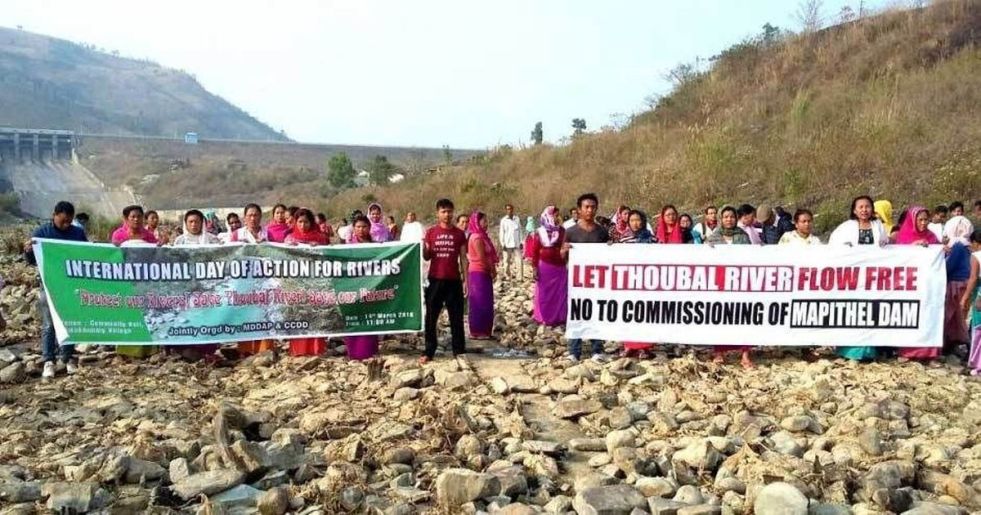
DRP News Bulletin 19 March 2018 (PM Abandons Inauguration of Mapithel Dam in Manipur Following Protests)

In an important development in Manipur this week, PM Narendra Modi could not commission the controversial Mapithel dam due to local protest. As per, the official statement notifying The PM was  was supposed to launch is the Mapithel dam, part of the Thoubal Multipurpose Project.

As per CRA Manipur blog report, the forum of Mapithel dam affected “Joint Action Committee Against Forced Inauguration of Mapithel Dam had threatened a 48-hour shutdown to coincide with the dam’s scheduled inauguration by Modi. The committee withdrew its call late on March 14, reportedly after the Manipur government agreed to shelve the inauguration.

The action committee is primarily demanding compensation for the people displaced by the project as mandated by the Right to Fair Compensation and Transparency in Land Acquisition, Rehabilitation and Resettlement Act, 2013.

Apart from complaints of inadequate compensation, opposition to the commissioning of the dam itself has grown louder over the years. Local communities claim the project violates the Forest Conservation Act of 1980 and its new avatar, the Forest Rights Act of 2006.  https://cramanipur.wordpress.com/2018/03/16/as-local-communities-protest-manipur-government-cancels-plan-of-modi-inaugurating-mapithel-dam/

Continue reading “DRP News Bulletin 19 March 2018 (PM Abandons Inauguration of Mapithel Dam in Manipur Following Protests)”

Dams

India Rivers Studies 2017: Rivers Succumbing To Dams, Pollution & Climate Change

After reviewing status of India rivers, SANDRP presents an account of research, studies and important reports on erratic monsoon, climate change, floods which all are severely affecting the rivers, their aquatic life and livelihood of dependent communities.

Rivers and Monsoon

Number of rainy days falling across river basins in India The study has found that number of rainy days is falling across river basins in India and rainfall intensities are seen to be increasing. The analysis determined changes in heavy precipitation and peak flood for seven river basins in India—Krishna, Godavari, Mahanadi, Narmada, Cauvery, Sabarmati and Brahamani and Baitarani. For the study, data pertaining to daily flows for about 30 odd years and precipitation for 61 years (from 1951 to 2012) were analysed.

The analysis also said the rivers which flow from west to east direction (in India) have more rainy days compared to those which flow towards the west. The study also held that anthropogenic activities (construction of storage reservoirs, diversions, urbanization, land-use change, and soil and water conservation measures, among others) have probably affected the generation of peak floods in the rivers of India. http://www.livemint.com/Politics/c7v8oXmsMDHIldjDv9k6lK/Number-of-rainy-days-falling-across-river-basins-in-India-s.html (Live Mint, 27 April 2017)

Continue reading “India Rivers Studies 2017: Rivers Succumbing To Dams, Pollution & Climate Change”

Dams · DRP News Bulletin

DRP News Bulletin 12 March 2018 (Swami Gyan Swaroop Sanand To Go On Fast For Ganga)

Swami Gyan Swarup Sanand (Prof G D Agarwal formerly) writes to Prime Minister on Feb 24 with three demands on Ganga and says if these are not satisfied by Ganga Dashera (June 22, 2018), he will go on fast unto death. The three demands are: 1. stop work on Vishnugad Pipalkoti, Singoli Bhawari and Phata Byung HEPs 2. Pass in Parliament the Draft Ganga protection act drafted by Just (retired) Girdhar Malviya headed committee and 3. Create a National Ganga follower committee whose permission will be necessary before taking any decision about Ganga. See the detailed blog by Arun Tiwari ji and link to the letter to PM. http://hindi.indiawaterportal.org/Swami-Sananda-open-letter-pm-modi-clean-ganga

Continue reading “DRP News Bulletin 12 March 2018 (Swami Gyan Swaroop Sanand To Go On Fast For Ganga)”

Dams

West India Rivers Review 2017: Governments, Industries Destroy Rivers

After review of North India and Maharashtra Rivers, SANDRP presents the development surrounding rivers in rest of West Zone: Gujarat, Goa, Madhya Pradesh and Rajasthan states in 2017.

Gujarat Rivers

Dams, industrial pollution killing State Rivers In MoEF report, Gujarat ranks 4th among top 5 states with highly polluted rivers. Sabarmati is among Gujarat’s 20 most polluted rivers including Narmada and Mahi. Over Rs 200 cr has been spent to curb pollution in Sabarmati & Mindola rivers. This fund is the highest amount ever spent outside the Ganga river conservation project on which Uttar Pradesh has spent Rs 917.24 crore, West Bengal Rs 411.26 crore and Bihar Rs 216.46 crore. As per activist, Rohit Prajapati, industrial effluents are being released in big rivers like Sabarmati, Mahi and Narmada without being treated and big dams have been built on big rivers due to which the rivers are drying up and vanishing as a result, the condition of rivers in Gujarat is going from bad to worse. https://timesofindia.indiatimes.com/city/ahmedabad/polluted-rivers-guj-ranks-4th/articleshow/62685910.cms (The Times of India, 29 Jan. 2017)

Continue reading “West India Rivers Review 2017: Governments, Industries Destroy Rivers”

Dams · Rivers

North India Rivers Review 2017: Pollution Poisoning Lifelines

In an effort to assess the situation of Rivers in 2017, SANDRP is presenting the compilation of key rivers related development in the country. The first part of this Rivers Review 2017 includes Northern States including Jammu and Kashmir, Punjab, Haryana, Himachal Pradesh, Uttarakhand, Uttar Pradesh and Delhi. The following parts will present separate accounts for Rivers in North East, West, East and South Zones. There will also be separate review reports on Ganga & Yamuna rivers.

Continue reading “North India Rivers Review 2017: Pollution Poisoning Lifelines”