On Nov 29, 2022, the World Meteorological Organization (WMO) has published its first State of Global Water Resources report to assess the effects of climate, environmental and societal change on the Earth’s water resources. The aim of this annual report is to support monitoring and management of global freshwater resources in an era of growing demand and limited supplies. For report and other related materials, see: https://public.wmo.int/en/our-mandate/water/state-of-global-water-resources
Continue reading “WMO Global Water Report asks for better & shared water data; reduced terrestrial water storage in North India”Tag: Ganga
DRP NB 281122: Justice Lokur at IRW 2022: We need to be vocally more aggressive to make a difference
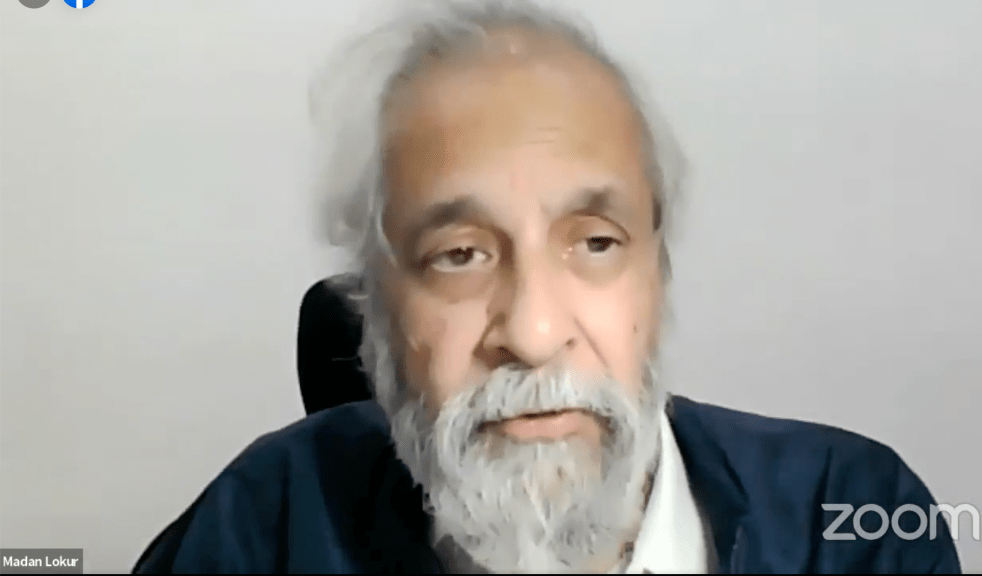
In his key note address at the final session of India Rivers Week 2022, Justice Madan Lokur, former judge of Supreme Court of India said, “Time has come we need to be a little more active and aggressive vocally to ensure that we are listened to about the problems we all are facing. Farmers struggle, the CAA amendment etc. are good examples. There is need for a political will to bring about any change. How do we generate such a political will is the issue.”
Among other messages Justice Lokur gave in his key note address at the final session of India Rivers Week 2022 on Nov 27, 2022 included: “Rivers belong to all, not a select few… We need to ensure that we are effective in our work, our messages.”
The two day, five session India Rivers Week 2022 function focused on use of rivers as waterways, organized in collaboration between India Rivers Forum (IRF is constituted by ten organizations now) and Manthan Adhyayan Kendra ended on Nov 27, 2022. The IRW 2022 sessions had a number of highlights, we will try to bring them to you in separate articles.
Continue reading “DRP NB 281122: Justice Lokur at IRW 2022: We need to be vocally more aggressive to make a difference”DRP NB 14 Nov 2022: Jal Shakti Ministry says: Groundwater extraction down, recharge up???
(Feature Image: The report also states that the monitoring of the groundwater resources was affected by the Covid-19 outbreak in the country. Source: Bloomberg/TIE)
This sounds so counter intuitive. The Ministry Jal Shakti on Nov 9, 2022 made some findings of its latest “National Compilation on Dynamic Ground Water Resources of India, 2022 public, strangely, without making the report public. It is not clear why the govt did not make the report public, though the counter intuitive nature of the findings provide some hint. The report claims that at all India macro level, the ministry claimed that the groundwater extraction is the lowest in 2022 since 2004, or 18 years and that the groundwater recharge has gone up.
These are counter intuitive findings, even if at macro level for a number of reasons. It is also unclear what methodology is used to arrive at these conclusions and if there has been any independent scrutiny of the same. Since groundwater extraction has been going up for over six decades now, this reversal will need plausible reasons. There are no indications that there is any reduction in this groundwater use. Secondly, the groundwater recharge mechanisms are under attack all over India, and thus the finding that there is increase in recharge raises questions. Particularly since the efforts at groundwater recharge through rainwater harvesting are far from convincing.
More importantly, the real story is at micro level, since groundwater occurs in decentralised aquifers and any significant reduction in use, increase in recharge has to happen at the aquifer level and the assessment also needs to be done and made available at aquifer level for it to have any impact on future regulation of groundwater. In fact the only regulatory body working for groundwater regulation, the CGWA, works in a centralised way and its work has been far from confidence inspiring. That makes this whole findings questionable. Moreover, it would also be useful to see if the extraction has reduced in over exploited areas and if the recharge has increased where it is required most: in over exploited areas. Too many questions and no answers, unfortunately.
Continue reading “DRP NB 14 Nov 2022: Jal Shakti Ministry says: Groundwater extraction down, recharge up???“DRP NB 071122: Increasing focus on Urban Rivers; they continue to face destruction
(Feature Image Source: Question of cities)
It is good to see that focus on Urban Rivers is increasing not only in media, but also by the government. The focus of the latest edition of “Question of Cities” is on Urban Rivers, carrying articles on, beside the lead article by SANDRP coordinator, Article “Rivers & Cities”, Sabarmati (Ahmedabad), Mula-Mutha (Pune), on River Centric Urban Planning Guidelines from Union Ministry of Housing and Urban Planning. In addition, this SANDRP DRP update also carries articles on Dravyawati River of Jaipur, Godavari river in Nasik and a report on Mandakini river in Badrinath.
All this increased focus is welcome, but will be worthwhile only when we see an effective impact of this on rejuvenated Urban rivers. We have yet to see that. In fact, if at all, the movement is hugely in opposite direction, with increasing destruction of Urban Rivers.
Continue reading “DRP NB 071122: Increasing focus on Urban Rivers; they continue to face destruction“DRP NB 31×22: Unviable Hydro Projects rejected in Himachal, Arunachal Pradesh, Assam
(Feature Image: Group photo during No Means No campaign in April 2022 against destructive hydro power projects in Kinnaur, Himachal Pradesh. Source: The Pahari Zone, You Tube)
A number of developments this week once again show how unviable large hydropower projects are facing rejection in a number of states. In Kinnaur (Himachal Pradesh) the local youth are demanding that the candidates in the state assembly elections to be held in November 2022 promise to work against the hydropower projects in the district.
In Arunachal Pradesh, the state government has told that High Court that they have cancelled all the 44 large hydropower projects proposed in Siang basin when locals alleged in the petition “the projects have been initiated in a reckless manner without any regard to the consequences of the same and without following any scientific research”.
In Assam with new accidents, the commissioning of the 2000 MW Lower Subansiri HEP has been pushed back further, making the over Rs 20000 crore project even more unviable. In J&K, the landslides killing 4 people at the under construction Ratel Hydropower project in Kishtwar district on Chenab River has again rung a warning as to what is in store for future if proper appraisal studies are not done. In Uttarakhand, the bid to take over the Lanco Hydropower project on Mandakini river, now undergoing bankruptcy case in the court have been rejected and same is likely to be the fate for the revised bid.
Continue reading “DRP NB 31×22: Unviable Hydro Projects rejected in Himachal, Arunachal Pradesh, Assam“India’s Rivers Crossing Highest Flood Level in Oct 2022
(Feature Image: River Rapti flowing in severe flood situation at Balrampur level forecast site in Balrampur district, Uttar Pradesh on Oct. 07, 2022. Image Source: CWC)
The retreating South West monsoon 2022 witnessed unusual rainfall spells in the first ten days of October eventually resulting in breach of Highest Flood Levels (HFL) at least at 26 stations in the country. In 2021, in entire October, there were just nine instances across India when HFL was breached, compared to 26 already this year. Rainfall across India as on Oct 26 morning as per IMD, is 109.2 mm, already 60% above normal rainfall of 68.3 mm.
26 HFL crossing sites in Oct 2022 comprised of 09 Level Forecast (LF) and 17 Level Monitoring (LM) crossing HFLs. 21 are in Ganga basin, 1 in Narmada basin, 3 in Cauvery basin and 1 is part of East Flowing Rivers (EFR) between Pennar to Kanyakumari basin. Of total sites breaching the HFLs in Ganga basin 13 are in Uttar Pradesh, 3 each in Uttarakhand and Madhya Pradesh and 2 in Bihar.
Continue reading “India’s Rivers Crossing Highest Flood Level in Oct 2022“DRP NB2 24X2022: Stay on Shimla Draft Development Plan 2041 A Right Step by NGT
(Feature Image:- Locals gather near the debris of the building which collapsed at Kachi Ghati in Shimla. Credit Amit Kanwar/ The Tribune Oct. 2021)
In a welcome development, National Green Tribunal (NGT) has put Shimla Draft Development Plan (SDDP) 2041 on hold finding it ill-conceived and in directly violation of its earlier order of regulating haphazard construction activity in the state capital. This is a major set back of present government which had been hoodwinking the judiciary to provide relief to unauthorized structures with Shimla Planning Area in view of upcoming state assembly election.
To push the SDDP, the government went on to challenge NGT’s judicial power and even approached Supreme Court and chose to ignore the principle of sustainable development. The NGT order is a validation of the crusade launched by environmentalists and social organizations to save the Queen of Hills from further concretization and degradation.
The government has failed to get any relief from NGT, High Court and Supreme Court on the issue. Its time, the government wake up to the gravity of concerns and fragility of the hill station which has also been struggling to meet potable water demand and performing poorly on solid and liquid waste treatment front.
Continue reading “DRP NB2 24X2022: Stay on Shimla Draft Development Plan 2041 A Right Step by NGT”India’s Rivers Breaching High Flood Levels in SW Monsoon 2022
(Feature Image: Hydrograph of River Godavari in extreme flood situation at Kaleswaram level forecast station in Bhupalpally district, Telangana on July 15, 2022. Source: CWC)
Highest Flood Level (HFL) breach incidents are important indicator of flood cycle and could also help in understanding the changing rainfall pattern. Though, with 925 mm rainfall[i], the south west monsoon season 2022 falls in normal category, its distribution both temporally and spatially has seen huge variations. This is also reflected by at least 57 HFL breach incidents in 8 river basin across the country during the SW Monsoon months of July-Sept 2022.
For past four years, SANDRP has been tracking the HFL breach incidents during pre-monsoon and monsoon months. The analysis of such HFL breaches in 2018[ii], 2019[iii] and 2020[iv], May-Sept 2021[v], Oct.-Nov 2021[vi] can be seen on our website. The pre-monsoon months of May and June 2022[vii] have also seen 5 HFL breach incidents. This report tracks the other HFL breach incidents taking place between July and September months.
Continue reading “India’s Rivers Breaching High Flood Levels in SW Monsoon 2022“DRP NB 031022: Great Victory of People: MP govt scraps all contracts related to Maheshwar Dam
(Feature image: A protest by Narmada Bachao Andolan in Nov. 2006. Source: @Sripadmanthan)
On Sept 27, 2022, the Madhya Pradesh Government cancelled all contracts related to the Maheshwar Dam Project on Narmada. This massive dam on Narmada River in Madhya Pradesh upstream of Sardar Sarovar Project and downstream of the Omkareshwar Project was to be a multi-purpose project with a 400 MW hydropower component and water supply component among others. It was opposed by the people’s movement lead by Narmada Bachao Andolan for over two decades now. The project being implemented by the private textile company S Kumars showed no will or intention of taking care of the social or environment impacts of the project. Madhya Pradesh government so far was trying to push ahead with the project by hook or by crook, but finally had the sense to realise that this is going to be a massively costly affair at estimated Rs 42000 crores and the state and the people of state are only going to suffer costs and adverse impacts. The cancellation of all the contracts for the project signals a major victory of the people’s movement.
While congratulating the state government for cancelling the contracts, we would also suggest that the government needs to quickly decide about decommissioning of the dam, so that it does not pose safety risk to the people upstream and downstream and also perpetuates unnecessary adverse social and environment impacts. Earlier the dam is decommissioned, quicker will be the relief from these impacts. Moreover, the MP government should also not let the private company go scot free and all attempts should be made to recover the money spent and also penalise them for breach of the contracts. The private company should also be made to pay for the decommissioning costs.
Continue reading “DRP NB 031022: Great Victory of People: MP govt scraps all contracts related to Maheshwar Dam“2022: Overview of CWC Flood Monitoring Sites in West India
(Feature Image: Bar chart showing CWC flood monitoring sites excluding UTs of Dadar & Nagar Haveli and Daman & Diu in West India in 2022)
Since 2018, SANDRP has been presenting detailed overviews on flood monitoring sites[i] of Central Water Commission (CWC) which is the only agency doing flood forecast work in India. This year, we have published and highlighted the inaccuracies in CWC’s flood monitoring sites in North[ii], North East[iii] and East[iv] zones. This fourth overview covers the West zone for Rajasthan, Madhya Pradesh, Gujarat, Maharashtra and Goa states. The previous overviews for the region can be seen here (2018[v]) and here (2019[vi]).
Continue reading “2022: Overview of CWC Flood Monitoring Sites in West India“