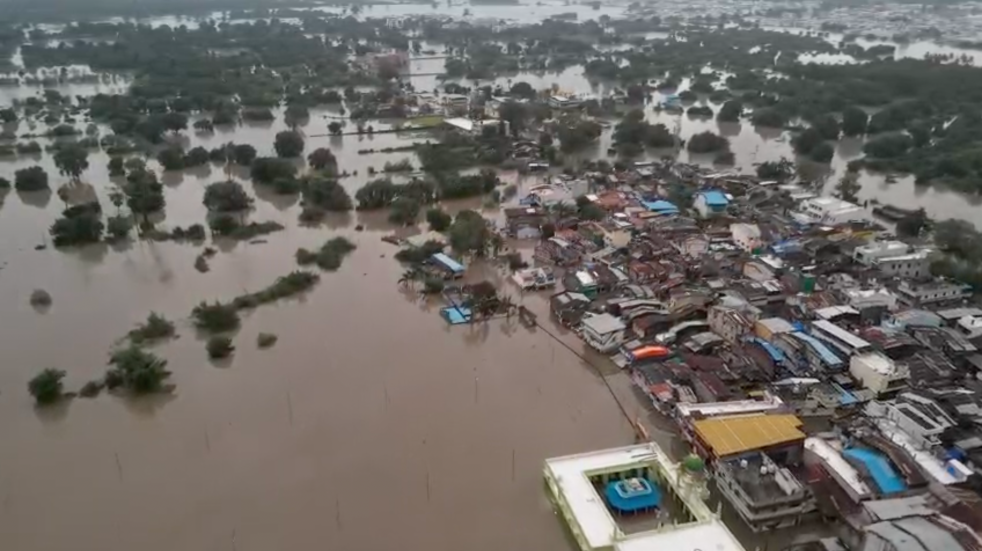
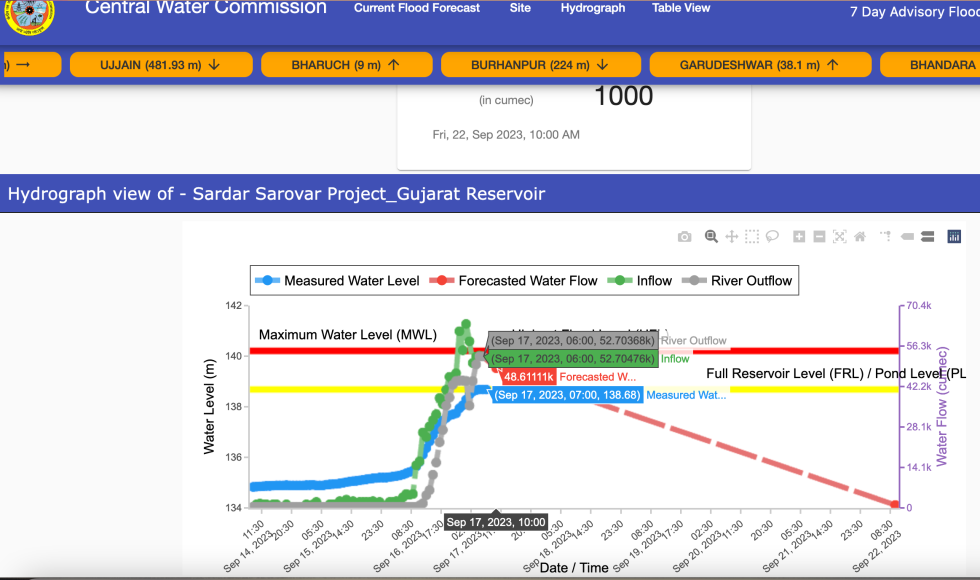
The avoidable flood disaster brought in Gujarat and upstream Madhya Pradesh, starting from the night of Sept 16, 2023 by unaccountable operation of the Sardar Sarovar Project (SSP) Dam has created unimaginable impacts for lakhs of people in several districts, the full contours of the damage are still not fully available. But another intriguing aspect of this man-made disaster has come to light. Shockingly, there was no power generation at the 1200 MW River Bed Power House (RBPH) of the SSP from Sept 6 to Sept 16. This not only means loss of power generation of about 270 million units (MU), worth over Rs 80 Crores even at low price of Rs 3 per unit), but also it would have meant release of 1200 cumecs or, 42000 cusecs and over ten days, this would have meant reduction of about 12000 cumecs or 4.2 lakh cusecs from peak discharge for 24 hours, and this itself would have hugely reduced the flood disaster.
Continue reading “Avoidable flood disaster from unaccountable Sardar Sarovar operation: Why was River Bed Power House stopped since Sept 6?”Tag: CWC
Unaccountable Sardar Sarovar operators again bring avoidable floods in downstream Gujarat
Late, lethargic and unaccountable actions of Sardar Sarovar Project (SSP) Dam operators have once again contributed to huge and largely avoidable downstream floods in Gujarat. The water level at Golden Bridge in Bharuch is approaching HFL (Highest Flood Level) today on Sept 17, 2023, but these floods could have been significantly lower and much less disastrous both for SSP upstream and downstream areas if SSP authorities had taken action earlier based on actionable information available and based on sound reservoir operation principles of following a rule curve.
Continue reading “Unaccountable Sardar Sarovar operators again bring avoidable floods in downstream Gujarat”Rivers Crossing Highest Flood Levels in India in August 2023
(Feature Image: An aerial view of flood-affected areas, in Rishikesh. Image Credit PTI/ Sourrce:-Out Look, 15 Aug. 2023.)
Though August 2023 has turned out to be hottest and driest month in a century; the first half the month has seen extreme flood events happening in North, North East and Central zones of the country causing breach in the highest flood level (HFL) at least at 17 flood monitoring sites being managed by Central Water Commission (CWC). These sites are in Ganga, Narmada and Brahmaputra basins.
There are some sites where HFL has been breached in June and July 2023 also and peak flood level of these sites is given below the peak levels attained in August 2023. The details of 2 sites breaching HFLs in June 2023 & 38 sites in July 2023 can be seen by clicking on respective hyperlinks. A separate report analyzing the severe flood situation in Alaknanda and Ganga basin on August 14, 2023 can be seen here.
Continue reading “Rivers Crossing Highest Flood Levels in India in August 2023”July-August 2023: Problems in CWC Flood Monitoring & Forecast
(Feature Image: CWC’s Delhi Railway Bridge forecast site showing abrupt changes in Yamuna water level during unusual flood spell in July 2023)
July and August are peak months of South West monsoon. There has already been flood related destruction in several states including Himachal Pradesh, Punjab, Haryana, Delhi and Uttarakhand so far. Amid these flood spells, SANDRP has observed many serious issues plaguing Central Water Commission’s (CWC) flood forecasting and monitoring work and some of these are described below.
Continue reading “July-August 2023: Problems in CWC Flood Monitoring & Forecast”DRP NB 070823: Forests & Biodiversity amendments: Gap between intent & application
(Feature Image: Dense Dudhatoli forest range near Peethsain in Thalisain block of Pauri Garhwal. Feb. 2023/ SANDRP)
As editorial comments in two different national newspapers given below shows, the biodiversity and forest conservation amendment bills passed by the Parliament last week weaken the cause of biodiversity and forest conservation, when it is most pressingly required to strengthen them.
Both amendments pave the way for ease of doing business and reducing role of local communities, both in terms of legal norms and practical implications.
The need for conservation of these resources was never more urgent than now considering the impacts of climate change on them and their importance for not only livelihood security of vast millions, but also for hydrological implications, food security, protection against increasing frequency and intensity of disasters, but also for adaptation in the context of changing climate. We hope against hope that better sense will prevail sooner rather than later to ensure the amendments do not lead to destruction of forest and biodiversity resources.
Continue reading “DRP NB 070823: Forests & Biodiversity amendments: Gap between intent & application”DRP NB 030723: Peak Hour Tariffs to be implemented from April 2024
(Feature Image: Vyasi HEP power station at Hathyari, Dehradun. SANDRP, June 2023)
This announcement by the government is indeed much belated but welcome step that India plans to increase peak hour power tariff compared to non-peak hour power tariff, beginning with commercial and industrial consumers from April 2024 a year later for others excluding agriculture consumers. The notification mentions it as daytime tariff (during solar hours) and night time power use, but this essentially also helps peak management.
This will not only put a premium on peak hour power consumption and hence generation, but also hopefully ensure that assessment of impacts of the peak hour power generation including at hydropower projects is done and done in a credible way, along with compensating those affected. It will also hopefully ensure that existing hydro capacity is used optimally for peak hour power generation before going for new hydro projects in the name of increasing peak our power generation.
One also hopes that it will lead to better peak hour power management and also considering all the options for such power generation rather than pushing hydro projects blindly in the name of peak hour power generation.
Continue reading “DRP NB 030723: Peak Hour Tariffs to be implemented from April 2024”DRP NB 260623: National Framework for Sediment Management
A National Framework for Sediment Management is certainly a long standing requirement and any move in that direction would have been welcome. Not only because the sediment accumulation destroys storage capacity of India’s Dams, created at such massive costs. But also because sediment is an integral part of river flow and also very important for the rivers to stop or reduce erosion at deltas. There are other issues related to sediment including creation and disposal of toxic sediment and impact of sediment free water flowing downstream from the hydropower projects.
But we need much more serious and sincere efforts in this direction than what has been suggested in following government press release. The movement on such an important subject is so snail paced, half hearted, non-comprehensive, unscientific and non-sincere that it is not clear how this is going to help.
Continue reading “DRP NB 260623: National Framework for Sediment Management”Vyasi Hydro: Village Drowned; River Dried but little power generation
(Featured Image: Submerged Lohari village houses in Vyasi HEP ‘RoR’ dam reservoir. SANDRP, June 2023)
The 120 Mw Vyasi HEP built by Uttarakhand Jal Vidyut Nigam Ltd (UJVN Ltd.) in Vikas Nagar tehsil of Dehradun is on its way to become the textbook example of how thoughtlessly pushed hydro power projects are proving a nightmare for local people, a costly affair for the state and the nation and a disaster for free-flowing living river.
The project offers some bitter lessons for the policy-makers, experts and society who have been assuming that hydro power is a cheap, green source of energy and the Run of River (RoR) projects don’t dam and cause much harm to the environment, people or rivers.
Continue reading “Vyasi Hydro: Village Drowned; River Dried but little power generation”DRP NB 190623: Ten years of Uttarakhand Flood disaster
(Feature Image: Thousands of people have been rescued but the inability of rescue teams to navigate disaster-struck areas has left over 60,000 people stranded in Uttarakhand. The Hindu, 19 June 2013)
This week marks ten years since the Uttarakhand flood disaster of June 2013, the worst recorded disaster in the state. The deaths and destruction in the disaster were unprecedented. Large parts of the deaths and destruction were due to man-made causes. Climate Change played its anthropogenic role too as the unprecedented rainfall happened even before the monsoon was set in. Even the Supreme Court took suo motu cognizance of the disaster and ordered halt to all hydropower projects and independent review of them. One of the major human causes that worsened the disaster was the lack of credible disaster prevention and management systems.
One expected that we and particularly our all powerful governments in the state and the Centre would learn lessons from such an unprecedented, such a massive destructive disaster. The first step to that would have been credible reporting of what exactly happened during the disaster, which agencies played what role and how the destruction could have been reduced. That such a report does not exist even today says a lot.
Continue reading “DRP NB 190623: Ten years of Uttarakhand Flood disaster”DRP NB 290523: Goa Fights to save Mahadayi River
(Feature Image: Thousands form human chain along Mhadei river to celebrate #MahadaiAmchiMai festival. Source: ToI)
On May 20, 2023 when thousands of people of Goa, Rakhondars (protectors) came out to form a 7 km long human chain to save Mhadei or Mahadayi river, they were not only celebrating Goa’s unique Mahadayi River festival, but were also coming together to declare their resolve save and rejuvenate the River that is lifeline of Goa.
A large number of organizations came together, including Earthivist Collective, Goa Heritage Action Group, Save Mhadei Save Goa front, among many others. It was a unique attempt to reconnect with the river, its history, its soul. The people from all kinds of art forms and all walks of life came together in a state where the connection with the river has always been strong for the people.
One hopes their tribe multiplies and they succeed in saving the river from dam building plans and other river affecting activities. That success will provide an example and impetus for river conservation activities elsewhere too.
Continue reading “DRP NB 290523: Goa Fights to save Mahadayi River”