Dams · DRP News Bulletin

DRP News Bulletin 19 February 2018 (How Are We Treating Our Urban Rivers?)

In this comprehensive article Mumbai-based author Vaishnavi Chandrashekhar throws the light on the plight of Uraban Rivers. “Rivers and streams have borne the brunt of the recent urban explosion in India, a nation whose population has nearly doubled in the last 40 years to 1.35 billion. Unplanned growth has led to the use of water bodies as dumping grounds for sewage and industrial effluent. According to CPCB, 63 % of the urban sewage flowing into rivers (some 62 billion liters a day) is untreated.

In addition, riverbanks, wetlands, and floodplains have been claimed over time by infrastructure, slums, offices, and housing developments – all of which has narrowed natural river channels and distorted flow, greatly reducing the ability of India’s rivers to buffer flooding. It also has taken a toll on biodiversity. http://e360.yale.edu/features/dying-waters-india-struggles-to-clean-up-its-polluted-urban-rivers (Yale Environment 360, 15 Feb. 2018) 

Continue reading “DRP News Bulletin 19 February 2018 (How Are We Treating Our Urban Rivers?)”
brahmaputra · China · Siang

Muddy Siang is sign of danger ahead, wake up call for Indian authorities

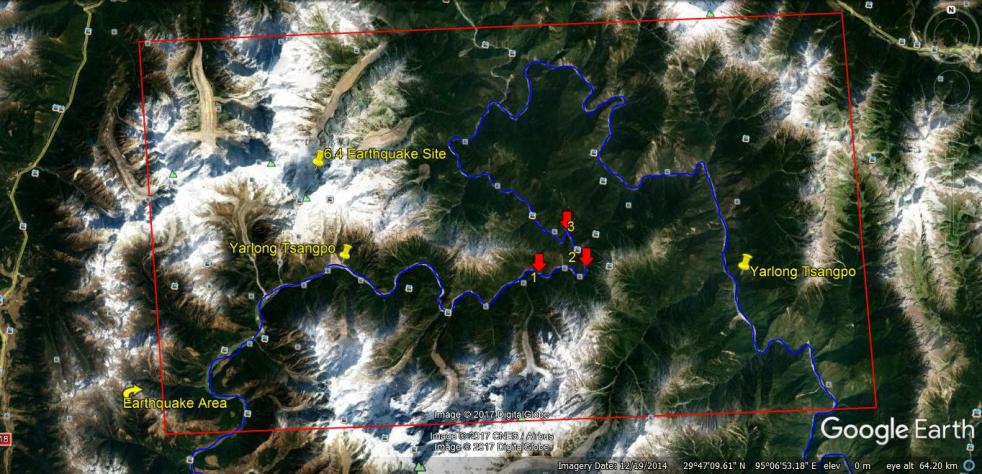
The current ongoing episode of Muddy Siang River water in Arunachal Pradesh is due to landslides in the upstream Tibet, triggered by the earthquakes starting on Nov 17, 2017 or possibly earlier. This is revealed by the satellite pictures and work of two researchers, first published in Arunachal Times on Dec 21, 2017[i]. These landslides are partly blocking the Siang flow and could lead to massive floods in the downstream Arunachal Pradesh and Assam any day.

A similar event in year 2000 led to sudden, massive floods in Siang River in Arunachal Pradesh on June 1, 2000. That episode, like the current one, started about 53 days before the floods, on April 9, 2000 due to landslides along a tributary of Yarlung Tsangpo, as Siang is known in Tibet. Continue reading “Muddy Siang is sign of danger ahead, wake up call for Indian authorities”

Dams · DRP News Bulletin

DRP News Bulletin 04 December 2017 (Protests Against Pancheshwar Dam in Champawat, Pithoragarh, Almora, Delhi)

Protests and controversies around Pancheshwar Multipurpose Project (PMP) are only growing louder and wider. While Expert Appraisal Committee (EAC) Rivers Valley Project in unnecessary hurry considering the project tomorrow (05 Dec. 2017)  http://environmentclearance.nic.in/writereaddata/Form-1A/Agenda/2811201745T4GD5I10thAgendaEACHydro05122017.pdf

Villagers and local groups people also continue raising their concerns and objections against 5040 Mw dam project. Today, scores of villagers, environmental groups including regional political party have protested at Jhulaghat in Champawat, Pithoragarh, Almora and in Delhi demanding EAC to listen to the voices of local people and groups.

Continue reading “DRP News Bulletin 04 December 2017 (Protests Against Pancheshwar Dam in Champawat, Pithoragarh, Almora, Delhi)”

Arunachal Pradesh · Assam · brahmaputra · Dams · Lohit River

‘Banks of the Lohit will shine’: Glimpses of a free-flowing river

Above: Lohit River, Parshuram Kund on the right. Photo: Parineeta Dandekar

Assam, Arunachal and the North East India, West Bengal and Bangladesh are riverine entities in many ways. Ancient rivers flowing through this landscape have moulded not only the mountains and the silt-heavy banks, but cultural identity of the region itself.  Rivers permeate through the literature, folklore, songs, poems, cuisine, even dressing… Bhupen Hazarika, the Bard of the Brahmaputra, likened the red ripples of the Assamese Gamcha (red and white stole)  to the braided filigree of the Red River. When Guwahati University opened on the banks of Luit, Hazarika sang “Jilikabo Luiter Paar”..Banks of the Luit will Shine. Rivers stood for revolution as they stood for Love.. Jyoti Prasad Agarwal wrote “Luitar Parore Ami Deka Lora.. Moribole Bhoi Nai.” (“We are the youth from the banks of the Luit/ We are not afraid of death”). Older poets like Parvato Prasad Baruah wrote entire books full of poems of Luit and today modern poets in Assam like Jeeban Narah  link their creative processes inextricably to rivers. Continue reading “‘Banks of the Lohit will shine’: Glimpses of a free-flowing river”

Assam · brahmaputra · Dams · Floods · West Bengal

Brahmaputra basin faces unprecedented flood wave in Aug 2017

In the morning of Aug 11, 2017, while checking my daily morning routine sites, I saw the sudden appearance of purple patch (signifying rainfall in access of 175 mm rainfall in previous 24 hours) on NASA daily rainfall accumulation map for Indian subcontinent.[i] The purpose  patch covered parts of the West Bengal, North East Indian and Bangladesh. I was taken aback, but it was not very unusual to see in the peak of monsoon. So as we usually do, I took a screenshot and put up on SANDRP FB page with a warning that this could lead to floods. I did not realize that this was the beginning of an unprecedented wave of floods for these regions that may extend to Ganga basin as I write this. Such purple patches generally disappear in 24 hours, since the rains do not last to long. However, in the case of current phase, not only the purple patch has last now for 42 hours, it has extended  to the west, all along India Nepal region along the southern boundary of Nepal.   Continue reading “Brahmaputra basin faces unprecedented flood wave in Aug 2017”

Dams · DRP News Bulletin

DRP News Bulletin 10 July 2017 (Private Companies Exit Unviable Large Hydro Projects)

In a remarkable trend emerging in hydro sector in Himachal Pradesh, many leading private companies have started surrendering hydro power projects allotted to them by State Govt. As per the news report, Tata Group, Reliance, Jindal and Larsen & Toubro have either surrendered or are in process of surrendering numbers of hydro projects given to them over past one and half decade. These companies are now increasingly terming the projects as  non-viable and unprofitable. 

In the last week of June, 2017, Tata group reportedly has written to Directorate Energy, expressing its desire to surrender the 450 MW Duggar power project in Pangi area of Chamba district. The project had been allotted to them in 2007-08 and post feasibility study done by its consultants the group has found the unviable. http://www.tribuneindia.com/news/himachal/tatas-give-up-chamba-power-project/428456.html

Before this the Reliance group had declined to set up  300 Mw Purty and 130 Mw Sumte Kothan hydro projects in Spiti. Following this, the State Cabinet on June 24, 2017 meeting agreed to return Rs 85 crore paid as upfront money by Reliance group. 

Similarly in recent past, the Jindal group, which was allotted the 250 MW Kutehar power project in Chamba, put the project on hold for some time without citing specific reasons. http://www.tribuneindia.com/news/himachal/reliance-power-to-get-back-rs-85-cr-it-paid-to-govt-for-2-projects/427112.html

In the latest incident, anticipating problems in evacuating power, with the market being very grim as far as buyers and power rates are concerned, Larsen and Toubro (L&T) is reported to have urged the state govt to enter into a power-purchase agreement (PPA) with it for two of its hydel projects — Reoli Dugli (Lahaul-Spiti) and Sach Khas (Pangi), located in the arduous Chenab basin.

Continue reading “DRP News Bulletin 10 July 2017 (Private Companies Exit Unviable Large Hydro Projects)”

Hydropeaking · Rivers

River bank failure due to sudden water flow changes

Can land, trees, structures, farms, pipes, poles, pumps etc, along a river bank several kilometers downstream collapse if water flow in the river is suddenly reduced or stopped? Yes, reduced/ stopped, not increased? This kind of river bank slump or collapse or failure is not easily understood, but it does happen. Let us see how. Continue reading “River bank failure due to sudden water flow changes”

Dams · DRP News Bulletin

DRP News Bulletin 02 Jan 2017 (Corruption in Nepal’s Hydro Power Projects)

The latest report of Transparency International reveals that lack of dependable hydrological data, authentic study, action plans giving dual meaning, lack of transparency in the power purchase agreement and a failure to increase the risk-bearing capacity among power developers have remained major hindrances towards the development of hydropower sector in Nepal.

As per the report, the irregularities start from the stages of project selection and identification and this tendency further flourished in the period of a survey and the project implementation, the report states, highlighting a responsible role from the government level to control this practice.

The report also points out that environment standard violations, inadequate compensation in regard to land acquisition, false claims, unreasonable local demands, unwarranted contract variations, bias in selection of top officials like board members and CEOs during the construction, procurement, and implementation phases are working as a catalyst to bring the hydro sector under the grip of corruption.

Continue reading “DRP News Bulletin 02 Jan 2017 (Corruption in Nepal’s Hydro Power Projects)”

Dams · DRP News Bulletin

DRP News Bulletin 11 Oct 2016 (Is there any justification for DESTRUCTION of Panna Tiger Reserve?)

Is there any justification for DESTRUCTION of Panna Tiger Reserve? Can we save our Natural Heritage like the Panna Tiger Reserve (PTR) from being destroyed in the name of baseless, questionable, non transparent, undemocratic and manipulated projects like Ken Betwa inter linking ? It will facilitate export of water from Bundelkhand to OUTSIDE Bundelkhand. Whatever little benefits are claimed, some of them are already available and much more can become available at much lower costs, faster and without destroying the Forests and Tiger Reserve. The project will actually lead to destruction of Ken catchment and hence the Ken River itself. Watch this FASCINATING, AWESOME story of tigers of PTR. This BBC film where Raghu Chandawat is the story teller and Pradip Kishen is lending his voice, tells the story of Tigers of Panna till 2003, it seems. Please watch and let us all try to save it from destruction that is now writ large in terms of Ken-Betwa Link Project (KBLP). One more short film by wildlife biologist Koustubh Sharma illustrates how the Daudhan Dam under KBLP will submerge and destroy the PTR.

Meanwhile, a new analysis of rainfall data reveals that monsoon shortages are growing in river basins with surplus water and falling in those with scarcities, raising questions about India’s Rs 11 lakh crore plan to transfer water from “surplus” to “deficit” basins. According to Himanshu Thakkar of SANDRP river basin interlinking should be considered only after exhausting the local potential for harvesting rain, recharging groundwater, watershed development, introducing better cropping patterns (non water-intensive crops) and methods (such as rice intensification), improving the soil moisture-holding capacity and saving and storing water. Raising alarm over significant increase in ground water use, increasing reliance and fast declining ground water table, he warns that inter-basin links would actually reduce groundwater recharge because forests would be destroyed, the river flow stopped and the local systems neglected.

Continue reading “DRP News Bulletin 11 Oct 2016 (Is there any justification for DESTRUCTION of Panna Tiger Reserve?)”

Dams

Celebrating our Rivers on the World Rivers Day, 2016!

Above: Parshuram Kund on River Lohit, Arunachal Pradesh

Since 2005, last Sunday of every September is celebrated as the World Rivers Day. The tradition started in 1980s in British Columbia when some river activists came together for their rivers. Its only grown since then.

All through the year we hear about water conflicts, river pollution, degrading freshwater biodiversity, damming of living rivers, mismanagment, concretisation and encroachment on Indian Rivers. As I write this, Cauvery Water Conflict and simmering, serious discontent over the Indus Water Treaty governing 6 rivers between India and Pakistan is mounting. A simple google search on Indian Rivers throws up images of filth, pollution, droughts and floods. Lest we forget, thats not the whole picture. We are still the custodians of an amazing legacy. India still holds some of the most beautiful, healthy and life giving rivers in the world. There are people and communities nurturing their rivers and protecting them. All is not lost and this is a battle worth fighting, full of positive energy. Continue reading “Celebrating our Rivers on the World Rivers Day, 2016!”