Government of Bihar, Revenue Department, Report on the Flood and Relief Operations in Bihar for 1948-49. Superintendent, Government Printing, Bihar, Patna, 1951.
Muzaffarpur [2]“During the August floods water from the River Narayani flooded the village Fatehabad. About 100 houses are reported to have collapsed as a result of the breach in the bundh due to change in course of the River Gandak. There were heavy showers and considerable damage was caused to the paddy crops and certain parts of the Sadar and major parts of Katra, Minapur and Sakra thanas experienced floods… During floods in the Ganges, Hajipur sub-division was badly affected and steps had to be taken to arrange relief.” P-15 Continue reading “1948 Floods in Bihar-2 Inaugural flood after Independence – Official Version of Floods and its Aftermath”→
Background Bihar is long known for its floods. The British had left India but their legacy of looking at rivers and their floods was still continuing in 1948[1]. They always favored ‘leaving the rivers to their own devices’ and did precious little to tame the rivers. The zamindars used to put temporary and not so temporary embankments along the rivers to provide some flood protection to their ‘ryots’ which used to breach quite often to the detriment of the people living in the flood plains of the river. The repairs of such breaches were the responsibility of the zamindars but if they did not repair the same, the British establishment used to repair it and realize the cost of it from the zamindars. There were only 160 kilometers of ‘well designed and equally well constructed’ embankments on Bihar Rivers then. Zamindars had got a hint from the Government of India that their days were numbered and had little interest in maintaining the embankments in order. It was under these circumstances that the Government of Bihar (GoB) was expected to face the floods for the first time in independent India.Continue reading “1948 Floods in Bihar-1 – Inaugural flood after Independence – View from Press Gallery”→
Above: Gangakhed sugar factory from Parbhani Marathwada which has crushed 7 Lakh Tonnes of cane till 21 Feb 2015. Parbhani has received a mere 346 mm rainfall this year, nearly equal to what it received during epic drought of 1972
~~~
Although Marathwada region in Maharashtra is no stranger to droughts, it’s facing a singularly acute crisis this year. Kharif crops had failed in all of the 8139 Kharif villages in the region with yields less than 50% of government standards (paisewari). Rabi is under cloud too with all 396 villages assessed for production showing less than 50% yield. And yet, area under and production of water guzzler crop like Sugarcane is going up. In 2013-14, Marathwada grew over 2 lakh hectares of sugarcane and is now crushing the cane in its 61 sugar factories using thousands of lakhs of litres water every day.
Does this make any social, economic or environmental sense? No
The National Green Tribunal (NGT) in a landmark judgment pronounced on 13 January 2015[1], has set an ambitious road map for a rejuvenated river Yamuna by 2017. Naming it as “Maily se Nirmal Yamuna rejuvenation project, 2017” the green court in the judgment spread over almost 100 pages has detailed steps necessary to achieve what all previous efforts have miserably failed. Continue reading “NGT Orders MAILY SE NIRMAL YAMUNA – WILL THIS LEAD TO A REJUVENATED YAMUNA?”→
Above: Pollution from a River Kasardi which was denotified as it was affecting some big businesses
When Devendra Fadnavis of BJP became the Chief Minister of Maharashtra, one would have thought that the chronically polluted and encroached Nag Nadi from Nagpur, as also other rivers in the state may see better days. This was not just an optimistic hope. The Government at the Centre was making all the correct noises about being concerned about rivers, it had launched the Namami Gange Program for rejuvenation of Ganga River and had changed the name of Ministry of Water Resources to Ministry of Water Resources, River Development and Ganga Rejuvenation. Continue reading “Maharashtra scraps River Regulation Zone : Pandering to industry at the cost of Rivers and People”→
Subject: Memorandum for inclusion in your Party manifesto, Delhi Assembly Elections 2015
Dear Sir/Madam,
Drinking water and sanitation is a major priority for residents of Delhi. There is no concrete commitment from any political party as yet in terms of norms, investment, pricing for water and sanitation, or what the elected government will do to ensure improvements in water supply, sanitation and cleanliness of Delhi. The slogan of Swachh Bharat Abhiyan is an empty slogan if the political parties are not willing to listen to the demands of the residents of poor and slum settlements of Delhi and commit to providing basic sanitation and water services as a Fundamental Right.
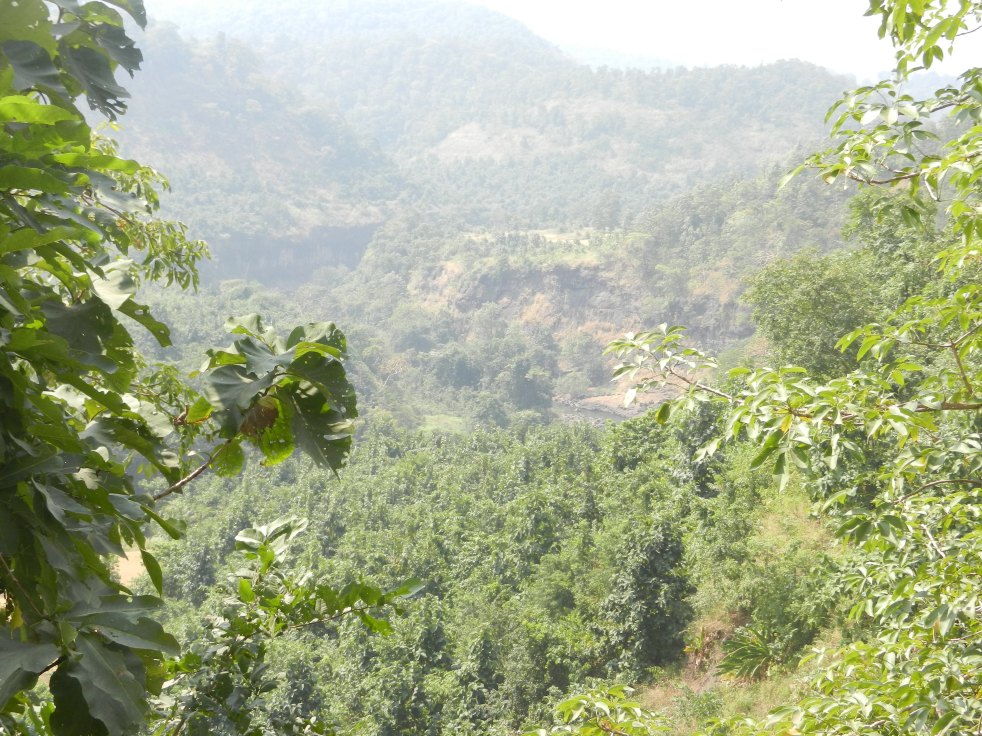
Above: Forested Valley, now lost forever for the Middle Vaitarna Dam Photo: Parineeta Dandekar
Respected Chief Minister,
At the outset we congratulate you for leading some progressive changes in the Water Resources Department of the State. These include decisions about continuing only with those dam projects which are more than 75% complete[1], appointment of independent people with a clean image like Shri. H.T. Mendhegiri as CADA Chief Secretary, changing norms of Economic Survey Report[2], stating that only hoarding water will not be counted towards increase in irrigation potential, etc. Continue reading “Water Smart Mumbai is possible without river links and big dams! Open Letter to CM Devendra Fadnavis”→
The 126 MW Larji Hydropower project near Aut on the mainstem of the Beas is run by the Himachal Pradesh State Electricity Board (HPSEB)[2]. The dam is constructed a little downstream of the confluence of the two main tributaries upstream, the Sainj and the Tirthan, at the narrowest part of a spectacular gorge, towering with limestone cliffs. The impounded waters of this dam have, since its construction in 2006, drowned the access road to the entire upper Kullu valley including Manali and the hundreds of villages upstream, including access to the entire Lahul valley and the region of Ladakh over the high passes from this end. The HPSEB then constructed a 3 km long tunnel to enable passage of traffic, and many people have warned of the hazardous nature of the tunnel. The 220 odd gods that descend from different valleys, on the backs of people to the lower Kullu valley every year in autumn however, refuse to use this tunnel. This is what compelled the HPSEB to build and maintain this tunnel, and during autumn to winter, to keep the water-storage in the dam low to enable the passage of gods, who have been traveling this route for over three and a half centuries. It is remark-worthy though, that this dam constructed as recently as 2006, seems to be heavily silted-up already and the dark shadows of sediment-shoals are visible just below the waters of the reservoir[3].
Being among the most recently completed, the Larji dam is the only dam on the Beas that has a fish-ladder, so it was of particular interest to us. Seeing no guard at the security booth, we walk in to the HPSEB dam operating office, and ask to speak to an officer about the fish ladder. To our complete surprise, we are spoken to and even taken on a tour of the ladder by a foreman who has worked on the dam for many years.
Having seen an elaborate fish ladder on the Kuri Chhu river in Bhutan of doubtful effectiveness[4], we could not help but look at this one with hope and excitement. Located at around 1,000 meters altitude, this dam was clearly in the way of a host of migratory species of fish. If this ladder design was effective, then surely the ‘barrier’ problem to seasonal migration for breeding and dispersal would have been addressed. Here though, is what we saw and heard.
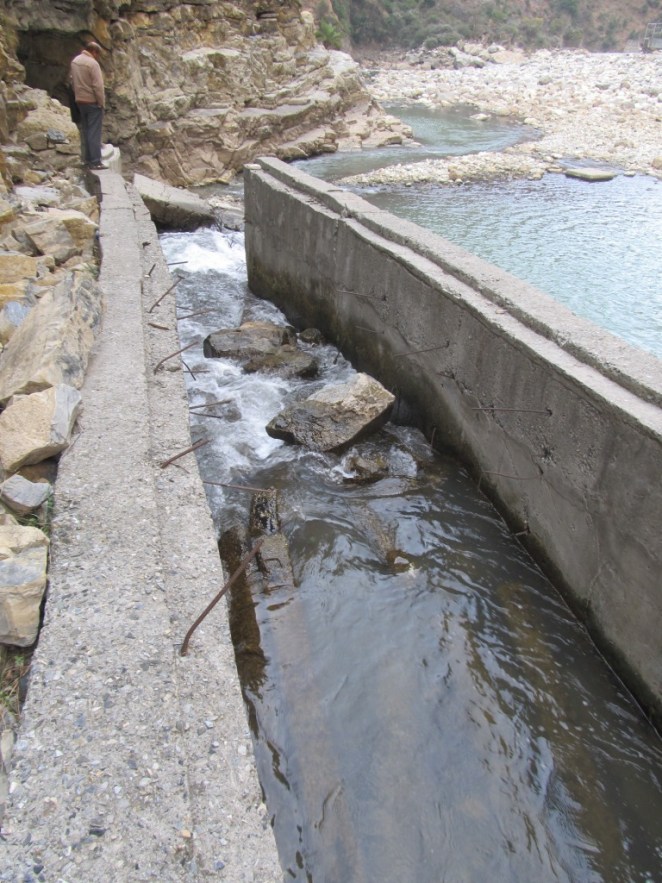
For one, the flow through the fish-pass seems too small to create an ‘attraction flow’ for fish. But even more obviously, the downstream entrance of the fish ladder is a steep cascade over a couple of meters of broken masonry and rock, that would clearly be un-negotiable by any fish that does not jump that high[5].
Downstream entrance of Larji fish ladder: The 2 m high jump that fish require to enter the ladder can be seen here (all photos by the author)
2. The outlet from the dam reservoir into the fish ladder is blocked off by a metal grill-mesh that is narrow enough to trap flotsam like Bisleri water-bottles. The mesh seemed too fine to let Mahseer of breeding-age pass through, either upstream or downstream.
3. The fish ladder was in a serious state of disrepair. To our questions about whether the ladder worked or not, the foreman says honestly that it does not. We see the reasons for this when we walk down the ̴100 meter length of the fish-pass channel.
Fishladder can be seen in serious state of disrepair and blocked by broken concrete parts can be seen here
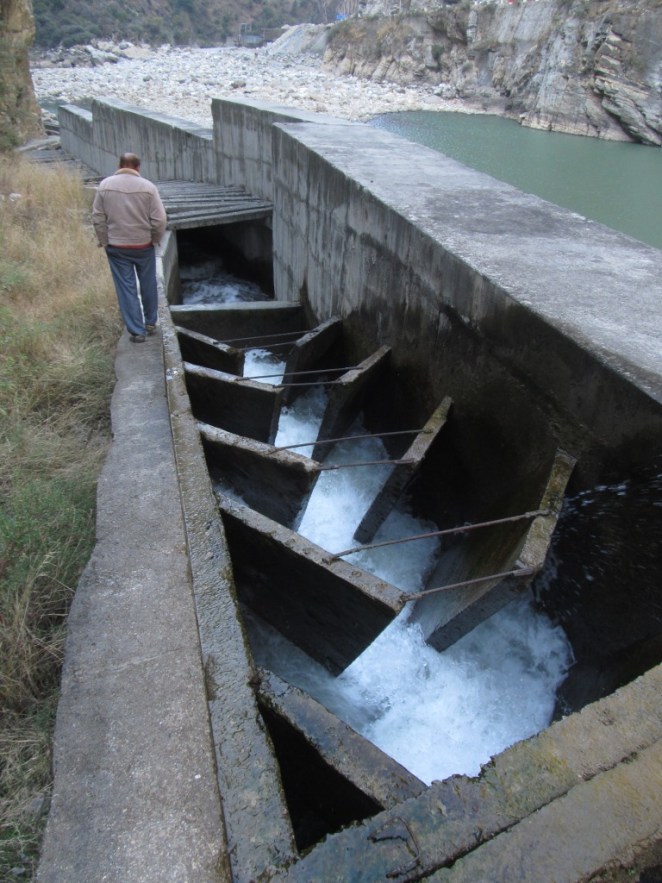
4. The Larji fish ladder seemed to be a hash of different designs of fish passes. There were four different design elements in this one fish-pass. It had a slotted-weir fishway design, a low gradient Denil fishway, a steep-pass Denil fishway and a plain concrete culvert on a grade design. Most of these slotted weirs were clogged with fallen rocks and debris from the slope above, and in places, the pools in them were over-flowing the weir in a vertical fall almost 2 meters high.
Steep-pass Denil fishway part of the fishladder can be seen here, water is flowing too rapidly here for any fish to be able to go upstream. The water picks up momentum down an extremely steep slope with the baffles at 45 degrees to the flow, not offset to slow the water, but concentrating the force of the water in mid-stream flow. The slope seemed to be at almost 40 degrees angle, and the water was turbulent in the extreme in this section. A workable Denilway slope, even for the strongest of swimmers among fish, is not designed to exceed a slope of 20% at most. This was close to a 100% slope
5. The oblique baffles on a Denil fishway are supposed to be placed in a manner that provides staggered partial-obstructions that slow the water down at variable velocities to make it passable for fish. However, here we saw that the water picks up momentum down an extremely steep slope with the baffles at 45 degrees to the flow, not offset to slow the water, but concentrating the force of the water in mid-stream flow. The slope seemed to be at almost 40 degrees angle, and the water was turbulent in the extreme in this section. A workable Denilway slope, even for the strongest of swimmers among fish, is not designed to exceed a slope of 20% at most. This was close to a 100% slope[6].
This part of fish ladder is less steep Denil
The last part of the fishway was a plain concrete culvert on a grade channel, essentially a sloping channel, where even the concrete sides of the channel had toppled over into the river-bed, and the final drop was over a two meter fall into the downstream flow. I asked the foreman whether he knew whether fish managed to make it over this extreme gauntlet. He said that they did not, but that he often saw fish gather and concentrate at the bottom of the dam under the sluice gates, and make futile leaps in an attempt to get over the dam. Clearly, the Larji dam fish ladder is just an unlovely trinket, a deceptive ornament.
Watch a 41 seconds video showing how fast the water is moving through the Larji Dam fishladder at: http://youtu.be/grVaxXPdeyY, Video is by the author.
It seemed to me that the dam builders and operators, the HPSEB in this case, both at the design and the executive levels, were not serious about constructing a fish-pass that would work, and neither were they serious about this at the operation and maintenance aspects. Whether they were serious at all even at the conceptual level, to put in place a mitigation measure that actually helped migratory fish bye-pass the barrier of the dam, or was this part of the design merely to obtain environmental clearance, can only be conjectured about. That hydropower projects can devise deceitful strategies for obtaining environmental clearance is one thing, but what does this tell us about the Union Ministry of Environment and Forests, the Expert Appraisal Committee on River Valley Projects appointed by MoEF, the regional office of the MoEF, the state Fisheries Department and also the state pollution Control Board, who are all variously part of the approval processes for hydropower projects, when they get their environmental clearances based on such ‘mitigation measures’?
Larji Dam – about 100 m long fishladder channel can be seen on the right side
[2] The 126 MW Larji project is also infamous for being the costliest hydro-power project per unit electricity generated so far in India. Finally built at a cost of R.s 10.27 billion, which was twice the estimated cost, the Vigilance department unearthed major financial misappropriation by HPSEB officials.
[5] Other than loaches, those tiny finger sized fish that can even climb (squiggle technique) up high waterfalls, provided there is something like a water-slide at the margins of the fall. They however, are not migratory fish.
[6] CIFRI recommends that the speed of flow of water in a fish-pass should not exceed 2 meters per second. Please see ‘Status of fish migration and fish passes with special reference to India’. MK Das and MA Hassan. CIFRI 2008.
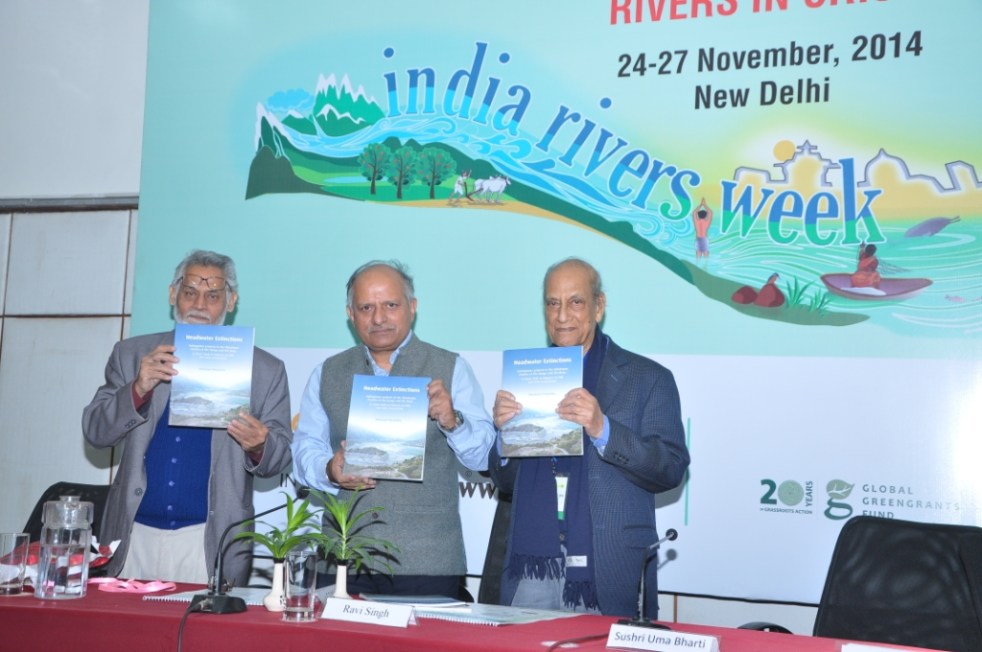
SANDRP has just published a new report: “Headwater Extinctions- Hydropower projects in the Himalayan reaches of the Ganga and the Beas: A closer look at impacts on fish and river ecosystems”, authored by Emmanuel Theophilus. The report[i] was released at the India Rivers Week held during Nov 24-27, 2014.
Front Cover of the report HEADWATER EXTINCTIONS
Headwater Extinctions deals with impacts of hydropower projects in Beas basin in Himachal Pradesh and Alaknanda-Bhagirathi basins in Uttarakhand on river ecosystem and its components, mainly fish. While the harrowing impacts of hydropower projects on local livelihoods and social systems are being realized gradually, we are yet unclear about the extent of impacts of these so-called green projects have on fish and aquatic biodiversity.
Environmental Impact Assessments of large hydropower projects (> 25 MW as per EIA Notification 2006[2]) are supposed to assess ecological impacts of such projects, but we are yet to come across any comprehensive effort in this direction from EIA reports that we have assessed so far.
The Expert Appraisal Committee (EAC) of Union Ministry of Environment, Forests and Climate Change (MoEF & CC) which is entrusted with appraising these projects and their EIAs has paid very little attention to this issue. Since over a decade, the EAC has had expert members from Wildlife Institute of India (WII) and Central Inland Fisheries Research Institute (CIFRI). Both these institutes are supposed to have expertise on fish and aquatic biodiversity. But sadly, their presence has not helped fill the serious lacunae in appraisal and EIAs of the hydropower projects.
SANDRP had been trying to highlight the impact of hydropower on fish and the long standing problems in the so-called mitigation measures being recommended by the EAC. We thought that it may be useful to bring out a first-hand report bring out ground realities of what is happening to our rivers. Emmanuel Theophilus, based in the Dhauliganga Valley and who is an avid mountaineer, storyteller, ecologist and our ally was commissioned by SANDRP to study the impacts of hydropower on fish and ecosystems, review the EIAs as well as mitigation measures recommended by EAC as a part of Environment Management Plans of hydropower projects. We are very glad to publish the report as a first of the hopefully many steps to be taken to understand and address this important issue.
Headwater Extinctions has been written in an eminently readable style that Theo is known for, as could be seen from the earlier blogs[3] he wrote for us! The report has a section on ‘Travelogue’ which records Theo’s travels and thoughts as he visits Bhagirathi and Alaknanda sub basins in Uttarakhand and Beas basin in Himachal Pradesh. The report also brings illuminating photos from these trips. The fact that the travels happened within months of the Uttarakhand disaster of June 2013 could be seen in his photos and travel reports. It further substantives the role hydropower projects played in increasing the proportions of the disaster.
Travelogue is followed by discussions in two parts: Discussions on the impact of hydropower projects on fish and aquatic habitats along the two sub-basins and the role of EIAs, EMPs, Fisheries Plan and the government approval process. The findings of this report are valid for all Himalayan states & rivers.
Back Cover of the report HEADWATER EXTINCTIONS
Headwater Extinctions ends with some striking insights. Sample this: “We are in the midst of river extinctions in the Himalaya, but are surrounded by a tragic drama of double-speak and equivocation. And a horde of jostling brokers. Ranging from reputed universities, government departments, research institutions, everyday bureaucrats, and of course, politicians and contractors from within ‘the community’[4] along the developers and regulators. They not only write the script of this drama, they even play all the part”.
The inside covers of the report have detailed maps of the two basins with locations of hydropower projects, with annexures containing lists of hydropower projects in Upper Ganga and Beas basins and also list of fish found in Upper Ganga basin.
Theo has completed this report on a stringent timeline and budget, which meant that all the proposed and implemented fisheries management plans could not be assessed. We hope Headwater Extinctions provides sufficient material and compelling reasons to overhaul the way impacts of hydropower projects on fisheries and aquatic biodiversity are treated by EIAs, EMPs and government committees. We would also urge agencies like WII and CIFRI to do justice to their work inside EAC and beyond. That they are not doing that is apparent.
For EAC and MoEF&CC, we certainly would like them to ensure proper and full impact assessment of projects on aquatic biodiversity in the EIAs. The EAC also needs to stop approving completely ineffective fish hatcheries. They could initiate a credible independent study of the costs, benefits and performance of the fisheries development plans they have been approving in recent projects. It does not only smell fishy, but more like a scam! Here is a relevant quote from the report: “I can’t help see a few things here, as perhaps you do? Bluntly put, I see slush funds being dangled to a whole range of possible collaborators. The kindest term I can find for them is ‘brokers’.”
We look forward to your comments and suggestions on all aspects of Headwater Extinctions. If you would like a hard copy, please write to us.
[2] We have been saying this for long and this report helps substantiate our contention that the assumption that projects below 25 MW are benign and do not need EIA-EMP or environmental monitoring and public consultations is wrong.








 SANDRP