Dams · Himachal Pradesh

Lahaul people write to Environment Committee not to clear Reoli Dugli Hydro project

To

The Environment Appraisal Committee

River Valley Projects

Ministry of Environment and Forests

New Delhi

Subject: Submission related to Chenab River and Lahaul Valley  in context of EC for 430 MW Reoli Dugli project

Dear Chairperson,

We have read reports that the expert appraisal committee (EAC) on river valley and hydel projects of the Ministry of Environment has decided “not to take any cognizance of representations” received by its members since such representations are ‘anti-development’. The article appearing in Indian Express on January 14, 2017 stated, “In its December 30 meeting, the committee concluded that once a project proposal reaches the EAC for appraisal, it has crossed the stage of public consultation and “the EAC should not go back in time, and should not reopen it, by entertaining unsubstantiated representations received from the people”. Continue reading “Lahaul people write to Environment Committee not to clear Reoli Dugli Hydro project”

Bihar · Ganga · West Bengal

Landmark Ganga Conference in Patna: What Bihar needs to urgently do

DURING FEB 25-26, 2017, A LANDMARK MEETING HAPPENED IN PATNA, ORGANISED BY BIHAR GOVERNMENT, UNDER THE LEADERSHIP OF CHIEF MINISTER SHRI NITISH KUMAR. THE MEETING WAS ON INCESSANT GANGA WITH SUBTITLE “CAN WE ACHIEVE CLEAN GANGA WITHOUT INCESSANT GANGA?”. THIS NATIONAL-INTERNATIONAL CONFERENCE WAS LANDMARK MEETING FOR A NUMBER OF REASONS, BUT MOST IMPORTANTLY, SINCE A STATE GOVERNMENT WAS TAKING THE LEADERSHIP FOR THE CAUSE OF THE RIVER GANGA. WHILE THE CONFERENCE WAS FOCUSSED ON ACHIEVING A REJUVENATED GANGA, I WAS TO SPEAK ON THE WAY FORWARD ABOUT THE FARAKKA BARRAGE, A KEY OBSTACLE IN THE PATH OF REJUVENATED GANGA. FOLLOWING IS MY LETTER TO BIHAR CHIEF MINISTER, FOLLOWING THE CONFERENCE, WHICH CONTAINS MY RECOMMENDATIONS TO THE BIHAR GOVERNMENT. THESE RECOMMENDATIONS WERE APPARENTLY ACCEPTED IN THE FINAL SESSION. 

March 2, 21017

To

Shri Nitish Kumar,

Chief Minister of Bihar,

Patna, Bihar

Respected Sir,

Firstly, I would like to thank you and Water Resources Department of Bihar for inviting me to the Patna Conference on Incessant Ganga on Feb 25-26, 2017. This shows great vision and foresight on your behalf, to raise such crucial issues that is not only necessary for the Ganga, people of Bihar, environment of Bihar and future of Bihar, but also for the whole nation. We hope you will continue to lead the nation on this issue, and I am sure you will get huge support, including from me. Continue reading “Landmark Ganga Conference in Patna: What Bihar needs to urgently do”

Groundwater · Maharashtra

Maharashtra Farm Ponds: accelerating groundwater exploitation, rather than harvesting rain?

Farm ponds dotting the agricultural fields immediately grab your attention as you enter Hiwargaon Pawasa – a small village of about 1500 population in Sangamner Taluka of Ahmadnagar District. The village is located just off NH-50, the national highway connecting Pune and Nashik. Farm ponds start to appear as soon as you turn east from NH-50 (which broadly runs North South) to head towards Hiwargaon. Nearly every farm, small or big, has a plastic lined farm pond. Hiwargaon Pawasa village alone has some 300 odd farm ponds.

I am here to see how these small scale irrigation facilities now set to be implemented on massive scale through the country are performing on ground. Continue reading “Maharashtra Farm Ponds: accelerating groundwater exploitation, rather than harvesting rain?”

Dams · Indus

Sindh People March to Protect Indus River

GUEST BLOG by Muhammad Ali Shah, Dr. Aly Ercelan & Roshan Bhatti

Sindh Peoples Caravan March 1-14, 2017 Protect Our Rivers and Delta 

Across the world the greed of capitalism has created water crises. Asia in general and South Asia in particular is no exception. This region is marred with complex and multidimensional aspects of water crises. Not only the brute availability of water has declined, but also the health of water bodies has been badly affected. A deep probe into the issue reveals that water crisis has been created by weak and deliberate mal-governance. Both wrong incentives and lack of penalties have led to major ecological disasters. These include deforestation, destruction of wetlands, dumping of industrial waste into waterways, construction of dams, overexploitation of the major river systems, corporate control on water resources and unplanned urbanization due to increasing population pressure.

1
Reduced fresh water flow in River Indus (Source: Google)

All these issues pose serious threats to life and health of people and water systems of South Asian River Systems, including Indus river system. Our analysis reveals that anti-human and anti-environment policies have been applied and imposed in South Asia with the same rapacity as colonial powers did to impose control over citizens. Post-independence, growth policies have become excuses for privatization and in favor of corporate monopolies rather than protection of the commons for public welfare. Among regions around the world, South Asia is the second number in the construction of large dams. Pursuing neo-colonial control over natural resources, the ecological consequences have become hazardous to life and livelihood.

Continue reading “Sindh People March to Protect Indus River”

Maharashtra

Maharashtra State Environment Protection Agency: Pathetic performance, sits over destruction of rivers

Above: Illegal Sand Mining in Pune (Photo: Indian Express)

At State level the State Environment Impact Assessment Authority (SEIAA) is the regulatory authority for granting environmental clearance to the projects falling under Category ‘B’ in Schedule of EIA notification, 2006, which receives projects recommended by State level Expert Appraisal Committee (SEAC). SEAC is constituted for the purpose of assisting the SEIAA. Both SEAC and SEIAA are constituted under the EIA notification. For Maharashtra there are three SEACs. SEAC-I looks after appraisal of all the projects related to Industries, Mining, Irrigation and others, excluding building projects. SEAC-II looks appraises all the building projects falling under Mumbai Metropolitan Region (MMR) and SEAC-III appraises the building projects falling under Non-MMR region.

SANDRP looked at the decisions of SEAC-I (hereafter referred to as SEAC) for 17 meetings (of year 2015-16) specifically for projects which involve rivers, water bodies and also which have large water footprint e.g. sugarcane. The projects related to rivers and water bodies mainly consisted of sand mining projects, medium irrigation projects, dredging of rivers for proposed waterways, newly proposed or capacity enhancement of sugar factories and few other specific projects such as solid waste dumping site proposed by Kalyan Dombivali Municipal Corporation (KDMC) which is close to the river etc.

At the outset it has to be said that the minutes for all the meetings are highly generic with little or no project specific elaboration especially of the environmental impacts. For most of the projects especially sand mining the remarks and conditions are standard. If one is trying to understand the rationale behind sanctioning some projects it finds no mention. Many of the projects like sand mining, river dredging or solid waste management sites near flood lines have been approved despite of evident grave risk. ‘No project’ does not seem to be an option at all.

Minutes of the meetings reflect how the project proponents (PP) have taken rivers for granted. Despite repeated violations SEAC has bestowed tremendous faith in PP that the conditions it stipulates will be complied with.

Remarks made by the committee give an impression of inadequate impact assessment of the projects. There is enough room to question if any serious impact assessment happened at all.

All in all after studying the minutes it becomes apparent how government bodies have failed to curb violations and damage to the rivers. Continue reading “Maharashtra State Environment Protection Agency: Pathetic performance, sits over destruction of rivers”

Dams · Maharashtra · Rivers

Maharashtra Urban water sector in 2016: Big cities eyeing big dams

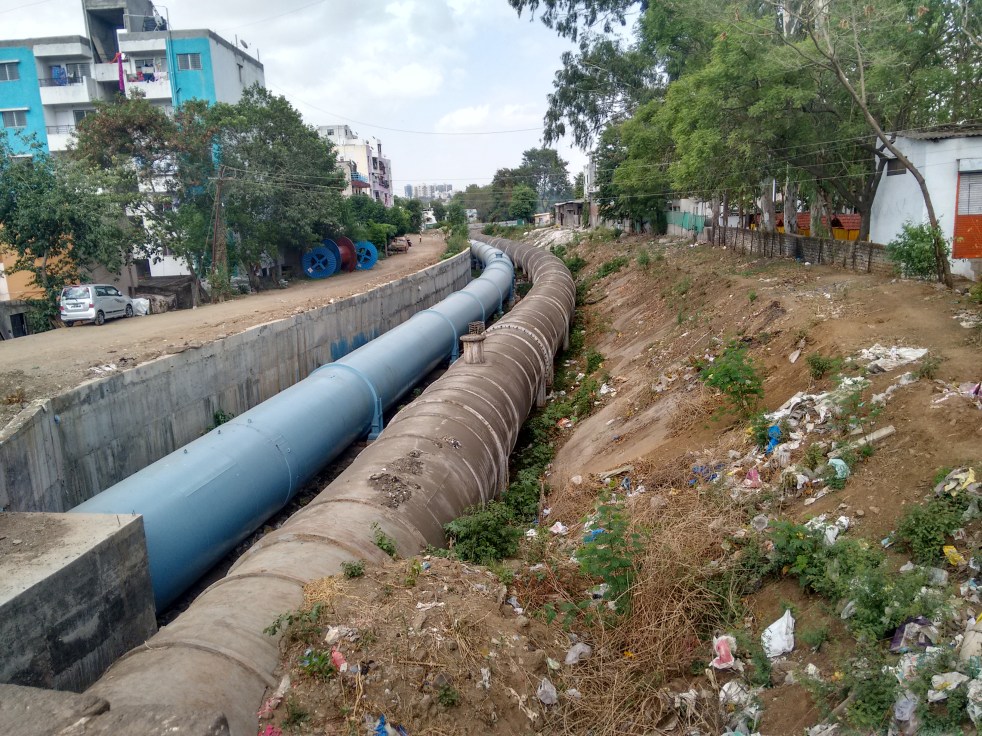
Above: Pipelines which supply water to Pune City from Khadakwasla Dam (Photo: Amruta Pradhan, SANDRP)

Urban narrative of Maharashtra revolves predominantly around cities of Mumbai (along with the Mumbai Metropolitan Region i.e. MMR), Pune, Nagpur and Nashik. Dominance of these large urban centres or the big cities over raw water sources is apparent. These cities have per capita water supply much more than the prescribed norms and continue to seek more water allocations. As Maharashtra gears up to fund more and more dams tapping finances from different sources, big cities with growing footprint of water consumption are all set to claim more water from these dams. Continue reading “Maharashtra Urban water sector in 2016: Big cities eyeing big dams”

Krishna River · Maharashtra · Rivers · Western Ghats

Bhima River in Maharashtra: A profile

Above: Pandhapur wari, the yearly pilgrimage on Bhima banks (Source: pandharpurwari.com)

Bhima River, the largest tributary of Krishna River holds a special significance for the state of Maharashtra. The river is closely woven with the spiritual fabric of the state. The river is also referred to as Chandrabhaga River, especially at Pandharpur- the famous pilgrimage city, as it resembles the shape of the Moon. Bhima basin occupies nearly 70% area of the Krishna Basin falling in Maharashtra. Though the river originates in Maharashtra, it merges with Krishna river in Karnataka state, thus can be viewed as an independent basin.

In recent years Bhima basin has been subjected to excessive pressure of anthropogenic activities such as religious festivals attracting millions of pilgrims through the year, growing pollution by urban centres, growing sugarcane cultivation and over extraction of the river water to feed the water guzzling crop. These activities are taking toll in the river’s health and its water availability. Maharashtra state’s haste of building more and more dams in Krishna basin is most prominently visible in Bhima basin.

In this sense this sub-basin of Krishna River Basin, is its perfect miniature.

We try to present a short profile of this basin. This article is in continuum with profile of Krishna River within Maharashtra published by SANDRP a few weeks back[1]. Continue reading “Bhima River in Maharashtra: A profile”

Maharashtra · Rivers

NGT stays work of Pune Metro affecting rivers: Another violation of the river floodplain

In a welcome move Western Zone Bench of National Green Tribunal (NGT) issued an interim stay on the proposed portion of the metro route passing through the Mutha river bed in the Pune city.[i] This directive was passed in an Environmental Interest Litigation (EIL) filed in the NGT on May 26 last year by a group of citizens contending that in the proposed metro rail alignment, a 1.7 km stretch passing through the left bank of the Mutha river could cause an irreversible damage to riverbank ecosystem along that route.

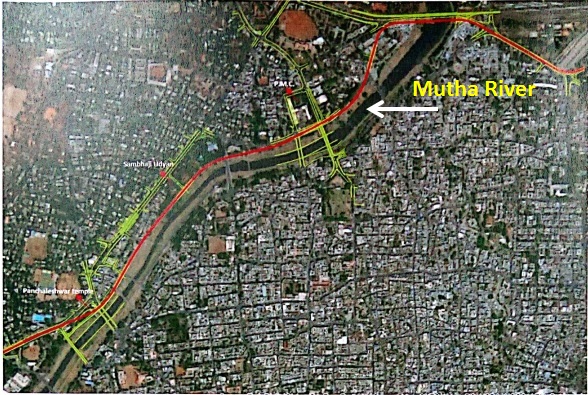
In the first phase two corridors of metro have been proposed in Pune. Corridor-I is of 16.59 km length from Pimpri-Chinchwad to Swargate and Corridor-II is of 14.6 km from Vanaz to Ramwadi. The petition before NGT Pune bench is against the 1.7 km stretch of Vanaz-Ramwadi corridor proposed through left bank of river Mutha. The metro route is proposed to enter the Mutha riverbed behind Savarkar memorial on Karve Road and proceed towards Pune Municipal Corporation (PMC) Bhavan and further to Food Corporation of India godowns behind Shivaji Nagar District Court.[ii] Two Metro stations are also proposed on the riverbed, one near Deccan Bus Stand and the other behind Sambhaji Park. Presently soil testing work for the project is in progress.

Proposed Metro alignment passing through Mutha riverbed (Source: Report of Technical Support Group on Biodiversity of PMC)

It certainly seems a good news for Pune’s rivers which have routinely made headlines for their pollution and poor state in general. Closer look towards the details however would cast a shadow on this development. The alignment through the river bed has been proposed despite PMC recently facing and losing a petition in NGT against 2.3 km long (and 24 m wide) road from Vitthalwadi to NH-4 bypass which was being constructed illegally right in the Mutha Riverbed. In its final judgment in July 2013 NGT ordered the road to be realigned. Subsequently a contempt petition was filed when PMC failed to comply with the orders where the NGT in January 2015 again ordered removal of the constructed road.[iii] Continue reading “NGT stays work of Pune Metro affecting rivers: Another violation of the river floodplain”

Dams · Maharashtra

Maharashtra Water Sector Review of 2016: Revival of scam tainted dams

When the Chief Minister of Maharashtra told the state Assembly on July 21, 2015, “We pushed large dams, not irrigation” he had raised much hopes for the state with a fresh memory of worst ever dam scam and drought termed as “worse than 1972”.[1]

Even though the CM unequivocally said in the state Assembly “Large Dams are not the road ahead”, looking back at year 2016 reveals that the approach of the new government remained as large dam centric. Year 2016 in Maharashtra has been all about reviving the corruption ridden controversial irrigation projects. Continue reading “Maharashtra Water Sector Review of 2016: Revival of scam tainted dams”

Dams · Krishna River · Maharashtra · Rivers

Krishna River in Maharashtra: A Profile

Above: Menawali Ghat at Wai, Satara Dist (Photo: Sanket Deshpande)

The mighty Krishna River bears the name of Lord Krishna; the beloved dark and dusky lord worshipped throughout the country. Originating but a few kilometers from Arabian Sea, the river has chosen to flow towards Bay of Bengal becoming a lifeline of four states viz. Maharashtra, Karnataka, Telangana and Andhra Pradesh. In its journey of thousands of kilometers and thousands of years, the river witnesses an amazing diversity in language, lifestyle, food and culture.

Maharashtra is blessed to be an upper riparian state in the Krishna Basin. Sahyadri ranges of Western Ghats falling in Maharashtra are abode to early flows of Krishna River. In Maharashtra the river is perceived in a feminine form called ‘Krishna Mai’ meaning ‘Mother Krishna’. The River Krishna is one of the important rivers flowing through Maharashtra and has a tremendous religious and cultural significance. Agriculture and economy of districts like Satara, Sangli and Kolhapur thrive on Krishna mainstream.

Here we make an attempt to provide glimpse of Krishna River within Maharashtra. The article is based on Maharashtra specific river profiles that SANDRP has prepared for India Rivers Week 2016. Continue reading “Krishna River in Maharashtra: A Profile”