Dams · Maharashtra

Tracing the Maharashtra Irrigation Scam: From 2012 to 2016

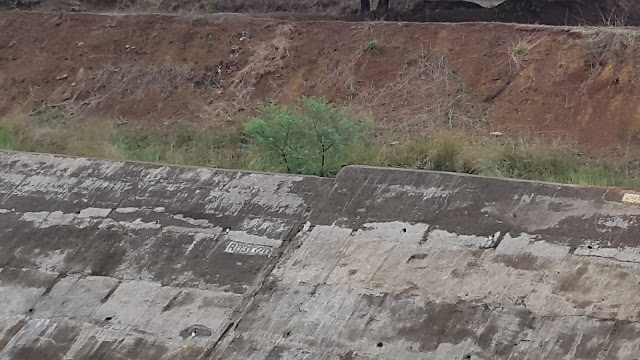
Above: Retaining wall of Gosikhurd RBC slid down from its location  Photo: Jan Manch

Aftermath of the irrigation scam exposed in 2012 in Maharashtra still continues. Roots of the scam were pointed out time and again by Comptroller & Auditor General of India (CAG) and also by several other committees set up by the Government. The scam was finally unveiled in May 2012 with a combined effort of several whistle blowers from inside & outside the government as civil society groups including SANDRP. Unjustified cost overruns, forged tenders, tweaking the norms of tendering process, incomplete projects laden with inferior quality work were brought to light and the unholy nexus of corrupt leaders, government officials and contractors became visible like never before.
Continue reading “Tracing the Maharashtra Irrigation Scam: From 2012 to 2016”

Maharashtra

Sinchan Shodh Yatra finds Gosikhurd Right Bank Canal incomplete even after a decade of construction

Above: Irrigation official confronting the angry farmer from Asolamendha village in Chandrapur District of Maharashtra Photo: Amruta Pradhan

“Farmers are dying… but your procedures have to be complete…”

Sight of an angry farmer saying this to an irrigation official has stayed with me long after I returned from visit to Gosikhurd Right Bank Canal (RBC). More often than not, I, like many others have read and written about mighty Gosikhurd- that multi thousand crore irrigation project languishing incomplete for last 32 years. I was now seeing personification of the havoc wrecked by this poorly planned and even more poorly implemented project.

I was at the Asolamendha dam, tail end of Gosikhurd RBC. 30-40 farmers from nearby villages suffering because of the shoddy work of RBC had gathered with complaints at tip of their tongue. Nature of complaints was serious. This incomplete canal running a total length of 99.53 km from Gosikhurd Dam in Pauni Tehsil of Bhandara District to Asolamendha Dam in Nagbhid tehsil of Chandrapur District has not only failed to provide irrigation  but is also destroying the catchment of the local water sources.

I was visiting Gosikhurd RBC as a part of Sinchan Shodh Yatra- a series of fact finding tours started since May 2015 by Jan Manch– a voluntary organization from Nagpur to uncover the shocking ground reality of corruption laden incomplete irrigation projects of Vidarbha region. The yatra that has visited 18 projects so far is being joined by more and more farmers who have suffered due to the poorly implemented, half done irrigation projects. It is becoming a platform for affected people to raise their voices and slowly emerging as a pressure group on irrigation officials. (Read more about Sinchan Shodh Yatra at https://sandrp.wordpress.com/2016/09/06/public-audits-of-corruption-ridden-irrigation-projects-in-vidarbha-sinchan-shodh-yatra/#more-15917)

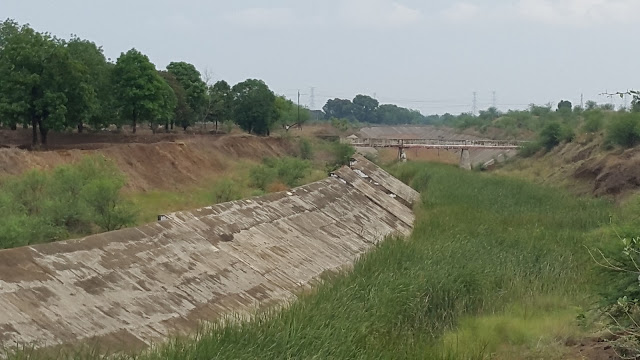
Shodh yatra consisting of about 70 people had taken an inspection tour of Gosikhurd RBC which was proposed to irrigate command area of 64,362 Ha but has been incomplete since last decade. During its journey of 50 km length of RBC (from 45 km from Gosikhurd dam to Asolamendha) Shodh yatra witnessed stalled work of the main canal which has not resumed for past more than three years, farmers agitating over host of issues from incomplete branch canals to crop damage caused by breach of canals and irrigation officials offering more and more excuses. Continue reading “Sinchan Shodh Yatra finds Gosikhurd Right Bank Canal incomplete even after a decade of construction”

CAG Report · Dams · Maharashtra

Public Audits of corruption ridden irrigation projects in Vidarbha: Sinchan Shodh Yatra

Right Bank Canal of Gosikhurd Dam (Photo: Jan Manch)

Controversial irrigation projects of Maharashtra continue to make headlines after massive irrigation scam that was unveiled in 2012. Following an inquiry in the scam, the state cabinet has recently scrapped 94 tenders of 14 irrigation projects worth Rs 9,196 Crore.[i] Around 52 of these tenders have been under the scanner of anti-corruption bureau (ACB), with first information reports (FIRs) filed in four of them. Continue reading “Public Audits of corruption ridden irrigation projects in Vidarbha: Sinchan Shodh Yatra”

Agriculture · Dams · Irrigation · Maharashtra · Marathwada

This is the time to protect Pulse Farmers in Marathwada

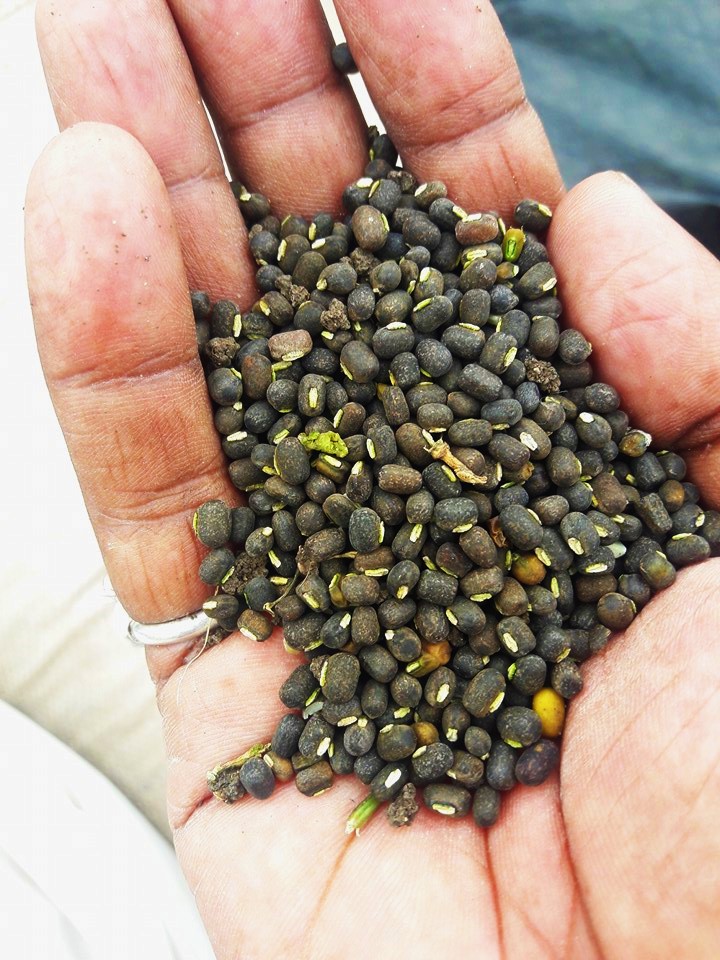
I have harvested Moong (green gram) from my farm, now I’m harvesting Udad (black gram). Their price is crashing each day…I may not get even the Minimum Support Price (MSP)…But I’m not supposed to care about the price… its solely the farmer’s responsibility to reduce inflation and make India a superpower.”

…says Ashok Bhau, a dry land farmer dependent on rainfall and groundwater in the heart of Marathwada: Osmanabad.

Last year his Moong failed completely, there was no seed development and although his Tur (Pegion Pea/Arhar) fetched a very good price, it did not mean anything for the family as the productivity was dismally low following three droughts and dry wells[i]. Like many farmers in Marathwada, he burned his sugarcane on 4 acres after watering it for many months… finally there was no water to sustain it. We had written about soaring pulses last year.udad (1).jpg Continue reading “This is the time to protect Pulse Farmers in Marathwada”

Maharashtra · Rivers

My visits to Pune’s Sewage Treatment Plants: Citizens Not Allowed!

Like almost all urban areas, Pune’s seage management has been dismal. In a recent Public Interest Litigation (PIL) filed against Pune Municipal Corporation (PMC) in National Green Tribunal (NGT) for failing to control water pollution in Mula Mutha Rivers it was revealed that several crucial details regarding sewage generation and disposal in Pune city remain unknown even to PMC. PMC failed to furnish even the basic details like present and future generation of domestic sewage (from 2022- 2025), present handling capacity and performance of STPs for six months.[i]

Japan International Cooperation Agency (JICA) has recently agreed to extend a loan of 1000 Cr. to PMC under project ‘pollution abatement of River Mula-Mutha’.[ii] Utilizing this funding PMC has proposed to build 11 new sewage treatment plants (STPs) with treatment capacity of 396 MLD (Million Litres per Day). It is hard to imagine that PMC who celebrated the signing of the loan agreement in January 2016 was not in position to furnish even the basic details about sewage generation and treatment in May 2016.

Currently in Pune there are total ten STPs with installed capacity of 567 MLD. Five of them have been funded by PMC while the other five have been funded by JNNURM (Jawaharlal Nehru National Urban Renewal Mission) Phase I. Operation & Maintenance (O&M) of these plants has been outsourced by PMC to various contractors. Treated effluent is being discharged in the rivers Mula, Mutha Rivers. PMC recently admitted in the print media that though the installed capacity of its existing STPs was to treat 567 MLD, only 290 MLD was being treated at present.[iii] The balance – almost 50% of the sewage – is going into the river untreated. Pune’s Rivers are some of the most polluted in the country. Continue reading “My visits to Pune’s Sewage Treatment Plants: Citizens Not Allowed!”

Dams · Maharashtra

Pune plans more STPs while existing plants under perform and there is no attempt to fix them

Above: Children trying to understand why their River Mutha is so polluted Photo: Parineeta Dandekar

Treating even 50% of its sewage is a dream that has been eluding Pune for decades. Mula, Mutha, Pavna and Indrayani Rivers crisscrossing Pune have routinely made headlines for pouring Pune’s sewage into Ujani Dam in the downstream, which supplies drinking water to several towns and villages, including the city of Solapur. All these rivers are classified as one of the 35 most polluted river stretches of India by Central Pollution Control Board (CPCB).[1]

Japan International Cooperation Agency (JICA) has recently agreed to extend a loan of 1000 Cr. under project ‘pollution abatement of River Mula-Mutha’.[2] Utilizing this funding PMC has proposed to build 11 new sewage treatment plants (STPs) with treatment capacity of 396 MLD. It is one of the star projects under Smart City programme and engineers of water supply department are gearing up for the construction of new STPs. As stated in the PMC newsletter of Feb 2016, the 11 new STPs will increase treatment capacity of Pune from current 477 MLD (Million Liters a Day) to 873 MLD which, it is claimed, will be sufficient to cater to sewage generation till year 2027.[3] Continue reading “Pune plans more STPs while existing plants under perform and there is no attempt to fix them”

CAG Report · Cumulative Impact Assessment · Environment Impact Assessment · Expert Appraisal Committee · Maharashtra · Ministry of Water Resources

महाराष्ट्र-तेलंगण आंतरराज्यीय करार: जनतेच्या मुलभूत हक्कांचे व देशाच्या पर्यावरणीय कायद्यांचे उल्लंघन

काल दि. २३ ऑगस्ट २०१६ रोजी महाराष्ट्र-तेलंगण आंतरराज्य मंडळाच्या आज झालेल्या पहिल्याच बैठकीत तुमडीहेटी, मेडिगट्टा आणि चनाखा-कोर्टा बॅरेज या तीन बॅरेजचे काम सुरू करण्यासाठी दोन्ही राज्यांदरम्यान करार करण्यात आले. कमालीची गोपनीयता पाळत केल्या गेलेल्या या कराराबद्दलची अत्यंत मोघम टिप्पणी प्रसार माध्यमांना  पाठविण्यात आली. तुमडीहेटी, मेडिगट्टा आणि चनाखा-कोर्टा बॅरेजमुळे महाराष्ट्र राज्यातील यवतमाळ, चंद्रपूर आणि गडचिरोली जिल्ह्यातील 30 हजार हेक्टर जमीन सिंचनाखाली येणार असून उपसा सिंचन योजनांना बारमाही शाश्वत पाण्याचा स्त्रोत उपलब्ध होणार आहे असे या टिप्पणीत नमूद केले आहे. तसेच या प्रकल्पामुळे महाराष्ट्रातील एकही गाव, गावठाण बुडणार नाही, नदीकाठच्या गावांना पुराचा धोका नाही व हे प्रकल्प दोन्ही राज्यासाठी फायदेशीर ठरणारे असून उपसा सिंचन योजनांना बाराही महिने पाणी मिळणार आहे असा दावा करत या भागातील नागरीकांनी या प्रकल्पांना विरोध करु नये असे आवाहनही महाराष्ट्राच्या मुख्यमंत्र्यांनी त्यांनी केले. Continue reading “महाराष्ट्र-तेलंगण आंतरराज्यीय करार: जनतेच्या मुलभूत हक्कांचे व देशाच्या पर्यावरणीय कायद्यांचे उल्लंघन”

Bihar · Dam Induced Flood Disaster · Floods · Ganga

A tale of two dams: Is Bihar’s unprecedented flood an avoidable man-made disaster?

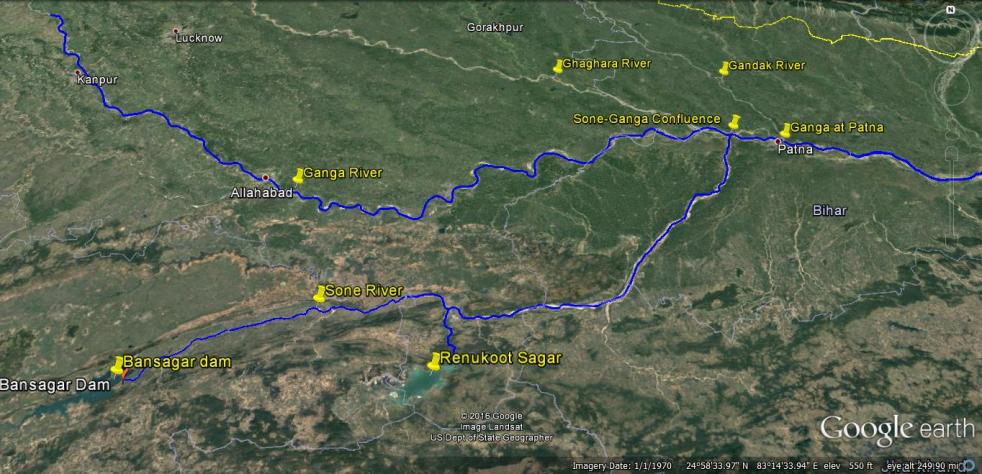
Above: Map Showing the location of Bansagar Dam, Sone River, Ganga River and Patna

Water level of Ganga at Patna reached 50.43 m on Aug 21, 2016 morning with still showing rising trend. This level was already 16 cm higher than the highest ever recorded flood level (HFL) of Ganga at Patna of 50.27 m. By Aug 22, 2016, at three more sites along Ganga, the water level had already breached the highest recorded levels: Balia in Uttar Pradesh (Ganga Water level at 60.3 m, higher than the HFL of 60.25 m recorded on Sept 14, 2003), Hathidah in Bihar (Ganga water level at 43.17 m, higher than the HFL of 43.15 m recorded on Aug 7, 1971, that is 45 years back) and Bhagalpur in Bihar (Ganga water level at 34.55 m, higher than HFL of 34.5 m recorded on Sept 3, 2013). This means that the highest flood level that started at Patna is now travelling both upstream and downstream along Ganga.

Several districts of Bihar along Ganga are facing floods, with at least 10 lakh people affected and about 2 lakh people displaced. On Aug 21 alone, NDRF teams have rescued over 5300 people from Didarganj, Bakhtiyarpur,  Danapur Chhapra, Vaishali and Maner. At least ten lakh people have been affected in Bihar, two lakh have been displaced and scores have been killed. It seems more like and annual natural calamity.

But that is not the case, if we look closely. Available information shows that the unprecedented floods that we are now seeing in Ganga in Bihar and UP are largely due to contribution of two dams: Bansagar Dam along Sone river in Madhya Pradesh in the upstream and Farakka Dam (misleadingly called a Barrage) on the Ganga river in West Bengal. If Bansagar Dam was operated in optimum way, than it need not have released over ten lakh cusecs of water. As pointed out by Bihar government, the high floods brought by Ganga in Patna are majorly due to the high flow contributed by Sone river upstream of Patna. Continue reading “A tale of two dams: Is Bihar’s unprecedented flood an avoidable man-made disaster?”

Sikkim · Teesta

TEESTA LANDSLIDE DAM IN DZONGU: RIVER OVERFLOWS OVER DAM BUT RISK CONTINUE

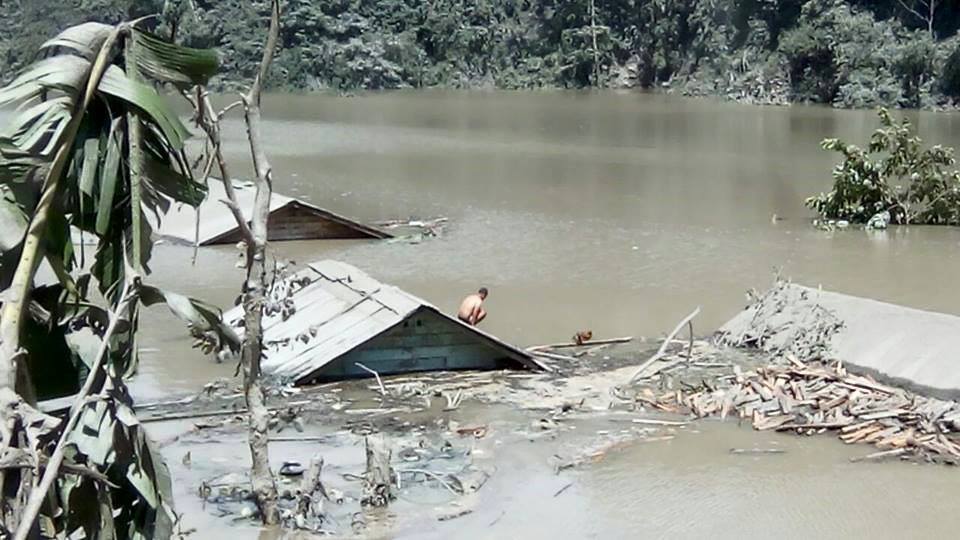
Above: Submerged houses in reservoir behind landslide dam. Photo from Darjeeling Chronicle

The Kanaka River is flowing over the dam that was created on Aug 13, 2016, it is confirmed now, but the risk of the dam failure and disaster downstream continues. In the meanwhile, the upstream villages, cut off due to road damaged and bridge submerged, are facing serious problems.[i] Continue reading “TEESTA LANDSLIDE DAM IN DZONGU: RIVER OVERFLOWS OVER DAM BUT RISK CONTINUE”

Sikkim · Teesta

LANDSLIDE DAM BLOCKS TEESTA TRIBUTARY IN NORTH SIKKIM: MAJOR RISK TO TEESTA RIVER BANK COMMUNITIES

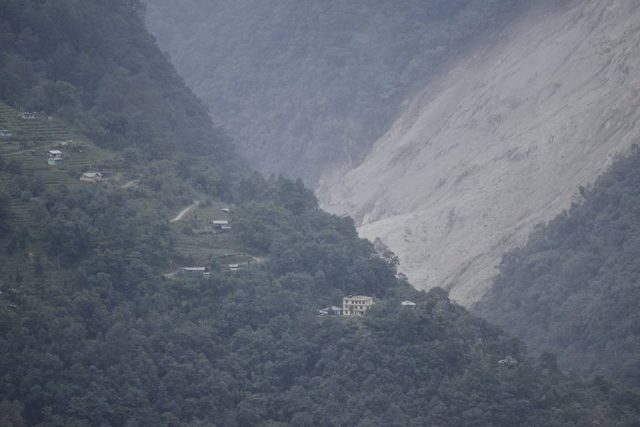
(Above: Lower part of the Dzongu Landslide, Photo from  Save the Hills)

According to a number of reports[i], at around 1230 hours on Aug 13, 2016, a massive landslide completely blocked the flow of Kanaka (Rongyoung) River near Mentam village in Dzongu region in North Sikkim. A hillock called “So Bhir” came crashing down, it is reported. The Landslide dam is about 50 m high, about 45 m wide, the landslide top point is about 900 m above the river. Darjeeling Chronicle reports, the river downstream is totally dry as the water has started collecting behind the landslide dam (that situation seems to have changed on 14th Aug morning around 830 am). Continue reading “LANDSLIDE DAM BLOCKS TEESTA TRIBUTARY IN NORTH SIKKIM: MAJOR RISK TO TEESTA RIVER BANK COMMUNITIES”