Above: A huge protest march against water release to Marathwada Photo: Zee 24 Taas
In 2015, with the change in the ruling party after 15 long years, Maharashtra had a massive opportunity to break free from the crisis-ridden and scam-ridden image of its water sector. Water and dams have been central behind the embarrassing loss of Congress-NCP government in the 2014 Loksabha elections. But could the ruling BJP government actually deliver such a “Paradigm Shift” as it likes to call it? Is there light at the end of the tunnel for the state that is facing not only management scams, but repeated droughts and extreme weather events?
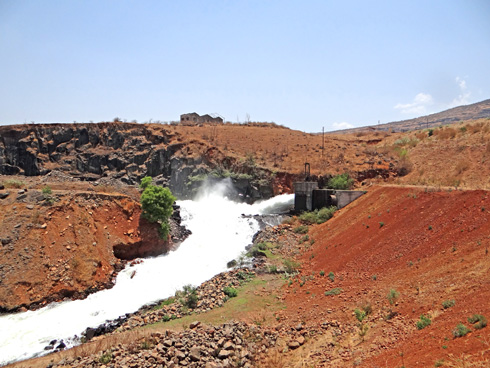
Above: Water released from Bhama Askhed Dam for Ujani Dam, April 2013 Photo:Author
Today (14th January 2016) Maharashtra’s Marathi AgroDaily announces[i]: “ 3 TMC Water will be released from Bhama Askhed and Chaskaman Dam for Ujani Dam from tomorrow, 15th January 2016. Looking at the opposition to this by farmers in Pune district, the release will happen under strict police protection. Electricity to farm pumps near the river will be disconnected for 7 days between 15th-22nd January to avoid water theft”.
Above: Placard proclaiming Ahmednagar’s claim over Mula Dam waters, protesting any downstream release Photo: Zee24 Taas
While largely unheard of in the country, bitter intrastate water conflicts are now routine to Maharashtra since the past few years. Come November or December, just as the state wearily puts behind one more sad monsoon, newspapers start carrying pictures of desperate farmers standing inside canals challenging dam authorities to release water. Politicians are quick to use this opportunity to deepen schisms between the state.Continue reading “Dams and Equitable Water Distribution: Learnings from Maharashtra”→
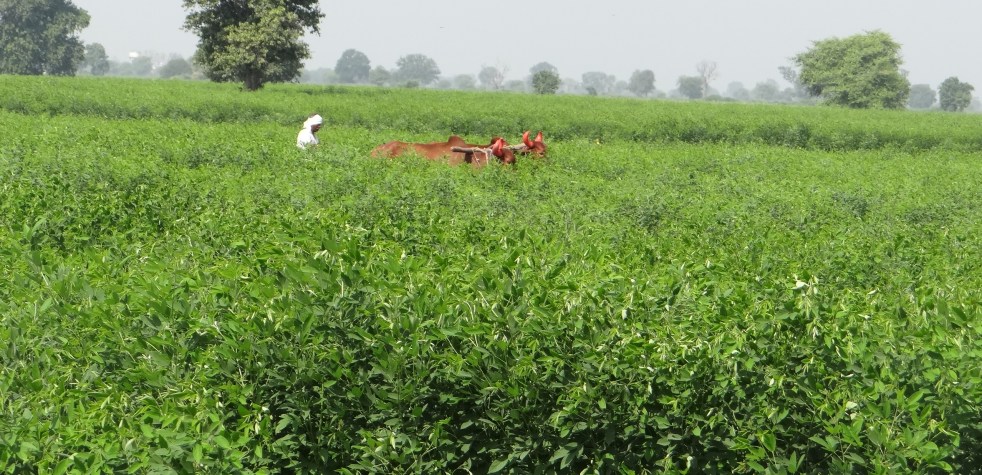
Above: A rainfed Tur (Arhar/Pigeon Pea) field in Amravati in Vidarbha region of Maharashtra Photo: Parineeta Dandekar, October 2015
Pulse prices are raging in Indian markets, leading to outrage from urban customers. Newspapers are full of coverage, cartoons and puns on pulse prices. The fate of rural population facing successive droughts which has to buy pulses is better left to imagination. If some benefits of this price hike were to reach actual pulse farmers, it would have been some consolation. But for now, as Pulse farmer Ashok Pawar from Osmanabad tells me, the Tur (Arhar/Pigeon Pea) that is in the market is last year’s. It was sold to the middle men (Adatya in Marathi) and market committee at a low rate as the production was dismal due to late rains and drought followed by unseasonal rainfall. This happened in 2013 too. Tur from 2014 is now being sold at a record price, the farmer watches this helplessly. Continue reading “Pulse Farmers: Custodians of Fertility, Water and Climate-friendly Agriculture”→
Sugarcane Crushing is set to start at any moment now in Maharashtra[i]. About 164 Sugar factories[ii] have put up proposals for securing Crushing Licenses with the Sugar Commissionerate of Maharashtra. With crushing, will begin debates, protests and demands for well deserved Fair Remunerative Price (FRP) for farmers and soft loans, subsidies, debt waivers and monetary help for sugar factories from state and Center. Sugar factories will put up justifications on why they cannot afford FRP (yet again) this year, how financially sick they are and, at the same time, how they are the only option for drought affected Maharashtra.Continue reading “Water and Sugarcane Crushing in Maharashtra: In search of sustainability”→
30th September marks the end of June-September South West summer monsoon in India and Maharashtra. The 2015 summer monsoon has proved to be the worst monsoon in the last six years for India. Rainfall deficits are seen in all major food-producing regions like UP (47% deficit), Bihar (28% deficit), Punjab and Haryana (32% deficit). This is India’s second successive year of high rainfall deficit, and only the fourth time this has happened since 1901.
Monsoon retreats from the country and the states on various dates. Some welcome showers are falling and are further expected in Maharashtra in the coming weeks, but the summer monsoon figures are now set. According to meteorologist Akshay Deoras. “Rain counters are refreshed on 1st October and new count of post monsoon season or winter monsoon season will start now.”
First week of October calls for an analysis of the summer monsoon, its performance in June, July, August and September and the implications this holds for various sectors.
People of Maharashtra have heard about, seen and experienced the dismal monsoon of 2015. Marathwada fared the worst, and was number one deficit state in the country at 52% deficit for a long time. However, at the end of monsoon, deficit of Marathwada is 40%. This is more worrisome as it comes piggybacking the 42% rainfall deficit in Marathwada in 2014, with rainfall of just 398.8 mm.
But, in order to understand the situation better, if one tries to analyse rainfall figures from various reputed official sources, one is taken aback by the disparities. We looked at official Indian Meteorological Department[i] figures, official Maharashtra Agriculture Department[ii] (Rainfall Recording and Analysis) figures and numbers from the 49th Cabinet Committee Note of the Government of Maharashtra dated 30th September 2015 accessed by SANDRP[iii].
All are concerned with Monsoon rainfall from 1-6-2015 to 30-9-2015. All of these contain different figures!
Indian Meteorological Department: IMD generates its rainfall data for Maharashtra based on its approximately 878 rain gauging stations spread across the state[iv]. According to IMD, regions of Maharashtra fall in rainfall deficit this year of varying proportions. Konkan region shows deficit of 31% with 2914 mm rainfall, Madhya Maharashtra shows deficit of 33% with 488.1 mm rainfall, Vidarbha shows deficit of 11% with 848.2 mm rainfall, but the highest deficit is Marathwada at 40% with 412.4 mm rainfall.
According to IMD, between 1st June to 30th September, Maharashtra has received 732.5 mm rainfall of its 1007.3 mm average normal rainfall, which is 73% of average rainfall (27% deficit).
5 Districts that have received 50% or less of the average rainfall include
The region-wise, month-wise rainfall in Maharashtra this monsoon, as per IMD figures was as per following table.
Rainfall, mm
Konkan-Goa
Vidarbha
Madhya Maharashtra
Marathawada
June
Normal
663
161
140
138
Actual
781
254
177
119
July
Normal
1147
318.9
247.8
192.5
Actual
581.5
137.8
111.7
26.8
Aug
Normal
759.6
305.7
289.1
188.2
Actual
388.7
288.9
56
112.2
Sept
Normal
344.7
169
152.4
164.2
Actual
253.8
167.5
143.4
154
Monsoon
Normal
2914.3
954.6
729.3
682.9
Actual
2005.0
848.2
488.1
412.4
Where is Madhya Maharashtra? Incidentally, IMD classifies the country in various categories. Maharashtra includes Konkan, Madhya Maharashtra, Marathwada and Vidarbha. Madhya Maharashtra includes Nashik and Pune Divisions of whopping 10 districts, from Nandurbar, Dhule, Jalgaon, Nashik, Pune, Ahmednagar, Satara, Solapur, Sangli and Kolhapur. This region is not uniform in any sense, neither rainfall-wise, nor geographically nor is it “Madhya (Central) Maharashtra”. Any assessment based on a Madhya Maharashtra is meaningless in a sense as it clubs Kolhapur, at the southern tip of Maharashtra whose normal rainfall is more than 1500 mm with Dhule at the northern end of the state whose normal rainfall is about 500 mm and includes areas of Tapi, Narmada, Krishna and Godavari basins. It is time IMD adds some rationale to its meteorological divisions in India.
Maharashtra Agriculture Department: Agriculture Department of GoM runs a very useful website: maharain.gov.in which displays detailed data from its Rainfall Recording and Analysis Department. It states: “The department of Agriculture, Maharashtra State initiated the project for recording daily rainfall in the state in year 1998. Initially rainfall data was recorded at tehsil level and subsequently same functionality was extended to circle level from 2013 as GoM has installed rain gauge at every circle. Circle officer sends daily rain data using mobile through SMS. In addition to SMS rain data can be entered directly on the web portal.”
Prima facie it appears that Agriculture Department may have a better spread in the over 40,000 villages in Maharashtra than IMD’s 878 rain gauging stations.According to Agriculture Department, of the 353 administrative blocks in the state (taluks):
65 bocks have received rainfall less than 50% rainfall (18.4% blocks). Most of these are concentrated in Solapur and Marathwada region.
174 blocks have received rainfall between 50-75% rainfall.
Just 23 blocks have received 100% or above of normal, and these are concentrated in Vidarbha and Nandurbar, Northern Maharashtra.
Cabinet Note of Government of Maharashtra, 49th Meeting, 30th Sept 2015: It reports that state has received 678.5 mm rain of the avergae 1131 mm, that is 59.9% or 60% of the average. But as we saw above, IMD says its 732.5mm of average 1007.3 mm, 73% of the average. There is no explanation for such widely different figures in the cabinet note.
Agricultural experts like Nishinkant Bhalerao states that the 60% magic figure will make any drought aid difficult and that it masks the monthly disparities which very badly affected this season’s Kharif. For example, Marathwada received barely 14% of its July average rainfall, a mere 28 mm, but cumulatively mainly due to late Spetmeber rains, this anamoly is hidden.
According to the note:
13 districts of Dhule, Nandurbar, Pune, Aurangabad, Buldana, Akola, Washim, Amravati, Wardha, Nagpur, Bhandara, Gondia, Gadchiroli received between 76-100% average rainfall,
17 districts of Thane, Palghar, Raigad Ratnagiri, Sindhudurga, Jalgaon, Ahmednagar, Satara, Sangli, Jalna, Beed, Latur, Osmanabad, Nanded, Hingoli, Yavatmal, Chandrapur eceived between 51-75% average rainfall and
In 4 districts, rainfall has been less than 50%, these include Nashik, Solapur, Kolhapur and Parbhani.
Strangely, IMD states Nashik received 729 mm rainfall till 30th Sept and has just 20% rainfall deficit but for the same period, Agriculture Department shows Nashik has received just 484.8 mm rainfall, and shows a rainfall deficit of about 52%! The difference between the two values is whopping 244.2 mm, more than entire seasonal rainfall of Solapur!!
IMD note also includes Beed (just about here at -50%) and Latur (-51%) in less than 50% rain, these are not included in the cabinet note.
Agriculture Department statistics includes Osmanabad in less 50% rainfall bracket, but it is not included in Cabinet Note
Cabinet note talks about 355 blocks, while Agri Dept considers 353 blocks and Government of India[v] considers 351 blocks in Maharashtra!
Sr. No
Cabinet Note, 30th September 2015
Agricultural Department Government of Maharashtra, 1st October 2015
Blocks with less than 25% rainfall
1
1
Blocks with 26-50% rainfall
49
64
Blocks with 51-75% rainfall
171
174
76-100% Rainfall
105
91
100% or more
29
23
While discrepancies in these sources is not the subject matter of this discussion, there is definitely a need to streamline and improve monsoon rainfall reporting. This is especially important at a time when policies, drought assistance, insurance payment to farmers and water allocation decisions are heavily dependent on rainfall figures. If we cannot get our rainfall figures right, it raises a lot of questions about our capacity to monitor and understand the most important weather event of the year, on which lives of over 50% of the population directly depend! There is a vast difference not only in observed rainfall, but also supposed normal rainfall figures, which skew up the percentages.
Below: Notable differences between IMD and State Govt Data
District
IMD (mm)
State Agriculture (mm)
Difference in Actual Rainfall (mm)
Normal
Actual Rainfall
% of Normal
Normal
Actual Rainfall
% of Normal
Dhule
523.5
533.5
101.9%
530.5
448.2
84.5%
85.0
Nashik
912.2
729.0
80%
1013
484.8
47.9%
244.2
Satara
723.8
455.7
63%
834.2
539.5
64.7%
83.3
Solapur
474.2
231.8
49%
488.8
193.9
39.7%
37.9
Kolhapur
1737.6
803.4
46%
1772.4
634.8
35.8%
168.6
Yavatmal
855
663.3
78%
911.4
479.1
52.6%
184.2
Nagpur
923.9
970
105%
988.5
938.2
94.9%
31.8
Solapur gets less than 1972 rainfall: According to Agriculture Dept, Solapur has received low rainfall of barely 193.9 mm from June-Sept. This is on top of 25% rainfall deficit in 2014 monsoon. In the epic drought of 1972 also, Solapur received more than this at 224.9 mm rainfall.[vi] This year, Solapur has received less than half of the rainfall Rajasthan received! This also seems to be the lowest monsoon rainfall Solapur received since 1901!
For two consecutive years, Parbhani has received less than 50% rainfall (326.9 mm this year). In fact it’s June –July August Rainfall this year is lowest in the century.
The district which has shown the highest deficit isKolhapur. As per Agriculture Department data, it has received just 634.8 mm rainfall, 35.8% of its normal average monsoon rainfall. Strangely, IMD shows 803.4 mm rainfall this monsoon for Kolhapur, which is 46% of normal. The difference of 168.6 mm is too huge to be ignored and needs to be explained.
Reservoir Storages:
Reservoirs storages at Maharashtra state level are at 56% of live storage capacity right now. But this is again masking the regional disparities. Marathwada has just 15% storage and 9 months ahead before the next monsoon. Four of its reservoirs are at 0 Live Storage (Mazalgaon, Manjara, Nimn Terna, Nimn Dudhna). The biggest Dam Jayakwadi is at a mere 7% storage.
Nashik division upstream of Marathwada also has relatively low storage at 59%.
Pune is slightly better at 61%.
Nagpur, Amravati and Konkan divisions are above 70%.
Some Contingency Planning steps:
Even in this situation, westward diversion of water from drought-hit Bhima-Krishna basin to high rainfall Konkan region and down to sea by Koyna and Tata dams continues, with no attempt to stop this completely wasteful diversion in this dry season.
No information is available in public domain about district-wise planning of available water resources till the commencement of next monsoon
No strong decision has been taken by the government about restricting or regulating sugarcane crushing which will commence from 15th October and which will consume lakhs of liters of water in the most severely drought-affected parts of the state.
No strong decision on limiting new area under sugarcane in Solapur and Marathwada regions, which will be planted after this harvesting and crushing season.
While IMD states that Maharashtra has received more than 70% average rainfall and State Government pegs it at around 60%, the reality is that water situation in Maharashtra especially Western Maharashtra, Nashik region and Marathwada is dismal. Erratic rainfall with long dry spell in July and August has affected Kharip crops, groundwater levels and surface water storages. There is a need to immediately work on a participatory contingency planning of the available water resources for the coming year.
This planning cannot happen in a closed door manner by the cabinet or group of ministers, but should include and respond to water users and farmers and should be built on the principles of equity and sustainability. MWRRA also needs to get into its act. The people of the state are waiting for such an initiatives from the government and MWRRA.
– Parineeta Dandekar, with inputs from Himanshu Thakkar
Above: Ashok Pawar’s motorbike cruises right inside his dry field, even after recent showers in Marathwada Photo: Ashok Pawar
After a heartbreaking gap, retreating monsoon is now blessing Marathwada with some showers. Small water harvesting structures and those built under the Jal Yukta Shivar Abhiyan, a flagship project of CM Devendra Fadnavis, are clocking an increase in water levels. 96.3% of average September rains in just the first 10 days of September (Dept of Agriculture, Govt of Maharashtra) is indeed a respite for a region that stands at the doorstep of an epic drought. What is lost in June-July-August in terms of crops failures, water scarcity, dismal dam storages etc., cannot be compensated by September rains, which are a fraction of total monsoon (June-July-Aug-Sept) rainfall. But if the rains continue, they can help drinking water situation and possibly Rabi crops. It is heartening to see the farmers celebrating this downpour.Continue reading “Sugarcane in Marathwada: A Syrupy debate amidst Lowest June-Aug Rainfall in the Century”→
Marathwada, a region known more for its routine and severe droughts in the recent years, now showing the highest rainfall deficit in the country at 48%[1].
Marathwada (which coincides with Aurangabad Division of Maharashtra) consists of 8 districts in the heart of Maharashtra: Aurangabad, Beed, Latur, Osmanabad, Parbhani, Jalna, Nanded and Hingoli.
The region has a population of about 1.87 Crores and a geographical area of 64.5 Thousand sq. kms. Nearly the entire region, barring parts of Beed, Latur and Osmanabad, falls in Godavari basin. This has historically been a rain shadow region with average rainfall of about 700 mm, but in districts like Beed, it dips down to 600 mm. Apart from Godavari, no major rivers originate or flow through Marathwada except rivers like Purna, Shivna, Dudhna, Velganga, Sindhphana, Bindusara, etc. These are modest rivers, which carry little water as the harsh summer approaches. This is unlike Vidarbha (to the east of Marathwada) which has mighty rivers like Penganga, Wainganga, Wardha etc., or Khandesh and Western Maharashtra to its north and west, which have bigger rivers, denser watersheds and more rainfall.
Since the past 4 years, Marathwada has been facing exceptionally cruel weather. June-September Monsoon, which is the lifeline of most of this rainfed region, has been playing truant. Last year, the region experienced highest rainfall deficit in the past 10 years at -42%. In two districts it was much more than 40%, leading to a severe water crisis.[2] To give you an example, the JJAS (June, July, August, and September) rainfall in Parbhani in 2014 was just 346 mm, barely 4 mm more than rainfall during the horrifying 1971 drought! These two are the lowest rainfall figures for Parbhani since 1902, for more than 113 years!Continue reading “Drought and Marathwada: An Oft repeated Tragedy”→
“Maharashtra has the country’s 40% large dams, but 82% area of the state is rain fed. We have moved away from our vision of watershed and conservation…We did not think about hydrology, geology and topography of a region before pushing large dams everywhere. But this has to change”
How a 15 MW project with 55 mts high dam threatens 5 villages and a fish sanctuary
After an analysis of a particularly nasty dam, I felt like going back to flowing rivers. It is monsoon after all. The plan was to visit Kal River in Western Ghats of Raigad District in Maharashtra to understand how a community in a small village called Walen Kondh is protecting the river and Mahseer fish. Mahseer (Deccan Mahseer, Tor tor) is classified as endangered as per IUCN classification and most wild Deccan Mahseer populations have been wiped out in India. And hence a small, out of the way place, protecting these fish as well as the river voluntarily was like a breeze of fresh air. Continue reading “White Elephant, Black Fish”→






 SANDRP