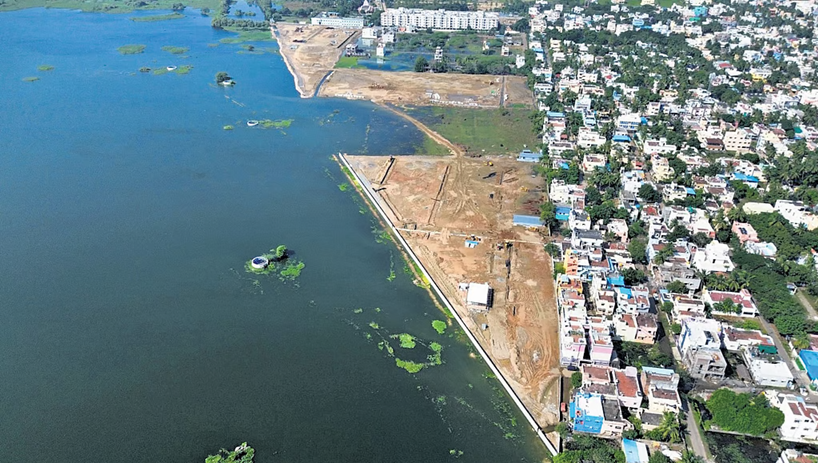
(Feature Image: An aerial shot of Madambakkam lake in Chengalpattu district, Tamil Nadu shows buildings on the banks of the waterbody: Source)
On occasion of World’s Wetlands Day 2026, this overview compiles top ten reports from 2025 covering decisions and steps taken by various state governments for the protection of wetlands in India. There could be some more relevant reports which we could not track and compile. The first part and second part of the overview have covered the continual degradation of Ramsar sites and other wetlands across the country.
Among all states the Punjab seems to have completed ground truthing of 1143 wetlands in 2025 and made recommendations for notification of 72 of them. The govts had also planned to complete the mapping of wetlands in of Odisha, J&K and Andhra Pradesh during the year. However, there is no further update on the present status of the exercise.
Notably, the second phase of Tamil Nadu State Planning Commission report has highlighted that the state economy is losing Rs 19,910.6 crore annually due to unrealized ecosystem services relating to 141 prioritized wetlands. As per the report the combined ecosystem value of 141 wetlands at 2024 prices stands at Rs 8,303.8 crore, while their potential value is Rs 28,214.37 crore.
The reports from Haryana and Gujarat suggests overall increase in coverage of surface water bodies. The VACB in Kerala and State Wetlands Authority Tamil Nadu took some steps to check illegal conversion of wetlands and protect Madambakkam lake from encroachment.
In Uttar Pradesh, the Jodhpur Jheel in Mathura is being developed as bird sanctuary. Under National Ganga Plan, the Bihar govt has got administrative approval for Rs 3.51 cr plan aimed at sustainable management of Nathmalpur Bhagad wetlands. The reports from Assam, Maharashtra and Karnataka indicate govts plans and initiatives are just limited to develop respective wetlands for ‘eco-tourism’ and water sport activities. Madhya Pradesh has annually been celebrating Jheel Mahotsav for tourism purposes.
At national level, the standing committee of the NBWL in its Aug. 2025 meeting has decided to finalize and circulate guidelines for infrastructural development in and around wetlands located within protected areas to all states and UTs. The NMCG in its 16th meeting has also asked Bihar and UP govts to expedite notification of 59 wetlands in Ganga basin. The MoEF&CC has taken up about 22,560 ha of land for mangroves restoration and conservation under MISHTI scheme.
1 Punjab Govt starts ‘ground truthing’ of 1,143 potential wetlands Forest department in March 2025 started ‘ground truthing’, a process of comparing satellite images with what is observed on ground physically, for 1,143 potential wetlands across the state. Punjab is the first state to do so, officials said. The process is aimed at identifying and developing new wetlands so as to improve the natural groundwater recharge system and push for organised protection of biodiversity in rural areas.
Govt recommends 72 water bodies for notification The decision was taken during the 3rd meeting of the State Wetlands Authority (SWA) in Sept. 2025, which reviewed conservation initiatives. The Supreme Court of India has in Dec 2024 directed all state & UT wetland authorities to complete ground-truthing & demarcation of the boundaries of all identified wetlands.
In Punjab, following ground-truthing, digital mapping, and evaluation of 1,143 water bodies by district wetland committees, 72 water bodies were recommended for notification. These include sites in Amritsar (2), Barnala (8), Faridkot (2), Fatehgarh Sahib (12), Fazilka (8), Ferozepur (3), Jalandhar (2), Kapurthala (4), Mansa (10), Moga (6), Patiala (3), Sangrur (5), and Muktsar (7).
The authority also approved an integrated management plan (IMP) for the Beas river, with a 5-yr budget requirement of Rs 38.45 cr. The approved plan will now be sent to the MoEF&CC for funding under the National Plan for Conservation of Aquatic Ecosystems (NPCA).
In March 2025, Rural Development and Panchayats Minister Tarunpreet Singh Sond in state assembly stated that Bathinda Rural district had 173 ponds spread across 65 gram panchayats. He said 5 ponds in the constituency had been developed using the Seechewal-Thapar model. “Work is underway to develop 16 more ponds using the Seechewal-Thapar technique. It is proposed to clean and renovate the remaining village ponds in a phased manner over the next 3 years,” he said.
After visiting Seechewal village and seeing its wastewater management system, named Seechewal model, the Deputy speaker Jai Krishan Singh Rouri on March 30, 2025 announced that the panchayats of 178 villages in Garhshankar would be brought to Seechewal and Sultanpur Lodhi to study the model. On March 28, 2025, Balbir Singh Seechewal said that the ‘Seechewal model’ of cleaning ponds has been running in nearly 250 villages across Punjab.
2 Tamil Nadu Failure to restore wetlands costs economy ₹19K cr per year: Planning panel The state economy is losing Rs 19,910.6 crore annually due to unrealized ecosystem services relating to 141 prioritized wetlands, according to a report submitted by the State Planning Commission. The report highlighted that the combined ecosystem value of 141 wetlands at 2024 prices stands at Rs 8,303.8 crore, while their potential value is Rs 28,214.37 crore.
The report, Economic Valuation of Ecosystem Services – A study of 61 prioritized wetlands/waterbodies in Tamil Nadu, released by CM MK Stalin, is the second phase of the study on wetlands. The first phase covered 80 waterbodies. The report suggests community-based management as a long-term strategy for sustainable waterbody governance, as local communities possess traditional ecological knowledge accumulated over generations.
The study also highlighted the fact that unilateral water transfers to cities, without compensating traditional users, triggers a cycle of displacement, increased urban demand, and ecosystem degradation, undermining sustainability. “Prioritizing urban water use over rural livelihoods is a false economy with hidden social and environmental costs,” it added. The report reiterated the finding that current wetland loss rates – three times faster than forest loss – threaten the foundational resources necessary for sustainable development.
According to the report, the total restoration cost for all 61 inland wetlands is estimated at Rs 5.4 crore (2024 prices) – this spending could help avert losses up to Rs 13,081 crore per annum which arise due to wetland degradation. In the first phase of the study, the ecosystem value of 81 water bodies was assessed. The report highlighted the fact that most waterbodies and wetlands in the study are owned and managed by the Public Works Department (PWD) and are mainly used for irrigation.
However, declining agricultural activities have reduced the demand for irrigation, shifting to diverse activities like recreational opportunities, local fisheries, biodiversity conservation, groundwater recharge and climate regulation. As a result, a multi-agency governance structure is needed – including local communities, environmental departments, tourism boards, and fisheries authorities, among others – to ensure equitable distribution of multiple benefits from the wetlands.
3 NBWL States, UTs to adopt guidelines for wetland infra The standing committee of the National Board for Wildlife (SCNBWL) has decided that guidelines for infrastructural development in and around wetlands located within protected areas and their designated eco-sensitive zones will be circulated to all states and UTs and adopted following finalization – a move that could protect these vulnerable and critical ecosystems, although some experts question the need for infrastructure projects in wetlands.
According to minutes of the 85th meeting of the SCNBWL held on Aug 19, 2025 the member secretary of SCNBWL, Ramesh Kumar Pandey said that directions were given in the 84th meeting for formulating guidelines for infrastructural development in and around wetlands located within protected areas and their designated eco-sensitive zones. Pandey added that an in-house committee had been formed within the ministry and an outline of the draft guidelines prepared.
HT reported on August 25, 2025 that an in-house committee was constituted to facilitate the guidelines for infrastructural development in and around wetlands located within protected areas and their designated eco-sensitive zones. The draft guidelines for SCNBWL’s consideration say they will apply to all new infrastructure projects proposed within or in proximity to wetlands located in protected areas and their notified eco-sensitive zones, and the operation and maintenance of existing infrastructure in such areas.
The protected area manager/wildlife warden shall serve as the nodal authority for the enforcement of the guidelines. Wetland health indicators shall be incorporated into annual monitoring schedules. Annual compliance reports on all infrastructure within wetland buffer zones shall be submitted to the chief wildlife warden and the State Board for Wildlife. Violations shall be subject to action under applicable provisions of law.
Birder and conservationist Anand Arya cited the agenda and asked how there could be any infrastructure project within a protected area. “The nature of infrastructure projects needs to be clarified. Are the wildlife and protected areas being opened? And for what kind of infrastructure? That needs to be defined first.”
3 Haryana 68k small wetlands revived in a year: Govt Haryana revived 68,827 small wetlands (most of them below 1 ha area) in a year as part of the Amrit Sarovar Mission and Mission Sahbhagita, state govt officials announced at Ramsar COP15 being held at Victoria Falls in Zimbabwe in July 2025.
The initiative involved gram panchayats, local communities, schoolchildren and NGOs. They were asked to identify, restore and maintain these water bodies. The state targeted small wetlands — ponds, johads and other traditional water bodies that had either dried up, vanished, or became waste-dumping sites.
Artificial wetlands fuel 10% growth in wetlands area The total wetland area in Haryana grew from 33,649 ha in 2017-18 to 36,984.5 ha in 2023-24, marking an increase of 3,335.5 ha, or 10%, as per a report “Indian Wetlands: High Resolution Remote Sensing Assessment and Analysis” by the Space Applications Centre.
5 Gujarat Lake, reservoir areas improved by 577 sqkm: Study A study by IIT Roorkee indicated that Gujarat recorded a rise in lentic water bodies (LWB) by 577 sq km from 1990 to the 2020s. Water bodies with still water, such as ponds, lakes, and reservoirs, are identified as LWB. Based on satellite data analysis along with other parameters, researchers indicated Gujarat had 308 sq km area of LWB in 1990, which increased to 885 sq km, marking a rise of 187% as per a study, ‘Exploring the Intersection of Socioeconomic and Environmental Changes and Their Impact on India’s Lentic Water Systems,’ by Pooja Singh et al IIT-R and Germany-based Technical University of Braunschweig.
According to the study, LWBs in Punjab fluctuated from 21.2 sq km to 30.9 sq km over three decades, whereas in West Bengal, the range was 557.3 sq km to 459.8 sq km. The LWB area in Kerala grew from 44.5 sq km to 72.3 sq km over three decades, the second highest among the four states after Gujarat. More importantly, the study highlighted that the LWB trend can be attributed to the overall positive trend of total water – growing from 27,225.3 sq km to 36,231 sq km in three decades. ‘Overall, the total water area exhibited differing trends throughout states, with Gujarat showing the most substantial positive growth and Punjab showing the highest drop, despite an ongoing rise in the number of LWB,’ indicated the study.
Rainfall, urbanization reshape Gujarat’s water map Another satellite study tracking the state’s surface water changes from 2020 to 2024 finds Kutch region recorded the largest increase in water body area, with an impressive 746.87 sq km gain. Ahmedabad district witnessed a moderate 36.59 sqkm increase in water body area, accounting for a 0.53% rise due to urbanization and water conservation projects.
Bharuch emerged as the top performer with an increase of 66.08 sqkm – likely driven by recent investments in check dams, canal rejuvenation and wetland revival. Districts such as Anand (52.17 sq km), Bhavnagar (32.39 sq km), and Banaskantha (21.35 sq km) posted substantial gains, pointing to improved water conservation practices, favourable rainfall and the construction of new reservoirs or farm ponds.
Saurashtra experienced a net decline of 37.37 sq km. Tapi, however, saw the sharpest district-level loss at 44.54 sq km. Rajkot district saw the largest water body loss at 30.67 sq km, likely due to “rainfall decline” or “groundwater overuse”. Other districts that saw reductions include Aravalli (21.58 sq km) & Narmada (20.80 sq km). Jamnagar, Morbi, Junagadh & Porbandar also faced notable reductions.
6 Odisha Govt initiates demarcation of 13,000 wetlands In March 2025 state govt initiated process for demarcation of over 13,000 wetlands for their conservation. Acting on the directions of the Supreme Court, the Forest department has taken up ground truthing of 13,667 wetlands with area over 2.25 ha, identified by the Space Application Centre (SAC).
The apex court had in its order directed the state/Union Territory Wetland authorities to expeditiously complete the ground truthing and demarcation exercise of the boundaries of each of the wetlands identified by SAC Atlas, 2021 and had set a three-month timeline for the same. Following the Supreme Court judgement, the Orissa High Court also initiated a suo motu PIL in January 2025 to monitor the conservation of wetlands in the state. Accordingly, sources said, the state government engaged the Chilika Development Authority (CDA), responsible for the management and protection of Asia’s largest brackish water lagoon, as the nodal agency to implement the wetland conservation measures.
7 Andhra Pradeesh Initiative to conserve 16 key wetlands This was stated by Forest & Environment Minister Pawan Kalyan during SWA meeting on Oct. 14, 2025. He noted that the wetlands identified include areas in Sompeta and Taveti mandals, which will be developed into a sprawling eco-tourism corridor spanning thousands of acres. Special bird conservation centres are also planned in Veerapuram and the sacred sites of Rajahmundry to protect rare species and attract tourists.
Mr. Kalyan said the State has 23,450 wetlands, of which 99.3% have completed digital boundary mapping. The remaining physical demarcation is expected to be finished by Oct. 28, 2025 through coordinated efforts by the Forest, Revenue, and Survey Departments. “The identification and conservation of wetlands will create eco-tourism opportunities while safeguarding natural resources for future generations,” he added.
8 Jammu & Kashmir Govt to complete wetland mapping Minister Rana explained that district wetland management units have been formed with the Deputy Commissioner concerned heading each unit following a government order. The department has initiated the mapping of wetlands using remote sensing data, which is being followed by ground-truthing and the demarcation process. This work is being carried out in collaboration with various stakeholder depts. Rana said the exercise is scheduled for completion by March 2025 end.
9 MoEF&CC Mangrove restoration The Union govt has taken up about 22,560 ha to restore and conserve mangroves under the Mangrove Initiative for Shoreline Habitats & Tangible Incomes (MISHTI) initiative over the past two years, it is claimed. While 19,220 ha has been taken up in Gujarat, 10 ha of mangrove plantation has been taken up in West Bengal which accounts for about 42% of mangrove cover in country. A national workshop on MISHTI was held in Andhra Pradesh on Jan 8-9, 2026.
10 NMCG 16th Meeting of Empowered Task Force In the 16th meeting of the Empowered Task Force (ETF) held on Sept. 25, 2025, special focus was on the status of wetlands in Uttar Pradesh and Bihar, where 282 & 387 wetlands were assessed respectively, with 40 in Uttar Pradesh & 19 in Bihar identified as high priority. The Union Jal Shakti Minister, chairing the meeting, urged both states to expedite notifications & provide protection to these wetlands.
Other Relevant Reports
Tamil Nadu SWA seeks report on Madambakkam lake encroachment The SWA in June 2025 requested an immediate action taken report from district authorities regarding the protection and management of Madambakkam Lake in Chengalpattu district. The direction came in the wake of multiple petitions filed by local residents and environmental activists raising concerns over sewage pollution, encroachments, and developmental threats to the waterbody. The lake, recorded as ‘Periya Eri’ in the A-register, is spread on 247 acres, but discrepancies were flagged as the Field Measurement Book sketch shows only 237 acres.
The authority said there was a need to verify the actual extent of the lake and noted that the district forest officer, Chennai Division, was asked to submit a field inspection report, which is still pending. The TNSWA letter said petitions were received alleging unregulated development in survey numbers closer to the lake, which could increase flood risks during heavy rains. The lake is listed in ISRO’s National Wetland Inventory and Assessment (NWIA) reports of 2011 and 2021. In line with the Supreme Court’s order dated Dec 11, 2024, the authority instructed district officials to conduct ground truthing and shapefile demarcation to legally protect the lake under the Wetlands (Conservation and Management) Rules, 2017
Kerala Illegal conversion of wetlands The Vigilance and Anti-Corruption Bureau (VACB) have uncovered a well-entrenched racket involving real estate developers, agents, and revenue officials who illegally convert paddy and wetland areas for construction, including suburban villas and gated communities, which are in high demand in Kerala’s booming housing market. On Nov 7, 2025 the VACB conducted surprise inspections at 27 Revenue Divisional Offices (RDOs) and also at the offices of 32 Deputy Collectors tasked with enforcing the Kerala Conservation of Paddy Land and Wetland Act, 2008.
Director, VACB, Manoj Abraham, authorised the operation code-named Haritha Kavacham after the anti-corruption agency’s intelligence wing flagged the existence of a mafia, including criminal gangs that own dumper truck fleets and use illegally mined earth to convert paddy fields into dry land for construction. Investigators said the “agent-builder-realtor-official” nexus provided cover for the widespread environmental crime by legitimising the illegal conversion. They said RDOs were the racket’s hubs. The offices maintain the wetland paddy land data bank, an essential digital record that identifies and categorises the nature of the land within their respective jurisdictions.
Assam Drive to evict over 600 families from Hasila beel The Assam govt on June 16, 2025 launched a massive drive to evict over 600 families from a 1,550-bigha wetland area in Goalpara district. The eviction and demolition of homes began with heavy security deployment in Goalpara district’s Hasila Beel village. Goalpara DC Khanindra Chaudhury oversaw the eviction drive.
The eviction drive displaced hundreds of families, raising serious questions about procedural fairness, administrative accountability and the human costs. Nearly 667 families were uprooted, with bulldozers and excavators dismantling homes, schools, and even a Jal Jeevan Mission (JJM) project. The affected families say they received no adequate warning or alternatives. Some had been living on the land for over 40 years and were even provided govt housing and electricity connections.
Dighalipukhuri set for green makeover Assam Tourism Development Corp (ATDC), on May 08, 2025 launched a project to clean and rejuvenate the historic Dighalipukhuri, one of Guwahati’s most iconic and culturally significant water bodies. Dighalipukhuri, which contains more than 285 million liters of water, has faced severe pollution issues in recent years that led to declining aquatic health, including mass fish deaths. The project will employ SABRE (Stabilised Aerobic/Anaerobic Bioengineered Reaction Environment) technology. The initiative will be executed over a 4–6 weeks.
The SABRE technology has already been successfully implemented in water body rejuvenation projects across Varanasi (Durgakund Lake), Pimpri, and Pandharpur, demonstrating its effectiveness in restoring polluted lakes and rivers.
Bihar New life for Nathmalpur Bhagad wetlands The Department of Environment, Forest and Climate Change (DEFCC) on June 2, 2025 received administrative approval and expenditure sanction for “conserving and sustainably managing Nathmalpur Bhagad (wetland)” from the Centre. “Technical support may be sought from an expert organization or agency. The project, approved at an estimated cost of Rs 3.51 crore under the National Ganga Plan (NGM-II budget head), will span 4 years from 2025–26 to 2028–29 across 2 phases: Phase I (2025–26) and Phase II (2026–29),” an official statement said.
“The project proposes a dual-level intervention — both at the sub-basin level (Ghaghara, Gomti, and Sone confluence with the Ganga) and at the site level (Nathmalpur Bhagad),” Harjot Kaur Bamhrah, Additional Chief Secretary of DEFCC said. According to the Bihar Economic Survey 2024–25, tabled in the Assembly in Feb. 2025, “As per the National Wetland Atlas (NWA)-2010, Bihar is home to 4,416 wetlands, each covering at least 2.25 hectares. Additionally, about 17,582 smaller wetlands (less than 2.25 hectares) also exist in the state.”
Uttar Pradesh Jodhpur Jhal wetland being developed as bird sanctuary Jodhpur Jhal, a wetland spread over 64 ha in the Koh village of Mathura’s Farah block, is being transformed into a bird sanctuary, officials said. Located just eight kms from the Sur Sarovar Bird Sanctuary in Agra and 35 kms from the Keoladeo National Park in Bharatpur, the wetland is expected to become a significant attraction for bird watchers and tourists. The sanctuary will feature seven water bodies, 13 islands, and a 2,200-metre nature trail with 13 huts for visitors to rest. The project is being executed with a budget of Rs 8.66 cr.
Maharashtra Wetlands to be declared as eco-tourism destinations soon The govt has begun the process to declare at least one wetland in each district along the Konkan coastline as eco-tourism destinations. Konkan commissioner Jagdish Patil directed collectors from Mumbai Suburban Palghar, Thane and Raigad to survey and select one wetland site each. The collectors need to submit the location during the next meeting of the wetland grievance redressal committee (constituted by the Bombay high court (HC) in Aug 2016) later this month.
Revival plan for Bhigwan wetlands On July 7, 2025 the forest department has presented to the Pune district collector a restoration plan for Bhigwan wetlands known as ‘Bharatpur of Maharashtra’. The plan aimed at long-term conservation plus sustainable tourism revolves around improving the habitat for migratory and resident birds while ensuring the ecological integrity of the wetland. Among the key measures included are installation of bamboo perching poles and floating platforms across water bodies to provide essential resting and feeding spots for visiting birds; and construction of earthen mounds within the wetland as also installation of raised nesting shelves along the embankments to further support nesting and breeding. These interventions are designed to attract species such as herons, egrets, and other waders.
Karnataka 7 lakes to be developed for water sports Tourism and the Minor Irrigation Departments are starting water sports in seven lakes in Shivamogga district. The Tourism Department had recently called for a tender. Balligavi Basavannana Kere, Doopadahalli Doddakere, Talagunda Hirekere, all from Shikaripur taluk; Keladi Kere from Sagar taluk; Kubaturu Kere in Sorab taluk; Humcha Mutthina Kere in Hosanagar taluk, and Gopishetty Koppa Doddakere in Shivamogga taluk will be developed to provide water sports.
Environmentalists say that while non-motorised activities might not have a direct impact on the ecosystem of the lakes, fish might be disturbed. However, it is the activity that comes with tourism that concerns them. “The major thing is the pollution that’s caused from single-use plastic in places declared as tourist destinations. Tourism in such places itself is hazardous to nature. Once these lakes become tourist destinations, more people will arrive and that will mean more private vehicles. Then they will go for road widening which will lead to landslides. Since the tenders will be awarded to private entities, it will also increase their dominance around these lakes. In a climate emergency scenario, such development of tourism is not necessary,” opined Akhilesh Chipli, an environmentalist.
Madhya Pradesh Jheel Mahotsav: Largest water carnival begins The Jheel Mahotsav, focused on MP’s cultural heritage, too place in April 2025 the first time in the Jabalpur and Mandla districts. The 15-day Jheel Festival is taking place at the scenic Bargi Dam from April 5-20, promising a unique blend of water, land and aerial adventure activities set against the breathtaking backdrop of the Narmada River.
First started in 2016, this year’s festival kicked off on April 5 with inaugural festivities led by Public Works Minister Rakesh Singh and Public Health Engineering Minister Sampatiya Uike. Several members of parliament and members of legislative assemblies, along with district collectors from Jabalpur and Mandla, were also in attendance.
SANDRP

 SANDRP