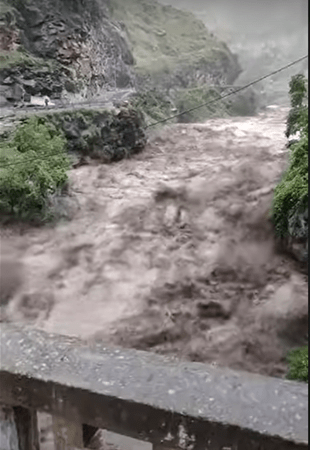
Scary visuals and messages on social media as also some of the pronouncements of the Supreme Court about Himachal Pradesh have shown that Western. Himalayan states have faced multiple flood disasters in the ongoing SW Monsoon 2025. Landscape of Himalayas is known to be vulnerable to landslides, mudslips, cloudbursts, flash-floods, GLOFs, erosion, seismicity and floods. While some floods are inevitable in the kind of climate prevailing here, how they become disasters is linked to the way we have treated the landscape, environment, regulations, people and floods.
A number of anthropogenic factors have increased proportions of the disasters. Himachal Pradesh has the highest installed capacity of hydropower projects and highest number of dams among all the Himalayan states. But Uttarakhand and Jammu & Kashmir are also racing to catch up. Honest Environmental, Social and Disaster Impact Assessments & Management Plans, at project and river basin level, along with credible carrying capacity and cumulative impact assessments, transparent appraisal process including independent experts and confidence inspiring public consultations, credible monitoring and compliance mechanisms are some of the key requirements in decision making process related to such projects, particularly in fragile Himachal landscape. Most of these aspects are missing both at state and central level and they are not even being missed! The Union Ministry of Environment and Forests as also the state governments are majorly responsible for this state of affairs. Local communities must have decisive place in planning and decision making, today they have NO place.
It is claimed that the existing hydropower projects and dams can help moderate floods. This can happen only if they are operated with that objective in mind. Their Standard Operating Procedures, including rule curves, necessarily updated every 3-5 years must be in public domain along with identity of responsible persons. Dam operations must be informed by actual water flow and rainfall in the upstream and downstream catchments and rivers and the carrying capacity of the rivers and catchment in the downstream. All information related to dam operations must promptly be in public domain, on website on a daily basis, archived for at least five years. Functioning early warning systems must be in place, not only in glacier areas in catchments of dams and hydro projects, but also in all landslide or flash flood prone stream catchments. Accountability mechanism must be in place and kick in whenever any of the dam and hydro project operating procedures are not followed.
Rivers and streams must have the adequate waterway capacity to carry the likely floods. To maintain this through policy and regulations, must be legal responsibility of the water resources departments. The existing encroachments, particularly those that have happened over the last couple of decades must be systematically and humanely removed, while not allowing new ones to happen. Today we do not have even a policy as to how much space each river needs in its different locations.
Similarly, muck created in the construction of projects including dams, hydro projects, roads, railways, townships, bridges, mining, etc must be disposed in a systematic way so that it does not enter rivers and reduce their carrying capacity. This requires policy and credible governance including monitoring, compliance and accountability mechanisms.
We also need to learn lessons from each disaster we face. The government must institute an independent assessment of each disaster to understand what happened, who played what role, what lessons can be learnt and whom to hold accountable. Without this basic step, we cannot even start understanding the impacts and implications of these disasters, nor learn lessons for future.
The First Information Reports (FIRs) filed in Aug 2025 by the HP government against BBMB and other dam operators is a good first step, but it must be taken to its logical conclusion. Its fate should not be like that of the notices that HP Chief Secretary issued to a number of dam authorities in Aug 2023. It seemed more like an action for the name sake considering the ineffectiveness of it.
We also need to underline the failure of Central Water Commission, the national flood forecaster that has so gloriously failed year after year for decades now. It not only failed to forecast most major floods, its monitoring itself seems to break down at every whiff of disaster. Its inflow forecasting does not take into account rule curve, upstream dam storage situations, nor is it ready to name any of the dams for wrong operations.
Similarly IMD has failed to provide actionable, location and time specific rainfall forecast before most disasters. We hear the word cloudburst so regularly, but in most cases, IMD refuses to certify any of them as cloudburst event as in most cases it does not have the means to quantify the local rainfall as its rain-gauge density is so low. The doppler radars that can help forecast high intensity rainfall events don’t seem to function at most necessary places. And IMD badly fails to report or forecast river basin and sub-basin wise rainfall, the key requirement to forecast river and dam inflows.
On disaster management, we continue to do better in rescue and relief, but we are miserable failures in prevention, on which front so much can be done. A good example is the GLOF management guidelines brought out by the National Disaster Management Authority in Oct 2020. The guidelines have so much to suggest in terms of preventing the disasters or reducing its impact, but none of the key recommendations are implemented almost five years since the guidelines came out. There is no action plan in place to ensure their time bound implementation.
The most spectacular failure related to GLOF was seen in the Himalayan state of Sikkim in Oct 2023, when the largest dam and hydropower project of that state got washed away. GLOF was a known risk in that region, and local communities had written about this to the decision making bodies, and even petitioned the judiciary, all to no result. And believe it or not, the MoEF’s Expert Appraisal Committee on River Valley Projects and also the MoEF sanctioned reconstruction of the project based on the same old flawed EIA that did not take into account GLOF risk among other usual flaws.
Why are the National Dam Safety Authority and State Dam Safety Authorities completely silent on the avoidable disasters brought by the wrong operations of dams year after year? Why do we see no impact of the Dam Safety Act on our dam safety track record? It comes out year after year that the callousness of National Highways Authority is responsible for a number of violations and landslides in state after state and yet, there seems no corrective action in place. Similarly there are huge questions about the functioning of National and state Tourism departments, pilgrimage authorities, and most pertinently about the roles of judiciary, media and academics. Sadly, the cost we pay for all these failures is multiplying in changing climate.
In many cases while dealing with these disasters, we are happy to use phrases like climate change, unprecedented and cloudbursts to convey as if we could not have done anything at such events. In reality we know this is exactly what is likely to happen in the Himalayas in changing climate. The factors described above are acting as force multipliers. The choices we make today is going to decide how the situation will pan out in future.
Is any of this asking for too much? Without all this, can we address the increasing threat of flood disasters that Western Himalayan states are facing? The fact is, without all these, we will be facing increasingly bigger disasters and progressing towards the Supreme Court Prognosis about Himachal Pradesh disappearing from the map. Let us work to ensure that SC’s prognosis does not become a reality for the Western Himalayan states. In fact the Himalayas and Himalayan rivers have been speaking louder and much earlier than SC. If only we care to hear through the commotion of almost daily din of disasters. If only we would pay heed. Earlier the better.
Himanshu Thakkar (ht.sandrp@gmail.com)
NOTE: An edited version of this was published on Aug 30 2025 here: https://www.tribuneindia.com/news/premium/dams-negligence-and-the-making-of-himalayan-floods/

 SANDRP
We as people of India should come together and request the honorable Supreme Court with folded hands to please stop all the heavy construction projects and engineering marvels that are ongoing in different himalayan states because those are the real reasons for the disasters of such a large scale. We have seen landslides before such heavy engineering were performed but not endangering thousands of lives as people living in the mountains have learnt from their birth how to adapt themselves.
River front development ie concrete walls or stairs are not meant for himalayan rivers because these rivers can bring down the whole mountain with them during excessive rains.
Changing the whole landscape into a visual paradise is okay for artificial intelligence but not in reality in places above 10,000 feet. (Even Switzerland doesn’t have it. And whatever they have made 100 years back still stand in that position because Alps is not young mountain as our Himalayas).
If infrastructure development becomes a power game to show our neighbourhood who’s the boss then let it be practised in some plains where millions of villages still lack the basic amenities.
And finally, those working to have a safe environment in the disaster prone zones, namely environmentalists, scientists, experts be given respects and listened to before any further infra push in that vulnerable region of Indian himalayas unless we want to vanish all of it. In that case, our natural barrier in the North will sustain damages and it would be more than a burden for tax payers to keep it intact, let alone functioning as it did in the past.
LikeLike