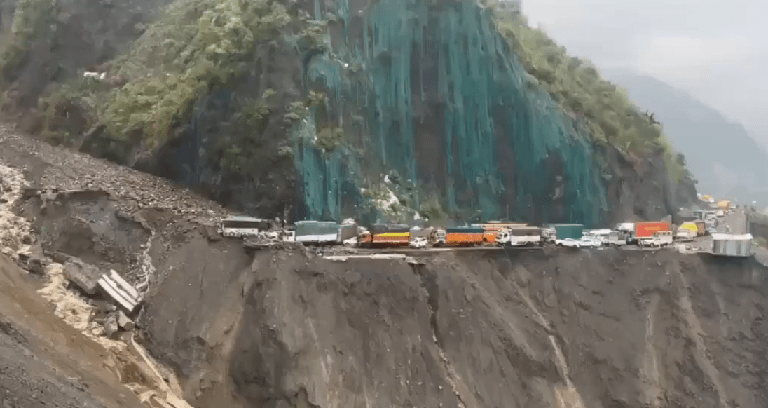
(Feature Image: Social media image showing scroes of vehicles precariously standing on severely damaaged NH 44 in Ramban on April 20, 2025)
After April 20, 2025 ‘cloudburst’ disaster in Ramban, the role of Jammu-Srinagar National Highway (NH) 44 has been under criticism for adding into the devastation trail. While a significant portion of the NH has been severely damaged in the aftermath, the residents have also blamed the NH work for compromising the drainage system and increasing destruction toll in the affected area.
The disaster not only destroyed hundreds of vehicles but also left thousands of tourists trapped along the NH stretch. As per the Times of India report, about a dozen locations along Nashri-Banihal stretch of NH were affected by multiple landslides, mudslides and shooting stones severely impacting the movement on this crucial route connecting Jammu and Srinagar.
Reports also mentions that the most affected residential and commercial structures including Ramban town, Seri, Kela Moth, Mehar Careteria, Maroog and Shan Palace were all along the NH 44 stretch. The NH stretch near Panthial was badly damaged writes the Greater Kashmir revealing that 3 vehicles rolled down hillslope after a portion of the NH caved in there while few trucks were buried under debris and around a dozen load carriers were stuck in mudslides near Maroog, one of the worst affected areas.
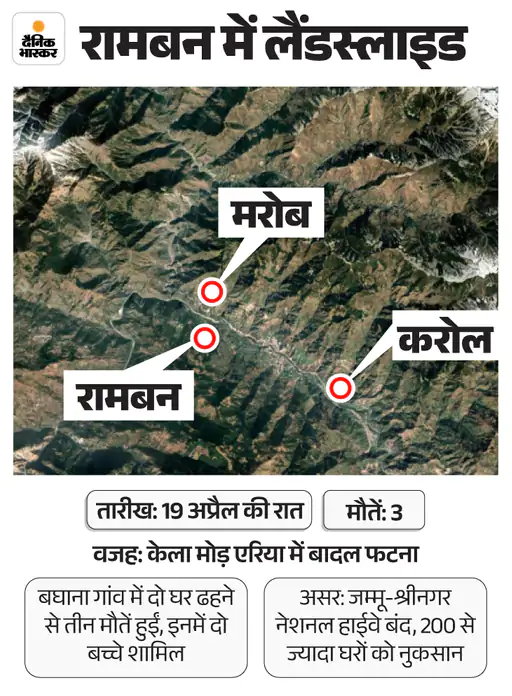
“Three major slides struck within the 100-meter radius affecting Seri; Kela Morh; Mehar Cafeteria, Maroog stretches and Shan Palace in Ramban town as big boulders and muck slides hit the structures. Bowli Bazar in Ramban town too was badly affected by flash floods in the adjoining nullah, which damaged around a dozen structures including shops. Several vehicles also got buried under the muck debris”, mentions the report.
As per the Daily Excelsior report, over 3000 vehicles were stranded at various places along the strategic NH. Near Hotel Usman at Ramban town at least 10-12 cars were buried under the debris scattered all over the area after massive cloudburst. Many houses and shops besides Govt offices suffered damage in Maitra area of Ramban town.
As per the Kashmiriyat report the aggressive tunnel drilling and road expansion has made the the Digdol, Panthiyal, and Mehar areas hot spots for repeated collapse and increased disaster vulnerability of Ramban district where apart from the landslides, the land subsidence recently reported in Pernote, Sangaldan, Gool, and parts of Batote has also become a parallel disaster.
Referring to The National Institute of Disaster Management (NIDM) report and The Comptroller and Auditor General (CAG) 2021 Audit findings on the Prime Minister’s Development Package for Jammu & Kashmir, the report pointed out that several projects were undertaken without “proper planning and adherence” to environmental guidelines, leading to delays and cost overruns which can exacerbate the region’s vulnerability to natural disasters like landslides and floods.

Covering the incident for Down to Earth, prominent climate activist Dr. Raja Muzaffar Bhat blamed the unplanned urbanization, blockage of traditional storm water drains and large-scale infrastructure projects including the NH 44 in Ramban for aggravating the disaster impact. He said, like Seri, the Dharamkund village about 20 km from Ramban town was also profoundly battered by another cloudburst destroying about 35 homes.
Quoting Badrul Duja, an environmental lawyer, the report by Dr. Bhat mentions that the non-stop drilling, mountain cutting by heavy machines and tunnelling work for building the 4 lane NH-44 between Ramsoo to Ramban and Banihal has further weakened the region’s already fragile geological formations making the hills more prone to landslides. The lawyer also demanded an inquiry into the matter.
In this Dainik Bhaskar ground report titled ‘Was Ramban disaster caused by the Highway?’, reporters interacted with some of the affected residents and truck drivers who attributed the reason behind the destruction and their sufferings to faulty construction work by the National Highway Authority India (NHAI) and poor disaster management preparation by the administration.
The report states that a 10 km long NH stretch was particularly affected by the landslides and Karol area in Ramban was among worst hit because a 25-30 feet wide drainage (nullah) was reduced to mere 2-4 feet wide during construction of the highway. As the muck, debris did not find ways to flow down, it flooded the homes and shops of people in the area. Similarly, a truck driver quoted in the report stated that despite weather alert and rains going on since evening hours of April 19, the traffic police did not stop vehicular movement on the NH. However, an NHAI official contacted by the reporters termed it a natural disaster caused by heavy rainfall.

The report also quoted Riyaz Ahmed Mir, Geologist, National Institute of Hydrology (NIH) referring to a 2020 survey by Geological Society of India (GSI) which found Ramban among most landslide vulnerable districts in J&K and the stretch between Maroob to Ramban falling in the fractured zone making it quite sensitive to landslides. As per the report the construction of buildings, 4 lane highway and railway tunnel has weakened the hill slops in Ramban area.
Interestingly, the ground report also quoted Chief Minister (CM) Omar Abdulla stating that people had complained to him against NHAI work chocking the drainage and causing damages to their properties. “The officials must ensure that people do not have to suffer the consequences of their wrongdoings. This road built for convenience is now causing harm.” Similarly, the former CM Mehbooba Mufti held deforestation and hill cutting work responsible for the disaster.
Another detailed report by Kashmir Observer titled ‘Highway to Havoc: Who or What broke NH 44?’ by Peerzada Mohsin Shafi further raises several questions on the adverse impacts and sustainability aspect of the NH 44. The report reveals that despite huge financial investment the ambitious all weather road project toady symbolizes engineering failures, environmental neglect and policy oversight as vertical cutting of slopes were undertaken without comprehensive geotechnical investigations resulting in series of landslides along the route.
Mentioning about the reoccurring damages and collapses the NH has been facing, the report shares, “In 2023, the Cafeteria Morh tunnel project, aimed at bypassing a well-known slide zone, collapsed due to weak geological conditions. Cracks were formed within the tunnel structure, halting work. A canopy structure was proposed as an alternative, but this too faced complications. In March 2025, persistent rainfall caused the road in the area to sink, reducing movement to a single lane and exposing the inadequacies of both the original and revised designs. Experts argue that a better solution would have been to extend the Ramban viaduct instead of disturbing the already unstable area.”
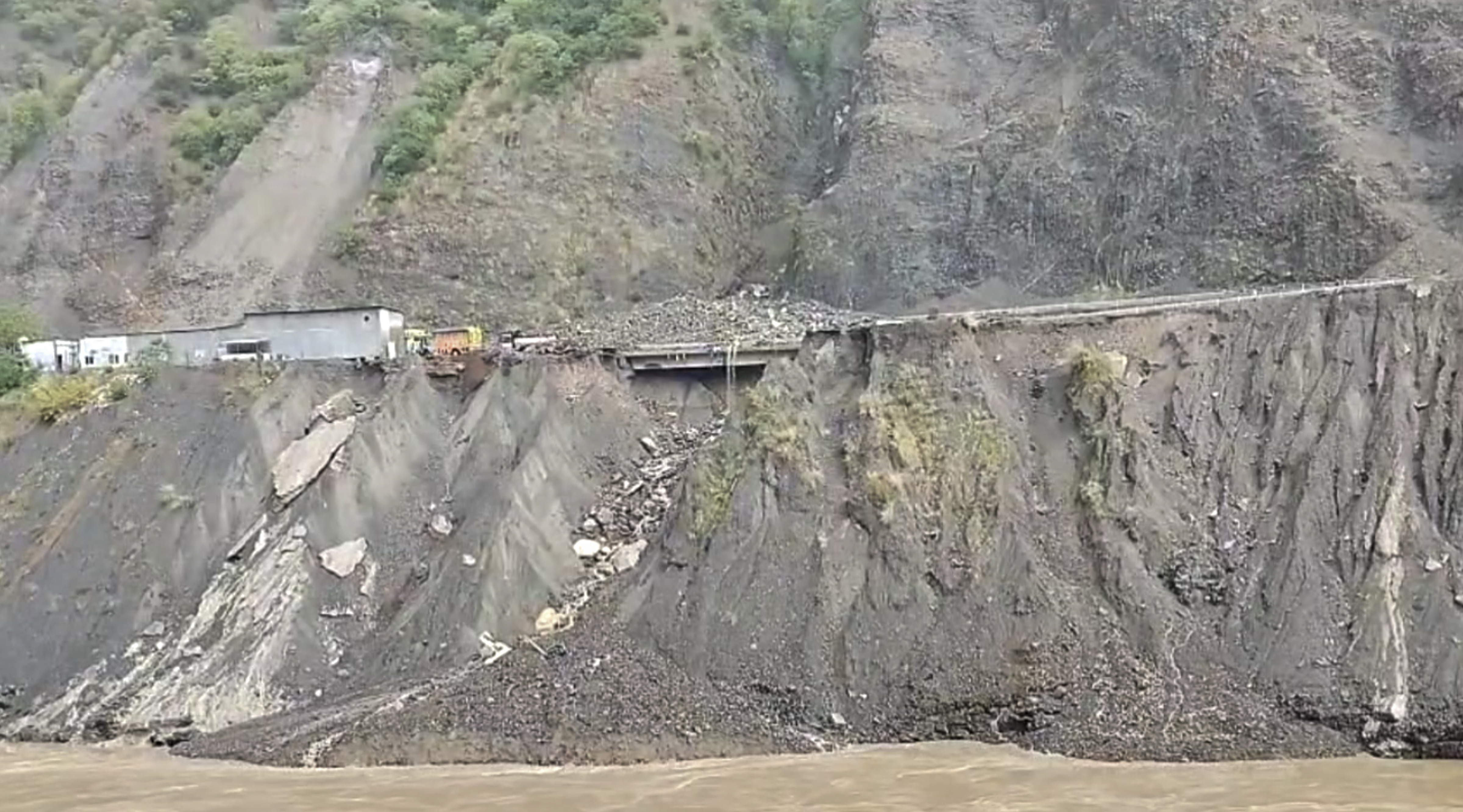
The report further alleges underestimation of geological complexity by the highway developers as 3 years of slope protection measures such as rock bolting, geo-mats, and mesh netting in the Seri region of Ramban were washed away during April 20 disaster. Similarly, the tunnels and canopy structures installed to protect the route from chronic landslides in Kela Morh and Panthal areas were destroyed. Besides, some portions of highway including at Battery Chashma were completely washed away because of which some vehicles plunged into deep gorges.
Indeed, while crores have been spent on upgradation, the project continues to suffer massively from reoccurring failures due to design flaws, poor implementation, lack of monitoring and accountability thus compromising safety of thousands of travellers. This Feb. 2018 SANDRP report has also documented several landslide incidents taking place along NH 44.
In conclusion This shows once again, that NHAI or the Ministry of Road Transport has no confidence inspiring system to firstly ensure that projects have adequate drainage component so that not only the road sustains but it does not increase the disaster potential of the area. A credible Environmental Impact Assessment and Environment Management are key components for this, but the concerned authorities seems to have very little concern about this. Second key requirement is ensuring proper and sufficient monitoring including independent oversight to ensure that all required measures are indeed implemented on ground as required. Thirdly, there is no clearly defined accountability mechanism in place to ensure accountability of those responsible. To achieve this, a key requirement is independent assessment of such works, particularly after such disasters. The NHAI and Ministry of Road Transport have repeatedly failed on each of these tests, but the pity is that there is neither self-realisation about this among the concerned, nor there is anyone to hold them accountable.
Bhim Singh Rawat (bhim.sandrp@gmail.com)
Postscript: Excellent piece by Aqib Javed Katoch-aqibat.aj@gmail.com narrating how large scale infrastructural projects have increased disaster in the district and has affected most the local people who had already paid a heavy cost for these development projects but still have been deprived of basic services: As hydropower dams and tunnels carve through fragile mountains, locals pay the price—in mudslides, poverty and neglect. Chenab Valley sits with a gun to its head. On one side: dams that dictate the river’s course and the valley’s fate. On the other geologically fragile, young mountains are being cut, drilled and dynamited to carve highways and tunnels, all in the name of utilitarianism. If progress comes at the price of instability, we are not advancing — we are circling disaster. This is not sustainable development. It is a disaster, only to be deferred.
– What sharpens the wound is the hypocrisy. After every landslide, every deadly rockfall, a predictable cycle begins media buzzes, experts warn, committees are formed, and environmental “concern” resurfaces. Yet on the ground, nothing changes, blasting resumes, and hills continue to be hollowed out. The next disaster is only to be scheduled in.
– Home to hydropower giants like Baglihar, Pakal Dul and Dul Hasti, the region generates electricity for millions. Yet its people remain in the dark. According to NITI Aayog’s debut MPI report, Ramban tops the poverty charts at 35.26%, followed by Doda at 28.92%. The irony is stark: the valley lighting the nation is looming under the darkness of poverty, illiteracy and unemployment, living the proverb— “chirag tale andhera”. https://kashmirreader.com/2025/05/22/chenab-valley-the-candle-that-burns-at-both-ends/ (22 May 2025)

 SANDRP