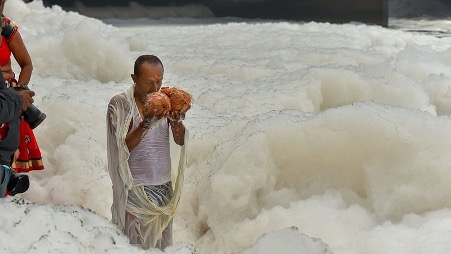
It was great to see that river figured prominently in the just concluded Delhi Assembly Elections where BJP has come to power in the state after 27 years. Prime Minister Narendra Modi assured Delhi that the BJP government will make every effort to clean Yamuna. “It may be a long haul but Mother Yamuna will surely bless our efforts,” he said. Will this help the cause of the River?
There is of course a lot that Delhi government can do to improve the state of Yamuna in Delhi, if the new Delhi government really wants to. Flow and connectivities are the defining characteristics of any river. The Delhi Government can work to ensure Yamuna continues to have sufficient freshwater flow downstream from Wazirabad barrage, where there is none today. There is also need to improve the connectivities that define a river, including longitudinal connectivity between upstream and downstream at various points within Delhi, the lateral connectivity of the river with its tributaries and the floodplain and the vertical connectivity for groundwater recharge. A lot needs to be done for improving Yamuna’s connectivities in Delhi.
On pollution front three key areas that need attention are: sewage treatment and performance of Sewage Treatment Plants (STPs), performance of Central Effluent Treatment Plants (CETPs) to treat industrial effluents and proper management of solid waste, since a lot of solid waste ends up in rivers when not managed properly.
But Yamuna exists beyond Delhi and the state of the river upstream and downstream has impact on the state of the river within Delhi. So for all the above issues, Delhi needs to work with the upstream and downstream states.
In addition, the central government has a huge role to play here. The way centre deals with the river has a bearing on each of the above aspects of Yamuna. Here National Mission for Clean Ganga (NMCG, since Yamuna is the biggest tributary of Ganga), Union Ministry of Environment and Forests, Union Jal Shakti Ministry including Central Water Commission and Upper Yamuna River Board under it, Union Ministry of Housing and Urban Affairs including Delhi Development Authority under it and Central Pollution Control Board can make a huge impact on the fate of Yamuna. Unfortunately, these central agencies have not performed the role necessary for improving the state of Yamuna in Delhi.
Delhi has one of the highest capacity (at around 760 Million Gallons per Day) of Sewage Treatment capacity compared to any other city in India. And yet, state of the Yamuna is one of the worst in Delhi, key reason being that the STPs & CETPs are not functioning as designed. The governments are happy installing large STP capacity at huge expenditure, but they have failed do anything to ensure that STPs function as planned. There is no transparency, accountability or participatory management in governance of STPs. No one knows why STPs are not functioning as planned, nor are there any consequences when STPs do not function as planned. If the government is really interested in improving the state of Yamuna, it needs to address the governance of STPs & CETPs. If all the STPs & CETPs in Delhi were to function as designed and planned, the state of Yamuna would hugely improve in the capital. Sewage that is a curse now, would become a boon for Delhi, as treated sewage can replace the freshwater for a number of activities, thus also reducing the demand for freshwater, freeing some fresh water for Yamuna’s environment flows.
For this, rain water and local water bodies within Delhi can be used, the way Bangalore is doing, for example. Rejuvenated water bodies within Delhi can harvest rainfall. In post monsoon months, adequately treated sewage can be released in such water bodies that will help treat it further and also help recharge groundwater. The outgoing AAP government has already started this process but can be taken to a bigger scale now.
In fact, the new government in Delhi needs to achieve much better rain water harvesting in Delhi, which in turn can help decrease the demand for freshwater from Yamuna and thus free up some additional water for environment flows in Delhi. It can ensure that all the government buildings, parks, roads, bridges, metro stations, schools, colleges, malls, multiplexes, embassies etc all must have functioning rainwater harvesting systems and some of them can also recharge groundwater. The sponge effect of these functioning RWH systems would also reduce the floods in Delhi during monsoon and make available rainwater post monsoon. There will also be exemplary demonstration effect of such functioning rainwater harvesting systems for others to emulate. The improved state of river in Delhi will also be a great boon during Chhath puja and other festivals, improve micro climate and in fact can create a much needed scenic, peace giving place for the city dwellers.
The state of Yamuna in Delhi is also affected by dams and diversions of water, state of water pollution in Yamuna, flow and connectivities of the river, sand mining, groundwater use and recharge, state of local water bodies and wetlands, aquatic and terrestrial biodiversity, state and extent of natural forests, state of tributaries of Yamuna upstream and downstream of Delhi, among other factors. The pattern and quantum of rainfall and snowfall in Yamuna basin and the state of glaciers in the upstream are also relevant here.
It is clear that this Yamuna puzzle has many components. A Delhi Water Policy can be a key instrument to guide through these issues. The new government in Delhi can, through involvement of the people of Delhi, prepare such a policy.
With BJP winning the Delhi Assembly elections, the party that is in power at the centre is also in power in Delhi state and also in neighbouring Yamuna basin states like Haryana, Uttar Pradesh, Rajasthan, as also in some other Yamuna basin states like Madhya Pradesh and Uttarakhand.
The Aam Aadmi Party (AAP) and Congress need to act as responsible opposition parties in Delhi Assembly and Parliament and keep raising the Yamuna issue.
It is clear that a lot can and must be done to improve the state of Yamuna river in Delhi, keeping in mind the context of changing climate. Let us see what the new government in Delhi actually does.
Himanshu Thakkar (ht.sandrp@gmail.com)
NOTE: An edited version of this was published in THE TRIBUNE on Feb 11 2025, see: https://www.tribuneindia.com/news/comment/how-promises-to-clean-yamuna-can-translate-into-action

 SANDRP