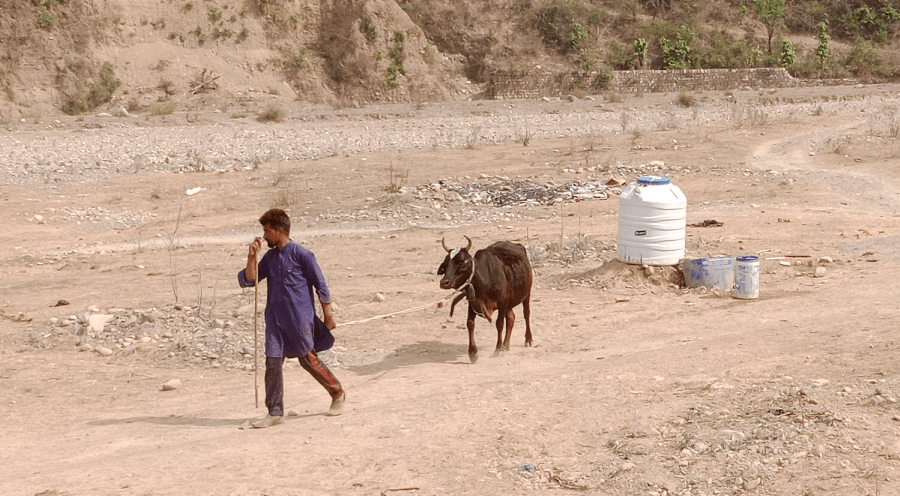
(Feature Image: A villager is taking his cattle through the bone-dry Nimi River, a tributary of Tons in Dehradun after feeding it water from a syntex tank placed in riverbed. The tank is filled with groundwater by a submersible installed on the bank of the river. B. S. Rawat/SANDRP/May 2024)
Like growing contamination of groundwater in India, its depletion is also increasing at alarming level as shows the top ten relevant reports from 2024 which we are able to compile in this third annual overview on the subject. At central level two reports on Atal Bhujal Yojna highlight that funds allocated for the flagship scheme have been grossly underutilized and the scheme is focusing more on meeting the deadlines and facing challenges in large scale community mobilization. The CGWB’s 2023 report published in June 2024 shows that the situation is worsening contradicting MoJS claim that the groundwater depletion situation is improving. About 87% of total groundwater extraction is used in farming.
At state level, a study has found that Punjab and Haryana have lost about 64.6 BCM groundwater in 17 years. Other reports also reveal that these states have extracted groundwater in unsustainable way. A report further links power subsidy in Punjab draining the groundwater reserves and 79% of irrigation demand is met by groundwater pumping. As the levels continue to fall, the farmers are forced to dig deeper borewells. The situation is similar in Haryana. Like power subsidy, another report has found that the subsidized solar pumps in Rajasthan are driving the depletion of groundwater table.
In Gujarat a book has shed light on inequity and overexploitation of groundwater. The CGWB report also finds that despite increase in surface water supply network in last ten years, cities are extracting more groundwater than annual recharge. In Tamil Nadu farmers have demanded installation of groundwater monitoring wells at village level & creation of rainwater harvesting infrastructure. Reports from Andhra Pradesh mentioned decline in groundwater table, groundwater in 188 villages in 7 districts has been declared overexploited.
The report from Karnataka underlines the expensive cost of treating leachate contamination of groundwater from landfill sites. Similarly, growing urbanization is cited as a reason behind fall in groundwater table in Odisha and Ladakh. Amid this, the excessive groundwater extraction is increasing land subsidence incidents in India as documented in a SANDRP blog and as suggest the reports from Bikaner, Barmer and Jaisalmer incidents in Rajasthan. The first part of the annual overview has covered important studies on groundwater published in 2024 and the second part has highlighted the growing chemical contamination of GW.
1. Atal Bhujal Yojana ABY falters: ₹1,778 cr allocation largely unused According to new data released by the Jal Shakti Ministry, the Atal Bhujal Yojana, a central sector scheme identified water-stressed areas of 8,203 gram panchayats under 229 blocks in 80 districts of seven states, has used only Rs 71.24 crore of Rs 1,778 crore up until Nov 25 2024. In Lok Sabha, Minister of State for Jal Shakti, Raj Bhushan Choudhary, indicated that the scheme, under implementation in Gujarat, Haryana, Karnataka, Madhya Pradesh, Maharashtra, Rajasthan, and Uttar Pradesh, has used just over 4 % of its annual allocation in the first 8 months of 2024-25. https://assamtribune.com/national/centres-water-conservation-scheme-falters-rs-1778-cr-allocation-largely-unused-1560224 (06 Dec. 2024)
ABY: Bridging ambition with reality? Amol Singh Yadav, a folk artist hailing from Dasania village in the Bundelkhand region of Madhya Pradesh, stood up to sing his song about the ABY. As he sang, his lyrics referenced diminishing community groundwater resources and encouraged his community, whom he referred to as friends, to unite in taking action as guardians of this resource. Most govt schemes either involve the govt setting up incentives and expecting changes in human behavior or directly providing social benefits to farmers. In ABY, the state’s role is viewed as facilitating community capacity building & providing instruments & logistics for GW management. https://www.indiawaterportal.org/articles/atal-bhujal-yojana-bridging-ambition-reality (9 May 2024)
CGWB’s As per 2023 GW report now published, situation is worsening. In UP, the number of dark zones has come down from 105 in 2021 to 95 in 2023, but this is partly due to changed definitions. In Punjab, Haryana, Delhi and W UP, there is over exploitation, but here there is water available for recharging. In parts of. Gujarat and Rajasthan over exploited areas, there is limited water available for recharging. https://triloknews.com/archives/192735 (8 Jun 2024)
MoJS GW depletion reversed? Gajendra Singh Shekhawat Union Jal Shakti Minister says GW depletion in stressed blocks in India has reversed with about 10% of the stressed blocks seeing improvement. The minister provided no details to support this claim. https://www.tribuneindia.com/news/india/groundwater-depletion-reversed-situation-eases-in-stressed-blocks-588425 (08 Feb. 2024)
2. Punjab-Haryana 64.6 BCM of GW lost in 17 years Punjab and Haryana have lost a staggering 64.6 BCM GW in the 17 years between 2003 to 2020, researchers from IIT-Delhi and Nasa’s Hydrological Sciences Laboratory estimate. The study, ‘Detection and Social Economic Attribution of Groundwater Depletion in India’, was published on Oct 14 in the Hydrogeology Journal.
The paper noted that “substantial groundwater depletion” was observed in Gurgaon and Faridabad, where water-intensive paddy cultivation is minimal — indicating that much of the resource in these areas was likely because of the urban sprawl. Data showed that groundwater level declined 8-10% in Punjab and Haryana from 2000 to 2015. In the two states, the growth rate of factories was 69% in FY 2004-2005 and this went up to 170% in FY 2018-2019. Similarly, urbanisation growth was 10% in 2001, and this went up to 20% by 2011. https://timesofindia.indiatimes.com/city/gurgaon/massive-groundwater-loss-punjab-haryana-deplete-646-billion-cubic-metres-in-17-years/articleshow/114662709.cms (28 Oct. 224)
GW extraction stage reaches 59.26% The Stage of Groundwater Extraction (SoE) in Haryana has reached 135.74%, indicating that more groundwater is being extracted than what should be sustainable. In Haryana, the annual groundwater recharge is 9.55 bcm, while the annual extractable groundwater is 8.69 bcm. The total GW extraction in 2023 was 11.8 bcm.
The situation in Punjab is even more concerning, with an SoE of 163.76%. According to the CGWB, Punjab’s annual groundwater recharge stands at 18.84 bcm, with 16.98 bcm being extractable annually. Yet, the total groundwater extraction in 2023 was 27.8 bcm. In Rajasthan, the SoE is 148.77%, as the total groundwater extraction in 2023 was 16.74 bcm, against an annual recharge of 12.45 bcm and an annual extractable groundwater volume of 11.25 bcm. For 2023, the SoE across the country was 59.26%.
During the post-monsoon 2023, data from Haryana revealed that of 985 observation wells, 149 (15.1%) recorded water levels deeper than 40 mbgl, while 253 wells (25.7%) reported water levels in the 20-30 mbgl range. In Punjab, of 283 observation wells, 19 (6.7%) had water levels deeper than 40 mbgl, while 81 (28.6%) had levels in the 20-40 mbgl range. Rajasthan has 1,061 observation wells, of which 240 (22.6%) showed levels deeper than 40 mbgl, and 194 (18.3%) recorded levels in the 20-40 mbgl range. In Chandigarh, of 14 observation wells, one (7.1%) had levels deeper than 40 mbgl, and four (28.6%) reported levels in the 20-40 mbgl range. These figures were shared in the Rajya Sabha on Dec 2. https://www.tribuneindia.com/news/haryana/groundwater-extraction-stage-reaches-136-in-haryana-164-in-punjab/ (5 Dec 2024) EDIT: https://www.tribuneindia.com/news/editorials/groundwater-crisis (06 Dec. 2024)
Punjab Power subsidy & groundwater reserves Even as economists have often derided the successive Punjab Govts for continuing with the power subsidy, which has been bleeding the state’s treasury and draining the underground water, it has become a politically sensitive issue over the decades. The free power for agricultural pumpsets owes its origin to a game of political one-upmanship played between two former Punjab CMs in the run up to the 1997 Vidhan Sabha elections. Before Rajinder Kaur Bhattal, then CM, could announce the free power subsidy for farmers, Parkash Singh Badal (then Leader of Opposition in the Assembly) outsmarted her by listing the scheme in his poll manifesto.
Farmers say that 10 days of accumulated water helps hydrate the fields and also ensures that when they transplant paddy, water remains a bit longer on the land. Contradicting the perception, Punjab Director of Agriculture Jaswant Singh, says that their dept has been spreading awareness among farmers to adopt direct seeding of rice. Author Devinder Sharma says that it is wrong to blame only the farmers for water wastage when every section of the society is doing so. Supporting the farmers, Bharatiya Kisan Union (Ugrahan) state president of Joginder Singh Ugrahan says the govt should check the wastage of water by companies manufacturing colas and liquor.
According to experts, every tubewell pumps out 30.24 lakh litres per week with an average eight hours of power supply. This means, 14 lakh tubewells (estimated count in Punjab) pump out 4,385 billion litres of water in a week. “Average power subsidy in Punjab is around Rs 10,000 per acre annually. However, in some parts of Sangrur, Barnala and Patiala where the water level is low, the subsidy touches Rs 15,000 to 20,000 per acre on an yearly basis,” says a senior PSPCL official. According to recent data prepared by the PSPCL, the districts with critical water table continue to have maximum tubewells. Ludhiana has the highest 1.17 lakh tubewells, followed by Gurdaspur (99,581), Amritsar (93,946), Sangrur (93,669) and Patiala (87,888). These districts have shown the steepest decline in water table.
Of the 150 assessed blocks in Punjab, the CGWB, in a report, categorised 114 (76.47 %) as “overexploited”, three (1.96 %) as “critical”, 13 (8.5 %) as “semi-critical” & 20 (13.07 %) as “safe”. https://www.tribuneindia.com/news/punjab/why-power-subsidy-drains-groundwater-reserves-632059 (19 June 2024)
GW meeting 79% irrigation demand Even after spending ₹274 crore on the crop diversification program (CDP) between 2014 and 2019, the sown area of rice has increased by 7.18 % in Punjab at the cost of other crops, found an audit report by the Comptroller and Auditor General. In March 2022, canal water accounted for 21 % of Punjab’s irrigation, while the remaining 79 % came from groundwater, according to data shared by Punjab’s Water Resources Minister. https://www.fairplanet.org/story/as-indias-groundwater-evaporates-farmers-scramble-for-solutions/ (11 Feb. 2024)
Farmers drill deeper to install borewells in Doaba The Doaba region has already been flagged for concerns regarding groundwater depletion and contamination as well as being declared a dark zone due to incessant water use. Repeated floods have aggravated the crisis.
Across the Shahkot, Sultanpur Lodhi and Gidderpindi areas, farmers are digging deeper to install borewells. Their previous borewells got contaminated after polluted water entered their fields. Besides GW was also contaminated by recent floods. The minimum depth at which a farmer can find fresh water has increased to 450 feet to 500 feet. From the year 2000 to 2019, anyone installing a borewell would dig upto a minimum of 100 to 150 feet.
After the 2019 floods in the Sutlej River, farmers across the Lohian, Shahkot and Gidderpindi areas had dug deeper to install borewells as industrial effluents laced with flood water contaminated the groundwater. In 2023, they had to dig even deeper. Shahkot and Lohian situated on banks of the Sutlej are the worst hit areas compared to Sultanpur Lodhi which is situated on the banks of the Beas River. https://www.tribuneindia.com/news/jalandhar/farmers-drill-deeper-to-install-borewells-as-floods-contaminate-groundwater-in-doaba-603907 (24 March 2024)
70% wells register dip in GW level Nearly 70% wells in Punjab — 130 out of 186 — have registered varying degree of fall in water level, in some cases by more than four metres, by Nov 2023 — in comparison to the mean of water level fluctuation from Nov 2003 to 2022 — putting the state at the top of the list among north Indian states and Union Territories. Of 186 wells in Punjab that were considered for the water level fluctuation, at least 43 wells (23.1%) in unconfined aquifers recorded a fall of more than four meters, 32 (17.2%) registered a fall of water level between two to four meters, and 55 (29.6%) witnessed a fall of zero to two meters. No change was observed in one well. https://indianexpress.com/article/cities/chandigarh/groundwater-level-punjab-wells-register-dip-9501789/ (08 Aug. 2024)
Haryana Gurgaon extracted from aquifers double of what it recharged last year While the Gurugram city’s sustainable annual groundwater extraction limit is 20,333 million-hectare metres (ham), it ended up withdrawing 43,262 ham in 2024, data released by the National Compilation on Dynamic Groundwater Resources showed. This extraction rate was the third highest in Haryana, followed by Kurukshetra (228%), Panipat (222%), Kaithal (190%) & Faridabad (180%). Five districts – Gurgaon, Panipat, Kaithal, Karnal, and Kurukshetra – were found to have exhausted their groundwater resources for future use. And the entire state of Haryana now has only 1.1 lakh ham of groundwater available for the future.
Gurgaon currently receives 570 MLD of fresh water from rivers, falling short of its peak summer demand of 675 MLD. With a growing population and insufficient surface water supply, the city’s residents increasingly rely on groundwater to meet their daily needs.
The state’s overall groundwater extraction rate showed increase from 135.7% to 136% over the past one year. Haryana’s total extractable groundwater was 9.3 lakh ham, actual extraction reached 12 lakh ham. https://timesofindia.indiatimes.com/city/gurgaon/guzzling-groundwater-gurgaon-extracted-from-aquifers-double-of-what-it-recharged-last-year/articleshowprint/117341621.cms (18 Jan. 2025)
Report MSP law is linked to groundwater crisis Crop diversification could address the problems caused by intense wheat and rice cultivation but the lack of government support makes it a risky prospect. https://scroll.in/article/1063821/the-farmers-demand-for-an-msp-law-is-linked-to-an-environmental-crisis-heres-how (17 Feb. 2024)
Needs to rethink agri practices Years of overexploitation of GW has led to steadily drying aquifers. Major crops like sugarcane, rice, cotton, and wheat are becoming more and more difficult to cultivate, given their water-intensive nature. Yet, govt policies favour the growth of staple water-intensive crops. https://www.indiatoday.in/diu/story/depleting-groundwater-india-agriculture-farmers-water-intensive-crops-2506372-2024-02-23 (23 Feb. 2024)
3. Rajasthan Solar revolution in farming depleting groundwater Farmers in hot, arid regions are turning to low-cost solar pumps to irrigate their fields. But by allowing them to pump throughout the day, the new technology is drying up aquifers.
There is a solar-powered revolution going on in the fields of India. By 2026, more than 3 million farmers will be pumping out GW using solar-powered pumps. With effectively free water available in almost unlimited quantities, their lives could be transformed. Until the water runs out. The desert state of Rajasthan is the Indian pioneer and has more solar pumps than any other. Over the past decade, the govt has given subsidized solar pumps to almost 100,000 farmers. Those pumps now water more than a million acres and have enabled agricultural water use to increase by more than a quarter. But as a result, water tables are falling rapidly. There is little rain to replace the water being pumped to the surface. In places, the underground rocks are now dry down to 400 feet below ground. That is the effective extraction limit of the pumps, many of which now lie abandoned. To keep up, in what amounts to a race to the bottom of the diminishing reserves, richer farmers have been buying more powerful solar pumps, leaving the others high and dry or forcing them to buy water from their rich neighbors.
Water wipeout looms. And not just in Rajasthan. Solar pumps are spreading rapidly among rural communities in many water-starved regions across India, Africa, and elsewhere.
But Technology could come to the rescue. If PV pumps had to be sold with sensors that allowed monitoring of their output, then regulators could directly limit their use. Whether govts would do that in practice, given the conflicting priorities, is another matter. https://e360.yale.edu/features/solar-water-pumps-groundwater-crops (27 Feb. 2024)
4. Gujarat Book examines groundwater crisis & its politics Excerpted from India’s Forgotten Country: A View From the Margins, Bela Bhatia, Penguin India: Aside from this problem of overexploitation, growing inequity in groundwater use is both a critical consequence and a major cause of overexploitation. This growing inequity compounds earlier economic inequalities based on land ownership, with the result that the agricultural community in Gujarat is increasingly sharply divided between a minority of prosperous farmers who monopolize most of the land and water and a majority of small farmers and agricultural labourers who are increasingly alienated from both of these means of production.
Inequity and overexploitation are, thus, twin aspects of the groundwater crisis in Gujarat, ultimately inseparable insofar as their common cause lies in the anti-social appropriation of groundwater by a minority of large farmers. https://scroll.in/article/1066751/a-new-book-examines-the-groundwater-crisis-and-its-politics-in-gujarat (01 April 2024)
State extracts 52% of groundwater recharge: CGWB In the past 10 years, Gujarat has recorded 100% or more seasonal rainfall for eight seasons. With Narmada River waters reaching cities and several regions of North Gujarat, the availability of surface water has also improved. However, more than half of the groundwater recharge in Gujarat is extracted, indicated CGWB report for 2023. The extraction is lower than the national average of 59%.
According to the CGWB report, the top 3 dists with the highest groundwater extraction include Banaskantha (115%), Mehsana (108%) & Patan (99%). Gandhinagar was close at 92%, with Ahmedabad at 87%. However, even among districts, there were variations in terms of water recharge and extraction — urban areas were extracting more water than annual recharge. https://timesofindia.indiatimes.com/city/ahmedabad/guj-extracts-52-of-groundwater-recharge-cgwb/articleshow/113792182.cms (29 Sept. 2024)
5. Tamil Nadu ‘4K observation wells inadequate to tackle GW challenges’ Farmers say 4,016 observation wells to monitor groundwater levels currently installed are incommensurate for the state’s 17,000 villages. As per the farmers the observation wells are installed at the firka level, but ideally, at least one well should be set up in every village to provide accurate data. K Balasubramani, state secretary of Tamil Nadu Vivasaya Munnetra Kazhagam (Farmers Association), said, “In addition to installing observation wells, the govt must develop infrastructure for rainwater harvesting in all villages. A few years ago, the state govt actively pushed RWH schemes in every household, but the momentum has slowed down.”
A senior official from WRD said, “Unless the state govt allocates funds for such projects, it will be impossible to implement them. Compared to other Southern states, TN depends heavily on ground water as other states have adequate storage of surface water.” Given the state’s financial situation, we have recommended a phased implementation, but the proposals are still awaiting approval, he added.
Another WRD official emphasized the need for technological upgrades: “Currently, we monitor observation wells manually, which provide data once in 24 hours. We have proposed a telemetry system that can automatically measure and transmit groundwater data four times a day”. A detailed project report has been submitted for financial approval. https://www.newindianexpress.com/states/tamil-nadu/2024/Nov/21/farmers-4k-observation-wells-in-tn-inadequate-to-tackle-groundwater-challenges (21 Nov. 2024)
6. Andhra Pradesh Drop in groundwater level Groundwater levels in the State have dropped by 2.27 metres below ground level (MBGL) this year compared to last year. Besides the deficit rainfall, experts have cited over exploitation of groundwater as the reason for the situation. As per statistics of the Andhra Pradesh Water Resources Information and Management System (APWRIMS), the State recorded 9.56 MBGL in Feb 2024, compared to 7.28 MBGL in Feb 2023. The depletion of groundwater level was more pronounced in both Rayalaseema and Coastal Andhra Pradesh dists this year. The groundwater table in coastal Andhra Pradesh was 8.92 MBGL last February, while it stood at 12.66 MBGL this February with a variation is 3.74 MBGL.
Terming the situation alarming, YV Malla Reddy, an expert in GW & working with the Rural Development Trust, said, “In my 50 years of career, I have not witnessed such a severe hydrological drought. Take undivided Anantapur as an example. Before 2019, there were 2.72 lakh borewells, which is four times more than what the groundwater levels in the district can sustain. In three years from 2019, the number has crossed three lakh.” Avoiding water-intensive crops, wherever groundwater levels are low, and crop water budgeting by the farmers, backed by a govt policy might improve. https://www.newindianexpress.com/states/andhra-pradesh/2024/Mar/25/andhra-pradesh-state-records-drop-in-groundwater-level (25 March 2024)
188 villages declared as ‘over-exploited’ The State government has declared 188 villages spread across seven districts of the State as ‘over-exploited’. With this, no well can be sunk in these areas except for public drinking purposes. Similarly, a hand pump cannot be sunk for public or private drinking water purposes and sand mining is also prohibited in these villages. The AP Water, Land and Trees Authority notified these villages as per the powers conferred under the AP Water, Land and Trees Act, 2002. The panchayat raj and rural development department issued orders notifying these villages as over-exploited, till further orders.
The 7 districts where the 188 villages are notified as over-exploited are from Rayalaseema, north coastal Andhra and coastal Andhra regions, with majority of the notified villages are from drought-prone Rayalaseema. Prakasam district has the highest of 57 over-exploited villages followed by 53 in Srikakulam, 42 in Sri Sathya Sai, 16 in Palnadu, 13 in Kadapa, six in Anantapur and one in Chittoor. These villages have been identified by the Groundwater Dept. Ground water dept officials said a village can be notified as over-exploited if the GW levels fall below 20 m. https://www.newindianexpress.com/states/andhra-pradesh/2024/Jan/29/188-villages-in-andhra-pradesh-declared-as-over-exploited (29 Jan 2024)
7. Karnataka Treatment of 3K MLD leachate to cost ₹553 cr A report of the Bangalore Solid Waste Management Ltd (BSWML) has estimated that a total of 3,074 million litres (ML) leachate has accumulated in Mittaganahalli and Kannur landfill sites, and it will take nearly four years and around ₹553 crore to treat it. These empty stone quarry pits have been used as landfills where garbage has been dumped for over 10 years. Residents of villages around these landfills often complain of leachate polluting groundwater. Leachate can be treated, like sewage, to reduce this pollution.
The quantification was done by RITES Ltd, a public sector enterprise operating under the Ministry of Railways, to issue tenders to set up two leachate treatment plants. Based on the area of the empty quarry pit, amount of waste dumped every day and hydrological parameters, RITES has estimated that the total leachate collected in these pits. However, the quantum is estimated to increase by 230.60 ML. This is due to the probable nine-month gap between estimated date and commencement of processing, due to the time it may take for the tenders to be processed and work to begin.
The report proposes two leachate treatment plants of 2 MLD processing capacity, at a cost of ₹1.68 per litre, adding up to ₹553 crore to treat the entire backlog of leachate accumulated in these quarry pits. CEO, BSWML, said that estimation of ₹1.68 per litre is lesser than the prevailing market rate of ₹4-6. However, an activist is of the opinion that the estimated cost is too high. Besides, the activist added, the report only talks about primary treatment, but not of secondary and tertiary treatments. Considering these the cost will go up further. https://www.thehindu.com/news/cities/bangalore/bswml-report-estimates-that-over-3000-million-litres-of-leachate-has-accumulated-in-two-landfills-processing-to-cost-553-crore-over-four-years/article69056722.ece (03 Jan. 2025)
8. Odisha GW level of 9 blocks in semi-critical stage Not only in Old Bhubaneswar, the groundwater level is falling at an alarming rate in many parts of the Smart City. Data from the CGWB says that in 2020, the groundwater levels in six blocks of the state were in the semi-critical category. But by 2023, the number had risen to nine. Over 70 % of the recharge in these blocks is being extracted.
Urbanisation and misuse of groundwater are responsible for the depletion of groundwater levels. In many towns, all areas are covered with paver blocks and concrete, so it becomes very difficult for the rainwater to recharge GW. https://odishatv.in/news/odisha/groundwater-level-of-9-odisha-blocks-in-semi-critical-stage-experts-warn-bengaluru-like-situation-230465 (17 March 2024)
Rapid urbanisation to blame for falling GW level: CM Attributing the fall in groundwater level to rising urbanisation and climate change, CMMajhi said a proposal to frame rules for implementing the Orissa Ground Water (Regulation, Development and Management) Act, 2011 is under active consideration by the govt. Once the rules are framed, monitoring and management of groundwater will be done by the Odisha Ground Water Authority (OGWA). At the moment, the CGWA monitors the groundwater level. Though the Act was notified in 2012, it has not been implemented yet pending framing of rules.
Under the Act, OGWA, led by the water resources secretary, will be formed. OGWA will conduct periodic census of groundwater level and identify the problem areas and notify them. In notified areas, people have to get permission from the authority to dig wells, except for domestic use and for agricultural purposes to some extent. Once formed, the authority will also decide on giving permission to use groundwater for industry and commercial purposes. https://timesofindia.indiatimes.com/city/bhubaneswar/groundwater-depletion-in-odisha-due-to-urbanisation-and-climate-change/articleshow/112724005.cms (23 Aug. 2024)
9. Ladakh Rapid urbanisation & climate change threaten GW Rapid urbanisation, population growth, and unplanned development have led to land use and land cover changes in Ladakh, adding stress on GW in the region, says a new study. Groundwater exploitation has further accelerated the decline in groundwater levels. Loss of ice and glaciers due to climate change has significantly reduced water availability and infiltration processes, impacting aquifer health. Sustainable management strategies and monitoring groundwater are crucial to adapting to these changes and ensuring water availability. https://india.mongabay.com/2024/07/rapid-urbanisation-and-climate-change-threaten-groundwater-resources-in-ladakh-says-study/ (11 July 2024)
10. Groundwater & Land Subsidence
SANDRP Blog Causes & consequences of increasing land subsidence Land subsidence is increasing in area and intensity across the world, including in India. Climate Change is not the only reason. Excessive groundwater exploitation is a major cause, among others. This article tries to capture various aspects of this issue, including possible solutions. https://sandrp.in/2024/06/19/causes-and-consequences-of-increasing-worldwide-land-subsidence/ (19 June 2024)
Rajasthan Land sinking reported in Bikaner, Barmer In the last month, two incidents of land subsidence took place in Rajasthan, alarming both geologists and the general public. Both incidents took place in desert districts, raising suspicions of a possible connection between them. On April 16, 2024, one and a half bigha of land collapsed around 3:30 am in Sahajrasar village of Lunkaransar tehsil of Bikaner district. At the time, a train full of passengers was passing by, narrowly escaping the sinking ground with the assistance of a tractor. The subsidence formed a pit about 70 feet deep, which, according to villagers, has since expanded to about 80-90 feet.
The second incident occurred on May 6, 2024, in Nagana village of Barmer district, where two parallel cracks appeared in the ground over an area of about one and a half kilometres. A geological team has submitted its preliminary report on these incidents occurring in the two districts of the Thar Desert. The preliminary reports suggest that water is a common factor in both dists. https://www.downtoearth.org.in/urbanisation/why-have-bikaner-and-barmer-in-rajasthan-reported-land-sinking-in-the-last-month–96169 (15 May 2024) Generally, incidents of land subsidence occur only in areas with mines. But this incident took place on a farm which was quite surprising for the local people, as there are no mines in this area. The people here earn their living only by farming. While many people are speculating that there was a well here, it sank. So, now, as per the latest information that has been received, the pit on this land is getting deeper. Geologists have reached the spot & are investigating. https://www.news18.com/viral/in-bikaner-land-sinks-80-100-feet-overnight-authorities-scramble-for-answers-8865562.html (26 April 2024) Geologists call them Lykins. Scientists link this to the drying up of an underground water source, while the villagers are also considering it a natural disaster or divine wrath. In this incident, about one and a half bighas of land has sunk about 22 meters down. The reason for them being called sinkholes is that they are circular like the hole made for drainage in a sink. Not only this; water, or rather the drying up of groundwater, is a factor in their formation. Earlier in 2021, a similar incident had occurred near Randhisar and Burj villages of Kolayat tehsil, about 50 km west of Bikaner in Bikaner district. (Arvind Vyas) https://shorturl.at/lNQR3 (02 May 2024)
Tubewell collapse triggers 12hr water eruption in Jaisalmer In a dramatic geological incident near Jaisalmer’s Mohangarh canal area on Dec 28, a tubewell drilling operation caused the ground to collapse, releasing water and gas under immense pressure. The eruption created a 10-feet-high jet of water, alarming nearby villagers who fled in panic. The incident occurred at a depth of 250 metre, turning the area into a flooded expanse, with water gushing continuously for over 12 hours. The collapse also swallowed the drilling machine and truck, leaving only the truck’s exterior visible.
Senior groundwater scientist Dr. Narayan Das Inkhia said, the incident likely resulted from an artesian condition. A breach in a buried groundwater reservoir within the trasseri sandstone formation caused pressurised saline water, mixed with white sand, to gush out forcefully. https://timesofindia.indiatimes.com/city/jaipur/tubewell-collapse-triggers-12hr-water-eruption-in-mohangarh/articleshow/116750858.cms (29 Dec. 2024) Groundwater expert Himanshu Thakkar commented that this could be due to the presence of artesian wells in the area. “Where artesian wells are present, there is water under a lot of pressure. If a hole is made there, the water comes out with very high pressure. As long as the pressure remains, the water keeps flowing, and as soon as the pressure decreases, the water stops,” he said in an interview with DW. “Today there may be sand here, but finding water sources is not impossible because the area has not always been a desert,” he added. https://www.jpost.com/omg/viral-news-from-the-web/article-835648 (01 Jan. 2024) The three-day water eruption from a collapsed tube well in Mohangarh stopped naturally early Dec 30 morning, bringing relief to dist officials, particularly as the associated gas leakage also halted. https://timesofindia.indiatimes.com/city/jaipur/water-eruption-stops-suddenly-in-mohangarh-locals-relieved/articleshow/116809180.cms (31 Dec. 2024) Speculation regarding the water’s connection to the ancient Saraswati River was refuted by Dr Inakhiya. https://indianexpress.com/article/india/high-pressure-jet-of-water-causes-panic-triggers-evacuations-amid-drilling-operation-in-jaisalmer-9752237/ (31 Dec. 2024) https://timesofindia.indiatimes.com/life-style/travel/destinations/lost-saraswati-river-suddenly-resurfaces-in-rajasthan/articleshow/116805601.cms (30 Dec. 2024) “During drilling, it seems that there was a breach of the sandstone barrier above the water, causing the water to rush out with such force,” an official from the Rajasthan govt said. Independent experts agreed that that is the only plausible explanation. Virendra M. Tiwari, director at CSIR NEIST, said the borewell being dug must have “punctured the confined aquifer mapped by heliborne surveys in Jaisalmer, leading to a gust of fresh water”. https://theprint.in/science/what-is-an-artesian-well-how-it-might-have-caused-water-eruption-in-jaisalmer-desert/2427149/ (01 Jan. 2025)
Compiled by Bhim Singh Rawat (bhim.sandrp@gmail.com)

 SANDRP