
(Feature Image: Srisailam dam in Telangana. Source: Telangana Today)
This annual overview focusses on the functioning of National Dam Safety Authority (NDSA) and related institutions in 2024 to understand if the functioning of these institutions have made Indian Dams any safer? Here functioning of Central Water Commission (CWC) is also important as CWC people head all the dam safety panels. The dam safety related institutions were formed following the passage of Dam Safety Act 2021 and hence there were promises and hopes that these institutions will make our dams safer.
However, as reports this 2024 annual overview shows, large number of questions arise about functioning of NDSA. The questions include some of generic nature including the need to include under construction dams, operational aspects besides the structural aspects, ensuring complete and prompt transparency, among others. Questions also arise how the specific dam related safety issues were dealt with including those related to Kaleshwaram, Polavaram, Mullaperiyar, Teesta 3, Lower Subansiri, Sardar Sarovar, Tungabhadra, among others. We had also raised a number of questions about dam safety governance earlier in 2023. A number of questions were also raised in another article by Archana Vaidya and Himanshu Thakkar in 2023.
The part 1 of the yearend roundup has documented the accidents and disasters related to dam and HEP projects in India in 2024. The part 2 focuses on community resistance against hydro projects in Himalayan states. The part 3 covers the struggle of dam projects affected people. The part 4 highlights growing concerns against pump storage projects. The part 5 complies reports on corruption and scam in dam and hydro projects.
NDSA & CWC India has 1,065 dams 50-100 years old, 234 are 100 plus yrs old According to the National Register of Large Dams (NRLD-2023 edition), compiled jointly by the NDSA and CWC, there are 6,138 constructed and 143 under construction dams which aggregate to a total of 6,281 large dams. Of these, 234 dams are more than 100 years old and there are 1065 large dams which are 50 to 100 years old, the MoJS said on Dec 16.
Responding to a question in the Rajya Sabha, Minister of State for MoJS Raj Bhushan Choudhary said the government enacted the Dam Safety Act and is also implementing the DRIP Phase II and III, aimed at rehabilitating 736 dams across 19 states and three central agencies. https://www.business-standard.com/pti-stories/national/1-065-large-dams-50-100-years-old-224-are-over-a-century-old-govt-124121600799_1.html (16 Dec. 2024)
Install advanced dam safety system: NDSA Seeking to achieve the satisfactory level of dam safety assurance, the regulations notified by the National Dam Safety Authority on May 20, also asked every state dam safety organisation to keep “perpetual surveillance of all specified dams under their jurisdiction, to observe various anomalies including cracks in the body of the dam or abutment, unusual seepage, deflection in the dam body and any other problem related to dam or hydro-mechanical equipment” for the safety of the dams.
The specified dams are those which fall under the National Register of Large Dams. There are 5,745 large dams in the country. As per the register, there are 234 large dams in India, which are more than 100-year-old whose safety is a major concern when their catchment areas get fairly good rainfall during monsoon. Madhya Pradesh has the highest number (63) of more than 100-year-old dams followed by Maharashtra (44), Gujarat (30), Rajasthan (25) and Telangana (21).
According to the notification, hydro-meteorological stations of specified dams will now have to constantly measure rainfall (precipitation), water level, discharge, temperature, humidity, evaporation, wind velocity and direction, and snowfall, if any, for monitoring the safety of dams. https://timesofindia.indiatimes.com/india/install-advanced-safety-system-govt-tells-dam-owners-amid-forecast-of-above-normal-rainfall/articleshow/110650016.cms (03 June 2024)
Why under construction excluded from dam safety regime? As we saw in reports (e.g., Luhri HEP in Himachal Pradesh, Vishnugad Pipalkoti in Uttarakhand and Subansiri Lower & Dibang HEP in Arunachal Pradesh), a number of under construction projects regularly face disaster, which includes deaths and destruction on large scale. We have been narrating stories related to disasters at such projects regularly in the past too. Normal safety norms suggests that no work should be happening at such projects during the vulnerable monsoon season, but such norms do not seem to exist or seem to be violated.
Deepak Jasrotia, Dy. Chief Engineer in Dept of Energy who also heads SDSO appeared unaware on land sinking and flood incidents impacting Luhri-I HEP work. “We will look into the matter and bring the project in our flood monitoring network” said Jasrotia adding that Luhri-I HEP is a Central Public Sector Undertaking (CPSU) project and comes under the preview of NDSA. However, when contacted RPS Verma, Senior Engineer, CWC, Chandigarh and head of NDSA, Northern Region responded that NDSA monitors only commissioned projects and under construction projects are not in NDSA list.
And yet these projects and disasters related to them are excluded from the dam safety regime including NDSA and also, it seems from the Disaster Management Authorities’ work. This is clearly major lacunae and needs to be urgently addressed. https://sandrp.in/2024/07/22/drp-nb-220724-why-are-under-construction-hydro-and-dam-projects-excluded-from-dam-safety-regime/ (22 July 2024)
Impact of GLOF Subsequent to Teesta-III Hydroelectric dam collapse in October, 2023, the CWC has decided to review the design flood of all the existing and under construction dams vulnerable to Glacial Lake Outburst Floods (GLOFs) to ensure their adequate spillway capacity for a combination of Probable Maximum Flood/Standard Probable Flood and GLOF. Further, GLOF Studies has been made mandatory for all new dams planned having Glacial Lakes in their catchments.
As per the information compiled by NDSA, 47 dams (38 Commissioned, 9 under construction) have been identified by CEA under Ministry of Power, which are likely to be affected by GLOF from the Glacial lakes in the Indian territory. GLOF studies have been completed for 31 projects. https://pib.gov.in/PressReleseDetailm.aspx?PRID=2042990 (8 Aug 2024) Further, the govt has made it mandatory for all new dams planned to have Glacial Lakes in their catchments to do GLOF studies. https://www.newindianexpress.com/nation/2024/Aug/09/govt-mandates-all-new-dams-to-conduct-studies-of-glacial-lakes-in-himalayan-regions (09 Aug. 2024) The CWC monitors 902 glacial lakes and water bodies, including over 400 glacial lakes, every year. https://www.telegraphindia.com/west-bengal/scan-on-glacial-lake-risk-to-dams-central-water-commission-readies-review-plan/cid/2040334 (12 Aug. 2024)
HC directs govt to consider NDMA recommendations The High court has directed the state to consider the National Disaster Management Authority’s (NDMA) recommendations before taking any further action on the Vishnugad-Tapovan hydropower project and has given four weeks to reach a resolution. This directive follows a previous order where the court instructed the NDMA to submit a status report to the state. The court was hearing a PIL filed in 2021, which raised environmental concerns regarding the hydropower project close to Joshimath town. The next hearing on Aug 13. https://timesofindia.indiatimes.com/city/dehradun/hc-directs-state-to-consider-ndma-recommendations/articleshow/111178630.cms (22 Jun 2024) NDSA should take pro-active role in such cases.
Kaleshwaram Project Questions about NDSA interim report The NDSA interim report on Kaleshwaram disaster ends with an interesting para: “Nothing contained herein shall be construed to absolve the dam owner (I&CAD) of the duties, obligations or liabilities incidental to the construction, operation, maintenance and supervision of the dam or reservoir.” But is the I& CAD the only possibly responsible body? What about the responsibility of the construction companies, Dam Safety Panel at the state and Central level? What about the responsibility of CWC, the elephant in the room? It may be added here that some very senior officers of CWC had publicly praised the disastrous Kaleshwaram project.
These questions become important as the interim report says that all three barrages were damaged way back in 2019 monsoon for the first time, same year of their commissioning. But the disaster came to light only in Oct 2023. What were all these agencies doing all these years? Is it possible to accept that none of them knew anything so far, then it raises a huge question mark about the monitoring of construction and operation of large dams in India. If CWC and others did know but did not do anything, then it raises question about the very functioning of CWC and other dam safety bodies. https://sandrp.in/2024/05/08/may-2024-questions-about-ndsa-interim-report-on-kaleshwaram-dam-disaster/ (08 May 2024)
The NDSA is likely to submit its final report on the Kaleshwaram Lift Irrigation Scheme (KLIS) by December end, excluding the aspect of conducting geo-technical tests. https://www.newindianexpress.com/states/telangana/2024/Dec/15/ndsa-likely-to-submit-final-report-on-kaleshwaram-lift-irrigation-scheme-by-december-end (15 Dec. 2024) Very strangely, no final report has come out from NDSA even as we write this in the first week of January 2025.
Polavaram Project Dam Disasters: Why is NDSA absent? Polavaram is the biggest dam project under implementation since 2006. That project is in standstill condition since several years due to disasters washing away coffer dams and also part of the main dam. Several state and central agencies are involved in deciding about next steps, including CWC, Polavaram Project Authority and Godavari Board. But NDSA is completely absent from the scene. There is no report from the NDSA about the disasters at this biggest dam project of India now under implementation. https://sandrp.in/2024/07/01/drp-nb-010724-time-for-independent-review-of-polavaram-project/ (01 July 2024)
Mullaperiyar Dam EAC cancelled meeting The EAC of the MoEF cancelled its May 28 meeting, which was supposed to consider Kerala’s request for a new Terms of Reference (ToR) for conducting an EIA for a new dam at Mullaperiyar in Idukki district. The meeting was cancelled at the eleventh hour without assigning any reasons. The top officials of the Irrigation Design and Research Board of Kerala, who reached New Delhi for the meeting, were informed that the meeting had been deferred. https://www.thehindu.com/news/national/why-is-there-a-fresh-row-on-mullaperiyar/article68241020.ece (02 June 2024)
Kerala demands safety review The Kerala State has demanded a safety review of the Mullaperiyar dam before a Supreme Court-appointed supervisory committee gives permission to repair it. According to sources, the State put forth the demand at a meeting comprising representatives of Kerala, Tamil Nadu and the Central Water Commission here on Thursday evening. However, the Tamil Nadu members said that the safety review should be conducted only after strengthening the baby dam. Earlier in the day, the committee visited the Mullaperiyar dam, following a directive of the apex court. https://www.thehindu.com/news/national/kerala/kerala-demands-safety-review-of-mullaperiyar-dam/article68286149.ece (13 June 2024)
Kerala grants permission for maintenance work The Kerala government’s forest department has permitted Tamil Nadu to undertake maintenance work at the Mullaiperiyar dam site and allowed the passage of lorries carrying construction material through the Vallakadavu check post and the Thekkady boat jetty, Theni district collector R V Shajeevana said. https://www.deccanchronicle.com/southern-states/tamil-nadu/kerala-grants-permission-for-maintenance-work-at-mullaiperiyar-dam-1846559 (13 Dec. 2024) The PWD vehicle from Tamil Nadu was denied entry to the Mullai Periyar dam area to conduct maintenance work as the Tamil Nadu Irrigation Department had not secured prior permission from the Minor Irrigation Department in Idukki district, said Periyar Tiger Reserve Additional Field Director Suresh Babu. https://www.newindianexpress.com/states/tamil-nadu/2024/Dec/08/tn-didnt-secure-permit-for-taking-pwd-vehicle-to-mullai-periyar-says-periyar-tiger-reserve-official (08 Dec. 2024)
Petitioner moves SC, seeks to implead NDSA An application has been moved in the Supreme Court, seeking to make the National Dam Safety Authority (NDSA) a party in the ongoing Mullaperiyar Dam case. The application was moved by Dr. Joe Joseph, a resident of Kothamangalam, who had previously filed a petition concerning the safety of the Mullaperiyar Dam. The petitioner also requested that the NDSA conduct regular safety assessments of the dam.
Joseph alleged that the supervisory committee responsible for the Mullaperiyar Dam only visits the site once or twice a year for inspections. A sub-committee formed by the supervisory committee reportedly visits the dam only once every three months. According to Joseph, these irregular inspections are inadequate for ensuring the dam’s safety. He argues that there is no effective system in place to consistently monitor the dam’s condition. https://english.mathrubhumi.com/news/kerala/mullaperiyar-dam-case-ndsa-inclusion-1.9939719 (28 Sept. 2024)
Safety audit is dam owners’ responsibility: Centre In a major setback for Kerala as the Union govt confirmed that the NDSA, established under the Dam Safety Act of 2021, does not have the authority to conduct safety audits of dams. Instead, the responsibility for comprehensive safety audits rests solely with dam owners. This clarification by the Union govt is expected to have far-reaching consequences, particularly regarding issues between Kerala & TN over the 125-year-old Mullaperiyar Dam. https://www.theweek.in/news/india/2024/11/29/mullaperiyar-dam-dispute-setback-for-kerala-as-centre-says-safety-audit-is-dam-owners-responsibility.html (29 Nov. 2024)
SC to hear plea in Jan 2025 The Supreme Court has decided to hear in January 2025 a petition from Kerala pleading to reduce the water level of Mullaperiyar dam to 120 ft from current 142 feet as a precautionary measure. The petition also refers to the recent Wayanad landslide. https://www.thehindu.com/news/national/supreme-court-to-hear-plea-to-reduce-water-level-at-mullaperiyar-dam-in-january-2025/article68953934.ece (06 Dec. 2024)
SC slams Centre delay in drafting safety panel The Supreme Court on Wednesday (Jan. 08) called for the Centre’s response to a petition over the structural safety of the century-old Mullaperiyar dam in Kerala and sought to know why a committee, which was required to assess the structural safety of dams under the Dam Safety Act of 2021, not formed yet. https://www.hindustantimes.com/india-news/sc-slams-centre-delay-in-drafting-safety-panel-for-mullaperiyar-dam-101736363812371.html (09 Jan. 2025)
Has NDSA examined dam safety? SC A fresh PIL by five advocates led by Mathews J Nedumpara on Jan 8 apprehended grave danger to millions of people in Kerala living downstream Mullaperiyar dam as it questioned the dam safety and doubted correctness of two earlier SC judgments allowing raising the water storage level in the dam from 136 feet to 142 feet. The bench wondered as to how the central government could on its own constitute a supervisory committee for examining the safety audit of Mullaperiyar dam when such a move is not backed by the 2021 legislation.
– It asked the NDSA and the ministry of Jal Shakti to file their affidavits on steps taken since 2021 to evaluate the safety of Mullaperiyar dam under the provisions of Dam Safety Act and explain whether the supervisory committee appointed by the ministry was envisaged under the legislation. The bench requested attorney general R Venkataramani to assist the court in the case. It criticised the Union government for being in slumber since 2021 when it was informed that no relevant rules and regulations under the Act have been framed till date. https://timesofindia.indiatimes.com/india/has-national-dam-safety-authority-examined-safety-of-mullaperiyar-sc-seeks-response-from-union-government-ndsa-seeks-ags-assistance/articleshow/117070937.cms (09 Jan. 2025)
Govt yet to wake up from its slumber on dam safety act: SC The Supreme Court has used strong words about center’s slumber about only on paper Dam Safety Act 2021, which is what we also wrote. One hopes SC will take CWC, NDSA and others to task. https://www.thehindu.com/news/national/government-yet-to-wake-up-from-its-slumber-on-dam-safety-act-supreme-court/article69076973.ece (08 Jan. 2025)
Srisailam NDSA team to reassess dam safety on May 18 A team of the NDSA will be revisiting the Srisailam project on May 18 as part of a stock taking exercise. The team which is likely to have experts from the -CWC will assess the safety aspects of the dam ahead of the onset of monsoon. The NDSA, according to sources, was not happy with the maintenance of the project for quite some time.
The NDSA team visited both Naragurjuna Sagar and the Srisailam projects in Feb 2024 to conduct safety inspection of the project structures. Responding to its report, the State government of Telangana stepped up the pace of maintenance works even as its officials had to face hurdles in gaining access to the project site following the deployment of CRPF after the Andhra Pradesh bid to take control of half of the dam gates on its end. The works taken up on the dam are nearing completion. So far as the Srisailam project was concerned, no significant headway could be made in respect of most of its repairs.
The NDSA team wanted the Irrigation department of AP to take certain precautions and initiate special measures to ensure total safety in the operations pertaining to the radial gates, water pumping facilities and the plunge pool located at the outlet of the spillway. The project authorities had proposed works accordingly with an outlay of Rs 135 crore. The 60-year-old Srisailam dam is a joint project of both AP and Telangana and it was in need of a major rehabilitation initiative, said officials.
The NDSA which proved to be prompt in responding to the structural issues noticed in Medigadda barrage on Godavari involving the State government of Telangana, lacked a serious approach so far as the maintenance of Srisailam project on which AP continues its operational control.
The NDSA was yet to respond on the Annamayya project that was partially washed away in Kadapa district and the Polavaram project diaphragm wall left damaged in flood couple of years ago. The NDSA cannot treat the states of Telangana and AP with two different yardsticks in getting the repairs completed on the joint projects, pointed out officials of TS Irrigation Dept. https://telanganatoday.com/ndsa-team-to-visit-srisailam-dam-to-reassess-project-safety-on-may-18 (14 May 2024)
Concerns rise over Srisailam dam safety Concern over the Srisailam Dam’s downstream apron remains unaddressed despite regular visits from dam safety authorities. The phase 2 of the Dam Rehabilitation and Improvement Project (DRIP) scheme was intended to address these issues. This envisaged a cost-sharing arrangement of 70:30 between the central and state government. However, the funds allocated for maintenance are far below the requirement. Some ₹3 crore to ₹4 crore is proposed annually for the maintenance, but what is released is around ₹1 crore or less, year after year.
Proposals worth ₹700 crore were submitted some time ago to strengthen the apron at gates 6, 7, 8 and 9 and to cover the plunge pool with concrete. Yet, there was neither the administrative sanction nor any action on the ground. In February last, a team from the national dam safety authority and the central water commission conducted a detailed study of the dam. According to chief engineer Kabir Basha, the team concentrated on the plunge pool’s condition, highlighting concerns about a significant pit in front of the dam.
A proposed budget of ₹135 crore was suggested for essential safety repairs. With the reservoir now full due to heavy rains, doubts about the plunge pool’s efficacy have resurfaced. However, dam officials assert there is no immediate cause for concern, but stress that the apron needs be strengthened in view of future floods. https://www.deccanchronicle.com/southern-states/andhra-pradesh/andhra-pradesh-concerns-rise-over-srisailam-dam-safety-1814867 (7 Aug 2024)
Leakage in cooling system triggers concerns The Srisailam left bank power house, a crucial component of Telangana’s energy infrastructure, faced an unexpected crisis. Over the past few days, a minor leakage had been detected in the cooling system, causing concern among the engineers and staff. The leakage, originating from a small crack in one of the draft tubes, had led to water seeping out and pooling around the turbine. This was dismissed initially as just a minor inconvenience; but it posed a serious threat to the operations of the plant. The continuous flow of water around the turbine could lead to corrosion and, eventually, operational issues if not addressed promptly. The plant authorities, realising the gravity of the situation, have initiated measures to address the issues. However, due to a lack of proper coordination among the officials, the efforts to contain and repair the leak were delayed. The situation was further complicated by the fact that the plant was operating at full capacity, making it difficult to shut down the system for repairs. https://telanganatoday.com/leakage-in-cooling-system-at-srisailam-left-bank-power-house-triggers-concerns (02 Jan. 2025)
CWC may take up silt formation study Central Water Commission (CWC) is likely to take up another round of study on formation of silt in Srisailam reservoir following the request from AP government. The state government recently conducted hydro-metric survey and found loss of storage capacity to the tune of 50 tmc due to the additional silt formation. Taking the issue with a serious note as the latest finding will pose more troubles in sharing water with Telangana, AP government requested CWC to take up a scientific study and finalise the actual storage capacity of Srisailam project.
– The project designed with 315tmc ft capacity is now capable of storing just around 185-190tmc ft. First scientific study carried out in 2001-02 found loss of about 44 tmc ft of storage. Then, the state government declared that Srisailam could store just around 264 tmc ft. Subsequently, another round of study was conducted in 2009-10 which found loss of another 50 tmc due to the heavy formation of silt due to the massive floods of 2009. After losing nearly 94 tmc ft in a decade, Srisailam reservoir was left with around 215 tmc capacity. https://timesofindia.indiatimes.com/city/vijayawada/study-on-silt-formation-in-srisailam-reservoir-cwc/articleshow/106499586.cms (03 Jan. 2024)
Rs 103 cr WB’s aid for Srisailam dam repairs The two-day visit of the World Bank (WB) delegation to assess the safety and integrity of the Srisailam reservoir was concluded on Tuesday. Speaking to the reporters, Chief Engineer Kabir Basha informed that the World Bank representatives have approved Rs 103 crore aid under Phase 1 for dam repairs and added that tenders would be called in November for the works.
The Chief Engineer recalled that Rs 10 crore had already been allocated for the repairs of the plunge pool in front of the dam. A team of officials from the CWC and Irrigation Department inspected the plunge pool, dam gates, machines, and construction walls among others and prepared a detailed report furnishing the data regarding the required repair works and conditions of the dam. The World Bank representatives have agreed to fund the repairs of the reservoir approach road which was damaged by landslides recently. Srisailam reservoir capacity has been reduced by 9 TMC ft due to sedimentation between 2011 and 2024. The plunge pool formed in the front portion of the dam is currently around 46 metres deep, he explained. https://www.newindianexpress.com/states/andhra-pradesh/2024/Oct/09/rs-103-crore-aid-from-world-bank-for-srisailam-dam-repairs (09 Oct. 2024)
Nagarjunasagar Retaining wall of Sunkishala caves in A 25-metre high retaining wall of Sunkishala intake well of Nagarjuna Sagar dam in Nalgonda district collapsed after heavy inflows from Krishna river gushed into the ongoing project last week. There was no loss of life in the incident, which occurred on Aug 2, but came to light only on Aug 8.
– Sunkishala project is essential for transferring water from Krishna river through Nagarjuna Sagar dead storage to meet the drinking water requirements of Greater Hyderabad even during peak summer. There was sudden flood in the Sagar dam with 3.5 lakh cusecs of inflows on that day, which damaged the tunnel gate, and the side wall collapsed. “It all happened in five minutes,” the water board said. The wall was constructed to prevent the water flow into the surge pool. The project works costing Rs 2,215 crore began in May 2022. It is being constructed by MEIL, was to be completed by March 2024, but was delayed. New deadline was in a month, but this will again be delayed. “With the Sunkishala project, water can be drawn from Nagarjuna Sagar even when the water level reaches minimum draw-down level of 510 feet,” a senior official said. https://timesofindia.indiatimes.com/city/hyderabad/sunkishala-caves-retaining-wall-collapses-due-to-sudden-flood/articleshowprint/112387434.cms (09 Aug. 2024)
Officials blame contractor While trying to protect itself, the board placed the blame on these expectations squarely at the feet of the contractor saying, in its news release, that “the agency thought that floods will reach Nagarjunasagar reservoir only towards the end of August, and that water level would reach the mid-tunnel level by then.” It also appeared to have sought to help the agency by saying “once the water level recedes, the company will rebuild the sidewall at its own cost, and the initial estimates for this repair has been put at Rs 20 crore.”
– By saying so, the water board appeared to have washed its hands of any responsibility for the disaster. Had its top officials done their homework, and kept track of how the rain was filling up Krishna in its upper reaches, they would have known that filling of Nagarjunasagar would not be “sudden” but something that was likely to happen notwithstanding “expectations” of a late flood.
– Incidentally, the same agency was also a significant contractor in the Kaleshwaram project and one of the components it built for that project – Laxmi pump house at Kannepally designed to lift water from Medigadda backwaters – was submerged in flood waters after a retaining wall at that pump house also collapsed. When Block 7 of the Medigadda barrage of the Kaleshwaram project cracked and began sinking last October, the then BRS government adopted a similar line maintaining that the damage was just to one block and insignificant, the very line the board has now taken with respect to what happened at Sunkishala. https://www.deccanchronicle.com/southern-states/telangana/water-board-ties-itself-up-in-knots-over-sunkishala-1815321 (09 Aug. 2024)
Dam at risk : Experts warn of immediate danger Experts who recently inspected Nagarjuna Sagar said that out of the 26 blocks in the dam, holes ranging from 1 to 6 meters deep have formed in each block. Holes had formed in the spillway. They expressed concern that this had happened less than two years after it was repaired for Rs. 16.54 crore. These repair works will have to be done from the AP side. First, the area where the potholes have occurred should be cleaned with an air-water jet. Then grouting, drilling, and fixing the rods should be done. Experts suggested that the work should be carried out under the supervision of the Dam Safety Review Panel and the CWC. https://indtoday.com/nagarjuna-sagar-at-risk-experts-warn-of-immediate-danger/ (02 Jan. 2025)
CWC team inspects Nagarjuna Sagar, Srisailam projects A team of senior engineers from the Central Water Commission (CWC) visited the Nagarjuna Sagar Project on Saturday (Jan. 04) as part of their ongoing inspections. The visit followed their assessment of the structural issues at the Srisailam Project on Friday (Jan. 03). Both the Srisailam and Nagarjuna Sagar projects are due for rehabilitation works. The Andhra Pradesh government has proposed repairs costing Rs 800 crore for the Srisailam Project, which is urgently in need of attention. The CWC team thoroughly examined the project’s condition and reviewed the operations conducted by the AP government.
The Telangana government had previously undertaken rehabilitation works costing over Rs 100 crore during the BRS regime. However, since the Congress party assumed power in the State, maintenance of the NSP project has been neglected. The team highlighted several dam surveillance issues, including the demolition of security posts along the dam during a face-off between security forces from Andhra Pradesh and Telangana on October 28, 2023. https://telanganatoday.com/central-team-visits-nagarjuna-sagar-dam-for-safety-inspection (04 Jan. 2025)
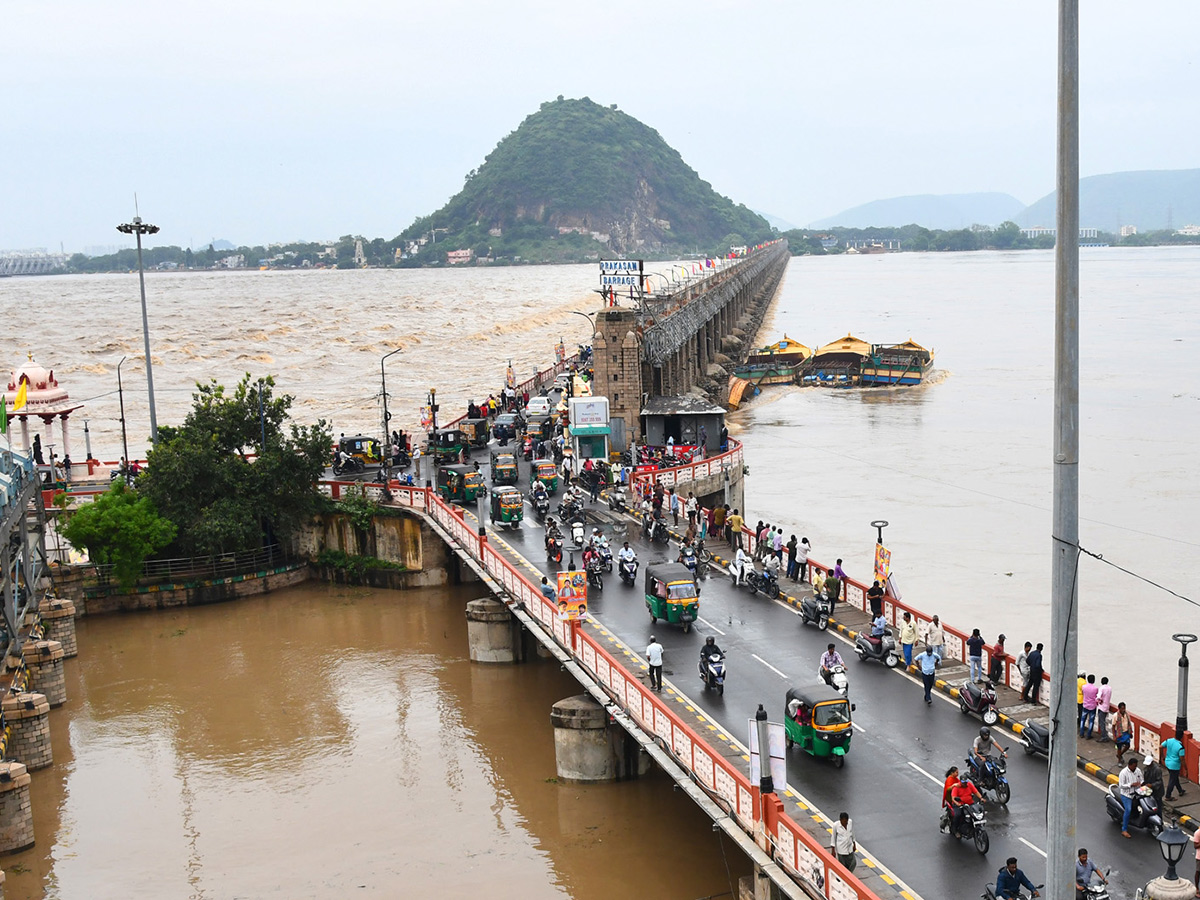
Above reports show that NDSA has been ineffective in achieving basic safety of massive dams like Srisailam and Nagarjunsagar on Krishna river, both of which NDSA visited in early 2024, but the serious problems remain. Similarly, there was a disaster at Prakasam Barrage on the same Krishna river in SW Monsoon 2024, but there has been no word about it from NDSA.
Tungabhadra Dam Gate Washed away: Questions for NDSA In a major dam related disaster at around 10.50 pm on Aug 10, 2024[i], one of the crest gates at the Tungabhadra dam has broken[ii] near Hospete in Vijayanagara district in Karnataka, causing the release of 70,000 to 100,000 cusecs of stored water. The chain on the 19th (of total 33 gates) gate of Tungabhadra dam on Tungabhadra river, part of Krishna River Basin, got cut, snapped and was washed away about 100 m from the dam on Saturday. The chain that was used to operate the gate snapped as the welding gave way. According to reports, the dam’s gates underwent comprehensive maintenance in May 2024, including the application of Cardium compound, greasing, and oil filling in gearbox units. Officials had confirmed the gates were in proper working order following these procedures. However, there is no word from National or State Dam Safety Authorities if either of them had inspected and given certificate of safety before the monsoon. Will the NDSA show promptness to inquire into the disaster the way they did for Medigadda dam disaster in Telangana?
Needless to add, there were not answers from NDSA or anyone else. https://sandrp.in/2024/08/11/tungabhadra-dam-a-crest-gate-washed-away-in-august-2024/ (11 Aug. 2024)
Tamil Nadu Madras HC issues notice to Centre over challenge to DSA The Madras High Court on Tuesday (July 23) took significant action by admitting a PIL filed by DMK party member and Mayiladuthural MP, DMK party member and Mayiladuthural MP, D Ramalingam, challenging the constitutionality of the Dam Safety Act (Act 41 of 2021). The court has issued notices to the Union Ministries Law and Justice and Jal Shakti. DMK MP P Wilson argued that the Parliament lacked the competence to enact laws on matters listed under List II entry 17 of the Constitution, which typically fall within the state’s legislative domain. He said that this act violates the principle of cooperative federalism.
The bench, comprising Acting Chief Justice M N Bhandari and Justice P D Audikesavalu, directed Additional Solicitor General R Sankaranarayanan to ensure that the Union govt refrains from constituting any authority under the newly notified act until further notice. Sankaranarayanan confirmed that no such authority had yet been formed. Furthermore, Wilson criticized various provisions of the Act as arbitrary, discriminatory, and unreasonable, infringing upon fundamental rights enshrined in Articles 14, 19, and 21 of constitution. https://lawtrend.in/madras-high-court-issues-notice-to-centre-over-challenge-to-dam-safety-act/#google_vignette (24 July 2024)
Teesta-3 HEP Govt, central panel split over what caused 2023 floods A report by a high-level government panel—that concluded the extreme flood event last October was caused by a glacial lake outburst flood (GLOF)—has become a bone of contention between the Ministry of Jal Shakti, NDSA and the Sikkim government. The Sikkim government has contested the findings of the 10-member committee constituted in Nov 2023 by the NDSA, which comes under the Ministry of Jal Shakti, and said that the 3 October incident was not caused by GLOF but a “cloudburst”. The committee, headed by former CWC chairman R.K. Jain was mandated to examine the causes leading to the bursting of South Lhonak Lake and consequent failure of Teesta-III Chungthang dam and damages to other downstream dams, and submitted its report to the ministry in June 2024. But the ministry is yet to accept the report and make its findings public.
The Prem Singh Tamang-led Sikkim govt has made multiple representations to the Jal Shakti Ministry, claiming that their observations based on data show last October’s flood was a result of “cloudburst”. The latest representation from the state government was sent to the ministry on 4 Sept 2024. In the aftermath of the disaster, senior state government officials, including chief secretary V.B. Pathak had in media briefings said that India Meteorological Department (IMD) data does not support a cloudburst as a probable cause. But the state government soon changed their stand, notifying the incident as a cloudburst. Though the dam is fully insured by a consortium of insurers led by IFFCO-Tokio General Insurance (the total sum assured is to the tune of Rs 11,400 crore), there’s a catch. While there is a 100 percent coverage of the sum assured for losses resulting from flash floods or cloudburst-induced floods, the coverage for damages by GLOF is capped at Rs 500 crore, a senior Sikkim government official said. A senior Jal Shakti Ministry official confirmed, “The State Dam Safety Organisation has submitted a representation, which is being considered. The ministry will finalise the committee’s report after that.” https://theprint.in/india/sikkim-govt-central-panel-split-over-what-caused-2023-floods-at-stake-is-rs-2500-cr-insurance-claim/2291910/ (1 Oct 2024) The NDSA report for this project is still not made public in January 2025.
NDSA 2 day workshop on rapid risk screening of specified dams The NDSA, DoWR, RD & GR, Govt. of India in collaboration with the Govt of Madhya Pradesh, conducted a 2-day Regional Workshop on Rapid Risk Screening of specified dams at Bhopal on 13-14 Dec 2024, under the aegis of DRIP. The objective of the workshop was to sensitize the five states viz. Maharashtra, Madhya Pradesh, Gujarat, Chhattisgarh & Rajasthan about the requirement for timely completion of Risk screening of all the specified dams in their respective states. These states constitute over 75% of the total number of specified dams in India. https://pib.gov.in/PressReleasePage.aspx (13 Dec. 2024)
Hirakud & Hdagarh NHRC Directs action on dam safety, NDSA criticised in petition The National Human Rights Commission (NHRC) has directed the DMs of Keonjhar and Sambalpur to take immediate steps to ensure the safety of people living near the Hadagarh and Hirakud dams. The notice follows a complaint filed by senior lawyer and human rights activist Radhakant Tripathi in Dec.
The apex rights body has asked the authorities to take appropriate action within eight weeks. Tripathi highlighted that the Hadagarh dam, built on the Salandi River in Keonjhar district, serves residents in both Keonjhar and Bhadrak districts. He noted that an embankment was constructed to protect the local population from rising river waters, but the dam has weakened over time, requiring urgent repairs and restoration. Tripathi also raised concerns over the safety of the Hirakud dam, alleging that it too is in dire need of repairs, restoration, and sediment recovery. Tripathi claimed that dam safety audits are not being conducted properly in a timely manner. Despite the existence of the Dam Safety Act 2021 and the National Dam Safety Authority, many dams across India are operating without adequate safety measures, which he argues puts people’s lives at risk. https://www.orissapost.com/nhrc-sends-notice-to-keonjhar-sambalpur-dms-over-dam-safety/ (03 Jan 2025)
Sardar Sarovar Project Why are Dam Safety reports not in public domain? The sudden release of water from the Sardar Sarovar dam in Sep 2023 is another case in point. A report by the SANDRP states that despite advance information about rains upstream, water from the Narmada River was released at once, flooding the low-lying areas. The NDSA’s preliminary report also found that crucial time was lost in taking preparatory action. https://www.theweek.in/theweek/current/2024/09/14/india-has-a-robust-dam-management-system-on-paper-but-inadequate-maintenance-and-climate-change-pose-serious-threats.html (22 Sep 2024) SANDRP issued a warning, supported by diagrams, that the SSD is at risk of causing flash floods in the Narmada Valley this year, similar to incidents in 2023. https://www.counterview.net/2024/09/narmada-valley-again-facing-flood.html (17 Sep 2024) However, NDSA report mentioned above is NOT in public domain.
These reports make it clear that there is little confidence inspiring change in Dam Safety issue since the passage of Dam Safety Act and formation of NDSA and other institutions.
Compiled by Bhim Singh Rawat (bhim.sandrp@gmail.com)

 SANDRP
How can National Dam Safety Authority (NDSA) can make Indian Dams that have been constructed long ago safe? The Bureaucrats’ create institutions to accommodate other bureaucrats who do not know basics of the subject matter
LikeLike