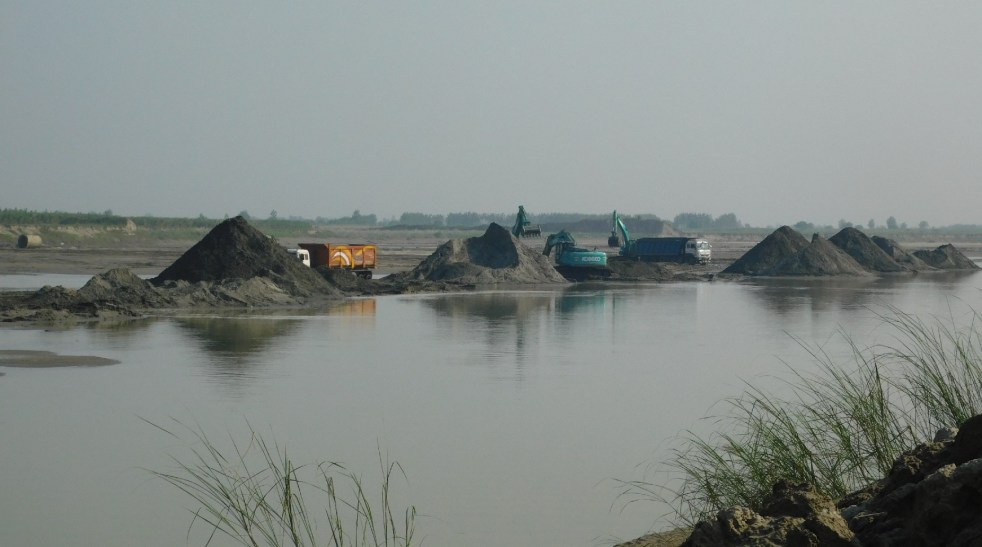
(Feature Image: Instream mechanized mining going on in Yamuna river at Gumthala Rao near Karnal-Yamuna Nagar border in Haryana in Oct. 2024. Source: Yamauna Nadi Mitra Mandli)
This twelfth edition of monthly Yamuna updates and the first one of the new year 2025, rounds up the critical issues impacting the river eco-system during the past year. The updates of the past one month only hint towards the bleak future the river is heading to. Without addressing the adverse effects and exploring cost effective alternatives, foundation stones of two massive river interlinking projects namely Ken-Betwa and Parbati-Kalisindh-Chambal have been laid. The work of unjustifiable Renuka and Lakhwar dams in climatically sensitive and geologically fragile region of Himalaya is going on.
The upper segment remains starved of flows and ravaged by unsustainable riverbed mining. The pollution levels in Delhi stretch have worsened and river has lost another patch of floodplain ‘Baansera’ to official encroachment. There is no stop in degradation of waterbodies and wetlands in the river catchment. As central and state governments are at the helm of all these issues, it is beyond doubt that the river degradation is by design. However, the year 2025 offers an opportunity to positively address the critical issue of environmental flows in the upper segment during review of 1994’s Yamuna water sharing agreement. This will also show whether or not the revival of river is governments’ priority at all.
Yamuna Manthan Updates in 2024
Dec. 2024 Native river fish species facing extinction A recent CIFRI report submitted to NGT is an eye-opening official document about the fish diversity in Yamuna. The report says that overall native fish species have declined sharply in the river not only in number but in size also due to habitat degradation, pollution and increasing presence of invasive fish species. The report admits that construction of Farakka barrage has led to complete elimination of Hilsa fish in lower segment of river since 2010. Despite this shocking state of affairs, the state govts & particularly the central govt continues to purpose and build more dams and river-interlinking projects in Yamuna basin which are bound to destroy river’s aquatic diversity further. https://sandrp.in/2024/12/05/yamuna-manthan-051224-native-river-fish-species-facing-extinction/ (05 Dec. 2024)
Nov. 2024 Save River from ‘Illegal’ Sand Mining Presently, the mining menace is quite rampant in Paonta Sahib, Yamuna Nagar, Saharanpur, Karnal, Shamili, Panipat, Sonipat, Baghpat and Ghaziabad districts along the river in upper segment. Similarly, in lower segment the main stem of river as well as its key tributaries Chambal, Sind, Betwa, Ken have been bearing the brunt of unsustainable sand mining.
Notably, the illegalities and violations are being mostly committed in government approved sand mines, where contractors showing no respect to norms deliberately indulge in obstruction of river flows, instream, mechanized mining even during night hours earning them ‘sand mafias’ tag. While they enjoy political patronage, the regulators including mine departments, pollution control boards in Yamuna basin states have been starved of resources thus proving inefficient to ensure compliance to norms. There have been multiples pleas on the issue, however the judiciary system too seems dealing with the cases in tokenistic manner by limiting itself to issuing notices, seeking reports and in some cases imposing nominal fines. https://sandrp.in/2024/11/07/yamuna-manthan-061124-save-river-from-illegal-sand-mining/ (07 Nov. 2024)
Oct. 2024 Threatened River Wetlands The waterbodies, lakes, wetlands in Yamuna basin continue to face damages and threats from many quarters, including concerned govt departments. In latest examples of this, there are reports of Uttar Pradesh govt’s plan to reduce the eco-sensitive zone (ESZ) of Keetham lake to zero. The wetlands also known as Sur Sarovar is a large ox bow lake formed by Yamuna River in Agra. It is a protected bird sanctuary and has been designated a Ramsar site in August 2020. In Sept. 2022, the Supreme Court had directed the govt to increase lake’s ESZ to 799 ha from 403 ha.
The waterbodies, lakes, wetlands in Yamuna basin continue to face damages and threats from many quarters, including concerned govt departments. In latest examples of this, there are reports of Uttar Pradesh govt’s plan to reduce ESZ of Keetham lake to zero. Similarly, the Uttar Pradesh govt departments have also been delaying process to notify Dhanauri wetlands as a Ramsar site in Greater Noida. In Gurugram, a report by has found several violations of ESZ norms by housing and infrastructure projects impacting Sultanpur National Park in Sahibi river basin. Likewise, in Delhi, NHAI was found damaging part of a protected pond in Goyla Khurd village by constructed road through the waterbody. https://sandrp.in/2024/10/03/yamuna-manthan-031024-threatened-river-wetlands/ (03 Oct. 2024)
Sept. 2024 Changing parameters of Ken-Betwa Project needs fresh appraisal? Firstly, there are plans to build two new barrages at Pailani and Banda and renovate Beriyapur and Pariksha weirs and Barua Sagar dam apart from renovation of 15 dams and large ponds in Mahoba district. Then, the construction of a 21 km link channel will require 271 ha of forest land. Similarly, the CM of MP has requested to increase irrigation capacity of Patne-Biarma Irrigation Scheme from 90,100 ha to 2,50,000 ha under the interlinking plan. On the other hand, the CM of UP has suggested inclusion of Hamirpur district in the plan. Moreover, the Forest Clearance is conditional, with conditions requiring changing in a number of project parameters, including removing the hydropower component from current location within the forest and protected area, among others.
All these changes are not part of the original plans and renders environment, forest and wildlife clearance and manipulated appraisal void. These changes are set to increase the project impacts, costs and benefits hugely and makes it necessary that project must undergo fresh forest, environmental and other clearance processes including preparation of fresh EIA report and conduction of fresh public hearings. https://sandrp.in/2024/09/05/yamuna-manthan-050924-changing-parameters-of-ken-betwa-project-needs-fresh-appraisal/ (05 Sept. 2024)
August 2024 Welcome Judicial Decisions for River Floodplain In the past one month there have been some interesting judicial interventions taking up the matters of floodplain, pollution and aquatic eco-system of the Yamuna River in Uttar Pradesh, Delhi, Haryana and Himachal Pradesh. Of these, the most significant one is the NGT order on July 11 fining MoJS & CWC of ₹50 000 each for the non-demarcation of floodplain in Agra.
Unfortunately, the execution of this direction has not happened. Moreover, the DDA has taken no action against leveling of around 19 ha of floodplain near Shashtri Park. Sadly, the river floodplain is yet to be mapped and demarcated in Delhi despite NGT orders and River Ganga Authorities Order, 2016. https://sandrp.in/2024/08/08/yamuna-manthan-080824-welcome-judicial-decisions-for-river-floodplain/ (08 Aug. 2024)
July 2024 A year after historic floods, where is River Governance? Despite multiple NGT orders, the DDA so far has neither mapped nor demarcated the Yamuna floodplain. Moreover, DDA has been proposing changes in the O Zone status to regularize unauthorized colonies in the floodplain. Despite High Court order the DDA has not removed construction waste dotting riverscape in Delhi. Despite Parliamentary Committee recommendation, the DDA and concerned agencies have neither prepared guidelines and rules regarding dumping of construction and other waste in the Yamuna nor have they established common portal to furnish and update data on sand mining, floodplain/wetland encroachment and dumping of waste into the river.
Likewise, the government agencies have so far not assessed or addressed the issues of increasing siltation and too many bridges on the river impacting its flood carrying capacity. The overall scenario indicates no change in the approach of govt agencies responsible for flood mitigation and floodplain management and the capital city is bound to face a repeat of July 2023 flood disaster following a few intense rainfall spells in upper catchment. https://sandrp.in/2024/07/04/yamuna-manthan-040724-a-year-after-historic-floods-where-is-river-governance/ (04 July 2024)
June 2024 Time to review UYRB to save river The UYRB suffers from some flaws in formation and functioning. The board is working in an opaque manner. Presently its website is inaccessible, and meeting minutes are not in public domain. It is also reportedly crippled by shortage of staff as against originally sanctioned post of 58, it is currently functioning with just 5 officials.
In this Oct. 2020 guest blog for SANDRP, the celebrated Yamuna crusader Late Manoj Misra has explained the fundamental problems in formation of UYRB and unscientific allocation of river waters by it. Unfortunately, in addition to World Environment Day, today is first death anniversary of famous Yamuna Jiye Abhiyan convener and despite being located by the mighty Yamuna, Delhi is facing water crisis, and the river is in highly deplorable state. There is need for urgent review of UYRB agreement to facilitate scientific distribution of Yamuna waters. Otherwise, the objective of river revival and solution to Delhi water crisis cannot be achieved. https://sandrp.in/2024/06/05/yamuna-manthan-050624-time-to-review-uyrb-to-address-delhi-water-crisis-save-river/ (05 June 2024)
May 2024 SC stays 4 NBWL cleared Dams in Kalesar WS In a welcome judicial intervention, the Supreme Court on April 24, 2024 has stayed building of four dams inside Kalesar National Park in Yamuna Nagar district of Haryana. Issuing notices to Centre and Haryana governments, the apex court noted that the dams namely Chikan, Kansli, Khillanwala and Ambawali would not achieve the intended purposes and would prove detrimental to wildlife, biota and eco-system of the National Park.
Disappointingly the National Board of Wildlife (NBWL) had approved the dams ignoring the Wildlife Institute of India (WII) report warning about adverse impacts of these dams on the terrestrial as well as aquatic biodiversity in the protected area. As per the WII report, the Irrigation Department, Haryana had planned building of six dams costing about Rs. 125 cr. on streams feeding Pathrala river in the national park. One hopes that the Supreme Court will take cognizance of adverse impacts of proposed four and other dams and prohibits their planning and construction permanently to protect the Yamuna river catchment in the region. https://sandrp.in/2024/05/02/yamuna-manthan-0105-sc-stays-4-nbwl-cleared-dams-in-kalesar-wildlife-sanctuary/ (02 May 2024)
April 2024 DDA Continues to Destroy River Floodplains In latest example proving Delhi Development Authority’s (DDA) utter failure in protecting Yamuna River floodplains from abuse and encroachment, a large part of floodplain land has been levelled by soil dumping thus raising it by several meters at Bela Estate farm near Shashtri Park Metro Depot. As per the reports, the DDA has allotted about 19.5 ha of floodplain to forest dept for compensatory plantation. The plantation work at the site like at most of the sites on Yamuna floodplain in Delhi has suffered damages during July 2023 floods. And the levelling at the Bela Estate site is being done in the name of protecting the compensatory plantation.
Due to discontinuation of Yamuna Monitoring Committee and non-functioning of Yamuna Principal Committee, the river is losing its floodplains bit by bit which is very much a recipe for disaster as seen during 2023 floods. In such a situation NGT is requested to take sou moto action against DDA, forest department and make them undo soil dumping from the site. We also hope the NGT will soon resume monitoring of Yamuna floodplains by independent expert committee before it is too late. https://sandrp.in/2024/04/03/yamuna-manthan-030424-dda-continues-to-destroy-river-floodplains/ (03 April 2024)
March 2024 Linking Plans Threatening River The push for country’s so called first river interlinking plan namely Ken-Betwa River interlinking is going on ignoring the norms, clearances and better viable alternatives. Now, the state governments of Madhya Pradesh and Rajasthan have signed agreement to prepare DPR for Parbati-Kalisindh-Chambal (PKC) river interlinking under modified Eastern Rajasthan Canal Project (ERCP).
The project has potential to deprive these rivers and ultimately Yamuna of essential environmental flows in lower segment in addition to increasing disaster potential and profound adverse impacts on riverine eco-system as suggested in a latest study. It is far better to exhaust all local alternatives and ensure that adversely affected riverine communities and others are able to take democratic and informed decision before embarking on massive project which in the long run would prove detrimental to still living and flowing Yamuna basin rivers in lower segments. https://sandrp.in/2024/03/06/yamuna-manthan-060324-linking-plans-threatening-yamuna/ (06 March 2024)
Feb. 2024 Inadequate efforts for river conservation, rejuvenation The Parliamentary Standing Committee on Water Resources (2023-24) has released its report titled ‘Review of cleaning projects of Upper Yamuna River upto Delhi and River Bed Management in Delhi’ in the Parliament on 06 February 2024.
Broadly, the report has found that there is inadequate flow in the Yamuna river downstream of Hathini Kund Barrage in Haryana and it needs to be increased from 10 cumecs (cubic metre per second) to 23 cumecs as already recommended by the National Institute of Hydrology in its recent study. The report has also highlighted the slow pace of river cleaning projects and no significant improvement in the water quality of Yamuna river.
It is worth noting that most of the issues discussed in the Parliamentary Committee report have been in the knowledge of the governments for years, yet no significant steps have been taken to resolve them till now. Apart from the report of the Parliamentary Committee, other news and information recorded in this compilation show that at present the condition of the Yamuna river is continuously deteriorating. In such a situation, it has to be seen how alertly and seriously the concerned governments and departments work on the recommendations of this report. https://shorturl.at/2UuBR (07 Feb. 2024)
SANDRP Yamuna Blogs in 2024
यमुना में पर्यावरणीय प्रवाह बढ़ाने के हों ठोस प्रयास यमुना में पर्यावरणीय प्रवाह बढ़ाने के लिए ही राष्ट्रीय हरित प्राधिकरण (एनजीटी ) ने जून 2015 में हथनी कुंड बैराज से नीचे यमुना नदी में न्यूनतम पर्यावरणीय प्रवाह को 4.5 घन मीटर प्रति सेकेंड (क्यूमेस) से बढाकर 10 क्यूमेक्स किया था। ना केवल यह जलराशि पूरी तरह अपर्याप्त है, बल्कि निष्पक्ष निगरानी के अभाव इस आदेश की पालना भी संशय में है। इसके बाद वर्ष 2019 राष्ट्रीय जलविज्ञान संस्थान रुड़की ने अपनी रिपोर्ट में हथनीकुंड बैराज से यमुना नदी में न्यूनतम पर्यावरणीय प्रवाह को 10 क्यूमेक्स से बढ़ाकर 23 क्यूमेक्स बढ़ाने की सिफारिश दी। परंतु पिछले पांच वर्षों में इस सुझाव पर सम्बंधित सरकारों और विभागों की तरफ से कोई पहल नहीं हुई है।
ज्ञात रहे कि 23 क्यूमेक्स की मात्रा भी नदी में प्रवाहमान बनाने में नाकाफी है। सैद्धांतिक तौर पर यमुना नदी की आधारभूत प्रक्रियाओं जैसे पारिस्थिकीय तंत्र, जलीय जीवों के जीवन चक्र, भूजल संचयन, रेत बहाव गाद निस्तारण आदि की पूर्ति हेतु नदी पर बने बांध और बैराज पर उपलब्ध जल का कम से कम 50 प्रतिशत नदी में छोड़ा जाना चाहिए। https://shorturl.at/jPBlo (31 Oct. 2024)
Yamuna SW Monsoon 2024: Upper Segment Misses Flood fter remarkable deluge in 2023, the upper segment of Yamuna river has seen no significant flood spell all through the just concluded southwest monsoon 2024. This is unusual as the river generally witnesses at least a couple of low or medium flood spells in this segment every year. However, this year the discharges from Hathnikund Barrage (HKB) in Haryana did not cross 1 lakh cusec figure even a single time. The peak discharge from the barrage was 87,017 cusecs at 06:00 hour on 26.09.2024. The IMD rainfall data shows that out of 15 districts which form Himalayan and Upper segments of the river, 12 districts have below normal rainfall. The CWC’s river basin wise cumulative rainfall map for the southwest monsoon 2024 shows normal rainfall in upper segment of the river. https://sandrp.in/2024/10/02/yamuna-sw-monsoon-2024-upper-segment-misses-flood/ (02 Oct. 2024)
UP: NGT Com Finds Sand Mining Rules Violated A joint committee formed by the NGT Delhi has found gross violations of several rules in a sand mining project on Yamuna river in Shamli district of Uttar Pradesh. Interestingly, the miner submitted EIA (Environment Impact Assessment) report in October 2019 and secured EC in March 2021 to carry out mining for five years, while the DSR (District Survey Report) was valid for a period of four years between August 2018 to March 2022. However, the miner kept on mining operation all through April 2022 and till June 2024 without a review or updation of DSR. In the two hearings so far, the NGT has not addressed this violation. https://sandrp.in/2024/08/24/uttar-pradesh-yamuna-aug-2024-ngt-com-finds-sand-mining-rules-violated/ (24 Aug. 2024)
‘Let Yamuna Flow’: A River’s Appeal to Political Parties In the wake of Lok Sabha election 2024 in Delhi on May 25, the civil societies and concerned citizens on behalf of River Yamuna appeal to the political parties to address the critical issue of absence of environmental flows adversely impacting the river health in the national capital. https://sandrp.in/2024/05/20/let-yamuna-flow-a-rivers-appeals-to-political-parties/ (20 May 2024)
Restore Yamuna Floodplain This is an open letter to concerned government officials regarding restoration of Yamuna floodplain illegally raised and levelled by Forest Department, Delhi and DDA at Bela Farm near Shashtri Park, Delhi. https://sandrp.in/2024/04/20/restore-yamuna-floodplain-raised-by-illegal-soil-dumping-near-shashtri-park-delhi/ (20 April 2024)
Parliamentary Committee Report Missing on River Governance The report has well documented the present status of untreated industrial and domestic effluents increasingly polluting the river and slow progress of river cleaning projects including sanctioned under Namami Gange. Further, the report has signified how critical is environmental flows for the river in absence of which the pollution control and river cleaning projects are turning into ineffective and futile exercise.
Despite staggering rise in untreated industrial effluents, sewage from municipal areas and solid waste from towns along Yamuna which indicates complete breaking down of river governance, the Parliamentary Committee has made No Recommendation on the institutional mechanism for pollution control and prevention and their functioning. One hopes that the DoWR, RD & GR and all other government agencies will follow the recommendations of the report in all their earnest and right spirit. https://sandrp.in/2024/03/12/yamuna-parliamentary-committee-report-missing-on-river-governance/ (12 March 2024)
July 2023 Floods: Parliamentary Committee Report Raises More Questions Overall, the Parliamentary Committee report has raised more questions than revealing the causes responsible behind unusual flood spell in Delhi in July 2023. Without providing convincing reasons, the Haryana government and CWC have ruled out role of ITO barrage closed gates in Delhi’s flood situation. Both have made confusing and contradictory statements which have also escaped the scrutiny of the Parliamentary Committee. The issue requires urgent credible scientific assessment including of Wazirabad and Okhla barrages.
The dispute between Haryana and Delhi governments regarding ownership and operations of ITO barrage seems to have reached no conclusion. The CWC and UYRB have also appeared non-serious on the issue. Yamuna is already starved of flows during lean season and plan of utilization of ITO barrage to divert available water in future is unviable and unjustified. In larger context of revival of river Yamuna and flood management all concerned stakeholders must initiate plan to decommission the barrage which is standing on the river without any purpose for the past 9 years in unmaintained condition, creating a lot of safety issues, among others. https://sandrp.in/2024/02/20/delhi-july-2023-floods-parliamentary-committee-report-raises-more-questions/ (20 Feb. 2024)
UPDATES FROM DECEMBER 2024
DAMS & HYDRO POWER PROJECTS IN YAMUNA BASIN
Himachal Pradesh Renukaji dam cost goes upto ₹8262 cr The Renukaji Dam project, envisioned on the Giri river 48 years ago (1976), is, it is claimed poised to emerge as a game-changer. PM Modi laid the foundation stone of this Rs 6,946 crore project on Dec 27, 2021. With 95 per cent of procedural hurdles already cleared (implying it is still not cleared completely), global tenders is to be floated for the project soon. The project cost, factoring a 5 per cent annual escalation, has surged to Rs 8,262 crore. The project is expected to be completed by 2030 and operations to commence in 2032. As per Harikesh Meena, Managing Director, HP Power Corp Ltd Rs 1,573 crore has already been disbursed as compensation and 90 homeless families have been offered rehabilitation options at designated sites.
The dam part of the PM Krishi Sinchai Yojana will store 498 million cubic metres water, supplying 275 MGD to Delhi and generating 40 MW of hydro power for Himachal. A breakthrough was achieved when an agreement to resolve water-sharing issues among six states was signed in Jan 2019. Haryana will contribute Rs 555.95 cr, followed by Uttar Pradesh (Rs 361.04 cr), Rajasthan (Rs 108.58 cr), Delhi (Rs 70.25 cr) and Uttarakhand (Rs 30.17 cr). Himachal will contribute Rs 36.67 cr. (KS Tomar) https://www.tribuneindia.com/news/himachal/renukaji-dam-project-promises-economic-growth-to-hp-water-security-to-delhi/ (28 Dec. 2024)
Cabinet nod to revive 700 stalled HEPs The state cabinet on Dec 12 accepted the recommendations of revenue minister Jagat Singh Negi-led high-powered committee to assess and formulate a policy to revive nearly 700 stalled hydropower projects of up to 25 Mw, which have been showing no visible progress. https://timesofindia.indiatimes.com/city/shimla/hp-cabinet-nod-to-revive-700-stalled-hydropower-projects/articleshowprint/116267801.cms (13 Dec. 2024)
INTERLINKING OF YAMUNA RIVERS
SANDRP Blog केन–बेतवा नदी जोड़ परियोजना का विरोध केन-बेतवा नदी जोड़ परियोजना को लेकर जय आदिवासी युवा शक्ति संगठन के पन्ना जिला अध्यक्ष मुकेश कुमार गौंड कहते हैं कि, “प्रभावित गांव 90 प्रतिशत आदिवासी क्षेत्र हैं। इन गांवों में लोग बुनियादी सुविधाओं से वंचित हैं। लेकिन, इन लोगों को सुविधाएं देने की वजाए विस्थापित किया जा रहा है। परियोजना में आदिवासियों को कुर्बानी देनी पड़ रही है। हम पहले विकास से वंचित हैं। ऐसे में परियोजना से हमारा क्षेत्र तहस-नहस हो जायेगा।“ मुकेश आगे बताते हैं कि, “मेरा अनुभव है कि पन्ना में जितने भी बांध बनाए गये, उसमें ज्यादातर बांध आदिवासियों की जमीन पर बनाए गए हैं। इन बांध योजनाओं में बहुत लोगों को मुआवजा नहीं मिला है। बहुत लोगों को बहुत कम मिला है। जिससे उनका जीवन विखंडित हो गया है।” https://shorturl.at/JRVKM (23 Dec. 2024)इस परियोजना को लेकर हमने पीपुल्स साइंस इंस्टीट्यूट कार्यरत वैज्ञानिक अनिल गौतम से बातचीत की। कहते हैं कि, “केन-बेतवा प्रोजेक्ट में मुख्य बिंदु यह रखा गया था कि, केन में पानी अधिक है और बेतवा में विचार करने योग्य है। यह मान्यता ही ग़लत है। क्योंकि दोनों नदियों के बेसिन में वर्षा दर समान है। केन नदी जल का अधिक दोहन नहीं हुआ है जबकि बेतवा नदी के जल का अत्यधिक दोहन हुआ है। इसलिए यह कहा जाता है कि, केन नदी में पानी अधिक है। जबकि, यह बात पूरी तरह से गलत है।” https://climateeast.in/tribal-people-are-opposing-ken-betwa-river-linking-project/ (26 Dec. 2024)
केन बेतवा जोड़ के गणित में घाटे का नतीजा केन-बेतवा जोड़ परियोजना से झांसी के राजघाट व माताटीला बांध पर खर्च अरबों रूपए व्यर्थ हो जाएंगे। यहां बन रही बिजली से भी हाथ धोना पड़ेगा। उल्लेखनीय है कि राजघाट परियोजना का काम जापान सरकार से प्राप्त कर्जे से अभी भी चल रहा है, इसके बांध की लागत 330 करेाड से अधिक तथा बिजली घर की लागत लगभग 140 करोड़ है। राजघाट से इस समय 953 लाख यूनिट बिजली भी मिल रही है। भारत सरकार स्वीकार कर रही है कि नदियों के जोड़ने पर यह पांच सौ करोड बेकार हो जाएगा। इसके साथ ही ललितपुर के दक्षिणी व झांसी जिले के वर्तमान में संचालित बेहतरीन सिंचित खेतों का पानी इस परियोजना के कारण बंद होना तय है।
जरूरी है कि वैश्विक मौसमी बदलाव के कुप्रभावों के नजरिए से नदियों को जोड़ने की योजना का मूल्यांकन हो। केन-बेतवा जोड़ परियोजना की लागात के एक चौथाई से भी कम धन खर्च कर समूचे बुंदेलखंड के पारंपरिक तालाब, बावड़ी कुओं और जोहड़ों की मरम्म्त की जा सकती है। सिकुड़ गई छोटी नदियों को उनके मूल स्वरूप में लाने के लिए काम हो सकता है। समूचे बुंदेलखंड में एक हजार साल पुराने हजारों चंदेलकालीन तालाब, लाख उपेक्षा व रखरखाव के अभाव के बावजूद आज भी लेागों के गले व खेत तर कर रहे हैं। बुंदेलखंड की किस्मत बदलने को छोटी परियोजनाएं कम व्यय में बगैर पुनर्वास या जंगल कटाई के ज्यादा कारगर होंगी, जिनकी योजना भी स्थानीय स्तर पर बने। (पंकज चतुर्वेदी) https://indiaclimatechange.com/result-of-deficit-in-mathematics-of-ken-betwa-addition/ (31 Dec. 2024)

शिलान्यास से नाराज प्रभावितों ने मनाया काला दिवस… एक तरफ देशभर का पत्रकार बिना ग्राउंड पर गए सरकारी पोस्टर और विज्ञापन पर इस परियोजना के गुणगान कर रहा है। वहीं इस केन बेतवा लिंक से नाराज स्थानीय आदिवास और ग्रामीणों ने आज बांध स्थल पर चिताओं मे लेटकर काला दिवस मनाया है। https://soochanasansar.in/pm-modi-today-opening-bundelkhand-region-ken-betva-river-link-project-but-lokal-rural-panna-taigar-rijarv-erea-people-today-protest-black-day/ (25 Dec 2024)
केन के पानी पर पहला हक हमारा देश की स्वच्छ और प्रदूषण मुक्त नदियों में सुमार केन नदी पन्ना टाइगर रिज़र्व के मध्य से प्रवाहित होती है। यह नदी वन्य प्राणियों सहित केन किनारे स्थित ग्रामों के लोगों के जीवन का आधार है। केन नदी के किनारे स्थित गांव के लोग बहुचर्चित केन-बेतवा लिंक परियोजना को लेकर सशंकित और चिंतित हैं। बीरा गांव के वीरेंद्र सिंह (78 वर्ष) अपनी चिंता जाहिर करते हुए कहते हैं कि “केन को पानी यदि ऊपर छेंक लेहें तो हम का करबी। हमसे कउनो राय व सहमति नहीं ली गई, जा तो हम लोगन के संगे सरासर अन्याय है”। ग्रामीणों का साफ कहना है कि केन के पानी पर पहला हक हमारा है। हम केन के पानी को रोककर बांध बनाने के पक्षधर नहीं हैं, क्योंकि इस नदी की जलधार पर ही हमारा जीवन निर्भर है।
उल्लेखनीय है कि पन्ना जिले से प्रवाहित होने वाली केन नदी रीठी कटनी के पास से निकलती है और 427 किलोमीटर की दूरी तय करने के बाद उत्तर प्रदेश के बांदा में यमुना नदी से मिल जाती है। ढोढन गांव के निकट जहां पर बांध का निर्माण होना है, वह नदी के उद्गम स्थल से लगभग 200 किलोमीटर की दूरी पर है। इस तरह से बांध के निचले क्षेत्र में नदी की लंबाई तकरीबन 227 किलोमीटर बचती है, जहां सैकड़ों की संख्या में पन्ना, छतरपुर व बांदा जिले के गांव स्थित हैं। 44 हजार करोड रुपए से भी अधिक लागत वाली इस परियोजना के मूर्तरूप लेने से बाघों सहित दूसरे वन्य जीवों और गिद्धों का सदियों पुराना रहवास जहाँ नष्ट होगा वहीं लाखों पेड़ों के कटने से पर्यावरण की अपूर्णीय क्षति होगी। केन नदी के किनारे स्थित फरस्वाहा गांव के करण त्रिपाठी का कहना है कि बांध बनने से केन की जलधार यदि रुक गई तो केन किनारे के गांवों में जिंदगी मुश्किल हो जाएगी। केन नदी में यदि पानी नहीं रहा तो इन गांवों के लोग कैसे जिंदा रहेंगे ? https://pannastories.blogspot.com/2024/12/25-3.html (24 Dec. 2024)
Farmers of four villages refuse relocation
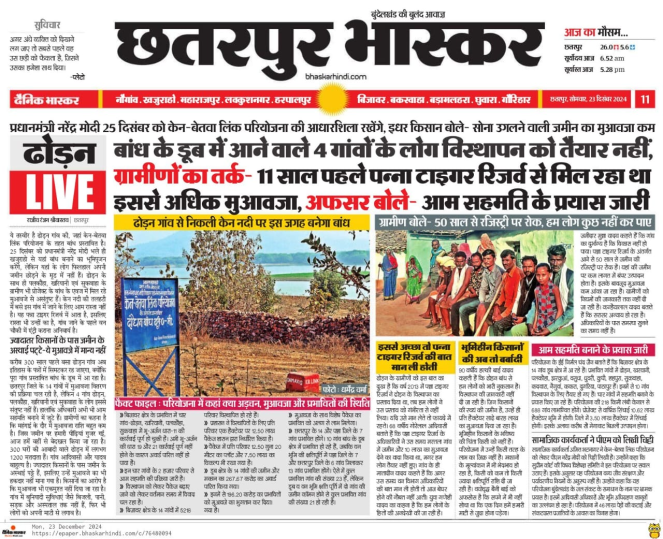
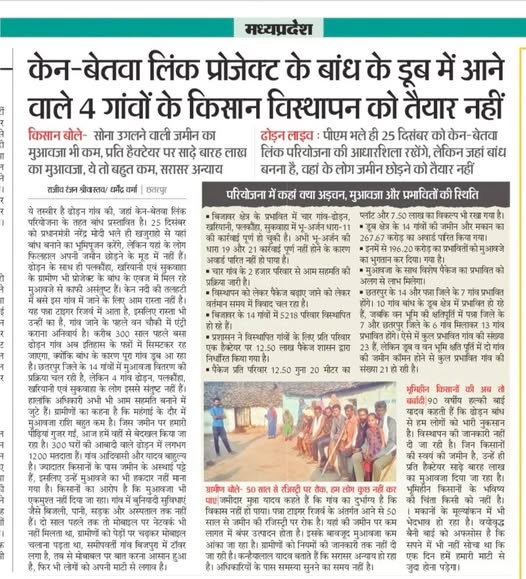
Why Ken Betwa Link should not go forward A detailed report this week based on extensive field visit and interview of the concerned persons shows once again why there is no justification for Ken Betwa Link starting from lack of hydrological justification: There is no credible evidence or are not credible figures proving that Ken has surplus water and Betwa is deficit. The project will actually facilitate export of water from drought prone Bundelkhand in addition to bringing massive adverse impacts and as a former Panna collector said, will keep the upstream Ken Basin area permanently backward.
The whole exercise of getting clearances for the project has been an exercise in manipulations at each step of the way, including EIA, Public Hearings, EAC process, Environment Clearance, Forest Clearance, Wildlife clearance and gram sabha clearances. This is also true as this report shows, for the people to be displaced by the project. The scathing CEC (Central Empowered Committee appointed by the Supreme Court) report on its wildlife related issue has not even been considered by the Supreme Court. We hope the Supreme Court will soon consider this and put a stop to the mindless project.
The forest clearance is in fact on conditions that changes the basic parameters of the project, requiring fresh cost benefit analysis, EIA and EC. The hydrological figures need urgent independent scrutiny, particularly considering the additional reason for changing climate. One only hopes that better sense will prevail and this massive costly, contract driven project will not go forward. https://sandrp.in/2024/12/02/drp-nb-021224-why-ken-betwa-link-should-not-go-forward/ (02 Dec. 2024)
Inauguration done but crucial questions remain Not everyone is convinced. Environmental activists have long said what the former bureaucrat wrote. “These are claimed benefits, assumptions. Not realistic. These claims are not independently scrutinised,” Himanshu Thakkar from the South Asia Network on Dams, Rivers and People told The Telegraph Online. Thakkar pointed out that it will take 20 years to complete the Ken-Betwa project.
Activists like Thakkar say there are other, less drastic ways to address the problem. “Bundelkhand gets 900 mm of rainfall. Even higher than Marathwada, Rajasthan and Kutch area, and parts of Andhra Pradesh,” Thakkar pointed out. According to Thakkar, the environmental cost is too high. His estimate of the number of trees to be felled is around 46 lakh trees. There will be loss of habitat, he underlined.
Environmental activists say the plan is merely on paper. Thakkar said Bundelkhand has a history of destruction in the name of development. “Forest advisory committee said this project should not be cleared. Destroying trees would lead to a decrease in rainfall. Floods will increase. There will be erosion after monsoon. Ken basin will remain backward,” Thakkar said.
But what could have been the alternative? “Even 60 years ago Bundelkhand didn’t have a water problem,” Thakkar said. “Destruction in the name of development led to this deficit. They should have ensured there is proper ground water recharge. There should be rainwater harvesting. These are much more cost-effective.”
The Supreme Court had appointed a central empowered committee to submit a report on the project. “The very objective…of natural evolution unhindered by human intervention will be defeated and will result in complete breakdown of the evolutionary process of millions of years,” the committee report said. “The alternative to the main objectives of the project proposal of irrigation and alleviation of poverty have not been examined by the project proponents. The disturbance to wildlife during the construction phase will extend beyond the 6071 ha of forest proposed for diversion and will last for more than a decade exerting tremendous biotic pressure on the core of national part and critical tiger habitat,” it added. https://www.telegraphindia.com/gallery/as-narendra-modi-inaugurates-ken-betwa-river-link-project-crucial-questions-remain-photogallery/cid/2073266 (25 Dec. 2024) KBL foundation stone laid but questions still pending! https://hindi.downtoearth.org.in/river/pm-modi-laid-foundation-stone-of-ken-betwa-river-link-project-but-questions-still-remain (25 Dec. 2024) PM to lay foundation stone of ‘controversial’ Ken- Betwa river linking project https://globalbihari.com/pm-to-lay-foundation-stone-of-controversial-ken-betwa-river-linking-project-on-atals-100th-birth-anniversary/ (24 Dec. 2024) The Congress on Wednesday (Dec. 25) said that by laying the foundation stone of the Ken-Betwa River Linking Project, PM Modi will give another proof of the difference between his “talk and walk” on environment as it poses a serious threat to the Panna Tiger Reserve. https://www.thehindu.com/news/national/ken-betwa-river-linking-project-poses-serious-threat-to-panna-tiger-reserve-congress/article69025522.ece (25 Dec. 2024)
KBL a recipe for bulldozing public policy The project is a case study in flawed public policy, marked by its rejection of updated data, new research, expert reviews, and external assessments from a water management perspective. At this delicate moment, as the public announcements have been made by the state, it will naturally be nearly impossible for any public official (or even a learned judge) to raise even mild queries.
So much of what is normal has been ignored and rejected, it seems the project has had to be cleared, or bulldozed, never mind the facts. A previous head of the NWDA presented a case study of this project to state that environmental clearances were hurdles in the pathway of development. So be it. Let the reader judge if thoroughly disregarding environmental impacts is the appropriate manner of investing scarce public resources and if Panna’s bleak future is the future they want for our drying country and warming planet. https://m.thewire.in/article/environment/ken-betwa-river-linking-project-a-recipe-for-bulldozing-public-policy-amidst-environmental-concerns/amp (21 Dec. 2024)
Link will not solve Bundelkhand water problems Instead of transferring water from a river already ravaged by sand mining, a very different approach is needed for resolving water problems of Bundelkhand. https://countercurrents.org/2024/12/ken-betwa-river-link-project-will-not-solve-the-water-problems-of-bundelkhand/ (27 Dec. 2024) Ken Betwa link project is not practical https://globalbihari.com/mudda-ken-betwa-link-pariyojna-vyavaharik-nahin-hai/ (24 Dec. 2024) Govt should think once more on river connection https://globalbihari.com/bharat-sarkaar-ko-nadi-jod-par-ek-baar-aur-vichaar-karna-chahiye/ (25 Dec. 2024) The 77m-tall Daudhan Dam would submerge 8,650 hectares of land, including a part of the biodiversity-rich reserved forests of Panna Tiger Reserve, as per a government report. https://www.news18.com/explainers/why-ken-betwa-river-project-will-be-boon-for-bundelkhand-but-bane-for-environment-explained-9168885.html (26 Sept. 2024) What really is the Ken Betwa River “Linking” project doing? https://www.youtube.com/shorts/RLPDhshRjM8 (25 Dec. 2024)
EDIT KBL product of political expediency The project seems more the product of political expediency and self-image than current ecological sense. The more resources the government sinks into it, the more unlikely changing or reversing course will become in the face of adverse developments. When they come to pass, the responsibility and costs of mitigating the adverse consequences of this and other projects, including the recently launched Parbati-Kalisindh-Chambal link, will fall to the people. https://www.thehindu.com/opinion/editorial/pushed-through-on-the-ken-betwa-river-interlinking-project/article69029968.ece (27 Dec. 2024)
Linking river can cause irreversible damages The Ken-Betwa linking project has been challenged on many grounds. It will submerge about 10% of the Panna Tiger Reserve and affect the entire biodiversity of the area. About 23 lakh trees will be felled. There are questions about the availability of surplus water to be transferred. Some experts have said that linking will make both the Ken and the Betwa basins water-deficient, and affect rainfall, sedimentation, soil fertility, and natural water storage capacity. It is also pointed out that there are alternatives, and the government has gone ahead with the project, ignoring the recommendations of an empowered committee. Extreme caution is needed in executing projects that seek to change nature, because the damage they cause is often irreversible. https://www.deccanherald.com/opinion/editorial/linking-of-rivers-calls-for-extreme-caution-3335669 (30 Dec. 2024)
PKC River Linking Foundation stone laid On Dec. 17, PM Narendra Modi laid foundation stone of the Parvati, Kalisindh and Chambal (PKC)-Eastern Rajasthan Canal Project (ERCP) project ending the 20-year-old water dispute between MP and Rajasthan.
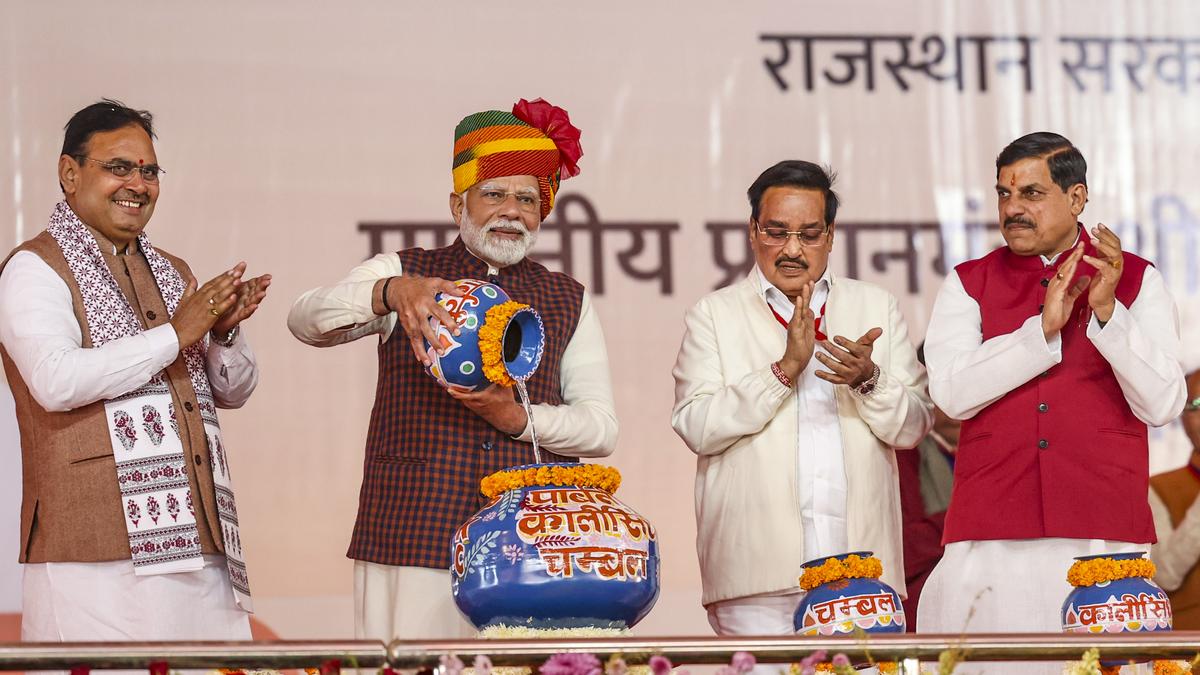
The project worth Rs 45,000 crores envisages the use of monsoon water-flowing waste in the Kalisindh, Parvati, Mej, and Chakan sub-basins. It envisages inter-basin transfer of water within the Chambal basin by diverting it to water-deficient sub-basins of Banas, Gambhiri, and Banganga. On completion of the scheme, the availability of drinking and industrial water will be ensured in 13 districts of eastern Rajasthan. Additionally, the project envisages irrigation of about 2.82 lakh hectares of area.
An expenditure of Rs 40,000 crore is estimated for this scheme. The districts benefiting from the scheme include Alwar, Dausa, Jaipur, Ajmer, Tonk, Sawai Madhopur, Bundi, Kota, Baran, Jhalawar, Bharatpur, Dholpur, and Karauli. In the first phase, water will reach Bisalpur and Isarda dams, and canal systems will be built in Ramgarh Barrage, Mahalpur Barrage, and Naunera. Water will reach 158 dams, ponds, and other water sources under the project.
The project will meet the industrial needs along with drinking water in many districts of MP including Shivpuri, Gwalior, Bhind, Morena, Indore, and Dewas. Under this, 7 dams will be built. This project will promote industrial investment, tourism, and educational institutions in both states. Also, the irrigation sector will become more prosperous.
Way back in 2004, the Central Water Resources Ministry submitted a report to the concerned state governments about the Parvati-Kalisindh-Chambal (PKC) link project. Under this, it was proposed to divert the excess water coming into the Parvati, Nevaj, and Kalisindh rivers during the monsoon months into the Chambal River. After this, the Rajasthan government came up with the ERCP project. https://www.news9live.com/opinion-analysis/pkc-ercp-project-realised-after-20-yrs-due-to-raj-mp-centres-triple-engine-govt-2776731 (18 Dec. 2024)
YAMUNA FLOODPLAIN
Delhi बांसेरा पार्क में हो सकेंगे कल्चरल दिल्ली के यमुना किनारे बने पहले बांस थीम पार्क बांसेरा की बुकिंग डीडीए ने सांस्कृतिक कार्यक्रमों के लिए शुरू की है। पर्यावरण एक्टिविस्टों ने इसके जैव विविधता पर संभावित असर को लेकर चिंता जाहिर की है। यह पार्क बुकिंग से डीडीए के रेवेन्यू में वृद्धि करेगा। बांसेरा पूरी तरह बांस से तैयार पार्क है। इसमें पांच जोन हैं और सभी जोन के लिए बुकिंग के अलग-अलग रेट तय किए गए हैं। जोन के साइज, वहां मौजूद फूलों, वॉटर बॉडी से दूरी, ग्रीन लॉन आदि के हिसाब से बुकिंग रेंज 25 हजार से 3.5 लाख रुपये तक है। इसे ऑनलाइन और ऑफलाइन दोनों तरह से बुक करवाया जा सकेगा।

SANDRP के भीम सिंह रावत ने कहा कि बांसेरा प्रोजेक्ट यमुना फ्लड प्लेन एरिया में बनाया ही नहीं जाना चाहिए था। इस पार्क के साथ फ्लड प्लेन एरिया का कमर्शलाइजेशन शुरू हो गया है। पार्क बनाने के लिए बाढ़ क्षेत्र की लेवलिंग की गई, अब वहां कैफेटेरिया और किड जोन भी शुरू कर दिया है। कल्चरल इवेंट से वहां की जैव विविधता नष्ट होगी और पक्षियों के लिए वह जगह उपयुक्त नहीं रह जाएगी। एनजीटी के नियमों का भी इसमें उल्लंघन दिखता है। दिल्ली 2023 में बाढ़ का उग्र रूप देख चुकी है। https://navbharattimes.indiatimes.com/metro/delhi/other-news/delhi-baansera-park-cultural-event-plan-environment-activists-has-objection-full-details/articleshow/116781152.cms (30 Dec 2024)
Noida Avoid buying farmhouses, plots on floodplain: Authority The Noida authority in an advisory issued in national dailies and its own website has appealed to the general public to avoid buying farmhouses or plots on Yamuna floodplain and also in unapproved projects. The move followed complaints to the authority that illegal farmhouses and residential plots are being sold in the city’s notified areas meant for planned development. The authority has also launched a crackdown against illegal construction in Nagli Wajidpur and Kondli village land.
The authority has issued two public notices, one about an illegal flat-style multi-storey building in Nagli Wazidpur and the other about farmhouse or other plot sale on floodplain on notified land of the city. The authority in second notice has advised the home-buyers not to buy any farmhouse, flat, shop or any other property in any such project that is not approved as per the building bylaws-2010, said officials.
Currently hundreds of illegal housing and commercial projects including farmhouse projects are being developed in the notified area prompting the authority to take action against this menace. The developers issue advertisements and lure buyers in the name of a cheap apartment, shop, farmhouse or other space. https://www.hindustantimes.com/cities/noida-news/avoid-buying-farmhouses-plots-on-yamuna-flood-plain-noida-authority-101733164301059.html (3 Dec 2024)
NGT orders immediate halt on illegal constructions Finding merit in the petition, the tribunal has now directed the state authorities and the Uttar Pradesh Pollution Control Board to ensure that no project requiring environmental clearances is allowed to proceed without compliance until the next date of hearing on March 27, 2025. “Over 20,000 ha of fertile farmland in Greater Noida and a similar area in Noida have been usurped for illegal plotting and construction,” the petition said. These developments, the petition argued, violated the Air Act and Water Act and lack of clearances for groundwater extraction from the district ground water management council.
Advocate Akash Vashishtha, representing Tyagi, emphasised the scale of illegal activities: “Almost the whole of Greater Noida has been taken over by unauthorised constructions. Borewells are being dug without mandatory approval, and power connections are being facilitated by the discom to illegal colonies,” he said. In July 2024, UPPCB Noida and Greater Noida submitted before the NGT that 47 villages of Greater Noida were found to have unauthorised constructions in the form of shops, residences, etc. In Noida, areas in Shahdara near Sector 141, Garhi Chowkhandi near Sector 121 and Behlolpur near Sector 65, which falls in the floodplain zone, were reeling under encroachments. https://www.hindustantimes.com/cities/noida-news/ngt-orders-immediate-halt-on-illegal-constructions-in-noida-greater-noida-101734114028908.html (14 Dec. 2024) The Allahabad high court issued notices to the Noida authority & other govt bodies concerned on Dec 13 on a petition filed by apartment owners of the Gaur Sportswood housing project in Sector 79. The petitioners, a group of 44 apartment owners, demanded the removal of a 2020 registry ban and execution of tripartite sub-lease deeds for their apartments under the Sports City group housing scheme. https://www.hindustantimes.com/cities/noida-news/allahabad-high-court-issues-notice-to-noida-authority-on-registry-ban-101734286582441.html (16 Dec 2024)
Haryana Interstate boundary on river to get markers The PWD has approved tenders for installing concrete pillars in the Yamuna riverbed to demarcate the interstate boundary between Haryana and Uttar Pradesh in Faridabad and Palwal districts. Spanning nearly 100 kilometres, the Yamuna serves as a natural border between the two states. According to district administration sources, the department has completed the survey and awarded the tender to an agency for execution. While the DPR estimates the total cost at Rs 10.20 crore, officials note that the final expenditure could vary based on material requirements. Of the total, Rs 8.70 crore is allocated for Palwal and Rs 1.50 crore for Faridabad.
The project involves installing 135 pillars in Faridabad and 529 in Palwal. Each 70-foot-long pillar will be embedded 50 feet deep into the ground to ensure stability and withstand peak water flows. However, the Revenue Department’s inputs will be critical in identifying the exact locations for erecting these pillars. The initiative follows a detailed report from the Survey of India, prepared a few months ago to address a long-standing boundary dispute. Similar poles were installed in the 1970s following recommendations by the Dixit Commission. However, most of these were washed away or damaged over time, reviving the boundary issues. https://www.tribuneindia.com/news/haryana/interstate-boundary-on-yamuna-to-get-markers/ (29 Dec. 2024)
YAMUNA POLLUTION
Delhi Will oversee all of key drains: Irrigation dept The Irrigation and Flood Control dept has informed the NGT that it has taken over all 22 major drains that end up in the Yamuna, making it the sole agency which is now responsible for maintenance and clean-up of drains in Delhi. In its submission of Dec 18, the dept, part of the Delhi government, said the decision to hand-over all drains was taken in a meeting held in April this year under the Integrated Drain Management Cell, following directions from the Delhi high court the same month.
Bhim Singh Rawat a Yamuna activist said while the move should help bring more transparency & accountability, the I&FC’s own track record for its drains is not too encouraging so far. “Even with the drains it had under its jurisdiction, it could have easily taken action, be it against encroachments or sewage entering it. While having a single agency helps fix accountability, it is important to ensure targets are set and timelines to clean these stormwater drains are fixed,” he said. https://www.hindustantimes.com/cities/delhi-news/irrigation-dept-tells-ngt-will-oversee-all-of-delhi-s-key-drains-101734716075354.html (21 Dec. 2024)
Okhla STP is unlikely to help fight river crisis To reduce the pollution load in the river, the design of most of the STPs is such that the treated water generated is released back into the Yamuna directly or through large drains. “While the Okhla and Kondli STPs will be fulfilling the obligation of treating the untreated sewage, they are designed in a way that the river stretch (in Delhi) will not get the benefit of the treated water,” Ankit Srivastava, a water expert, said.
The Okhla STP will be able to treat 140 MGD sewage once it is fully operational. Srivastava explained that the facility, touted as Asia’s biggest STP, will discharge its treated water outside the boundary of Delhi into the Agra Canal (UP). This raises the question of whether the initial planners considered this factor. The Okhla STP project is a joint venture between NMCG & DJB, started in 2017. It is now nearing completion. The estimated cost of the project is Rs 665 crore. While almost 85% of the funds were from central govt, the remaining was given by Delhi govt. https://timesofindia.indiatimes.com/city/delhi/why-delhis-largest-stp-in-okhla-is-unlikely-to-help-fight-yamuna-crisis/articleshow/116774632.cms (30 Dec 2024)
Record pollution in Nov in 4 years The Yamuna experienced its highest pollution levels this Nov since Dec 2020. While this continued a pattern seen in previous Novembers, the faecal pollution, which worsened throughout the year, was the highest in four years. https://timesofindia.indiatimes.com/city/delhi/yamuna-river-pollution-surges-faecal-coliform-count-hits-record-high/articleshowprint/116183271.cms (11 Dec. 2024)
Story of a dying river. https://www.youtube.com/watch?v=aBGzwby48VA (22 Dec. 2024)
Haryana NGT serves notices on unrecovered ₹230 cr fine Giving one month reply time, the NGT on Dec 20 week issued notices to the Haryana govt and the SPCB after a petition argued that Rs 230 crore, which was imposed on entities or individuals who had violated environmental norms, was yet to be recovered and utilised to make up for the damages. The tribunal was hearing a plea filed by Delhi resident Varun Gulati, who argued that govt and HSPCB’s “inefficiency” in recovering environmental compensation was harming the environment by preventing restoration, remediation and rejuvenation efforts. Next hearing on Feb 13. https://timesofindia.indiatimes.com/city/gurgaon/rs-230-cr-green-damages-not-collected-ngt-serves-notice-to-haryana/articleshow/116609567.cms (24 Dec. 2024)
Madhya Pradesh HC moved to stop transport of UC waste to Pithampur While govt prepares on a war footing to transfer Union Carbide waste from Bhopal to a disposal facility in Dhar’s Pithampur, a petition was filed before the Indore bench of high court on Dec 30, seeking to halt the transportation. The petitioners seek formation of a judicial committee to check impact of the disposal on people who live in the vicinity of the plant. The petition (WP/41965/2024) fears disposal of the waste left over from the 1984 tragedy will have a ‘grave impact’ on Pithampur & Indore.
The waste disposal plant in Pithampur is situated close to Gambhir river, a source of water supply to Yeshwant Sagar reservoir — which supplies water to 40% of Indore. “There is a possibility that this dam may be polluted because of hazardous waste, therefore such a huge risk cannot be taken by the administration,” the petition said. The petition also seeks directions to establish a temporary hospital capable of dealing with any aftermath related to the disposal of Union carbide waste. They want an evacuation plan and SOP for local residents and a rehabilitation plan in case of a mishap. https://timesofindia.indiatimes.com/city/indore/hc-moved-to-stop-transport-to-pithampur/articleshow/116806343.cms (31 Dec. 2024)
MINING IN YAMUNA RIVERS
Uttarakhand HC bars excavators in river mining The HC hearing a PIL, has prohibited use of heavy machinery like excavators for riverbed mining. State govt and others asked to submit affidavits in 4 weeks, next hearing on Jan 8. https://timesofindia.indiatimes.com/city/dehradun/hc-bars-excavators-in-river-mining-seeks-affidavit-from-govt/articleshow/116252748.cms (12 Dec. 2024)
Uttar Pradesh ‘Road’ stopped, sandbags still there Construction of an unauthorised road at a bend of the Yamuna between Delhi and Ghaziabad near Loni stopped earlier this month after a NGT notice, but scores of sandbags used in its construction are yet to be removed from the riverbed. Experts say the prolonged presence of the sandbags could obstruct the river’s flow, potentially causing diversions and dryness in sections of it.
The road, being built by the official leaseholder for sand mining in the area, had been laid by tethering wooden planks to the riverbed, filling them up with sandbags and then with sand to make it look like any other part of the heavily silted river. A TOI report in Nov highlighted that the miners were building the road for excavators to make their way across the Yamuna and dredge sand. Over decades, under the guise of leases, sand miners have operated with abandon on the Yamuna floodplains. Ghaziabad mining officer Saurav Chaturvedi said they would remove the sandbags once the river changed its course, and the area became dry. https://timesofindia.indiatimes.com/city/noida/road-on-yamuna-stopped-sandbags-still-there/articleshow/116692173.cms (27 Dec. 2024)
NGT cites TOI report on sand mining, asks for govt replies The NGT has taken suo-motu cognisance of a TOI report last month highlighting how sand miners had constructed unauthorised roads across the Yamuna between Delhi and Ghaziabad and sought replies from the Centre, pollution boards and district magistrates. In a Dec 16 order, NGT bench named several parties to the case, including the Ghaziabad and North Delhi DMs, the central, UP and Delhi pollution control boards and the ministry of environment, forest and climate change as parties to the case. The tribunal sought affidavits from them at least a week before the next hearing on April 14 2025. https://timesofindia.indiatimes.com/city/noida/ngt-cites-toi-report-on-sand-mining-asks-for-govt-replies/articleshowprint/116547444.cms (22 Dec. 2024) The news report indicated to the NGT that sand miners in the region were building makeshift roads across the river, which enabled them to transport excavators and carry out mining operations in the floodplain. The article further said these roads were often constructed by placing wooden planks and sandbags across the river bed, not authorised under any mining leases, and caused considerable damage to the river’s fragile ecosystem. https://indianexpress.com/article/cities/delhi/yamuna-illegal-sand-mining-ngt-issues-notice-9734487/ (19 Dec. 2024)
मौरम खदान ‘सांडी खंड 77’ पर बाँदा प्रशासन की कार्यवाही आशीष सागर दीक्षित बाँदा पैलानी क्षेत्र के ग्राम सांडी मे इस सीजन 2024 के अंतिम माह मे खण्ड 77 मौरम खदान के संचालन का आगाज हो गया है। खदान पट्टेधारक जयपुर निवासी हिमांशु मीणा है। वहीं खदान फर्म ‘न्यू यूरेका माइन्स एंड मिनरल्स’ का पता मध्यप्रदेश का छतरपुर सूचना बोर्ड पर अंकित है। पैलानी क्षेत्र के मौरम मास्टर बंसल, अवैध खनन विशेषज्ञ जावेद, लाइजनर सेंगर ने पूरी कमान संभाल ली है। बड़ी प्रतिबंधित पोकलैंड केन के कछार फिर पट्टे की जद और बेखौफ नदी जलधारा पर उतरने को व्याकुल है। बीते 26 दिसंबर ही सुबह से बाँदा पत्रकारों की पैनी गिद्ध नजर और खदानों पर बाज सी झपट्टा मारने की कला ने खण्ड 77 से जुड़ी खबरों को ब्रेकिंग बनाना शुरू कर दिया था। https://soochanasansar.in/sandi-ilgal-sand-mining-khand-77-pailani-erea-dm-and-other-officer-take-action-26-disambarbanda/ (27 Dec. 2024)
Delhi NGT asks applicant to approach DPCC or Mining dept first In an order dated Dec 24, a bench of NGT has asked a petitioner to approach the DPCC or the mining department regarding allegations of illegal instream and riverbed sand mining from the Yamuna in north Delhi. The tribunal gave the order to enable the committee or department to ascertain the extent of the illegal activity. The green body was hearing a petition by the Jagatpur village chief, or ‘pradhan’, who alleged that the sand was being illegally extracted in huge quantities. The petition also alleged that a bund (check dam) created near Jagatpur and Burari villages in Delhi had developed cracks because of unauthorised activities. https://www.deccanherald.com/india/delhi/illegal-mining-in-yamuna-ngt-asks-applicant-to-approach-dpcc-or-mining-dept-first-3335255 (29 Dec. 2024)
Himachal Pradesh ED arrest in PMLA case The two persons — Gian Chand and Sanjay Dhiman — have been taken into custody under the provisions of the Prevention of MoneyLaundering Act (PMLA) on Nov 18, the federal probe agency said. They were arrested from Himachal Pradesh. The case pertains to unauthorised sand and minerals mining in Beas in Himachal Pradesh & Yamuna River in the Saharanpur district of Uttar Pradesh.
Another FIR was registered by Behat police station in Saharanpur (UP) on Nov 1 against Gian Chand under the Mines and Minerals (Regulation and Development) Act, 1957 and some other laws and this complaint was clubbed with the complaints filed in Himachal Pradesh. Searches were conducted against various persons and scrutiny of “incriminating” material found that Gian Chand and his associates are involved in illegal mining ranging from Beas river to Yamuna river. The proceeds of crime generated from this activity have been used in purchasing immovable properties and mining machineries like trucks, tippers, JCBs, crushers etc. https://realty.economictimes.indiatimes.com/news/regulatory/ed-arrests-two-persons-in-pmla-case-linked-to-illegal-sand-mining-in-hp-up/115484114 (20 Nov 2024)
Haryana Mining mafia brings down Aravali hillock Days after authorities found that 6,000 ton of stones had been mined from the Aravalis of Nuh, another hillock in Rava village of the district was blown into pieces on the night of Dec 19. Though the administration is aware of illegal mining in this area along Rajasthan border, no action has been taken till now.
The scale of the operation was recorded by the mining department on Dec 16 and 17, when an inspection by officials found fresh signs of stones being quarried from the hills. The team noted that an area of 200 metres in length, 10m in width and two metres in depth had been mined in Rava, amounting to 6,000 MT of stones.
While mining of the Aravalis is banned in Nuh, there is no such ban in Bharatpur-Rajasthan. The lack of a clearly demarcated boundary between Haryana & Rajasthan makes it challenging to monitor and control illegal mining. This ambiguity allows mining mafias to move operations across borders to evade enforcement. https://timesofindia.indiatimes.com/city/gurgaon/mining-mafia-brings-down-aravali-hillock-in-nuh-6k-mt-of-stones-quarried-illegally/articleshowprint/116575613.cms (23 Dec. 2024)
Mining still goes unchecked in Aravalis: NGT panel NGT also expressed concerns over the report, which merely referred to the patwari’s report identifying the land as ‘pahar’ under the ownership of ‘shamlat deh’. Observing that the committee failed to provide complete details of people or entities involved in illegal activities, the tribunal said, “Despite the directions and presence of vehicles, workers and electricity connections on the site, the committee could not identify those responsible. Furthermore, no immediate action was taken by Haryana and its instrumentalities despite clear environmental violations.”
The committee is tasked with closing the site immediately & banning all illegal activities, including storage of construction materials at the site, restoration of the land by active plantation activities and submission of action-taken report in two weeks. Next hearing on Jan 9, 2025. https://timesofindia.indiatimes.com/city/gurgaon/ngt-orders-immediate-action-against-illegal-mining-in-aravalis/articleshowprint/116225994.cms (12 Dec 2024)
Govt to claim costs, plug gaps As per an estimate, mining contractors from Rajasthan have caused Haryana a loss of Rs 2,500 crore in the last two years by illegal mining in the Aravallis along Nuh border in the garb of “confusion over jurisdiction”. To curb the menace, the Haryana Govt said it would go for remote sensing technique Lidar (light detection and ranging) and demarcate the boundary along the Aravalli hills using GPS. https://www.tribuneindia.com/news/haryana/raj-miners-eat-into-nuh-aravallis-haryana-to-claim-costs-plug-gaps (08 Dec. 2024)
YAMUNA WETLANDS, LAKES, WATER BODIES
Delhi City’s ponds in neglect A study by the SANDRP on Narela in northwest Delhi revealed that the area, once a serene town known for its red chilli crops, orchards, and vibrant fairs, is now witnessing the relentless pace of urbanisation. Famous for its historic ponds or johads, the region’s transformation into a modern economic hub has meant grave environmental cost.
Bordered by Haryana on three sides, Narela has evolved from a historic Sarai for traders and invaders to Asia’s largest food grain market. With rapid industrial and residential developments promoted by urban planners, the area has been rebranded as a sub-city. This transition has led to the destruction of its once-abundant ponds, sacrificing vital water resources.
Experts say that the fault lies with the controlling agencies, be it DDA, MCD or the revenue dept. “These govt agencies are the biggest encroachers. The problem with agencies like the DDA is that they are development agencies, which only see the real estate value of any piece of land,” said Bhim Singh Rawat of SANDRP. With Delhi facing water shortage during summer, a healthy pond system can also help restore groundwater. “Untreated waste including metals is often dumped in these ponds which can lead to groundwater contamination. Once groundwater is contaminated, there is no known process to decontaminate it,” said Rawat. https://www.newindianexpress.com/cities/delhi/2024/Dec/16/citys-ponds-in-neglect (16 Dec 2024)
Steps to revive south Delhi lake underway The DPCC has informed the NGT that corrective action to revive Satpula Lake near Khirki village, south Delhi has been initiated by the DDA, months after it found that the water body was suffering from high algal bloom. In a report to the tribunal on December 13, DPCC said that DDA — the land-owning body — has manually removed the algae from the lake and operationsalised the adjacent STP. DDA has also carried out bioremediation by introducing carp fishes, it said. DPCC said that a freshwater sample of the lake has been collected and results are awaited.
NGT in April took suo motu cognizance of a news report that said sewage water was being pumped into the lake from a large drain from the neighbouring Khirki village and directed DPCC to furnish factual information. DPCC in May carried out an inspection and submitted a report in Sep saying that the lake was “highly eutrophic” and required attention. Diwan Singh, an activist who has worked on reviving water bodies in Dwarka, said sewage entering water bodies remains one of the biggest concerns in Delhi. “We have observed this in Dwarka, too. Until stormwater drains are protected and kept sewage free, we will not see water bodies staying clean. The fact that sewage is still not being trapped and sent to sewage treatment plants is a key concern,” he said. https://www.hindustantimes.com/cities/delhi-news/steps-to-revive-south-delhi-lake-underway-dpcc-to-ngt-101734285501528.html (13 Dec 2024)
DDA blames DJB for sewage entering Vasant Kunj pond DDA via an affidavit on Dec 6 was responding to a NGT order of Nov 22, in which the green court had criticised the authority and DJB for prioritising “financial disputes” over environmental protection, leaving residents of the city grappling with water pollution. DJB, prior to the hearing, had said it planned to create an additional STP in the area, but despite transferring ₹21.9 cr to DDA for land acquisition, DDA had demanded an additional ₹8.84 cr before transferring the land. https://www.hindustantimes.com/cities/delhi-news/ddablames-delhi-jal-board-for-sewer-water-entering-vasant-kunj-pond-101733681286321.html (09 Dec. 2024)
मुंडका में छह तालाबों पर अवैध कब्जा, अदालत ने डीडीए के वीसी को किया तलब एनजीटी ने छह तालाबों के जीर्णोद्धार के लिए कोई कार्रवाई न करने पर डीडीए के उपाध्यक्ष को व्यक्तिगत रूप से अदालत में पेश होने का आदेश दिया है। इस मामले में दो दिसंबर, 2024 को एनजीटी में सुनवाई हुई थी। मामला दिल्ली के मुंडका में छह तालाबों के जीर्णोद्धार से जुड़ा है, जिन पर अवैध रूप से कब्जा कर लिया गया है, या निर्माण के लिए भर दिया गया है।
इस मामले में अदालत ने पश्चिमी दिल्ली के जिला मजिस्ट्रेट डीएसआईआईडीसी के प्रबंध निदेशक को भी अगली सुनवाई पर उपस्थित होने के लिए कहा है। इस मामले में अगली सुनवाई 13 दिसंबर, 2024 को है। इस बीच, अदालत ने कहा है कि संबंधित अधिकारी तालाबों को उनकी मूल स्थिति में बहाल करने के लिए उठाए गए कदमों के बारे में जानकारी दे। 25 अक्टूबर, 2024 के अपने आदेश में ट्रिब्यूनल ने कहा है कि इनमें से पांच तालाब डीडीए के अधीन हैं, जबकि एक डीएसआईआईडीसी के कब्जे में है। https://hindi.downtoearth.org.in/environment/encroachment-of-6-ponds-in-mundka-village-delhi (4 Dec 2024)
Gurugram Pond case: NGT warns of sr officers’ arrest, gives last chance for revamp Angered that its order on redeveloping a pond was not being followed despite two deadline extensions, the NGT last week warned the chiefs of GMDA, MCG and HSVP and DTCP secretary to complete the project by March or face civil action. The officials, the bench of NGT chairperson Arun Kumar Tyagi and expert member Dr Afroz Ahmad said on Dec 19, “could face arrest and detention in civil prison until the orders are fully complied with. They may also be prosecuted under Section 26 of the NGT Act, 2010.” Section 26 outlines the penalties for failing to comply with NGT’s orders. This can include a jail term up to three years, or/and fine up to Rs 10 crore.
The tribunal’s warning came on a petition filed by Gurgaon resident Brig (retd) Paramjit Singh, who contended that civic agencies did not comply with NGT’s March 2023 order on redeveloping a pond in Sector 41. The pond has been at the centre of a legal dispute since April 2022, when the Haryana Shahari Vikas Pradhikaran (HSVP) revised the sector’s layout plan to construct a commercial complex, triggering public outcry. In May that year, a resident petitioned NGT against HSVP’s move and sought preservation and redevelopment of the pond in the sector.
In Mar 2023, NGT ruled in favour of the petitioner and directed agencies to restore the pond, build pathways and green belts around it, and introduce fish and other aquatic species to keep the water clean. The deadline to complete this work was set at one year, but agencies failed to complete it. In May 2024, the tribunal granted a six-month extension to GMDA and other agencies. But this deadline too went by without progress till Dec 2. Again, a ten-day extension was given, but this also lapsed on Dec 12. Last week, NGT granted authorities three months to complete the project, but said it was the last extension. The tribunal said it will ask officials to appear before it physically if its ruling is not complied with by the next hearing on Mar 27. https://timesofindia.indiatimes.com/city/gurgaon/in-pond-hearing-ngt-warns-of-sr-officers-arrest-gives-last-chance-for-revamp-in-gurgaon/articleshow/116609610.cms (24 Dec 2024)
Redevelop Silokhra pond according to approved plan: NGT The NGT has directed the Gurugram Metropolitan Development Authority (GMDA) to rework the changes made in the approved plan to redevelop the Silokhra pond adjacent to the Signature Tower crossing within the next 10 days. The tribunal in its order issued on Dec 2, pointed out that changes made and suggested by the authority have been rejected earlier and it should not have been done initially. It also asked GMDA to explain why timelines to take specific actions had not been adhered to, officials aware of the matter said. According to the green watchdog, trees have been cut and changes made in the design, which were not approved by the court.
The Silokhra pond and the land adjoining it was identified as ‘gairmumkin nullah’ in revenue records and it was acquired by the Haryana Shahari Vikas Pradhikaran (HSVP). The authority later planned to develop this land and auction the site for construction of a multi-story commercial complex. The decision of the HSVP was however, challenged by local residents, who approached the NGT, which upheld their contention & directed the authority to redevelop the land as a pond. https://www.hindustantimes.com/cities/others/ngt-directs-gmda-to-redevelop-silokhra-pond-according-to-approved-plan-101733422647149.html (6 Dec 2024)
GROUNDWATER IN YAMUNA BASIN
Haryana 1,920 villages under groundwater project A national initiative to address declining groundwater levels covers 2,000-odd Haryana villages, with Yamunanagar dist topping the list at 327. The central Jal Shakti ministry on Dec 3 told the Rajya Sabha about efforts under the Atal Bhujal Yojana to reverse depletion trends. In response to a query from Haryana MP Kiran Choudhary, minister of state for Jal Shakti Raj Bhushan Choudhary disclosed that the govt had selected 1,920 villages across 14 districts and 1,647 panchayats for intervention, and collaborated with the state and communities to restore water levels. Haryana’s inclusion represents almost two-third of the state’s districts, underscoring the gravity of the crisis. https://timesofindia.indiatimes.com/city/chandigarh/1920-villages-in-haryana-to-benefit-from-groundwater-restoration-initiative/articleshow/115950546.cms (4 Dec 2024)
MONSOON IN YAMUNA BASIN
Uttarakhand 90% rain deficit in Dec Meteorological Dept scientist Rohit Thapliyal confirmed that Uttarakhand has seen 90 % less than normal rainfall in Dec, and that there has been no significant rain in the last 3 months. November had also passed without rain in Uttarakhand while Oct witnessed 80 % less rainfall than normal. https://garhwalpost.in/uttarakhand-witnesses-90-rain-deficit-in-december/ (23 Dec. 2024)
Delhi 5th wettest Dec in history A persistent patter of rain that continued through Dec 27 to soak Delhi and its surrounding regions, delivering an unusually wet Dec day that shattered long-standing rainfall records and highlighted the unpredictability. By the end of the day, the city had recorded 42.8mm of rainfall this month, making it the fifth wettest Dec in Delhi’s recorded history and the rainiest since 1997 (rainfall 71.8 mm), or in 27 years, according to IMD. IMD data shows that Dec’s total rainfall this year has reached levels not seen in nearly three decades. Going further back, the highest Dec rainfall was recorded in 1901 at 77.2mm, followed by 1967 (69.5mm) and 1936 (68.1mm). https://www.hindustantimes.com/cities/delhi-news/fifth-wettest-december-in-delhi-s-history-101735320381830.html (28 Dec. 2024)
URBAN FLOODS
Delhi Forgotten drain led to waterlogging A mystery drain, the existence of which everyone had forgotten for 15 yrs, & which, as a result, had not been cleaned for that span of time, was responsible for the flooding in tony south Delhi neighbourhoods such as Hauz Khas, Vasant Kunj & Malviya Nagar after Delhi received 230 mm rain in 24 hrs till 8.30am on Jun 28.

The discovery of this 113 m-long drain led to a series of meetings and letters exchanges between PWD, DMRC, Municipal Corp of Delhi (MCD) and the Malviya Nagar MLA’s office. It emerged that DMRC, while building its underground Yellow Line in 2009 blocked a brick barrel drain but added four large steel pipelines for drainage. But even DMRC has no record of the agency from which it took over the brick drain, or the agency that had been maintaining it previously. Interestingly, DMRC also has no records of which agency it handed the drain to.
“During construction of cut & cover tunnel for Yellow Line Metro in Green Park under Sri Aurobindo Marg in 2009, DMRC dismantled the previous drainage system consisting of big brick barrel drain and replaced it with four metal pipes laid at about 3-4 metre depth below ground level…This whole drainage system is laid about 4 metres below the ground level and taking discharge of surrounding areas like SDA, Green Park, Hauz Khas & sewer also,” one letter said. https://www.hindustantimes.com/cities/delhi-news/forgotten-for-15-years-drain-which-led-to-waterlogging-found-in-south-delhi-101734546986031.html (19 Dec 2024)
CLOUD BURSTS
Himachal Pradesh 4 ‘Cloudburst’ Incidents in Yamuna basin in SW Monsoon 2024 River basin wise Sutlej river basin witnessed the maximum 12 ‘cloudburst’ induced flashflood spells followed by 5 in Chenab basin, 4 each in Beas and Yamuna basin and 1 each in Ravi and Ghaggar basin. https://sandrp.in/2024/12/14/himachal-pradesh-cloudburst-incidents-in-sw-monsoon-2024/ (14 Dec. 2024)
RELEVANT REPORTS
गंगा सहित देश की छोटी बड़ी नदियां पर गहरा संकट मुजफ्फरपुर के चंद्रशेखर भवन में गंगा मुक्ति आंदोलन के 28, 29 और 30 नवंबर 2024 को हुए राष्ट्रीय सम्मेलन में “ गंगा बेसिन की समस्या और इसके समाधान ” पर देश भर के चिंतकों, विशेषज्ञों और जमीनी कार्यकर्ताओं ने गंभीर मंथन कर इस नतीजे पर पहुंचे कि गंगा सहित देश भर की सभी छोटी बड़ी नदियां व्यवसायीकरण की शिकार हो गई है और बरबाद हो गई है । ये नदियां खासकर किनारे बसे लोगों के लिए जैसे सदियों से आजीविका का श्रोत थी, वह अब नहीं रह गई है। उसका पानी जहरीला हो गया है और मानव सहित पशु पक्षी और वनस्पतियों के लिए किसी भी तरह उपयोगी नहीं रह गया है। इस पर भी विचार हुआ कि मछुआ, केवट, गंगोटा सहित अन्य समुदायों के लिए नदियां संसाधन नहीं हैं, वे गंगा जमुना संस्कृति की संस्थापिका है। नदियों के किनारे हमारे नायकों और संतों के स्मारक भी हैं जो अब पर्यटन और मनोरंजन के नाम पर विकसित किए जा रहे स्थलों के कारण छिन्न भिन्न हो रहे हैं । ऐसे में गंगा सहित सभी नदियों की रक्षा के लिए राष्ट्रीय स्तर पर समग्र आंदोलन शुरू करने की जरूरत बताई गई। https://jajaipur.blogspot.com/2024/12/blog-post.html (08 Dec. 2024)
Uttar Pradesh Ensure drinking, bathing quality water during Kumbh: NGT The principal bench passed the order earlier this week while disposing of a petition which had raised grievances about the discharge of untreated sewage from drains into Ganga River in Prayagraj. The order further went on to state that CPCB and UPPCB have to collect water samples from Ganga and Yamuna rivers at least twice a week from the monitoring points and they would have to display analysis reports on their website. During the Maha Kumbh and after it is over, the authorities have also been directed to take steps for effective disposal of the sludge generated in the STPs and deposited in geo-tubes, by following requisite environmental norms.
A total of 81 drains joins the Ganga and Yamuna rivers out of which 37 drains are tapped into existing STPs while 44 drains are untapped, as per data submitted by the UP government. https://indianexpress.com/article/india/maha-kumbh-mela-2025-ganga-water-quality-ngt-9748891/# (28 Dec. 2024)
Bihar ‘Take effective steps, not just meetings’: NGT hauls up NMCG The NGT in August expressed dissatisfaction with the lack of strict action by NMCG after observing the river’s water quality hadn’t even met the bathing criteria owing to high faecal coliform levels. In an order of Nov 25, NGT bench the NMCG filed a reply dated Nov 22, disclosing some meetings, communications, and replies. “Reply is not in conformity with the directions issued. Even in that reply, it is admitted that estimated sewage generation in the state is 1,100 MLD and completed STPs are only for 343 MLD. There is a gap of more than 750 MLD, and this 750 MLD untreated sewage is directly flowing into the river. Further, as per the NMCG report, of 8 STPs, 6 STPs are non-compliant,” the tribunal said. https://indianexpress.com/article/india/ngt-clean-river-panel-ganga-pollution-bihar-9695996/ (28 Nov. 2024)
Uttarakhand River water unpotable in Hardwar The Ganga river water in Haridwar was found to be in ‘B’ category, making it unsafe for drinking but suitable for bathing, said Uttarakhand Pollution Control Board on Dec 4. The UPCB tests the water of Ganga every month at about eight places around Haridwar along the Uttar Pradesh border. https://www.ndtv.com/india-news/ganga-water-in-haridwar-unsafe-for-drinking-pollution-control-board-7167735 (04 Dec. 2024)
Report Polluting industries exempted from dual approvals Majorly polluting industries that have obtained environmental clearance can skip applying for consent to establish their plants with state pollution boards. Permits from state pollution boards obligate them to monitor compliance of polluting industries. The environment ministry has proposed integrating the state pollution control boards in the environmental clearance process. https://india.mongabay.com/2024/12/polluting-industries-are-now-exempt-from-dual-approvals-before-setting-up-ops/ (11 Dec. 2024)
CSE Only 28% of urban wastewater is treated A meagre 28 per cent of the urban wastewater and sewage generated in India undergoes treatment while the rest flows directly into rivers, lakes and land, according to a report by the Centre for Science and Environment, the report released on Dec 16 said. https://www.ndtv.com/india-news/only-28-of-urban-wastewater-in-india-is-treated-report-7261471 (16 Dec. 2024)
Study Algae based solution for wastewater treatment Indian researchers have proposed a theory for a sustainable wastewater treatment method using a microalgae-bacterial consortium to remove toxic ammonium. The method, proposed in a recently published study, leverages algae’s photosynthesis mechanism to produce oxygen, cutting energy costs by up to 90% compared to traditional aeration methods.
According to a 2022 Niti Aayog report, the India generates approximately 39,604 MLD of wastewater in rural regions, while in the urban centres, the wastewater generation has been estimated as 72,368 MLD for 2020-21. https://india.mongabay.com/2024/12/researchers-propose-algae-based-solution-for-wastewater-treatment/ (3 Dec 2024)
We are not studying our rivers Global North is studying Exactly three months back, on Sept 30 2024, we had highlighted the urgent need for credible river studies in India (https://sandrp.in/2024/09/30/drp-nb-300924-focus-on-river-studies/). A new research report published last week in Nature has corroborated this, showing that volume of research across global south is disproportionately small compared to need based on basic population, water withdrawals and water consumption.
The insight from this.1 study thus underlines not only more studies, but also the need for study agenda to be selected by global south based on the local situations and needs. This has become even more urgent considering the increasing impacts of climate change and increasing urgency to study the sustainable management of transboundary rivers as also exemplified by cases of Indus, Ganga, Teesta, Siang around India, among others. https://sandrp.in/2024/12/30/__trashed/ (30 Dec. 2024)
Rivers worldwide changing The nearly 3 million rivers that weave across the world are experiencing rapid and surprising changes, with potentially drastic implications for everything from drinking water supplies to flood risks, according to a new study. Scientists mapped the flow of water through every single river on the planet, every day over the past 35 years, using a combination of satellite data and computer modeling.
Nearly half of the world’s largest downstream rivers— 44% — saw a drop in the amount of water flowing through them each year, according to the research published Dec 12 in the journal Science. For the smallest upstream rivers, mostly in mountainous areas, it was a different story: 17% saw an increase in flow rate. While the study didn’t delve into the reasons behind the changes, the authors say the clear drivers are human activity & the fossil fuel-driven climate crisis, which is shifting rainfall patterns & accelerating snowmelt. https://edition.cnn.com/2024/12/12/climate/world-rivers-flow-mapped/index.html (12 Dec. 2024)
Compiled by Bhim Singh Rawat (bhim.sandrp@gmail.com)
Also see: Yamuna Manthan 05 Dec. 2024 and Yamuna Manthan 07 Nov 2024
Follow us on: www.facebook.com/sandrp.in; https://twitter.com/Indian_Rivers
In memory of Late Manoj Mishra, Convenor of Yamuna Jiye Abhiyan, SANDRP is publishing monthly Yamuna Manthan from Feb 2024. It’s a compilation of developments related to Yamuna River. This is Twelfth such monthly report in the series and we will try to release same updates in the first week of every month. The main purpose of the exercise is to monitor, document and research all the issues affecting the Yamuna rivers and riverine people so that all concerned may get updated information on ground realities of the river and its people. All are requested to read, share and give suggestions to improve it.

 SANDRP