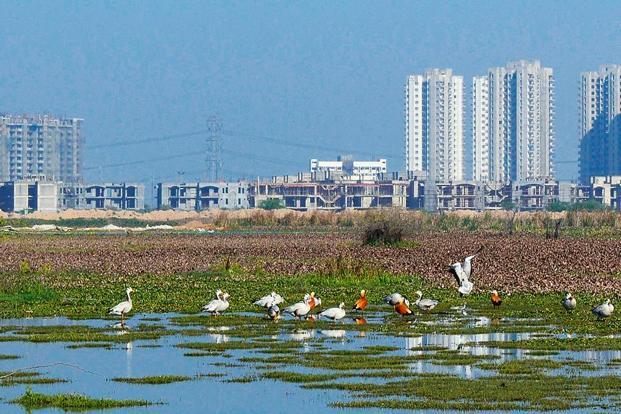
(Feature Image: The Basai wetlands in Gurugram. Photo by Pankaj Gupta at Live Mint)
It is indeed good to see an Editorial in a newspaper on the important issue of wetlands protection and rejuvenation. The Supreme Court’s order on wetlands last week shows its concern over the threat to wetlands as a natural feature of the environment that is under serious threat. The court ordered the protection of about 30,000 wetlands (each with area more than 2.25 ha) over the 201,503 protected by an order which it issued in 2017, and asked states to ensure their demarcation and ground-truthing which involves closer verification, within three months.
The order is in response to a PIL that said the Central government had abdicated its functions under the Environment Protection Act, 1986, to protect the wetlands. The petition also sought the identification and protection of around 5,55,557 wetlands which are less than 2.25 hectares in size. The court is likely to consider the proposal in March. One hopes the SC also gives effective orders for their protection.
The existence and survival of wetlands is crucial for the health of the planet’s ecosystem. It is unfortunate that the highest court’s intervention is needed to ensure their protection. The Supreme Court had done some interventions in the past, but it has been far from effective, one must say. In fact, the 2017 wetland guidelines are not even implemented and as the petitioners told the apex court, the government has abdicated its responsibility for protection of wetlands, including even the Ramsar wetlands. Let us hope the SC intervention this time will actually help the cause of the wetlands comprehensively and effectively.
EDIT Wetland revival: No room for false starts https://www.deccanherald.com/opinion/editorial/wetland-revival-no-room-for-false-starts-3321911 (18 Dec. 2024)
HYDRO POWER PROJECTS
SANDRP Overview 2024: People’s Resistance against Dam, Hydro Projects The tribals in Siang valley have been urging Central and State govts to stop pushing the giant SUMP. In Teesta valley the GLOF, flood and landslide though have served as wake-up call, the planners seem to ignore the warnings. Facing adverse impacts, the native people in Manipur have resolved to stop further extension to Loktak lake HEP. In Nagaland, fearing damages, the villagers have made the future of Dikhu HEP uncertain.
In contrast, the local people in Northwest Himalayan regions continue to suffer from blatant violation of norms, struggle to get promised rehabilitation, compensation and employments be it ongoing Ratle HEP in J&K, Pipalkoti Vishnugad, Tapovan Vishnugad HEPs in Uttarakhand or already built Pong dam in Himachal. The accidents and disasters at Multhan, Malana and Joshimath by the destructive projects have only worsened their plight. https://sandrp.in/2024/12/21/2024-peoples-resistance-against-dam-hydro-projects-in-himalayan-states/ (21 Dec. 2024)
2024: Accidents & Damages to Hydro & Dams in India The annual overview highlights the damages and accidents affecting dams and hydro power projects in India during 2024. The highest number of such incidents happened in Himachal Pradesh. Incidents are also noteworthy from Sikkim, Arunachal Pradesh and Uttarakhand among the Himalayan states. In addition, noteworthy dam disaster incidents in the year happened in Karnataka, Telangana, Andhra Pradesh and Madhya Pradesh. https://sandrp.in/2024/12/20/2024-accidents-damages-to-hydro-dams-in-india/ (20 Dec. 2024)
Arunachal Pradesh Civil society urge President to help stop SUMP survey The statement issued by the People for Himalaya and Youth for Himalaya said the SUMP has been a raging controversy in Arunachal Pradesh for years given the opposition of the Adi tribe inhabiting one of India’s most important Himalayan biodiversity hotspots. “We stand in complete solidarity with the SIFF that has been making submissions to the government and carrying out peaceful and democratic protests against the construction of the mega hydropower dam. It is disturbing that the State and Central governments have turned around on its promise made a few months ago that no activity of the project shall be initiated without the consent of the people,” the statement said.
Calling for a review of India’s hydropower plans in the Himalayas, the petition said the NHPC’s 2,000 MW Subansiri Lower HEP was an example of “denting the public exchequer” by undertaking the project without necessary geological risk assessment or disaster potential assessment. The signatories demanded that the trust and faith of the indigenous population in constitutional democracy be maintained through the use of democratic consultations and processes of the consent of the villagers rather than threat, force, and intimidation. https://www.thehindu.com/news/national/arunachal-pradesh/civil-society-outfits-urge-president-to-help-stop-hydropower-project-survey-in-arunachal/article69009233.ece (21 Dec. 2024)
Appeal to president to withdraw paramilitary forces from Siang Valley A group of more than 450 experts, scientists, community representatives, and environmental groups from across the country and abroad, especially the Himalayan states, have appealed to President Droupadi Murmu to withdraw the paramilitary forces deployed in Siang Valley to ‘forcefully’ carry out hydropower project surveys. “One of the reasons that the people have been opposing the initial surveys is because once a survey of such a large scale project is underway it compromises the stance of the local people as project proponents cite investments in surveys as an excuse for approvals.” It further stated that the SIFF had filed a case in the high court, challenging the Siang ultra mega power plant, and that in September 2022 “the Arunachal Pradesh High Court also directed that the consent of the people be upheld.” https://arunachaltimes.in/index.php/2024/12/21/experts-locals-environmentalists-appeal-to-president-to-withdraw-paramilitary-forces-from-siang-valley/ (21 Dec. 2024) Environmentalists warned of potential disasters, citing recent catastrophic events in the Himalayas linked to climate change and large-scale hydro projects. “The people of Siang Valley are acutely aware of their fragile landscape and the hazards associated with such massive construction,” the letter stated. It also highlighted instances where hydropower dams in the region failed or exacerbated disasters, including the 2013 Uttarakhand floods and the 2023 glacial lake outburst in Sikkim. https://newsarenaindia.com/states/resistance-to-siang-dam-grows-president-s-help-sought/31320 (20 Dec. 2024) They added that these events not only destroyed hydropower infrastructure worth hundreds of crores but also swept away public infrastructure and private properties, including houses, farms, and fields downstream of the dams. Flood and landslide-related casualties have also been on the rise in the Himalayan region in recent years. These events are increasing the disaster potential of the region, as shown by numerous scientific studies, the letter said. https://www.indiatodayne.in/arunachal-pradesh/story/arunachal-civil-society-organisations-urge-president-to-withdraw-troops-from-siang-dam-site-1141226-2024-12-20 (20 Dec. 2024)
One winter evening in Siang Excellent piece by Tongam Rina: Who is an outsider and who is an insider in your own home? This is the conundrum and narrative being set by the state in Siang Valley. While the state has not explicitly defined who qualifies as an outsider in their own home, the tone is clear: they want to frame anyone vocal against the government’s decisions as such.
– While the protests continue against militarisation, Chief Minister Pema Khandu visited Boleng, a town in Siang district where nearby villages are still protesting against militarisa-tion. His speech was filled with contradictions. Instead of trying to convince the people during his speech – incidentally, a victory party celebration for his fellow cabinet minister – he squandered the opportunity by blaming outsiders for the protests.
– However, the chief minister, by using coercion and showing no patience for logical discussion, seems to have forgotten that some issues are both local and international, like the case of Siang. Therefore, caution and objectivity are necessary in order to avoid escalating the fragile situation… Better still, he (CM) could ask his Prime Minister, Modi, who opposed the Siang dam in 2014 in Pasighat, won the election, and then came back to announce that dam-building is important for the nation.
The current minister from Boleng, Ojing Tasing, was one of the most well-known anti-mega dam activists before he became an advocate of the project. Assam businessman and politician Ashok Singhal, now the BJP boss in Arunachal, in fact headed an organisation – Jana Jagriti – opposing dams. Many MLAs from Siang have opposed dams. For that matter, even the BJP itself opposed the dam. Tarun Vijay, Rajya Sabha member and National Spokesperson of the BJP, spoke in the Rajya Sabha on May 9 2012 about the need for dialogue on the protests in Tawang. The BJP, then in opposition, also issued a press statement stating that the govt should engage in dialogue. https://arunachaltimes.in/index.php/2024/12/23/one-winter-evening-in-siang/ (23 Dec 2024)
Protests Intensify Against SUMP Emotions are on a high, and protests are intensifying against the Siang Upper Multipurpose Project, a nearly 12-gigawatt hydropower dam that is proposed to be built on the Siang river. On December 15, villagers including from Reiw and Geku arrived at the village of Parong to take part in a peaceful march against the project. On December 16, protests continued in the village of Geku, local sources told The Wire.
-The recent protests in the Siang region began after the state directed last week that central and state armed forces would be deployed to implement the Project. Many rights and civic bodies in the area have written to officials regarding the overreach, which also includes several rights and legal violations such as of the Forest Right Act 2006.
-Villagers from across the districts of Siang, Upper Siang and East Siang, who will be affected by the project, also wrote to state and central officials that they would “not tolerate any attempts to coerce or force our consent regarding the dam”.
-Their main concerns revolve around displacement and the loss of agricultural lands and homes, the environmental impacts of the nearly 12 GW dam – which will be the biggest in India, if it is built – which is to be located in a seismically active area. https://thewire.in/environment/siang-arunachal-pradesh-upper-multipurpose-project-protests/ (18 Dec. 2024)
Tribals appeal CM to halt deployment & SUMP Peaceful protests have been held in many villages where the forces were scheduled to be stationed over the past week. While there is no clarity on whether the state government plans to send forces anytime soon, the people remain firm in their opposition to the SUMP.
-There are plans for more peaceful protests and local rituals against the proposed project, with a major demonstration scheduled in Komkar on Wednesday, 18 December, and another public gathering planned for the same day in Geku. Villagers spoken to by reporters were clear in their opposition to the project, with gaon buras and buris leading the protests.
-Strongly opposing the Siang project, the gaon buras of Riew village have appealed to Chief Minister Pema Khandu not to send any armed personnel to the region as proposed. They argue that since there is no violence in the area, there is absolutely no reason for the government to consider such a move. https://arunachaltimes.in/index.php/2024/12/18/anger-and-apprehension-grip-siang-valley-gbs-appeal-to-cm-to-halt-deployment-and-siang-project/ (18 Dec. 2024)
‘No hydropower project if people don’t want it. But…’: CM Pema Khandu said on Thursday (Dec. 19) that the 12,500 Siang Upper multipurpose hydropower project (SUMP) in the state, which is facing resistance from residents, would be shelved if people don’t want it. The chief minister made the statement during a visit to Boleng in Siang district. “If you don’t want a dam, if you don’t want a hydropower project, there won’t be. Chapter closed,” said Khandu.
– The chief minister also told the gathering that rumours that the government would forcibly execute the project by using armed police forces were not true, saying, “We are a democratic country. We do not believe in forcing projects on our own people. We believe in taking into confidence the last man in the queue.”
– “We are against the move to militarise the area by deploying central armed police force personnel. The project will be detrimental to the people and the ecology of the region,” said Bhanu Tatak, legal adviser of Siang Indigenous Farmer’s Forum, one of the groups opposing the project. https://www.hindustantimes.com/india-news/no-hydropower-project-if-people-don-t-want-it-but-arunachal-cm-pema-khandu-101734628690481.html (19 Dec. 2024) -Khandu said, “The govt is not in urgency. I am not here only for the hydropower issue but to discuss the future of Siang and the Adi people. This is a project to save the Adi, the Assamese and the people of Bangladesh.” https://arunachaltimes.in/index.php/2024/12/20/cm-urges-people-of-siang-region-to-allow-survey-for-sump/ (20 Dec. 2024)
Movement against Sharavathi PSP Questioning the ‘hurry’ with which the state government was pursuing the Sharavathi Pumped Storage Project in the Lion Tailed Macaque Sanctuary, activists, concerned over the project’s impact on the fragile ecology of the Western Ghats, will launch a movement to raise awareness about the same among the people. Under the banner of ‘Vrushalaksha Andolana’, 12 activists and conservationists have, in an open letter, questioned the state forest and environment department’s stance on the project.
“The Forest Department has approved and recommended the project to the Union Environment ministry. The government has already awarded the tender. Farmers, fishermen and people living in the area have no information,” Anant Hegade Ashisar of the Andolana said. The 2,000MW project proposed by the KPCL requires 378 acres (153 ha) of which about 126 acres (52.62 ha) is forest land spread over Honnavar, Shivamogga Wildlife and Sagar divisions. Within the forest land, 97 acres falls within the part of the LTM sanctuary. https://www.deccanherald.com/india/karnataka/movement-against-sharavathi-pumped-storage-project-3327389 (21 Dec. 2024)
Himachal Pradesh Severe power crisis hits HEPs’, output falls 90% According to data from the Himachal Pradesh State Electricity Board (HPSEB), power generation in Kangra and parts of Mandi districts has plummeted to just 10% of total capacity in various hydel projects, even as the intense cold has driven up power demand manifold. During peak hours, HPSEB has been relying on supply from the national grid to meet daily electricity requirements.
Dheeraj Dhiman, Superintending Engineer of HPSEB Generation Circle Palampur said that power generation in hydel projects under his jurisdiction has dropped by 90% over the past two months compared to peak output periods. “The average power generation during August-September is around 26 lakh units per day. Today, it has fallen to 2.9 lakh units per day,” he said.
-The drastic decline is attributed to reduced water flow in rivers such as Uhal, Binwa, Baner, Gajj, and Neugal, which feed multiple power projects in Kangra. “The water flow has decreased by 70%, severely affecting power generation,” Dhiman added.
-The water shortage has also affected private hydel projects, which have seen a similar 90% reduction in power generation. The Shanan Power Project, managed by the Punjab Government at Joginder Nagar, has also been hit hard. Its power generation has dropped to 12 MW per day compared to its installed capacity of 110 MW, as the Uhal river has nearly dried up at Barot. https://www.tribuneindia.com/news/himachal/severe-power-crisis-hits-state-as-hydel-projects-output-falls-90/ (14 Dec. 2024)
Shanan HEP: Haryana files pleas in SC Haryana has added a new dimension to the ongoing legal dispute between Himachal Pradesh and Punjab over the British-era 110 MW Shanan Hydel Project by filing a petition in the Supreme Court. Haryana has requested to be made a party to the case.
-In its application submitted on December 12, Haryana argued that the Shanan project, located on the Uhl River— a tributary of the Beas — also feeds the Bhakra Dam. As Haryana has a stake in the Bhakra Beas Management Board (BBMB), it contends that it has a legitimate claim to the project. Haryana’s application also cites the Punjab Reorganisation Act, 1966, asserting its historical connection as a part of undivided Punjab.
-Himachal Pradesh Advocate General Anup Kumar Rattan said that Himachal Pradesh would oppose Haryana’s application, asserting that the matter is primarily between Punjab and Himachal Pradesh. Punjab is also expected to oppose Haryana’s move. Himachal Pradesh plans to file its objection during the Supreme Court hearing scheduled for January 15, 2025. https://indianexpress.com/article/explained/punjab-haryana-himachal-hydel-power-project-9732125/ (18 Dec. 2024)
MNRE Govt to mandate battery storage for renewable power projects Addressing the 21st edition of the Global MSME Business Summit organized by the Confederation of Indian Industry (CII), Prashant Kumar Singh, secretary, Union ministry of new and renewable energy on Monday (Dec. 16) said that an initial mandate of 10% of the plant’s total renewable energy capacity may be introduced for storage, and that this can then be gradually enhanced.
-In 2022, the power ministry issued guidelines for the procurement and utilization of battery energy storage systems as part of generation, transmission and distribution assets, along with ancillary services. Further, it also notified the energy storage obligations of 4% of the total consumption of electricity by FY30 for power discoms in line with the renewable purchase obligation. https://www.livemint.com/industry/energy/govt-to-mandate-battery-storage-for-renewable-power-projects-11734356975792.html (16 Dec. 2024)
MoEF Relevant Agenda of FAC meeting to be held on Dec 26 2024: – 4.75 HA. FOREST LAND FOR HALAIPANI HEP (16 MW) BY HALAIPANI HYDRO PROJECT LTD. IN ANJAW DISTRICT OF ARUNACHAL PRADESH
– 17.00 HA. FOREST LAND FOR UNDERGROUND WORK OF URI-I STAGE II HE PROJECT, DISTRICT BARAMULA UT OF JAMMU & KASHMIR https://forestsclearance.nic.in/AgendaDetail.aspx?id=309%21dis1&fbclid
DAMS
Polavaram Project Loss pegged at over ₹10,000 cr Delay in the execution of works for the Polavaram Project has resulted in measurable losses to the tune of Rs 10,000 crore to Rs 15,000 crore, including additional cost of Rs 2,400 crore for the construction of a new diaphragm wall and other elements, Rs 3,000 crore for the power project, and Rs 3,000 crore due to price escalation, Chief Minister N Chandrababu Naidu said on Dec 16. If the probable gains from the project are calculated, losses would be higher. Speaking after reviewing works at the project site, Naidu explained that construction of the new D-Wall will commence on Jan 2, 2025 with an estimated cost of Rs 990 crore. He announced that December 2025 has been set as the deadline for completing the D-Wall although time has been sought till March 2026. “Our target is to complete phase-1 of the irrigation project by October 2026. https://www.newindianexpress.com/states/andhra-pradesh/2024/Dec/17/polavaram-irrigation-project-loss-pegged-at-over-rs-10000-cr (17 Dec. 2024)
CM sets Oct 2026 deadline for completion of phase I works said the state exchequer incurred a loss of Rs 2,400 crore because of the additional works. “On top of it, there will be additional expenditure with cost escalation in raw material prices, labour, and inflation. Another Rs 2,000 crore was lost in the hydroelectric project. The overall damages would be around Rs 15,000 crore. Completion of Polavaram is a crucial step in interlinking of rivers, but unfortunately, the previous govt was ignorant of the facts,” he said. https://timesofindia.indiatimes.com/city/vijayawada/polavaram-cm-sets-oct-2026-deadline-for-completion-of-phase-i-works/articleshowprint/116376580.cms (16 Dec. 2024)
Maharashtra Cabinet approves construction of Kikvi dam The cabinet on Friday (Oct. 04) approved construction work of Kikvi dam at Brahmanwade village in the district’s Trimbakeshwar taluka, NCP minister Chhagan Bhujbal said. The minister said the need for the new dam arose because the storage capacity of Gangapur dam — the major source of water supply to Nashik Municipal Corporation — has reduced considerably because of continuous silt deposit over the period. Desiltation of a dam is a mammoth task. Instead of desilting Gangapur dam, construction of Kikvi dam was proposed with a storage capacity of 2.1 TMC.
-According to the proposal, the new dam will ensure enough drinking water for the residents of Nashik city, considering the rise in population till 2041. A senior water resources department official said the total land required for the project is now 738 hectares. Govt had already taken 174 hectares for the project from the forest department by allotting alternative land. The project cost was Rs283 crore in 2009, which has now gone up to Rs1,400 crore. Besides, the land acquisition will need Rs662 crore and the construction work will cost Rs738 crore.
-State govt had sanctioned the dam over Kikvi in 2009. The environmental clearance for the project came in 2014. However, the project was challenged in high court on the ground that the water storage exceeded the total water availability in the upstream of Jayakwadi dam. In 2017, Kikvi dam was included in the water plan of Godavari and approved by govt. But by then, govt had stopped several works related to the water resources department across the state. https://timesofindia.indiatimes.com/city/nashik/maharashtra-cabinet-greenlights-21-tmc-kikvi-dam-to-secure-nashiks-water-supply/articleshowprint/113947694.cms (04 Oct. 2024)
Rajya Sabha India has 1,065 dams 50-100 years old, 224 are hundred plus: Govt According to the National Register of Large Dams (NRLD-2023 edition), compiled jointly by the National Dam Safety Authority (NDSA) and CWC, there are 6,138 constructed and 143 under construction dams which aggregate to a total of 6,281 large dams.
Of these numbers, only 224 dams are more than 100 years old and there are 1065 large dams which are 50 to 100 years old, the Jal Shakti Ministry said on Monday (Dec. 16).
-Responding to a question in the Rajya Sabha, Minister of State for Jal Shakti Raj Bhushan Choudhary said the government enacted the Dam Safety Act and is also implementing the Dam Rehabilitation and Improvement Project (DRIP) Phase II and III, aimed at rehabilitating 736 dams across 19 states and three central agencies. https://www.business-standard.com/pti-stories/national/1-065-large-dams-50-100-years-old-224-are-over-a-century-old-govt-124121600799_1.html (16 Dec. 2024)
NDSA 2 day workshop on rapid risk screening of specified dams The National Dam Safety Authority (NDSA), DoWR, RD & GR, Govt. of India in collaboration with the Government of Madhya Pradesh, conducted a two-day Regional Workshop on Rapid Risk Screening of specified dams at Bhopal on 13-14 December 2024, under the aegis of Dam Rehabilitation and Improvement Program (DRIP). The objective of the workshop was to sensitize the five states viz. Maharashtra, Madhya Pradesh, Gujarat, Chhattisgarh and Rajasthan about the requirement for timely completion of Risk screening of all the specified dams in their respective states. These states constitute more than seventy five percent of the total number of specified dams in the country. https://pib.gov.in/PressReleasePage.aspx (13 Dec. 2024)
INTERLINKING OF RIVERS
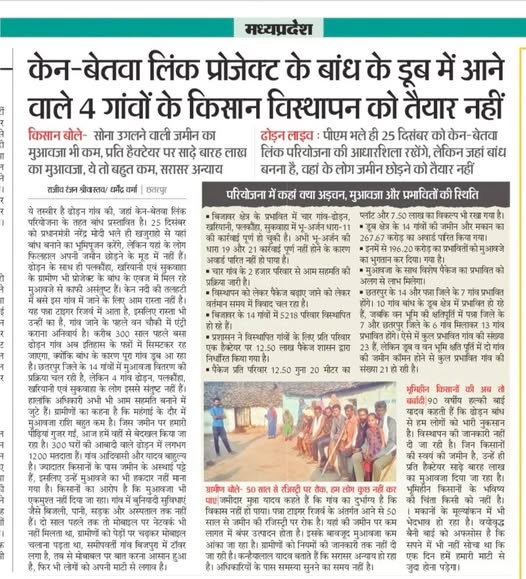
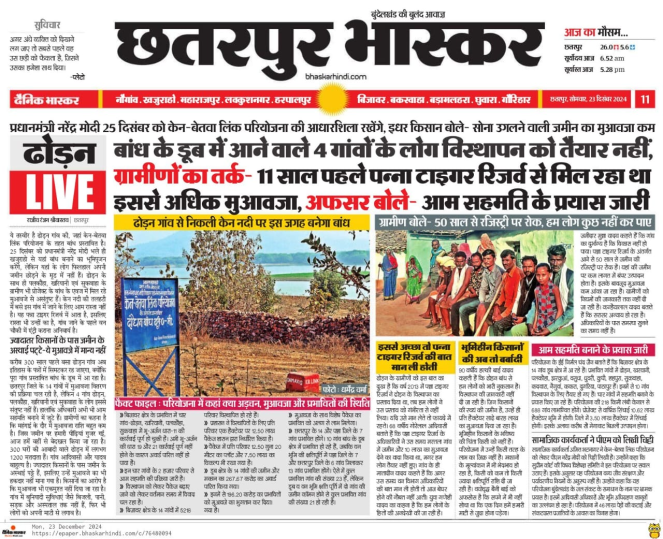
SANDRP Blog केन-बेतवा नदी जोड़ परियोजना का विरोध केन-बेतवा नदी जोड़ परियोजना को लेकर जय आदिवासी युवा शक्ति संगठन के पन्ना जिला अध्यक्ष मुकेश कुमार गौंड कहते हैं कि, “प्रभावित गांव 90 प्रतिशत आदिवासी क्षेत्र हैं। इन गांवों में लोग बुनियादी सुविधाओं से वंचित हैं। लेकिन, इन लोगों को सुविधाएं देने की वजाए विस्थापित किया जा रहा है। परियोजना में आदिवासियों को कुर्बानी देनी पड़ रही है। हम पहले विकास से वंचित हैं। ऐसे में परियोजना से हमारा क्षेत्र तहस-नहस हो जायेगा।“
मुकेश आगे बताते हैं कि, “मेरा अनुभव है कि पन्ना में जितने भी बांध बनाए गये, उसमें ज्यादातर बांध आदिवासियों की जमीन पर बनाए गए हैं। इन बांध योजनाओं में बहुत लोगों को मुआवजा नहीं मिला है। बहुत लोगों को बहुत कम मिला है। जिससे उनका जीवन विखंडित हो गया है।” https://shorturl.at/JRVKM (23 Dec. 2024)
Ken Betwa Linking A recipe for bulldozing public policy The project is a case study in flawed public policy, marked by its rejection of updated data, new research, expert reviews, and external assessments from a water management perspective. At this delicate moment, as the public announcements have been made by the state, it will naturally be nearly impossible for any public official (or even a learned judge) to raise even mild queries.
– So much of what is normal has been ignored and rejected, it seems the project has had to be cleared, or bulldozed, never mind the facts. A previous head of the NWDA presented a case study of this project to state that environmental clearances were hurdles in the pathway of development. So be it. Let the reader judge if thoroughly disregarding environmental impacts is the appropriate manner of investing scarce public resources and if Panna’s bleak future is the future they want for our drying country and warming planet. https://m.thewire.in/article/environment/ken-betwa-river-linking-project-a-recipe-for-bulldozing-public-policy-amidst-environmental-concerns/amp (21 Dec. 2024)
Farmers of four villages refuse relocation
PKC River Linking Foundation stone laid On Dec. 17, PM Narendra Modi laid foundation stone of the Parvati, Kalisindh and Chambal (PKC)-Eastern Rajasthan Canal Project (ERCP) project ending the 20-year-old water dispute between MP and Rajasthan.
-The project worth Rs 45,000 crores envisages the use of monsoon water-flowing waste in the Kalisindh, Parvati, Mej, and Chakan sub-basins. It envisages inter-basin transfer of water within the Chambal basin by diverting it to water-deficient sub-basins of Banas, Gambhiri, and Banganga. On completion of the scheme, the availability of drinking and industrial water will be ensured in 13 districts of eastern Rajasthan. Additionally, the project envisages irrigation of about 2.82 lakh hectares of area.
-An expenditure of Rs 40,000 crore is estimated for this scheme. The districts benefiting from the scheme include Alwar, Dausa, Jaipur, Ajmer, Tonk, Sawai Madhopur, Bundi, Kota, Baran, Jhalawar, Bharatpur, Dholpur, and Karauli. In the first phase, water will reach Bisalpur and Isarda dams, and canal systems will be built in Ramgarh Barrage, Mahalpur Barrage, and Naunera. Water will reach 158 dams, ponds, and other water sources under the project.
-The project will meet the industrial needs along with drinking water in many districts of MP including Shivpuri, Gwalior, Bhind, Morena, Indore, and Dewas. Under this, 7 dams will be built. This project will promote industrial investment, tourism, and educational institutions in both states. Also, the irrigation sector will become more prosperous.
-Way back in 2004, the Central Water Resources Ministry submitted a report to the concerned state governments about the Parvati-Kalisindh-Chambal (PKC) link project. Under this, it was proposed to divert the excess water coming into the Parvati, Nevaj, and Kalisindh rivers during the monsoon months into the Chambal River. After this, the Rajasthan government came up with the ERCP project. https://www.news9live.com/opinion-analysis/pkc-ercp-project-realised-after-20-yrs-due-to-raj-mp-centres-triple-engine-govt-2776731 (18 Dec. 2024)
PAV River Delinking ‘Pampa-Achankovil-Vaippar delinking a threat to environment’ Former Water Resources Minister and Kerala Congress Chairman PJ Joseph on Sunday (Dec. 15) criticised the claim that the project would generate 508 MW of electricity, labelling it a misleading tactic designed to deceive the public. He also argued that the decision to include the project in the special agenda of the National Water Development Agency was a poor one, as the Pampa and Achankovil rivers both originate and ow through Kerala.
-The proposed project involves diverting 63.4 crore sqm of water to Tamil Nadu via a tunnel. Joseph highlighted that its implementation could lead to the submergence of over 2,000 hectares of forest land. Additionally, he warned that it could accelerate the intrusion of saline water into Vembanad Lake and exacerbate the suffering of local communities.
-The former minister further stated that the construction of 150-metre-high dams at Pampa Kallar and Achankovil Kallar, as well as a mini dam on the Achankovil River, would have serious ecological repercussions for the state. https://www.onmanorama.com/news/kerala/2024/12/15/pampa-achankovil-vaippar-river-delinking-project-environmental-hazard-pj-joseph.html (15 Dec. 2024)
RIVERS AS NATIONAL WATERWAYS
Meghalaya Shillong MP Ricky Andrew J Syngkon on Wednesday (Dec. 18) urged the Centre to develop inland ports on the Umngot and Kynshi rivers in Meghalaya, stating that this will bring immense economic benefits to the state and improve its inland transport system. https://theshillongtimes.com/2024/12/19/shillong-mp-urges-centre-to-develop-inland-ports-on-umngot-kynshi-rivers/ (19 Dec. 2024)
URBAN RIVERS
Mula-Mutha-Pune When the river rises in the city Sarang Yadwadkar, Pune-based environmentalist and architect, shares that this year, Mutha River’s discharge from the Khadakwasla dam was 35,570 cusecs, while its blue line is defined for 60,000 cusecs. Although the discharge increased due to rainwater runoffs from the free catchment area, it remained below 60,000 cusecs. The blue line was crossed due to two main flaws in the floodline defined in 2011: they did not account for flows from the free catchment area and the confluence effect, where merging rivers slow down and create upstream pressure. Secondly, narrowing of the river by channelisation for the RFD project caused the blue line to be breached.

-Historically, even higher flows (67,000 cusecs in 2014 and 90,000 cusecs in 1997) did not cause significant flooding. However, the 2024 floods with lower discharges raised concerns about increasing encroachments in the riverbed — both legal and illegal — that restrict river flow. “Encroachments include debris dumped to expand land and riverfront developments that have narrowed the river significantly. Just like traffic slows down at a busy junction where two roads meet, the velocity of the water reduces when two rivers meet. This causes back pressure on the upstream leading to rise in flood levels. This is how all the areas flooded this year were upstream of the RFD, highlighting the failure of RFD to manage water flow effectively,” he explained.
-Experts believe that repeated flooding in these areas will not stop unless the carrying capacity of the river is increased. Shailaja Deshpande of Jeevitnadi says, “Regulations prohibit construction in the blue flood zone and between the blue and red zones, allowing building only beyond the red line. However, this information hasn’t reached the public, leading to extensive construction in flood-prone areas. A wall won’t stop floodwaters; there must be proper drainage. The solution lies in increasing the flood-carrying capacity of rivers, streams, and tributaries, along with rainwater harvesting and borewells. Rehabilitation of those in flood zones as per regulations is essential.”
-Building the embankments along the river ensured that the rainwater that accumulated along the riverbanks in homes could not flow back into the river, say the residents of these communities. The administration should have made provisions for the water to flow back into the river. “Despite environmental experts opposing the riverfront development project, instead of spending excessive amounts on this project, the administration should have focused on reviving the river, increasing its carrying capacity, and creating natural green zones. The city is already experiencing the consequences of climate change, and the administration should be spending on projects that would help reduce these impacts,” says Deshpande. https://india.mongabay.com/2024/12/when-the-river-rises-in-the-city/ (20 Dec. 2024)
Dahisar; Mumbai River rejuvenation project gets green nod Pegged at a cost of Rs 1,192 crore, the Poisar River rejuvenation project would require the removal of encroachments from the banks and according to civic authorities, 250 encroachers have been identified so far.
The river rejuvenation project was originally recommended by the Madhav Chitale committee formed after the July 2005 deluge. The idea behind the project is to provide Mumbai with an augmented drainage network that will lead to the smooth flow of water & silt during the monsoon.
-In 2019, civic authorities floated the proposal of rejuvenating the river by setting up 10 mini STPs at different points alongside it to treat and recycle the sewage. Each of these STPs will have the capacity to treat 33 MLD of sewage. The proposal also envisaged widening the banks of the river to ensure a smooth flow of water and a service road adjoining the bank of the river.
-Alongside this, the BMC will also spend Rs 246 crore to rejuvenate Dahisar River located in the extreme northern end of Mumbai’s western suburbs. At present, this river has a varying width of 35-40 metres and civic authorities have already constructed a retaining wall. https://indianexpress.com/article/cities/mumbai/bmcs-ambitious-poisar-river-rejuvenation-project-gets-green-nod-9730393/ (17 Dec. 2024)
Musi; Hyderabad RFD cost to be borne by state govt: Centre In reply to a question posed by BRS Rajya Sabha member KR Suresh Reddy, the Centre has said that funding for the Musi rejuvenation project will be borne by the Telangana govt. The Centre said that urban planning falls under the jurisdiction of urban local bodies and urban development authorities, as outlined in the 12th schedule of the Constitution. “The govt of India supports the state’s efforts through schemes and provides both financial and technical assistance,” it added in the reply. https://timesofindia.indiatimes.com/city/hyderabad/musi-project-cost-to-be-borne-by-t-govt-says-centre/articleshowprint/116446799.cms (18 Dec. 2024)
Demolitions along river: Adjournment motion served The CPI State unit has moved an adjournment motion in the Telangana Assembly to discuss the demolitions along Hyderabad’s Musi River and the compensation to be provided to affected residents. https://www.siasat.com/demolitions-along-musi-river-in-hyderabad-adjournment-motion-served-in-assembly-3148806 (16 Dec. 2024)
Chennai Buckingham canal restoration stuck Buckingham Canal, vital for flood control and ecology, faces neglect, pollution, and halted restoration due to funding challenges. https://citizenmatters.in/buckingham-canal-encroachments-no-funds-restoration-wrd-stopped-gcc/ (20 Dec. 2024)
RIVERS
KRISHNA Report Telangana, Andhra, Karnataka & Maharashtra polluted their lifeline The Krishna, India’s third longest river, is severely polluted due to unchecked sewage and industrial effluent being dumped into it by Telangana, Andhra Pradesh, Karnataka and Maharashtra, according to a preliminary report by the National Institute of Technology (NIT), Warangal. The institute, along with NIT Surathkal, was appointed to study the Krishna river basin by the Union Jal Shakti ministry which sanctioned Rs 6.3 crore for the project. Apart from identifying the source of pollution in Krishna, the two premier institutes were also asked to suggest remedial measures. Their findings show that 427 industries, mainly in chemicals, metallurgy, engineering and food processing, are discharging waste into the Krishna. Chemical and metallurgical industries are the biggest culprits, responsible for 31.38% of the pollutants, followed by engineering industries at 22%. Textiles, mining, sugar mills, and other plants also contribute to the contamination.
– According to Prof N V Umamahesh, principal investigator, Centre for Krishna River Basin Management and Studies, NIT Warangal, a comprehensive action plan focusing on river rejuvenation and water quality enhancement will be formulated after compilation of the final report. https://timesofindia.indiatimes.com/city/hyderabad/telangana-andhra-pradesh-karnataka-maharashtra-have-polluted-their-lifeline-krishna-river-reveals-new-report/articleshow/116350764.cms (16 Dec. 2024)
Odisha State has 7 PRS The Central Pollution Control Board (CPCB) has identified 311 polluted river stretches across India and seven of them are in Odisha, environment, forest and climate change minister Bhupender Yadav informed the Lok Sabha on Monday (Dec. 16). Maharashtra leads with 55 polluted river stretches, followed by Madhya Pradesh (19), while Kerala and Bihar have 18 affected stretches each
-“The major factors contributing to river pollution include discharge of untreated or partially treated sewage from urban areas, industrial effluents, and improper solid waste management,” Yadav explained. He also cited operational issues in treatment plants and lack of dilution as additional concerns. The report, however, did not mention the rivers facing such problems.
-The ministry of environment, forest and climate change has taken steps toward river rejuvenation by preparing detailed project reports (DPRs) for 13 major rivers through the Indian Council of Forestry Research and Education. These reports, covering rivers including the Mahanadi, Yamuna and Godavari, were forwarded to respective state govts in June 2022 for implementation. https://timesofindia.indiatimes.com/city/bhubaneswar/311-polluted-river-stretches-in-india-7-of-them-in-odisha-union-min/articleshowprint/116371460.cms (16 Dec. 2024)
Telangana Godavari, Krishna, six other rivers polluted As per 2022 CPCB report, Godavari is the second most polluted river in the state after Musi. The other rivers that have higher than normal BOD was Karakavagu, Kinnerasani, Krishna, Manair, Manjeera, Munneru, and Nakkavagu. https://www.deccanchronicle.com/southern-states/telangana/not-just-musi-godavari-krishna-six-other-rivers-polluted-in-state-1847385 (16 Dec. 2024)
Jammu & Kashmir 8 PRS identified: Centre J&K has eight polluted river stretches identified in 2022, according to Union Minister for Environment, Forest, and Climate Change, Bhupender Yadav. The pollution in these river stretches is primarily attributed to the discharge of untreated or partially treated sewage from urban areas, industrial effluents, improper solid waste management, operational issues in sewage and effluent treatment plants, lack of dilution, and other non-point sources, the minister, said. https://www.dailyexcelsior.com/jammu-and-kashmir-has-eight-identified-polluted-river-stretches-centre/ (16 Dec. 2024)
GANGA Uttar Pradesh Inflows to be ramped up for Mahakumbh The Tehri Dam has begun releasing 2,000 cusecs daily into the Ganga to augment the river’s water levels, starting December 15. Meanwhile, the Narora Barrage will release 5,000 cusecs per day downstream towards Prayagraj from December 24, according to officials. This increased water supply will continue till February 26.
-Rajnish Yadav, the executive engineer (Barrage section) of the irrigation department in Kanpur, said that the department has prioritised the water supply for the festival. “Also, all the water from the Kanpur Barrage will be sent downstream to ensure an adequate flow of the Ganga during Mahakumbh,” Yadav added.
-The Kanpur Barrage has been releasing significant amounts of water into the Ganga. On December 19, the barrage released 4,124 cusecs, while on December 18, it released 5,105 cusecs. The highest release of 13,865 cusecs was recorded on December 1. Kanpur’s water supply requires only 40 cusecs, and the remaining water will be diverted to Prayagraj to ensure an adequate flow during the Maha Kumbh festival.
-Water released from the Narora Barrage takes approximately 10 days to reach the confluence at Sangam in Prayagraj. The river also receives water from the Ramganga River in Kannauj and the Garra River in Hardoi during the dry season. However, these rivers carry less water during the winter months. https://www.hindustantimes.com/cities/lucknow-news/inflows-into-ganga-to-be-ramped-up-for-mahakumbh-101734806936232.html (22 Dec. 2024)
Prayagraj 3 streams ‘merged’ into 1 The department deployed three massive dredging machines based on survey findings. However, stabilizing the dredgers against the Ganga’s swift current and high water levels proved challenging. The strong flow frequently destabilized the heavy machinery, bending discharge pipes and complicating operations. Engineers employed large anchors, pontoon bridges, and thick ropes to secure the dredgers. Despite technical setbacks, including a damaged support pin and another dredger being pushed ashore, the team persevered. https://www.moneycontrol.com/news/india/mahakumbh-2025-3-streams-of-ganga-merged-into-one-inspired-by-a-mythological-tale-12893627.html (19 Dec. 2024)
Book Review ‘Aag Aur Pani’: Portrait of eternal Banaras The title Aag Aur Pani reflects the inherent contradictions of Banaras, a city that thrives on the interplay of extremes. Vyomesh Shukla’s anecdotal narrative revolves around these binaries, using the metaphor of fire for the city’s spiritual intensity and water for the flowing, adaptive nature of the Ganga. Banaras is portrayed as a city that consumes & purifies, simultaneously rooted in the ancient & open to the new.
Drawing from the legacy of figures like Dr Ram Manohar Lohia, Vyomesh Shukla critiques the failings of Banaras’s civic and religious institutions. The neglect of the Ganga, for instance, serves as a metaphor for the city’s larger struggles. Revered as a lifeline and a divine entity, the river is simultaneously subjected to pollution and mismanagement, reflecting a dissonance between belief and action. This critique echoes Pankaj Mishra’s observations of Banaras as a city caught between its lofty mythologies and the stark inequities of contemporary life. https://scroll.in/article/1076423/aag-aur-pani-hindi-writer-vyomesh-shukla-draws-an-authentic-portrait-of-eternal-banaras (15 Dec. 2024)
Report गंगा की गंदगी : सफाई के नाम पर मची लूट पतित-पावनी, जीवन-दायिनी कही जाने वाली गंगा सरकार और ठेकेदारी में लगे सेठों की अकूत कमाई का साधन भी बन गईं हैं। पिछले कुछ दशकों से गंगा की सफाई के नाम पर लाखों करोड रूपए पानी की तरह बहाए जा रहे हैं और सेठों, सरकारी मुलाजिमों की तिजोरियां भरने के बावजूद गंगा जहां-की-तहां, मैली-की-मैली ही हैं। क्या है, यह गोरखधंधा? https://www.spsmedia.in/opinion/gangas-pollution-looting-in-the-name-of-cleaning/ (Dec. 2024)
YAMUNA Delhi Will oversee all of key drains: Irrigation dept The Irrigation and Flood Control (I&FC) dept has informed the NGT that it has taken over all 22 major drains that end up in the Yamuna, making it the sole agency which is now responsible for maintenance and clean-up of drains in the Capital. In its submission of Dec 18, the department, part of the Delhi government, said the decision to hand-over all drains was taken in a meeting held in April this year under the Integrated Drain Management Cell, following directions from the Delhi high court the same month.
Bhim Singh Rawat, a Yamuna activist and member of SANDRP said while the move should help bring more transparency and accountability, the I&FC’s own track record for its drains is not too encouraging so far. “Even with the drains it had under its jurisdiction, it could have easily taken action, be it against encroachments or sewage entering it. While having a single agency helps fix accountability, it is important to ensure targets are set and timelines to clean these stormwater drains are fixed,” he said. https://www.hindustantimes.com/cities/delhi-news/irrigation-dept-tells-ngt-will-oversee-all-of-delhi-s-key-drains-101734716075354.html (21 Dec. 2024)
Story of a dying river. https://www.youtube.com/watch?v=aBGzwby48VA (22 Dec. 2024)
BIODIVERSITY OF RIVERS
Assam Ganges dolphin geotagged The tagging exercise will help in understanding their seasonal and migratory patterns, range, distribution, and habitat utilisation, particularly in fragmented or disturbed river systems. “Tagging river dolphins will contribute to evidence-based conservation strategies that are urgently needed for this species. I am delighted that this historic step has been undertaken,” WII director Virendra R Tiwari said. https://www.hindustantimes.com/environment/ganges-river-dolphin-geotagged-in-assam-environment-minister-101734582052412.html (19 Dec. 2024)
FISH, FISHERIES, FISHERFOLKS
Chennai Opposition to 660-MW Ennore thermal power station expansion The project has sparked fierce opposition from local residents and environmental activists. North Chennai, a region characterised by brackish wetlands and mangrove forests, already grapples with heavy industrialisation which many residents blame for health-related issues. The local fishing community, heavily dependent on the region’s ecosystems, has also raised concerns about the impact on their livelihoods. In 2023, an oil spill from the CPCL refinery affected over 20,000 residents, further intensifying calls to reconsider additional industrial projects in the area.
Speaking to The Print, environmental activist Nityanand Jayaraman said the area is already saturated with high-pollution industries, including a 10.5 million-tonne-per-annum oil refinery and 34 petrochemical units. Combined with the Kamarajar Port and Chennai Port, these industries have contributed to alarming pollution levels.
At a public hearing held Friday (Dec. 20) by the SPCB in Ernavur, many residents voiced their objections, highlighting potential health hazards posed by industrial pollution. The hearing turned chaotic as it was also attended by functionaries of Naam Tamilar Katchi (NTK), who vehemently opposed the project while DMK functionaries supported it. City-based Chennai Climate Action Group (CCAG) demanded Saturday that the public hearing be declared illegal since the district collector and TNPCB officials left mid-way.
According to the EIA report submitted to the MoEF, the plant will be located 70 metres from the Ennore backwaters and 575 metres from the Kosasthalaiyar River, with the Bay of Bengal 815 metres away. The report noted that 4,33,117 people live within a 10-kilometre radius of the project, including in Ernavur, just 1.2 kilometres away. While the assessment stated that the project’s impact on air, noise and water would remain within permissible limits, it recommended measures such as wastewater treatment plants, dust extraction systems and fly ash suppression facilities to mitigate pollution. https://theprint.in/india/whats-fuelling-oppn-to-660-mw-ennore-thermal-power-station-expansion-in-tamil-nadu/2413370/ (21 Dec. 2024)
Opinion divided on ETPS expansion at public hearing Jayapalyam, a fisher community leader from Ennore, said nature and the livelihood of fishers were closely linked. He highlighted concerns over the impact on fishers’ livelihood, particularly the release of fly ash into the Kosasthalaiyar and Ennore backwaters by Tangedco. He pointed out that not only the water, but the air, too, was polluted in Ennore, and called for an increased focus on solar and wind energy as alternative solutions. M. Karunakaran, a fisher leader from Kattukuppam, said Ennore’s industrial growth over the past 30 years had failed to create permanent jobs, while harming the livelihoods of fishers and farmers as well as the health of the locals. Some argued that the project’s Environmental Impact Assessment was invalid, as it was prepared based on the Terms of Reference finalised in January 2019, which were valid only for four years.
Prabhakaran Veerarasu of Poovulagin Nanbargal said that in areas like Ennore, which were already burdened with industrial pollution, a cumulative impact assessment should be conducted to evaluate the overall effects of pollution from all thermal plants & industries, rather than focusing on the expansion project. Naam Tamilar Katchi chief coordinator Seeman questioned the need for expanding the thermal plant, “When there are ways to generate electricity without polluting the environment or endangering the health of nearby residents, why proceed with this expansion? Those who support the project for the sake of job creation, despite knowing it will poison the air, land, and water, and cause serious health problems…I challenge you to build houses near ETPS & live there.” https://www.thehindu.com/news/national/tamil-nadu/opinion-divided-on-ennore-thermal-plant-expansion-at-public-hearing/article69009433.ece (20 Dec 2024)
Assam FCC held meeting on river pollution The newly formed Fishery Coordination Committee (FCC), Dergaon, organised an awareness meeting on Wednesday (Dec. 18) in connection with poisoning of the rivers Gelabeel and Kakodonga here. Assistant commissioner cum chairperson of FCC Anwesha Thakur said that poisoning of the rivers has severely damaged the ecosystem of these natural water bodies. Several villagers, fishermen, and others attended the awareness meeting. It may be recalled that a public protest was staged recently over the poisoning of the rivers. The meeting also conducted free registration of fishermen, fish farmers, fish traders, and fish entrepreneurs under the National Fishery Development Programme (NFDP). https://assamtribune.com/assam/river-pollution-in-dergaon-newly-form-body-takes-proactive-steps-to-address-issue-1561742 (20 Dec. 2024)
SAND MINING
Uttar Pradesh NGT cites TOI report on sand mining, asks for govt replies The NGT has taken suo-motu cognisance of a TOI report last month highlighting how sand miners had constructed unauthorised roads across the Yamuna between Delhi and Ghaziabad and sought replies from the Centre, pollution boards and district magistrates. In a Dec 16 order, NGT bench named several parties to the case, including the Ghaziabad and North Delhi DMs, the central, UP and Delhi pollution control boards and the ministry of environment, forest and climate change as parties to the case. The tribunal sought affidavits from them at least a week before the next hearing on April 14 next year. https://timesofindia.indiatimes.com/city/noida/ngt-cites-toi-report-on-sand-mining-asks-for-govt-replies/articleshowprint/116547444.cms (22 Dec. 2024) The news report indicated to the NGT that sand miners in the region were building makeshift roads across the river, which enabled them to transport excavators and carry out mining operations in the floodplain. The article further said these roads were often constructed by placing wooden planks and sandbags across the river bed, not authorised under any mining leases, and caused considerable damage to the river’s fragile ecosystem. https://indianexpress.com/article/cities/delhi/yamuna-illegal-sand-mining-ngt-issues-notice-9734487/ (19 Dec. 2024)
Tamil Nadu HC questions EC for beach sand mining The Madras High Court took up a suo motu PIL on the illegal mining of beach sand minerals in the southern districts in 2015 after a series of allegations were raised. The state government banned the mining of beach sand minerals in 2013. However, certain companies reportedly continued thriving on illegal mining.
-Subsequently, the state government appointed two committees to enquire into illegal mining. The court also appointed an amicus curiae to independently assess the illegal mining. Based on the reports, the state government issued recovery notices to 64 leaseholders for recovery of Rs 5,035 crore for illegal mining. Some of these leaseholders have challenged the notices in court while others have submitted their reply to the authorities concerned. https://www.newindianexpress.com/states/tamil-nadu/2024/Dec/18/madras-hc-questions-environmental-clearance-for-beach-sand-mining-in-tamil-nadu-districts (18 Dec. 2024)
Minister appears before ED The central agency had in July attached assets worth more than Rs 14 crore in an alleged illegal mining-linked money laundering case against the 74-year-old minister, a DMK leader, his ex-MP son P Gautham Sigamani and some family members. The money laundering case related to alleged illegal red earth mining stems from a state police (crime branch) FIR. “Red earth was extracted illegally beyond the permitted limits to the tune of Rs 25.7 crore and the sale proceeds were invested in the overseas entity,” it had alleged. https://news.abplive.com/news/india/money-laundering-case-minister-ponmudy-appears-before-ed-on-sand-mining-case-1738101 (17 Dec. 2024)
WETLANDS, LAKES, WATER BODIES
Odisha Proposed bridge on Chilika lake faces opposition Environmentalists, fishermen and a section of local communities have strongly opposed the construction of a proposed 4-kilometre bridge over Odisha’s Chilika lake, connecting Satapada town to Janhikuda village.
They have warned that the project threatens the lake’s delicate ecosystem, including its rich biodiversity and the livelihoods of over 100,000 people dependent on its resources. https://www.downtoearth.org.in/environment/proposed-bridge-on-odishas-chilika-lake-faces-opposition-over-environmental-concerns (23 Dec. 2024)
Save Chilika ecosystem from highway concerns ‘Chilika is not only the source of livelihood for over 1 lakh fishers, but is also of critical importance as a home to threatened species. The proposed 7.8-km connectivity includes two bridges of 1.7 km and 1.9 km length likely to interfere with the lake’s sedimentation, breeding migration and salinity. Add to it the threat from light, sound and vehicular pollution to the endangered Irrawaddy dolphins, for which Chilika is the single largest home.
-This part of the Ramsar site is also on the Central Asian Flyway used by several migratory waterbirds; about a million avian guests arrive at the lagoon every year to escape harsh Eurasian winters. Chilika is already under pressure from climate change – its growing siltation is a major cause for concern.
-The central and state governments should draw up plans to conserve the fragile coastal ecosystem and not add to its burden. The need is to explore sustainable connectivity, instead of looking for shortcuts. Chilika must be protected at all costs. https://www.newindianexpress.com/editorials/2024/Dec/16/save-chilika-ecosystem-from-highway-concerns (17 Dec. 2024)
Chilika lake highway sparks fears over biodiversity loss The two-lane planned over Chilika, a designated Ramsar site, has drawn sharp criticism from environmentalists and conservationists who fear the lake’s fragile ecosystem and its rich biodiversity might face negative consequences of the project. Expressing grave concerns, secretary of Odisha Environmental Society Jayakrushna Panigrahi said the idea to build highway and bridges over Chilika lagoon is highly insensitive as it will destroy the wetland biodiversity and cause irreparable harm to the lake’s unique flora and fauna.
-Two bridges spanning 3.55-km are proposed to be built over the lake as part of the connectivity, subject to environmental clearance and approval of the state government. The alignment approval committee (AAC) of the ministry has already cleared it along with the land acquisition plan, the sources said. https://www.newindianexpress.com/states/odisha/2024/Dec/10/chilika-lake-highway-gets-nod-sparks-fears-over-biodiversity-loss (10 Dec. 2024)
Proposed NH project to hurt Chilika’s fragile ecosystem Chilika lake is currently confronting several environmental and socioeconomic challenges and a fresh decision to construct the coastal highway (NH-516A), that will connect Gopalpur-Satpada passing through Krushnaprasad within Chilika, will further degrade the lake ecosystem and its biodiversity by way of increased air, water and noise pollution, opined the panellists. https://www.newindianexpress.com/states/odisha/2024/Dec/16/proposed-nh-project-to-hurt-chilikas-fragile-ecosystem-experts (16 Dec. 2024)
Himachal Pradesh ₹24-cr project to tap tourism potential of Pong wetland The Pong wetland attracts over one lakh exotic and local migratory birds every winter, making it an ideal destination for eco-tourism. The state government has submitted Rs 24-crore tourism infrastructure development project for the Pong Wetland under the Centrally-sponsored ‘Swadesh Darshan-2’ scheme to the Ministry of Tourism for final approval. As per the project’s first phase, key initiatives include the introduction of solar boats and the launch of an online tourism portal for the wetland. Despite being a world-renowned Ramsar Wetland Site, the Pong wetland has long suffered from neglect, with existing infrastructure lying unused due to poor maintenance. https://www.tribuneindia.com/news/himachal/rs-24-crore-project-to-tap-tourism-potential-of-pong-wetland/ (18 Dec. 2024)
Kerala Kozhikode Corpn. to act against encroachment on Kottooli wetlands The Kozhikode Corporation Council on Saturday (December 21), unanimously decided to take strict action against the rampant encroachment on the Kottooli wetlands in the heart of the city, citing their ecological significance. The decision comes against the backdrop of the recent incidents at Vazhathuruthi. The council also unanimously decided to appeal to the authorities concerned to relocate the Hindustan Petroleum (HP) Depot at Elathur to a safer location. The motion came in the backdrop of the recent incident in which thousands of litres of diesel leaked from the depot through the drains to reach the sea. The council noted that the consequences would have been more severe had petrol leaked and criticised depot authorities for their lack of urgency in addressing the situation, despite repeated leaks and minor fires in the past. https://www.thehindu.com/news/national/kerala/kozhikode-corpn-to-act-against-encroachment-on-kottooli-wetlands/article69013429.ece (21 Dec. 2024)
WATER OPTIONS
पर्यावरण का अनुपम स्मृति पाठ -अनुपम जी की सबसे बड़ी उपलब्धि, मेरा यकीन है, भारत के तालाबों पर किया गया काम है जो हमेशा जिंदा रहेगा। अगर आप इस विषय पर उनकी लिखी दो पुस्तकें देखेंगे तो वह सिर्फ तालाबों की सरंचना पर ही नहीं है बल्कि उस समाज के बारे में है जिन्होंने वह तालाब बनाए।

उनके लिए यह समाज की कहानी थी, जिसे पढ़ाए जाने की जरूरत है क्योंकि वह कहानी हमें एक लचीला, देखभाल करने वाले और मानवीय समाज के पुनर्निर्माण की जरूरत के बारे में सिखाती है। ऐसा ही समाज एक बार फिर से अपने जल निकायों का निर्माण करेगा। https://hindi.downtoearth.org.in/water/third-death-anniversary-of-gandhian-environmentalist-anupam-mishra-68484 (18 Dec. 2024)
GROUNDWATER
Study Saltwater will taint 77% of coastal aquifers by 2100 Seawater will infiltrate underground freshwater supplies in about three of every four coastal areas around the world by the year 2100, according to a recent study led by researchers at NASA’s Jet Propulsion Laboratory in Southern California. In addition to making water in some coastal aquifers undrinkable and unusable for irrigation, these changes can harm ecosystems and corrode infrastructure.

-Two impacts of climate change are tipping the scales in favor of salt water. Spurred by planetary warming, sea level rise is causing coastlines to migrate inland and increasing the force pushing salt water landward. At the same time, slower groundwater recharge—due to less rainfall and warmer weather patterns—is weakening the force moving the underground fresh water in some areas.
-The study, published in Geophysical Research Letters in November, evaluated more than 60,000 coastal watersheds (land area that channels and drains all the rainfall and snowmelt from a region into a common outlet) around the world, mapping how diminished groundwater recharge and sea level rise will each contribute to saltwater intrusion while estimating what their net effect will be. https://phys.org/news/2024-12-saltwater-taint-coastal-aquifers-century.html (11 Dec. 2024)
Centre W Bengal, Bihar most impacted by arsenic contamination The tribunal is hearing the issue of rice being susceptible to arsenic contamination because it absorbs more of the toxic semi-metallic element from water and soil. In an order dated December 16, the NGT bench noted that the as per reply by the centre, the states of West Bengal and Bihar are reported to be most affected by arsenic contamination of groundwater irrigation by contaminated groundwater is the major route for arsenic entry into agricultural soil which ultimately leads to its entry into the food chain. There can be a “significant build-up” of the toxic element in rice as it is a water-intensive crop, the reply stated.
The reply also suggested various remedial measures to minimise the effect of arsenic in the soil-plant system. These include replacing water-intensive rice varieties with other less water-intensive crops and relatively arsenic-tolerant rice varieties, growing non-edible and leguminous crops during the dry season in the hotspot areas, application of biochar (modified charcoal produced from burning biomass sources), and increased use of green manures and application of silicate fertilisers. The tribunal then impleaded the ICAR as a respondent and sought its response. It will hear the matter next on April 15. https://www.thehindu.com/news/national/west-bengal-bihar-most-impacted-by-arsenic-contamination-centre-tells-ngt/article69015247.ece (22 Dec. 2024)
Gujarat Alarming contamination levels across districts According to the data wise Number of Partly Affected Districts (cumulative) with major Contaminants in Ground Water of India in 2022-23, major contaminants have affected numerous districts across the state. Salinity levels exceeding 3000 micro mhos/cm (EC) were detected in 28 districts, while fluoride levels above 1.5 mg/l plagued 30 districts. Nitrate contamination, surpassing the safe limit of 45 mg/l, was found in 32 districts, and arsenic levels above 0.01 mg/l affected 12 districts. Additionally, 14 districts reported iron concentrations exceeding 1 mg/l.
Fluoride levels exceeding 1.5 mg/L have been recorded in several districts across Gujarat, including Ahmedabad, Amreli, Anand, Arvalli, Banaskantha, Bhavnagar, Botad, Chhota Udepur, Dahod, Devbhoomi Dwarka, Gir Somnath, Jamnagar, Junagadh, Kachchh, Mahesana, Morbi, Narmada, Panchmahal, Patan, Porbandar, Rajkot, Sabarkantha, Surat, Surendranagar, and Vadodara. In a Reply by the Union Ministry of Jal Shakti in response to MP R Girirajan’s question in the Rajya Sabha, the government highlighted the grave health hazards posed by contaminated groundwater. https://www.newindianexpress.com/nation/2024/Dec/16/gujarat-groundwater-crisis-alarming-contamination-levels-across-districts-revealed (16 Dec. 2024)
URBAN LAKES, WETLANDS
Hyderabad HYDRAA to sign MoU for identification of lake encroachments Technologies such as LIDAR survey, drone mapping and remote sensing would be used for identifying the encroachments, Commissioner, HYDRAA, A.V. Ranganath has informed, and added that an agreement with the National Remote Sensing Centre (NRSC) is in the draft stage, and very soon all the technologies will be in place. With the remote sensing images, a review is possible every 15 days, of the structures that have come up in the water bodies, he said. https://www.thehindu.com/news/national/telangana/hydraa-to-sign-mou-with-nrsc-for-identification-of-lake-encroachments/article69000898.ece (18 Dec. 2024)
HYDRAA to only raze illegal structures built after July However, this exemption does not apply to commercial complexes in Full Tank Level (FTL) zones or those built without proper permissions from the departments concerned. HYDRAA commissioner reiterated that illegal structures built after July would be demolished, while those predating HYDRAA’s establishment, if legally permitted, would remain untouched. https://www.newindianexpress.com/amp/story/cities/hyderabad/2024/Dec/18/hydraa-to-only-raze-illegal-structures-built-after-july-ranganath (18 Dec. 2024)
Mumbai RTI challenges CIDCO’s claim of rejecting wetland status The wetlands of Panje, NRI complex, TS Chanakya, Lotus Lake and Kharghar in the Flamingo City of Navi Mumbai figure are among the 564 wetlands identified and surveyed by the Maharashtra Government, confirms the RTI procured by environmentalist BN Kumar, Director of NatConnect Foundation. https://www.freepressjournal.in/mumbai/navi-mumbai-rti-challenges-cidcos-claim-of-rejecting-wetland-status-2 (17 Dec. 2024)
Delhi City’s ponds in neglect A study conducted by the SANDRP on Narela in northwest Delhi revealed that the area, once a serene town known for its red chilli crops, orchards, and vibrant fairs, is now witnessing the relentless pace of urbanisation. Famous for its historic ponds or johads, the region’s transformation into a modern economic hub has come at a grave environmental cost.
-Bordered by Haryana on three sides, Narela has evolved from a historic Sarai for traders and invaders to Asia’s largest food grain market. With rapid industrial and residential developments promoted by urban planners, the area has been rebranded as a sub-city. This transition has led to the destruction of its once-abundant ponds, sacrificing vital water resources in the name of progress.
-Experts say that the fault lies with the controlling agencies, be it DDA, MCD or the revenue department. “These government agencies are the biggest encroachers. The problem with agencies like the DDA is that they are development agencies, which only see the real estate value of any piece of land,” said Bhim Singh Rawat, Associate Coordinator of SANDRP.
With Delhi facing acute water shortage during summer, a healthy pond system can also help restore groundwater. “Untreated waste including metals is often dumped in these ponds which can lead to groundwater contamination. Once groundwater is contaminated, there is no known process to decontaminate it,” said Rawat. https://www.newindianexpress.com/cities/delhi/2024/Dec/16/citys-ponds-in-neglect (16 Dec 2024)
URBAN WATER
CSE Only 28% of urban wastewater is treated A meagre 28 per cent of the urban wastewater and sewage generated in India undergoes treatment while the rest flows directly into rivers, lakes and land, according to a report by the think tank Centre for Science and Environment. India’s urban water crisis could ease if all the wastewater is treated and reused, the report released here on Monday (Dec. 16) said. https://www.ndtv.com/india-news/only-28-of-urban-wastewater-in-india-is-treated-report-7261471 (16 Dec. 2024)
JJM/ RURAL WATER SUPPLY
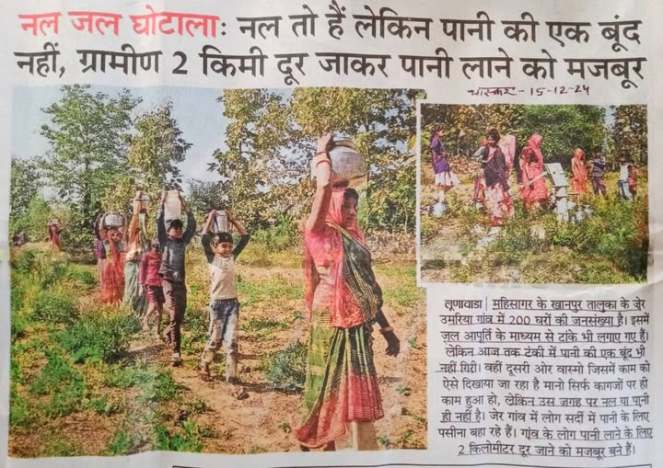
Assam ₹381cr spent but 44 schemes lie non-functional Over Rs 19,000 cr were spent, and 57.52 lakh households were “provided” with tap water connections in Assam. But these Jal Jeevan Mission (JJM) statistics disseminated to the public could be eyewash. A sample investigation in one public health engineering (PHE) division has let out the skeletons in the closet. The Bokakhat PHE division has completed 371 piped water supply schemes, spending over Rs 381 crore so far. However, 44 of them are non-functional, according to data revealed by the PHE in response to an RTI by advocate Nayan Moni Hazarika.
Sources, however, said the number of non-functioning schemes could be much more, and the number of consumers actually getting water from the schemes is a mystery. All these schemes were completed between 2021 and 2024. A majority of them were completed in 2023. In its response, the PHE said the reasons for the scheme being non-functional are non-payment of bills to the APDCL, PWD road widening, and inefficient jal mitra or water users committee. However, a closer look at the data revealed that as many as 34 of the total 44 schemes, which are said to be non-functional officially, are due to “distribution network damage.” Pumps are not working in three of them. The quality of work and coordination with line agencies have also raised serious doubts. https://assamtribune.com/assam/jjm-in-assam-rs-381-cr-spent-but-44-schemes-lie-non-functional-1561934 (22 Dec. 2024)
Gujarat People in villages in Lunawada, are forced to carry water from 2 km away as there is no supply from Jal Jeevan Mission/ Nal Jal Project, though the project claims water supply. (Dainik Bhaskar 12 Dec. 2024)
WATER
Odisha State implements scheme to bolster water conservation Union Jal Shakti minister C R Patil informed the Lok Sabha that Odisha’s total annual groundwater recharge has been assessed at 17.35 billion cubic meters (BCM), with an annual extraction of 7.39 BCM. Out of 314 blocks in the state, 299 (95.22%) are categorized as ‘safe,’ nine (2.87%) as ‘semi-critical,’ and six (1.91%) as ‘saline.’
-Odisha has implemented two schemes to enhance groundwater levels: CHHATA (community harnessing & harvesting rainwater artificially from terrace to aquifer) and ARUA (artificial recharge to underground aquifer). These initiatives align with the ministry of Jal Shakti’s Jal Shakti Abhiyan: Catch the Rain 2024, which integrates central govt schemes like MGNREGS, AMRUT & PMKSY. https://timesofindia.indiatimes.com/city/bhubaneswar/state-implements-scheme-to-bolster-water-conservation/articleshowprint/116507026.cms (20 Dec. 2024)
AGRICULTURE
FLOOD 2024
Karnataka Rains led to death of 133 people A total of 133 people died in Karnataka due to rains this year, said Karnataka Revenue Minister Krishna Byre Gowda in assembly on Friday (Dec. 13). He also said that ₹5 lakh compensation has been paid to each family of the deceased by the state government.
-The minister also noted that the rains have also caused significant crop and property damage in the state. “Kharif crops were damaged across nearly 1.6 lakh hectares, with ₹94.94 crore in compensation paid. Meanwhile, Rabi crops on over 1.45 lakh hectares also suffered damage, and compensation of ₹112.17 crore is being processed. A total compensation for rain-related damages this year amounts to ₹297 crore, with ₹80.47 crore allocated for repairing public infrastructure,” he told in assembly. https://www.hindustantimes.com/cities/bengaluru-news/karnataka-rains-led-to-the-death-of-133-people-in-2024-minister-krishna-byre-gowda-in-assembly-101734089681280.html (13 Dec. 2024)
Govt to pay ₹297cr as relief for rain damage While speaking of the temporary financial relief provided by the government to deal with excess rainfall, the minister articulated the need to find permanent solutions to prevent floods. “According to the National Geographical Survey, there are 863 landslide-prone gram panchayats in Dakshina Kannada, Uttara Kannada, Kodagu, Udupi, Chikkamagaluru and Shivamogga districts. To prevent these landslides, the CM has directed to provide Rs 425 crore for 2-2.5 years.”
-Gowda noted that the World Bank had provided a loan of Rs 3,000 crore for remodelling around 300 km of the roughly 1,000-km long stormwater drains in Bengaluru (Rs 2,000 cr) and for the BWSSB to finish work on underground sewages (Rs 1,000 cr). Another Rs, 2,000 crore was provided by the Disaster Mitigation Fund for the rest of the state. https://www.deccanherald.com/india/karnataka/karnataka-govt-to-pay-rs-297-crore-as-relief-for-rain-damage-this-year-3317186 (14 Dec. 2024)
URBAN FLOODS
Delhi Forgotten drain led to waterlogging A mystery drain, the existence of which everyone had forgotten for 15 years, and which, as a result, had not been cleaned for that span of time, was responsible for the flooding seen in tony south Delhi neighbourhoods such as Hauz Khas, Vasant Kunj and Malviya Nagar after the Capital received 230 millimetres (mm) of rain in 24 hours till 8.30am on June 28.
The discovery of this 113 m-long drain led to a series of meetings and letters exchanges between PWD, DMRC, Municipal Corp of Delhi (MCD) and the Malviya Nagar MLA’s office. It emerged that DMRC, while building its underground Yellow Line in 2009 blocked a brick barrel drain but added four large steel pipelines for drainage. But even DMRC has no record of the agency from which it took over the brick drain, or the agency that had been maintaining it previously. Interestingly, DMRC also has no records of which agency it handed the drain over to.
“During construction of cut and cover tunnel for Yellow Line Metro in Green Park under Sri Aurobindo Marg in 2009, DMRC dismantled the previous drainage system consisting of big brick barrel drain and replaced it with four metal pipes laid at about 3-4 metre depth below ground level…This whole drainage system is laid about four metres below the ground level and taking discharge of surrounding areas like SDA, Green Park, Hauz Khas as well as sewer also,” one letter said. https://www.hindustantimes.com/cities/delhi-news/forgotten-for-15-years-drain-which-led-to-waterlogging-found-in-south-delhi-101734546986031.html (19 Dec 2024)
Bengaluru State unveils ₹5,000 cr plan to curb urban floods Revenue Minister Krishna Byregowda on Dec. 13 said that a permanent project worth ₹5,000 crore has been designed to prevent flood-like damage caused by heavy rainfall in areas under the Bruhat Bengaluru Mahanagara Palike (BBMP). So far, 700 km of drainage systems have been developed, and the remaining 300 km of Rajakaluves will be developed in the coming year, with ₹240 crore allocated from the Disaster Mitigation Fund,” he said.
The govt has already conducted 10 rounds of meetings with the World Bank to secure their support for this project. A ₹3,000 crore loan from the World Bank will be used to develop all Rajakaluves through the BBMP at a cost of ₹2,000 crore. “In addition, a comprehensive sewage system is being planned for the 110 newly added villages under the BBMP, where there is no existing drainage.
-“In addition, a comprehensive sewage system is being planned for the 110 newly added villages under the BBMP, where there is no existing drainage. The project aims to connect the sewage water directly to the sewage treatment water line, and the Bengaluru Water Supply and Sewerage Board (BWSSB) has been allocated ₹1,000 crore for this initiative. Another ₹2,000 crore will be allocated for other related works,” Byregowda said. https://bangaloremirror.indiatimes.com/opinion/sunday-read/the-sunday-read-state-unveils-rs-5000-cr-plan-to-curb-urban-floods/articleshow/116325522.cms (15 Dec. 2024)
LANDSLIDES
Uttarakhand Landslide lakes: A ticking time bomb A decade of landslides that have grown in intensity and frequency have birthed as many as six lakes. For the first time, a team of scientists from institutes like the Wadia Institute of Himalayan Geology and Hemvati Nandan Bahuguna Garhwal University along with the Uttarakhand State Disaster Management Authority, and other government organisations are surveying these landslides and the lakes. Their goal? To understand the vulnerability of these lake areas and stop a disaster.
-But the going is slow. They can no longer rely on maps, and the fear is that by the time the report is ready to be submitted to the National Disaster Management Authority, the embankments would have given way. Meanwhile, villagers have started their own the survey under the guidance of local leaders. To add to the confusion, many want to convert the lakes into a tourist attraction with walkways, boat rides, and temples.
-As of Dec 2024, the multi-agency team is still in the process of identifying the landslide lakes. Once the locations of these lakes are recorded, the authorities will go on to make individual plans to manage them, said a senior official from the Uttarakhand State Disaster Management Authority (USDMA). “We may not be able to deploy a one-size-fits-all solution to manage all these lakes. Each lake will have to be studied individually,” the official said. Some of the larger ones for instance, like Kuwari, may require emergency interventions like manually draining water through artificial channels. This will ensure that the lake’s water levels are maintained to prevent flooding.
-The entire process, however, may take at least two to three years to complete. Officials say the delay is because most of the areas where these lakes have come up are located at high altitudes, cut off from motorable access. While the lake in Kuwari seems to have been formed naturally, a coal plant there leads to regular mountain-cutting. This could have weakened the mountains, making them more vulnerable to landslides, said Mohit Kumar Puniya, a geologist at the Uttarakhand Landslide Mitigation and Management Centre (ULMMC). “Kuwari is the largest landslide lake that we know of. But over the last few years, we have also observed another such lake in Dharchula, on Kali Ganga and in Almora,” he added. https://theprint.in/ground-reports/uttarakhands-ticking-bomb-landslide-lakes/2409981/ (Dec. 2024)
ENVIRONMENT GOVERNANCE
Report Govt defies SC & breaks own rules Violating three Supreme Court orders and the law, the government of Prime Minister Narendra Modi has cleared, between February and September 2024, 56 proposals to cut prime, natural forests for mines, roads, power plants and other ‘development’ and allow ‘compensatory afforestation’ in areas that are already forests. A seemingly deliberate misinterpretation and misapplication of the law allows this twice-over-loss of forests, according to our analysis of the minutes of 26 meetings, accelerating India’s deforestation, now second only to Brazil’s. (Prakriti Srivastava, Prerna Singh Bindra & Krithika Sampath) https://article-14.com/post/growing-new-forests-over-old-other-ways-modi-govt-defies-supreme-court-breaks-its-own-rules-6764e4c30145c (20 Dec. 2024)
MoEF Green area grows, now covers 25.17% of India The latest biennial State of Forest (ISFR) report by the Forest Survey of India, delayed by more than a year, showed that while India’s green cover has grown to encompass 25.17% of its geographical area, almost all the growth (149.13 sq km out of 156.41 sq km) has occurred outside natural forests through plantations and agroforestry. At the same time, over 92,000 sq km of natural forests have degraded from dense to open categories in the past decade, raising concerns about the quality of India’s forest resources despite the headline growth in numbers. https://www.hindustantimes.com/india-news/green-area-grows-now-covers-25-17-of-india-101734807480099.html (22 Dec. 2024)
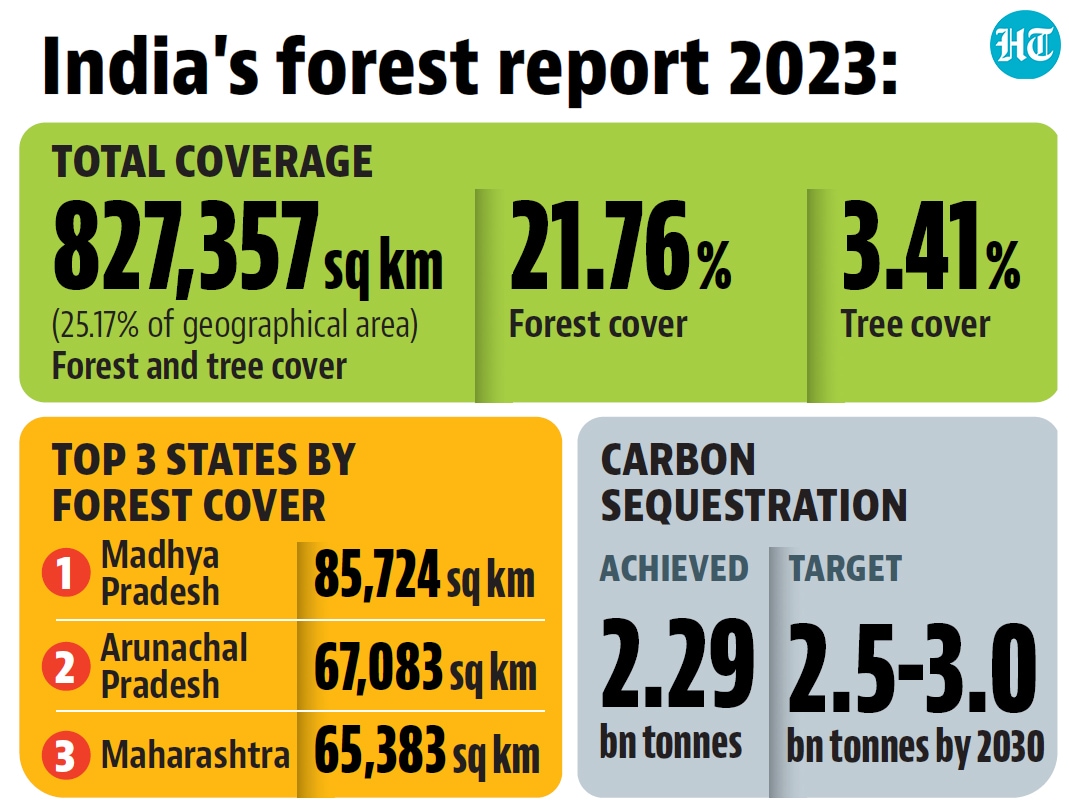
Tree patches smaller than 1 hectare are not considered forests and are accounted for separately as tree cover. At 1,12,014 sq km, India’s tree cover now extends over 3.41% of the land area and supplements India’s 21.76% forest cover. https://indianexpress.com/article/india/india-lost-dense-forests-gained-tree-cover-says-govt-report-9738341/ (22 Dec. 2024)
Forest cover down in 8 mountain states The ISFR has revealed a decline in forest cover in eight mountain states over the period between 2021 and 2023, with several northeastern states on the list. Tripura recorded the largest loss of 95.3 sq km, followed by Arunachal Pradesh (-91 sq km), Assam (-79 sq km), Manipur (-54.8 sq km), Nagaland (-51.9 sq km), Meghalaya (-30 sq km), Uttarakhand (-22 sq km) and West Bengal (-2.4 sq km). ISFR further shows that in Uttarakhand, the decline of 22.9 sq km includes forest cover of Corbett, Rajaji and Kedarnath forest divisions, among other 21 forest divisions that saw a dip in forest cover in two years. https://timesofindia.indiatimes.com/india/forest-cover-of-eight-mountain-states-down-in-2-years-government-report/articleshow/116576551.cms (23 Dec. 2024)
Meghalaya see 84sqkm decreased forest cover Meghalaya lost over 84 sq km forest cover between 2021 & 2023, according to the latest ISFR. Except for Sikkim, which reported an increase of 2 sq km forest cover, all other states in the northeast witnessed a reduction of the area under forests, it said. The region, with 7.98 per cent of land area, collectively contributes 21.08 per cent of India’s forest and tree cover, the ISFR, 2023, said. While the study did not specify what caused the loss of forest cover in Meghalaya, forest officials in the state said human activities, including agricultural expansion, increased settlement and infrastructure development are suspected to be the reasons. https://www.business-standard.com/india-news/meghalaya-sees-84-sq-km-decrease-in-forest-cover-between-2021-2023-isfr-124122200503_1.html (22 Dec. 2024)
Uttarakhand sees highest number of forest fires The Himalayan state of Uttarakhand has recorded an alarming increase in forest fire counts this season, jumping from its 13th place last season to becoming the top most-affected state this season. Satellites detected 21,033 fire counts this season compared to 5,351 last season, according to the latest India State of Forest Report 2023 released in Dehradun on Saturday (Dec. 21). The forest fires also caused extensive damage in the neighbouring Himachal Pradesh where over 10,136 fire counts were detected as compared to just 704 in the previous season. The detections using SNPP-VIIRS sensors cover the period from November 2023 to June 2024, which corresponds to the forest fire season in India, with a peak occurring from February 8, 2024, to June 30, 2024. https://www.news18.com/india/uttarakhand-sees-highest-number-of-forest-fires-alarming-spike-in-cases-since-last-season-9163880.html (21 Dec. 2024)
Missing the forest for the trees An analysis of rising forest cover in India State of Forest Reports, 1987–2021 by Madhusudan MD: -Despite successive ISFR claiming rising forest cover, there is little evidence to show that India’s natural forest cover has actually increased. In fact, it has very likely declined. The purported gains come largely from FSI’s problematic and perverse redefinition of ‘forest’ to include tea gardens, coconut plantations, urban built-up areas, native grasslands wrecked by invasive trees, and even treeless desert scrub. https://mdmadhusudan.medium.com/missing-the-forest-for-the-trees-37a94c13ab8c (18 Jan. 2022)
CLIMATE CHANGE
IPBES Report Climate change, biodiversity loss interlinked The Intergovernmental Science-Policy Platform on Biodiversity and Ecosystem Services (IPBES) has released a new landmark report called “Nexus Report”, a product of three years of work by 165 leading international experts from 57 countries from all regions of the world. The report categorically says existing actions to address these challenges fail to tackle the complexity of interlinked problems and result in inconsistent governance. “These issues are not standalone; they cascade and compound each other,” said Prof Paula Harrison, co-chair of the report. “Without integrated action, we risk making matters worse.” https://www.newindianexpress.com/xplore/2024/Dec/21/call-for-nexus-approach-as-climate-change-biodiversity-loss-interlinked-2 (21 Dec. 2024)

Climate change and biodiversity loss are connected The IPBES new report examined five major challenges — climate change, biodiversity loss, food insecurity, water scarcity, and health risks — and found that they were strongly interconnected. Trying to deal with these challenges separately, while ignoring the interactions with and influences on others, was not just likely to be ineffective, but also counterproductive, according to the report. https://indianexpress.com/article/explained/explained-climate/nexus-report-ipbes-9732764/ (21 Dec 2024)
SOUTH ASIA
India-Bhutan Govt syncs 2 units of Punatsangchu II HEP The Royal Government of Bhutan on Dec 17 announced the synchronisation of Units 1 and 2 (170 MW each) of the 1,020 MW Punatsangchhu II HEP with the Indian power grid. A ceremony was held at the project site to mark the occasion, which was attended by Bhutan’s Minister of Energy & Natural Resources, Lyonpo Gem Tshering, and the project team. https://assamtribune.com/assam/assam-to-receive-174-mw-as-bhutan-syncs-2-units-of-punatsangchhu-ii-hep-1561490 (18 Dec. 2024)
Nepal Upper Arun question mark The problem is said to be India’s displeasure with the World Bank’s involvement in the 1,061MW Upper Arun. Delhi is so sensitive to the issue that sources said it even leaned on Indian-born American President of the World Bank, Ajaya Banga to cancel his trip to Kathmandu for the IDA21 Replenishment Meeting in June. When it gets the green light, $1.6 billion Upper Arun will be the most expensive hydroelectric project in Nepal so far.

The semi-storage scheme is located on the transboundary Arun River 15km from the Chinese border after it cuts through the Himalaya between Mt Everest and Kangchenjunga. India’s silence is said to stem from its strategic interest in not allowing anyone else to build large storage projects on the tributaries of the Ganga in Nepal. India’s SJVN is also currently constructing three large projects downstream, including Arun III and Lower Arun with a total generation capacity of nearly 2,000MW. https://nepalitimes.com/news/upper-arun-question-mark (18 Dec. 2024)
Bhutan Construction of 1,125 Mw Dorjilung HEP to start late next year The construction of the Nu 145 Billion 1,125 MW Dorjilung Hydropower Project, spanning Lhuentse and Mongar Dzongkhag, is set to commence by 2025 end. The project is to be developed under the agreement with Tata Power Company with DGPC. Preparatory activities, including building access roads, ensuring power supply, and setting up transit camps, are expected to commence in the second quarter of the year, according to the Druk Green Power Corporation (DGPC). The Detailed Project Report (DPR), initially prepared in 2015, was updated this year with financial assistance of USD 4 million from the World Bank. The revised DPR incorporates international best practices, Bhutan’s hydropower development guidelines, and the World Bank’s safeguards requirements. The updated DPR is currently under review for final approval.
– The Detailed Project Report (DPR), initially prepared in 2015, was updated this year with financial assistance of USD 4 million from the World Bank. The revised DPR incorporates international best practices, Bhutan’s hydropower development guidelines, and the World Bank’s safeguards requirements. The updated DPR is currently under review for final approval. In addition to Dorjilung, the DGPC-Tata Power partnership plans to develop several other projects, including the 740 MW Gongri Reservoir, the 1,800 MW Jeri Pumped Storage, and the 364 MW Chamkharchhu-IV projects. https://kuenselonline.com/construction-of-1125-mw-dorjilung-project-to-kickstart-late-next-year/ (19 Dec. 2024)
THE REST OF THE WORLD
World Bank WB is backing mega dams Earlier this week the World Bank’s board of directors approved a scheme to make the bank the lead financier in a $6.3 billion project to finish construction of the Rogun Dam in Tajikistan. The frequently stalled project, launched in 1976, is now about 30 percent complete. If fully built, it would become both the world’s tallest dam, at 1,100 feet, and with its total price tag of $11 billion, one of the world’s most expensive.
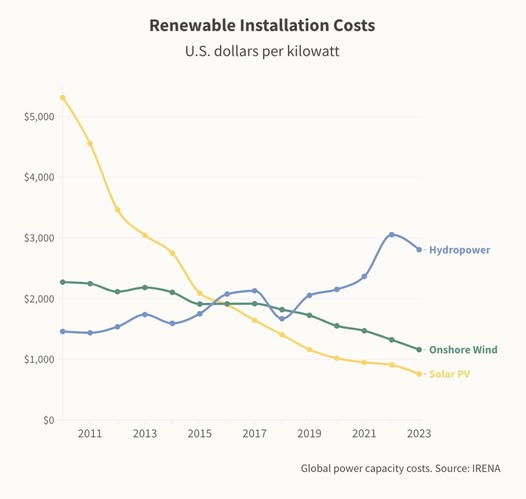
CONGO: The World Bank and Democratic Republic of Congo officials also have been negotiating the terms of a deal that would include financing Inga 3, the third of eight proposed dams in a megaproject known as Grand Inga. Grand Inga is a $100-billion venture that would be the world’s largest dam scheme, nearly doubling the power output of China’s Three Gorges, currently the world’s largest hydroelectric dam, and potentially bringing electricity to a sizable chunk of the African continent. It would also reconfigure the hydrology of the world’s second-most-powerful river, the Congo.
-From 2014 to this year, the bank supported only one new major hydropower project, Nachtigal in Cameroon. Yet between this week and mid-2025, the bank’s board of directors is likely to approve financing for five major dams, including Rogun and Inga 3.
– Experts believe the bank’s involvement will not alter the global dam-building industry’s current downward trajectory, for many increasingly obvious reasons. These include dams’ enormous upfront costs followed by waits of as long as a decade or more before electricity revenues begin flowing; their destruction of fisheries and riverine ecosystems; their displacement of a conservatively estimated 80 million people around the world and their damage to the livelihoods of a half-billion more; their substantial emissions of methane from some reservoirs; their steep reductions in energy production when drought — which is increasingly common due to climate change — empties reservoirs, as is currently happening in southern Africa and elsewhere; and the seeming coup de grace, their declining competitiveness with increasingly less costly wind and solar installations. https://e360.yale.edu/features/world-bank-hydro-dams (19 Dec. 2024)
USA 99% streams are off the radar amid rising flash flood risks Storms are intensifying faster, weakening more slowly and producing more extreme precipitation that the land can’t absorb fast enough. Inland flood risk is less understood or easily anticipated. These disasters underscore the importance of fast, accurate flood warnings. They’re also a reminder that extensive gaps still exist in the systems that monitor U.S. stream levels.

– The National Weather Service uses advanced models to issue flood warnings. These models rely on historical trends, land cover information and a network of over 11,800 stream-gauges – sensors that provide near-real-time data on precipitation, streamflow and water depth – to simulate water flow. Much of that data is available online in real time. However, the stream-gauge network covers less than 1% of the nation’s rivers and streams. Many states average more than 500 miles for each streamgage. That means many stretches of waterway lack monitoring equipment to trigger flood warnings. Averages over 100 miles, particularly in highly populated regions like the East Coast, mean large coverage gaps. The U.S. Geological Survey acknowledges that these sensors alone do not provide enough data at fast enough intervals to fully address flood risk. https://theconversation.com/no-flood-gauges-no-warning-99-of-us-streams-are-off-the-radar-amid-rising-flash-flood-risks-we-saw-the-harm-in-2024-227533 (17 Dec. 2024)
SANDRP
Also see: DRP 16 Dec. 2024 & DRP 09 Dec. 2024
Follow us on: www.facebook.com/sandrp.in; https://twitter.com/Indian_Rivers

 SANDRP