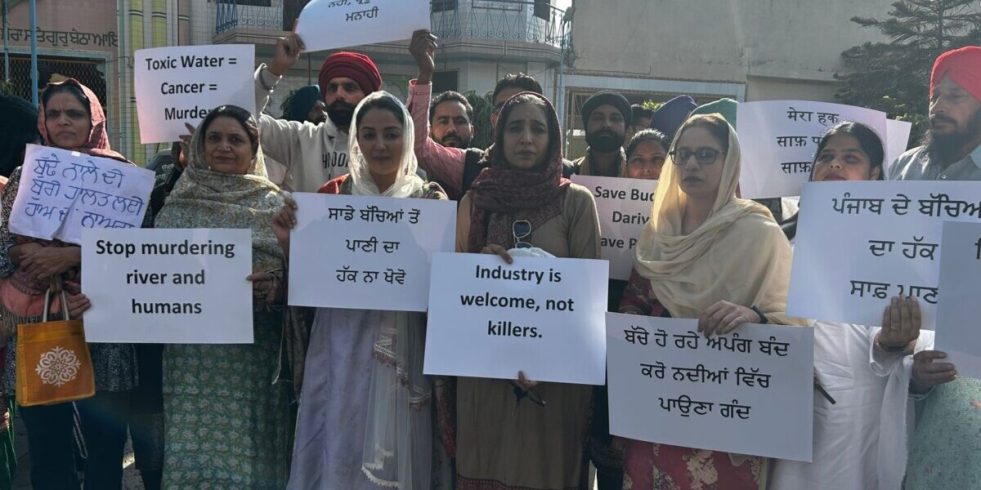
(Feature Image: Women activists who were standing and displaying placards were detained by the Ludhiana police during the protest. Photo: By special arrangement/The Wire)
‘Kale Pani da Morcha”, the people’s movement against Pollution of Buddha Nallah, a tributary of Sutlej River in Ludhiana (Punjab) is a landmark movement in more than one sense. Firstly, while severe pollution of rivers is the usual story from across the country, a courageous people’s movement to address is the issue is such a rare event.
The fact that the industries association actually threatened this movement with a counter from the industries and their workers is shocking and shows the impunity of these industries. While the state government has to take quick action to address the issue, there is also a huge role for the central government, which has abjectly failed to perform its basic duty of providing credible governance of rivers, including their pollution in India. They including CPCB and MoEF know since decades that CETPs are completely failed model, and no worthwhile action has been taken to address the failure, including by the World Bank which has funded many of them. The filthy rivers all over India are violating the fundamental rights of millions of people, without any credible action even by the judiciary.
The Buddha nala pollution issue is decades long, but the current movement started about six months back. It is also heartening to know that even affected people from downstream, from Rajasthan have also supported the movement. May this movement succeed and may there be many more such movements.
Buddha Dariya; Ludhiana Activists set deadline for govt to stop Sutlej pollution After activists associated with the Kale Pani da Morcha (war against black water) held a protest to block the flow of toxic industrial waste into Ludhiana’s Buddha Nallah, which merges into Sutlej River, the AAP led Punjab government on Tuesday (Dec 3) sought a week’s time to address the issue. The activists said they would announce their next course of action after the deadline ends. Earlier, on November 19, the activists had given an ultimatum to the state government headed by Punjab Chief Minister Bhagwant Mann to implement its directives, warning, that if their demands were not met, they would themselves stop the flow of toxic waste into Sutlej River on December 3.
– The movement was first launched on June 18 this year while their maiden protest took place on August 24, 2024. As the government failed to act, on Dec 3 (Tuesday), the activists and locals gathered at the Verka Milk Plant, Ludhiana to stop the discharge of effluents from the Common Effluent Treatment Plants (CETPs) meant to treat toxic water of dyeing units into the Buddha Nallah. There are three CETPs to treat effluents of dyeing units in Ludhiana district. Ludhiana, which is famous for its hosiery goods, has around 384 dyeing units, apart from the electroplating industries.
– Environmentalist Jaskirat Singh, who was leading the protest said that there were reports of police camping at some local gurdwaras to ensure that no announcement was made for mobilising people. “Similarly, raids were conducted at various places till late Tuesday night to stop the protest from gaining strength”, he said. He said that at the protest, the Punjab government officials called Punjab Pollution Control Board (PPCB) officials on the spot but the latter expressed their helplessness in implementing the orders. “Finally, the Punjab government sought one-weeks’ time to address the issue, on which we would wait and watch. However, we informed the government officials that if they failed to act, people would again come out in large numbers, as it was a matter related to their health and life”, added Singh. https://thewire.in/environment/kale-pani-da-morcha-holds-protest-to-block-the-flow-of-toxic-industrial-waste-into-sutlej-river (05 Dec. 2024)
Activists march towards dyeing units Tension gripped Ludhiana today as thousands of activists from the Kale Pani Da Morcha (KPDM) gathered near the Verka Milk Plant on Ferozepur Road around 11 am to march towards Tajpur Road. Their aim was to block the discharge lines of dyeing units that, they alleged, were releasing untreated effluents into the Buddha Nullah.
-On the opposite side, an almost equal number of workers of dyeing units and other industries assembled on Tajpur Road and Bahadurke Road to protect their CETPs. The workers spread across all connecting roads leading to the CETPs to thwart KPDM activists from disrupting operations.
-The activists claimed they had been forced to launch the KPDM campaign as the authorities had “failed” to clean the Buddha Nullah and the people had been drinking contaminated water for the past two decades. On the other side, thousands of industrial workers gathered on Tajpur Road to counter the KDPM activists. The dyeing industry had arranged special vehicles to bring in the workers. The police had barricaded all roads leading to Tajpur Road and no vehicular movement was allowed within 1-km radius of the CETPs. https://www.tribuneindia.com/news/punjab/ludhiana-on-edge-as-buddha-nullah-activists-march-towards-dyeing-units/ (04 Dec. 2024)
Ludhiana comes to standstill -Over 150 people including women were taken into preventive custody on Tuesday (Dec. 03) as Ludhiana came to a standstill with activists of KPDM gathering there to stop the discharge of effluents into the Buddha Nallah. The city has been turned into a fortress, with heavy police presence at all entry points, particularly on Ferozepur Road and Tajpur Road. Mobile networks were slow in many parts of the city as sources said police had used jammers near protest sites.

-KPDM activists had called for halting the discharge of effluents from the CETP of dyeing units into the Buddha Nallah on December 3, claiming that the Punjab Government was unresponsive despite repeated representations. In response, the Punjab Dyers’ Association (PDA) labelled the activists as “blackmailers”. The situation at Tajpur Road, which has outlets for common effluent treatment plants, was tense as hundreds of migrant workers and dyeing association members dared activists to close any outlet. Over 225 dyeing units remained closed as their workers had gathered at Tajpur Road. https://indianexpress.com/article/cities/chandigarh/kale-pani-da-morcha-ludhiana-activists-buddha-nallah-dyeing-units-9704450/lite/ (03 Dec. 2024)
Rajasthan farmers head to Ludhiana More than 1,000 farmers from Rajasthan set out on a protest yatra towards Ludhiana on Tuesday to raise the issue of pollution in the river Sutlej. Water from the river is supplied to 12 districts in the state through the Indira Gandhi canal for drinking and irrigation. The farmers, from Rajasthan’s Sri Ganganagar and Hanumangarh districts, have started a ‘Zeher se mukti andolan’ (Stop the pollution movement), alleging that pollution from factories in Punjab is leaving the water toxic and causing major illnesses to residents of their districts. https://indianexpress.com/article/cities/jaipur/the-water-is-making-us-sick-1000-rajasthan-farmers-head-to-ludhiana-to-protest-sutlej-pollution-most-stopped-en-route-9705065 (04 Dec. 2024)
More than 1,000 farmers from Rajasthan set out on a protest yatra towards Ludhiana on Tuesday (Dec. 03) to raise the issue of pollution in the river Sutlej. Water from the river is supplied to 12 districts in the state through the Indira Gandhi canal for drinking and irrigation. The farmers, from Rajasthan’s Sri Ganganagar and Hanumangarh districts, have started a ‘Zeher se mukti andolan’ (Stop the pollution movement), alleging that pollution from factories in Punjab is leaving the water toxic and causing major illnesses to residents of their districts. https://indianexpress.com/article/cities/jaipur/the-water-is-making-us-sick-1000-rajasthan-farmers-head-to-ludhiana-to-protest-sutlej-pollution-most-stopped-en-route-9705065/ (04 Dec. 2024)
Thousands of industrial workers from across the state gathered at Tajpur Road to provide security to the CETPs installed by the dyeing industry. The move came following threats from KPDM activists to shut down the CETPs as they were playing with the lives of people by polluting the Buddha Nullah. https://www.tribuneindia.com/news/ludhiana/buddha-nullah-battle-workers-guard-dyeing-plants-as-activists-threaten-to-cut-lines/ (03 Dec. 2024)
Protest over pollution The agitation eased only after negotiations between the protest leaders, district administration, and police officials. Amarjit Singh Bains, additional deputy commissioner (General), said: “The PPCB confirmed the 15 MLD CETP plant at Tajpur Road will be shut within two days. Decisions on two other CETPs, reportedly under NGT stay orders, will be made after a legal review in 7 days.” https://www.hindustantimes.com/cities/chandigarh-news/protest-over-illegal-treatment-plants-triggers-traffic-chaos-in-ludhiana-101733254295771.html (4 Dec 2024)
KPDM activists accuse Punjab govt of failing to take concrete action even as the CPCB, in a recent reply submitted in the NGT had declared that CETPs functioning in Ludhiana were found “non-complying with environmental norms.” The PPCB in September this year, had issued notices to dyeing industries to stop discharge into Buddha Nullah. The dyeing industry later moved NGT seeking interim relief. The matter is now sub-judice in the green tribunal. https://indianexpress.com/article/cities/chandigarh/black-water-pollution-board-state-govt-activists-fight-9705382/ (04 Dec. 2024)
The protest is being spearheaded by the Public Action Committee, Naroa Punjab Manch, and several other organizations, with the support of all major farmer unions in Punjab, including the Samyukta Kisan Morcha, Kisan Mazdoor Morcha, and the Samyukta Kisan Morcha (non-political). Despite their ideological differences, these groups have come together for the common cause of ensuring clean drinking water for the people of Punjab and beyond. https://indianexpress.com/article/cities/chandigarh/punjab-haryana-rajasthan-activists-support-farmer-unions-kale-pani-da-morcha-buddha-nallahs-contaminated-water-9527620/ (22 Aug. 2024)
EDIT Civil society leads Residents of Ludhiana and downstream regions continue to suffer from the polluted water as their health and farming are affected. The time for symbolic protests has passed; it is now imperative for all stakeholders — government, industries and civil society — to unite for tangible action. A clean Buddha Nullah is not just an environmental goal but a fundamental human right. https://www.tribuneindia.com/news/editorials/civil-society-leads/ (5 Dec 2024)
HYDRO POWER PROJECTS
International Rivers Saving rivers means saving democracy Democracy isn’t just about casting votes. It’s about whose voices matter in the decisions that shape our world. When we work with communities along the banks of the Salween, the Tapajos, the Teesta, the Kunene, we see how the most effective river protection comes when previously marginalized voices – especially those of Indigenous communities, women, youth – are brought to the forefront.
– The challenges to democracy that we’re witnessing globally are more than abstract political issues – they have real consequences for environmental and social justice. When democratic institutions weaken, environmental protections and human rights often follow suit. We’ve seen how autocratic tendencies frequently align with the dismantling of environmental safeguards, the silencing of Indigenous voices, and the prioritization of short-term gain over long-term sustainability. The path forward requires us to recognize that environmental protection and democratic principles are inseparable. https://www.internationalrivers.org/news/why-saving-rivers-means-saving-democracy (06 Dec. 2024)
Karantaka Sharavathy HEP will need drilling, blasting The controversial Rs 8005 Cr Sharavathy pumped-storage project will include blasting and movement of heavy machinery in the Sharavathi Lion Tailed Macaque Sanctuary and felling at least 14,000 trees of evergreen forest in the heart of the Western Ghats. The 2,000 MW project proposed by the Karnataka Power Corporation Ltd requires 378 acres (153 hectares) of which about 126 acres (52.62 ha) is forest land spread over Honnavar, Shivamogga Wildlife and Sagar divisions.
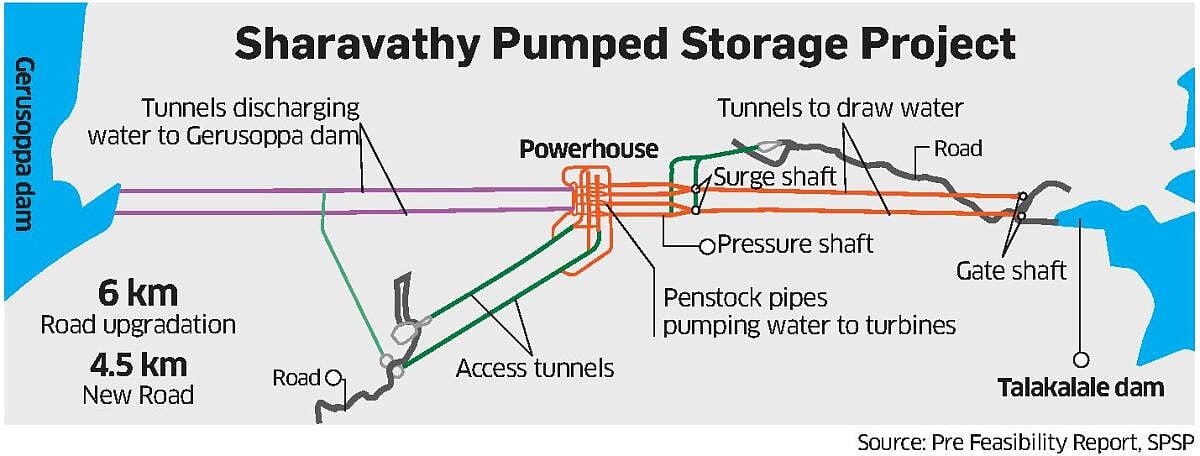
Within the forest land, 97 acres is part of the Lion Tailed Macaque Sanctuary. Two large tunnels 2.3 km long will draw water from Talakalale dam in the upstream and pump it to the surge shafts connected to the turbines in the power house. The water from the power house will be discharged in the Gerusoppa reservoir downstream with two other tunnels, each 3.3 km long. https://www.deccanherald.com/india/karnataka/sharavathy-project-will-need-drilling-blasting-in-western-ghats-3305764 (06 Dec. 2024)
Sharavathi’s survival at stake Sharavathi River in Karnataka Western Ghats is facing fresh threats and govt pushes a 2000 MW pump storage project on it. The Sharavathi valley was known as the ‘Pepper Queen’ for pepper found in its lush forests and spice gardens that attracted Arab and European traders over centuries. The Sharavathi originates in Ambuthreetha in the crestline of the Western Ghats in the Shivamogga district, plunging 960 feet at Jog Falls—a breathtaking sight that draws tourists from across the country. After traversing 132 km, it empties into the Arabian Sea at Honnavar in the Uttara Kannada district.
– The govt also wants to divert 15 TMC water from the Linganamakki reservoir on the Sharavathi to supply water for Bengaluru, which was stalled after opposition from activists and people in 2019. The aim is to lift this water 1,500 feet and pump it to travel 430 km to reach Bengaluru. https://www.deccanherald.com/opinion/sharavathis-survival-at-stake-3300825 (03 Dec. 2024)
Andhra Pradesh PSPs spark concerns over tribal displacement & environmental harm Five pumped storage projects (PSPs) are facing accusations of violating laws designed to protect tribal communities and forest rights. There are growing concerns that tribal communities may face displacement and disenfranchisement, while the environment may suffer significant harm. Allocations for these projects, with a combined capacity of 6,600 MW, were granted to private companies by the New and Renewable Energy Development Corporation of Andhra Pradesh Limited (NREDCAP), the state nodal agency, during the YSR Congress party government’s tenure between 2019 and 2024.
– These projects include the Kurukutti PSP (1,200 MW) in Salur mandal and the Karrivalasa PSP (1,000 MW) in Pachipenta mandal – both in Parvathipuram Manyam district. The Pedakota PSP in the Ananthagiri mandal of the Alluri Sitarama Raju (ASR) district had its capacity increased from 1,500 MW to 1,800 MW in August 2024. In the ASR district, Shirdi Sai Electricals has been allocated the Yerravaram PSP (1,200 MW) in Chintapalli and Koyyuru mandals, while the Aditya Birla Group has been allocated the Gujjili PSP (1,400 MW) in Ananthagiri mandal. “We are shocked at the brazen manner in which these projects have been granted in open contempt of the law and various constitutional provisions applicable in the fifth schedule region. These include both the PESA [Andhra Pradesh Panchayats Extension to Scheduled Areas Rules] and the FRA [Forest Rights Act],” stated G. Rohit, state secretary of the Human Rights Forum (HRF) Andhra Pradesh. https://thewire.in/environment/andhra-pradesh-pumped-storage-projects-spark-concerns-over-tribal-displacement-and-environmental-harm/ (06 Dec. 2024)
Sikkim Holding financiers accountable for bankrolling big HEPs As the Teesta III dam in north Sikkim is about to be rebuilt, public sector development finance institutions are yet again lining up to bankroll the reconstruction. This investment plan raises serious concerns because it ignores the web of climate risks, financial and ecological costs and harmful socio-economic impact associated with the project, tragically demonstrated in last year’s devastating Glacial Lake Outburst Flood, which devastated hundreds of lives still struggling to recover. https://india.mongabay.com/2024/12/commentary-holding-financiers-accountable-for-bankrolling-big-hydro-projects/ (04 Dec. 2024)
Arunachal Pradesh ‘CM working as ‘mouthpiece of dam developers’’ Human rights and anti-dam activist Ebo Mili on Monday (Dec. 02) accused the BJP-led Arunachal Pradesh government of being “a mouthpiece of the dam developers” as chief minister Pema Khandu defends the proposed Siang upper multipurpose project. Addressing a press conference at the Arunachal Press Club here, Mili expressed concern that, despite strong opposition, the state government is going ahead with construction of dams on rivers in the state, posing a serious threat to the ecology and the residents. https://arunachaltimes.in/index.php/2024/12/03/ebo-mili-accuses-goap-of-being-mouthpiece-of-dam-developers/ (03 Dec. 2024)
Mili raises indigenous people’s land rights issue at UN forum -Addressing the 13th annual United Nations Forum on Business and Human Rights (UNBHR) here in Switzerland, human rights and conservation activist, advocate Ebo Mili “highlighted the ongoing struggle of the indigenous communities to protect their ancestral lands amid increasing pressure from state governments and local representatives (MLAs), who have often become advocates for dam developers,” the North East Human Rights informed in a release.
-He emphasised the violation of free, prior, and informed consent principle, citing the longstanding resistance against the Dibang multipurpose dam project. “Despite decades of opposition, the project proceeded, resulting in the loss of land, forests, and rivers for compensation that amounted to approximately 40% of the actual value,” Mili said. He pointed out the failure of local leaders and the administration to adequately support the families affected by the project. He also shed light on the continuous pressure from the state government for the Siang upper multipurpose project. Mili criticised the use of strategic defence narratives, concerns over Chinese dams and nationalistic rhetoric to justify the project. https://arunachaltimes.in/index.php/2024/12/01/mili-raises-indigenous-peoples-land-rights-issue-at-un-forum/ (01 Dec. 2024)
CM Khandu informed that the central government has agreed to give 26% equity share from each project to the state besides the existing quota of 12% free power. https://arunachaltimes.in/index.php/2024/12/03/hydropower-effective-source-of-revenue-generation-khandu/ (03 Dec. 2024)
Jammu & Kashmir Rattle HEP muck dumping in Chenab: NGT seeks report in 2 weeks Joint committee report dated Nov. 25, has been filed through the CPCB. Project proponents stated that they want to file an objection to the joint committee report and for this purpose wants a longer time of almost a month. Dumping of muck is on the side of river damaging everyday, river hydrology, morphology and ecology and also affecting flora and fauna and it is a matter which requires urgent attention and Proponents who are carrying on such kind of activities must be stopped from carrying out such activities, the court said.
Thus, a longer date in such matter would only encourage and continue with destruction of environment everyday which cannot be permitted, particularly, considering the fact that the area concerned is a fragile area of Himalaya, the court noted. However, since reasonable opportunity against the Joint Committee report needed to be granted to project proponents, the court allowed two weeks’ time to concerned respondents to file objections, if any, to the Joint Committee report. http://www.indiaenvironmentportal.org.in/content/477113/order-of-the-national-green-tribunal-regarding-dumping-of-muck-illegally-during-the-construction-of-rattle-hydro-electric-power-project-village-drabshalla-district-kishtwar-jammu-kashmir-03122024/ (03 Dec. 2024)
MEIL violating contract conditions: Residents Residents living in the vicinity of the 850 MW hydropower project, which is expected to be commissioned by May 2026, have accused MEIL of violating the conditions laid down in the contract.
– A Bhartiya Janta Party legislator has alleged that the Telangana-based Megha Engineering and Infrastructure Limited (MEIL) was working like the ‘East India Company’ while executing the Rs 5,281-crore Ratle power project in Kishtwar that has been marred by protests by locals and workers’ strikes. The allegation comes days after the construction giant was blamed by Jammu and Kashmir government for posing a “grave threat” to the environment with its “unscientific manner of blasting, drilling, muck disposal and movement of vehicles” which has caused “irreversible damage” to the “flora-fauna and ecosystem” of the eco-fragile region. The project has allegedly caused physical damages to their properties such as houses and shops while the unscientific blasting and dumping of waste has also resulted in a spike in respiratory and other diseases.
– Mohinder Kumar, a local leader of National Conference also alleged that since 2022 when the work started on the project, only those connected with the ruling party have been provided jobs. “It is a big scam which should be investigated by the government,” he told The Wire. The J&K government had set up Ratle Hydroelectric Power Corporation Limited which signed a contract agreement with MEIL for the turnkey execution of the project in 2022. The company was recently in news after it turned out to be one of the two biggest donors in the controversial electoral bonds scheme and the biggest donor of electoral bonds to the BJP at Rs 586 crore. https://thewire.in/energy/megha-engineering-ratle-power-project-jammu-kashmir/ (01 Dec. 2024)
Dam Concrete work of KWAR HEP inaugurated The pouring of concrete at the deepest foundation level of the Concrete Gravity Dam of 540 Mw KWAR HEP was inaugurated via VC mode by R.K. Chaudhary, CMD of NHPC Ltd & SJVN Ltd, on Wednesday (Dec. 04). KWAR H.E. Project is a joint venture between NHPC Ltd (Govt. of India) and JKSPDC (Govt. of J&K), and CVPPL is entrusted with implementing 4 hydroelectric projects with a combined capacity of 3,094 MW in the Chenab River Basin. https://statetimes.in/cmd-nhpc-inaugurates-commencement-of-dam-concrete-work-of-kwar-project/ (05 Dec. 2024)
Uttarakhand SC panel clears 5 HEPs on Ganga despite concerns These shortsighted HEP projects will not benefit the river, the Himalayan ecosystems, the people dependent on them or the country. So, for whose benefit are they being proposed? For whose benefit is it acceptable to damage the flow of a river eulogised as “Maa Ganga,” a river linked to the faith and sustenance of millions of Indians, and one that Modi vowed to restore to its pure flow through his Namami Gange programme? For whose benefit is it acceptable to risk the lives of Indians entwined with the Ganga? One can only wonder. https://thewire.in/environment/supreme-court-panel-clears-five-hydel-projects-on-ganga-despite-environmental-concerns (04 Dec. 2024)
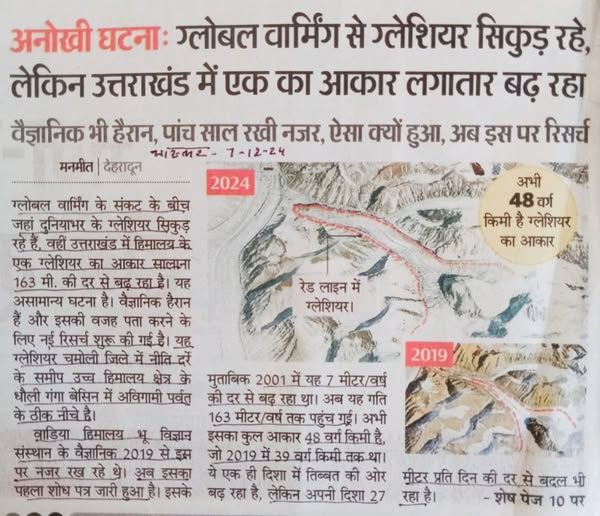
Surge in velocity of over 12sq km glacier A study conducted by scientists from the Wadia Institute of Himalayan Geology has revealed the dramatic surge of an unnamed glacier in Uttarakhand’s Niti Valley. Located about 1km north of the Raykana Glacier, this ‘compound valley-type glacier’ spans approximately 12.6 sq km.
The authors observed that the surge occurred after a phase of gradual retreat, highlighting its unpredictable behaviour. “The study results suggest that the glacier’s velocity varied considerably during the observed period, with periods of gradual increase, sudden increase, and subsequent decrease,” they added.
“The unnamed glacier’s surge dynamics, as revealed by our findings, align with the Alaska-type surge model, characterised by rapid acceleration and deceleration within short timeframes. We speculate that the surge of this glacier is triggered by hydrological shifts,” the study noted, urging continuous monitoring of Himalayan glaciers as climate change accelerates glacial dynamics.
The researchers also found significant changes in the glacier’s morphology, including the development of extensive crevasses and increased ice mass transfer from its accumulation zone to the terminus. Surface elevation analysis revealed thinning in the reservoir area and thickening near the terminus, suggesting rapid ice movement. The study warned that such surges could lead to hazardous glacial lake outbursts, threatening lives and livelihoods downstream.
While surges are more commonly documented in the Karakoram and Pamir ranges, they remain poorly understood in the Central Himalayas. The findings of the study contribute to growing evidence of the presence of surge-type glaciers in the region and underscore the urgent need to address climate change and its impact on glacier dynamics. Rising global temperatures are likely to increase the frequency and intensity of such surges, exacerbating risks to Himalayan ecosystems & human settlements. https://timesofindia.indiatimes.com/city/dehradun/incredible-surge-of-126-sq-km-glacier-near-india-china-border-velocity-jumps-from-7m-to-163myear/articleshow/116054143.cms (6 Dec 2024)
Unlike other Himalayan glaciers that are receding, one glacier in Chamoli dist in Uttarakhand, in Dhauliganga basin near Niti sub basin is actually growing. Its area was 39 sq km in 2019 and has now grown to 48 sq km. A new study has been launched by the Wadia Institute for Himalayan Research.
Uttarakhand is witnessing alarming glacier melt rates, driven by global warming, human activities like road construction and deforestation, and hydropower projects. This rapid melting poses severe consequences for the region and the entire country, including increased floods, water scarcity, and displacement. https://www.indiawaterportal.org/climate-change/how-to-mitigate-the-impact-of-melting-glaciers-in-uttarakhand (07 Dec. 2024)
Himachal Pradesh State records 2nd highest deaths in hydro-meteorological disasters Himachal Pradesh recorded the second-highest number of deaths in hydro-meteorological disasters in the country this year, with 358 fatalities reported due to rains, landslides, and cloudburst incidents. A total of 7,088 cattle were lost in natural calamities, and 1,004 houses were damaged. The Ministry of Home Affairs shared these figures in the Lok Sabha in response to an unstarred question. In comparison, the death toll in Uttarakhand was 80, followed by 68 in Delhi, 28 in Jammu and Kashmir, 23 in Punjab, and one in Haryana.
Madhya Pradesh topped the list with 373 deaths. https://www.thestatesman.com/india/hp-records-second-highest-deaths-in-hydro-meteorological-disasters-1503371870.html (3 Dec 2024)
CEA Initiatives to harness hydro potential As per the study carried out by CEA during the period 2017-2023, the exploitable large hydro potential in the country is about 133.4 Giga Watt (GW). Further, the identified pumped storage potential is about 181.4 Gw. CEA has concurred 11 HEP schemes including PSPs with an aggregate installed capacity of 9,048 Mw during the last five years. The State/UT-wise details are at Annexure-II. Further, 11 HEP Schemes aggregating to 8,036 Mw and 44 PSPs aggregating to 60,050 MW are under Survey & Investigation (S&I) for preparation of Detailed Project Report. Annexures provide details. https://pib.gov.in/PressReleasePage.aspx (02 Dec. 2024)
Report Conference on floating solar potential Surbhi Goyal, Senior Energy Specialist at the World Bank, India, Speaking at SOLAR-HYDRO 2024 International Conference, organized by Aqua- Media International, in partnership with the International Commission on Large Dams, that took place on 22 and 23 April in Juan-les-Pins Antibes in France, gave a talk on prospects and plans for unlocking India’s floating solar potential. She noted that of 6 Gw of FPV projects which had been announced, less than six per cent had so far been commissioned. There were regulatory, technical and commercial barriers to be overcome; these included the lack of availability of stands, an inadequate infrastructure for testing, issues of water rights, relatively small manufacturing capacities, and an inadequate skills set for large-scale FPV, for example.
ICOLD wanted to ensure that FPV could not cause a threat to dams. https://www.hydropower-dams.com/wp-content/uploads/Solar-Hydro-Report-MedRES.pdf (Dec. 2024)
NGT seeks FSI report on forest cover loss The NGT, taking suo-motu cognisance of a media report earlier this year which indicated loss of forest cover up to 23 lakh ha in the country since 2000, has directed Forest Survey of India (FSI), headquartered in Dehradun, to provide a comprehensive report on the matter.
The matter was initially examined by the green court on May 20, whereupon the CPCB, MoEF, and Survey of India were impleaded. The tribunal had at the time instructed Survey of India to submit reports depicting the country’s forest cover status, particularly the North-East, from 2000 onwards at five-year intervals till March 2024. Survey of India, during the hearing on Nov 18, stated that FSI maintains the forest cover information. Accordingly, NGT directed the FSI’s director general to submit the report within a month. The order was issued on the day of the hearing but was made available last week.
The report did not specify the yearwise breakup of the 23 lakh hectares figure cited in the Global Forest Watch data but mentioned that five northeastern states accounted for 60% of all tree cover reduction between 2001 and 2023. Assam exhibited the maximum depletion at 324,000 ha compared to an average of 66,600 ha. Mizoram lost 312,000 ha of tree cover, Arunachal 262,000 ha, Nagaland 259,000 ha and Manipur 240,000 ha, as per the report. The report further said India experienced a reduction of 4,14,000 ha of humid primary forest (4.1%) from 2002 to 2023, constituting 18% of its total tree cover depletion within the same time frame. https://timesofindia.indiatimes.com/city/dehradun/ngt-seeks-fsi-report-on-forest-cover-loss/articleshow/115912210.cms (03 Dec. 2024)
Work going on 78 tunnel projects: Gadkari NHAI has completed 35 tunnel projects of 49 km in length costing Rs 20,000 crore, Gadkari said. Around 75 tunnel projects of 146 km in length are ongoing in the country at a cost of Rs 49,000 core, while 78 tunnels projects worth Rs 1.10 trillion are upcoming in the country which would cover a distance of 285 km, Gadkari said while addressing the ‘World Tunnel Day 2024 Conference on Safe & Sustainable Tunneling’, adding that huge potential lies in the tunnel sector in India. https://www.business-standard.com/india-news/around-75-tunnel-projects-worth-rs-49-000-cr-under-construction-gadkari-124120401286_1.html (04 Dec. 2024)
DAMS
Polavaram Project Uproar in Odisha assembly The Speaker rejected the discussion on the ground that the Polavaram issue is subjudice and cannot be discussed on the floor of the House. However, the Opposition members were not in the mood to subscribe to the Speaker’s views and continued demanding a thorough discussion on this contentious issue as the project would harm the state’s interests and submerge a number of villages in the border areas. https://www.telegraphindia.com/india/polavaram-project-triggers-uproar-in-odisha-assembly-house-adjourned-amid-protests/cid/2068892 (07 Dec. 2024)
Kaleshwaram Project Earthquake prompts urgent checks at Medigadda Wednesday’s (Dec. 04) early morning 5.3 magnitude earthquake near Medaram village in Mulugu district is believed to have not impacted the Medigadda barrage on Godavari river, with officials from the irrigation department, fearing possible repercussions, inspecting the barrage and pronouncing it safe from the quake’s impact. The barrage located just 35 km from the quake epicentre, is already under stress from the partial sinking and cracking of one of the barrage’s blocks in October 2023.
Meanwhile, a former senior state irrigation department official with vast experience in operation and maintenance issues, said since the quake was not minor, all irrigation structures, be they dams, barrages, or bunds in the state should be thoroughly inspected as a matter of abundant caution. Officials also said there was no cause for concern at the Mallannasagar reservoir — part of the Kaleshwaram lift irrigation scheme (KLIS) where the National Geophysical Research Institute had flagged the presence of a large fault zone, an issue that was also mentioned as a matter of safety concern by the Comptroller and Auditor General’s report on the Kaleshwaram project. https://www.deccanchronicle.com/southern-states/telangana/earthquake-prompts-urgent-checks-at-medigadda-1844100 (04 Dec. 2024)
Sardar Sarovar Project 2 affected climb mobile tower Frustrated by years of unmet promises, two individuals affected by the Sardar Sarovar Project climbed a mobile tower in Gujarat’s Narmada district on Friday to protest their unfulfilled demands. The duo, identified as Dinesh Pasiyabhai Tadvi from Chichdia village and Babita Bachumbhai Tadvi from Nawagam Limdi Chichdia village, took this extreme step to highlight the grievances of dam-affected families.

The protest stems from long-standing issues related to land acquisition and employment guarantees, dating back to the construction of the Sardar Sarovar Dam. Despite assurances from government officials in 2016-17, their demands remain unaddressed, prompting the dramatic demonstration. https://www.freepressjournal.in/india/sardar-sarovar-project-affected-climb-mobile-tower-in-gujarats-narmada-district (06 Dec. 2024)
Mullaperiyar dam The Supreme Court has decided to hear in January 2025 a petition from Kerala pleading to reduce the water level of Mullaperiyar dam to 120 ft from current 142 feet as a precautionary measure. The petition also refers to the recent Wayanad landslide. https://www.thehindu.com/news/national/supreme-court-to-hear-plea-to-reduce-water-level-at-mullaperiyar-dam-in-january-2025/article68953934.ece (06 Dec. 2024)
The PWD vehicle from Tamil Nadu was denied entry to the Mullai Periyar dam area to conduct maintenance work as the Tamil Nadu Irrigation Department had not secured prior permission from the Minor Irrigation Department in Idukki district, said Periyar Tiger Reserve Additional Field Director Suresh Babu. https://www.newindianexpress.com/states/tamil-nadu/2024/Dec/08/tn-didnt-secure-permit-for-taking-pwd-vehicle-to-mullai-periyar-says-periyar-tiger-reserve-official (08 Dec. 2024)
Jharkhand DVC issues tender for 234 Mw floating solar projects Damodar Valley Corporation (DVC) has invited bids to commission 234 MW of floating solar projects on the Maithon reservoir in Dhanbad. The minimum individual project size must be 58.5 MW. The projects must have a capacity utilization factor of 25.34%. The developers must oversee the projects’ operation and maintenance for 10 years. https://www.mercomindia.com/damodar-valley-corporation-234-mw-floating-solar (03 Dec. 2024)
Telangana Govt plans 300 Mw floating solar plant at Lower Manair dam The state government has chosen Lower Maniar dam to build 300 Mw floating solar power plant to generate 300 Mw at Lower Maniar dam. This will be state’s first floating solar project if all goes according to plans of Singareni Collieries Company Limited. Though the dam is spread around 80 km, the solar plant is likely to come up roughly over one-tenth of the dam area. The survey for setting up solar plants was done three years ago. The previous govt had not acted on the project report. The project is likely to cost around Rs.12,000 crore and once it is completed, it would be the largest solar power plant in the country. https://www.deccanchronicle.com/southern-states/telangana/telangana-government-plans-300-mw-floating-solar-plant-at-lower-manair-dam-1845274 (09 Dec. 2024)
INTERSTATE WATER DISPUTES
Krishna & Godavari Water Disputes Fight for share of river waters: Telangana CM In a high-level review meeting with irrigation officials and legal experts, the CM emphasised the need for meticulous preparation to present Telangana’s case before the Brijesh Kumar Tribunal. The CM questioned the decisions of the Krishna and Godavari River Management Boards (KRMB and GRMB) in the absence of a final tribunal verdict. He suggested raising this issue in the Supreme Court and argued against board interventions until water allocations are finalised.
-The CM instructed officials to compile all necessary documents, past rulings, and DPRs to build a strong argument for Telangana. The CM directed officials to prepare a comprehensive report detailing the state’s historical losses in water allocations since its formation in 2014. This report will form the basis for arguments before the tribunal and other forums.
-During the meeting, officials presented concerns over Andhra Pradesh’s diversion of excess Krishna waters. Revanth Reddy was briefed on plans to implement telemetry systems for real-time monitoring of water flows, estimated to cost Rs 12 crore. Telangana is prepared to bear the initial cost, with reimbursement from Andhra Pradesh to be pursued later.
-Revanth Reddy also reviewed major irrigation projects, including Srisailam, Pothireddypadu, Telugu Ganga, and Handri-Neeva, instructing officials to account for water usage and stop any misuse. He ordered speedy approval for the Sitarama and Sammakka Barrage projects to ensure irrigation for Telangana’s command areas. https://www.indiatoday.in/india/story/telangana-fight-for-share-of-krishna-godavari-river-waters-chief-minister-revanth-reddy-tells-officials-2642954-2024-12-01 (01 Dec. 2024)
RIVERS AS NATIONAL WATERWAYS
Assam 7 temples to be connected via waterways in Brahmaputra River In a recent update, the Assam government has got approval from the Ministry of Ports, Shipping, and Waterways to develop 10 waterway projects that will connect seven prominent temples in the state. As per proposal, the waterways will work on a “Hop on & Hop off” basis. As per the Ministry of Ports, Shipping and Waterways Sarbananda Sonowal, the project will be built with an investment of INR 645.56 crore under the Sagarmala Scheme. The Department of Expenditure, Ministry of Finance, has granted approval for the projects. As per reports, the waterways will promote river tourism in the state. The plans are to develop 12 floating terminals, two multimodal terminals at Pandu and Jogighopa, and two permanent terminals at Bogibeel and Dhubri. https://timesofindia.indiatimes.com/travel/travel-news/7-temples-in-assam-to-be-connected-via-waterways-in-brahmaputra-river/articleshow/115930095.cms (03 Dec. 2024)
URBAN RIVERS
Bengaluru Wastewater crisis brews in backyard Recent measurements revealed striking: While the government plans to bring 1.8 TMC of fresh water to Thippagondanahalli Reservoir on Arkavathi River, through the costly Yettinahole project (₹23,251.66 crore), approximately 143 MLD wastewater enters the reservoir daily. That’s 1.8 TMC annually – nearly negating the entire intervention!
With each passing year, both the pollution crisis and the city’s drinking water crisis intensify. The government and policymakers continue to focus on costly and unsustainable projects to source drinking water from west-owing rivers like Netravathi and Sharavathi, located even farther from the city. Pollution prevention and mitigation have taken a backseat.
It is time to recalibrate the thoughts and actions that decide pollution parameters in Bengaluru. It is important to shift from relying on post-contamination solutions to prioritising contamination prevention. This means preventing industrial effluents, solid waste, and sewage from entering our rivers.
Prevention is, by far, the most effective method of cleanup. It is enshrined in the Water (Prevention and Control of Pollution) Act 1974, underscoring the need for proactive measures to safeguard our water resources. Prevention does not require new technology. Enforcing existing regulations and targeted actions, such as removing phosphates in detergents and banning harmful chemicals like triclosan, helps.
Most importantly, prevention requires a collective will—political, corporate, and societal—to act and strengthen water pollution governance. Without this unified effort, the drinking water crisis caused by pollution at TGR will persist and worsen with each passing day. (Nirmala Gowda) https://www.deccanherald.com/india/karnataka/bengaluru/wastewater-crisis-brews-in-bengalurus-backyard-3307500 (07 Dec. 2024)
Musi; Hyderabad Rudra Tech gets closure notice for dumping effluents in river Telangana Pollution Control Board (TGPCB) on Tuesday issued a closure notice to Rudra Technologies at Pashamailaram in Sangareddy district after it was caught illegally discharging industrial effluents into the Musi near Bapughat bridge at Hyderguda, Attapur. Residents of Langer Houz noticed a tanker releasing effluents into the river around 1:30 am on Nov 26. This prompted them to file a complaint at the Rajendranagar police station. https://timesofindia.indiatimes.com/city/hyderabad/rudra-tech-faced-with-closure-over-illegal-effluent-dumping-into-musi-river/articleshow/115946314.cms (04 Dec. 2024)
Done with fulfilling the Six Guarantees, the government will now introduce several Bills, including one on HYDRAA, the Musi River beautification project and protection of waterbodies. https://www.deccanchronicle.com/southern-states/telangana/telangana-government-to-introduce-bills-on-waterbodies-ror-act-today-1845268 (09 Dec. 2024)
Pune Mapping riverine flora Several citizens, environmentalists and enthusiasts have started a mapping of flora in the city. The event was organised this weekend by the Pune River Revival and Jeevitnadi, groups of citizens and organisations dedicated to saving rivers along the banks of the Mula River.

The overall programme was organised to observe each tree, take photos, and record its name, description, latitude and longitude on a website. Students from Fergusson College, Ecological Society, ICER and Modern College participated in this initiative. Jeevitnadi activists and some botany experts guided them and provided information about the trees. https://www.freepressjournal.in/pune/citizens-environmentalists-join-forces-to-map-punes-flora-along-riverbanks-photos (02 Dec. 2024)
RIVERS
Tamil Nadu Residents demand check dams on Chinnar basin Residents of Palacode urged the administration to construct more check dams in the Chinnar river basin to address water scarcity. Chinnar is a rain-fed river which flows across Palacode and Pennagaram taluk. It has its water catchment areas in Bettamugilalam, Namagiri , Perungadu and Sastri Mutlu hills in the district and reaches the Chinnar dam. Every year the surplus water drains into Cauvery River. Citing this, residents urged the administration to construct more check dams in the Chinnar river basin and store water. https://www.newindianexpress.com/states/tamil-nadu/2024/Dec/06/construct-check-dams-on-chinnar-river-basin-to-address-water-scarcity-palacode-residents (06 Dec. 2024)
Kerala Diesel leak from HPCL depot causes extensive water pollution in Elathur A diesel leak from an HPCL depot in Elathur on Dec 4 has caused significant water and soil pollution, with approximately 1,500 litres of fuel lost, the Kozhikode district administration said on Thursday (Dec. 05). Kozhikode District Collector Snehil Kumar Singh held Hindustan Petroleum Corporation Ltd accountable for the leakage and the resulting environmental damage. “It may have occurred due to a mechanical or electronic failure, but the responsibility lies with HPCL. They are at fault, and there is no doubt about that. They should have been more careful,” Singh added.
The Collector stated that the immediate priority is to address the pollution by cleaning up all the water bodies in the area, a task that will be undertaken by HPCL. The Collector further stated that a case under the Factories Act has been registered against HPCL. The issue of compensation to be paid by the company will be determined after discussions with the SPCB. He also mentioned that, according to the information received, fish have been affected and the leaked diesel has reached the shores of a nearby river. https://www.deccanherald.com/india/kerala/diesel-leak-from-hpcl-depot-causes-extensive-water-pollution-in-keralss-elathur-3305252 (05 Dec. 2024)
Odisha 5 million suffered from diarrhoea, typhoid due to polluted water: CAG In its Performance Audit Report on Storm Water Drainage and Sewerage Management Systems in Municipal Corporations for the year ending 31 March 2022 tabled in the Assembly on Saturday (Dec. 07), the report underlined that use of polluted water even resulted in mental imbalance, miscarriages and cancer.
Acute diarrhoea disease (ADD) had maximum health impact in Ganjam district, covering Berhampur Municipal Corporation (BeMC), where no sewerage projects had been implemented. Five districts Ganjam, Khurda, Sundargarh, Cuttack, Sambalpur accounted for nearly 1 million cases of the total 4.2 million mentioned in the report. The audit watchdog underlined that the reported health disorders, arising due to use of contaminated water, also include disorders relating to skin, digestive, respiratory and nervous systems, kidneys, spinal cord and heart, mental imbalance, miscarriage, and cancer.
The CAG audit found delay in implementation of sewerage projects, delayed by 9 to 14 years, had severe environmental impact. The wastewater discharged directly into Mahanadi, Kathajodi, Kuakhai, Daya, Gangua, Brahmani and the Bay of Bengal, caused water contamination. It also found presence of heavy metals in samples of vegetable crops grown using contaminated water collected by the audit team with the help of soil science department of OUAT in February 2023.
The audit also observed that none of the five municipal corporations Berhampur, Khurda, Sundargarh, Cuttack, Sambalpur could implement the sewerage projects fully in their jurisdiction within the deadline of April 2020 and came down heavily on SPCB for its failure to levy and collect environment compensation to the tune of Rs 1,239 crore for the same. https://www.newindianexpress.com/states/odisha/2024/Dec/08/five-million-suffered-from-diarrhoea-typhoid-due-to-polluted-water-in-odisha-cag (08 Dec. 2024)
NGT issues notices over ‘encroachment’ on Luna riverbed The NGT east zone bench in Kolkata has issued notices to several state authorities regarding alleged encroachment on 18 acres of Luna riverbed at Badapal, Kendrapada district. Notices have also been sent to the member secretary of SPCB and SEIAA. The bench has directed responses from the chief secretary, water resource department secretary, and other key officials within four weeks.
The notices come while hearing a petition filed by local activist Alaya Samantaray, highlighting unauthorized construction activities by a Jharkhand-based private company engaged in the National Highway-53 expansion project. According to the petition, filed through advocates Sankar Prasad Pani and Ashutosh Padhy, the construction company has allegedly set up labour camps, material yards and office structures on the riverbed without necessary permissions. The petitioner claims these activities threaten the river’s ecosystem and natural flow.
Information obtained through RTI applications reveals that the construction company lacks both consent to establish (CTE) and consent to operate (CTO) certificates. The petition also alleges illegal sand extraction from the riverbed near Badapal. The tribunal has scheduled the next hearing for January 27, 2025. https://timesofindia.indiatimes.com/city/bhubaneswar/national-green-tribunal-takes-action-against-illegal-encroachment-on-luna-riverbed-in-odisha/articleshow/115900782.cms (02 Dec. 2024)
Maharashtra Review compensation calculated for Panchganga pollution: NGT The Western Bench of NGT has directed the Maharashtra Pollution Control Board to review the environmental damages compensation calculated at ₹38.40 crore to be levied on the Kolhapur Municipal Corp in the Panchganga River pollution issue. The municipal corporation has raised an objection to the decision taken by NGT in its November 3 hearing stating that the amount is already calculated in an earlier penalty levied by the environmental watchdog in the case registered in 2018, and two compensations cannot be imposed for the same period. The next hearing on Apr 7, 2025. https://www.hindustantimes.com/cities/pune-news/mpcb-directed-to-review-compensation-calculated-for-panchganga-pollution-101733601640522.html (08 Dec. 2024)
GANGA गंगा सहित देश की छोटी बड़ी नदियां पर गहरा संकट मुजफ्फरपुर के चंद्रशेखर भवन में गंगा मुक्ति आंदोलन के 28, 29 और 30 नवंबर 2024 को हुए राष्ट्रीय सम्मेलन में “ गंगा बेसिन की समस्या और इसके समाधान ” पर देश भर के चिंतकों, विशेषज्ञों और जमीनी कार्यकर्ताओं ने गंभीर मंथन कर इस नतीजे पर पहुंचे कि गंगा सहित देश भर की सभी छोटी बड़ी नदियां व्यवसायीकरण की शिकार हो गई है और बरबाद हो गई है । ये नदियां खासकर किनारे बसे लोगों के लिए जैसे सदियों से आजीविका का श्रोत थी, वह अब नहीं रह गई है। उसका पानी जहरीला हो गया है और मानव सहित पशु पक्षी और वनस्पतियों के लिए किसी भी तरह उपयोगी नहीं रह गया है। इस पर भी विचार हुआ कि मछुआ, केवट, गंगोटा सहित अन्य समुदायों के लिए नदियां संसाधन नहीं हैं, वे गंगा जमुना संस्कृति की संस्थापिका है। नदियों के किनारे हमारे नायकों और संतों के स्मारक भी हैं जो अब पर्यटन और मनोरंजन के नाम पर विकसित किए जा रहे स्थलों के कारण छिन्न भिन्न हो रहे हैं । ऐसे में गंगा सहित सभी नदियों की रक्षा के लिए राष्ट्रीय स्तर पर समग्र आंदोलन शुरू करने की जरूरत बताई गई। https://jajaipur.blogspot.com/2024/12/blog-post.html (08 Dec. 2024)
Uttar Pradesh River pollution can affect health of crores of pilgrims: NGT -In September this year, the tribunal had formed a high-powered committee (HPC) under the UP chief secretary and directed it to submit a report about the preventive measures by November 23. In an order dated November 29, a bench of NGT Chairperson said, “The HPC has filed no such report, nor any written request has been received from it expressing any difficulty in filing the report or seeking extension of time.” The bench noted the submissions of the counsel for Uttar Pradesh, as per which, there was a typographical error in a communication sent to him by the chief secretary on November 28 about seeking an extension for filing the report.
“Even if we accept such a submission, we find that though the order was passed by the tribunal on September 23, 2024, yet it appears that till November 7, no effective action was taken by the HPC,” the tribunal said noting the communication. It underlined that the issue of river Ganga’s pollution was a “time-sensitive matter”. It expressed dissatisfaction with the government counsel’s request seeking 15 days to submit the report.
“Counsel for the state of UP has submitted that the report has already been prepared and it has been placed before the chief secretary for appraisal and signature. If that is so, we failed to understand why 15 days have been sought for filing the report,” the tribunal said. “Considering the request made by the counsel, a week is granted to file the report,” it added. The NGT said though it was inclined to direct the personal presence of the principal secretary of the state’s environment department, it was restraining itself, considering the counsel’s assurance about “prompt action” and no delays in the future. Next hearing on Dec 9.
In the hearing dated July 1, the tribunal, noting a report by the UP Pollution Control Board, had observed, “The action taken report reflects that the water of the river in the relevant stretch is not of drinkable quality for ‘achman’ purposes.” The plea has been filed by advocate Saurabh Tiwary. https://indianexpress.com/article/india/ngt-maha-kumbh-ganga-pollution-pilgrim-health-9708798/ (05 Dec. 2024)
Industry closure plan firmed up This plan by the state environment and climate change department involves temporarily shutting down those industrial units in 23 Uttar Pradesh and two Uttarakhand districts that discharge waste into the Ganga or its catchment area near the Snan dates during the mega religious congregation. The strategy for closure of the units has been made depending on the time taken by the river water to reach Prayagraj.
The roster for closure of industrial units is in addition to the work of tapping/diverting drains at the local level with the help of temporary STPs in Prayagraj and the districts nearby. The roster has been shared with the respective districts’ administration. The district magistrate concerned have been asked to implement the same.
Addition of fresh water into the Ganga at different places has been planned particularly from the Narora Dam, in Bulandshahr district. The barrage feeds the Lower Ganga Canal and the Parallel Lower Ganga Canal, which are used for irrigation. The Narora Dam has been used to supply fresh and clean water to the river in the past also during the mega religious gathering that involves bathing by millions of devotees.
Prayagraj has 81 major drains releasing 277.38 MLD waste generated in the city. According to a report in September, there were 39 untapped drains discharging 72.41 MLD of untreated sewage in river. Such drains will be tapped/diverted and water will be treated via temporary sewage treatment plants. https://www.hindustantimes.com/cities/lucknow-news/industry-closure-plan-firmed-up-for-clean-ganga-during-mahakumbh-101733509626760.html (07 Dec. 2024)
9 factories discharging into Hindon to be shut Industries that have the potential to discharge into the Ganga, Yamuna and their tributaries across UP will be closed in phases for a total of 24 days for the ‘shahi snans’ during the Maha Kumbh in Prayagraj from Jan 13. UPPCB RO Vikas Mishra said the govt has identified several industries in the catchment areas of eight western UP districts — Ghaziabad, Bijnor, Saharanpur, Muzaffarnagar, Shamli, Meerut, Baghpat, and Hapur — those empty effluents in the two rivers and their tributaries. Nine of them are in Ghaziabad alone. A roster, the official said, has been chalked out to ensure these units shut down at least nine days prior to the dates corresponding to each of the six ‘sahi snans’ between Jan 13 & Feb 26. https://timesofindia.indiatimes.com/city/noida/closure-of-9-polluting-factories-in-ghaziabad-for-maha-kumbh-to-protect-ganga-and-yamuna/articleshowprint/115947442.cms (4 Dec 2024)
Sludge managment solutions The authorities of Jal Nigam will use 3 temporary treatment plants, permanent STPs at Naini and Jhunsi, and a fecal sludge treatment plant in Arail. Advanced infrastructure, including cesspool vehicles and pipelines, will support sludge treatment. To prevent the additional sludge load from impacting the city of Prayagraj, the Jal Nigam expanded capacity of the Alopi Pumping station from 45 KLD to 80 KLD. https://timesofindia.indiatimes.com/city/allahabad/revolutionary-sludge-management-strategies-for-maha-kumbh-in-prayagraj/articleshow/116084969.cms (07 Dec. 2024)
PWD officials booked in Bareilly bridge death case“Earlier this year, floods in Ram Ganga caused the front portion of the bridge to collapse onto the river, but this change had not been updated in the system,” Faridpur Circle Officer Ashutosh Shivam said. The bridge had no safety barriers or warning signs on the approach when the incident happened, he added. https://www.thehindu.com/news/national/uttar-pradesh/bareilly-bridge-car-death-google-maps-police-case/article68912720.ece (26 Nov. 2024)
Bihar ‘Take effective steps, not just meetings’: NGT hauls up NMCG The NGT in August expressed dissatisfaction with the lack of strict action by NMCG after observing the river’s water quality hadn’t even met the bathing criteria owing to high faecal coliform levels. In an order dated Nov 25, a bench of NGT the NMCG filed a reply dated Nov 22, disclosing some meetings, communications, and replies. “Reply is not in conformity with the directions issued. Even in that reply, it is admitted that estimated sewage generation in the state is 1,100 MLD and completed STPs are only for 343 MLD. There is a gap of more than 750 MLD, and this 750 MLD untreated sewage is directly flowing into the river. Further, as per the NMCG report, of 8 STPs, 6 STPs are non-compliant,” the tribunal said.
The bench said NMCG should have taken strong and effective action to remediate the situation, but the reply by the executive director (technical) of NMCG did not reflect such action. “Having regard to the seriousness of the situation in the state of Bihar, NMCG is expected to take effective steps instead of merely indulging in writing letters and seeking responses by holding the meetings,” the tribunal said. The bench therefore directed the NMCG executive director to file a fresh affidavit in compliance with the tribunal’s earlier directions to take steps to mitigate the situation. Underlining the “seriousness”, the tribunal impleaded the principal secretary of the state’s environment department as a respondent in the matter. https://indianexpress.com/article/india/ngt-clean-river-panel-ganga-pollution-bihar-9695996/ (28 Nov. 2024)
Uttarakhand River water unpotable in Hardwar The Ganga river water in Haridwar was found to be in ‘B’ category, making it unsafe for drinking but suitable for bathing, said Uttarakhand Pollution Control Board on Wednesday (Dec. 04). The Uttarakhand Pollution Control Board tests the water of Ganga every month at about eight places around Haridwar along the Uttar Pradesh border. https://www.ndtv.com/india-news/ganga-water-in-haridwar-unsafe-for-drinking-pollution-control-board-7167735 (04 Dec. 2024) पीसीबी के क्षेत्रीय अधिकारी राजेंद्र सिंह ने बताया कि इसमें पानी की गुणवत्ता बी श्रेणी में मिला है। बी श्रेणी का पानी नहाने के लिए ठीक होता है, लेकिन पीने के लिए नहीं होता। पीसीबी के सदस्य सचिव डॉ. पराग मधुकर धकाते ने बताया कि हरिद्वार में गंगा का पानी काफी समय से बी श्रेणी में रिपोर्ट हो रहा है। https://www.amarujala.com/dehradun/uttarakhand-pollution-control-board-testing-ganga-water-in-haridwar-is-fine-for-bathing-but-not-drinkable-2024-12-04 (04 Dec. 2024)
WII begins Himalayan shrines’ carrying capacity study on NGT orders The Uttarakhand govt has tasked the Dehradun-based WII with evaluating the carrying capacity of pilgrims and tourists at Char Dham shrines — Kedarnath, Gangotri, Yamunotri and Badrinath — and Hemkund Sahib to mitigate the environmental and infrastructural challenges caused by increasing footfall. Officials said a team of 12-13 people is involved in the project.
The NGT had directed the state on July 31 to submit an affidavit on the carrying capacity of these pilgrimage sites, citing concerns from scientists and environmentalists over the risks of overcrowding. These Himalayan shrines, located above 10,000 feet, host fragile ecosystems, including endemic flora and fauna. https://timesofindia.indiatimes.com/city/dehradun/new-study-launched-to-assess-pilgrim-capacity-at-himalayan-shrines-amid-environmental-concerns/articleshow/115944299.cms (03 Dec. 2024)
CM Pushkar Singh Dhami on Sunday (Dec. 08) inaugurated the Winter Char Dham Yatra at Omkareshwar Temple in Ukhimath, the winter seat of Lord Kedarnath. https://telanganatoday.com/uttarakhand-cm-inaugurates-winter-char-dham-yatra-opens-doors-for-year-round-pilgrimage (08 Dec. 2024)
YAMUNA Noida Avoid buying farmhouses, plots on floodplain: Authority -The Noida authority in an advisory issued in national dailies and its own website has appealed to the general public to avoid buying farmhouses or plots on Yamuna floodplain and also in unapproved projects. The move followed complaints to the authority that illegal farmhouses and residential plots are being sold in the city’s notified areas meant for planned development. The authority has also launched a crackdown against illegal construction in Nagli Wajidpur and Kondli village land.
-The authority has issued two public notices, one about an illegal flat-style multi-storey building in Nagli Wazidpur and the other about farmhouse or other plot sale on floodplain on notified land of the city. The authority in second notice has advised the home-buyers not to buy any farmhouse, flat, shop or any other property in any such project that is not approved as per the building bylaws-2010, said officials.
-Currently hundreds of illegal housing and commercial projects including farmhouse projects are being developed in the notified area prompting the authority to take action against this menace. The developers issue advertisements and lure buyers in the name of a cheap apartment, shop, farmhouse or other space. https://www.hindustantimes.com/cities/noida-news/avoid-buying-farmhouses-plots-on-yamuna-flood-plain-noida-authority-101733164301059.html (3 Dec 2024)
RIVERS BIODIVERSITY
Report Dams & barrages pose challenge for dolphins In India, Bihar has one of the highest populations of dolphins, and dolphin sightings in Patna were once quite common. However, Ravindra Kumar Sinha, known as the ‘Dolphin man of India’ said that today, with the Ganga receding further away from the city, most dolphin sightings are in Bhagalpur, Gopalganj, or other parts of eastern and western Bihar.
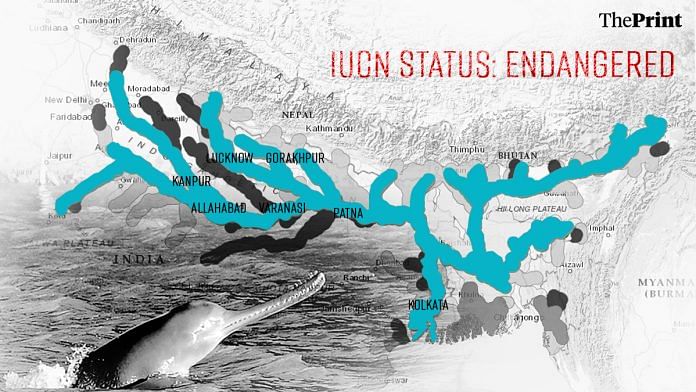
-“Now, Ganga dolphins are seen either at the confluence of the two rivers—Ganga and Gandak—or where a swirl in the waters makes it easy for the dolphins to position their heavy body against the current. The Ganga in Patna, unfortunately, is moving away. So, the dolphins have also moved away to other places,” R.K. Sinha said.
-“The threat faced by Ganga dolphins from fishermen has drastically reduced. But, the threat comes from dams and barrages now. We have seen dolphins killed near barrages. The creation of dams and barrages isolates the dolphins to a certain stretch and hits their breeding hard. It can have a catastrophic effect on them,” Sinha said. https://theprint.in/environment/ganga-dolphin-sightings-up-in-bihar-poaching-down-dams-barrages-pose-a-challenge/2380638/ (02 Dec. 2024)
Study Ecologists studied the amphibians living on rock outcrops in the northern Western Ghats to determine how they respond to different agricultural practices. https://www.thehindu.com/sci-tech/energy-and-environment/study-flags-threat-to-frogs-from-agroforestry/article68945229.ece (04 Dec. 2024)
FISH, FISHERIES, FISHERFOLKS
Yamuna Manthan Native river fish species facing extinction A recent CIFRI report submitted to NGT is an eye-opening official document about the fish diversity in Yamuna. The report says that overall native fish species have declined sharply in the river not only in number but in size also due to habitat degradation, pollution and increasing presence of invasive fish species. The report admits that construction of Farakka barrage has led to complete elimination of Hilsa fish in lower segment of river since 2010. Despite this shocking state of affairs, the state govts & particularly the central govt continues to purpose and build more dams and river-interlinking projects in Yamuna basin which are bound to destroy river’s aquatic diversity further. https://sandrp.in/2024/12/05/yamuna-manthan-051224-native-river-fish-species-facing-extinction/ (05 Dec. 2024)
Maharashtra Floating solar plans face opposition from fishers A community worries its way of life is at risk if government plans to install solar panels atop the Nathsagar reservoir go ahead.
– The government is considering a project to blanket about 7,500 hectares of the 350-sq km reservoir near the town of Paithan in Maharashtra state with floating photovoltaics. Details on the Jayakwadi project, which is in the early stages of planning, are not publicly available, and THDC India Limited, the state power company behind it, did not respond to requests for information about the floating solar farm’s capacity, cost or when construction might begin.
– But their impact on nature is a topic of debate, and environmentalists have warned that they may adversely affect people who depend on fishing and agriculture. “We depend on this water for our food and our livelihood,” said Birute, who belongs to the local Kahar community. “If they cover the water with solar panels, what will happen to the fish? … If there are no fish, we will have nothing left.” About 25,000 families earn their living from the reservoir. Earlier this year, hundreds of fishers and their families protested against the planned solar farm, and one group is pursuing a legal challenge to stop construction.
A hydroelectric plant on the banks of the river has been idle since December as it awaits maintenance, an engineer at the facility said on condition of anonymity. “Why don’t they fix what’s already built before starting another project?” said the activist Limbore. (Reuters) https://www.eco-business.com/news/indias-floating-solar-plans-run-into-opposition-from-fishers/ 27 Nov. 2024
SAND MINING
Supreme Court SC asks 5 States to provide facts & figures on illegal sand-mining The SC Bench on Dec. 04 was hearing a 2018 petition filed by M. Alagarsamy, represented by advocate Prashant Bhushan, who has sought a CBI probe into rampant illegal beach and river sand mining causing severe ecological imbalance, disturbance in water tables and degradation of land across the five States of Tamil Nadu, Maharashtra, Andhra Pradesh, Punjab & Madhya Pradesh.
The plea said illegal sand mining activities in these States had reached alarming proportions. There was scant respect paid to the Sustainable Sand Mining Management Guidelines of 2016. The apex court directed the five States to come prepared for the next hearing with the facts and figures on sand mining activities. Next hearing in the week commencing Jan 27, 2025.
The plea said armed miners “run the racket” and cause a loss of thousands of crores to the public exchequer. The 2010 Guidelines had not been implemented in consultation with the States to maintain sustainable mining practices and to check illegal activities which harm the ecology, the petition said. https://www.thehindu.com/news/national/authorities-have-to-check-sand-mining-sc/article68947002.ece (05 Dec. 2024)
Illegal sand mining needs to be curbed: SC A bench comprising Chief Justice Sanjiv Khanna and Justice Sanjay Kumar said it needed to check whether a similar petition against the NGT order on illegal sand mining was pending in the top court. “Illegal sand mining is a serious issue and needs to be dealt with effectively,” the CJI said, when advocate Prashant Bhushan, appearing for PIL petitioner Alagarsamy alleged that the states, instead of taking actions, indulged in a coverup.
On July 16, 2024 the bench asked Tamil Nadu, Madhya Pradesh, Maharashtra and Andhra Pradesh to file their replies to the PIL within six weeks or a fine of Rs 20,000 would be imposed on them. Though Rs 20,000 fine is not commensurate with the value of illegal sand mining alleged, it will force the states to file the affidavits, Justice Khanna had said.
On January 24, 2019, the top court issued notices and directed the Centre, CBI and five states to respond to the plea. “Due to the lack of implementation of guidelines by the states, various sand mining scams have taken place across different parts of the country,” the plea alleged. The plea referred to a top court verdict, which held that leases of minor minerals for an area less than five hectare as well as their renewal, was to be granted only after getting the environmental clearance. https://realty.economictimes.indiatimes.com/news/allied-industries/illegal-sand-mining-serious-needs-to-be-curbed-supreme-court/115974061 (04 Dec. 2024) The petitioner demanded a direction for mandatory EIA, environmental management plan (EMP) and public consultation before grant of environmental clearance (EC) for sand mining projects across India. https://www.tribuneindia.com/news/punjab/illegal-sand-mining-supreme-court-asks-punjab-four-other-states-to-furnish-details/ (04 Dec. 2024)
NGT Illegal sand mining: NGT asks CPCB to prepare pan India guidelines The NGT on Friday (Nov 29) directed the CPCB to prepare a detailed pan India guidelines within three months for silica sand mining and silica washing plants. The green court gave the direction in a judgment on illegal sand mining and also endangering people’s health to various diseases like Silicosis etc. in Uttar Pradesh. The court said that extraction of silica sand from silica sand mines may cause health hazards to the workers since they may suffer lungs related diseases and silicosis which are very serious in nature and, therefore, deserve immediate socio-medical welfare activities in the area concerned.
The green court also imposed penalties on various private companies engaged in mining related activities. “Such illegal sand mining take place across the country and put the health of workers also in danger. The court has now directed the CPCB to come up with nationwide guidelines to solve this problem and we hope that it will make a difference,” said advocate Rohit Kumar Tuteja, who was the advocate for the petitioner in the case. https://www.thehindu.com/news/national/illegal-sand-mining-ngt-asks-cpcb-to-prepare-pan-india-guidelines/article68928787.ece (30 Nov. 2024)
Tamil Nadu Madras HC closes case against 5 collectors The Madras High Court has closed the petitions filed by the TN Public Secretary and five district collectors challenging the summons issued to them by the Enforcement Directorate (ED) in connection with the probe into the proceeds of crime generated through illegal sand mining in the state. Justices SM Subramaniam and M Jothiraman passed the order following the submission made by Advocate General PS Raman who said that the petitions have become infructuous after the collectors appeared before the central agency.
The top court had ordered the collectors to appear before the ED while allowing the special leave petition filed by the agency against a Madras HC order staying the summons. The petitions were filed in 2023 after five collectors were summoned. The court also dismissed as withdrawn another batch of petitions seeking the court to restrain the ED from proceeding in matters concerning the state without obtaining prior consent. https://www.newindianexpress.com/states/tamil-nadu/2024/Dec/07/illegal-sand-mining-madras-high-court-closes-case-against-5-collectors ; https://www.livelaw.in/high-court/madras-high-court/madras-high-court-sand-mining-money-laundring-case-district-collectors-closed-277617 (07 Dec. 2024)
Uttarakhand Matri Sadan seer starts indefinite fast to save Ganga Swami Dayanand of Matri Sadan Ashram in Haridwar began an indefinite fast on Saturday (Dec. 07) to protest against mining activities which the ashram says are being carried out under the guise of river dredging in the Kumbh area. The seer accused district officials of being “puppets of the mining mafia” and demanded an immediate halt to the activity and action against those responsible. A meeting between Matri Sadan seers and district officials on Friday (Dec. 06) ended inconclusively. Officials said that “dredging was essential to maintaining the Ganga’s flow and preventing flooding, adding that the extracted materials would be used for NHAI projects”. https://timesofindia.indiatimes.com/city/dehradun/matri-sadan-seer-swami-dayanand-begins-indefinite-fast-to-save-ganga-from-mining/articleshow/116084846.cms (07 Dec. 2024)
Jammu & Kashmir Dy CM seeks report on illegal riverbed mining in Pulwama Deputy CM Surinder Choudhary who is also the Minister for Mining Department on Sunday (Dec. 01) directed the District Mineral Officer-DMO Pulwama to file a detailed report on illegal riverbed mining -RBM in taking place in Romshi nallah in Cheva Kalan, Ch Kalanrd and its adjoining villages. The Dy CM responded to noted social activist Dr Raja Muzaffar Bhat on X as he had highlighted the illegal mining work being carried out in Romshi nallah inspite of NGTs direction to stop it.
Dr Raja Muzaffar who has filed over more than half dozen petitions in NGT on illegal riverbed mining had posted GPS pics on x and tagged Dy CM, DC Pulwama and many other officers. Pertinently Raja Muzaffar Bhat has already filed a petition in this case in NGT last year in November and a notice had already been issued to DC Pulwama and SEIAA by NGT. https://kashmirobserver.net/2024/12/01/dy-cm-seeks-report-on-illegal-riverbed-mining-in-pulwama/ (01 Dec. 2024)
Himachal Pradesh Illegal stone crusher sealed after prolonged protest An illegal stone crusher operating without proper documentation on the Gramphu-Kaza-Sumdo highway at Chhatdu was sealed by officials of the Lahaul and Spiti district administration, pollution control board and the police yesterday (Dec. 05). This action follows prolonged protests on social media and a formal complaint lodged with the SPCB, Shimla. The crusher had been operating illegally for an extended period in Lahaul and Spiti district, lacking the necessary permits, including the original Forest Conservation Act (FCA) clearance. https://www.tribuneindia.com/news/himachal/illegal-stone-crusher-on-highway-sealed-after-prolonged-protest/ (06 Dec. 2024)
Haryana SC sets aside NGT order imposing ₹3 cr fine on mining firm The Supreme Court on Thursday (December 5, 2024) set aside an NGT order imposing around ₹3 crore fine on M/s Govardhan Mines and Minerals as compensation for damages to the environment on account of illegal stone mining activities in the Dadam Hills of Tosham at Bhiwani, Haryana. Asking the NGT to deal with the case afresh, a bench comprising Chief Justice Sanjiv Khanna and justices Sanjay Kumar and Manmohan took strong note of the green panel’s order and said it did not deal with the contentions of the firm and adopted the report of a committee set up to ascertain illegal mining. https://www.thehindu.com/news/national/supreme-court-sets-aside-ngt-order-imposing-3-crore-fine-on-mining-firm/article68951254.ece (05 Dec. 2024)
Living under a dust blanket in Mahendragarh In Haryana’s Mahendragarh, stone cutting and crushing in the Aravali mountain range impacts health and agricultural output. Ashok Kumar reports on the sufferings of the people who live in close proximity to the crushing machines. Their homes and crops are covered in dust so thick it looks like snow. https://www.thehindu.com/news/national/haryana/living-under-a-dust-blanket/article68948157.ece (06 Dec. 2024)
WETLANDS, LAKES, WATER BODIES
Odisha Environmentalists oppose proposed NH over Chilika Environmentalists across Odisha have expressed serious concerns over the plans to construct a two-lane national highway (NH-516A) over Chilika Lake, as announced by the NHAI recently. They said the project will potentially damage the rich bio-diversity of Asia’s largest brackish water lake and leave a trail of destruction of the region’s fragile ecosystem. Secretary of Orissa Environmental Society, Jaya Krushna Panigrahi said that the construction of the highway would pose imminent threats to the livelihood of fishing communities, and would also endanger existence of migratory birds, who consider Chilika a safe haven during winter.
Echoing similar concerns, NGT lawyer Sankar Prasad Pani said, “Even though the project was dropped off in 2018 following stiff opposition from the locals, it is absurd to conceive the thoughts about the project again. Despite Chilika being the first Ramsar site in India, the large-scale construction and frequent noise, arising from the movement of automobiles, would keep the birds away from the wetland”. Moreover, Pani added that it is futile to connect Satapada and Gopalpur since it does not serve any business interests. https://www.orissapost.com/environmentalists-oppose-proposed-nh-over-chilika/ (08 Dec. 2024)
WATER OPTIONS
Study Algae based solution for wastewater treatment Indian researchers have proposed a theory for a sustainable wastewater treatment method using a microalgae-bacterial consortium to remove toxic ammonium. The method, proposed in a recently published study, leverages algae’s photosynthesis mechanism to produce oxygen, cutting energy costs by up to 90% compared to traditional aeration methods.
According to a 2022 Niti Aayog report, the India generates approximately 39,604 MLD of wastewater in rural regions, while in the urban centres, the wastewater generation has been estimated as 72,368 MLD for the year 2020-21. https://india.mongabay.com/2024/12/researchers-propose-algae-based-solution-for-wastewater-treatment/ (03 Dec. 2024)
Coimbatore Floating vetiver islands in lakes to purify water Always brimming with water, the Ukkadam Big Tank or Periyakulam is the city’s pride. Spread over 120 hectares and one of the foremost tanks of River Noyyal, it offers a pleasant and tranquil view of the cityscape, a quiet retreat from the urban buzz. However, the water is highly polluted with sewage. While a STP is mandatory to check the pollution, a team of researchers led by scientist Kamaludeen Sara Parwin Banu, Professor in Environmental Sciences, from the Tamil Nadu Agricultural University, installed vetiver floats at the lake, a novel experiment aimed at a solution towards clean water bodies.
Called TNAU floating treatment wetlands, this man-made structure with a buoyant hydroponic platform or a float that can hold 84 plants, was used on the lake on a pilot basis. Considered a green and environmental friendly wastewater treatment technology as well as a natural recycling method, vetiver when grown under land and aquatic conditions has an extremely high tolerance level for pollutants, particularly nitrate and phosphate, as well as most heavy metals that most other plants cannot tolerate. https://www.thehindu.com/life-and-style/floating-vetiver-islands-in-coimbatore-lakes-to-purify-water/article68941723.ece (06 Dec. 2024)
GROUNDWATER
Report ABY falters: ₹1,778 cr allocation largely unused According to new data released by the Jal Shakti Ministry, the Atal Bhujal Yojana, a central sector scheme identified water-stressed areas of 8,203 gram panchayats under 229 blocks in 80 districts of seven states, has only used Rs 71.24 crore of Rs 1,778 crore up until November 25 of the current fiscal year. Replying to a question in the Lok Sabha, Minister of State for Jal Shakti, Raj Bhushan Choudhary, indicated that the scheme, under implementation in Gujarat, Haryana, Karnataka, Madhya Pradesh, Maharashtra, Rajasthan, and Uttar Pradesh, has used just over 4 percent of its annual allocation in the first 8 months of the financial year. https://assamtribune.com/national/centres-water-conservation-scheme-falters-rs-1778-cr-allocation-largely-unused-1560224 (06 Dec. 2024)
Haryana 1,920 villages under groundwater project A national initiative to address declining groundwater levels covers 2,000-odd Haryana villages, with Yamunanagar district topping the list at 327 of those affected places. The central Jal Shakti ministry on Tuesday (Dec. 03) told the Rajya Sabha about efforts under the Atal Bhujal Yojana to reverse depletion trends. In response to a query from Haryana MP Kiran Choudhary, minister of state for Jal Shakti Raj Bhushan Choudhary disclosed that the govt had selected 1,920 villages across 14 districts and 1,647 panchayats for intervention, and collaborated with the state and communities to restore water levels. Haryana’s inclusion represents almost two-third of the state’s districts, underscoring the gravity of the crisis. https://timesofindia.indiatimes.com/city/chandigarh/1920-villages-in-haryana-to-benefit-from-groundwater-restoration-initiative/articleshow/115950546.cms (04 Dec. 2024)
EDIT Groundwater Crisis Recent data from the Central Ground Water Board paints a grim picture: Punjab’s Stage of Groundwater Extraction (SoE) stands at a staggering 163.76%, while Haryana follows closely with 135.74%. These figures indicate that groundwater extraction in these states far exceeds natural recharge, pushing aquifers to critical depletion levels. https://www.tribuneindia.com/news/editorials/groundwater-crisis (06 Dec. 2024)
Report Groundwater extraction stage reaches 59.26% The Stage of Groundwater Extraction (SoE) in Haryana has reached 135.74%, indicating that more groundwater is being extracted than what should be sustainably utilised. The situation in Punjab is even more concerning, with an SoE of 163.76%. In Haryana, the annual groundwater recharge is 9.55 billion cubic metres (bcm), while the annual extractable groundwater is 8.69 bcm. However, the total groundwater extraction in 2023 was 11.8 bcm.
According to the Central Ground Water Board (CGWB), Punjab’s annual groundwater recharge stands at 18.84 bcm, with 16.98 bcm being extractable annually. Yet, the total groundwater extraction in 2023 was 27.8 bcm. In Rajasthan, the SoE is 148.77%, as the total groundwater extraction in 2023 was 16.74 bcm, against an annual recharge of 12.45 bcm and an annual extractable groundwater volume of 11.25 bcm. For 2023, the SoE across the country was assessed at 59.26%.
During the post-monsoon period of 2023, data from Haryana revealed that of 985 observation wells, 149 (15.1%) recorded water levels deeper than 40 mbgl, while 253 wells (25.7%) reported water levels in the 20-30 mbgl range. In Punjab, of 283 observation wells, 19 (6.7%) had water levels deeper than 40 mbgl, while 81 (28.6%) had levels in the 20-40 mbgl range. Rajasthan has 1,061 observation wells, of which 240 (22.6%) showed levels deeper than 40 mbgl, and 194 (18.3%) recorded levels in the 20-40 mbgl range. In Chandigarh, of 14 observation wells, one (7.1%) had levels deeper than 40 mbgl, and four (28.6%) reported levels in the 20-40 mbgl range.
These figures were shared in the Rajya Sabha on December 2 in response to a query by Punjab AAP MP Sant Balbir Singh. https://www.tribuneindia.com/news/haryana/groundwater-extraction-stage-reaches-136-in-haryana-164-in-punjab/ (05 Dec. 2024)
Ladakh Heavy Metal Contamination In Leh’s Groundwater A groundbreaking study by the Birbal Sahni Institute of Palaeosciences (BSIP) in Lucknow has revealed alarming levels of heavy metal contamination in the groundwater of Leh district leading to sharp increase in cancer cases in the region over the past decade. The findings, published in Environmental Geochemistry and Health, suggest a strong correlation between contaminated water and increase in cancer cases.
Dr. Arif Ansari, the lead researcher, highlighted that cancer-related deaths in Ladakh have increased by 27% over the last ten years, rising from 135 in 2013 to 171 in 2022. The study attributes this trend to the presence of toxic heavy metals in groundwater, marking the first such comprehensive analysis in the high-altitude region. https://www.freepressjournal.in/india/heavy-metal-contamination-in-lehs-groundwater-linked-to-rising-cancer-cases-reveals-bsip-study (02 Dec. 2024)
URBAN LAKES, WETLANDS
Bengaluru BWSSB cited in ongoing lake water quality inquiry After incriminating Bruhat Bengaluru Mahanagara Palike (BBMP), Karnataka State Pollution Control Board (KSPCB), and Karnataka Wetland Authority, the NGT has now sent notice to the Bangalore Water Supply and Sewerage Board (BWSSB) regarding questionable water quality at 15 Bengaluru’s lakes with STPs. The southern bench of NGT, in an order passed on December 2 sent a notice to the water board after observing that BWSSB is also a necessary party to this proceeding and should be impleaded as an additional respondent. The tribunal passed the order while hearing the suo motu case registered by the principal bench, based on an article published in Bangalore Mirror on September 16. https://bangaloremirror.indiatimes.com/bangalore/civic/bwssb-cited-in-ongoing-lake-water-quality-inquiry/articleshow/116018156.cms (06 Dec. 2024)
Mumbai Coastal road buries mangroves, wetlands: Greens Vast stretches of mangroves and intertidal wetlands are being buried in the construction of coastal road Kharghar-Nerul coastal road in Navi Mumbai by CIDCO, according to various environmental groups working in this satellite township. The construction of Coastal Road at Sector-25, Kharghar by CIDCO, a state government undertaking, is in total violation of the Environmental Clearance (EC) granted by the MOEFCC, NatConnect Foundation and Kharghar Wetlands and Hills Forum said in a statement.
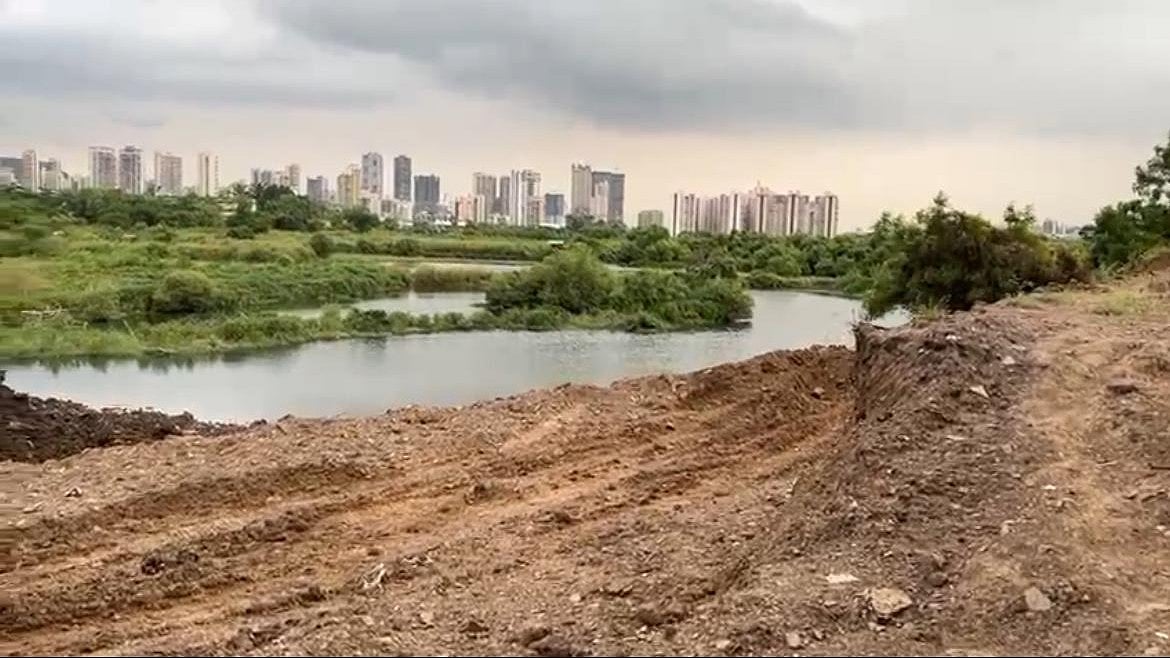
The MOEFCC has given a conditional EC that the road should be built on stilts, avoiding damage to mangroves, NatConnect Director B N Kumar recalled. The ministry had originally kept the EC in abeyance asking CIDCO to submit alternative alignment plans. https://www.deccanherald.com/india/maharashtra/navi-mumbai-coastal-road-buries-mangroves-wetlands-greens-sos-to-centre-3308436 (08 Dec. 2024)
दिल्ली मुंडका में छह तालाबों पर अवैध कब्जा, अदालत ने डीडीए के वीसी को किया तलब एनजीटी ने छह तालाबों के जीर्णोद्धार के लिए कोई कार्रवाई न करने पर डीडीए के उपाध्यक्ष को व्यक्तिगत रूप से अदालत में पेश होने का आदेश दिया है। इस मामले में दो दिसंबर, 2024 को एनजीटी में सुनवाई हुई थी। मामला दिल्ली के मुंडका में छह तालाबों के जीर्णोद्धार से जुड़ा है, जिन पर अवैध रूप से कब्जा कर लिया गया है, या निर्माण के लिए भर दिया गया है।
इस मामले में अदालत ने पश्चिमी दिल्ली के जिला मजिस्ट्रेट डीएसआईआईडीसी के प्रबंध निदेशक को भी अगली सुनवाई पर उपस्थित होने के लिए कहा है। इस मामले में अगली सुनवाई 13 दिसंबर, 2024 को होनी है। इस बीच, अदालत ने कहा है कि संबंधित अधिकारी तालाबों को उनकी मूल स्थिति में बहाल करने के लिए उठाए गए कदमों के बारे में जानकारी दे सकते हैं। 25 अक्टूबर, 2024 के अपने आदेश में ट्रिब्यूनल ने कहा है कि इनमें से पांच तालाब डीडीए के अधीन हैं, जबकि एक डीएसआईआईडीसी के कब्जे में है। https://hindi.downtoearth.org.in/environment/encroachment-of-6-ponds-in-mundka-village-delhi (04 Dec. 2024)
Gurugram Redevelop Silokhra pond according to approved plan: NGT The NGT has directed the Gurugram Metropolitan Development Authority (GMDA) to rework the changes made in the approved plan to redevelop the Silokhra pond adjacent to the Signature Tower crossing within the next 10 days. The tribunal in its order issued on Monday (Dec. 02), pointed out that changes made and suggested by the authority have been rejected earlier and it should not have been done initially. It also asked GMDA to explain why timelines to take specific actions had not been adhered to, officials aware of the matter said. According to the green watchdog, trees have been cut and changes made in the design, which were not approved by the court.
The Silokhra pond and the land adjoining it was identified as ‘gairmumkin nullah’ in revenue records and it was acquired by the Haryana Shahari Vikas Pradhikaran (HSVP). The authority later planned to develop this land and auction the site for construction of a multi-story commercial complex. The decision of the HSVP was however, challenged by local residents, who approached the green tribunal, which upheld their contention and directed the authority to redevelop the land as a pond. https://www.hindustantimes.com/cities/others/ngt-directs-gmda-to-redevelop-silokhra-pond-according-to-approved-plan-101733422647149.html (06 Dec. 2024)
URBAN WATER
EDIT Unsafe drinking water in cities As policymakers prioritise universal access to potable water, the death of three persons last week in Chennai due to suspected consumption of contaminated piped water is a reminder that coverage is not the only problem: even urban centres with a long history of piped supply are still not assured of potable water that is free from dangerous contamination. The incident, which involved drinking water supplied through the State agency in suburban Pallavaram, also sent 34 people to hospital with complaints of diarrhoea.
Irrespective of the cause, it is concerning that severe contamination of water continues to occur with greater periodicity in cities in India. In the past six months, large-scale outbreaks of health episodes due to consumption of water containing E.coli have been reported in cities including Bengaluru, Kochi, Noida and Vizianagaram. This exposes the challenge of catering to the basic needs of people, who are increasingly shifting to cities and living in congested environs, putting the water and drainage infrastructure under strain. https://www.thehindu.com/opinion/editorial/%E2%80%8Bdeath-by-contamination-on-indian-cities-and-unsafe-drinking-water/article68961754.ece (09 Dec. 2024)
Chennai Officials’ silence on Pallavaram water contamination enrages residents In Pallavaram, contaminated water isn’t just making people sick. It is also exposing the lack of transparency from the public health department. Nearly three days after an acute gastroenteritis outbreak that killed two people and hospitalised at least 50 people, the health department is yet to announce what caused the infection.
The water analysis laboratory at the King Institute of Preventive Medicine in Guindy said “a confidential preliminary analysis” report was submitted to the state health department, but senior public health officials refuse to divulge details. While senior officials said they were waiting for a “comprehensive analysis and post-mortem report”, which are expected in two weeks, health minister Ma Subramanian, who initially denied water from public taps as a source of infection, did not respond to calls or messages from TOI.
Civic activists also demand a clear plan for the underground drainage system as a long-term measure to improve sanitation and prevent such outbreaks. “For years, we’ve been told it will be completed soon. Nobody is aware of the status of these projects. They don’t communicate when or how the work will be completed,” said Chitlapakkam resident P Vishwanathan, who is also a member of the environment protection and awareness association. https://timesofindia.indiatimes.com/city/chennai/pallavaram-water-crisis-residents-demand-answers-after-contamination-outbreak/articleshow/116086955.cms (08 Dec. 2024)
At least three people have died, and 20 others fell ill in Pallavaram near Chennai on Thursday (Dec. 05) after allegedly consuming drinking water contaminated with sewage, Tamil Nadu Health Minister M Subramaniyan said on Thursday (Dec. 05). Addressing a press conference, Mr Subramaniyan said that the cause of death can be known only after the completion of the autopsy of three people. https://www.ndtv.com/video/3-die-20-ill-in-chennai-after-consuming-contaminated-drinking-water-870030 (05 Dec. 2024)
Gurugram ₹100-cr ‘quick fix’ fails to give city clean look While the Municipal Corporation of Gurugram spent over Rs 100 crore to ‘quick fix’ city’s sanitation crises it has failed to do much. The much pompous promise of getting rid of Bandhwari landfill mountain by December 2024 has fallen flat as this deadline has now been shifted to June 2025. Meanwhile, the Haryana Human Rights Commission (HHRC) has taken a stern stance on MCG’s constant failure to get rid of Bandhwari landfill and directed it to submit a status report explaining the reason for delay in disposal of legacy waste.
The commission visited the landfill site in 2023 after a complaint about the dumping ground polluting the groundwater in nearby villages. The commission directed the MCG to construct drainage to stop the seepage of leachate into groundwater and nearby water bodies and directed that garbage mounds be cleared from the site. MCG had assured the panel that the site will be cleared by Nov 30, 2024. A hearing in this matter was held on Monday (Dec. 09). The HHRC observed that there was no significant change at Bandhwari till now. https://www.tribuneindia.com/news/haryana/100-cr-quick-fix-fails-to-give-gurugram-clean-look/ (04 Dec. 2024)
WATER
FSSAI Packaged drinking water in a ‘High-Risk Food Category’ The Food Safety and Standards Authority of India (FSSAI) has decided to classify packaged drinking and mineral water as a ‘High-Risk Food Category.’ So these products will now be subject to mandatory inspections and third-party audits. The change follows the government’s October decision to remove the requirement for certification from the Bureau of Indian Standards (BIS) for these products.
Under the new rule, all packaged drinking and mineral water manufacturers will now face annual, risk-based inspections. These inspections will take place before they are granted a licence or registration. This move ensures stricter safety measures for products that fall under the high-risk category. Previously, the packaged drinking water industry had called for simplified regulations, requesting the removal of dual certification requirements from both BIS and FSSAI. https://www.indiatoday.in/information/story/fssai-classifies-packaged-drinking-water-as-high-risk-food-category-2643579-2024-12-02 (02 Dec. 2024)
Tamil Nadu Govt to move resolution to cancel tungsten mining licence The CM M K Stalin will move a resolution in the state Assembly on December 9 urging the union government to cancel the licence awarded to Hindustan Zinc Limited for tungsten mining in Madurai district and not to conduct an auction for issuing mining licences without the consent of the state government. https://www.newindianexpress.com/states/tamil-nadu/2024/Dec/03/tamil-nadu-to-move-resolution-in-assembly-to-cancel-tungsten-mining-licence (03 Dec. 2024)
WINTER 2024
Shimla In a first in many decades, Shimla and its nearby tourist resorts on Sunday (Dec. 08) evening experienced the season’s first snowfall in early December, with the hospitality industry eyeing a surge of tourists. “Shimla and its nearby areas have experienced light snowfall and this was the season’s first snowfall in Shimla town,” an official of the Meteorological Department here told IANS. “It’s for the first time that we witnessed the snowfall in early December. As far as my memory goes, this is the season’s first snowfall in over two decades,” said Ganesh Sud, a local resident who has been settled in Shimla since the early 1990s. https://www.ndtv.com/india-news/in-decades-shimla-sees-seasons-first-snowfall-in-early-december-7203000 (8 Dec 2024)
MONSOON 2024
Maharashtra Unpredictable rainfall makes farming in Marathwada even harder The changes in rainfall distribution in Jalna reveal a pressing need for new agricultural water management strategies. Prevailing water management practices in Marathwada are based on storing excess water in farm ponds. These ponds do provide some relief, but they don’t prevent waterlogging or retain water beyond a single season. This limits their usefulness. For conventional methods to manage watersheds, experts use historical rainfall data to determine storage capacity. But with the monsoons becoming less predictable, Jalna and other similar areas need watershed structures that can withstand high runoff volumes from extreme rain events. One sustainable approach would be to focus on enhancing the region’s drainage networks and improving surface water storage.
-Transitioning from farm ponds that depend on groundwater to surface runoff capture systems could also reduce the pressure on aquifers and prevent groundwater depletion. Additionally, shifting to more water-tolerant varieties of crops can allow the water to percolate through the soil more and help sustain the landscape even when it is inundated. This combination of improved drainage infrastructure, surface water storage facilities, and resilient land use can foster a balanced water management system capable of withstanding the disruptive weather changes in Marathwada. (Lakshmikantha NR ,Ishita Jalan) https://www.thehindu.com/data/unpredictable-rainfall-makes-farming-in-marathwada-even-harder/article68946766.ece (05 Dec. 2024)
FLOOD 2024
Tamil Nadu Dam Flood Villagers left in chaos after sudden release The sudden release of water to the tune 1.8 lakh cusecs from Sathanur dam in Tiruvannamalai district on Sunday (Dec. 01) night may have triggered the flooding in many areas along the Thenpennai river in Tiruvannamalai, Villupuram, and Cuddalore districts, but lack of specific details about the level of flooding or pointed instruction to move to designated relief shelters, during the initial hours of the calamity, seem to have put the residents to avoidable trouble. While the Tamil Nadu government had said that it did everything as per the standard operating procedure and alerted the people along the banks of the river, a visit by TNIE to many of these villages showed that a majority of the residents either did not receive proper alerts or the communication was insufficient.
A visit to Puthur Chekkadi, Rayandapuram, Thiruvathanur, and Kolamajanur villages, all of which were included in the fifth and final flood warning sent by the Assistant Executive Engineer of Sathanur Dam Sub-Division of Water Resources Department in the early hours of Monday (Dec. 02) to the Tahsildars of Thandarampet, Chengam, Tiruvannamalai and Tirukoilur taluks showed that all these villages were affected in the floods. Most of villagers said that this was the worst flooding they have seen in their living memory, while some of the elderly people recalled a similar flooding in the early 1970s. https://www.newindianexpress.com/states/tamil-nadu/2024/Dec/05/sathanur-dam-flood-alert-failure-tiruvannamalai-villagers-left-in-chaos-after-sudden-release (6 Dec 2024)
Puducherry Rural areas affected by the release of water from Sathanur, Veedur Dams The opening of Sathanur dam in the Tiruvannamalai district of Tamil Nadu on Monday (Dec. 02) led to a flood-like situation in the rural villages of Bahour, Arachikuppam, Sooriankuppam, Manamedu and Irulansanthai. “Water started entering these villages after the dam shutters were opened. We are trying to evacuate people from these villages but residents hesitate to move out of their homes. Still, we have shifted about 300 people from Arachikuppam. We have requested one more unit of the Army. They are expected to arrive by Monday night,” the official said.
Opening the shutters of Sathanur Dam has caused the water level in Thenpennaiyar to rise to an alarming level. The water level in Sankaraparani River has also increased due to the release of water from Veedur Dam in Villupuram district. The opening of both the dams in Tamil Nadu has its impact in the rural areas of Puducherry, the official added. https://www.thehindu.com/news/cities/puducherry/rural-areas-affected-by-the-release-of-water-from-sathanur-veedur-dams-in-tn/article68938584.ece (02 Dec. 2024)
Political row erupts over floodwater release from Sathanur dam In a statement on Tuesday (Dec. 03), the AIADMK general secretary Edappadi K. Palaniswami blamed the DMK regime for releasing flood flows from the dam to the extent of 1.68 lakh cubic feet per second (cusecs) “without any alert.” This had caused floods in villages of Kallakurichi, Villupuram and Cuddalore districts. “It is because of the flood water of South Pennai river that both Cuddalore and Villupuram towns have been flooded,” Mr Palaniswami asserted.
-After the flow into the dam touched the figure of 1.06 lakh cusecs at 1 am on December 2, yet another alert was given at 2-45 am. As the inflow went up further to 1.68 lakh cusecs 15 minutes later, the discharge of the identical quantum was made for another five hours – up to 8 am. This was done, “considering the dam safety,” Mr Duraimurugan observed.
-Officials in the department say that in 1972, the dam discharged the highest quantum of 2.54 lakh cusecs, though it had the maximum discharge level of 1.9 lakh cusecs. Between 1998 and 2000, an additional spillway was formed to let 75,000 cusecs. https://www.thehindu.com/news/national/tamil-nadu/political-row-erupts-over-floodwater-release-from-sathanur-dam/article68943801.ece (04 Dec. 2024)
WRD minister denies charge over release of dam water Denying the charges that the state released a huge volume of water from Sathanur dam without issuing any warnings, Water Resources Minister Duraimurugan on Dec 3 said, “Had 1.8 lakh cusecs of water not been released, it would have caused huge danger to the dam and its entire capacity of 7 TMC water would have flown out,” the minister said in a six-page statement. He pointed out that five flood warnings were issued from time to time about the release of water from Sathanur and at midnight, the inflow became unpredictable.
AIADMK general secretary Edappadi K Palaniswami had earlier alleged that the government should have issued flood warnings when the inflow to the dam increased. “At 2.30 am on Dec 2, as much as 1.68 lakh cusecs of water was released from the dam without any announcement. Many villages in Kallakurichi, Villupuram and Cuddalore were marooned and people lost their livelihood resources,” he said. Talking to reporters at Manjakuppam, BJP state president K Annamalai said that the five flood warnings were shared among the government departments and not to the people. “So, the water resources minister’s statement cannot be accepted and it is contrary to the ground reality. Can we expect people to watch TV at 3 am?” he asked. https://www.newindianexpress.com/states/tamil-nadu/2024/Dec/04/minister-duraimurugan-denies-charge-over-release-of-dam-water-says-govt-action-saved-lives (4 Dec 2024)
Houses, farms under water as record rain hits north, west The record rainfall, unseen in the past two decades, which pounded Puducherry, Villupuram and Cuddalore districts in north Tamil Nadu and Krishnagiri and Dharmapuri districts in the west over the last two days blocked access to several villages and residential colonies, inundated thousands of acres of crops and stranded hundreds of passengers as rail and road traffic was hit. In 24 hours ending at 8.30 am Monday (Dec. 02), Uthangarai in Krishnagiri district received 50cm rainfall, Kedar in Villupuram clocked 42cm, and Harur in Dharmapuri recorded 33cm. Cuddalore and Tiruvannamalai had recorded 16cm each. https://www.newindianexpress.com/states/tamil-nadu/2024/Dec/03/houses-farms-under-water-as-record-rain-hits-north-west-tamil-nadu (03 Dec. 2024)
The Tamil Nadu government has issued a flood warning in Cuddalore, following the release of excess water from Veeranam Lake. This reservoir, situated 235 km from Chennai and a key water source for the city, is now overflowing. Puducherry has been devastated by the cyclone’s torrential downpours. The Indian Army was deployed to rescue stranded residents. Officials reported that 200 people, including those in the Krishna Nagar neighbourhood, were safely evacuated. Residents stated that the natural disaster is the worst witnessed in the UT in over 30 years. https://www.business-standard.com/india-news/cyclone-fengal-aftermath-flood-warning-heavy-rain-in-puducherry-and-tn-124120200271_1.html (02 Dec. 2024)
Amaravathy water level reaches the brim Amaravathy dam in Udumalpet taluk of Tiruppur district has reached the brim, despite releasing the surplus water of 4.5 tmc. The Amaravathy dam was constructed with a height of 90 ft Full Reservoir Level and with a water holding capacity of 4 tmc to irrigate 55,000 acres in Tiruppur and Karur districts. Chinnaru and Thenaru rivers from the Western Ghats and Silandhi river and Pambaru from Kerala serve as a water resource for the Amaravathy dam.
Farmers in both the districts have been cultivating sugarcane, plantains, maize, millets and vegetables. Until two years, the dam used to go dry affecting irrigation and resulting in water scarcity for more than 50 comprehensive drinking water supply schemes. But, for the last two years the dam’s water level has always remained to the brim. https://www.thehindu.com/news/cities/Coimbatore/amaravathy-water-level-reaches-the-brim-despite-releasing-45-tmc-of-surplus-water/article68941654.ece (03 Dec. 2024)
Bihar Exhibition on flood resilience of the residents The exhibition, titled Portraits of Persistence, and Enduring Communities of North Bihar is part of the Visual Kathã series by Eklavya Prasad from Megh Pyne Abhiyan (MPA). The MPA is a grassroots initiative focused on drinking water and sanitation through participatory groundwater management in flood-prone areas of north Bihar, and later in Jharkhand. The photographs by Prasad, who has led MPA since 2005, document the immediate impacts on daily life, as homes, farmlands, and infrastructure yield to the force of water.
The collection also reflects the long-lasting impacts of these floods, seen in the transformations of rural society, the reimagining of livelihoods, and the generational imprints on people’s lives. However, as Prasad notes, the people of the region adapt to survive remarkably in the face of this annual cyclical devastation through adaptive coping mechanisms and community innovations developed to meet critical needs. https://www.downtoearth.org.in/rivers/an-ode-to-the-spirit-of-a-people-whose-land-is-blighted-annually-by-floods (07 Dec. 2024)
HFL BREACH
Puducherry River Varahanadhi at Kumarapalayam site has breached old HFL 15.255 meter dated 19.11.2021 and set 15.545 meter as new HFL at 10:00 hour on 02.12.2024 which is 0.29 meter higher than the old HFL. The river stayed in extreme flood for about 07 hours. Present flood level is 12.605 meter at 09:00 hour on 03.12.2024.

Tamil Nadu -River Ponnaiyar at Vazhavachanur site in Tiruvannamalai district has crossed old HFL 139.4 meter dated 19.11.2021 and set 142.72 meter as new HFL at 05:00 hour on 02.12.2024 which is 3.32 meter higher than the old HFL. Present flood level is 139.4 meter at 19:00 hour on 02.12.2024 with falling trend.

ENERGY OPTIONS
Lucknow Rooftop solar panels must for 1,000 sqft plots: LDA In a move to promote renewable energy, the Lucknow Development Authority (LDA) revised its solar panel installation guidelines. During its 183rd board meeting held on Wednesday, the LDA made it mandatory for all residential properties with a plot size of 1,000 square feet or more to install rooftop solar panels under the PM Surya Ghar scheme. Previously, this requirement applied only to plots measuring 2,000 square feet or more. LDA vice-chairman Prathmesh Kumar stated that the new mandate aims to encourage the wider adoption of solar energy and contribute to a sustainable urban environment. Homeowners planning new constructions on qualifying plot sizes must now include rooftop solar systems in their building plans. https://timesofindia.indiatimes.com/city/lucknow/lucknow-mandates-rooftop-solar-panels-for-residential-plots-over-1000-sqft/articleshow/115983865.cms (05 Dec. 2024)
ENVIRONMENT GOVERNANCE
MoEF Expedite processing of forest clearances immediately The Union environment ministry has asked the governments of states and Union territories (UTs) to immediately expedite the time taken to process forest clearances for various infrastructure and other projects that involve diversion of forest land. It has also sought regular review by the Principal Secretary (Forests) or the Principal Chief Conservator of Forests, to assess the time being taken by various authorities in processing the proposals and directed those strict warnings be issued to officers not adhering to the timelines prescribed under the Van (Sanrakshan Evam Samvardhan) Rules, 2023.
Experts said that the communication highlighted two complex realities related to regulating forests. “Firstly, forest lands are a subject of federal distribution of powers and timeline for decision making needs to recognise these negotiations. Secondly, forest land diversions are difficult to rush because the regulatory process needs to navigate rights of communities and multiple government agencies. It may be useful to gather all the challenges on why there are delays in the procedure and design a process that is cognizant of ground realities and committed to conserving forests,” said Kanchi Kohli. https://www.hindustantimes.com/india-news/expedite-processing-of-forest-clearances-immediately-centre-101733424564806.html (6 Dec. 2024)
Gujarat Forest officials in Dang use violence and barbed wire to turn tribal farmland into government plantations under the Green Credit scheme. https://frontline.thehindu.com/environment/india-green-credit-programme-afforestation-adivasis-dang-gujarat-environmental-policy-firewood-grazing-ntfp/article68950778.ece (06 Dec. 2024)
Chhattisgarh 94,460 trees felled in Hasdeo 2,73,757 more to go In a recent response to an unstarred question in the Rajya Sabha, MoEF minister Bhupender Yadav revealed on Thursday (December 5) that “As per the information received during the month of July, 2024 from the state govt, 94,460 trees have been felled in Parsa East Kete Basen (PEKB) Mine and 53,40,586 trees have been planted as compensatory afforestation, mine reclamation and translocation. Further, the state has informed that 2,73,757 number of trees are to be cut in this forest for mining activities in the coming years,” Yadav informed the parliament.
Notably, the govt’s approach to forest management and land acquisition for development projects have raised concerns among environmentalists and indigenous groups. Critics argue that the government’s push for afforestation and reforestation projects favours commercial plantations over the restoration of natural forests. https://thewire.in/environment/94460-trees-felled-in-chhattisgarhs-hasdeo-forest-273757-more-to-go-government-tells-parliament (05 Dec. 2024)
The Chhattisgarh State Scheduled Tribes Commission (CGSTC) says clearances for mining in Parsa block were given based on forged documents. The mining of Parsa block in the Hasdeo Arand forest has been contentious, and residents have long said they never provided consent for mining. https://india.mongabay.com/2024/11/chhattisgarh-tribal-body-says-consent-for-mining-in-hasdeo-arand-was-forged/ (28 Nov. 2024)
Odisha Protest over 25-year contract of iron ore mine to Adani The protest over the 25-year contract between Steel Authority of India Limited (SAIL) and Adani Group for an iron mine in Taldih locality under Koida block in Sundargarh district entered ninth day today (Dec. 08), bringing transportation of minerals to a grinding halt. While thousands of men and women from three affected panchayats have been staging a mass protest in front of the mine gate of the mines for the last nine days over fulfillment of their 15-point charter of demands, it has yielded no results yet.
According to sources, the demonstrators are opposing a 25-year agreement with the Adani Group and allege that promises made during public hearings for the welfare of the affected locals were not met. Their demands include providing employment to 1,133 people affected by the mining activities and ensuring healthcare, education and transportation facilities for the three affected panchayats—Tensa, Chordhara, and Sasyakala. https://odishatv.in/news/odisha/protest-over-25-year-contract-of-mine-to-adani-group-in-sundargarh-250584 (07 Dec. 2024)
Report A doom with a view Overtourism is killing local cultures, ecosystems and scenic beauty. India is facing a travel catastrophe of unmanageable proportions. https://www.newindianexpress.com/magazine/2024/Nov/30/a-doom-with-a-view (30 Nov. 2024)
CLIMATE CHANGE
Ladakh Artificial glaciers melting due to climate change Chewang Norphel, known as the “Ice Man of India”, built around 15 artificial glaciers in Ladakh by 2012. These glaciers are known to help the region during water scarcity. But now, climate change is affecting the backbone itself. Artificial Glaciers are melting. NDTV’s Pallava Bagla speaks with meteorologist Sonam Lotus on the disappearing glaciers. https://www.ndtv.com/videos/artificial-glaciers-in-ladakh-blessing-during-water-scarcity-is-now-melting-due-to-climate-change-867872 (02 Dec. 2024)
SOUTH ASIA
Pakistan NJ power project far from success despite cost overrun The Neelum-Jhelum Hydropower Project (NJHPP) has proved another classic example in the list of failed projects in Pakistan. The project witnessed cost and time overrun as its cost has gone up from initial estimates of Rs40-45 billion to over Rs540 billion, but now serious flaws have surfaced and come into the ‘knowledge’ of the planning ministry.
– The meeting on Dec 2 2024 chaired by Federal Minister for Planning Ahsan Iqbal concluded with directives to expedite the investigation process and improve the terms of reference (ToRs). The minister also suggested involving international experts as part of the investigative team, led by Shahid Khan, to ensure transparency and accountability. He recommended that the consultant and contractor be given an opportunity to respond to the findings, ensuring that no party could claim they were not given opportunity to clarify their position. “The public has the right to know who is responsible for the delays and financial losses of such a significant project,” the minister added. https://www.thenews.com.pk/print/1257626-nj-power-project-far-from-success-despite-cost-overrun (03 Dec. 2024)
Govt to sue consultants over NJHP tunnel fault Pakistan is considering suing consultants of the Rs 500 B Neelum-Jhelum Hydropower Project (NJHP) for repeated faults. Prime Minister Shehbaz Sharif would take a final decision to this effect. Neelum-Jhelum Consultants is a joint venture comprising MWH USA (lead firm), NORPLAN (Norway) and NESPAK, ACE & NDC of Pakistan, according to the Ministry of Water Resources, while its contractor is a consortium of two Chinese firms — CGGC and CMEC. https://www.dawn.com/news/1876339/govt-to-sue-consultants-over-njhp-tunnel-fault (03 Dec. 2024)
Nepal Women organise to negotiate for land compensation for HEP’s impacts Indigenous women in Tanahun have formed an advocacy group—Masto Lafa Bheja (literally, ‘women’s friends group’ in Magar language)—on behalf of their community, which will likely be forced to relocate due to the Tanahu Hydropower Project’s plan to build a 140-metre tall dam that will submerge their land. Community leaders say that they were given no advanced notice of the project. Therefore, in February of 2020, the community filed a complaint through the Asian Development Bank’s Accountability Mechanism and the European Investment Bank’s Complaints Mechanism. The Asian Development Bank and the European Investment Bank are providing $150 million and $80 million, respectively, for the project.
– Compensation negotiations with the people who live in Damauli and whose land will be submerged after the dam’s construction have stalled the project. The Nepal Electricity Authority’s 2018 Resettlement and Indigenous Peoples Plan identified 547 affected households—a total of 3,919 people—that they expected to lose land, structures, or trees, as a result of the project, making these households eligible for compensation. https://kathmandupost.com/national/2024/12/08/women-organise-to-negotiate-for-land-compensation-for-hydel-plant-s-impacts (08 Dec. 2024)
Cost of electricity exports Nepal’s relentless focus on exporting electricity achieved a major milestone this year. For the first time, Nepal became a net exporter of electricity in the last fiscal year (2023-24), earning Rs137 million more from exports than imports. Over 2023-24, the NEA imported 1,845 million units (GWh) and exported 1,946 GWh, earning Rs17.1 billion from exports while paying Rs16.9 billion for imports, its annual report for 2023-24 states.
– But the outsized national emphasis on electricity exports perpetuates Nepal’s energy poverty, distracts from a balanced approach to development and will ultimately not benefit the people of Nepal. Nepal exports electricity without adequately fulfilling the needs of its own people. Large segments of Nepalis, particularly the poor who would benefit the most, remain significantly underserved.
– The NEA’s own data reveals that Nepal’s average monthly household electricity consumption was approximately 69 units (or kWh) in 2022-23. Consumption is highly uneven among households: Approximately 2.1 million (or 45 percent) of the 4.7 million households that have a metered grid connection consume approximately 7 kWh monthly on average per household. The remaining 2.6 million households consume approximately 119 kWh on average per household every month. These levels are absurdly low. Nepal’s electricity export strategy fails to provide Nepalis with the electricity they need and then charges them more per unit than for export. How can such a strategy ever benefit the people of Nepal? https://kathmandupost.com/opinion/2024/12/05/cost-of-electricity-exports (05 Dec. 2024)
India-Bhutan Tata Power and Druk Green Power Corporation are building a 600 MW hydropower project in Bhutan. The project will cost Rs 6,900 crore. It will be operational by September 2029. Another 1,125 MW project is also planned. This partnership aims to develop 5,000 MW of clean energy capacity in Bhutan. Work on the second project will begin in January 2025. https://economictimes.indiatimes.com/industry/renewables/khorlochhu-hydropower-project-in-bhutan-to-commission-in-2029-tata-power-ceo/printarticle/116097614.cms (08 Dec. 2024)
ASIA
MEKONG Thailand Deeper Dive: What’s behind flooding? In the second half of 2024, 42 out of the 77 Thai provinces faced flooding. At least 50 people were killed, and billions of baht were lost in damages to property and farmland. So what caused it all? The release of water from hydropower dams upstream, particularly in China and Laos, causes acute flooding and erodes the riverbanks.
https://www.bangkokpost.com/thailand/general/2911021/deeper-dive-whats-behind-thailands-flooding- (29 Nov. 2024)
THE REST OF THE WORLD
California Tulare Lake resurfaces after 130 years Once the largest body of freshwater west of the Mississippi River, the Tulare Lake, often referred to as a “ghost lake,” began to dry up in the 1850s. The draining process was not a natural phenomenon but rather the result of deliberate human actions. Settlers built hundreds of irrigation canals and basins to redirect water, turning the land into arable farmland. This process, known as “reclamation,” not only destroyed the lake but also displaced the indigenous Tachi Yokut tribe, for whom the lake—dubbed “Pa’ashi”—was central to their way of life.
However, nature asserted itself in the spring of 2023. A series of massive winter storms in California, combined with significant snowmelt from the Sierra Nevada, overwhelmed man-made drainage systems and filled the lakebed once again. Despite its rejuvenation, the future of Tulare Lake remains uncertain. This is not the first time it has resurfaced since its disappearance in the 19th century. According to The Week, experts note that its return may be cyclical, and the lake could vanish again, depending on future climatic and human interventions. https://timesofindia.indiatimes.com/world/us/ghost-lake-returns-tulare-lake-resurfaces-after-130-years-submerging-94000-acres-of-farmland/articleshow/115905150.cms (02 Dec. 2024)
SANDRP
Also see: DRP 02 Dec. 2024 & DRP 25 Nov. 2024
Follow us on: www.facebook.com/sandrp.in; https://twitter.com/Indian_Rivers

 SANDRP