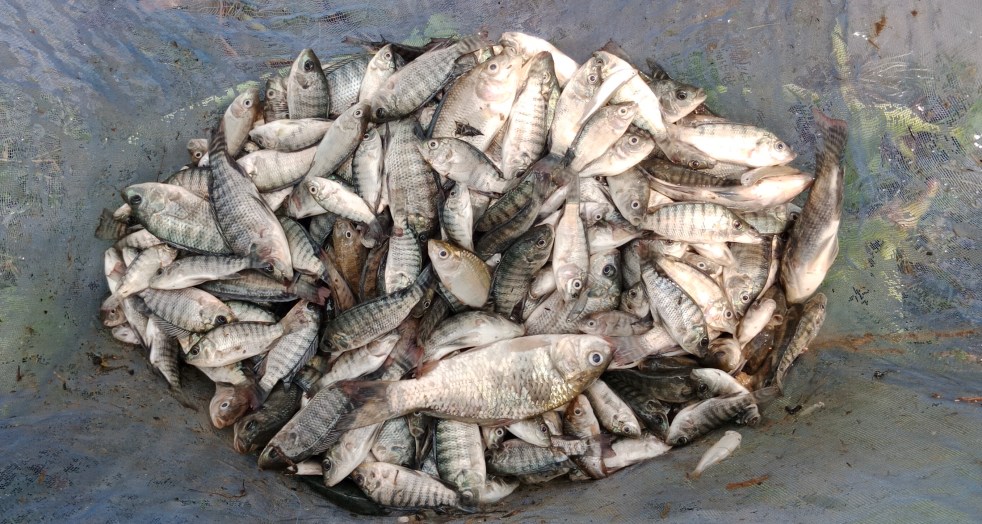
(Feature Image: A fish catch comprised mostly of invasive Tilapia species downstream Wazairabad barrage in Delhi in June 2023. Bhim Singh Rawat/SANDRP)
A recent CIFRI (Central Inland Fisheries Research Institute) report submitted to NGT is an eye-opening official document about the fish diversity in Yamuna. The report says that overall native fish species have declined sharply in the river not only in number but in size also due to habitat degradation, pollution and increasing presence of invasive fish species.
The report admits that construction of Farakka barrage has led to complete elimination of Hilsa fish in lower segment of river since 2010. Among other recommendations the report has suggested maintenance of continuous flows in the river and addressing sources of pollution.
Indeed, the freshwater fish species are key indicator of health of a river eco-system and the fish diversity in Yamuna has been pushed to brink by the water abstraction, unsustainable riverbed mining activities and ever-increasing pollution of river waters besides other factors.
Despite this shocking state of affairs, the state govts & particularly the central govt continues to purpose and build more dams and river-interlinking projects in Yamuna basin which are bound to destroy river’s aquatic diversity further. The Lakhwar dam, Ken-Betwa Linking, Parbati-Kali Sindh-Chambal Interlinking, Pachnad Irrigation projects are some of the latest examples of such projects.
The govt bodies have taken no effective step to ensure adequate flows in the river from exiting dam, barrage projects. On the other hand, they have failed to protect river fish diversity from pollution and unsustainable mining. Amid this gloomy scenario, one expects effective decisions from NGT & sincere efforts from govts for restoring fish diversity in Yamuna River.
Dominance of exotic fish species in Yamuna, NGT told In its order dated Nov 7, a bench of National Green Tribunal (NGT) noted that CIFRI in Prayagraj had filed its reply dated Sept 19, which supported the plea about the decrease in local fish species. The bench also noted the report about the decline in the number of fish species, including Indian Major Carps (IMCs), large catfishes and Hilsa fishery.
“In the 1960s and 1970s, IMCs contributed nearly 50 per cent of the total catch. Among the IMCs, Cirrhinus Mrigala (Mrigal/Nain) contributed the most, followed by Labeo Calbasu (Karaunchh/ Kalboss), Labeo Rohita (Rohu), and Labeo Catla (Bhakur/Katla). Notably, Labeo Catla has experienced the most significant decline in abundance, indicating ongoing habitat degradation in the river Yamuna,” said the CIFRI report submitted to the NGT.
Regarding large catfishes, the report said the important species were Sperata Aor (Tengan/Singhara), Sperata Seenghala (Tengan/Singhara), Wallago Attu (Padhin), Rita Rita (Ritha), Silonias Silondia (Sinda), Bagarius Bagarius (Gaunchh), and Pangasius Pangasius (Piyasi) and their contribution to the total catch had declined in both composition and size, likely due to the increasing presence of exotic species and other miscellaneous fish groups.
CIFRI said that the Tenualosa Ilisha (Hilsa/ Ilish) fishery had been totally wiped out from the riverine stretch in Prayagraj since 2010 due to the construction of the Farakka barrage. According to the report, the exotic fishery in the Yamuna was primarily represented by Common Carp (Cyprinus carpio), Nile tilapia (Oreochromis Niloticus), and Clarias Gariepinus. Other significant contributors included Clarias Gariepinus (Thai Mangur) at Delhi (Wazirabad). The report concluded, “These indicate an overall dominance of exotic fish species in the river Yamuna.”
The tribunal, meanwhile, noted the recommendations for addressing the issue, such as prohibiting illegal fishing gears, enhanced monitoring, control and surveillance during the fishing ban, implementing strategic ranching practices, maintenance of proper records of fish catch data, banning the release of exotic fish for rituals, maintaining continuous water flow, addressing source pollution and increasing awareness.
It also sought a response from the secretaries of the Union ministries of Jal Shakti and Fisheries and Animal Husbandry. Further hearing on Mar 3, 2025. https://theprint.in/india/dominance-of-exotic-fish-species-in-yamuna-ngt-told/2351532/ (11 Nov 2024)
DAMS & HEP PROJECTS IN YAMUNA BASIN
Uttar Pradesh Decisions of EAC meeting held on Nov 5, 2024 Panchnad Major Irrigation Scheme (CCA : 24,328 Ha) in 24328 Ha at village Sadhrapur, Sub-District and District Auraiya, Uttar Pradesh by Irrigation and Water Resource Department, Kanpur, Uttar Pradesh – Terms of Reference: In view of ecological sensitivity of the proposed project site the Sub-committee of EAC members shall conduct a site visit before making any recommendations to the project site. https://parivesh.nic.in/utildoc/111657975_1731754427455.pdf (Nov. 2024)
INTERLINKING OF YAMUNA RIVERS
Why Ken Betwa Link should not go forward A detailed report this week based on extensive field visit and interview of the concerned persons shows once again why there is no justification for Ken Betwa Link starting from lack of hydrological justification: There is no credible evidence or credible figures proving that Ken has surplus water and Betwa is deficit. The project will actually facilitate export of water from drought prone Bundelkhand in addition to bringing massive adverse impacts and as a former Panna collector said, will keep the upstream Ken Basin area permanently backward. This was also proved during the SANDRP initiated Ken Yatra from Ken Yamuna confluence upstream to the origin of the river.
The whole exercise of getting clearances for the project has been an exercise in manipulations at each step of the way, including EIA, Public Hearings, EAC process, Environment Clearance, Forest Clearance, Wildlife clearance and gram sabha clearances. This is also true as this report shows, for the people to be displaced by the project. The scathing CEC (Central Empowered Committee appointed by the Supreme Court) report on its wildlife related issues has not even been considered by the Supreme Court. We hope the Supreme Court will soon consider this and put a stop to the mindless project.
The forest clearance is in fact on conditions that changes the basic parameters of the project, requiring fresh cost benefit analysis, EIA and EC. The hydrological figures need urgent independent scrutiny, particularly considering the additional reason for changing climate. One only hopes that better sense will prevail and this massive, costly, contract driven project will not go forward. https://sandrp.in/2024/12/02/drp-nb-021224-why-ken-betwa-link-should-not-go-forward/ (02 Dec. 2024)
Adivasis in Panna tiger park: dammed futures The project has been widely criticised. “There is no justification for the project, not even hydrological justification,” says scientist Himanshu Thakkar who has been involved in the water sector for 35 years. “To begin with, the Ken does not have surplus water. There has been no credible assessment or objective study, only pre-determined conclusions,” he adds.
– Thakkar is Coordinator of the South Asia Network on Dams, Rivers and People (SANDRP). He was a member of the expert committee set up around 2004 by the Ministry of Water Resources (now Jal Shakti) on interlinking of rivers. He says the very basis of the project is shocking: “River linking will have huge environmental and consequent social impacts on forest, river, biodiversity and will impoverish people here as well as in Bundelkhand and far beyond.”
– Panna Tiger Reserve (PTR) has 79 of the great cats and when the dam drowns a large part of core forest area… What will be the hydrological implication of cutting down some 46 lakh trees (as per assessment given in Forest Advisory Committee meeting in 2017) from natural forest has not even been assessed. Tigers are not the only hapless wild residents. One of India’s only three ghariyal (crocodile) sanctuaries is a few kilometres downstream of the proposed dam. The area is also an important nesting site for the Indian vulture – on the IUCN Red List for Critically Endangered birds. Besides there are many large herbivores and carnivores who will lose habitat.
– In October 2023 when the final sanctions for the Ken-Betwa River Linking Project (KBRLP) came through, it was welcomed with cheers by then BJP Chief Minister Shivraj Singh Chouhan. He called it a “fortunate day for the people of Bundelkhand who had lagged behind.” He made no mention of the thousands of farmers, herders, forest dwellers and their families in his state that it would deprive. Nor did he see that the forest clearance was awarded on the basis that power generation would be outside the PTR, but now it is inside.
– The notion that the Ken has surplus water needs to be questioned, says Dr. Nachiket Kelkar. The dams that already exist on the Ken– Bariyarpur barrage, Gangau dam and one at Pawai – should have provided for irrigation. “When I visited Banda and surroundings along the Ken some years back, I regularly heard that irrigation water was not available,” adds this ecologist at the Wildlife Conservation Trust. Researchers from SANDRP who walked the length of the river in 2017 wrote in a report , “…the Ken is now not a perennial river everywhere…For a longer part, the river runs flowless and waterless.” Ken itself has an irrigation deficit, so what it can give to Betwa will compromise its own command area. A point echoed by Nilesh Tiwari who has lived all his life in Panna. He says there is a lot of anger about the dam as it will permanently deprive people of Madhya Pradesh while seeming to benefit neighbouring Uttar Pradesh.
– As a result of the lies and opacity behind state action, in every village that PARI visited, no one knew when and where they would go, or the exact amount / rate of compensation for houses, land, cattle and trees. People of 22 villages seem to be living in a state of suspended animation.
– “Not many people talk about climate change in central India, but it is here that we are witnessing rapid increase in extreme rain events as well as droughts, both indicative of climate change impacts,” points out ecologist Kelkar. “Most rivers in central India are seeing accelerated flows caused by climate change, but they won’t last. These flows may be feeding the notion of surplus now, but under climate change projections, it is evident that they would be short-term.” He warns that if these short-term changes are encashed to link rivers, the possibility of the region facing far more serious drought in the future cannot be ruled out. Thakkar also warns that the hydrological impact of destruction of a huge area of natural forest, is a monumental mistake. “The report of the Central Empowered Committee of the Supreme Court has thrown light on this, but that report has not even been considered by the SC.”
– Whatever data has been used by the National Water Development Agency (NWDA) under whose aegis the project exists, is not being shared with scientists, citing national security concerns, adds Himanshu Thakkar. In 2015, when the dam began to look like a real possibility, Thakkar and others in SANDRP had wrote many letters to the Environment Assessment Committee (EAC). One such titled ‘Flawed Ken Betwa EIA & violations in Public Hearing’ said, “the EIA of the project is fundamentally flawed, incomplete and its public hearings involved numerous violations. Any clearance to the project with such inadequate studies would not only be wrong, but also legally untenable.” https://ruralindiaonline.org/en/articles/adivasis-in-panna-tiger-park-dammed- (28 Nov. 2024)
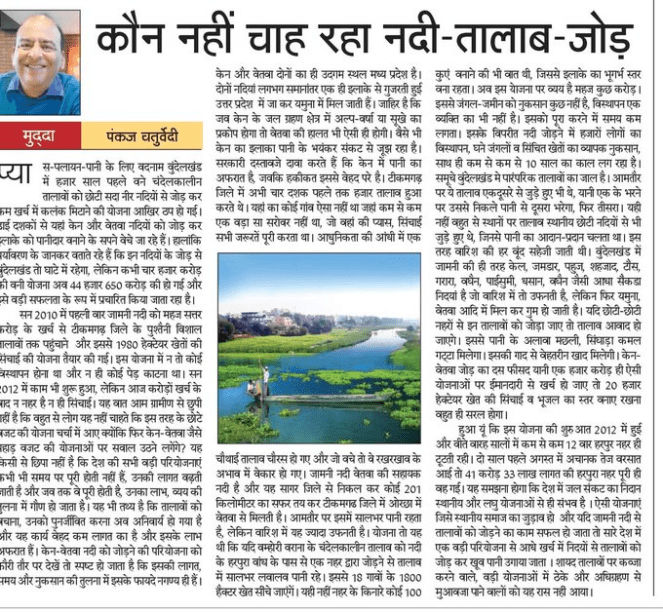
समूचे बुंदेलखंड मे पारंपरिक तालाबों का जाल है। आमतौर पर ये तालाब एकदूसरे से जुड़े हुए भी थे, यानी एक के भरने पर उससे निकले पानी से दूसरा भरेगा, फिर तीसरा। यही नहीं बहुत से स्थानों पर तालाब स्थानीय छोटी नदियों से भी जुड़े हुए थे, जिनसे पानी का आदान-प्रदान चलता था। इस तरह बारिश की हर बूंद सहेजी जाती थी। बुंदेलखंड में जामनी की ही तरह केल, जमडार, पहुज, शहजाद, टौंस, गरारा, बघैन, पाईसुमी, धसान, बघैन जैसी आधा सैंकडा निदयां है जो बारिश में तो उफनती है, लेकिन फिर यमुना, बेतवा आदि में मिल कर गुम हो जाती है। यदि छोटी-छोटी नहरों से इन तालाबों को जोड़ा जाए तो तालाब आबाद हो जाएगे। इससे पानी के अलावा मछली, सिंघाड़ा कमल गट्टा मिलेगा। इसकी गाद से बेहतरीन खाद मिलेगी। केन-बेतवा जोड़ का दस फीसद यानी एक हजार करोड़ ही ऐसी योजनाओं पर ईमानदारी से खर्च हो जाए तो 20 हजार हेक्टेयर खेत की सिंचाई व भूजल का स्तर बनाए रखना बहुत ही सरल होगा। (पंकज चतुर्वेदी) http://m.samaylive.com/editorial/521143/who-does-not-want-river-pond-linking.html (30 Nov 2024)
NCC gets contract to build ₹3,389.49 cr Daudhan dam Infrastructure Company NCC Ltd on Nov. 29 has received a contract valued at Rs 3,389.49 crore to execute the Daudhan Dam under the Ken-Betwa Link Project. The contract involves planning, design, engineering, and hydro-mechanical works on an EPC basis. The project is to be completed over a 72-month period. The company received the Letter of Acceptance on November 28. https://economictimes.indiatimes.com/industry/indl-goods/svs/construction/ncc-gets-rs-3389-49-crore-ken-betwa-link-project-authority/articleshow/115801984.cms (29 Nov. 2024)
Uttar Pradesh 1,191cr boost for revival of Ken canal system The Uttar Pradesh state cabinet on Monday (Nov. 4) approved the expenditure proposal of Rs 1,191.51 crore for the revival of the Ken canal system under the Ken-Betwa link project. The work proposed in the project for the restoration of the Ken canal system is scheduled from 2025 to 2028 with the canal closure period from January to June. The project is proposed to be completed in 2027-28. In the Banda district of the Bundelkhand region, in addition to the present irrigated area of 87,784 hectares, 79,191 hectares of unirrigated area can also be irrigated. According to an estimate in Banda district, a total of 166,975 hectares of area will be irrigated through this project, eventually benefiting approximately 160,000 farmers.
An MoU was signed between the UP govt, Madhya Pradesh govt, & the Centre on Mar 22, 2021, for the implementation of the Ken-Betwa link project. The project was approved by the Union cabinet on Dec 8, 2021. The project cost of Rs 44,605 crore was approved by the Union Jal Shakti ministry on Dec 22, 2021. https://timesofindia.indiatimes.com/city/lucknow/massive-rs-1191-crore-investment-to-revive-ken-canal-system-in-india/articleshow/114956787.cms (5 Nov 2024)
YAMUNA AS WATERWAY
Delhi Water taxi project still in works The Delhi government’s irrigation and flood control (I&FC) department has informed the NGT that the plan to operate a water taxi in the Yamuna is still in the works, adding that it is yet to receive an affidavit and an indemnity bond from the Inland Waterways Authority of India (IWAI), nearly five years after it gave its nod to the Central agency to use a shank at Sonia Vihar for project. The I&FC department’s statement came in the form of an affidavit submitted before NGT on November 23, informing the green court about the status of the project.
The Centre in 2018 had announced a water taxi project for the Delhi stretch of the Yamuna. Initially, the plan was that the project would cover a 16-km stretch of the river from Wazirabad to Fatehpur Jat. A year earlier, the NGT was approached for environmental clearance, but the green court referred the matter to a principal committee, and the panel in May 2017 said the project proponent needed to relook the proposal, taking into account the environmental impact of the proposed activities in the drinking water reservoir.
Meanwhile, experts have raised concerns about the project, noting that a water taxi service will require constant dredging of the river as well as a significant flow through the year. “This project has been in the works for several years now, but the problem remains the same — there is not enough flow in the Yamuna to sustain ferries. We also need to look at the aim behind this, as running a small loop has no purpose and it will not connect people to other transport hubs,” said Bhim Singh Rawat, a Yamuna activist and member of the South Asia Network on Dams, Rivers and People (SANDRP). “Instead of focusing on constant dredging, our goal first should be to improve the river’s water quality and improve the flow,” he added. https://www.hindustantimes.com/cities/delhi-news/yet-to-receive-indemnity-bond-for-yamuna-water-taxi-from-centre-delhi-govt-tells-ngt-101732645777121.html (27 Nov. 2024)

MoU signed for boat taxi rides on 7km stretch, govt tells NGT According to the expression of interest, the ferry ride is to start at Sonia Vihar and make its way to the Hanuman temple near Wazirabad barrage before returning to Sonia Vihar, a route of around 7km. I&FC has given permission for the use of the river bank there through its letter of March 15, 2019. The affidavit submitted to NGT adds, “However, IWAI asked for a security deposit of Rs 20 lakh to be waived off. For this, it agreed to submit the requisite documents, i.e., an indemnity bond and an affidavit.” I&FC said reminders were sent to IWAI in 2021 & more recently, on Oct 23.
In Sept, IWAI called for expressions of interest in operating the boat service. The plan is to initially have two electric or solar hybrid boats, each capable of seating 20-30 passengers. “The speed should be 5-7 knots, with a maximum draft of 1.2 metres,” the EOI states. Other infrastructure support that will be provided by IWAI and DDA, supported by DJB and I&FC, include polyethylene floating jetties, navigational aids and a shore facility providing e-charging.
The latest plan, as per the EOI, shows only a 4km stretch upstream of Wazirabad will be involved. Here, the water quality is comparatively better than in other stretches. In 2023, the Indian Navy, using INS Barasingha, carried out a navigability assessment that found the river depth varied from 0.9 metres to 4 metres between ISBT Kashmere Gate and ITO. https://timesofindia.indiatimes.com/city/delhi/delhi-government-signs-mou-for-eco-friendly-boat-taxi-service-on-yamuna-river/articleshow/115707186.cms (26 Nov. 2024)
YAMUNA FLOODPLAIN
Delhi Reclaiming floodplain bit by bit?? This report does not mention the illegal encroachments by official agencies and also by DDA, and where DDA is taking no action. Large number of bridges have also added to the encroachments, but the report mentions only one. The report also does not point out that DDA has not implemented the orders of the court to demarcate the floodplain. https://timesofindia.indiatimes.com/city/delhi/delhi-takes-major-steps-to-combat-flooding-issues-by-reclaiming-yamuna-floodplain/articleshow/115392825.cms (18 Nov. 2024)
Noida Avoid buying farmhouses, plots on floodplain: Authority -The Noida authority in an advisory issued in national dailies and its own website has appealed to the general public to avoid buying farmhouses or plots on Yamuna floodplain and also in unapproved projects. The move followed complaints to the authority that illegal farmhouses and residential plots are being sold in the city’s notified areas meant for planned development. The authority has also launched a crackdown against illegal construction in Nagli Wajidpur and Kondli village land.
-The authority has issued two public notices, one about an illegal flat-style multi-storey building in Nagli Wazidpur and the other about farmhouse or other plot sale on floodplain on notified land of the city. The authority in second notice has advised the home-buyers not to buy any farmhouse, flat, shop or any other property in any such project that is not approved as per the building bylaws-2010, said officials.
-Currently hundreds of illegal housing and commercial projects including farmhouse projects are being developed in the notified area prompting the authority to take action against this menace. The developers issue advertisements and lure buyers in the name of a cheap apartment, shop, farmhouse or other space. https://www.hindustantimes.com/cities/noida-news/avoid-buying-farmhouses-plots-on-yamuna-flood-plain-noida-authority-101733164301059.html (03 Dec. 2024)
Illegal construction rampant along floodplains The Noida Authority identified and flagged several constructions, including flat-style multi-storey buildings, on land parcels in Wajidpur village near the Yamuna floodplains. These unauthorised developments have been deemed illegal, with the authority confirming that action against violators is underway. In addition, the authority has turned its attention to Kondli village, where the construction of several buildings has been noted. To determine further action, the authority sought a detailed report on these structures.
The landowners of these parcels previously challenged the authority’s July demolition order in the Allahabad high court. In its order dated Aug 20, the court directed the authority to address objections raised by the petitioners within six weeks, ensuring all stakeholders were heard. The court also restrained the landowners from further constructions on the disputed site or creating third-party interests. Officials reiterated that any construction or plotting that violates the approved master plan or the Uttar Pradesh Industrial Area Development Act, 1976, is entirely illegal. https://timesofindia.indiatimes.com/city/noida/rampant-illegal-constructions-threaten-noidas-yamuna-floodplains/articleshow/115936648.cms (03 Dec. 2024)
YAMUNA POLLUTION
Delhi Lack of annual flush leaves river highly polluted this year -According to I&FC data, there have only been six occasions since 1963 when lower maximum levels have been observed — in 1984 (204.15m), 1987 (202.51m), 1991 (203.36m), 2004 (203.72m), 2006 (204.1m) and 2014 (204m). In the past 62 years, the warning level has been breached in 53 of them, making it a common annual occurrence.
-Bhim Singh Rawat, of SANDRP said the lack of fresh water being released in the river and high pollution level also highlight the issue of ecological flow of the river now being maintained. “The river is dead because no water is being released into it. Low to medium flood level is an annual phenomenon and the river has rarely been this dry in the last decade. For a river like the Yamuna, the four-month monsoon cycle is critical for annual cleaning, when the river flows from mouth to tail in one flow — unlike the fragmented polluted river for remaining eight months. It is also crucial for recharging the floodplains and aquifers,” he said.
-Rawat said that the state of the river also brings the issue of e-flow under the spotlight. “An ecological flow of 23 cumec (1cumec = 35 cusec) has been recommended by National Institute of Hydrology as well as the parliamentary standing committee on water resources, but the river only get less than 10 cumec water. Besides the low rainfall, less water is being released from the Hathinikund barrage. A 15-day release before Chhath could also provide a temporary relief from frothing due to dilution,” he said.

Diwan Singh, an activist said: “Flooding recharges the aquifers in the river floodplains. More the flooding cycle, better the river health. Monsoon months are the only time when the river flows in its natural form. Otherwise, beyond Wazirabad, the river is almost dead.” https://www.hindustantimes.com/cities/delhi-news/lack-of-annual-flush-leaves-yamuna-highly-polluted-this-year-101731001096519.html (8 Nov 2024)
Drains, soap, dyes: What plagues the river Experts attribute the foam issue to largely two causes – dumping of detergents in the river, and “churning points” that lead to bubble formation. Bhim Singh Rawat, an activist with the SANDRP, said the government has been slow to act on evidence of contamination. “In 2021, the DPCC banned detergents and soaps that did not meet BIS standards to prevent froth formation in the Yamuna, but the ban remains only on paper. The surfactants released from these detergents is one of the key reasons behind froth formation, which completely eats up any oxygen left in the river,” said Rawat.
The Yamuna Monitoring Committee, in its fifth report on the river in 2021, stated the presence of high phosphates and surfactants, released by detergents was the main reason behind high froth formation. It had also asked for action against illegal dhobi ghats, operating along the river. “There were plans of the government to create a platform to prevent churning in the river, but even that has not materialised,” he added. Meanwhile, illegal dyeing operations continue to release toxic effluents into the city’s drains. Many of these facilities, operating in areas not zoned for industry, funnel waste directly into the river, experts said. https://www.hindustantimes.com/cities/delhi-news/drains-soap-dyes-what-plagues-the-yamuna-in-delhi-101731001458707.html (8 Nov 2024)
Permanent solution needed for toxic foam Bhim Singh Rawat of SANDRP said that instead of focusing on river pollution for 15 days before Chhath Puja, a round-the-year action plan is needed & the underlying cause should be tackled. “The Upper Yamuna River Board water agreement between the Yamuna basin states is up for renewal in 2025, and that could be first step to restore the river water.” https://www.hindustantimes.com/cities/delhi-news/permanent-solution-needed-for-toxic-foam-in-yamuna-djb-101731523328896.html (14 Nov 2024)
Money going down the drain Delhi has spent over Rs 7,000 crore on Yamuna river’s cleaning since 2017 but has very little to show in terms of progress, according to a Moneycontrol analysis. The Delhi government has allocated over Rs 200 crore for Yamuna cleaning for the current fiscal. Centre has spent over Rs 15,000 crore on the Clean Ganga program—some of this has also gone to Delhi for Yamuna clean-up—since FY15 but has made incremental gains.
Reports submitted to the NGT by the governments of Delhi, UP and Haryana in January 2024 indicated severe deficiencies in implementing the rejuvenation program. Haryana had no data on the segregation of treated and untreated sewage, and UP was not tapping 14 drains flowing into the Yamuna river. https://www.moneycontrol.com/news/india/despite-spending-rs-7000-crore-yamuna-in-delhi-is-no-better-than-before-mc-analysis-12863173.html (11 Nov. 2024)
19 out of 37 STPs not up to standard: DPCC report The report, dated Nov 5, is part of the monthly assessment report for Oct, reveals that a large chunk of STPs are yet to meet the prescribed norms set for parameters such as faecal coliform, BOD & total suspended solids (TSS), among others.
Bhim Singh Rawat, a of SANDRP, said that the water utility has missed multiple deadlines to increase and upgrade Delhi’s STP network. “This is the reason DJB has been rapped by both the Delhi high court and NGT in the past. Yet we don’t seem to see the urgency to take corrective action,” he said. https://www.hindustantimes.com/cities/delhi-news/19-out-of-37-sewage-treatment-plants-in-delhi-not-up-to-standard-dpcc-report-101732471475883.html (25 Nov. 2024)
STPs do not meet standards: DPCC The report said that the DJB’s STPs are not adhering to norms, mostly concerning faecal coliform, which indicates the presence of raw sewage and excreta in the water. Apart from faecal coliform, many STPs failed to meet the standards for BOD and total suspended solids. There were then 28 such STPs with exponentially high faecal levels. Officials at STPs, however, stated that at present, 18 STPs have working disinfection facilities either through chlorination or UV treatment, while 9 STPs are under construction with UV treatment facilities, & the process of installing UV devices at others is in the pipeline. https://timesofindia.indiatimes.com/city/delhi/19-out-of-37-delhi-sewage-treatment-plants-fail-to-meet-standards-raising-pollution-concerns/articleshow/115633454.cms (25 Nov 2024)
NGT imposes ₹25cr fine on MCD, DJB The NGT on Nov 21 imposed environmental compensation of ₹25.22 cr on each of the MCD and DJB for failing to check pollution of stormwater drains and subsequently, the Yamuna. The DJB was pulled up for connecting drains carrying sewage and polluted waste with stormwater ones, and not maintaining separate lines for the past few years, while the MCD was penalised for covering drains, altering their shape and polluting the Yamuna. Both bodies were asked to deposit the fine with the CPCB in two months.
The court noted that stormwater drains in Delhi were designed well and should not be polluted so that they can be used for groundwater recharge. The order also quoted a 2016 report by the NCRPB that made remarks on encroachment of natural drainage channels, covering of drains and constructions over them, silting of drains, and mixing of sewage and drainage. Citing it, NGT directed partial removal of cover across the length of stormwater drains at different intervals so that not only cleaning or desilting becomes convenient and possible, but also so gases and foul smells do not shoot out from a single point. NGT also directed DJB to take steps for immediate diversion or tapping of drains carrying sewage meeting the stormwater drain by taking appropriate steps within three months. https://www.hindustantimes.com/cities/delhi-news/ngt-imposes-25-crore-fine-on-mcd-djb-over-yamuna-pollution-101732296948901.html (23 Nov. 2024)
STPs not up to mark: HC A bench of Chief Justice Manmohan and Justice Manmeet PS Arora suggested that tamper-proof meters be installed at STPs to track both operational timings and electricity usage. Furthermore, the court directed that this data be uploaded in real-time to the websites of the CPCB, DJB & the Chief Secretary’s office. The court called for the installation of sensors at discharge points where treated water flows into the river. These sensors would monitor critical water quality parameters, including BOD, COD, TSS, Fecal Coliform & Dissolved Phosphate. https://www.newindianexpress.com/cities/delhi/2024/Nov/20/stps-not-up-to-mark-polluting-yamuna-delhi-hc (20 Nov. 2024)
Most STPs being upgraded: DJB NGT had earlier taken suo motu cognisance of a TOI report, stating that despite treatment, about 75% of STPs operated by DJB were failing to get even close to treating the E coli or faecal coliform. However, DJB did not respond on time, due to which the tribunal, during a hearing in Aug, imposed a fine of Rs 10,000 upon CEO, DJB, for non-appearance before the tribunal and not filing the response. However, DJB filed a response dated Nov 21, where it asserted that most of its STPs were in the process of upgradation, while various others were now adhering to norms.
DJB, which operates 38 STPs, said Delhi’s estimated sewage generation was 792 MGD, which was 80% of its daily water production of 990 MGD. It asserted that against the sewage generation of 792 MGD, its installed capacity was just 712 MGD. It said that out of 38 STPs, 18 catering to 375.4 MGD of sewage were complying with standards, and nine catering to 245 MGD were under upgradation and would comply by Mar 2025.
DJB further stated that it was constructing 9 STPs – 2 at Okhla & 7 at Sonia Vihar — which would be ready by Mar 2025, while 9 other STPs would be upgraded by March 2026. Three other STPs currently functional at Okhla, however, were not complying with norms. However, as per details further furnished by DJB in the same report, it did not disclose the details of faecal coliform. The report further pointed out that barring 18 STPs, others did not adhere to the prescribed norms for TSS and BOD. https://timesofindia.indiatimes.com/city/delhi/djb-reports-most-sewage-treatment-plants-upgraded-amid-ngt-concerns/articleshow/115575896.cms (22 Nov 2024)
Sewage network upgrade holds key Despite having 40 STPs, Delhi still is unable to treat 182 million gallons per day (MGD) of the around 800 MGD of sewage generated every day. The untreated material ends up in the Yamuna, which is the city’s primary source of drinking water. Currently, 18 of the STPs are being upgraded both to enhance their treating capacity as well as to equip them to handle specific sewage treatment processes.
According to govt officials, 161 unauthorised colonies are located either in forest areas, the Yamuna O zone or on ASI land, all of which require special permits for sewerage to be installed. Talks for this are going on with the various agencies. Besides laying sewers, the other part of the plan is to stop points where the sewer lines and stormwater drains interconnect because of which sewage flows into the river or overflows onto the roads. DJB has identified 191 such points, of which, according to the latest report, 167 has been tapped. The work on six others will be completed by the end of this year. https://timesofindia.indiatimes.com/city/delhi/yamuna-river-restoration-urgent-sewage-network-upgrade-needed/articleshow/115227688.cms (12 Nov. 2024)
NGT seeks report on waste removal from river banks The NGT has directed the MCD to provide complete details about the removal of waste on the banks of Yamuna river in the national capital. The green body was hearing a plea saying domestic, dry and waste garbage had been dumped on the banks of river Yamuna in Wazirabad and Jagatpur villages. In an order passed on November 13, a bench of NGT Chairperson Justice Prakash Shrivastava noted the submissions of the counsel for MCD that the cleaning work was in progress in the entire stretch of 4.3 km and that 10 workers had been deployed at the spot. It said the details had to be provided within four weeks. The matter has been posted on March 6 for further proceedings. https://www.theweek.in/wire-updates/national/2024/11/20/lgd17-green-delhi-yamuna.html (20 Nov 2024)
HC refuses permission to Chhath Puja on river bank A PIL seeking permission for Chhath Puja on the Yamuna’s banks was dismissed by the Delhi High Court due to severe pollution concerns. The court emphasized health risks and noted nearly 1,000 alternative locations for the ritual. The Delhi High Court (HC) has on November 6 dismmised a PIL seeking permission to conduct Chhath Puja rituals on the banks of the Yamuna River, according to an ANI report.
The PIL challenged the public ban on Chhath festivites on the banks of the Yamuna River, which petitioner Purvanchal Nav Nirman Sansthan said was first imposed during the COVID-19 pandemic and re-imposed now, it said. However, the Delhi HC refused to scrap the ban and citied severe pollution, contamination and toxic foam issues of the Yamuna River, the report added.
The court also directed the petitioner to around 1,000 other alternative locations that have been designated for Chhath Puja with arrangements made for the celebration. The bench further said that puja can be performed safely at the designated areas. https://www.livemint.com/news/india/chhath-puja-delhi-hc-denies-permission-rituals-yamuna-banks-pollution-concerns-alternate-location-toxic-foam-health-news-11730884415323.html (6 Nov 2024) The court also referred to its recent order in another case in which judicial notice was taken about the fact that pollution in the Yamuna was at an all-time high. Delhi govt standing counsel Santosh Kumar Tripathi told the court that the Yamuna was highly polluted at this juncture and if the devotees were allowed to perform Chhath Puja on the river banks, they were likely to fall sick. https://timesofindia.indiatimes.com/city/delhi/delhi-high-court-denies-permission-for-chhath-puja-on-yamuna-river-banks-due-to-pollution/articleshow/115027318.cms (07 Nov. 2024) The Chief Justice responded that effective river cleaning is an extensive endeavour, highlighting the persistent issue of untreated sewage flowing into the river from unauthorised settlements along its banks. He also expressed disappointment over the lack of political will to address the issue. https://www.newindianexpress.com/cities/delhi/2024/Nov/07/chhath-at-yamuna-can-harm-devotees-delhi-hc (07 Nov. 2024)
DJB plans froth suppression Delhi Jal Board (DJB) will set up an in situ treatment for froth suppression with the help of automatic sprinklers under the Kalindi Kunj flyover to manage the problem of froth in the Yamuna throughout the year. “This year, an experiment was done by creating two foam-suppressing zones on the river’s surface where solution is being sprayed. We have installed water sprinklers under the flyover and large nets,” a DJB official said.
DJB has created two ‘reaction zones’ where the froth generated near the barrage gates is collected and then suppressed with the help of spraying a defoaming agent. Every year, Chhath brings the visible pollution of the Yamuna back into focus. Last year, DJB used a defoaming agent to manage the situation, and this year it is being repeated. However, officials said the problem of froth and pollution in the river is a year-long phenomenon. Hence, the idea is to set up a permanent mechanism in place to reduce the problem. https://timesofindia.indiatimes.com/city/delhi/delhi-jal-board-launches-froth-suppression-initiative-to-tackle-yamuna-pollution/articleshow/115027314.cms (06 Nov. 2024)
Ammonia up in river, water production hit The ammonia levels in the Yamuna rose once again on Monday (Nov. 18) night, forcing DJB to curtail water production at the major Wazirabad water treatment plant (WTP) by 15% on Tuesday (Nov. 19). This is the third such recorded episode this year when the pollution in the river increased, affecting the water treatment network. The problem is likely to impact the water supply in central Delhi and some localities in south Delhi. This year, the ammonia spike was also reported by officials in Jan, Feb and Oct, affecting the production of drinking water at various WTPs, mainly Wazirabad.
Citizens Front for Water Democracy, a group of water activists, wrote to Delhi govt last week about the rising levels of ammonia in water and raised concerns about public safety. “The rise of ammonia content in the Yamuna at Wazirabad pond and its upstream has become routine and very frequent for the past four to five years. This badly affects treatment at DJB’s WTPs, resulting in reduced supply and creating a huge scarcity of water in the command area,” said activist SA Naqvi. https://timesofindia.indiatimes.com/city/delhi/ammonia-levels-surge-in-yamuna-leading-to-water-supply-crisis-in-delhi/articleshow/115461967.cms (20 Nov. 2024)
Health impacts of froth Contact with froth-laden water can trigger various immediate health issues. “The pollutants can cause skin irritation, rashes, and allergic reactions, as the chemicals strip the natural oils from the skin and cause inflammation,” says Dr Hiremath. More alarming is the risk of accidental ingestion or inhalation, which can lead to gastrointestinal problems, including vomiting, diarrhea, and stomach cramps. The respiratory consequences of exposure can be particularly severe. Skin-related problems are among the most visible effects of exposure. Perhaps most concerning are the long-term effects of repeated exposure. “Heavy metals like arsenic, cadmium, and lead, commonly found in polluted rivers, can accumulate in the body over time,” says Dr Hiremath, “potentially causing neurological disorders, kidney damage, and developmental issues in children.” https://indianexpress.com/article/lifestyle/health/skin-respiration-overall-health-problems-polluted-toxic-river-froth-9654071/ (06 Nov. 2024)
Story The Han Meets the Yamuna… Every night as the moon peeps through the polluted sky, Yamuna sheds tears. She looks miserable and sick. Word of Yamuna’s ill-health spread over water boundaries and fell into the ears of Han–one of the longest rivers in South Korea. Everyone talked of Han’s beauty and came to appreciate her with their families and friends. Hearing about Yamuna’s health, Han decided to meet her and try to cheer her up. https://young.downtoearth.org.in/stories/water/jab-we-met-the-han-meets-the-yamuna-river–117374 (05 Nov. 2024)
Report From sacred glory to silent despair The Yamuna river holds deep religious significance in India. Ancient texts and paintings depict her as a goddess and celebrate her association with Krishna. Miniature paintings, particularly the ‘Palam Bhagavata’ series, vividly portray the river and the legend of Krishna overcoming the venomous serpent Kaliya. Sadly, the Yamuna is now heavily polluted. https://economictimes.indiatimes.com/opinion/et-commentary/yamuna-and-her-twin-tales-from-sacred-glory-to-silent-despair/articleshow/115606314.cms (23 Nov. 2024)
How Faith and Pollution Collide on Delhi’s Yamuna River https://www.indiawaterportal.org/people-and-culture/how-faith-and-pollution-collide-on-delhis-yamuna-river (03 Dec. 2024)
YAMUNA RIVERS
Delhi Natural drain encroached, NGT told A natural stormwater drain in Goyla Khurd, sw Delhi, is completely filled and encroached upon by private properties, with officials concerned unable to locate the drain, a joint committee headed by the DM told the NGT. The Nov 8 report says two separate inspections of the area were carried out last month: on October 3 by the Naib Tehsildar, DPCC and DJB officials, while a second inspection by the CPCB was undertaken on October 19. Officials said that they were unable to find the drain on the ground in either inspection.
“There exists no drain on the site at present…. in the Khasra No. 38…which is now bifurcated in plots of different sizes and bearing hoarding indicating the ownership of the land,” the report said, adding that a detailed analysis by CPCB, using Google Earth images, revealed that a drain existed on the ground in 2022. The joint committee was constituted by NGT in July to check the ground situation of the natural drain, on a petition by Goyla Khurd’s Shyam Kunj RWA, which alleged a natural drain in the village—forming a part of the Najafgarh drain (Sahibi river)—had been encroached completely. The petition said that the drain was around 450 metres long and 15 metres wide, contending the encroachment led to waterlogging in the area in monsoon. https://www.hindustantimes.com/cities/delhi-news/natural-stormwater-drain-in-goyla-khurd-filled-encroached-ngt-told-101731262433100.html (11 Nov. 2024)
Uttar Pradesh Hindon a river lost: Unchecked discharge of industrial effluents and inadequate sewage treatment facilities have turned the Hindon’s water toxic. Down To Earth tracks the Hindon’s journey through seven Uttar Pradesh districts, starting from its origin in Saharanpur.
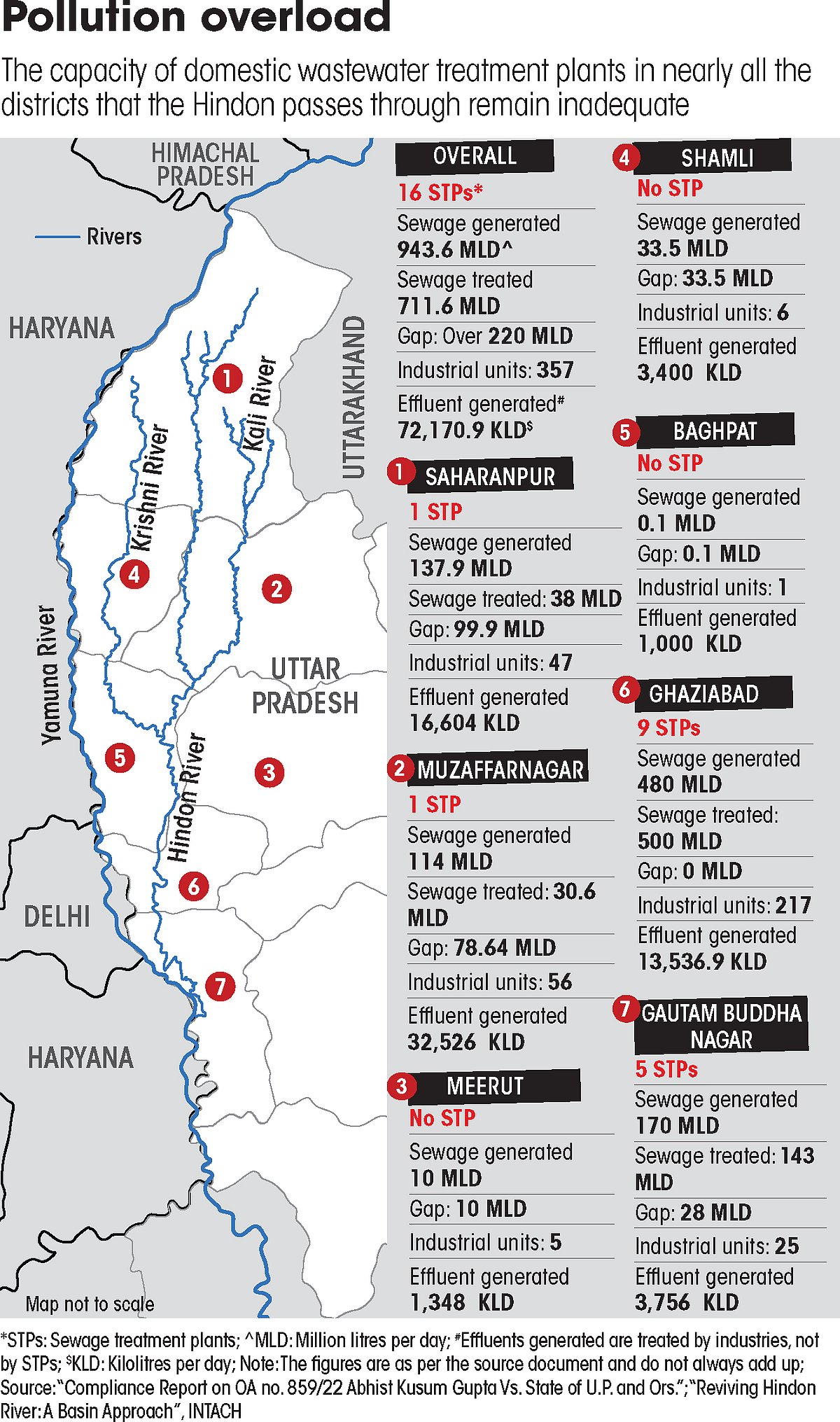
A river has primarily two sources of pollution: industrial effluents (for which factories are required by law to instal effluent treatment plants) and domestic wastewater (which government bodies are mandated to treat in sewage treatment plants or STPs before releasing in waterbodies). CPCB’s 2023 compliance report estimates that along its course in the seven districts, the Hindon receives 72,170.9 kilolitres per day (KLD) of effluents from 357 industries, and 943.63 million litres per day (MLD) of domestic sewage.
Though the industries are equipped to treat effluents, they often do not, as shown by CPCB’s 2023 compliance report, which says closure orders were issued to 33 units in the seven districts, while 13 units were fined Rs 76.78 crore as “environmental compensation” in 2023-24. Similarly, the 16 STPS in the seven districts treat only about 711.6 MLD of the 943.6 MLD sewage generated, which means that over 220 MLD sewage is released into the Hindon without being treated. https://www.downtoearth.org.in/pollution/a-river-lost-unchecked-discharge-of-industrial-effluents-and-inadequate-sewage-treatment-facilities-have-turned-the-hindons-water-toxic (16 Nov 2024) Hindi report: https://hindi.downtoearth.org.in/river/ground-report-the-name-of-a-dying-river-is-hindon (12 Nov 2024)
NGT panel on Pahuj pollution The NGT has formed a panel to suggest remedial measures to tackle the problem of pollution in the Pahuj river in Jhansi district. The tribunal was hearing a petition alleging that the river has shrunk due to pollution and encroachment and that sewage is discharged and solid waste thrown into it. The river is a tributary of the Sindh and the Yamuna and was once regarded as the lifeline of Jhansi and surrounding areas, the plea said.
The NGT said the district magistrate will be the nodal agency for coordination. “The joint committee will visit the site of the river flowing from district Jhansi, ascertain the source of its pollution, take the water sample, get the analysis done and submit the analysis report and also suggest the remedial measure,” the tribunal said. The matter has been posted on Nov 28 for further proceedings. https://theprint.in/india/jhansi-river-pollution-ngt-forms-panel-to-suggest-remedial-measures/2240974/ (24 Aug. 2024)
MINING IN YAMUNA RIVERS
Uttar Pradesh Sand miners laid road across Yamuna The area is across Panchayara village (Pachera to locals) in Ghaziabad. On the other side is Alipur, the outskirts of north Delhi. Over decades, under the guise of leases, sand miners have operated with abandon on the Yamuna floodplains to meet a huge appetite for construction. The river’s banks have also been plundered by the sand mafia, damaging its ecology and making it prone to large-scale encroachment.
The building of a road, for excavators to make their way across the Yamuna and dredge sand, is an example of brazen violations the protected floodplains see. There’s an official lease that’s been given for these parts for mining, but no lease allows excavators on the river’s banks, let alone building a road across it.
Locals in Pachera said it’s not the first time the Yamuna was being “bridged” like this. This is, according to them, a post-monsoon ritual for years. A road is laid and it lasts from winter till the rains arrive, after which the river swells & it gets washed away. Once the river recedes, about now, back come the men to build the road. The excavators follow.
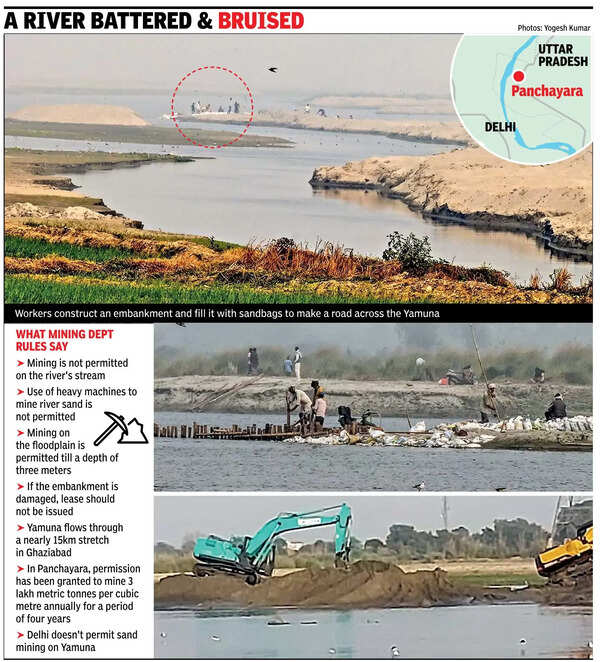
Pradeep Tyagi, who owns an agricultural patch on the Delhi side of the Yamuna, said trucks laden with mined river sand roll in and out daily, almost in an ant-like procession. “I have been seeing this since 2020. This year, it began a week ago,” he said. Ravindra, another villager, said earthmovers don’t stop even at night. “The miners are not scared of anyone. They do as they please,” he said. https://timesofindia.indiatimes.com/city/ghaziabad/sand-miners-lay-road-across-yamuna-illegal-mining-ravages-floodplains-endangers-ecosystem/articleshow/115827733.cms (30 Nov. 2024)
Govt dismantles sand miners’ road across Yamuna After a TOI report on Nov 30 revealed sand miners had built a road to join two banks of the Yamuna between Delhi and Ghaziabad and make way for excavators, local authorities rushed to the site at Panchayara village in Loni and demolished the pathway. The road had been laid by tethering wooden planks to the river bed, filling them up with sandbags and then with sand to make it look like any other part of the heavily silted river. The road was built by the official lease holder for sand mining in the area, who had told TOI he had done nothing wrong. There were other violations of lease conditions like taking heavy machinery to the banks that the TOI report had pointed out. It wasn’t clear what action had been initiated against the lease holder. https://timesofindia.indiatimes.com/city/noida/authorities-take-action-illegal-sand-miners-makeshift-road-across-yamuna-dismantled/articleshow/115875210.cms (02 Nov. 2024)
SC sets aside ‘completely erroneous’ NGT order Taking serious note of the massive illegal sand mining carried out in Dhasan River in Jhansi, the Supreme Court has set aside the NGT order and asked the tribunal to hear the matter again. Observing that the fact finding recorded in the NGT order was completely erroneous, a two-judge Bench of the apex court, Justice Abhay S. Oka and Justice Ujjal Bhuyan, has said that the tribunal ought to have gone into the allegations of breach of the terms and conditions made in the application before it.
Advocate Akash Vashishtha, appearing for the appellant, Naveen Kumar, submitted that 31 paragraphs pointing out violations of 49 General and Specific Conditions imposed by the Environmental Clearance (EC) were disregarded outright by the tribunal. The observations of the tribunal in the order were completely inconsistent with each other, he said. The NGT order was in complete breach of the EC, he added. https://www.newindianexpress.com/nation/2024/Feb/15/sc-sets-aside-completely-erroneous-ngt-order-allowing-dhasan-river-sand-mining-application (15 Feb. 2024)
Haryana Sand mining racket busted in Palwal Sharing details, DSP Rajdeep Mor of the flying squad said a stock of around 400 metric tonnes (MT) of river sand mined illegally was found in the fields at Sultanpur village, which was located in the vicinity of the Yamuna river, in the district following a raid conducted on Friday (Nov. 08). He said while the sand was lying dumped at three places, there was no claimant found at the spot that led to the suspicion that the sand had been mined illegally and without any permission from the department concerned by some who had been involved in this type of activity.
The officials of the Revenue Department, including the Patwari of the region, have been asked to take action against the owners of the land, on which the stock had been detected. The DSP said no official record of the sand had been found by the team. It is claimed that a racket of illegal mining of river sand is reported to be in some of the villages located adjacent to the river in the district. While the stock was seized, the officials of the departments concerned have been asked to lodge an FIR against the owners of the land or those involved in the racket. https://www.tribuneindia.com/news/haryana/cm-flying-squad-busts-sand-mining-racket-in-palwal-detects-400-mt-stock/ (10 Nov. 2024)

Unabated excessive riverbed mining in Yamuna threatening the structural safety of Nagli bridge connecting Yamuna Nagar and Saharanpur. (Dainik Jagran, 18 Nov. 2024)
यमुनानगर के नगली घाट पर 140 करोड़ की लागत से बनाए जा रहे पुल के पास खनन हो रहा है। यहां से ओवरलोडेड ट्राले गुजरने से पुल का निर्माण होने से पहले ही क्षतिग्रस्त होने का खतरा मंडरा रहा है। पुल का 70 प्रतिशत निर्माण हो चुका है। https://www.dainiktribuneonline.com/news/Haryana/threat-to-the-under-construction-bridge-connecting-haryana-uttar-pradesh-71182/ (08 Nov. 2023)
YAMUNA WETLANDS, LAKES, WATER BODIES
Noida Lack of upkeep keeping winter birds away from wetlands Okhla Bird Sanctuary has not yet welcomed any winter migratory water bird species so far this year. The sanctuary’s deteriorating condition is believed to be the reason behind the absence of these avian visitors. Similarly, Surajpur wetland has also experienced a lack of winter birds, with only five species observed as of last week against 15-20 species last year. Over the past few years, the sanctuary’s ecosystem has been negatively impacted by various factors, resulting in a diminished capacity to attract and support the wide array of migratory birds that previously frequented its waters.
Ecologist TK Roy told TOI, “Unfortunately, due to mismanagement and the destruction of wildlife and birdlife habitats, the sanctuary has been transformed into a highly disturbed entertainment park.” Roy added that unauthorised concrete structures have been erected on the grounds, which has further degraded the natural environment that once supported a thriving ecosystem. As a result of these detrimental changes, the resident water bird population has suffered a significant decline, with fewer than 15 species now present in the sanctuary — and their numbers have dwindled to alarmingly low levels. https://timesofindia.indiatimes.com/city/noida/winter-birds-absent-from-noida-wetlands-due-to-neglect/articleshow/114891924.cms (03 Nov. 2024)
Red faces at eco-tourism event in Okhla A govt eco-tourism event at Okhla Bird Sanctuary ended in many red faces as the main attraction – water birds – were missing conspicuously. Bird watchers and environmentalists criticised the event, saying it showed the degeneration of the bird sanctuary because of poor maintenance. Projects like ‘eco-tourism’, they said, had further affected the natural habitat, by relentlessly driving up footfall — which touched nearly 70,000 last year — and building watch towers and trails to draw more people, at the cost of the sanctuary’s natural wealth, its host and visiting bird species.
Winter migratory birds, among them Common Teal, Northern Shoveler, Northern Pintail, Gadwal, Common Pochard, and Bar-headed Geese, which usually start reaching the sanctuary by Oct, have not made a pit stop at Okhla this year yet. “The transformation of Okhla Bird Sanctuary into an entertainment venue, under the label of eco-tourism, by the forest division has severely impacted its ecosystem. This commercialisation, single-mindedly aimed at revenue generation, has significantly degraded the avian habitat,” said ecologist and ornithologist TK Roy. https://timesofindia.indiatimes.com/city/noida/okhla-bird-sanctuary-eco-tourism-event-flops-as-water-birds-go-missing/articleshow/115029388.cms (07 Nov. 2024)
Delhi Construction on pond land raises concerns In the urbanised village of Budhela, near Vikaspuri in West Delhi, the construction of a cultural complex for the Sahitya Kala Parishad was continuing on the land where a pond once stood, the residents said. In a recent letter addressed to the Delhi Development Authority (DDA), the Tehsildar (Dwarka) noted that the said land was registered as ‘Johar ‘in revenue records. The term ‘Johar’ stands for a traditional village pond. “Considering the above said facts and take necessary action according to the Rules and submit an action taken report to the office of District Magistrate,” it added.
Paras Tyagi, a village resident, said, “We are stuck between the DDA, which is the land-owning authority and the Delhi government which is managing the site. The DDA is not in a position to act against the construction as it not managing the land.”
Documents from the Delhi Parks and Gardens Society indicate that four ponds were originally listed in Budhela village, including the johar in question. In August 2021, the Wetland Authority of Delhi also included the pond in a list of 1,040 waterbodies identified and assigned unique identification numbers. The authority’s records show that the pond covered 0.6 hectares. https://www.newindianexpress.com/cities/delhi/2024/Nov/09/construction-of-cultural-complex-on-pond-land-in-delhis-vikaspuri-village-raises-concerns (09 Nov. 2024)
WATER OPIONS IN YAMUNA BASIN
Vikalp Sangam Water conservation by Meo communities This article explores the transformative work of Tarun Bharat Sangh (TBS), an NGO that has rejuvenated over 16,000 traditional water bodies, including Johads and revived dead rivers including Sairni, Tevar, Jahajwali, Tildeh, Ruparel, Agrani, Bhagani, Sarsa, Arvari, Maheshwra, Sahibi across Rajasthan, Haryana and Maharashtra, without relying on modern civil engineering. Through collaborative efforts, TBS and the Mewatis have not only built resilient water infrastructure but also challenged prevailing misconceptions, proving that their eco-centric practices offer valuable insights for addressing today’s global climate and water crises. https://vikalpsangam.org/article/how-the-meo-community-fights-stereotypes-with-sustainable-water-management/ (29 Oct. 2024)
Uttar Pradesh River rejuvenation by Women In recent months a story from a remote village of Jhansi district (Uttar Pradesh) that attracted attention at the national level has been that of the efforts of about 18 women volunteers of Simravari panchayat for the rejuvenation of Ghurari river. This river has been in decline after an important check dam got damaged and there was growth of weeds. This panachayat has about 18 jal sahelis or water protector volunteers. They decided to take up the work of creating a sack bund on their own as well as cleaning weeds. In Mar-Apr, they filled up nearly 1000 sacks & placed these at a carefully selected place in the river to provide a temporary bund. https://countercurrents.org/2024/11/rejuvenation-of-river-by-women-water-protectors-of- (15 Nov 2024)
YAMUNA URBAN WATER
Noida Borewell, 2 RO plants sealed for illegally extracting groundwater Officials from Noida Authority, the ground water department and the district magistrate’s office sealed an illegal borewell and shut down two unauthorised reverse osmosis (RO) plants during inspections at two localities on Friday (Nov. 29). The team conducted the inspections after a complaint was filed online about illegal groundwater exploitation in the areas.
“During the operation, an illegal borewell installed on a land near the Hindon river was sealed and two RO plants operating without authorisation in FNG Vihar were shut down,” said Vivekanand Mishra, city magistrate, Noida. “Penalties will be imposed on those running unauthorised borewells and RO plants. This drive is not a one-time effort. We will continue to conduct joint inspections and ensure that such illegal activities are curbed at their roots,” the officer said. https://timesofindia.indiatimes.com/city/noida/noida-authorities-crack-down-on-illegal-borewells-and-ro-plants-amidst-severe-groundwater-depletion/articleshow/115851978.cms (01 Dec. 2024)
Groundwater comes out while digging pit, govt stalls project During a visit to the site on Tuesday (Nov. 05), it was found that an 11m-deep basement excavation caused water to rise to the raft (concrete slab), necessitating pump usage to prevent structural damage, groundwater officials said. Officials noted that the Noida Authority had previously granted permission to the builder for a 15m-deep basement excavation. However, the current development has raised concerns about the Authority’s decision-making process, particularly regarding the absence of proper groundwater level assessment for the plot.
Previously, in July, the DM instructed the three industrial authorities—Noida, Greater Noida, and Yamuna—to assess groundwater levels of each plot before approving basement excavations for developers. However, a subsequent RTI inquiry revealed that no action has been taken on these directives thus far. Activist Vikrant Tongad had recently filed an RTI asking the Noida Authority, “De-watering has to be done for digging the basement. Therefore, depth of basement should be reduced so there is no problem in extracting groundwater. Provide a copy of the order in which the authority has decided to reduce the depth of the basement?” https://timesofindia.indiatimes.com/city/noida/up-government-halts-commercial-project-due-to-groundwater-concerns/articleshow/115063472.cms (08 Nov. 2024)
Residents sprinkling ‘rain’ to tackle toxic pollution With panic setting in because of toxic pollution levels in Delhi-NCR this week, several housing societies in Noida resorted to sprinkling water from high-rise terraces to settle dust and pollutants, to create a rain-like effect. Several RWAs also sprinkled water on the roads and pavements that are adjacent to their societies. Meanwhile, the Noida Authority has also been sprinkling water on 100 to 125 km stretch daily. While any initiative to tackle pollution is a welcome one, sprinkling of water can at best have a localised limited impact when the entire airshed is highly polluted. https://timesofindia.indiatimes.com/city/noida/noida-condos-combat-toxic-pollution-with-sprinkler-rain-initiative/articleshowprint/115500849.cms (21 Nov. 2024)
Delhi Cloud seeding a misguided fix for pollution crisis Over the past five years, data showed that during peak pollution episodes in Delhi and the surrounding areas, clouds are rarely present. Without clouds, cloud seeding becomes ineffective, raising questions about its feasibility in such conditions. “Cloud seeding requires the presence of moisture-laden clouds. Delhi’s winters are typically dry with minimal cloud cover, making seeding ineffective. The success of cloud seeding is not guaranteed, as it heavily depends on pre-existing weather conditions and precise execution,” said Dr Sachin Ghude, IITM scientist.
According to the expert, during winter, Delhi often experiences temperature inversions, trapping pollutants near the surface. “These stable atmospheric conditions do not favor the development of clouds that could be seeded. The scale of Delhi’s pollution problem is vast, requiring massive, continuous rain over a large area to have a measurable impact,” he added. Even if a few isolated clouds could be seeded—an unlikely scenario—it would not result in heavy or widespread rainfall. According to Dr Ghude, the effort required to generate sustained rainfall for effective pollution control is neither practical nor feasible. https://indianexpress.com/article/cities/pune/iitm-pune-cloud-seeding-misguided-fix-for-delhi-pollution-9678560/ (20 Nov. 2024)
Solid waste management rules remain on paper: SC Expressing concern over “unchecked waste accumulation at landfill sites, waste from construction, and the risk of fires at waste storage areas,” the Supreme court in Nov 11 order has warned the authorities of “harsh orders” if the Solid Waste Management Rules, 2016 were not implemented in a time-bound manner.
While hearing a 1985 PIL on pollution filed by lawyer-turned environmental activist MC Mehta, a Bench led by Justice AS Oka directed Delhi Chief Secretary to call a meeting of the Municipal Corporation of Delhi (MCD) and other stakeholders and come up with a time-bound schedule for implementation of the Solid Waste Management Rules, 2016. “If we find that all other authorities do not come together and tell us the time-bound schedule for implementation of the 2016 Rules, the Court may have to consider passing harsh orders,” it said, next hearing on Dec 16. https://www.tribuneindia.com/news/delhi/solid-waste-management-rules-remain-on-paper-sc-warns-delhi-govt-mcd-of-harsh-orders/ (16 Nov. 2024)
RELEVANT REPORTS
Kumbh 2025 Can we treat Ganga as River All Round the Year? Shutting down some polluting industries, releasing water from upstream Tehri dam, diverting sewage carrying stream from the Ganga and temporarily ensuring better functioning of the sewage treatment plants, solid waste collection and Central Effluent Treatment Plants are some of the measures taken every time there is a Kumbh Mela and the same may be done this year too. All these are minimum measures necessary for treating Ganga as a river. But should we not be treating Ganga as a river all-round the year? https://sandrp.in/2024/11/18/drp-nb-181124-kumbh-2025-can-we-treat-ganga-as-river-all-round-the-year/ (18 Nov. 2024)
Uttar Pradesh Polluting industries to be shut for Kumbh Industries that have the potential to discharge into the Ganga, Yamuna and their tributaries across UP will be closed in phases for a total of 24 days for the ‘shahi snans’ during the Maha Kumbh in Prayagraj from Jan 13. UP Pollution Control Board regional officer Vikas Mishra said the govt has identified several industries in the catchment areas of eight western UP districts — Ghaziabad, Bijnor, Saharanpur, Muzaffarnagar, Shamli, Meerut, Baghpat, and Hapur — those empty effluents in the two rivers and their tributaries. Nine of them are in Ghaziabad alone. A roster, the official said, has been chalked out to ensure these units shut down at least nine days prior to the dates corresponding to each of the six ‘sahi snans’ between Jan 13 and Feb 26. https://timesofindia.indiatimes.com/city/noida/closure-of-9-polluting-factories-in-ghaziabad-for-maha-kumbh-to-protect-ganga-and-yamuna/articleshow/115947442.cms (04 Dec. 2024)
International Conference on River Resilience: E-Flows to River Health through the lens of ecosystem services: Feb 27 to March 1, 2025. At NIT Calicut. https://sites.google.com/view/icrr-2025
Study River emits 5 times more methane after WTP A stretch of river into which treated wastewater has been discharged emits five times more methane than a stretch of river without that wastewater. This is according to research by Ida Peterse and Lisanne Hendriks of Radboud University. The paper is published in the journal Science of The Total Environment. For the study, microbiologist Peterse and ecologist Hendriks measured methane emissions at different points of the Linge and Kromme Rijn rivers. Peterse said, “Using a floating chamber, we caught the gases rising from the river on the water surface and analyzed them. We also investigated which nutrients were in the water and in the soil.”

The researchers thus show that the treated water, although clean according to Dutch standards, has effects on a river. Hendriks said, “The treated water also contains nitrogen, phosphate and carbon. All those nutrients in the water cause more algae to grow, for example. These eventually die and sink to the bottom, which in turn is an ideal situation for methane-producing micro-organisms.” Since that process takes a while, methane emissions are not much higher just after a discharge point. A bit further on, however, they are. Peterse added, “Although water discharged into rivers meets Dutch standards, it is important to realize that it still contributes to higher methane emissions. Since water systems like rivers are 50% responsible for methane emissions, this is something we might be able to address.” https://phys.org/news/2024-11-river-emits-methane-wastewater-treatment.html (15 Nov 2024)
MoEF Rules under new Water Act notified The Rules come in the backdrop of the amendments made to the Water Act earlier this year, wherein offences and violations of the Act were decriminalized, replacing them with penalties instead. Earlier in July, the Union Environment Ministry also notified Rules exempting non-polluting ‘white’ category industries from obtaining prior permissions to establish and operate under the Water Act, to give effect to certain amendments in the Act.
The amendments had also allowed the Centre to appoint officers to adjudicate offences, violations and determine penalties. “The CPCB, SPCBs, Pollution Control Committees and Integrated Regional Offices, in their respective jurisdictions, through their authorized Officers, or any other persons, may file a complaint …to the adjudicating officer regarding any contravention committed under sections 41, 41A, 42, 43, 44, 45A and 48 of the Act,” the new Rules state. These sections relate to contravention of norms on releasing industrial effluents and pollutants. https://indianexpress.com/article/india/rules-under-new-water-act-notified-how-inquiry-and-penalties-process-will-work-9665847/ (12 Nov. 2024)
EC permits for low-polluting industries waived While the government is pushing this move to promote the ease of doing business, environmental experts said this will only worsen the monitoring of industrial pollution. Bhavreen Kandhari, a Delhi-based environmental activist, said that the latest government notification is a “dangerous precedent”, prioritising short-term economic gains over long-term sustainability and public wellbeing. “In an era when nations, including India, are committing to implement stricter environmental controls to combat climate change and protect public health, decisions to relax such safeguards are alarming,” Kandhari said. She also explained that the role of state pollution control boards is crucial because these bodies are better equipped to address local environmental conditions and enforce compliance with pollution standards. https://theprint.in/environment/govt-waives-environmental-permits-for-low-polluting-industries-in-push-for-ease-of-doing-business/2356437/ (14 Nov. 2024) Saying that it has complied with a “long standing demand by industry,” the Union Environment Ministry has exempted 39 categories of industries from the mandatory requirement of approaching SPCB for permission to run their industries. https://www.thehindu.com/sci-tech/energy-and-environment/centre-exempts-white-category-industries-from-key-state-pollution-board-permits/article68868439.ece (15 Nov. 2024)
Draft bill on IWRMA circulated among states A draft model bill proposing to set up an Integrated Water Resources Management Authority which will be responsible for developing water security plans from villages to cities, groundwater management and floodplain management has been circulated among the states. Rakesh Kumar Verma, Additional Secretary, Department of Water Resources, said on Nov 12 that the government has proposed the Integrated Water Resources Management Authority (IWRM) at the state level, which will coordinate and integrate efforts of multiple water-related departments and agencies. “A draft model Bill has been circulated to all the states. This state IWRM authority, under the overall supervision of an IWRM council headed by chief minister, has been vested with various regulatory powers to set the direction of water sector development,” he said. https://www.newindianexpress.com/nation/2024/Nov/12/draft-bill-on-integrated-water-resource-management-authority-circulated-among-states- (12 Nov. 2024)
Compiled by Bhim Singh Rawat (bhim.sandrp@gmail.com)
Also see: Yamuna Manthan 07 Nov. 2024; Yamuna Manthan 03 Oct. 2024
Follow us on: www.facebook.com/sandrp.in; https://twitter.com/Indian_Rivers
In memory of Late Manoj Mishra, Convenor of Yamuna Jiye Abhiyan, SANDRP is publishing monthly Yamuna Manthan from Feb 2024. It’s a compilation of developments related to Yamuna River. This is Eleventh such monthly report in the series and we will try to release same updates in the first week of every month. The main purpose of the exercise is to monitor, document and research all the issues affecting the Yamuna rivers and riverine people so that all concerned may get updated information on ground realities of the river and its people. All are requested to read, share and give suggestions to improve it.

 SANDRP