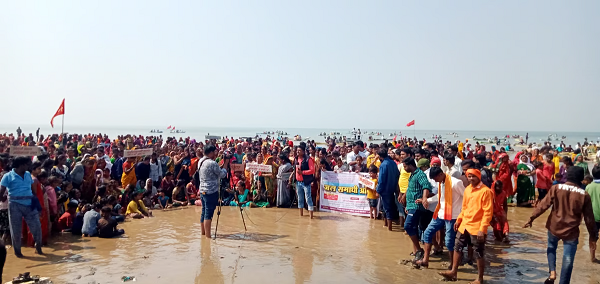
(Feature Image: Fisherfolk Stage ‘Jalsamadhi’ Protest Against Solar Power Project At Jayakwadi Dam, Seek Cancellation. FPJ Feb 2024)
Marking World Fisheries Day 2024, this yearend round up complies the top ten reports outlining how the fish and fisherfolks in India have been facing existential crisis due to govts’ apathy, various developmental projects and growing climate change threats. The first part of the annual overview covering positive developments on fish, fisheries and fisherfolks can be seen here.
1 Gujarat Bhadbhut barrage on Narmada estuary killing a way of life In Bhadbhut village, one gets the impression that they are looking at the last generation of fisherfolk here who have come out with their boats to catch fish in the waves. The village is situated in Bharuch district at the spot where the Narmada river meets the Gulf of Khambhat, an inlet of the Arabian Sea. The construction of the Sardar Sarovar Dam (SSD) in 2017 caused a reduction in the flow of freshwater in the Narmada. As a result, fish became scarce. The income of fishers went down. The Bhadbhut barrage is being constructed 125 kilometres downstream from the SSD and about 25 km before the river merges with the sea. It is about 30 per cent complete. The fisherfolk look at the direction of the dam site with despair. Once it is completed, the remaining fish, fishers and boats in the area will also be gone, they say.
Himanshu Thakkar, an environmental activist, dam and water expert, said the Bhatbhut barrage was needed to mitigate the SSD’s ill effects. This is the second mistake being made to correct the first one, he said. Thakkar remembered that 250 fishermen from Bharuch district in 40 boats had showed black flags when Prime Minister Narendra Modi came to lay the foundation stone of the Bhadbhut barrage in 2017. “After the SSD, they are now building the barrage at Bhadbhut to mitigate the problem of increased salinity in the lower reaches of the Narmada. There was no public hearing for this. There is no monitoring the environmental impacts. What impact the two dams will have on the river and the community remains to be seen,” said Thakkar. Regarding pollution in the river and sea due to industrial wastewater, he said, “In 1974, the Water (Prevention and Control of Pollution) Act was promulgated. 2024 is the golden jubilee year of this legislation. We have completely failed to control water pollution. Why don’t companies treat and recycle their industrial wastewater?”
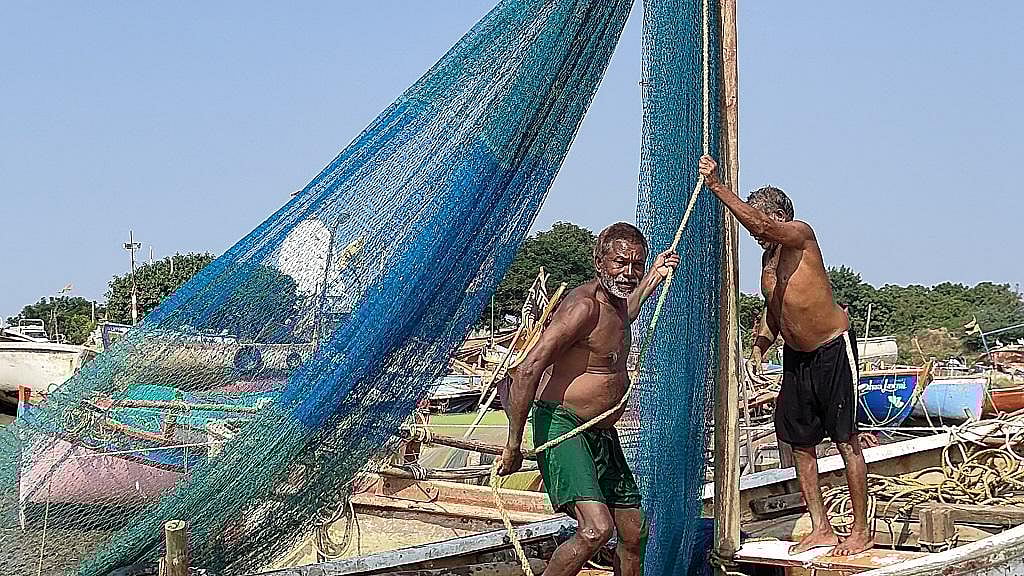
Kamlesh S Madhiwala, a lawyer and president of the Bharuch District Machhimar Samaj, a non-governmental organisation, said, “The Bhadbhut barrage will affect the livelihood of 15,000 fisher families. Last year, Hilsa worth Rs 1,000-1,200 crore was traded in Bharuch. Fishing families earned between Rs 5 lakh and Rs 15 lakh. Everyone is at risk of unemployment. When you do not have the means to provide employment to so many families, why are you taking away their traditional employment? For whom are they building dams?” https://www.downtoearth.org.in/environment/just-transition-in-petrochemicals-bhadbhut-barrage-coming-up-on-the-narmada-estuary-in-bharuch-is-killing-a-way-of-life-94130 (29 Jan. 2024) The same report by Varsha Singh can also be seen in Hindi here. https://www.downtoearth.org.in/hindistory/river/dam/for-whom-are-bhadbhut-dam-being-built-question-of-fishermen-of-narmada-94098 (25 Jan. 2024)
Fisherfolks oppose salt industry in Narmada delta Thousands of fisherfolks of Bharuch district, who are going to lose their livelihoods due to the under construction Bhadbhut Dam on Narmada river, have resumed their protests. They are also protesting against the allotment of their land to the salt industrialists of Kutch. (DRP 080424) The fisher people and others oppose the shocking proposal of govt to hand over 18.49 sqkm area to salt industrialists in Narmada delta. They have submitted a memorandum to the collector. It is also an issue in Bharuch Parliamentary seat. https://www.youtube.com/watch?v=TuIfDuKnE6M (18 Mar 2024)
2 Madhya Pradesh Omkareshwar solar project subject to final HC order The Jabalpur high court in an interim order said that work on Omkareshwar solar energy project would be subject to its final order. The court is hearing a petition filed by two fishermen’s societies challenging the project on the ground that it’s jeopardising their livelihood as they need to catch fish in the Omkareshwar dam reservoir and sell them to make a living. The court also issued notices to the state government and M/s Rewa Ultra Mega Solar Ltd, the company executing the project.
The fishermen’s cooperative societies — Maa Satmata Sailani Matyasodyog Samiti and Maa Kajalrani Vishthapit Adivasi Machhuara Sahkari Samiti — in their petition said that the state government is executing a 600 MW solar energy project in the reservoir of Omkareshwar dam and the contract for this has been given to Rewa Ultra Mega Solar Ltd. The company is installing solar panels on the reservoir, which has put fishing at risk and their livelihood in danger. The state government has no rehabilitation plan for them, they say.
Referring to the environment and social impact report on Omkareshwar solar energy project, they said that the report admits that it would put an end to the livelihood of hundreds of fishermen, and they should be given financial assistance and jobs in the project as their rehabilitation. But no initiative in this regard has been taken nor they have been consulted on the issue ever, say the petitioners. They demanded that a rehabilitation plan involving a permanent job to them under the project and benefits of rehabilitation under rehabilitation rules 2013 be provided to them. https://timesofindia.indiatimes.com/city/bhopal/omkareshwar-solar-project-subject-to-final-hc-order/articleshow/107768320.cms (17 Feb. 2024) The petition also demands that the work of installing solar plates in their area be postponed until all the fishermen get these benefits. Next hearing on March 4. https://www.spsmedia.in/dam-and-displacement/omkareshwar-solar-energy-project-notice-issued-to-government-on-petition-of-fishermen/ (14 Feb. 2024) https://www.bhaskar.com/local/mp/khandwa/news/notice-to-government-on-omkareshwar-solar-project-132586206.html (14 Feb. 2024)
Fishermen lose homes, livelihood to solar plant 1877 members of the fishermen’s community are reported to be affected by the Omkareshwar Floating Solar Project in Madhya Pradesh. Ground report from the affected village Ekhand. https://groundreport.in/groundreport/omkareshwar-floating-solar-and-fishermen-livelihood-question-4536539 (04 May 2024) Omkareshwar Floating Solar Power Park: Fishermen Lose Their Livelihood. https://www.youtube.com/watch?v=exta1PPFCoY (19 June 2024)
The world’s largest floating solar plant under installation in Omkareshwar reservoir has been badly damaged by wind on April 9 2024 even before commissioning. https://www.abplive.com/states/madhya-pradesh/asia-largest-floating-solar-power-plant-damaged-due-to-strong-storm-in-narmada-omkareshwar-dam-in-khandwa-mp-ann-2661705 (10 April 2024) Narmada Hydroelectric Development Corp has started evaluation of the damage but is confident the plant will be back to producing power soon. Part of the plant went operational last week, and this is the section that took a hit. The floating plant, built on the backwaters of Omkareshwar Dam, was ready for launch but it was slammed around by 50kmph winds in a storm that hit on April 9. No employees were injured. It is joint venture of NHPC & Madhya Pradesh govt. https://timesofindia.indiatimes.com/city/indore/storm-damages-worlds-biggest-floating-solar-plant/articleshow/109231119.cms (13 April 2024)
3 Maharashtra Jayakwadi fishermen warn of protest against solar plant Fishermen from Chhatrapati Sambhajinagar and neighbouring Ahmednagar district have threatened to start a Jal Samadhi from Feb 7 as the govt authorities have not taken a call on cancelling the proposed floating solar power project at Jayakwadi dam yet. In a letter addressed to different govt authorities & public representatives, the Save Jayakwadi Fishermen committee said that fishermen, along with their families, will meet a watery grave due to the project. Union minister of state for finance Bhagwat Karad — the brainchild of the project — however, was firm on its implementation & said he would take the fishermen into confidence before starting the works.
The fishermen said the project was being done in an illegal manner and would affect their livelihood. “The Centre and state are pushing the project in an illegal manner. The project is bound to flout all norms related to the core area and eco-sensitive zones of the Jayakwadi bird sanctuary. Also, it will snatch the income of fishermen,” Bajrang Limbore, the president of the committee, said. The fishermen also said the large panels coming up inside Nathsagar, the reservoir of Jayakwadi dam, would obstruct the entry of sunlight into the water. https://timesofindia.indiatimes.com/city/aurangabad/fishermen-threaten-protest-against-solar-plant-at-jayakwadi-dam-latest-news/articleshow/107246788.cms (30 Jan. 2024) Fisherfolks from Ahmednagar & Chhatrapati Sambhajinagar on Feb 7 gathered in large numbers to protest the floating solar project at Jayakwadi Dam. https://www.latestly.com/socially/india/news/floating-solar-project-at-jayakwadi-dam-fisherfolks-from-ahmednagar-and-chhatrapati-sambhajinagar-hold-protests-against-the-construction-of-proposed-solar-project-in-maharashtras-ahmednagar-watch-5743229.html (7 Feb 2024)
Fishermen go to NGT for scrapping of Jayakwadi floating solar plant The fishermen had earlier approached the Aurangabad bench of the Bombay high court with a similar plea, but the court had asked them to seek remedy from the Green Court first. Another leader of fishermen, Sambhaji Shingare, said that the Paithan MIDC police have started issuing prohibitary notices to fishermen to deter them from staging the agitation on Feb 7. “Many of us will meet our watery grave during ‘Jal Samadhi’ agitation. The govt is anyway snatching our livelihood & therefore it should allow us to die without using any pressure tactic,” he said.
Fishermen have also refuted claims of the authorities that talks were held to discuss the apprehensions of locals about the ill-effects of the project. Forest dept said that the project is still in conceptual stage. “The project has not received an official go-ahead from the forest dept. Only a preliminary survey was allowed to assess the depth of dam water,” a senior official said. Fishermen said that a station, as part of the floating solar power plant, is being set up at Mauje Katpur in Paithan taluka of Chhatrapati Sambhajinagar dist & a feasibility survey is to commence soon. https://timesofindia.indiatimes.com/city/aurangabad/fishermen-knock-on-ngt-doors-for-scrapping-of-jayakwadi-plant/articleshow/107444111.cms (6 Feb 2024)
4 W Bengal Flood drowned farming, fishing opportunities A flood originating in Sikkim in Oct 2023, covered farms along the Teesta riverbanks in the neighbouring W Bengal, with sand and silt, altering the agricultural landscape. The affected farmers & fishers are facing difficulties in accessing govt aid because of property rights and land ownership issues. The local people highlight the urgent need for an embankment to prevent future flooding. A makeshift dam that was shielding homes from the Teesta river’s flooding has been impacted by the Oct flood.
The floods, that occur once every 5-10 years, used to bring silt that revitalised lands, enhancing yield and soil quality, according to Manoranjan Biswas, deputy head of Chapandanga gram panchayat. The toll of the floods extends to the fishing communities that rely on the Teesta river for sustenance. Kankan Lahiri elaborated, “The water remains contaminated, with fish stocks depleted. Many have turned to migrant work or resorted to purchasing fish from elsewhere, with only a slight resurgence this Jan after a complete lull in Nov-Dec.” The farmers have not received any assistance from the govt following the flood, they say. One of the reasons is that around 60% of these lands are khas lands, officially owned by the govt, with no property rights granted to individuals, says Biswas.
There was a makeshift dam, ‘bashta’r bandh’ made with cement bags right next to the barrage, shielding the fields and houses in the area from floods in Teesta. It was constructed some five years ago under the Mahatma Gandhi National Rural Employment Guarantee Scheme by the local villagers. The flood affected this structure as the sand and silt covered it. The villagers now demand a dam to be constructed along that area, separate from the barrage, to protect the downstream region from further floods. https://india.mongabay.com/2024/03/sikkim-flood-drowned-farming-and-fishing-in-west-bengal/ (01 March 2024)
5 Manipur Loktak fishermen express concern over Govt’s push for inland waterways project The All Loktak Lake Areas Fishers Union, Manipur (ALLAFUM), has questioned the Manipur govt’s unilateral decision to advance the proposed Loktak inland waterways improvement project. The fishermen’ union contends that the state govt’s move lacks consultation with the local fishing community residing in and around the peripheral areas of the Loktak Lake, the largest freshwater lake in South Asia, in Manipur’s Bishnupur district. They expressed concern over the potential adverse effects on the lake’s ecology and the traditional livelihoods of fishermen families. https://www.icsf.net/newss/manipur-loktak-fishermen-express-concern-over-govts-push-for-inland-waterways-project/
Socio-Political & Environmental dynamics of Loktak For many reasons, whether empirical or scientific, Loktak Lake has been embroiled deep in controversies of sorts during these past four decades and continuing. One amongst the declared seventy five Ramsar sites in India, Loktak finds itself in a complicated situation on ground that has given it the status of an ‘aging lake’, perhaps kicking hard to keep itself afloat despite the many forms of pressures upon it, of which anthropogenic influences are paramount. The main ‘bone of contention’ is the Ithai Barrage which is seen as the root of all issues in the lake.

Their voice of dissent also reflects upon the pitiable conditions under which Manipur’s flagship mammal species – the Sangai, Manipur Brow-antlered Deer Rucervus eldii eldii – and the other wildlife are faring amid their deteriorating habitat in Keibul Lamjao National Park, which is often described as the ‘only’ floating national park in the world! The twists and turns continue to this day even as this feature is being written, with the lake managers always on the lookout for excuses to throw out the fishing community from Champu Khangpok floating island village. In one word, the fishers are “occupiers”, so say the lake managers. At this point of time, there are no alternatives for the fishers than to fight back as best as they can – for their rights to life in their territory. (Salam Rajesh) https://vikalpsangam.org/article/socio-political-and-environmental-dynamics-of-manipurs-loktak-ramsar-site/ (24 Jan. 2024)
‘Will remove Loktak Lake from Montreux record’ Loktak Development Authority (LDA) chairman Asnikumar Moirangthem has assured to work for the welfare of fish workers of Loktak while also committing to remove Loktak from the Montreux record. He said this during the International Day of Wetland observed by the All Loktak Areas Fishers Union Manipur & Champu Khangpok Floating Village Welfare Committee at the Champu Khangpok Floating Elementary School on Feb 2. Montreux Record is a register of wetland sites on the Ramsar list that are threatened by technological developments, pollution, or human interference. This year saw the participation of LDA & the Bishnupur District Administration. https://www.ifp.co.in/manipur/will-remove-loktak-lake-from-montreux-record (4 Feb 2024)
6 Assam Fishers dependent on Deepor beel loss livelihoods While the fishing community wants their rights within Deepor Beel to be defined, they said this should not be at the cost of denotifying the wetland as a wildlife sanctuary. The fishing community said members were aware their livelihood rights remain protected under the Wildlife Protection Act. According to Section 26 A of the Act, the limits of the area of a water body to be included within the sanctuary will be determined in consultation with the chief naval hydrographer, “after taking adequate measures to protect the occupational interests of the local fishermen”.
In fact, the fishermen often end up cleaning the wetland. They see large quantities of plastic floating on the wetland when they are fishing and try to collect the plastic, said Golak Das. The fishermen still use traditional wooden boats, not motorboats. According to Seema Talukdar of 7Weaves, more comprehensive studies need to be done on the fishing community of Deepor Beel. “Their fishing is based on their traditional knowledge which they have acquired by living in the vicinity of the beel for ages and yet their techniques are scientific,” Talukdar said.
The president of the Deeporbeel Paaspara Samabay Samiti, also named Golak Das, said, “What will the tourists come here for? When there aren’t enough birds and fishes like before, when the water is so dirty…what will they see?” Before attempting to turn the area into a tourist spot, authorities should instead clean the waterbody and stop all further pollution, he said. https://article-14.com/post/as-assam-s-only-wetland-protected-under-global-treaty-deteriorates-local-fishing-community-faces-loss-of-livelihood-66bc2476cfc17 (14 Aug. 2024)
7 Jammu & Kashmir Fishing community’s struggle for survival The Dal Lake is home to thousands of indigenous people known as the Haenz in common parlance. The Haenz or the Hanjis have been living in and around the lake for thousands of years. These people regard the lake as their home. The Hanjis are not a monolithic group but a community of many subgroups. One of the subgroups is the Ga’ed Haenz or the fishing community. Also called the Maahigeer, they live around the Dal Lake. They can be seen selling the fish along the banks of the Dal. But today, amidst environmental degradation and rampant urbanisation to attract tourists, the Hanji people are confronted with threats to their way of life. https://www.thequint.com/news/india/dal-lake-in-srinagar-a-fishing-communitys-struggle-for-survival#read-more (13 March 2024)
Dal Lake: Fishing community’s struggle The present condition of the Dal is the result of a complex mesh of activities happening in the past few decades, as the surge of residents and tourists has grown exponentially. The findings from the interviews of Hanji people are in congruence with what the research and the local reporting have been suggesting that sewage dumping, population rise and mismanagement is causing irreversible damage to the Dal.
While the beautification of Dal is thriving – with proper roads, footpaths, and new shops opening to cater to the growing population of tourists – the lake itself is slowly dying, and with that, the Hanji community is also slowly being removed from their ancestral fishing grounds. https://thewire.in/labour/the-drowning-jewel-tapestry-of-dal-lakes-decline-and-fishing-communitys-struggle-in-kashmir (01 March 2024)
NGT forms committee to tackle pollution in Dal The NGT has formed a joint committee to tackle pollution in Dal Lake. “The Committee will ascertain the sources of pollution in Dal Lake and will find out the persons/ entities responsible for the same and will take appropriate remedial and punitive action. The Committee will also prepare environmental management guidelines for houseboats,” the order dated Aug 21 stated. Next hearing on Dec 2, 2024.
The Tribunal was hearing a suo motu matter regarding the deteriorating condition of Dal Lake caused by the discharge of municipal sewage and other pollutants from various sources. The response from the Member Secretary of the J&KPCC revealed the unabated flow of untreated domestic water into channels and the violation of environmental norms. It further disclosed that untreated sewage flows into Dal Lake from areas like Telbal and Lalbazar. Additionally, there are about 910 houseboats in Dal and Nigeen Lake, and their wastewater often gets discharged into Dal Lake without any treatment. https://www.barandbench.com/news/ngt-committee-pollution-dal-lake-guidelines-houseboats (27 Aug. 2024)
8 Karnataka Protest warned over Netravathi RFD The ongoing Netravathi Riverfront Promenade project of Mangaluru Smart City Limited (MSCL), with an allocated budget of Rs 70 crore for 2.1 km, is unscientific and negatively impacting the livelihoods and operations of boat building and fishing enterprises, said Athaulla Rehman, president, Citizen Forum for Justice. He said on Jan 25, that boat building yards and fish net making establishments, which have obtained financial loans from MSME, Pradhan Mantri Matsya Sampada Yojana, and other financial sources, are currently facing the possibility of closure due to the construction of a wall-like structure along the riverside, which will result in cutting off the access to the river.
“The MSCL project is posing a threat of eviction to the boat building yards, fishnet making, and other establishments in the area leading to a reduction in the number of boatyard repairers and negatively impacting the local fishing industry in Mangalore. This potential closure would also lead to significant unemployment among thousands of skilled workers with minimal or no formal education, many of whom are beneficiaries of below poverty line (BPL) schemes. The MSCL has not conducted a social impact assessment or conducted public hearings regarding the project,” he said. He warned of staging a protest if their grievances are not addressed. https://timesofindia.indiatimes.com/city/mangaluru/protest-warned-over-riverfront-project/articleshow/107159385.cms (26 Jan. 2024)
RFD: NGT seeks report on CRZ, green norms violations Recognising the seriousness of the environmental and social issues associated with the project, NGT has taken suo motu cognisance and directed the formation of a joint committee to submit a detailed report on the project. The Netravati Waterfront Promenade Project has been mired in controversy due to alleged violations of Coastal Regulation Zone (CRZ) norms and environmental regulations. Managed by MSCL, the project has faced criticism for its potential adverse effects.
The primary objective of MSCL and its contracting agencies in filling soil in the intertidal zone is to acquire extra land for the project, as there is a lack of govt or port land, and subsequently create sketches and plans for the project based on the available land. Furthermore, there is no EIA report prepared for this project, which is crucial in evaluating its potential environmental effects, especially considering that the estuary is just a km away from the project site. The site is home to old trees and mangroves, serving as a natural feeding and breeding ground for various animals, birds, fish, crabs, molluscs and other marine life. NECF and various other environmental organisations have demanded an immediate halt to the project in this area due to CRZ-2011 norms and violations in conditional CRZ clearance granted by KSCZMA. https://www.downtoearth.org.in/news/water/netravati-riverfront-project-ngt-takes-cognisance-of-crz-environmental-norm-violation-allegations-seeks-report-95189 (22 March 2024)
9 Delhi Fishermen battling dying Yamuna & govt apathy Every year, the Delhi govt issues fishing licences but now it wants the community to stop fishing due to rising toxicity and depleting aquatic life. But fisherfolk are not ready to give up the profession they’ve inherited from their fathers and grandfathers. They’re also fighting a larger battle—for identity, respect, and a cleaner Yamuna. “Most senior officers do not even know that Delhi has fishermen,” said Gungun Kumar (37) who lives in a fishing colony in Sonia Vihar. Every year, he goes to the Delhi Development Ministry’s office to renew his licence only to be met with disbelief & disdain.
According to govt records, the fisherfolk in Delhi are ghosts. Their licences don’t recognise them as professional; those fishing for leisure get the same one. And so, they are not entitled to govt benefits like their counterparts in other states such as Gujarat, Tamil Nadu and W Bengal. And what good is a fishing licence when the river is dying, said Kumar. It’s a question licence-issuing officials ask them derisively when they queue up with their documents.
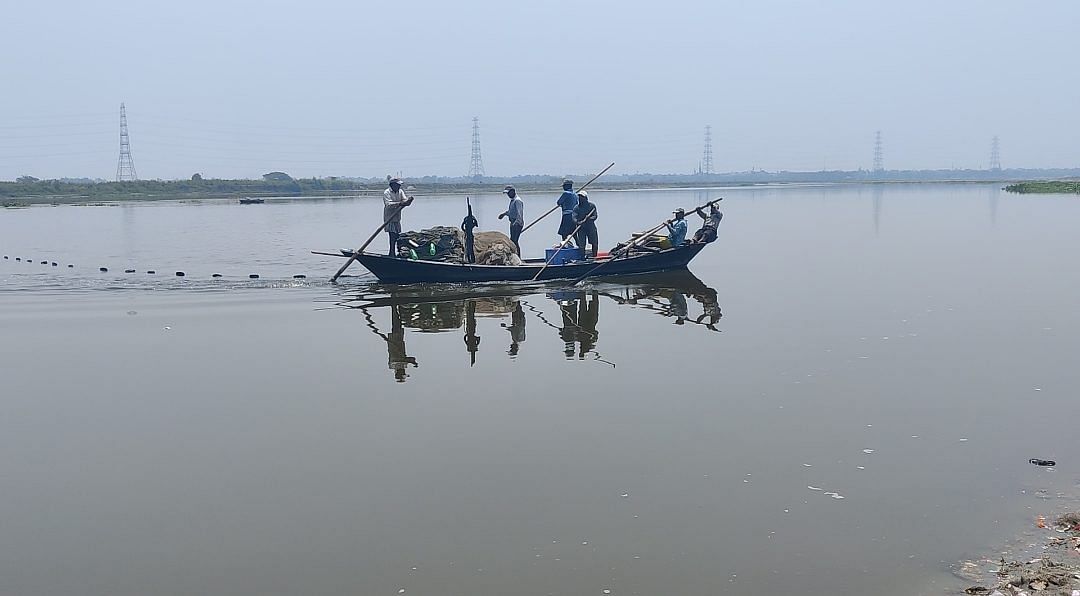
Now, a few fisherfolk are using Facebook, YouTube and WhatsApp to tell the city that they exist. They want to reclaim their identity, keep their skill from dying out, and reach consumers directly. Most of the fisherfolk at the colony in Sonia Vihar have moved on to other professions. They are labourers, drivers, factory workers and small-time entrepreneurs. But they haven’t put down their nets or boats. Every year before the monsoon, they go to the Yamuna to fish.
Most of the fisherfolk can trace their roots to W Bengal and Bihar. Their parents or grandparents migrated to Delhi for better employment opportunities, and settled along the banks of Yamuna—Burari, Sonia Vihar, Okhla—and continued their family profession. Back then, the catch was good, and the fish rates in local markets were higher than what they got in their villages. https://theprint.in/ground-reports/delhis-fishermen-are-battling-a-dying-yamuna-and-govt-apathy-what-good-is-a-licence/2106310/ (29 May 2024)
10 Rajasthan Lone Fisheries college in peril The Fisheries College under Maharana Pratap University of Agriculture and Technology in Udaipur is facing a critical shortage of faculty, putting its academic programs and the future prospects of students at risk. Being the only fisheries college in Rajasthan, the institution holds importance in limnology and ichthyology.Across India, there are more than 30 fisheries colleges. Some states like Gujarat, Tamil Nadu, and Maharashtra have three fisheries colleges each, supported by their governments.”
The current scenario is especially concerning given the ambitious “Pradhan Mantri Matsya Sampada Yojana” initiated by the Central Govt, aimed at leveraging fisheries resources for economic growth. The success of such initiatives relies on the availability of qualified professionals, making the resolution of the faculty shortage imperative. https://en.themooknayak.com/amp/story/education/the-lone-fisheries-college-in-rajasthan-in-peril-due-to-acute-faculty-shortage-ex-dean-urges-cm-for-immediate-intervention (13 Mar 2024)
More Reports on Fish, Fisherfolks in India
Report Small fisher, fish workers ignored by govt Small-scale fishers and fish workers are still often marginalized or ignored by governments, international organizations and businesses when environmental and commercial plans are devised & implemented says Michael Fakhri, Special Rapporteur on the right to food. https://www.icsf.net/newss/world-news-small-scale-fishers-and-fish-workers-are-still-often-marginalized-or-ignored-by-governments-says-michael-fakhri-special-rapporteur-on-the-right-to-food/
Small fishers want exemption from WTO curbs on subsidies India’s small and marginal fishers have demanded complete exemption from any WTO commitment for reducing subsidies on essentials such as fuel, nets, fishing boats and other fishing gear, for fishing up to 200 nautical miles (nm), as they say that it could drive them into further poverty. https://www.thehindubusinessline.com/economy/agri-business/indias-small-fishers-want-complete-exemption-form-wto-curbs-on-subsidies/article67867844.ece (20 Feb. 2024) The WTO’s 13th Ministerial Conference will seek to build consensus on the potential regulation of fisheries subsidies contributing to excessive fishing effort and capacity. India is advocating for the principles of common but differentiated responsibilities & respective capabilities, proposing a 25-year transition period for developing countries and addressing livelihood and food security concerns for fishermen. https://india.mongabay.com/2024/02/indias-stance-at-wto-balances-fisheries-subsidies-for-artisanal-fishers-and-sectoral-growth/ (09 Feb. 2024)
W Bengal Eviction of over 1 lakh small-scale fishers of Sundarbans More than 1 lakh fishers face eviction in the Indian part of the Sundarbans. Over 2 million people subsist on the Indian Sundarbans. Depending on seasonal variations in livelihood patterns, this number can be higher than 5 million. And this is based on the 2011 Census data.
Forming fishing-teams constituting three, four or five persons, the traditional small-scale fishers of the Sundarbans go out on seasonal fishing expeditions in the marine and estuarine waterways of the Sundarbans. The boats they go out on are non-mechanised – called ‘dinghy’ or ‘dinghee’ in local parlance – a word that had crept into the English language from South Bengal during the colonial times. They take turns to manually pull the oars, coursing through the tidal waterways of the Sundarbans, collecting fish, crab and at times honey.
Currently, the state authorities and even international agencies are observed to be espousing the causes of preservation of the vulnerable mangrove ecosystems and tiger conservation as pretexts to evict more than 1 lakh small-scale fishers of the Indian Sundarbans from their livelihood. No sincere efforts to account for and redress their vulnerabilities or to ensure their participation in the conservation of the ecologies which they depend on are being undertaken by the powers that be – at the grave expense of democracy in the Sundarbans. https://countercurrents.org/2024/08/on-the-imminent-eviction-of-more-than-1-lakh-small-scale-fishers-of-the-indian-sundarbans-from-their-traditional-livelihood/ (05 Aug. 2024)
Sundarbans fishermen facing existential threat Milan Das Sundarbans has become a victim of capitalism. The biodiversity of this mangrove ecosystem is at risk due to the unbridled tourism. The poor and marginalized are in danger of being evicted due to the dictatorship of the Forest Dept. New legal tactics are being adopted to create new threats to the livelihood of fishermen. https://climateeast.in/unchecked-avarice-and-abuse-of-power-push-sundarban-fishers-to-the-brink/ (19 Nov. 2024)
Kolkata The lost Lakes, the city found Dr Bidhan Chandra Roy envisaged Salt Lake to accommodate the growing population of Calcutta, especially after the influx of hundreds of thousands of refugees post-Partition. It was meant for people from middle and low-income groups. Today, however, the upscale satellite town is far removed from that dream. The expanding network of the East-West Metro weaving its way through colossal mansions, shopping malls, multiplexes and a giant sports stadium are in sharp contrast to the interconnected bheris tended by the fishermen of yesterday. https://www.telegraphindia.com/culture/the-lost-lakes-the-city-found-a-recount-of-stories-of-salt-lakes-birth-62-years-ago/cid/2013212 (14 April 2024)
Madhya Pradesh Mahseer existence threatened by dams By Raj Kumar Sinha The construction of various dams on the Narmada river in the last few decades has obstructed the natural flow of its water, which has endangered the existence of the state fish Mahseer. Continuous sand mining in Narmada, illegal fishing in rivers, use of explosives to catch fish and construction of dams are also a major reason for the decrease in the number of Mahseer. Earlier, it was 30 percent in Narmada compared to other fishes, which has now decreased to 2 percent. There are 215 species of fish in the state. Out of these, 17 are in danger of extinction. https://www.cenfa.org/21-november-fisheries-day/ (21 Nov. 2024)
Gujarat Industrial pollution in Dahej destroyed fisheries Dahej is one of several villages in the area where local lives have changed for the worse due to industrial expansion. Many villages in Bharuch district, including Dahej, Suwa, Lakhigam, Kavi, Sarod, Hansot, and Kantiazar, have traditionally depended on fish farming for livelihood. The traditional means of livelihood of the community living in Asia’s number one industrial region are shrinking and new industrial units are emerging rapidly. Local people are struggling for livelihood and the graph of profits of industrial units is constantly on the upward trend.
Dahej is important environmentally as the freshwater of the Narmada enters the saline waters of the Gulf of Khambhat. Many types of fish and sea life including shrimp, bumla, salmon, boi, makul are found here. At the same time, the area is also the breeding ground of the Hilsa (known as ‘palwa’ in Gujarat) fish. The economy of many villages depends on it. Rivers and seas have become easy means of disposal of industrial waste.
The value of the country’s chemical industry is projected to grow from $220 B in 2022 to $300 B by 2025. The GPCB gave environmental clearance based on the study from Dec 2021 to Feb 2022 to develop industrial parks and multi-product SEZs in 715-ha spread over Pakhajan, Ambhel & Limdi villages of Vagra taluka. https://www.downtoearth.org.in/news/environment/just-transition-in-petrochemicals-dahej-near-bharuch-is-asia-s-richest-industrial-zone-but-what-of-its-local-fisherfolk-93783 (8 Jan 2024)
Changing landscape spurs decline in ginger prawn fishing Little Rann of Kutch supports two seasonal livelihoods, prawn fisheries and inland salt farming. The region is the largest nursery ground of the ginger prawn species endemic to the Gulf of Kutch and almost 50,000 fishers on foot earn an income from fishing it juvenile. After the fishing season is when salt production from sub-soil brine takes place. However, the expansion of salt works is impacting prawn fisheries which are on the decline. https://india.mongabay.com/2024/02/changing-landscape-spurs-decline-in-ginger-prawn-fishing/ (01 Feb. 2024)
When two livelihoods collide The brackish water ecology of the Little Rann of Kutch, is made up of a mix of seawater, river run-off and rainwater, which makes it an ideal nursery for ginger prawns. This hydrological regime where ginger prawn thrives is broken by the expansion of marine salt works and reduced freshwater runoff from rivers. Rann Sarovar, a proposed freshwater lake in the Little Rann of Kutch, would, if approved, deal a final blow to this small-scale fishery. https://india.mongabay.com/2024/02/when-two-livelihoods-collide/ (2 Feb 2024)
Maharashtra Coastal Road spells doom for the city’s Kolis Lives and livelihoods of the oldest inhabitants of Mumbai, the Kolis, have been drastically affected ever since the Coastal Road construction began. The ongoing infrastructural work has not only altered the familiar coastline of the city but also the way the fisherfolk have been forced to live. At Worli Koliwada, one of the more affected settlements, the fisherfolk have had to contend with difficulty in navigating the waters, depleting numbers of fish, and a large dip in their earnings. Fishing, which was their major occupation, is not sufficient now as fish breeding grounds have borne the brunt of the construction work. Also, they have had to put up a long struggle merely to have their concerns heard in the corridors of power. This photo essay narrates the story of Worli Koliwada facing the onslaught of the city’s development agenda. (Aboli Maharwade) https://questionofcities.org/mumbais-shiny-new-coastal-road-spells-doom-for-the-citys-kolis/ (7 April 2024)
Port project cleared despite opposition from fishing villages A fisher, Ramdas Vinde said, “The govt wants to develop this area with the port but we are already developed. We have a thriving gold-die and fishing business. We employ so many people. Instead of developing us the govt is destroying us.” Even if the port developers assure the community that villages won’t be displaced, Vinde said they would have to leave as living next to such large port would deprive them of a livelihood and they fear that they would be displaced. https://india.mongabay.com/2024/04/port-project-in-maharashtra-cleared-by-environment-ministry-despite-opposition-from-fishing-villages/ (23 April 2024)
Fisherfolks seek compensation for loss due to Atal Setu The Koli Fishing Community has moved the Bombay High Court seeking compensation for the loss in fish production caused by the Mumbai Trans Harbour Link (MTHL), also known as Atal Bihari Vajpayee Atal Setu. The petition has been filed by Mari Aai Machimar Sahkari Sanstha Maryadit, which represents the Koli fisherfolk community from various villages, including Vashigaon, Juhugaon, Koparkhairane, Ghansoli, Gothivali, Diva, and Belapur. Furthermore, it stated that although the authorities have admitted that compensation ought to be paid, they have failed to provide it. The plea asserts that the fundamental rights under Articles 14, 19, and 21 of the Constitution of India, 1950, as well as the customary easement rights of the fisherfolk community are being violated. https://lawbeat.in/news-updates/fisherfolk-community-moves-bombay-high-court-seeking-compensation-loss-caused-due-atal-setu (13 Agu. 2024)
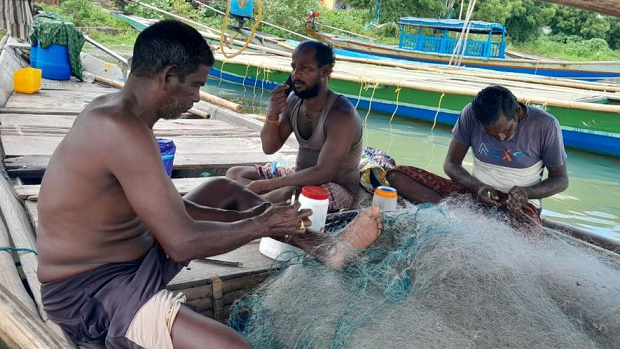
Odisha Poor catch in Chilika forcing fisherfolk to migrate Villagers blame state govt focus on tourism and the new sea mouth for polluting the lagoon’s water, ruining its ecology and disrupting fish life.
https://www.newsclick.in/odisha-poor-catch-chilika-forcing-fisherfolk-migrate (12 Oct. 2024)
Fishermen protest ban on fishing Fisheries dept has imposed restrictions on fishing by mechanised vessels from April 15 to June 14 across the state. Last month, marine fishermen expressed discontent over the govt’s failure to address their grievances, forcing them to announce a boycott of the upcoming Assembly and Lok Sabha polls. During this 2-month “Fishing Holiday” coinciding with the elections, fishermen plan to abstain from voting to draw attention to their demands.
The monsoon trawling ban, introduced in 1998, aims to facilitate unhindered fish breeding during the rainy season. Approximately 21,000 fishing vessels, including 2,000 trawlers, are registered in the state. During the ban, mechanised vessels that pose a threat to fish eggs and juveniles are prohibited from sea operations, while smaller vessels and non-mechanised boats under 8.5 m with larger net gaps are exempt. https://www.newindianexpress.com/states/odisha/2024/Apr/16/fisheries-department-imposes-fishing-ban-fishermen-plan-to-abstain-from-voting (16 April 2024)
Assam Fishermen protest A large number of the people dependent on fishing took to protest against the local administration in the Biswanath district. The protesters mentioned that they would refrain from voting in the upcoming general elections if their demands were not fulfilled. They were demanding removal of ban on fishing in Brahmaputra river. https://www.sentinelassam.com/north-east-india-news/assam-news/assam-large-number-of-fishermen-stage-protests-682023 (20 Nov. 2023)
Meghalaya Preserving aquatic treasures The initiatives by the State’s Fisheries Dept resulted in identifying and proclaiming over 70 fish sanctuaries over the years. However, while the declaration of sanctuaries is a relatively straightforward task, the most pivotal and challenging aspect is in consistently and effectively maintaining these sanctuaries. This entails a multifaceted approach that integrates scientific rigour, community involvement, and adaptive management strategies ranging from monitoring of water quality, habitat conditions, and fish populations to the enforcement of sustainable fishing practices and the prevention of illegal activities within these designated areas to ensure that these sanctuaries fulfil their intended purpose of safeguarding aquatic ecosystems & sustaining the diverse array of fish species.
Additionally, effective sanctuary management empowers communities to transform them into appealing tourist destinations, serving as a consistent source of revenue for the local community. Complexities arise from the dynamic nature of aquatic ecosystems, where external factors such as climate change, pollution, and habitat degradation pose continuous challenges. The Fisheries Dept, in collaboration with environmental agencies & local communities, must have robust management plans. The plans should address immediate concerns & incorporate adaptive strategies that respond to evolving environmental conditions & emerging threats. https://theshillongtimes.com/2024/02/09/preserving-meghalayas-aquatic-treasures-a-vital-imperative/ (9 Feb 2024)
Himachal Pradesh Pong fisheries body wants insurance policy expanded The Pong Dam Reservoir Fisheries Societies’ Association convened a meeting, presided over by it’s president Jaswant Singh, at Jawali on Feb 28. At the meeting, the association appealed to the state govt to formulate an effective pro-fishermen policy as thousands of fishermen were facing problems in earning their livelihood. The association demanded relaxation in the existing life insurance cover (Rs 5 lakh) provided by the state govt to the fishermen by including all deaths. https://www.tribuneindia.com/news/himachal/pong-fisheries-body-wants-insurance-policy-expanded-595981 (29 Feb. 2024)
Some Report on Govt Actions
Centre Inland fishing contribution increased to 132 lakh T in a decade: Minister Union Minister for Fisheries, Animal Husbandry & Dairying, Rajiv Ranjan Singh said that the fish production in the country has increased significantly in the last 10 years. He said that in 2014 the total fish production was 96 lakh T and today it is 176 lakh T. He added that of these 176 lakh T, 132 lakh T are the contribution by the inland fishing. Mr Singh said that Arunachal Pradesh has a lot of potential in the sector. https://theindianawaaz.com/indias-fish-production-rises-from-96-to-176-lakh-tonnes-in-a-decade-minister/ (13 Nov. 2024)
Arunachal Pradesh Agreement for fisheries management plan at Subansiri Lower HEP The agreement was formalized between the Department of Fisheries, Govt of Arunachal Pradesh, and NHPC Ltd. on June 6. To kickstart the initiative, approximately 6000 fingerlings of Indian Major Carps were released into the Subansiri River downstream of the dam. https://www.sentinelassam.com/north-east-india-news/assam-news/department-of-fisheries-and-nhpc-sign-agreement-for-fisheries-management-plan-at-subansiri-lower-he-project (8 Jun 2024) The plan envisages development of hatcheries for rearing of fish seed of Golden Mahseer, Snow Trout and Indian Major and Minor Carps by Dept of Fisheries, Govt of Arunachal Pradesh and the ranching of fingerlings in Subansiri river upstream of SLP-Dam as a conservation measure for sustenance of riverine ecology. https://www.indiatodayne.in/assam/story/6000-indian-major-carp-released-in-subansiri-river-to-strengthen-fisheries-management-1023260-2024-06-07 (07 June 2024)
Madhya Pradesh Govt develops hatchery to save Mahseer The reason known for its majestic silver shine, Mahseer fish is fighting for its existence after being declared an endangered species. The Fisheries dept has come up with some measures to save this State Fish so that future generations are able to see it. Like Mahseer, there are around 16 other species of fishes which have reached to the brink of extinction in the state. Now to save it, the fisheries dept has developed last year a hatchery for seed production of Mahseer in the Bargi area of Jabalpur. The seeds of Mahseer will be released into the river from this hatchery. https://www.freepressjournal.in/bhopal/mp-endangered-mahseer-fish-struggles-for-survival-narmada-dam-deemed-the-reason (22 May 2024)
Indore IMC facelift to Sirpur, releases 2.5L fish seeds Indore Municipal Corp (IMC), which released around 2.5 lakh fish seeds in Sirpur Pond and carried out other works of developments for World Wetlands Day’s event at this Ramsar site, has received approval of a fund of Rs 2.3 cr for it. According to senior IMC officials, it took around two months of hard work to transform entire Sirpur Pond including removing around 5,500 dumper-loaded water hyacinth from one of two (small) ponds while many other works including developing roads without concreting, butterfly park, knowledge park along with plantation, painting and beautification. “For all these works, EPCO has sanctioned a fund of Rs 1 cr while the central govt has sanctioned around Rs 1.3 cr” IMC additional commissioner Abhilash Mishra said. https://timesofindia.indiatimes.com/city/indore/world-wetlands-day-imc-facelift-to-sirpur/articleshow/107394996.cms (04 Feb. 2024)
Punjab GW salinity turns blessing in disguise for Malwa shrimp farmers Witnessing the success of shrimp farming, which showcased the potential scope of economic utilisation of salt-affected wastelands, the first state govt sponsored shrimp farming demonstration was held at Ratta Khera village of Sri Muktsar Sahib district under the technical guidance of Guru Angad Dev Veterinary and Animal Sciences University and Regional Centre of ICAR — Central Institute of Fisheries Education in Haryana. Similar camps were held in other parts of the region. With active efforts of the university and promotional schemes of the Dept of Fisheries of Punjab, the area under shrimp farming expanded very fast from 1 acre in 2014 to 1,315 acres in 2023. https://www.tribuneindia.com/news/ludhiana/groundwater-salinity-turns-blessing-in-disguise-for-malwa-shrimp-farmers/ (05 Aug. 2024)
Compiled by Bhim Singh Rawat (bhim.sandrp@gmail.com)

 SANDRP