Guest Article by: Dr. Ruchi Shree
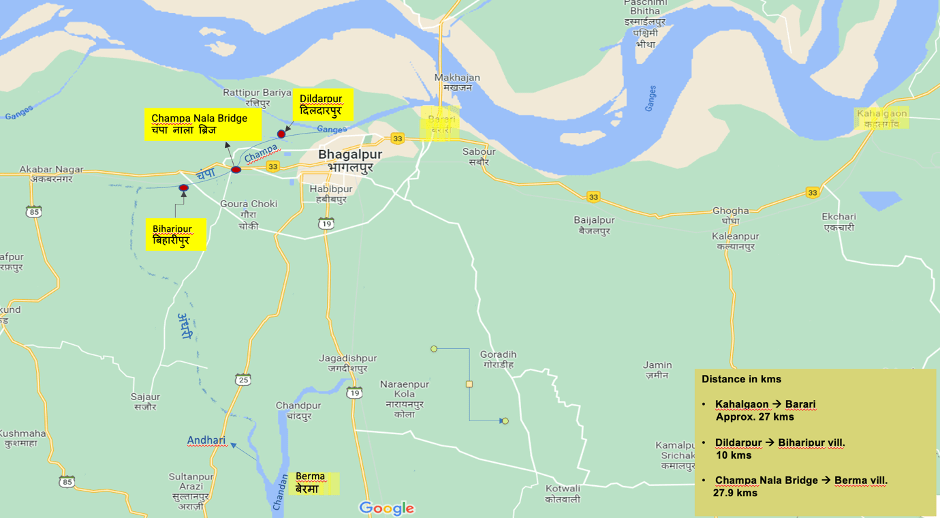
In 2024, Bihar received 19 percent less rainfall than the normal rainfall and one of its districts named Bhagalpur even lesser with 29 percent. From 1 June to October 21, this district of South Bihar situated on the banks of the Ganga received merely 713.8 mm rain while the expectation was 1054.3 mm according to India Meteorological Department figures. It is the third consecutive year when Bihar has received lesser rainfall than expectation[i] and it is likely to worsen the water scenario in the coming years. On the other hand, Bihar faced severe flood this year and Bhagalpur was one of its worst affected districts due to a rise in the level of the Ganga. In a span of around 45 days i.e. from mid-August to end of September, Bhagalpur faced floods four times. This writing is based on my observation of three locations in Nathnagar block of Bhagalpur — two villages named Dildarpur and Biharipur and the Tilka Manjhi Bhagalpur University (TMBU) premise (administrative wing and Lalbagh Professors’ Colony). TMBU is quite close to Dildarpur village (situated on the Diyara land between Champa Nalla/River and river Ganga).
Blurred Boundaries Between ‘Rural’ and ‘Urban’
My experience of floods in Bhagalpur over the last four years suggests that it is difficult to demarcate the ‘rural’ and ‘urban’ since the separation between them is often confusing. For instance, the flood in Dildarpur village is more of a warning of an upcoming flood in the University premises. Although, this study closely observed the floods in Nathnagar block but I would like to mention about its another worst affected block named Sabaur. One of its villages named Masadhu witnessed the fall of many buildings and the villagers were forced to leave the houses to save their lives. In the interviews to the TV channels[iii], some of them shared that they have not been able to pay back the loans taken to build their houses and the building has now been taken by the Ganga. Others said that “we are demolishing our houses to take away the bricks with us rather than to see the house vanish in front of our eyes”[iv]. Within three days, around 40 to 45 houses were blown by the Ganga. In the Sabaur block, a three storeyed building of Delhi Public School (DPS) also vanished in the Ganga like a pack of cards. The consequences of such floods range from homelessness to loss of valuables and the cattle living on the roads to name a few of them. The residents of Dildarpur village are forced to live outside their village for a month or so almost every year. Due to being situated on the Diyara land, the moment the level of the Ganga River reaches the danger level, the village is bound to get flood affected.
The Everydayness of Boat-Dependent Life
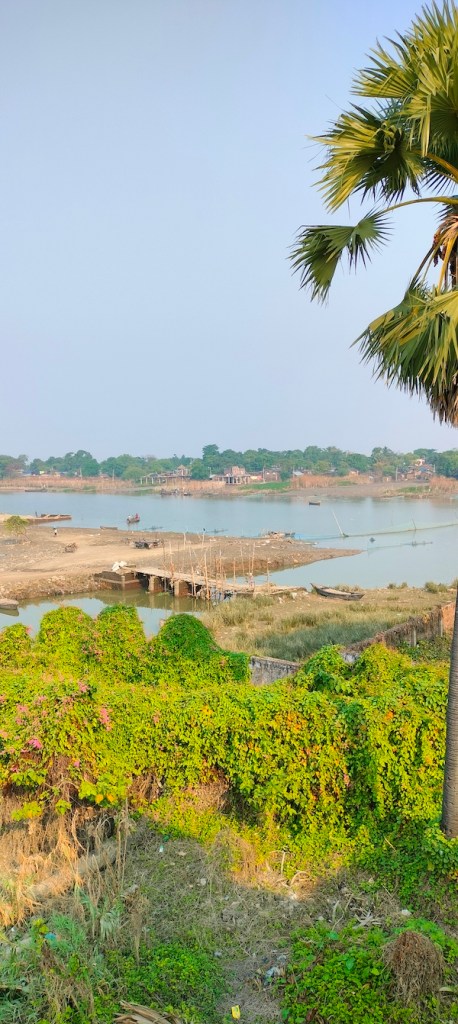
During the floods, boat is the only medium of transportation and it also reveals many other realities. For example, I got to learn that many of the small boats used during the floods mostly remain unused for rest of the year. Boats are provided by the Govt. of Bihar to the villagers during the period of flood. However, for the urban flood-affected people like us who live in the Lalbagh Professors’ Colony in Bhagalpur and have to live a boat-dependent life for four to five days (depending on the intensity of flood) need to hire a boat (private) through Lalbagh Vikas Parishad. During those days, we have to contact the boat person to stop outside the residential campus. Even the administrative premise of the University gets flooded and the officials also commute by boats. The colleges and University departments are not affected. This localized flood creates another kind of divided life – some workplaces one kilometer away have no flood, while the residential premise is boat-dependent.
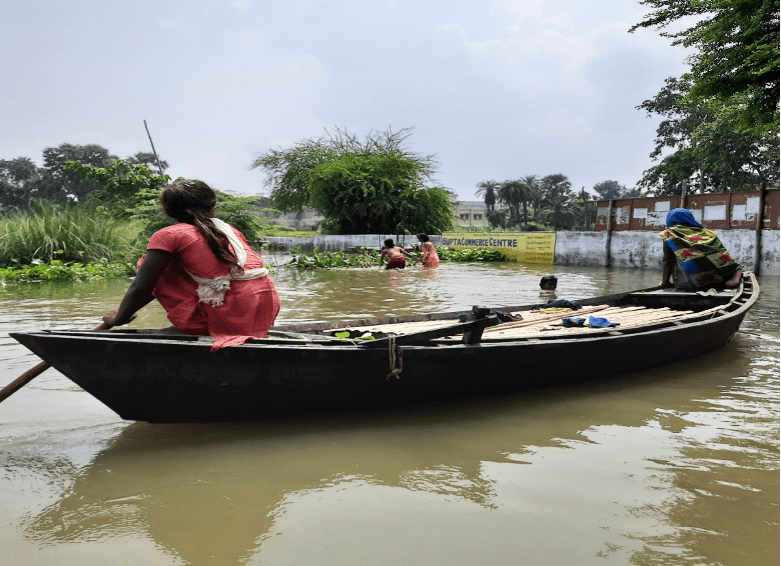
In 2022, I witnessed a woman and a girl rowing a boat during the flood and was quite surprised as we usually do not get to see them in that role. It reminds one of Satyawati, wife of Bhisma’s father Santanu, king of Hastinapur. Satyawati was the driver of boat to take people across Yamuna in Mahabharat. I learnt two important lessons that day: first, it was a fascinating example of women empowerment and second, the circumstances teach us how to live and cope-up with the difficulties. In fact, the resilience among the flood-affected villagers and the way they co-operate with each-other to survive is worth emulating. Along with safeguarding their lives and valuables, taking their cattle to a safe place remains a major challenge for them. Big boats are used to take away the cattle. Sometimes, the villagers have to walk many kilometers with their buffaloes and cows to find a safe place to live. Due to the flood water all around, there is a huge shortage of fodder during this period. Similarly, the lack of sanitation and shelter for the homeless due to flood is quite common.
Memories of the Floods
The two severe floods of 2021[v] and 2024 in Bhagalpur led me to a temporary displacement for a week and also made me think about the floods in Bihar more deeply. Prior to coming to Bhagalpur, I had only read about flood (books and newspaper articles) and seen some of the TV reports but had hardly imagined the series of difficulties caused due to floods. In 2021, it was mid-August when I moved to Patna for a week (due to being unable to cope up with the floods) and this year, it was the third week of September when I shifted to a flood-safe part of Bhagalpur during the boat-dependent days of my residential area. While in 2021, I had fallen sick after reaching Patna, this year I was more or less mentally prepared for the likely evacuation scenario. In 2021, the flood came in a steady way in two to three days, in 2024, the rise in water levels was so speedy that the place became unlivable or water-logged overnight.

It is pertinent to note that there was more or less no rainfall in the month of August 2021 when the flood came. So, to have sunny days and flood at the same time seemed quite contrary. Even in 2024, the rainfall was quite low locally when Bhagalpur faced the flood. While in 2021 it was rainfall in faraway upstream area of Uttarakhand among others that brought flood, in 2024 it was possibly due to heavy rainfall in upstream Nepal. We must remember the insufficient drainage due to many reasons – be it due to backwater effect due to downstream Farakka dam, heavy siltation or excessive plastic waste which have reduced the capacity of the river locally. The dredging of the river being done for navigation could also be a contributing factor. Encroachment of the riverbeds is another reason of the floods as the increased water in rivers don’t get their due place to flow.
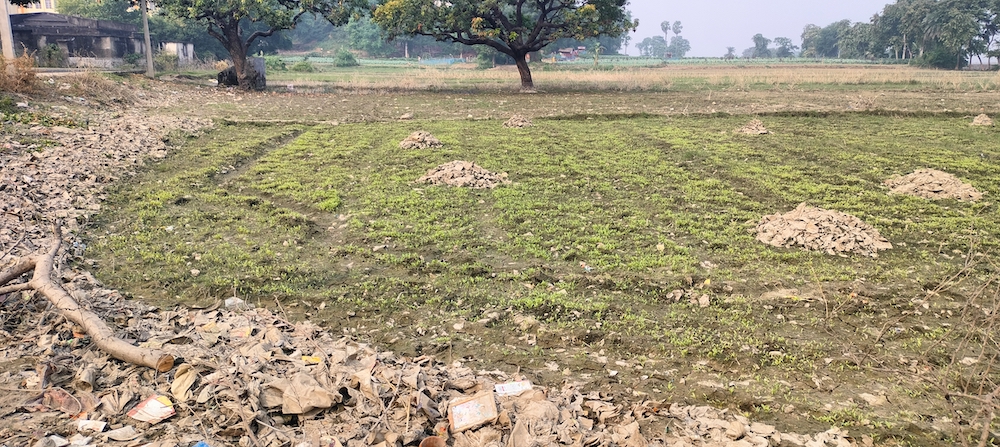
These days we often blame global warming and climate change as the root causes of most of the environmental problems. However, we also need to take cognizance of the local and regional factors to find their appropriate solutions. Last few years of lesser rainfall and increasing numbers of floods in Bihar must lead to think and act for viable solutions. This will include the way we are dealing with the North Bihar floods over the decades since independence[vi]. This piece only looks at the local perspective of personal experience, there is of course larger picture of this flood and its impacts from upstream to downstream.
Dr. Ruchi Shree (jnuruchi@gmail.com)[vii] is Assistant Professor at the University Department of Political Science at TMBU-Bhagalpur and also a research associate with the School of Law, SOAS (London). All photos are by the author.
[i] Hindustan, 14th October, 2024, ‘Bihar se huyi Monsoon ki vidai, 20 pratishat kam huyi barish’
[ii] The author would like to thank Ms. Shalini Jha (Research Assistant as part of her British Academy Leverhulme SRG Project titled ‘Fostering Ecocentric Community-Led River Restoration and Conservation in India’ from Dec, 2021 to November, 2023)
[iii] NDTV, 24 September, 2024, Bhagalpur Flood News, https://www.youtube.com/results?search_query=floods+in+bhagalpur
[iv] In the interviews to the TV channels
[v] I had documented that experience and one may read that at https://sandrp.in/2021/09/01/the-everydayness-of-flood-experiences-from-bhagalpur-bihar/
[vi] To know more about the floods in Bihar, one may read the writings of Dinesh Mishra (Badh Mukti Abhiyaan) and Eklavya Prasad (Megh Pyne Abhiyaan).
[vii] The author would like to thank Mr. Himanshu Thakkar (SANDRP) and Mr. Eklavya Prasad (MPA) for their valuable inputs.

 SANDRP