
It is increasingly clear that Large Dams across the world are facing increasing challenge due to climate change. In recent years, we have already seen serious dam disasters in Australia, Brazil, Canada, India, Kenya, Libya, Nepal, Nigeria, Poland, Spain, Sudan and USA to name just a few.
All these are related to extreme rainfall events, which are going to only increase in intensity, frequency and spread. It is interesting that hydro industry platform has come out with this report highlighting this issue this week.
For a country like India, the third large dam builder in the world, this challenge is going to be even more daunting as we have been seeing the increasing number of dams related disasters in last few years. As we remember the Teesta 3 dam disaster a year ago, the nature and dimension of this challenge becomes even starker. This is also exemplified by the fact that the dam safety panel report about this disaster is not even out in public domain. And even now new theories are being proposed about what happened during the disaster.
Most government observers think that dam safety act and the committees set up there after will take care of this challenge. Assuming this would be trying to hide the problem under the rug. We need to do lot more if we want to address this challenge, to begin with making a more realistic assessment of safety of our completed dams and doing a lot more about the dams under construction. And maybe not take up any more big dams till we are able to address this challenge in convincing way.
Climate change challenges to dams The U.S. is far from alone in experiencing these extreme weather patterns, as recent dam safety events in India, Kenya, Libya (a year ago, two dams upstream of Derna collapsed, causing 6,000 to 20,000 in casualties), Nigeria (in September 2024, Alua Dam in northeastern Nigeria burst, killing 37 people and displacing thousands) and Sudan (the collapse of Arbaat Dam at the end of August 2024, which caused catastrophic flooding in downstream communities, destroying 20 villages and killing more than 60 people) attest. Couple this with the fact that dams and hydroelectric facilities in many cases are decades or even a century old, and challenges to the safety of dams are more regular and serious. Even in cases where individual dams hold strong, the challenges of passing record levels of water downstream, where often other dams are located, just compounds the situation. During a recent flood event in Poland, which took six hydroelectric power plants off line, even while the dam structures remained safe.
The Associated Press reported in July 2024 that in the U.S. state of Vermont, flooding “has added fresh urgency to concerns about the hundreds of dams in the state, a third of which are more than a century old.” In 2023, flooding caused five dams to fail and overtopped nearly 60 dams.
The combined factors of more extreme weather events and outdated hydrological and climate data appear to be the primary culprits. “The changing climate poses a significant risk through increasing the probability of failure,” IHE Delft said.
“Adaptation of dams, through increasing the capacity of spillways, or even decommissioning, is hugely expensive and slow,” IHE Delft said. At the same time, “The impacts of a dam collapsing are catastrophic.” One shortcoming that is being addressed in the U.S. is the need for updated data regarding precipitation frequency that accounts for climate change. To this end, the National Oceanic and Atmospheric Administration (NOAA) is developing Atlas 15, an update to the Precipitation Frequency Atlas called Atlas 14. NOAA Atlas 14 – produced by the National Weather Service Office of Water Prediction — estimates are used to design, plan and manage much of the country’s infrastructure for a wide variety of purposes under federal, state and local regulations. Work on the atlas began in February 2022. The updated atlas is expected to be released in 2026 for the Lower 48 states and in 2017 for the rest of the country. https://www.hydroreview.com/dams-and-civil-structures/dam-safety/climate-change-challenges-to-dams-a-wave-is-building/ (04 Oct. 2024)
HYDRO POWER PROJECTS
SANDRP Blog EAC asks Adani to apply afresh for Warasgaon Warangi PSP In a respite to forest dwelling communities of Western Ghats, fragile biodiversity and community conservation areas, the Expert Appraisal Committee (EAC) for River Valley Projects of the Union MoEF (Ministry of Environment and Forests) in its Sept 27 meeting Rejected Adani’s application and asked to apply afresh for the 1500 MW Warsagaon Warangi Pump Storage Project. https://sandrp.in/2024/10/03/moefs-committee-defers-stage-i-clearance-to-adanis-warasgaon-warangi-project/ (03 Oct. 2024)
Quoting the September 27 MoEFCC’s Expert Appraisal Committee (EAC) meeting, released on October 2, a senior scholar-activist of the top environmental advocacy group South Asia Network on Dams, Rivers and People (SANDRP) has reported that in a “respite” to forest dwelling communities, fragile biodiversity and community conservation areas, the EAC has “rejected” the Adani application for project.
– Appreciating the move, Dandekar said, the EAC not just “rejected” the application but “decided to visit sites all the PSPs that have applied for environment clearance before giving any further clearances”, hoping, “The site visits will expose the perilous siting of over 15 pumped storage projects in the Western Ghats.”
In a detailed analysis on September 24 on the advocacy group’s website, Dandekar had pointed to how the upper dam of 1500 MW Warasgaon Warangi Project “was set to destroy a sacred fish pool and sacred grove of Goddess Varadayini in the village Tekpowale.” This followed an SANDRP submission to the EAC outlining the impacts of this project on the “ecologically sensitive area” and the “wider cumulative impact” of the multiple PSP schemes in the Western Ghats.
The submission was signed by more than 200 individuals and organizations, including Parineeta Dandekar and Himanshu Thakkar of SANDRP; Suniti SR and colleagues of the National Alliance for People’s Movements; Shailaja Deshpande and colleagues of the Jeevit Nadi; Priyadarshini Karve of the Indian Network on Ethics and Climate Change; Jaideep Baphana of Pune River Revival (a group with over 1000 members in Pune); and Shripad Dharmadhikary of the Manthan Adhyayan Kendra, Pune. https://www.counterview.net/2024/10/modi-govt-distancing-from-adanis-moefcc.html (04 Oct. 2024)
“Pumped storage projects proposed in the Western Ghats entail blasting, tunnelling, diversion of forest land, impact on environmental sensitive areas and some would involve taking water from dams that are already overallocated. In short, there are a range of cumulative impacts of such projects. Considering these issues which are never represented in the proposals, EAC’s site visit is a welcome decision,” said Parineeta Dandekar, associate coordinator of South Asia Network on Dams, Rivers and People (SANDRP), a research and advocacy group working on sustainable river management. https://indianexpress.com/article/india/western-ghats-fragility-environment-ministry-expert-panel-to-review-pumped-hydro-projects-9602980/ (04 Oct. 2024)
For all pumped storage projects in Western Ghats that have been granted ToR, a site visit shall be carried out in toto wherever possible, the committee has said.
Since March 2014, the Union Environment Ministry has issued six draft notifications to declare the Western Ghats as ecologically sensitive, but the final notification is still pending due to objections from the states. The 60-day period for submitting objections and suggestions on the latest (sixth) draft notification to declare over 56,800 sq km of the Western Ghats across six states as ecologically sensitive areas ended on Sept. 30. https://thefederal.com/category/news/water-projects-in-western-ghats-govt-panel-key-suggestion-148473 (04 Oct. 2024)
Arunachal Pradesh 2nd major protest against Siang HEP as hundreds gather in Geku In today’s (Oct. 05) protest, led by the Siang Indigenous Farmers’ Forum (SIFF), the villagers voiced their opposition to the National Hydroelectric Power Corporation (NHPC), saying “no” to surveys and “no” to the dam. They also protested against the elected representatives of Siang and Upper Siang – RWD Minister Ojing Tasing, who represents the Pangin-Boleng assembly constituency; Tuting-Yingkiong MLA Alo Libang; and Geku-Mariyang MLA Oni Panyang – and Chief Minister Pema Khandu. They also voiced their opposition against some of the members of Adi Bane Kebang (ABK), the apex body of the Adis. The SIFF accuses the ABK of consenting to the government’s proposal for conducting surveys for the proposed project.
-Earlier, on 16 September, the SIFF reiterated its objection to the proposal for preparing a pre-feasibility report for the proposed mega project during a consultative meeting organised by the All Riew Students’ Union. The meeting was attended by Rural Development Minister Ojing Tasing, SIFF members, and NHPC representatives. However, it yielded no feasible outcome, as participants remained stuck to their respective stands.
-The government’s initial plans for the Lower Siang HEP (2,700 mw) and the Siang Upper HEP Stage-II (3,750 mw had already faced resistance for more than two decades. Amid fears and opposition from the people, the capacity was expanded to 11,000 mw without new studies, triggering a fresh wave of protests. https://arunachaltimes.in/index.php/2024/10/06/second-major-protest-against-siang-hydro-project-as-hundreds-gather-in-geku/ (06 Oct. 2024)
The protest, organised by the Siang Indigenous Farmers Forum (SIFF), was held in Geku village, opposing the preliminary study being conducted in the area for the Siang Upper Multipurpose Project (SUMP). Thousands of villagers gathered at the spot around 8 am, raising slogans against the NHPC and CM Pema Khandu. Geku’s Extra Assistant Commissioner A Ratan said the protest was peaceful and ended at 1 pm without any untoward incident.
The NHPC has proposed three sites in the Upper Siang and Siang districts for the construction of the dam. One site is between Parong and Deging villages, one at Ugeng near Riga village and another between Ditte-Dime and Geku, officials said. The NHPC has been conducting surveys at the proposed sites to prepare a feasibility report for the project, they said.
SIFF general secretary Donggo Libang said the Adi community were opposing the project as it would be a threat to their land, environment and way of life. “If the dam is constructed, the wet rice cultivation field and many villages will be submerged. People will be deprived of their indigenous rights,” he said. Last month, the Upper Siang district administration had served notices to several government employees and ‘gaon burahs’ or village heads for joining the protests. Several anti-dam groups also organised a protest rally in Dite Dime in Siang district on August 31. Locals are opposing the project, claiming that the dam would displace the indigenous people and cause damage to the environment. https://arunachal24.in/arunachal-protest-against-proposed-12500-mw-hydropower-project-in-upper-siang/ (05 Oct. 2024)
Siang river diplomacy This paper by a hydro industry consultant AN Mohammed about hydro projects in China and India on Brahmaputra provides no new information but tries to push the standard hydro narrative about fears of China dam and India’s dam response. https://arunachaltimes.in/index.php/2024/10/03/siang-river-diplomacy-indias-response-to-chinas-move/ (03 Oct. 2024)
Himachal Pradesh Villagers threaten to intensify stir near Malana HEP An indefinite sit-in by residents of Chowki, Baladhi villages and adjoining areas seeking compensation for the losses they suffered due to the bursting of the barrage of Malana Hydel Project-I on July 31 entered 16th day. Earlier, the villagers were protesting near the gate of the project powerhouse. After the project authorities registered a police complaint and nine protesters were summoned, the villagers shifted to a road leading to the project. They have pitched tents and are protesting round-the-clock. The villagers said they would not back down in the fight for their rights. Bhagat Singh Thakur, president of Mahadev Yuvak Mandal, Chowki, alleged that it was evident that the dam did not burst due to natural causes, but the disaster occurred due to the release of excess water by Malana Project-II and bursting of barrage of Malana Project-I.
Khem Chand, another resident of the area, alleged that even as the dam was damaged, the company was continuing with power generation against the norms by diverting river water directly into the tunnel, compromising with the safety of people and aquatic life downstream. “An action should be taken against the company for violating the rules and a high-level committee should be formed to probe the matter. A delegation of villagers has met the Kullu DC and ADM, but they got mere assurances,” he added. https://www.tribuneindia.com/news/himachal/villagers-threaten-to-intensify-stir-near-malana-power-project/ (03 October 2024)
Workers protest against NHPC’s ‘anti-labour’ laws Contract and outsourced workers from various hydropower projects including National Hydro Power Corporation projects, under the banner of Centre for Indian Trade Unions (CITU) staged a sit-in, raising their voice against the new labour codes and unmet demands. The protest followed a month-long campaign, running from September 1 to September 30, during which the CITU activists spread awareness about the government’s ‘anti-worker’ policies among various sections of outsourced labour. Protests were held at six locations in Chamba, including NHPC’s Baira Siul Project, Chamera I, II, and III Projects, and the Kuthed Project witnessing participations of hundreds of workers. https://www.tribuneindia.com/news/himachal/chamba-hydel-project-workers-protest-against-anti-labour-laws/ (01 Oct. 2024)
Sikkim GLOF Disaster: Was there any EWS installed? Sikkim is spearheading the Centre’s plans to counter the impact of climate change and make it a lesson to study the glacial lakes across all Himalayan states in the country. But the team needed the participation of the community—to access Khang Chu glacial lake, record their findings, and develop concrete disaster mitigation solutions such as early warning systems, anti-encroachment drives, and awareness campaigns.
– Since the 2023 GLOF event, tribes in northern Sikkim—the worst affected by the disaster—have become wary of scientific interventions and the hydropower plants. “It’s what triggered these disasters. The gods are angry,” said one villager.
– But the expedition team had to face many obstacles: a human wall blocking the road, broken trust between the government and villagers, and the belief that the gods were angry. It took three days, two monks, Sikkim’s chief minister, and multiple rounds of talks with two Pipons—the heads of the communities—to reach an agreement. The team would be allowed to study the glacial lake under strict supervision and with several restrictions.
– “Much of their folklore is based on scientific knowledge. Their ancestors wove stories to make the communities abide by the principles of preservation and conservation,” Ranjan added.
– “If the dam had not collapsed, the damage would not have been so intense. An assessment by activists showed that when the dam walls broke that day, it was holding enough water to fill 20,000 Olympic-sized swimming pools. Imagine all that water flowing into your villages,” said Gyatsu. Like other villagers, he trusts ‘local assessments’ over government reports. In terms of damage wrought, the expedition team is in agreement. According to Rajan, the Chungthang dam’s collapse caused the majority of the destruction, leaving large boulders and sediment in many affected villages.
– Scientists, who will submit the findings to the Sikkim government in October, have observed a worrying trend of climate change-driven warming of the glaciers. The expedition team discovered that Lhonak Lake breached its embankment following an avalanche on the surrounding mountains, causing icecaps and sediments to roll into the lake and displace water that gushed down the valley. The Sikkim government, however, is wary of attributing climate change as a possible cause of GLOF events. It is contesting a central committee report that blames GLOF for the incident, arguing instead that it was caused by a cloudburst. What’s at stake is a Rs 2,500 crore insurance claim.
STRANGELY, The Print here reports NOW that an early warning system existed, and it did sound an alarm. But the early warning system was required not at the dam site, but upstream in the catchment. Why is The Print claiming this now? Whom is it trying to save? It is particularly strange as the authors do not even provide any tangible details about this alarm system they claim existed.
STRANGELY too, the Print refuses to mention the failure of CWC’s flood forecasting system, among many others. https://theprint.in/ground-reports/sikkim-war-on-glof-monks-shamans-and-scientists-all-in-the-fight/2295809/ (04 Oct. 2024)
Govt, central panel split over what caused 2023 floods A report by a high-level government panel—that concluded the extreme flood event last October was caused by a glacial lake outburst flood (GLOF)—has become a bone of contention between the Ministry of Jal Shakti, National Dam Safety Authority (NDSA) and the Sikkim government. The Sikkim government has contested the findings of the 10-member committee constituted in Nov 2023 by the NDSA, which comes under the Ministry of Jal Shakti, and said that the 3 October incident was not caused by GLOF but a “cloudburst”. The committee, headed by former Central Water Commission (CWC) chairman R.K. Jain was mandated to examine the causes leading to the bursting of South Lhonak Lake and consequent failure of Teesta-III Chungthang dam and damages to other downstream dams, and submitted its report to the ministry in June 2024. But the ministry is yet to accept the report and make its findings public.
– The Prem Singh Tamang-led Sikkim government has made multiple representations to the Jal Shakti Ministry, claiming that their observations based on data show last October’s flood was a result of “cloudburst”. The latest representation from the state government was sent to the ministry on 4 Sept 2024. In the aftermath of the disaster, senior state government officials, including chief secretary V.B. Pathak had in media briefings said that India Meteorological Department (IMD) data does not support a cloudburst as a probable cause. But the state government soon changed their stand, notifying the incident as a cloudburst. Though the dam is fully insured by a consortium of insurers led by IFFCO-Tokio General Insurance (the total sum assured is to the tune of Rs 11,400 crore), there’s a catch. While there is a 100 percent coverage of the sum assured for losses resulting from flash floods or cloudburst-induced floods, the coverage for damages by GLOF is capped at Rs 500 crore, a senior Sikkim government official said. A senior Jal Shakti Ministry official confirmed, “The State Dam Safety Organisation has submitted a representation, which is being considered. The ministry will finalise the committee’s report after that.” https://theprint.in/india/sikkim-govt-central-panel-split-over-what-caused-2023-floods-at-stake-is-rs-2500-cr-insurance-claim/2291910/ (01 Oct. 2024)
Flood triggered by cloudburst not GLOF: CM Sikkim commemorated the one-year anniversary of the disaster as State Disaster Risk Reduction Day in Gangtok, with CM Prem Singh Golay in attendance. The government has claimed that last year’s disaster was triggered by a ‘cloudburst’ instead of a GLOF, with GLOF-related damages securing only Rs. 500 crore as an insurance claim for the State. In contrast, a cloudburst would ensure 100 percent compensation, and the State has declared Rs. 3,600 crore as part of the Post-Disaster Needs Assessment submitted to the Union Government. The CM responded to the claims, stating, “Yes, the disaster was triggered by a ‘cloudburst’, which the government has also notified. We are unsure which will secure more funds for the State, but whatever the truth is, we have submitted it to the central government.” https://www.eastmojo.com/sikkim/2024/10/04/sikkim-flood-triggered-by-cloudburst-not-glof-cm-golay/ (05 Oct. 2024)
NHPC NHPC to double capacity to 15 GW in 5 years: CMD The company is working on 16 projects totalling 10,692 MW, he said. Of these, nine are hydro projects having a capacity of 9,314 MW and seven are solar projects with 1,378 MW capacity. Out of the nine hydro projects, NHPC will commission eight by FY29 with a capacity of 6,434 MW.
The company, which recently received the Navratna status, is also betting big on pumped hydro storage projects. The hydro power developer has a portfolio of 11,240 MW of pumped storage projects (PSPs) in states like Andhra, Madhya Pradesh, Maharashtra, Gujarat and Tripura, Chaudhary said. Of the total PSPs, three totalling 4,350 MW are in the pre feasibility stage, four having a 4,390 MW capacity are in detailed project report preparation stage and three projects of 2,500 MW are where PFR has been submitted. https://economictimes.indiatimes.com/industry/energy/power/nhpc-to-double-capacity-to-15-gw-in-5-years-cmd-raj-kumar-chaudhary/articleshow/113860629.cms (01 Oct. 2024)
Rajasthan THDCIL to invest Rs 8,800 cr in PSPs: CMD State-owned THDCIL has signed an agreement with the Rajasthan government to set up 1,600 MW of pumped storage projects at an investment of Rs 8,800 crore. The Memorandum of understanding (MoU) aims for the development of two pumped storage projects (PSPs) of 800 MW each at Bisanpura in Bundi and another at Rampura Tonk, THDC India Ltd (THDCIL) said in a statement.
-“The Bisanpura PSP will source water from the Gudha Dam, while the Rampura PSP will utilize water from the existing Bisalpur reservoir. This strategic approach ensures a reliable supply while minimizing environmental impact, allowing both projects to contribute significantly to sustainable energy solutions through efficient energy storage, thereby enhancing grid stability,” he said. https://www.business-standard.com/amp/companies/news/thdcil-to-invest-rs-8-800-cr-in-pumped-storage-projects-in-raj-cmd-vishnoi-124100200566_1.html (02 Oct. 2024)
Maharashtra JSW bags PSHP JSW Energy Ltd.’s arm received a Letter of Intent for procurement of pumped hydro energy storage from Maharashtra State Electricity Distribution Co. The company’s subsidiary, JSW Neo Energy Ltd. will procure 1,500 megawatt/12,000 Megawatt-hour of pumped hydro energy storage, the company said in an exchange filing on Tuesday (Oct. 01). The Bhavali Pumped Hydro Project will feature an eight-hour discharge capacity with a maximum of five hours of continuous discharge, the statement said. The LoI is for providing energy storage capacity for 40 years. ADVERTISEMENT After this, the company’s locked-in energy storage capacity stands at 16.2 GWh which includes a pumped hydro storage capacity of 14.4 GWh and battery energy storage capacity of 1.8 GWh, it said. https://www.ndtvprofit.com/business/jsw-energy-arm-bags-pumped-hydro-storage-project-from-maharashtra-state-electricity-distribution (02 Oct. 2024)
Report Power demand falls for second consecutive months Demand for electricity in India waned by about 0.3% in Sept 2024 from a year ago to an estimated 141 billion units (BU) although it increased 5.4% for the April-September period. In Aug 2024 power demand had contracted by 5.3%. Peak power demand in Sept declined to 230 MW compared to 243 MW a year ago. It was 217 MW in Aug. 2024. https://www.livemint.com/industry/monsoon-september-india-power-demand-crisil-11727958010009.html (03 Oct. 2024)
MoEF Decisions as per the minutes of EAC on River Valley Projects held on Sept 27 2024: 1. Warsgaon Warangi Pumped Storage Project (1500 MW) in 225.14 Ha at Village Teckpole and Warangi, Tehsil Velhe and Mahad, Dist Pune and Raigad Mah) by Adani Green Energy Ltd – Amendment in Terms of Reference given on 13.2.2023: “The project proposes to use water of the catchment of lower reservoir for initial filling and annual recuperation of losses. This will impact several small rivulets draining into these reservoirs as the water will not be released downstream.
The EAC was of the view that PP has changed configuration of the project drastically which could attract more impact on the environment. The EAC raised its concerns about change in the total forest land required for the project with increase of more than three times i.e. from 24.50 Ha to 88.98 Ha. The EAC also noted that the PP has not applied for Stage-I forest clearance as per time period given as per OM dated 01.08.2013, which stipulates for submission of application for StageI Forest Clearance within 6 months of grant of TOR.”
“Accordingly, the EAC suggested the PP to submit a fresh proposal for grant of TOR with modified PFR incorporating information on:
i. Fresh alternative site analysis modifying the project layout with no obstruction of small rivulets in the area as the small rivulets are the key source of water for the perennial rivers in the western ghats.
ii. Change in project profile i.e. change in project layout, change in forest land and private land requirement.”
THE EAC ALSO DECIDED: “The EAC reviewed the Terms of Reference recommended to the PSPs proposed to be located in Western Ghats. The Member Secretary informed the Expert Appraisal Committee (EAC) that the Ministry has granted Terms of Reference (ToR) to approximately 15 projects in the Western Ghats. Given the region’s high environmental sensitivity, the EAC, in previous meetings, recommended site visits by sub-committee members to several pumped storage projects. These projects are located in the ecologically fragile Western Ghats and huge forest area is also involved, the EAC emphasized that, prior to granting environmental clearance or making any recommendations, all pumped storage projects in Western Ghats that have been granted ToR by the Ministry, a site visit shall be carried in toto wherever possible.”
2. Khairibhandan Barrage Project at village Anlabeni, Tehsil – Jashipurin, Mayurbhanj, Odisha by Dept of Water Resources, Govt of Odisha –for Environmental Clearance: Approved.
3. Report of the Site visit by EAC(Sub-Committee), during 10.06.2024 to 14.06.2024 for Phata Byung HEP (76 MW) in 23.323 Ha, at Village Barasu, Byung, Jamu, Gair etc., Sub Dist Okhimath, Dist Rudraprayag (Uttarakhand) by Mandakini Jal Urja Pvt Ltd: “The EAC after detailed deliberations accepted the site visit report and suggested the PP to address the concerns raised by the Sub Committee in the EIA/EMP report.” https://parivesh.nic.in/utildoc/107849168_1727934715085.pdf (Oct. 2024)
DAMS
Kaleshwaram Project Panel tells former top engineer not to lie The judicial probe into various aspects of the Kaleshwaram project took a dramatic turn on Sept 28 with Justice Pinaki Chandra Ghose cracking the whip on the project’s former engineer-in-chief (ENC), N Venkateswarulu, and warning him against lying to the commission during his deposition. He said that action can be taken for not speaking facts under oath.
– It may be recalled that Venkateswarulu, who was the ENC for Kaleshwaram project barrages during their construction phase, was removed from service in Feb 2024 by the state government following an interim report submitted by the vigilance and enforcement wing regarding various omissions and commissions by some irrigation department officials. On Central Design Org’s role in deciding on what kind of piles were needed for Medigadda, and the other two barrages, Venkateswarulu replied that it suggested that either secant or any other suitable design, including cutoff walls, or Z shaped piles could be used. Justice Ghose made it clear that CDO officials, who had deposed earlier, had provided all the necessary information and evading a clear and direct reply will not stand, and lying to the commission could be punishable.
– Venkateswarulu said that among the reasons for problems at Medigadda, and the other Kaleshwaram barrages, were the suppositions on which the designs were based, especially when it came to flood dissipation structures. He said the designs assumed constant presence of water in the ‘stilling basin’ right after the barrage on the downstream side, which was not the case on the field that resulted in flood dissipation structures getting washed away due to high ‘shooting velocities’ when water was let out through the gates.
– He also informed the commission that Annaram and Sundilla barrages were not built on the original sites selected by WAPCOS — Water and Power Consultancy Services (India) Limited — which was asked to prepare the detailed project report but were shifted to save on costs. Elaborating on it, Venkateswarulu said that the location shifts were to reduce the cost of power for lifting of water, reduce the length of diversion channels between the barrages leading to the pump houses, and also reduce the extent of farmland that would be submerged and on the requirement of forest land. https://www.deccanchronicle.com/southern-states/telangana/kaleshwaram-hearing-probe-panel-tells-former-klis-top-engineer-not-to-lie-1826748 (Sep. 2024)
Panel raps ex-ENC for sharing misleading information The Justice P.C. Ghose Commission of Inquiry going into the alleged irregularities in the planning, execution, operation and maintenance of the Kaleshwaram Lift Irrigation Project (KLIP) components, particularly Medigadda, Annaram and Sundilla barrages which make head works, has expressed serious dissatisfaction over the attempt to mislead the Commission by former engineer-in-chief of the project N. Venkateshwarlu. It is learnt that the Commission had expressed anger at the former ENC for his response on the use of secant piles in the Medigadda Barrage foundation instead of sheet piles as designed earlier.
– Asked as to who had instructed or taken the decision for the use of secant piles for the barrage, Mr. Venkateshwarlu was understood to have told the Commission that they were used as per the recommendation of the Chief Engineer of the Central Designs Organisation (CDO) in the Irrigation department. Angered by the response, Justice Ghose was said to have asked how the CDO could make recommendations when it was mandated only to give the designs and drawings along with cross-sections. https://www.thehindu.com/news/national/telangana/commission-of-inquiry-on-kaleshwaram-project-in-telangana-grills-ex-enc-raps-him-for-sharing-misleading-information/article68694975.ece (28 Sep. 2024)
Hirakud Dam Govt to spend ₹855 cr on renovation of irrigation system State govt has decided to spend ₹855 crore over next 4 years to renovate the dilapidiated canal system. “The government is yet to deliver irrigation water to the promised 2.3 lakh hectare area, which is already 15 per cent less than the original target of 2.71 lakh hectare due to the deteriorating conditions of the canal network. The renovation was long overdue,” said Ashok Pradhan, Convenor of Paschim Odisha Krushak Suraksha Samanwaya Samiti. https://www.hindustantimes.com/india-news/odisha-to-spend-855-cr-for-renovation-of-hirakud-its-oldest-irrigation-system-101728209560762.html (06 Oct. 2024)
IRRIGATION
Tamil Nadu Kodavadi check dam to recharge gw A check dam built across Kodavadi river near Pollachi for 40 metres will have 0.45 mcft of water, thus recharging the groundwater aquifer besides benefitting 118 acres. During South West and North East monsoons, water in Kodavadi river flows towards Kerala and gets drained into Bharathapuzha and into Arabian sea. Farmers have been demanding check dams in small streams so that it will recharge the groundwater besides irrigating the agricultural lands. Following this, WRD officials began inspection of sites for the construction of check dams and finally they chose Vadakkipalayam. At Vadakkipalayam, work on the check dam at an estimated outlay of ₹2.68 crore began in January and completed now. The check dam will recharge groundwater aquifer, besides yielding water in 10 open wells & 20 bore wells. https://www.thehindu.com/news/cities/Coimbatore/kodavadi-check-dam-to-recharge-ground-water-aquifer-and-irrigate-118-acres/article68720909.ece (05 Oct.2024)
URBAN RIVERS
Musi; Hyderabad Revenue dept demolishes over 160 houses along riverbed Amid stiff opposition from residents and political functionaries, the revenue department on Tuesday (Oct. 01) demolished 163 houses encroaching on Musi riverbed as part of Musi Riverfront Development Project. Those displaced from the 163 houses in Chaderghat’s Shankar Nagar basti have been shifted to 2BHK houses in different parts of the city, including Jiyaguda, Pilligudisela, Pratap Singaram, and Narsingi. “These houses were identified during a recent encroachment survey a week ago and were vacated before demolition. We have identified 700 more houses for demolition. The occupants will be vacated soon,” said Hyderabad revenue divisional officer Mahipal Reddy. https://timesofindia.indiatimes.com/city/hyderabad/revenue-dept-demolishes-over-160-houses-along-telanagana-musi-riverbed/articleshow/113867195.cms (02 Oct. 2024)
The govt has announced an additional financial aid of Rs 25,000 for residents of the Musi riverbed, along with the allocation of 2BHK homes as part of the Musi River Development Programme (MRDP). This new initiative, unveiled on Wednesday (Oct. 02), aims to support the relocation and rehabilitation of families living along the river. https://www.siasat.com/telangana-govt-offers-rs-25000-to-musi-riverbed-residents-3106811/ (03 Oct. 2024)
Demolitions on river bed are not in the plan Contrary to the fear created among people, there will not be any demolitions on the Musi river bed till all the identified residents are convinced to shift with a key to the allotted double-bedroom houses. But at the same time, buildings belonging to the elite constructed illegally on lake beds in other parts of the city will be demolished. Sources in the government said that till Deepawali there will be no demolitions of any residential structures falling under the Full Tank Level (FTL) of lakes but those illegal constructions engaged in business would not be spared. https://www.thehindu.com/news/national/telangana/no-demolitions-till-deepawali-on-ftl-buildings-unless-they-run-businesses-in-illegal-constructions/article68698580.ece (30 Sept. 2024)
‘HYDRAA has nothing to do with demolition of homes on riverbed’ The HYDRAA Commissioner AV Ranganath clarified on Sep 30 that the agency has no role in the surveys on the Musi River and is not responsible for evacuating residents. He further stated that HYDRAA is not conducting demolitions or marking houses in the Musi catchment area. Ranganath also said that the Musi beautification project is a special initiative being undertaken by the Musi Riverfront Development Corp. https://www.deccanchronicle.com/southern-states/telangana/hydraa-has-nothing-to-do-with-demolitions-on-musi-av-ranganath-1827051 (30 Sep 2024)
Ludhiana Case against blocking CETP inlet The police from Division Number 7 have registered a case against unidentified individuals after receiving a complaint from Punjab Dyers Association director Rahul Verma. Verma reported that some miscreants blocked the water inlet of the 40 MLD Common Effluent Treatment Plant (CETP) on Tajpur Road. According to Verma, about three days ago, the culprits dumped around 100 concrete bags into the inlet, obstructing the plant’s operations. This blockage has caused significant damage to parts of the industries relying on the plant and could lead to further industrial losses. https://www.hindustantimes.com/cities/chandigarh-news/ludhiana-unknown-persons-booked-for-blocking-water-inlet-of-tajpur-road-cetp-plant-101728062702707.html (04 Oct. 2024)
RIVERS
Study Why Mount Everest is growing taller every year What gave Everest its height advantage and contributes to making it grow taller by millimeters every year? Research published on Monday in the journal Nature Geoscience points to a surprising cause: a river, stolen long ago by another marauding waterway. Rivers are agents of erosion, but their consumption of land can have unexpected effects. About 89,000 years ago, a powerful river annexed another one nearby. Combined, the two grew more erosive. This led to the washing away of far more of the Himalayan landscape, and a huge weight was shorn from the crust, the layer of Earth we live on.
– This lightweight crust, the study says, was able to float more easily atop the underlying mantle layer. Ultimately, this has added anywhere from 50 to 165 feet to the height of Everest, serving as a reminder that nothing, not even a colossal pyramid of rock, is immutable. It’s as if the Himalayas “are standing on a bouncy castle,” said Adam Smith, a geoscientist at University College London in England who is an author of the new study.
– When the crust neither rises nor sinks, it’s referred to as being in isostatic equilibrium. And Everest should be in that state. Material is always being scraped off the Indian plate and added to the mountain range as the plate plunges downward. Rock is also being removed from the mountain’s exposed surfaces by precipitation and the grinding movement of glaciers. These forces should balance each other, and Everest should neither shrink nor grow. But Everest’s superlative height suggests that something had been putting its thumb on the tectonic scales. And there is nothing better at creating that imbalance than a rock-eating river.
– In Everest’s shadow lies the Arun River. And, just as Everest outgrew the other Himalayan peaks, the Arun distinguishes itself from neighboring waterways. The Arun takes a suspiciously circuitous route: It runs along the northern Himalayas and then turns abruptly and cuts through a ridge near Everest. That suggests the upper and lower segments of the river were not always unified, and that something significant forced them to become one. Reproducing the region’s myriad rivers in computer simulations, the researchers identified that big moment. Some 89,000 years ago, a river network, the Kosi, cut backward into the Himalayas, eventually reaching the Arun, plundering its water and merging with it. The Himalayas were no match for this rock-eroding liquid behemoth. The gossamer crust was pushed skyward by the buoyant mantle sea, various peaks were uplifted and Everest gained up to 165 extra feet in the blink of a geologic eye.
– The tallest mountain on Earth is still growing, by about the width of a strand of spaghetti each year. A combination of factors, including this crustal rebound, explains these gains. But its growth spurt probably won’t continue forever. The balance could tip the other way, shaving some of Everest’s great height. The Himalayas will rise and fall, as all mountain ranges do. The rocky skin of a dynamic planet is never stationary. “On long time scales,” Mr. Smith said, “it’s almost as if the Earth is breathing.” https://www.nytimes.com/2024/09/30/science/mount-everest-tallest-growing.html (30 Sep. 2024)
Recent uplift of Chomolungma enhanced by river drainage piracy Abstract: -The Himalayas, which host glaciers, modulate the Indian Monsoon and create an arid Tibetan Plateau, play a vital role in distributing freshwater resources to the world’s most populous regions. The Himalayas formed under prolonged crustal thickening and erosion by glaciers and rivers. Chomolungma (8,849 m)—also known as Mount Everest or Sagarmāthā—is higher than surrounding peaks, and GPS measurements suggest a higher uplift rate in recent years than the long-term trend. Here we analyse the potential contribution of a river capture event in the Kosi River drainage basin on the renewed surface uplift of Chomolungma.
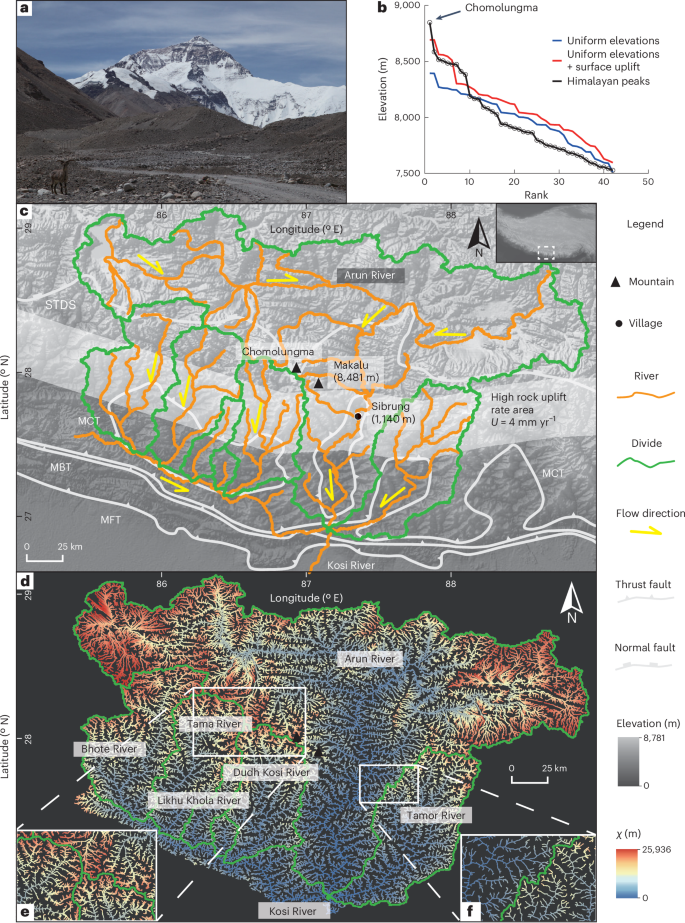
-We numerically reconstruct the capture process using a simple stream power model combined with nonlinear inverse methods constrained by modern river profiles. Our best-fit model suggests the capture event occurred approximately 89 thousand years ago and caused acceleration of downstream incision rates. Flexural models estimate this non-steady erosion triggers isostatic response and surface uplift over a broad geographical area. We suggest that part of Chomolungma’s anomalous elevation (~15–50 m) can be explained as the isostatic response to capture-triggered river incision, highlighting the complex interplay between geological dynamics and the formation of topographic features. https://www.nature.com/articles/s41561-024-01535-w (30 Sept. 2024)
Tamil Nadu Palar river basin severely hit by heavy metal contamination A research paper published in Elsevier Group of Journals titled ‘Ecological Indicators’ has revealed severe water contamination in Palar River basin, which is spread all across Vellore district. “Cadmium, zinc, and manganese are some of the heavy metals found in alarming levels in the river. The water quality is significantly contaminated with chromium, carbon monoxide, copper, cadmium, and iron, and moderately contaminated with manganese, nickel, and zinc,” read the research journal authored by A Kumaraguru, Biodiversity Conservation Foundation, Tiruchy.
Commenting on the solutions for the issue, co-author Sai Saraswathi, School of Advanced Sciences, Vellore Institute of Technology, said, “There is a need for adoption of advanced water treatment technologies, promotion of green chemistry practices in local industries, establishment of stricter regulatory frameworks, and implementation of community-based water management strategies,” said Professor Sai. These measures are essential to ensuring safe drinking water & achieving sustainable development goals. The findings underscore the urgent need for comprehensive monitoring & proactive strategies in industrially contaminated regions.
The cobalt contamination along the riverside is primarily attributed to the government and public sector undertakings in SIPCOT, located on the east side, which contributes to contamination flowing through the river. https://www.dtnext.in/news/tamilnadu/palar-river-basin-severely-hit-by-heavy-metal-contamination-finds-report-805648 (30 Sept. 2024)
Telangana Musi’s Toxic Waters Leave Farmers Poorer When TOI visited their villages, farmers complained that the quality of the soil had deteriorated. “Initially, we did not see any problem using the Musi River water for cultivation. But over the years, the yield has decreased and the soil has become loose and dead. Now we cannot use tractors because they get stuck in the field,” said Kallari Mallesham, who owns 10 acres of land in Palliwada village in Ramannapeta mandal, Yadadri Bhuvanagiri district. He added that even labourers think twice about working in the fields as they have to work in knee-deep soil and also suffer from skin problems.
-Paddy farmers from villages along the Musi river belt are living in uncertainty, with no guarantee that they will recoup their investment before the harvest. Aside from issues of low produce, farmers along the Musi river belt are also faced with pest attacks. “If we have to deal with the brown planthopper (BPH) or any other pest attack, we will lose everything,” said Sattiah Goud, a tenant farmer from Rudravelly village.
-Along with paddy farmers, toddy tappers along the Musi belt have also been affected, as they now collect barely four litres of toddy a day, compared to 20-30 litres in the past. The number of toddy tappers has declined drastically over the years as many find it unprofitable to sell toddy. Devaiah Goud Nunemuntala, 61, who climbs four trees every day to collect toddy, said the amount of toddy produced came down because of the contaminated river water. He added that there used to be about 35 toddy tappers in his village, but now the number has been reduced to four. https://timesofindia.indiatimes.com/city/hyderabad/musis-toxic-waters-leave-farmers-poorer/amp_articleshow/113793312.cms (30 Sep. 2024)
Arunachal Pradesh Over 6,500 kgs of plastic waste removed Over 6,500 kgs of plastic waste were removed from the Dikrong riverbed near the Sat market here during a cleaning drive organised by the NSS cell and the NCC unit of Rajiv Gandhi University (RGU) and the Youth Mission for Clean River (YMCR) on Tuesday (Oct. 01). More than 100 students from RGU and Government College, Doimukh participated in the cleaning drive. https://arunachaltimes.in/index.php/2024/10/02/over-6500-kgs-of-plastic-waste-removed/ (2 Oct 2024)
YAMUNA Delhi River pollution hits record high The faecal levels, depicting untreated sewage and high-level pollution in the river Yamuna, reached an all-time high in September. However, even the August rain couldn’t improve the levels of faecal coliform, which at its peak was a whopping 4,900,000 MPN (most probable number)/100 ml. This is 1,959 times higher than the standard of 2,500 units and 9,800 times the desired limit of 500 units. This was the worst pollution in the river, in terms of faecal coliform, since February 2022, when the faecal level at Agra Canal (one of the stations at the river stretch in the city) had reached 6,300,000 units.
The faecal level in the river was assessed by the Delhi Pollution Control Committee (DPCC) for Sep, a report of which was released on October 4, with samples collected on September 4. The report comes at a time when certain stretches of the river are already showing heavy frothing, a visible proof of pollution when mixed pollutants like surfactants and phosphates are churned out to reveal their presence, even if the DPCC doesn’t test those parameters. “The source of high faecal coliform could be untreated or inadequately treated sewage from the STPs, sewage mixing through open drains coming from unauthorised colonies, intrusion or mixing of septage, faeces of animals, etc.,” stated a senior official involved with the cleaning of the Yamuna river.
Earlier in August, the highest faecal coliform level recorded was 920,000 units—a substantial increase from the 160,000 units observed in July. Media had earlier in Sept, referring to another DPCC report, stated that 56% of the sewage treatment plants in Delhi failed to meet the standards in Aug, the same as earlier in July & June. The STP mostly failed to meet the standards for TSS, BOD, COD, and faecal coliform. The sewage treated from STPs often makes its way to the river Yamuna or is often used for horticulture. https://timesofindia.indiatimes.com/city/delhi/yamuna-river-pollution-hits-record-high-in-delhi-faecal-coliform-levels-soar-in-september/articleshow/113981900.cms (06 Oct. 2024)
RIVERS BIODIVERSITY
Documentary First Ever CGI Footage of Ganges River Dolphin Witness the captivating story of the endangered Ganges River Dolphin like never before in ‘Tangled Fates’ by Soumen Bakshi.
This groundbreaking documentary features the first-ever CGI footage of the elusive Ganges River Dolphin, exploring its habitat, struggles, and the grave threat posed by bycatch from fishing practices. https://www.youtube.com/watch?v=8VdjWnewvvs (05 Oct. 2024)
Uttarakhand First-ever honey badger recording on camera The honey badger (Mellivora capensis) was photographed on January 7, 2024, near the Sharda River Canal at the Bagha I beat in the Surai range of the forest division. Initially thought to be a civet cat, officials later identified it as a honey badger, distinguished by its large head and distinctive mantle colouring.
The Terai East Forest Division (TEFD) forms a crucial link between two key wildlife areas — Nandhaur Wildlife Sanctuary & Pilibhit Tiger Reserve — via the Kilpura-Khatima-Surai corridors, which enable elephants, tigers, leopards, bears and hyenas to move freely. The presence of the honey badger adds further ecological importance to these corridors, reinforcing the need for stronger conservation efforts to safeguard them from threats like human encroachment and habitat loss. https://www.downtoearth.org.in/wildlife-biodiversity/uttarakhands-terai-forest-yields-first-ever-honey-badger-recording-on-camera (1 Oct 2024)
Arunachal Pradesh Namdapha NP & Kamlang WS declared ESZs The MoEF&CC has declared Arunachal Pradesh’s Namdapha National Park & Tiger Reserve and Kamlang Wildlife Sanctuary & Tiger Reserve as Eco-Sensitive Zone (ESZ). The Namdapha National Park & Tiger Reserve is in Changlang district, while the Kamlang Wildlife Sanctuary & Tiger Reserve falls in Lohit district. https://www.indiatodayne.in/arunachal-pradesh/story/arunachals-namdapha-national-park-and-kamlang-wildlife-sanctuary-declared-eco-sensitive-zones-1102279-2024-10-05 (5 Oct 2024)
FISH, FISHERIES, FISHERFOLKS
A review of inland fisheries in India by FAO, 2024 India has abundant water resources including rivers, canals, ponds, lakes, reservoirs, upland lakes, and floodplain wetlands covering over 5.8 percent of the country. These environments harbour a rich fish fauna of 1 035 species that constitutes the basis for the inland fisheries sector, which annually produces 2 144 452 tonnes of fish – if enhanced and culture-based fisheries are included – corresponding to 21 percent of total fish production. https://www.icsf.net/resources/a-review-of-the-inland-fisheries-of-india-by-fao-2024/ (04 Oct. 2024)
SAND MINING
Uttar Pradesh Illegal sand miners on Sept 22 tried to mow down Moradabad Joint Magistrate. NGT has not sent notices to Secretary, MoEF, Member Secretary of Pollution Control Boards at centre and states of UP and Uttarakhand and also DMs of Moradabad and neighboring Udham Singh Nagar districts. https://www.hindustantimes.com/cities/lucknow-news/illegal-miners-attempt-to-run-over-trainee-ias-officer-at-u-p-uttarakhand-border-101727287881110.html (26 Sept. 2024)
Haryana Focus on illegal sand mining in Yamuna Nagar In Haryana and, specifically, in Yamunanagar, mining on riverbeds, sometimes flouting the restrictions, picked up pace after the Haryana government introduced contracts through auction in November 2013. In 2019, Mahadevan documented that illegal sand miners made around Rs five lakh of profit daily in just one district. According to a survey report, prepared by the Yamunanagar district administration in October 2023, 30.71 million metric tonnes of sand were mined between financial years 2020-21 and 2022-23 while 2.46 million metric tonnes of boulder and gravel were mined during the same period. A mining official said the Haryana government levies Rs 50 on each tonne of sand mined. The report seen by ThePrint said the state government raked in nearly Rs 500 crore in royalties from sand mining in the Yamunanagar district between 2020 and 2023. https://theprint.in/politics/exploited-riverbeds-crores-in-play-quashed-arrest-of-ex-mla-puts-focus-on-yamunanagar-illegal-mining/2296881/ (04 Oct. 2024)
NGT takes cognisance of auction for mining in protected Aravalli The NGT has taken suo motu cognisance of a news report regarding the auction of a portion of Aravalli forest land in Rajawas, Haryana, for mining purposes, shortly after its declaration as a ‘protected forest.’ The NGT has directed all these respondents to file their replies in the form of affidavits at least one week before the next hearing scheduled for January 28, 2025. https://www.barandbench.com/news/ngt-cognisance-auction-mining-aravali (04 Oct. 2024)
Tamil Nadu Private school blasted hill to mine sand at Kovilpatti: Greens Social activists are irked by the actions of the Kovilpatti police and revenue officials, who are tightlipped on the illegal mining of ‘saral’ (sand) from Kathiresan Malai at Kovilpatti. The hill is home to the famous Kathirvel Murugan Temple, belonging to the HR&CE department. Sources said that a private school belonging to Pasumpon Educational Trust, located on HR&CE land in the foothills of the hill, removed saral sand to establish a playground for the school.
Without prior permission from the geology and mining department, miners had used explosives to blast the rocks off the hill. Several hundred loads of saral sand had been sold in the past week, before the Kovilpatti police acted on a complaint and secured an earthmover operator A Marikannan (30) and tipper lorry driver A Muthu Lakshmanan (34) on September 27. However, they were released shortly after a call from the higher-ups. https://www.newindianexpress.com/states/tamil-nadu/2024/Oct/03/private-school-blasted-hill-to-mine-sand-at-tamil-nadus-kovilpatti-say-activists (03 Oct. 2024)
WETLANDS, LAKES, WATER BODIES
SANDRP Blog Yamuna Manthan 031024: Threatened River Wetlands There are reports of Uttar Pradesh govt’s plan to reduce ESZ of Keetham lake to zero. Similarly, the Uttar Pradesh govt departments have also been delaying process to notify Dhanauri wetlands as a Ramsar site in Greater Noida. In Gurugram, a report by has found several violations of ESZ norms by housing and infrastructure projects impacting Sultanpur National Park in Sahibi river basin. Likewise, in Delhi, NHAI was found damaging part of a protected pond in Goyla Khurd village by constructed road through the waterbody. https://sandrp.in/2024/10/03/yamuna-manthan-031024-threatened-river-wetlands/ (03 Oct. 2024)
WATER OPTIONS
Report Effective greywater management & its reuse potential in rural Punjab, Haryana As greywater generation increases due to the Jal Jeevan Mission (JJM) program with Functional Household Tap Connections (FHTCs) installed in rural India, exploring its potential for groundwater recharge and irrigation is crucial. To optimise the greywater value chain at the village level, a multifaceted strategy is necessary. This involves streamlining policy implementation, refining funding mechanisms, and strengthening community engagement.
1. Encouraging use of treated greywater for agricultural reuse – Enhancing agricultural practices through treated greywater, involving farmers in the process, and promoting sustainable farming could reduce groundwater extraction and boost agricultural productivity. Collaborative studies, pilot projects, and comprehensive training programs for farmers could accelerate the adoption of these practices.
2. Strengthening community involvement through VWSCs – Empowering local bodies with knowledge, resources, and decision-making authority, we can achieve more effective management of greywater treatment facilities and solid waste management at the village level. This approach leverages local expertise and encourages community-driven solutions.
3. Developing comprehensive water quality standards – Prioritise comprehensive water quality testing by VWSC members on a regular basis to ensure greywater safety, protect public health, and inform farmers about quality standards before irrigation.
4. Refining funding mechanisms – Developing alternative funding parameters beyond population size, such as considering existing infrastructure or water scarcity levels, could lead to a more equitable distribution of resources. This approach would benefit smaller villages that currently struggle to access adequate funds for greywater management. https://www.indiawaterportal.org/water-quality-and-pollution/waste-water-/effective-greywater-management-and-its-reuse-potential-in-rural-punjab-and-haryana (30 Sep. 2024)
Karnataka India’s first indirect potable water reuse project opened Boson Whitewater, a water utility company that converts STP-treated water into high-quality potable water, has collaborated with Biome Environmental Trust for India’s first indirect potable water reuse project through managed aquifer recharge at Devanahalli, Karnataka. The project produces 6,40,000 litres of potable drinking water per day, adhering to BIS-10500 drinking water standards. The clean water now directly benefits thousands of residents in the Devanahalli municipality.
– As part of this project, treated wastewater from the sewage treatment plant is first pumped into Bagalur Lake, where it is diluted with rainwater. It is then directed to Devanahalli’s Sihineerukere Lake, further diluted with rainwater, and subsequently filtered through the earth to recharge the aquifer. The water is then picked up from the aquifer through a dug well and shallow filter borewells, treated, and then supplied to the town. Indirect potable reuse involves using an environmental buffer, such as a lake for dilution with rainwater and/ or groundwater aquifer for earth filtration, before the water undergoes final treatment at a drinking water facility. https://www.thehansindia.com/karnataka/indias-first-indirect-potable-water-reuse-project-opened-911328 (02 Oct. 2024)
Chhattisgarh Village fought water crisis with conservation efforts Village Parstarai, once afflicted by severe water scarcity in Chhattisgarh’s Dhamtari district, has emerged as an exemplar of water conservation and crop cycle transformation, embodying the vision under the ‘Jal Shakti Abhiyan’.
-A few years ago, Parstarai grappled with drought and a severe water shortage. The groundwater levels in the region had significantly declined and the crisis led to routine crop failures resulting in a significant drop in farmers’ incomes. To combat the existing challenge, the village chief Parmanand Adil and local community leaders initiated the ‘Jal Jagr’ campaign in their habitat.
-Efforts were made to conserve rainwater through the construction of soak pits and rainwater harvesting practices in every household. Water conservation measures were also introduced in public places and even in the schools of the village. With water conservation practices adopted, the farmers of the village also switched from water-intensive paddy crops to drought-resistant crops thereby transforming their crop cycle.
-Now the local agrarian community cultivate pulses, oilseeds, chickpeas, mustard, moong and urad among others. “Instead of relying only on paddy, we now grow crops that require less water. This has helped in our efforts aimed to conserve water and also boosted our income,” says Ramnarayan Sahu, a local farmer. Impressed with the achievement of the villagers, the state government has decided to observe it as ‘Jal Jagr Mahotsav’ to be held in Dhamtari on October 5-6. https://www.newindianexpress.com/nation/2024/Sep/29/how-chhattisgarh-village-fought-water-crisis-with-conservation-efforts (29 Sept. 2024)
URBAN LAKES, WETLANDS
Hyderabad HYDRAA gains statutory backing to protect water bodies Telangana Government has drafted an ordinance to this effect transferring powers hitherto under the purview of different departments to HYDRAA enabling its uninterrupted operations. The ordinance envisaging transfer of powers vested in different departments to the Government, which in turn entrusted the responsibility of their effective implementation to HYDRAA, has been approved by Governor Jishnu Dev Varma recently. https://www.thehindu.com/news/national/telangana/hydraa-now-empowered-to-issue-notification-to-vacate-encroachments-telangana-governor-approves-ordinance/article68709485.ece (02 Oct. 2024)
HC declines to stay GO 99 The Telangana High Court was not inclined to issue interim orders to stay GO 99, which was issued to establish the HYDRAA. Justice K. Lakshman was hearing petitions challenging the legal sanctity of HYDRAA and seeking to set aside the government order. https://www.deccanchronicle.com/southern-states/telangana/telangana-high-court-declines-to-stay-go-99-on-hydraa-1827455 (02 Oct. 2024)
Bengaluru Builder faces fresh heat as NGT reopens 4- year-old case After a five-year legal battle, an applicant accusing a builder of violating environmental laws has successfully persuaded the NGT to reopen his case. The applicant, B Raghupathy, had initially approached the NGT, accusing builder K S Satish of breaching the buffer zone regulations established by the tribunal. The NGT has ow reinstated a four-year-old case where Raghupathy alleges that the New Ark Project, which involves the construction of both an apartment and a commercial complex in Kasavanahalli, has violated environmental guidelines. Raghupathy claims the builder initially sought land conversion from agricultural to ‘hi-tech’ use.
However, before the deputy commissioner could issue an order, the builder requested the Bangalore Development Authority to convert the land from ‘hi-tech’ to ‘commercial.’ He further alleged that a secondary nala adjacent to the project site, which acts as a feeder canal to the Kaikondrahalli and Kasavanahalli lakes, is at risk due to the construction. https://www.deccanherald.com/india/karnataka/bengaluru/builder-faces-fresh-heat-as-ngt-reopens-4-year-old-case-3218884 (04 Oct. 2024)
URBAN WATER
Mumbai Building new dams will not solve poor distribution network Before pushing capital-intensive projects to augment supply, the municipality should inform citizens about the status of the water distribution network: the percentage of households connected to piped water supply in different parts of the city, the water pressure, per capita delivery of water in different zones, timings and the reliability of supply.
-By reducing water losses, Mumbai can save water and potentially avoid (or postpone) constructing expensive dams and desalination plants.
-It must pay greater attention to improving the distribution network. The poorly managed distribution network is the reason citizens suffer. Multi-crore projects that will hurt the environment and Adivasis in the hinterland need to be considered after a more realistic assessment of the problem. (Sachin Tiwale, ATREE) https://amp.scroll.in/article/1072914/mumbais-water-problem-building-new-dams-will-not-solve-the-citys-poor-distribution-network (04 Oct. 2024)
4 months’ worth of water just disappears! The Brihanmumbai Municipal Corporation (BMC) claims that non-revenue water (NRW), which refers to water losses, has decreased from 38 per cent to 34 per cent over the past two years. However, this still equates to losing the equivalent of four months’ worth of water supply. Ideally, the loss rate should not exceed 15 per cent of the total supply. NRW encompasses water that is supplied but not paid for, including losses from leakage, unbilled water, illegal connections, faulty water meters, and inaccurate readings. Of the 3,950 million litres of water received daily, 1,500 million litres were lost—a significant amount.
Mumbai has a water supply network spanning over 5,000 km. Water from the city’s 27 balance reservoirs is distributed to 3.89 lakh customers through this extensive network, excluding an additional 800 km of water tunnels and large pipelines that bring water from dams to treatment plants and then to the reservoirs. https://www.mid-day.com/mumbai/mumbai-news/article/mumbais-water-woes-bmc-reports-34-pc-loss-despite-improvement-in-nrw-23405124 (04 Oct. 2024)
Pimpri Chinchwad Not able to supply water in PMRDA limits: PCMC Pimpri Chinchwad Municipal Corporation (PCMC) has expressed inability to supply water to villages located in PMRDA limits. This comes a few days after the PMRDA commissioner, in a letter to the civic body, said that the civic bodies must provide water to villages located within a 5 km radius as per the rules. Municipal commissioner Shekhar Singh, in his letter to PMRDA, said that the water supply situaticon in PCMC is already strained. The civic body finds it difficult to provide water to its own people, hence it is not possible to provide water to areas outside its jurisdiction, he said. https://timesofindia.indiatimes.com/city/pune/not-able-to-supply-water-to-villages-in-pmrda-limits-pcmc/articleshow/113713460.cms (26 Sept. 2024)
Greater Noida NGT initiates suo motu case on water contamination NGT has taken suo motu cognisance of a news report highlighting the contamination of drinking water in Greater Noida’s Supertech Ecovillage 2 housing society. The news article, published in The Indian Express on September 13, 2024, reported that the water supply contained traces of E.coli bacteria and bleaching powder, leading to over 300 residents, including 170 children, falling ill. The residents suffered from symptoms like diarrhea, vomiting, stomach pain, and fever. Therefore, it issued notices to the Greater Noida authority, UPPCB), CPCB and the DM in Noida. The NGT has directed all these respondents to file their replies in the form of affidavits at least one week before the next hearing scheduled for January 28, 2025. https://www.barandbench.com/news/ngt-suo-motu-case-water-contamination-greater-noida-flats (04 Oct. 2024)
JJM/ RURAL WATER SUPPLY
Haryana Villagers challenge politicians to drink water Voters in Samaspur village, Charkhi Dadri constituency, have issued a challenge to all political candidates seeking their votes in the upcoming election: drink a glass of the water supplied to their village. Residents claim they have been forced to buy drinking water for the past decade, as the water supplied to their area is dirty, foul-smelling, and unfit even for animals, let alone humans. https://www.indiatoday.in/elections/assembly/video/villagers-challenge-politicians-to-drink-water-supplied-to-them-in-haryana-2609961-2024-10-02 (02 Oct. 2024)
AGRICULTURE
Jammu & Kashmir Kashmiris harvest rice crop amid dwindling paddy land. https://www.greaterkashmir.com/kashmir/in-frames-kashmiris-harvest-rice-crop-amid-dwindling-paddy-land/ (02 Oct. 2024)
MONSOON 2024
SANDRP Blog SW Monsoon 2024: District wise rainfall in India In the just concluded South West Monsoon 2024, India received 934.8 mm, about 107.6% of the Normal SW Monsoon rainfall of 868.6 mm as per India Meteorological Department (IMD).

This article gives region wise, monthwise, state wise, sub division wise and district wise rainfall in India for the SW Monsoon 2024. Plz Read, Share. https://sandrp.in/2024/10/07/sw-monsoon-2024-district-wise-rainfall-in-india/ (07 Oct. 2024)
Yamuna SW Monsoon 2024: Upper Segment Misses Flood After remarkable deluge in 2023, the upper segment of Yamuna river has seen no significant flood spell all through the just concluded southwest monsoon 2024. This is unusual as the river generally witnesses at least a couple of low or medium flood spells in this segment every year. However, this year the discharges from Hathnikund Barrage (HKB) in Haryana did not cross 1 lakh cusec figure even a single time. The peak discharge from the barrage was 87,017 cusecs at 06:00 hour on 26.09.2024. https://sandrp.in/2024/10/02/yamuna-sw-monsoon-2024-upper-segment-misses-flood/ (02 Oct. 2024)
Report Monsoon pattern changing Rainfall data analysis by the IIT, Gandhinagar, however, showed a localised increase in extreme rainfall, indicating that unusually heavy rainfall was occurring and impacting some places more than others. Even though an area’s annual total rainfall may remain within expected levels, it could see more concentrated and extreme rainfalls over shorter periods, leading to flash floods and overwhelming drainage systems.
“We are observing shifts in weather patterns and extremes that challenge the assumptions based on historical data,” said Udit Bhatia, who leads the Machine Intelligence and Resilience (MIR) Laboratory at IIT Gandhinagar, adding that relying too much on historical rain patterns might no longer be the safest approach. Infrastructure designed using outdated data may not be fully equipped to handle the intensity of future extremes, he said.
The analysis also highlights the increasing vulnerability of urban areas to extreme rainfall as the infrastructure is not built to cope with sudden increases in rainfall. During this monsoon, people in Delhi, Mumbai, Surat, Jaipur, Chandigarh, Gurugram and Bengaluru saw massive flooding. Unless India has a plan to build climate-resilient urban infrastructure, the flooding of cities will become more intense in the future as the intensity of extreme rains increases. There is enough science available on building climate-resilient infrastructure: India needs to invest in it to improve life in cities where half of the country’s population will live by 2050. https://www.hindustantimes.com/opinion/ecostani-monsoon-pattern-changing-with-himalayas-west-coast-recording-more-extreme-rain-101727708826385.html (01 Oct. 2024)
Record surplus but erratic rainfall Even though this monsoon will be categorised as “normal” as a whole, there are wide regional variations. Nagaland stands at 32% deficit, followed by Manipur (31%), Arunachal Pradesh and Punjab (29%), Bihar (28%), Jammu and Kashmir (27%) and Himachal Pradesh (20%). Bihar and Punjab are important states from the point of view of kharif crops. Deficient rainfall in Jammu and Kashmir and Himachal Pradesh might also affect production of apples.
Even last year, states such as Kerala, Karnataka, eastern Uttar Pradesh, Jharkhand, Bihar, Gangetic West Bengal and the four states together in the North East (Mizoram, Manipur, Tripura and Nagaland) had ended in the negatives, all deficient beyond 20%, possibly because of El Nino weather phenomenon. https://scroll.in/article/1073906/monsoon-set-to-withdraw-india-records-surplus-but-erratic-rainfall-with-regional-variations (02 Oct. 2024)
Highest number of very-heavy and extremely-heavy rainfall events in last 5 years The ‘end of monsoon report’ recently published by the IMD stated that there were 2,632 very-heavy rainfall events and 473 extremely-heavy rainfall events in 2024. In 2023, which was officially a drought year, the country recorded 2,321 very-heavy rainfall events and 421 extremely-heavy rainfall events. If recorded rainfall is between 115.6 mm and 204.5 mm in 24 hours, IMD classifies it as very-heavy rainfall. Similarly, more than 204.5 mm of rainfall in 24 hours is defined as extremely-heavy rainfall. https://indianexpress.com/article/india/monsoon-2024-reports-extreme-rainfall-years-9606493/ (06 Oct. 2024)
8% more rain than historical average: IMD About 35% of the country received ‘excess rainfall’ and slightly over half, or 54%, receiving ‘normal’ rainfall. Monthly rainfall over the country as a whole was 89% of the average in June, 9% more than normal of July, 15% above the normal of August, and 12% over the normal of September.
During the monsoon months, the agency had said that a key factor for bountiful rainfall would be La Nina, or a minimum half a degree cooling of the Central Equatorial Pacific, that was to have set in by September. This, however, has not happened with most of the international climate models, including India’s going wrong on this factor. “We don’t know specifically why La Nina hasn’t set in but most models, on average, give a 71% chance for La Nina to set in during October, November and December,” said M. Mohapatra, Director General, IMD.
The main reason for good rainfall this season was the formation of several low pressure systems — or moisture-laden winds from the Arabian Sea or Bay of Bengal — with 14 of them having formed from June to September. https://www.thehindu.com/news/national/above-normal-rain-likely-in-central-southern-peninsular-northeast-india-from-october-to-december-says-imd/article68705674.ece (01 Oct. 2024)
How, why global forecasters got La Nina prediction wrong It’s October and the El Nino Southern Oscillation (ENSO) conditions are still continuing. There’s no sign of a positive IOD effect; IOD remains neutral. And the delay in the establishment of La Nina may lengthen the warm streak seen globally since last October , experts said. “None of the models globally go the t La Nina forecast right. But circulation features resembled La Nina which helped the monsoon. It needs to be researched as to why models gave those signals,” said M Mohapatra, director general, IMD.
Experts believe the climate crisis may be responsible for the anomaly. “Probably, the most important reason may be global warming. The past year saw very hot months and ocean temperatures were up. Global warming may have led to the asymmetric evolution of El Nino and La Niña. The models do not factor in these effects of global warming,” said M Rajeevan, former secretary, ministry of earth sciences and climate scientist. “The expected La Nina event was a weak/ moderate. Normally models have poor skill in predicting these weaker events. Models do well on stronger events because the signal is much stronger,” Rajeevan added. Whatever the reason, the slow transition has led to a continued warm streak. https://www.hindustantimes.com/india-news/how-why-global-forecasters-got-la-nina-prediction-wrong-101727894302075.html (03 Oct. 2024)
Over 1,400 died during extreme weather events The IMD data revealed that 895 people lost their lives due to floods and rain-related incidents, while 597 fatalities were caused by thunderstorms and lightning strikes during the monsoon season. The IMD reported that the country experienced 525 heavy rainfall events (precipitation between 115.6 mm and 204.5 mm) — the highest in the last five years — and 96 extremely heavy rainfall events (above 204.5 mm) during the 2024 monsoon.
Assam and Madhya Pradesh recorded 102 and 100 deaths, respectively, due to floods and heavy rains. In the national capital, 13 deaths were reported as a result of floods and heavy rains. According to the data, 17 people died from heatwaves — 13 in Jharkhand and four in Rajasthan — during the early part of the season. Kerala, which witnessed devastating landslides in the ecologically fragile Wayanad district on July 30, recorded 397 deaths due to floods and heavy rains. Madhya Pradesh recorded the highest number of deaths (189) due to thunderstorms and lightning strikes, followed by Uttar Pradesh (138), Bihar (61), and Jharkhand (53). https://www.ndtv.com/india-news/over-1-400-died-in-india-during-extreme-weather-events-in-2024-monsoon-6693643 (01 Oct. 2024)
Karnataka More isn’t enough for agricultural sector After back-to-back droughts and deficit monsoons over the past few years, Karnataka had in 2024 a bounteous Southwest monsoon. However, this may still be inadequate for the agricultural sector as the monsoon has mostly been marked by only short spells of heavy rain instead of sustained ones. “Technically speaking, it has been a good hydrological monsoon as all rivers are in spate, reservoirs and canals are full to the brim. But, if you look at it from the point of view of agriculture, it has failed as the heavy spells were only over shorter durations,” CS Patil, Sr Scientist at IMD Bangalore explained.
While IMD Bengaluru reported 11% excess rainfall, Karnataka State Natural Disaster Monitoring Centre’s (KSNDMC) cumulative data for Southwest monsoon pointed at 15% excess rainfall. IMD data revealed that Karnataka, during the monsoon months, received 926.6 cm rainfall as against the normal rainfall of 831.8 cm. KSNDMC data put rainfall at 977 cm, as against the normal figure of 852 cm. A comparison of various meteorological zones of the state revealed that Coastal Karnataka received the highest rainfall (20% excess), followed by Malnad (13%), North Interior Karnataka (12%) & South Interior Karnataka (11%). https://timesofindia.indiatimes.com/city/bengaluru/karnatakas-agriculture-struggles-despite-excess-monsoon-rainfall-in-2024/articleshowprint/113828286.cms (1 Oct 2024)
Nagaland Changing rainfall pattern The study, carried out using historical rainfall data of forty years, analysed rainfall trends across eleven stations in Nagaland. Using a technique called Innovative Trend Analysis (ITA), the study detected significant variations in both seasonal and annual rainfall. Out of the eleven places studied, three stations saw an increase in annual rainfall, mainly in the north-western areas like Mokokchung and Longleng.
However, eight stations, especially in urban areas like Dimapur and Kohima, recorded less rainfall. When looking at seasonal rainfall, the monsoon season showed a mixed picture- rainfall increased at four stations, while seven saw a drop. The winter season was more concerning, as all eleven stations experienced a drop in rainfall, which is important for farming and water supply during the dry months.
Rainfall varied significantly across the state, with northern regions like Tuensang and Longleng seeing more rain, while southeastern areas like Peren and Kohima experienced sharp declines. The decrease was more noticeable in places affected by urban development and deforestation, suggesting that human activities are likely playing a role in these changes. https://www.downtoearth.org.in/climate-change/changing-rainfall-patterns-in-nagaland-requires-call-for-region-specific-water-management-strategies (30 Sept. 2024)
EDIT The other monsoon The IMD has forecast that this year’s post-monsoon rainfall is likely to be ‘above normal’ or about 12% over the historical average. Because of its limited spread and quantity, the northeast monsoon does not get as much attention as the southwest monsoon. However, it significantly affects the productivity of rice and maize in Tamil Nadu and Andhra Pradesh. Records show that in years of deficiency, there was a considerable decrease in agricultural production in the region.
The northeast monsoon rainfall, averaged over the five subdivisions where it is predominant, has a variation of almost 25%, exceeding that of the southwest monsoon rainfall (10%). This translates into years of massive deluge followed by dry spells. If this year’s forecast holds, it will be the second consecutive year of a normal northeast monsoon. Expectations are high that a La Nina, or cooling of the equatorial central Pacific, will support this. However, most global models have struggled to forecast the timing of La Nina this year. More focus is needed on modelling its impact regarding urban flooding. Climate change uncertainty makes such prognosis essential, and disaster management agencies in States must develop credible strategies to incorporate these buffers into budgets. https://www.thehindu.com/opinion/editorial/the-other-monsoon-on-the-northeast-monsoon/article68718752.ece (05 Oct. 2024)
FLOOD 2024
DAM FLOOD DEATHS Villagers demand bridge after 8 deaths from Middle Vaitarna dam water release Villagers from Savarde, on the border of Thane and Palghar districts, launched a protest on Monday at the Middle Vaitarna dam site to demand a proper bridge in the area and to demand justice for several villagers who fell victim to the strong current of the water discharged from the dam. Local MLA Sunil Bhusara announced plans for a temporary ₹50-lakh iron bridge, but it is currently awaiting approval from guardian minister Ravindra Chavan. Once approved, construction is expected to begin within a month.
– Savarde and Dapora villages, located five kilometres downstream from the Middle Vaitarna Dam—the third-tallest dam in Maharashtra—have faced increasing danger since the dam’s construction in 2012. While the dam, which stores 455 million litres of water for Mumbai, was previously provided with advance notice of water releases, villagers said that the alerts had ceased for the past three years. The lack of communication and inadequate transportation facilities, including the washed-away previous bridge, have resulted in at least eight deaths.
– On Monday (Sept. 30) at 9 am, villagers gathered near the dam gate and began their protest. About 100 villagers peacefully demanded the construction of a bridge, justice for those who lost their lives crossing the river, and accountability from the authorities who released dam water without prior notice. The release of the dam’s water is handled by the BMC’s engineering department. Said sarpanch Hanumant Padir: “Additionally, water facilities should be established in both Savarde and Dapora villages, as there are currently no water tanks or pipelines. Villagers have to travel two km daily to fetch water.’’ https://www.hindustantimes.com/cities/mumbai-news/villagers-demand-bridge-after-8-deaths-from-middle-vaitarna-dam-water-release-101727724336462.html (01 Oct. 2024)
W Bengal CM blames Farakka Barrage for floods Chief Minister Mamata Banerjee on Sep 29, 2024 blamed the Farakka Barrage for the deluge in parts of north Bengal. “The Centre did not take up maintenance work of the Farakka Barrage, and its water-bearing capacity has reduced to a great extent, despite our repeated reminders to them,” she said. “Farakka Dam has not engaged in dredging. With proper dredging, [they] could have stored more water in the Farakka Dam. Dredging would have held another four lakh cusecs of water,” she said. https://www.thehindu.com/news/national/west-bengal/flood-situation-alarming-in-north-bengal-centre-not-extending-help-mamata/article68697534.ece (29 Sep. 2024)
Kerala Community-oriented flood forecast system launched A unique decentralised, community-oriented, and impact-based flood forecast and early warning system has been developed for the Periyar and Chalakudy river basins of Kerala, pioneering a new approach to disaster management in the country. This innovative system, launched on September 28, 2024, at Ernakulam District Collectorate, aims to help administrators understand increasingly severe annual weather events, particularly floods, caused by climate change and exacerbated by numerous anthropogenic factors.
Under the newly launched climate information system, data collected on a daily basis from 100 rain gauges operated with community participation across the Periyar and Chalakudy river basins will be available to the Ernakulam District Emergency Operation Centre (EOC) for improved disaster planning. This will help in taking informed decisions during emergencies. This collective initiative significantly enhances flood disaster preparedness, mitigation, rescue, and rehabilitation in the two crucial river basins, prompting other vulnerable areas in the country to replicate the model.
CoS-it-FloWS aims to bridge the connectivity and data gaps at the last mile while providing innovative and inclusive solutions to address climate risks. To accomplish this, it is necessary to empower neighbourhood communities to create hyper-local monitoring systems, develop hydrological models, and develop AI modules to lessen flood inundation mapping and forecasting uncertainties. Additionally, the initiative aims to develop impact-based warning systems and co-create science-based solutions and decision support systems for disaster risk reduction with communities. https://www.downtoearth.org.in/natural-disasters/kerala-community-oriented-flood-forecast-system-launched-in-disaster-prone-periyar-chalakudi-river-basins (30 Sept. 2024)
Assam Flood-adaptive community faces challenges The name Mising translates to ‘man of the water’ with mi meaning man and sing referring to water or river. However, unpredictable floods challenge the Mising tribe, who are normally accustomed to floods. The Mising tribe is attuned to flooding. However, that history does not work because the problem has shifted from a flood issue to a landlessness one,” Varma said. “They are losing land because the [Assam’s] Water Resource Department acquires their remaining land for their embankment.”
-Varma is referring to the state’s policy that embankments should be built 500 metres away from the river. As the river washes away more land, the embankment is required to be reconstructed closer towards the villages harmed by floods. While embankments are one of the main flood mitigation policies for India, Varma said the infrastructure is a “band-aid approach.”
-Today, embankment breaches, happening from floodwaters and heavy rain, are a result of embankments constructed after the 1950 earthquake made mostly of local soil and sediment. These embankments are “washed away by large floods and by the natural relocation of channels in the braided river,” said Robert Wasson, a geomorphologist. https://india.mongabay.com/2024/10/when-books-sink-underwater-assam/ (04 Oct. 2024)
Bunds causing floods Soon after independence, in the 1950s, embankments were built along the Kosi to contain its flow. While they were seen as a lasting solution, not only have the embankments been breached several times, they have created a new problem. -“Embankments narrowed the course of the river. Thus, while Kosi earlier had the option to distribute its sediments, now it was in a straitjacket. With nowhere for the sediments to go, the river’s bed has been rising by about 5 inches a year, making it more prone to overflowing,” Dinesh Kumar Mishra, convenor of NGO Barh Mukti Abhiyan said.
This time, flooding is worse than the past few years because the Birpur barrage, built on the Kosi in Nepal, released 6.6 lakh cusec of water, the highest in almost six decades. On the Indian side, embankment breaches have been reported from seven places in four districts. Mishra said, “The embankments were built with a capacity of 9.5 lakh cusec of water. They are being breached even with water discharge at a much lower level because the river is now shallower. As many as 380 villages lie within the embankments, home to at least 15 lakh people. They have no escape from the annual floods. The government gave them land for rehabilitation, but of the 1200 hectares, 570 were waterlogged.” https://indianexpress.com/article/explained/why-bihar-is-flooded-every-year-9599418/lite/ (03 Oct. 2024)
HFL BREACH
Bihar River Kosi at Dhamaraghat stie in Khagaria district has crossed old HFL 37.74 meter dated 03.08.2020 at 17:00 hour on 30.09.2024. Present flood level is 37.75 meter at 22:00 hour on 30.09.2024 with stable trend.
River Gandak at Lalganj site in Vaishali district has crossed old HFL 51.83 meter 02.09.2021 at 11:00 hour on 01.10.2024. Present flood level is 51.96 meter at 14:00 hour on 01.10.2024 with rising trend.
Madhya Pradesh River Sonar in lower Yamuna basin at Narsinghgarh site in Damoh district has crossed old HFL 336.94 meter dated 12.09.2024 at 16:00 hour on 30.09.2024. Present flood level is 337.08 meter at 22:00 hour on 30.09.2024 with stable trend.
URBAN FLOODS
Chennai Vulnerability mapping in flood prone areas -The Corporation has commenced registration of student volunteers from more than 100 colleges in the city, and has set a target of enlisting 10,000 volunteers for rescue and relief. “We have registered 5,000 college students as volunteers. They will receive training to assist residents during the rains; supply essential items to vulnerable residents; and they will be trained in rescue and relief operations,” an official said. https://www.thehindu.com/news/cities/chennai/vulnerability-mapping-in-chennais-flood-prone-areas-to-be-completed-by-october-10/article68721916.ece/amp/ (05 Oct. 2024)
CLOUD BURSTS
Himachal Pradesh Monsoon losses Rs 1,360 crore in 2024 The state has suffered losses to the tune of over Rs 1,360 crore this monsoon. Last year, the losses due to the widespread rain disaster were around Rs 10,000. The state recorded 101 events of cloudburst/flashfloods and landslides this year, resulting in the death of 37 persons with 33 persons going missing. In the 54 flashfloods/cloudburst and 47 landslides, 122 houses were damaged and 149 cattle were lost.
The PWD suffered the maximum damage of around Rs 633 cr. Jal Shakti Vibhag was a close 2nd, recording losses around Rs 540 cr. The Horticulture Dept suffered losses of around Rs 140 cr. Jal Shakti Vibhag saw 5,505 water supply schemes damaged. This caused a loss of around Rs 382 cr to the dept. As many as 1,213 irrigation schemes were affected during the monsoon, resulting in the loss of Rs 129 cr. https://www.tribuneindia.com/news/himachal/monsoon-losses-rs-1360-crore-in-2024/ (1 Oct 2024)
DISASTERS
Report Glaciologist digs deep into permafrost to gauge future disasters Possible collapse of permafrost, which are permanently frozen rock or soil formations, is an emerging climate-change induced issue in the upper reaches of the Himalayas. Glaciologist S.N. Remya from Kerala, who is part of this year’s India’s Arctic Expedition, currently based at the Himadri research station in Norway, says that her work is aimed at identifying the probability of disasters due to permafrost collapse and help provide early warnings to local communities.
“Soil or rock that remains frozen for atleast two consecutive years is considered as permafrost. Underneath the surface, there would be regions of ice. Due to global warming, this layer of ice will melt leading to a permafrost thaw, causing fluctuations or collapse of the ground. There have been cases in Canada and other places where buildings or other infrastructure have collapsed. We still do not have proof whether permafrost had a role to play in some of the disasters in the Himalayas and it is something that has to be studied,” says Remya, from the Himadri station, hosted by the National Centre for Polar and Ocean Research (NCPOR) at the International Arctic Research base in Ny-Alesund.
Her objective in the Arctic is to study these features more closely, as permafrost areas are more accessible in those regions, and apply these findings to the Himalayas, which has similar topography and climate. https://www.thehindu.com/sci-tech/energy-and-environment/glaciologist-digs-deep-into-permafrost-to-gauge-future-disasters/article68698268.ece (30 Sept. 2024)
ENVIRONMENT GOVERNANCE
MoEF Key forest panel calls tunnel construction ‘environment friendly’ The construction of a tunnel is an “environment friendly activity, the forest advisory committee has held, adding that no compensatory afforestation is needed for such projects as they do not involve “damage to the above ground vegetation and wildlife”. The Union environment ministry communicated this decision to state government in a letter, a copy of which is available on the Parivesh website, last month, paving the way for “construction of road/railways tunnels in the forest area” to be treated at par with underground mining projects.
While the decision may encourage tunnels where possible as against felling of trees or slope cutting, a blanket statement on tunneling itself can cause severe damage, experts said. They pointed that a lot will depend on the topography, nature of rocks, underground aquifers and final workmanship to determine whether a tunnel is in fact safe and less detrimental to the environment. https://www.hindustantimes.com/india-news/key-forest-panel-calls-tunnel-construction-environment-friendly-101728067511844.html (05 Oct. 2024)
Report ‘Resistance is needed for govt to perform its basic duties’ Eminent environmentalist Ravi Chopra resigned from the Supreme Court-appointed high-powered committee to supervise the Char Dham road-widening project in 2022 as an act of protest. His advice to limit the road width in the fragile Himalayan terrain had been overruled. However, as the Uttarakhand region sees a massive rush of construction, Chopra continues to lend himself to campaigns, speaking to different audiences, and immersing himself in advocacy about the deteriorating ecology. A powerful and respected voice of dissent and protest, Chopra talks about the need for resistance in today’s India. https://questionofcities.org/resistance-is-needed-for-government-to-perform-its-basic-duties/ (20 Sept. 2024)
Failure of planning cities The widely-prevalent conventional urban planning framework in India, focused on land use, zoning and building regulations, is out of step with the demands of the time we live in, especially climate change events. Development Plans or Master Plans approach natural areas in cities merely as resources to be exploited. This old mould has to be broken. Planning has to be more sensitive to nature in cities and to the needs of the largest number of people if cities have to be liveable, inclusive and sustainable. https://questionofcities.org/the-spectacular-failure-of-planning-cities-as-we-know-it-what-next/ (04 Oct. 2024)
Over 46K acres of forest land diverted for mining in 5 years -A whopping 46,759 acres of forest land have been diverted for mining across the country in the last five years. Between April 1, 2019 and March 31 this year, the Environment Ministry gave 179 approvals to 17 states to carry out mining of minerals and coal. https://www.tribuneindia.com/news/india/over-46k-acres-of-forest-land-diverted-for-mining-in-5-years/amp (03 Oct. 2024)
Biodiversity: The unsung hero Newly published work has highlighted that ecosystems rich in diverse species contribute to cleaner air, water, more food resources and aids in the discovery of medicines. The loss of biodiversity through activities like deforestation and pollution threatens these benefits. https://www.massey.ac.nz/about/news/biodiversity-the-unsung-hero-of-human-health-and-ecosystem-resilience/ (01 Oct. 2024)
SOUTH ASIA
NEPAL-INDIA-BANGLADESH POWER TRADE: India, Nepal, and Bangladesh have on Oct 4 2024, signed a trilateral agreement to export 40 MW of electricity from Nepal to Bangladesh via India’s power grid. This is the first ever such a deal between three countries. A Nepal-Bangladesh meeting also agreed to develop the Sunkoshi-3 hydropower project in a collaborative participatory modality between Nepal, Bangladesh, and India. They have decided to finalise a joint venture agreement in the next meeting. https://www.newsonair.gov.in/india-nepal-nepal-to-export-40-mw-to-bangladesh-via-indias-grid/ (04 Oct. 2024)
Nepal 20 HEPs affected by two-day disaster At least 20 hydropower plants suffered damages due to floods and landslides triggered by the incessant rainfall in the past two days, which has led to the disruption in power supply across the country. As a result of the devastation caused by the natural disasters, the Nepal Electricity Authority which was exporting over 500 MW of electricity on a daily basis to India during this monsoon instead has had to rely on imported electricity to meet the market demand. The NEA Spokesperson Chandan Kumar Ghosh said they imported 300 MW of electricity from India on Saturday.
– The NEA reported that around 3,000 MW of electricity was being produced in Nepal until last week. The recent flooding and landslides over the past two days have reduced current production to only 1,300 MW. According to the Independent Power Producers’ Association of Nepal (IPPAN), a total of 1,177 MW of electricity out of 15 power projects has been completely halted since Saturday. These projects have sustained damages worth Rs 2.31 billion. Floods inflicted damages on powerhouses, transmission lines, access roads and other structures of the power projects.
– The disasters damaged the headbox and powerhouse of the 456 MW Upper Tamakoshi Hydropower Project, the 22 MW Mandu Hydropower Project and the 14.9 MW Hewa Khola Hydropower Project. The electricity productions from an 86 MW Solu Dudh Koshi Hydropower Project and 9.6 MW Mai Khola and its cascade project of 3 MW have also been affected. The 1 MW Pheme Khola Hydropower Project, 5 MW Siuri Khola Hydropower Project, 40 MW Super Nyadi Hydropower Project, 216 MW Upper Trishuli-1, 20 MW Langtang Khola Hydropower Project and 4.36 MW Tungun-Thosne Hydropower Project are among those that suffered damages to the power plants. Similarly, the physical structures and equipment of the 216 MW Upper Trishuli 2 Hydropower Project, under construction in Rasuwa, have been damaged. According to IPPAN, the access road of Sabhakhola-C Hydroelectric Project has been damaged and the road infrastructure of Landruk Modi Hydroelectric Project has also been washed away. The flood has swept away the construction equipment of the Super Trishuli Hydropower Project. https://myrepublica.nagariknetwork.com/news/over-1-100-mw-of-electricity-production-from-at-least-20-hydropower-plants-affected-by-the-two-day-disaster/ (30 Sep. 2024)

Dave Petley on role of landslides in recent Nepal flood disaster. https://eos.org/thelandslideblog/28-to-28-september-2024-nepal (01 Oct. 2024)
Climate change intensifying extreme weather: ICIMOD Unplanned construction, particularly on floodplains, has left large parts of Kathmandu and other urban areas with poor drainage, insufficient water retention capacity and increasing exposure to flood risks. With soil already saturated from an unusually wet monsoon season, this weekend’s rains fell on highly vulnerable ground, amplifying the damage.
In the face of these growing risks, ICIMOD stated it has been working with regional governments and communities to enhance EWS and increase the accuracy of weather forecasts. The centre’s high-impact weather assessment toolkit has helped predict changes in rainfall patterns and alerted authorities to the risk of flooding. Yet, despite these advances, experts say that without more comprehensive planning and investment in climate-resilient infrastructure, Nepal will continue to face mounting losses from extreme weather. The region’s vulnerability to climate change, coupled with haphazard development, means that every monsoon season could bring fresh devastation. https://www.downtoearth.org.in/climate-change/climate-change-intensifying-extreme-weather-in-nepal-warns-icimod (30 Sept. 2024)
Highest mini HEP planned near Mt Everest The Rs 630 M Amadablam Mini Hydropower project near Mount Everest will be built at the elevation of 4423 m on Cholunche Khola, a trbutary of Imja Khola using two turbines with rating of 485 KW. It will be the highest elevation of hydropoewer project of the world. It will come within the national park. https://www.uniindia.com/~/highest-mini-hydropower-project-planned-near-mt-everest/World/news/3295028.html (01 Oct. 2024)
India-Bhutan After 11 years halt, mega dam construction to resume Punatsangchu I HEP work likely to be restarted. According to an article published in Nature Journal in 2020, several slope failures affected the site since 2013, probably as a consequence of the undercutting of a previously unrecognised active landslide. “Our results indicate that downslope displacement, likely related to the natural instability, was already visible in 2007 on various sectors of the entire valley flank,” the subtract of the article written by Benedetta Dini, Andrea Manconi, Simon Loew and Jamyang Chophel states. “Moreover, the area with active displacements impinging on the dam site has continuously increased in size since 2007 and into 2018, even though stabilisation measures have been implemented since 2013.”
– According to the article, stabilisation measures currently only focus on a small portion of the slope, however, the unstable area is larger than previously evaluated. Highly damaged rock is present across many areas of the entire valley flank, indicating that the volumes involved may be orders of magnitude higher than the area on which stabilisation efforts have been concentrated after the 2013 failure. Though several rectification measures were taken since the landslide in 2013, these failed again in 2016 and 2019, further delaying the project. There were differences in geological interpretations between the two governments that led to disagreements about the necessary stabilisation measures. Now, the Central Water Commission (CWC) of India has prepared the design for the right bank stabilisation measures and submitted it to the Bhutanese government.
– “The CWC’s proposal is still under technical review,” the Kuensel report quoted Bhutan’s Energy and Natural Resources Minister Gem Tshering as saying. “We will evaluate if it meets our requirements, and only then will we discuss with the Indian counterparts the adequacy of the stabilisation measures, based on the geological profile of the hill slope.” Though a consensus has been reached to resume construction of the dam, actual work can only start after rectification work is carried out on the right bank. Though initially estimated at around Rs 35 billion, the project’s cost has more than doubled due to unforeseen geological issues and an extended construction timeline and is now estimated to be nearly Rs 100 billion. https://www.etvbharat.com/en/!opinion/explained-the-importance-of-resuming-construction-of-india-funded-mega-dam-in-bhutan-enn24100505961 (05 Oct. 2024)
Punatsangchhu-I to move ahead? The 1,200 MW Punatsangchhu-I Hydropower Project is going ahead with the construction of the dam with essential stabilisation measures for the right bank slide. After 11 years of deliberation and more than 30 Technical Coordination Committee (TCC) meetings, the governments of Bhutan and India have finally reached a consensus to advance the dam’s construction. However, TCC is still discussing whether to go ahead with dam construction. Rectification works will be carried out on the right bank, which suffered a major landslide, bringing the works at the hydropower project site to a sudden halt.
– Speaking to Kuensel, Energy and Natural Resources Minister Gem Tshering said that the Central Water Commission (CWC) of India had prepared the design for the right bank stabilisation measures and submitted it to the Bhutanese government. “The CWC’s proposal is still under technical review,” Lyonpo Gem Tshering said. “We will evaluate if it meets our requirements, and only then will we discuss with the Indian counterparts the adequacy of the stabilisation measures, based on the geological profile of the hill slope.” However, Lyonpo said that it is unclear how long the review process and subsequent joint discussions will take. “We have been requesting a joint sitting for a long time, but the Indian side is not yet ready,” he added. Differences in geological interpretations between the two governments have led to disagreements about the necessary stabilisation measures.
– The government of Bhutan had proposed the construction of a barrage as a feasible alternative to a dam. A detailed project report (DPR), prepared by Swiss company Stucky at the cost of Nu 150 million, found the barrage to be viable at a location 2.6km upstream from the current dam site. However, Indian officials raised safety concerns and expressed reservations about the barrage proposal. The cost overrun for Puntsangchhu-I has reached a whopping Nu100 billion from the initial project cost of Nu 35 billion. So far, the project has spent around Nu 86 billion. https://kuenselonline.com/punatsangchhu-i-to-move-ahead-with-dam-construction/ (5 Oct 2024)
EDIT on Punatsangchu I HEP: One cannot help but question whether the long-term viability of PHPA-I has been compromised. With the ever-increasing costs, how will Bhutan and India manage the financial burden? There are lessons to be learned here, especially when it comes to large-scale infrastructure projects in geologically challenging areas. More robust risk assessments and contingency planning should be integral to future hydropower projects to avoid the pitfalls that have beset PHPA-I.
– Looking ahead, the key to salvaging this project lies in ensuring that the next phase of construction proceeds smoothly, without further complications. The stabilisation measures for the right bank must be implemented with the utmost care, backed by continuous monitoring and technical oversight. Given the significant financial investment already made, there is little room for further errors. Both governments must stay committed to seeing the project through to completion, not only to safeguard their financial stakes but also to maintain public confidence in hydropower as a viable and sustainable economic driver. https://kuenselonline.com/time-to-push-ahead-with-prudence/ (07 Oct. 2024)
Bhutan Anil Ambani $1 B projects The Reliance group led by Anil Ambani on Wednesday (Oct. 02) launched a new company for investing in Bhutan’s renewable energy sector, starting with building 1.2 GW including 500 MW solar and 770 MW hydropower projects that industry watchers said could entail investments of up to $1 billion and mark a revival of fortunes for the beleaguered entity after becoming nearly debt free recently. Named Reliance Enterprises for undertaking projects in partnership with Bhutan’s sovereign commercial and investment arm, Druk Holding and Investments Ltd. The 500 MW solar plant is to be developed in Bhutan’s Gelephu Mindfulness City in two phases of 250 MW each over the next two years. The Reliance-DHI partnership will also extend to developing the 770 MW Chamkharchhu-1 hydroelectric project, marking the first joint venture with an Indian private sector company in Bhutan’s hydro sector. https://timesofindia.indiatimes.com/business/international-business/anil-ambani-powers-a-comeback-with-1-billion-worth-projects-in-bhutan/articleshowprint/113880714.cms (1 Oct 2024)
Can Bhutan tap full hydro potential? Bhutan has about 2500 MW existing hydro capacity that generates about 18% or about 450 MW power in winter. Its electricity demand grew by about 100% in last two years from 450 MW to 900 MW. This year it will be 1100 MW and next year 1600 MW. It now hopes to install 5000-6000 MW Solar and 15000 MW hydro by 2040. Bhutan hopes to attract private investment in hydro, but not 100% in any project as it does not want natural resources to go into the hands of private control. https://kuenselonline.com/hydropower-dreams-can-bhutan-tap-its-full-potential/ (04 Oct. 2024)
India-Bangladesh Fishy diplomacy In September, Dhaka imposed an export ban on hilsa, specifically targeting shipments to India. This came in the run-up to the Durga Puja festival in October when demand typically peaks across the border. Fisheries officials explained that the ban was necessary to prioritise domestic supply and manage the declining hilsa population. However, weeks later, the Commerce Ministry reversed the ban and approved a 3,000-tonne shipment to India.
Hilsa prices have shot up sharply in India as Dhaka reduced exports by 1,000 tonnes. But the government has failed to bring down the prices in Bangladesh. “A syndicate of fishermen who smuggled hilsa to India kept the price high,” said Khandakar Tahmid Rejwan, a research data analyst at the Bangladesh Peace Observatory under the Centre for Alternatives.
An expert from India said the brief ban marked “a firm departure” from Hasina’s practice of using the fish as a symbol of goodwill and friendship between Dhaka and New Delhi. Hasina first used the fish as a diplomatic tool when she came to power in 1996. She gifted hilsa to then-West Bengal CM Jyoti Basu ahead of a landmark agreement on sharing water, a major bilateral issue between the neighbours.
In 2016, the former Bangladeshi PM sent a consignment of hilsa to Mamata Banerjee, who heads the government of West Bengal bordering Bangladesh. A year later, former President Pranab Mukherjee, a prominent Bengali leader of the time, was gifted hilsa as a gesture of friendship. But the interim government is likely to diverge from Hasina’s pro-India foreign policy, according to an expert on India-Bangladesh relations. https://www.aljazeera.com/news/2024/10/1/fishy-diplomacy-what-a-hilsa-ban-reveals-about-india-bangladesh-tensions (01 Oct. 2024)
RUSSIA
A large dam burst An accident with a dam breach occurred during scheduled work in Altai. This was reported by the local emergencies ministry. It is reported that during the planned lowering of the water level in a cascade of lakes located 9 kilometers southwest of the village of Shelabolikha, destructive road activity occurred due to “water overflow.” There is currently no information about flooded houses or private land plots. https://112.ua/en/u-rosii-prorvalo-veliku-dambu-so-vidomo-42334 (05 Oct. 2024)
EUROPE
Scientists protecting the Danube’s delicate ecosystems The Danube is the longest river in the European Union, flowing through 10 countries. What impact do human activities have on this delicate river ecosystem and how can its biodiversity be protected? That is the mission of REXDAN, a multidisciplinary European research project with laboratories on land and on board this ship, the largest of its kind in continental European waterways. https://www.euronews.com/my-europe/2024/09/30/river-research-the-international-scientists-protecting-the-danubes-delicate-ecosystems (30 Sept. 2024)
THE REST OF THE WORLD
USA Tribes celebrate largest dam removal The largest dam removal project in U.S. history was completed Oct 2 2024, marking a major victory for tribes in the region who fought for decades to free hundreds of miles of the Klamath River near the California-Oregon border. But tribal advocates and activists see their work as far from finished, with some already refocusing their efforts on revegetation and other restoration work on the Klamath River and the surrounding land. The report provides fascinating stories of some tribal leaders how and why they fought to achieve this. https://apnews.com/article/klamath-dam-removal-completed-tribes-435b955f5bfdeaca82de66bfc6551ba1 (03 Oct. 2024)
Dams weren’t built for today’s climate-charged rain & floods As flooding hammered Appalachia in the aftermath of Hurricane Helene, residents became intimately familiar with a new norm in the US’s post-storm script: dams at imminent risk of failing. Officials last week said multiple dams were on the brink, including Tennessee’s Nolichucky Dam and North Carolina’s Walters and Lake Lure dams. People in nearby communities were ordered to evacuate. Ultimately, the dams held. But the close calls highlighted the stress on the nation’s dams, many of which are more than half a century old and none of which were designed for the higher levels of precipitation brought on by climate change.
RECENT DAM FAILURES Over the past decade, extreme precipitation has caused partial or complete dam failures in Connecticut, Minnesota and Michigan. In 2017, heavy rainfall brought California’s Oroville dam to crisis stage and forced the evacuation of more than 180,000 people. Between 2015 and 2018, North and South Carolina saw more than 100 dams breached due to record flooding, according to a Congressional Research Services report. Only 3% of dams in the US are under federal control; some are managed by states, but the majority are under private ownership. In 2022, the Association of State Dam Safety Officials, a nonprofit, estimated that $75.7 billion was needed to rehabilitate non-federal dams.
PROBABLE MAXIMUM PRECIPITATION: For more than 75 years, infrastructure whose failure could cause loss of lives — including dams and nuclear power plants — has been built or upgraded to withstand floods using a standard called Probable Maximum Precipitation (PMP). PMP was developed by the federal government starting in the 1940s, a process led by what is now the National Oceanic and Atmospheric Administration. The standard is based on the most extreme rainfall events of the past, with the idea that infrastructure built to endure those extremes will be future-proof. But the data used to maintain the standard hasn’t been updated nationally since 1999, and in some regions not for 60 years. Some states have acted on their own initiative. “There’s probably 20 states now that have updated their PMP in the absence of federal guidelines,” often turning to the private sector for help, said Bill McCormick, who serves as a subject-matter expert on extreme precipitation for the Association of State Dam Safety Officials. North Carolina began its own updating effort before Helene hit, he said. But many states haven’t started. And absent federal oversight, it’s not clear if the state updates go far enough.
ACT ON PMP: For a long time, NOAA “didn’t have any legislative mandate” to update the federal PMP, said McCormick. That changed in 2022 with the passage of the Providing Research and Estimates of Changes in Precipitation (PRECIP) Act. The law required the agency to conduct a study on estimating precipitation, including PMP, within two years. In June, the National Academies of Sciences, Engineering, and Medicine issued that report, authored by a committee that Smith chaired. It urges the US to update the way it calculates the standard to take climate change into account. So far only two countries — Norway and Sweden — have rules requiring that dam owners incorporate future climate predictions into their operations, said Javier Fluixá-Sanmartín, a dam safety engineer with the Swiss firm HYDRO Exploitation SA. But more such rules are likely coming to other countries. In the US, the National Academies report is a key first step. But the bigger question will be funding. Many dam owners can’t necessarily afford to make upgrades. https://www.bnnbloomberg.ca/investing/commodities/2024/10/02/american-dams-werent-built-for-todays-climate-charged-rain-and-floods/ (02 Oct. 2024)
Helene’s death toll tops 130 Widespread devastation left behind by Hurricane Helene came to light Monday (Sept. 30) across the South, revealing a wasteland of splintered houses, crushed cargo containers and mud-covered highways in one of the worst storms in U.S. history. The death toll topped 130. https://apnews.com/article/hurricane-helene-north-carolina-asheville-f02869c7d01e68f2d7f0553abb82252f (01 Oct. 2024)
Decade after signing of California gw law, major challenges remain In 2014, California Gov. Jerry Brown signed historic legislation establishing a framework for California to begin managing groundwater with widespread overpumping, rapid decline of aquifer levels, hundreds of wells dry, and caused the ground to sink in parts of the Central Valley. The law was based on the idea that groundwater could best be managed at the local level, and it called for newly formed local agencies to gradually adopt measures to address chronic declines in groundwater levels. The legislation laid out an implementation timeline stretching more than a quarter-century, giving many areas until 2040 to address their depletion problems. Today, experts and state officials say implementation of the Sustainable Groundwater Management Act, or SGMA, is unfolding largely as expected. But while California has made some preliminary progress toward safeguarding groundwater, the hardest tests loom ahead.
– According to state agencies, about 95% of all groundwater pumping in California is now subject to a locally adopted sustainability plan. “I’m absolutely confident we are going to be successful in achieving groundwater sustainability,” said Paul Gosselin, the Department of Water Resources’ deputy director of sustainable water management.
– Tran pointed out that reviews of the first round of local plans found many wouldn’t adequately protect drinking water, small farmers or the environment. She said the fragmentation of agencies that should be working together is also a problem. When a moderator asked her to give a letter grade for the law’s implementation so far, Tran said it’s been between a C-plus and a B-minus. “There’s still so much infighting that’s happening because there’s not a culture of collaboration,” Tran said. “There’s a scarcity mindset where people are fighting over water. https://www.latimes.com/environment/story/2024-09-17/despite-california-groundwater-law-challenges-remain (17 Sep. 2024)
Brazil Mega dams hit by drought Santo Antônio, Jirau and Belo Monte were built in the Amazon rainforest despite strong opposition from environmental groups and have become among the top five most powerful dams in the country. Belo Monte, which started operating in 2016, has the fourth-largest capacity in the world. But the mega dams are running well below capacity as river levels shrink due to a record drought in the Amazon, highlighting how climate change is becoming a growing challenge to Brazil’s green ambition.
“Unlike with old power plants, the river is the boss, if it gets too dry it stops working,” said a guide who took tourists around the Santo Antônio dam earlier this year.
Santo Antônio had to deactivate 43 out of its 50 turbines early in September as river levels neared a record low due to the drought, having had to shut completely for the same reason for two weeks in October 2023. The three mega dams worked at only a fraction of their full capacity in September, exacerbating a trend whereby hydropower companies have consistently failed to meet the “minimum assured energy” output set out in their contracts with the government.
Experts say the situation is likely to deteriorate as droughts become more regular in future. “Studies indicate that severe drought periods will become more frequent in all regions of Brazil,” Norte Energia, the company which operates Belo Monte, told Context. A 2015 report commissioned by the government predicted that energy potential from natural river flows in Brazil will fall between 7% and 30% by 2030. https://www.context.news/climate-risks/brazil-mega-dams-promised-a-green-future-then-came-climate-change (26 Sept. 2024)
Zambia Mega dam has caused a mega power crisis -Despite having the mighty Zambezi River and the massive hydro-powered Kariba Dam, Zambia is currently grappling with the worst electricity blackouts in living memory. The crisis is so severe that cities and towns across the country are sometimes without electricity for three consecutive days, with people counting themselves lucky if the lights come on for an hour or two. The power cuts have come as a shock to the 43% of Zambians who are connected to the grid and have taken electricity for granted all their lives. But one of the severest droughts in decades – caused by the El Niño weather phenomenon – has decimated Zambia’s power-generation capacity. https://www.bbc.com/news/articles/cx2krr137x9o (03 Oct. 2024)
AMAZON Brazil dredges rivers, raising environmental concerns Dredging and the subsequent sediment redeposition may reduce access to fishing areas, increase erosion in high-risk residential zones, and deteriorate water quality. Risks to nature also include silting and changes to the water’s pH, conductivity, salinity, turbidity and temperature, all of which pose drastic consequences for riverine ecosystems.
-In the state of Pará, dredging started in mid-August, and manatees and river dolphins, species already threatened by droughts, have been found dead along the Amazon River, as well as countless smaller fish.
-One of the main points of concern associated with dredging, however, is the disturbance of sediment layers on the riverbed, which can release and expose any contaminants buried there, including heavy metals such as mercury, whose presence in the Madeira River is a growing problem.
-However, dredging by its nature involves changes to the geometry of the river and to its currents. “For most of the Amazon Basin, we know very little about how the velocity of the current is distributed, meaning that we can’t predict the impact that a seemingly small change to the shape of a channel can have, especially on flow intensity during a flood,” Marinho said. That is particularly concerning given that the Brazilian Amazon has witnessed some of its worst floods in history over the past decade alone.
-Previous studies of other rivers have found that channels that have undergone dredging tend to silt up more frequently, making this an unsustainable solution in the long term. “If you redeposit the sediment close to the dredged area, the tendency is that the river will go back to its original state,” Filizola said. https://news.mongabay.com/2024/10/brazil-dredges-amazon-rivers-to-ease-drought-isolation-raising-environmental-concerns/ (01 Oct. 2024)
Shrinking of major Amazon rivers Huge tributaries that feed the mighty Amazon River — the largest on the planet — have plunged to record-low levels, upending lives, stranding boats, and threatening endangered dolphins as drought grips Brazil. The country is currently enduring its worst drought since records began in 1950, according to Cemaden, the country’s natural disaster monitoring center. It’s Brazil’s second straight year of extreme drought. Nearly 60% of the country is affected, with some cities, including the capital Brasília, enduring more than 140 consecutive days without rain.
In the heart of the Amazon rainforest, the impact on rivers is shocking and experts are sounding the alarm on what this means for the region, a biodiversity hot spot and crucial climate change buffer. The drought has also set the stage for devastating wildfires in Brazil that have destroyed huge swaths of the Amazon as well as the Pantanal, the world’s largest tropical wetlands, and choked cities in thick smoke. There is little relief in sight. Rainfall at levels that could start to replenish rivers is not expected for weeks yet and river levels are projected to keep on falling. “Until November the situation will continue to worsen,” Cuartas said. https://edition.cnn.com/2024/09/30/climate/amazon-rivers-drought-satellite-pictures/index.html (30 Sept. 2024)
Stark before-after pics reveal dramatic shrinking of rivers Huge tributaries that feed the mighty Amazon River — the largest on the planet — have plunged to record-low levels, upending lives, stranding boats, and threatening endangered dolphins as drought grips Brazil. The country is currently enduring its worst drought since records began in 1950, according to Cemaden, the country’s natural disaster monitoring center. It’s Brazil’s second straight year of extreme drought. Nearly 60% of the country is affected, with some cities, including the capital Brasília, enduring more than 140 consecutive days without rain.
-In the heart of the Amazon rainforest, the impact on rivers is shocking and experts are sounding the alarm on what this means for the region, a biodiversity hot spot and crucial climate change buffer. The drought has also set the stage for devastating wildfires in Brazil that have destroyed huge swaths of the Amazon as well as the Pantanal, the world’s largest tropical wetlands, and choked cities in thick smoke. There is little relief in sight. Rainfall at levels that could start to replenish rivers is not expected for weeks yet and river levels are projected to keep on falling. “Until November the situation will continue to worsen,” Cuartas said. https://edition.cnn.com/2024/09/30/climate/amazon-rivers-drought-satellite-pictures/index.html (30 Sep. 2024)
River level in rainforest port hits 122-year low amid drought The river port in the Amazon rainforest’s largest city of Manaus on Friday (Oct. 04) hit its lowest level since 1902, as a drought drains waterways and snarls transport of grain exports and essential supplies that are the region’s lifeline. Below-average rainfall – even through the rainy season – has plagued the Amazon and much of South America since last year, also feeding the worst wildfires in more than a decade in Brazil and Bolivia. Researchers say climate change is the main culprit. Scientists predict the Amazon region may not fully recover moisture levels until 2026. Last year, the drought became a humanitarian crisis, as people reliant on rivers were stranded without food, water or medicine. https://www.theglobeandmail.com/world/article-river-level-at-amazon-rainforest-port-hits-122-year-low-amid-drought/ (05 Oct. 2024)
SANDRP
Also see: DRP 30 Sept 2024 & DRP 23 Sept. 2024
Follow us on: www.facebook.com/sandrp.in; https://twitter.com/Indian_Rivers

 SANDRP