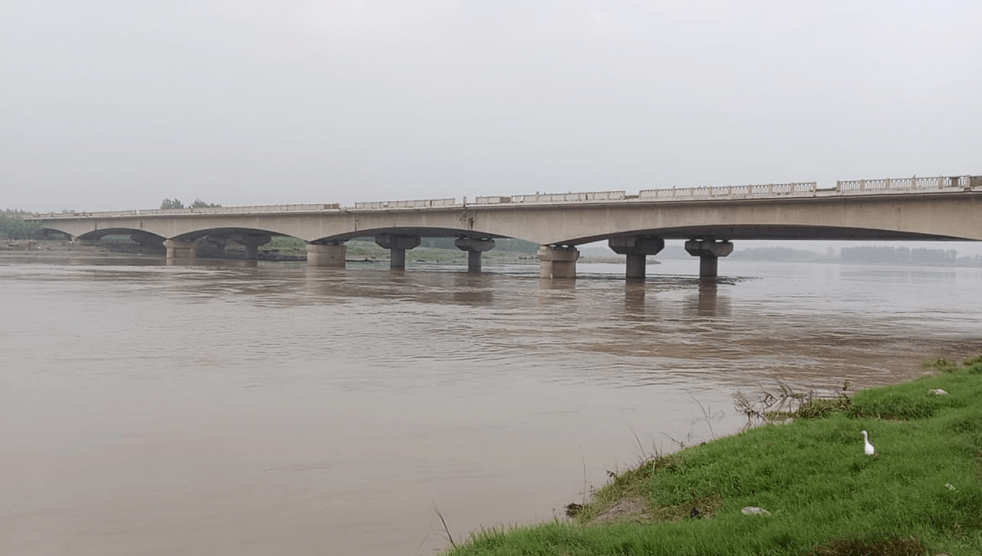
(Feature Image: Yamuna river at Mawi site in Kairana, UP in Sept. 2024)
After remarkable deluge in 2023, the upper segment of Yamuna river has seen no significant flood spell all through the just concluded southwest monsoon 2024. This is unusual as the river generally witnesses at least a couple of low or medium flood spells in this segment every year.
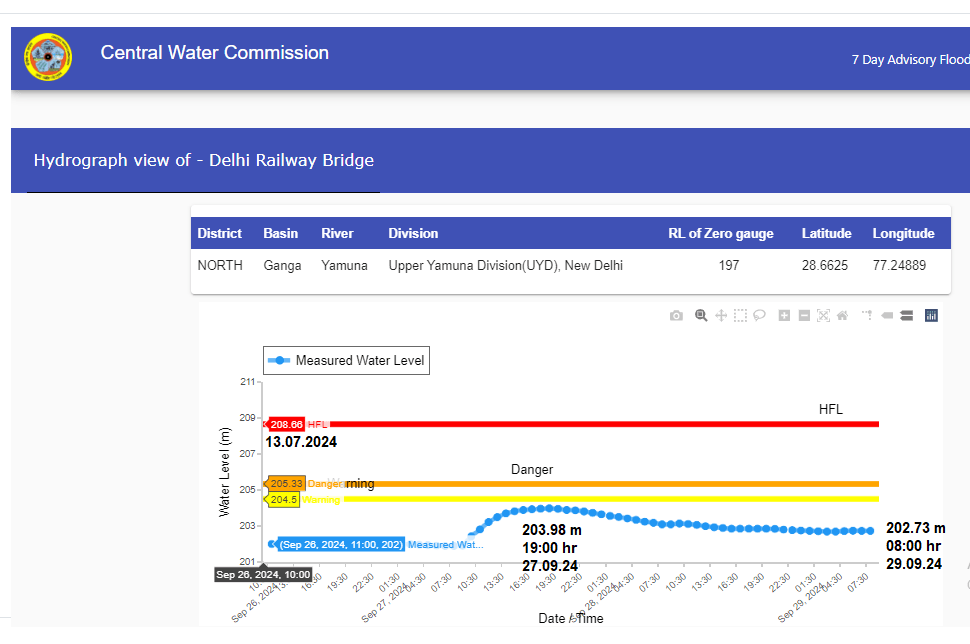
However, this year the discharges from Hathnikund Barrage (HKB) in Haryana did not cross 1 lakh cusec figure even a single time. The peak discharge from the barrage was 87,017 cusecs at 06:00 hour on 26.09.2024.
Table 1: Table 50,000 cusecs + discharges from HKB in SW Monsoon 2024
| Date/Time | Discharge in Cusecs |
| 02.09.2024 | |
| 09:00 hour | 51,644 |
| 12:00 hour | 65,653 |
| 26.09.2024 | |
| 05:00 hour | 62,209 |
| 06:00 hour | 87,017 |
| 07:00 hour | 60,585 |
| 11:00 hour | 53,187 |
| 12:00 hour | 50,340 |
| 14:00 hour | 50,940 |
This technically falls in low flood category but was too little to breach even the warning level at any of 5 flood monitoring sites upstream of Delhi including at Delhi Railway Station site where the river had reached unprecedented level of 208.66 meter on 13 July 2023.
The IMD rainfall data shows that out of 15 districts which forms Himalayan and Upper segments of the river, 12 districts have below normal rainfall. The CWC’s river basin wise cumulative rainfall map for the southwest monsoon 2024 shows normal rainfall in upper segment of the river.
Table 2: Rainfall During SW Monsoon 2024 in Upper Yamuna basin
| SN | State/ District | Actual (mm) | Normal (mm) | % DEP. | CAT. |
| Himachal Pradesh | |||||
| 1 | Solan | 690.0 | 874.3 | -21% | D |
| 2 | Shimla | 716.9 | 627.5 | 14% | N |
| 3 | Sirmaur | 1162.5 | 1183.8 | -2% | N |
| Uttarakhand | |||||
| 4 | Uttarkashi | 1092.6 | 1151.2 | -5% | N |
| 5 | Tehri | 992.4 | 948.0 | 5% | N |
| 6 | Dehradun | 1751.4 | 1442.9 | 21% | E |
| Haryana | |||||
| 7 | Yamuna Nagar | 619.7 | 896.5 | -31% | D |
| 8 | Karnal | 322.1 | 522.0 | -38% | D |
| 9 | Panipat | 412.4 | 455.8 | -10% | N |
| 10 | Sonipat | 447.2 | 479.2 | -7% | N |
| Uttar Pradesh | |||||
| 11 | Saharanpur | 623.5 | 762.5 | -18% | N |
| 12 | Muzaffar Nagar | 621.8 | 664.1 | -6% | N |
| 13 | Shamli | 142.8 | 535.2 | -73% | LD |
| 14 | Baghpat | 470.7 | 499.5 | -6% | N |
| 15 | Ghaziabad | 334.0 | 457.9 | -27% | D |
| 16 | Delhi | 658.3 | 544.3 | 21% | E |
Note: DEP.- Departure, CAT. -Category, N- Normal, E- Excess, D- Deficient, LD- Large Deficient, LE- Large Excess, mm- Millimeters

In sharp contrast, the middle and lower Yamuna basins, particularly the catchment areas of Sahibi, Gambhir, Chambal, Kunwari, Sind, Betwa and Ken registered excess to large excess rains resulting in good flood spells in the river in August and September 2024. Also see, Lower Yamuna Basin: 11 Rivers Crossed old HFLs in just 2 days in Sept 2024.
Table 3: Rainfall Figure in Yamuna Rivers Basin During SW Monsoon 2024
| SN | Basin | Actual (mm) | Normal (mm) | % DEP. | CAT. |
| 1 | Upto HKB | 995.6 | 872.4 | 14% | N |
| 2 | HKB to Mathura | 625 | 661.1 | -5% | N |
| 3 | Mathura to Naini | 806.7 | 658.4 | 23% | E |
| 4 | Sahibi | 728.3 | 508 | 43% | E |
| 5 | Gambhir | 1053 | 550.9 | 91% | LE |
| 6 | Upper Chambal | 905 | 814 | 11% | N |
| 7 | Chambal | 1043.6 | 645.4 | 62% | LE |
| 8 | Kunwari | 897.6 | 645.8 | 39% | E |
| 9 | Sind | 1062.3 | 753.1 | 41% | E |
| 10 | Betwa | 1147.2 | 916.8 | 25% | E |
| 11 | Ken | 1202.6 | 982.1 | 22% | E |
Impact: In absence of flood spells in upper segment, there was rise in pollution level in Yamuna impacting water treatment plants and thus potable water supply in the national capital. Also, the river faced incidents of frothing and growth of water hyacinth around Okhla barrage, Delhi in the middle of monsoon season. The monsoon has also failed to improve the condition of Hindon river. And for large part of the season both Yamuna and Hindon rivers were seen carrying polluted waters through Delhi and downstream areas.
Good flood spells in upper segment of Yamuna used to restore flows in the river for about three to four months. Lack of floods in upper segment this year will result in decrease in lean season flows and put more pressure on river to cater to irrigation, industrial and potable water demands. This will also affect the remaining aquatic life and riverine eco-system dependent on the river. At the same time, the pollution level in Delhi stretch of Yamuna is bound to worsen in coming months.
Bhim Singh Rawat (bhim.sandrp@gmail.com)

 SANDRP