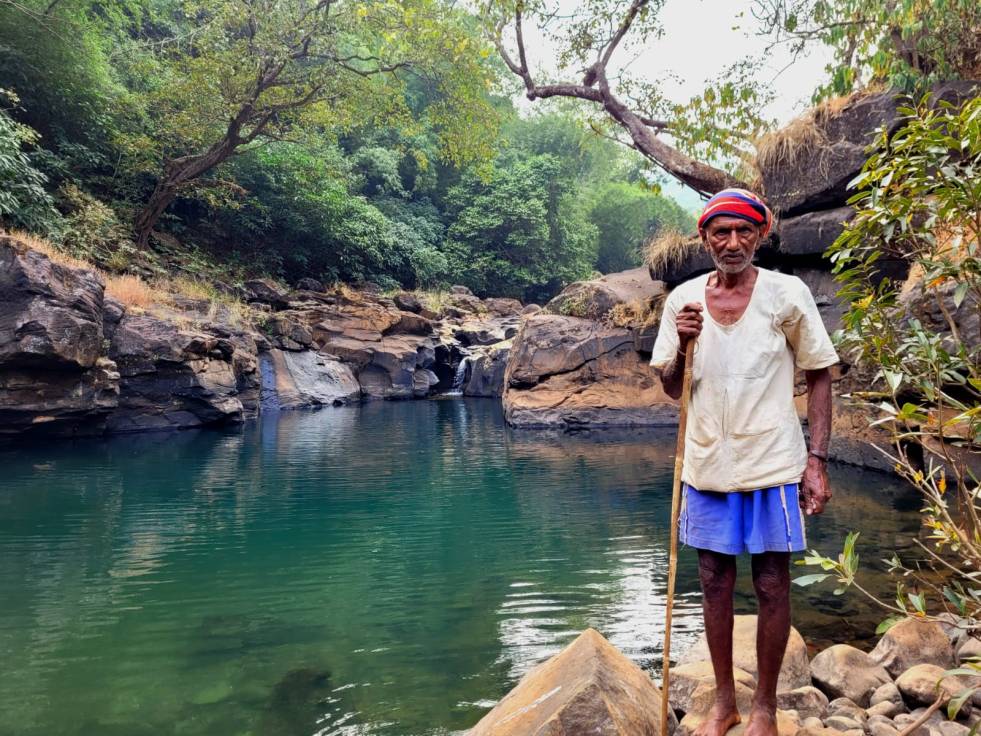
Adani Energy proposes to build two large dams in the heart of Western Ghats as a part of Warangi-Warasgaon Pumped Storage Project. One of the dams will be located in Tekpowale Village, about 65 kms from Pune.
I actually could not believe my eyes when I read the name Tekpowale.
I have been to Tekpowale and have written about it a few times, but the village is veritably unknown even in Pune. This small settlement nestled in a densely forested pocket of Western Ghats, surrounded by multiple dam backwaters, is so remote and shrouded that it is nearly forgotten in time.
Tekpowale has just missed submergence from Panshet dam and is now perched precariously on its finger-like backwaters. Warasgaon Dam backwaters are about 7 kms from here, Mulshi about 19 kms, Temghar about 19 kms and Pawana at about 48 kms. Yes, it is a very dam-dense region. In fact, if you draw a straight line from the backwaters of the northern-most Thokarwadi Dam to Panshet Dam, the mere 66 kms encompass ten large dams in the Mula-Mutha Basin. Maharashtra is the most-dammed state in the country and this might be the most-dammed region in Maharashtra.
Multiple dams, mushrooming resorts, creaking cities like Lonavala and townships like Lavasa have pushed Western Ghats Forests to a corner here. And yet, the region is speckled with community conservation spaces like sacred groves, temple forests, sacred river origins and that spectacular gem of culture and conservation: community fish sanctuaries.
This has brought me to Tekpowale several times. (SANDRP’s work on Fish Sanctuaries in the End Notes)
Tekpowale Fish Sanctuary:
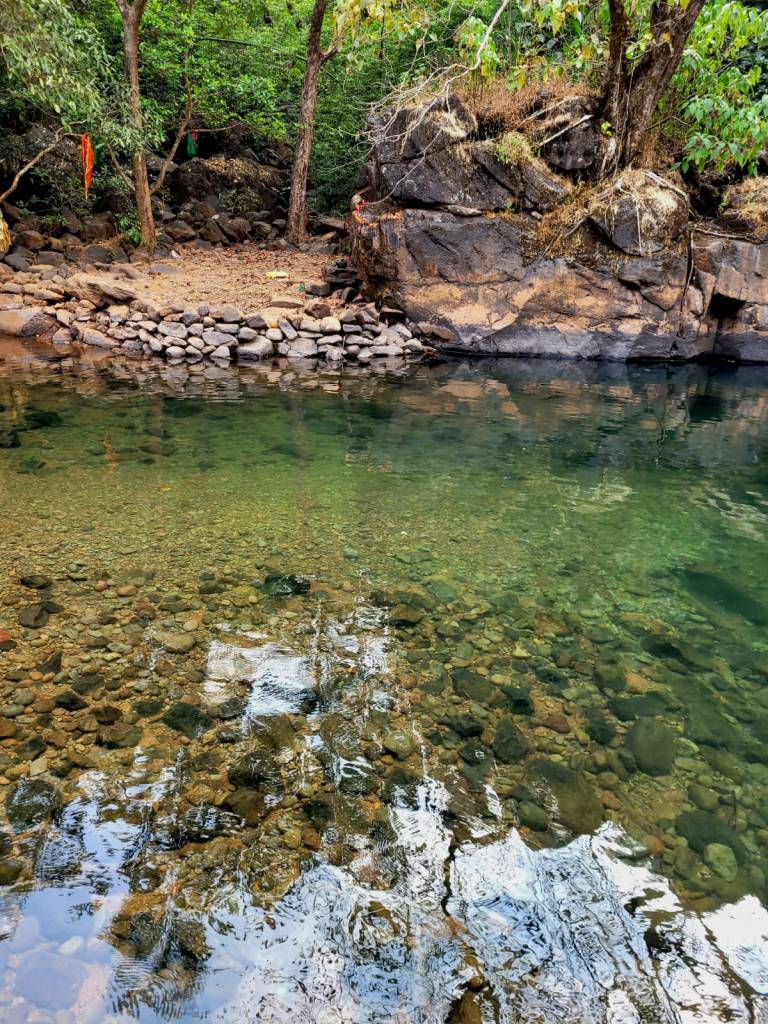
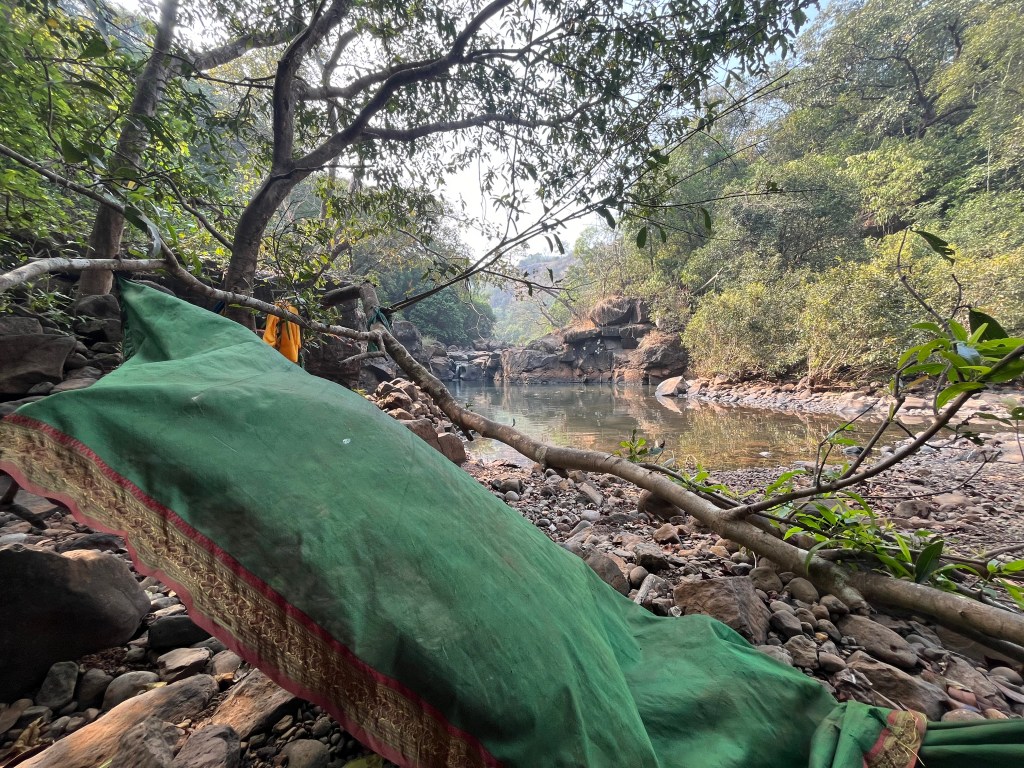
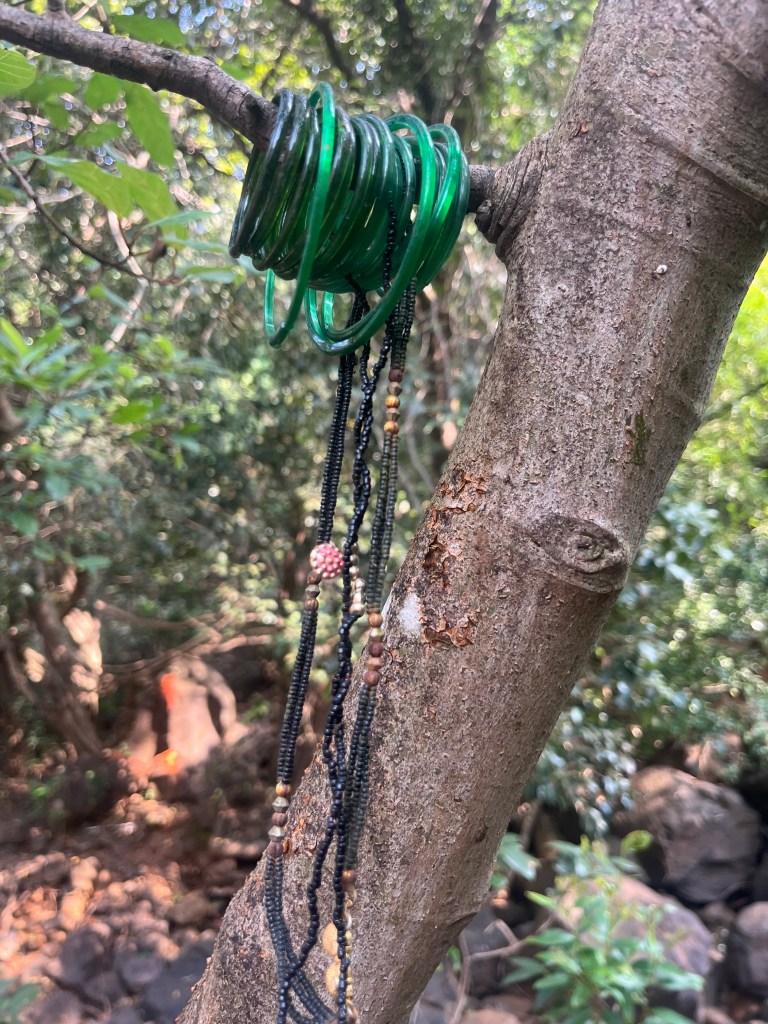
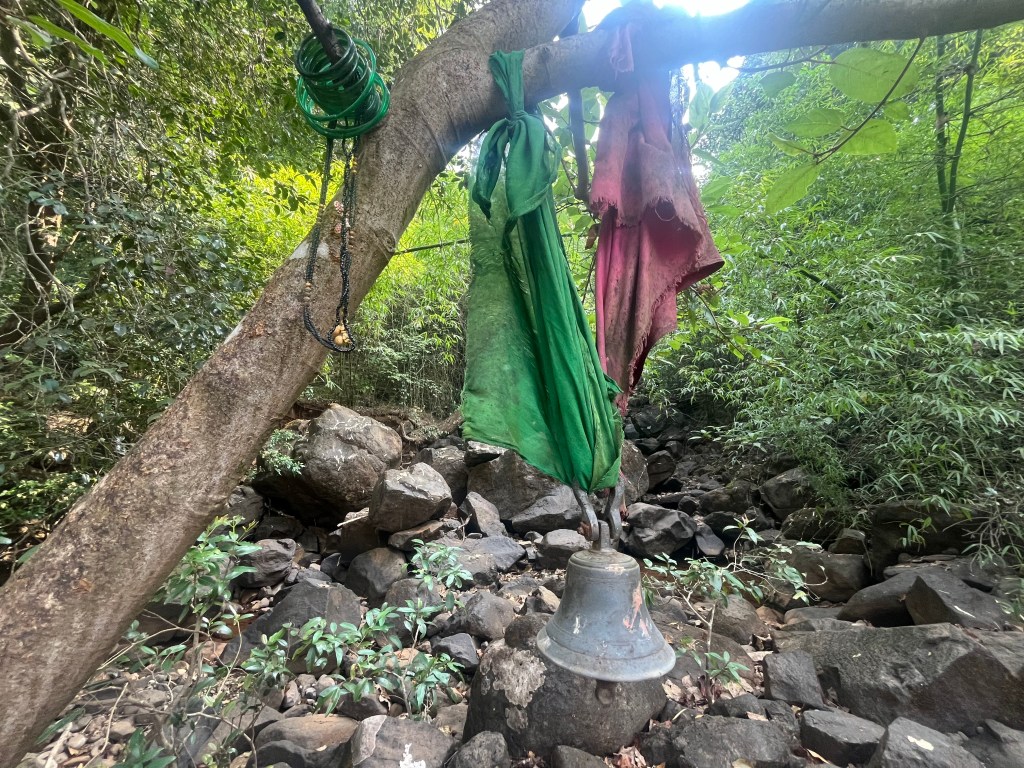
This small, remote settlement protects a pool and fish dear to a particularly fierce forest deity, Vardayini (Bestower of Boons). The pool is surrounded by a dark sacred grove which is the open-to-sky shrine to the goddess. Ancient lianas, riparian jamun trees and a crystal-clear pool are a setting majestic enough for a tempestuous goddess who does not like crowds. Trees in the shrine are adorned with a tattered green sari, a few green glass bangles and some mangalsutras.

Tekpowale Fish Pool and Sanctuary Photo Parineeta Dandekar
A shaded corner where a stream joins the pool has jagged basalt marked with vermillion. Tiny cradles line up against the pool and the natural basalt wall. The riverine goddess cult in Maharashtra is closely associated with fertility and childbearing and the pool is protected vigilantly by the villagers. After visiting several fish sanctuaries in the country, I can say that Tekpowale sanctuary is the most guarded. In fact, some years back, a colleague from SANDRP hitch-hiked to the village but was not allowed to approach the pool.
Ganesh Kaka, who accompanied me and my friend Sameer Punde to the pool once, was not too happy with me going closer to the sanctum of the sacred grove either. He tells us about a river which originates at the feet of a jamun tree and thus called ‘Mula’ and of a river originating from crab holes and thus called ‘Mutha’.
Like temple pools and fish sanctuaries across the country, this pool too holds Mahseer fish. (Tor species. A fish species threatened in the wild which is not classified as such only because it is reared in dam reservoirs. A friend asks me if we breed enough tigers in captivity, can we take them off the endangered list too?) Mahseer is known as Khavlya or Khadas in Marathi. It also holds several other species like Garra sps, Black line Rasbora, carps, Puntius species, etc. (Pers Comm. Vivek Kale and Vidyadhar Atkore). No net is ever cast on this pool. Ganesh Kaka calls the villagers as Rakhandars or guardians of the pool. He brings a small bag of puffed rice tied to his waist and scatters it over the waters for the fish.

The fisherfolk, ‘koli’ communities told us that if a Mahseer from the pool swims downstream to Panshet dam and gets caught in the net, it is released immediately. Mahseer is well-known as Varadayini’s fish in the region and the fish from this pool are said to have a red mark on their foreheads given by the Goddess. This is eerily similar to the tales of Mohana fisherfolk who tell us of Hilsa fish travelling up the Indus river and being marked by a red tika by Khwaja Khijr, ruler of the waters.

Several beautiful tales in Tekpowale tell us about a fish marked with a Shendri Tree (Mallotus phillpensis) on its back, of seven layers of fish swimming in concentric circles guarding the secret to life, a golden fish with a nose-ring etc. Such stories of sacred pools are shared from Karnataka to Jammu.

Forest-dwelling communities here do not cast a net on the pool even when the drought is bad, and food is scarce. Water is not drawn from the pool, there are no pumps and pipes dipping in the pool, otherwise ubiquitous all over. If needed badly, water is drawn by hand and carried in pots. While protecting a fish, the villagers protect an entire riverine tract, riparian forests and sacred groves. This community based conservation model seems remarkably effective and successful. People here hesitate to step inside the grove of a goddess who likes solitude. They are respectful and proud of this tiny pool and their goddess Vardayini who has no temple and no idol.
And this is where Adani Energy is planning to build a 56 meters high dam, just a few meters upstream from the pool of Vardayini. The dam will submerge 49 hectares dense forests which are a part of the proposed Velhe-Mulshi Conservation Reserve.
The dam, its allied structures, buildings, roads, transmission lines, mining, dumping, blasting and tunnelling, changes in hydrology are set to defile a zealously guarded, much-loved and revered place of community worship and freshwater diversity conservation.
Adani Green Energy: 1500 MW Warasgaon-Warangi Pumped Storage Project:
Adani Energy has proposed 1500 MW Warasgaon Warangi Pumped storage Project which consists of interbasin transfers of water from Krishna basin to the flood-prone, west flowing Savitri Basin and back. The project will be discussed in the upcoming 16th EAC Meeting on the 27th of September 2024 for amendment of TORs.
The project consists of two large dams: Upper dam is proposed be built in Tekpowale village (56 meters high) and the lower, across the ridge to the west of Sahyadri in Warangi village of Kal basin (51 meters high). The dams will be connected by an underground tunnel of about 2 kms. The project will operate as a pumped storage plant for about 6 hrs everyday, generating electricity needed at peak demand hours and pumping back during off peak hours.
Project boundary is 9.2 kms from Tamhini Wildlife Sanctuary and 6.6 kms from the Ecologically Sensitive Zone of Tamhini Wildlife Sanctuary.
Project cost stands at Rs 5516.8 crores and it will need 225.14 hectares of land including 88.9 hectares forest land and 131.16 hectares private land. Water use is about 7 MCM. FRL (Full reservoir level) of upper reservoir is 736 meters and that of lower is 197 meters with a head of 539 meters.
So, the project does not need to much water or land. All it needs is suitable head. (Level difference, to generate electricity)
Which brings us to the heart of the issue. How can such a project be proposed in a biodiversity-rich, highly dammed area with sacred space of worship, dense forests, a conservation reserve and a Wildlife Sanctuary?
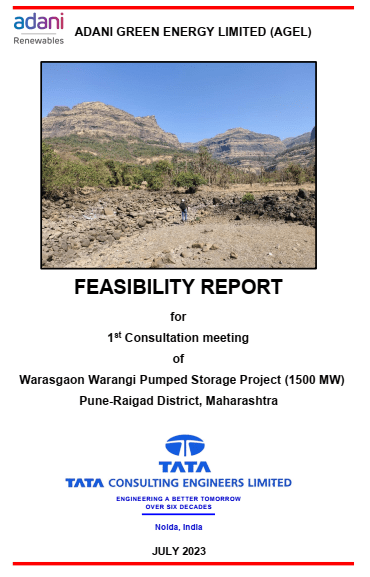
Alternative analysis of the project locations done in the Pre-feasibility report is a purely desktop exercise which considers only the economic cost of the alternatives. The consultants (Tata Consultancy has worked on the PFR) simply put 4 options on paper and have paid zero attention to the siting and its impact on ecology of the Global Biodiversity Hotspot of Western Ghats. While the PFR deals with several obscure issues, it does not even mention the presence of Varadayini Fish Sanctuary at Tekpowale!
Adani ‘Green’ Energy has proposed several such pumped storage projects in the Ecosenstive Areas of Western Ghats in Maharashtra. This region is already densely dammed and the remaining forest patches and ecosensitive areas are the last bastions for protected species.
Letter by Chief Wildlife Warden
Letter by Chief Wildlife Warden dated 2 July 2024 clearly states that in addition to being in proximity with Tamhini Wildlife Sanctuary, ESZ of Tamhini Wildlife Sanctuary and Sudhagad Wildlife Sanctuary, the project also impinges upon the Reserved Forest blocks in Mahad and will need clearance under Forest Conservation Act, 1980. Warangi village falls under the Western Ghats Ecosenstive Area Draft Notification (06.07.2022) and will have to fulfill all conditionalities. The project is 19.7 kms from Raigad Conservation Reserve.
The project falls inside the proposed Velhe-Mulshi Conservation Reserve and once the Reserve is notified, the project will need clearance from State and National Wildlife Boards.
Walen Kondh Fish Sanctuary
Astonishingly, the project is set to impact not one but two fish sanctuaries. Walen Kondh Fish sanctuary is about 5 kms downstream from the Lower Dam and it too finds no mention in the PFR.
Centuries before Adani Energy thought of linking Tekpowale to Kal River, Ganesh Kaka tells me of a story that the fish from Varadayini fish sanctuary used to disappear in the mountain and appear on the other side of the ridge in Walen Kondh Sanctuary.
For such an ecologically and culturally invaluable region, the PFR suggests: “The proposed project is located in western ghat, which is a famous hill station in the Maharashtra state. The provision of tourist amenities like parks, tourist resorts, etc. can be developed around the proposed upper reservoir area for attracting tourists.”
Almost everything stated above is misplaced and misguided. It would be funny if it was not so grim.
We request the EAC of the Ministry of Environment, Forests and Climate Change not to issue Terms of Reference to this destructive project which can be located at several other places rather than a much-loved fish sanctuary.
PFR states “the scheme will facilitate large-scale development of green power and ensure supply of round-the-clock green power and thereby helps in de-carbonization of energy sector in the country.”
Vardayini Goddess, her fish and her sacred grove will not agree with this, neither will the villagers of Tekpowale. A project that plans to destroy all that is truly green, is not Clean or Sustainable. And is definitely not Green.
Parineeta Dandekar, SANDRP (parineeta.dandekar@gmail.com)
End Notes
https://sandrp.in/2016/03/31/fish-sanctuaries-in-western-ghats-of-maharashtra/

 SANDRP
As a common man and citizens of India we need to protect bio diversity water bodies and jungle.I support the cause and want to stop warasgaon warangi pumped storage project.
LikeLike
A much needed initiative and action to protect not only the indigenious people but also the indigenous flora and fauna. The balance between development and conservation is already askewed. Let’s coalesce all support viz polifical, social, legal, environmental and citizenery to save Tekpowale.
LikeLike
please start a petition to stop this nonsense and to review the environment bill and the exemptions made of late
please please please
LikeLike