
(Feature Image: Google Earth Image showing location of 6 proposed dams in Kalesar national park area by Haryana government)
In a welcome judicial intervention, the Supreme Court on April 24, 2024 has stayed building of four dams inside Kalesar National Park in Yamuna Nagar district of Haryana. Issuing notices to Centre and Haryana governments, the apex court noted that the dams namely Chikan, Kansli, Khillanwala and Ambawali would not achieve the intended purposes and would prove detrimental to wildlife, biota and eco-system of the National Park.
Disappointingly the National Board of Wildlife (NBWL) had approved the dams ignoring the Wildlife Institute of India (WII) report warning about adverse impacts of these dams on the terrestrial as well as aquatic biodiversity in the protected area. As per the WII report, the Irrigation Department, Haryana had planned building of six dams costing about Rs. 125 cr. on streams feeding Pathrala river in the national park.
The WII report found that construction of six dams would require over 220 hectare of land and damage over 1.50 lakh trees. The report had recommended shifting of four dams outside Kalesar national park area. Even the Forest Department of Haryana had raised concerns over these dams as a threat to existing pattern of habitat use of various species in the sanctuary.
In addition to above reasons, the dams would affect the catchment of Yamuna further compromising the water sources and flows in the river. Off late the Haryana government has been planning and pushing various dams in the area. Absurdly, one of the reasons behind dams on Somb and Pathrala rivers which fed Yamuna in the district is to ‘revive’ lost Saraswati river while the Yamuna is already starved of essential flows.
Similarly, in the name of protecting Delhi from floods, the state government only in August 2023, has planned to build a new bigger dam at a cost of Rs. 6,134 cr, 4.5 km upstream the existing Hathnikund Barrage. The proposed dam would displace 9 villages and submerge a large part of Kalesar national park.
One hopes that the Supreme Court will take cognizance of adverse impacts of proposed four and other dams and prohibits their planning and construction permanently to protect the Yamuna river catchment in the region.
Haryana SC stays building of 4 dams in Kalesar sanctuary The Supreme Court on Apr 24 stayed the construction of four proposed dams inside Kalesar Wildlife Sanctuary in Yamunanagar district. Acting on a petition filed by advocate Gaurav Bansal, the Bench also issued notices to the Centre, Haryana Government and others, asking them to respond to the petition. Bansal has challenged the construction of four dams — Chikan, Kansli, Khillanwala and Ambawali — within Kalesar Wildlife Sanctuary, saying it would have a negative impact on the flora and fauna in the area. “Issue notice. We further direct that no steps shall be taken for the construction of the dams unless an order is passed by this court,” a Bench led by Justice BR Gavai said, noting that the construction of dams would not only be detrimental to wildlife and population in Kalesar, but also to the ecosystem. Even the purpose for which the dams were proposed would not be achieved, said the Bench, which also included Justice Sandeep Mehta.
– Notified on December 13, 1996, Situated in Shivalik foothills, Kalesar Wildlife Sanctuary spread over 13,209 acres and shares its boundary with Uttar Pradesh in the east and Himachal Pradesh and Uttaranchal in the north. The entire area is full of biodiversity, having dense sal and khair forests and patches of grasslands. Plea filed in SC after National Board for Wildlife gave nod to build four dams in sanctuary. The NBWL okayed without taking cognisance of a report of the Wildlife Institute of India (WII). “The WII has categorically stated in its report, ‘Feasibility Study of Proposed Small Dams in Kalesar Wildlife Sanctuary, Haryana’ that the dams are under the protected area boundary of the sanctuary and as such would significantly affect the terrestrial as well as aquatic biodiversity of the protected area,” Bansal submitted. Referring to a letter by the Principal Chief Conservator of Forests and Chief Wildlife Warden of Haryana, Bansal said he had stated the dam sites in the notified boundary of the sanctuary would affect the existing pattern of habitat use of various species. https://www.tribuneindia.com/news/haryana/threat-to-wildlife-supreme-court-stays-building-of-4-dams-in-haryanas-kalesar-sanctuary-614240 (25 April 2024) https://www.livelaw.in/top-stories/supreme-court-stays-construction-of-4-dams-in-haryanas-kalesar-wildlife-sanctuary-256314 (27 April 2024)
WII red flags irrigation dams in Kalesar forest The wildlife institute of India (WII), Dehradun, has recommended relocating two of the six earthen dams proposed to be constructed in Kalesar National Park and Wildlife Sanctuary (KNP&S) to outside the forest area. The WII also observed that the construction of four other dams would affect flow of water and thereby impact terrestrial as well as aquatic biodiversity of the forest reserve. The dams, recommended to be shifted out of KNP&S, include Ambawali Dam on Ambawali Khol and Chikan Dam on Chikan Khol. The other four dams include Nagli Dam on Nagli Khol, Darpur Dam on Palasi Khol, Kansli Dam on Kansli Khol, and Khillanwalla Dam on Khillanwalla Khol.
The Haryana Irrigation and Water Resources Department had proposed construction of the six dams at a cost of Rs 125 crore on the tributaries of Pathrala river, which further meets Somb river before finally merging into Yamuna. The dams, including three big-sized structures, were proposed to help improve the underground water level and providing water for irrigation in the region. The State Board for Wildlife (SBW), headed by CM Manohar Lal Khattar, had cleared the proposal in August.
A total of 222.52 hectare (549.93 acre) land is required for construction of dams. Ambawali and Chiken dams, which were recommended to be relocated out of forest reserve, would come up on 56.25 hectare and 27.31 hectare land, respectively. In its report, WII concluded that 1,59,034 trees and plants would be damaged due to construction of dams. “Eight earthen dams are already constructed by the forest department and located near proposed dam sites. Fortunately, these dams are frequently used by most mammalian species found in the area. The construction of dams on the proposed sites would alter the natural water storage capacity of earthen dams during the monsoon,” the WII report states.
In its observation about Khillanwalla dam site, the team found a dry river bed with sand, cobbles and pebbles at its base. The team inferred that during monsoon, the intermittent stream serves as a breeding and spawning ground for fish such as Mahseer, which are migratory in nature and require fast flowing turbulent water. Construction of dam will adversely hamper the connectivity and flow requirements to complete their life cycle.
The team observed, “In view of freshwater resources, all the proposed dam construction sites are non-perennial in nature. However, these streams are observed as important spawning and nursery habitats of fishes especially during monsoon season”. Aquatic habitats observed during the survey were characterized as shallow riffles and pools, small cascades, optimum flow condition with low turbidity required for the survival of juvenile of varied fish such as Bariluis Bendelisis, Barilius barna, tot tor etc. The dam construction on the proposed sites will adversely effect survival of fishes, especially migratory fish, which use these unique habitats for their life history requirements. https://indianexpress.com/article/cities/chandigarh/wii-red-flags-irrigation-dams-in-kalesar-forest-will-impact-biodiversity-6758247/ (17 Oct. 2020)
Haryana plans Rs 6,134-cr dam to curb Yamuna fury To prevent a repeat of the July floods caused by the Yamuna in Delhi and in adjoining areas of the river in Haryana, the Haryana government is planning to build a dam at a cost of Rs 6,134 crore. It will have a 14-km-long reservoir and will be built 4.5 km upstream from the Hathnikund Barrage in Yamunanagar district. Nine villages will be displaced for its construction, besides shifting an 11-km stretch of NH-73. It will also submerge a large chunk of forest land, including areas in Kalesar National Park and Wildlife Sanctuary.
Once the project is completed, officials say, the state will get a financial advantage of Rs 497 crore through availability of additional irrigation water, groundwater recharge and aquaculture, apart from generation of 250 Mw electricity. The dam area also shares borders with Uttarakhand and Uttar Pradesh. Its reservoir will have a capacity of 10.82 lakh cusecs.
The four Haryana villages – Garhi, Kalesar, Banjarwas and Mamduwas – proposed to be displaced are part of one village panchayat Kalesar which has a population of nearly 3,000 residents. The five villages of Himachal Pradesh to be displaced are – Bahral, Satiwala, Bata Mandi, Ganguwala and Thaparpur. The village residents have concerns about the compensation in lieu of their houses and agricultural land. At the same time, they also admit that the Yamuna has been causing huge losses to their crops, apart from washing away their adjoining land.
Officials said an initial survey of the proposed dam has already taken place in the areas concerned in Haryana and Himachal Pradesh. For the additional survey, the Haryana government has sought a no-objection certificate (NOC) from the Himachal Pradesh government. https://indianexpress.com/article/india/hathnikund-barrage-controversy-yamuna-fury-delhi-flood-delhi-yamuna-water-level-8881452/ (08 Aug. 2023)
INTERLINKING OF YAMUNA RIVERS
Ken Betwa Linking Will the project benefit the Bundelkhand region? While highlighting new risks due to the Ken Betwa project and unresolved wildlife clearance issue, it also does not mention the unresolved issues related to Forest Clearance. Nor that the project will facilitate export of water from Bundelkhand. Nor about the project’s questionable hydrology assumptions, the hydrology figures are not in public domain, nor peer reviewed by independent experts. https://groundreport.in/environment/will-the-ken-betwa-project-benefit-the-bundelkhand-region-4481149 (14 April 2024)
YAMUNA FLOODPLAIN
Delhi Restore Yamuna Floodplain Raised by Illegal Soil Dumping near Shashtri Park, Delhi This is an open letter to concerned government officials regarding restoration of Yamuna floodplain illegally raised and levelled by Forest Department, Delhi and DDA at Bela Farm near Shashtri Park, Delhi. https://sandrp.in/2024/04/20/restore-yamuna-floodplain-raised-by-illegal-soil-dumping-near-shashtri-park-delhi/ (20 April 2024)
Nav Bharat Times on SANDRP’s Bhim Singh Rawat’s letter to authorities in Delhi about floodplain encroachments in Yamuna in Delhi leading to increased flood risk among other consequences.

DDA flouts NGT’s guidelines, continues construction on floodplain Despite last year marking the worst floods in Delhi’s history, The Hindu has found that the Delhi Development Authority (DDA) is persisting with its plans of constructing permanent structures on the banks of the Yamuna. The project, dubbed as “restoration” of the river’s floodplain, violates the guidelines issued by a committee appointed by the NGT, which the States were ordered to “strictly” follow.
-Under the DDA’s ‘Restoration and Rejuvenation of River Yamuna Floodplains Project’, several permanent structures, including concrete ghats, large sitting areas made of concrete and sandstone, and a concrete cafe, have been built. An approximately 40-metre-long pool and several concrete offices have also been constructed, while a convention centre, tent city, and more ghats are among the other buildings that the DDA is planning to construct on the floodplain.
The Principal Committee, formed by the NGT in 2015 after a landmark judgment with the specific purpose of monitoring activity on the Yamuna’s floodplain, outlines strict norms governing construction in the area. However, sources told The Hindu that the committee has not met in over 21 months.
Experts believe that the DDA’s project has led to concretisation of the Yamuna’s banks. “The construction will lead to a reduction of the water carrying capacity of the floodplain,” said Bhim Singh Rawat, associate coordinator at the SANDRP. Shashi Shekhar, former Secretary at the MoWR, opined that Indian rivers need more floodplains compared to Western rivers as they swell in size during monsoons. The ‘Sabarmati model’ — the urbanisation of Ahmedabad’s Sabarmati riverfront with concrete embankment walls — was not a feasible solution for other rivers in India, he added. “We must focus on restoring the Yamuna to its natural form,” he said. https://www.thehindu.com/news/cities/Delhi/dda-flouts-ngts-guidelines-continues-construction-on-crowded-yamuna-floodplain-in-delhi/article68068418.ece (16 April 2024)
9 years after NGT’s directions, floodplain yet to be demarcated Its been nine years since NGT ordered demarcation of Yamuna floodplains in Delhi, but that is yet to happen. While the Delhi government had claimed in submissions to the NGT that “100%” physical demarcation of a major stretch of the Yamuna’s floodplain in the city has been done, visits to the sites in question and interviews with officials by The Hindu have confirmed that major gaps persist. Moreover, nine years after the green panel asked authorities to identify encroachments in the floodplain, this process, too, has not been done, and was not initiated even after the devastating July 2023 floods that saw the Yamuna rise to unprecedented levels. In fact, illegal permanent constructions on the floodplain have only grown since the NGT’s directions in a landmark judgment in 2015, according to latest satellite images.
“Demarcation of a floodplain is not rocket science. If it is not being done despite court orders, it is because of the dishonest intentions of bureaucrats and the government’s Executive wing,” said Shashi Shekhar, former Secretary at the Ministry of Water Resources, River Development and Ganga Rejuvenation. He added that there was a “strong land mafia” that was “grabbing” the floodplain. “This cannot happen without the connivance of officials and politicians.”
After the 2023 floods, the NGT took suo motu cognisance of a newspaper report, and formed another committee headed by the Chief Secretary in October last year. The green panel’s directions to the new committee echoed almost exactly what it had told the Principal Committee eight years ago – to physically demarcate the floodplain and suggest measures to remove encroachments. The new committee was set a deadline of three months, but the deadline was missed. In January this year, the committee asked for three more months to comply with the NGT’s directions. https://www.thehindu.com/news/cities/Delhi/nine-years-after-ngts-directions-yamuna-floodplain-yet-to-be-demarcated/article68072355.ece (17 Apr 2024)
DDA ignores directions to remove official constructions on floodplain, builds more Just over a hundred metres from the Wazirabad Bridge in north Delhi lies Sur Ghat, spread over an expanse of at least 2,000 square metres. The ghat, enclosed by barbed-wire boundary walls, features tiled floors, four concrete rooms, and a 40-metre-long pool, and is often visited by Hindu families performing the last rites of their loved ones. Large letters painted on a 12-foot-high wall proclaim the area under the jurisdiction of the DDA.
The whole complex, however, bustling as it is, is built on the Yamuna floodplain, a mere 50 metres from the river. The area, as per directions of the NGT nine years ago, was meant to be reclaimed from concretization. But over the years, the DDA has done the very opposite, and has constructed more and more structures at Sur Ghat, dealing a blow to the floodplain, which is meant to serve as a key defence in the event of floods. Sur Ghat is not the only example of encroachments on the Yamuna’s floodplain. The DDA, despite court orders, has not only failed to recover multiple such “official” encroachments, but has helmed further concretisation for official developmental works, The Hindu has found.
Similarly, the now-defunct Millenium Bus Depot near Sarai Kale Khan, which was built atop a large portion of the floodplain ahead of the Commonwealth Games in 2010, still remains in its concretised form, despite directions for it to be recovered. Some experts say that DDA’s flouting of court orders is “the same old story”. “Committees cannot keep visiting places again and again to check whether court orders are being implemented. Ultimately, it is the DDA that has to implement court orders,” said former IIT Delhi professor A.K. Gosain, who is a member of the Principal Committee, which was appointed by the NGT in 2015 to monitor illegal construction on the Yamuna’s floodplain. https://www.thehindu.com/news/cities/Delhi/dda-ignores-directions-to-remove-official-constructions-on-floodplain-builds-more/article68079888.ece (19 April 2024)
NGT orders action against illegal dairies on floodplain -A petition filed by a resident last year pointed out that at least 60 illegal dairies were operating on the Yamuna floodplain, polluting the area and the river. Consequently, NGT formed a joint committee, which made certain recommendations. The tribunal has asked the authorities to implement the recommendations without any delay. The joint committee had stated in its submission that the dairies were being operated illegally by encroaching upon the floodplain area at Chak Chilla village, rechristened as Mayur Nature Park, on DDA land.
-For Delhi, this authority is DPCC. “DPCC shall publish a public note for dairy farms to obtain CTE,” the recommendation added. “Recommendations are required to be implemented by DDA,” stated a bench headed by NGT chairperson Justice Prakash Shrivastava while also pointing out that a separate reply on behalf of DDA has been filed disclosing certain matters that are pending before Delhi High Court against the action relating to the removal of slums and jhuggies in the area. But the DDA counsel “does not dispute that these pending matters are not relating to the removal of dairies”, NGT observed. https://timesofindia.indiatimes.com/city/delhi/ngt-orders-action-against-illegal-dairies-on-river-floodplain/articleshow/109546789.cms (2 April 2024)
HC orders DDA to remove encroachments from floodplains High Court orders DDA to remove encroachments from Yamuna floodplains at a number of places by removing debris and also file report on biodiversity parks. HC has also asked DDA to appoint officers for floodplains upkeep. https://timesofindia.indiatimes.com/city/delhi/delhi-hc-orders-dda-to-remove-encroachments-from-yamuna-floodplains/articleshow/109228754.cms (12 Apr 2024)
300 acres on floodplain reclaimed in 1.5 yrs Delhi Development Authority, held responsible for floodplain destruction in Delhi, claims that over the last two years it has reclaimed 300 acres of floodplain in Delhi, removing some dairies and cricket grounds. https://timesofindia.indiatimes.com/city/delhi/300-acres-on-floodplain-reclaimed-in-1-5-yrs/articleshow/109176048.cms (10 April 2024) NGT asks DDA to remove encroachments from Floodplains at Majnu ka tila. https://timesofindia.indiatimes.com/city/delhi/free-up-floodplain-at-majnu-ka-tilla-ngt/articleshow/109096638.cms (07 April 2024)
YAMUNA RIVERS POLLUTION
Report SC orders Haryana, Punjab, Delhi, UP to fill SPCBs vacancies As 6,092 posts in Statutory Pollution Control Boards in various states remain vacant, the Supreme Court has directed Haryana, Rajasthan, Delhi and Uttar Pradesh — four states with highest vacancies — to take immediate measures to fill the vacant posts. “We direct the aforesaid four states to respond immediately by filing an affidavit setting out the number of vacant posts, as of today, and the steps taken for filling in the vacant posts,” a Bench of Justice Abhay S Oka and Ujjal Bhuyan said in its April 22 order.
In Haryana, almost 65% of the posts in the state Pollution Control Board remained vacant as there were only 165 persons working against a sanctioned strength of 450. The remaining 285 posts were vacant. In Delhi, the vacancy stood at 68% as 233 of the total 344 posts remained vacant, with only 111 persons working in the state pollution control body. Similarly, Rajasthan had almost 60% vacancy in the state Pollution Control Board. There were only 332 persons working against a sanctioned strength of 808 while the rest 476 posts remained vacant. https://www.tribuneindia.com/news/haryana/6-092-posts-in-pollution-control-boards-vacant-sc-orders-haryana-punjab-delhi-and-up-to-fill-vacancies-614544 (25 April 2024)
5 districts outside Delhi also to blame for dirty Yamuna -The order came after National Mission for Clean Ganga submitted a report, which revealed a gap of 37 million gallons per day (MGD) in sewage treatment in Baghpat, a city upstream of Wazirabad, and pointed out that gaps were also found in treating the sewage flowing into the river in many other cities in the state.
-According to the data of 23 districts, listed in the order dated April 16, five districts’ sewage was falling into the Yamuna. The data stated that in Baghpat, about 37.7MGD sewage was being discharged into the river while Mathura was unable to treat 42.2MGD of sewage flowing into the Yamuna. Other cities included Saharanpur with 100MGD falling into the Yamuna, Kali, Krishna, Hindon and Muskara. In Hamirpur, 33.1MGD was being released into the Yamuna and Betwa; 113MGD into the Yamuna and Kali in Aligarh; and 28.8MGD into the Yamuna and Karvan in Hathras.
-The other polluted tributaries of the Ganga in 23 districts are Kali, Krishna, Hindon, Betwa, Sehjwal, Bishui, Manaharan, Ramganga, Aril, West and East Begul, Kichha, Karvan, Pahuj, Tamsa, Saryu, Garrah, Sai, Khannaut and Gomati. There are also ponds/talabs. “These waterbodies have high BOD and fecal coliform,” NGT added. Emphasising that the local bodies and authorities need to take preventive action expeditiously, the order stated that each of the district magistrates would prepare an action plan and ensure the objective of zero discharge of sewage/effluent into the Ganga and its tributaries.
-In Delhi, the most polluted stretch of the Yamuna, there exists a gap of 28.7% in treating sewage, and only 15 out of its 37 sewage treatment plants are complying with norms. According to a report, while the city generates around 792MGD of sewage, 80% of its total water supply — 990MGD, the gap in treatment continues to be high at 227MGD or 28.7% of all the sewage generated. https://timesofindia.indiatimes.com/city/delhi/5-districts-outside-delhi-also-to-blame-for-dirty-yamuna/articleshow/109543111.cms (24 April 2024)
Haryana Will fill 87 vacancies in 3 months: SPCB According to a petition filed before the tribunal last year, over 60% of staff positions are lying vacant in SPCB. NGT has directed the SPCB to file a fresh report within a month. The direction came while the tribunal was hearing a petition by activist Varun Gulati, which said 303 (69%) of 481 posts in SPCB were lying vacant across all 22 districts of the state, hindering its work to tackle rising pollution levels. The April 10 order was released to the public on Thursday (April 18). The next hearing is on July 31. https://timesofindia.indiatimes.com/city/gurgaon/will-fill-87-vacancies-in-3-months-hspcb-to-ngt/articleshow/109414602.cms (19 April 2024)
13 units in Sonipat shut for discharging chemicals As many as 13 dyeing units in Sonipat have been shut down after they were found discharging untreated effluents into open areas and drains, which ultimately flow into the Yamuna. This was submitted to the NGT on Friday (April 05) by a joint committee comprising representatives from the Central Pollution Control Board (CPCB), Haryana State Pollution Control Board (HSPCB), and district magistrates from Sonipat.
In Jan, the tribunal directed four districts of Haryana — Gurgaon, Sonipat, Faridabad and Jhajjar — to carry out a ground survey and inspect dyeing units falling in the ‘red category’, which have high pollution levels. The districts requested eight weeks’ time on Friday to complete the task. NGT’s directions came while hearing a petition stating that residential areas in the four Haryana districts are grappling with severe water contamination due to the presence of ‘red category’ units. Petitioner Varun Gulati alleged that these units “have not installed effluent treatment plants or any other anti-pollution devices and are discharging untreated effluents into the open area or in the drains, which ultimately flow into the Yamuna.” https://timesofindia.indiatimes.com/city/gurgaon/13-units-shut-for-discharging-chemicals-into-yamuna-in-sonipat-city-factories-on-radar/articleshow/109076494.cms (06 April 2024)
Delhi TERI to study microplastics, froth in river The Energy and Resources Institute (TERI) in a first-of-its-kind detailed study will analyse the presence of microplastics in the Yamuna and groundwater in Delhi and assess the source and cause behind the frothing in the river in certain seasons. After completing the study, TERI will provide remedies. Scientists at TERI said that the study, proposed by Delhi govt in Dec 2021, will take a year. The aim would be to identify and prioritise groundwater sources (aquifers) and to map resources based on microplastic concentration. Scientists at TERI said the study would be done as two projects: the first on the froth in the Yamuna, the second on the microplastic in the river and groundwater. https://timesofindia.indiatimes.com/city/delhi/teri-to-study-microplastics-froth-in-yamuna/articleshow/109279020.cms (13 April 2024)
HC issue direction on drainage management The HC has recently issued slew of directions on the management of drainage system in the national capital, rejuvenation of water bodies, Yamuna river including its floodplains and rain water harvesting. https://www.livelaw.in/high-court/delhi-high-court/delhi-high-court-management-drainage-system-rejuvenation-yamuna-254753 2/2 ( 10 April 2024)
High Court has asked Delhi Govt to bring management and operation of all 22 drains of Delhi under one unified authority/ command by Apr 30. https://timesofindia.indiatimes.com/city/delhi/assign-upkeep-of-all-drains-to-1-dept-hc/articleshow/109207116.cms (11 April 2024)
Noida Momnathal villagers particularly women suffering from serious health issues due to unabated pollution in Hindon river.
Mathura River cleaning big poll issue As the political landscape heats up in Mathura district, the issue of cleaning Yamuna has again become a big poll pitch. With the river bearing the brunt of pollution from industrial waste and untreated sewage, candidates are under pressure to present comprehensive plans for its restoration, while locals say that they want action on the ground, instead of mere lip service. The issue of Yamuna’s cleanliness is a much-talked about one in the temple town, although on ground, the river remains as dirty as ever, if not more. https://timesofindia.indiatimes.com/city/agra/who-will-clean-polluted-yamuna-in-mathura-river-cleaning-big-poll-issue/articleshow/109267448.cms (13 April 2024)
Madhya Pradesh Rivers doomed to drown in pollution The cleanliness of key rivers like Narmada, Kshipra, and Betwa has been a recurring issue in Lok Sabha, Assembly, and urban body elections over the past 15 years. From Chief Ministers to Mayors, and from Members of Parliament to Members of Legislative Assembly, assurances have been made to prevent the entry of polluted city water into these rivers. However, post-elections, little progress has been made in this regard. Although sewage treatment plants have been installed in some areas, they have failed to effectively prevent the flow of contaminated water into the rivers.
-Despite the implementation of various schemes such as the Namami Gange Mission and National River Conservation, pollution levels continue to rise due to a lack of interest and commitment from regional public representatives and responsible officials. The condition of the Narmada River, considered the lifeline of Madhya Pradesh, is particularly dire in terms of pollution. In addition to the Narmada, other significant rivers like Mahi, Tapti, Kali Sindh, Chambal, Parbati, Dhasan, Ken, Sindh, Kuno, Shipra, Betwa, and the Son River – the largest tributary joining the Ganga from the south – are also experiencing increasing pollution levels. https://en.themooknayak.com/environment/are-madhya-pradesh-rivers-doomed-to-drown-in-pollution-while-election-discourses-ignore-their-revival (16 April 2024)
Agra SC orders desilting of riverbed A bench of Justices Abhay S. Oka and Ujjal Bhuyan was hearing the application moved by an NGO seeking directions for the restoration of the river bed to its natural state and removal of the silt, sludge, and garbage up to a depth of 5-6 metres. The Bench has asked the Centre, the Uttar Pradesh government, and the Agra Development Authority to file compliance affidavits by the end of June 2024.
-“The three authorities, while filing the affidavits, shall take a clear stand setting out the name of the authority which is under an obligation to undertake continuous work of removal of silt, sludge, and garbage from the bed of river Yamuna,” it said. The top court said that if the authorities concerned need advice from an expert agency to ensure the cleaning of the river bed, the Union government will take an appropriate decision in such a case. -“Needless to add that removal of the slit, sludge, and garbage from the bed of river Yamuna has to be a continuous activity,” the SC order said. The matter will be taken up for further hearing on July 11. https://weather.com/en-IN/india/pollution/news/2024-04-25-supreme-court-orders-immediate-cleaning-of-yamuna-river-bed-in-agra (25 April 2024)
YAMUNA RIVERS BIODIVERSITY
Noida NGT seeks response on construction at Okhla Bird Sanctuary Thedevelopment, part of a NGT hearing on March 21, came days after the UPirrigation department on March 19 temporarily halted construction work on a road inside the sanctuary, following opposition from birders and nature enthusiasts against the activity inside the eco-sensitive zone. The road in question would provide access to a crematorium located behind the park, officials said.
-The Okhla Bird Sanctuary in Gautam Budh Nagar is spread across 400 hectares along the Yamuna and is designated an IBA (important bird area) site. Notified as a bird sanctuary in 1990, the park is part of the Central Asian Flyway and according to birders, more than 20,000 birds of over 70 native and migratory species can be spotted at the site.
-Environmental activist Yogesh Kumar, meanwhile, moved NGT on March 18, stating that an approach road to a cremation ground inside the sanctuary was being laid. The sanctuary is situated on the floodplains of Yamuna River and no permanent construction can be raised inside the sanctuary,” the petition read. The next date of hearing is July 2. https://www.hindustantimes.com/cities/noida-news/ngt-seeks-response-from-centre-up-bodies-on-construction-at-okhla-bird-sanctuary-101711476007601.html (27 March 2024) A similar issue of a road being built in Okhla Bird Sanctuary was flagged in 2004, when it went to the Supreme Court. The apex court had then created a central empowered committee (CEC), which ruled in 2006 that no construction is allowed in the sanctuary. “The road, which was constructed within the sanctuary, has been dismantled by the Noida Authority. In future, no new road will be allowed to be constructed within the sanctuary,” the CEC report had said. https://timesofindia.indiatimes.com/city/noida/road-in-okhla-sanctuary-ngt-seeks-replies-from-up-centre-and-noida/articleshow/108757001.cms (25 March 2024)
YAMUNA FISH, FISHERFOLKS
Agra Hundreds of fish die overnight in Keetham Lake due to pollutants Hundreds of fish died overnight at Agra’s Keetham Lake due to an unknown pollutant in the water. People who had come to visit the lake on the occasion of ‘World Wetland Day’ on Friday (Feb. 02) to look at the migratory birds nesting there saw hundreds of dead fish floating on the water. The forest department has filed a complaint with the irrigation and pollution control departments after the dead fishes were found.
-Meanwhile, a senior official told India Today that the Supreme Court hearing on the desilting of the Yamuna will be held on March 12. The hearing will decide on a plea to allow the desilting of the Yamuna by up to five to six metres, so pollutants in the riverbed can be removed, and the riverbed can return to its natural state. This will improve the ecosystem of the river and give more room for the storage of more water. The petition was filed by the Agra Development Foundation which requested a study of increasing the water level in the Yamuna near the riverside monuments in Agra. https://www.indiatoday.in/india/story/hundreds-of-fish-die-overnight-in-agra-keetham-lake-due-to-pollutants-2497283-2024-02-04 (04 April 2024)
Uttar Pradesh Govt to utilise water bodies for floating solar farms The latest move comes as UP is targeting 22,000 Mw of solar energy generation in 4-5 years. Most of the floating plants are likely to come up in Bundelkhand and Purvanchal (eastern UP) spanning Jhansi, Lalitpur, Mahoba, Hamirpur, Chitrakoot, Mirzapur, Chandauli, and Sonbhadra. The state government has set up a high-level committee for identifying water bodies and drafting norms for allotting them for the proposed solar farms.
-The state irrigation department will allot the water bodies to the alternative energy department for allotment to developers and, at the same time, ensure that the projects do not disturb the local ecology or aquaculture. The state irrigation department owns and manages a network of nearly 75,000 km of canals, 34,000 government tube wells, 92 reservoirs and 280 lift irrigation canals. In August 2019, the state government had cleared the proposal of renewable energy majors ReNew Power and Shapoorji Pallonji to collectively invest Rs 750 crore in a 150 Mw floating solar power project in UP. The project was proposed at the existing Rihand hydro power project of UP Jal Vidyut Nigam Limited in Sonbhadra. https://www.business-standard.com/india-news/uttar-pradesh-govt-looks-to-utilise-water-bodies-for-floating-solar-farms-124041901038_1.html (19 April 2024)
MINING IN YAMUNA RIVERS
SANDRP Blog Why Existing Rules, Regulations Fail to Deter Illegal Sand Miners of Ken River? Some recent short video clips, media reports and satellite images have again revealed that sand miners continue to indulge in river destructive mining activities in government approved mine sites in three districts of two states namely Panna and Chhatarpur districts of Madhya Pradesh and in Banda district of Uttar Pradesh.
The miners here have blatantly violated the existing mining rules, MoEF guidelines and NGT orders while the respective regulatory agencies have miserably failed to enforce the laws and ensure compliance. https://sandrp.in/2024/04/06/why-existing-rules-regulations-fail-to-deter-illegal-sand-miners-of-ken-river/ (06 April 2024)
Haryana Attack on Ambala SDM: No arrest On April 6, a case was registered against unidentified assailants after the IAS officer’s car was hit while patrolling to inspect the area for any unlawful mining activities on March 28. The SDM’s private vehicle was attacked twice, when the assailants, suspected to be connected to the mining mafia, tried to chase him out of the area.
While they had fled the spot, the FIR stated that it was only after the intervention of local police that the driver of the car, which hit the SDM’s vehicle, came to apologise for the incident. “His mobile phone was checked and there was evidence to suggest that the location of the officials was shared,” it added. https://www.hindustantimes.com/cities/chandigarh-news/attack-on-ambala-sdm-s-car-no-arrest-in-case-so-far-101712602349391.html (09 April 2024)
IAS officer’s car chased by illegal miners Haryana Police Saturday (April 06) registered an FIR under the charges of attempt to murder after the car of IAS officer Yash Jaluka, who had gone for inspection of illegal mining in Ambala district at midnight, was chased and an attempt was made to hit the vehicle. While the incident took place on March 28, a complaint was made Friday (April 06) after verifying details about the accused, a police officer said. A 2021-batch IAS officer, Jaluka (29) is currently posted as SDM Naraingarh in Ambala district.
According to the FIR, based on the complaint filed by Constable Jasbir Singh, the PSO of the SDM, Jaluka, along with local tehsildar Abhishek Pilania, had left his Naraingarh residence in a private vehicle to inspect illegal mining in the area at 1 am on March 28. “An Innova car started following the vehicle. When an attempt was made to flag down the Innova, its driver tried to hit the SDM’s vehicle. Then, the officers followed the Innova car. When its driver was called, he again tried to hit the SDM’s vehicle,” said Jasbir Singh, who was accompanying the officer. https://indianexpress.com/article/cities/chandigarh/haryana-ias-officer-car-chased-illegal-mining-9256925/ (08 April 2024)
EDIT: Illegal Mining The recent directive by the NGT to the Haryana Govt, laying bare flaws in its approach to tackling illegal mining, underscores a worrisome disregard for environmental protection. The NGT’s scrutiny of Rule 104 of the Haryana Minor Mineral Concession, Stocking and Transportation of Minerals and Prevention of Illegal Mining Rules, 2012, has revealed a significant oversight in the state’s standard operating procedure (SOP) regarding the imposition and recovery of environmental damage compensation. At the heart of the issue lies the provision of Rule 104 to exempt the first two offences of illegal mining from the registration of FIRs, raising questions about its compliance with constitutional provisions and directives from higher judicial authorities. This leniency not only undermines the gravity of the problem but also weakens the deterrent effect that strict enforcement measures could have. https://www.tribuneindia.com/news/editorials/illegal-mining-605994 (01 April 2024)
GPS mandate for transporting minerals: NGT Expressing its concern over the lack of action against those who are involved in illegal mining in the Aravalis, NGT has mandated that only GPS-equipped vehicles will be permitted to transport minerals to stone crushers and screening plants in Gurgaon, Faridabad and Nuh. From 15 April, any vehicle transporting minerals without GPS can be seized by police. NGT has also given Haryana a three-week deadline to submit a new report on the same. The tribunal’s decision came while hearing a plea filed by the Aravalli Bachao Citizens Movement, which alleged that stone quarrying is rampant in the protected area despite the Supreme Court’s blanket ban on mining in 2009. The next hearing in this matter is on May 2. https://timesofindia.indiatimes.com/city/gurgaon/gps-mandate-for-transporting-minerals-ngts-new-move-to-fight-illegal-miners/articleshow/109076405.cms (06 April 2024)
YAMUNA WETLANDS, LAKES, WATER BODIES
Haryana Sultanpur wetland is being deliberately dried up Otherwise a wetland, much of the Sultanpur National Park is dry. Large patches, which would usually be submerged in four feet of water, are now barren, with nilgais resting and grazing on the bed of the lake.
Drying up the water bodies, officials told TOI, was essential. In Jan this year, the wildlife department shut off water supply from the Gurgaon canal to Sultanpur, a designated Ramsar site. It was because they had spotted catfish last year. Catfish, officials explained, is an invasive species that consumes smaller fish rapidly. The smaller fish are also food for resident birds in Sultanpur. Additionally, drying up large parts of the 350-acre wetland, which runs along the Gurgaon-Jhajjar highway, allows the wildlife department to remove weeds and the top layer of soil, which can inhibit growth of plants and trees that in turn are nesting spaces for birds. The timing of such an intervention is critical as the park needs to have enough water by June-July, when the resident birds start breeding and need to nest within the area.
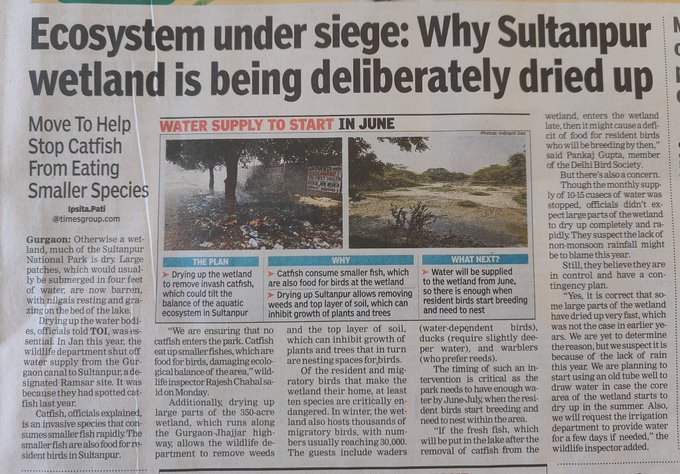
Though the monthly supply of 10-15 cusecs of water was stopped, officials didn’t expect large parts of the wetland to dry up completely and rapidly. They suspect the lack of non-monsoon rainfall might be to blame this year. Still, they believe they are in control and have a contingency plan. “Yes, it is correct that some large parts of the wetland have dried up very fast, which was not the case in earlier years. We are yet to determine the reason, but we suspect it is because of the lack of rain this year. We are planning to start using an old tube well to draw water in case the core area of the wetland starts to dry up in the summer. Also, we will request the irrigation department to provide water for a few days if needed,” the wildlife inspector added. https://timesofindia.indiatimes.com/city/gurgaon/ecosystem-under-siege-why-sultanpur-wetland-is-being-deliberately-dried-up/articleshow/109705614.cms (30 Apr 2024)
Govt starts survey on impact of infra projects on Sultanpur park State govt has initiated an assessment of the cumulative impact of housing societies around Sultanpur National Park, a Ramsar site, on its ecosystem. This comes in response to the rapid development of the area. Govt will soon submit its findings to the st anding committee of the Centre’s National Board for Wildlife (NBWL). The committee has already reviewed measures taken for the preservation of wetlands and Ramsar sites in the state and also studied the water flow from Sultanpur to Najafgarh.
-According to officials, govt’s assessment was prompted by the standing committee’s directive on Feb 28 to evaluate the impact of infrastructure projects in the area. It was issued while the panel was considering a proposal to use nearly 3.7 hectares of land for an affordable group housing colony at Garhi Harsaru in Sector 95B, which is 4km away from the national park’s boundary and falls within its eco-sensitive zone. https://timesofindia.indiatimes.com/city/gurgaon/govt-starts-survey-on-impact-of-infra-projects-on-sultanpur-park/articleshow/109016081.cms (04 April 2024)
Delhi Govt to list 322 waterbodies over 1,000 it can’t manage While the city has struggled to maintain or restore 1,045 waterbodies enumerated in 2021 — many of them non-existent on the ground — Delhi govt has added 322 more to the tally based on satellite imagery. This makes a total of 1,367 waterbodies that need to be rejuvenated in the capital. Given the lack of action on vetting the wetlands, Delhi High Court asked the state govt on April 8 to ensure all the wetlands are appraised for maintenance by the end of the year. https://timesofindia.indiatimes.com/city/delhi/delhi-adds-another-322-waterbodies-to-list-of-over-1000-it-cant-manage/articleshow/109258187.cms (13 April 2024)
Coming up on ‘grave’ of pond, a cultural complex On a plot in Budhela village in west Delhi’s Vikaspuri that was walled by a govt department, a cultural complex is coming up. The irony is that while it is listed as govt land, it is actually a pond, enumerated as one of the city’s 1,040 wetlands by the Wetland Authority of Delhi and meant to be notified as such by the state govt. The disappearance of this last surviving of the four ponds in the village underscores the challenges confronting the wetland conservation.
A petition on this was recently accepted by Delhi High Court and on March 28, the court sought the responses of the various Delhi govt departments on the matter. According to petitioner Paras Tyagi, co-founder of Centre for Youth, Culture, Law and Environment, an NGO dealing with public policy, the land originally belonged to Delhi Development Authority. “In 2002, DDA allocated 4,300 square metres of this land to the Sahitya Kala Parishad, which is part of Delhi govt and looks after art and culture,” said Tyagi. “The Parishad asked DTTDC, another Delhi govt undertaking, to construct a cultural complex on the plot and a private contractor has just started the work.” https://timesofindia.indiatimes.com/city/delhi/coming-up-on-grave-of-pond-a-cultural-complex/articleshow/109258349.cms (13 April 2024)
YAMUNA URBAN WATER
Noida One borewell is illegal but this housing project has 60 A showcause notice was issued to Ace Group after a govt team found 60 borewells at one of its project sites off Yamuna Expressway. At least 10 of the borewells at the site of YXP township in Sector 22D were found fitted with motors, which augmented their capacity to draw water. The inspection was carried out by the groundwater wing of the district administration on Wednesday (March 20) after a video circulated on social media purportedly showed dirty water being drained out of the project site. While examining the area, the team found that much of the land had been dug up, causing water to come out. Officials also found that 60 borewells were scattered across the site. https://timesofindia.indiatimes.com/city/noida/one-borewell-is-illegal-but-this-housing-project-has-60/articleshow/108718992.cms (23 March 2024)
NGT seeks builders’ replies on GW extracted at 63 project sites The directive came after a petition was filed by environmentalists Pradeep Dahalyia and Prasoon Pant, who alleged that groundwater was being extracted at 63 projects in Greater Noida West. The petitioners said that these developers were also fined Rs 300 crore by a committee comprising officials of the district administration, UP Pollution Control Board (UPPCB) and the Central Ground Water Authority (CGWA). The petitioners also said that they will file their own responses as there are several new projects in Greater Noida West where illegal groundwater extraction could be going on.
-Earlier, NGT had said that notices should be issued to all builders in Bisrakh and govt offices that extract ground water illegally. The tribunal further added that since no formal notices were issued by the tribunal to all project proponents who may be affected by the ultimate order, notices should be issued to all respondents, except those who are already represented. However, till now the builders have not filed their responses in NGT. The next hearing is scheduled on Apr 29. https://timesofindia.indiatimes.com/city/noida/groundwater-extracted-at-63-project-sites-in-gr-noida-west-ngt-seeks-builders-replies/articleshow/108925882.cms (1 April 2024)
Gurugram Bandhwari fire: NGT asks for report from 6 govt agencies While HSPCB, the Gurgaon DC and MCG sought four weeks’ time to file their reports, the others will be served notices to submit their responses at least one week before the next hearing on July 18. In an order issued on Friday (April 26) , the tribunal highlighted the lack of precautionary measures to stop waste burning. TOI had reported that the blaze on Tuesday (April 23) was the fourth fire incident at the landfill in April. The site had earlier witnessed fires on April 6, 7, and 17. Around 16.4 lakh metric tonnes of garbage are dumped there.
“The news item also discloses that this is the fourth fire incident. The report mentions that a thick haze has engulfed the villages around Bandhwari, especially Mangar, and such fire in the landfill site is a threat to biodiversity and poses a health hazard to citizens of NCR. It also discloses that leftovers, after processing of the legacy waste, are indiscriminately dumped in surrounding villages, which is contaminating the soil,” read the order. https://timesofindia.indiatimes.com/city/gurgaon/bandhwari-fire-ngt-asks-for-report-from-6-govt-agencies/articleshow/109655838.cms (28 April 2024)
NGT seeks thermal plant’s reply on fly ash compliance The NGT has directed the Haryana Power Generation Corporation Ltd (HPGCL) to submit a fresh affidavit within a period of four weeks on disposal of old fly ash in the Aravalis after the closure of the Faridabad thermal power station. Saying that nothing has been pointed out to show that the norms have been complied with, the tribunal stated that the affidavit should clarify if the old fly ash dyke meets all conditions mentioned in the relevant provisions. The next hearing is on July 26.
Following the NGT’s instructions, the SPCB conducted an inspection on July 31 last year. The board’s report confirmed the presence of two ash dykes in the Aravalis. One of them, the old ash dyke, is spread across 103 acres. It was filled in 1987 and is currently covered with plantation after deposition of a layer of soil. The other is spread across 152 acres, where lifting of ash is in progress now. The report disclosed that no lifting of fly ash took place between 2018 to 2022. Now, the work has been awarded to two agencies. Till June 30 last year, approximately 8 lakh metric tonnes (MT) of fly ash was lifted. Approximately 10 lakh MT fly ash is yet to be lifted. HSPCB also informed NGT that the entire remaining fly ash at the second ash dyke will be lifted by June 21, 2026. https://timesofindia.indiatimes.com/city/gurgaon/fly-ash-disposal-in-aravalis-ngt-seeks-thermal-plants-reply-on-compliance/articleshow/109384679.cms (17 Feb. 2024)
Drain to prevent leachate spill from landfill site MCG told the tribunal it is taking the necessary steps to construct a high-density polyethylene lining drain around the landfill. This drain, along with an embankment, is expected to prevent the spread of leachate and limit its percolation into the surrounding environment. NGT also told HSPCB and MCG to file a fresh action-taken report at least three days before the next hearing, which is on May 17. https://timesofindia.indiatimes.com/city/gurgaon/soon-a-drain-to-prevent-leachate-spill-from-landfill-site-to-aravalis/articleshow/109175985.cms (10 April 2024)
SPCB says landfill leachate polluting GW, MCG trashes claim Water samples collected by SPCB from areas near the Bandhwari landfill have been found to contain toxic substances and chemicals, much higher than the permissible limits. MCG, however, has denied any contamination by leachate spill from the landfill, claiming that the spots from where the samples were collected were over 20km away from the site. HSPCB submitted a report to the NGT on Thursday (April 04) following tests conducted on samples collected from 10 areas near the landfill’s waste processing plant on Feb 24. The tests came after NGT directed the board to determine if untreated leachate was being dumped into the fragile ecosystem of the Aravalis. https://timesofindia.indiatimes.com/city/gurgaon/hspcb-says-landfill-leachate-polluting-groundwater-mcg-trashes-its-claim/articleshow/109047609.cms (05 April 2024)
– The NGT has expressed dissatisfaction with the steps taken by the municipal corporations of Gurgaon and Faridabad to process daily and legacy waste at Bandhwari landfill. It has asked for a fresh report, citing undisclosed advancements in their recent submissions. The tribunal has also questioned the rationale behind sending groundwater samples to a lab in Punjab even though SPCB has its own facilities for testing. The next hearing in this matter is on April 04. https://timesofindia.indiatimes.com/city/gurgaon/corpns-face-ngt-flak-over-bandhwari-waste-processing-told-to-file-report/articleshow/108955620.cms (02 April 2024)
Delhi 14th-century dam still stands strong As one walks out of the labyrinth of Khirki village, home to the majestic Khirki Masjid, a short distance away, an easy-to-miss sign towards the left announces: Satpula. Entering the complex, one is greeted with an arched gate leading to a magnificent Tughlaq-era dam. Built in 1340 by Mohammad Bin Tughlaq, the dam served two purposes: Providing a reliable source of water for irrigation, and acting as a defence against possible intruders. Centuries later, the stream over which the dam was built was diverted by the British, reducing the water body to a mere drain flowing on one side. However, the Satpula structure remains formidable as ever, reminding one of the type of masonry the empire was capable of. https://indianexpress.com/article/cities/delhi/built-to-supply-water-act-as-bastion-this-14th-century-dam-still-stands-strong-9257154/ (08 April 2024)
NGT has asked DPCC why it should not be penalised for allowing illegal groundwater extraction by guest houses and hotels, including 536 hotels/ GH in Paharganj. https://timesofindia.indiatimes.com/city/delhi/ngt-raps-dpcc-for-not-cracking-the-whip/articleshow/109384951.cms (18 April 2024)
The Supreme Court recently expressed shock over the problems surrounding solid waste management in Delhi, noting that the city was producing around 3,000 tonnes of solid waste everyday in excess of its processing capacity. https://www.barandbench.com/news/supreme-court-solid-waste-processing-problem-delhi (25 April 2024)
Himachal Pradesh Baoris & call for restoration Baoris deterioration is not a thing of the past. The degradation has been induced by development near that area and deforestation of vehicular activity over the baori catchment zones. Water quality has deteriorated significantly in recent years. Baoris have become seasonal or have dried up. Due to the unsuitable and unthoughful plans and repairs initiated by authorities, the state of baoris have worsened. The cementing of area near the baoris have caused the water to degrade. The natural stones which helped in the water filtration process were replaced by cemented repairs which worsened the state of baoris. These natural springs are drying up or losing their purity as global warming rises and infrastructure development increases. Many Boris have become contaminated due to development in the surrounding areas.
-We have lost the workers having the required skill for locating and construction of baoris. That is for sure that baoris are difficult to construct now. Now, baoris act like heritage tresures which depict the stories of the past. Although the use of baoris has decreased dramatically, People still yearn for “Baori k pani ka swad” and are interested in having them revived. Few people still use baoris as a compulsive practice, which can be hazardous to them if water quality keeps degrading. We still have time to revive these natural resources and work towards a sustainable development approach. These resources must be considered and thoroughly documented before any construction that can contribute to their degradation. (Swati Bhardwaj) https://timesofindia.indiatimes.com/blogs/stories-undiscovered/sacred-waters-baoris-of-himachal-and-the-call-for-restoration/ (22 April 2024)
YAMUNA RIVERS FLOOD
Delhi Govt failed to see worst flood coming An analysis by The Hindu of forecasts issued by the Central Water Commission, the agency which monitors floods in India, shows that not only did it not predict that Delhi might see the worst flood in its history, but the agency, kept saying that the water level will “remain steady”, even as it continued to rise through July 12 to reach the highest ever level on July 13.
The forecasts of the CWC were being used officials of the Delhi government to take decisions and it affected decision making, multiple officers confirmed. “The only prediction of water level we have is from the CWC and if the prediction was better, it could have led to better decision making,” a senior official of the irrigation department of the Delhi government, which ran a flood control room in Delhi said.
“We have been monitoring floods in India for over a decade and the CWC has gotten the prediction wrong on many occasions,” said Himanshu Thakkar, coordinator of South Asia Network on Dams, Rivers and People (SANDRP), who has been working on issues related to rivers for the past three decades. Mr. Thakkar highlighted that lack of accurate predictions of water level of rivers have many times led to improper management of dams/barrages, leading to floods in downstream areas, which could have been avoided. The CWC did not respond to an email seeking comments. https://www.thehindu.com/news/cities/Delhi/2023-delhi-floods-how-govt-did-not-see-delhis-worst-flood-coming-even-24-hours-before-it/article68105240.ece (27 April 2024)
Broken ITO drain gate that worsened flooding to be fixed Delhi government officials will repair by April 30 an iron gate — installed on a drain to control the flow of water from the Yamuna — that collapsed and allowed water from the river to course into parts of central Delhi during last year’s record floods, said people aware of the matter. The new gate, known as a regulator, will also be designed to hold back more water, added the officials. The regulator is usually left open and is closed only when the Yamuna’s waters swell, officials said.
-Officials from the irrigation and flood control department said that they will install the iron gate at ITO’s drain number 12 by April 30 and complete repair work at the site. Officials said that the new design received the final financial approval from the irrigation department in January, after which tenders were floated to forge the new gate at an estimated cost of ₹43 lakh. Following the sudden release of water towards Delhi last year, the design capacity of the new gate has been increased to handle the Yamuna water level up to 210 metres, which earlier was at 206 metres, they added.
-Officials said that the new design received the final financial approval from the irrigation department in January, after which tenders were floated to forge the new gate at an estimated cost of ₹43 lakh. Following the sudden release of water towards Delhi last year, the design capacity of the new gate has been increased to handle the Yamuna water level up to 210 metres, which earlier was at 206 metres, they added. https://www.hindustantimes.com/cities/delhi-news/broken-drain-gate-that-worsened-flooding-at-ito-in-delhi-to-be-fixed-at-last-101713896125212.html (24 April 2024)
RELEVANT REPORTS
Study Landscape evolution of the NW Himalayan rivers Abstract: -Here, we present the high-resolution chronostratigraphic records based on 47 optically stimulated luminescence (OSL) ages from 6 cores (∼50 m deep) retrieved across the palaeochannels of the Yamuna. We document multi-storied sand bodies deposited by a mobile channel belt in a large alluvial fan system characterized by four possible stages of drainage reorganization and landscape evolution during the late Quaternary.

It has also been inferred that a major eastward shift of the palaeo-Yamuna River occurred at ∼18 ka, predating both the westward shift of the Sutlej at ∼8 ka and the decline of the Harappan Civilization at ∼3.9 ka BP. Our chronostratigraphic data helps to understand the drainage reorganization of the Himalayan river systems during the late Quaternary in the NW Himalayan foreland and reaffirms the non-contemporaneity of the Harappan Civilization with a large river system. https://www.sciencedirect.com/science/article/abs/pii/S0277379124001239 (April 2024)
Assessment of macro & microplastics from Ganga & Yamuna Abstract The current study aimed to conduct a comprehensive investigation of the seasonal and spatial distribution of macro to microplastics (MPs) in the surface water, water column, and sediments from the River Ganga and Yamuna. MP samples were collected from various points of these Rivers, including upstream, downstream, and drainage points around the vicinity of Haridwar, Agra, Prayagraj, and Patna cities. With a significant seasonal variation, the estimated MPs and plastic flux were higher during the wet season than during the dry season. MPs sized 300 µm-1 mm and fibre-shaped blue and black colored MPs were pre-dominant in both rivers. Polyacrylamide, polyamide, and polyvinyl chloride were the most ascertained polymers. MPs including hazardous polymers (hazard score >1000) may pose a risk to the population of Indo-Gangetic Plain via direct and indirect exposure to MPs. The information provided in this study could serve as a starting point for the action plan required by municipal corporations to mitigate plastic pollution and target the possible sources at each location. https://www.sciencedirect.com/science/article/abs/pii/S0304389424005053 (April 2024)
Indo-Gangetic Plains to soon become hotspot of extreme events -A study involving researchers from the Indian Institute of Technology has revealed worrying predictions about the future of the densely populated areas around the Indus and Ganges rivers. Compound extreme weather, made more common by climate change, is set to become a major problem. These compound events, where different extreme weather conditions occur together or in quick succession, are increasingly frequent. For example, droughts and heatwaves or heavy rainfall after extreme temperatures can cause significant damage.
-The study suggests that the Indo Gangetic Plains could face increased risks of crop failure due to rising temperatures, drought, and unpredictable rainfall patterns caused by global warming. Study author Harald Kunstmann emphasises the importance of preparing for these challenges, suggesting measures such as investing in heat and drought-resistant seeds, building flood-resistant dams, and storing rainfall for irrigation during dry periods. https://www.businessinsider.in/sustainability/news/indo-gangetic-plains-home-to-half-the-indian-population-to-soon-become-hotspot-of-extreme-climate-events-study/articleshow/109376569.cms (17 April 2024)
Irrigation-driven gw depletion in Ganges-Brahmaputra basin decreases streamflow in BoB Abstract Irrigation-driven groundwater depletion and climate change affect the Ganges-Brahmaputra’s hydrology, threatening the stability of the Bay of Bengal. Here, we quantify, using results from a land reanalysis, the impacts of a changing climate and intensive irrigation on the surface water flowing into the Bay of Bengal. The effects of such activities mostly occurring in the Ganges basin, either intensified or lessened depending on the area by the climatic conditions, decrease freshwater flow into the bay by up to 1200 m3/s/year. While the increase in precipitation in the Ganges basin reduces the effects of groundwater depletion on the streamflow, the decrease in precipitation and the snowmelt decline in the Brahmaputra basin exacerbate streamflow reduction due to groundwater depletion at the delta. https://www.nature.com/articles/s43247-024-01348-0 (1 April 2024)
ISRO Himalayan glaciers melting at unprecedented rates At least 89 per cent of 2,431 glacial lakes in the Himalayas that were identified in 2016-17 have notably expanded since 1984, the Indian Space Research Organisation (ISRO) said in a report today. The results of the ISRO analysis is worrying as expanding glacial lakes due to warming can lead to cascading consequences in the lower regions, say experts. Satellite data archives spanning the past three to four decades provide valuable insights into changes occurring in glaciated environments, ISRO said. Long-term satellite imagery covering the catchments of Indian Himalayan river basins from 1984 to 2023 indicates significant changes in glacial lakes, ISRO said in the report.
The ISRO report said 601 glacial lakes, or 89 per cent, have expanded more than twice, and 10 lakes have grown between 1.5 times and double their size. Sixty-five lakes have expanded 1.5 times. Of the 2,431 glacial lakes larger than 10 hectares, 676 have significantly expanded, and at least 130 of these lakes are in India – 65 (Indus River basin), 7 (Ganga River basin), and 58 (Brahmaputra River basin). Elevation-based analysis shows 314 lakes are located in the 4,000 to 5,000 metres range, and 296 lakes are above 5,000 metres elevation, ISRO said in the report ‘Satellite Insights: Expanding Glacial Lakes in the Indian Himalayas’ released on Apr 22. https://www.ndtv.com/india-news/89-expanding-glacial-lakes-in-himalayas-grew-more-than-twice-in-38-years-isro-5499623 (22 April 2024)
Uttarakhand Govt to evaluate the risk of GLOFs The govt has constituted two teams of experts to evaluate the risk posed by five potentially hazardous glacial lakes in the region. These lakes are prone to Glacial Lake Outburst Floods (GLOFs), the kind of events that have resulted in several disasters in the Himalayan states in recent years. According to NDMA, there are 188 risky glacial lakes in Himalayas, of them 13 are in Uttarakhand, 10 of them are unnamed. 5 of them are in A (highest risk) category, including one in Chamoli and four in Pithoragarh district. https://indianexpress.com/article/explained/explained-climate/risk-from-glacial-lake-floods-9249967/ (04 April 2024)
Report Demand to include River protection measures in election manifestoes The demand of NAPM to political parties going to the National elections in next couple of months to include protection of rivers and communities dependent on rivers in their manifestoes is most appropriate and urgently required.
Some key components of the demand include strengthening of decentralized river governance, role in decision making related to rivers for the fisherfolks, boats people and other river dependent communities. A draft of the People’s River Protection Bill has also been sent to the political parties. The NAPM also opposed indiscriminate construction of dams, hydro projects, embankments, barrages, river front developments, illegal sand mining, dumping of solid and liquid waste in the rivers and also interlinking of projects, all being done in the name of development, with least concern for the rivers.
The draft bill also demands removal of unjust encroachments into riverbeds and floodplains. NAPM also demands continued flow in the perennial rivers by way of adequate environment flows throughout the length of the rivers from origin to its confluence with other rivers or sea. Will the political parties listen and respond positively? That will depend on how much the local communities all over the country make this demand to the candidates and political parties that approach them for votes. https://sandrp.in/2024/04/08/drp-nb-080424-demand-to-include-river-protection-measures-in-election-manifestoes/ (08 April 2024)
Highlights from the 27th International Day of Action for Rivers The International Day of Action for Rivers originated in Curitiba, Brazil in 1997, when representatives from dam-affected communities around the world gathered to raise their voices against dams and in support of river protections. From a small event of 50 groups in 1999, Day of Action for Rivers has grown into a global movement with over 110 events by 400+ groups taking place in more than 40 countries this year. https://www.internationalrivers.org/news/water-for-all-highlights-of-the-27th-international-day-of-action-for-rivers/ (08 April 2024)
Villagers use Saraswati riverbed for cow dung, cremation, crop The sites in Punjab, Haryana and Rajasthan along the river’s paleochannels may be the biggest archaeological evidence that can establish the Saraswati story but the alarming rate at which the river bed is being lost doesn’t bode well for the band of excavators looking to co-relate the late Harappan period with Vedic period. And at the heart of this encroachment lies an important question — what is more important, history or livelihood? https://theprint.in/the-fineprint/villagers-use-saraswati-riverbed-for-cow-dung-cremation-crop-where-do-we-keep-cattle/2035667/ (11 April 2024)
Saving tropical riverine grasslands of floodplains This study on the riverine alluvial grasslands of Kaziranga Tiger Reserve (KTR) in the Brahmaputra floodplains aimed at generating baseline information to aid the management authorities in formulating and upgrading management practices in the grasslands.
– The study aimed at answering the following questions: Does the duration of inundation influence short grassland (SG) and tall grassland (TG) extent in KTR? What are the vegetation characteristics and soil nutrient content (C, N, P and K) of SG and TG? Is there any similarity between species composition of SG and TG in the selected sites? How do environmental variables such as rainfall (RF), maximum temperature (MAXT), minimum temperature (MINT) and soil nutrient content (C, N, P and K) influence plant species distribution in SG and TG? https://www.indiawaterportal.org/articles/saving-tropical-riverine-grasslands-brahmaputra-floodplains (25 April 2024)
Saving the Hilsa by letting the flow! The paper titled ‘Assessment of optimal dam release for anadromous fish migration in estuary’ published in Ecological Indicators discusses the findings of a study that investigates the effects of Sardar Sarovar Dam (SSD) on downstream flow, and estimates the flow requirements necessary to support anadromous fish migration namely that of the hilsa fish in the Narmada River estuary. https://www.indiawaterportal.org/articles/saving-hilsa-letting-narmada-flow (20 April 2024)
Compiled by Bhim Singh Rawat (bhim.sandrp@gmail.com)
Also see: Yamuna Manthan 03 April 2024; Yamuna Manthan 06 March 2024
Follow us on: www.facebook.com/sandrp.in; https://twitter.com/Indian_Rivers
Carrying forward the legacy of Yamuna conservation work done by Late Manoj Mishra, Convenor of Yamuna Jiye Abhiyan, SANDRP is publishing a compilation of news reports and other relevant information on contemporary issues related to Yamuna River from February 2024. This is the second such monthly report in the series and we will try to release same updates on the first Wednesday of every month. The main purpose of the exercise is to monitor, document and research all the issues affecting the Yamuna rivers and riverine people so that all concerned may get updated information on ground realities of the river and its people. All of you are requested to read, share and give suggestions to improve it.

 SANDRP