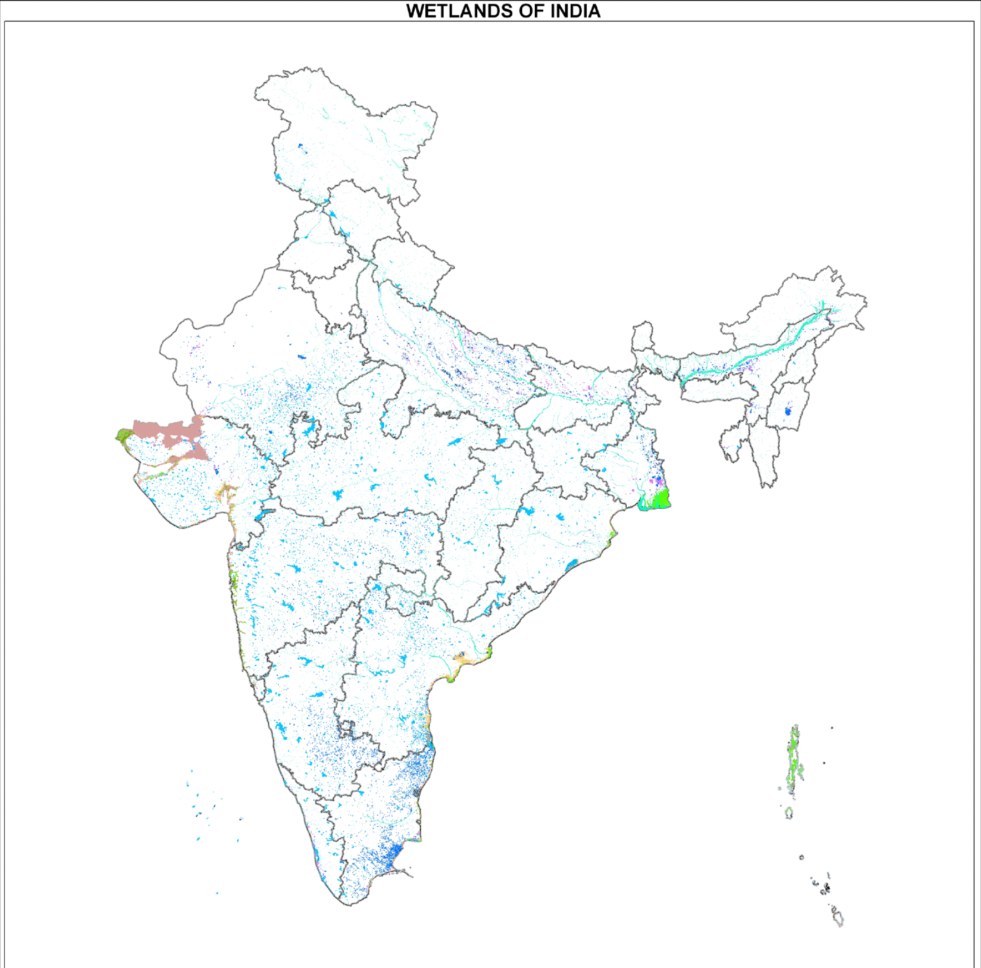
As somewhat belated summer in North India reaches its peak, with ongoing heat wave in Delhi and surrounding areas, there is increasing fear of water scarcity. The media generally uses one figure to highlight this situation, namely Live Storage in some 150 reservoirs in Central Water Commission (CWC)’s Weekly Reservoir Bulletin (WRB) that is published every Thursday afternoon (why cannot this be given on daily basis is a mystery).
Continue reading “Becoming water smart holds the key to our water secure future”Month: May 2024

DRP 270524: Illegal Sand Mining Menace: Can Judiciary act effectively?
(Mechanized mining in Yamuna river in Vikas Nagar. Image credit: Nishant Panwar, 12 May 2024)
The river sand mining stories this week makes fascinating reading. We have stories from Andhra Pradesh, Telangana, Uttar Pradesh, Goa, Rajasthan, Madhya Pradesh and Punjab. The stories from first five states are related to judiciary. One story from Punjab is about collapse of a bridge due to illegal mining and another about how illegal sand mining is part of electoral narrative. The story from Madhya Pradesh is possibly most interesting and most indicative of the direction in which we need to go. In MP at a public hearing for sand mining project, the women of the villages, including sarpanch, have decided to save the river rather than allow unsustainable mining.
The stories from five states about judicial actions includes the one from Andhra Pradesh where the Supreme Court of India has warned the govt about contempt action. The apex court has set up committees of govt officials in Krishna and Guntur districts to stop illegal mechanized sand mining. The story from Rajasthan is about Supreme Court stopping sand mining in 1 km radius around Sariska Tiger Reserve. The stories from next two states is about the NGT action. Lastly, the story from Goa is about High Court action.
Continue reading “DRP 270524: Illegal Sand Mining Menace: Can Judiciary act effectively?”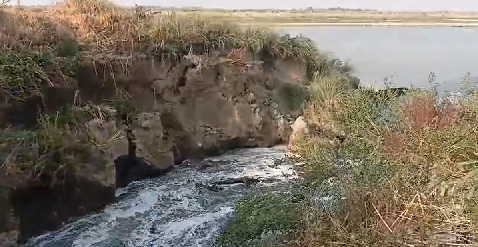
DRP 200524: After Ten years of Namami Gange and Rs 40 000 Cr expenditure Ganga remains dirty
(Feature Image: Untreated effluents being discharged in Gang river through ‘Chor’ nullah in Kanpur on May 19, 2024. Image Source: Sceenshot of ABC News Media report)
The reports this week from Ganga basin rivers clearly show that after ten years of Namami Gange and NMCG (National Mission for Clean Ganga) efforts and expenditure of over Rs 40 000 Cr, there is no improvement in even river pollution, leave aside the state of river flows or state of the rivers in the Ganga basin.
In fact, there is nothing to show that even the new STPs are making any difference to the river even with respect to the limited objective of sewage treatment. As highlighted in the report below, until and unless the governance of STPs become more transparent, accountable and participatory, there is no hope for change, no matter how much money is spent, how much new STP capacity is added or what technology is used. Only a responsive, confidence inspiring governance can make a difference. But there is no interest in working in that direction from the government.
Continue reading “DRP 200524: After Ten years of Namami Gange and Rs 40 000 Cr expenditure Ganga remains dirty”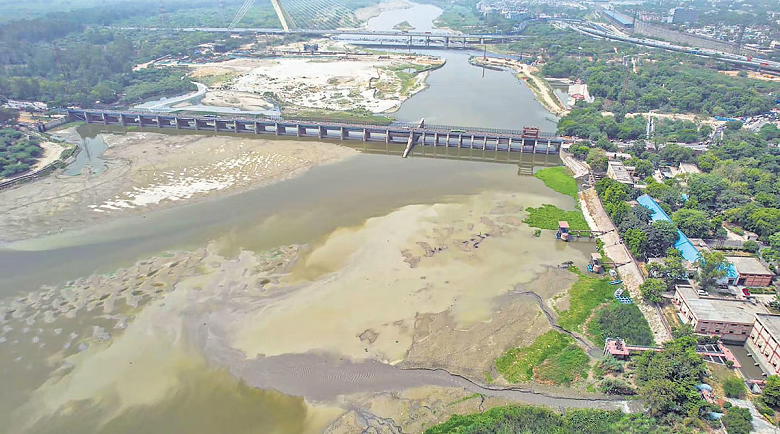
‘Let Yamuna Flow’: A River’s Appeal to Political Parties
(Feature Image: An aerial view of Wazirabad Barrage shows a drying up Yamuna in May 2022. Image Credit: PTI/TNIE)
In the wake of Lok Sabha election 2024 in Delhi on May 25, the civil societies and concerned citizens on behalf of River Yamuna appeal to the political parties to address the critical issue of absence of environmental flows adversely impacting the river health in the national capital.
Continue reading “‘Let Yamuna Flow’: A River’s Appeal to Political Parties”
DRP 130524: Unreliable Hydropower poses new challenges for India
(Feature Image: NHPC’s under construction 2000 Mw Subansiri Lower Hydro Power Project. Source: PIB, June 2023)
As per this Reuters report based on official information and statements, in June 2024 India will face the biggest peak hour power shortfall in 14 years, mainly due to the slump in hydropower generation. This is the result of not only pushing hydropower projects over the decades, but also not taking any steps to optimize peaking power generation from existing hydro or doing anything worthwhile to manage peak load. India’s hydropower generation had steepest fall in four decades in the year ending on March 31 2024, which was another reason not on rely on unreliable hydropower projects. The regular and frequent disasters that we see connected with hydropower projects in almost every month and more frequently in monsoons should be another reason in this regard.
Continue reading “DRP 130524: Unreliable Hydropower poses new challenges for India”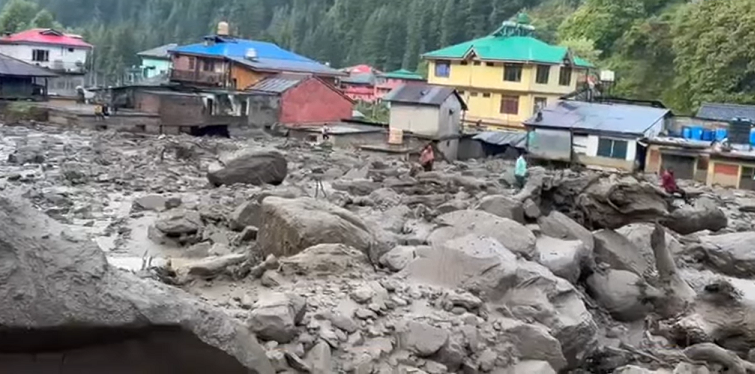
May 2024: Lambadug HEP Leak Disaster in Kangra-Himachal
(Feature Image: Flashflood ravaged Multhan market area after leakages in 25 Mw Lambadug HEP tunnel on May 10, 2024. Image Source: Screen shot of Amar Ujala video report)
The massive leakages in penstock of Lambadug Hydro Electric Project (HEP) on May 10 2024 morning have caused extensive damages in Multhan market area of Kangra district in Himachal Pradesh. The sudden leakages turning into a flash flood spell occurred around 08:00 am on May 10, 2024. As per reports the deluge containing mud and debris spread over 400 meter of market and invaded about 50 homes, 80 shops apart from damaging cash crops over 6 acres farming land.
The incident created panic situation for 150 families living in the area. Several residents had to run to save their lives. The project and administration officials remained unavailable to control the situation for hours. With no help in site, the local people had to divert the gushing currents towards Lambadug river to prevent further damages to their homes and properties.
Continue reading “May 2024: Lambadug HEP Leak Disaster in Kangra-Himachal”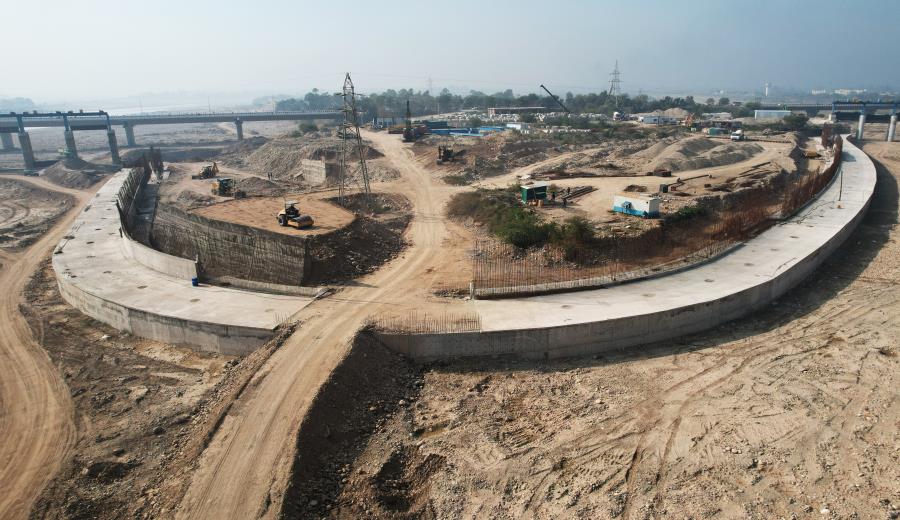
Tawi Barrage & Riverfront Projects in Jammu destroying river, inviting disaster
(Feature Image: a picture of Tawi Riverfront and Real Estate Development uploaded on Jammu Smart City website)
Tawi Riverfront Development (RFD) project in Jammu symbolizes the fallacy of most of the RFD projects in India. The city owes its historical relevance, cultural legacy and gradual prosperity to the river. But in return the Tawi has been witnessing typical urban river problems of gradual decline in flows, continual rise in solid and liquid waste pollution, encroachments and riverbed mining. And as is the case with most of urban rivers, instead of taking effective measures to address the existing threats, the government here has been pumping crores of rupees into an artificial lake and RFD project for over past one and half decade in a non-transparent and questionable manner.
Continue reading “Tawi Barrage & Riverfront Projects in Jammu destroying river, inviting disaster”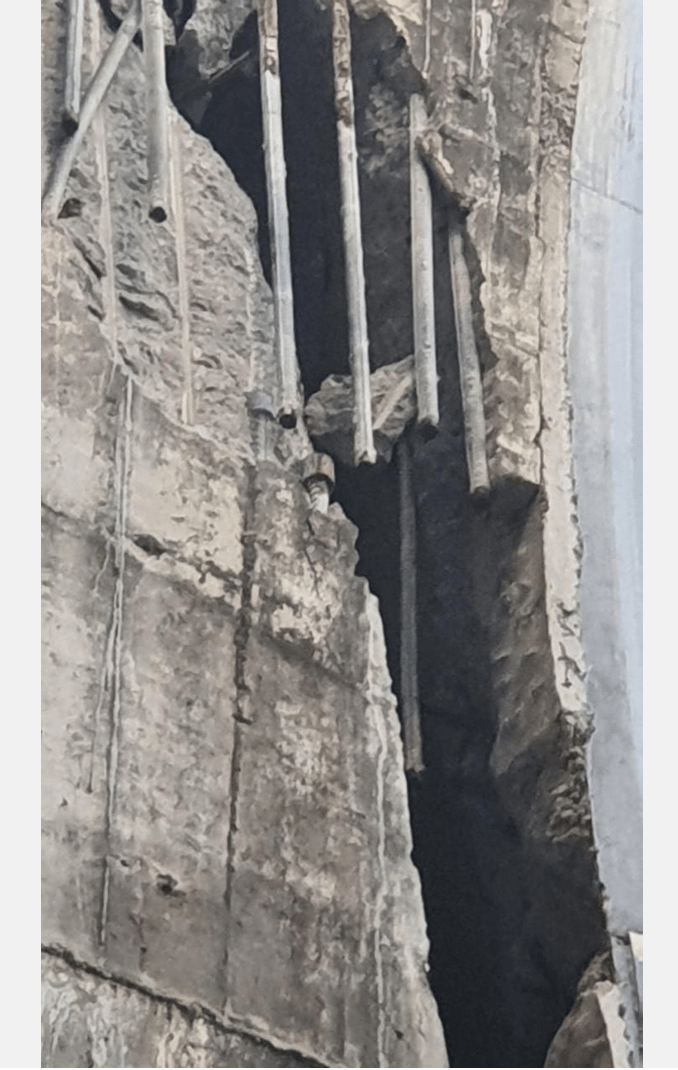
May 2024: Questions about NDSA interim report on Kaleshwaram Dam Disaster
The National Dam Safety Authority (NDSA) Chairman Shri Anil Jain has through a letter dated May 1, 2024, sent an interim report of the NDSA committee to the Telangana govt. The 16 page interim report titled: “RECOMMENDATIONS ON THE INTERIM MEASURES AND FURTHER STUDIES/INVESTIGATIONS TO BE TAKEN UP BY IRRIGATION & CAD DEPARTMENT, BEFORE THE ONSET OF COMING MONSOON” came as an annexure to the letter addressed to Rahul Bojja, Irrigation and Command Area Department (I & CAD) of Govt of Telangana.
Continue reading “May 2024: Questions about NDSA interim report on Kaleshwaram Dam Disaster”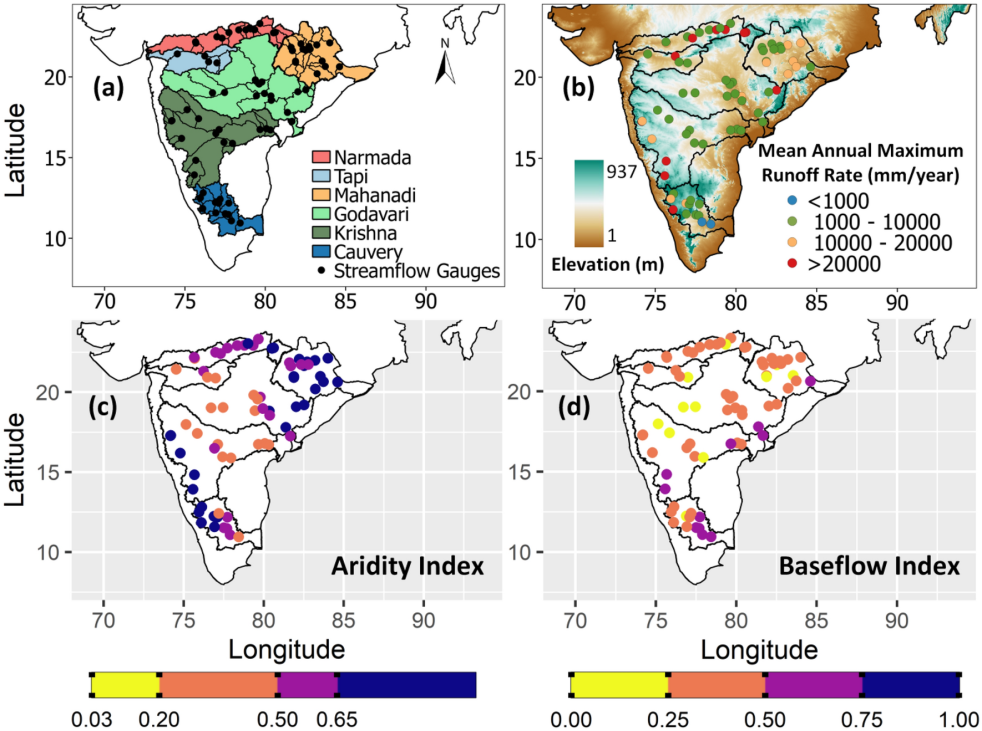
DRP 060524: Study on dam induced river flooding in Peninsular India
(Feature Image: (a) Locations of streamflow gauges with catchment boundaries in six major river basins of Peninsular India, (b) elevation map and mean annual maximum runoff rate (streamflow per unit catchment area), (c) Aridity Index (AI) and (d) Baseflow Index (BFI). The maps in first row are prepared in QGIS (Version 2.14.0 ‘Essen’ (2016), URL: http://qgis.org) and the maps in second row are generated using R (Version 4.2.2 (2022), URL: https://www.R-project.org/). Source: Baseflow significantly contributes to river floods in Peninsular India )
A recently published study, see details given below throws light on the role of groundwater contribution to baseflow in rivers and their flooding in Peninsular India’s river like Narmada, Tapi, Mahanadi, Godavari, Krishna and Cauvery. The found that while baseflow contributes more to river flows, its share in the flood event flow magnitude decreases as surface runoff accounts for a larger proportion of flood discharge on the day of the flood.
Most significant are the findings related to dam induced flood that SANDRP has been writing for long and the finding corroborate exactly what SANDRP has been saying: Sudden releases of water from a dam can raise river levels during extreme rainfall events, especially when the dam is nearly full. The impact of sudden floods is more destructive because people living in nearby areas are often unprepared. Without a dam, floodwaters rise slowly over time, allowing people to take preventive measures. However, sudden floods caused by dam releases offer little or no time to prepare, increasing the risks associated with dam-induced flood hazards. Furthermore, the construction of dams alters the natural regime of rivers, leading to changes in sediment transport and erosion patterns. These changes can heighten the risk of flooding downstream from a dam.
Continue reading “DRP 060524: Study on dam induced river flooding in Peninsular India”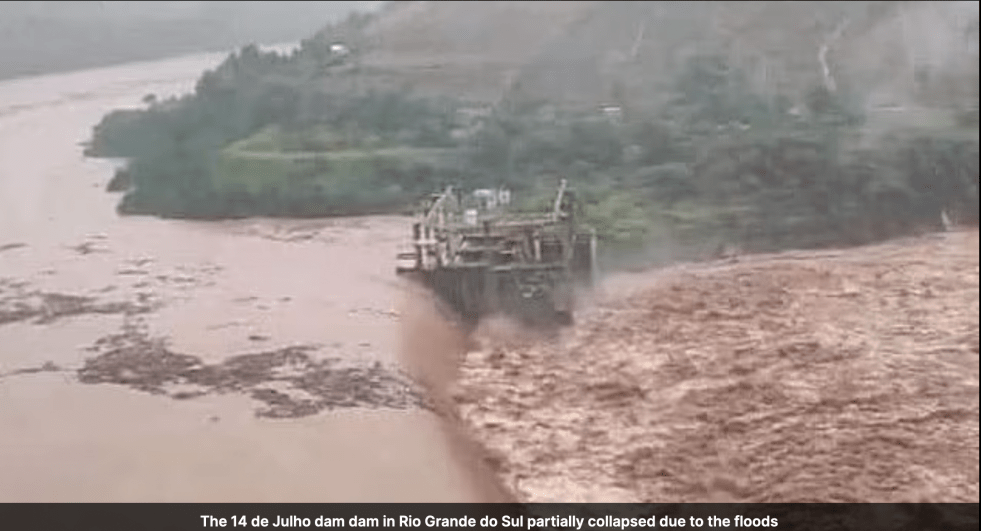
May 2024: Brazil Dam Collapse leads to death, destruction
A dam which was part of the 14 de Julho hydropower plant in Brazil has partially collapsed on May 2, 2024, following heavy rains that started on Apr 29 and expected to be continued to May 3[i]. The breached dam, located between Cotiporã municipality and Bento Gonçalves city, reportedly created a 2m wave, exacerbating the floods in the already inundated areas. Meteorologists attribute the extreme weather event to an unusual amalgamation of soaring temperatures, elevated humidity levels, and fierce winds.
Continue reading “May 2024: Brazil Dam Collapse leads to death, destruction” SANDRP