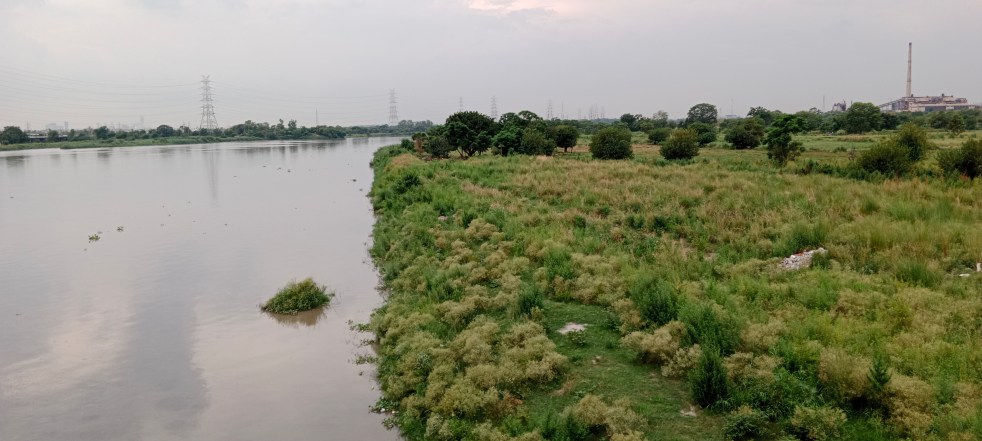
(Feature Image: Part of Yamuna river & its floodplain downstream Geeta Colony bridge in Delhi in June 2023. Bhim Singh Rawat/SANDRP)
In a welcome decision, the Supreme Court of India has rejected Delhi Police’s petition seeking permission for construction of the Police trainees’ accommodation in the floodplains of Yamuna River in Delhi. The plea was rejected by the Bench of Justices Abhay S Oka and Ujjal Bhuyan on January 2, 2024.
The Bench was hearing the Civil Appeal (No. 000002 of 2024 (Arising out of Diary No.44256 of 2023) by Commissioner of Police Delhi which was represented by Mukesh Kumar Maroria, Senior Government Advocate against National Green Tribunal (NGT) dismissal of same proposal on 28 September 2020.
The 3-page apex court order (which can be seen here) reads “Heard the learned Additional Solicitor General appearing for the appellant. Delay condoned. Paragraph 4 of the impugned order (NGT order dated 28.09.2020) reads thus:
“4. We are of the view that there is no ground to vary the directions in the order dated 13.09.2015 for the purpose sought. Having regard to the pitiable condition of river Yamuna, in spite of repeated directions of this Tribunal, what is necessary is stringent compliance of directions and not relaxation thereof. Activities which may be beneficial for the rejuvenation of the river like bio-diversity parks, artificial wetlands, afforestation etc. are required not the constructions. Idea of semi-permanent or temporary construction for utilization of the Police officials may not be a very germane idea. Such requirement is not temporary. Alternatives for viable permanent constructions may need to be explored.”
After hearing the case the Bench concluded: “We concur with the view taken by NGT. We also agree with the concern expressed by the NGT about maintaining the floodplains of river Yamuna in the larger interests of not only members of the public but also in the larger interests of the environment. After all, it is the obligation of everyone to protect and preserve our rivers. We, therefore, dismiss the appeal.”
The PTI report as carried by several print media outlets mentioned that SC wondered how could permission be given for allowing construction on the floodplains. The reports further mention about some strong remark expressed by the Bench which could be part of Bench’s oral observation reads: “Why do you want to construct in Yamuna floodplains? Steps need to be taken for the environment. Last year the flood water entered the Supreme Court. How can we allow barracks on Yamuna? Dismissed”.

Before this, while hearing the Delhi Police petition (MA No. 56/2020) in Original Application No. 6/2012 Manoj Misra Versus Union of India & Ors.) on 28.09.2020 the NGT had also rejected the argument that the Principal Committee – formed by the green tribunal to take care of Yamuna revival and floodplain protection related issues- had recommended the project in favour of the Delhi Police.
During the hearing, the NGT Principal Bench comprised of Justic Adarsh Kumar Goel, Chairperson, Justice S.P. Wangdi, Judicial Member and Dr. Nagin Nanda, Expert Member also referred to its landmark “Maili Se Nirmal Yamuna” judgement dated 13.01.2015 which had prohibited carrying on of any construction activity in the demarcated floodplain.
Dealing with this argument made by Ms. Jyoti Mendiratta, Advocate representing Delhi Police, the NGT Bench remarked in 2020 that, “In the said application, the project was permitted on recommendations of the Principal Committee, as the project was found to be in public interest, not in any manner affecting the flood plains, subject to the cumulative impact assessment.”
Concluding the argument, the NGT had ruled that: “The present project is right on the flood plains and has potential for generating solid waste and sewage, unlike the project which was earlier allowed. The application is dismissed.” The NGT order of 2020 can be seen here.
Upholding NGT order, the Supreme Court has rightly rejected the Delhi Police petition. The case should act as an eye-opener for all the developmental agencies in national capital still eyeing on floodplain land for unjustified projects which can further jeopardize the carrying capacity and ecological functions of Yamuna River and its floodplain. At the same time, the case also offers a learning lesson for the Principal Committee which should have ideally rejected the proposal.
Hope the Principal Committee would function accordingly the spirit of “Maili Se Nirmal Yamuna” case which is among most remarkable NGT judgements for River Yamuna till date. And though the man behind the judgement Manoj Misra of Yamuna Jiye Abhiyan is no more but the outcomes of his determined efforts are still proving instrumental in safeguarding the interests of Yamuna River and its floodplain in Delhi.
Bhim Singh Rawat (bhim.sandrp@gmail.com)

 SANDRP